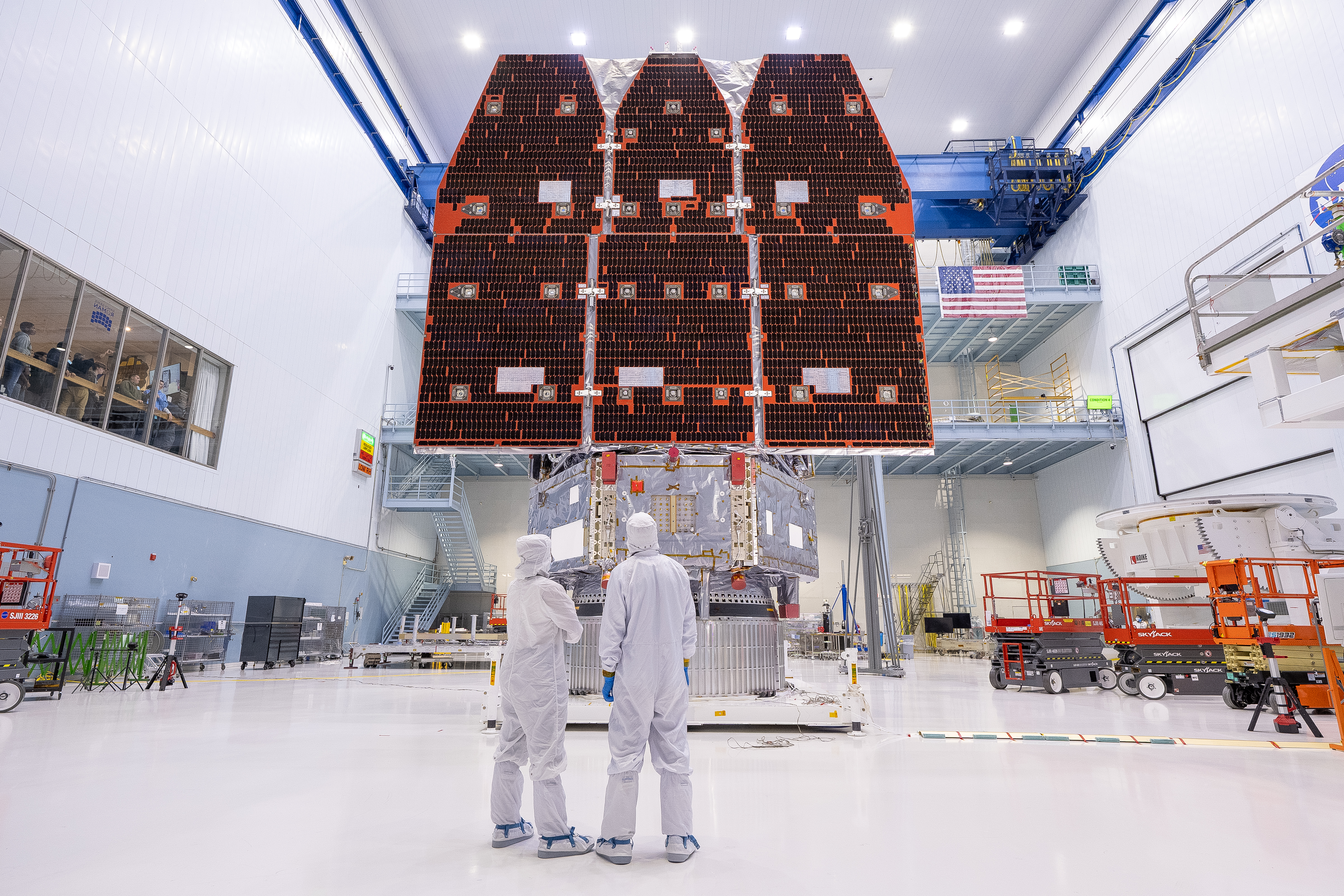
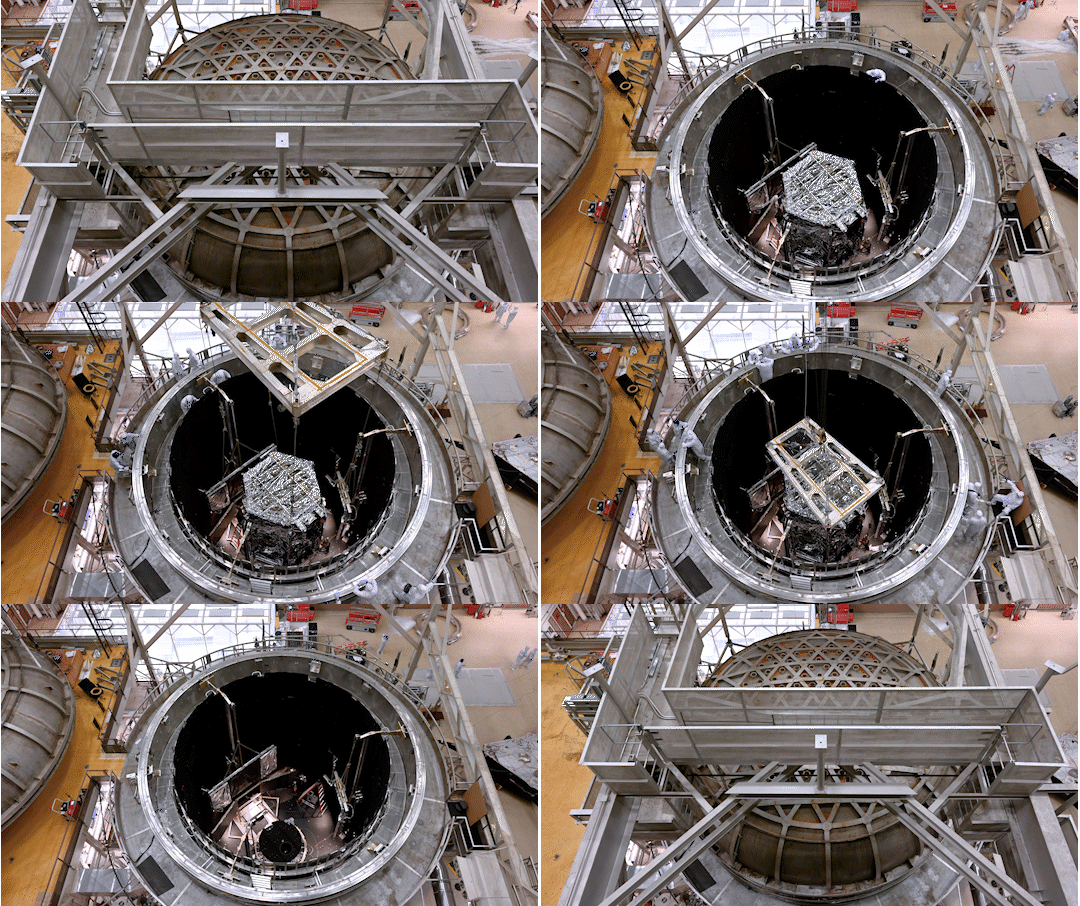
A few weeks ago, technicians inside a cavernous clean room in Maryland made the final connection to complete assembly of NASA’s Nancy Grace Roman Space Telescope.
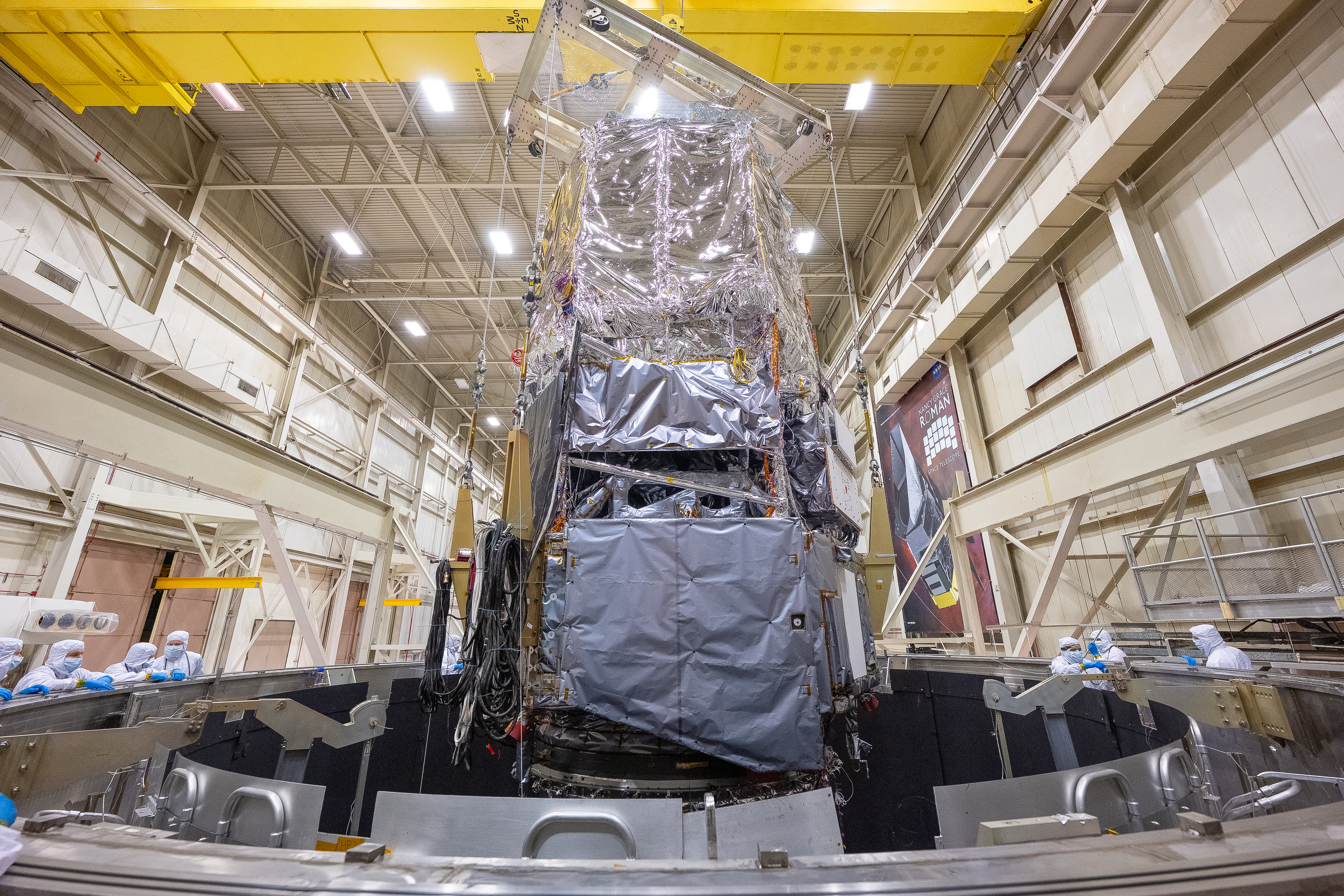
Parts of this new observatory, named for NASA’s first chief astronomer, recently completed a spate of tests to ensure it can survive the shaking and intense sound of a rocket launch. Engineers placed the core of the telescope inside a thermal vacuum chamber, where it withstood the airless conditions and extreme temperature swings it will see in space.
Then, on November 25, teams at NASA’s Goddard Space Flight Center in Greenbelt, Maryland, joined the inner and outer portions of the Roman Space Telescope. With this milestone, NASA declared the observatory complete and on track for launch as soon as fall 2026.
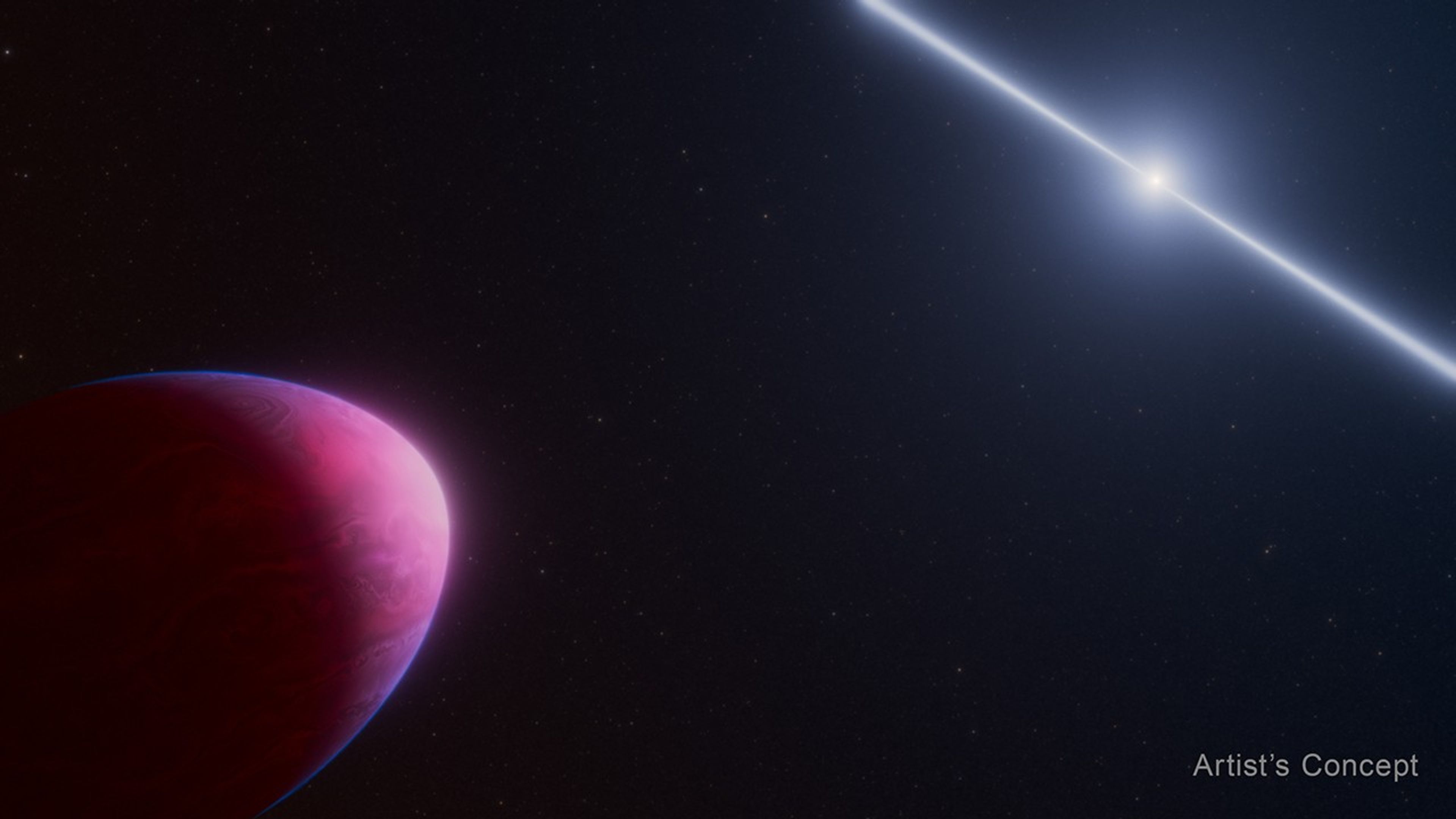
This artist’s concept shows what the exoplanet called PSR J2322-2650b (left) may look like as it orbits a rapidly spinning neutron star called a pulsar (right).
Credits: Illustration: NASA, ESA, CSA, Ralf Crawford (STScI)
Scientists using NASA’s James Webb Space Telescope have observed a rare type of exoplanet, or planet outside our solar system, whose atmospheric composition challenges our understanding of how it formed.
Officially named PSR J2322-2650b, this Jupiter-mass object appears to have an exotic helium-and-carbon-dominated atmosphere unlike any ever seen before. Soot clouds likely float through the air, and deep within the planet, these carbon clouds can condense and form diamonds. How the planet came to be is a mystery. The paper appears Tuesday in The Astrophysical Journal Letters.
“This was an absolute surprise,” said study co-author Peter Gao of the Carnegie Earth and Planets Laboratory in Washington. “I remember after we got the data down, our collective reaction was ‘What the heck is this?’ It’s extremely different from what we expected.”
Image A: Exoplanet PSR J2322-2650b and Pulsar (Artist’s Concept)
This artist’s concept shows what the exoplanet called PSR J2322-2650b (left) may look like as it orbits a rapidly spinning neutron star called a pulsar (right). Gravitational forces from the much heavier pulsar are pulling the Jupiter-mass world into a bizarre lemon shape.
Illustration: NASA, ESA, CSA, Ralf Crawford (STScI)
This planet-mass object was known to orbit a pulsar, a rapidly spinning neutron star. A pulsar emits beams of electromagnetic radiation at regular intervals typically ranging from milliseconds to seconds. These pulsing beams can only be seen when they are pointing directly toward Earth, much like beams from a lighthouse.
This millisecond pulsar is expected to be emitting mostly gamma rays and other high energy particles, which are invisible to Webb’s infrared vision. Without a bright star in the way, scientists can study the planet in intricate detail across its whole orbit.
“This system is unique because we are able to view the planet illuminated by its host star, but not see the host star at all,” said Maya Beleznay, a third-year PhD candidate at Stanford University in California who worked on modeling the shape of the planet and the geometry of its orbit. “So we get a really pristine spectrum. And we can study this system in more detail than normal exoplanets.”
“The planet orbits a star that’s completely bizarre — the mass of the Sun, but the size of a city,” said the University of Chicago’s Michael Zhang, the principal investigator on this study. “This is a new type of planet atmosphere that nobody has ever seen before. Instead of finding the normal molecules we expect to see on an exoplanet — like water, methane, and carbon dioxide — we saw molecular carbon, specifically C3 and C2.”
Molecular carbon is very unusual because at these temperatures, if there are any other types of atoms in the atmosphere, carbon will bind to them. (Temperatures on the planet range from 1,200 degrees Fahrenheit at the coldest points of the night side to 3,700 degrees Fahrenheit at the hottest points of the day side.) Molecular carbon is only dominant if there’s almost no oxygen or nitrogen. Out of the approximately 150 planets that astronomers have studied inside and outside the solar system, no others have any detectable molecular carbon.
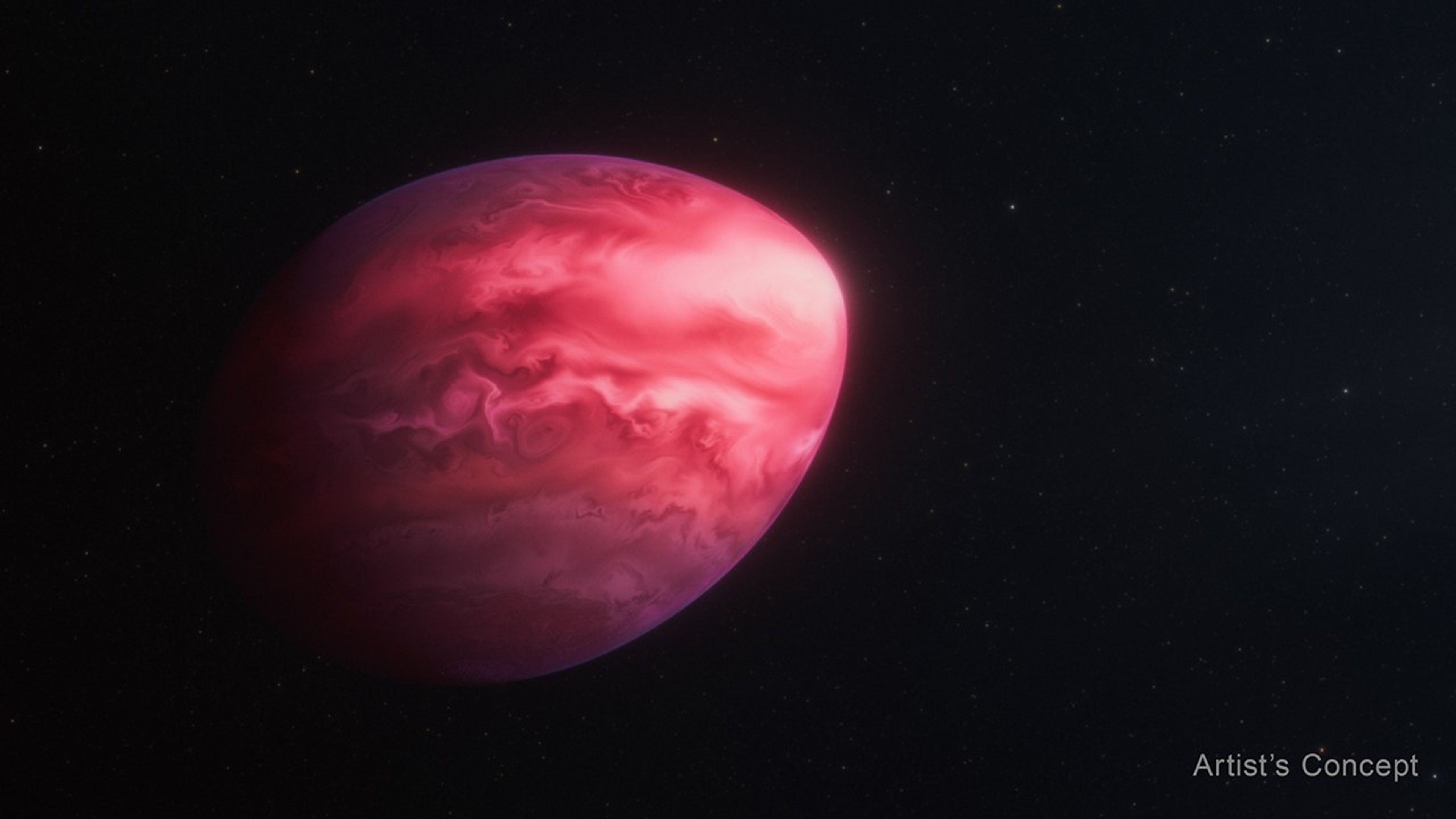
PSR J2322-2650b is extraordinarily close to its star, just 1 million miles away. In contrast, Earth’s distance from the Sun is about 100 million miles. Because of its extremely tight orbit, the exoplanet’s entire year — the time it takes to go around its star — is just 7.8 hours. Gravitational forces from the much heavier pulsar are pulling the Jupiter-mass planet into a bizarre lemon shape.
Image B: Exoplanet PSR J2322-2650b (Artist’s Concept)
This artist’s concept shows what the exoplanet PSR J2322-2650b may look like. Gravitational forces from the much heavier pulsar it orbits are pulling the Jupiter-mass world into this bizarre lemon shape.
Illustration: NASA, ESA, CSA, Ralf Crawford (STScI)
Together, the star and exoplanet may be considered a “black widow” system, though not a typical example. Black widow systems are a rare type of double system where a rapidly spinning pulsar is paired with a small, low-mass stellar companion. In the past, material from the companion streamed onto the pulsar, causing the pulsar to spin faster over time, which powers a strong wind. That wind and radiation then bombard and evaporate the smaller and less massive companion. Like the spider for which it is named, the pulsar slowly consumes its unfortunate partner.
But in this case, the companion is officially considered an exoplanet, not a star. The International Astronomical Union defines an exoplanet as a celestial body below 13 Jupiter masses that orbits a star, brown dwarf, or stellar remnant, such as a pulsar.
Of the 6,000 known exoplanets, this is the only one reminiscent of a gas giant (with mass, radius, and temperature similar to a hot Jupiter) orbiting a pulsar. Only a handful of pulsars are known to have planets.
“Did this thing form like a normal planet? No, because the composition is entirely different,” said Zhang. “Did it form by stripping the outside of a star, like ‘normal’ black widow systems are formed? Probably not, because nuclear physics does not make pure carbon. It’s very hard to imagine how you get this extremely carbon-enriched composition. It seems to rule out every known formation mechanism.”
Study co-author Roger Romani, of Stanford University and the Kavli Institute for Particle Astrophysics and Cosmology Institute, proposes one evocative phenomenon that could occur in the unique atmosphere. “As the companion cools down, the mixture of carbon and oxygen in the interior starts to crystallize,” said Romani. “Pure carbon crystals float to the top and get mixed into the helium, and that’s what we see. But then something has to happen to keep the oxygen and nitrogen away. And that’s where the mystery come in.
“But it’s nice to not know everything,” said Romani. “I’m looking forward to learning more about the weirdness of this atmosphere. It’s great to have a puzzle to go after.”
Video A: Exoplanet PSR J2322-2650b and Pulsar (Artist’s Concept)
This animation shows an exotic exoplanet orbiting a distant pulsar, or rapidly rotating neutron star with radio pulses. The planet, which orbits about 1 million miles away from the pulsar, is stretched into a lemon shape by the pulsar’s strong gravitational tides.
Animation: NASA, ESA, CSA, Ralf Crawford (STScI)
With its infrared vision and exquisite sensitivity, this is a discovery only the Webb telescope could make. Its perch a million miles from Earth and its huge sunshield keep the instruments very cold, which is necessary for these observations. It is not possible to conduct this study from the ground.
The James Webb Space Telescope is the world’s premier space science observatory. Webb is solving mysteries in our solar system, looking beyond to distant worlds around other stars, and probing the mysterious structures and origins of our universe and our place in it. Webb is an international program led by NASA with its partners, ESA (European Space Agency) and CSA (Canadian Space Agency).
The following sections contain links to download this article’s images and videos in all available resolutions followed by related information links, media contacts, and if available, research paper and spanish translation links.
Related Images & Videos
Exoplanet PSR J2322-2650b and Pulsar (Artist’s Concept)
This artist’s concept shows what the exoplanet called PSR J2322-2650b (left) may look like as it orbits a rapidly spinning neutron star called a pulsar (right). Gravitational forces from the much heavier pulsar are pulling the Jupiter-mass world into a bizarre lemon shape.
Exoplanet PSR J2322-2650b (Artist’s Concept)
This artist’s concept shows what the exoplanet PSR J2322-2650b may look like. Gravitational forces from the much heavier pulsar it orbits are pulling the Jupiter-mass world into this bizarre lemon shape.
Exoplanet PSR J2322-2650b Orbiting a Pulsar
This animation shows an exotic exoplanet orbiting a distant pulsar, or rapidly rotating neutron star with radio pulses. The planet, which orbits about 1 million miles away from the pulsar, is stretched into a lemon shape by the pulsar’s strong gravitational tides. NASA&rsqu…
NASA’s Carruthers Geocorona Observatory has captured its first images from space, revealing rare views of Earth and the Moon in ultraviolet light. Taken on Nov. 17 — still months before the mission’s science phase begins — these “first light” images confirm the spacecraft is healthy while hinting at the incredible views to come.
The initial images consist of two from Carruthers’ Wide Field Imager and two from its Narrow Field Imager. Each imager captured two different views: one showing a broad spectrum of far ultraviolet light, and one revealing light from Earth’s geocorona.
These four images constitute the “first light” for the Carruthers Geocorona Observatory mission. The images were taken on Nov. 17, 2025, from a location near the Sun-Earth Lagrange point 1 by the spacecraft’s Wide Field Imager (left column) and Narrow Field Imager (right column) in far ultraviolet light (top row) and the specific wavelength of light emitted by atomic hydrogen known as Lyman-alpha (bottom row). Earth is the larger, bright circle near the middle of each image; the Moon is the smaller circle below and to the left of it. The fuzzy “halo” around Earth in the images in the bottom row is the geocorona: the ultraviolet light emitted by Earth’s exosphere, or outermost atmospheric layer. The lunar surface still shines in Lyman-alpha because its rocky surface reflects all wavelengths of sunlight — one reason it is important to compare Lyman-alpha images with the broad ultraviolet filter. The far ultraviolet light imagery from the Narrow Field Imagery also captured two background stars, whose surface temperatures must be approximately twice as hot as the our Sun’s to be so bright in this wavelength of light.
NASA/Carruthers Geocorona Observatory
When Carruthers captured these images, the Moon was also in its field of view and slightly closer to the spacecraft than Earth was, making the Moon appear larger and closer to Earth than usual.
The specific wavelength Carruthers observed in two of the images, called Lyman-alpha, is light emitted by atomic hydrogen. The faint glow of Lyman-alpha from hydrogen in Earth’s outer atmosphere is called the “geocorona,” Latin for “Earth crown.”
In the broad-spectrum images, the Moon and Earth look similar: both are spheres with well-defined edges. However, in the Lyman-alpha filter, the Moon still appears as a crisp, sharp sphere while Earth appears surrounded by a bright “fuzz” extending out to space. This glow is the geocorona, the primary focus of the Carruthers mission. It is the only way to “see” Earth’s outermost atmospheric layer, although the light of the geocorona has only been photographed a handful of times in history. Carruthers will be the first mission to image it repeatedly, and from far enough away to see its great extent and discover how it changes over time.
These first images also offer a rare treat: sunlight reflected off the far side of the Moon, a view impossible to capture from Earth.
Original
Annotated
Original
Annotated
Carruthers Geocorona ObservatorY
A View of Earth’s Geocorona
Narrow Field Imager/Lyman-alpha filter
This view of the Earth, Moon, and Earth’s geocorona was captured by the Carruthers Geocorona Observatory’s Narrow Field Imager on Nov. 17, 2025. Move the slider to switch between the original version and one with overlaid annotations. In the annotated version, labels for Earth, the Moon, and Earth’s geocorona are overlaid on the image. The circle around Earth represents Earth’s surface, and the arc around Earth’s middle represents the orientation of Earth’s equator. The arrow pointing up and slightly to the left from Earth represents Earth’s rotational axis. The arrow pointing out to the right from Earth represents the direction to the Sun. The color scale indicates brightness, with brighter light appearing more yellow and dimmer light appearing more blue. The ‘glow’ that extends beyond Earth’s surface and out into space is Earth’s geocorona, which is emitted by hydrogen atoms in Earth’s exosphere in a wavelength of ultraviolet light known as Lyman-alpha.
These initial images were taken with short, five-minute exposures — just long enough to confirm that the instrument is performing well. During the main science phase, Carruthers will take 30-minute exposures, allowing it to reveal even fainter details of the geocorona and trace how Earth’s outer atmosphere responds to the changing Sun.
Carruthers launched on Sept. 24 and is just a few weeks from completing its journey to the Sun-Earth Lagrange point 1, a point of gravitational balance roughly 1 million miles closer to the Sun than Earth is. Carruthers will begin its primary science phase in March 2026, when it will begin sending back a steady stream of ultraviolet portraits of our planet’s ever-shifting outer atmosphere.
By Miles Hatfield NASA’s Goddard Space Flight Center, Greenbelt, Md.
NASA’s IMAP Mission Captures ‘First Light,’ Looks Back at Earth
All 10 instruments aboard NASA’s newly launched IMAP (Interstellar Mapping and Acceleration Probe) mission have successfully recorded their first measurements in space. With these “first light” observations, the spacecraft is now collecting preliminary science data as it journeys to its observational post at Lagrange point 1 (L1), about 1 million miles from Earth toward the Sun.
“We are extremely pleased with the initial in-flight performance of the IMAP mission. All instruments have successfully powered on and our commissioning remains on track. We have already collected useful data including exercising our near-real-time space weather data stream,” said Brad Williams, IMAP program executive at NASA Headquarters in Washington. “This successful milestone is quickly setting the stage for the start of our primary science operations.”
As a modern-day celestial cartographer, IMAP will chart the boundaries of the heliosphere — a huge bubble created by the Sun’s wind that encapsulates our entire solar system — and study how the heliosphere interacts with the local galactic neighborhood beyond.
To map the heliosphere’s boundaries, IMAP is equipped with three instruments that measure energetic neutral atoms: IMAP-Lo, IMAP-Hi, and IMAP-Ultra. These uncharged particles, called ENAs for short, are cosmic messengers formed at the heliosphere’s edge that allow scientists to study the boundary region and its variability from afar.
These partial maps of the heliosphere’s boundaries were compiled from first-light data from the IMAP-Hi, IMAP-Lo, and IMAP-Ultra instruments. These initial looks offer a first glimpse at the detail NASA’s IMAP (Interstellar Mapping and Acceleration Probe) will be able to capture. The warmer colors show regions with more energetic neutral atoms (ENAs).
NASA
“It’s just astounding that within the first couple weeks of observations, we see such clear and consistent ENA data across the factor of 10,000 in energy covered collectively by the three imagers,” said David McComas, Princeton University professor and principal investigator for the IMAP mission. “This, plus excellent first light data from all seven of the other instruments, makes for a 10 out of 10, A-plus start to the mission.”
As IMAP travelled away from Earth, the IMAP-Ultra instrument looked back at the planet and picked up ENAs created by Earth’s magnetic environment. These terrestrially made ENAs, which overwhelm ENAs coming from the heliosphere in sheer numbers, is a reason why IMAP will be stationed at L1. There the spacecraft will have an unobstructed view of ENAs coming from the heliosphere’s boundaries.
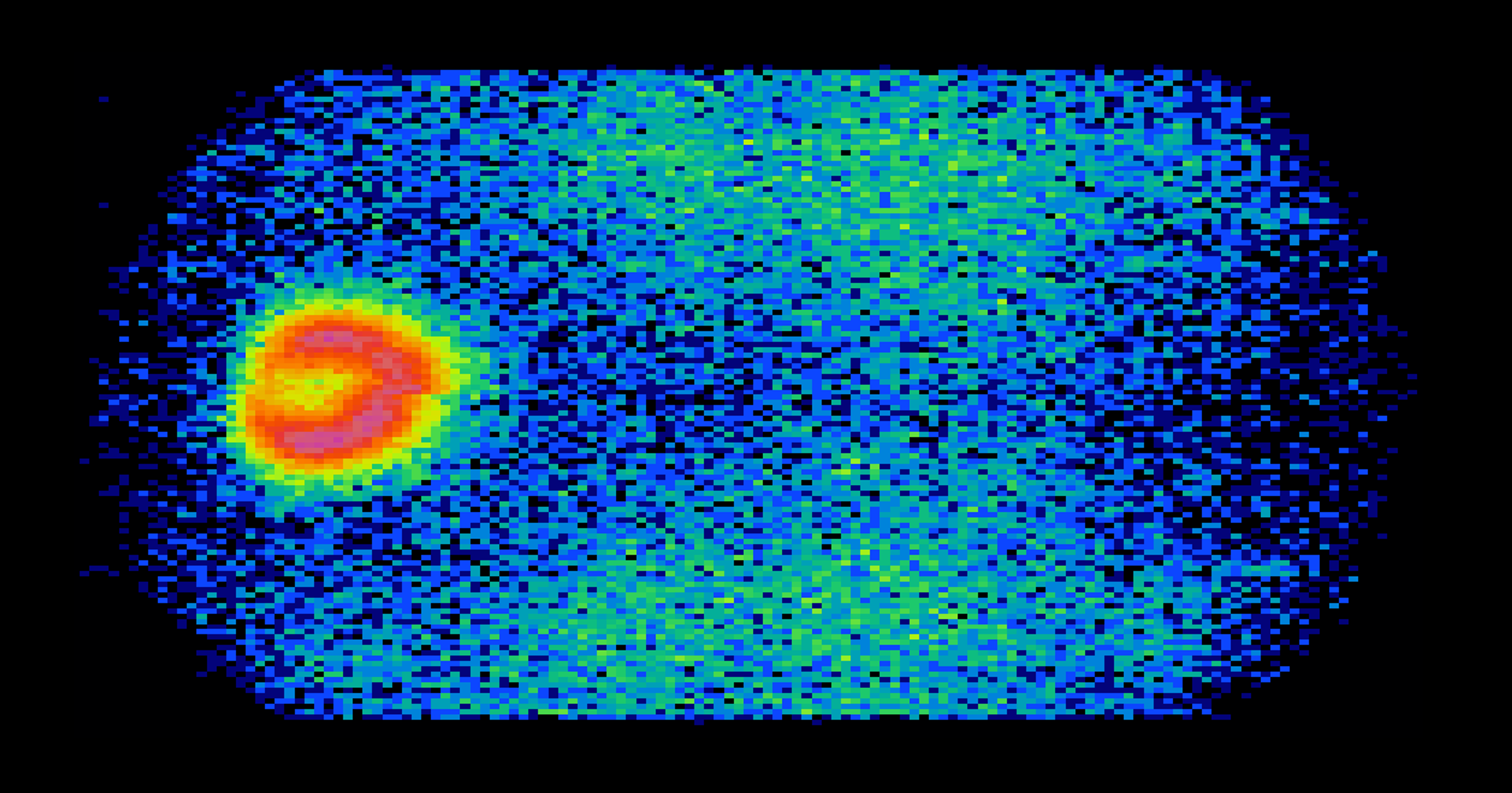
Earth’s magnetic environment can be seen glowing bright in this image taken by the IMAP-Ultra instrument, which includes ENA data as well as noise. Earth sits at the center of the red donut-shaped structure. This image was taken as IMAP left Earth for its post at Lagrange point 1.
NASA
The mission will also study the solar wind, a continuous flow of charged particles coming from the Sun. Solar wind observations from five of IMAP’s instruments will be used by the IMAP Active Link for Real-Time (I-ALiRT) system to provide roughly a half hour’s warning to voyaging astronauts and spacecraft near Earth about harmful space weather and radiation coming their way. The IMAP instruments are already making near-real-time solar wind measurements that can be used to support space weather forecasts. The I-ALiRT network is being exercised and will be ready for space weather forecasters when IMAP starts its regular science mission at L1.
With all of IMAP’s instruments up and running, the mission has nearly completed its commissioning stage and will arrive at L1 in early January. The mission is now working to complete the final commissioning steps and instrument calibration with the goal of being ready to take operational science data starting Saturday, Feb. 1, 2026.
Here’s a look at IMAP’s instruments and what they’ve seen in their first-light observations.
IMAP-Lo, IMAP-Hi, and IMAP-Ultra
The three ENA (energetic neutral atom) instruments, IMAP-Lo, IMAP-Hi, and IMAP-Ultra, will help construct maps of the boundaries of the heliosphere, which will advance our understanding of how the solar wind interacts with our local galaxy. The green streak in this image from IMAP-Hi shows the instrument’s ability to separate ENAs from other particles such as cosmic rays (green and yellow blob).
NASA
MAG
The magnetometer instrument measures magnetic fields from the Sun that stretch across the solar system. Its first-light data clearly shows dynamic changes in the solar wind’s magnetic field due to a shockwave created by the solar wind (squiggles at right).
NASA
SWAPI
The Solar Wind and Pickup Ions (SWAPI) instrument measures ions from the solar wind and charged particles from beyond the solar system. Initial data from SWAPI showed a change in the composition of the solar wind over one day. This image shows particles from a coronal mass ejection on Nov. 11 and 12, 2025.
NASA
CoDICE
The Compact Dual Ion Composition Experiment (CoDICE) instrument measures ions from the solar wind and charged particles from beyond the solar system. It detected different types of oxygen, hydrogen, and helium atoms in its first-light data.
NASA
HIT
The High-energy Ion Telescope (HIT) measures energetic ions and electrons from the Sun. Early ion data shows the common elements up through iron.
NASA
GLOWS
Unlike other IMAP instruments that study particles, the GLObal Solar Wind Structure (GLOWS) instrument images ultraviolet light called the helioglow that is created in part by the solar wind. The first data taken with GLOWS showed helioglow and bright stars, matching scientists’ expectations for the instrument. Unexpectedly, the signature of comet C/2025 K1 (ATLAS), shown by the first small bump from the left in the image, was also seen before it disappeared from GLOWS’ view.
NASA
SWE
As its name suggests, the Solar Wind Electron (SWE) instrument measures electrons from the solar wind. In its first data collection, SWE successfully captured electrons at a range of energy levels. On Nov. 12, a solar storm passed through the solar system and SWE captured the resulting spike in the number of electrons at each energy level.
NASA
IDEX
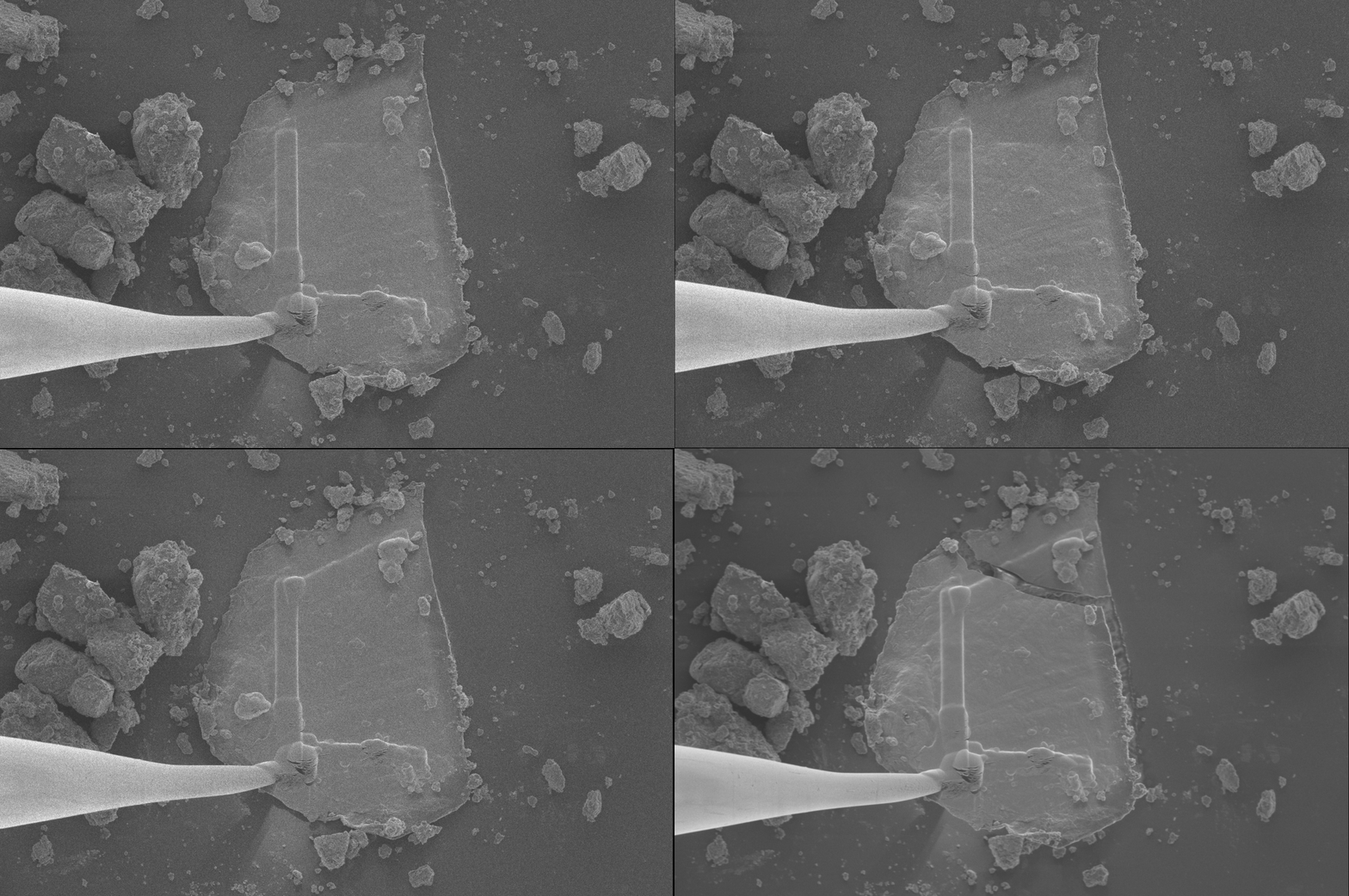
The Interstellar Dust Experiment (IDEX) measures cosmic dust — conglomerations of particles originating outside of the solar system that are smaller than a grain of sand. Prior to IMAP, few of these dust particles had been measured. With two new detections already completed, IDEX has demonstrated its ability to become an unrivaled dust detector. This observation of one of the dust particles shows tentative identifications of the particle’s chemical composition, which includes carbon, oxygen, magnesium, silicon, and hydrogen sulfide.
NASA
By Mara Johnson-Groh NASA’s Goddard Space Flight Center, Greenbelt, Md.
Our universe is filled with galaxies, in all directions as far as our instruments can see. Some researchers estimate that there are as many as two trillion galaxies in the observable universe. At first glance, these galaxies might appear to be randomly scattered across space, but they’re not. Careful mapping has shown that they are distributed across the surfaces of giant cosmic “bubbles” up to several hundred million light-years across. Inside these bubbles, few galaxies are found, so those regions are called cosmic voids. NASA’s Nancy Grace Roman Space Telescope will allow us to measure these voids with new precision, which can tell us about the history of the universe’s expansion.
This narrated video sequence illustrates how NASA's Nancy Grace Roman Space Telescope will be able to observe cosmic voids in the universe. These highly detailed measurements will help constrain cosmological models.
Credit: Video: NASA, STScI; Visualization: Frank Summers (STScI); Script Writer: Frank Summers (STScI); Narration: Frank Summers (STScI); Audio: Danielle Kirshenblat (STScI); Science: Giulia Degni (Roma Tre University), Alice Pisani (CPPM), Giovanni Verza (Center for Computational Astrophysics/Flatiron Inst.)
“Roman’s ability to observe wide areas of the sky to great depths, spotting an abundance of faint and distant galaxies, will revolutionize the study of cosmic voids,” said Giovanni Verza of the Flatiron Institute and New York University, lead author on a paper published in The Astrophysical Journal.
Cosmic Recipe
The cosmos is made of three key components: normal matter, dark matter, and dark energy. The gravity of normal and dark matter tries to slow the expansion of the universe, while dark energy opposes gravity to speed up the universe’s expansion. The nature of both dark matter and dark energy are currently unknown. Scientists are trying to understand them by studying their effects on things we can observe, such as the distribution of galaxies across space.
“Since they’re relatively empty of matter, voids are regions of space that are dominated by dark energy. By studying voids, we should be able to put powerful constraints on the nature of dark energy,” said co-author Alice Pisani of CNRS (the French National Centre for Scientific Research) in France and Princeton University in New Jersey.
To determine how Roman might study voids, the researchers considered one potential design of the Roman High-Latitude Wide-Area Survey, one of three core community surveys that Roman will conduct. The High-Latitude Wide-Area Survey will look away from the plane of our galaxy (hence the term high latitude in galactic coordinates). The team found that this survey should be able to detect and measure tens of thousands of cosmic voids, some as small as just 20 million light-years across. Such large numbers of voids will allow scientists to use statistical methods to determine how their observed shapes are influenced by the key components of the universe.
To determine the actual, 3D shapes of the voids, astronomers will use two types of data from Roman — the positions of galaxies in the sky and their cosmological redshift, the latter of which is determined using spectroscopic data. To convert redshift to a physical distance, astronomers make assumptions about the components of the universe, including the strength of dark energy and how it might have evolved over time.
Pisani compared it to trying to infer a cake recipe (i.e., the universe’s makeup) from the final dessert served to you. “You try to put in the right ingredients — the right amount of matter, the right amount of dark energy — and then you check whether your cake looks as it should. If it doesn’t, that means you put in the wrong ingredients.”
In this case, the appearance of the “cake” is the shape found by statistically stacking all of the voids detected by Roman on top of each other. On average, voids are expected to have a spherical shape because there is no “preferred” location or direction in the universe (i.e., the universe is both homogeneous and isotropic on large scales). This means that, if the stacking is done correctly, the resulting shape will be perfectly round (or spherically symmetric). If not, then you have to adjust your cosmic recipe.
Power of Roman
The researchers emphasized that to study cosmic voids in large numbers, an observatory must be able to probe a large volume of the universe, because the voids themselves can be tens or hundreds of millions of light-years across. The spectroscopic data necessary to study voids will come from a portion of the Roman High-Latitude Wide-Area Survey that will cover on the order of 2,400 square degrees of the sky, or 12,000 full moons. It will also be able to see fainter and more distant objects, yielding a greater density of galaxies than complementary missions like ESA’s (European Space Agency’s) Euclid.
“Voids are defined by the fact that they contain so few galaxies. So to detect voids, you have to be able to observe galaxies that are quite sparse and faint. With Roman, we can better look at the galaxies that populate voids, which ultimately will give us greater understanding of the cosmological parameters like dark energy that are sculpting voids,” said co-author Giulia Degni of Roma Tre University and INFN (the National Institute of Nuclear Physics) in Rome.
The Nancy Grace Roman Space Telescope is managed at NASA’s Goddard Space Flight Center in Greenbelt, Maryland, with participation by NASA’s Jet Propulsion Laboratory in Southern California; Caltech/IPAC in Pasadena, California; the Space Telescope Science Institute in Baltimore; and a science team comprising scientists from various research institutions. The primary industrial partners are BAE Systems, Inc. in Boulder, Colorado; L3Harris Technologies in Melbourne, Florida; and Teledyne Scientific & Imaging in Thousand Oaks, California.
By Christine Pulliam Space Telescope Science Institute, Baltimore, Md. cpulliam@stsci.edu
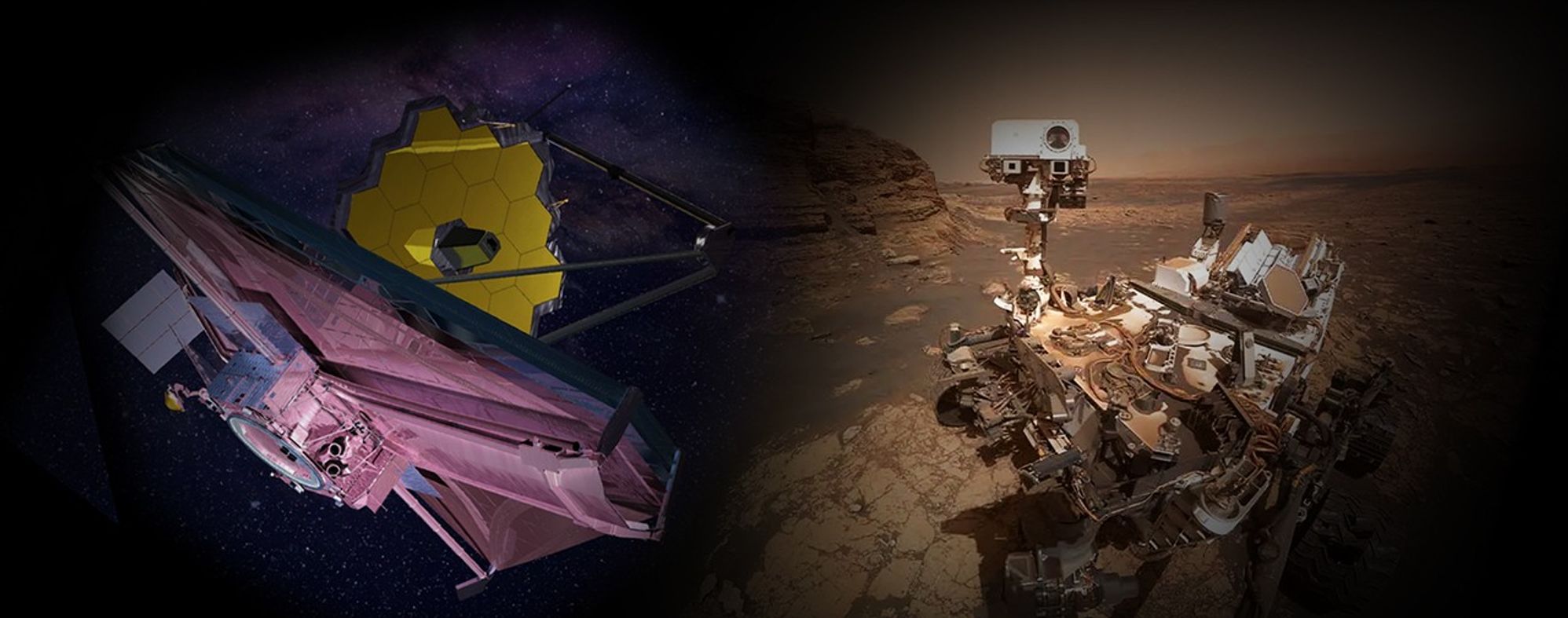
NASA’s James Webb Space Telescope and NASA’s Curiosity rover, have earned places in TIME’s “Best Inventions Hall of Fame”.
NASA GSFC, NASA JPL
Two icons of discovery, NASA’s James Webb Space Telescope and NASA’s Curiosity rover, have earned places in TIME’s “Best Inventions Hall of Fame,” which recognizes the 25 groundbreaking inventions of the past quarter century that have had the most global impact, since TIME began its annual Best Inventions list in 2000. The inventions are celebrated in TIME’s December print issue.
“NASA does the impossible every day, and it starts with the visionary science that propels humanity farther than ever before,” said Nicky Fox, associate administrator, Science Mission Directorate, NASA Headquarters in Washington. “Congratulations to the teams who made the world’s great engineering feats, the James Webb Space Telescope and the Mars Curiosity Rover, a reality. Through their work, distant galaxies feel closer, and the red sands of Mars are more familiar, as they expanded and redefined the bounds of human achievement in the cosmos for the benefit of all.”
Decades in the making and operating a million miles from Earth, Webb is the most powerful space telescope ever built, giving humanity breathtaking views of newborn stars, distant galaxies, and even planets orbiting other stars. The new technologies developed to enable Webb’s science goals – from optics to detectors to thermal control systems – now also touch Americans’ everyday lives, improving manufacturing for everything from high-end cameras and contact lenses to advanced semiconductors and inspections of aircraft engine components.
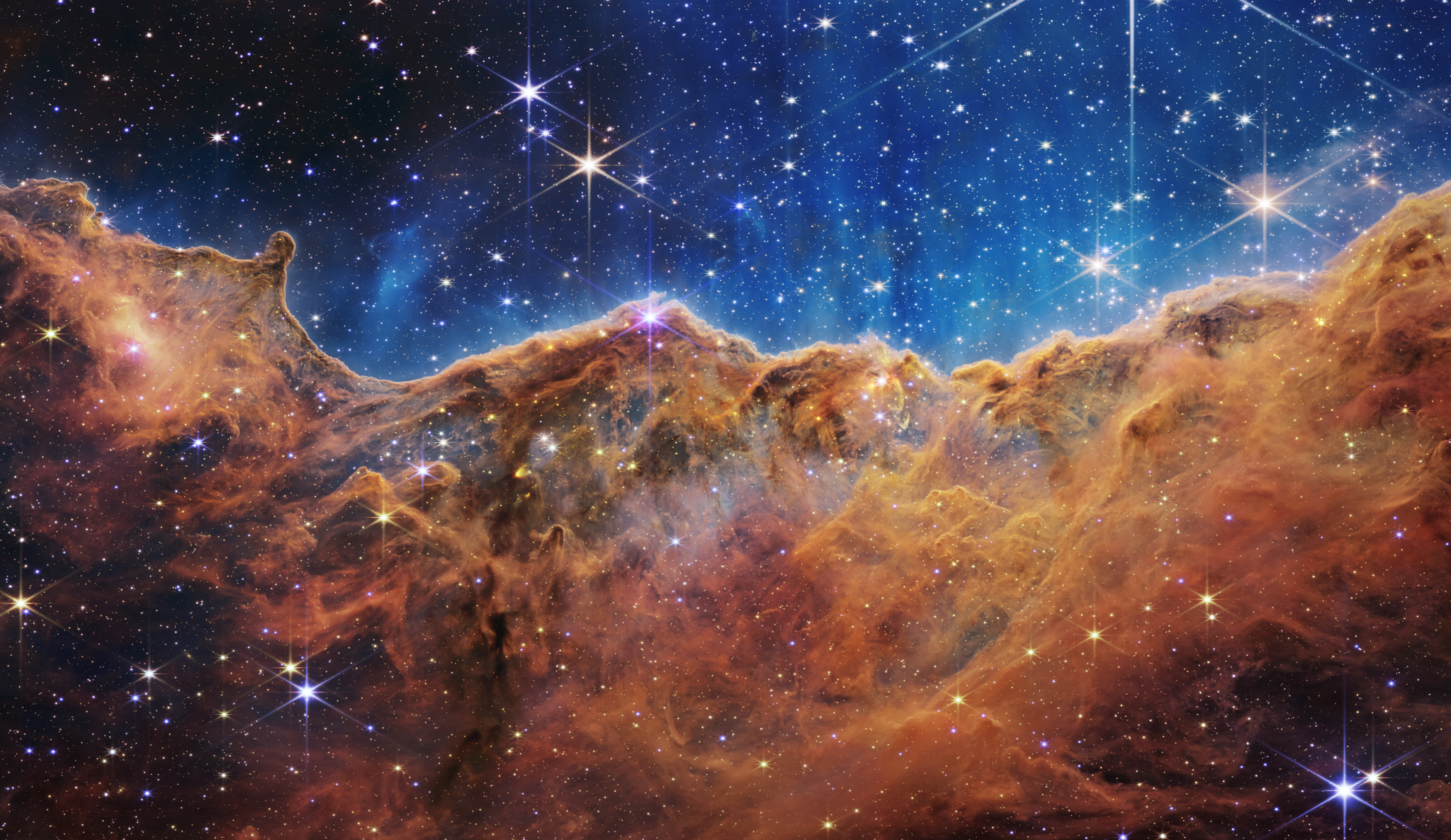
This landscape of “mountains” and “valleys” speckled with glittering stars is actually the edge of a nearby, young, star-forming region called NGC 3324 in the Carina Nebula. Captured in infrared light by NASA’s James Webb Space Telescope, this image reveals for the first time previously invisible areas of star birth.
NASA, ESA, CSA, and STScI
Meanwhile on Mars, the unstoppable Curiosity rover, NASA’s car-size science lab, has spent more than a decade uncovering clues that the Red Planet once could have supported life, transforming our understanding of our planetary neighbor. These NASA missions continue to make breakthroughs that have reshaped our understanding of the universe and our place in it. Curiosity has also paved the way for future astronauts: Its Radiation Assessment Detector has studied the Martian radiation environment for nearly 14 years, and its unforgettable landing by robotic jetpack allowed heavier spacecraft to touch down on the surface — a capability that will be needed to send cargo and humans to Mars.
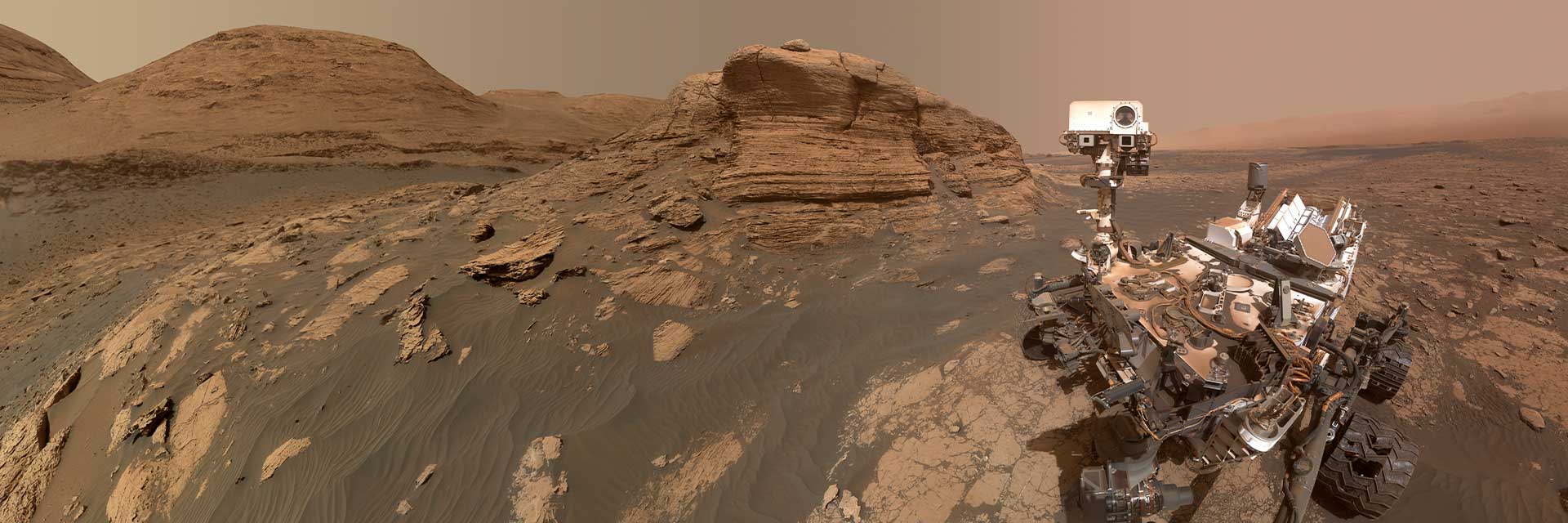
NASA’s Curiosity Mars rover used two different cameras to create this selfie in front of Mont Mercou, a rock outcrop that stands 20 feet (6 meters) tall. The panorama is made up of 60 images taken by the Mars Hand Lens Imager (MAHLI) on the rover’s robotic arm on March 26, 2021, the 3,070th Martian day, or sol, of the mission. These were combined with 11 images taken by the Mastcam on the mast, or “head,” of the rover on March 16, 2021, the 3,060th Martian day of the mission.
NASA/JPL-Caltech/MSSS
To compile this “Hall of Fame” list, TIME solicited nominations from TIME editors and correspondents around the world, paying special attention to high-impact fields, such as health care and technology. TIME then evaluated each contender on a number of key factors, including originality, continued efficacy, ambition, and impact.
The James Webb Space Telescope is the world’s premier space science observatory. Webb is solving mysteries in our solar system, looking beyond to distant worlds around other stars, and probing the mysterious structures and origins of our universe and our place in it. Webb is an international program led by NASA with its partners, ESA (European Space Agency) and CSA (Canadian Space Agency).
The Curiosity rover was built by NASA’s Jet Propulsion Laboratory, which is managed by Caltech in Pasadena, California. JPL leads the mission on behalf of NASA’s Science Mission Directorate in Washington as part of NASA’s Mars Exploration Program portfolio.
To learn more about NASA’s science missions, visit:
NASA’s Nancy Grace Roman Space Telescope team has released detailed plans for a major survey that will reveal our home galaxy, the Milky Way, in unprecedented detail. In one month of observations spread across two years, the survey will unveil tens of billions of stars and explore previously uncharted structures.
This video begins with a view of the Carina Nebula — a giant, relatively nearby star-forming region in the southern sky. Roman will view the entire nebula as well as its surroundings, including a 10,000 light-year-long swath of the spiral arm it resides in. The observation will offer an unparalleled opportunity to watch how stars grow, interact, and sculpt their environments, and it’s just one of many thousands of highlights astronomers are looking forward to from the Galactic Plane Survey NASA’s Nancy Grace Roman Space Telescope will conduct. Credit: NASA’s Goddard Space Flight Center
“The Galactic Plane Survey will revolutionize our understanding of the Milky Way,” said Julie McEnery, Roman’s senior project scientist at NASA’s Goddard Space Flight Center in Greenbelt, Maryland. “We’ll be able to explore the mysterious far side of our galaxy and its star-studded heart. Because of the survey’s breadth and depth, it will be a scientific mother lode.”
The Galactic Plane Survey is Roman’s first selected general astrophysics survey — one of many observation programs Roman will do in addition to its three core surveys and Coronagraph technology demonstration. At least 25% of Roman’s five-year primary mission is reserved for astronomers worldwide to propose more surveys beyond the core programs, fully leveraging Roman’s capabilities to conduct groundbreaking science. Roman is slated to launch by May 2027, but the team is on track for launch as early as fall 2026.
While ESA’s (European Space Agency’s) retired Gaia spacecraft mapped around 2 billion Milky Way stars in visible light, many parts of the galaxy remain hidden by dust. By surveying in infrared light, Roman will use powerful heat vision that can pierce this veil to see what lies beyond.
“It blows my mind that we will be able to see through the densest part of our galaxy and explore it properly for the first time,” said Rachel Street, a senior scientist at Las Cumbres Observatory in Santa Barbara, California, and a co-chair of the committee that selected the Galactic Plane Survey design.
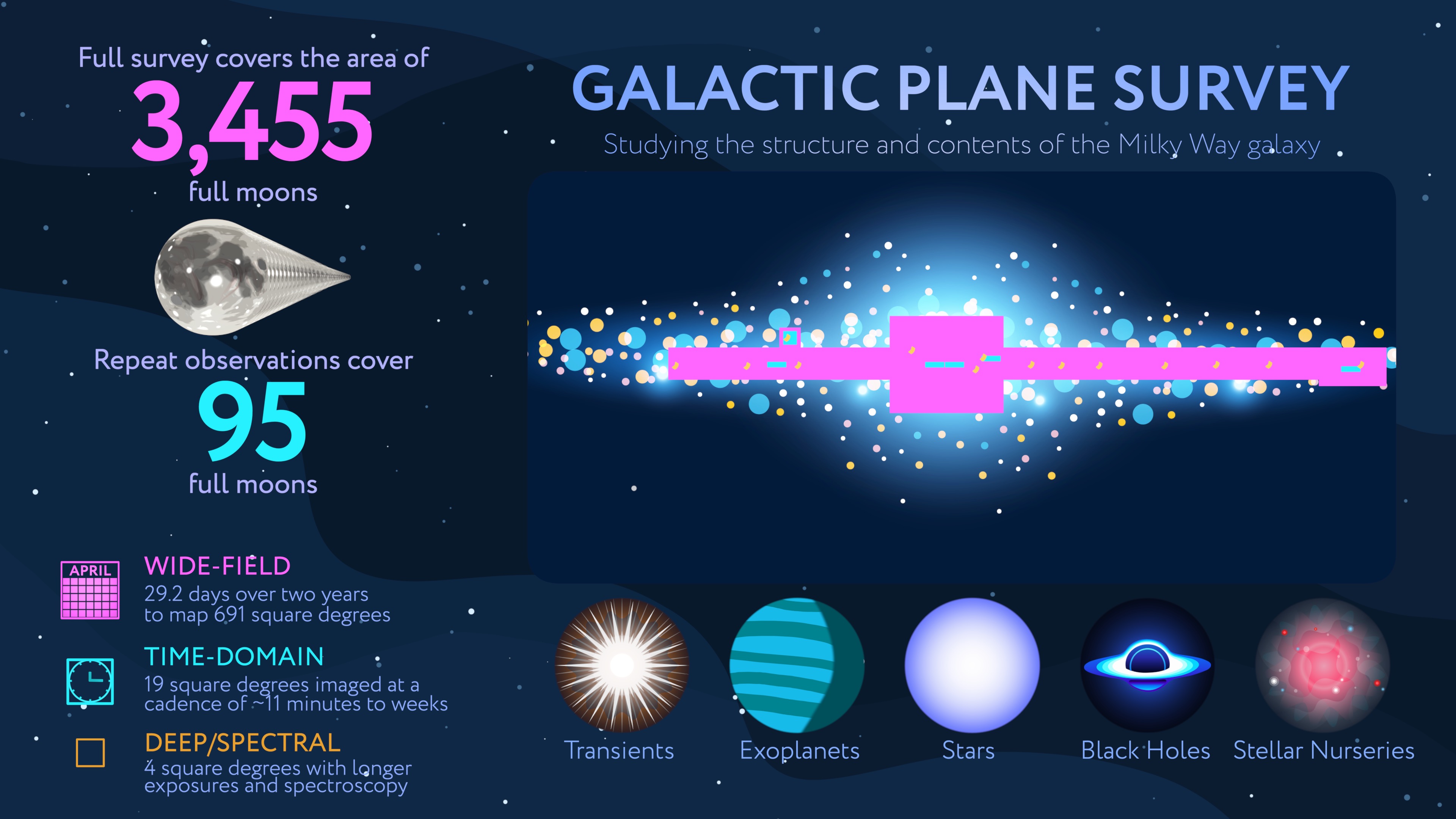
This infographic describes the 29-day Galactic Plane Survey that will be conducted by NASA’s Nancy Grace Roman Space Telescope. The survey’s main component will cover 691 square degrees — a region of sky as large as around 3,500 full moons — in 22.5 days. Roman will also view a smaller area — 19 square degrees, the area of 95 full moons — repeatedly for about 5.5 days total to capture things that change over time. The survey’s final component will image a smattering of even smaller areas, adding up to about 4 square degrees (the area of 20 full moons) and 31 total hours, with Roman’s full suite of filters and spectroscopic tools. The survey will reveal our home galaxy in unprecedented detail including many in regions we’ve never been able to see before because they’re blocked by dust, unveiling tens of billions of stars and other objects.
Credit: NASA’s Goddard Space Flight Center
The survey will cover nearly 700 square degrees (a region of sky as large as about 3,500 full moons) along the glowing band of the Milky Way — our edge-on view of the disk-shaped structure containing most of our galaxy’s stars, gas, and dust. Scientists expect the survey to map up to 20 billion stars and detect tiny shifts in their positions with repeated high-resolution observations. And it will only take 29 days spread over the course of the mission’s first two years.
Cosmic Cradles
Stars are born from parent clouds of gas and dust. Roman will peer through the haze of these nesting grounds to see millions of stellar embryos, newborn stars still swaddled in shrouds of dust, tantrumming toddler stars that flare unpredictably, and young stars that may have planetary systems forming around them. Astronomers will study stellar birth rates across a wide range of masses and stitch together videos that show how stars change over time.
“This survey will study such a huge number of stars in so many different stellar environments that we’ll be sampling every phase of a star’s evolution,” Street said.
Observing so many stars in various stages of early development will shed light on the forces that shape them. Star formation is like a four way tug-of-war between gravity, radiation, magnetism, and turbulence. Roman will help us study how these forces influence whether gas clouds collapse into full-fledged stars, smaller brown dwarfs — in-between objects that are much heavier than planets but not massive enough to ignite like stars — or new worlds.
The Galactic Plane Survey by NASA’s Nancy Grace Roman Space Telescope will scan the densest part of our galaxy, where most of its stars, gas, and dust reside — the most difficult region to study from our place inside the Milky Way since we have to look through so much light-blocking material. Roman’s wide field of view, crisp resolution, and infrared vision will help astronomers peer through thick bands of dust to chart new galactic territory. Credit: NASA’s Goddard Space Flight Center
Some stars are born in enormous litters called clusters. Roman will study nearly 2,000 young, loosely bound open clusters to see how the galaxy’s spiral arms trigger star formation. The survey will also map dozens of ancient, densely packed globular clusters near the center of the galaxy that could help astronomers reconstruct the Milky Way’s early history.
Comparing Roman’s snapshots of clusters scattered throughout the galaxy will enable scientists to study nature versus nurture on a cosmic scale. Because a cluster’s stars generally share the same age, origin, and chemical makeup, analyzing them allows astronomers to isolate environmental effects very precisely.
Pulse Check
When they run out of fuel, Sun-like stars leave behind cores called white dwarfs and heavier stars collapse to form neutron stars and black holes. Roman will find these stellar embers even when they’re alone thanks to wrinkles in space-time.
Anything that has mass warps the underlying fabric of the universe. When light from a background star passes through the gravitational well around an intervening object on its journey toward Earth, its path slightly curves around the object. This phenomenon, called microlensing, can temporarily brighten the star. By studying these signals, astronomers can learn the mass and size of otherwise invisible foreground objects.
A separate survey — Roman’s Galactic Bulge Time-Domain Survey — will conduct deep microlensing observations over a smaller area in the heart of the Milky Way. The Galactic Plane Survey will conduct repeated observations over a shorter interval but across the whole center of the galaxy, giving us the first complete view of this complex galactic environment. An unobscured view of the galaxy’s central bar will help astronomers answer the question of its origin, and Roman’s videos of stars in this region will enable us to study some ultratight binary objects at the very ends of their lives thanks to their interactions with close companions.
“Compact binaries are particularly interesting because they’re precursors to gravitational-wave sources,” said Robert Benjamin, a visiting professor at the University of Wisconsin-Whitewater, and a co-chair of the committee that selected the Galactic Plane Survey design. When neutron stars and black holes merge, the collision is so powerful that it sends ripples through the fabric of space-time. “Scientists want to know more about the pathways that lead to those mergers.”
optical
infrared
This colorful image, taken by the Hubble Space Telescope and published in 2018, celebrated the observatory’s 28th anniversary of viewing the heavens.
This colorful image, taken by the Hubble Space Telescope and published in 2018, celebrated the observatory’s 28th anniversary of viewing the heavens.
optical
infrared
Optical vs infrared
Two Views
The Galactic Plane Survey by NASA’s Nancy Grace Roman Space Telescope will scan the densest part of our galaxy, where most of its stars, gas, and dust reside — the most difficult region to study from our place inside the Milky Way since we have to look through so much light-blocking material. Roman’s wide field of view, crisp resolution, and infrared vision will help astronomers peer through thick bands of dust to chart new galactic territory. Credit: NASA, ESA, and STScI
Roman’s repeated observations will also monitor stars that flicker. Ground-based surveys detect thousands of bright stellar outbursts, but often can’t see the faint, dust-obscured stars that produce them. Roman will pinpoint the culprits plus take high-resolution snapshots of the aftermath.
Some stars throb rhythmically, and the speed of their pulsing is directly linked to their intrinsic brightness. By comparing their true brightness to how bright they appear from Earth, astronomers can measure distances across the galaxy. Roman will find these blinking stars farther away than ever before and track them over time, helping astronomers improve their cosmic measuring sticks.
“Pairing Roman’s Galactic Plane Survey with other Milky Way observations will create the best portrait of the galaxy we’ve ever had,” Benjamin said.
Observatories with smaller views of space have provided exquisite images of other galaxies, revealing complex structures. But studying our own galaxy’s anato...
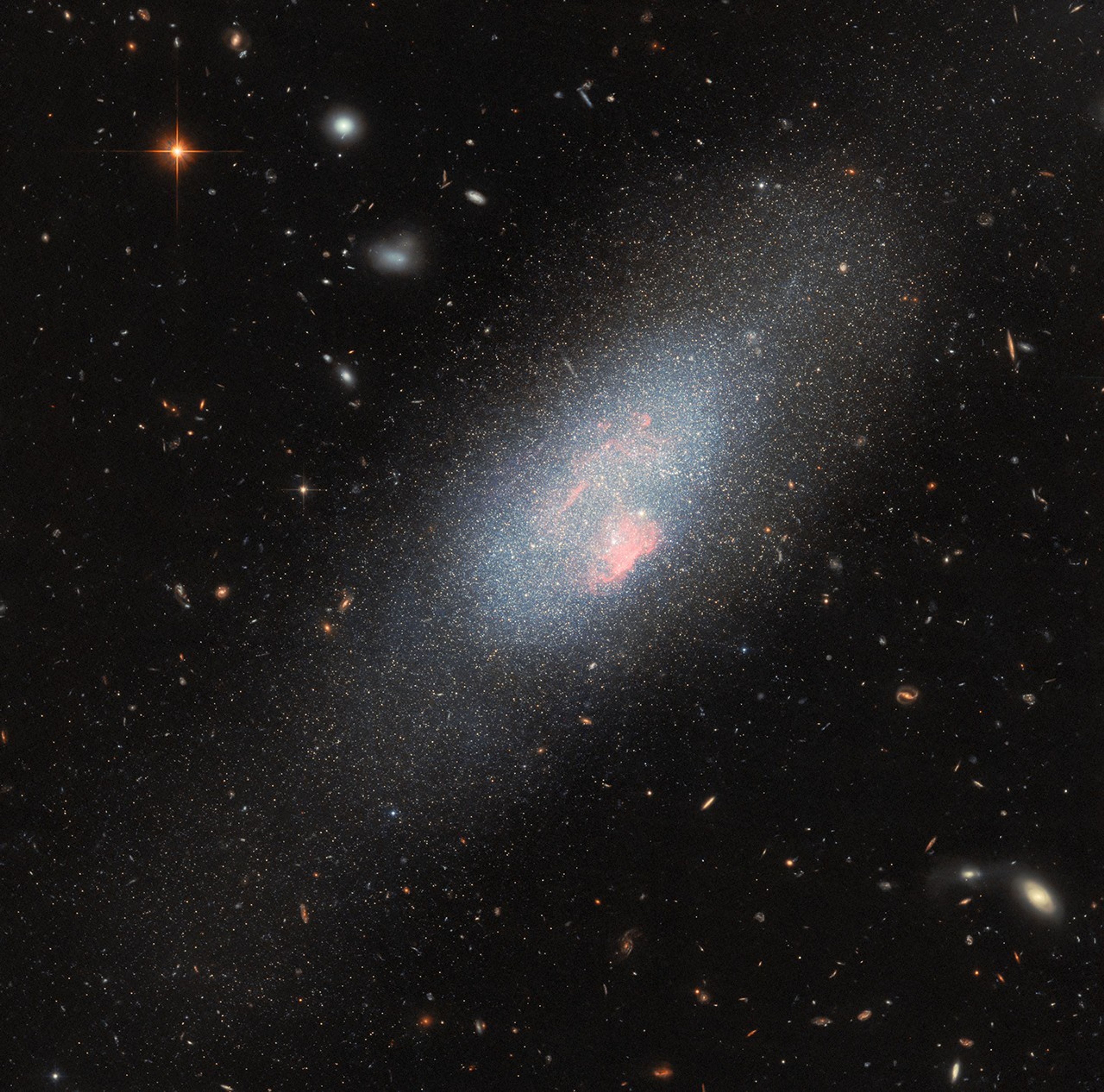
This NASA/ESA Hubble Space Telescope image features the blue dwarf galaxy Markarian 178 (Mrk 178) against a backdrop of distant galaxies in all shapes and sizes. Some of these distant galaxies even shine through the diffuse edges of Mrk 178.
ESA/Hubble & NASA, F. Annibali, S. Hong
This NASA/ESA Hubble Space Telescope image features a glittering blue dwarf galaxy called Markarian 178 (Mrk 178). The galaxy, which is substantially smaller than our own Milky Way, lies 13 million light-years away in the constellation Ursa Major (the Great Bear).
Mrk 178 is one of more than 1,500 Markarian galaxies. These galaxies get their name from the Armenian astrophysicist Benjamin Markarian, who compiled a list of galaxies that were surprisingly bright in ultraviolet light.
While the bulk of the galaxy is blue due to an abundance of young, hot stars with little dust shrouding them, Mrk 178 gets a red hue from a collection of rare massive Wolf–Rayet stars. These stars are concentrated in the brightest, reddish region near the galaxy’s edge. Wolf–Rayet stars cast off their atmospheres through powerful winds, and the bright emission lines from their hot stellar winds are etched upon the galaxy’s spectrum. Both ionized hydrogen and oxygen lines are particularly strong and appear as a red color in this photo.
Massive stars enter the Wolf–Rayet phase of their evolution just before they collapse into black holes or neutron stars. Because Wolf–Rayet stars last for only a few million years, researchers know that something must have triggered a recent burst of star formation in Mrk 178. At first glance, it’s not clear what could be the cause — Mrk 178 doesn’t seem to have any close galactic neighbors that may have stirred up its gas to form new stars. Instead, researchers suspect that a gas cloud crashed into Mrk 178, or that the intergalactic medium disturbed its gas as the galaxy moved through space. Either disturbance could light up this tiny galaxy with a ripple of bright new stars.
NASA’s Parker Solar Probe Spies Solar Wind ‘U-Turn’
Images captured by NASA’s Parker Solar Probe as the spacecraft made its record-breaking closest approach to the Sun in December 2024 have now revealed new details about how solar magnetic fields responsible for space weather escape from the Sun — and how sometimes they don’t.
Like a toddler, our Sun occasionally has disruptive outbursts. But instead of throwing a fit, the Sun spews magnetized material and hazardous high-energy particles that drive space weather as they travel across the solar system. These outbursts can impact our daily lives, from disrupting technologies like GPS to triggering power outages, and they can also imperil voyaging astronauts and spacecraft. Understanding how these solar outbursts, called coronal mass ejections (CMEs), occur and where they are headed is essential to predicting and preparing for their impacts at Earth, the Moon, and Mars.
Images taken by Parker Solar Probe in December 2024, and published Thursday in the Astrophysical Journal Letters, have revealed that not all magnetic material in a CME escapes the Sun — some makes it back, changing the shape of the solar atmosphere in subtle, but significant, ways that can set the course of the next CME exploding from the Sun. These findings have far-reaching implications for understanding how the CME-driven release of magnetic fields affects not only the planets, but the Sun itself.
These images from the Wide-Field Imager for Solar Probe on NASA’s Parker Solar Probe show a phenomenon that occurs in the Sun’s upper atmosphere called an inflow. Inflows are the result of stretched magnetic field lines reconfiguring and causing material trapped along the lines to rain back toward the solar surface.
NASA
“These breathtaking images are some of the closest ever taken to the Sun and they’re expanding what we know about our closest star,” said Joe Westlake, heliophysics division director at NASA Headquarters in Washington. “The insights we gain from these images are an important part of understanding and predicting how space weather moves through the solar system, especially for mission planning that ensures the safety of our Artemis astronauts traveling beyond the protective shield of our atmosphere.”
Parker Solar Probe reveals solar recycling in action
As Parker Solar Probe swept through the Sun’s atmosphere on Dec. 24, 2024, just 3.8 million miles from the solar surface, its Wide-Field Imager for Solar Probe, or WISPR, observed a CME erupt from the Sun. In the CME’s wake, elongated blobs of solar material were seen falling back toward the Sun.
This type of feature, called “inflows”, has previously been seen from a distance by other NASA missions including SOHO (Solar and Heliospheric Observatory, a joint mission with ESA, the European Space Agency) and STEREO (Solar Terrestrial Relations Observatory). But Parker Solar Probe’s extreme close-up view from within the solar atmosphere reveals details of material falling back toward the Sun and on scales never seen before.
“We’ve previously seen hints that material can fall back into the Sun this way, but to see it with this clarity is amazing,” said Nour Rawafi, the project scientist for Parker Solar Probe at the Johns Hopkins Applied Physics Laboratory, which designed, built, and operates the spacecraft in Laurel, Maryland. “This is a really fascinating, eye-opening glimpse into how the Sun continuously recycles its coronal magnetic fields and material.”
Insights on inflows
For the first time, the high-resolution images from Parker Solar Probe allowed scientists to make precise measurements about the inflow process, such as the speed and size of the blobs of material pulled back into the Sun. These previously hidden details provide scientists with new insights into the physical mechanisms that reconfigure the solar atmosphere.
1. The process that creates inflows begins with a solar eruption known as a coronal mass ejection (CME). CMEs are often triggered by twisted magnetic field lines from the Sun that explosively snap and realign in a process called magnetic reconnection. This magnetic explosion kicks out a burst of charged particles and magnetic fields — the CME.
NASA
2.As the CME travels outward from the Sun, the CME expands. Eventually, it pushes through solar magnetic field lines to escape into space.
NASA
3. The magnetic field lines torn open by the CME rejoin to form new magnetic loops that get squeezed together.
NASA
4. In some cases, the compressed magnetic field lines tear apart. This forms separate magnetic loops, some of which travel outward from the Sun and others that connect back to the Sun. As these loops contract back into the Sun, they drag down blobs of nearby solar material — forming inflows.
NASA
The CMEs are often triggered by twisted magnetic field lines that explosively snap and realign in a process called magnetic reconnection. This magnetic explosion kicks out a burst of charged particles and magnetic fields — a CME.
As the CME travels outward from the Sun, it expands, in some cases causing nearby magnetic field lines to tear apart like the threads of an old piece of cloth pulled too tight. The torn magnetic field quickly mends itself, creating separate magnetic loops. Some of the loops travel outward from the Sun, and others stitch back to the Sun, forming inflows.
“It turns out, some of the magnetic field released with the CME does not escape as we would expect,” said Angelos Vourlidas, WISPR project scientist and researcher at Johns Hopkins Applied Physics Laboratory. “It actually lingers for a while and eventually returns to the Sun to be recycled, reshaping the solar atmosphere in subtle ways.”
An important result of this magnetic recycling is that as the inflows contract back into the Sun, they drag down blobs of nearby solar material and ultimately affect the magnetic fields swirling beneath. This interaction reconfigures the solar magnetic landscape, potentially altering the trajectories of subsequent CMEs that may emerge from the region.
“The magnetic reconfiguration caused by inflows may be enough to point a secondary CME a few degrees in a different direction,” Vourlidas said. “That’s enough to be the difference between a CME crashing into Mars versus sweeping by the planet with no or little effects.”
Scientists are using the new findings to improve their models of space weather and the Sun’s complex magnetic environment. Ultimately, this work may help scientists better predict the impact of space weather across the solar system on longer timescales than currently possible.
“Eventually, with more and more passes by the Sun, Parker Solar Probe will help us be able to continue building the big picture of the Sun’s magnetic fields and how they can affect us,” Rawafi said. “And as the Sun transitions from solar maximum toward minimum, the scenes we’ll witness may be even more dramatic.”
By Mara Johnson-Groh NASA’s Goddard Space Flight Center, Greenbelt, Md.
NASA’s Webb Detects Thick Atmosphere Around Broiling Lava World
This artist’s concept shows what the hot super-Earth exoplanet TOI-561 b and its star could look like based on observations from NASA’s James Webb Space Telescope and other observatories. Webb data suggests that the planet is surrounded by a thick atmosphere above a magma ocean.
Credits: Illustration: NASA, ESA, CSA, Ralf Crawford (STScI)
Researchers using NASA’s James Webb Space Telescope have detected the strongest evidence yet for an atmosphere on a rocky planet outside our solar system, as NASA leads the world in exploring the universe from the Moon to Mars and beyond. Observations of the ultra-hot super-Earth TOI-561 b suggest that the exoplanet is surrounded by a thick blanket of gases above a global magma ocean. The results help explain the planet’s unusually low density and challenge the prevailing wisdom that relatively small planets so close to their stars are not able to sustain atmospheres.
Image A: Super-Earth Exoplanet TOI-561 b and Its Star (Artist’s Concept)
This artist’s concept shows what the hot super-Earth exoplanet TOI-561 b and its star could look like based on observations from NASA’s James Webb Space Telescope and other observatories. Webb data suggests that the planet is surrounded by a thick atmosphere above a magma ocean.
Illustration: NASA, ESA, CSA, Ralf Crawford (STScI)
With a radius roughly 1.4 times Earth’s, and an orbital period less than 11 hours, TOI-561 b falls into a rare class of objects known as ultra-short period exoplanets. Although its host star is only slightly smaller and cooler than the Sun, TOI-561 b orbits so close to the star — less than one million miles (one-fortieth the distance between Mercury and the Sun) — that it must be tidally locked, with the temperature of its permanent dayside far exceeding the melting temperature of typical rock.
“What really sets this planet apart is its anomalously low density,” said Johanna Teske, staff scientist at Carnegie Science Earth and Planets Laboratory and lead author on a paper published Thursday in The Astrophysical Journal Letters. “It’s not a super-puff, but it is less dense than you would expect if it had an Earth-like composition.”
Image B: Super-Earth Exoplanet TOI-561 b (Artist’s Concept)
An artist’s concept shows what a thick atmosphere above a vast magma ocean on exoplanet TOI-561 b could look like. Measurements captured by NASA’s James Webb Space Telescope suggest that in spite of the intense radiation it receives from its star, TOI-561 b is not a bare rock.
Illustration: NASA, ESA, CSA, Ralf Crawford (STScI)
One explanation the team considered for the planet’s low density was that it could have a relatively small iron core and a mantle made of rock that is not as dense as rock within Earth. Teske notes that this could make sense: “TOI-561 b is distinct among ultra-short period planets in that it orbits a very old (twice as old as the Sun), iron-poor star in a region of the Milky Way known as the thick disk. It must have formed in a very different chemical environment from the planets in our own solar system.” The planet’s composition could be representative of planets that formed when the universe was relatively young.
But an exotic composition can’t explain everything. The team also suspected that TOI-561 b might be surrounded by a thick atmosphere that makes it look larger than it actually is. Although small planets that have spent billions of years baking in blazing stellar radiation are not expected to have atmospheres, some show signs that they are not just bare rock or lava.
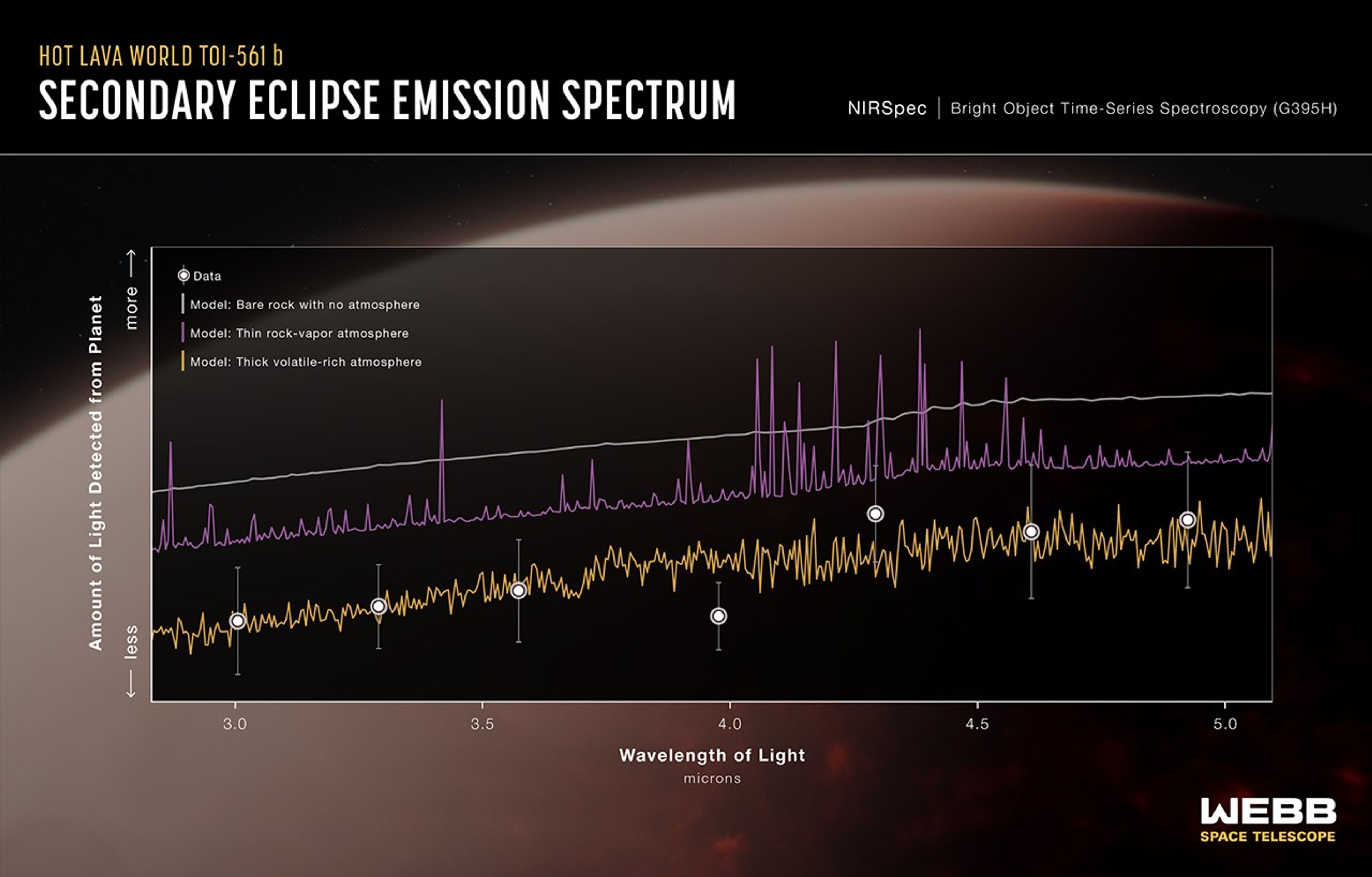
To test the hypothesis that TOI-561 b has an atmosphere, the team used Webb’s NIRSpec (Near-Infrared Spectrograph) to measure the planet’s dayside temperature based on its near-infrared brightness. The technique, which involves measuring the decrease in brightness of the star-planet system as the planet moves behind the star, is similar to that used to search for atmospheres in the TRAPPIST-1 system and on other rocky worlds.
If TOI-561 b is a bare rock with no atmosphere to carry heat around to the nightside, its dayside temperature should be approaching 4,900 degrees Fahrenheit (2,700 degrees Celsius). But the NIRSpec observations show that the planet’s dayside appears to be closer to 3,200 degrees Fahrenheit (1,800 degrees Celsius) — still extremely hot, but far cooler than expected.
Image C: Super-Earth Exoplanet TOI-561 b (NIRSpec Emission Spectrum)
An emission spectrum captured by NASA’s James Webb Space Telescope in May 2024 shows the brightness of different wavelengths of near-infrared light emitted by exoplanet TOI-561 b. Comparing the data to models suggests that the planet is surrounded by a volatile-rich atmosphere.
Illustration: NASA, ESA, CSA, Ralf Crawford (STScI); Science: Johanna Teske (Carnegie Science Earth and Planets Laboratory), Anjali Piette (University of Birmingham), Tim Lichtenberg (Groningen), Nicole Wallack (Carnegie Science Earth and Planets Laboratory)
To explain the results, the team considered a few different scenarios. The magma ocean could circulate some heat, but without an atmosphere, the nightside would probably be solid, limiting flow away from the dayside. A thin layer of rock vapor on the surface of the magma ocean is also possible, but on its own would likely have a much smaller cooling effect than observed.
“We really need a thick volatile-rich atmosphere to explain all the observations,” said Anjali Piette, coauthor from the University of Birmingham, United Kingdom.
“Strong winds would cool the dayside by transporting heat over to the nightside. Gases like water vapor would absorb some wavelengths of near-infrared light emitted by the surface before they make it all the way up through the atmosphere. (The planet would look colder because the telescope detects less light.) It’s also possible that there are bright silicate clouds that cool the atmosphere by reflecting starlight.”
While the Webb observations provide compelling evidence for such an atmosphere, the question remains: How can a small planet exposed to such intense radiation can hold on to any atmosphere at all, let alone one so substantial? Some gases must be escaping to space, but perhaps not as efficiently as expected.
“We think there is an equilibrium between the magma ocean and the atmosphere. At the same time that gases are coming out of the planet to feed the atmosphere, the magma ocean is sucking them back into the interior,” said co-author Tim Lichtenberg from the University of Groningen in the Netherlands. “This planet must be much, much more volatile-rich than Earth to explain the observations. It’s really like a wet lava ball.”
These are the first results from Webb’s General Observers Program 3860, which involved observing the system continuously for more than 37 hours while TOI-561 b completed nearly four full orbits of the star. The team is currently analyzing the full data set to map the temperature all the way around the planet and narrow down the composition of the atmosphere.
“What’s really exciting is that this new data set is opening up even more questions than it’s answering,” said Teske.
The James Webb Space Telescope is the world’s premier space science observatory. Webb is solving mysteries in our solar system, looking beyond to distant worlds around other stars, and probing the mysterious structures and origins of our universe and our place in it. Webb is an international program led by NASA with its partners, ESA (European Space Agency) and CSA (Canadian Space Agency).
Super-Earth Exoplanet TOI-561 b and Its Star (Artist’s Concept)
This artist’s concept shows what the hot super-Earth exoplanet TOI-561 b and its star could look like based on observations from NASA’s James Webb Space Telescope and other observatories. Webb data suggests that the planet is surrounded by a thick atmosphere above a magma ocean.
Super-Earth Exoplanet TOI-561 b (Artist’s Concept)
An artist’s concept shows what a thick atmosphere above a vast magma ocean on exoplanet TOI-561 b could look like. Measurements captured by NASA’s James Webb Space Telescope suggest that in spite of the intense radiation it receives from its star, TOI-561 b is not a bare rock.
Super-Earth Exoplanet TOI-561 b (NIRSpec Emission Spectrum)
An emission spectrum captured by NASA’s James Webb Space Telescope in May 2024 shows the brightness of different wavelengths of near-infrared light emitted by exoplanet TOI-561 b. Comparing the data to models suggests that the planet is surrounded by a volatile-rich atmosphere.
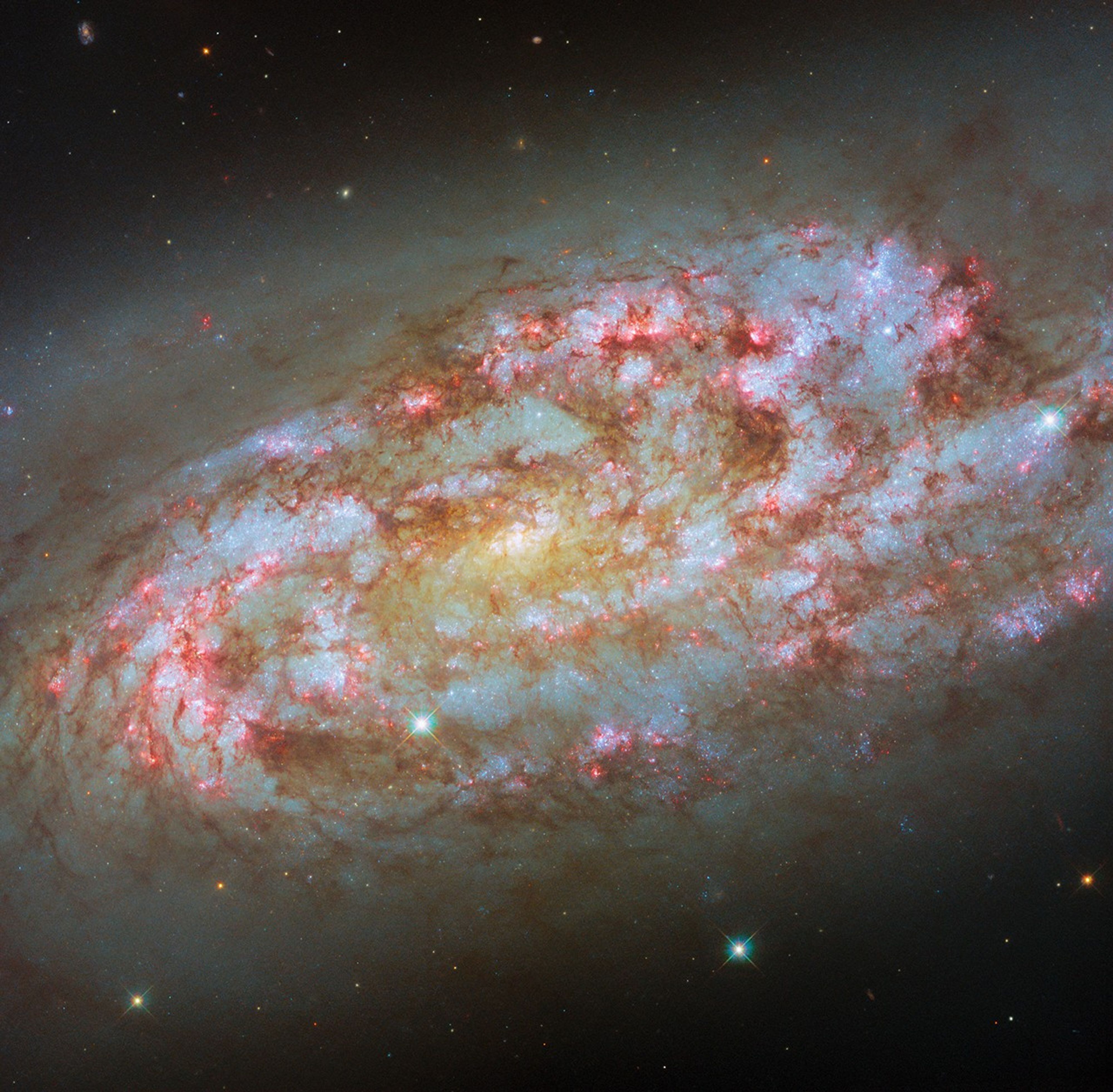
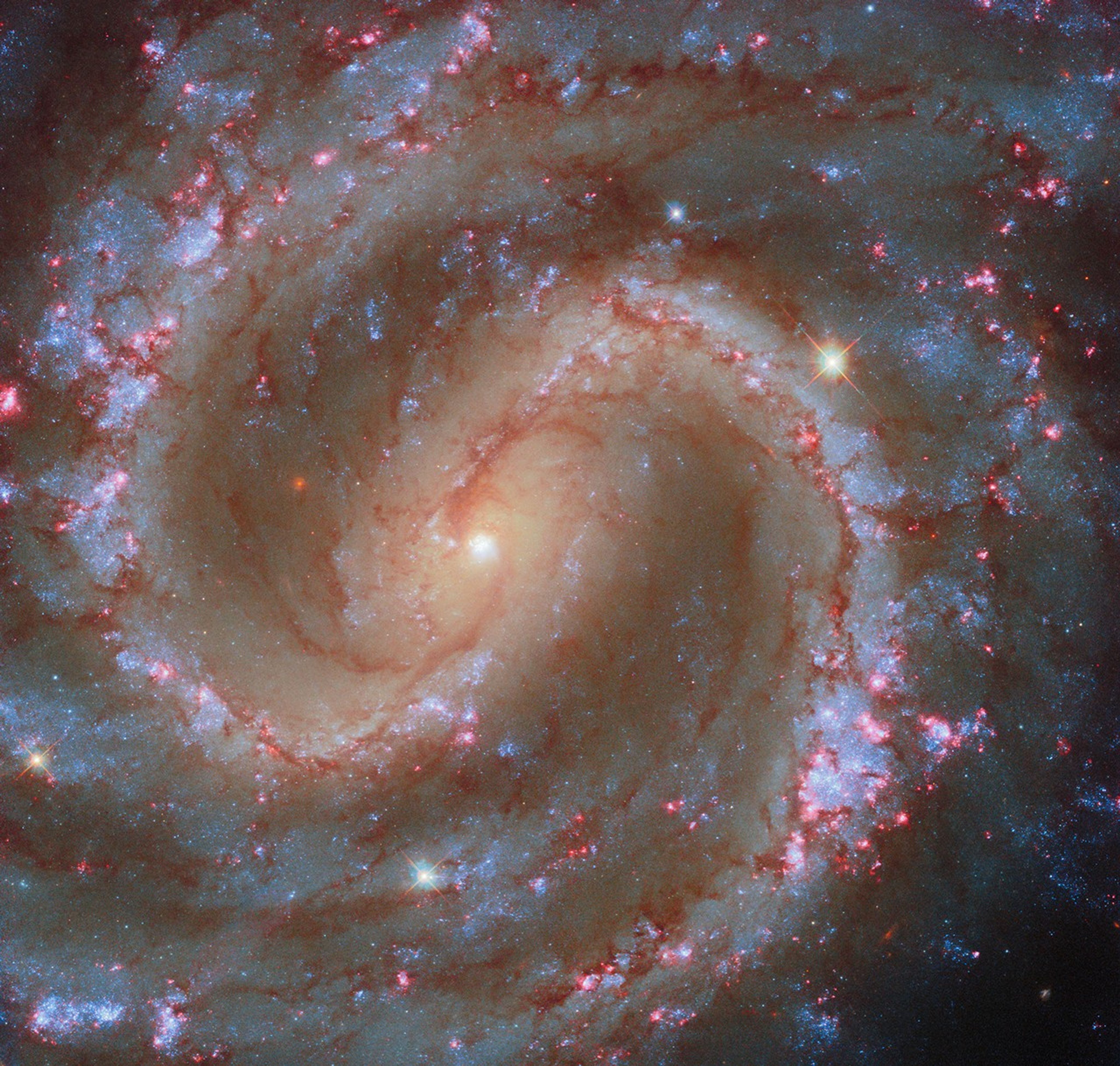
This NASA/ESA Hubble Space Telescope image features the spiral galaxy named NGC 1792.
ESA/Hubble & NASA, D. Thilker, F. Belfiore, J. Lee and the PHANGS-HST Team
This NASA/ESA Hubble Space Telescope image features a stormy and highly active spiral galaxy named NGC 1792. Located over 50 million light-years from Earth in the constellation Columba (the Dove), the bright glow of the galaxy’s center is offset by the flocculent and sparkling spiral arms swirling around it.
NGC 1792 is just as fascinating to astronomers as its chaotic look might imply. Classified as a starburst galaxy, it is a powerhouse of star formation, with spiral arms rich in star-forming regions. In fact, it is surprisingly luminous for its mass. The galaxy is close to a larger neighbor, NGC 1808, and astronomers think the strong gravitational interaction between the two stirred up the reserves of gas in this galaxy. The result is a torrent of star formation, concentrated on the side closest to its neighbor, where gravity has a stronger effect. NGC 1792 is a perfect target for astronomers seeking to understand the complex interactions between gas, star clusters, and supernovae in galaxies.
Hubble studied this galaxy before. This new image includes additional data collected throughout 2025, providing a deeper view of the tumultuous activity taking place in the galaxy. Blossoming red lights in the galaxy’s arms mark Hydrogen-alpha (H-alpha) emission from dense clouds of hydrogen molecules. The newly forming stars within these clouds shine powerfully with ultraviolet radiation. This intense radiation ionizes the hydrogen gas, stripping away electrons which causes the gas to emit H-alpha light. H-alpha is a very particular red wavelength of light and a tell-tale sign of new stars.
NASA-JAXA XRISM Finds Elemental Bounty in Supernova Remnant
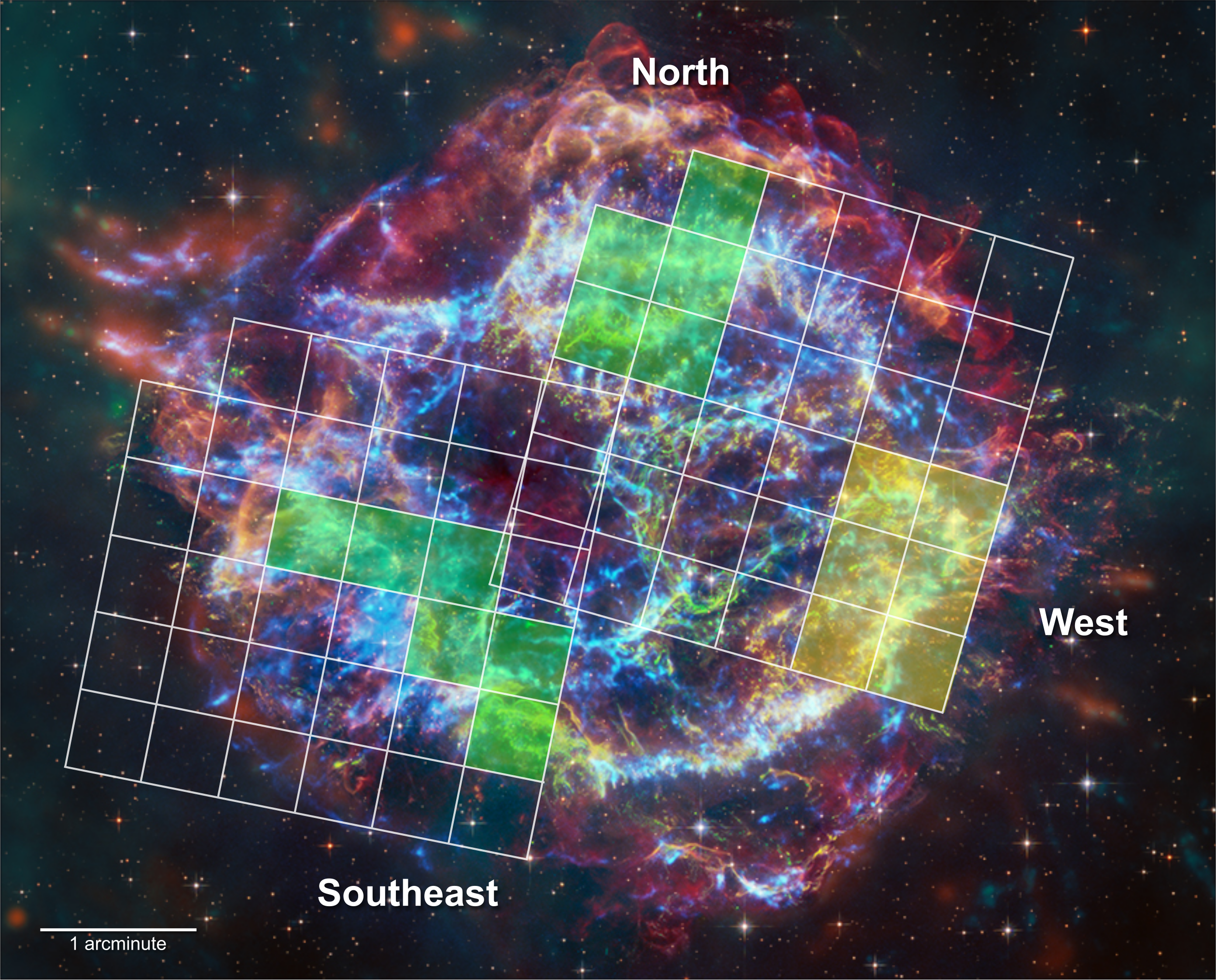
For the first time, scientists have made a clear X-ray detection of chlorine and potassium in the wreckage of a star using data from the Japan-led XRISM (X-ray Imaging and Spectroscopy Mission) spacecraft.
The Resolve instrument aboard XRISM, pronounced “crism,” discovered these elements in a supernova remnant called Cassiopeia A or Cas A, for short. The expanding cloud of debris is located about 11,000 light-years away in the northern constellation Cassiopeia.
“This discovery helps illustrate how the deaths of stars and life on Earth are fundamentally linked,” said Toshiki Sato, an astrophysicist at Meiji University in Tokyo. “Stars appear to shimmer quietly in the night sky, but they actively forge materials that form planets and enable life as we know it. Now, thanks to XRISM, we have a better idea of when and how stars might make crucial, yet harder-to-find, elements.”
Observations of the Cassiopeia A supernova remnant by the Resolve instrument aboard the NASA-JAXA XRISM (X-ray Imaging and Spectroscopy Mission) spacecraft revealed strong evidence for potassium (green squares) in the southeast and northern parts of the remnant. Grids superposed on a multiwavelength image of the remnant represent the fields of view of two Resolve measurements made in December 2023. Each square represents one pixel of Resolve’s detector. Weaker evidence of potassium (yellow squares) in the west suggests that the original star may have had underlying asymmetries before it exploded.
NASA’s Goddard Space Flight Center; X-ray: NASA/CXC/SAO; Optical: NASA/ESA/STScI; IR: NASA/ESA/CSA/STScI/Milisavljevic et al., NASA/JPL/CalTech; Image Processing: NASA/CXC/SAO/J. Schmidt and K. Arcand
Stars produce almost all the elements in the universe heavier than hydrogen and helium through nuclear reactions. Heat and pressure fuse lighter ones, like carbon, into progressively heavier ones, like neon, creating onion-like layers of materials in stellar interiors.
Nuclear reactions also take place during explosive events like supernovae, which occur when stars run out of fuel, collapse, and explode. Elemental abundances and locations in the wreckage can, respectively, tell scientists about the star and its explosion, even after hundreds or thousands of years.
Some elements — like oxygen, carbon, and neon — are more common than others and are easier to detect and trace back to a particular part of the star’s life.
Other elements — like chlorine and potassium — are more elusive. Since scientists have less data about them, it’s more difficult to model where in the star they formed. These rarer elements still play important roles in life on Earth. Potassium, for example, helps the cells and muscles in our bodies function, so astronomers are interested in tracing its cosmic origins.
The roughly circular Cas A supernova remnant spans about 10 light-years, is over 340 years old, and has a superdense neutron star at its center — the remains of the original star’s core. Scientists using NASA’s Chandra X-ray Observatory had previously identified signatures of iron, silicon, sulfur, and other elements within Cas A.
In the hunt for other elements, the team used the Resolve instrument aboard XRISM to look at the remnant twice in December 2023. The researchers were able to pick out the signatures for chlorine and potassium, determining that the remnant contains ratios much higher than expected. Resolve also detected a possible indication of phosphorous, which was previously discovered in Cas A by infrared missions.
Watch to learn more about how the Resolve instrument aboard XRISM captures extraordinary data on the make-up of galaxy clusters, exploded stars, and more using only 36 pixels. Credit: NASA’s Goddard Space Flight Center
“Resolve’s high resolution and sensitivity make these kinds of measurements possible,” said Brian Williams, the XRISM project scientist at NASA’s Goddard Space Flight Center in Greenbelt, Maryland. “Combining XRISM’s capabilities with those of other missions allows scientists to detect and measure these rare elements that are so critical to the formation of life in the universe.”
The astronomers think stellar activity could have disrupted the layers of nuclear fusion inside the star before it exploded. That kind of upheaval might have led to persistent, large-scale churning of material inside the star that created conditions where chlorine and potassium formed in abundance.
The scientists also mapped the Resolve observations onto an image of Cas A captured by Chandra and showed that the elements were concentrated in the southeast and northern parts of the remnant.
This lopsided distribution may mean that the star itself had underlying asymmetries before it exploded, which Chandra data indicated earlier this year in a study Sato led.
“Being able to make measurements with good statistical precision of these rarer elements really helps us understand the nuclear fusion that goes on in stars before and during supernovae,” said co-author Paul Plucinsky, an astrophysicist at the Center for Astrophysics | Harvard & Smithsonian in Cambridge, Massachusetts. “We suspected a key part might be asymmetry, and now we have more evidence that’s the case. But there’s still a lot we just don’t understand about how stars explode and distribute all these elements across the cosmos.”
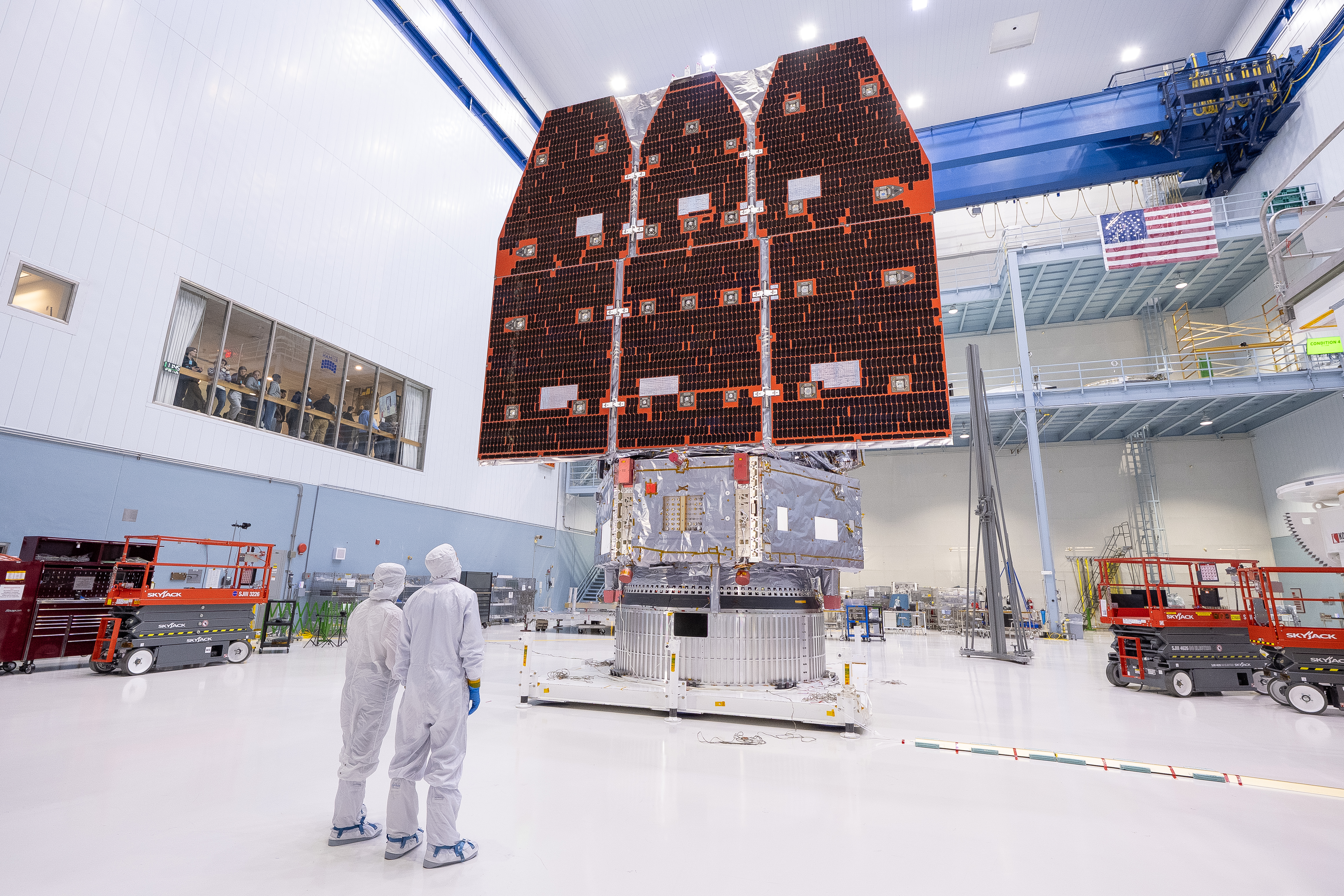
Over the course of several hours, technicians meticulously connected the inner and outer segments of NASA’s Nancy Grace Roman Space Telescope.
NASA/Jolearra Tshiteya
Two technicians look up at NASA’s Nancy Grace Roman Space Telescope after its inner and outer segments were connected at the agency’s Goddard Space Flight Center in Greenbelt, Maryland on Nov. 25, 2025. This marked the end of Roman’s construction. After final testing, the telescope will move to the launch site at NASA’s Kennedy Space Center in Florida for launch preparations in summer 2026. Roman — named after Dr. Nancy Grace Roman, NASA’s first chief astronomer — is slated to launch by May 2027, but the team is on track for launch as early as fall 2026.
NASA’s next big eye on the cosmos is now fully assembled. On Nov. 25, technicians joined the inner and outer portions of the Nancy Grace Roman Space Telescope in the largest clean room at the agency’s Goddard Space Flight Center in Greenbelt, Maryland.
NASA’s Nancy Grace Roman Space Telescope is now fully assembled following the integration of its two major segments on Nov. 25 at the agency’s Goddard Space Flight Center in Greenbelt, Md. The mission is slated to launch by May 2027, but the team is on track for launch as early as fall 2026.
Credit: NASA/Jolearra Tshiteya
“Completing the Roman observatory brings us to a defining moment for the agency,” said NASA Associate Administrator Amit Kshatriya. “Transformative science depends on disciplined engineering, and this team has delivered—piece by piece, test by test—an observatory that will expand our understanding of the universe. As Roman moves into its final stage of testing following integration, we are focused on executing with precision and preparing for a successful launch on behalf of the global scientific community.”
After final testing, Roman will move to the launch site at NASA’s Kennedy Space Center in Florida for launch preparations in summer 2026. Roman is slated to launch by May 2027, but the team is on track for launch as early as fall 2026. A SpaceX Falcon Heavy rocket will send the observatory to its final destination a million miles from Earth.
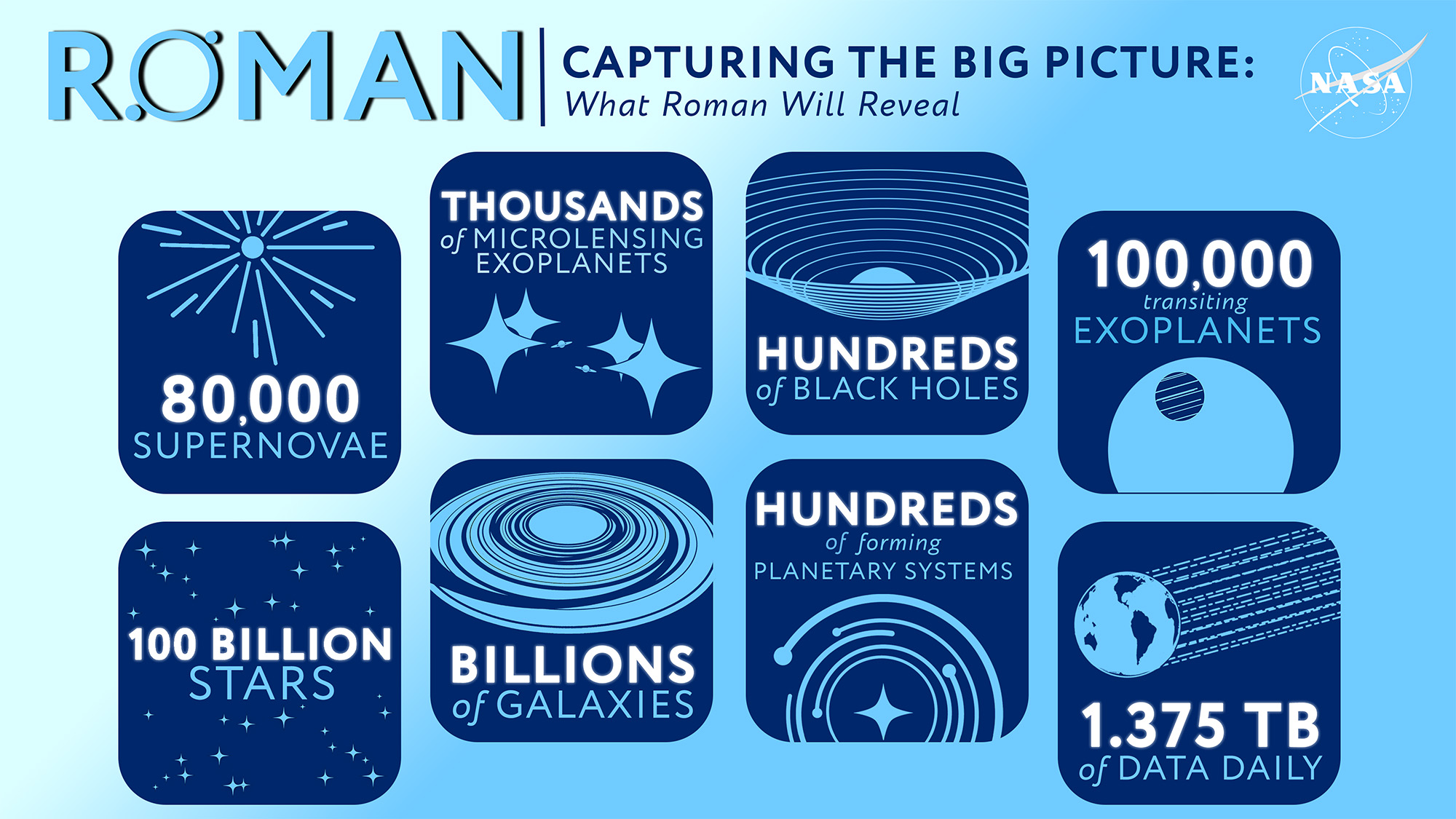
“With Roman’s construction complete, we are poised at the brink of unfathomable scientific discovery,” said Julie McEnery, Roman’s senior project scientist at NASA Goddard. “In the mission’s first five years, it’s expected to unveil more than 100,000 distant worlds, hundreds of millions of stars, and billions of galaxies. We stand to learn a tremendous amount of new information about the universe very rapidly after Roman launches.”
NASA’s Nancy Grace Roman Space Telescope will survey vast swaths of sky during its five-year primary mission. During that time, scientists expect it to see an incredible number of new objects, including stars, galaxies, black holes and planets outside our solar system, known as exoplanets. This infographic previews some of the discoveries scientists anticipate from Roman’s data deluge.
Credit: NASA’s Goddard Space Flight Center
Observing from space will make Roman very sensitive to infrared light — light with a longer wavelength than our eyes can see — from far across the cosmos. Pairing its crisp infrared vision with a sweeping view of space will allow astronomers to explore myriad cosmic topics, from dark matter and dark energy to distant worlds and solitary black holes, and conduct research that would take hundreds of years using other telescopes.
“Within our lifetimes, a great mystery has arisen about the cosmos: why the expansion of the universe seems to be accelerating. There is something fundamental about space and time we don’t yet understand, and Roman was built to discover what it is,” said Nicky Fox, associate administrator, Science Mission Directorate, NASA Headquarters in Washington. “With Roman now standing as a complete observatory, which keeps the mission on track for a potentially early launch, we are a major step closer to understanding the universe as never before. I couldn’t be prouder of the teams that have gotten us to this point.”
The coronagraph will demonstrate new technologies for directly imaging planets around other stars. It will block the glare from distant stars and make it easier for scientists to see the faint light from planets in orbit around them. The Coronagraph aims to photograph worlds and dusty disks around nearby stars in visible light to help us see giant worlds that are older, colder, and in closer orbits than the hot, young super-Jupiters direct imaging has mainly revealed so far.
“The question of ‘Are we alone?’ is a big one, and it’s an equally big task to build tools that can help us answer it,” said Feng Zhao, the Roman Coronagraph Instrument manager at NASA’s Jet Propulsion Laboratory in Southern California. “The Roman Coronagraph is going to bring us one step closer to that goal. It’s incredible that we have the opportunity to test this hardware in space on such a powerful observatory as Roman.”
The coronagraph team will conduct a series of pre-planned observations for three months spread across the mission’s first year-and-a-half of operations, after which the mission may conduct additional observations based on scientific community input.
The Wide Field Instrument is a 288-megapixel camera that will unveil the cosmos all the way from our solar system to near the edge of the observable universe. Using this instrument, each Roman image will capture a patch of the sky bigger than the apparent size of a full moon. The mission will gather data hundreds of times faster than NASA’s Hubble Space Telescope, adding up to 20,000 terabytes (20 petabytes) over the course of its five-year primary mission.
“The sheer volume of the data Roman will return is mind-boggling and key to a host of exciting investigations,” said Dominic Benford, Roman’s program scientist at NASA Headquarters.
Over the course of several hours, technicians meticulously connected the inner and outer segments of NASA’s Nancy Grace Roman Space Telescope, as shown in this time-lapse. Next, Roman will undergo final testing prior to moving to the launch site at NASA’s Kennedy Space Center in Florida for launch preparations in summer 2026.
Credit: NASA/Sophia Roberts
Survey trifecta
Using the Wide Field Instrument, Roman will conduct three core surveys which will account for 75% of the primary mission. The High-Latitude Wide-Area Survey will combine the powers of imaging and spectroscopy to unveil more than a billion galaxies strewn across a wide swath of space and time. Astronomers will trace the evolution of the universe to probe dark matter — invisible matter detectable only by how its gravity affects things we can see — and trace the formation of galaxies and galaxy clusters over time.
The High-Latitude Time-Domain Survey will probe our dynamic universe by observing the same region of the cosmos repeatedly. Stitching these observations together to create movies will allow scientists to study how celestial objects and phenomena change over time periods of days to years. That will help astronomers study dark energy — the mysterious cosmic pressure thought to accelerate the universe’s expansion — and could even uncover entirely new phenomena that we don’t yet know to look for.
Roman’s Galactic Bulge Time-Domain Survey will look inward to provide one of the deepest views ever of the heart of our Milky Way galaxy. Astronomers will watch hundreds of millions of stars in search of microlensing signals — gravitational boosts of a background star’s light caused by the gravity of an intervening object. While astronomers have mainly discovered star-hugging worlds, Roman’s microlensing observations can find planets in the habitable zone of their star and farther out, including worlds like every planet in our solar system except Mercury. Microlensing will also reveal rogue planets—worlds that roam the galaxy untethered to a star — and isolated black holes. The same dataset will reveal 100,000 worlds that transit, or pass in front of, their host stars.
The remaining 25% of Roman’s five-year primary mission will be dedicated to other observations that will be determined with input from the broader scientific community. The first such program, called the Galactic Plane Survey, has already been selected.
Because Roman’s observations will enable such a wide range of science, the mission will have a General Investigator Program designed to support astronomers to reveal scientific discoveries using Roman data. As part of NASA’s commitment to Gold Standard Science, NASA will make all of Roman’s data publicly available with no exclusive use period. This ensures multiple scientists and teams can use data at the same time, which is important since every Roman observation will address a wealth of science cases.
NASA’s freshly assembled Nancy Grace Roman Space Telescope will revolutionize our understanding of the universe with its deep, crisp, sweeping infrared views of space. The mission will transform virtually every branch of astronomy and bring us closer to understanding the mysteries of dark energy, dark matter, and how common planets like Earth are throughout our galaxy. Roman is on track for launch by May 2027, with teams working toward a launch as early as fall 2026. Credit: NASA’s Goddard Space Flight Center
Roman’s namesake — Dr. Nancy Grace Roman, NASA’s first chief astronomer — made it her personal mission to make cosmic vistas readily accessible to all by paving the way for telescopes based in space.
“The mission will acquire enormous quantities of astronomical imagery that will permit scientists to make groundbreaking discoveries for decades to come, honoring Dr. Roman’s legacy in promoting scientific tools for the broader community,” said Jackie Townsend, Roman’s deputy project manager at NASA Goddard. “I like to think Dr. Roman would be extremely proud of her namesake telescope and thrilled to see what mysteries it will uncover in the coming years.”
The Nancy Grace Roman Space Telescope is managed at NASA’s Goddard Space Flight Center in Greenbelt, Maryland, with participation by NASA’s Jet Propulsion Laboratory in Southern California; Caltech/IPAC in Pasadena, California; the Space Telescope Science Institute in Baltimore; and a science team comprising scientists from various research institutions. The primary industrial partners are BAE Systems Inc. in Boulder, Colorado; L3Harris Technologies in Rochester, New York; and Teledyne Scientific & Imaging in Thousand Oaks, California.
NASA and industry partners will fly and operate a commercial robotic arm in low Earth orbit through the Fly Foundational Robots mission set to launch in late 2027. This mission aims to revolutionize in-space operations, a critical capability for sustainably living and working on other planets. By enabling this technology demonstration, NASA is fostering the in-space robotics industry to unlock valuable tools for future scientific discovery and exploration missions.
“Today it’s a robotic arm demonstration, but one day these same technologies could be assembling solar arrays, refueling satellites, constructing lunar habitats, or manufacturing products that benefit life on Earth,” said Bo Naasz, senior technical lead for In-space Servicing, Assembly, and Manufacturing (ISAM) in the Space Technology Mission Directorate at NASA Headquarters in Washington. “This is how we build a dominant space economy and sustained human presence on the Moon and Mars.”
Artist concept of the FFR Mission’s robotic system payload atop the Astro Digital spacecraft. The robotic arm, provided by Motiv Space Systems, will perform robotic demonstrations in orbit.
Motiv Space Systems
The Fly Foundational Robots (FFR) mission will leverage a robotic arm from small business Motiv Space Systems capable of dexterous manipulation, autonomous tool use, and walking across spacecraft structures in zero or partial gravity. This mission could enable ways to repair and refuel spacecraft, construct habitats and infrastructure in space, maintain life support systems on lunar and Martian surfaces, and serve as robotic assistants to astronauts during extended missions. Advancing robotic systems in space could also enhance our understanding of similar technologies on Earth across industries including construction, medicine, and transportation.
To demonstrate FFR’s commercial robotic arm in space, NASA’s Space Technology Mission Directorate is contracting with Astro Digital to provide a hosted orbital test through the agency’s Flight Opportunities program.
Guest roboticists will have the opportunity to contribute to the FFR mission, and participation will allow them to use Motiv’s robotic platform as a testbed and perform unique tasks. NASA will serve as the inaugural guest operator and is currently seeking other interested U.S. partners to participate.
The future of in-space robotics relies on testing robotic operations in space prior to launching more complex and extensive servicing and refueling missions. Through FFR, the demonstration of Motiv’s robotic arm operations in space will begin to push open the door to endless possibilities.
NASA’s Fly Foundational Robots demonstration is funded through the NASA Space Technology Mission Directorate’s ISAM portfolio and managed by NASA’s Goddard Space Flight Center in Greenbelt, Maryland. Motiv Space Systems of Pasadena, California, will supply the mission’s robotic arm system through a NASA Small Business Innovation Research Phase III award. Astro Digital of Littleton, Colorado, will flight test Motiv’s robotic payload through NASA’s Flight Opportunities program managed by NASA’s Armstrong Flight Research Center in Edwards, California.
The asteroid Bennu continues to provide new clues to scientists’ biggest questions about the formation of the early solar system and the origins of life. As part of the ongoing study of pristine samples delivered to Earth by NASA’s OSIRIS-REx (Origins, Spectral Interpretation, Resource Identification, and Security-Regolith Explorer) spacecraft, three new papers published Tuesday by the journals Nature Geosciences and Nature Astronomy present remarkable discoveries: sugars essential for biology, a gum-like substance not seen before in astromaterials, and an unexpectedly high abundance of dust produced by supernova explosions.
Sugars essential to life
Scientists led by Yoshihiro Furukawa of Tohoku University in Japan found sugars essential for biology on Earth in the Bennu samples, detailing their findings in the journal Nature Geoscience. The five-carbon sugar ribose and, for the first time in an extraterrestrial sample, six-carbon glucose were found. Although these sugars are not evidence of life, their detection, along with previous detections of amino acids, nucleobases, and carboxylic acids in Bennu samples, show building blocks of biological molecules were widespread throughout the solar system.
For life on Earth, the sugars deoxyribose and ribose are key building blocks of DNA and RNA, respectively. DNA is the primary carrier of genetic information in cells. RNA performs numerous functions, and life as we know it could not exist without it. Ribose in RNA is used in the molecule’s sugar-phosphate “backbone” that connects a string of information-carrying nucleobases.
“All five nucleobases used to construct both DNA and RNA, along with phosphates, have already been found in the Bennu samples brought to Earth by OSIRIS-REx,” said Furukawa. “The new discovery of ribose means that all of the components to form the molecule RNA are present in Bennu.”
The discovery of ribose in asteroid samples is not a complete surprise. Ribose has previously been found in two meteorites recovered on Earth. What is important about the Bennu samples is that researchers did not find deoxyribose. If Bennu is any indication, this means ribose may have been more common than deoxyribose in environments of the early solar system.
Researchers think the presence of ribose and lack of deoxyribose supports the “RNA world” hypothesis, where the first forms of life relied on RNA as the primary molecule to store information and to drive chemical reactions necessary for survival.
A team of Japanese and US scientists have discovered the bio-essential sugars ribose and glucose in samples of asteroid Bennu that were collected by NASA’s OSIRIS-REx mission. This finding builds on the earlier discovery of nucleobases (the genetic components of DNA and RNA), phosphate, and amino acids (the building blocks of proteins) in the Bennu samples, showing that the molecular ingredients of life could have been delivered to early Earth by meteorites. Download this graphic from NASA’s Scientific Visualization Studio website: https://svs.gsfc.nasa.gov/14932
NASA/Goddard/University of Arizona/Dan Gallagher
“Present day life is based on a complex system organized primarily by three types of functional biopolymers: DNA, RNA, and proteins,” explains Furukawa. “However, early life may have been simpler. RNA is the leading candidate for the first functional biopolymer because it can store genetic information and catalyze many biological reactions.”
The Bennu samples also contained one of the most common forms of “food” (or energy) used by life on Earth, the sugar glucose, which is the first evidence that an important energy source for life as we know it was also present in the early solar system.
Mysterious, ancient ‘gum’
A second paper, in the journal Nature Astronomy led by Scott Sandford at NASA’s Ames Research Center in California’s Silicon Valley and Zack Gainsforth of the University of California, Berkeley, reveals a gum-like material in the Bennu samples never seen before in space rocks – something that could have helped set the stage on Earth for the ingredients of life to emerge. The surprising substance was likely formed in the early days of the solar system, as Bennu’s young parent asteroid warmed.
Once soft and flexible, but since hardened, this ancient “space gum” consists of polymer-like materials extremely rich in nitrogen and oxygen. Such complex molecules could have provided some of the chemical precursors that helped trigger life on Earth, and finding them in the pristine samples from Bennu is important for scientists studying how life began and whether it exists beyond our planet.
On this primitive asteroid that formed in the early days of the solar system, we’re looking at events near the beginning of the beginning.
Scott SandFord
Astrophysicist, NASA's Ames Research Center
Bennu’s ancestral asteroid formed from materials in the solar nebula – the rotating cloud of gas and dust that gave rise to the solar system – and contained a variety of minerals and ices. As the asteroid began to warm, due to natural radiation, a compound called carbamate formed through a process involving ammonia and carbon dioxide. Carbamate is water soluble, but it survived long enough to polymerize, reacting with itself and other molecules to form larger and more complex chains impervious to water. This suggests that it formed before the parent body warmed enough to become a watery environment.
“With this strange substance, we’re looking at, quite possibly, one of the earliest alterations of materials that occurred in this rock,” said Sandford. “On this primitive asteroid that formed in the early days of the solar system, we’re looking at events near the beginning of the beginning.”
Using an infrared microscope, Sandford’s team selected unusual, carbon-rich grains containing abundant nitrogen and oxygen. They then began what Sandford calls “blacksmithing at the molecular level,” using the Molecular Foundry at Lawrence Berkeley National Laboratory (Berkeley Lab) in Berkeley, California. Applying ultra-thin layers of platinum, they reinforced a particle, welded on a tungsten needle to lift the tiny grain, and shaved the fragment down using a focused beam of charged particles.
A microscopic particle of asteroid Bennu, brought to Earth by NASA’s OSIRIS-REx mission, is manipulated under a transmission electron microscope. In order to move the fragment for further analysis, researchers first reinforced it with thin strips of platinum (the “L” shape on the particle’s surface) then welded a tungsten microneedle to it. The asteroid fragment measures 30 micrometers (about one-one thousandth of an inch) across.
NASA/University of California, Berkeley
When the particle was a thousand times thinner than a human hair, they analyzed its composition via electron microscopy at the Molecular Foundry and X-ray spectroscopy at Berkeley Lab’s Advanced Light Source. The ALS’s high spatial resolution and sensitive X-ray beams enabled unprecedented chemical analysis.
“We knew we had something remarkable the instant the images started to appear on the monitor,” said Gainsforth. “It was like nothing we had ever seen, and for months we were consumed by data and theories as we attempted to understand just what it was and how it could have come into existence.”
The team conducted a slew of experiments to examine the material’s characteristics. As the details emerged, the evidence suggested the strange substance had been deposited in layers on grains of ice and minerals present in the asteroid.
It was also flexible – a pliable material, similar to used gum or even a soft plastic. Indeed, during their work with the samples, researchers noticed the strange material was bendy and dimpled when pressure was applied. The stuff was translucent, and exposure to radiation made it brittle, like a lawn chair left too many seasons in the sun.
“Looking at its chemical makeup, we see the same kinds of chemical groups that occur in polyurethane on Earth,” said Sandford, “making this material from Bennu something akin to a ‘space plastic.’”
The ancient asteroid stuff isn’t simply polyurethane, though, which is an orderly polymer. This one has more “random, hodgepodge connections and a composition of elements that differs from particle to particle,” said Sandford. But the comparison underscores the surprising nature of the organic material discovered in NASA’s asteroid samples, and the research team aims to study more of it.
By pursuing clues about what went on long ago, deep inside an asteroid, scientists can better understand the young solar system – revealing the precursors to and ingredients of life it already contained, and how far those raw materials may have been scattered, thanks to asteroids much like Bennu.
Abundant supernova dust
Another paper in the journal Nature Astronomy, led by Ann Nguyen of NASA’s Johnson Space Center in Houston, analyzed presolar grains – dust from stars predating our solar system – found in two different rock types in the Bennu samples to learn more about where its parent body formed and how it was altered by geologic processes. It is believed that presolar dust was generally well-mixed as our solar system formed. The samples had six-times the amount of supernova dust than any other studied astromaterial, suggesting the asteroid’s parent body formed in a region of the protoplanetary disk enriched in the dust of dying stars.
The study also reveals that, while Bennu’s parent asteroid experienced extensive alteration by fluids, there are still pockets of less-altered materials within the samples that offer insights into its origin.
An artistic visualization of the OSIRIS-REx spacecraft descending towards asteroid Bennu to collect a sample.
NASA/Goddard/University of Arizona
“These fragments retain a higher abundance of organic matter and presolar silicate grains, which are known to be easily destroyed by aqueous alteration in asteroids,” said Nguyen. “Their preservation in the Bennu samples was a surprise and illustrates that some material escaped alteration in the parent body. Our study reveals the diversity of presolar materials that the parent accreted as it was forming.”
NASA’s Goddard Space Flight Center provided overall mission management, systems engineering, and the safety and mission assurance for OSIRIS-REx. Dante Lauretta of the University of Arizona, Tucson, is the principal investigator. The university leads the science team and the mission’s science observation planning and data processing. Lockheed Martin Space in Littleton, Colorado, built the spacecraft and provided flight operations. Goddard and KinetX Aerospace were responsible for navigating the OSIRIS-REx spacecraft. Curation for OSIRIS-REx takes place at NASA’s Johnson Space Center in Houston. International partnerships on this mission include the OSIRIS-REx Laser Altimeter instrument from CSA (Canadian Space Agency) and asteroid sample science collaboration with JAXA’s (Japan Aerospace Exploration Agency’s) Hayabusa2 mission. OSIRIS-REx is the third mission in NASA’s New Frontiers Program, managed by NASA’s Marshall Space Flight Center in Huntsville, Alabama, for the agency’s Science Mission Directorate in Washington.
For more information on the OSIRIS-REx mission, visit:
How did the molecular building blocks of life arrive at early Earth? To find out, NASA sent a spacecraft called OSIRIS-REx to collect samples from the carbon...
NASA’s nearly complete Nancy Grace Roman Space Telescope has made another set of critical strides toward launch. This fall, the outer portion passed two tests — a shake test and an intense sound blast — to ensure its successful launch. The inner portion of the observatory underwent a major 65-day thermal vacuum test, showing that it will function properly in space. As NASA’s next flagship space telescope, Roman will address essential questions in the areas of dark energy, planets outside our solar system, and astrophysics.
The inner portion of NASA’s Nancy Grace Roman Space Telescope (which consists of the telescope, instrument carrier, two instruments, and spacecraft) recently passed thermal vacuum testing. In this photo, the assembly is being lifted out of the Space Environment Simulator after completing 65 days of assessments.
Credit: NASA/Jolearra Tshiteya
“We want to make sure Roman will withstand our harshest environments,” said Rebecca Espina, a deputy test director at NASA’s Goddard Space Flight Center in Greenbelt, Maryland. “From a mechanical standpoint, our heaviest loads and stresses come from launch, so we use testing to mimic the launch environment.”
The vibration and acoustic testing were the final round of launch simulations for the outer portion of the Roman observatory, which consists of the outer barrel assembly, deployable aperture cover, and recently installed flight solar panels.
During acoustic testing, a large chamber with gigantic horns emulated the launch’s thunderous sounds, which cause high-frequency vibrations. Test operators outfitted the chamber and assembly with various sensors to monitor the hardware’s response to the sound, which gradually ramped up to a full minute at 138 decibels — louder than a jet plane’s takeoff at close range!
After moving to a massive shaker table, Roman’s outer assembly went through testing to replicate the rocket launch’s lower-frequency vibrations. Each individual test lasts only about a minute, sweeping from 5 to 50 hertz (the lowest note on a grand piano vibrates at 27.5 hertz), but NASA engineers tested three axes of movement over several weeks, breaking up the tests with on-the-spot data analysis.
Like in acoustic testing, the team installed sensors to capture the assembly’s response to the shaking. Structural analysts and test operators use this information not only to evaluate success but also to improve models and subsequent assessments.
“There’s a real sense of accomplishment when you get a piece of hardware this large through this test program,” said Shelly Conkey, lead structural analyst for this assembly at NASA Goddard. “I am proud of the work that our team of people has done.”
The outer portion of NASA’s Nancy Grace Roman Space Telescope (which consists of the outer barrel assembly, deployable aperture cover, and solar panels) recently passed vibration and acoustic testing. The structure is shown here in the acoustic testing chamber at NASA’s Goddard Space Flight Center in Greenbelt, Md., where it was blasted with intense sound to simulate launch conditions.
Credit: NASA/Jolearra Tshiteya
The core portion of the observatory (the telescope, instrument carrier, two instruments, and spacecraft bus) moved into the Space Environment Simulator test chamber at NASA Goddard in August. There, it was subjected to extreme temperatures to mimic the chill of space and heat from the Sun. A team of more than 200 people ran simulations continuously for more than two months straight, assessing the telescope’s optics and the assembly’s overall mission readiness.
“The thermal vacuum test marked the first time the telescope and instruments were used together,” said Dominic Benford, Roman’s program scientist at NASA Headquarters in Washington. “The next time we turn everything on will be when the observatory is in space!”
Following extensive assessments, the core portion of NASA’s Nancy Grace Roman Space Telescope was removed from the test chamber (as shown in this gif) and returned to the largest clean room at NASA’s Goddard Space Flight Center in Greenbelt, Md. Next, it will be prepped for final integration.
Credit: NASA/Sophia Roberts
The team expects to connect Roman’s two major parts in November, resulting in a complete observatory by the end of the year. Following final tests, Roman will move to the launch site at NASA’s Kennedy Space Center in Florida for launch preparations in summer 2026. Roman remains on schedule for launch by May 2027, with the team aiming for as early as fall 2026.
The Nancy Grace Roman Space Telescope is managed at NASA’s Goddard Space Flight Center in Greenbelt, Maryland, with participation by NASA’s Jet Propulsion Laboratory in Southern California; Caltech/IPAC in Pasadena, California; the Space Telescope Science Institute in Baltimore; and a science team comprising scientists from various research institutions. The primary industrial partners are BAE Systems Inc. in Boulder, Colorado; L3Harris Technologies in Rochester, New York; and Teledyne Scientific & Imaging in Thousand Oaks, California.
For more information about the Roman Space Telescope, visit:
NASA, NOAA Rank 2025 Ozone Hole as 5th Smallest Since 1992
While continental in scale, the ozone hole over the Antarctic was small in 2025 compared to previous years and remains on track to recover later this century, NASA and the National Oceanic and Atmospheric Administration (NOAA) reported. The hole this year was the fifth smallest since 1992, the year a landmark international agreement to phase out ozone-depleting chemicals began to take effect.
At the height of this year’s depletion season from Sept. 7 through Oct. 13, the average extent of the ozone hole was about 7.23 million square miles (18.71 million square kilometers) — that’s twice the area of the contiguous United States. The 2025 ozone hole is already breaking up, nearly three weeks earlier than usual during the past decade.
This map shows the size and shape of the ozone hole over the South Pole on the day of its 2025 maximum extent. Moderate ozone losses (orange) are visible amid areas of more potent ozone losses (red). Scientists describe the ozone “hole” as the area in which ozone concentrations drop below the historical threshold of 220 Dobson units.
NASA Earth Observatory image by Lauren Dauphin, using data courtesy of NASA Ozone Watch and GEOS-5 data from the Global Modeling and Assimilation Office at NASA GSFC
The hole reached its greatest one-day extent for the year on Sept. 9 at 8.83 million square miles (22.86 million square kilometers). It was about 30% smaller than the largest hole ever observed, which occurred in 2006, and had an average area of 10.27 million square miles (26.60 million square kilometers).
“As predicted, we’re seeing ozone holes trending smaller in area than they were in the early 2000s,” said Paul Newman, a senior scientist with the University of Maryland, Baltimore County, and leader of the ozone research team at NASA’s Goddard Space Flight Center in Greenbelt, Maryland. “They’re forming later in the season and breaking up earlier. But we still have a long way to go before it recovers to 1980s levels.”
NASA and NOAA scientists say this year’s monitoring showed that controls on ozone-depleting chemical compounds established by the Montreal Protocol and subsequent amendments are driving the gradual recovery of the ozone layer in the stratosphere, which remains on track to recover fully later this century.
The ozone-rich layer acts as a planetary sunscreen that helps shield life from harmful ultraviolet (UV) radiation from the Sun. It is located in the stratosphere, which is found between 7 and 31 miles above the Earth’s surface. Reduced ozone allows more UV rays to reach the surface, resulting in crop damage as well as increased cases of skin cancer and cataracts, among other adverse health impacts.
The ozone depletion process starts when human-made compounds containing chlorine and bromine rise high into the stratosphere miles above Earth’s surface. Freed from their molecular bonds by the more intense UV radiation, the chlorine and bromine-containing molecules then participate in reactions that destroy ozone molecules. Chlorofluorocarbons and other ozone-depleting compounds were once widely used in aerosol sprays, foams, air conditioners, and refrigerators. The chlorine and bromine from these compounds can linger in the atmosphere for decades to centuries.
“Since peaking around the year 2000, levels of ozone-depleting substances in the Antarctic stratosphere have declined by about a third, relative to pre-ozone-hole levels,” said Stephen Montzka, a senior scientist with NOAA’s Global Monitoring Laboratory.
As part of the 1987 Montreal Protocol, countries agreed to replace ozone-depleting substances with less harmful alternatives.
“This year’s hole would have been more than one million square miles larger if there was still as much chlorine in the stratosphere as there was 25 years ago,” Newman said.
Still, the now-banned chemicals persist in old products like building insulation and in landfills. As emissions from those legacy uses taper off over time, projections show the ozone hole over the Antarctic recovering around the late 2060s.
NASA and NOAA previously ranked ozone hole severity using a time frame dating back to 1979, when scientists began tracking Antarctic ozone levels with satellites. Using that longer record, this year’s hole area ranked 14th smallest over 46 years of observations.
Factors like temperature, weather, and the strength of the wind encircling Antarctica known as the polar vortex also influence ozone levels from year to year. A weaker-than-normal polar vortex this August helped keep temperatures above average and likely contributed to a smaller ozone hole, said Laura Ciasto, a meteorologist with NOAA’s Climate Prediction Center.
NOAA scientists also use instruments carried on weather balloons and upward-looking surface-based instruments to measure stratospheric ozone directly above the South Pole Atmospheric Baseline Observatory. Balloon data showed that the ozone concentration reached its lowest value of 147 Dobson Units this year on Oct. 6. The lowest value ever recorded over the South Pole was 92 Dobson Units in October 2006.
NOAA scientists launch a weather balloon carrying an ozonesonde near the South Pole in September 2025.
Simeon Bash/IceCube – courtesy of NOAA
The Dobson Unit is a measurement that indicates the total number of ozone molecules present throughout the atmosphere above a certain location. A measurement of 100 Dobson Units corresponds to a layer of pure ozone 1 millimeter thick — about as thick as a dime — at standard temperature and pressure conditions.
View the latest status of the ozone layer over the Antarctic with NASA’s ozone watch.
This NASA/ESA Hubble Space Telescope image features the spiral galaxy NGC 4535.
ESA/Hubble & NASA, F. Belfiore, J. Lee and the PHANGS-HST Team
Today’s NASA/ESA Hubble Space Telescope image features the spiral galaxy NGC 4535, which is situated about 50 million light-years away in the constellation Virgo (the Maiden). Through a small telescope, this galaxy appears extremely faint, giving it the nickname ‘Lost Galaxy’. With a mirror spanning nearly eight feet (2.4 meters) across and its location above Earth’s light-obscuring atmosphere, Hubble can easily observe dim galaxies like NGC 4535 and pick out features like its massive spiral arms and central bar of stars.
This image features NGC 4535’s young star clusters, which dot the galaxy’s spiral arms. Glowing-pink clouds surround many of these bright-blue star groupings. These clouds, called H II (‘H-two’) regions, are a sign that the galaxy is home to especially young, hot, and massive stars that blaze with high-energy radiation. Such massive stars shake up their surroundings by heating their birth clouds with powerful stellar winds, eventually exploding as supernovae.
The image incorporates data from an observing program designed to catalog roughly 50,000 H II regions in nearby star-forming galaxies like NGC 4535. Hubble released a previous image of NGC 4535 in 2021. Both the 2021 image and this new image incorporate observations from the PHANGS observing program, which seeks to understand the connections between young stars and cold gas. Today’s image adds a new dimension to our understanding of NGC 4535 by capturing the brilliant red glow of the nebulae that encircle massive stars in their first few million years of life.
NASA’s TESS Spacecraft Triples Size of Pleiades Star Cluster
These young, hot blue stars are members of the Pleiades open star cluster and resides about 430 light-years away in the northern constellation Taurus. The brightest stars are visible to the unaided eye during evenings from October to April. A new study finds the cluster to be triple the size previously thought — and shows that its stars are scattered across the night sky. The Schmidt telescope at the Palomar Observatory in California captured this color-composite image.
NASA, ESA and AURA/Caltech
Astronomers have revolutionized our understanding of a collection of stars in the northern sky called the Pleiades. They used data from NASA’s TESS (Transiting Exoplanet Survey Satellite) and other observatories as NASA explores the secrets of the universe for the benefit of all, from the Moon to Mars and beyond.
By examining the rotation, chemistry, and orbit around the Milky Way of members of several different nearby stellar groups, the scientists identified a continuum of more than 3,000 stars arcing across 1,900 light-years. This Greater Pleiades Complex triples the number of stars associated with the Pleiades and opens new approaches for discovering similar dispersed star clusters in the future.
“The Pleiades are very well studied — we often use them as a benchmark in astronomical observations,” said Andrew Boyle, a graduate student at the University of North Carolina at Chapel Hill. “When I started this research, I didn’t expect the cluster to balloon to the size that it did. It really touches on a human note. In the Northern Hemisphere, we’ve been looking up at the Pleiades and telling stories about them for thousands of years, but there’s so much more to them than we knew.”
A paper about the result, led by Boyle, published Wednesday, Nov. 12, in the Astrophysical Journal.
This image shows two-thirds of the night sky, illustrating the vast extent of the Greater Pleiades Complex. Original stellar members of the Pleiades, sometimes called Messier 45, appear as blue dots. Newly identified members are in yellow. The constellations are outlined and labeled in green.
The Pleiades is a bright cluster of stars, also known as Messier 45. This loose grouping of about 1,000 members was born roughly 100 million years ago from the same molecular cloud, a cold dense patch of gas and dust.
About six of the stars in the cluster are visible to the unaided eye during evenings from October to April in the northern constellation Taurus. This collection has also been known since antiquity as the Seven Sisters, although the seventh star is no longer visible.
Boyle and his team initially identified over 10,000 stars that could be related to the Pleiades. These stars were orbiting at a similar rate around our Milky Way galaxy according to data from ESA’s (European Space Agency) Gaia satellite.
They narrowed down that collection using stellar rotation data from TESS.
Watch how a star’s rotation slows with age in this artist’s concept of a Sun-like star. The number of star spots also decreases with age.
NASA’s Goddard Space Flight Center
NASA’s TESS mission scans a wide swath of the sky for about a month at a time, looking for variations in the light from stars to spot orbiting planets. This technique also allows TESS to identify and monitor asteroids out to large distances, determining their spin and refining their shape. Such observations improve our understanding of asteroids in our solar system, which can aid in planetary defense.
Scientists can also use TESS data to determine how fast the stars are rotating by looking at regular fluctuations in their light caused when dark surface features called star spots come in and out of view. Because stellar rotation slows as stars age, the researchers were able to pick out the stars that were about the same age as the Pleiades.
The team also looked at the chemical abundances in potential members using data from ground-based missions like the Sloan Digital Sky Survey, which is led by a consortium of institutions.
“The core of the Pleiades is chemically distinct from the average star in a few elements like magnesium and silicon,” said Luke Bouma, a co-author and fellow at the Carnegie Science Observatories in Pasadena, California. “The other stars that we propose are part of the Greater Pleiades are chemically distinct in the same way. The combination of these three major lines of evidence — Milky Way orbits, ages, and chemistry — tells me that we’re on the right path when making these connections.”
The team members think that all the stars in the Greater Pleiades Complex formed in a tighter collection, like the stars in the young Orion cluster, about 100 million years ago. Over time, the cluster dispersed due to the explosive forces of internal supernovae and from the tidal forces of our galaxy’s gravity.
The result is a stream of stars arcing across the sky from horizon to horizon.
This image shows an all-sky view of the Greater Pleiades Complex with the plane of our Milky Way running through the middle. Members of the original open cluster are in blue, and new members are in yellow. The constellations are outlined and labeled in green.
Boyle and Bouma are now working on what they call the TESS All-Sky Rotation Survey. This database will allow researchers to access the rotation information for over 8 million stars to discover even more hidden stellar connections like the Greater Pleiades Complex.
“Thanks to TESS, this team was able to shed new light on a fixture of astronomy,” said Allison Youngblood, the TESS project scientist at NASA’s Goddard Space Flight Center in Greenbelt, Maryland. “From distant stars and planets to asteroids in our solar system and machine learning models here on Earth, TESS continues to push the boundaries of what we can accomplish with large datasets that capture just a part of the complexity of our universe.”

 Login
Login