
❌

Normal view

There are new articles available, click to refresh the page.
Before yesterdayMain stream

Hubble Glimpses Galactic Gas Making a Getaway
2 January 2026 at 10:39
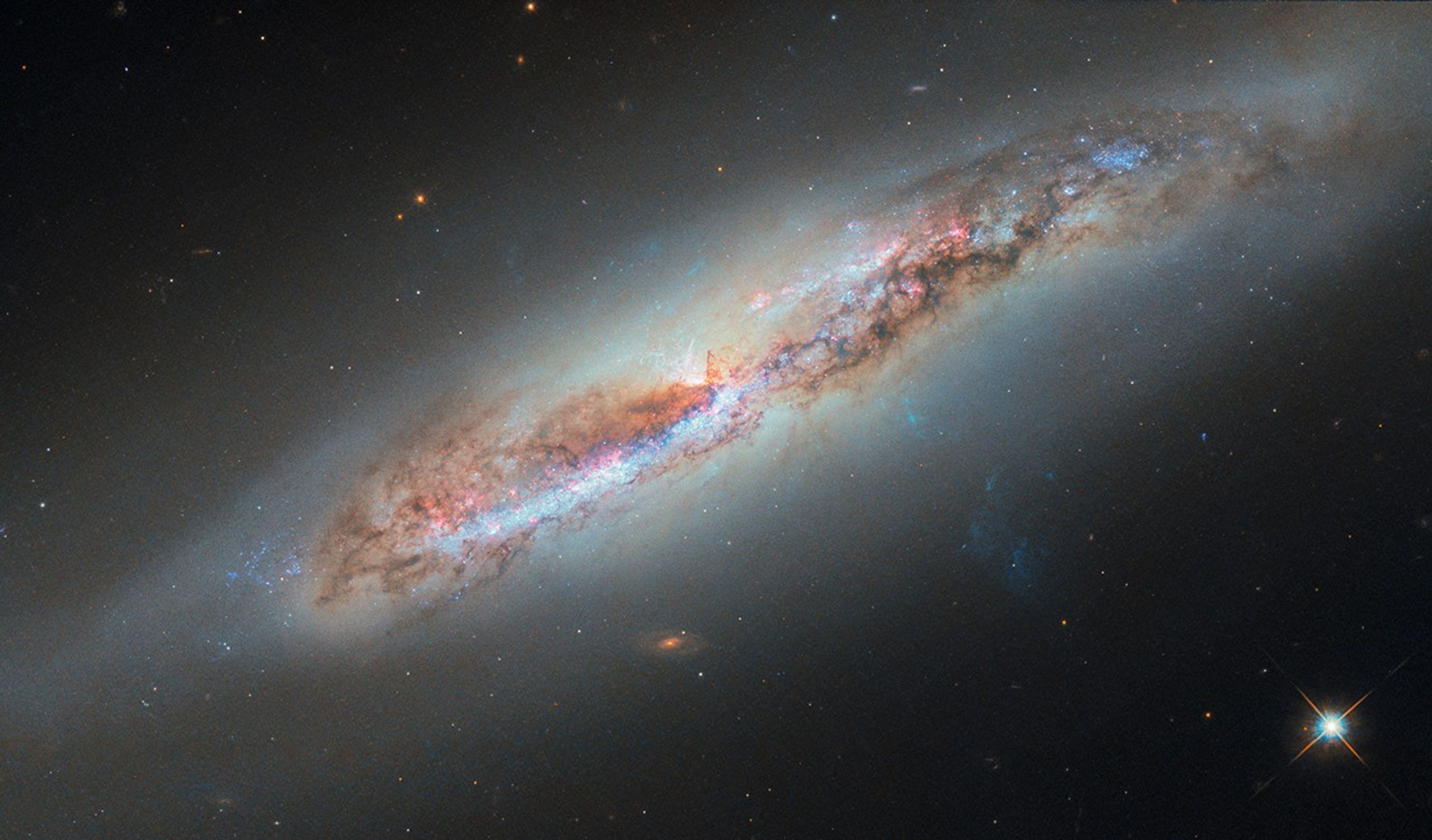
A nearly edge-on spiral galaxy. Its disk holds pink light from star-forming nebulae and blue light from clusters of hot stars. Thick dark clouds of dust block the strong white light from galaxy’s center. A faint, glowing halo of gas surrounds the disk, fading into the black background of space. A bluish plume of gas also extends from the galaxy’s core extending toward the lower-right corner of the image.
This NASA/ESA Hubble Space Telescope image features the galaxy NGC 4388, a member of the Virgo galaxy cluster.
ESA/Hubble & NASA, S. Veilleux, J. Wang, J. Greene

A sideways spiral galaxy shines in this NASA/ESAΒ Hubble Space TelescopeΒ image. Located about 60 million light-years away in the constellation Virgo (the Maiden), NGC 4388 is a resident of the Virgo galaxy cluster. This enormous cluster of galaxies contains more than a thousand members and is the nearest large galaxy cluster to the Milky Way.

NGC 4388 appears to tilt at an extreme angle relative to our point of view, giving us a nearly edge-on prospect of the galaxy. This perspective reveals a curious feature that wasn’t visible in aΒ previous Hubble image of this galaxyΒ released in 2016: a plume of gas from the galaxy’s nucleus, here seen billowing out from the galaxy’s disk toward the lower-right corner of the image. But where did this outflow come from, and why does it glow?

The answer likely lies in the vast stretches of space that separate the galaxies of the Virgo cluster. Though the space between galaxies appears empty, this space is occupied by hot wisps of gas called the intracluster medium. As NGC 4388 moves within the Virgo cluster, it plunges through the intracluster medium. Pressure from hot intracluster gas whisks away gas from within NGC 4388’s disk, causing it to trail behind as NGC 4388 moves.

The source of the ionizing energy that causes this gas cloud to glow is more uncertain. Researchers suspect that some of the energy comes from the center of the galaxy, where a supermassive black hole spins gas around it into a superheated disk. The blazing radiation from this disk might ionize the gas closest to the galaxy, while shock waves might be responsible for ionizing filaments of gas farther out.

This image incorporates new data, including several additional wavelengths of light, that bring the ionized gas cloud into view. The image holds data from several observing programs that aim to illuminate galaxies with active black holes at their centers.

Image credit: ESA/Hubble & NASA, S. Veilleux, J. Wang, J. Greene
A Galactic Embrace

29 December 2025 at 11:43
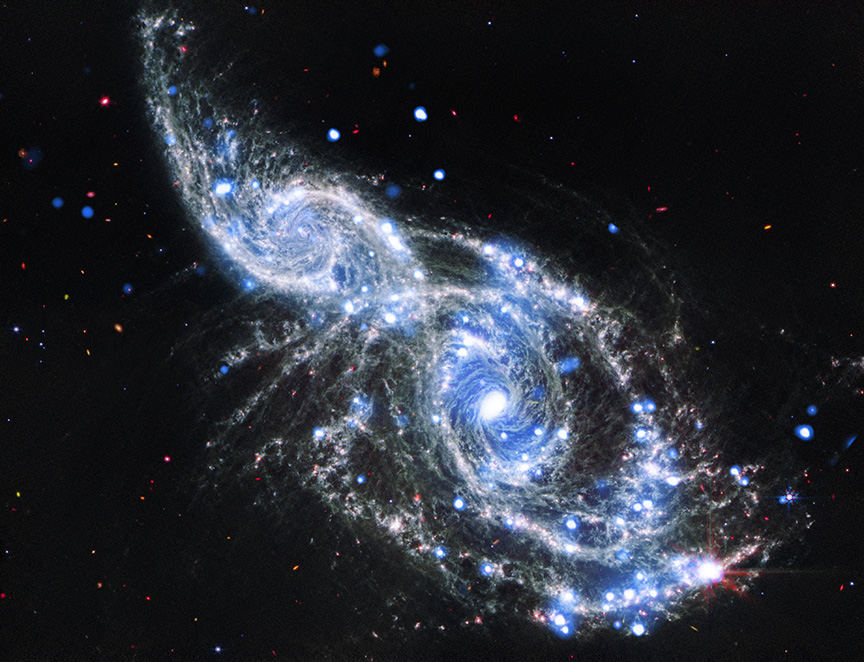
A pair of colliding spiral galaxies. Here, both spirals are shown face on, with the smaller of the two galaxies, IC 2163, at the upper left of the larger galaxy, NGC 2207, which dominates the center and lower right of the image. Both galaxies have long, spiraling, silver blue arms, dotted with specs of blue and red. Toward our upper left, the curving arms overlap, and bend toward their neighbors' core. James Webb mid-infrared image (white, gray, and red) and adds the X-ray view from Chandra (blue).
X-ray: NASA/CXC/SAO; Infrared: NASA/ESA/CSA/STScI/Webb; Image Processing: NASA/CXC/SAO/L. Frattare

Mid-infrared data from NASA’s James Webb Space Telescope (in white, gray, and red) and X-ray data from NASA’s Chandra X-ray Observatory (in blue) come together in this photo of colliding spiral galaxies released on Dec. 1, 2025. The pair grazed one another millions of years ago; billions of years in the future, they will merge into a single galaxy.

Image credit: X-ray: NASA/CXC/SAO; Infrared: NASA/ESA/CSA/STScI/Webb; Image Processing: NASA/CXC/SAO/L. Frattare

Hubble Glimpses Galactic Gas Making a Getaway

19 December 2025 at 07:00

2 min read

Hubble Glimpses Galactic Gas Making a Getaway

A nearly edge-on spiral galaxy. Its disk holds pink light from star-forming nebulae and blue light from clusters of hot stars. Thick dark clouds of dust block the strong white light from galaxy’s center. A faint, glowing halo of gas surrounds the disk, fading into the black background of space. A bluish plume of gas also extends from the galaxy’s core extending toward the lower-right corner of the image.
This NASA/ESA Hubble Space Telescope image features the galaxy NGC 4388, a member of the Virgo galaxy cluster.
ESA/Hubble & NASA, S. Veilleux, J. Wang, J. Greene
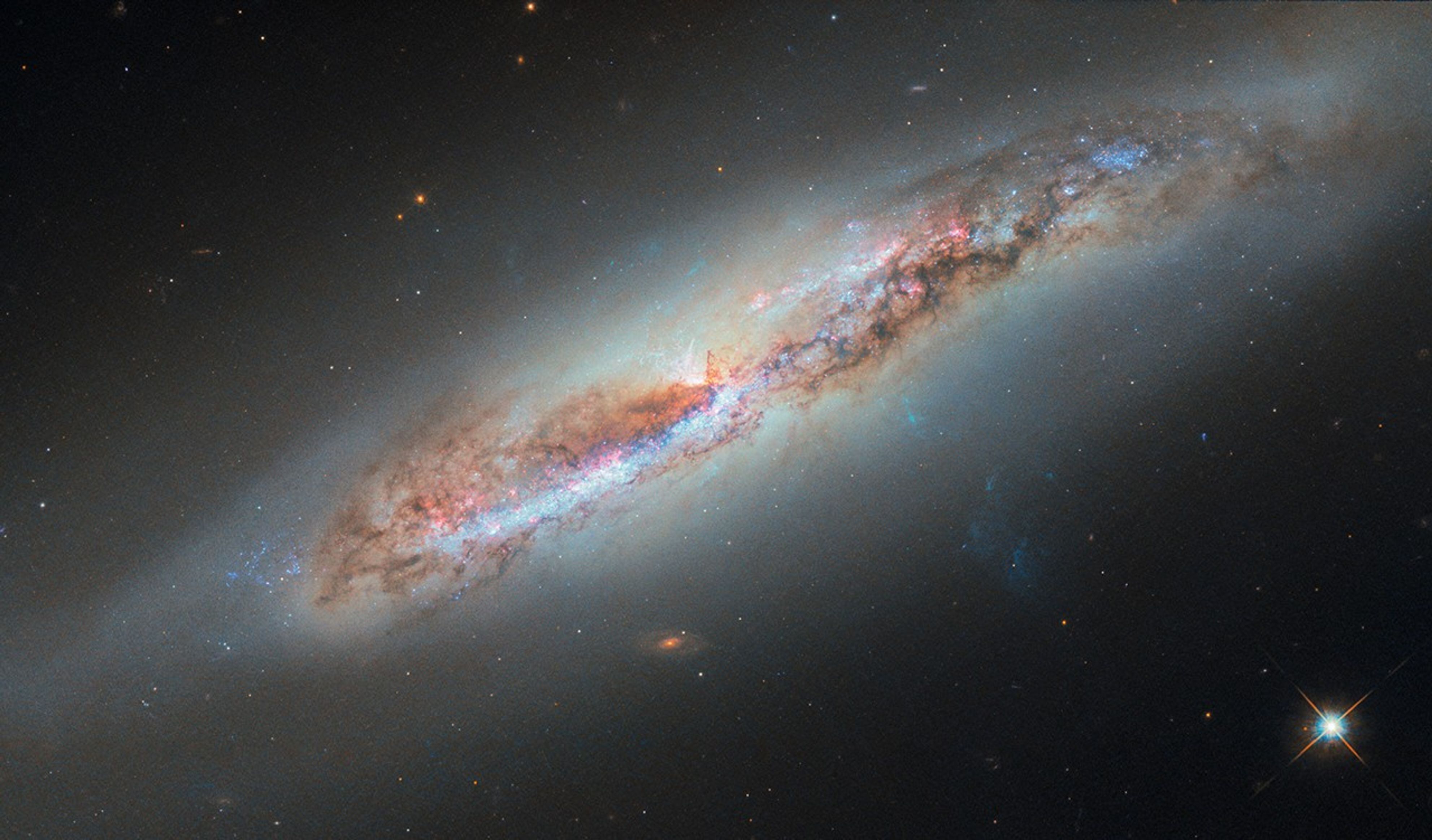
A sideways spiral galaxy shines in this NASA/ESA Hubble Space Telescope image. Located about 60 million light-years away in the constellation Virgo (the Maiden), NGC 4388 is a resident of the Virgo galaxy cluster. This enormous cluster of galaxies contains more than a thousand members and is the nearest large galaxy cluster to the Milky Way.

NGC 4388 appears to tilt at an extreme angle relative to our point of view, giving us a nearly edge-on prospect of the galaxy. This perspective reveals a curious feature that wasn’t visible in a previous Hubble image of this galaxy released in 2016: a plume of gas from the galaxy’s nucleus, here seen billowing out from the galaxy’s disk toward the lower-right corner of the image. But where did this outflow come from, and why does it glow?

The answer likely lies in the vast stretches of space that separate the galaxies of the Virgo cluster. Though the space between galaxies appears empty, this space is occupied by hot wisps of gas called the intracluster medium. As NGC 4388 moves within the Virgo cluster, it plunges through the intracluster medium. Pressure from hot intracluster gas whisks away gas from within NGC 4388’s disk, causing it to trail behind as NGC 4388 moves.

The source of the ionizing energy that causes this gas cloud to glow is more uncertain. Researchers suspect that some of the energy comes from the center of the galaxy, where a supermassive black hole spins gas around it into a superheated disk. The blazing radiation from this disk might ionize the gas closest to the galaxy, while shock waves might be responsible for ionizing filaments of gas farther out.

This image incorporates new data, including several additional wavelengths of light, that bring the ionized gas cloud into view. The image holds data from several observing programs that aim to illuminate galaxies with active black holes at their centers.

Facebook logo
Instagram logo

Media Contact:

Claire AndreoliΒ (claire.andreoli@nasa.gov)
NASA’sΒ Goddard Space Flight Center,Β Greenbelt, MD

❌
❌