NASA’s Chandra Releases Deep Cut From Catalog of Cosmic Recordings
Like a recording artist who has had a long career, NASA’s Chandra X-ray Observatory has a “back catalog” of cosmic recordings that is impossible to replicate. To access these X-ray tracks, or observations, the ultimate compendium has been developed: the Chandra Source Catalog (CSC).
The CSC contains the X-ray data detected up to the end of 2020 by Chandra, the world’s premier X-ray telescope and one of NASA’s “Great Observatories.” The latest version of the CSC, known as CSC 2.1, contains over 400,000 unique compact and extended sources and over 1.3 million individual detections in X-ray light.
before
after
This image contains lower-, medium-, and higher-energy X-rays in red, green, and blue respectively.
This image is the sum of 86 observations added together, representing over three million seconds of Chandra observing time. It spans just about 60 light-years across, which is a veritable pinprick on the entire sky. The underlying image contains lower-, medium-, and higher-energy X-rays in red, green, and blue respectively. The annotations on the image show where Chandra has detected over 3,300 individual sources in this field of view over a 22-year timeframe.
This image is the sum of 86 observations added together, representing over three million seconds of Chandra observing time. It spans just about 60 light-years across, which is a veritable pinprick on the entire sky. The underlying image contains lower-, medium-, and higher-energy X-rays in red, green, and blue respectively. The annotations on the image show where Chandra has detected over 3,300 individual sources in this field of view over a 22-year timeframe.
This image is the sum of 86 observations added together, representing over three million seconds of Chandra observing time. It spans just about 60 light-years across, which is a veritable pinprick on the entire sky. The underlying image contains lower-, medium-, and higher-energy X-rays in red, green, and blue respectively. The annotations on the image show where Chandra has detected over 3,300 individual sources in this field of view over a 22-year timeframe.
Within the CSC, there is a wealth of information gleaned from the Chandra observations — from precise positions on the sky to information about the the X-ray energies detected. This allows scientists using other telescopes — both on the ground and in space including NASA’s James Webb and Hubble Space Telescopes — to combine this unique X-ray data with information from other types of light.
The richness of the Chandra Source Catalog is illustrated in a new image of the Galactic Center, the region around the supermassive black hole at the center of the Milky Way galaxy called Sagittarius A*. In this image that spans just about 60 light-years across, a veritable pinprick on the entire sky, Chandra has detected over 3,300 individual sources that emit X-rays. This image is the sum of 86 observations added together, representing over three million seconds of Chandra observing time.
Another new representation of the vast scope of the Chanda Source Catalog is found in a just-released sonification, the translation of astronomical data into sound. This sonification encompasses the new map that includes 22 years of Chandra observations across the sky, beginning from its launch through its observations in 2021. Because many X-ray sources have been observed multiple times over the life of the Chandra mission, this sonification represents those repeat X-ray sightings over time through different notes.
Chandra Source Catalog Sonification.
NASA/CXC/SAO/K.Arcand, SYSTEM Sounds (M. Russo, A. Santaguida
In the view of the sky, projected in a similar way to how the Earth is often depicted in world maps, the core of the Milky Way is in the center and the Galactic plane is horizontal across the middle of the image. A circle appears at the position of each detection and the size of the circle is determined by the number of detections in that location over time. A year counter appears at the top of the frame. Since Chandra continues to be fully operational, the text changes to “… and beyond” after 2021 as the telescope continues to collect observations. During the video, a collage of images produced by Chandra fades in as a background. In the final frames of the video, thumbnail images representing the thousands of Chandra observations taken over the lifetime of the mission appear behind the sky map.
NASA’s Marshall Space Flight Center in Huntsville, Alabama, manages the Chandra program. The Smithsonian Astrophysical Observatory’s Chandra X-ray Center controls science operations from Cambridge, Massachusetts, and flight operations from Burlington, Massachusetts.
A very deep Chandra X-ray Observatory image around the Sagittarius A* supermassive black hole, located in the center of the Milky Way galaxy, is shown. The image is dominated by burnt orange, deep gold and blue hues, with a sprinkling of rich green. The area looks both intricate and full, with a dense population of tiny dots, along with larger clumps and diffuse areas and nebulous areas peeking through.
At the center of the image, there is a bright, lumpy area in pale gold showing the intense X-ray radiation emanating from the Sagittarius A* black hole. In the surrounding area, there are more smaller lumps layered throughout, feathering out to a large almost butterfly shape filling much of the screen. The image appears textured, like dozens of blue and orange glow worms are paused in their wriggling.
The image offers an unprecedented view of lobes of hot gas extending for a dozen light years on either side of the black hole. These lobes provide evidence for powerful eruptions occurring several times over the last ten thousand years. The image also contains several mysterious X-ray filaments, some of which may be huge magnetic structures interacting with streams of energetic electrons produced by rapidly spinning neutron stars. Such features are known as pulsar wind nebulas. Chandra has detected over 3,300 individual sources that emit X-rays in this field of view. This image is the sum of 86 observations added together, representing over three million seconds of Chandra observing time.
The operations team determined the issue arose when TESS slewed to point at a target, but its solar panels did not rotate to remain pointed at the Sun relative to the spacecraft’s new direction. The off-Sun angle of the solar arrays resulted in a slow discharge of TESS’s batteries. As designed and planned for in situations of this kind, the satellite entered a safe mode after detecting the low-power condition.
At the time of the safe mode, TESS was conducting a week-long observation of comet 3I/ATLAS and resumed those observations Jan. 18. Data from TESS is publicly available through archives at the Mikulski Archive for Space Telescopes.
May 7, 2024
NASA’s TESS Returns to Science Operations
NASA’s TESS (Transiting Exoplanet Survey Satellite) returned to science operations May 3 and is once again making observations. The satellite went into safe mode April 23 following a separate period of down time earlier that month.
The operations team determined this latest safe mode was triggered by a failure to properly unload momentum from the spacecraft’s reaction wheels, a routine activity needed to keep the satellite properly oriented when making observations. The propulsion system, which enables this momentum transfer, had not been successfully repressurized following a prior safe mode event April 8. The team has corrected this, allowing the mission to return to normal science operations. The cause of the April 8 safe mode event remains under investigation.
The TESS mission is a NASA Astrophysics Explorer operated by the Massachusetts Institute of Technology in Cambridge, Massachusetts. Launched in 2018, TESS has been scanning almost the entire sky looking for planets beyond our solar system, known as exoplanets. The TESS mission has also uncovered other cosmic phenomena, including star-shredding black holes and stellar oscillations. Read more about TESS discoveries at nasa.gov/tess.
April 24, 2024
NASA’s Planet-Hunting Satellite Temporarily on Pause
During a routine activity April 23, NASA’s TESS (Transiting Exoplanet Survey Satellite) entered safe mode, temporarily suspending science operations. The satellite scans the sky searching for planets beyond our solar system.
The team is working to restore the satellite to science operations while investigating the underlying cause. NASA also continues investigating the cause of a separate safe mode event that took place earlier this month, including whether the two events are connected. The spacecraft itself remains stable.
The TESS mission is a NASA Astrophysics Explorer operated by the Massachusetts Institute of Technology in Cambridge, Massachusetts. Launched in 2018, TESS recently celebrated its sixth anniversary in orbit. Visit nasa.gov/tess for updates.
April 17, 2024
NASA’s TESS Returns to Science Operations
NASA’s TESS (Transiting Exoplanet Survey Satellite) has returned to work after science observations were suspended on April 8, when the spacecraft entered into safe mode. All instruments are powered on and, following the successful download of previously collected science data stored in the mission’s recorder, are now making new science observations.
Analysis of what triggered the satellite to enter safe mode is ongoing.
The TESS mission is a NASA Astrophysics Explorer operated by MIT in Cambridge, Massachusetts. Launched in 2018, TESS has been scanning almost the entire sky looking for planets beyond our solar system, known as exoplanets. The TESS mission has also uncovered other cosmic phenomena, including star-shredding black holes and stellar oscillations. Read more about TESS discoveries at nasa.gov/tess.
NASA’s TESS (Transiting Exoplanet Survey Satellite) entered into safe mode April 8, temporarily interrupting science observations. The team is investigating the root cause of the safe mode, which occurred during scheduled engineering activities. The satellite itself remains in good health.
The team will continue investigating the issue and is in the process of returning TESS to science observations in the coming days.
The TESS mission is a NASA Astrophysics Explorer operated by MIT in Cambridge, Massachusetts. Launched in 2018, TESS has been scanning almost the entire sky looking for planets beyond our solar system, known as exoplanets. The TESS mission has also uncovered other cosmic phenomena, including star-shredding black holes and stellar oscillations. Read more about TESS discoveries at nasa.gov/tess.
NASA’s Universe of Learning Unveils Fresh Facilitator Guides Inspired by Community Feedback
NASA’s Universe of Learning Program Facilitator Guides provide educators with detailed resources, including background information, activities, and slide decks to engage audiences in exploring astrophysics themes such as Stars, Data & Image Processing, the Electromagnetic Spectrum, and Finding Exoplanets.
The goal of NASA’s Universe of Learning (UoL) is to connect the public to the data, discoveries, and experts that span NASA’s Astrophysics missions. To make this possible, the NASA’s UoL team creates engaging STEM experiences that let people explore data and discoveries from NASA’s Astrophysics missions and learn from the experts behind them.
Our science center does a lot of work with after school groups weekly. I can’t wait to use this program guide [Finding Exoplanets] to help run some programs for our ‘space week’ this fall. I also appreciate the adaptations for different age groups.
Facilitator
Southern Arizona
One example is the Program Facilitator Guides—a series of resources for informal educators that cover different astrophysics themes and empower organizations to share NASA science with their audiences. Since their introduction, these guides have supported libraries and community centers in delivering engaging STEM learning experiences. “”The Programming Guide is just amazing … that resource alone is really great for planning. There’s so many opportunities for programs… and there’s room for your own creativity as well,”” shared one educator.
The NASA’s UoL team is excited to announce the refresh of several Program Facilitator Guides, along with the introduction of a new guide. These resources have been updated based on feedback from the informal education community, collected through evaluation surveys, focus groups, and webinars. From events held last year before the updates, the guides received a highly favorable rating—91% of educators found them useful as a resource, emphasizing their value in supporting informal STEM education. To make them more effective, we implemented the following updates:
Easy and direct access to all Program Facilitator Guides through a dedicated web page under the “Informal Educators” menu on NASA’s Universe of Learning.
Creating an easy-to-access URL for the Program Facilitator Guides: https://universe-of-learning.org/program-guides.
Making available PowerPoint slides and Kahoot Quizzes for the facilitator to complement the Program Facilitator Guide themes.
Moving activity guides to a more user-friendly and standard template.
Designing a set of resources around some of the methods astronomers use to find exoplanets — worlds beyond the solar system — in collaboration with a NASA Science Mission Directorate Community of Practice for Education (SCoPE) grantee:
The “Finding Exoplanets” Program Facilitator Guide.
The “Lights, Coronagraph, Action!” Activity Guide that demonstrates how astronomers find exoplanets via direct imaging.
The “Exoplanet Detectives” Activity Guide that shows how astronomers find exoplanets by measuring the amount of light that gets blocked when a planet transits its host star.
NASA Webb Finds Young Sun-Like Star Forging, Spewing Common Crystals
NASA’s James Webb Space Telescope’s 2024 NIRCam image shows protostar EC 53 circled. Researchers using new data from Webb’s MIRI proved that crystalline silicates form in the hottest part of the disk of gas and dust surrounding the star — and may be shot to the system’s edges.
Credits: Image: NASA, ESA, CSA, STScI, Klaus Pontoppidan (NASA-JPL), Joel Green (STScI); Image Processing: Alyssa Pagan (STScI)
Astronomers have long sought evidence to explain why comets at the outskirts of our own solar system contain crystalline silicates, since crystals require intense heat to form and these “dirty snowballs” spend most of their time in the ultracold Kuiper Belt and Oort Cloud. Now, looking outside our solar system, NASA’s James Webb Space Telescope has returned the first conclusive evidence that links how those conditions are possible. The telescope clearly showed for the first time that the hot, inner part of the disk of gas and dust surrounding a very young, actively forming star is where crystalline silicates are forged. Webb also revealed a strong outflow that is capable of carrying the crystals to the outer edges of this disk. Compared to our own fully formed, mostly dust-cleared solar system, the crystals would be forming approximately between the Sun and Earth.
Webb’s sensitive mid-infrared observations of the protostar, cataloged EC 53, also show that the powerful winds from the star’s disk are likely catapulting these crystals into distant locales, like the incredibly cold edge of its protoplanetary disk where comets may eventually form.
“EC 53’s layered outflows may lift up these newly formed crystalline silicates and transfer them outward, like they’re on a cosmic highway,” said Jeong-Eun Lee, the lead author of a new paper in Nature and a professor at Seoul National University in South Korea. “Webb not only showed us exactly which types of silicates are in the dust near the star, but also where they are both before and during a burst.”
Image: Protostar EC 53 in the Serpens Nebula (NIRCam Image)
NASA’s James Webb Space Telescope’s 2024 NIRCam image shows protostar EC 53 circled. Researchers using new data from Webb’s MIRI proved that crystalline silicates form in the hottest part of the disk of gas and dust surrounding the star — and may be shot to the system’s edges.
Image: NASA, ESA, CSA, STScI, Klaus Pontoppidan (NASA-JPL), Joel Green (STScI); Image Processing: Alyssa Pagan (STScI)
The team used Webb’s MIRI (Mid-Infrared Instrument) to collect two sets of highly detailed spectra to identify specific elements and molecules, and determine their structures. Next, they precisely mapped where everything is, both when EC 53 is “quiet” (but still gradually “nibbling” at its disk) and when it’s more active (what’s known as an outburst phase).
This star, which has been studied by this team and others for decades, is highly predictable. (Other young stars have erratic outbursts, or their outbursts last for hundreds of years.) About every 18 months, EC 53 begins a 100-day, bombastic burst phase, kicking up the pace and absolutely devouring nearby gas and dust, while ejecting some of its intake as powerful jets and outflows. These expulsions may fling some of the newly formed crystals into the outskirts of the star’s protoplanetary disk.
“Even as a scientist, it is amazing to me that we can find specific silicates in space, including forsterite and enstatite near EC 53,” said Doug Johnstone, a co-author and a principal research officer at the National Research Council of Canada. “These are common minerals on Earth. The main ingredient of our planet is silicate.” For decades, research has also identified crystalline silicates not only on comets in our solar system, but also in distant protoplanetary disks around other, slightly older stars — but couldn’t pinpoint how they got there. With Webb’s new data, researchers now better understand how these conditions might be possible.
“It’s incredibly impressive that Webb can not only show us so much, but also where everything is,” said Joel Green, a co-author and an instrument scientist at the Space Telescope Science Institute in Baltimore, Maryland. “Our research team mapped how the crystals move throughout the system. We’ve effectively shown how the star creates and distributes these superfine particles, which are each significantly smaller than a grain of sand.”
Webb’s MIRI data also clearly shows the star’s narrow, high-velocity jets of hot gas near its poles, and the slightly cooler and slower outflows that stem from the innermost and hottest area of the disk that feeds the star. The image above, which was taken by another Webb instrument, NIRCam (Near-Infrared Camera), shows one set of winds and scattered light from EC 53’s disk as a white semi-circle angled toward the right. Its winds also flow in the opposite direction, roughly behind the star, but in near-infrared light, this region appears dark. Its jets are too tiny to pick out.
Image: Silicate Crystallization and Movement Near Protostar EC 53 (Illustration)
This illustration represents half the disk of gas and dust surrounding the protostar EC 53. Stellar outbursts periodically form crystalline silicates, which are launched up and out to the edges of the system, where comets and other icy rocky bodies may eventually form.
Illustration: NASA, ESA, CSA, Elizabeth Wheatley (STScI)
Look ahead
EC 53 is still “wrapped” in dust and may be for another 100,000 years. Over millions of years, while a young star’s disk is heavily populated with teeny grains of dust and pebbles, an untold number of collisions will occur that may slowly build up a range of larger rocks, eventually leading to the formation of terrestrial and gas giant planets. As the disk settles, both the star itself and any rocky planets will finish forming, the dust will largely clear (no longer obscuring the view), and a Sun-like star will remain at the center of a cleared planetary system, with crystalline silicates “littered” throughout.
EC 53 is part of the Serpens Nebula, which lies 1,300 light-years from Earth and is brimming with actively forming stars.
The James Webb Space Telescope is the world’s premier space science observatory. Webb is solving mysteries in our solar system, looking beyond to distant worlds around other stars, and probing the mysterious structures and origins of our universe and our place in it. Webb is an international program led by NASA with its partners, ESA (European Space Agency) and CSA (Canadian Space Agency).
The following sections contain links to download this article’s images and videos in all available resolutions followed by related information links, media contacts, and if available, research paper and Spanish translation links.
Related Images & Videos
Protostar EC 53 in the Serpens Nebula (NIRCam Image)
NASA’s James Webb Space Telescope’s 2024 NIRCam image shows protostar EC 53 circled. Researchers using new data from Webb’s MIRI proved that crystalline silicates form in the hottest part of the disk of gas and dust surrounding the star — and may be shot to the system’s edges.
Silicate Crystallization and Movement Near Protostar EC 53 (Illustration)
This illustration represents half the disk of gas and dust surrounding the protostar EC 53. Stellar outbursts periodically form crystalline silicates, which are launched up and out to the edges of the system, where comets and other icy rocky bodies may eventually form.
Protostar EC 53 in the Serpens Nebula (NIRCam Compass Image)
This image of protostar EC 53 in the Serpens Nebula, captured by the James Webb Space Telescope’s Near Infrared Camera (NIRCam), shows compass arrows, scale bar, and color key for reference.
Intricacies of Helix Nebula Revealed With NASA’s Webb
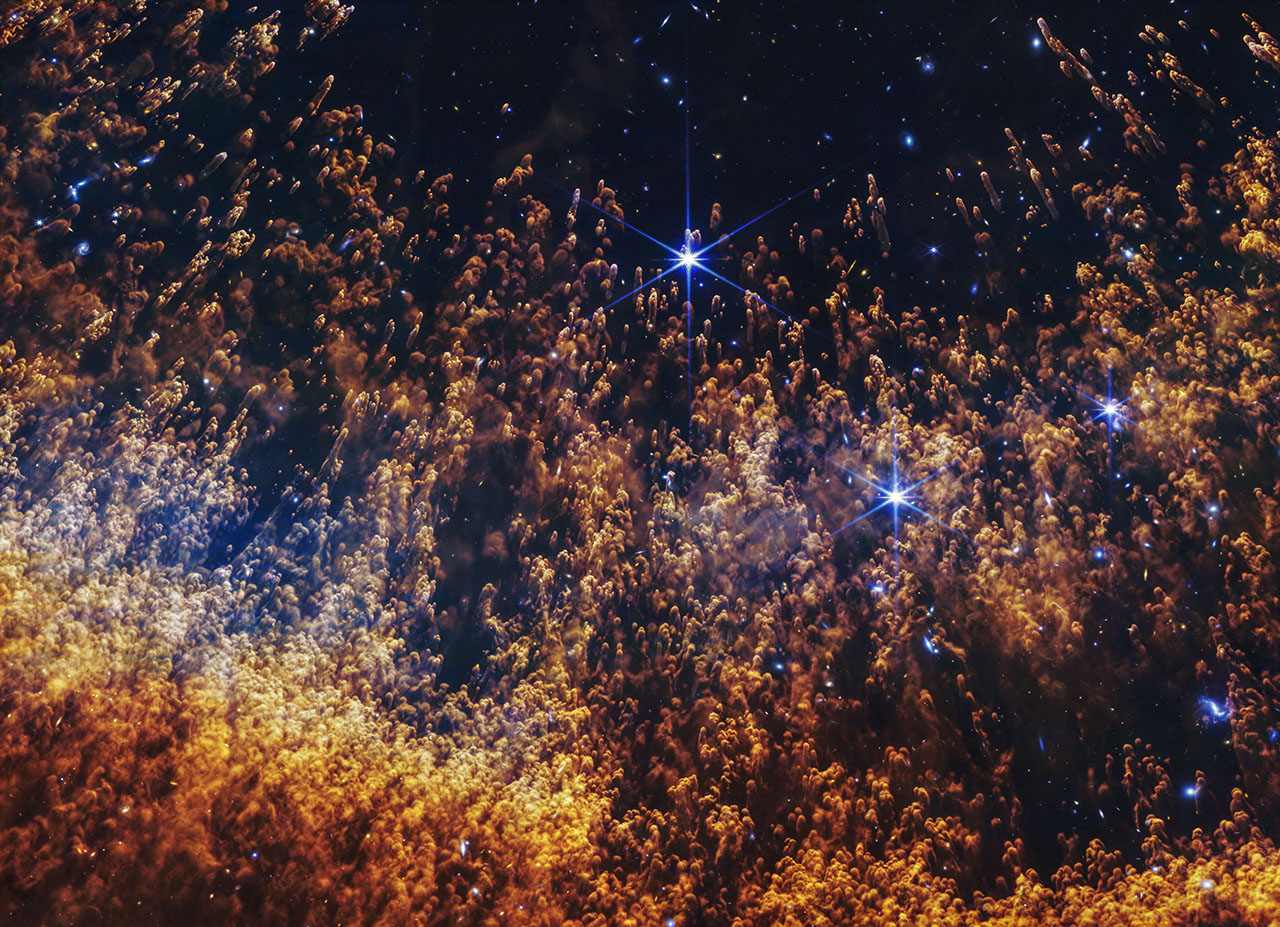
This new image of a portion of the Helix Nebula from NASA’s James Webb Space Telescope highlights comet-like knots, fierce stellar winds, and layers of gas shed off by a dying star interacting with its surrounding environment.
NASA’s James Webb Space Telescope has zoomed into the Helix Nebula to give an up-close view of the possible eventual fate of our own Sun and planetary system. In Webb’s high-resolution look, the structure of the gas being shed off by a dying star comes into full focus. The image reveals how stars recycle their material back into the cosmos, seeding future generations of stars and planets, as NASA explores the secrets of the universe and our place in it.
Image: Helix Nebula (NIRCam)
This new image of a portion of the Helix Nebula from NASA’s James Webb Space Telescope highlights comet-like knots, fierce stellar winds, and layers of gas shed off by a dying star interacting with its surrounding environment.
Image: NASA, ESA, CSA, STScI; Image Processing: Alyssa Pagan (STScI)
In the image from Webb’s NIRCam (Near-Infrared Camera), pillars that look like comets with extended tails trace the circumference of the inner region of an expanding shell of gas. Here, blistering winds of fast-moving hot gas from the dying star are crashing into slower moving colder shells of dust and gas that were shed earlier in its life, sculpting the nebula’s remarkable structure.
The iconic Helix Nebula has been imaged by many ground- and space-based observatories over the nearly two centuries since it was discovered. Webb’s near-infrared view of the target brings these knots to the forefront compared to the ethereal image from NASA’s Hubble Space Telescope, while its increased resolution sharpens focus from NASA’s retired Spitzer Space Telescope’s snapshot. Additionally, the new near-infrared look shows the stark transition between the hottest gas to the coolest gas as the shell expands out from the central white dwarf.
Image: Helix Nebula Context (VISTA and Webb)
This image of the Helix Nebula from the ground-based Visible and Infrared Telescope for Astronomy (left) shows the full view of the planetary nebula, with a box highlighting Webb’s field of view (right).
Image: ESO, VISTA, NASA, ESA, CSA, STScI, J. Emerson (ESO); Acknowledgment: CASU
A blazing white dwarf, the leftover core of the dying star, lies right at the heart of the nebula, out of the frame of the Webb image. Its intense radiation lights up the surrounding gas, creating a rainbow of features: hot ionized gas closest to the white dwarf, cooler molecular hydrogen farther out, and protective pockets where more complex molecules can begin to form within dust clouds. This interaction is vital, as it’s the raw material from which new planets may one day form in other star systems.
In Webb’s image of the Helix Nebula, color represents the temperature and chemistry. A touch of a blue hue marks the hottest gas in this field, energized by intense ultraviolet light from the white dwarf. Farther out, the gas cools into the yellow regions where hydrogen atoms join into molecules. At the outer edges, the reddish tones trace the coolest material, where gas begins to thin and dust can take shape. Together, the colors show the star’s final breath transforming into the raw ingredients for new worlds, adding to the wealth of knowledge gained from Webb about the origin of planets.
Spitzer’s studies of the Helix Nebula hinted at the formation of more complex molecules, but Webb’s resolution shows how they form in shielded zones of the scene. In the Webb image, look for dark pockets of space amid the glowing orange and red.
This video compares images of the Helix Nebula from three NASA observatories: Hubble’s image in visible light, Spitzer’s infrared view, and Webb’s high-resolution near-infrared look.
Video: NASA, ESA, CSA, STScI, Alyssa Pagan (STScI); Acknowledgment: NASA/JPL-Caltech, ESO, VISTA, CASU, Joseph Hora (CfA), J. Emerson (ESO)
The Helix Nebula is located 650 light-years away from Earth in the constellation Aquarius. It remains a favorite among stargazers and professional astronomers alike due to its relative proximity to Earth, and its similar appearance to the “Eye of Sauron.”
The James Webb Space Telescope is the world’s premier space science observatory. Webb is solving mysteries in our solar system, looking beyond to distant worlds around other stars, and probing the mysterious structures and origins of our universe and our place in it. Webb is an international program led by NASA with its partners, ESA (European Space Agency) and CSA (Canadian Space Agency).
The following sections contain links to download this article’s images and videos in all available resolutions followed by related information links, media contacts, and if available, research paper and Spanish translation links.
Related Images & Videos
Helix Nebula (NIRCam)
This new image of a portion of the Helix Nebula from NASA’s James Webb Space Telescope highlights comet-like knots, fierce stellar winds, and layers of gas shed off by a dying star interacting with its surrounding environment.
Helix Nebula Context (VISTA and Webb)
This image of the Helix Nebula from the ground-based Visible and Infrared Telescope for Astronomy (left) shows the full view of the planetary nebula, with a box highlighting Webb’s field of view (right).
Helix Nebula (NIRCam Compass Image)
This image of the Helix Nebula, captured by the NIRCam (Near-Infrared Camera) instrument on Webb, includes compass arrows, scale bar, and color key for reference.
Observatory Comparison (Hubble/Spitzer/Webb)
This video compares images of the Helix Nebula from three NASA observatories: Hubble’s image in visible light, Spitzer’s infrared view, and Webb’s high-resolution near-infrared look.
The Cepheus A region is home to a number of infant stars, including a protostar that is responsible for much of the region’s illumination.
NASA, ESA, and R. Fedriani (Instituto de Astrofisica de Andalucia); Processing: Gladys Kober (NASA/Catholic University of America)
Star-forming region G033.91+0.11 is home to a protostar hidden within a reflection nebula.
NASA, ESA, and R. Fedriani (Instituto de Astrofisica de Andalucia); Processing: Gladys Kober (NASA/Catholic University of America)
A protostar is swathed in the gas of an emission nebula within star-forming region GAL-305.20+00.21.
NASA, ESA, and R. Fedriani (Instituto de Astrofisica de Andalucia); Processing: Gladys Kober (NASA/Catholic University of America)
A protostar’s jets of high-speed particles are responsible for the bright region of excited, glowing hydrogen in this Hubble image.
NASA, ESA, and R. Fedriani (Instituto de Astrofisica de Andalucia); Processing: Gladys Kober (NASA/Catholic University of America)
Newly developing stars shrouded in thick dust get their first baby pictures in these images from NASA’s Hubble Space Telescope. Hubble took these infant star snapshots in an effort to learn how massive stars form.
Protostars are shrouded in thick dust that blocks light, but Hubble can detect the near-infrared emission that shines through holes formed by the protostar’s jets of gas and dust. The radiating energy can provide information about these “outflow cavities,” like their structure, radiation fields, and dust content. Researchers look for connections between the properties of these young stars – like outflows, environment, mass, brightness – and their evolutionary stage to test massive star formation theories.
These images were taken as part of the SOFIA Massive (SOMA) Star Formation Survey, which investigates how stars form, especially massive stars with more than eight times the mass of our Sun.
The Cepheus A region is home to a number of infant stars, including a protostar that is responsible for much of the region’s illumination.
NASA, ESA, and R. Fedriani (Instituto de Astrofisica de Andalucia); Processing: Gladys Kober (NASA/Catholic University of America)
The high-mass star-forming region Cepheus A hosts a collection of baby stars, including one large and luminous protostar, which accounts for about half of the region’s brightness. While much of the region is shrouded in opaque dust, light from hidden stars breaks through outflow cavities to illuminate and energize areas of gas and dust, creating pink and white nebulae. The pink area is an HII region, where the intense ultraviolet radiation of the nearby stars has converted the surrounding clouds of gas into glowing, ionized hydrogen. Cepheus A lies about 2,400 light-years away in the constellation Cepheus.
Star-forming region G033.91+0.11 is home to a protostar hidden within a reflection nebula.
NASA, ESA, and R. Fedriani (Instituto de Astrofisica de Andalucia); Processing: Gladys Kober (NASA/Catholic University of America)
Glittering much closer to home, this Hubble image depicts the star-forming region G033.91+0.11 in our Milky Way galaxy. The light patch in the center of the image is a reflection nebula, in which light from a hidden protostar bounces off gas and dust.
A protostar is swathed in the gas of an emission nebula within star-forming region GAL-305.20+00.21.
NASA, ESA, and R. Fedriani (Instituto de Astrofisica de Andalucia); Processing: Gladys Kober (NASA/Catholic University of America)
This Hubble image showcases the star-forming region GAL-305.20+00.21. The bright spot in the center-right of the image is an emission nebula, glowing gas that is ionized by a protostar buried within the larger complex of gas and dust clouds.
A protostar’s jets of high-speed particles are responsible for the bright region of excited, glowing hydrogen in this Hubble image.
NASA, ESA, and R. Fedriani (Instituto de Astrofisica de Andalucia); Processing: Gladys Kober (NASA/Catholic University of America)
Shrouded in gas and dust, the massive protostar IRAS 20126+4104 lies within a high-mass star-forming region about 5,300 light-years away in the constellation Cygnus. This actively forming star is a B-type protostar, characterized by its high luminosity, bluish-white color, and very high temperature. The bright region of ionized hydrogen at the center of the image is energized by jets emerging from the poles of the protostar, which ground-based observatories previously observed.
New images added every day between January 12-17, 2026! Follow @NASAHubble on social media for the latest Hubble images and news and see Hubble’s Stellar Construction Zones for more images of young stellar objects.
While this eerie NASA Hubble Space Telescope image may look ghostly, it’s actually full of new life. Lupus 3 is a star-forming cloud about 500 light-years away in the constellation Scorpius.
White wisps of gas swirl throughout the region, and in the lower-left corner resides a dark dust cloud. Bright T Tauri stars shine at the left, bottom right, and upper center, while other young stellar objects dot the image.
T Tauri stars are actively forming stars in a specific stage of formation. In this stage, the enveloping gas and dust dissipates from radiation and stellar winds, or outflows of particles from the emerging star. T Tauri stars are typically less than 10 million years old and vary in brightness both randomly and periodically due to the environment and nature of a forming star. The random variations may be due to instabilities in the accretion disk of dust and gas around the star, material from that disk falling onto the star and being consumed, and flares on the star’s surface. The more regular, periodic changes may be caused by giant sunspots rotating in and out of view.
T Tauri stars are in the process of contracting under the force of gravity as they become main sequence stars which fuse hydrogen to helium in their cores. Studying these stars can help astronomers better understand the star formation process.
New images added every day between January 12-17, 2026! Follow @NASAHubble on social media for the latest Hubble images and news and see Hubble’s Stellar Construction Zones for more images of young stellar objects.
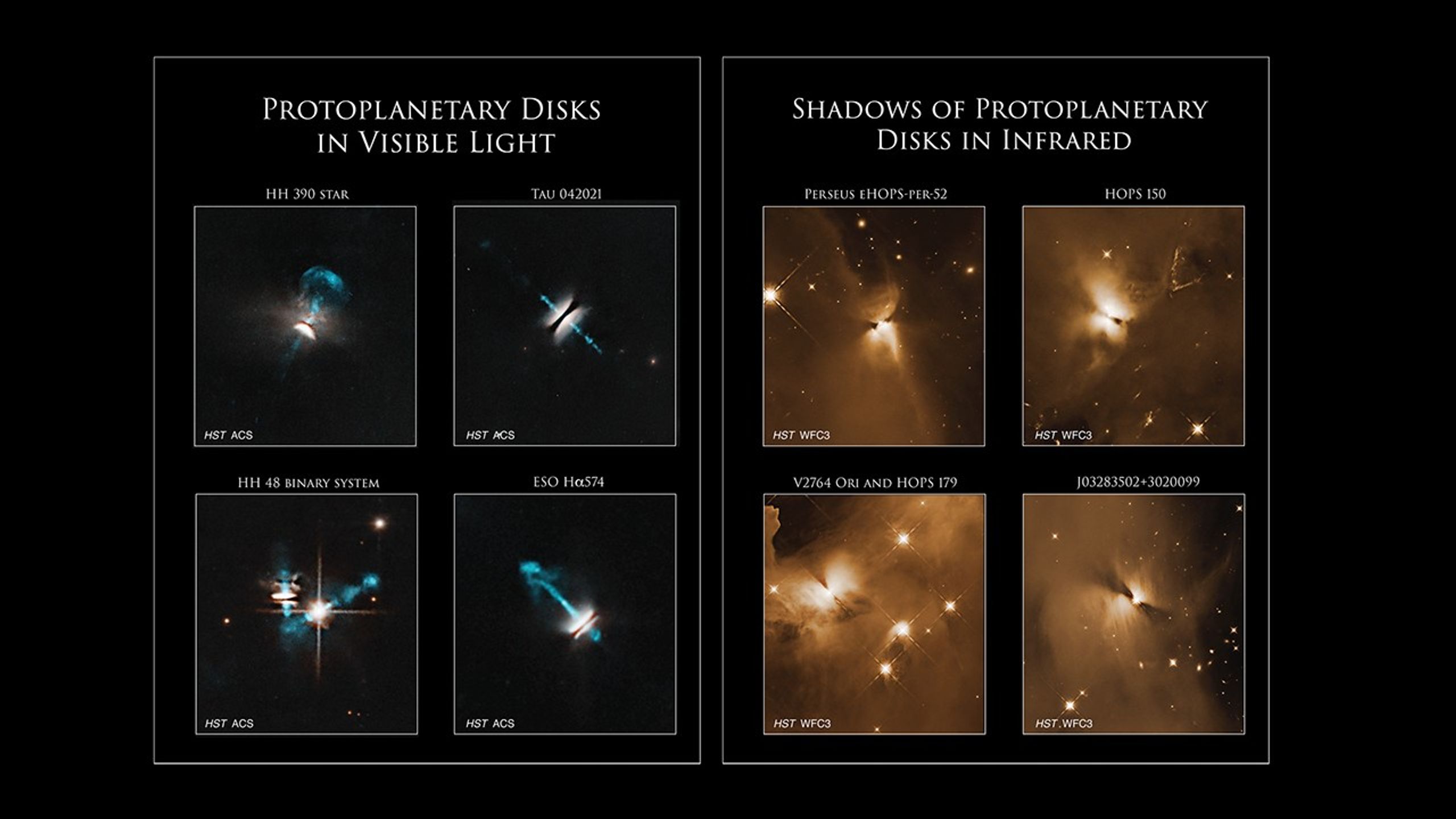
Hubble images of protoplanetary disks in visible and infrared light show dusty regions around newly developing stars where planets may form.
Left: NASA, ESA, and K. Stapelfeldt (Jet Propulsion Laboratory); Processing: Gladys Kober (NASA/Catholic University of America) Right: NASA, ESA, and T. Megeath (University of Toledo); Processing: Gladys Kober (NASA/Catholic University of America)
This collection of new images taken by NASA’s Hubble Space Telescope showcases protoplanetary disks, the swirling masses of gas and dust that surround forming stars, in both visible and infrared wavelengths. Through observations of young stellar objects like these, Hubble helps scientists better understand how stars form.
Jets of gas blast from protostars in these visible-light images. HH 390’s outflow is accompanied by a one-sided nebula, evidence that the protoplanetary disk is not viewed edge-on from our perspective. Tau 042021 is a large, symmetrical disk seen edge-on, and is in a late stage of dust evolution, since the dust particles have clumped together into larger grains. HH 48 is a binary protostar system in which gravitational tidal forces from the larger star appear to be influencing the disk of the secondary object. ESO Hα574 is a very compact disk with a “collimated” ― or beam-like and linear ― outflow, and one of the faintest edge-on disks yet recognized.
NASA, ESA, and K. Stapelfeldt (Jet Propulsion Laboratory); Processing: Gladys Kober (NASA/Catholic University of America)
These visible-light images depict dark, planet-forming dust disks around a hidden, newly developing star, called a protostar. Bipolar jets of fast-moving gases, traveling at about 93 miles (150 km) per second, shoot from both ends of the protostar. The top two images are of protostars found about 450 light-years away in the Taurus Molecular Cloud, while the bottom two are almost 500 light-years away in the Chameleon I star-forming region.
Stars form out of collapsing clouds of gas and dust. As surrounding gas and dust falls toward the protostar, some of it forms a rotating disk around the star that continues to feed the growing object. Planets form from the remaining gas and dust orbiting the star. The bright yellow regions above and below the spinning disks are reflection nebulae, gas and dust lit up by the light of the star.
The jets that are released from the magnetic poles of the stars are an important part of their formation process. The jets, channeled by the protostar’s powerful magnetic fields, disperse angular momentum, which is due to rotational movement of the object. This allows the protostar to spin slowly enough for material to collect. In the images, some of the jets appear to broaden. This occurs when the fast jet collides with the surrounding gas and causes it to glow, an effect called a shock emission.
Bright central protostars and the shadows of their dusty disks appear in these infrared images.
NASA, ESA, and T. Megeath (University of Toledo); Processing: Gladys Kober (NASA/Catholic University of America)
These edge-on views of protostars in infrared light also reveal thick, dusty protoplanetary disks. The dark areas may look like very large disks, but they are actually much wider shadows cast in the surrounding envelope by the central disks. The bright haze throughout the image comes from light scattering off of the surrounding cloud’s dust grains. The top right and bottom left stars reside in the Orion Molecular Cloud complex about 1,300 light-years away, and the top left and bottom right stars lie in the Perseus Molecular Cloud roughly 1,500 light-years away.
In its early stages, these disks draw from the dust that remains around the forming stars. Unlike visible light, infrared light can travel through this “protostellar envelope.” The protostars in the visible images above are further along in their evolution, so much of the dusty envelope has dissipated. Otherwise, they could not be seen in visible wavelengths.
Viewed in infrared light, the central star is visible through the thick dust of the protoplanetary disks. Bipolar jets are also present but not visible because the hot gas emission isn’t strong enough for Hubble to detect.
HOPS 150 in the top right is actually in a binary system, in orbit with another young protostar. HOPS 150’s companion, HOPS 153, is not pictured in this image.
From a wider Hubble survey of Orion protostars, including HOPS 150 and HOPS 367, astronomers found that regions with a higher density of stars tend to have more companion stars. They also found a similar number of companions between main-sequence (active, hydrogen-fusing stars) and their younger counterparts.
New images added every day between January 12-17, 2026! Follow @NASAHubble on social media for the latest Hubble images and news and see Hubble’s Stellar Construction Zones for more images of young stellar objects.
Protostar HOPS 181 is buried in layers of dusty gas clouds, but its energy shapes the material that surrounds it.
NASA, ESA, and T. Megeath (University of Toledo); Processing: Gladys Kober (NASA/Catholic University of America)
A protostar wrapped in obscuring dust creates a cavity with glowing walls while its jet streams into space.
NASA, ESA, and T. Megeath (University of Toledo); Processing: Gladys Kober (NASA/Catholic University of America)
A curving cavity in a cloud of gas has been hollowed out by a protostar in this Hubble image.
NASA, ESA, and T. Megeath (University of Toledo); Processing: Gladys Kober (NASA/Catholic University of America)
Just-forming stars, called protostars, dazzle a cloudy landscape in the Orion Molecular Cloud complex (OMC). These three new images from NASA’s Hubble Space Telescope were taken as part of an effort to learn more about the envelopes of gas and dust surrounding the protostars, as well as the outflow cavities where stellar winds and jets from the developing stars have carved away at the surrounding gas and dust.
Scientists used these Hubble observations as part of a broader survey to study protostellar envelopes, or the gas and dust around the developing star. Researchers found no evidence that the outflow cavities were growing as the protostar moved through the later stages of star formation. They also found that the decreasing accretion of mass onto the protostars over time and the low rate of star formation in the cool, molecular clouds cannot be explained by the progressive clearing out of the envelopes.
The OMC lies within the “sword” of the constellation Orion, roughly 1,300 light-years away.
Protostar HOPS 181 is buried in layers of dusty gas clouds, but its energy shapes the material that surrounds it.
NASA, ESA, and T. Megeath (University of Toledo); Processing: Gladys Kober (NASA/Catholic University of America)
This Hubble image shows a small group of young stars amidst molecular clouds of gas and dust. Near the center of the image, concealed behind the dusty clouds, lies the protostar HOPS 181. The long, curved arc in the top left of the image is shaped by the outflow of material coming from the protostar, likely from the jets of particles shot out at high speeds from the protostar’s magnetic poles. The light of nearby stars reflects off and is scattered by dust grains that fill the image, giving the region its soft glow.
The bright star in the lower right quadrant called CVSO 188 might seem like the diva in this image, but HOPS 310, located just to the left of center behind the dust, is the true hidden star. This protostar is responsible for the large cavity with bright walls that has been carved into the surrounding cloud of gas and dust by its jets and stellar winds. Running diagonally to the top right is one of the bipolar jets of the protostar. These jets consist of particles launched at high speeds from the protostar’s magnetic poles. Some background galaxies are visible in the upper right of the image.
A curving cavity in a cloud of gas has been hollowed out by a protostar in this Hubble image.
NASA, ESA, and T. Megeath (University of Toledo); Processing: Gladys Kober (NASA/Catholic University of America)
The bright protostar to the left in this Hubble image is located within the Orion Molecular Clouds. Its stellar winds — ejected, fast-flowing particles that are spurred by the star’s magnetic field — have carved a large cavity in the surrounding cloud. In the top right, background stars speckle the image.
New images added every day between January 12-17, 2026! Follow @NASAHubble on social media for the latest Hubble images and news and see Hubble’s Stellar Construction Zones for more images of young stellar objects.
NASA’s Webb Delivers Unprecedented Look Into Heart of Circinus Galaxy
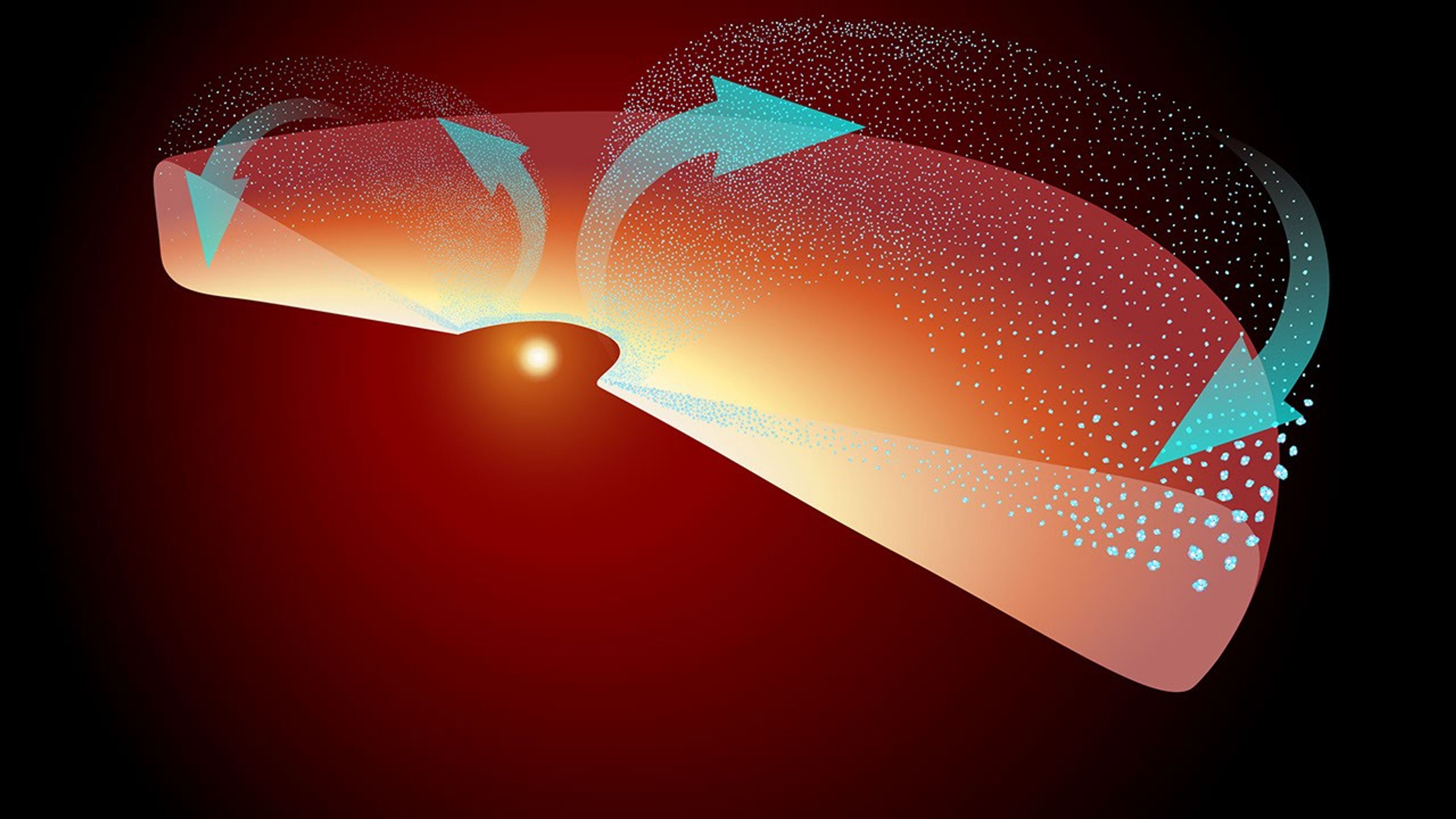
This artist’s concept depicts the central engine of the Circinus galaxy, visualizing the supermassive black hole fed by a thick, dusty torus that glows in infrared light.
Credits: Artwork: NASA, ESA, CSA, Ralf Crawford (STScI)
The Circinus Galaxy, a galaxy about 13 million light-years away, contains an active supermassive black hole that continues to influence its evolution. The largest source of infrared light from the region closest to the black hole itself was thought to be outflows, or streams of superheated matter that fire outward.
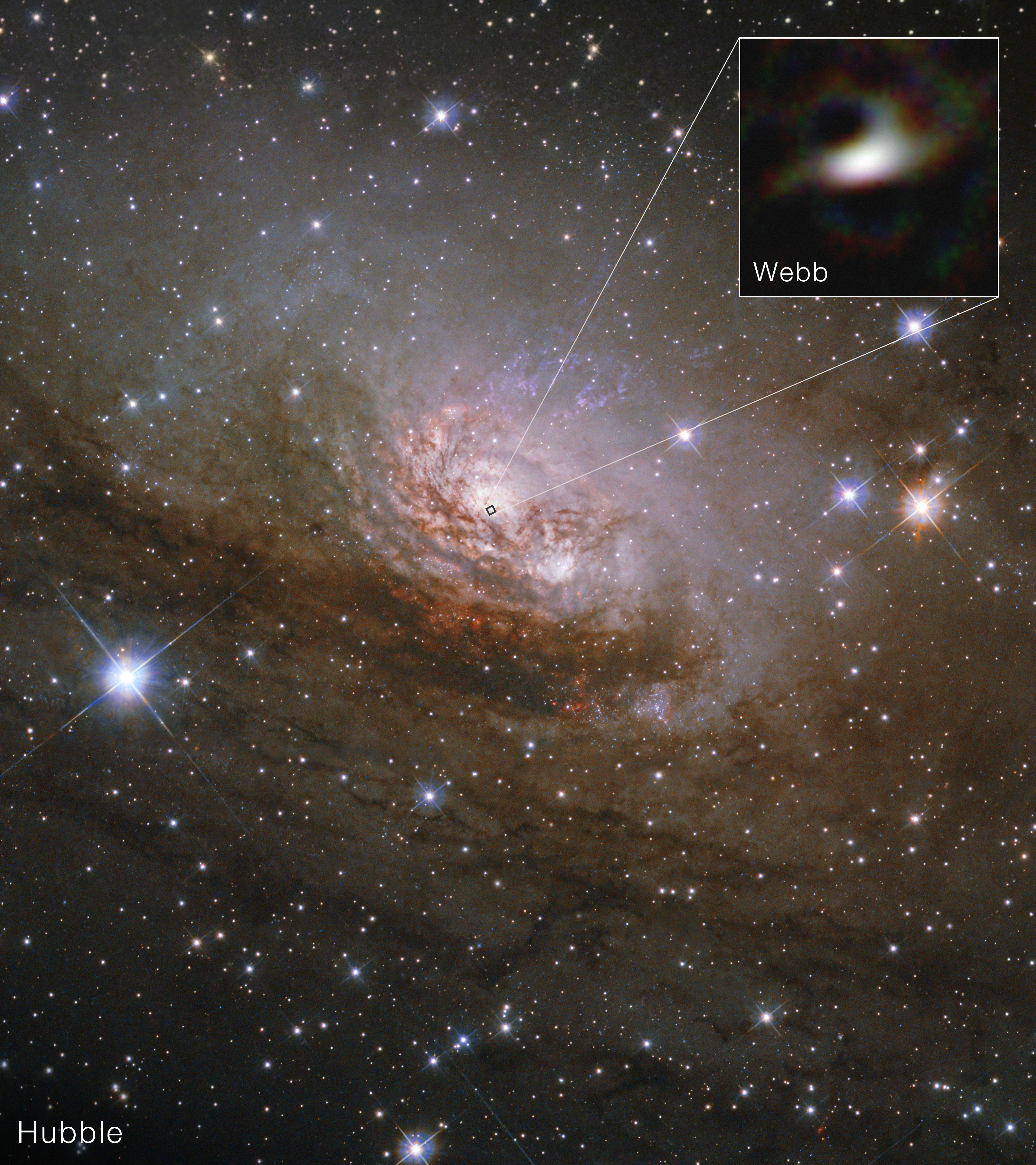
Image: Circinus Galaxy (Hubble and Webb)
This image from NASA’s Hubble Space Telescope shows the Circinus galaxy. A close-up of its core from NASA’s James Webb Space Telescope shows the inner face of the hole of the donut-shaped disk of gas disk glowing in infrared light. The outer ring appears as dark spots.
Image: NASA, ESA, CSA, Enrique Lopez-Rodriguez (University of South Carolina), Deepashri Thatte (STScI); Image Processing: Alyssa Pagan (STScI); Acknowledgment: NSF’s NOIRLab, CTIO
Now, new observations by NASA’s James Webb Space Telescope, seen here with a new image from NASA’s Hubble Space Telescope, provide evidence that reverses this thinking, suggesting that most of the hot, dusty material is actually feeding the central black hole. The technique used to gather this data also has the potential to analyze the outflow and accretion components for other nearby black holes.
The research, which includes the sharpest image of a black hole’s surroundings ever taken by Webb, published Tuesday in Nature.
Outflow question
Supermassive black holes like those in Circinus remain active by consuming surrounding matter. Infalling gas and dust accumulates into a donut-shaped ring around the black hole, known as a torus. As supermassive black holes gather matter from the torus’ inner walls, they form an accretion disk, similar to a whirlpool of water swirling around a drain. This disk grows hotter through friction, eventually becoming hot enough to emit light.
This glowing matter can become so bright that resolving details within the galaxy’s center with ground-based telescopes is difficult. It’s made even harder due to the bright, concealing starlight within Circinus. Further, since the torus is incredibly dense, the inner region of the infalling material, heated by the black hole, is obscured from our point of view. For decades, astronomers contended with these difficulties, designing and improving models of Circinus with as much data as they could gather.
Image: Circinus Galaxy Center (Artist’s Concept)
This artist’s concept depicts the central engine of the Circinus galaxy, visualizing the supermassive black hole fed by a thick, dusty torus that glows in infrared light.
Artwork: NASA, ESA, CSA, Ralf Crawford (STScI)
“In order to study the supermassive black hole, despite being unable to resolve it, they had to obtain the total intensity of the inner region of the galaxy over a large wavelength range and then feed that data into models,” said lead author Enrique Lopez-Rodriguez of the University of South Carolina.
Early models would fit the spectra from specific regions, such as the emissions from the torus, those of the accretion disk closest to the black hole, or those from the outflows, each detected at certain wavelengths of light. However, since the region could not be resolved in its entirety, these models left questions at several wavelengths. For example, some telescopes could detect an excess of infrared light, but lacked the resolution to determine where exactly it was coming from.
“Since the ‘90s, it has not been possible to explain excess infrared emissions that come from hot dust at the cores of active galaxies, meaning the models only take into account either the torus or the outflows, but cannot explain that excess,” said Lopez-Rodriguez.
Such models found that most of the emission (and, therefore, mass) close to the center came from outflows. To test this theory, then, astronomers needed two things: the ability to filter the starlight that previously prevented a deeper analysis, and the ability to distinguish the infrared emissions of the torus from those of the outflows. Webb, sensitive and technologically sophisticated enough to meet both challenges, was necessary to advance our understanding.
Webb’s innovative technique
To look into the center of Circinus, Webb needed the Aperture Masking Interferometer tool on its NIRISS (Near-Infrared Imager and Slitless Spectrograph) instrument.
On Earth, interferometers usually take the form of telescope arrays: mirrors or antennae that work together as if they were a single telescope. An interferometer does this by gathering and combining the light from whichever source it is pointed toward, causing the electromagnetic waves that make up light to “interfere” with each other (hence, “interfere-ometer”) and creating interference patterns. These patterns can be analyzed by astronomers to reconstruct the size, shape, and features of distant objects with much greater detail than non-interferometric techniques.
The Aperture Masking Interferometer allows Webb to become an array of smaller telescopes working together as an interferometer, creating these interference patterns by itself. It does this by utilizing a special aperture made of seven small, hexagonal holes, which, like in photography, controls the amount and direction of light that enters the telescope’s detectors.
“These holes in the mask are transformed into small collectors of light that guide the light toward the detector of the camera and create an interference pattern,” said Joel Sanchez-Bermudez, co-author based at the National University of Mexico.
With new data in hand, the research team was able to construct an image from the central region’s interference patterns. To do so, they referenced data from previous observations to ensure their data from Webb was free of any artifacts. This resulted in the first extragalactic observation from an infrared interferometer in space.
“By using an advanced imaging mode of the camera, we can effectively double its resolution over a smaller area of the sky,” Sanchez-Bermudez said. “This allows us to see images twice as sharp. Instead of Webb’s 6.5-meter diameter, it’s like we are observing this region with a 13-meter space telescope.”
The data showed that contrary to the models predicting that the infrared excess comes from the outflows, around 87% of the infrared emissions from hot dust in Circinus come from the areas closest to the black hole, while less than 1% of emissions come from hot dusty outflows. The remaining 12% comes from distances farther away that could not previously be told apart.
“It is the first time a high-contrast mode of Webb has been used to look at an extragalactic source,” said Julien Girard, paper co-author and senior research scientist at the Space Telescope Science Institute. “We hope our work inspires other astronomers to use the Aperture Masking Interferometer mode to study faint, but relatively small, dusty structures in the vicinity of any bright object.”
Video: Circinus Galaxy Zoom
This zoom-in video shows the location of the Circinus galaxy on the sky. It begins with a ground-based photo of the constellation Circinus by the late astrophotographer Akira Fujii. The video closes in on the Circinus galaxy, using views from the Digitized Sky Survey and the Dark…
While the mystery of Circinus’ excess emissions has been solved, there are billions of black holes in our universe. Those of different luminosities, the team notes, may have an influence on whether most of the emissions come from a black hole’s torus or their outflows.
“The intrinsic brightness of Circinus’ accretion disk is very moderate,” Lopez-Rodriguez said. “So it makes sense that the emissions are dominated by the torus. But maybe, for brighter black holes, the emissions are dominated by the outflow.”
With this research, astronomers now have a tested technique to investigate whichever black holes they want, so long as they are bright enough for the Aperture Masking Interferometer to be useful. Studying additional targets will be essential to building a catalog of emission data to figure out if Circinus’ results were unique or characteristic of a pattern.
“We need a statistical sample of black holes, perhaps a dozen or two dozen, to understand how mass in their accretion disks and their outflows relate to their power,” Lopez-Rodriguez said.
The James Webb Space Telescope is the world’s premier space science observatory. Webb is solving mysteries in our solar system, looking beyond to distant worlds around other stars, and probing the mysterious structures and origins of our universe and our place in it. Webb is an international program led by NASA with its partners, ESA (European Space Agency) and CSA (Canadian Space Agency).
The following sections contain links to download this article’s images and videos in all available resolutions followed by related information links, media contacts, and if available, research paper and spanish translation links.
Related Images & Videos
Circinus Galaxy Center (Artist’s Concept)
This artist’s concept depicts the central engine of the Circinus galaxy, visualizing the supermassive black hole fed by a thick, dusty torus that glows in infrared light.
Circinus Galaxy (Hubble and Webb)
This image from NASA’s Hubble Space Telescope shows the Circinus galaxy. A close-up of its core from NASA’s James Webb Space Telescope shows the inner face of the hole of the donut-shaped disk of gas disk glowing in infrared light. The outer ring appears as dark spots.
Circinus Galaxy (Hubble and Webb Compass Image)
This image shows two views of the Circinus galaxy, one captured by the Hubble Space Telescope and the other by the James Webb Space Telescope’s NIRISS (Near-Infrared Imager and Slitless Spectrograph. It shows compass arrows, scale bar, and color key for reference.
Circinus Galaxy Zoom
This zoom-in video shows the location of the Circinus galaxy on the sky. It begins with a ground-based photo of the constellation Circinus by the late astrophotographer Akira Fujii. The video closes in on the Circinus galaxy, using views from the Digitized Sky Survey and the Dark…
Among other things, the James Webb Space Telescope is designed to get us closer to finding habitable worlds around faraway stars. From its perch a million miles from Earth, Webb's huge gold-coated mirror collects more light than any other telescope put into space.
The Webb telescope, launched in 2021 at a cost of more than $10 billion, has the sensitivity to peer into distant planetary systems and detect the telltale chemical fingerprints of molecules critical to or indicative of potential life, like water vapor, carbon dioxide, and methane. Webb can do this while also observing the oldest observable galaxies in the Universe and studying planets, moons, and smaller objects within our own Solar System.
Naturally, astronomers want to get the most out of their big-budget observatory. That's where NASA's Pandora mission comes in.
This new NASA Hubble Space Telescope image captures a jet of gas from a forming star shooting across the dark expanse. The bright pink and green patches running diagonally through the image are HH 80/81, a pair of Herbig-Haro (HH) objects previously observed by Hubble in 1995. The patch to the upper left is part of HH 81, and the bottom streak is part of HH 80.
Herbig-Haro objects are bright, glowing regions that occur when jets of ionized gas ejected by a newly forming star collide with slower, previously ejected outflows of gas from that star. HH 80/81’s outflow stretches over 32 light-years, making it the largest protostellar outflow known.
Protostars are fed by infalling gas from the surrounding environment, some of which can be seen in residual “accretion disks” orbiting the forming star. Ionized material within these disks can interact with the protostars’ strong magnetic fields, which channel some of the particles toward the pole and outward in the form of jets.
As the jets eject material at high speeds, they can produce strong shock waves when the particles collide with previously ejected gas. These shocks heat the clouds of gas and excite the atoms, causing them to glow in what we see as HH objects.
HH 80/81 are the brightest HH objects known to exist. The source powering these luminous objects is the protostar IRAS 18162-2048. It’s roughly 20 times the mass of the Sun, and it’s the most massive protostar in the entire L291 molecular cloud. From Hubble data, astronomers measured the speed of parts of HH 80/81 to be over 1,000 km/s, the fastest recorded outflow in both radio and visual wavelengths from a young stellar object. Unusually, this is the only HH jet found that is driven by a young, very massive star, rather than a type of young, low-mass star.
The sensitivity and resolution of Hubble’s Wide Field Camera 3 was critical to astronomers, allowing them to study fine details, movements, and structural changes of these objects. The HH 80/81 pair lies 5,500 light-years away within the Sagittarius constellation.
New images added every day between January 12-17, 2026! Follow @NASAHubble on social media for the latest Hubble images and news and see Hubble’s Stellar Construction Zones for more images of young stellar objects.
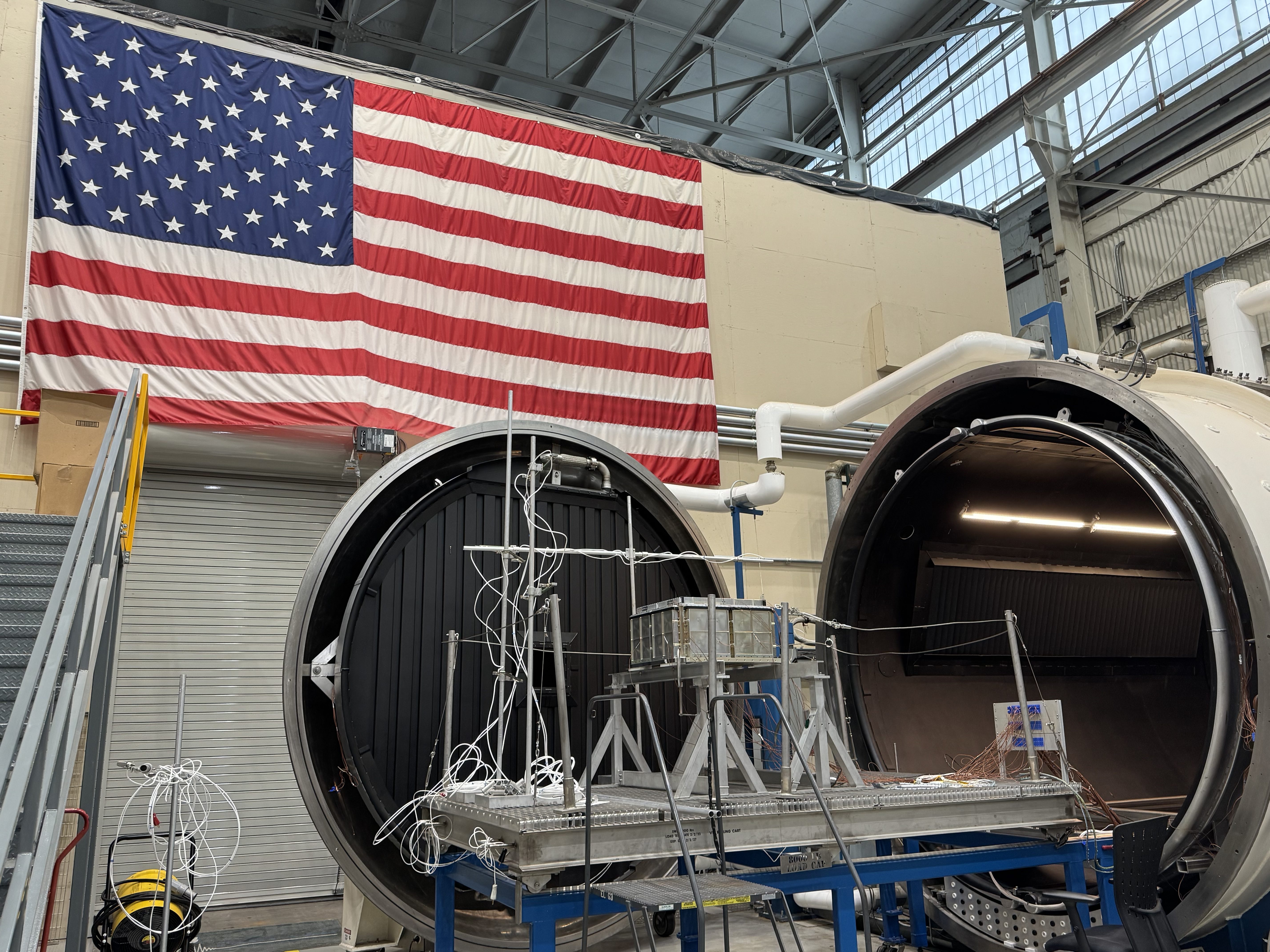
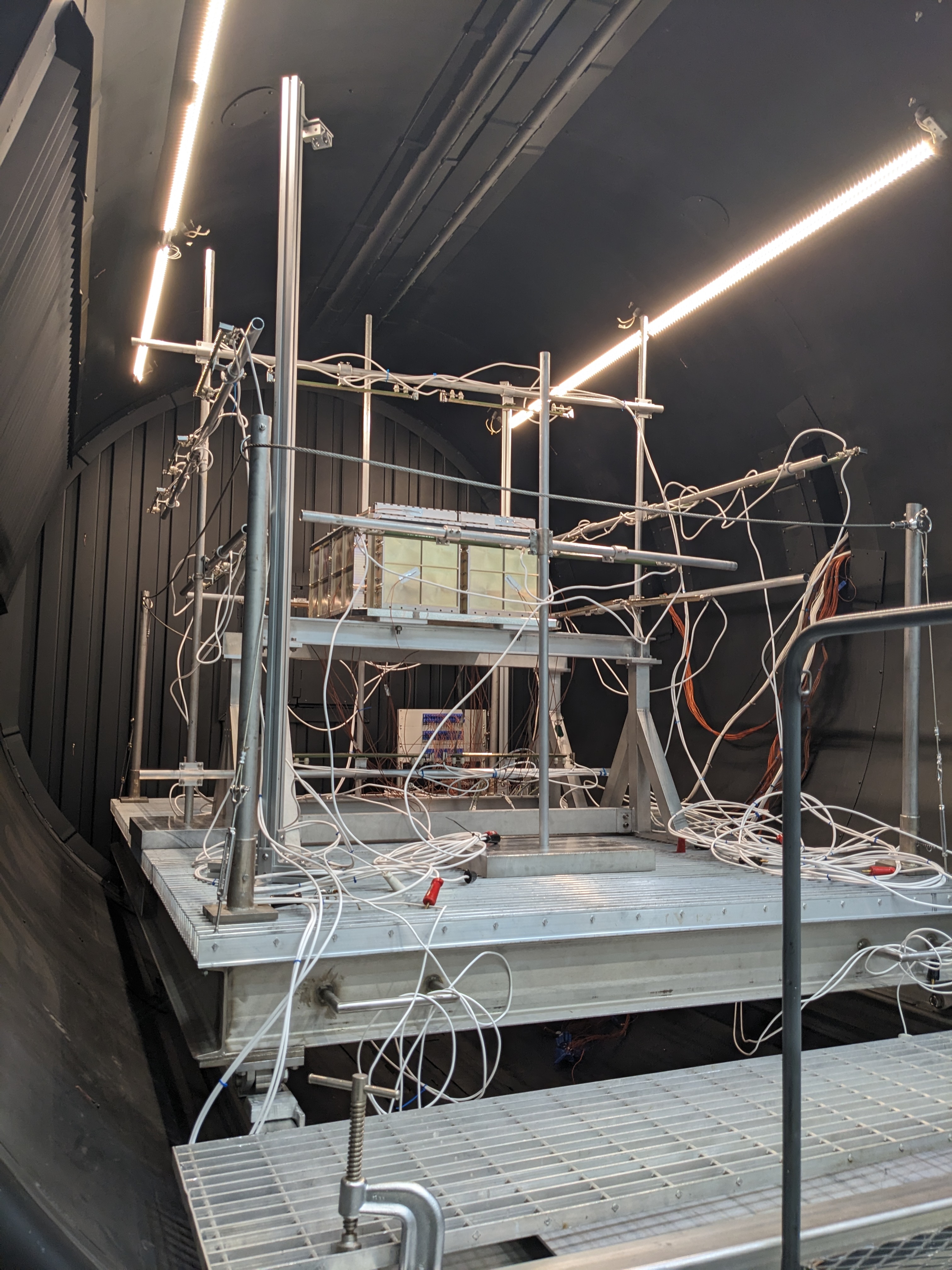
NASA’s StarBurst instrument outside a thermal vacuum chamber at NASA’s Marshall Space Flight Center in Huntsville, Alabama.
NASA/Daniel Kocevski
Heated, cooled, shaken, and settled – NASA’s StarBurst instrument is several steps closer to being ready for launch. The small satellite is now awaiting instrument calibration following a successful integration in Canada and rigorous testing by engineers at the agency’s Marshall Space Flight Center in Huntsville, Alabama.
StarBurst is designed to detect the initial emission of short gamma-ray bursts, some of the most powerful explosions in the universe and a key indicator of neutron star mergers. This would provide valuable insight into such events, which are also detected through gravitational waves by observatories on Earth. These events are where most of the heavy metals in the universe, such as gold and platinum, are formed. To date, only one such event has been observed simultaneously in gravitational waves and gamma-rays; StarBurst is expected to find up to 10 per year.
StarBurst arrived at NASA Marshall in March 2025. During its time at the center, the instrument underwent thermal testing in a vacuum chamber and flight vibration testing.
The team held StarBurst’s nonstop thermal testing in a vacuum chamber, 24 hours a day for 18 days. Technicians placed radioactive material into the vacuum chamber, giving StarBurst the ability to detect gamma-ray signals during the tests.
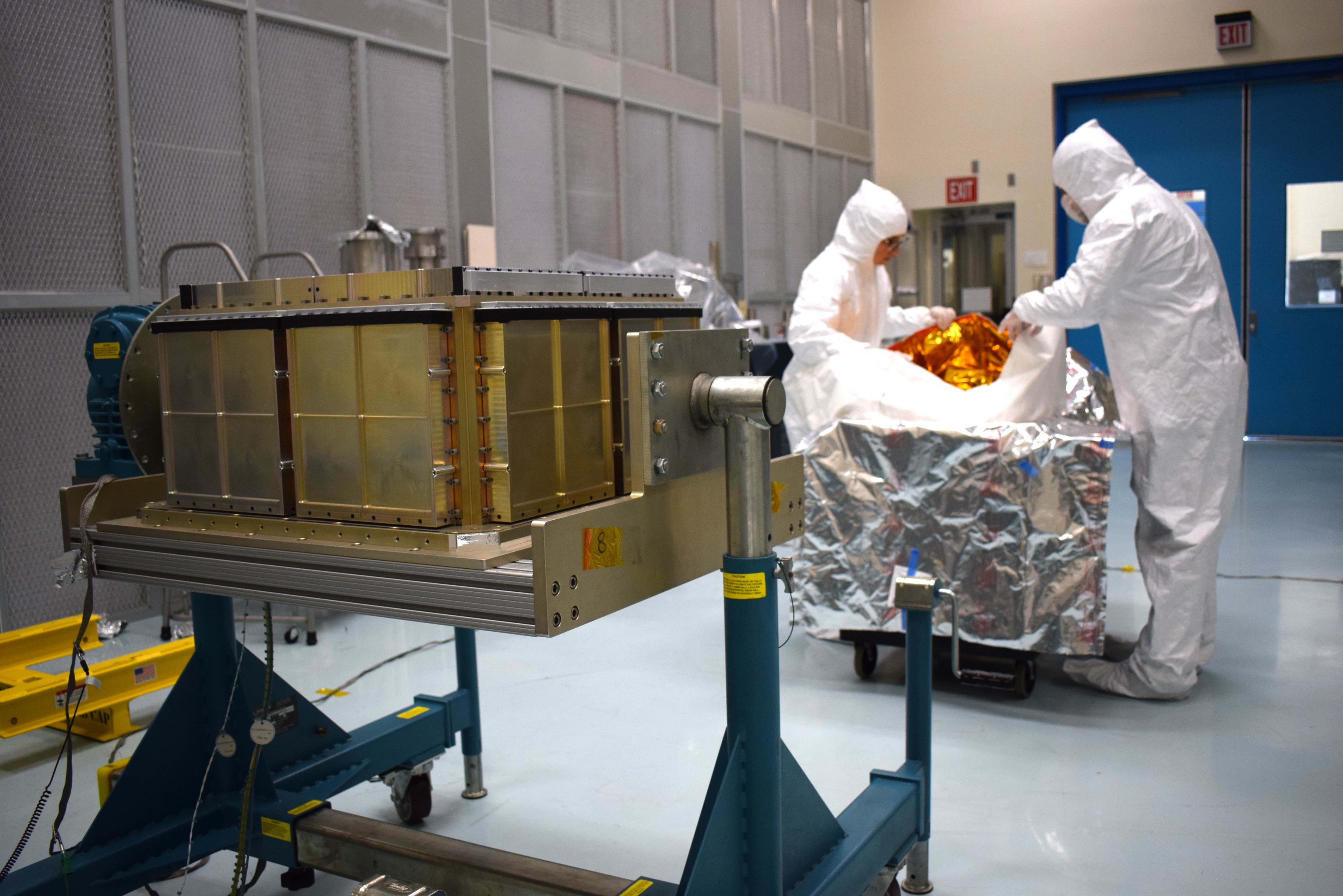
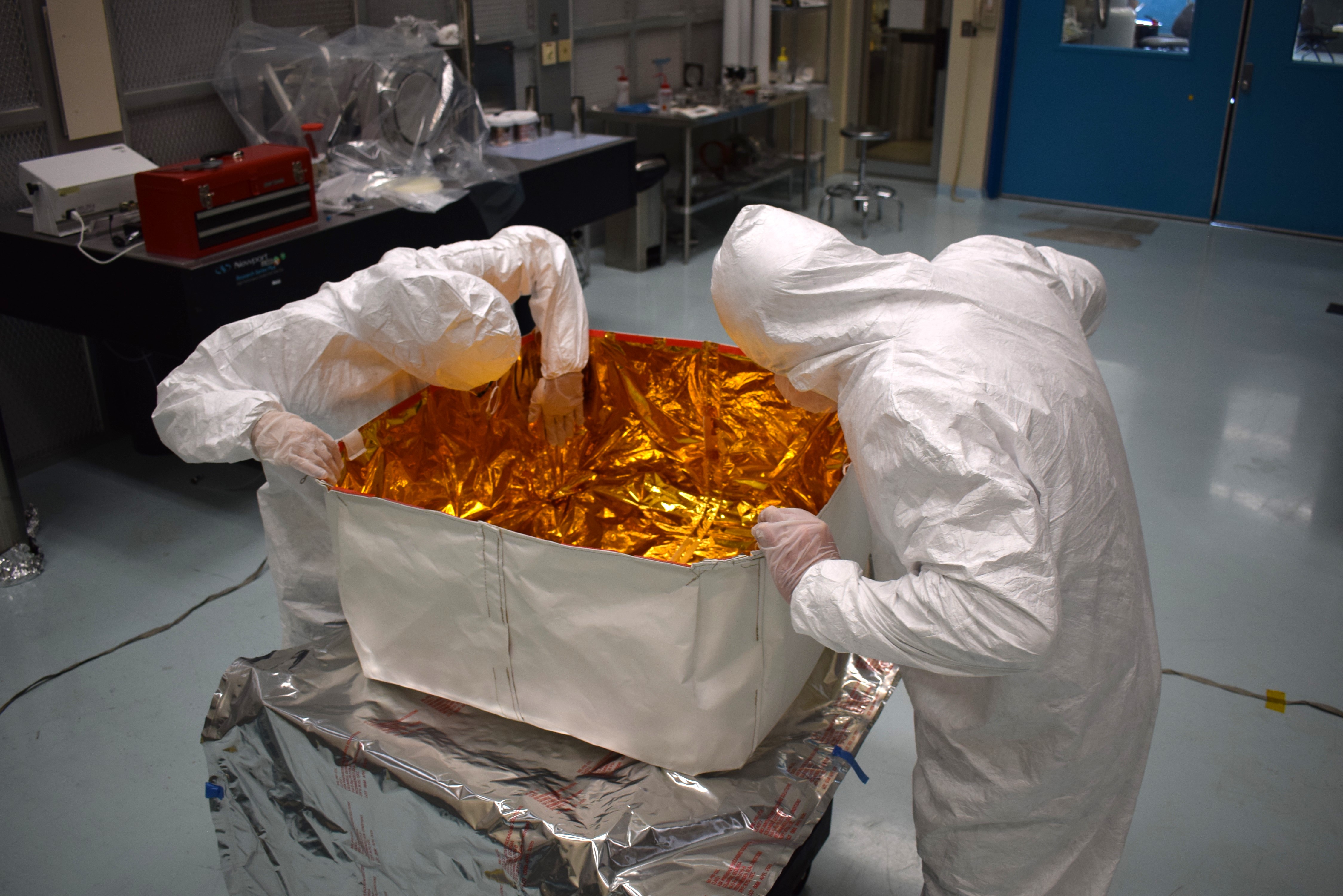
NASA Marshall test engineers fit test the multi-layer insulation blanket in early August at Marshall’s Stray Light Facility. The thermal blanket will insulate the crystal detector units.
NASA/Michael Allen
Test teams conducted thermal balance testing to simulate the hottest and coldest situations the instrument will operate under in space. Data from these tests improves thermal models used by NASA engineers, while also ensuring the satellite can handle these temperatures in orbit.
NASA engineers also completed a 24-hour “bake-out,” a process that removes unwanted gas or vapor from the instrument using extreme heat in a vacuum.
“NASA’s StarBurst mission is ready for its next stage of assembly and is one step closer to flight,” said Daniel Kocevski, principal investigator at NASA Marshall. “Testing at NASA Marshall has verified engineering models, adding our understanding of how StarBurst will operate in space as it observes gamma ray emission from merging neutron stars to help us better understand the building blocks of Earth—and the universe.”
Outside of the vacuum chamber, a “vibe test” bolted the instrument to a special “shaker table” to simulate the vibrations and turbulence StarBurst will experience during launch.
While at NASA Marshall, StarBurst underwent a series of tests in a vacuum chamber
NASA
The Marshall team shipped the StarBurst instrument to Space Flight Laboratory at the University of Toronto, which manufactured the spacecraft bus, in August.
Prior to shipment, teams at Marshall’s Stray Light Facility fit-tested the multi-layer insulation blanket needed to insulate the crystal detector units from the harsh space environment. StarBurst is equipped with 12 of these detectors, which serve as the main gamma-ray detection system on the spacecraft.
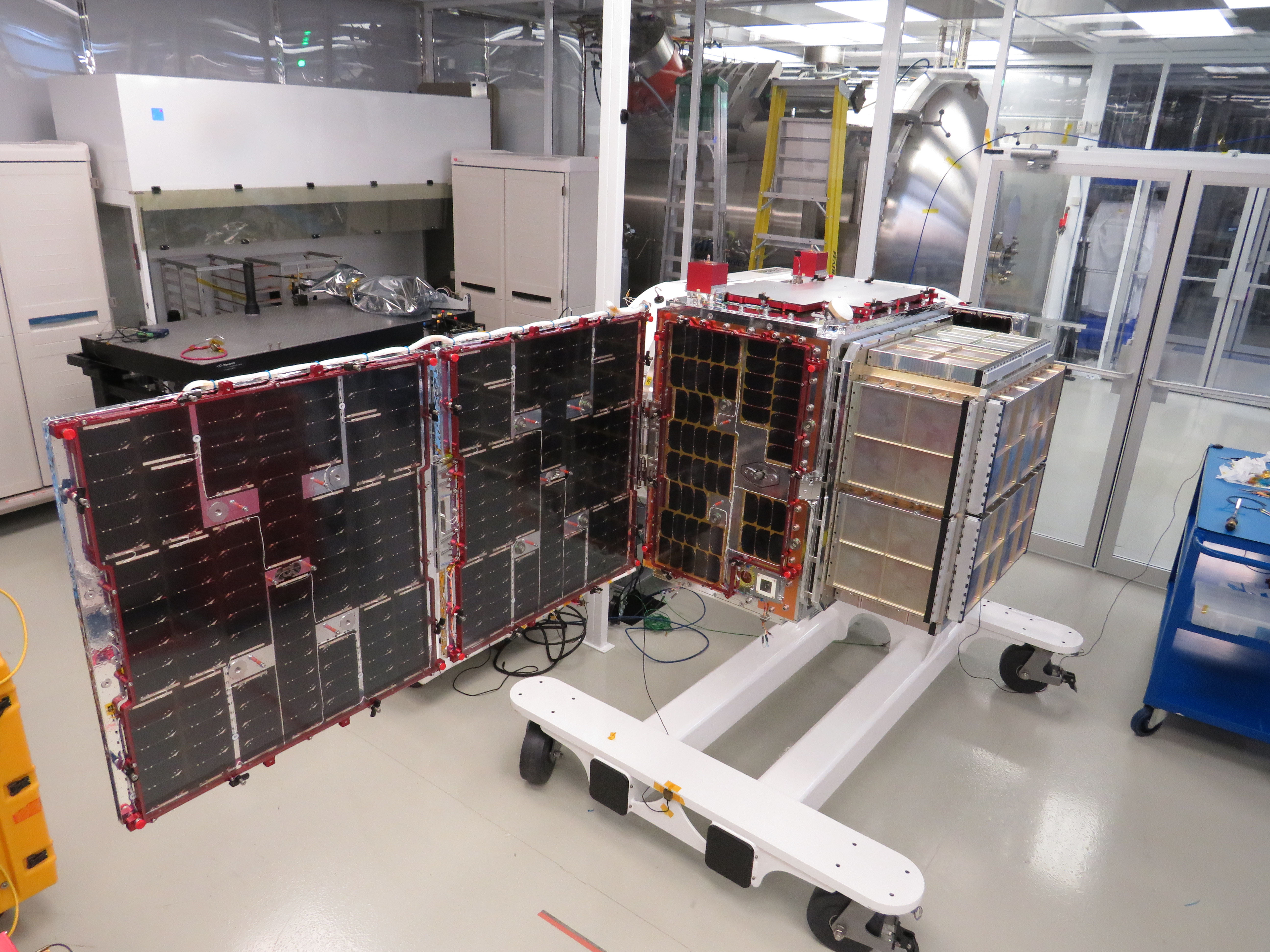
Marshall team members traveled to Toronto and were on hand to help integrate the instrument with the spacecraft bus in early September. Testing at Marshall set the stage for planned post-integration testing, which included functional testing and electromagnetic compatibility testing. StarBurst is scheduled to undergo additional calibration, vibration, and thermal vacuum testing in the spring.
Integration teams intend to have StarBurst launch-ready by June 2026. NASA plans to launch the satellite as early as 2027 during the next run of the Laser-Interferometer Gravitational Wave Observatory to maximize the chance of detecting gamma-ray bursts that coincide with gravitational wave events. To date, such a joint gamma-ray and gravitational-wave detection has been observed only once.
StarBurst was successfully integrated with the spacecraft bus Marshall team members were on hand to help integrate the instrument with the spacecraft bus at the Space Flight Laboratory at the University of Toronto in early September.
NASA
StarBurst is a collaborative effort led by NASA’s Marshall Space Flight Center, with partnerships with the U.S. Naval Research Laboratory, the University of Alabama Huntsville, the Universities Space Research Association, and the University of Toronto Institute for Aerospace Studies Space Flight Laboratory. StarBurst was selected for development as part of the NASA Astrophysics Pioneers program, which supports lower-cost, smaller hardware missions to conduct compelling astrophysics science.
NASA’s Pandora Satellite, CubeSats to Explore Exoplanets, Beyond
Editor’s Note, Jan. 11, 2026: NASA’s Pandora and the NASA-sponsored BlackCAT and SPARCS missions lifted off at 8:44 a.m. EST (5:44 a.m. PST) Sunday, Jan. 11.
A new NASA spacecraft called Pandora is awaiting launch ahead of its journey to study the atmospheres of exoplanets, or worlds beyond our solar system, and their stars.
All three missions are set to launch Jan. 11 on a SpaceX Falcon 9 rocket from Space Launch Complex 4 East at Vandenberg Space Force Base in California. The launch window opens at 8:19 a.m. EST (5:19 a.m. PST). SpaceX will livestream the event.
Artist’s concept of NASA’s Pandora mission, which will help scientists untangle the signals from the atmospheres of exoplanets — worlds beyond our solar system — and their stars.
NASA’s Goddard Space Flight Center/Conceptual Image Lab
“Pandora’s goal is to disentangle the atmospheric signals of planets and stars using visible and near-infrared light,” said Elisa Quintana, Pandora’s principal investigator at NASA’s Goddard Space Flight Center in Greenbelt, Maryland. “This information can help astronomers determine if detected elements and compounds are coming from the star or the planet — an important step as we search for signs of life in the cosmos.”
BlackCAT and SPARCS are small satellites that will study the transient, high-energy universe and the activity of low-mass stars, respectively.
Pandora will observe planets as they pass in front of their stars as seen from our perspective, events called transits.
As starlight passes through a planet’s atmosphere, it interacts with substances like water and oxygen that absorb characteristic wavelengths, adding their chemical fingerprints to the signal.
But while only a small fraction of the star’s light grazes the planet, telescopes also collect the rest of the light emitted by the star’s facing side. Stellar surfaces can sport brighter and darker regions that grow, shrink, and change position over time, suppressing or magnifying signals from planetary atmospheres. Adding a further complication, some of these areas may contain the same chemicals that astronomers hope to find in the planet’s atmosphere, such as water vapor.
All these factors make it difficult to be certain that important detected molecules come from the planet alone.
Pandora will help address this problem by providing in-depth study of at least 20 exoplanets and their host stars during its initial year. The satellite will look at each planet and its star 10 times, with each observation lasting a total of 24 hours. Many of these worlds are among the over 6,000 discovered by missions like NASA’s TESS (Transiting Exoplanet Survey Satellite).
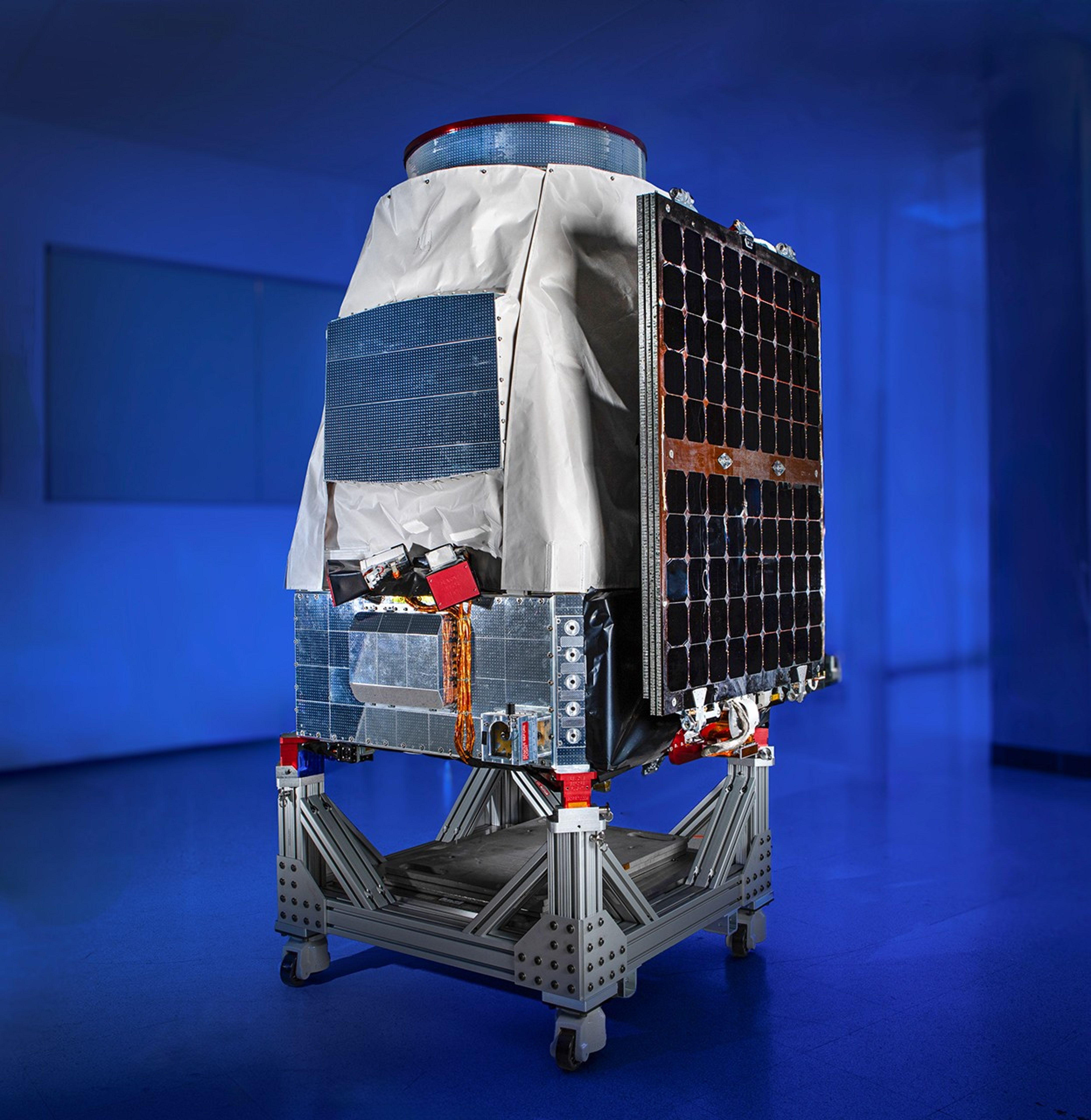
This view of the fully integrated Pandora spacecraft was taken May 19, 2025, following the mission’s successful environmental test campaign at Blue Canyon Technologies in Lafayette, Colorado. Visible are star trackers (center), multilayer insulation blankets (white), the end of the telescope (top), and the solar panel (right) in its launch configuration.
NASA/BCT
Pandora will collect visible and near-infrared light using a novel, all-aluminum 17-inch-wide (45-centimeter) telescope jointly developed by Lawrence Livermore National Laboratory in California and Corning Incorporated in Keene, New Hampshire. Pandora’s near-infrared detector is a spare developed for NASA’s James Webb Space Telescope.
Each long observation period will capture a star’s light both before and during a transit and help determine how stellar surface features impact measurements.
“These intense studies of individual systems are difficult to schedule on high-demand missions, like Webb,” said engineer Jordan Karburn, Pandora’s deputy project manager at Livermore. “You also need the simultaneous multiwavelength measurements to pick out the star’s signal from the planet’s. The long stares with both detectors are critical for tracing the exact origins of elements and compounds scientists consider indicators of potential habitability.”
Pandora is the first satellite to launch in the agency’s Astrophysics Pioneers program, which seeks to do compelling astrophysics at a lower cost while training the next generation of leaders in space science.
After launching into low Earth orbit, Pandora will undergo a month of commissioning before embarking on its one-year prime mission. All the mission’s data will be publicly available.
“The Pandora mission is a bold new chapter in exoplanet exploration,” said Daniel Apai, an astronomy and planetary science professor at the University of Arizona in Tucson where the mission’s operations center resides. “It is the first space telescope built specifically to study, in detail, starlight filtered through exoplanet atmospheres. Pandora’s data will help scientists interpret observations from past and current missions like NASA’s Kepler and Webb space telescopes. And it will guide future projects in their search for habitable worlds.”
Watch to learn more about NASA’s Pandora mission, which will revolutionize the study of exoplanet atmospheres. NASA’s Goddard Space Flight Center
The BlackCAT and SPARCS missions will take off alongside Pandora through NASA’s Astrophysics CubeSat program, the latter supported by the Agency’s CubeSat Launch Initiative.
CubeSats are a class of nanosatellites that come in sizes that are multiples of a standard cube measuring 3.9 inches (10 centimeters) across. Both BlackCAT and SPARCS are 11.8 by 7.8 by 3.9 inches (30 by 20 by 10 centimeters). CubeSats are designed to provide cost-effective access to space to test new technologies and educate early career scientists and engineers while delivering compelling science.
The BlackCAT mission will use a wide-field telescope and a novel type of X-ray detector to study powerful cosmic explosions like gamma-ray bursts, particularly those from the early universe, and other fleeting cosmic events. It will join NASA’s network of missions that watch for these changes. Abe Falcone at Pennsylvania State University in University Park, where the satellite was designed and built, leads the mission with contributions from Los Alamos National Laboratory in New Mexico. Kongsberg NanoAvionics US provided the spacecraft bus.
The SPARCS CubeSat will monitor flares and other activity from low-mass stars using ultraviolet light to determine how they affect the space environment around orbiting planets. Evgenya Shkolnik at Arizona State University in Tempe leads the mission with participation from NASA’s Jet Propulsion Laboratory in Southern California. In addition to providing science support, JPL developed the ultraviolet detectors and the associated electronics. Blue Canyon Technologies fabricated the spacecraft bus.
Pandora is led by NASA Goddard. Livermore provides the mission’s project management and engineering. Pandora’s telescope was manufactured by Corning and developed collaboratively with Livermore, which also developed the imaging detector assemblies, the mission’s control electronics, and all supporting thermal and mechanical subsystems. The near-infrared sensor was provided by NASA Goddard. Blue Canyon Technologies provided the bus and performed spacecraft assembly, integration, and environmental testing. NASA’s Ames Research Center in California’s Silicon Valley will perform the mission’s data processing. Pandora’s mission operations center is located at the University of Arizona, and a host of additional universities support the science team.
Scientists Identify ‘Astronomy’s Platypus’ with NASA’s Webb Telescope
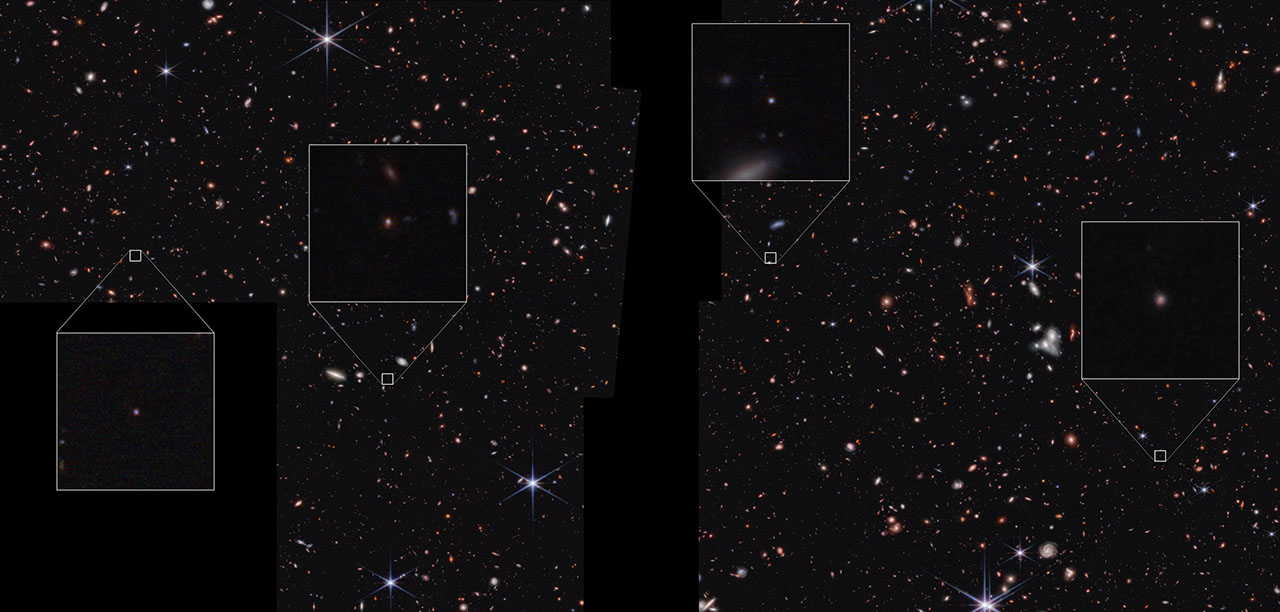
Four of the nine galaxies in the newly identified “platypus” sample were discovered in NASA’s James Webb Space Telescope’s Cosmic Evolution Early Release Science Survey (CEERS). One key feature that makes them distinct is their point-like appearance.
Credits: Image: NASA, ESA, CSA, Steve Finkelstein (UT Austin); Image Processing: Alyssa Pagan (STScI)
After combing through NASA’s James Webb Space Telescope’s archive of sweeping extragalactic cosmic fields, a small team of astronomers at the University of Missouri says they have identified a sample of galaxies that have a previously unseen combination of features. Principal investigator Haojing Yan compares the discovery to an infamous oddball in another branch of science: biology’s taxonomy-defying platypus.
“It seems that we’ve identified a population of galaxies that we can’t categorize, they are so odd. On the one hand they are extremely tiny and compact, like a point source, yet we do not see the characteristics of a quasar, an active supermassive black hole, which is what most distant point sources are,” said Yan.
The research was presented in a press conference at the 247th meeting of the American Astronomical Society in Phoenix.
Image A: Galaxies in CEERS Field (NIRCam image)
Four of the nine galaxies in the newly identified “platypus” sample were discovered in NASA’s James Webb Space Telescope’s Cosmic Evolution Early Release Science Survey (CEERS). One key feature that makes them distinct is their point-like appearance, even to a telescope that can capture as much detail as Webb.
Image: NASA, ESA, CSA, Steve Finkelstein (UT Austin); Image Processing: Alyssa Pagan (STScI)
“I looked at these characteristics and thought, this is like looking at a platypus. You think that these things should not exist together, but there it is right in front of you, and it’s undeniable,” Yan said.
The team whittled down a sample of 2,000 sources across several Webb surveys to identify nine point-like sources that existed 12 to 12.6 billion years ago (compared to the universe’s age of 13.8 billion years). Spectral data gives astronomers more information than they can get from an image alone, and for these nine sources it doesn’t fit existing definitions. They are too far away to be stars in our own galaxy, and too faint to be quasars, which are so brilliant that they outshine their host galaxies. Though the spectra resemble the less distant “green pea” galaxies discovered in 2009, the galaxies in this sample are much more compact.
“Like spectra, the detailed genetic code of a platypus provides additional information that shows just how unusual the animal is, sharing genetic features with birds, reptiles, and mammals,” said Yan. “Together, Webb’s imaging and spectra are telling us that these galaxies have an unexpected combination of features.”
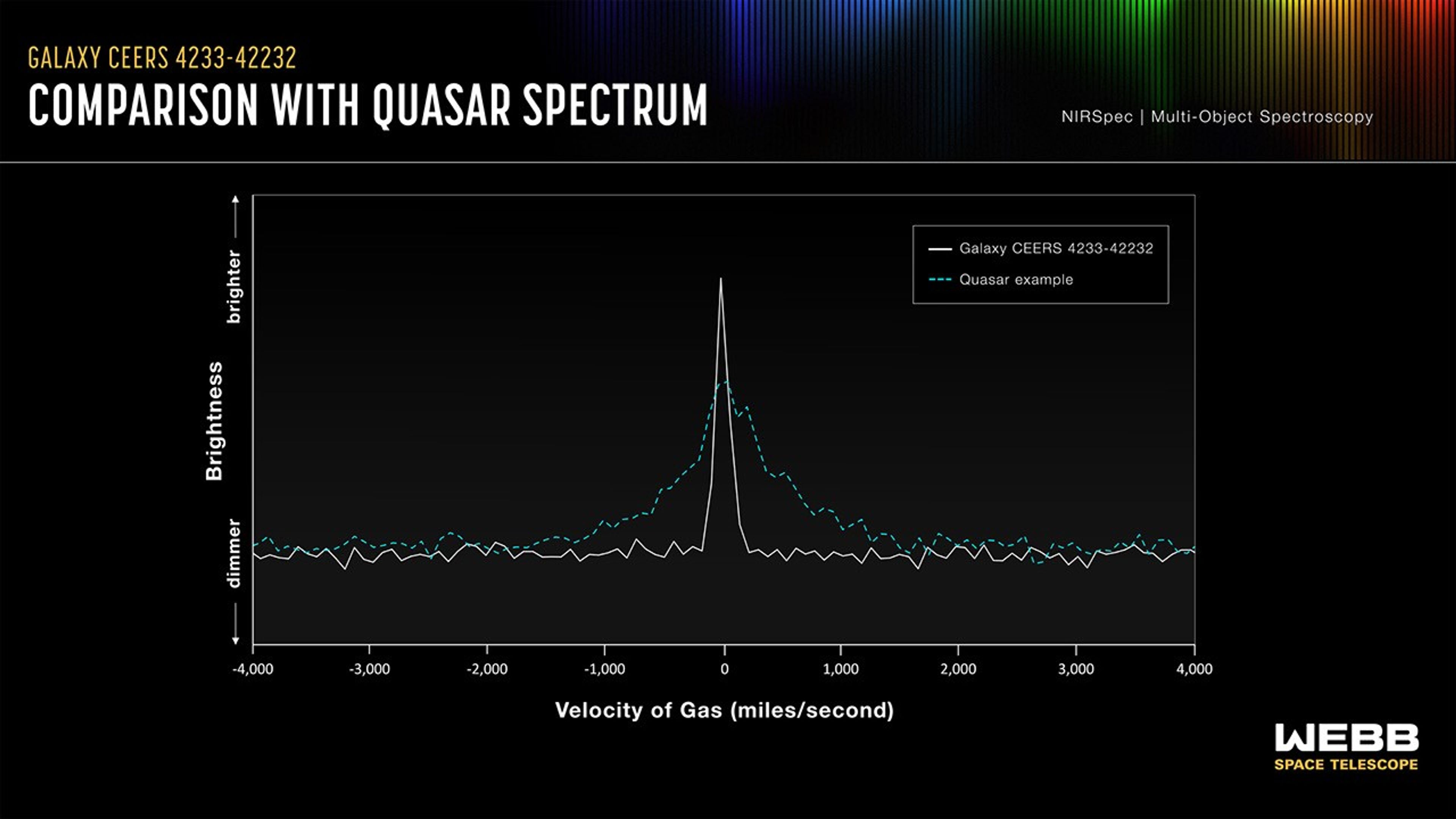
Yan explained that for typical quasars, the peaks in their characteristic spectral emission lines look like hills, with a broad base, indicating the high velocity of gas swirling around their supermassive black hole. Instead, the peaks for the “platypus population” are narrow and sharp, indicating slower gas movement.
While there are narrow-line galaxies that host active supermassive black holes, they do not have the point-like feature of the sample Yan’s team has identified.
Image B: Galaxy CEERS 4233-42232: Comparison With Quasar Spectrum
This graphic illustrates the pronounced narrow peak of the spectra that caught researchers’ attention in a small sample of galaxies, represented here by galaxy CEERS 4233-42232. Typically, distant point-like light sources are quasars, but quasar spectra have a much broader shape.
Illustration: NASA, ESA, CSA, Joseph Olmsted (STScI)
Has Yan’s team discovered a missing link in the cosmos? Once the team determined that the objects didn’t fit the definition of a quasar, graduate student researcher Bangzheng Sun analyzed the data to see if there were signatures of star-forming galaxies.
“From the low-resolution spectra we have, we can’t rule out the possibility that these nine objects are star-forming galaxies. That data fits,” said Sun. “The strange thing in that case is that the galaxies are so tiny and compact, even though Webb has the resolving power to show us a lot of detail at this distance.”
One proposal the team suggests is that Webb, as promised, is revealing earlier stages of galaxy formation and evolution than we have ever been able to see before. It is generally accepted across the astronomy community that large, massive galaxies like our own Milky Way grew by many smaller galaxies merging together. But, Yan asks, what comes before small galaxies?
“I think this new research is presenting us with the question, how does the process of galaxy formation first begin? Can such small, building-block galaxies be formed in a quiet way, before chaotic mergers begin, as their point-like appearance suggests?” Yan said.
To begin answering that question, as well as to determine more about the nature of their odd platypuses, the team says they need a much larger sample than nine to analyze, and with higher-resolution spectra.
“We cast a wide net, and we found a few examples of something incredible. These nine objects weren’t the focus; they were just in the background of broad Webb surveys,” said Yan. “Now it’s time to think about the implications of that, and how we can use Webb’s capabilities to learn more.”
The James Webb Space Telescope is the world’s premier space science observatory. Webb is solving mysteries in our solar system, looking beyond to distant worlds around other stars, and probing the mysterious structures and origins of our universe and our place in it. Webb is an international program led by NASA with its partners, ESA (European Space Agency) and CSA (Canadian Space Agency).
The following sections contain links to download this article’s images and videos in all available resolutions followed by related information links, media contacts, and if available, research paper and spanish translation links.
Related Images & Videos
Galaxies in CEERS Field (NIRCam image)
Four of the nine galaxies in the newly identified “platypus” sample were discovered in NASA’s James Webb Space Telescope’s Cosmic Evolution Early Release Science Survey” (CEERS). One key feature that makes them distinct is their point-like appearance.
Galaxy CEERS 4233-42232: Comparison With Quasar Spectrum
This graphic illustrates the pronounced narrow peak of the spectra that caught researchers’ attention in a small sample of galaxies, represented here by galaxy CEERS 4233-42232. Typically, distant point-like light sources are quasars, but quasar spectra have a much broader shape.
NASA Webb Finds Early-Universe Analog’s Unexpected Talent for Making Dust
Images from NASA’s James Webb Space Telescope of the dwarf galaxy Sextans A reveal polycyclic aromatic hydrocarbons (PAHs), large carbon-based molecules that can be a signifier of star formation. The inset at the top right zooms in on those PAHs, which are represented in green.
Credits: Image: NASA, ESA, CSA, Elizabeth Tarantino (STScI), Martha Boyer (STScI), Julia Roman-Duval (STScI); Image Processing: Alyssa Pagan (STScI)
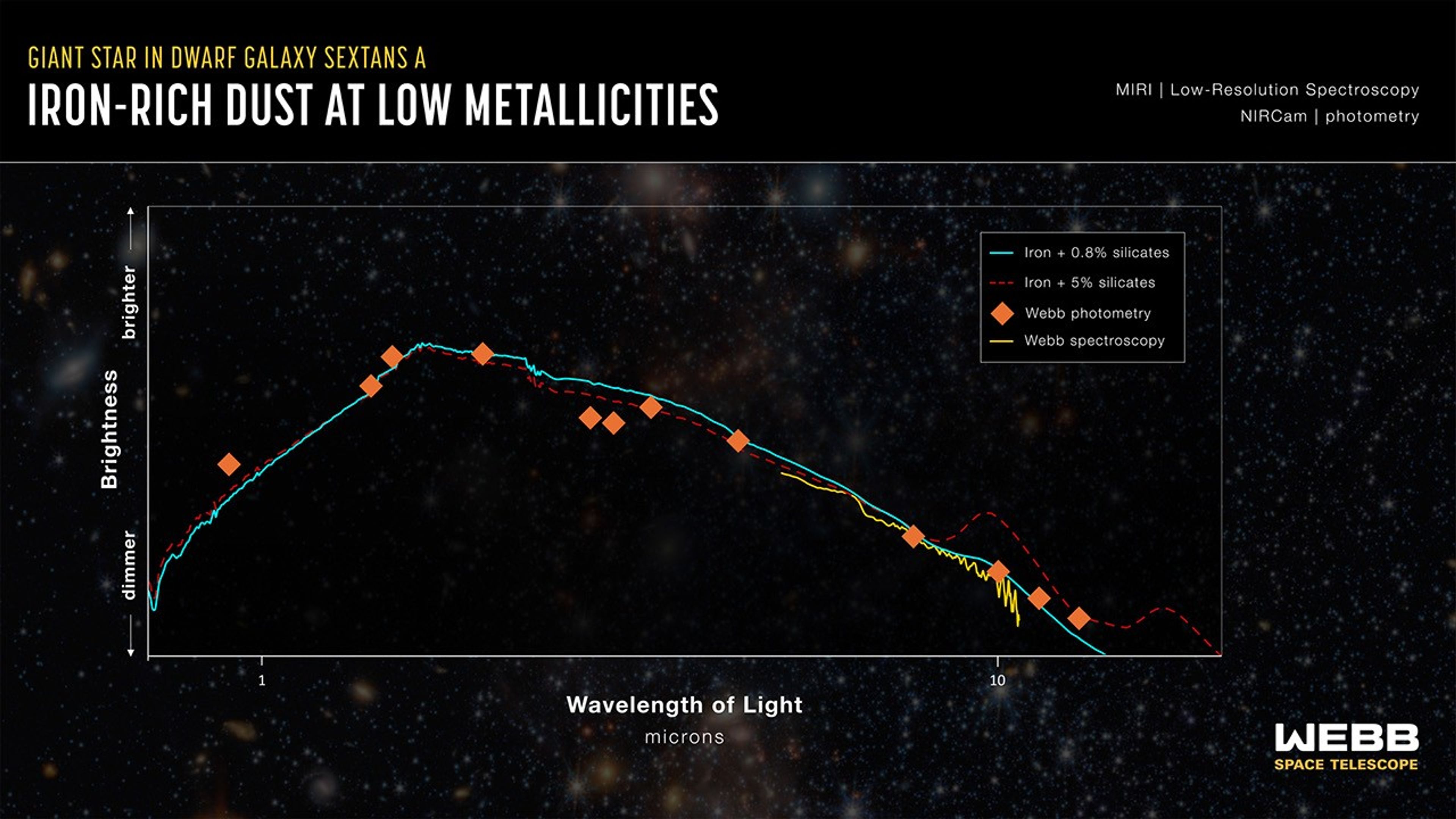
Using NASA’s James Webb Space Telescope, astronomers have spotted two rare kinds of dust in the dwarf galaxy Sextans A, one of the most chemically primitive galaxies near the Milky Way. The finding of metallic iron dust and silicon carbide (SiC) produced by aging stars, along with tiny clumps of carbon-based molecules, shows that even when the universe had only a fraction of today’s heavy elements, stars and the interstellar medium could still forge solid dust grains. This research with Webb is reshaping ideas about how early galaxies evolved and developed the building blocks for planets, as NASA explores the secrets of the universe and our place in it.
Sextans A lies about 4 million light-years away and contains only 3 to 7 percent of the Sun’s metal content, or metallicity, the astrophysical term for elements heavier than hydrogen and helium. Because the galaxy is so small, unlike other nearby galaxies, its gravitational pull is too weak to retain the heavy elements like iron and oxygen created by supernovae and aging stars.
Galaxies like it resemble those that filled the early universe just after the big bang, when the universe was made of mostly hydrogen and helium, before stars had time to enrich space with ‘metals.’ Because it is relatively close, Sextans A gives astronomers a rare chance to study individual stars and interstellar clouds under conditions similar to those shortly after the big bang.
“Sextans A is giving us a blueprint for the first dusty galaxies,” said Elizabeth Tarantino, postdoctoral researcher at the Space Telescope Science Institute and lead author of the results in one of the two studies presented at a press conference at the 247th meeting of the American Astronomical Society in Phoenix. “These results help us interpret the most distant galaxies imaged by Webb and understand what the universe was building with its earliest ingredients.”
Image A: Sextans A PAHs Pull-out (NIRCam and MIRI Image)
Images from NASA’s James Webb Space Telescope of the dwarf galaxy Sextans A reveal polycyclic aromatic hydrocarbons (PAHs), large carbon-based molecules that can be a signifier of star formation. The inset at the top right zooms in on those PAHs, which are represented in green.
Image: NASA, ESA, CSA, Elizabeth Tarantino (STScI), Martha Boyer (STScI), Julia Roman-Duval (STScI); Image Processing: Alyssa Pagan (STScI)
Forging dust without usual ingredients
One of those studies, published in the Astrophysical Journal, honed in on a half a dozen stars with the low-resolution spectrometer aboard Webb’s MIRI (Mid-Infrared Instrument). The data collected shows the chemical fingerprints of the bloated stars very late in their evolution, called asymptotic giant branch (AGB) stars. Stars with masses between one and eight times that of the Sun pass through this phase.
“One of these stars is on the high-mass end of the AGB range, and stars like this usually produce silicate dust. However, at such low metallicity, we expect these stars to be nearly dust-free,” said Martha Boyer, associate astronomer at the Space Telescope Science Institute and lead author in that second companion study. “Instead, Webb revealed a star forging dust grains made almost entirely of iron. This is something we’ve never seen in stars that are analogs of stars in the early universe.”
Silicates, the usual dust formed by oxygen-rich stars, require elements like silicon and magnesium that are almost nonexistent in Sextans A. It would be like trying to bake cookies in a kitchen without flour, sugar, and butter.
A normal cosmic kitchen, like the Milky Way, has those crucial ingredients in the form of silicon, carbon, and iron. In a primitive kitchen, like Sextans A, where almost all of those ingredients are missing, you barely have any proverbial flour or sugar. Therefore, astronomers expected that without those key ingredients, stars in Sextans A couldn’t “bake” much dust at all.
However, not only did they find dust, but Webb showed that one of these stars used an entirely different recipe than usual to make that dust.
The iron-only dust, as well as silicon carbide produced by the less massive AGB stars despite the galaxy’s low silicon abundance, proves that evolved stars can still build solid material even when the typical ingredients are missing.
“Dust in the early universe may have looked very different from the silicate grains we see today,” Boyer said. “These iron grains absorb light efficiently but leave no sharp spectral fingerprints and can contribute to the large dust reservoirs seen in far-away galaxies detected by Webb.”
Image B: Sextans A Context Image (Webb and KPNO)
NASA’s James Webb Space Telescope’s image of a portion of the nearby Sextans A galaxy is put into context using a ground-based image from the Nicholas U. Mayall 4-meter Telescope at Kitt Peak National Observatory.
Image: STScI, NASA, ESA, CSA, KPNO, NSF’s NOIRLab, AURA, Elizabeth Tarantino (STScI), Phil Massey (Lowell Obs.), George Jacoby (NSF, AURA), Chris Smith (NSF, AURA); Image Processing: Alyssa Pagan (STScI), Travis Rector (UAA), Mahdi Zamani (NSF’s NOIRLab), Davide De Martin (NSF’s NOIRLab)
Tiny clumps of organic molecules
In the companion study, currently under peer review, Webb imaged Sextans A’s interstellar medium and discovered polycyclic aromatic hydrocarbons (PAHs), which are complex, carbon-based molecules and the smallest dust grains that glow in infrared light. The discovery means Sextans A is now the lowest-metallicity galaxy ever found to contain PAHs.
But, unlike the broad, sweeping PAH emission seen in metal-rich galaxies, Webb revealed PAHs in tiny, dense pockets only a few light-years across.
“Webb shows that PAHs can form and survive even in the most metal-starved galaxies, but only in small, protected islands of dense gas,” said Tarantino.
The clumps likely represent regions where dust shielding and gas density reach just high enough to allow PAHs to form and grow, solving a decades-long mystery about why PAHs seem to vanish in metal-poor galaxies.
The team has an approved Webb Cycle 4 program to use high-resolution spectroscopy to study the detailed chemistry of Sextans A’s PAH clumps further.
Image C: Giant Star in Dwarf Galaxy Sextans A (Spectrum)
This graph shows a spectrum of an Asymptotic Giant Branch (AGB) star in the Sextans A galaxy. It compares data collected by NASA’s James Webb Space Telescope with models of mostly silicate-free dust and dust containing at least 5% silicates.
Illustration: NASA, ESA, CSA, STScI, Joseph Olmsted (STScI)
Connecting two discoveries
Together, the results show that the early universe had more diverse dust production pathways than the more established and proven methods, like supernova explosions. Additionally, researchers now know there’s more dust than predicted at extremely low metallicities.
“Every discovery in Sextans A reminds us that the early universe was more inventive than we imagined,” said Boyer. “Clearly stars found a way to make the building blocks of planets long before galaxies like our own existed.”
The James Webb Space Telescope is the world’s premier space science observatory. Webb is solving mysteries in our solar system, looking beyond to distant worlds around other stars, and probing the mysterious structures and origins of our universe and our place in it. Webb is an international program led by NASA with its partners, ESA (European Space Agency) and CSA (Canadian Space Agency).
The following sections contain links to download this article’s images and videos in all available resolutions followed by related information links, media contacts, and if available, research paper and spanish translation links.
Related Images & Videos
Sextans A PAHs Pull-out (NIRCam and MIRI Image)
Images from NASA’s James Webb Space Telescope of the dwarf galaxy Sextans A reveal polycyclic aromatic hydrocarbons (PAHs), large carbon-based molecules that can be a signifier of star formation. The inset at the top right zooms in on those PAHs, which are represented in green.
Sextans A Context Image (Webb and KPNO)
NASA’s James Webb Space Telescope’s image of a portion of the nearby Sextans A galaxy is put into context using a ground-based image from the Nicholas U. Mayall 4-meter Telescope at Kitt Peak National Observatory.
Sextans A PAHs Pull-out (Compass Image)
This image of dwarf galaxy Sextans A, captured by NASA’s James Webb Space Telescope’s Near Infrared Camera (NIRCam) and Mid-Infrared Instrument (MIRI), shows compass arrows, scale bar, and color key for reference.
Giant Star in Dwarf Galaxy Sextans A (Spectrum)
This graph shows a spectrum of an Asymptotic Giant Branch (AGB) star in the Sextans A galaxy. It compares data collected by NASA’s James Webb Space Telescope with models of mostly silicate-free dust and dust containing at least 5% silicates.
This artist’s concept depicts a smaller white dwarf star pulling material from a larger star, right, into an accretion disk. Earlier this year, scientists used NASA’s IXPE (Imaging X-ray Polarization Explorer) to study a white dwarf star and its X-ray polarization.
MIT/Jose-Luis Olivares
By Michael Allen
For the first time, scientists have used NASA’s IXPE (Imaging X-ray Polarization Explorer) to study a white dwarf star. Using IXPE’s unique X-ray polarization capability, astronomers examined a star called the intermediate polar EX Hydrae, unlocking the geometry of energetic binary systems.
In 2024, IXPE spent nearly one week focused on EX Hydrae, a white dwarf star system located in the constellation Hydra, approximately 200 light-years from Earth. A paper about the results published in the Astrophysical Journal. Astrophysics research scientists based at the Massachusetts Institute of Technology in Cambridge led the study, along with co-authors at the University of Iowa, East Tennessee State University, University of Liége, and Embry Riddle Aeronautical University.
A white dwarf star occurs after a star runs out of hydrogen fuel to fuse in its core but is not massive enough to explode as core-collapse supernovae. What remains is very dense, roughly the same diameter as Earth with as much mass as our Sun.
EX Hydrae is in a binary system with a main sequence companion star, from which gas is continuously falling onto the white dwarf. How exactly the white dwarf is accumulating, or accreting, this matter and where it arrives on the white dwarf depends on the strength of the white dwarf star’s magnetic field.
In the case of EX Hydrae, its magnetic field is not strong enough to focus matter completely at the star’s poles. But, it is still rapidly adding mass to the accretion disk, earning the classification “intermediate polars.
In an intermediate polar system, material forms an accretion disk while also being pulled towards its magnetic poles. During this phenomenon, matter reaches tens of millions of degrees Fahrenheit, bouncing off other material bound to the white dwarf star, creating large columns of gas that emit high-energy X-rays – a cosmic situation perfect for IXPE to study.
“NASA IXPE’s one-of-a-kind polarimetry capability allowed us to measure the height of the accreting column from the white dwarf star to be almost 2,000 miles high – without as many assumptions required as past calculations,” said Sean Gunderson, MIT scientist and lead author on the paper. “The X-rays we observed likely scattered off the white dwarf’s surface itself. These features are far smaller than we could hope to image directly and clearly show the power of polarimetry to ‘see’ these sources in detail never before possible.”
Information from IXPE’s polarization data of EX Hydrae will help scientists understand other highly energetic binary systems.
More about IXPE
The IXPE mission, which continues to provide unprecedented data enabling groundbreaking discoveries about celestial objects across the universe, is a joint NASA and Italian Space Agency mission with partners and science collaborators in 12 countries. It is led by NASA’s Marshall Space Flight Center in Huntsville, Alabama. BAE Systems, Inc., headquartered in Falls Church, Virginia, manages spacecraft operations together with the University of Colorado’s Laboratory for Atmospheric and Space Physics in Boulder. Learn more about IXPE’s ongoing mission here:
NASA Hubble Helps Detect ‘Wake’ of Betelgeuse’s Elusive Companion Star
This artist’s concept shows the red supergiant star Betelgeuse and an orbiting companion star.
Credits: Artwork: NASA, ESA, Elizabeth Wheatley (STScI); Science: Andrea Dupree (CfA)
Using new observations from NASA’s Hubble Space Telescope and ground-based observatories, astronomers tracked the influence of a recently discovered companion star, Siwarha, on the gas around Betelgeuse. The research, from scientists at the Center for Astrophysics | Harvard & Smithsonian (CfA), reveals a trail of dense gas swirling through Betelgeuse’s vast, extended atmosphere, shedding light on why the giant star’s brightness and atmosphere have changed in strange and unusual ways.
The results of the new study were presented Monday at a news conference at the 247th meeting of the American Astronomical Society in Phoenix and are accepted for publication in The Astrophysical Journal.
The team detected Siwarha’s wake by carefully tracking changes in the star’s light over nearly eight years. These changes show the effects of the previously unconfirmed companion as it plows through the outer atmosphere of Betelgeuse. This discovery resolves one of the biggest mysteries about the giant star, helping scientists to explain how it behaves and evolves while opening new doors to understanding other massive stars nearing the end of their lives.
Located roughly 650 light-years away from Earth in the constellation Orion, Betelgeuse is a red supergiant star so large that more than 400 million Suns could fit inside. Because of its enormous size and proximity, Betelgeuse is one of the few stars whose surface and surrounding atmosphere can be directly observed by astronomers, making it an important and accessible laboratory for studying how giant stars age, lose mass, and eventually explode as supernovae.
This artist’s concept shows the red supergiant star Betelgeuse and an orbiting companion star. The companion, which is orbiting clockwise from this point of view, generates a dense wake of gas that expands outward. It is so close to Betelgeuse that it is passing through the extended outer atmosphere of the supergiant. The companion star is not to scale; it would be a pinprick compared to Betelgeuse, which is hundreds of times larger. The companion’s distance from Betelgeuse is to scale relative to the diameter of Betelgeuse.
Artwork: NASA, ESA, Elizabeth Wheatley (STScI); Science: Andrea Dupree (CfA)
Using NASA’s Hubble and ground-based telescopes at the Fred Lawrence Whipple Observatory and Roque de Los Muchachos Observatory, the team was able to see a pattern of changes in Betelgeuse, which provided clear evidence of a long-suspected companion star and its impact on the red supergiant’s outer atmosphere. Those include changes in the star’s spectrum, or the specific colors of light given off by different elements, and the speed and direction of gases in the outer atmosphere due to a trail of denser material, or wake. This trail appears just after the companion crosses in front of Betelgeuse every six years, or about 2,100 days, confirming theoretical models.
“It’s a bit like a boat moving through water. The companion star creates a ripple effect in Betelgeuse’s atmosphere that we can actually see in the data,” said Andrea Dupree, an astronomer at the CfA, and the lead study author. “For the first time, we’re seeing direct signs of this wake, or trail of gas, confirming that Betelgeuse really does have a hidden companion shaping its appearance and behavior.”
For decades, astronomers have tracked changes in Betelgeuse’s brightness and surface features in hopes of figuring out why the star behaves the way it does. Curiosity intensified after the giant star appeared to “sneeze” and became unexpectedly faint in 2020. Two distinct periods of variation in the star were especially puzzling for scientists: a short 400-day cycle, recently attributed to pulsations within the star itself, and the long, 2,100-day secondary period.
Scientists used NASA’s Hubble Space Telescope to look for evidence of a wake being generated by a companion star orbiting Betelgeuse. The team found a noticeable difference in light shown in the lefthand peak when the companion star was at different points in its orbit.
Illustration: NASA, ESA, Elizabeth Wheatley (STScI); Science: Andrea Dupree (CfA)
Until now, scientists have considered everything from large convection cells and clouds of dust to magnetic activity, and the possibility of a hidden companion star. Recent studies concluded that the long secondary period was best explained by the presence of a low-mass companion orbiting deep within Betelgeuse’s atmosphere, and another team of scientists reported a possible detection, but until now, astronomers lacked the evidence to prove what they believed was happening. Now, for the first time, they have firm evidence that a companion is disrupting the atmosphere of this supergiant star.
“The idea that Betelgeuse had an undetected companion has been gaining in popularity for the past several years, but without direct evidence, it was an unproven theory,” said Dupree. “With this new direct evidence, Betelgeuse gives us a front-row seat to watch how a giant star changes over time. Finding the wake from its companion means we can now understand how stars like this evolve, shed material, and eventually explode as supernovae.”
With Betelgeuse now eclipsing its companion from our point of view, astronomers are planning new observations for its next emergence in 2027. This breakthrough may also help explain similar mysteries in other giant and supergiant stars.
The Hubble Space Telescope has been operating for over three decades and continues to make ground-breaking discoveries that shape our fundamental understanding of the universe. Hubble is a project of international cooperation between NASA and ESA (European Space Agency). NASA’s Goddard Space Flight Center in Greenbelt, Maryland, manages the telescope and mission operations. Lockheed Martin Space, based in Denver, also supports mission operations at Goddard. The Space Telescope Science Institute in Baltimore, which is operated by the Association of Universities for Research in Astronomy, conducts Hubble science operations for NASA.
Betelgeuse and Wake of its Companion Star (Artist’s Concept)
This artist’s concept shows the red supergiant star Betelgeuse and an orbiting companion star. The companion, which is orbiting clockwise from this point of view, generates a dusty wake that expands outward.
Betelgeuse: Effect of Companion Star Wake
Scientists used NASA’s Hubble Space Telescope to look for evidence of a wake being generated by a companion star orbiting Betelgeuse. The team found a noticeable difference in light shown in the lefthand peak when the companion star was at different points in its orbit.
NASA’s Hubble Examines Cloud-9, First of New Type of Object
Magenta is radio data from the ground-based Very Large Array showing the presence of Cloud-9. The dashed circle marks the peak of radio emission, which is where researchers focused their search for stars. Hubble found no stars within Cloud-9. The few objects within its boundaries are background galaxies.
Credits: NASA, ESA, VLA, Gagandeep Anand (STScI), Alejandro Benitez-Llambay (University of Milano-Bicocca); Image Processing: Joseph DePasquale (STScI)
A team using NASA’s Hubble Space Telescope has uncovered a new type of astronomical object — a starless, gas-rich, dark-matter cloud considered a “relic” or remnant of early galaxy formation. Nicknamed “Cloud-9,” this is the first confirmed detection of such an object in the universe — a finding that furthers the understanding of galaxy formation, the early universe, and the nature of dark matter itself.
“This is a tale of a failed galaxy,” said the program’s principal investigator, Alejandro Benitez-Llambay of the Milano-Bicocca University in Milan, Italy. “In science, we usually learn more from the failures than from the successes. In this case, seeing no stars is what proves the theory right. It tells us that we have found in the local universe a primordial building block of a galaxy that hasn’t formed.”
“This cloud is a window into the dark universe,” said team member Andrew Fox of the Association of Universities for Research in Astronomy/Space Telescope Science Institute (AURA/STScI) for the European Space Agency. “We know from theory that most of the mass in the universe is expected to be dark matter, but it’s difficult to detect this dark material because it doesn’t emit light. Cloud-9 gives us a rare look at a dark-matter-dominated cloud.”
This image shows the location of Cloud-9, which is 14 million light-years from Earth. The diffuse magenta is radio data from the ground-based Very Large Array (VLA) showing the presence of the cloud. The dashed circle marks the peak of radio emission, which is where researchers focused their search for stars. Follow-up observations by the Hubble Space Telescope’s Advanced Camera for Surveys found no stars within the cloud. The few objects that appear within its boundaries are background galaxies. Before the Hubble observations, scientists could argue that Cloud-9 is a faint dwarf galaxy whose stars could not be seen with ground-based telescopes due to the lack of sensitivity. Hubble’s Advanced Camera for Surveys shows that, in reality, the failed galaxy contains no stars.
Science: NASA, ESA, VLA, Gagandeep Anand (STScI), Alejandro Benitez-Llambay (University of Milano-Bicocca); Image Processing: Joseph DePasquale (STScI)
The object is called a Reionization-Limited H I Cloud, or “RELHIC.” The term “H I” refers to neutral hydrogen, and “RELHIC” describes a natal hydrogen cloud from the universe’s early days, a fossil leftover that has not formed stars. For years, scientists have looked for evidence of such a theoretical phantom object. It wasn’t until they turned Hubble toward the cloud, confirming that it is indeed starless, that they found support for the theory.
“Before we used Hubble, you could argue that this is a faint dwarf galaxy that we could not see with ground-based telescopes. They just didn’t go deep enough in sensitivity to uncover stars,” said lead author Gagandeep Anand of STScI. “But with Hubble’s Advanced Camera for Surveys, we’re able to nail down that there’s nothing there.”
The discovery of this relic cloud was a surprise. “Among our galactic neighbors, there might be a few abandoned houses out there,” said STScI’s Rachael Beaton, who is also on the research team.
Astronomers think RELHICs are dark matter clouds that couldn’t accumulate enough gas to form stars. They represent a window into the early stages of galaxy formation. Cloud-9 suggests the existence of many other small, dark matter-dominated structures in the universe — other failed galaxies. This discovery provides new insights into the dark components of the universe that are difficult to study through traditional observations, which focus on bright objects like stars and galaxies.
Scientists have studied hydrogen clouds near the Milky Way for many years, but these clouds tend to be much bigger and more irregular than Cloud-9. Compared with other observed hydrogen clouds, Cloud-9 is smaller, more compact, and highly spherical, making it look very different from the others.
The core of this object is composed of neutral hydrogen and is about 4,900 light-years in diameter. Researchers measured the hydrogen gas in Cloud-9 by the radio waves it emits, measuring it to be approximately one million times the mass of the Sun. Assuming that the gas pressure is balancing the dark matter cloud’s gravity, which appears to be the case, researchers calculated Cloud-9’s dark matter must be about five billion solar masses.
Cloud-9 is an example of structures and mysteries that don’t involve stars. Just looking at stars doesn’t give the full picture. Studying the gas and dark matter helps provide a more complete understanding of what’s going on in these systems that would otherwise be unknown.
Observationally, identifying these failed galaxies is challenging because nearby objects outshine them. Such systems are also vulnerable to environmental effects like ram-pressure stripping, which can remove gas as the cloud moves through intergalactic space. These factors further reduce their expected numbers.
The starless relic was discovered three years ago as part of a radio survey by the Five-hundred-meter Aperture Spherical Telescope (FAST) in Guizhou, China, a finding later confirmed by the Green Bank Telescope and the Very Large Array facilities in the United States. But only with Hubble could researchers definitively determine that the failed galaxy contains no stars.
Cloud-9 was simply named sequentially, having been the ninth gas cloud identified on the outskirts of a nearby spiral galaxy, Messier 94 (M94). The cloud is close to M94 and appears to have a physical association with the galaxy. High-resolution radio data shows slight gas distortions, possibly indicating interaction between the cloud and galaxy.
The cloud may eventually form a galaxy in the future, provided it grows more massive — although how that would occur is under speculation. If it were much bigger, say, more than 5 billion times the mass of our Sun, it would have collapsed, formed stars, and become a galaxy that would be no different than any other galaxy we see. If it were much smaller than that, the gas could have been dispersed and ionized and there wouldn’t be much left. But it’s in a sweet spot where it could remain as a RELHIC.
The lack of stars in this object provides a unique window into the intrinsic properties of dark matter clouds. The rarity of such objects and the potential for future surveys is expected to enhance the discovery of more of these “failed galaxies” or “relics,” resulting in insights into the early universe and the physics of dark matter.
The Hubble Space Telescope has been operating for more than three decades and continues to make ground-breaking discoveries that shape our fundamental understanding of the universe. Hubble is a project of international cooperation between NASA and ESA (European Space Agency). NASA’s Goddard Space Flight Center in Greenbelt, Maryland, manages the telescope and mission operations. Lockheed Martin Space, based in Denver, also supports mission operations at Goddard. The Space Telescope Science Institute in Baltimore, which is operated by the Association of Universities for Research in Astronomy, conducts Hubble science operations for NASA.
Magenta is radio data from the ground-based Very Large Array (VLA) showing the presence of Cloud-9. The dashed circle marks the area where researchers focused their search for stars. Hubble found no stars within Cloud-9. The few objects within its boundaries are background galaxies.
Cloud 9, Starless Gas Cloud Compass Image
This is an annotated composite image of Cloud-9, a Reionization-Limited H I Cloud (RELHIC), as captured by the Hubble Space Telescope’s ACS (Advanced Camera for Surveys) and the ground-based Very Large Array (VLA) radio telescope.
Cloud 9, Starless Gas Cloud Video
This annotated video shows the location of Cloud-9 on the sky. As the video zooms into this gas-rich, dark-matter cloud, it becomes evident that there are no stars within it. Only background galaxies appear behind Cloud-9, which has survived since the universe’s early days….
X-ray: NASA/CXC/UCDavis/F. Bouhrik et al.; Optical:Legacy Survey/DECaLS/BASS/MzLS; Image Processing: NASA/CXC/SAO/P. Edmonds and L. Frattare
Celebrate the New Year with the “Champagne Cluster,” a galaxy cluster seen in this new image from NASA’s Chandra X-ray Observatory and optical telescopes.
Astronomers discovered this galaxy cluster Dec. 31, 2020. The date, combined with the bubble-like appearance of the galaxies and the superheated gas seen with Chandra observations (represented in purple), inspired the scientists to nickname the galaxy cluster the Champagne Cluster, a much easier-to-remember name than its official designation of RM J130558.9+263048.4.
The new composite image shows that the Champagne Cluster is actually two galaxy clusters in the process of merging to form an even larger cluster. Multimillion-degree gas in galaxy clusters usually takes on an approximately circular or moderately oval shape in images, but in the Champagne Cluster it is more widely spread from top to bottom, revealing the presence of the two colliding clusters. Two clumps of individual galaxies making up the colliding clusters can be seen toward the top and bottom of center. (The image has been rotated clockwise by 90 degrees so that North points to the right.)
The hot gas outweighs the combined mass in all of the hundred-plus individual galaxies in the newly forming cluster. The clusters also contain even larger amounts of unseen dark matter, the mysterious substance that pervades the universe.
In addition to the Chandra data, this new image contains optical data from the Legacy Surveys (red, green, and blue), which consists of three individual and complementary surveys from various telescopes in Arizona and Chile.
The Champagne Cluster is a member of a rare class of merging clusters, which includes the well-known Bullet Cluster, where the hot gas in each cluster has collided and slowed down, and there is a clear separation between the hot gas and the most massive galaxy in each cluster.
By comparing the data with computer simulations, astronomers came up with two possibilities for the history of the Champagne Cluster. One is that the two clusters already collided with each other over two billion years ago. After the collision the two clusters traveled outward and then were pulled back toward each other by gravity, and are now heading into a second collision. The other idea is that a single collision occurred about 400 million years ago, and the two clusters are now traveling away from each other after that collision. Researchers think further studies of the Champagne Cluster can potentially teach them how dark matter reacts to a high-speed collision.
A paper describing these results recently appeared in The Astrophysical Journal and is available online. The authors of the paper are Faik Bouhrik, Rodrigo Stancioli, and David Wittman, all from the University of California, Davis.
NASA’s Marshall Space Flight Center in Huntsville, Alabama, manages the Chandra program. The Smithsonian Astrophysical Observatory’s Chandra X-ray Center controls science operations from Cambridge, Massachusetts, and flight operations from Burlington, Massachusetts.
This release features a composite image of a galaxy cluster discovered on New Year’s Eve day, 2020.
The cluster appears here as a large collection of brilliant white lights, each a distinct galaxy. A neon purple cloud stretches across the cluster’s crowded core. Many of the hundred-plus galaxies in the cluster are in two clumps of galaxies towards the top and bottom of center. Some are encircled by a faint glowing haze, while a few foreground stars gleam with diffraction spikes. Some of the smaller galaxies are tinted blue, orange, or red, and some appear more oblong than round, suggesting spiral shapes viewed edge-on.
The neon purple cloud sits at the heart of the image, surrounding the most densely-packed part of the cluster. This cloud, which spreads vertically across the cluster, is multimillion-degree gas observed by Chandra. The two clumps of observable galaxies, and the spread of superheated gas, reveal that the Champagne Cluster is in fact two clusters in the process of colliding.
With the two clusters of sparkling light clinking together, and the auspicious discovery date, astronomers have dubbed the merged cosmic structure “The Champagne Cluster”.

 Login
Login