❌

Normal view

There are new articles available, click to refresh the page.
Before yesterdayMain stream

NASA Webb Finds Young Sun-Like Star Forging, Spewing Common Crystals

21 January 2026 at 11:00
Β 
5 Min Read

NASA Webb Finds Young Sun-Like Star Forging, Spewing Common Crystals

A rectangular image of the Serpens Nebula with black vertical rectangles at the bottom left and top right to indicate missing data. A young star-forming region is filled with wispy orange, red, and blue layers of gas and dust. The upper left corner of the image is filled with mostly orange dust, and within that orange dust, there are several small red plumes of gas that extend from the top left to the bottom right at the same angle. At center-left is a larger star that is circled. This star has Webb’s signature diffraction spikes, but along the right also has an arc of white, with the circular edge starting at the center of the star. Mostly blue gas fills the center. There is a particularly bright central star. The gas to the right is a darker orange. Small points of light are sprinkled across the field. The brightest sources have extensive eight-pointed diffraction spikes.
NASA’s James Webb Space Telescope’s 2024 NIRCam image shows protostar EC 53 circled. Researchers using new data from Webb’s MIRI proved that crystalline silicates form in the hottest part of the disk of gas and dust surrounding the star β€” and may be shot to the system’s edges.
Credits:
Image: NASA, ESA, CSA, STScI, Klaus Pontoppidan (NASA-JPL), Joel Green (STScI); Image Processing: Alyssa Pagan (STScI)

Astronomers have long sought evidence to explain why comets at the outskirts of our own solar system contain crystalline silicates, since crystals require intense heat to form and these β€œdirty snowballs” spend most of their time in the ultracold Kuiper Belt and Oort Cloud. Now, looking outside our solar system, NASA’s James Webb Space Telescope has returned the first conclusive evidence that links how those conditions are possible. The telescope clearly showed for the first time that the hot, inner part of the disk of gas and dust surrounding a very young, actively forming star is where crystalline silicates are forged. Webb also revealed a strong outflow that is capable of carrying the crystals to the outer edges of this disk. Compared to our own fully formed, mostly dust-cleared solar system, the crystals would be forming approximately between the Sun and Earth.

Webb’s sensitive mid-infrared observations of the protostar, cataloged EC 53, also show that the powerful winds from the star’s disk are likely catapulting these crystals into distant locales, like the incredibly cold edge of its protoplanetary disk where comets may eventually form.

β€œEC 53’s layered outflows may lift up these newly formed crystalline silicates and transfer them outward, like they’re on a cosmic highway,” said Jeong-Eun Lee, the lead author of a new paper in Nature and a professor at Seoul National University in South Korea. β€œWebb not only showed us exactly which types of silicates are in the dust near the star, but also where they are both before and during a burst.”

Image: Protostar EC 53 in the Serpens Nebula (NIRCam Image)

A rectangular image of the Serpens Nebula with black vertical rectangles at the bottom left and top right to indicate missing data. A young star-forming region is filled with wispy orange, red, and blue layers of gas and dust. The upper left corner of the image is filled with mostly orange dust, and within that orange dust, there are several small red plumes of gas that extend from the top left to the bottom right at the same angle. At center-left is a larger star that is circled. This star has Webbu2019s signature diffraction spikes, but along the right also has an arc of white, with the circular edge starting at the center of the star. Mostly blue gas fills the center. There is a particularly bright central star. The gas to the right is a darker orange. Small points of light are sprinkled across the field. The brightest sources have extensive eight-pointed diffraction spikes.
NASA’s James Webb Space Telescope’s 2024 NIRCam image shows protostar EC 53 circled. Researchers using new data from Webb’s MIRI proved that crystalline silicates form in the hottest part of the disk of gas and dust surrounding the star β€” and may be shot to the system’s edges.
Image: NASA, ESA, CSA, STScI, Klaus Pontoppidan (NASA-JPL), Joel Green (STScI); Image Processing: Alyssa Pagan (STScI)

The team used Webb’s MIRI (Mid-Infrared Instrument) to collect two sets of highly detailed spectra to identify specific elements and molecules, and determine their structures. Next, they precisely mapped where everything is, both when EC 53 is β€œquiet” (but still gradually β€œnibbling” at its disk) and when it’s more active (what’s known as an outburst phase).

This star, which has been studied by this team and others for decades, is highly predictable. (Other young stars have erratic outbursts, or their outbursts last for hundreds of years.) About every 18 months, EC 53 begins a 100-day, bombastic burst phase, kicking up the pace and absolutely devouring nearby gas and dust, while ejecting some of its intake as powerful jets and outflows. These expulsions may fling some of the newly formed crystals into the outskirts of the star’s protoplanetary disk.Β 

β€œEven as a scientist, it is amazing to me that we can find specific silicates in space, including forsterite and enstatite near EC 53,” said Doug Johnstone, a co-author and a principal research officer at the National Research Council of Canada. β€œThese are common minerals on Earth. The main ingredient of our planet is silicate.” For decades, research has also identified crystalline silicates not only on comets in our solar system, but also in distant protoplanetary disks around other, slightly older stars β€” but couldn’t pinpoint how they got there. With Webb’s new data, researchers now better understand how these conditions might be possible.

β€œIt’s incredibly impressive that Webb can not only show us so much, but also where everything is,” said Joel Green, a co-author and an instrument scientist at the Space Telescope Science Institute in Baltimore, Maryland. β€œOur research team mapped how the crystals move throughout the system. We’ve effectively shown how the star creates and distributes these superfine particles, which are each significantly smaller than a grain of sand.”

Webb’s MIRI data also clearly shows the star’s narrow, high-velocity jets of hot gas near its poles, and the slightly cooler and slower outflows that stem from the innermost and hottest area of the disk that feeds the star. The image above, which was taken by another Webb instrument, NIRCam (Near-Infrared Camera), shows one set of winds and scattered light from EC 53’s disk as a white semi-circle angled toward the right. Its winds also flow in the opposite direction, roughly behind the star, but in near-infrared light, this region appears dark. Its jets are too tiny to pick out.

Image: Silicate Crystallization and Movement Near Protostar EC 53 (Illustration)
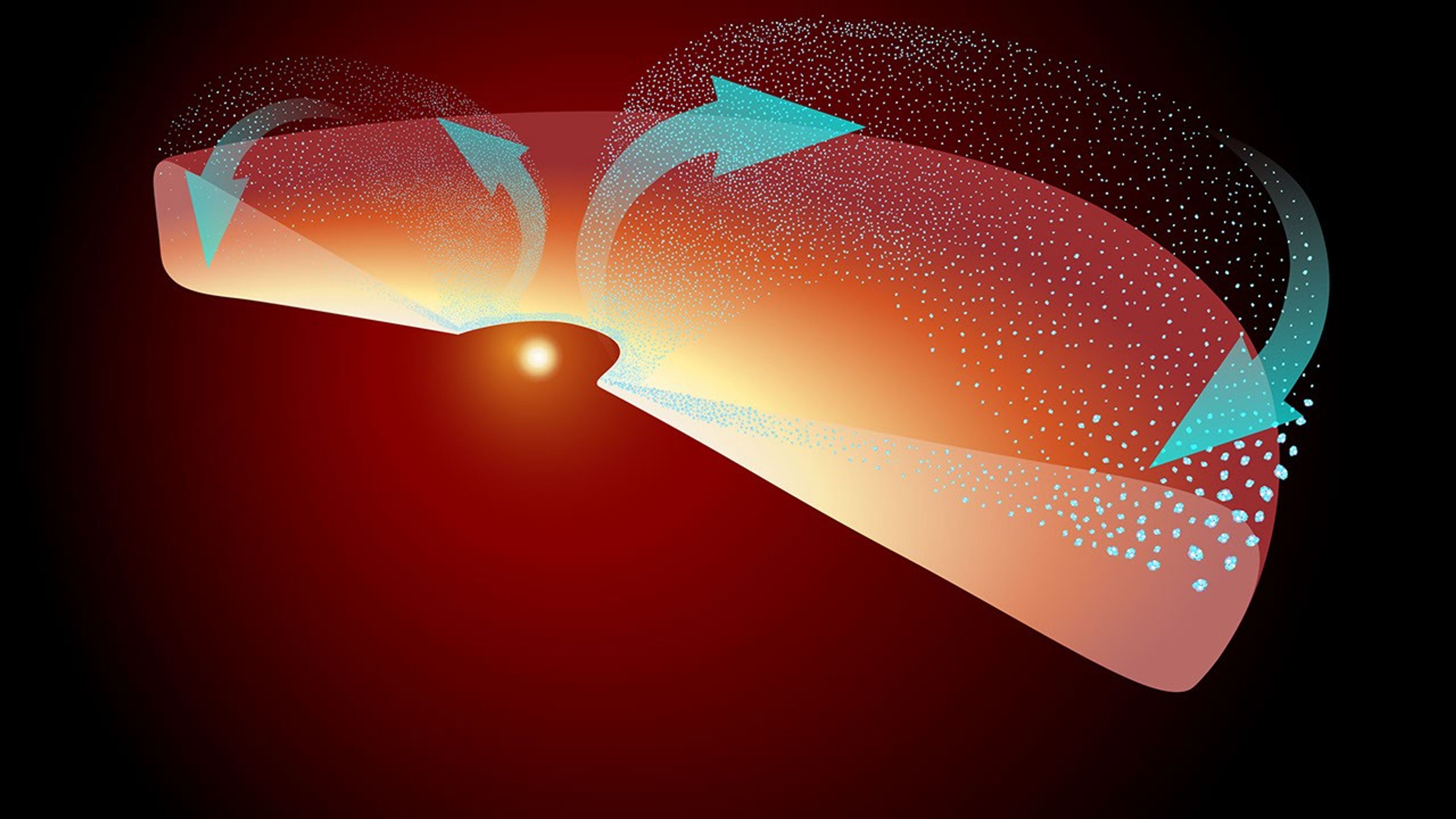
Illustration shows a small yellow sphere at center surrounded from upper left to lower right by a semi-circle that has the rough shape of half a pancake with rounded edges. The pancake has a hole in the middle and doesn’t touch the star. The semi-circle is bright yellow closest to the star, orange toward the center, and redder at its round edges. Several large teal arrows are within the semi-circle. Two arrows start in the area nearest the star at the left and right edges of the yellow disk. Each arrow goes immediately up and points outward to the left or right. Two additional large teal arrows appear at far left and far right, following a swooping pattern begun by the first arrows, with each pointing down to the farthest edges of the pancake. Small teal dots begin where the arrows begin, following the arrows, but also are embedded within the pancake forming a straight edge from the inner to the outer regions. A faint red haze extends from the star in the lower left diagonal and the background is black.
This illustration represents half the disk of gas and dust surrounding the protostar EC 53. Stellar outbursts periodically form crystalline silicates, which are launched up and out to the edges of the system, where comets and other icy rocky bodies may eventually form.
Illustration: NASA, ESA, CSA, Elizabeth Wheatley (STScI)

Look ahead

EC 53 is still β€œwrapped” in dust and may be for another 100,000 years. Over millions of years, while a young star’s disk is heavily populated with teeny grains of dust and pebbles, an untold number of collisions will occur that may slowly build up a range of larger rocks, eventually leading to the formation of terrestrial and gas giant planets. As the disk settles, both the star itself and any rocky planets will finish forming, the dust will largely clear (no longer obscuring the view), and a Sun-like star will remain at the center of a cleared planetary system, with crystalline silicates β€œlittered” throughout.

EC 53 is part of the Serpens Nebula, which lies 1,300 light-years from Earth and is brimming with actively forming stars.

The James Webb Space Telescope is the world’s premier space science observatory. Webb is solving mysteries in our solar system, looking beyond to distant worlds around other stars, and probing the mysterious structures and origins of our universe and our place in it. Webb is an international program led by NASA with its partners, ESA (European Space Agency) and CSA (Canadian Space Agency).

To learn more about Webb, visit:

https://science.nasa.gov/webb

Downloads & Related Information

The following sections contain links to download this article’s images and videos in all available resolutions followed by related information links, media contacts, and if available, research paper and Spanish translation links.

Related Images & Videos

A young star-forming region is filled with wispy orange, red, and blue layers of gas and dust. At center-left, a larger star is circled. It has prominent diffraction spikes and an arc of white at right.

Protostar EC 53 in the Serpens Nebula (NIRCam Image)

NASA’s James Webb Space Telescope’s 2024 NIRCam image shows protostar EC 53 circled. Researchers using new data from Webb’s MIRI proved that crystalline silicates form in the hottest part of the disk of gas and dust surrounding the star β€” and may be shot to the system’s edges.

Illustration shows a large, angled semi-circle pancake around a small yellow orb representing a star. Tiny teal dots start near the orb, flowing up, out, and down toward the edges of the pancake, following several arrows.

Silicate Crystallization and Movement Near Protostar EC 53 (Illustration)

This illustration represents half the disk of gas and dust surrounding the protostar EC 53. Stellar outbursts periodically form crystalline silicates, which are launched up and out to the edges of the system, where comets and other icy rocky bodies may eventually form.

Image titled u201cJames Webb Space Telescope; Protostar EC 53 in the Serpens Nebula,u201d with compass arrows and color key.

Protostar EC 53 in the Serpens Nebula (NIRCam Compass Image)

This image of protostar EC 53 in the Serpens Nebula, captured by the James Webb Space Telescope’s Near Infrared Camera (NIRCam), shows compass arrows, scale bar, and color key for reference.

Related Links

Read more:Β Webb’s Star Formation Discoveries

Explore more:Β Image Tour: Herbig-Haro 46/47

Read more:Β First-of-Its-Kind Detection Made in Striking New Webb Image

Read more:Β Infographic: Recipe for planet formation

Explore more:Β Star formation in the Eagle Nebula

Video:Β Exploring Star and Planet Formation

More Webb News

More Webb Images

Webb Science Themes

Webb Mission Page


Share

Details

Last Updated
Jan 22, 2026
Contact
Media

Laura Betz
NASA’s Goddard Space Flight Center
Greenbelt, Maryland
laura.e.betz@nasa.gov

Claire Blome
Space Telescope Science Institute
Baltimore, Maryland

Christine Pulliam
Space Telescope Science Institute
Baltimore, Maryland

Hubble Snaps Stellar Baby Pictures

17 January 2026 at 10:00

3 min read

Hubble Snaps Stellar Baby Pictures

Shining blue stars are sprinkled throughout glowing clouds of orange, pink and bluish gas, alongside dark clouds of dust. A particularly bright star shines against the inky dark dust of the lower right quadrant.
The Cepheus A region is home to a number of infant stars, including a protostar that is responsible for much of the region’s illumination.
NASA, ESA, and R. Fedriani (Instituto de Astrofisica de Andalucia); Processing: Gladys Kober (NASA/Catholic University of America)
A small, bluish cloud edged in red gas is in the center of a field thick with multicolored stars.
Star-forming region G033.91+0.11 is home to a protostar hidden within a reflection nebula.
NASA, ESA, and R. Fedriani (Instituto de Astrofisica de Andalucia); Processing: Gladys Kober (NASA/Catholic University of America)
Within a field of glittering multicolored stars, bluish clouds of gas edged in glowing red cluster at the top of the image and in a bubble-shaped clump to the mid-right. A single shining star throws diffraction spikes across the upper left of the image.
A protostar is swathed in the gas of an emission nebula within star-forming region GAL-305.20+00.21.
NASA, ESA, and R. Fedriani (Instituto de Astrofisica de Andalucia); Processing: Gladys Kober (NASA/Catholic University of America)
A bright, glowing cloud of orange gas is situated in the center of dark dust clouds and a field of stars.
A protostar’s jets of high-speed particles are responsible for the bright region of excited, glowing hydrogen in this Hubble image.
NASA, ESA, and R. Fedriani (Instituto de Astrofisica de Andalucia); Processing: Gladys Kober (NASA/Catholic University of America)

Newly developing stars shrouded in thick dust get their first baby pictures in these images from NASA’s Hubble Space Telescope. Hubble took these infant star snapshots in an effort to learn how massive stars form.

Protostars are shrouded in thick dust that blocks light, but Hubble can detect the near-infrared emission that shines through holes formed by the protostar’s jets of gas and dust. The radiating energy can provide information about these β€œoutflow cavities,” like their structure, radiation fields, and dust content. Researchers look for connections between the properties of these young stars – like outflows, environment, mass, brightness – and their evolutionary stage to test massive star formation theories.

These images were taken as part of the SOFIA Massive (SOMA) Star Formation Survey, which investigates how stars form, especially massive stars with more than eight times the mass of our Sun.

Shining blue stars are sprinkled throughout glowing clouds of orange, pink and bluish gas, alongside dark clouds of dust. A particularly bright star shines against the inky dark dust of the lower right quadrant.
The Cepheus A region is home to a number of infant stars, including a protostar that is responsible for much of the region’s illumination.
NASA, ESA, and R. Fedriani (Instituto de Astrofisica de Andalucia); Processing: Gladys Kober (NASA/Catholic University of America)

The high-mass star-forming region Cepheus A hosts a collection of baby stars, including one large and luminous protostar, which accounts for about half of the region’s brightness. While much of the region is shrouded in opaque dust, light from hidden stars breaks through outflow cavities to illuminate and energize areas of gas and dust, creating pink and white nebulae. The pink area is an HII region, where the intense ultraviolet radiation of the nearby stars has converted the surrounding clouds of gas into glowing, ionized hydrogen.
Cepheus A lies about 2,400 light-years away in the constellation Cepheus.

A small, bluish cloud edged in red gas is in the center of a field thick with multicolored stars.
Star-forming region G033.91+0.11 is home to a protostar hidden within a reflection nebula.
NASA, ESA, and R. Fedriani (Instituto de Astrofisica de Andalucia); Processing: Gladys Kober (NASA/Catholic University of America)

Glittering much closer to home, this Hubble image depicts the star-forming region G033.91+0.11 in our Milky Way galaxy. The light patch in the center of the image is a reflection nebula, in which light from a hidden protostar bounces off gas and dust.

Within a field of glittering multicolored stars, bluish clouds of gas edged in glowing red cluster at the top of the image and in a bubble-shaped clump to the mid-right. A single shining star throws diffraction spikes across the upper left of the image.
A protostar is swathed in the gas of an emission nebula within star-forming region GAL-305.20+00.21.
NASA, ESA, and R. Fedriani (Instituto de Astrofisica de Andalucia); Processing: Gladys Kober (NASA/Catholic University of America)

This Hubble image showcases the star-forming region GAL-305.20+00.21. The bright spot in the center-right of the image is an emission nebula, glowing gas that is ionized by a protostar buried within the larger complex of gas and dust clouds.

A bright, glowing cloud of orange gas is situated in the center of dark dust clouds and a field of stars.
A protostar’s jets of high-speed particles are responsible for the bright region of excited, glowing hydrogen in this Hubble image.
NASA, ESA, and R. Fedriani (Instituto de Astrofisica de Andalucia); Processing: Gladys Kober (NASA/Catholic University of America)

Shrouded in gas and dust, the massive protostar IRAS 20126+4104 lies within a high-mass star-forming region about 5,300 light-years away in the constellation Cygnus. This actively forming star is a B-type protostar, characterized by its high luminosity, bluish-white color, and very high temperature. The bright region of ionized hydrogen at the center of the image is energized by jets emerging from the poles of the protostar, which ground-based observatories previously observed.

New images added every day between January 12-17, 2026! Follow @NASAHubble on social media for the latest Hubble images and news and see Hubble’s Stellar Construction Zones for more images of young stellar objects.

Facebook logo
Instagram logo

Explore More

Media Contact:

Claire Andreoli
NASA’sΒ Goddard Space Flight Center,Β Greenbelt, MD
claire.andreoli@nasa.gov

Hubble Observes Ghostly Cloud Alive with Star Formation

16 January 2026 at 07:49

2 min read

Hubble Observes Ghostly Cloud Alive with Star Formation

Misty, bluish-white gas nearly fills this image. A few scattered stars shine through the gas. To the bottom left and just near a bright star, a dark cloud of dust interrupts the glowing, nebulous landscape.
A seemingly serene landscape of gas and dust is hopping with star formation behind the scenes.
NASA, ESA, and K. Stapelfeldt (Jet Propulsion Laboratory); Processing: Gladys Kober (NASA/Catholic University of America)

While this eerie NASA Hubble Space Telescope image may look ghostly, it’s actually full of new life. Lupus 3 is a star-forming cloud about 500 light-years away in the constellation Scorpius.Β 

White wisps of gas swirl throughout the region, and in the lower-left corner resides a dark dust cloud. Bright T Tauri stars shine at the left, bottom right, and upper center, while other young stellar objects dot the image.

T Tauri stars are actively forming stars in a specific stage of formation. In this stage, the enveloping gas and dust dissipates from radiation and stellar winds, or outflows of particles from the emerging star. T Tauri stars are typically less than 10 million years old and vary in brightness both randomly and periodically due to the environment and nature of a forming star. The random variations may be due to instabilities in the accretion disk of dust and gas around the star, material from that disk falling onto the star and being consumed, and flares on the star’s surface. The more regular, periodic changes may be caused by giant sunspots rotating in and out of view.Β 

T Tauri stars are in the process of contracting under the force of gravity as they become main sequence stars which fuse hydrogen to helium in their cores. Studying these stars can help astronomers better understand the star formation process.

New images added every day between January 12-17, 2026! Follow @NASAHubble on social media for the latest Hubble images and news and see Hubble’s Stellar Construction Zones for more images of young stellar objects.

Facebook logo
Instagram logo

Explore More

Media Contact:

Claire Andreoli
NASA’sΒ Goddard Space Flight Center,Β Greenbelt, MD
claire.andreoli@nasa.gov

Hubble’s Album of Planet-Forming Disks

15 January 2026 at 08:13

3 min read

Hubble’s Album of Planet-Forming Disks

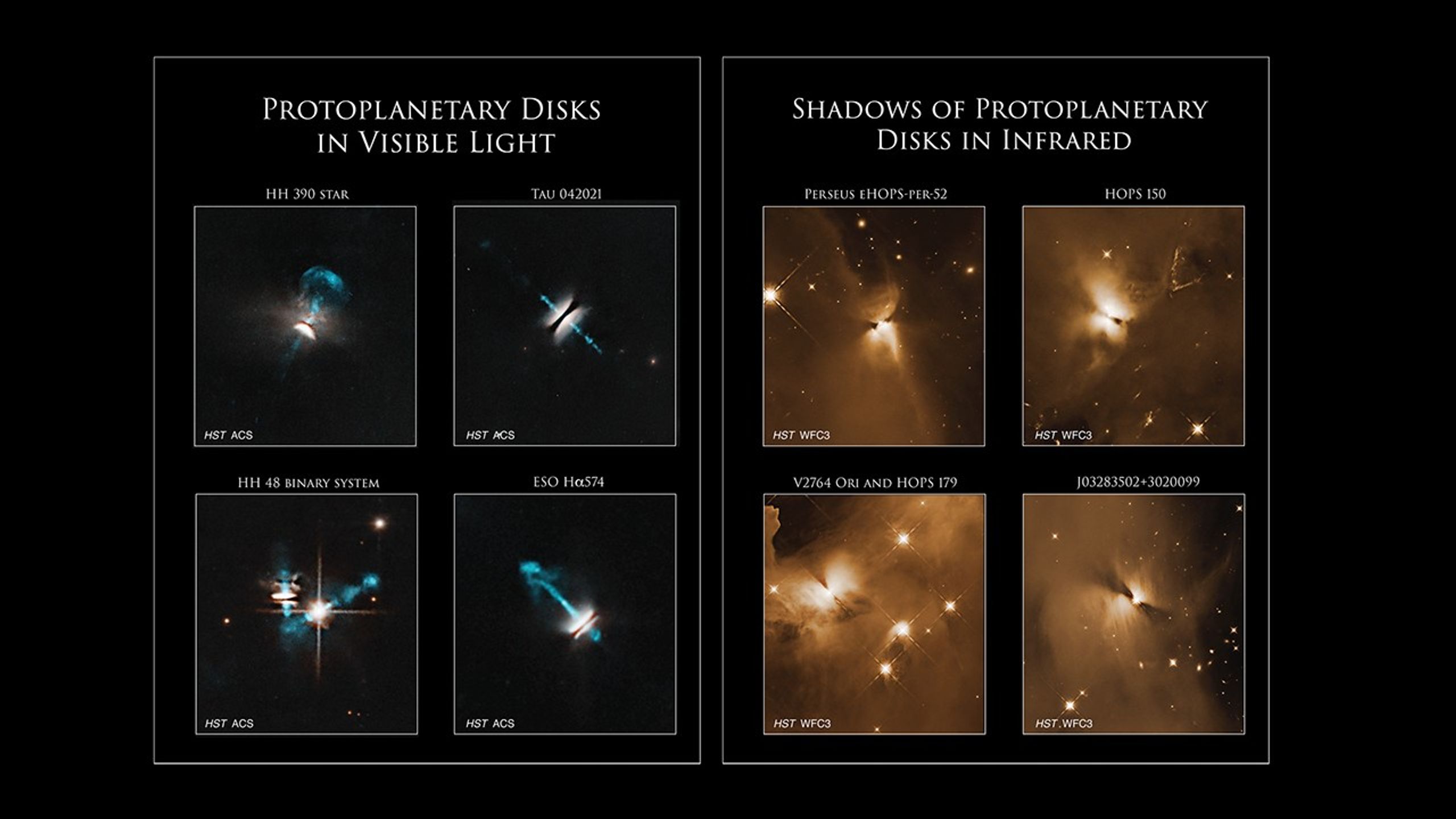
Side by side images of four protoplantetary disks in visible light., and four different protoplanetary disks in infrared light.
Hubble images of protoplanetary disks in visible and infrared light show dusty regions around newly developing stars where planets may form.
Left: NASA, ESA, and K. Stapelfeldt (Jet Propulsion Laboratory); Processing: Gladys Kober (NASA/Catholic University of America) Right: NASA, ESA, and T. Megeath (University of Toledo); Processing: Gladys Kober (NASA/Catholic University of America)

This collection of new images taken by NASA’s Hubble Space Telescope showcases protoplanetary disks, the swirling masses of gas and dust that surround forming stars, in both visible and infrared wavelengths. Through observations of young stellar objects like these, Hubble helps scientists better understand how stars form.

Jets of gas blast from protostars in these visible-light images. HH 390’s outflow is accompanied by a one-sided nebula, evidence that the protoplanetary disk is not viewed edge-on from our perspective. Tau 042021 is a large, symmetrical disk seen edge-on, and is in a late stage of dust evolution, since the dust particles have clumped together into larger grains. HH 48 is a binary protostar system in which gravitational tidal forces from the larger star appear to be influencing the disk of the secondary object. ESO HΞ±574 is a very compact disk with a β€œcollimated” ― or beam-like and linear ― outflow, and one of the faintest edge-on disks yet recognized.
NASA, ESA, and K. Stapelfeldt (Jet Propulsion Laboratory); Processing: Gladys Kober (NASA/Catholic University of America)

These visible-light images depict dark, planet-forming dust disks around a hidden, newly developing star, called a protostar. Bipolar jets of fast-moving gases, traveling at about 93 miles (150 km) per second, shoot from both ends of the protostar. The top two images are of protostars found about 450 light-years away in the Taurus Molecular Cloud, while the bottom two are almost 500 light-years away in the Chameleon I star-forming region.

Stars form out of collapsing clouds of gas and dust. As surrounding gas and dust falls toward the protostar, some of it forms a rotating disk around the star that continues to feed the growing object. Planets form from the remaining gas and dust orbiting the star. The bright yellow regions above and below the spinning disks are reflection nebulae, gas and dust lit up by the light of the star.

The jets that are released from the magnetic poles of the stars are an important part of their formation process. The jets, channeled by the protostar’s powerful magnetic fields, disperse angular momentum, which is due to rotational movement of the object. This allows the protostar to spin slowly enough for material to collect. In the images, some of the jets appear to broaden. This occurs when the fast jet collides with the surrounding gas and causes it to glow, an effect called a shock emission.

The central disks of bright protostars cast wider, twin, fan-shaped shadows across clouds of gas and dust in these orange-colored images. There are four images in a grid, clockwise from upper left: Perseus  eHOPS-per-52, HOPS 150, V2764 Ori and HOPS 179, J03283502+3020099.
Bright central protostars and the shadows of their dusty disks appear in these infrared images.
NASA, ESA, and T. Megeath (University of Toledo); Processing: Gladys Kober (NASA/Catholic University of America)

These edge-on views of protostars in infrared light also reveal thick, dusty protoplanetary disks. The dark areas may look like very large disks, but they are actually much wider shadows cast in the surrounding envelope by the central disks. The bright haze throughout the image comes from light scattering off of the surrounding cloud’s dust grains. The top right and bottom left stars reside in the Orion Molecular Cloud complex about 1,300 light-years away, and the top left and bottom right stars lie in the Perseus Molecular Cloud roughly 1,500 light-years away.

In its early stages, these disks draw from the dust that remains around the forming stars. Unlike visible light, infrared light can travel through this β€œprotostellar envelope.” The protostars in the visible images above are further along in their evolution, so much of the dusty envelope has dissipated. Otherwise, they could not be seen in visible wavelengths.

Viewed in infrared light, the central star is visible through the thick dust of the protoplanetary disks. Bipolar jets are also present but not visible because the hot gas emission isn’t strong enough for Hubble to detect.

HOPS 150 in the top right is actually in a binary system, in orbit with another young protostar. HOPS 150’s companion, HOPS 153, is not pictured in this image.

From a wider Hubble survey of Orion protostars, including HOPS 150 and HOPS 367, astronomers found that regions with a higher density of stars tend to have more companion stars. They also found a similar number of companions between main-sequence (active, hydrogen-fusing stars) and their younger counterparts.

New images added every day between January 12-17, 2026! Follow @NASAHubble on social media for the latest Hubble images and news and see Hubble’s Stellar Construction Zones for more images of young stellar objects.

Facebook logo
Instagram logo

Explore More

Media Contact:

Claire Andreoli
NASA’sΒ Goddard Space Flight Center,Β Greenbelt, MD
claire.andreoli@nasa.gov

Hubble Observes Stars Flaring to Life in Orion

14 January 2026 at 08:21

3 min read

Hubble Observes Stars Flaring to Life in Orion

A tumultuous orange cloud of gas and dust is laced with areas of dark dust and scattered with bright stars.
Protostar HOPS 181 is buried in layers of dusty gas clouds, but its energy shapes the material that surrounds it.
NASA, ESA, and T. Megeath (University of Toledo); Processing: Gladys Kober (NASA/Catholic University of America)
A jet streams diagonally out from upper right corner of the orange-colored image to the center, across a field of gas clouds and stars. While most of the image is full of gas, the upper right corner is mostly clear of gas and dust, and more stars are visible in this darker space.
A protostar wrapped in obscuring dust creates a cavity with glowing walls while its jet streams into space.
NASA, ESA, and T. Megeath (University of Toledo); Processing: Gladys Kober (NASA/Catholic University of America)
A bright protostar is nestled within a cavern-like gap in a cloud of gas and dust to the left. To the right, the gas cloud fades away to show a area thick with glittering stars.
A curving cavity in a cloud of gas has been hollowed out by a protostar in this Hubble image.
NASA, ESA, and T. Megeath (University of Toledo); Processing: Gladys Kober (NASA/Catholic University of America)

Just-forming stars, called protostars, dazzle a cloudy landscape in the Orion Molecular Cloud complex (OMC). These three new images from NASA’s Hubble Space Telescope were taken as part of an effort to learn more about the envelopes of gas and dust surrounding the protostars, as well as the outflow cavities where stellar winds and jets from the developing stars have carved away at the surrounding gas and dust.

Scientists used these Hubble observations as part of a broader survey to study protostellar envelopes, or the gas and dust around the developing star. Researchers found no evidence that the outflow cavities were growing as the protostar moved through the later stages of star formation. They also found that the decreasing accretion of mass onto the protostars over time and the low rate of star formation in the cool, molecular clouds cannot be explained by the progressive clearing out of the envelopes.

The OMC lies within the β€œsword” of the constellation Orion, roughly 1,300 light-years away.

A tumultuous orange cloud of gas and dust is laced with areas of dark dust and scattered with bright stars.
Protostar HOPS 181 is buried in layers of dusty gas clouds, but its energy shapes the material that surrounds it.
NASA, ESA, and T. Megeath (University of Toledo); Processing: Gladys Kober (NASA/Catholic University of America)

This Hubble image shows a small group of young stars amidst molecular clouds of gas and dust. Near the center of the image, concealed behind the dusty clouds, lies the protostar HOPS 181. The long, curved arc in the top left of the image is shaped by the outflow of material coming from the protostar, likely from the jets of particles shot out at high speeds from the protostar’s magnetic poles. The light of nearby stars reflects off and is scattered by dust grains that fill the image, giving the region its soft glow.

A jet streams diagonally out from upper right corner of the orange-colored image to the center, across a field of gas clouds and stars. While most of the image is full of gas, the upper right corner is mostly clear of gas and dust, and more stars are visible in this darker space.
A protostar wrapped in obscuring dust creates a cavity with glowing walls while its jet streams into space.
NASA, ESA, and T. Megeath (University of Toledo); Processing: Gladys Kober (NASA/Catholic University of America)

The bright star in the lower right quadrant called CVSO 188 might seem like the diva in this image, but HOPS 310, located just to the left of center behind the dust, is the true hidden star. This protostar is responsible for the large cavity with bright walls that has been carved into the surrounding cloud of gas and dust by its jets and stellar winds. Running diagonally to the top right is one of the bipolar jets of the protostar. These jets consist of particles launched at high speeds from the protostar’s magnetic poles. Some background galaxies are visible in the upper right of the image.

A bright protostar is nestled within a cavern-like gap in a cloud of gas and dust to the left. To the right, the gas cloud fades away to show a area thick with glittering stars.
A curving cavity in a cloud of gas has been hollowed out by a protostar in this Hubble image.
NASA, ESA, and T. Megeath (University of Toledo); Processing: Gladys Kober (NASA/Catholic University of America)

The bright protostar to the left in this Hubble image is located within the Orion Molecular Clouds. Its stellar winds β€” ejected, fast-flowing particles that are spurred by the star’s magnetic field β€” have carved a large cavity in the surrounding cloud. In the top right, background stars speckle the image.

New images added every day between January 12-17, 2026! Follow @NASAHubble on social media for the latest Hubble images and news and see Hubble’s Stellar Construction Zones for more images of young stellar objects.

Facebook logo
Instagram logo

Explore More

Media Contact:

Claire Andreoli
NASA’sΒ Goddard Space Flight Center,Β Greenbelt, MD
claire.andreoli@nasa.gov

Hubble Spies Stellar Blast Setting Clouds Ablaze

12 January 2026 at 08:06

2 min read

Hubble Spies Stellar Blast Setting Clouds Ablaze

Narrow, knotted clouds of purple and green glowing gas are seen against a field of stars.
Jets of ionized gas streak across a cosmic landscape from a newly forming star.
NASA, ESA, and B. Reipurth (Planetary Science Institute); Processing: Gladys Kober (NASA/Catholic University of America)

This new NASA Hubble Space Telescope image captures a jet of gas from a forming star shooting across the dark expanse. The bright pink and green patches running diagonally through the image are HH 80/81, a pair of Herbig-Haro (HH) objects previously observed by Hubble in 1995. The patch to the upper left is part of HH 81, and the bottom streak is part of HH 80.

Herbig-Haro objects are bright, glowing regions that occur when jets of ionized gas ejected by a newly forming star collide with slower, previously ejected outflows of gas from that star. HH 80/81’s outflow stretches over 32 light-years, making it the largest protostellar outflow known.Β 

Protostars are fed by infalling gas from the surrounding environment, some of which can be seen in residual β€œaccretion disks” orbiting the forming star.Β  Ionized material within these disks can interact with the protostars’ strong magnetic fields, which channel some of the particles toward the pole and outward in the form of jets.Β 

As the jets eject material at high speeds, they can produce strong shock waves when the particles collide with previously ejected gas. These shocks heat the clouds of gas and excite the atoms, causing them to glow in what we see as HH objects.

HH 80/81 are the brightest HH objects known to exist. The source powering these luminous objects is the protostar IRAS 18162-2048. It’s roughly 20 times the mass of the Sun, and it’s the most massive protostar in the entire L291 molecular cloud. From Hubble data, astronomers measured the speed of parts of HH 80/81 to be over 1,000 km/s, the fastest recorded outflow in both radio and visual wavelengths from a young stellar object. Unusually, this is the only HH jet found that is driven by a young, very massive star, rather than a type of young, low-mass star.Β 

The sensitivity and resolution of Hubble’s Wide Field Camera 3 was critical to astronomers, allowing them to study fine details, movements, and structural changes of these objects. The HH 80/81 pair lies 5,500 light-years away within the Sagittarius constellation.

New images added every day between January 12-17, 2026! Follow @NASAHubble on social media for the latest Hubble images and news and see Hubble’s Stellar Construction Zones for more images of young stellar objects.

Facebook logo
Instagram logo

Explore More

Media Contact:

Claire Andreoli
NASA’sΒ Goddard Space Flight Center,Β Greenbelt, MD
claire.andreoli@nasa.gov

❌
❌