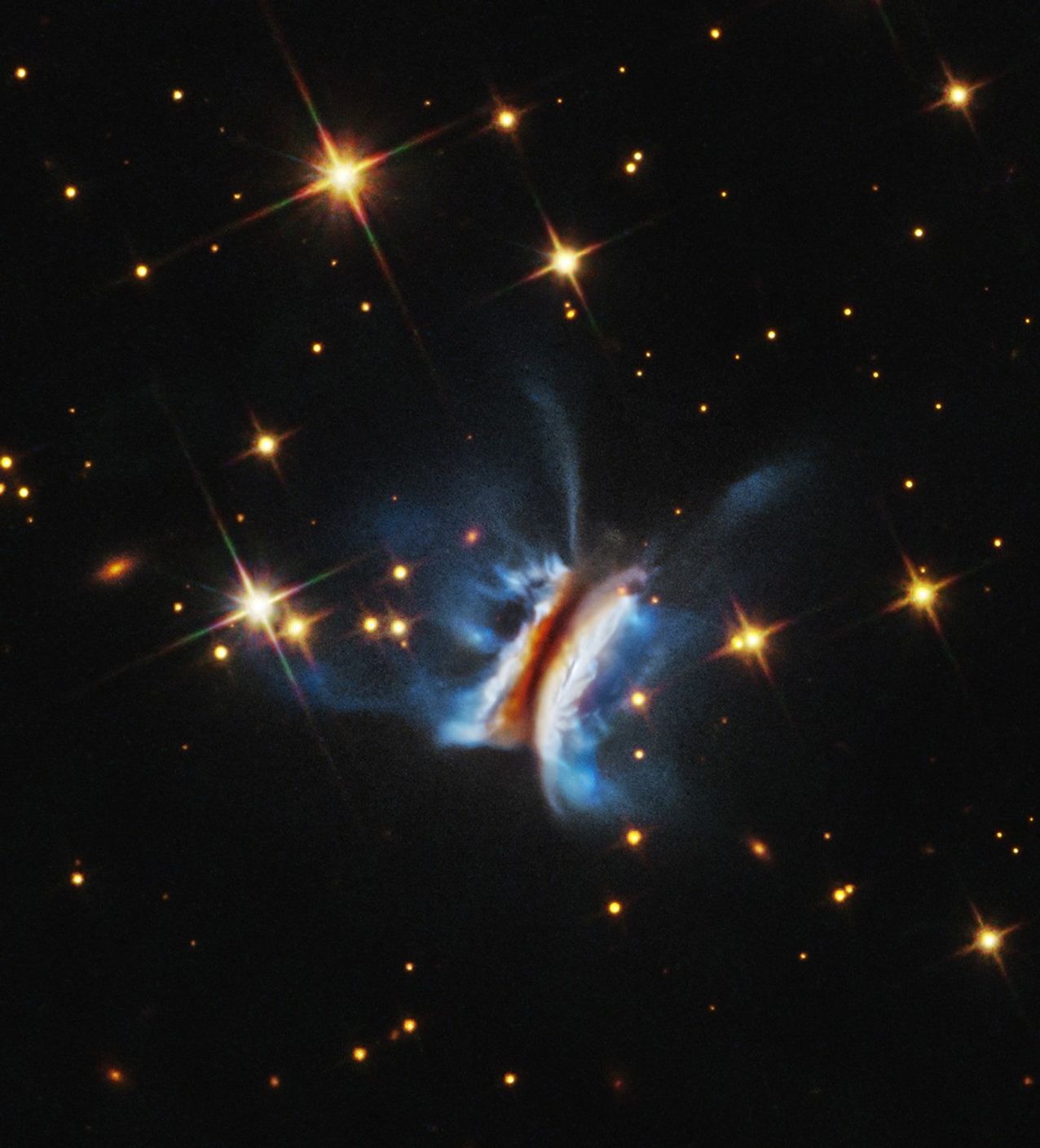
The Cepheus A region is home to a number of infant stars, including a protostar that is responsible for much of the region’s illumination.
NASA, ESA, and R. Fedriani (Instituto de Astrofisica de Andalucia); Processing: Gladys Kober (NASA/Catholic University of America)
Star-forming region G033.91+0.11 is home to a protostar hidden within a reflection nebula.
NASA, ESA, and R. Fedriani (Instituto de Astrofisica de Andalucia); Processing: Gladys Kober (NASA/Catholic University of America)
A protostar is swathed in the gas of an emission nebula within star-forming region GAL-305.20+00.21.
NASA, ESA, and R. Fedriani (Instituto de Astrofisica de Andalucia); Processing: Gladys Kober (NASA/Catholic University of America)
A protostar’s jets of high-speed particles are responsible for the bright region of excited, glowing hydrogen in this Hubble image.
NASA, ESA, and R. Fedriani (Instituto de Astrofisica de Andalucia); Processing: Gladys Kober (NASA/Catholic University of America)
Newly developing stars shrouded in thick dust get their first baby pictures in these images from NASA’s Hubble Space Telescope. Hubble took these infant star snapshots in an effort to learn how massive stars form.
Protostars are shrouded in thick dust that blocks light, but Hubble can detect the near-infrared emission that shines through holes formed by the protostar’s jets of gas and dust. The radiating energy can provide information about these “outflow cavities,” like their structure, radiation fields, and dust content. Researchers look for connections between the properties of these young stars – like outflows, environment, mass, brightness – and their evolutionary stage to test massive star formation theories.
These images were taken as part of the SOFIA Massive (SOMA) Star Formation Survey, which investigates how stars form, especially massive stars with more than eight times the mass of our Sun.
The Cepheus A region is home to a number of infant stars, including a protostar that is responsible for much of the region’s illumination.
NASA, ESA, and R. Fedriani (Instituto de Astrofisica de Andalucia); Processing: Gladys Kober (NASA/Catholic University of America)
The high-mass star-forming region Cepheus A hosts a collection of baby stars, including one large and luminous protostar, which accounts for about half of the region’s brightness. While much of the region is shrouded in opaque dust, light from hidden stars breaks through outflow cavities to illuminate and energize areas of gas and dust, creating pink and white nebulae. The pink area is an HII region, where the intense ultraviolet radiation of the nearby stars has converted the surrounding clouds of gas into glowing, ionized hydrogen. Cepheus A lies about 2,400 light-years away in the constellation Cepheus.
Star-forming region G033.91+0.11 is home to a protostar hidden within a reflection nebula.
NASA, ESA, and R. Fedriani (Instituto de Astrofisica de Andalucia); Processing: Gladys Kober (NASA/Catholic University of America)
Glittering much closer to home, this Hubble image depicts the star-forming region G033.91+0.11 in our Milky Way galaxy. The light patch in the center of the image is a reflection nebula, in which light from a hidden protostar bounces off gas and dust.
A protostar is swathed in the gas of an emission nebula within star-forming region GAL-305.20+00.21.
NASA, ESA, and R. Fedriani (Instituto de Astrofisica de Andalucia); Processing: Gladys Kober (NASA/Catholic University of America)
This Hubble image showcases the star-forming region GAL-305.20+00.21. The bright spot in the center-right of the image is an emission nebula, glowing gas that is ionized by a protostar buried within the larger complex of gas and dust clouds.
A protostar’s jets of high-speed particles are responsible for the bright region of excited, glowing hydrogen in this Hubble image.
NASA, ESA, and R. Fedriani (Instituto de Astrofisica de Andalucia); Processing: Gladys Kober (NASA/Catholic University of America)
Shrouded in gas and dust, the massive protostar IRAS 20126+4104 lies within a high-mass star-forming region about 5,300 light-years away in the constellation Cygnus. This actively forming star is a B-type protostar, characterized by its high luminosity, bluish-white color, and very high temperature. The bright region of ionized hydrogen at the center of the image is energized by jets emerging from the poles of the protostar, which ground-based observatories previously observed.
New images added every day between January 12-17, 2026! Follow @NASAHubble on social media for the latest Hubble images and news and see Hubble’s Stellar Construction Zones for more images of young stellar objects.
While this eerie NASA Hubble Space Telescope image may look ghostly, it’s actually full of new life. Lupus 3 is a star-forming cloud about 500 light-years away in the constellation Scorpius.
White wisps of gas swirl throughout the region, and in the lower-left corner resides a dark dust cloud. Bright T Tauri stars shine at the left, bottom right, and upper center, while other young stellar objects dot the image.
T Tauri stars are actively forming stars in a specific stage of formation. In this stage, the enveloping gas and dust dissipates from radiation and stellar winds, or outflows of particles from the emerging star. T Tauri stars are typically less than 10 million years old and vary in brightness both randomly and periodically due to the environment and nature of a forming star. The random variations may be due to instabilities in the accretion disk of dust and gas around the star, material from that disk falling onto the star and being consumed, and flares on the star’s surface. The more regular, periodic changes may be caused by giant sunspots rotating in and out of view.
T Tauri stars are in the process of contracting under the force of gravity as they become main sequence stars which fuse hydrogen to helium in their cores. Studying these stars can help astronomers better understand the star formation process.
New images added every day between January 12-17, 2026! Follow @NASAHubble on social media for the latest Hubble images and news and see Hubble’s Stellar Construction Zones for more images of young stellar objects.
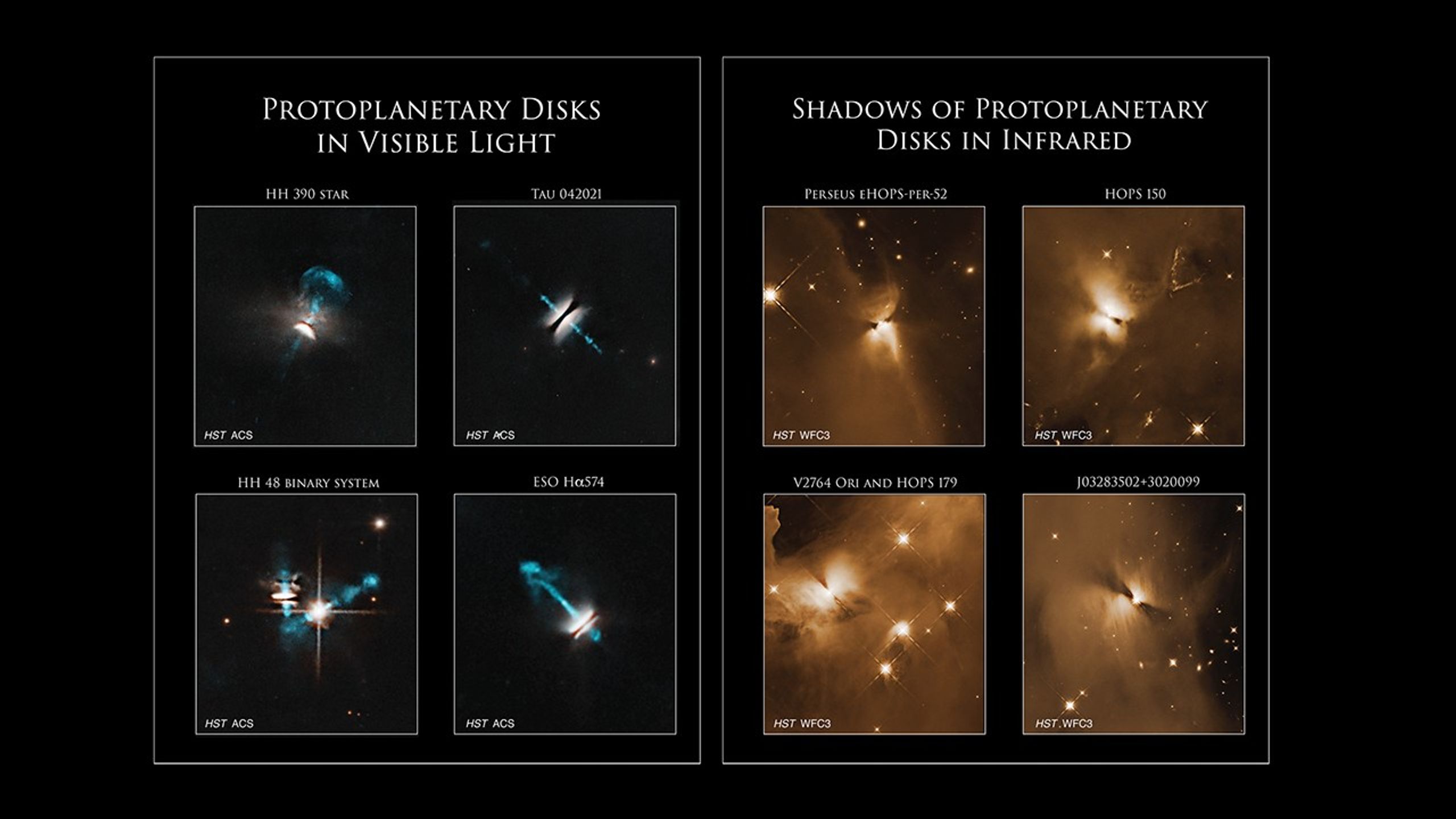
Hubble images of protoplanetary disks in visible and infrared light show dusty regions around newly developing stars where planets may form.
Left: NASA, ESA, and K. Stapelfeldt (Jet Propulsion Laboratory); Processing: Gladys Kober (NASA/Catholic University of America) Right: NASA, ESA, and T. Megeath (University of Toledo); Processing: Gladys Kober (NASA/Catholic University of America)
This collection of new images taken by NASA’s Hubble Space Telescope showcases protoplanetary disks, the swirling masses of gas and dust that surround forming stars, in both visible and infrared wavelengths. Through observations of young stellar objects like these, Hubble helps scientists better understand how stars form.
Jets of gas blast from protostars in these visible-light images. HH 390’s outflow is accompanied by a one-sided nebula, evidence that the protoplanetary disk is not viewed edge-on from our perspective. Tau 042021 is a large, symmetrical disk seen edge-on, and is in a late stage of dust evolution, since the dust particles have clumped together into larger grains. HH 48 is a binary protostar system in which gravitational tidal forces from the larger star appear to be influencing the disk of the secondary object. ESO Hα574 is a very compact disk with a “collimated” ― or beam-like and linear ― outflow, and one of the faintest edge-on disks yet recognized.
NASA, ESA, and K. Stapelfeldt (Jet Propulsion Laboratory); Processing: Gladys Kober (NASA/Catholic University of America)
These visible-light images depict dark, planet-forming dust disks around a hidden, newly developing star, called a protostar. Bipolar jets of fast-moving gases, traveling at about 93 miles (150 km) per second, shoot from both ends of the protostar. The top two images are of protostars found about 450 light-years away in the Taurus Molecular Cloud, while the bottom two are almost 500 light-years away in the Chameleon I star-forming region.
Stars form out of collapsing clouds of gas and dust. As surrounding gas and dust falls toward the protostar, some of it forms a rotating disk around the star that continues to feed the growing object. Planets form from the remaining gas and dust orbiting the star. The bright yellow regions above and below the spinning disks are reflection nebulae, gas and dust lit up by the light of the star.
The jets that are released from the magnetic poles of the stars are an important part of their formation process. The jets, channeled by the protostar’s powerful magnetic fields, disperse angular momentum, which is due to rotational movement of the object. This allows the protostar to spin slowly enough for material to collect. In the images, some of the jets appear to broaden. This occurs when the fast jet collides with the surrounding gas and causes it to glow, an effect called a shock emission.
Bright central protostars and the shadows of their dusty disks appear in these infrared images.
NASA, ESA, and T. Megeath (University of Toledo); Processing: Gladys Kober (NASA/Catholic University of America)
These edge-on views of protostars in infrared light also reveal thick, dusty protoplanetary disks. The dark areas may look like very large disks, but they are actually much wider shadows cast in the surrounding envelope by the central disks. The bright haze throughout the image comes from light scattering off of the surrounding cloud’s dust grains. The top right and bottom left stars reside in the Orion Molecular Cloud complex about 1,300 light-years away, and the top left and bottom right stars lie in the Perseus Molecular Cloud roughly 1,500 light-years away.
In its early stages, these disks draw from the dust that remains around the forming stars. Unlike visible light, infrared light can travel through this “protostellar envelope.” The protostars in the visible images above are further along in their evolution, so much of the dusty envelope has dissipated. Otherwise, they could not be seen in visible wavelengths.
Viewed in infrared light, the central star is visible through the thick dust of the protoplanetary disks. Bipolar jets are also present but not visible because the hot gas emission isn’t strong enough for Hubble to detect.
HOPS 150 in the top right is actually in a binary system, in orbit with another young protostar. HOPS 150’s companion, HOPS 153, is not pictured in this image.
From a wider Hubble survey of Orion protostars, including HOPS 150 and HOPS 367, astronomers found that regions with a higher density of stars tend to have more companion stars. They also found a similar number of companions between main-sequence (active, hydrogen-fusing stars) and their younger counterparts.
New images added every day between January 12-17, 2026! Follow @NASAHubble on social media for the latest Hubble images and news and see Hubble’s Stellar Construction Zones for more images of young stellar objects.
An artist’s conception shows a spacecraft with robotic arms preparing to grapple the Hubble Space Telescope. (Orbital Robotics Illustration)
A space startup founded by veterans of Jeff Bezos’ Blue Origin space venture is recruiting partners in its quest to build robotic arms powered by artificial intelligence.
Founded in late 2024, Puyallup, Wash.-based Orbital Robotics is still in its infancy — but it has already raised about $310,000 in funding. Orbital Robotics CEO Aaron Borger told GeekWire that the company is working with a stealthy space venture on an orbital rendezvous project for the U.S. Space Force, with a series of missions scheduled in the next year and a half.
And that’s just the start: Borger and his teammates are trying to get traction for a plan that could give NASA’s aging Hubble Space Telescope a much-needed boost.
“We worked to get to the right people to talk to, both on the servicing side and on the mission side, and we’re in conversations now on how we could work together on a collaborative mission,” said Doug Kohl, Orbital Robotics’ chief operating officer.
Members of the Orbital Robotics team — chief operating officer Doug Kohl, CEO Aaron Borger, engineer Sohil Pokharna and adviser Chris Sembroski — pose for a holiday portrait at last month’s GeekWire Gala. (Orbital Robotics via LinkedIn)
Orbital Robotics aims to focus on a key challenge looming for the next stage of the new space age: how to build spacecraft that can interact with other orbiting objects safely.
That’s not as easy as it may sound, especially when you’re trying to manipulate objects in space while obeying Newton’s Third Law of Motion. When a robotic arm on a free-flying spacecraft moves around, the spacecraft itself reacts with an equal and opposite motion. The arm has to compensate for those movements as it reaches out to grab its target.
“That is exactly one of the hardest parts about putting robotic arms on spacecraft,” Borger said. “When you move the arm, your spacecraft is going to move as well.”
To address the challenge, Orbital Robotics is developing a suite of AI-based software tools designed to track targets in space, plan out orbital maneuvers and interact with other spacecraft. It’s also laying the groundwork for robotic arms and spacecraft that make use of its technology. “A lot of NASA engineers will say you can’t use AI because you can’t really predict what it’s going to do, but with our method, we can,” Borger said.
Orbital Robotics’ prototype robotic arm, known as ORA-T1, has seven degrees of freedom. (Orbital Robotics Photo)
Earlier in their careers, Borger and Mark were involved in efforts to put small AI-controlled robotic arms through suborbital testing. Now Orbital Robotics has built a larger prototype arm with seven degrees of freedom. For the next few months, the company will be putting that hardware through its paces in its lab.
“Those smaller arms were designed to catch, like, a ball or a cube. We had a small 3D-printed wrench that we were focused on,” Borger said. “This one is more focused on how you dock with space debris, for example.”
The ability to inspect or link up with objects in space has obvious implications for national security in space, which is why the Pentagon is so interested in the technology. Borger declined to discuss that side of Orbital Robotics’ business plan, but he noted that there are commercial applications as well.
“Now that there’s the ability to put so much mass up there, it’s come to the point where, OK, you have all this stuff up there. How do you actually continue to use it, rather than just letting it come down or die up there?” he said. “If you want to refuel something, if you want to repair something, the first step is, how do you capture it? That’s what we’re really focused on right now. … Then we can start focusing on using our robotic arms to manipulate things, start refilling it, repairing it, all sorts of stuff.”
Orbital Robotics recently tested its tracking software using video footage that was captured during an earlier suborbital test mission. Now the team is collaborating with a stealth partner on a series of space missions. The first mission would test Orbital Robotics’ flight software. Later missions would test the company’s robotic arm and demonstrate its ability to capture a spacecraft in orbit. Borger said it would be premature to disclose the partner’s identity, but he mentioned a 2026-2027 time frame for the missions.
There’s a growing interest in orbital rendezvous, proximity operations and capture, or RPOC for short — and Orbital Robotics isn’t the only space company targeting that market. Starfish Space and Portal Space Systems are among other Seattle-area ventures on the RPOC frontier.
Borger said he prefers to think of such companies as potential partners rather than rivals.
“I think they could use our arms,” he said. “They could use some of our software.” The company has already announced partnerships with Redmond, Wash.-based Starcloud and Texas-based Space Ocean.
Orbital Robotics is also recruiting partners for an effort to save the 35-year-old Hubble Space Telescope from a fiery, mission-ending descent. Kohl said he and his collaborators are working on a white paper about the project that would be reviewed by NASA experts as well as astronauts who participated in previous Hubble servicing missions.
Orbital Robotics has drawn up a concept for a spacecraft equipped with robotic arms that could attach itself to the Hubble Space Telescope and boost it to a higher, more stable orbit. (Orbital Robotics Illustration)
The plan calls for building a robotic spacecraft that could attach itself to the telescope, install a star tracker package on its exterior, boost Hubble to a more stable orbit, and then undock.
“Jared is as interested in Hubble as we are, and so we’re hoping to take an unsolicited proposal to him with the white paper on helping to recover Hubble,” he said.
The clock is ticking: Last week, a team of scientists reported that Hubble could fall to its doom in as little as three or four years, due to increased atmospheric drag caused by heightened solar activity. “Even though it would come in around 2030, we actually need to save it before that,” Borger said. “The longer you wait, the more difficult it is.”
Meanwhile, the clock is ticking for Orbital Robotics as well. Borger acknowledged that it’s going to take more funding to fuel the venture’s grand ambitions. “We’re OK with where we’re at on funding for now, and then we’ll go for a much larger round in a couple of months,” he said.
Correction: Orbital Robotics has raised a total of $310,000 to date, including $110,000 from a friends-and-family funding round that was completed in November. An earlier version of this report didn’t reflect earlier investments.
Protostar HOPS 181 is buried in layers of dusty gas clouds, but its energy shapes the material that surrounds it.
NASA, ESA, and T. Megeath (University of Toledo); Processing: Gladys Kober (NASA/Catholic University of America)
A protostar wrapped in obscuring dust creates a cavity with glowing walls while its jet streams into space.
NASA, ESA, and T. Megeath (University of Toledo); Processing: Gladys Kober (NASA/Catholic University of America)
A curving cavity in a cloud of gas has been hollowed out by a protostar in this Hubble image.
NASA, ESA, and T. Megeath (University of Toledo); Processing: Gladys Kober (NASA/Catholic University of America)
Just-forming stars, called protostars, dazzle a cloudy landscape in the Orion Molecular Cloud complex (OMC). These three new images from NASA’s Hubble Space Telescope were taken as part of an effort to learn more about the envelopes of gas and dust surrounding the protostars, as well as the outflow cavities where stellar winds and jets from the developing stars have carved away at the surrounding gas and dust.
Scientists used these Hubble observations as part of a broader survey to study protostellar envelopes, or the gas and dust around the developing star. Researchers found no evidence that the outflow cavities were growing as the protostar moved through the later stages of star formation. They also found that the decreasing accretion of mass onto the protostars over time and the low rate of star formation in the cool, molecular clouds cannot be explained by the progressive clearing out of the envelopes.
The OMC lies within the “sword” of the constellation Orion, roughly 1,300 light-years away.
Protostar HOPS 181 is buried in layers of dusty gas clouds, but its energy shapes the material that surrounds it.
NASA, ESA, and T. Megeath (University of Toledo); Processing: Gladys Kober (NASA/Catholic University of America)
This Hubble image shows a small group of young stars amidst molecular clouds of gas and dust. Near the center of the image, concealed behind the dusty clouds, lies the protostar HOPS 181. The long, curved arc in the top left of the image is shaped by the outflow of material coming from the protostar, likely from the jets of particles shot out at high speeds from the protostar’s magnetic poles. The light of nearby stars reflects off and is scattered by dust grains that fill the image, giving the region its soft glow.
The bright star in the lower right quadrant called CVSO 188 might seem like the diva in this image, but HOPS 310, located just to the left of center behind the dust, is the true hidden star. This protostar is responsible for the large cavity with bright walls that has been carved into the surrounding cloud of gas and dust by its jets and stellar winds. Running diagonally to the top right is one of the bipolar jets of the protostar. These jets consist of particles launched at high speeds from the protostar’s magnetic poles. Some background galaxies are visible in the upper right of the image.
A curving cavity in a cloud of gas has been hollowed out by a protostar in this Hubble image.
NASA, ESA, and T. Megeath (University of Toledo); Processing: Gladys Kober (NASA/Catholic University of America)
The bright protostar to the left in this Hubble image is located within the Orion Molecular Clouds. Its stellar winds — ejected, fast-flowing particles that are spurred by the star’s magnetic field — have carved a large cavity in the surrounding cloud. In the top right, background stars speckle the image.
New images added every day between January 12-17, 2026! Follow @NASAHubble on social media for the latest Hubble images and news and see Hubble’s Stellar Construction Zones for more images of young stellar objects.
This new NASA Hubble Space Telescope image captures a jet of gas from a forming star shooting across the dark expanse. The bright pink and green patches running diagonally through the image are HH 80/81, a pair of Herbig-Haro (HH) objects previously observed by Hubble in 1995. The patch to the upper left is part of HH 81, and the bottom streak is part of HH 80.
Herbig-Haro objects are bright, glowing regions that occur when jets of ionized gas ejected by a newly forming star collide with slower, previously ejected outflows of gas from that star. HH 80/81’s outflow stretches over 32 light-years, making it the largest protostellar outflow known.
Protostars are fed by infalling gas from the surrounding environment, some of which can be seen in residual “accretion disks” orbiting the forming star. Ionized material within these disks can interact with the protostars’ strong magnetic fields, which channel some of the particles toward the pole and outward in the form of jets.
As the jets eject material at high speeds, they can produce strong shock waves when the particles collide with previously ejected gas. These shocks heat the clouds of gas and excite the atoms, causing them to glow in what we see as HH objects.
HH 80/81 are the brightest HH objects known to exist. The source powering these luminous objects is the protostar IRAS 18162-2048. It’s roughly 20 times the mass of the Sun, and it’s the most massive protostar in the entire L291 molecular cloud. From Hubble data, astronomers measured the speed of parts of HH 80/81 to be over 1,000 km/s, the fastest recorded outflow in both radio and visual wavelengths from a young stellar object. Unusually, this is the only HH jet found that is driven by a young, very massive star, rather than a type of young, low-mass star.
The sensitivity and resolution of Hubble’s Wide Field Camera 3 was critical to astronomers, allowing them to study fine details, movements, and structural changes of these objects. The HH 80/81 pair lies 5,500 light-years away within the Sagittarius constellation.
New images added every day between January 12-17, 2026! Follow @NASAHubble on social media for the latest Hubble images and news and see Hubble’s Stellar Construction Zones for more images of young stellar objects.
NASA Hubble Helps Detect ‘Wake’ of Betelgeuse’s Elusive Companion Star
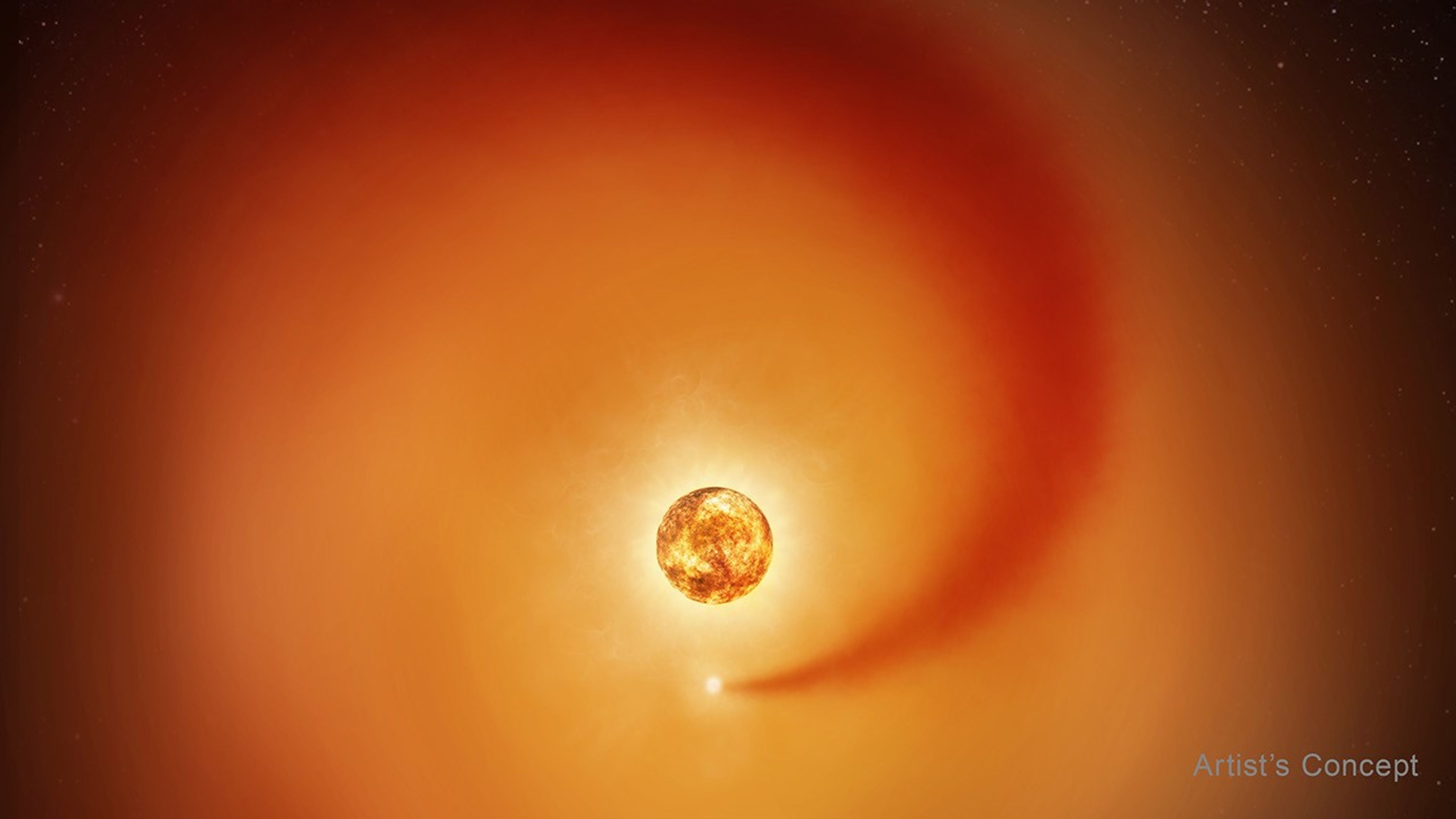
This artist’s concept shows the red supergiant star Betelgeuse and an orbiting companion star.
Credits: Artwork: NASA, ESA, Elizabeth Wheatley (STScI); Science: Andrea Dupree (CfA)
Using new observations from NASA’s Hubble Space Telescope and ground-based observatories, astronomers tracked the influence of a recently discovered companion star, Siwarha, on the gas around Betelgeuse. The research, from scientists at the Center for Astrophysics | Harvard & Smithsonian (CfA), reveals a trail of dense gas swirling through Betelgeuse’s vast, extended atmosphere, shedding light on why the giant star’s brightness and atmosphere have changed in strange and unusual ways.
The results of the new study were presented Monday at a news conference at the 247th meeting of the American Astronomical Society in Phoenix and are accepted for publication in The Astrophysical Journal.
The team detected Siwarha’s wake by carefully tracking changes in the star’s light over nearly eight years. These changes show the effects of the previously unconfirmed companion as it plows through the outer atmosphere of Betelgeuse. This discovery resolves one of the biggest mysteries about the giant star, helping scientists to explain how it behaves and evolves while opening new doors to understanding other massive stars nearing the end of their lives.
Located roughly 650 light-years away from Earth in the constellation Orion, Betelgeuse is a red supergiant star so large that more than 400 million Suns could fit inside. Because of its enormous size and proximity, Betelgeuse is one of the few stars whose surface and surrounding atmosphere can be directly observed by astronomers, making it an important and accessible laboratory for studying how giant stars age, lose mass, and eventually explode as supernovae.
This artist’s concept shows the red supergiant star Betelgeuse and an orbiting companion star. The companion, which is orbiting clockwise from this point of view, generates a dense wake of gas that expands outward. It is so close to Betelgeuse that it is passing through the extended outer atmosphere of the supergiant. The companion star is not to scale; it would be a pinprick compared to Betelgeuse, which is hundreds of times larger. The companion’s distance from Betelgeuse is to scale relative to the diameter of Betelgeuse.
Artwork: NASA, ESA, Elizabeth Wheatley (STScI); Science: Andrea Dupree (CfA)
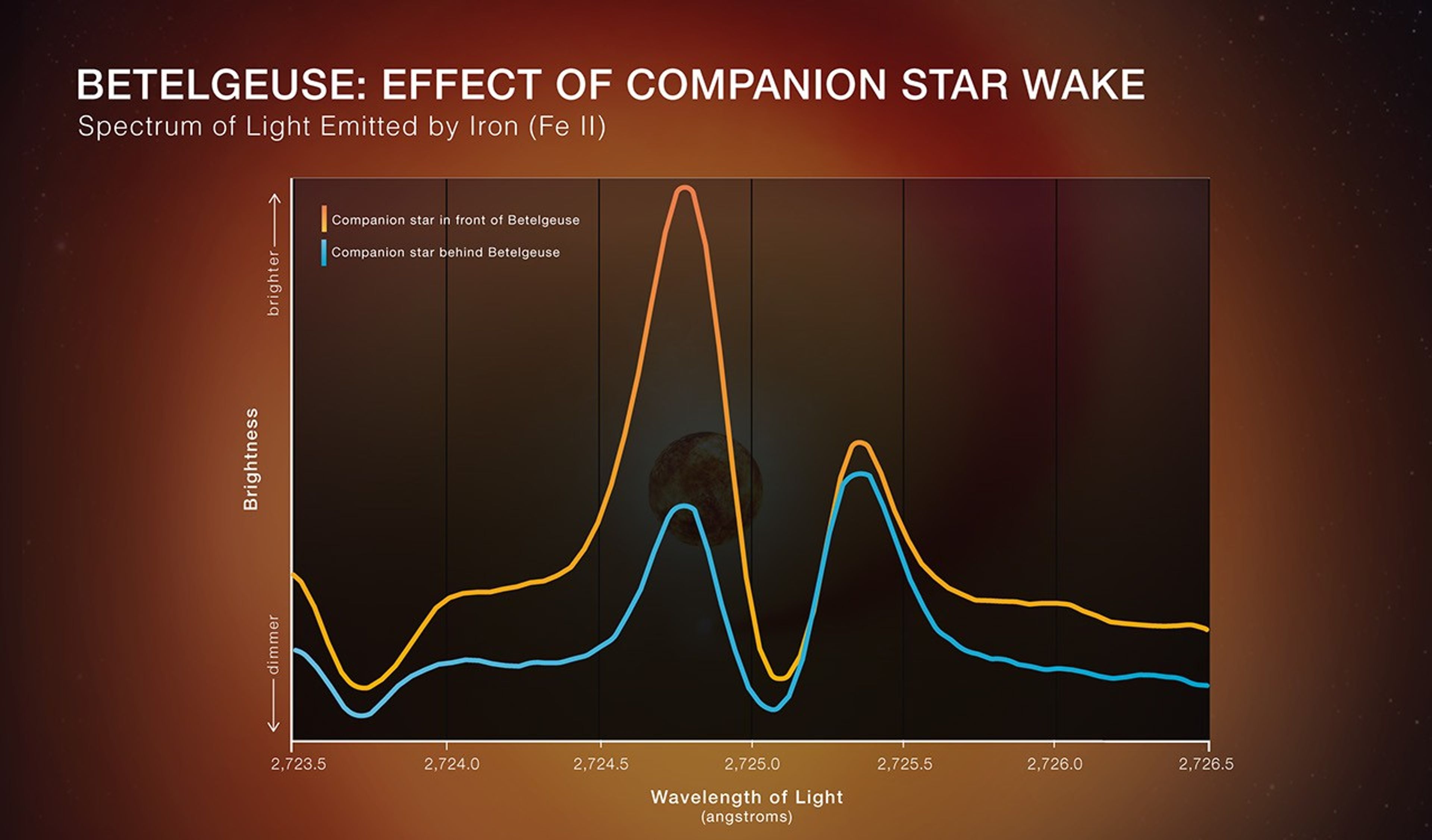
Using NASA’s Hubble and ground-based telescopes at the Fred Lawrence Whipple Observatory and Roque de Los Muchachos Observatory, the team was able to see a pattern of changes in Betelgeuse, which provided clear evidence of a long-suspected companion star and its impact on the red supergiant’s outer atmosphere. Those include changes in the star’s spectrum, or the specific colors of light given off by different elements, and the speed and direction of gases in the outer atmosphere due to a trail of denser material, or wake. This trail appears just after the companion crosses in front of Betelgeuse every six years, or about 2,100 days, confirming theoretical models.
“It’s a bit like a boat moving through water. The companion star creates a ripple effect in Betelgeuse’s atmosphere that we can actually see in the data,” said Andrea Dupree, an astronomer at the CfA, and the lead study author. “For the first time, we’re seeing direct signs of this wake, or trail of gas, confirming that Betelgeuse really does have a hidden companion shaping its appearance and behavior.”
For decades, astronomers have tracked changes in Betelgeuse’s brightness and surface features in hopes of figuring out why the star behaves the way it does. Curiosity intensified after the giant star appeared to “sneeze” and became unexpectedly faint in 2020. Two distinct periods of variation in the star were especially puzzling for scientists: a short 400-day cycle, recently attributed to pulsations within the star itself, and the long, 2,100-day secondary period.
Scientists used NASA’s Hubble Space Telescope to look for evidence of a wake being generated by a companion star orbiting Betelgeuse. The team found a noticeable difference in light shown in the lefthand peak when the companion star was at different points in its orbit.
Illustration: NASA, ESA, Elizabeth Wheatley (STScI); Science: Andrea Dupree (CfA)
Until now, scientists have considered everything from large convection cells and clouds of dust to magnetic activity, and the possibility of a hidden companion star. Recent studies concluded that the long secondary period was best explained by the presence of a low-mass companion orbiting deep within Betelgeuse’s atmosphere, and another team of scientists reported a possible detection, but until now, astronomers lacked the evidence to prove what they believed was happening. Now, for the first time, they have firm evidence that a companion is disrupting the atmosphere of this supergiant star.
“The idea that Betelgeuse had an undetected companion has been gaining in popularity for the past several years, but without direct evidence, it was an unproven theory,” said Dupree. “With this new direct evidence, Betelgeuse gives us a front-row seat to watch how a giant star changes over time. Finding the wake from its companion means we can now understand how stars like this evolve, shed material, and eventually explode as supernovae.”
With Betelgeuse now eclipsing its companion from our point of view, astronomers are planning new observations for its next emergence in 2027. This breakthrough may also help explain similar mysteries in other giant and supergiant stars.
The Hubble Space Telescope has been operating for over three decades and continues to make ground-breaking discoveries that shape our fundamental understanding of the universe. Hubble is a project of international cooperation between NASA and ESA (European Space Agency). NASA’s Goddard Space Flight Center in Greenbelt, Maryland, manages the telescope and mission operations. Lockheed Martin Space, based in Denver, also supports mission operations at Goddard. The Space Telescope Science Institute in Baltimore, which is operated by the Association of Universities for Research in Astronomy, conducts Hubble science operations for NASA.
Betelgeuse and Wake of its Companion Star (Artist’s Concept)
This artist’s concept shows the red supergiant star Betelgeuse and an orbiting companion star. The companion, which is orbiting clockwise from this point of view, generates a dusty wake that expands outward.
Betelgeuse: Effect of Companion Star Wake
Scientists used NASA’s Hubble Space Telescope to look for evidence of a wake being generated by a companion star orbiting Betelgeuse. The team found a noticeable difference in light shown in the lefthand peak when the companion star was at different points in its orbit.
NASA’s Hubble Examines Cloud-9, First of New Type of Object
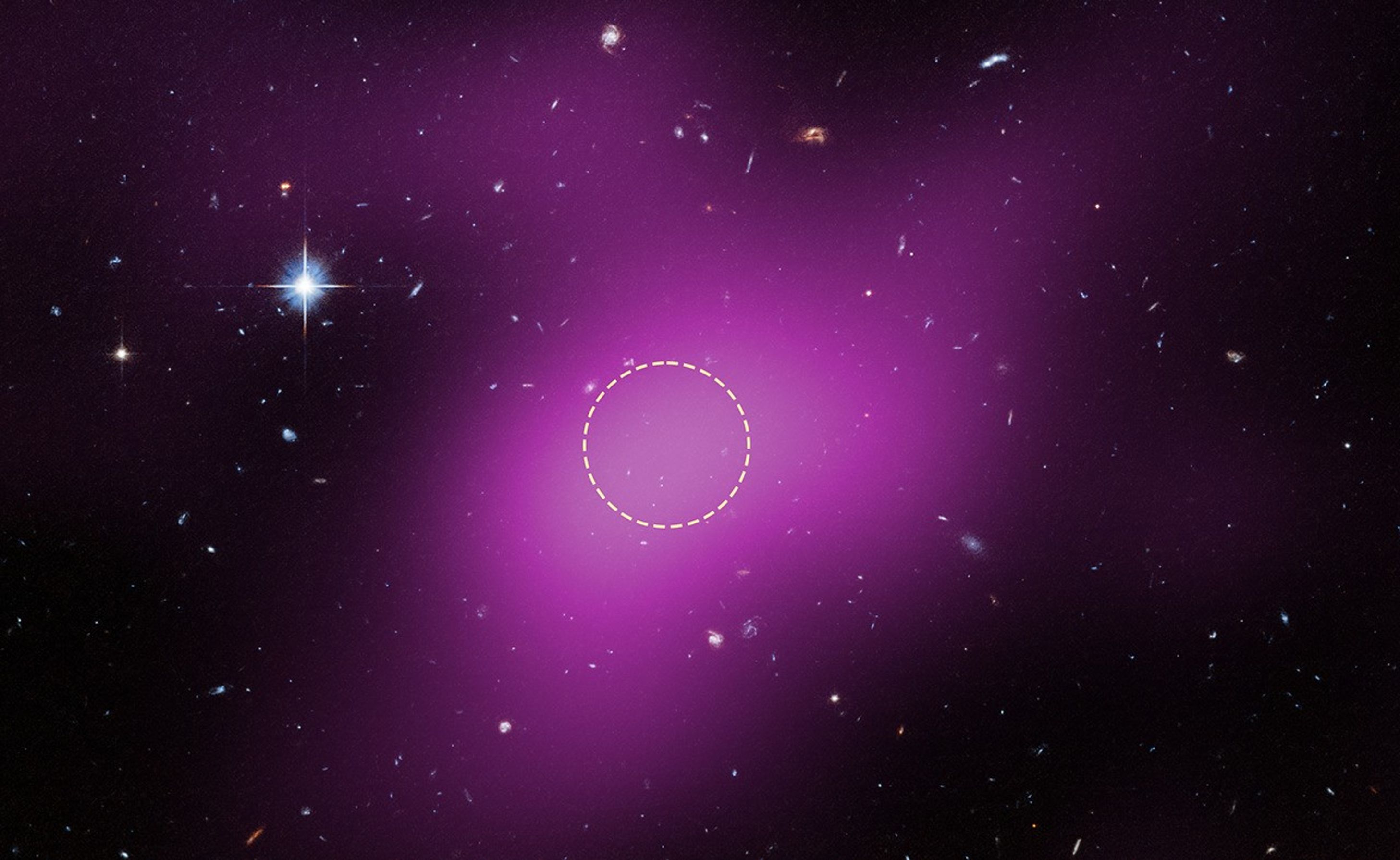
Magenta is radio data from the ground-based Very Large Array showing the presence of Cloud-9. The dashed circle marks the peak of radio emission, which is where researchers focused their search for stars. Hubble found no stars within Cloud-9. The few objects within its boundaries are background galaxies.
Credits: NASA, ESA, VLA, Gagandeep Anand (STScI), Alejandro Benitez-Llambay (University of Milano-Bicocca); Image Processing: Joseph DePasquale (STScI)
A team using NASA’s Hubble Space Telescope has uncovered a new type of astronomical object — a starless, gas-rich, dark-matter cloud considered a “relic” or remnant of early galaxy formation. Nicknamed “Cloud-9,” this is the first confirmed detection of such an object in the universe — a finding that furthers the understanding of galaxy formation, the early universe, and the nature of dark matter itself.
“This is a tale of a failed galaxy,” said the program’s principal investigator, Alejandro Benitez-Llambay of the Milano-Bicocca University in Milan, Italy. “In science, we usually learn more from the failures than from the successes. In this case, seeing no stars is what proves the theory right. It tells us that we have found in the local universe a primordial building block of a galaxy that hasn’t formed.”
“This cloud is a window into the dark universe,” said team member Andrew Fox of the Association of Universities for Research in Astronomy/Space Telescope Science Institute (AURA/STScI) for the European Space Agency. “We know from theory that most of the mass in the universe is expected to be dark matter, but it’s difficult to detect this dark material because it doesn’t emit light. Cloud-9 gives us a rare look at a dark-matter-dominated cloud.”
This image shows the location of Cloud-9, which is 14 million light-years from Earth. The diffuse magenta is radio data from the ground-based Very Large Array (VLA) showing the presence of the cloud. The dashed circle marks the peak of radio emission, which is where researchers focused their search for stars. Follow-up observations by the Hubble Space Telescope’s Advanced Camera for Surveys found no stars within the cloud. The few objects that appear within its boundaries are background galaxies. Before the Hubble observations, scientists could argue that Cloud-9 is a faint dwarf galaxy whose stars could not be seen with ground-based telescopes due to the lack of sensitivity. Hubble’s Advanced Camera for Surveys shows that, in reality, the failed galaxy contains no stars.
Science: NASA, ESA, VLA, Gagandeep Anand (STScI), Alejandro Benitez-Llambay (University of Milano-Bicocca); Image Processing: Joseph DePasquale (STScI)
The object is called a Reionization-Limited H I Cloud, or “RELHIC.” The term “H I” refers to neutral hydrogen, and “RELHIC” describes a natal hydrogen cloud from the universe’s early days, a fossil leftover that has not formed stars. For years, scientists have looked for evidence of such a theoretical phantom object. It wasn’t until they turned Hubble toward the cloud, confirming that it is indeed starless, that they found support for the theory.
“Before we used Hubble, you could argue that this is a faint dwarf galaxy that we could not see with ground-based telescopes. They just didn’t go deep enough in sensitivity to uncover stars,” said lead author Gagandeep Anand of STScI. “But with Hubble’s Advanced Camera for Surveys, we’re able to nail down that there’s nothing there.”
The discovery of this relic cloud was a surprise. “Among our galactic neighbors, there might be a few abandoned houses out there,” said STScI’s Rachael Beaton, who is also on the research team.
Astronomers think RELHICs are dark matter clouds that couldn’t accumulate enough gas to form stars. They represent a window into the early stages of galaxy formation. Cloud-9 suggests the existence of many other small, dark matter-dominated structures in the universe — other failed galaxies. This discovery provides new insights into the dark components of the universe that are difficult to study through traditional observations, which focus on bright objects like stars and galaxies.
Scientists have studied hydrogen clouds near the Milky Way for many years, but these clouds tend to be much bigger and more irregular than Cloud-9. Compared with other observed hydrogen clouds, Cloud-9 is smaller, more compact, and highly spherical, making it look very different from the others.
The core of this object is composed of neutral hydrogen and is about 4,900 light-years in diameter. Researchers measured the hydrogen gas in Cloud-9 by the radio waves it emits, measuring it to be approximately one million times the mass of the Sun. Assuming that the gas pressure is balancing the dark matter cloud’s gravity, which appears to be the case, researchers calculated Cloud-9’s dark matter must be about five billion solar masses.
Cloud-9 is an example of structures and mysteries that don’t involve stars. Just looking at stars doesn’t give the full picture. Studying the gas and dark matter helps provide a more complete understanding of what’s going on in these systems that would otherwise be unknown.
Observationally, identifying these failed galaxies is challenging because nearby objects outshine them. Such systems are also vulnerable to environmental effects like ram-pressure stripping, which can remove gas as the cloud moves through intergalactic space. These factors further reduce their expected numbers.
The starless relic was discovered three years ago as part of a radio survey by the Five-hundred-meter Aperture Spherical Telescope (FAST) in Guizhou, China, a finding later confirmed by the Green Bank Telescope and the Very Large Array facilities in the United States. But only with Hubble could researchers definitively determine that the failed galaxy contains no stars.
Cloud-9 was simply named sequentially, having been the ninth gas cloud identified on the outskirts of a nearby spiral galaxy, Messier 94 (M94). The cloud is close to M94 and appears to have a physical association with the galaxy. High-resolution radio data shows slight gas distortions, possibly indicating interaction between the cloud and galaxy.
The cloud may eventually form a galaxy in the future, provided it grows more massive — although how that would occur is under speculation. If it were much bigger, say, more than 5 billion times the mass of our Sun, it would have collapsed, formed stars, and become a galaxy that would be no different than any other galaxy we see. If it were much smaller than that, the gas could have been dispersed and ionized and there wouldn’t be much left. But it’s in a sweet spot where it could remain as a RELHIC.
The lack of stars in this object provides a unique window into the intrinsic properties of dark matter clouds. The rarity of such objects and the potential for future surveys is expected to enhance the discovery of more of these “failed galaxies” or “relics,” resulting in insights into the early universe and the physics of dark matter.
The Hubble Space Telescope has been operating for more than three decades and continues to make ground-breaking discoveries that shape our fundamental understanding of the universe. Hubble is a project of international cooperation between NASA and ESA (European Space Agency). NASA’s Goddard Space Flight Center in Greenbelt, Maryland, manages the telescope and mission operations. Lockheed Martin Space, based in Denver, also supports mission operations at Goddard. The Space Telescope Science Institute in Baltimore, which is operated by the Association of Universities for Research in Astronomy, conducts Hubble science operations for NASA.
Magenta is radio data from the ground-based Very Large Array (VLA) showing the presence of Cloud-9. The dashed circle marks the area where researchers focused their search for stars. Hubble found no stars within Cloud-9. The few objects within its boundaries are background galaxies.
Cloud 9, Starless Gas Cloud Compass Image
This is an annotated composite image of Cloud-9, a Reionization-Limited H I Cloud (RELHIC), as captured by the Hubble Space Telescope’s ACS (Advanced Camera for Surveys) and the ground-based Very Large Array (VLA) radio telescope.
Cloud 9, Starless Gas Cloud Video
This annotated video shows the location of Cloud-9 on the sky. As the video zooms into this gas-rich, dark-matter cloud, it becomes evident that there are no stars within it. Only background galaxies appear behind Cloud-9, which has survived since the universe’s early days….
NASA’s Hubble Reveals Largest Found Chaotic Birthplace of Planets
Astronomers using NASA’s Hubble Space Telescope have imaged the largest protoplanetary disk ever observed circling a young star. For the first time in visible light, Hubble has revealed the disk is unexpectedly chaotic and turbulent, with wisps of material stretching much farther above and below the disk than astronomers have seen in any similar system. Strangely, more extended filaments are only visible on one side of the disk. The findings, which published Tuesday in The Astrophysical Journal, mark a new milestone for Hubble and shed light on how planets may form in extreme environments, as NASA’s missions lead humanity’s exploration of the universe and our place in it.
Located roughly 1,000 light-years from Earth, IRAS 23077+6707, nicknamed “Dracula’s Chivito,” spans nearly 400 billion miles — 40 times the diameter of our solar system to the outer edge of the Kuiper Belt of cometary bodies. The disk obscures the young star within it, which scientists believe may be either a hot, massive star, or a pair of stars. And the enormous disk is not only the largest known planet-forming disk; it’s also shaping up to be one of the most unusual.
“The level of detail we’re seeing is rare in protoplanetary disk imaging, and these new Hubble images show that planet nurseries can be much more active and chaotic than we expected,” said lead author Kristina Monsch of the Center for Astrophysics | Harvard & Smithsonian (CfA). “We’re seeing this disk nearly edge-on and its wispy upper layers and asymmetric features are especially striking. Both Hubble and NASA’s James Webb Space Telescope have glimpsed similar structures in other disks, but IRAS 23077+6707 provides us with an exceptional perspective — allowing us to trace its substructures in visible light at an unprecedented level of detail. This makes the system a unique, new laboratory for studying planet formation and the environments where it happens.”
The nickname “Dracula’s Chivito” playfully reflects the heritage of its researchers—one from Transylvania and another from Uruguay, where the national dish is a sandwich called a chivito. The edge-on disk resembles a hamburger, with a dark central lane flanked by glowing top and bottom layers of dust and gas.
This Hubble Space Telescope image shows the largest planet-forming disk ever observed around a young star. It spans nearly 400 billion miles — 40 times the diameter of our solar system.
Image: NASA, ESA, STScI, Kristina Monsch (CfA); Image Processing: Joseph DePasquale (STScI)
Puzzling asymmetry
The impressive height of these features wasn’t the only thing that captured the attention of scientists. The new images revealed that vertically imposing filament-like features appear on just one side of the disk, while the other side appears to have a sharp edge and no visible filaments. This peculiar, lopsided structure suggests that dynamic processes, like the recent infall of dust and gas, or interactions with its surroundings, are shaping the disk.
“We were stunned to see how asymmetric this disk is,” said co-investigator Joshua Bennett Lovell, also an astronomer at the CfA. “Hubble has given us a front row seat to the chaotic processes that are shaping disks as they build new planets — processes that we don’t yet fully understand but can now study in a whole new way.”
All planetary systems form from disks of gas and dust encircling young stars. Over time, the gas accretes onto the star, and planets emerge from the remaining material. IRAS 23077+6707 may represent a scaled-up version of our early solar system, with a disk mass estimated at 10 to 30 times that of Jupiter — ample material for forming multiple gas giants. This, plus the new findings, makes it an exceptional case for studying the birth of planetary systems.
“In theory, IRAS 23077+6707 could host a vast planetary system,” said Monsch. “While planet formation may differ in such massive environments, the underlying processes are likely similar. Right now, we have more questions than answers, but these new images are a starting point for understanding how planets form over time and in different environments.”
Credit: NASA’s Goddard Space Flight Center; Lead Producer: Paul Morris
The Hubble Space Telescope has been operating for over three decades and continues to make ground-breaking discoveries that shape our fundamental understanding of the universe. Hubble is a project of international cooperation between NASA and ESA (European Space Agency). NASA’s Goddard Space Flight Center in Greenbelt, Maryland, manages the telescope and mission operations. Lockheed Martin Space, based in Denver, also supports mission operations at Goddard. The Space Telescope Science Institute in Baltimore, which is operated by the Association of Universities for Research in Astronomy, conducts Hubble science operations for NASA.
This Hubble Space Telescope image shows the largest planet-forming disk ever observed around a young star. It spans nearly 400 billion miles — 40 times the diameter of our solar system.
Dracula’s Chivito (IRAS 23077+6707) Compass Image
Image of Dracula’s Chivito captured by Hubble’s WFC3 instrument, with compass arrows, scale bar, and color key for reference.
Hubble Spots Giant Vampire Sandwich? Video
Dracula’s Chivito isn’t just the largest protoplanetary disk ever imaged, it’s also a window into how planets are born and how systems like our solar system may have formed.
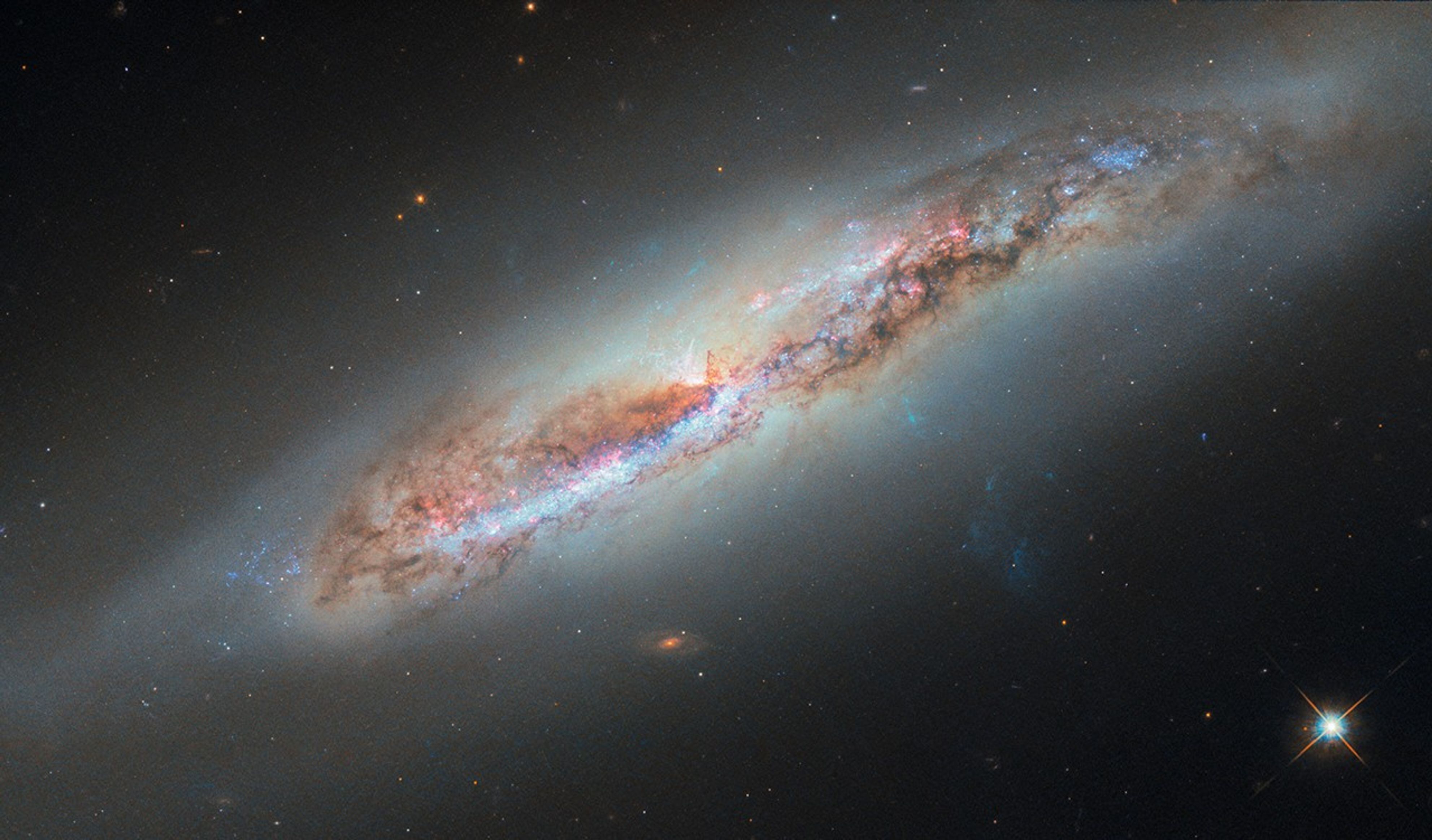
This NASA/ESA Hubble Space Telescope image features the galaxy NGC 4388, a member of the Virgo galaxy cluster.
ESA/Hubble & NASA, S. Veilleux, J. Wang, J. Greene
A sideways spiral galaxy shines in this NASA/ESA Hubble Space Telescope image. Located about 60 million light-years away in the constellation Virgo (the Maiden), NGC 4388 is a resident of the Virgo galaxy cluster. This enormous cluster of galaxies contains more than a thousand members and is the nearest large galaxy cluster to the Milky Way.
NGC 4388 appears to tilt at an extreme angle relative to our point of view, giving us a nearly edge-on prospect of the galaxy. This perspective reveals a curious feature that wasn’t visible in a previous Hubble image of this galaxy released in 2016: a plume of gas from the galaxy’s nucleus, here seen billowing out from the galaxy’s disk toward the lower-right corner of the image. But where did this outflow come from, and why does it glow?
The answer likely lies in the vast stretches of space that separate the galaxies of the Virgo cluster. Though the space between galaxies appears empty, this space is occupied by hot wisps of gas called the intracluster medium. As NGC 4388 moves within the Virgo cluster, it plunges through the intracluster medium. Pressure from hot intracluster gas whisks away gas from within NGC 4388’s disk, causing it to trail behind as NGC 4388 moves.
The source of the ionizing energy that causes this gas cloud to glow is more uncertain. Researchers suspect that some of the energy comes from the center of the galaxy, where a supermassive black hole spins gas around it into a superheated disk. The blazing radiation from this disk might ionize the gas closest to the galaxy, while shock waves might be responsible for ionizing filaments of gas farther out.
This image incorporates new data, including several additional wavelengths of light, that bring the ionized gas cloud into view. The image holds data from several observing programs that aim to illuminate galaxies with active black holes at their centers.
NASA’s Hubble Sees Asteroids Colliding at Nearby Star for First Time
Like a game of cosmic bumper cars, scientists think the early days of our solar system were a time of violent turmoil, with planetesimals, asteroids, and comets smashing together and pelting the Earth, Moon, and the other inner planets with debris. Now, in a historical milestone, NASA’s Hubble Space Telescope has directly imaged similar catastrophic collisions in a nearby planetary system around another star, Fomalhaut.
“This is certainly the first time I’ve ever seen a point of light appear out of nowhere in an exoplanetary system,” said principal investigator Paul Kalas of the University of California, Berkeley. “It’s absent in all of our previous Hubble images, which means that we just witnessed a violent collision between two massive objects and a huge debris cloud unlike anything in our own solar system today. Amazing!”
Just 25 light-years from Earth, Fomalhaut is one of the brightest stars in the night sky. Located in the constellation Piscis Austrinus, also known as the Southern Fish, it is more massive and brighter than the Sun and is encircled by several belts of dusty debris.
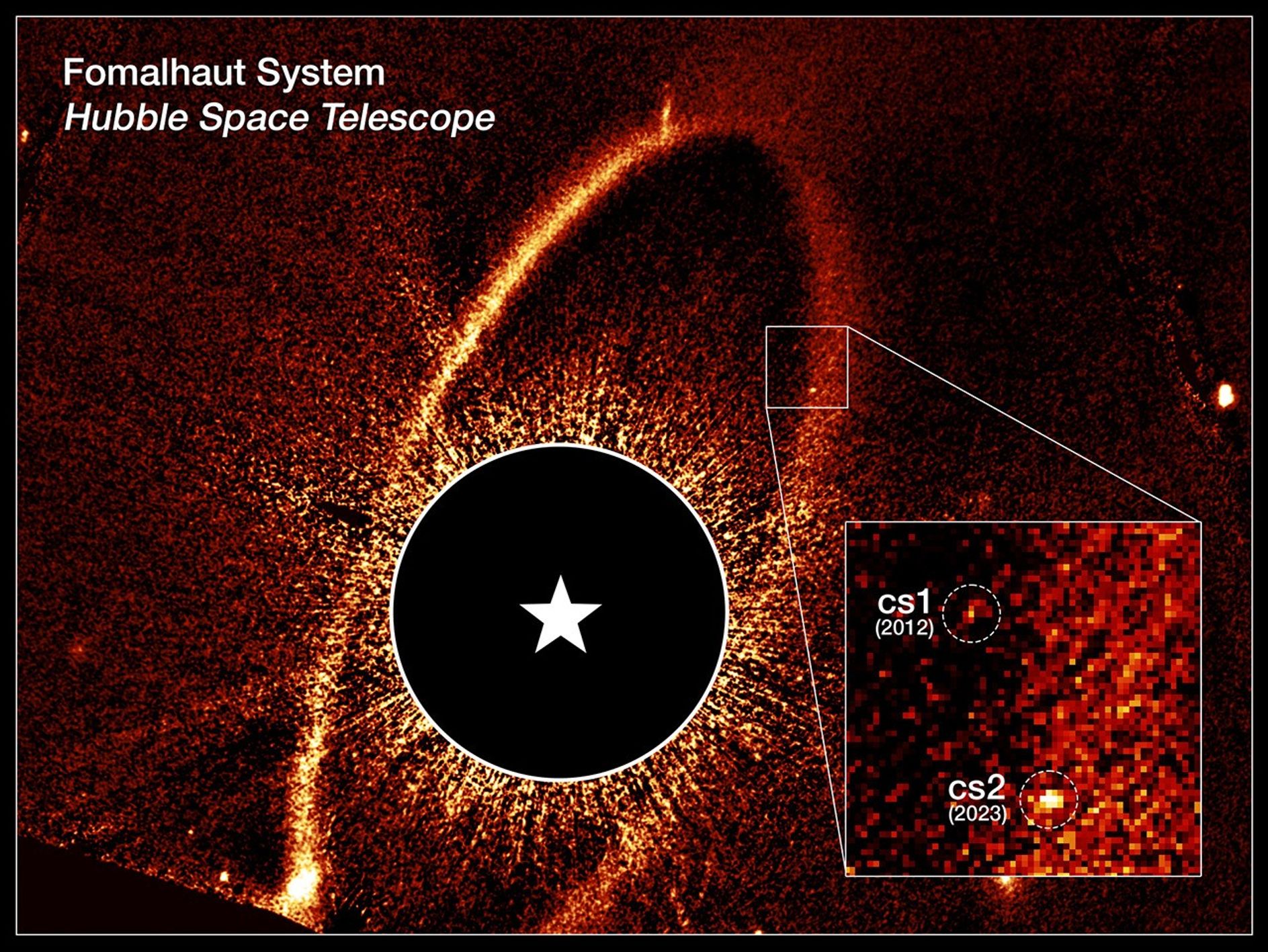
This composite Hubble Space Telescope image shows the debris ring and dust clouds cs1 and cs2 around the star Fomalhaut. Fomalhaut itself is masked out to allow the fainter features to be seen. Its location is marked by the white star.
Image: NASA, ESA, Paul Kalas (UC Berkeley); Image Processing: Joseph DePasquale (STScI)
In 2008, scientists used Hubble to discover a candidate planet around Fomalhaut, making it the first stellar system with a possible planet found using visible light. That object, called Fomalhaut b, now appears to be a dust cloud masquerading as a planet—the result of colliding planetesimals. While searching for Fomalhaut b in recent Hubble observations, scientists were surprised to find a second point of light at a similar location around the star. They call this object “circumstellar source 2” or “cs2” while the first object is now known as “cs1.”
Tackling Mysteries of Colliding Planetesimals
Why astronomers are seeing both of these debris clouds so physically close to each other is a mystery. If the collisions between asteroids and planetesimals were random, cs1 and cs2 should appear by chance at unrelated locations. Yet, they are positioned intriguingly near each other along the inner portion of Fomalhaut’s outer debris disk.
Another mystery is why scientists have witnessed these two events within such a short timeframe. “Previous theory suggested that there should be one collision every 100,000 years, or longer. Here, in 20 years, we’ve seen two,” explained Kalas. “If you had a movie of the last 3,000 years, and it was sped up so that every year was a fraction of a second, imagine how many flashes you’d see over that time. Fomalhaut’s planetary system would be sparkling with these collisions.”
Collisions are fundamental to the evolution of planetary systems, but they are rare and difficult to study.
This artist’s concept shows the sequence of events leading up to the creation of dust cloud cs2 around the star Fomalhaut. In Panel 1, the star Fomalhaut appears in the top left corner. Two white dots, located in the bottom right corner, represent the two massive objects in orbit around Fomalhaut. In Panel 2, the objects approach each other. Panel 3 shows the violent collision of these two objects. In Panel 4, the resulting dust cloud cs2 becomes visible and starlight pushes the dust grains away from the star.
Artwork: NASA, ESA, STScI, Ralf Crawford (STScI)
“The exciting aspect of this observation is that it allows researchers to estimate both the size of the colliding bodies and how many of them there are in the disk, information which is almost impossible to get by any other means,” said co-author Mark Wyatt at the University of Cambridge in England. “Our estimates put the planetesimals that were destroyed to create cs1 and cs2 at just 37 miles or 60 kilometers across, and we infer that there are 300 million such objects orbiting in the Fomalhaut system.”
“The system is a natural laboratory to probe how planetesimals behave when undergoing collisions, which in turn tells us about what they are made of and how they formed,” explained Wyatt.
Cautionary Tale
The transient nature of Fomalhaut cs1 and cs2 poses challenges for future space missions aiming to directly image exoplanets. Such telescopes may mistake dust clouds like cs1 and cs2 for actual planets.
“Fomalhaut cs2 looks exactly like an extrasolar planet reflecting starlight,” said Kalas. “What we learned from studying cs1 is that a large dust cloud can masquerade as a planet for many years. This is a cautionary note for future missions that aim to detect extrasolar planets in reflected light.”
Looking to Future
Kalas and his team have been granted Hubble time to monitor cs2 over the next three years. They want to see how it evolves—does it fade, or does it get brighter? Being closer to the dust belt than cs1, the expanding cs2 cloud is more likely to start encountering other material in the belt. This could lead to a sudden avalanche of more dust in the system, which could cause the whole surrounding area to get brighter.
Credit: NASA’s Goddard Space Flight Center; Lead Producer: Paul Morris
“We will be tracing cs2 for any changes in its shape, brightness, and orbit over time,” said Kalas, “It’s possible that cs2 will start becoming more oval or cometary in shape as the dust grains are pushed outward by the pressure of starlight.”
The team also will use the NIRCam (Near-Infrared Camera) instrument on NASA’s James Webb Space Telescope to observe cs2. Webb’s NIRCam has the ability to provide color information that can reveal the size of the cloud’s dust grains and their composition. It can even determine if the cloud contains water ice.
Hubble and Webb are the only observatories capable of this kind of imaging. While Hubble primarily sees in visible wavelengths, Webb could view cs2 in the infrared. These different, complementary wavelengths are needed to provide a broad multi-spectral investigation and a more complete picture of the mysterious Fomalhaut system and its rapid evolution.
The Hubble Space Telescope has been operating for over three decades and continues to make ground-breaking discoveries that shape our fundamental understanding of the universe. Hubble is a project of international cooperation between NASA and ESA (European Space Agency). NASA’s Goddard Space Flight Center in Greenbelt, Maryland, manages the telescope and mission operations. Lockheed Martin Space, based in Denver, also supports mission operations at Goddard. The Space Telescope Science Institute in Baltimore, which is operated by the Association of Universities for Research in Astronomy, conducts Hubble science operations for NASA.
This composite Hubble Space Telescope image shows the debris ring and dust clouds cs1 and cs2 around the star Fomalhaut. Fomalhaut itself is masked out to allow the fainter features to be seen. Its location is marked by the white star.
Fomalhaut cs2 Illustration
This artist’s concept shows the sequence of events leading up to the creation of dust cloud cs2 around the star Fomalhaut.
Fomalhaut cs2 Video
Hubble captured the violent collision of two massive objects around the star Fomalhaut. This extraordinary event is unlike anything in our own present-day solar system. The video shows the sequence of events leading up to the creation of dust cloud cs2 around the star Fomalhaut. …
Hubble Captures Destruction of Worlds Video
NASA’s Hubble Space Telescope captured a rare and violent event unfolding around the nearby star Fomalhaut. This discovery sheds light on the chaotic processes that may have shaped our own solar system billions of years ago. With support from both Hubble and the James Webb Space Telescope, astronomers are now closely monitoring the aftermath.
From 2020: Exoplanet Apparently Disappears in Latest Hubble Observations
From 2013: Hubble Reveals Rogue Planetary Orbit for Fomalhaut b
Newly released Hubble Space Telescope images of a vast debris disk encircling the nearby star Fomalhaut, and of a mysterious planet circling it, may provide forensic evidence of a titanic planetary disruption in the system.
From 2008: Hubble Directly Observes Planet Orbiting Fomalhaut
NASA’s Hubble Space Telescope has taken the first visible-light snapshot of a planet circling another star.
From 2005: Elusive Planet Reshapes a Ring Around Neighboring Star
NASA Hubble Space Telescope’s most detailed visible-light image ever taken of a narrow, dusty ring around the nearby star Fomalhaut (HD 216956), offers the strongest evidence yet that an unruly and unseen planet may be gravitationally tugging on the ring.
This NASA/ESA Hubble Space Telescope image features the blue dwarf galaxy Markarian 178 (Mrk 178) against a backdrop of distant galaxies in all shapes and sizes. Some of these distant galaxies even shine through the diffuse edges of Mrk 178.
ESA/Hubble & NASA, F. Annibali, S. Hong
This NASA/ESA Hubble Space Telescope image features a glittering blue dwarf galaxy called Markarian 178 (Mrk 178). The galaxy, which is substantially smaller than our own Milky Way, lies 13 million light-years away in the constellation Ursa Major (the Great Bear).
Mrk 178 is one of more than 1,500 Markarian galaxies. These galaxies get their name from the Armenian astrophysicist Benjamin Markarian, who compiled a list of galaxies that were surprisingly bright in ultraviolet light.
While the bulk of the galaxy is blue due to an abundance of young, hot stars with little dust shrouding them, Mrk 178 gets a red hue from a collection of rare massive Wolf–Rayet stars. These stars are concentrated in the brightest, reddish region near the galaxy’s edge. Wolf–Rayet stars cast off their atmospheres through powerful winds, and the bright emission lines from their hot stellar winds are etched upon the galaxy’s spectrum. Both ionized hydrogen and oxygen lines are particularly strong and appear as a red color in this photo.
Massive stars enter the Wolf–Rayet phase of their evolution just before they collapse into black holes or neutron stars. Because Wolf–Rayet stars last for only a few million years, researchers know that something must have triggered a recent burst of star formation in Mrk 178. At first glance, it’s not clear what could be the cause — Mrk 178 doesn’t seem to have any close galactic neighbors that may have stirred up its gas to form new stars. Instead, researchers suspect that a gas cloud crashed into Mrk 178, or that the intergalactic medium disturbed its gas as the galaxy moved through space. Either disturbance could light up this tiny galaxy with a ripple of bright new stars.
Image credit: ESA/Hubble & NASA, F. Annibali, S. Hong

 Login
Login