A new study shows that earthquake monitoring networks can track falling space debris by detecting the sonic booms produced during atmospheric reentry, sometimes more accurately than radar. The Associated Press reports: Scientists reported Thursday that seismic readings from sonic booms that were generated when a discarded module from a Chinese crew capsule reentered over Southern California in 2024 allowed them to place the object's path nearly 20 miles (30 kilometers) farther south than radar had predicted from orbit. Using this method to track uncontrolled objects plummeting at supersonic speeds, they said, could help recovery teams reach any surviving pieces more quickly -- crucial if the debris is dangerous.
"The problem at the moment is we can track stuff very well in space," said Johns Hopkins University's Benjamin Fernando, the lead researcher. "But once it gets to the point that it's actually breaking up in the atmosphere, it becomes very difficult to track." His team's findings, published in the journal Science, focus on just one debris event. But the researchers already have used publicly available data from seismic networks to track a few dozen other reentries, including debris from three failed SpaceX Starship test flights in Texas. [...]
Fernando is looking to eventually publish a catalog of seismically tracked, entering space objects, while improving future calculations by factoring in the wind's effect on falling debris. In a companion article in Science, Los Alamos National Laboratory's Chris Carr, who was not involved in the study, said further research is needed to reduce the time between an object's final plunge and the determination of its course. For now, Carr said this new method "unlocks the rapid identification of debris fall-out zones, which is key information as Earth's orbit is anticipated to become increasingly crowded with satellites, leading to a greater influx of space debris."
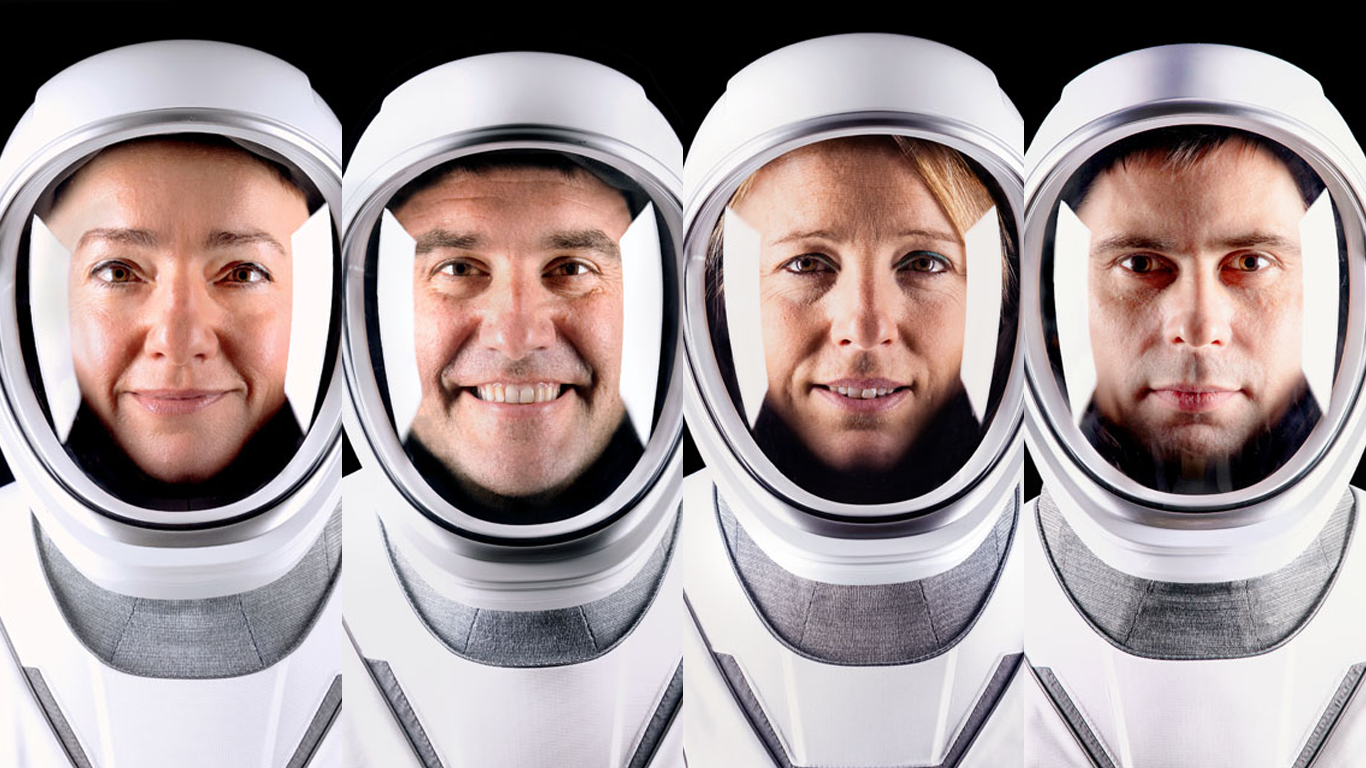
NASA’s SpaceX Crew-12 crew, from left to right, is NASA astronauts Jessica Meir and Jack Hathaway, ESA (European Space Agency) astronaut Sophie Adenot, and Roscosmos cosmonaut Andrey Fedyaev.
Credit: SpaceX
NASA and its partners will discuss the upcoming crew rotation to the International Space Station during a pair of news conferences on Friday, Jan. 30, from the agency’s Johnson Space Center in Houston.
At 11 a.m. EST, mission leadership will discuss final launch and mission preparations in a news conference that will stream on the agency’s YouTube channel.
Next, the crew of NASA’s SpaceX Crew-12 mission will participate in a virtual news conference from NASA Johnson crew quarters at 1 p.m., also on the agency’s YouTube channel. Individual streams for each of the events will be available on that page. This is the final media opportunity with Crew-12 before they travel to NASA’s Kennedy Space Center in Florida for launch.
Crew-12 will carry NASA astronauts Jessica Meir and Jack Hathaway, ESA (European Space Agency) astronaut Sophie Adenot, and Roscosmos cosmonaut Andrey Fedyaev to the orbiting laboratory. The crew will launch aboard a SpaceX Dragon spacecraft on the company’s Falcon 9 rocket from Space Launch Complex 40 at Cape Canaveral Space Force Station in Florida. The agency is working with SpaceX and its international partners to review options to advance the launch of Crew-12 from its original target date of Sunday, Feb. 15.
United States-based media interested in attending in person must contact the NASA Johnson newsroom no later than 5 p.m. CST on Thursday, Jan. 29, at 281-483-5111 or jsccommu@mail.nasa.gov.
Media wishing to join the news conferences by phone must contact the Johnson newsroom by 9:45 a.m. on the day of the event. A copy of NASA’s media accreditation policy is available online.
Briefing participants are as follows (all times Eastern and subject to change based on real-time operations):
11 a.m.: Mission Overview News Conference
Ken Bowersox, associate administrator, NASA’s Space Operations Mission Directorate
Steve Stich, manager, Commercial Crew Program, NASA Kennedy
Dana Weigel, manager, International Space Station Program, NASA Johnson
Andreas Mogensen, Human Exploration Group Leader, ESA
This will be the second flight to the space station for Meir, who was selected as a NASA astronaut in 2013. The Caribou, Maine, native earned a bachelor’s degree in biology from Brown University, a master’s degree in space studies from the International Space University, and a doctorate in marine biology from Scripps Institution of Oceanography in San Diego. On her first spaceflight, Meir spent 205 days as a flight engineer during Expedition 61/62, and she completed the first three all-woman spacewalks with fellow NASA astronaut Christina Koch, totaling 21 hours and 44 minutes outside of the station. Since then, she has served in various roles, including assistant to the chief astronaut for commercial crew (SpaceX), deputy for the Flight Integration Division, and assistant to the chief astronaut for the human landing system.
A commander in the United States Navy, Hathaway was selected as part of the 2021 astronaut candidate class. This will be Hathaway’s first spaceflight. The South Windsor, Connecticut, native holds a bachelor’s degree in physics and history from the U.S. Naval Academy and master’s degrees in flight dynamics from Cranfield University and national security and strategic studies from the U.S. Naval War College, respectively. Hathaway also is a graduate of the Empire Test Pilot’s School, Fixed Wing Class 70 in 2011. At the time of his selection, Hathaway was deployed aboard the USS Truman, serving as Strike Fighter Squadron 81’s prospective executive officer. He has accumulated more than 2,500 flight hours in 30 different aircraft, including more than 500 carrier arrested landings and 39 combat missions.
The Crew-12 mission will be Adenot’s first spaceflight. Before her selection as an ESA astronaut in 2022, Adenot earned a degree in engineering from ISAE-SUPAERO in Toulouse, France, specializing in spacecraft and aircraft flight dynamics. She also earned a master’s degree in human factors engineering at Massachusetts Institute of Technology in Cambridge. After earning her master’s degree, she became a helicopter cockpit design engineer at Airbus Helicopters and later served as a search and rescue pilot at Cazaux Air Base from 2008 to 2012. She then joined the High Authority Transport Squadron in Villacoublay, France, and served as a formation flight leader and mission captain from 2012 to 2017. Between 2019 and 2022, Adenot worked as a helicopter experimental test pilot in Cazaux Flight Test Center with DGA (Direction Générale de l’Armement – the French Defence Procurement Agency). She has logged more than 3,000 hours flying 22 different helicopters.
This will be Fedyaev’s second long-duration stay aboard the orbiting laboratory. He graduated from the Krasnodar Military Aviation Institute in 2004, specializing in aircraft operations and air traffic organization, and earned qualifications as a pilot engineer. Prior to his selection as a cosmonaut, he served as deputy commander of an Ilyushin-38 aircraft unit in the Kamchatka Region, logging more than 600 flight hours and achieving the rank of second-class military pilot. Fedyaev was selected for the Gagarin Research and Test Cosmonaut Training Center Cosmonaut Corps in 2012 and has served as a test cosmonaut since 2014. In 2023, he flew to the space station as a mission specialist during NASA’s SpaceX Crew-6 mission, spending 186 days in orbit, as an Expedition 69 flight engineer. For his achievements, Fedyaev was awarded the title Hero of the Russian Federation and received the Yuri Gagarin Medal.
NASA Selects Participants to Track Artemis II Mission
A visual representation of NASA’s Artemis I mission.
Credits: NASA
NASA has selected 34 global volunteers to track the Orion spacecraft during the crewed Artemis II mission’s journey around the Moon.
The Artemis II test flight will launch NASA’s Space Launch System (SLS) rocket, carrying the Orion spacecraft and a crew of four astronauts, on a mission into deep space. The agency’s second mission in the Artemis campaign is a key step in NASA’s path toward establishing a long-term presence at the Moon and confirming the systems needed to support future lunar surface exploration and paving the way for the first crewed mission to Mars.
While NASA’s Near Space Network and Deep Space Network, coordinated by the agency’s SCaN (Space Communication and Navigation) program , will provide primary communications and tracking services to support Orion’s launch, journey around the Moon, and return to Earth, participants selected from a request for proposals published in August 2025, comprised of established commercial service providers, members of academia, and individual amateur radio enthusiasts will use their respective equipment to passively track radio waves transmitted by Orion during its approximately 10-day journey.
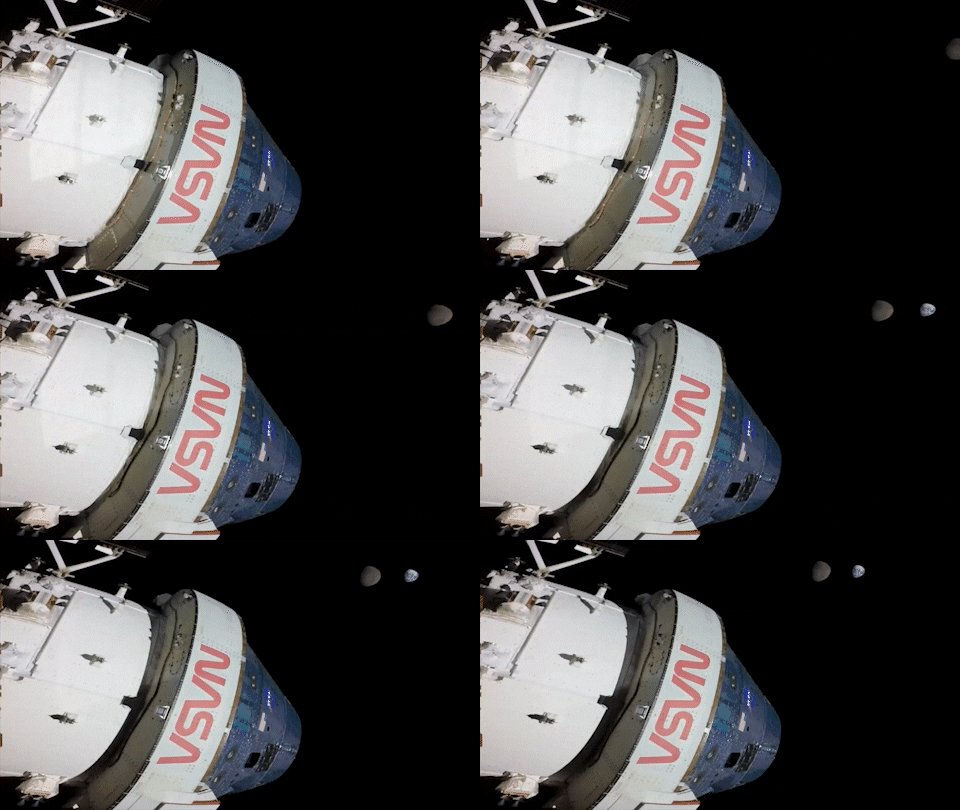
The Orion capsule viewing the Moon during Artemis I.
NASA
“The Artemis II tracking opportunity is a real step toward SCaN’s commercial-first vision. By inviting external organizations to demonstrate their capabilities during a human spaceflight mission, we’re strengthening the marketplace we’ll rely on as we explore farther into the solar system,” said Kevin Coggins, deputy associate administrator for SCaN at NASA Headquarters in Washington. “This isn’t about tracking one mission, but about building a resilient, public-private ecosystem that will support the Golden Age of innovation and exploration.”
This isn’t about tracking one mission, but about building a resilient, public-private ecosystem that will support the Golden Age of innovation and exploration.”
KEvin Coggins
NASA Deputy Associate Administrator for SCaN
These volunteers will submit their data to NASA for analysis, helping the agency better assess the broader aerospace community’s tracking capabilities and identify ways to augment future Moon and Mars mission support. There are no funds exchanged as a part of this collaborative effort.
This initiative builds on a previous effort in which 10 volunteers successfully tracked the Orion spacecraft during Artemis I in 2022. That campaign produced valuable data and lessons learned, including implementation, formatting, and data quality variations for Consultative Committee for Space Data Systems, which develops communications and data standards for spaceflight. To address these findings, SCaN now requires that all tracking data submitted for Artemis II comply with its data system standards.
Compared to the previous opportunity, public interest in tracking the Artemis II mission has increased. About 47 ground assets spanning 14 different countries will be used for to track the spacecraft during its journey around the Moon.
Participants List:
Government:
Canadian Space Agency (CSA), Canada
The German Aerospace Center (DLR), Germany
Commercial:
Goonhilly Earth Station Ltd, United Kingdom
GovSmart, Charlottesville, Virginia
Integrasys + University of Seville, Spain
Intuitive Machines, Houston
Kongsberg Satellite Services, Norway
Raven Defense Corporation, Albuquerque, New Mexico
Reca Space Agency + University of Douala, Cameroon
Rincon Research Corporation & the University of Arizona, Tucson
Sky Perfect JSAT, Japan
Space Operations New Zealand Limited, New Zealand
Telespazio, Italy
ViaSat, Carlsbad, California
Von Storch Engineering, Netherlands
Individual:
Chris Swier, South Dakota
Dan Slater, California
Loretta A Smalls, California
Scott Tilley, Canada
Academia:
American University, Washington
Awara Space Center + Fukui University of Technology, Japan
Morehead State University, Morehead, Kentucky
Pisgah Astronomical Research Institute, Rosman, North Carolina
University of California Berkeley, Space Sciences Laboratory, California
University of New Brunswick, ECE, Canada
University of Pittsburgh, ECE, Pittsburgh
University of Zurich – Physics Department, Switzerland
Non-Profit & Amateur Radio Organizations:
AMSAT Argentina, Argentina
AMSAT Deutschland, Germany
Amateur Radio Exploration Ground Station Consortium, Springfield, Illinois
CAMRAS, Netherlands
Deep Space Exploration Society, Kiowa County, Colorado
Neu Golm Ground Station, Germany
Observation Radio Pleumur-bodou, France
Artemis II will fly around the Moon to test the systems which will carry astronauts to the lunar surface for economic benefits and scientific discovery in the Golden Age of exploration and innovation.
The networks supporting Artemis receive programmatic oversight from NASA’s SCaN Program office. In addition to providing communications services to missions, SCaN develops the technologies and capabilities that will help propel NASA to the Moon, Mars, and beyond. The Deep Space Network is managed by NASA’s Jet Propulsion Laboratory in Southern California, and the Near Space Network is managed by NASA’s Goddard Space Flight Center in Greenbelt, Maryland.
Katrina Lee is a writer for the Space Communications and Navigation (SCaN) Program office and covers emerging technologies, commercialization efforts, exploration activities, and more.
Welcome to Edition 8.26 of the Rocket Report! The past week has been one of advancements and setbacks in the rocket business. NASA rolled the massive rocket for the Artemis II mission to its launch pad in Florida, while Chinese launchers suffered back-to-back failures within a span of approximately 12 hours. Rocket Lab's march toward a debut of its new Neutron launch vehicle in the coming months may have stalled after a failure during a key qualification test. We cover all this and more in this week's Rocket Report.
As always, we welcome reader submissions. If you don't want to miss an issue, please subscribe using the box below (the form will not appear on AMP-enabled versions of the site). Each report will include information on small-, medium-, and heavy-lift rockets, as well as a quick look ahead at the next three launches on the calendar.
Australia invests in sovereign launch. Six months after its first orbital rocket cleared the launch tower for just 14 seconds before crashing back to Earth, Gilmour Space Technologies has secured 217 million Australian dollars ($148 million) in funding that CEO Adam Gilmour says finally gives Australia a fighting chance in the global space race, the Sydney Morning Herald reports. The funding round, led by the federal government's National Reconstruction Fund Corporation and superannuation giant Hostplus with $75 million each, makes the Queensland company Australia’s newest unicorn—a fast-growth start-up valued at more than $1 billion—and one of the country’s most heavily backed private technologyventures.
Register now to save up to $680 on your TechCrunch Disrupt 2026 pass and get a second ticket at 50% off. This offer ends next week on January 30, or once the first 500 tickets are claimed — whichever comes first.
After moving the massive SLS rocket and Orion spacecraft to the launchpad last weekend, NASA is now eyeing the next stage of its preparations for Artemis II, the first crewed lunar mission in more than five decades. Now firmly in place at Launch Pad 39B at the Kennedy Space Center in Florida, the rocket will […]
Blue Origin confirmed Thursday that the next launch of its New Glenn rocket will carry a large communications satellite into low-Earth orbit for AST SpaceMobile.
The rocket will launch the next-generation Block 2 BlueBird satellite "no earlier than late February" from Launch Complex 36 at Cape Canaveral Space Force Station.
However, the update from Blue Origin appears to have buried the real news toward the end: "The mission follows the successful NG-2 mission, which included the landing of the 'Never Tell Me The Odds' booster. The same booster is being refurbished to power NG-3," the company said.
NASA's first astronauts to fly to the Moon in more than 50 years will pay tribute to the lunar and space exploration missions that preceded them, as well as aviation and American history, by taking with them artifacts and mementos representing those past accomplishments.
NASA, on Wednesday, January 21, revealed the contents of the Artemis II mission's Official Flight Kit (OFK), continuing a tradition dating back to the Apollo program of packing a duffel bag-sized pouch of symbolic and celebratory items to commemorate the flight and recognize the people behind it. The kit includes more than 2,300 items, including a handful of relics.
"This mission will bring together pieces of our earliest achievements in aviation, defining moments from human spaceflight and symbols of where we're headed next," Jared Isaacman, NASA's administrator, said in a statement. "Historical artifacts flying aboard Artemis II reflect the long arc of American exploration and the generations of innovators who made this moment possible."
Jeff Bezos' Blue Origin had previously suggested that the third launch of the mega-rocket would take the space company's robotic lunar lander to the moon.
There’s little about building spacecraft that anyone would call simple. But there’s at least one element of designing a vehicle that will operate outside the Earth’s atmosphere that’s fairly easier to handle: aerodynamics. That’s because, at the altitude that most satellites operate at, drag can essentially be ignored. Which is why most satellites look like refrigerators with solar panels and high-gain antennas attached jutting out at odd angles.
But for all the advantages that the lack of meaningful drag on a vehicle has, there’s at least one big potential downside. If a spacecraft is orbiting high enough over the Earth that the impact of atmospheric drag is negligible, then the only way that vehicle is coming back down in a reasonable amount of time is if it has the means to reduce its own velocity. Otherwise, it could be stuck in orbit for decades. At a high enough orbit, it could essentially stay up forever.
Launched in 1958, Vanguard 1 is expected to remain in orbit until at least 2198
There was a time when that kind of thing wasn’t a problem. It was just enough to get into space in the first place, and little thought was given to what was going to happen in five or ten years down the road. But today, low Earth orbit is getting crowded. As the cost of launching something into space continues to drop, multiple companies are either planning or actively building their own satellite constellations comprised of thousands of individual spacecraft.
Fortunately, there may be a simple solution to this problem. By putting a satellite into what’s known as a very low Earth orbit (VLEO), a spacecraft will experience enough drag that maintaining its velocity requires constantly firing its thrusters. Naturally this presents its own technical challenges, but the upside is that such an orbit is essentially self-cleaning — should the craft’s propulsion fail, it would fall out of orbit and burn up in months or even weeks. As an added bonus, operating at a lower altitude has other practical advantages, such as allowing for lower latency communication.
VLEO satellites hold considerable promise, but successfully operating in this unique environment requires certain design considerations. The result are vehicles that look less like the flying refrigerators we’re used to, with a hybrid design that features the sort of aerodynamic considerations more commonly found on aircraft.
ESA’s Pioneering Work
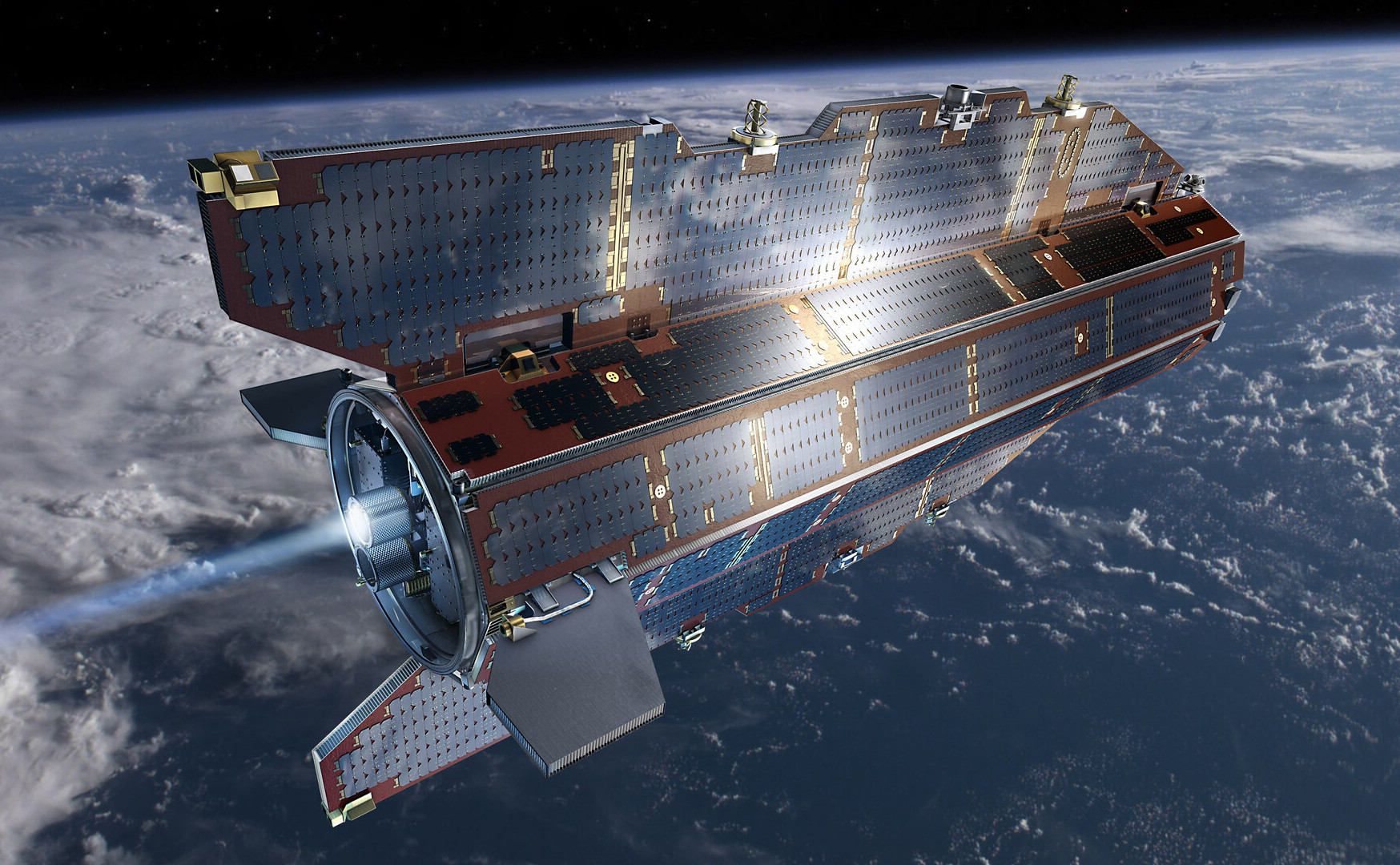
This might sound like science fiction, but such craft have already been developed and successfully operated in VLEO. The best example so far is the Gravity Field and Steady-State Ocean Circulation Explorer (GOCE), launched by the European Space Agency (ESA) back in 2009.
To make its observations, GOCE operated at an altitude of 255 kilometers (158 miles), and dropped as low as just 229 km (142 mi) in the final phases of the mission. For reference the International Space Station flies at around 400 km (250 mi), and the innermost “shell” of SpaceX’s Starlink satellites are currently being moved to 480 km (298 mi).
Given the considerable drag experienced by GOCE at these altitudes, the spacecraft bore little resemblance to a traditional satellite. Rather than putting the solar panels on outstretched “wings”, they were mounted to the surface of the dart-like vehicle. To keep its orientation relative to the Earth’s surface stable, the craft featured stubby tail fins that made it look like a futuristic torpedo.
Even with its streamlined design, maintaining such a low orbit required GOCE to continually fire its high-efficiency ion engine for the duration of its mission, which ended up being four and a half years.
In the case of GOCE, the end of the mission was dictated by how much propellant it carried. Once it had burned through the 40 kg (88 lb) of xenon onboard, the vehicle would begin to rapidly decelerate, and ground controllers estimated it would re-enter the atmosphere in a matter of weeks. Ultimately the engine officially shutdown on October 21st, and by November 9th, it’s orbit had already decayed to 155 km (96 mi). Two days later, the craft burned up in the atmosphere.
JAXA Lowers the Bar
While GOCE may be the most significant VLEO mission so far from a scientific and engineering standpoint, the current record for the spacecraft with the lowest operational orbit is actually held by the Japan Aerospace Exploration Agency (JAXA).
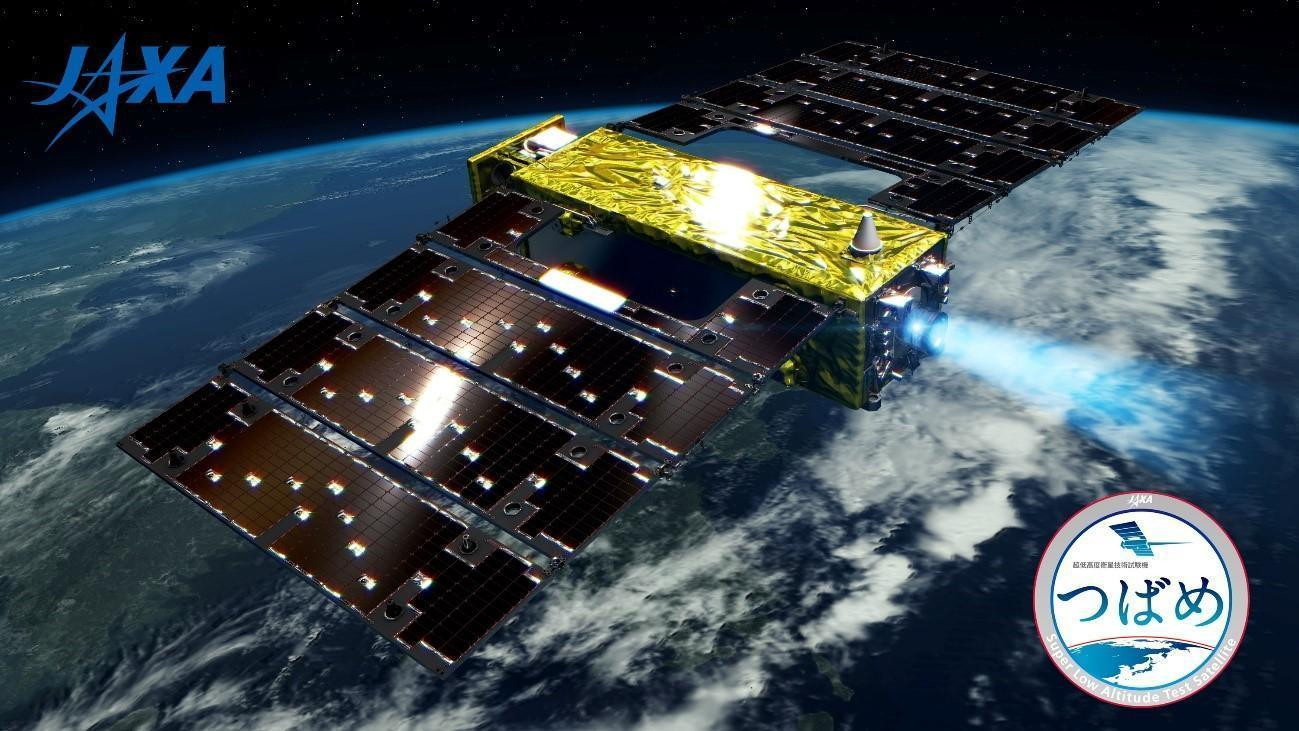
In December 2017 JAXA launched the Super Low Altitude Test Satellite (SLATS) into an initial orbit of 630 km (390 mi), which was steadily lowered in phases over the next several weeks until it reached 167.4 km (104 mi). Like GOCE, SLATS used a continuously operating ion engine to maintain velocity, although at the lowest altitudes, it also used chemical reaction control system (RCS) thrusters to counteract the higher drag.
SLATS was a much smaller vehicle than GOCE, coming in at roughly half the mass. It also carried just 12 kg (26 lb) of xenon propellant, which limited its operational life. It also utilized a far more conventional design than GOCE, although its rectangular shape was somewhat streamlined when compared to a traditional satellite. Its solar arrays were also mounted in parallel to the main body of the craft, giving it an airplane-like appearance.
The combination of lower altitude and higher frontal drag meant that SLATS had an even harder time maintaining velocity than GOCE. Once its propulsion system was finally switched off in October 2019, the craft re-entered the atmosphere and burned up within 24 hours. The mission has since been recognized by Guinness World Records for the lowest altitude maintained by an Earth observation satellite.
A New Breed of Satellite
As impressive as GOCE and SLATS were, their success was based more on careful planning than any particular technological breakthrough. After all, ion propulsion for satellites is not new, nor is the field of aerodynamics. The concepts were simply applied in a novel way.
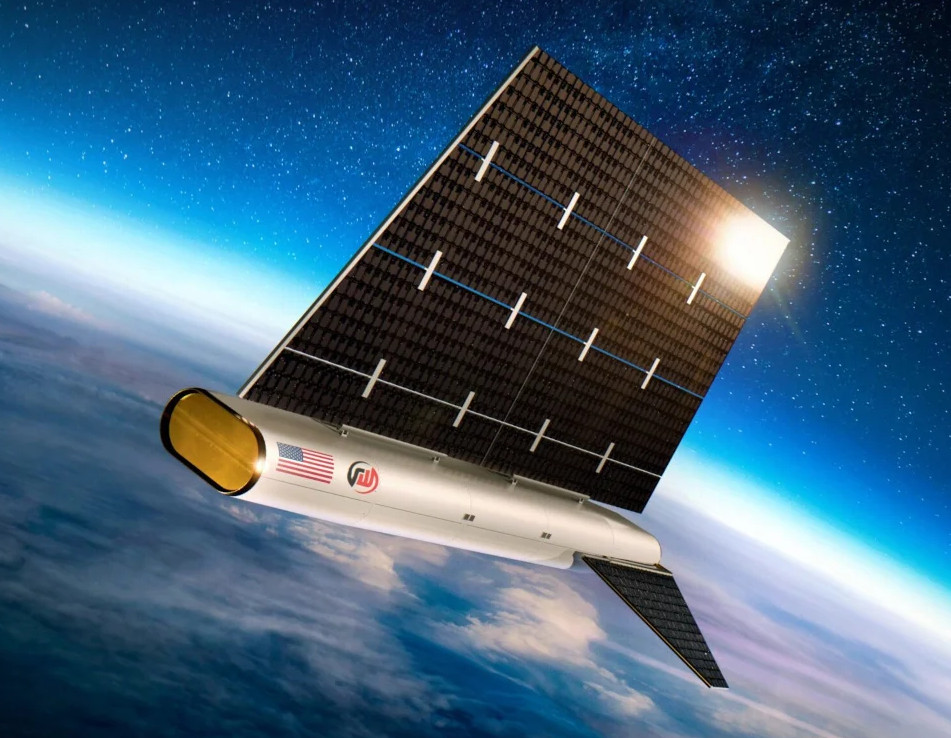
But there exists the potential for a totally new type of vehicle that operates exclusively in VLEO. Such a craft would be a true hybrid, in the sense that its primarily a spacecraft, but uses an air-breathing electric propulsion (ABEP) system akin to an aircraft’s jet engine. Such a vehicle could, at least in theory, maintain an altitude as low as 90 km (56 mi) indefinitely — so long as its solar panels can produce enough power.
Both the Defense Advanced Research Projects Agency (DARPA) in the United States and the ESA are currently funding several studies of ABEP vehicles, such as Redwire’s SabreSat, which have numerous military and civilian applications. Test flights are still years away, but should VLEO satellites powered by ABEP become common platforms for constellation applications, they may help alleviate orbital congestion before it becomes a serious enough problem to impact our utilization of space.
The excitement is building as NASA works toward launching its first crewed lunar flight in more than five decades. The Artemis II mission, which will take four astronauts on a 10-day voyage around the moon, could lift off as early as February 6. NASA has just released a cinematic trailer for the highly anticipated mission. […]
Blue Origin has lifted the curtain on its plan for an ultra-high-speed satellite data network called TeraWave. (Credit: Blue Origin)
Jeff Bezos’ Blue Origin space venture says it’ll be ramping up an ultra-high-speed satellite data network called TeraWave, which will compete with SpaceX’s Starlink network for business from data centers, large-scale enterprises and government customers.
The service appears to dovetail with Amazon Leo, the satellite-based broadband internet service that was Bezos’ brainchild while he served as Amazon’s CEO. Amazon Leo — previously known as Project Kuiper — promises downlink speeds of up to 1 gigabit per second (Gbps). In contrast, TeraWave is targeting higher-end data applications with symmetrical data speeds of up to 6 terabits per second (Tbps), a rate that’s 6,000 times faster.
In today’s announcement, Blue Origin said TeraWave’s constellation would consist of 5,408 laser-linked satellites in low Earth orbit (LEO) and medium Earth orbit (MEO). It plans to start deploying the satellites in late 2027, presumably using the company’s New Glenn rockets.
Blue Origin’s plans are discussed in an application and technical annex filed today with the Federal Communications Commission. In its application, the company is seeking waivers from several regulatory requirements in order to get TeraWave off the ground quickly.
“TeraWave addresses the unmet needs of customers who are seeking higher throughput, symmetrical upload/download speeds, more redundancy and rapid scalability,” Blue Origin said. An array of 5,280 satellites in LEO would provide access speeds of up to 144 Gbps, while another 128 satellites in MEO would offer terabit-level speeds.
Blue Origin said the multi-orbit network design would facilitate ultra-high-throughput links between global hubs and distributed gigabit-scale user connections, particularly in parts of the world that are not well-served by optical fiber connections.
This chart shows how the satellites in the TeraWave constellation would be connected using optical and radio links. Click on the chart for a larger version. (Blue Origin Infographic)
But what about Amazon, which is in the process of putting more than 3,200 satellites into low Earth orbit for Amazon Leo? Tech consultant Tim Farrar, the founder of TMF Associates, said the emergence of TeraWave raises questions about the relationship between the two best-known companies founded by Bezos.
“This is a very different design from Amazon Leo/Kuiper, but there is certainly overlap with Amazon’s target customers in the government and enterprise sectors,” Farrar told GeekWire in an email. “Is this all part of an ongoing negotiation with Amazon? … Or an alternative source of launch demand [for Blue Origin] in case Amazon decides to scale back their near-term space investments while they try to prove the case for Amazon Leo Gen1, before spending more money to launch a Gen2 system?”
Farrar speculated that the TeraWave initiative might represent an effort by Bezos to pressure Amazon’s current leadership to keep investing in space, or to spin off the Leo system to Blue Origin. He also said Blue Origin (Bezos’ private space venture) may be in a better position than Amazon (the publicly traded retail giant) to build out a next-generation satellite network.
“One takeaway is that everyone recognizes the value of vertical integration, where rocket makers create their own launch demand by building a constellation, as SpaceX has done,” Farrar said. “Amazon doesn’t have that right now, and it is a problem when you want to develop a mass-market satellite system with good enough economics to meet consumer price points, because you end up paying the full retail price for your launches.”
The announcement came out of the blue, from Blue, on Wednesday.
The space company founded by Jeff Bezos, Blue Origin, said it was developing a new megaconstellation named TeraWave to deliver data speeds of up to 6Tbps anywhere on Earth. The constellation will consist of 5,408 optically interconnected satellites, with a majority in low-Earth orbit and the remainder in medium-Earth orbit.
The satellites in low-Earth orbit will provide up to 144Gbps through radio spectrum, whereas those in medium-Earth orbit will provide higher data rates through optical links.
TechCrunch Disrupt 2026 tickets are officially on sale. Save up to $680 on your ticket and be among the first 500 registrants to score a plus-one pass at 50% off. Don't miss 10,000 tech leaders, founders, and VCs in San Francisco from October 13-15. Register before these one-time deals vanish.
An artist’s conception shows an Otter spacecraft in proximity to another satellite. (Starfish Space Illustration)
Starfish Space has secured a $52.5 million contract from the U.S. Space Force’s Space Development Agency to dispose of military satellites at the end of their operational lives.
The Tukwila, Wash.-based startup says it’s the first commercial deal ever struck to provide “deorbit-as-a-service,” or DaaS, for a satellite constellation in low Earth orbit. In this case, the constellation is the Pentagon’s Proliferated Warfighter Space Architecture, which provides global communications access and encrypted connectivity for military missions.
The contract calls for Starfish Space to launch the satellite disposal service in 2027.
“This is not research and development. This is an actual service, in a structure that allows that service to scale for this constellation, for an entire industry,” Starfish Space co-founder Trevor Bennett told GeekWire. He said the arrangement validates the Space Development Agency’s approach to building and maintaining its constellation, and also validates “the path that we can take with the industry at large.”
Starfish is developing a spacecraft called Otter that would be able to capture other satellites, maneuver them into different orbits, release them and then move on. In a deorbiting scenario, Otter would send the target satellite into a trajectory for atmospheric re-entry that wouldn’t pose a risk to other orbital assets. Starfish’s system doesn’t require the target satellite to be pre-outfitted with specialized hardware — which is a significant selling point.
The system provides an alternative to what typically happens to satellites toward the end of their lives. Today, most satellite operators either have to execute a deorbiting maneuver while they’re sure that the propulsion system still works, or risk having their spacecraft turn into unmanageable space junk.
Bennett compared Otter to a tow truck that can be brought in to carry away an old vehicle when it really needs to be scrapped.
“With the tow truck kind of capability, we can provide that service as needed, but we are not trying to replace normal operation,” he said. “We are augmenting it and extending it so the satellites that are being flown in that constellation can go fly longer. … Once it’s done operating and it’s time to dispose, we can provide that transit to the right disposable altitude.”
Starfish’s deal with the Space Development Agency builds on a previously awarded mission study contract that supported work on the concept in 2024 and 2025. The $52.5 million won’t be paid out all at once. An initial payment will cover costs leading up to the first deorbiting operation, and from then on, the agency will pay Starfish for services rendered. Bennett declined to provide further financial details, citing confidentiality.
Otter’s capabilities aren’t limited to deorbiting satellites. The oven-sized spacecraft could also be used to change a satellite’s orbital path, or bring it in for servicing. “With Otter, we’ve dramatically reduced the cost and complexity of satellite servicing across orbits,” Austin Link, Starfish Space’s other co-founder, said in a news release. “This contract reflects both the value of affordable servicing missions and the technical readiness of the Otter.”
Starfish conducted a partial test of its first Otter prototype, known as Otter Pup, in 2024. A second prototype, Otter Pup 2, launched in mid-2025 and is currently undergoing tests that could include a satellite docking attempt. “That vehicle remains healthy and operational, and is actually progressing through some additional mission milestones,” Bennett said.
Three other projects are in the works:
Starfish is due to send an Otter spacecraft to hook up with a retired SES satellite in geostationary Earth orbit, or GEO, and maneuver it into a graveyard orbit. The Otter would then dock with a different SES satellite and use its onboard propulsion system to keep that satellite in an operational orbit for additional years of life. (The deal was originally struck with Intelsat, but that company was acquired by SES last year.)
The Space Force’s Space Systems Command awarded Starfish Space a $37.5 million contract that calls for a different Otter spacecraft to dock with and maneuver national security assets in GEO.
“Those Otters are all under construction and in testing,” Bennett said. “Actually, we’ll see a couple of those launched this year. And so this is an exciting time, where Otters are about to go to space and start operating as commercial vehicles.”
Nearly 14 years ago, NASA’s Curiosity rover landed on Mars for a mission to explore the red planet and discover if it had an environment capable of supporting microbial life. Over the years, the rover has also been beaming back striking images of its surroundings, including the stunner at the top of this page captured […]
The Helix Nebula is one of the most well-known and commonly photographed planetary nebulae because it resembles the "Eye of Sauron." It is also one of the closest bright nebulae to Earth, located approximately 655 light-years from our Solar System.
You may not know what this particular nebula looks like when reading its name, but the Hubble Space Telescope has taken some iconic images of it over the years. And almost certainly, you'll recognize a photograph of the Helix Nebula, shown below.
Like many objects in astronomy, planetary nebulae have a confusing name, since they are formed not by planets but by stars like our own Sun, though a little larger. Near the end of their lives, these stars shed large amounts of gas in an expanding shell that, however briefly in cosmological time, put on a grand show.
Tesla aims to restart work on Dojo3, its previously abandoned third-generation AI chip. Only this time, Dojo3 won’t be aimed at training self-driving models on Earth. Instead, Musk says it will be dedicated to “space-based AI compute.”

 Login
Login