Normal view

There are new articles available, click to refresh the page.
Today — 19 December 2025Main stream

NASA’s Wideband Technology Demo Proves Space Missions are Free to Roam

19 December 2025 at 14:57
4 Min Read

NASA’s Wideband Technology Demo Proves Space Missions are Free to Roam

An artist's concept of the Polylingual Experimental Terminal transmitting data in space.
Credits: NASA/Morgan Johnson

Just like your cellphone stays connected by roaming between networks, NASA’s Polylingual Experimental Terminal, or PExT, technology demonstration is proving space missions can do the same by switching seamlessly between government and commercial communications networks.

NASA missions rely on critical data to navigate, monitor spacecraft health, and transmit scientific information back to Earth, and this game-changing technology could provide multiple benefits to government and commercial missions by enabling more reliable communications with fewer data interruptions.

“This mission has reshaped what’s possible for NASA and the U.S. satellite communications industry,” said Kevin Coggins, deputy associate administrator for the agency’s SCaN (Space Communications and Navigation) Program at NASA Headquarters in Washington. “PExT demonstrated that interoperability between government and commercial networks is possible near-Earth, and we’re not stopping there. The success of our commercial space partnerships is clear, and we’ll continue to carry that momentum forward as we expand these capabilities to the Moon and Mars.”

This mission has reshaped what’s possible for NASA and the U.S. satellite communications industry.

Kevin Coggins

Kevin Coggins

Deputy Associate Administrator for SCaN

Wideband technology enables data exchange across a broad range of frequencies, helping bridge government and commercial networks as NASA advances commercialization of space communications. By providing interoperability between government and commercial assets, this technology unlocks new advantages not currently available to agency missions.

As commercial providers continue to advance their technology and add new capabilities to their networks, missions equipped with wideband terminals can integrate these enhancements even after launch and during active operations. The technology also supports NASA’s network integrity by allowing missions to seamlessly switch back and forth between providers if one network faces critical disruptions that would otherwise interfere with timely communications.
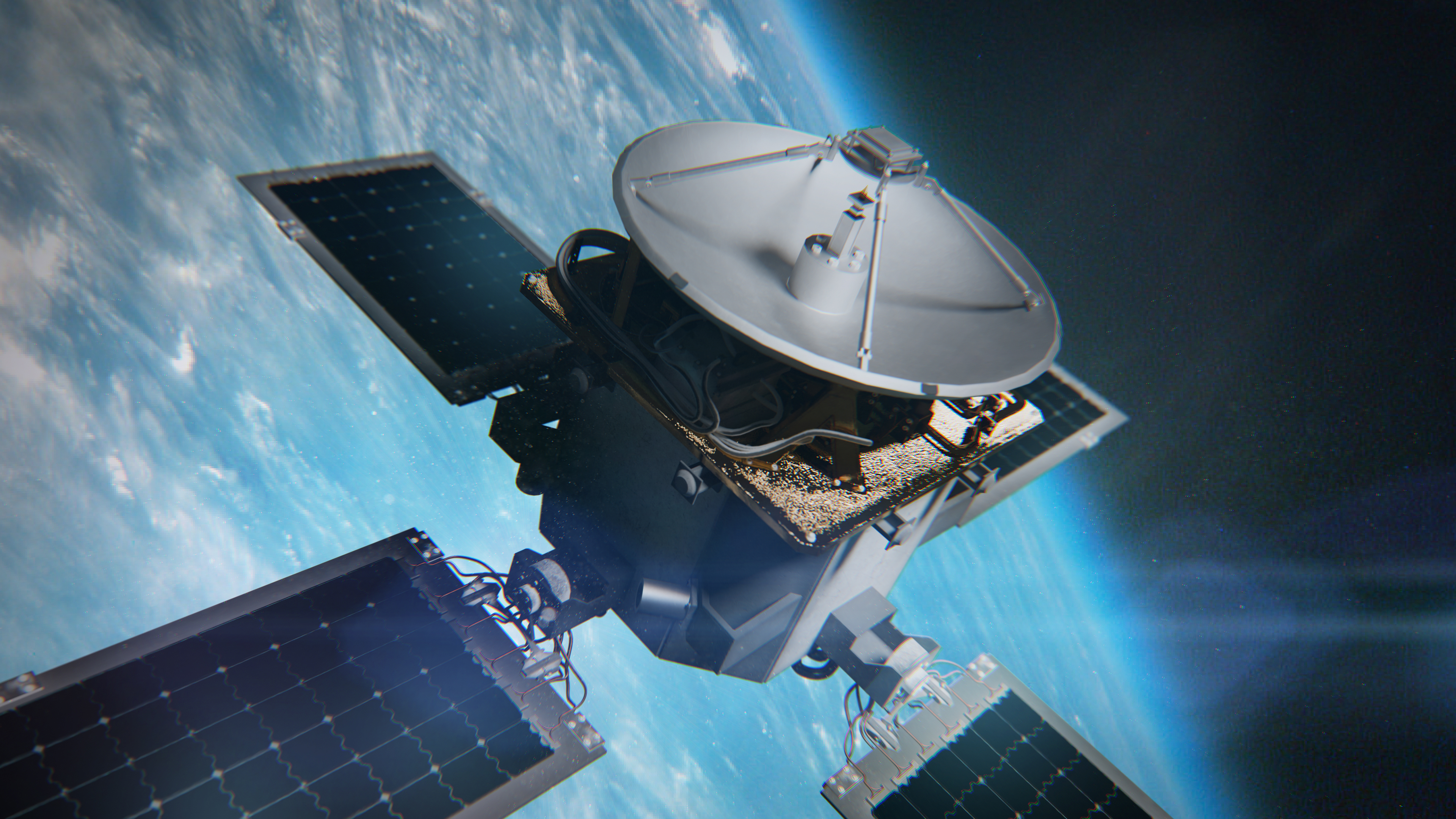
An artist’s concept of the BARD mission in space.
NASA/Dave Ryan

“Today, we take seamless cellphone roaming for granted, but in the early days of mobile phones, our devices only worked on one network,” said Greg Heckler, SCaN’s capability development lead at NASA Headquarters. “Our spaceflight missions faced similar limitations—until now. These revolutionary tests prove wideband terminals can connect spacecraft to multiple networks, a huge benefit for early adopter missions transitioning to commercial services in the 2030s.”

On July 23, the communications demo launched into low Earth orbit aboard the York Space Systems’ BARD mission. Designed by Johns Hopkins Applied Physics Laboratory, the compact wideband terminal communicates over a broad range of the Ka-band frequency, which is commonly used by NASA missions and commercial providers. After completing a series of tests that proved the BARD spacecraft and the demonstration payload were functioning as expected, testing kicked off with NASA’s TDRS (Tracking and Data Relay Satellite) fleet and commercial satellite networks operated by SES Space & Defense and Viasat.

During each demonstration, the terminal completed critical space communications and navigation operations, ranging from real-time spacecraft tracking and mission commands to high-rate data delivery. By showcasing end-to-end services between the BARD spacecraft, multiple commercial satellites, and mission control on Earth, the wideband terminal showed future NASA missions could become interoperable with government and commercial infrastructure.
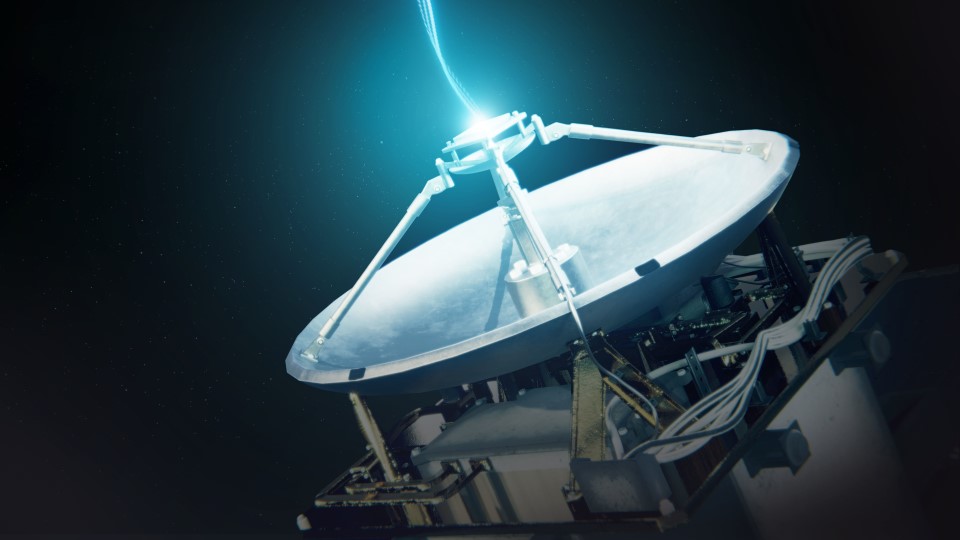
An artist’s concept of the Polylingual Experimental Terminal transmitting data in space.
NASA/Morgan Johnson

Due to the flexibility of wideband technology and the innovative nature of this mission, NASA recently extended the Polylingual Experiment Terminal demonstration for an additional 12 months of testing. Extended mission operations will include new direct-to-Earth tests with the Swedish Space Corporation, scheduled to begin in early 2026.

This technology demonstration will continue testing spaceflight communications capabilities through April 2027. By 2031, NASA plans to purchase satellite relay services for science missions in low Earth orbit from one or more U.S. companies.

To learn more about this wideband technology demonstration visit:

PExT – NASA

The Polylingual Experimental Terminal technology demonstration is funded and managed by NASA’s SCaN Program within the Space Operations Mission Directorate at NASA Headquarters in Washington. York Space Systems provided the host spacecraft. Johns Hopkins Applied Physics Laboratory developed the demonstration payload. Commercial satellite relay demonstrations were conducted in partnership with SES Space & Defense and Viasat.

An artist’s concept of the BARD mission in space.
NASA/Dave Ryan
Before yesterdayMain stream

NASA’s Push Toward Commercial Space Communications Gains Momentum 

17 December 2025 at 11:05
6 Min Read

NASA’s Push Toward Commercial Space Communications Gains Momentum 

An artist’s concept of a near-Earth satellite relay constellation.
Credits: NASA/Chase Leidy 

NASA’s commercial partners are actively demonstrating next-generation satellite relay capabilities for spaceflight missions, marking a significant step toward retiring the agency’s Tracking and Data Relay Satellite (TDRS) system and adopting commercial services. The demonstrations – ranging from real-time spacecraft tracking during launch to transmitting mission commands and scientific data – are part of NASA’s Communications Services Project, which is modernizing how the agency communicates with its science missions in near-Earth orbit. 

Managed by the agency’s SCaN (Space Communications and Navigation) Program, the project awarded funded Space Act Agreements in 2022 to six U.S. companies that are developing and testing commercial satellite communications services. The initiative supports NASA’s broader strategy to retire the TDRS constellation and adopt a commercial-first model for near-Earth communications. 

“In collaboration with our commercial partners, SCaN is ushering in a new era of space exploration that will deliver powerful, forward-thinking solutions that reduce cost, increase adaptability, and increase mission success,” said Kevin Coggins, deputy associate administrator for SCaN at NASA Headquarters in Washington. “This work advances our commitment to expanding the low Earth orbit economy, and our commercial space partners are leading the charge through these groundbreaking demonstrations, proving for the first time that commercial satellite relay services can work for NASA missions.” 

This work advances our commitment to expanding the low Earth orbit economy, and our commercial space partners are leading the charge through these groundbreaking demonstrations.

Kevin Coggins

Kevin Coggins

Deputy Associate Administrator for SCaN

By leveraging private-sector innovation, NASA aims to establish a more flexible, cost-effective, and scalable communications infrastructure for future science missions. 

Amazon

Amazon Leo for Government, a subsidiary of Amazon, is demonstrating high-rate data exchanges over optical links using its satellite network in low Earth orbit  

Amazon has developed the hardware and software components necessary to support optical communication links within its Amazon Leo satellite relay network. Optical communications, also known as laser communications, use infrared light to transmit data at a higher rate compared to standard radio frequency systems. The Amazon Leo demonstrations, scheduled to begin in early 2026, will test the pointing, acquisition, and tracking capabilities of their optical communications systems to ensure the technology can accurately locate, lock onto, and stay connected with a mission as it travels through space. 

An image of the view from an Amazon Leo satellite overlooking the Earth.
Credit: Amazon 

SES Space & Defense  

SES Space & Defense is demonstrating high-rate data exchanges as well as tracking, telemetry, and command services using its O3b mPOWER satellite network in medium Earth orbit and its satellites in geosynchronous Earth orbit.  

Over the last two months, in collaboration with Planet Labs, SES conducted multiple flight tests of its near-Earth space relay services. These demonstrations showcased uninterrupted, high-capacity connectivity between a Planet Labs satellite in low Earth orbit and SES communications satellites in geosynchronous Earth orbit and medium Earth orbit, demonstrating the ability to deliver real-time data relay across multiple orbits. SES has validated two relay services, one for low-rate tracking, telemetry, and command applications via its C-band satellites, and one for high-rate data applications over its Ka-band constellation. Additional flight demonstrations are planned for early 2026. 

An artist’s concept of SES Space and Defense’s satellite relay demonstration. 
Credit: SES Space and Defense  

SpaceX 

SpaceX is demonstrating high-rate data exchanges over optical links using its Starlink network in low Earth orbit.  

Since 2024, SpaceX has completed multiple demonstrations of on-orbit optical communications services. During two human spaceflight missions, Polaris Dawn and Fram2, SpaceX leveraged the Starlink satellite constellation and an optical communications terminal installed on the Dragon spacecraft to demonstrate high-rate data relay services. Optical communications technology is not currently available through TDRS. By demonstrating optical relay services with multiple commercial partners, the agency is unlocking new capabilities for emerging missions.  

An image of the view from an Amazon Leo satellite overlooking the Earth. Credit: Amazon
An artist’s concept of SpaceX’s commercial satellite relay demonstration using the Dragon spacecraft and Starlink network.
Credit: SpaceX 

Telesat 

Telesat U.S. Services LLC, doing business as Telesat Government Solutions, is demonstrating high-rate data exchanges over optical links using its anticipated Telesat Lightspeed network in low Earth orbit. 

Development of the Telesat Lightspeed satellite network is currently underway, with satellite launches planned for late 2026. These satellites will use innovative technologies, like optical inter-satellite links and advanced onboard processing, to establish a global, mesh network in space. Software-defined networks aim to enable robust and reliable routing of traffic from a space-based or terrestrial terminal to its final destination autonomously. In 2027, Telesat plans to complete multiple demonstrations of space-to-space connectivity, including an optical data exchange from a Planet Labs spacecraft in low Earth orbit to the Telesat Lightspeed constellation. The data will then be routed over optical links before getting downlinked to a Telesat landing station on Earth, representing a full end-to-end capability. 

An artist illustration showing Telesat's Lightspeed satellite network. The Earth taking up most of the frame and there are grey and blue satellites above the Earth connected with yellow lines showing communication links
An artist illustration of Telesat’s planned commercial relay demonstration using its Lightspeed satellite network.
Credit: Telesat 

Viasat  

Viasat Inc. is demonstrating launch, tracking, telemetry, command, and high-data rate exchanges for launch vehicles and low Earth orbit operations. In May 2023, Viasat completed the acquisition of Inmarsat, the sixth satellite communications company to win a contract award from NASA, combining the resources of both companies to form a unified global communications provider. 

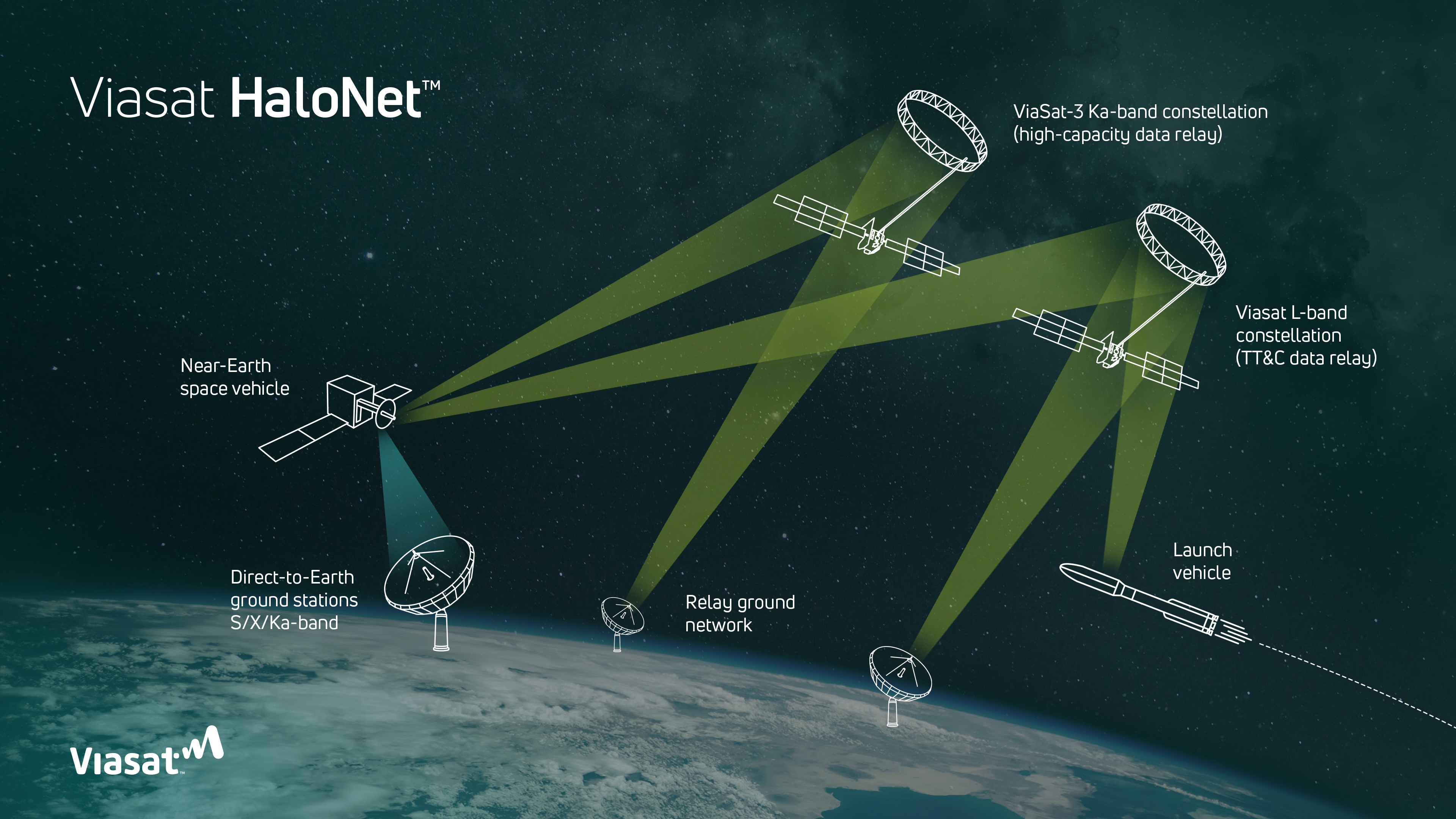
Viasat’s space demonstrations will use its established satellite networks in geostationary orbit to validate three primary capabilities: launch telemetry over the L-band radio frequency to track and monitor spacecraft during ascent; command and control over L-band to maintain continuous spacecraft custody and enable real-time operations; and high-speed Ka-band data relay to transfer large volumes of mission data through next-generation spacecraft terminals. Flights test began in November, when Viasat used its satellite network to successfully track the telemetry of Blue Origin’s New Glenn rocket as it launched into low Earth orbit. Follow-on demonstrations are planned for 2026, including additional L-band launch services as well as high-capacity services over Ka-band frequencies. 

An artist’s concept outlining Viasat’s satellite relay capabilities.
Credit: Viasat

Commercializing communications services for future near-Earth science missions enables NASA to focus resources on deep space missions to the Moon as part of the Artemis campaign, in preparation for future human missions to Mars. The agency will continue to work with these commercial partners to demonstrate next-generation services through 2027. By 2031, NASA plans to purchase satellite relay services for science missions from one or more U.S. satellite communications providers.   

To learn more about the decision to use commercial satellite relay services in low Earth orbit, visit: 

Embracing Commercial Relay Services – NASA 

The Communications Services Project is managed by NASA’s Glenn Research Center in Cleveland, under the direction of the Space Communications and Navigation Program within NASA’s Space Operations Mission Directorate.  

❌
❌