Normal view

There are new articles available, click to refresh the page.
Before yesterdayMain stream

Journey to Center of Milky Way With Upcoming NASA Roman Core Survey

23 January 2026 at 10:00

At the heart of our own galaxy, there is a dense thicket of stars with a supermassive black hole at the very center. NASA’s Nancy Grace Roman Space Telescope will provide the deepest-ever view of this zone, revealing stars, planets, and unique objects that resist definition.

Based on the input of astronomers from across the globe, the Roman Space Telescope will spend three-quarters of its five-year primary mission conducting three revolutionary surveys of unprecedented scale. Their combined results will transform all areas of astronomy and answer longstanding questions about dark matter, dark energy, and planets outside of our solar system, called exoplanets.

That last theme will be addressed by the Galactic Bulge Time-Domain Survey, which will peer into the center of our galaxy to study the stars and exoplanets that make up the densely populated region around the center of the Milky Way, known as the galactic bulge.
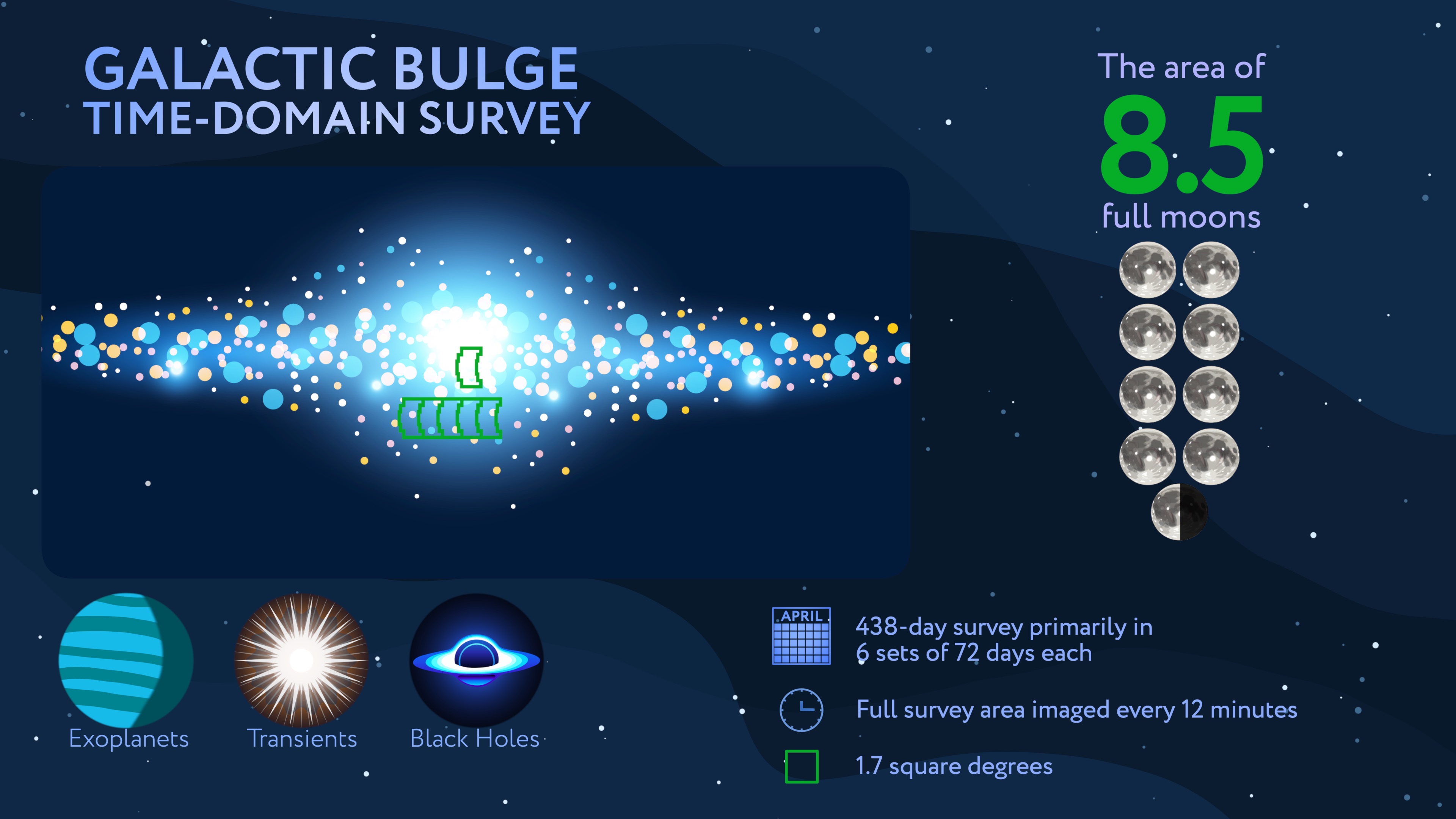
Galactic Bulge Time-Domain Survey infographic
This infographic describes the Galactic Bulge Time-Domain Survey that will be conducted by NASA’s Nancy Grace Roman Space Telescope. The smallest of Roman’s core surveys, this observation program will consist of repeat visits to six fields covering 1.7 square degrees total. One field will pierce the very center of the galaxy, and the others will be nearby — all in a region of the sky that will be visible to Roman for two 72-day stretches each spring and fall. The survey will mainly consist of six seasons (three early on, and three toward the end of Roman’s primary mission), during which Roman will view each field every 12 minutes. Roman will also view the six fields with less intensity at other times throughout the mission, allowing astronomers to detect microlensing events that can last for years, signaling the presence of isolated, stellar-mass black holes.
Credit: NASA’s Goddard Space Flight Center

The survey will observe six patches of the galactic bulge, one pinpointing the center and five nearby, every 12 minutes during 438 days of total observing time. The observations will be separated into six “seasons” spread out over five years.

Spending so much time focusing on a relatively small area of the sky, the mission will be able to track changes in the motion and light of hundreds of millions of stars, and any planets that orbit them, over long periods — the “time-domain” aspect of the survey.

“This survey will be the highest precision, highest cadence, longest continuous observing baseline survey of our galactic bulge, where the highest density of stars in our galaxy reside,” said Jessie Christiansen of Caltech/IPAC, who served as co-chair of the committee that defined the Galactic Bulge Time-Domain Survey.

Exoplanet microlensing

Roman will use a method called microlensing to search for exoplanets, a technique that has so far identified just over 200 exoplanets, compared to more than 4,000 discovered with the transit method, out of the greater than 6,000 currently confirmed.

With this survey, scientists expect to see over 1,000 new planets orbiting other stars just using microlensing alone. This would increase the number of exoplanets identified using this method by more than fivefold.

A microlensing event is when light from a distant star in the background is warped slightly by a foreground object, like a star and its planet. This warping of light is called gravitational lensing, with the gravity from the star and planet bending the fabric of space that light is traveling through and focusing it like a magnifying glass.

This animation illustrates the concept of gravitational microlensing. When one star in the sky appears to pass nearly in front of another, the light rays of the background source star become bent due to the warped space-time around the foreground star. This star is then a virtual magnifying glass, amplifying the brightness of the background source star, so we refer to the foreground star as the lens star. If the lens star harbors a planetary system, then those planets can also act as lenses, each one producing a short deviation in the brightness of the source. Thus we discover the presence of exoplanets, and measure its mass and separation from its star.
Credit: NASA’s Goddard Space Flight Center/CI Lab

While the transit method is very good at identifying exoplanets that orbit close to their star, the microlensing method can discover exoplanets that orbit farther away from their star, and in planetary systems farther from Earth than ever studied before. Roman will be versatile enough to see exoplanets dwelling from the inner edge of the habitable zone out to great distances from their stars, with a wide range of masses from planets smaller than Mars to the size of gas giants like Jupiter and Saturn. It may even discover “rogue planets” without host stars that either formed alone or were ejected from their host systems long ago.

“For the first time, we will have a big picture understanding of Earth and our solar system within the broader context of the exoplanet population of the Milky Way galaxy,” Christiansen said. “We still don’t know how common Earth-like planets are, and the Roman Galactic Bulge Time-Domain Survey will provide us with this answer.”

This survey will create a census of exoplanets for scientists to draw statistical conclusions from, revealing common patterns found in exoplanets and furthering our understanding of planetary formation and habitability.

One survey; lots of science

Because of the immense amount of observing time and subsequent data produced, the Galactic Bulge Time-Domain Survey will advance not only the field of exoplanet microlensing, but other areas of astronomy, too.

“There is an incredibly rich diversity of science that can be done with a high-precision, high-cadence survey like this one,” said Dan Huber of the University of Hawaii, the other survey co-chair.

The core survey was optimized not only for microlensing, but also to observe changes in brightness from small, fast blips to long-term trends. This property allows astronomers to discover and characterize transiting planets, red giant stars, stellar-mass black holes and other stellar remnants, and eclipsing binaries, and can lead to a deeper understanding about the physics of star formation and evolution.
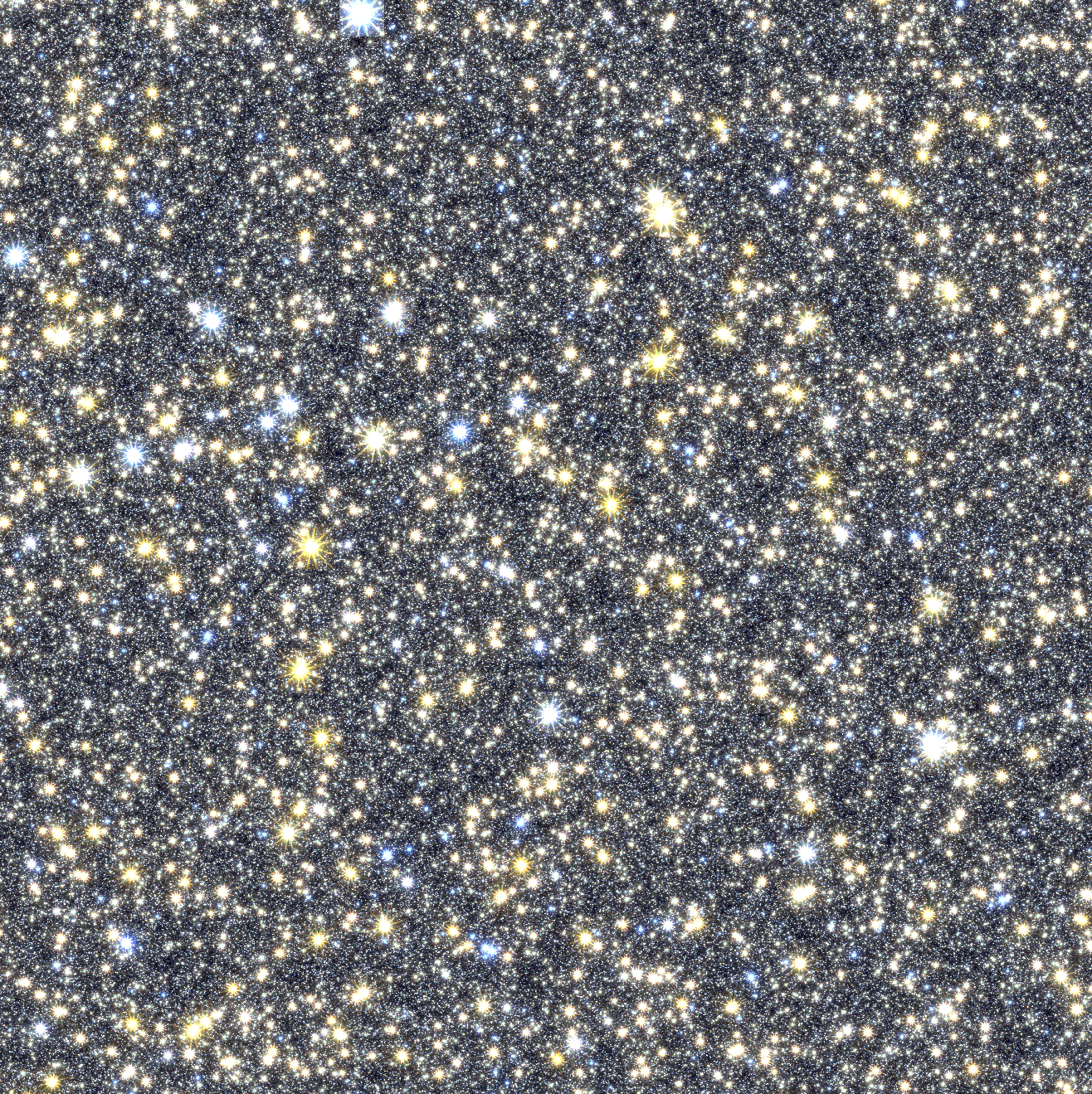
Many thousands of bright, explosive looking stars speckle the screen. The smallest ones are white pinpoints, strewn across the screen like spilled salt. Larger ones are yellow and bluish white and they have spiky outer edges like sea urchins.
A simulated image of Roman’s observations toward the center of our galaxy, spanning only less than 1 percent of the total area of Roman’s galactic bulge time-domain survey. The simulated stars were drawn from the Besançon Galactic Model.
Credit: Matthew Penny (Louisiana State University)

“The stars in the bulge and center of our galaxy are unique and not yet well understood,” Huber said. “The data from this survey will allow us to measure how old these stars are and how they fit into the formation history of our Milky Way galaxy.”

Roman’s observing strategy in the Galactic Bulge Time-Domain Survey, as well as the High-Latitude Time-Domain Survey and the High-Latitude Wide-Area Survey, will allow astronomers to maximize scientific output, all with one telescope.

Abundance of data to explore

Roman will observe hundreds of millions of stars every 12 minutes during the survey period, providing an unprecedented volume of data for astronomers to parse through.

The Roman Science Support Center at Caltech/IPAC in Pasadena, California, will be responsible for the high-level science data processing for the Galactic Bulge Time Domain Survey, including exoplanet microlensing and general community outreach for Roman exoplanet science. The Science Support Center’s monitoring of these stars has been automated to detect microlensing and variable events within the data. This helps scientists understand features like how frequently a star’s brightness is changing, or if there are planets lurking near the lensed stars, or other sources of variability. The number of stars and frequency of the observations make the Roman data an ideal dataset for finding such sources.

All Roman observations will be made publicly available after a short processing period. The mission is scheduled to launch no later than May 2027, with the team on track for launch in fall 2026.

The Nancy Grace Roman Space Telescope is managed at NASA’s Goddard Space Flight Center in Greenbelt, Maryland, with participation by NASA’s Jet Propulsion Laboratory in Southern California; Caltech/IPAC in Pasadena, California; the Space Telescope Science Institute in Baltimore; and a science team comprising scientists from various research institutions. The primary industrial partners are BAE Systems Inc. in Boulder, Colorado; L3Harris Technologies in Rochester, New York; and Teledyne Scientific & Imaging in Thousand Oaks, California.

By Isabel Swafford
Caltech/IPAC, Pasadena, Calif.

Media contact:

Claire Andreoli
NASA’s Goddard Space Flight Center, Greenbelt, Md.
301-286-1940

Share

Details

Last Updated
Jan 23, 2026
Editor
Ashley Balzer
Contact
Location
Goddard Space Flight Center

💾

This animation illustrates the concept of gravitational microlensing. When one star in the sky appears to pass nearly in front of another, the light rays of ...

TESS Status Updates

23 January 2026 at 09:02

4 min read

TESS Status Updates

Jan. 23, 2026

NASA’s TESS Returns to Science Observations

NASA’s TESS (Transiting Exoplanet Survey Satellite) entered safe mode Jan. 15 and returned to normal science operations Jan. 18. 

The operations team determined the issue arose when TESS slewed to point at a target, but its solar panels did not rotate to remain pointed at the Sun relative to the spacecraft’s new direction. The off-Sun angle of the solar arrays resulted in a slow discharge of TESS’s batteries. As designed and planned for in situations of this kind, the satellite entered a safe mode after detecting the low-power condition.

At the time of the safe mode, TESS was conducting a week-long observation of comet 3I/ATLAS and resumed those observations Jan. 18. Data from TESS is publicly available through archives at the Mikulski Archive for Space Telescopes.

May 7, 2024

NASA’s TESS Returns to Science Operations

NASA’s TESS (Transiting Exoplanet Survey Satellite) returned to science operations May 3 and is once again making observations. The satellite went into safe mode April 23 following a separate period of down time earlier that month.

The operations team determined this latest safe mode was triggered by a failure to properly unload momentum from the spacecraft’s reaction wheels, a routine activity needed to keep the satellite properly oriented when making observations. The propulsion system, which enables this momentum transfer, had not been successfully repressurized following a prior safe mode event April 8. The team has corrected this, allowing the mission to return to normal science operations. The cause of the April 8 safe mode event remains under investigation. 

The TESS mission is a NASA Astrophysics Explorer operated by the Massachusetts Institute of Technology in Cambridge, Massachusetts. Launched in 2018, TESS has been scanning almost the entire sky looking for planets beyond our solar system, known as exoplanets. The TESS mission has also uncovered other cosmic phenomena, including star-shredding black holes and stellar oscillations. Read more about TESS discoveries at nasa.gov/tess.

April 24, 2024

NASA’s Planet-Hunting Satellite Temporarily on Pause

During a routine activity April 23, NASA’s TESS (Transiting Exoplanet Survey Satellite) entered safe mode, temporarily suspending science operations. The satellite scans the sky searching for planets beyond our solar system.

The team is working to restore the satellite to science operations while investigating the underlying cause. NASA also continues investigating the cause of a separate safe mode event that took place earlier this month, including whether the two events are connected. The spacecraft itself remains stable.

The TESS mission is a NASA Astrophysics Explorer operated by the Massachusetts Institute of Technology in Cambridge, Massachusetts. Launched in 2018, TESS recently celebrated its sixth anniversary in orbit. Visit nasa.gov/tess for updates.

April 17, 2024

NASA’s TESS Returns to Science Operations

NASA’s TESS (Transiting Exoplanet Survey Satellite) has returned to work after science observations were suspended on April 8, when the spacecraft entered into safe mode. All instruments are powered on and, following the successful download of previously collected science data stored in the mission’s recorder, are now making new science observations.

Analysis of what triggered the satellite to enter safe mode is ongoing.

The TESS mission is a NASA Astrophysics Explorer operated by MIT in Cambridge, Massachusetts. Launched in 2018, TESS has been scanning almost the entire sky looking for planets beyond our solar system, known as exoplanets. The TESS mission has also uncovered other cosmic phenomena, including star-shredding black holes and stellar oscillations. Read more about TESS discoveries at nasa.gov/tess.

April 11, 2024

NASA’s TESS Temporarily Pauses Science Observations

NASA’s TESS (Transiting Exoplanet Survey Satellite) entered into safe mode April 8, temporarily interrupting science observations. The team is investigating the root cause of the safe mode, which occurred during scheduled engineering activities. The satellite itself remains in good health.

The team will continue investigating the issue and is in the process of returning TESS to science observations in the coming days.

The TESS mission is a NASA Astrophysics Explorer operated by MIT in Cambridge, Massachusetts. Launched in 2018, TESS has been scanning almost the entire sky looking for planets beyond our solar system, known as exoplanets. The TESS mission has also uncovered other cosmic phenomena, including star-shredding black holes and stellar oscillations. Read more about TESS discoveries at nasa.gov/tess.

Media Contacts

Claire Andreoli
(301) 286-1940
claire.andreoli@nasa.gov
NASA’s Goddard Space Flight Center, Greenbelt, Md.

Alise Fisher
202-358-2546
alise.m.fisher@nasa.gov
NASA Headquarters, Washington

NASA AI Model That Found 370 Exoplanets Now Digs Into TESS Data

22 January 2026 at 09:00

4 min read

NASA AI Model That Found 370 Exoplanets Now Digs Into TESS Data

A bright red-orange star burns in the center of the image, with red flames burning off it in all directions. Two dark gray spheres orbit in front of the star, one on the far left (partially in front of the star, partially off the side), and the other at the bottom center.
This artist’s impression shows the star TRAPPIST-1 with two planets transiting across it. ExoMiner++, a recently updated open-source software package developed by NASA, uses artificial intelligence to help find new transiting exoplanets in data collected by NASA’s missions.
NASA, ESA, and G. Bacon (STScI)

Scientists have discovered over 6,000 planets that orbit stars other than our Sun, known as exoplanets. More than half of these planets were discovered thanks to data from NASA’s retired Kepler mission and NASA’s current TESS (Transiting Exoplanet Survey Satellite) mission. However, the enormous treasure trove of data from these missions still contains many yet-to-be-discovered planets. All of the data from both missions is publicly available in NASA archives, and many teams around the world have used that data to find new planets using a number of techniques.

In 2021, a team from NASA’s Ames Research Center in California’s Silicon Valley created ExoMiner, a piece of open-source software that used artificial intelligence (AI) to validate 370 new exoplanets from Kepler data. Now, the team has created a new version of the model trained on both Kepler and TESS data, called ExoMiner++.

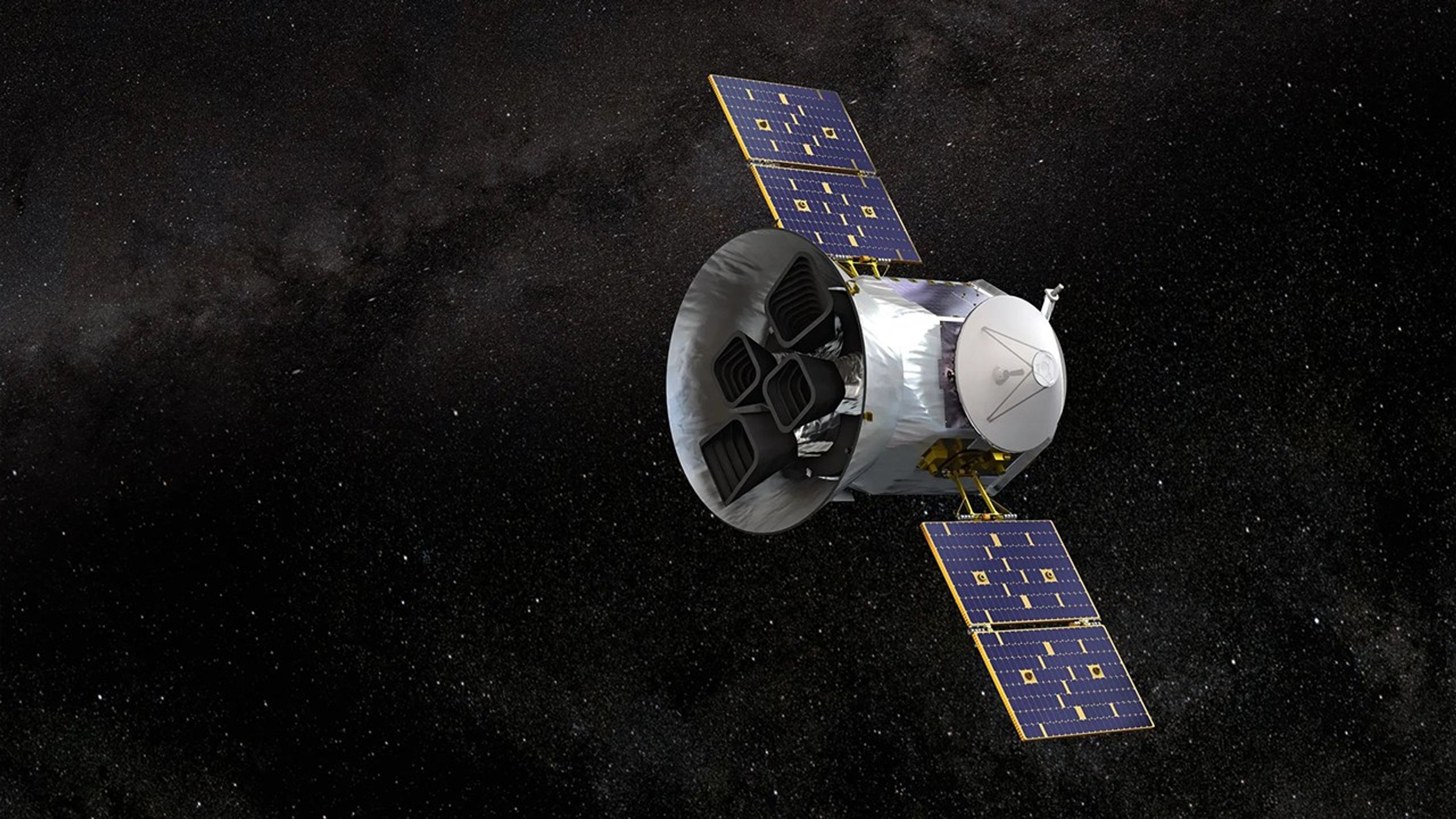
Artist's impression of NASA's Transiting Exoplanet Survey Satellite (TESS), a cylinder-shaped space telescope with two solar panels stretching out on opposite sides of the spacecraft body.
Artist’s impression of NASA’s Transiting Exoplanet Survey Satellite (TESS), which launched in 2018 and has discovered nearly 700 exoplanets so far. NASA’s ExoMiner++ software is working toward identifying more planets in TESS data using artificial intelligence.
NASA’s Goddard Space Flight Center

The new algorithm, which is discussed in a recent paper published in the Astronomical Journal, identified 7,000 targets as exoplanet candidates from TESS on an initial run. An exoplanet candidate is a signal that is likely to be a planet but requires follow-up observations from additional telescopes to confirm.

ExoMiner++ can be freely downloaded from GitHub, allowing any researcher to use the tool to hunt for planets in TESS’s growing public data archive.

“Open-source software like ExoMiner accelerates scientific discovery,” said Kevin Murphy, NASA’s chief science data officer at NASA Headquarters in Washington. “When researchers freely share the tools they’ve developed, it lets others replicate the results and dig deeper into the data, which is why open data and code are important pillars of gold-standard science.”

ExoMiner++ sifts through observations of possible transits to predict which ones are caused by exoplanets and which ones are caused by other astronomical events, such as eclipsing binary stars. “When you have hundreds of thousands of signals, like in this case, it’s the ideal place to deploy these deep learning technologies,” said Miguel Martinho, a KBR employee at NASA Ames who serves as the co-investigator for ExoMiner++.

This animation shows a graph of the tiny amount of dimming that takes place when a planet passes in front of its host star. NASA’s Kepler and TESS missions spot exoplanets by looking for these transits. ExoMiner++ uses artificial intelligence to help separate real planet transits from other, similar-looking astronomical phenomena.
NASA’s Goddard Space Flight Center

Kepler and TESS operate differently — TESS is surveying nearly the whole sky, mainly looking for planets transiting nearby stars, while Kepler looked at a small patch of sky more deeply than TESS. Despite these different observing strategies, the two missions produce compatible datasets, allowing ExoMiner++ to train on data from both telescopes and deliver strong results. “With not many resources, we can make a lot of returns,” said Hamed Valizadegan, the project lead for ExoMiner and a KBR employee at NASA Ames.

The next version of ExoMiner++ will improve the usefulness of the model and inform future exoplanet detection efforts. While ExoMiner++ can currently flag planet candidates when given a list of possible transit signals, the team is also working on giving the model the ability to identify the signals themselves from the raw data.

Open-source science and open-source software are why the exoplanet field is advancing as quickly as it is.

Jon Jenkins

Exoplanet Scientist, NASA Ames Research Center

In addition to the ongoing stream of data from TESS, future exoplanet-hunting missions will give ExoMiner users plenty more data to work with. NASA’s upcoming Nancy Grace Roman Space Telescope will capture tens of thousands of exoplanet transits — and, like TESS data, Roman data will be freely available in line with NASA’s commitment to Gold Standard Science and sharing data with the public. The advances made with the ExoMiner models could help hunt for exoplanets in Roman data, too.

“The open science initiative out of NASA is going to lead to not just better science, but also better software,” said Jon Jenkins, an exoplanet scientist at NASA Ames. “Open-source science and open-source software are why the exoplanet field is advancing as quickly as it is.”

NASA’s Office of the Chief Science Data Officer leads the open science efforts for the agency. Public sharing of scientific data, tools, research, and software maximizes the impact of NASA’s science missions. To learn more about NASA’s commitment to transparency and reproducibility of scientific research, visit science.nasa.gov/open-science. To get more stories about the impact of NASA’s science data delivered directly to your inbox, sign up for the NASA Open Science newsletter.

By Lauren Leese 
Web Content Strategist for the Office of the Chief Science Data Officer

NASA launches new mission to get the most out of the James Webb Space Telescope

12 January 2026 at 14:25

Among other things, the James Webb Space Telescope is designed to get us closer to finding habitable worlds around faraway stars. From its perch a million miles from Earth, Webb's huge gold-coated mirror collects more light than any other telescope put into space.

The Webb telescope, launched in 2021 at a cost of more than $10 billion, has the sensitivity to peer into distant planetary systems and detect the telltale chemical fingerprints of molecules critical to or indicative of potential life, like water vapor, carbon dioxide, and methane. Webb can do this while also observing the oldest observable galaxies in the Universe and studying planets, moons, and smaller objects within our own Solar System.

Naturally, astronomers want to get the most out of their big-budget observatory. That's where NASA's Pandora mission comes in.

Read full article

Comments

© Blue Canyon Technologies

NASA’s Pandora Satellite, CubeSats to Explore Exoplanets, Beyond

9 January 2026 at 09:40

6 min read

NASA’s Pandora Satellite, CubeSats to Explore Exoplanets, Beyond

Editor’s Note, Jan. 11, 2026: NASA’s Pandora and the NASA-sponsored BlackCAT and SPARCS missions lifted off at 8:44 a.m. EST (5:44 a.m. PST) Sunday, Jan. 11.

A new NASA spacecraft called Pandora is awaiting launch ahead of its journey to study the atmospheres of exoplanets, or worlds beyond our solar system, and their stars.

Along for the ride are two shoebox-sized satellites called BlackCAT (Black Hole Coded Aperture Telescope) and SPARCS (Star-Planet Activity Research CubeSat), as NASA innovates with ambitious science missions that take low-cost, creative approaches to answering questions like, “How does the universe work?” and “Are we alone?”

All three missions are set to launch Jan. 11 on a SpaceX Falcon 9 rocket from Space Launch Complex 4 East at Vandenberg Space Force Base in California. The launch window opens at 8:19 a.m. EST (5:19 a.m. PST). SpaceX will livestream the event.

The Pandora spacecraft with an exoplanet and two stars in the background
Artist’s concept of NASA’s Pandora mission, which will help scientists untangle the signals from the atmospheres of exoplanets — worlds beyond our solar system — and their stars.
NASA’s Goddard Space Flight Center/Conceptual Image Lab

“Pandora’s goal is to disentangle the atmospheric signals of planets and stars using visible and near-infrared light,” said Elisa Quintana, Pandora’s principal investigator at NASA’s Goddard Space Flight Center in Greenbelt, Maryland. “This information can help astronomers determine if detected elements and compounds are coming from the star or the planet — an important step as we search for signs of life in the cosmos.”

BlackCAT and SPARCS are small satellites that will study the transient, high-energy universe and the activity of low-mass stars, respectively.

Pandora will observe planets as they pass in front of their stars as seen from our perspective, events called transits.

As starlight passes through a planet’s atmosphere, it interacts with substances like water and oxygen that absorb characteristic wavelengths, adding their chemical fingerprints to the signal.

But while only a small fraction of the star’s light grazes the planet, telescopes also collect the rest of the light emitted by the star’s facing side. Stellar surfaces can sport brighter and darker regions that grow, shrink, and change position over time, suppressing or magnifying signals from planetary atmospheres. Adding a further complication, some of these areas may contain the same chemicals that astronomers hope to find in the planet’s atmosphere, such as water vapor.

All these factors make it difficult to be certain that important detected molecules come from the planet alone.

Pandora will help address this problem by providing in-depth study of at least 20 exoplanets and their host stars during its initial year. The satellite will look at each planet and its star 10 times, with each observation lasting a total of 24 hours. Many of these worlds are among the over 6,000 discovered by missions like NASA’s TESS (Transiting Exoplanet Survey Satellite).

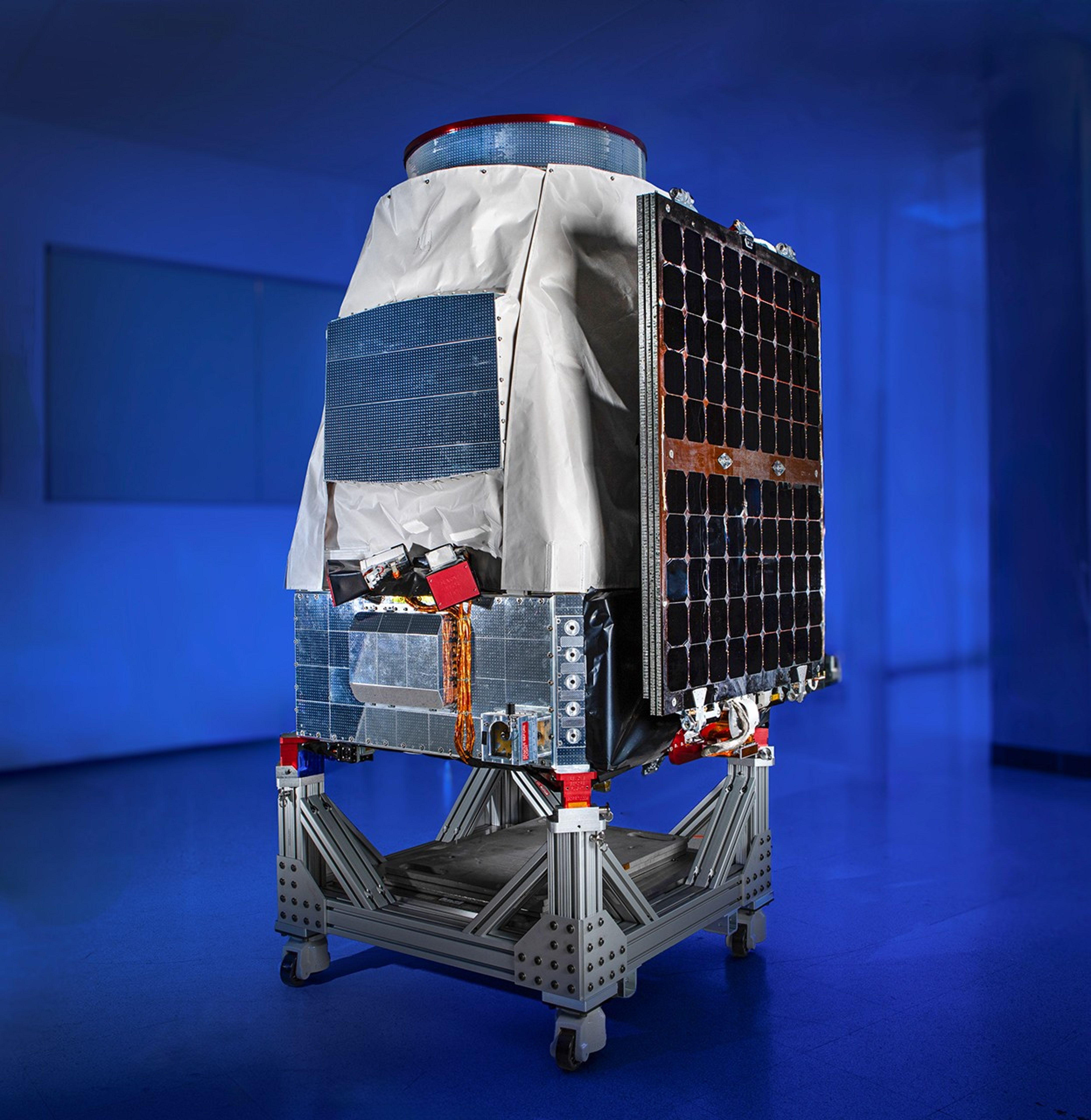
Pandora, fully integrated, with blue-lit background
This view of the fully integrated Pandora spacecraft was taken May 19, 2025, following the mission’s successful environmental test campaign at Blue Canyon Technologies in Lafayette, Colorado. Visible are star trackers (center), multilayer insulation blankets (white), the end of the telescope (top), and the solar panel (right) in its launch configuration.
NASA/BCT

Pandora will collect visible and near-infrared light using a novel, all-aluminum 17-inch-wide (45-centimeter) telescope jointly developed by Lawrence Livermore National Laboratory in California and Corning Incorporated in Keene, New Hampshire. Pandora’s near-infrared detector is a spare developed for NASA’s James Webb Space Telescope.

Each long observation period will capture a star’s light both before and during a transit and help determine how stellar surface features impact measurements.

“These intense studies of individual systems are difficult to schedule on high-demand missions, like Webb,” said engineer Jordan Karburn, Pandora’s deputy project manager at Livermore. “You also need the simultaneous multiwavelength measurements to pick out the star’s signal from the planet’s. The long stares with both detectors are critical for tracing the exact origins of elements and compounds scientists consider indicators of potential habitability.”

Pandora is the first satellite to launch in the agency’s Astrophysics Pioneers program, which seeks to do compelling astrophysics at a lower cost while training the next generation of leaders in space science.

After launching into low Earth orbit, Pandora will undergo a month of commissioning before embarking on its one-year prime mission. All the mission’s data will be publicly available.

“The Pandora mission is a bold new chapter in exoplanet exploration,” said Daniel Apai, an astronomy and planetary science professor at the University of Arizona in Tucson where the mission’s operations center resides. “It is the first space telescope built specifically to study, in detail, starlight filtered through exoplanet atmospheres. Pandora’s data will help scientists interpret observations from past and current missions like NASA’s Kepler and Webb space telescopes. And it will guide future projects in their search for habitable worlds.”

Watch to learn more about NASA’s Pandora mission, which will revolutionize the study of exoplanet atmospheres.
NASA’s Goddard Space Flight Center

The BlackCAT and SPARCS missions will take off alongside Pandora through NASA’s Astrophysics CubeSat program, the latter supported by the Agency’s CubeSat Launch Initiative.

CubeSats are a class of nanosatellites that come in sizes that are multiples of a standard cube measuring 3.9 inches (10 centimeters) across. Both BlackCAT and SPARCS are 11.8 by 7.8 by 3.9 inches (30 by 20 by 10 centimeters). CubeSats are designed to provide cost-effective access to space to test new technologies and educate early career scientists and engineers while delivering compelling science.

The BlackCAT mission will use a wide-field telescope and a novel type of X-ray detector to study powerful cosmic explosions like gamma-ray bursts, particularly those from the early universe, and other fleeting cosmic events. It will join NASA’s network of missions that watch for these changes. Abe Falcone at Pennsylvania State University in University Park, where the satellite was designed and built, leads the mission with contributions from Los Alamos National Laboratory in New Mexico. Kongsberg NanoAvionics US provided the spacecraft bus.

The SPARCS CubeSat will monitor flares and other activity from low-mass stars using ultraviolet light to determine how they affect the space environment around orbiting planets. Evgenya Shkolnik at Arizona State University in Tempe leads the mission with participation from NASA’s Jet Propulsion Laboratory in Southern California. In addition to providing science support, JPL developed the ultraviolet detectors and the associated electronics. Blue Canyon Technologies fabricated the spacecraft bus.

Pandora is led by NASA Goddard. Livermore provides the mission’s project management and engineering. Pandora’s telescope was manufactured by Corning and developed collaboratively with Livermore, which also developed the imaging detector assemblies, the mission’s control electronics, and all supporting thermal and mechanical subsystems. The near-infrared sensor was provided by NASA Goddard. Blue Canyon Technologies provided the bus and performed spacecraft assembly, integration, and environmental testing. NASA’s Ames Research Center in California’s Silicon Valley will perform the mission’s data processing. Pandora’s mission operations center is located at the University of Arizona, and a host of additional universities support the science team.

By Jeanette Kazmierczak
NASA’s Goddard Space Flight Center, Greenbelt, Md.

Media Contact:
Claire Andreoli
301-286-1940
NASA’s Goddard Space Flight Center, Greenbelt, Md.

Facebook logo
Instagram logo

Researchers spot Saturn-sized planet in the “Einstein desert”

2 January 2026 at 15:54

Most of the exoplanets we've discovered have been in relatively tight orbits around their host stars, allowing us to track them as they repeatedly loop around them. But we've also discovered a handful of planets through a phenomenon that's called microlensing. This occurs when a planet passes between the line of sight between Earth and another star, creating a gravitational lens that distorts the star, causing it to briefly brighten.

The key thing about microlensing compared to other methods of finding planets is that the lensing planet can be nearly anywhere on the line between the star and Earth. So, in many cases, these events are driven by what are called rogue planets: those that aren't part of any exosolar system at all, but they drift through interstellar space. Now, researchers have used microlensing and the fortuitous orientation of the Gaia space telescope to spot a Saturn-sized planet that's the first found in what's called the "Einstein desert," which may be telling us something about the origin of rogue planets.

Going rogue

Most of the planets we've identified are in orbit around stars and formed from the disks of gas and dust that surrounded the star early in its history. We've imaged many of these disks and even seen some with evidence of planets forming within them. So how do you get a planet that's not bound to any stars? There are two possible routes.

Read full article

Comments

© NASA, ESA

NASA’s Hubble Sees Asteroids Colliding at Nearby Star for First Time

18 December 2025 at 14:00
5 Min Read

NASA’s Hubble Sees Asteroids Colliding at Nearby Star for First Time

A grainy orange oval ring tilts slightly from upper right to lower left.

Like a game of cosmic bumper cars, scientists think the early days of our solar system were a time of violent turmoil, with planetesimals, asteroids, and comets smashing together and pelting the Earth, Moon, and the other inner planets with debris. Now, in a historical milestone, NASA’s Hubble Space Telescope has directly imaged similar catastrophic collisions in a nearby planetary system around another star, Fomalhaut.

“This is certainly the first time I’ve ever seen a point of light appear out of nowhere in an exoplanetary system,” said principal investigator Paul Kalas of the University of California, Berkeley. “It’s absent in all of our previous Hubble images, which means that we just witnessed a violent collision between two massive objects and a huge debris cloud unlike anything in our own solar system today. Amazing!”

Just 25 light-years from Earth, Fomalhaut is one of the brightest stars in the night sky. Located in the constellation Piscis Austrinus, also known as the Southern Fish, it is more massive and brighter than the Sun and is encircled by several belts of dusty debris.

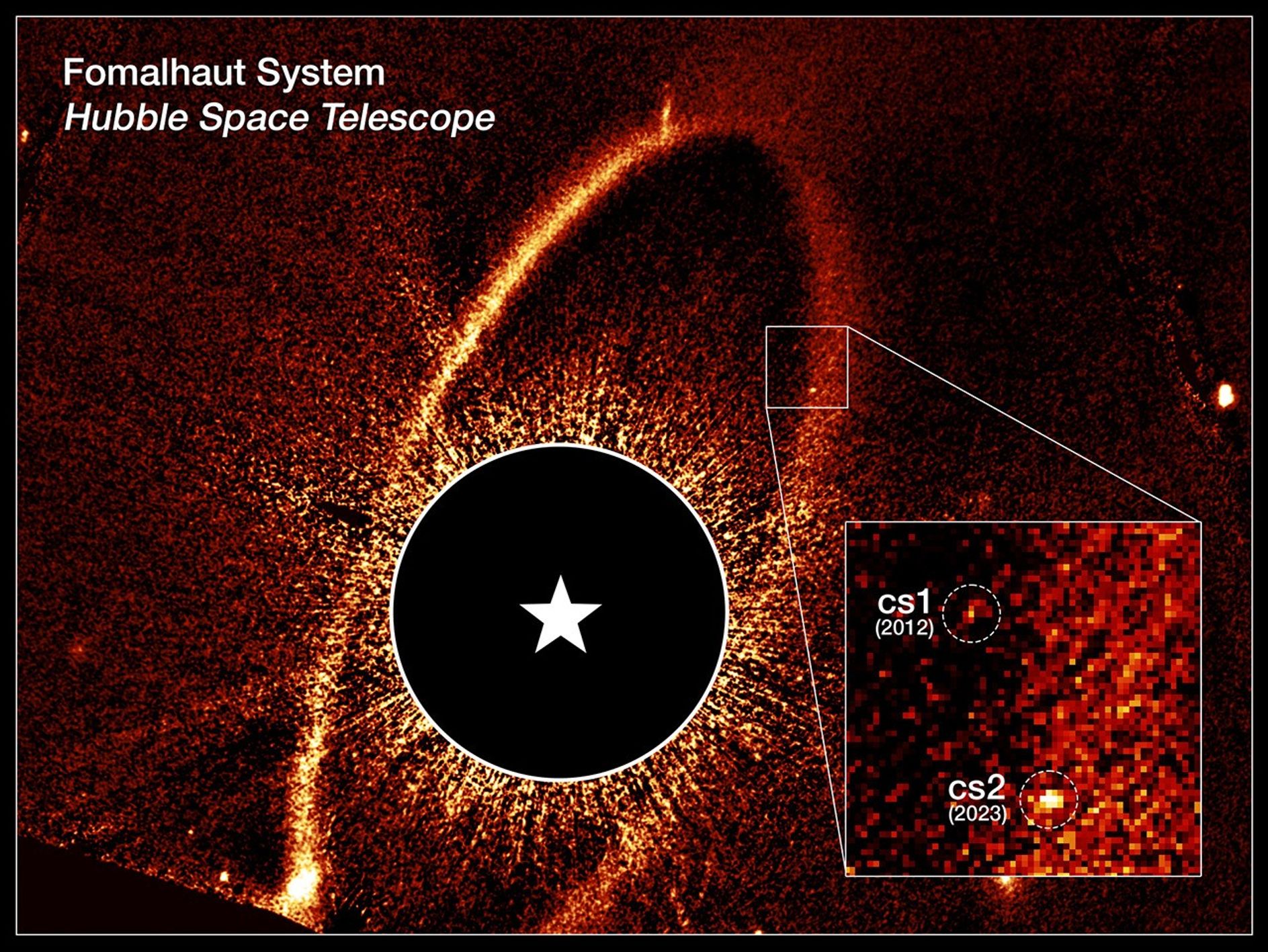
Image labeled Fomalhaut system, Hubble Space Telescope. A grainy orange oval ring tilts slightly from upper right to lower left. At two o'clock, a white box outlines the ring's edge and white lines extend to a larger pullout box at lower right. Two spots inside the larger box are marked with dashed white circles and labeled cs1 2012 and cs2 2023. Inside the ring is a black circle with a white star symbol in the middle.
This composite Hubble Space Telescope image shows the debris ring and dust clouds cs1 and cs2 around the star Fomalhaut. Fomalhaut itself is masked out to allow the fainter features to be seen. Its location is marked by the white star.
Image: NASA, ESA, Paul Kalas (UC Berkeley); Image Processing: Joseph DePasquale (STScI)

In 2008, scientists used Hubble to discover a candidate planet around Fomalhaut, making it the first stellar system with a possible planet found using visible light. That object, called Fomalhaut b, now appears to be a dust cloud masquerading as a planet—the result of colliding planetesimals. While searching for Fomalhaut b in recent Hubble observations, scientists were surprised to find a second point of light at a similar location around the star. They call this object “circumstellar source 2” or “cs2” while the first object is now known as “cs1.”

Tackling Mysteries of Colliding Planetesimals

Why astronomers are seeing both of these debris clouds so physically close to each other is a mystery. If the collisions between asteroids and planetesimals were random, cs1 and cs2 should appear by chance at unrelated locations. Yet, they are positioned intriguingly near each other along the inner portion of Fomalhaut’s outer debris disk.

Another mystery is why scientists have witnessed these two events within such a short timeframe. “Previous theory suggested that there should be one collision every 100,000 years, or longer. Here, in 20 years, we’ve seen two,” explained Kalas. “If you had a movie of the last 3,000 years, and it was sped up so that every year was a fraction of a second, imagine how many flashes you’d see over that time. Fomalhaut’s planetary system would be sparkling with these collisions.”

Collisions are fundamental to the evolution of planetary systems, but they are rare and difficult to study.

Illustration is labeled Artist’s Concept in the bottom left corner. This four-panel image shows the sequence of events leading up to, during, and following the collision of two objects in orbit around a star. Please refer to the Extended Description for more details.
This artist’s concept shows the sequence of events leading up to the creation of dust cloud cs2 around the star Fomalhaut. In Panel 1, the star Fomalhaut appears in the top left corner. Two white dots, located in the bottom right corner, represent the two massive objects in orbit around Fomalhaut. In Panel 2, the objects approach each other. Panel 3 shows the violent collision of these two objects. In Panel 4, the resulting dust cloud cs2 becomes visible and starlight pushes the dust grains away from the star.
Artwork: NASA, ESA, STScI, Ralf Crawford (STScI)

“The exciting aspect of this observation is that it allows researchers to estimate both the size of the colliding bodies and how many of them there are in the disk, information which is almost impossible to get by any other means,” said co-author Mark Wyatt at the University of Cambridge in England. “Our estimates put the planetesimals that were destroyed to create cs1 and cs2 at just 37 miles or 60 kilometers across, and we infer that there are 300 million such objects orbiting in the Fomalhaut system.”

“The system is a natural laboratory to probe how planetesimals behave when undergoing collisions, which in turn tells us about what they are made of and how they formed,” explained Wyatt.

Cautionary Tale

The transient nature of Fomalhaut cs1 and cs2 poses challenges for future space missions aiming to directly image exoplanets. Such telescopes may mistake dust clouds like cs1 and cs2 for actual planets.

“Fomalhaut cs2 looks exactly like an extrasolar planet reflecting starlight,” said Kalas. “What we learned from studying cs1 is that a large dust cloud can masquerade as a planet for many years. This is a cautionary note for future missions that aim to detect extrasolar planets in reflected light.”

Looking to Future

Kalas and his team have been granted Hubble time to monitor cs2 over the next three years. They want to see how it evolves—does it fade, or does it get brighter? Being closer to the dust belt than cs1, the expanding cs2 cloud is more likely to start encountering other material in the belt. This could lead to a sudden avalanche of more dust in the system, which could cause the whole surrounding area to get brighter.

Credit: NASA’s Goddard Space Flight Center; Lead Producer: Paul Morris

“We will be tracing cs2 for any changes in its shape, brightness, and orbit over time,” said Kalas, “It’s possible that cs2 will start becoming more oval or cometary in shape as the dust grains are pushed outward by the pressure of starlight.”

The team also will use the NIRCam (Near-Infrared Camera) instrument on NASA’s James Webb Space Telescope to observe cs2. Webb’s NIRCam has the ability to provide color information that can reveal the size of the cloud’s dust grains and their composition. It can even determine if the cloud contains water ice. 

Hubble and Webb are the only observatories capable of this kind of imaging. While Hubble primarily sees in visible wavelengths, Webb could view cs2 in the infrared. These different, complementary wavelengths are needed to provide a broad multi-spectral investigation and a more complete picture of the mysterious Fomalhaut system and its rapid evolution.

This research appears in the December 18 issue of Science.

The Hubble Space Telescope has been operating for over three decades and continues to make ground-breaking discoveries that shape our fundamental understanding of the universe. Hubble is a project of international cooperation between NASA and ESA (European Space Agency). NASA’s Goddard Space Flight Center in Greenbelt, Maryland, manages the telescope and mission operations. Lockheed Martin Space, based in Denver, also supports mission operations at Goddard. The Space Telescope Science Institute in Baltimore, which is operated by the Association of Universities for Research in Astronomy, conducts Hubble science operations for NASA.

Facebook logo
Instagram logo

Related Images, Videos, & Resources

Image labeled Fomalhaut system, Hubble Space Telescope. A grainy orange oval ring tilts slightly from upper right to lower left. At two o'clock, a white box outlines the ring's edge and white lines extend to a larger pullout box at lower right. Two spots inside the larger box are marked with dashed white circles and labeled cs1 2012 and cs2 2023. Inside the ring is a black circle with a white star symbol in the middle.

Fomalhaut cs2

This composite Hubble Space Telescope image shows the debris ring and dust clouds cs1 and cs2 around the star Fomalhaut. Fomalhaut itself is masked out to allow the fainter features to be seen. Its location is marked by the white star.

Illustration is labeled Artistu2019s Concept in the bottom, left corner. Slightly off-center against a black background, an explosive and fiery-looking orange object appears. Orange streamers, filaments, and particles radiate from the objectu2019s center. Within it, but slightly off-center to the right, is a mottled, yellow, amorphous blob. This blob is outlined on three sides in white, and on the fourth, right side in dark orange and red. White particles emanate from this blob, particularly on the right side.

Fomalhaut cs2 Illustration

This artist’s concept shows the sequence of events leading up to the creation of dust cloud cs2 around the star Fomalhaut.

At the top left corner, a fuzzy white star appears. Traversing the top of the image and cutting across the top of the star is a ghostly white streak. At the bottom right corner is an explosive and fiery-looking orange object. Orange streamers, filaments, and particles radiate from the objectu2019s center. Within it, but slightly off-center to the right, is a mottled, yellow, amorphous blob. This blob is outlined on three sides in white, and on the fourth, right side in dark orange and red. White particles emanate from this blob, particularly on the right side.

Fomalhaut cs2 Video

Hubble captured the violent collision of two massive objects around the star Fomalhaut. This extraordinary event is unlike anything in our own present-day solar system. The video shows the sequence of events leading up to the creation of dust cloud cs2 around the star Fomalhaut. …

A grainy orange oval ring tilts slightly from upper right to lower left.

Hubble Captures Destruction of Worlds Video

NASA’s Hubble Space Telescope captured a rare and violent event unfolding around the nearby star Fomalhaut. This discovery sheds light on the chaotic processes that may have shaped our own solar system billions of years ago. With support from both Hubble and the James Webb Space Telescope, astronomers are now closely monitoring the aftermath.

Model of Fomalhaut b Dust Cloud

From 2020:
Exoplanet Apparently Disappears in Latest Hubble Observations

What astronomers thought was a planet beyond our solar system has now seemingly vanished from sight. 

Rogue Planetary Orbit for Fomalhaut b

From 2013:
Hubble Reveals Rogue Planetary Orbit for Fomalhaut b

Newly released Hubble Space Telescope images of a vast debris disk encircling the nearby star Fomalhaut, and of a mysterious planet circling it, may provide forensic evidence of a titanic planetary disruption in the system.

HST Image of Fomalhaut and Fomalhaut b

From 2008:
Hubble Directly Observes Planet Orbiting Fomalhaut

NASA’s Hubble Space Telescope has taken the first visible-light snapshot of a planet circling another star.

Fomalhaut Debris Ring (Annotated)

From 2005:
Elusive Planet Reshapes a Ring Around Neighboring Star

NASA Hubble Space Telescope’s most detailed visible-light image ever taken of a narrow, dusty ring around the nearby star Fomalhaut (HD 216956), offers the strongest evidence yet that an unruly and unseen planet may be gravitationally tugging on the ring.

Share

Details

Last Updated
Dec 19, 2025
Editor
Andrea Gianopoulos
Contact
Media

Claire Andreoli
NASA’s Goddard Space Flight Center
Greenbelt, Maryland
claire.andreoli@nasa.gov

Ann Jenkins, Christine Pulliam
Space Telescope Science Institute
Baltimore, Maryland

NASA’s Webb Observes Exoplanet Whose Composition Defies Explanation

16 December 2025 at 10:00
 

6 min read

NASA’s Webb Observes Exoplanet Whose Composition Defies Explanation

6 Min Read

NASA’s Webb Observes Exoplanet Whose Composition Defies Explanation

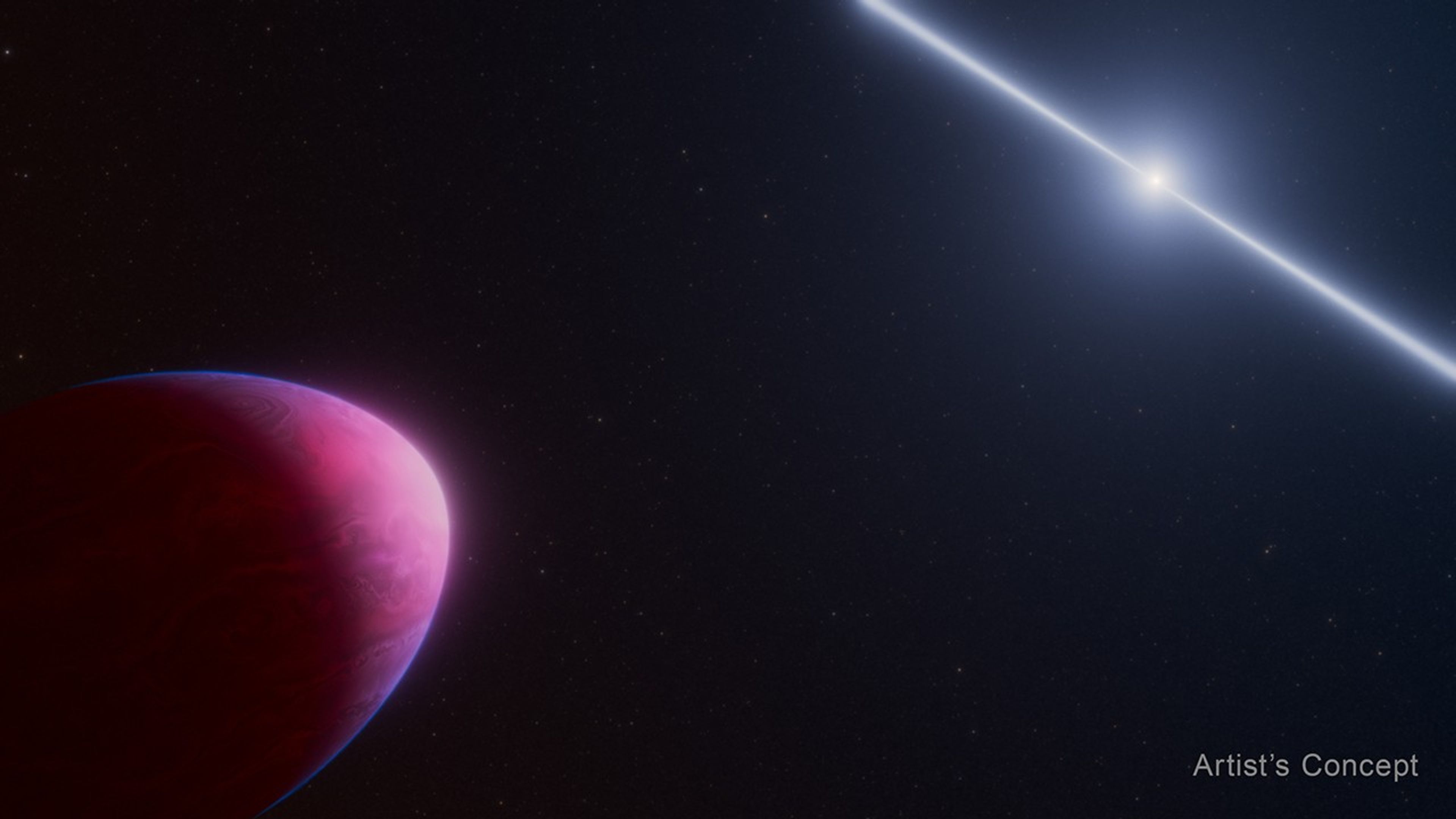
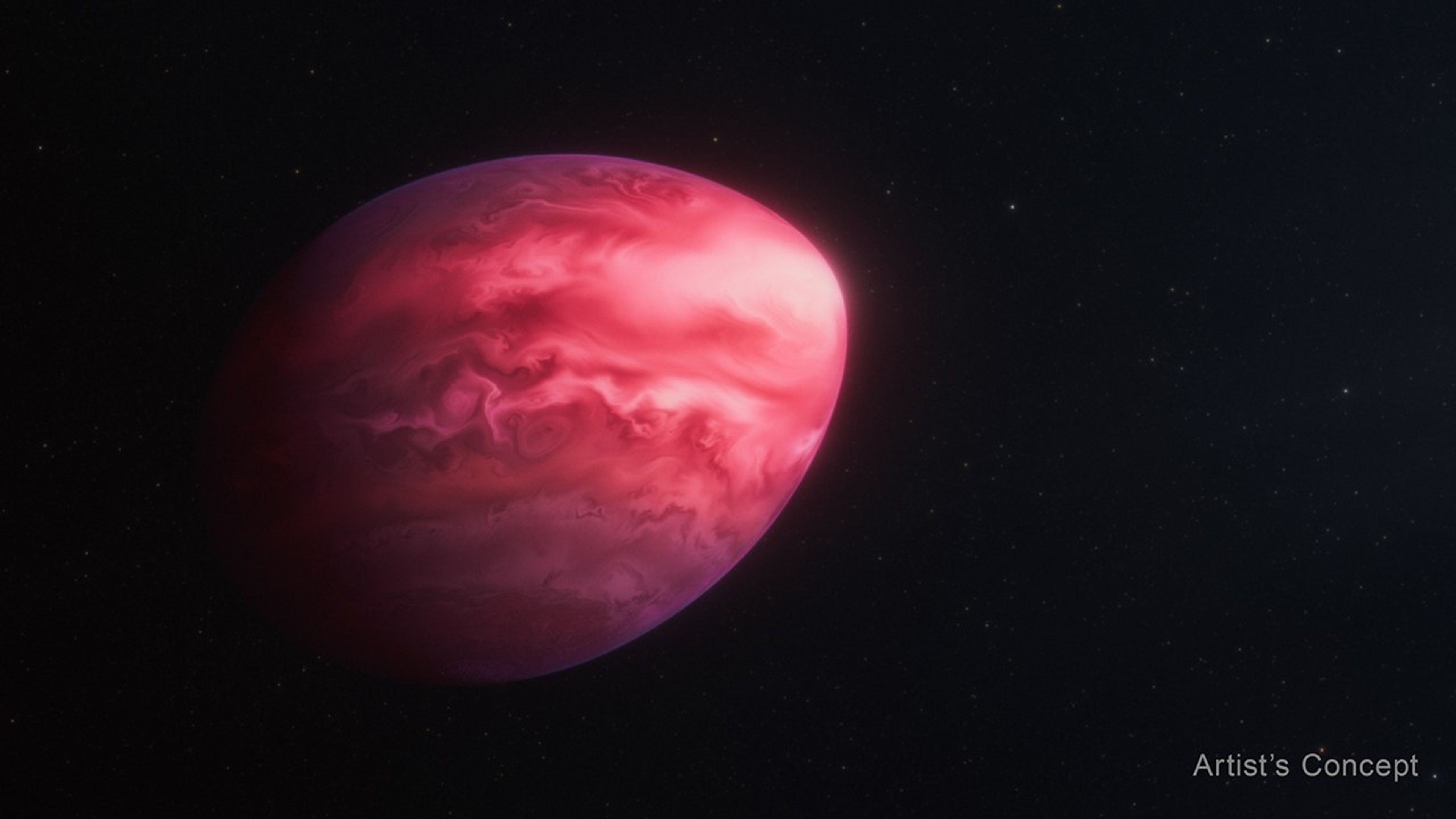
llustration labeled “artist’s concept” at right bottom corner. At left bottom corner, a partially illuminated, lemon-shaped exoplanet appears against a black background. This planet is most brightly illuminated at its elongated tip on its right side. On the left side, which is wider, the planet trails off into the darkness of the background. The planet is colored in varying, mottled shades of red, light pink, and fuchsia. Most of the pink occurs closest to the tip, while most of the fuchsia is at the top and bottom edges. At right top corner, a white beam emanates diagonally, oriented from 10 o’clock to 4 o’clock, from either side of a small, glowing, white star.
This artist’s concept shows what the exoplanet called PSR J2322-2650b (left) may look like as it orbits a rapidly spinning neutron star called a pulsar (right).
Credits:
Illustration: NASA, ESA, CSA, Ralf Crawford (STScI)

Scientists using NASA’s James Webb Space Telescope have observed a rare type of exoplanet, or planet outside our solar system, whose atmospheric composition challenges our understanding of how it formed. 

Officially named PSR J2322-2650b, this Jupiter-mass object appears to have an exotic helium-and-carbon-dominated atmosphere unlike any ever seen before. Soot clouds likely float through the air, and deep within the planet, these carbon clouds can condense and form diamonds. How the planet came to be is a mystery. The paper appears Tuesday in The Astrophysical Journal Letters. 

“This was an absolute surprise,” said study co-author Peter Gao of the Carnegie Earth and Planets Laboratory in Washington. “I remember after we got the data down, our collective reaction was ‘What the heck is this?’ It’s extremely different from what we expected.”

Image A: Exoplanet PSR J2322-2650b and Pulsar (Artist’s Concept)

llustration labeled u201cartistu2019s conceptu201d at right bottom corner. At left bottom corner, a partially illuminated, lemon-shaped exoplanet appears against a black background. This planet is most brightly illuminated at its elongated tip on its right side. On the left side, which is wider, the planet trails off into the darkness of the background. The planet is colored in varying, mottled shades of red, light pink, and fuchsia. Most of the pink occurs closest to the tip, while most of the fuchsia is at the top and bottom edges. At right top corner, a white beam emanates diagonally, oriented from 10 ou2019clock to 4 ou2019clock, from either side of a small, glowing, white star.
This artist’s concept shows what the exoplanet called PSR J2322-2650b (left) may look like as it orbits a rapidly spinning neutron star called a pulsar (right). Gravitational forces from the much heavier pulsar are pulling the Jupiter-mass world into a bizarre lemon shape.
Illustration: NASA, ESA, CSA, Ralf Crawford (STScI)

This planet-mass object was known to orbit a pulsar, a rapidly spinning neutron star. A pulsar emits beams of electromagnetic radiation at regular intervals typically ranging from milliseconds to seconds. These pulsing beams can only be seen when they are pointing directly toward Earth, much like beams from a lighthouse.  

This millisecond pulsar is expected to be emitting mostly gamma rays and other high energy particles, which are invisible to Webb’s infrared vision. Without a bright star in the way, scientists can study the planet in intricate detail across its whole orbit. 

“This system is unique because we are able to view the planet illuminated by its host star, but not see the host star at all,” said Maya Beleznay, a third-year PhD candidate at Stanford University in California who worked on modeling the shape of the planet and the geometry of its orbit. “So we get a really pristine spectrum. And we can study this system in more detail than normal exoplanets.” 

“The planet orbits a star that’s completely bizarre — the mass of the Sun, but the size of a city,” said the University of Chicago’s Michael Zhang, the principal investigator on this study. “This is a new type of planet atmosphere that nobody has ever seen before. Instead of finding the normal molecules we expect to see on an exoplanet — like water, methane, and carbon dioxide — we saw molecular carbon, specifically C3 and C2.

Molecular carbon is very unusual because at these temperatures, if there are any other types of atoms in the atmosphere, carbon will bind to them. (Temperatures on the planet range from 1,200 degrees Fahrenheit at the coldest points of the night side to 3,700 degrees Fahrenheit at the hottest points of the day side.) Molecular carbon is only dominant if there’s almost no oxygen or nitrogen. Out of the approximately 150 planets that astronomers have studied inside and outside the solar system, no others have any detectable molecular carbon.

PSR J2322-2650b is extraordinarily close to its star, just 1 million miles away. In contrast, Earth’s distance from the Sun is about 100 million miles. Because of its extremely tight orbit, the exoplanet’s entire year — the time it takes to go around its star — is just 7.8 hours. Gravitational forces from the much heavier pulsar are pulling the Jupiter-mass planet into a bizarre lemon shape.

Image B: Exoplanet PSR J2322-2650b (Artist’s Concept)

Partially illuminated, lemon-shaped planet appears against a black background. The planet is most brightly illuminated at its elongated tip on its right side. On the left side, which is wider, the planet trails off into the darkness of the background. The planet is colored in varying, mottled shades of red, light pink, and fuchsia. Most of the pink occurs closest to the tip, while most of the fuchsia is at the top and bottom edges.
This artist’s concept shows what the exoplanet PSR J2322-2650b may look like. Gravitational forces from the much heavier pulsar it orbits are pulling the Jupiter-mass world into this bizarre lemon shape.
Illustration: NASA, ESA, CSA, Ralf Crawford (STScI)

Together, the star and exoplanet may be considered a “black widow” system, though not a typical example. Black widow systems are a rare type of double system where a rapidly spinning pulsar is paired with a small, low-mass stellar companion. In the past, material from the companion streamed onto the pulsar, causing the pulsar to spin faster over time, which powers a strong wind. That wind and radiation then bombard and evaporate the smaller and less massive companion. Like the spider for which it is named, the pulsar slowly consumes its unfortunate partner.

But in this case, the companion is officially considered an exoplanet, not a star. The International Astronomical Union defines an exoplanet as a celestial body below 13 Jupiter masses that orbits a star, brown dwarf, or stellar remnant, such as a pulsar.

Of the 6,000 known exoplanets, this is the only one reminiscent of a gas giant (with mass, radius, and temperature similar to a hot Jupiter) orbiting a pulsar. Only a handful of pulsars are known to have planets.

“Did this thing form like a normal planet? No, because the composition is entirely different,” said Zhang. “Did it form by stripping the outside of a star, like ‘normal’ black widow systems are formed? Probably not, because nuclear physics does not make pure carbon. It’s very hard to imagine how you get this extremely carbon-enriched composition. It seems to rule out every known formation mechanism.”

Study co-author Roger Romani, of Stanford University and the Kavli Institute for Particle Astrophysics and Cosmology Institute, proposes one evocative phenomenon that could occur in the unique atmosphere. “As the companion cools down, the mixture of carbon and oxygen in the interior starts to crystallize,” said Romani. “Pure carbon crystals float to the top and get mixed into the helium, and that’s what we see. But then something has to happen to keep the oxygen and nitrogen away. And that’s where the mystery come in.

“But it’s nice to not know everything,” said Romani. “I’m looking forward to learning more about the weirdness of this atmosphere. It’s great to have a puzzle to go after.”

Video A: Exoplanet PSR J2322-2650b and Pulsar (Artist’s Concept)

This animation shows an exotic exoplanet orbiting a distant pulsar, or rapidly rotating neutron star with radio pulses. The planet, which orbits about 1 million miles away from the pulsar, is stretched into a lemon shape by the pulsar’s strong gravitational tides.

Animation: NASA, ESA, CSA, Ralf Crawford (STScI)

With its infrared vision and exquisite sensitivity, this is a discovery only the Webb telescope could make. Its perch a million miles from Earth and its huge sunshield keep the instruments very cold, which is necessary for these observations. It is not possible to conduct this study from the ground.

The James Webb Space Telescope is the world’s premier space science observatory. Webb is solving mysteries in our solar system, looking beyond to distant worlds around other stars, and probing the mysterious structures and origins of our universe and our place in it. Webb is an international program led by NASA with its partners, ESA (European Space Agency) and CSA (Canadian Space Agency).

To learn more about Webb, visit: https://science.nasa.gov/webb

Downloads & Related Information

The following sections contain links to download this article’s images and videos in all available resolutions followed by related information links, media contacts, and if available, research paper and spanish translation links.

Related Images & Videos

llustration labeled u201cartistu2019s conceptu201d at right bottom corner. At left bottom corner, a partially illuminated, lemon-shaped exoplanet appears against a black background. This planet is most brightly illuminated at its elongated tip on its right side. On the left side, which is wider, the planet trails off into the darkness of the background. The planet is colored in varying, mottled shades of red, light pink, and fuchsia. Most of the pink occurs closest to the tip, while most of the fuchsia is at the top and bottom edges. At right top corner, a white beam emanates diagonally, oriented from 10 ou2019clock to 4 ou2019clock, from either side of a small, glowing, white star.

Exoplanet PSR J2322-2650b and Pulsar (Artist’s Concept)

This artist’s concept shows what the exoplanet called PSR J2322-2650b (left) may look like as it orbits a rapidly spinning neutron star called a pulsar (right). Gravitational forces from the much heavier pulsar are pulling the Jupiter-mass world into a bizarre lemon shape.

Partially illuminated, lemon-shaped planet appears against a black background. The planet is most brightly illuminated at its elongated tip on its right side. On the left side, which is wider, the planet trails off into the darkness of the background. The planet is colored in varying, mottled shades of red, light pink, and fuchsia. Most of the pink occurs closest to the tip, while most of the fuchsia is at the top and bottom edges.

Exoplanet PSR J2322-2650b (Artist’s Concept)

This artist’s concept shows what the exoplanet PSR J2322-2650b may look like. Gravitational forces from the much heavier pulsar it orbits are pulling the Jupiter-mass world into this bizarre lemon shape.

Against a black background, a white beam emanates diagonally, oriented from 11 ou2019clock to 5 ou2019clock, from either side of a small, glowing, white star. To the right of this star, a partially illuminated, lemon-shaped exoplanet appears. This planet is most brightly illuminated at its elongated tip on its left side. The planetu2019s right side, which is wider, appears to trail off into the darkness of the background. The planet is colored in varying, mottled shades of red, light pink, and fuchsia. Most of the pink occurs closest to the tip, while most of the fuchsia is at the top and bottom edges.

Exoplanet PSR J2322-2650b Orbiting a Pulsar

This animation shows an exotic exoplanet orbiting a distant pulsar, or rapidly rotating neutron star with radio pulses. The planet, which orbits about 1 million miles away from the pulsar, is stretched into a lemon shape by the pulsar’s strong gravitational tides. NASA&rsqu…

Related Links

Article : Webb’s Impact on Exoplanet Research

Interactive: ViewSpace  Exoplanet Variety: Atmosphere

Video : How to Study Exoplanets: Webb and Challenges

Video : Black Widow Pulsars Consume Their Mates

More Webb News

More Webb Images

Webb Science Themes

Webb Mission Page

Related for Kids

What is the Webb Telescope?

SpacePlace for Kids


Share

Details

Last Updated
Dec 16, 2025
Contact
Media

Laura Betz
NASA’s Goddard Space Flight Center
Greenbelt, Maryland
laura.e.betz@nasa.gov

Ann Jenkins
Space Telescope Science Institute
Baltimore, Maryland

Christine Pulliam
Space Telescope Science Institute
Baltimore, Maryland

This Week in Space: Scylla, Moon Dust, and Space Plumbing

10 February 2023 at 10:35
GMT033_EHDC3_1157

Good morning, readers, and happy Friday. Welcome to This Week in Space, our Friday morning roundup of the week’s most important space news. Today we’ve got a bunch of good news, including a newfound exoplanet and a dozen new moons orbiting Jupiter. We’ve also got a report of an absolutely wild idea — a literal moonshot — for fighting climate change with moon dust.

SpaceX Starship Aces Static Fire Test

Thursday afternoon, SpaceX ran a successful static fire test of its gigantic Starship rocket. With 33 separate Raptor engines, Starship has the most engines of any rocket ever. Together, their thrust is twice that of a Saturn V or the Space Launch System. Is anyone else amazed the struts can hold that thing on the gantry?

Only 31 of the 33 engines fired. However, that’s actually good news because it means Starship can handle multiple engine failures.

Views from drone of Booster 7's static fire test pic.twitter.com/KN4sk1nohf

— SpaceX (@SpaceX) February 9, 2023

SpaceX hopes to attempt a test flight for Starship in March. “That first flight test is going to be really exciting. It’s going to happen in the next month or so,” said Gwynne Shotwell, SpaceX’s president and chief operating officer.

“We will go for a test flight and we will learn from the test flight and we will do more test flights,” Shotwell added. “The real goal is to not blow up the launch pad. That is success.”

ISS Astronauts Work On Plasma Crystals, Space Plumbing

We’ve talked about how the folks aboard the International Space Station have to become polymaths to keep up with the demands of life in orbit. This winter, among many other pursuits, NASA astronauts on the ISS have been tending tomatoes and working on avant-garde methods of space propulsion. But the most recent projects in low-earth orbit make space tomatoes sound outdated. Over the past few days, crew on the ISS have been working on plasma crystals, servicing jetpacks, and… doing space plumbing.

NASA astronaut Frank Rubio and JAXA astronaut Koichi Wakata spent Thursday doing maintenance on the station’s water recovery system and orbital plumbing for the station’s bathroom, respectively. Meanwhile, station commander Sergey Prokopyev worked inside the Columbus lab “configuring video hardware that records how clouds of highly charged particles, or plasma crystals, behave in microgravity.”

Hubble Captures New Portrait of Tarantula Nebula

The Tarantula Nebula is the brightest star-forming region in our cosmic neighborhood. It’s not even in our galaxy — it’s in the Large Magellanic Cloud, one of the Milky Way’s satellite galaxies. But it’s so bright that it dazzles even at that distance. Astronomers recently used the Hubble space telescope to capture this image of the Tarantula Nebula in all its splendor:

What you see here is actually a joint effort between two different astronomy projects. One team sought to analyze the properties of dust grains floating between stars — a proposal dubbed Scylla by the Hubble team. Those dust grains create the dark, wispy clouds spread across the frame. The other, called Ulysses, studies interstellar dust and starlight interactions.

Curiosity Finds Clues to Mars’ Watery Past

NASA’s Perseverance rover went to Mars with a plan: Scour the planet’s surface for evidence that can teach us about Mars’ history and tell us whether the Red Planet might once have supported life. During its two years on Mars, the rover has found silicate clay and other minerals, signs that liquid water once flowed across Mars’ surface. But none of its discoveries have had evidence of water as visually obvious as a photograph that the agency’s Curiosity rover recently captured. The rover caught a photo of sandstone rock with ripples carved out of its surface, showing that the rock was once at the bottom of a lake.

The ripples support our observations of Mars’ weather and climate. Gentle, constant winds create standing ripple patterns like these. This fits with the constant prevailing winds and planetwide dust storms we’ve seen on Mars. It’s also exciting evidence that Mars indeed had liquid water once upon a time.

Russia Launches Progress Spacecraft to International Space Station

Russia successfully launched a Progress capsule aboard a Soyuz rocket this week, bound for the International Space Station. The rocket launched from Russia’s Baikonur aerodrome early Thursday morning, local time. This capsule, ISS Progress 83 (83P), carries about three tons of supplies, including food, water, and air. It will dock with the Russian Zvezda module on Saturday morning, replacing the Progress capsule that left Monday afternoon.

What happens to Progress 82 once it departs? Progress capsules are expendable. This means that the crew on the ISS loads the capsules with trash from the station while it’s docked. Then, hours or days after the capsule undocks, it burns up in the atmosphere.

CAPSTONE Lunar Satellite Reports In After 11-Day Glitch

NASA’s CAPSTONE satellite is finally responding to hails after nearly two weeks incommunicado. A software glitch left the probe unresponsive on Jan. 26 until it rebooted itself Monday.

“The spacecraft remained overall healthy and on-course throughout the issue,” NASA said in a blog post. “On Feb. 6, an automatic command-loss timer rebooted CAPSTONE, clearing the issue and restoring two-way communications between CAPSTONE and the ground.”

The satellite has made twelve successful circuits in its near-rectilinear halo orbit (NRHO) — twice what its original mission expected. That’s great news for NASA. CAPSTONE is trying out the fancy new NRHO orbit because it’s more fuel efficient than other lunar orbits we’ve used. In twelve orbits, CAPSTONE has only had to fire its engine twice. This smashing success means the agency may use the new orbital pattern for lunar support satellites under the aegis of its Artemis project.

Rolls-Royce Building Nuclear Engine For Spaceships

Did you know Ball makes Mason jars — and parts for space telescopes? Ball made parts for Hubble and the mirrors for the JWST. In a similar fashion, Rolls-Royce appears to be branching out. Way out. The luxury automaker’s subsidiary, Rolls-Royce Holdings, has announced plans to build a nuclear engine for deep space exploration.

(Image: Rolls-Royce Holdings)

According to Rolls-Royce, the micro-reactor will use uranium as fuel for nuclear fission. The company hopes to use the micro-reactor as an energy source for trips to the Moon, Mars, and beyond.

Webb Telescope Breaks Own ‘Speed Limit’ Tracking DART Impact

NASA’s Guaranteed Time Observation program gives a certain amount of telescope time to those who worked on the JWST. One GTO project: Making observations of NASA’s DART kinetic asteroid redirect test. However, the project brought an unlooked-for surprise. Wednesday, JWST deputy project scientist Stefanie Milam explained how the telescope broke its own speed limit watching the asteroid impact.

Webb launched with the ability to track objects moving through the sky as fast as Mars. But scientists who study fast-moving small bodies like asteroids, comets, and interstellar objects “really wanted to study objects that moved faster than Mars,” said Milam. So, the team set out to show that not only could Webb exceed this “notional speed limit,” it could go much faster. Their efforts paid off when it came time to observe the DART asteroid impact.

NASA’s DART kinetic asteroid redirect test, as seen by the JWST. Image: NASA/JPL

The video Webb captured of the Dimorphos impact showed that the telescope can move its field of regard at more than triple its original maximum speed. Most of the time, though, Milam says the telescope will confine itself to double its original turning speed. Darn.

Chris Hadfield Meets With King Charles III

On Thursday, Canada’s favorite astronaut, Chris Hadfield, met with King Charles III at Buckingham Palace. The two sat down to discuss “efforts to encourage sustainability in space,” according to the Royal Family’s official Twitter.

“What a pleasure and privilege to be asked to advise and assist, and make the King laugh,” Hadfield wrote afterward.

What a pleasure and privilege to be asked to advise and assist. And make the King laugh :) https://t.co/3dGxNLCkUJ pic.twitter.com/DH9dgkq9t9

— Chris Hadfield (@Cmdr_Hadfield) February 9, 2023

While we don’t yet have specifics, Charles is a longtime environmentalist. Could it be that the King is interested in cleaning up space junk?

A Shield of Lunar Dust Could Help Cool Earth

Astrophysicists are pondering the pros and cons of a literal moonshot to blunt the effects of climate change. In a recent study, a group of researchers proposed launching moon dust into orbit around Earth to create a dusty shield that would reduce Earth’s exposure to the Sun. Evidently, lunar dust grains are just the right size and composition to block some of the solar energy that would hit the Earth.

For six days out of the year, the researchers say, the dust cloud would shield Earth from a few percent of the Sun’s radiation. To carry out this plan, the researchers’ numbers require dredging up some 22 billion pounds of lunar dust. They could fire the dust into orbit from the Moon or a platform in orbit — potato, poterrible idea. Surely there is some lower-hanging fruit?

Scientists Find a Dozen New Moons Orbiting Jupiter

In October 2019, astronomers at the Carnegie Institution for Science found 20 new moons orbiting Saturn. This made Saturn the “moon king” of the Solar System, with a total of 83. However, the same team has announced they’ve found a dozen new moons orbiting Jupiter.

Jupiter – Unsplash

Stealing the crown back from Saturn, Jupiter now has 92 known moons. Nine of the twelve new moons are retrograde, meaning they orbit “backward” against Jupiter’s orbit. All the new moons are quite small, and they had been lost in Jupiter’s glare until now.

Astronomers Spot Nearby, Potentially Habitable Exoplanet

An international team of astronomers has reported a newfound exoplanet in our cosmic backyard. The new planet, Wolf 1069 b, is between 1 and 1.4 Earth masses and just 8% bigger. Calling it Earth-like might be a stretch: Wolf 1069 b zips around its low-mass red dwarf star in just 15 Earth days. However, it’s just 31 light-years away.

Unlike our nearest neighbor, Proxima Centauri, Wolf 1069 doesn’t show the characteristic bursts of violent flares we frequently see in red dwarf stars. This could mean it has managed to retain an atmosphere. If so, the planet’s surface temperature could be about 55 degrees Fahrenheit. If not, it’s more likely an iceball, too cold to sustain liquid water.

Skywatchers Corner

Comet C/2022 E3 (ZTF) is a once-in-an-epoch visitor from the outer solar system. We haven’t seen it since the time of the Neanderthals, but it’s come back for one last visit. The outbound comet passed close to Earth last week. Now, it’s buzzing Mars.

It's green! Comet C/2022 E3 (ZTF) and its twin tails. Image: NASA

It’s green! Comet C/2022 E3 (ZTF) and its twin tails. Image: NASA

The green comet will be near Mars in the constellation of Taurus for the next several days. After sunset, look high in the sky for the best shot at catching it through binoculars or a telescope. After Feb. 14, the comet will start heading toward Orion and Eridanus.

If you don’t have a good shot at viewing the comet where you are, you can still catch it online. This weekend, the Virtual Telescope Project is webcasting a free livestream of the comet’s approach to the Red Planet. The livestream will begin this Saturday, Feb. 11, at 2 p.m. EST (1900 GMT). You can watch it on the project’s website and YouTube channel.

Feature image: This week’s waning gibbous moon, taken from the International Space Station. Courtesy of NASA HQ Flickr.

Now Read:

❌
❌