Here’s a fun and somewhat terrifying fact: you’re on a planet right now. We all know this, but it’s hard to really visualize. The good news is there’s a website for that, and it can tell you exactly how far Earth has traveled through space since you arrived on it.
Sometimes, you just need to give your mind a little vacation. And these days, outer space sounds like as good a destination as any. Thankfully, the James Webb Space Telescope (JWST) is here to give us a dazzling new image of the Helix Nebula.
Discovered in the early 19th century, the Helix Nebula resides in the constellation Aquarius. (Cue The 5th Dimension.) At about 655 light-years away, it's one of Earth's closest planetary nebulae. When zoomed farther out, it's easy to see why it's been nicknamed the Eye of God or Eye of Sauron. This 2004 image from the Hubble telescope illustrates that.
A wider view of the same nebula from 2004
NASA / ESA / C.R. O'Dell (Vanderbilt University) / M. Meixner / P. McCullough / G. Bacon ( STSI)
What we're seeing in the nebula is, in a sense, a moment of death that lays the groundwork for a new birth. The dying star (out of frame in the closer new image) sheds its outer layers. As expelled gas and dust cool, they provide raw material that could someday form new stars and perhaps planetary systems.
The new image from Webb's NIRCam (Near-Infrared Camera) provides a much closer, higher-resolution view.
Pillar-like reddish knots in the Helix Nebula
Those pillars you see are called cometary knots, and this image is our best view of those to date. "Here, blistering winds of hot gas from the dying star are crashing into colder shells of dust and gas that were shed earlier in its life, sculpting the nebula's remarkable structure," the ESA wrote in its press release.
The knots' colors represent temperature and chemistry. Hints of blue indicate the hottest gas (energized by ultraviolet light). The yellow regions, where hydrogen atoms form molecules, are farther from the nebula's nucleus (and therefore cooler). On the edges, reddish-orange regions depict the coolest material, where gas thins and dust begins to form.
This article originally appeared on Engadget at https://www.engadget.com/science/space/earth-is-having-some-issues-so-lets-enjoy-the-webb-telescopes-new-nebula-image-181049901.html?src=rss
After a tumultuous 2025 that saw it lose around 4,000 employees, NASA finally has an operating budget for 2026, and one that largely preserves its scientific capabilities. On Thursday, the Senate passed an appropriations bill funding NASA, alongside the National Science Foundation and a handful of other federal agencies.
Going into the appropriations process, the president called for a 24 percent year over year reduction to NASA's total operating budget. As part of that plan, the White House wanted to reduce the Science Mission Directorate's funding by nearly half, a move that would have forced NASA to cancel 55 ongoing and planned missions, including efforts like OSIRIS-APEX. The bill effectively rejects President Trump's plan, reducing NASA's total operating budget by just 1.6 percent year over year to $24.4 billion.
Per the new appropriations, NASA's science budget will stand at $7.25 billion, 1.1 percent less relative to fiscal 2024, while shuffling the remaining funds to focus on different priorities. For instance, the House and Senate allocated $874 million (+8.7 percent) for the agency's heliophysics work; planetary sciences, which oversees missions like New Horizons, was cut to $2.5 billion (-6.5 percent) compared to 2024. At the same time, NASA's STEM engagement office, which the president proposed eliminating, escaped unscathed with its funding maintained at parity.
"It's almost everything we had been asking for, and it's very encouraging to see a House and Senate run by the president's own party agreeing that we need to keep investing in things like NASA science," says Casey Dreier, chief of policy at the Planetary Society, a nonprofit founded by Carl Sagan that advocates for the exploration and study of space. "It contains very clear and direct language that not only is this funding made available to these projects, but that it will be spent on the initiatives that Congress states."
Lawmakers also rejected Trump's effort to scuttle the Space Launch System after its third flight. NASA's heavy-lift rocket is billions of dollars over budget, but remains — as of now — the only spacecraft ready to ferry astronauts to the Moon. Compared to the rest of NASA, the fate of the SLS was never really in doubt. Senator Ted Cruz (R-TX) secured funding for the rocket as part of Trump's Big Beautiful Bill. "I've been saying for a long time you should never underestimate the political coalition behind the SLS, and I think that was very much validated this year," says Dreier.
More importantly, it appears the Goddard Space Flight Center will be safe from further damage. Over the summer, the future of the facility, known for its work on projects like the James Webb Space Telescope, was put in jeopardy. By some estimates, the campus has lost a third of its staff due to workforce cuts, and dozens of buildings, including some 100 laboratories, have been shut down by management. One of the casualties was NASA's largest library, which houses irreplaceable documents chronicling the history of the space race. As part of a "consolidation" effort, many of those documents will be thrown out.
Under the appropriations bill, the Senate has directed NASA to “preserve all the technical and scientific world-class capabilities at Goddard.” It has also instructed the agency to ensure employees of the Goddard Institute for Space Studies are able to continue their work with "minimal disruption." The New York-based office, one of America's leading climate labs, was sent into limbo last spring after the Trump administration moved to shut it down.
The bill also provides a lifeline for NASA's to bring back samples of Martian dirt collected by the Perseverance rover. Congress has effectively cancelled the official program tied to that ambition, the Mars Sample Return (MSR), but has set aside $110 million for the agency to continue developing technologies for future science missions to the Red Planet. MSR advocates have argued the mission could lead to significant scientific discoveries, but Dreier notes the program was "ripe for cancellation" after it became mired in mismanagement.
"I worry MSR now has this stink of bloat, excess cost and threat of overruns that are really going to make it challenging to restart this without having a dramatically different approach," says Dreier, adding that deciding what to do with mission will likely be top of mind for the agency's new administrator, Jared Isaacman.
The 2026 budget leaves NASA with fewer resources. Even in areas where Congress allocated the same amount of funds as it did in 2024, the agency will need to do more with less due to inflation. Compared to the absolute blood bath that would have been Trump's proposed budget, a marginal funding cut is the best case scenario given the circumstances, but the circumstances remain less than ideal.
"There will be another presidential budget request coming out in the next couple of months," Dreier said. "They could do this all over again if they wanted to."
In the immediate future, NASA and its employees are at least protected from the potential fallout of another impending government shutdown. Congress has until January 30 to fully fund the federal government, and as of earlier this week, it has yet to find a way forward on appropriations for agencies like the Department of Labor.
Correction 9:05PM ET: A previous version of this article incorrectly stated Casey Dreier’s surename as Drier. We regret the error.
This article originally appeared on Engadget at https://www.engadget.com/science/space/senate-passes-minibus-bill-funding-nasa-rejecting-trumps-proposed-cuts-231605536.html?src=rss
The SpaceX Dragon spacecraft carrying the Crew-11 astronauts has splashed down into the ocean after they left the ISS a month earlier than planned due a medical issue. It’s the first time NASA cut a mission short due to a medical concern. The agency didn’t name the crew member and their condition but stated that they were stable and that it wasn’t a case of medical evacuation. NASA merely decided to end the mission early out of an abundance of caution, because the ISS didn’t have the tools for a proper diagnosis.
NASA astronauts Mike Fincke and Zena Cardman, JAXA’s Kimiya Yui and Russian cosmonaut Oleg Platonov — the members of Crew-11 — left for the space station on August 1 and were supposed to stay there until February. Despite the mission being cut early, they still stayed 167 days in space before they made their way back home. The Dragon capsule carrying the members splashed down off the coast of San Diego, California at 3:41AM on January 15. A SpaceX medical doctor was the first person who checked in on them, though that is routine procedure and not because of one member’s medical issue.
“I couldn’t be prouder of our astronauts and the teams on the ground at NASA, SpaceX, and across our international partnerships,” said NASA Administrator Jared Isaacman. “Their professionalism and focus kept the mission on track, even with an adjusted timeline. Crew-11 completed more than 140 science experiments that advance human exploration. Missions like Crew-11 demonstrate the capability inherent in America’s space program — our ability to bring astronauts home as needed, launch new crews quickly, and continue pushing forward on human spaceflight as we prepare for our historic Artemis II mission, from low Earth orbit to the Moon and ultimately Mars.”
With Crew-11 back on Earth, there are now only three people aboard the orbiting lab. Two are Russian cosmonauts, while the other one is NASA astronaut Chris Williams. NASA is now looking at options to be able to send Crew-12 to the ISS earlier than its planned February 15 launch.
LIVE: After undocking from the @Space_Station, Crew-11 is on their way back to Earth. Tune in to watch them splash down off the coast of California, scheduled for 3:41am ET (0841 UTC). https://t.co/mIUojli3XW
Update, January 15, 2026, 7:30AM ET: This post has been updated to add Jared Isaacman’s statement.
This article originally appeared on Engadget at https://www.engadget.com/science/space/iss-mission-splashes-down-after-medical-issue-103000302.html?src=rss
An artist’s conception zeroes in on a main-belt asteroid called 2025 MN45, which makes a full rotation in less than two minutes. (Credit: NSF-DOE Vera C. Rubin Observatory / NOIRLab / SLAC / AURA / P. Marenfeld)
The asteroid, known as 2025 MN45, is nearly half a mile (710 meters) in diameter and makes a full rotation every 1.88 minutes, based on an analysis of data from the Vera C. Rubin Observatory. “This is now the fastest-spinning asteroid that we know of, larger than 500 meters,” University of Washington astronomer Sarah Greenstreet said today at the American Astronomical Society’s winter meeting in Phoenix.
Greenstreet, who serves as an assistant astronomer at the National Science Foundation’s NOIRLab and heads the Rubin Observatory’s working group for near-Earth objects and interstellar objects, is the lead author of a paper in The Astrophysical Journal Letters that describes the discovery and its implications. It’s the first peer-reviewed paper based on data from Rubin’s LSST Camera in Chile.
2025 MN45 is one of more than 2,100 solar system objects that were detected during the observatory’s commissioning phase. Over time, the LSST Camera tracked variations in the light reflected by those objects. Greenstreet and her colleagues analyzed those variations to determine the size, distance, composition and rate of rotation for 76 asteroids, all but one of which are in the main asteroid belt between the orbits of Mars and Jupiter. (The other asteroid is a near-Earth object.)
The team found 16 “super-fast rotators” spinning at rates ranging between 13 minutes and 2.2 hours per revolution — plus three “ultra-fast rotators,” including 2025 MN45, that make a full revolution in less than five minutes.
This chart shows the light curve of 2025 MN45. The y-axis shows the asteroid’s brightness, and the x-axis shows its phase, or where it is in its rotation. The resulting curve shows the asteroid’s fluctuating brightness as it spins. Light curves can help scientists determine an asteroid’s rotation period, size, shape and surface properties. (Credit: NSF–DOE Vera C. Rubin Observatory / NOIRLab / SLAC / AURA/ J. Pollard)
Greenstreet said 2025 MN45 appears to consist of solid rock, as opposed to the “rubble pile” material that most asteroids are thought to be made of.
“We also believe that it’s likely a collisionary fragment of a much larger parent body that, early in the solar system’s history, was heated enough that the material internal to it melted and differentiated,” Greenstreet said. She and her colleagues suggest that the primordial collision blasted 2025 MN45 from the dense core of the parent body and sent it whirling into space.
Astronomers have previously detected fast-spinning asteroids that measure less than 500 meters wide, but this is the first time larger objects have been found with rotational rates that are faster than five minutes per revolution. The Rubin team’s other two ultra-fast rotators have rates of 1.9 minutes and 3.8 minutes.
What would it be like to take a spin on 2025 MN45? Imagine riding on a Ferris wheel — say, the Seattle Great Wheel, which typically makes three revolutions in 10 to 12 minutes. Now make the wheel more than 10 times taller, and make the rotation rate at least twice as fast. It’d feel as if you were going more than 40 mph.
“If you were standing on it, it would probably be quite the ride to be going around on the outside edge of this thing that’s the size of eight football fields,” Greenstreet said.
But the significance of the study goes beyond imagining an extraterrestrial amusement ride.
“This is only the beginning of science for the Rubin Observatory,” Greenstreet said. “We are already seeing that we can study smaller asteroids at farther distances than we’ve ever been able to study before. And being able to study these fast rotators further, we’re going to learn a lot of really crucial information about the internal strength, composition and collisional histories of these primitive solar system bodies that date back to the formation of the solar system.”
The study published in The Astrophysical Journal Letters, “Lightcurves, Rotation Periods, and Colors for Vera C. Rubin Observatory’s First Asteroid Discoveries,” lists 71 co-authors. Authors from the University of Washington include Greenstreet as well as Zhuofu (Chester) Li, Dmitrii E. Vavilov, Devanshi Singh, Mario Jurić, Željko Ivezić, Joachim Moeyens, Eric C. Bellm, Jacob A. Kurlander, Maria T. Patterson, Nima Sedaghat, Krzysztof Suberlak and Ian S. Sullivan.
The Vera C. Rubin Observatory is jointly funded by the National Science Foundation and the U.S. Department of Energy’s Office of Science. The University of Washington was one of the founding members of the consortium behind the project, which benefited from early contributions by Microsoft co-founder Bill Gates and software executive Charles Simonyi. The observatory’s Simonyi Survey Telescope was named in honor of Simonyi’s family.
Most of the exoplanets we've discovered have been in relatively tight orbits around their host stars, allowing us to track them as they repeatedly loop around them. But we've also discovered a handful of planets through a phenomenon that's called microlensing. This occurs when a planet passes between the line of sight between Earth and another star, creating a gravitational lens that distorts the star, causing it to briefly brighten.
The key thing about microlensing compared to other methods of finding planets is that the lensing planet can be nearly anywhere on the line between the star and Earth. So, in many cases, these events are driven by what are called rogue planets: those that aren't part of any exosolar system at all, but they drift through interstellar space. Now, researchers have used microlensing and the fortuitous orientation of the Gaia space telescope to spot a Saturn-sized planet that's the first found in what's called the "Einstein desert," which may be telling us something about the origin of rogue planets.
Going rogue
Most of the planets we've identified are in orbit around stars and formed from the disks of gas and dust that surrounded the star early in its history. We've imaged many of these disks and even seen some with evidence of planets forming within them. So how do you get a planet that's not bound to any stars? There are two possible routes.
Preparations for Next Moonwalk Simulations Underway (and Underwater)
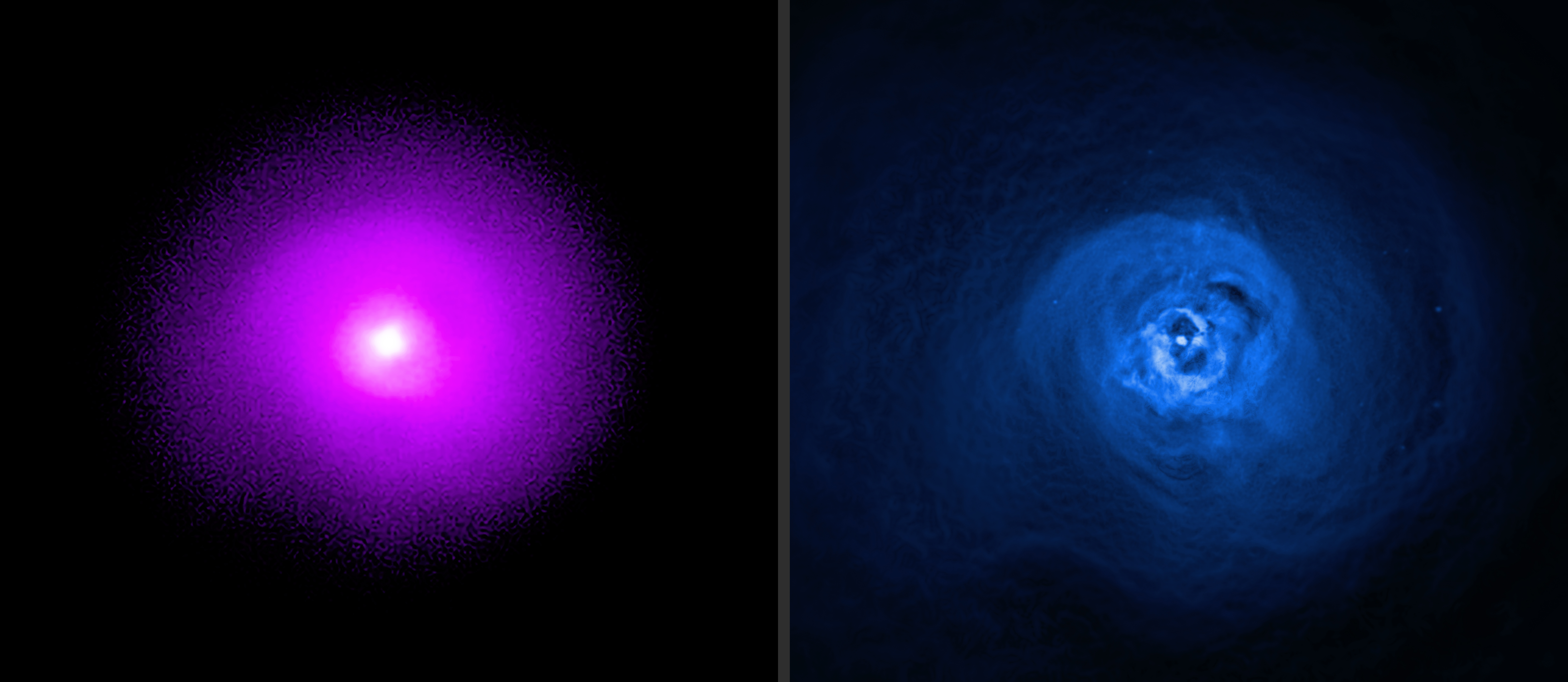
Two composite images show side-by-side observations of the Perseus Cluster from NASA’s IXPE (Imaging X-Ray Polarimetry Explorer) and Chandra X-ray Observatory. Scientists used data from both observatories, along with data from Nuclear Spectroscopic Telescope Array (NuSTAR), and Neil Gehrels Swift Observatory, to confirm measurements of the galaxy cluster.
X-ray: (Chandra) NASA/CXC/SAO, (IXPE) NASA/MSFC; Image Processing: NASA/CXC/SAO/N. Wolk and K. Arcand
Written by Michael Allen
An international team of astronomers using NASA’s IXPE (Imaging X-ray Polarimetry Explorer) has identified the origin of X-rays in a supermassive black hole’s jet, answering a question that has been unresolved since the earliest days of X-ray astronomy. Their findings are described in a paper published in The Astrophysical Journal Letters, by the American Astronomical Society, Nov. 11.
The IXPE mission observed the Perseus Cluster, the brightest galaxy cluster observable in X-rays, for more than 600 hours over a 60-day period between January and March. Not only is this IXPE’s longest observation of a single target to date, it also marks IXPE’s first time observing a galaxy cluster.
Specifically, the team of scientists studied the polarization properties of 3C 84, the massive active galaxy located at the very center of the Perseus Cluster. This active galaxy is a well-known X-ray source and a common target for X-ray astronomers because of its proximity and brightness.
Because the Perseus Cluster is so massive, it hosts an enormous reservoir of X-ray emitting gas as hot as the core of the Sun. The use of multiple X-ray telescopes, particularly the high-resolution imaging power of NASA’s Chandra X-ray Observatory was essential to disentangle the signals in the IXPE data. Scientists combined these X-ray measurements with data from the agency’s Nuclear Spectroscopic Telescope Array (NuSTAR) mission and Neil Gehrels Swift Observatory.
Fast facts
Polarization measurements from IXPE carry information about the orientation and alignment of emitted X-ray light waves. The more X-ray waves traveling in sync, the higher the degree of polarization.
X-rays from an active galaxy like 3C 84 are thought to originate from a process known as inverse Compton scattering, where light bounces off particles and gains energy. The polarization measurements from IXPE allow us to identify the presence of either inverse Compton scattering or other scenarios.
“Seed photons” is the term for the lower-energy radiation undergoing the energizing process of inverse Compton scattering.
“While measuring the polarization of 3C 84 was one of the key science goals, we are still searching for additional polarization signals in this galaxy cluster that could be signatures of more exotic physics,” said Steven Ehlert, project scientist for IXPE and astronomer at NASA’s Marshall Space Flight Center in Huntsville.
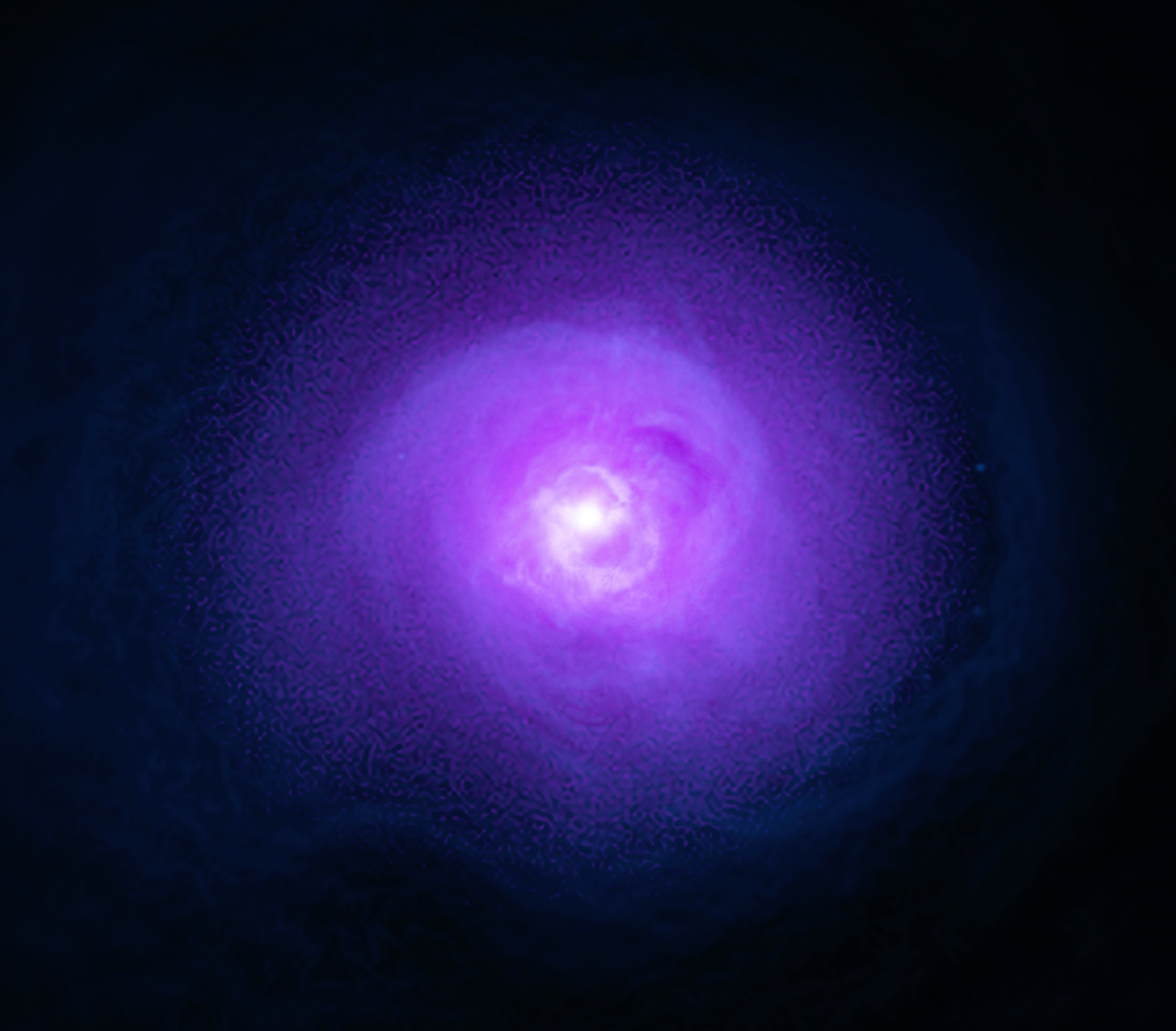
Chandra & IXPE composite image of the Perseus Cluster.
X-ray: (Chandra) NASA/CXC/SAO, (IXPE) NASA/MSFC; Image Processing: NASA/CXC/SAO/N. Wolk and K. Arcand
“We’ve already determined that for sources like 3C 84, the X-rays originated from inverse Compton scattering,” said Ioannis Liodakis, a researcher at the Institute of Astrophysics – FORTH in Heraklion, Greece, and lead author on the paper. “With IXPE observations of 3C 84 we had a unique chance to determine the properties of the seed photons.”
The first possible origin scenario for the seed photons is known as synchrotron self-Compton, where lower-energy radiation originates from the same jet that produces the highly energetic particles.
In the alternative scenario known as external Compton, seed photons originate from background radiation sources unrelated to the jet.
“The synchrotron self-Compton and external Compton scenarios have very different predictions for their X-ray polarization,” said Frederic Marin, an astrophysicist at the Strasbourg Astronomical Observatory in France and co-author of the study. “Any detection of X-ray polarization from 3C 84 almost decisively rules out the possibility of external Compton as the emission mechanism.”
Throughout the 60-day observation campaign, optical and radio telescopes around the world turned their attention to 3C 84 to further test between the two scenarios.
NASA’s IXPE measured a net polarization of 4% in the X-rays spectrum, with comparable values measured in the optical and radio data. These results strongly favor the synchrotron self-Compton model for the seed photons, where they come from the same jet as the higher-energy particles.
“Separating these two components was essential to this measurement and could not be done by any single X-ray telescope, but by combining the IXPE polarization data with Chandra, NuSTAR, and Swift, we were able to confirm this polarization measurement was associated specifically with 3C 84,” said Sudip Chakraborty, a researcher at the Science and Technology Institute of the Universities Space Research Association in Huntsville, Alabama, and co-author on the paper.
Scientists will continue to analyze IXPE’s data from different locations in the Perseus Cluster for different signals.
More about IXPE
NASA’s IXPE, which continues to provide unprecedented data enabling groundbreaking discoveries about celestial objects across the universe, is a joint NASA and Italian Space Agency mission with partners and science collaborators in 12 countries. The IXPE mission is led by NASA’s Marshall Space Flight Center in Huntsville, Alabama. BAE Systems, Inc., headquartered in Falls Church, Virginia, manages spacecraft operations together with the University of Colorado’s Laboratory for Atmospheric and Space Physics in Boulder.

 Login
Login