Normal view

There are new articles available, click to refresh the page.
Before yesterdayMain stream

NASA’s Roman Could Bring New Waves of Information on Galaxy’s Stars

20 November 2025 at 10:00

Lee esta nota de prensa en español aqui.

A team of researchers has confirmed stars ring loud and clear in a “key” that will harmonize well with the science goals and capabilities of NASA’s upcoming Nancy Grace Roman Space Telescope.

Artist’s concept of the Sun and several red giant stars
This artist’s concept visualizes the Sun and several red giant stars of varying radii. NASA’s upcoming Nancy Grace Roman Space Telescope will be well suited for studying red giant stars with a method known as asteroseismology. This approach entails studying the changes in stars’ overall brightness, which is caused by their turbulent interiors creating waves and oscillations. With asteroseismic detections, astronomers can learn about stars’ ages, masses, and sizes. Scientists estimate Roman will be able to detect a total of 300,000 red giant stars with this method. This would be the largest sample of its kind ever collected.
Credit: NASA, STScI, Ralf Crawford (STScI)

Stars’ turbulent natures produce waves that cause fluctuations in their overall brightness. By studying these changes — a method called asteroseismology — scientists can glean information about stars’ ages, masses, and sizes. These shifts in brightness were perceptible to NASA’s Kepler space telescope, which provided asteroseismic data on approximately 16,000 stars before its retirement in 2018.

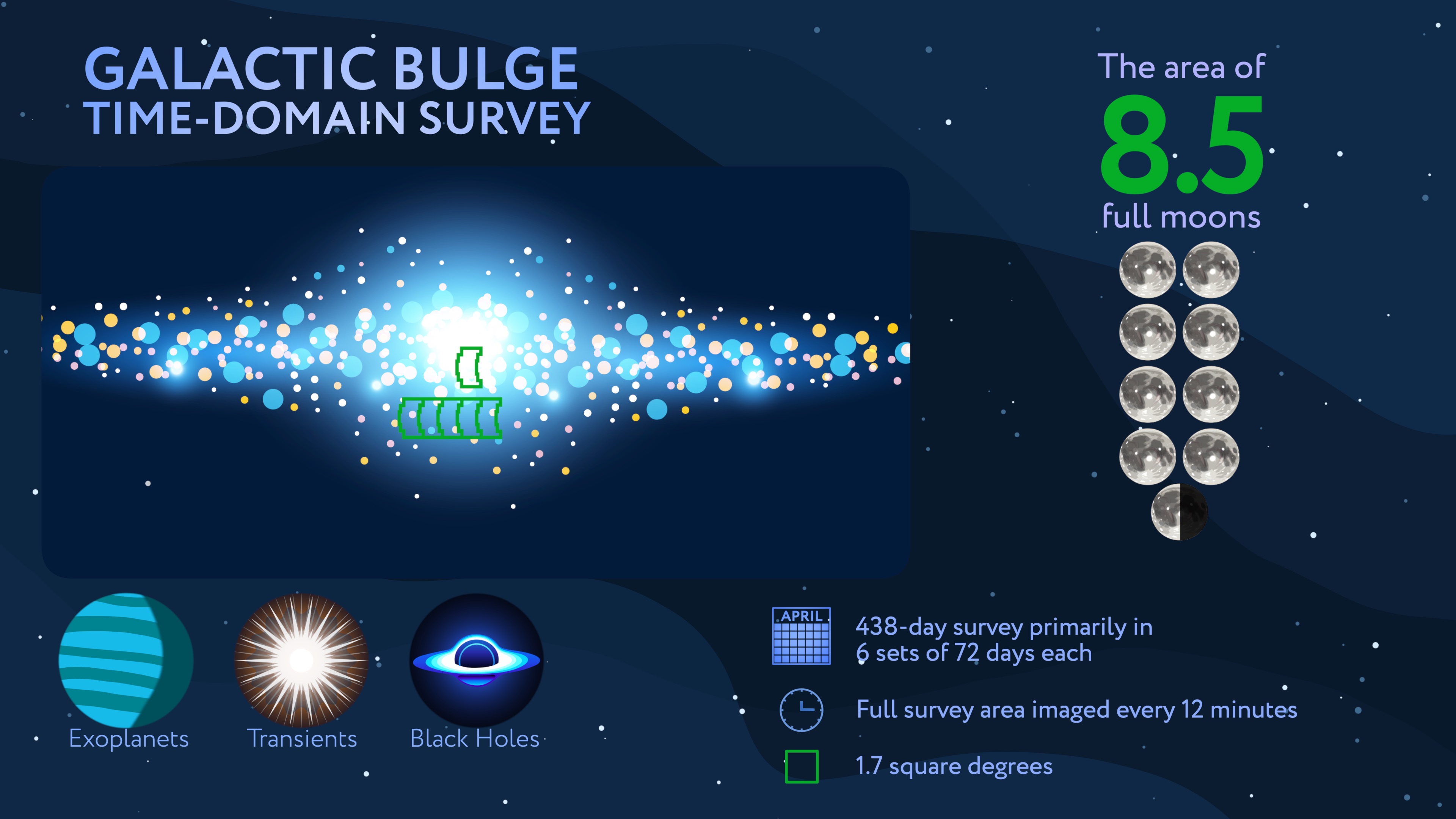
Using Kepler data as a starting point and adapting the dataset to match the expected quality from Roman, astronomers have recently proven the feasibility of asteroseismology with the soon-to-launch telescope and provided an estimated range of detectable stars. It’s an added bonus to Roman’s main science goals: As the telescope conducts observations for its Galactic Bulge Time-Domain Survey — a core community survey that will gather data on hundreds of millions of stars in the bulge of our Milky Way galaxy — it will also provide enough information for astronomers to determine stellar measurements via asteroseismology.

“Asteroseismology with Roman is possible because we don’t need to ask the telescope to do anything it wasn’t already planning to do,” said Marc Pinsonneault of The Ohio State University in Columbus, a co-author of a paper detailing the research. “The strength of the Roman mission is remarkable: It’s designed in part to advance exoplanet science, but we’ll also get really rich data for other scientific areas that extend beyond its main focus.”

Exploring what’s possible

The galactic bulge is densely populated with red giant branch and red clump stars, which are more evolved and puffier than main sequence stars. (Main sequence stars are in a similar life stage as our Sun.) Their high luminosity and oscillating frequency, ranging from hours to days, work in Roman’s favor. As part of its Galactic Bulge Time-Domain Survey, the telescope will observe the Milky Way’s galactic bulge every 12 minutes over six 70.5-day stretches, a cadence that makes it particularly well suited for red giant asteroseismology.

While previous research has explored the potential of asteroseismology with Roman, the team took a more detailed look by considering Roman’s capabilities and mission design. Their investigation consisted of two large efforts:

First, the team members looked at Kepler’s asteroseismic data and applied parameters so the dataset matched the expected quality of Roman data. This included increasing the observation frequency and adjusting the wavelength range of light. The team calculated detection probabilities, which confirmed with a resounding yes that Roman will be able to detect the oscillations of red giants.

The team then applied their detection probabilities to a model of the Milky Way galaxy and considered the suggested fields of view for the galactic bulge survey to get a sense of how many red giants and red clump stars could be investigated with asteroseismology.

This sonification is based on a simulation of data that NASA’s Roman Space Telescope will collect after its launch as soon as fall 2026. The sonification converts the waves moving inside red giant stars into sound. These pressure waves cause tiny changes in brightness that Roman can measure. Bigger stars take longer for the waves to bounce around, which means brightness changes have lower frequencies. Here, those frequencies are turned into sound and sped up so we can hear them. The first sound in the sonification comes from the Sun to give a sense of scale (even though Roman won’t look at the Sun). It then moves on to bigger and bigger red giants, with the pitch changing for each one. Astronomers can calculate a star’s size and other properties by measuring these frequencies. An audio-described version is available for download at the bottom of the page. 
Credit: Video: NASA, STScI; Sonification: Christopher Britt (STScI), Martha Irene Saladino (STScI); Designer: Ralf Crawford (STScI); Science: Noah Downing (OSU), Trevor Weiss (CSU)

“At the time of our study, the core community survey was not fully defined, so we explored a few different models and simulations. Our lower limit estimation was 290,000 objects in total, with 185,000 stars in the bulge,” said Trevor Weiss of California State University, Long Beach, co-first author of the paper. “Now that we know the survey will entail a 12-minute cadence, we find it strengthens our numbers to over 300,000 asteroseismic detections in total. It would be the largest asteroseismic sample ever collected.”

Bolstering science for all

The benefits of asteroseismology with Roman are numerous, including tying into exoplanet science, a major focus for the mission and the galactic bulge survey. Roman will detect exoplanets, or planets outside our solar system, through a method called microlensing, in which the gravity of a foreground star magnifies the light from a background star. The presence of an exoplanet can cause a noticeable “blip” in the resulting brightness change.

“With asteroseismic data, we’ll be able to get a lot of information about exoplanets’ host stars, and that will give us a lot of insight on exoplanets themselves,” Weiss said.

“It will be difficult to directly infer ages and the abundances of heavy elements like iron for the host stars of exoplanets Roman detects,” Pinsonneault said. “Knowing these things — age and composition — can be important for understanding the exoplanets. Our work will lay out the statistical properties of the whole population — what the typical abundances and ages are — so that the exoplanet scientists can put the Roman measurements in context.”

Additionally, for astronomers who seek to understand the history of the Milky Way galaxy, asteroseismology could reveal information about its formation.

“We actually don’t know a lot about our galaxy’s bulge since you can only see it in infrared light due to all the intervening dust,” Pinsonneault said. “There could be surprising populations or chemical patterns there. What if there are young stars buried there? Roman will open a completely different window into the stellar populations in the Milky Way’s center. I’m prepared to be surprised.”

Since Roman is set to observe the galactic bulge soon after launch, the team is working to build a catalog in advance and provide a target list of observable stars that could help with efforts in validating the telescope’s early performance.

“Outside of all the science, it’s important to remember the amount of people it takes to get these things up and running, and the amount of different people working on Roman,” said co-first author Noah Downing of The Ohio State University. “It’s really exciting to see all of the opportunities Roman is opening up for people before it even launches and then think about how many more opportunities will exist once it’s in space and taking data, which is not very far away.” Roman is slated to launch no later than May 2027, with the team working toward a potential early launch as soon as fall 2026.

The paper was published in The Astrophysical Journal.

The Nancy Grace Roman Space Telescope is managed at NASA’s Goddard Space Flight Center in Greenbelt, Maryland, with participation by NASA’s Jet Propulsion Laboratory in Southern California; Caltech/IPAC in Pasadena, California; the Space Telescope Science Institute in Baltimore; and a science team comprising scientists from various research institutions. The primary industrial partners are BAE Systems, Inc. in Boulder, Colorado; L3Harris Technologies in Melbourne, Florida; and Teledyne Scientific & Imaging in Thousand Oaks, California.

To learn more about Roman, visit: https://www.nasa.gov/roman

By Abigail Major
Space Telescope Science Institute, Baltimore, Md.

Additional Resources

Video with audio descriptions

Nov 19, 2025

MP4 (6.58 MB)

Share

Details

Last Updated
Nov 20, 2025
Editor
Ashley Balzer
Contact
Location
Goddard Space Flight Center

NASA’s Webb Explores Largest Star-Forming Cloud in Milky Way

24 September 2025 at 10:00
 
4 Min Read

NASA’s Webb Explores Largest Star-Forming Cloud in Milky Way

A wide view of a region of space filled with stars and clumps of orange clouds.
Stars, gas and cosmic dust in the Sagittarius B2 molecular cloud glow in near-infrared light, captured by Webb’s NIRCam instrument. Full image and caption below.
Credits: Image: NASA, ESA, CSA, STScI, Adam Ginsburg (University of Florida), Nazar Budaiev (University of Florida), Taehwa Yoo (University of Florida); Image Processing: Alyssa Pagan (STScI)

NASA’s James Webb Space Telescope has revealed a colorful array of massive stars and glowing cosmic dust in the Sagittarius B2 molecular cloud, the most massive and active star-forming region in our Milky Way galaxy. 

“Webb’s powerful infrared instruments provide detail we’ve never been able to see before, which will help us to understand some of the still-elusive mysteries of massive star formation and why Sagittarius B2 is so much more active than the rest of the galactic center,” said astronomer Adam Ginsburg of the University of Florida, principal investigator of the program.

Image A: Sagittarius B2 (NIRCam Image)

A wide view of a region of space filled with stars and clumps of orange clouds.
Stars, gas and cosmic dust in the Sagittarius B2 molecular cloud glow in near-infrared light, captured by Webb’s NIRCam instrument. The darkest areas of the image are not empty space but are areas where stars are still forming inside dense clouds that block their light.
Image: NASA, ESA, CSA, STScI, Adam Ginsburg (University of Florida), Nazar Budaiev (University of Florida), Taehwa Yoo (University of Florida); Image Processing: Alyssa Pagan (STScI)

Sagittarius B2 is located only a few hundred light-years from the supermassive black hole at the heart of the galaxy called Sagittarius A*, a region densely packed with stars, star-forming clouds, and complex magnetic fields. The infrared light that Webb detects is able to pass through some of the area’s thick clouds to reveal young stars and the warm dust surrounding them. 

However, one of the most notable aspects of Webb’s images of Sagittarius B2 are the portions that remain dark. These ironically empty-looking areas of space are actually so dense with gas and dust that even Webb cannot see through them. These thick clouds are the raw material of future stars and a cocoon for those still too young to shine.

The high resolution and mid-infrared sensitivity of Webb’s MIRI (Mid-Infrared Instrument) revealed this region in unprecedented detail, including glowing cosmic dust heated by very young massive stars. The reddest area on the right half of MIRI’s image, known as Sagittarius B2 North, is one of the most molecularly rich regions known, but astronomers have never seen it with such clarity. (Note: North is to the right in these Webb images.)

Image B: Sagittarius B2 (MIRI Image)

Cosmic clouds of pink and purple, some with bright centers, are surrounded by dark areas that appear like black space dotted with bright blue stars. A group of small clouds to the right is more red than any other area of the image.
Webb’s MIRI instrument shows the Sagittarius B2 region in mid-infrared light, with warm dust glowing brightly. Only the brightest stars emit strongly enough to appear through the dense clouds as blue pinpoints.
Image: NASA, ESA, CSA, STScI, Adam Ginsburg (University of Florida), Nazar Budaiev (University of Florida), Taehwa Yoo (University of Florida); Image Processing: Alyssa Pagan (STScI)

The difference longer wavelengths of light make, even within the infrared spectrum, are stark when comparing the images from Webb’s MIRI and NIRCam (Near-Infrared Camera) instruments. Glowing gas and dust appear dramatically in mid-infrared light, while all but the brightest stars disappear from view.

In contrast to MIRI, colorful stars steal the show in Webb’s NIRCam image, punctuated occasionally by bright clouds of gas and dust. Further research into these stars will reveal details of their masses and ages, which will help astronomers better understand the process of star formation in this dense, active galactic center region. Has it been going on for millions of years? Or has some unknown process triggered it only recently?

Image C: Compare NIRCam and MIRI Images of Sagittarius B2

NIRCam
MIRI
A wide view of a region of space filled with stars and clumps of orange clouds.
Stars, gas and cosmic dust in the Sagittarius B2 molecular cloud glow in near-infrared light, captured by Webb’s NIRCam instrument. The darkest areas of the image are not empty space but are areas where stars are still forming inside dense clouds that block their light.
Image: NASA, ESA, CSA, STScI, Adam Ginsburg (University of Florida), Nazar Budaiev (University of Florida), Taehwa Yoo (University of Florida); Image Processing: Alyssa Pagan (STScI)
Cosmic clouds of pink and purple, some with bright centers, are surrounded by dark areas that appear like black space dotted with bright blue stars. A group of small clouds to the right is more red than any other area of the image.
A wide view of a region of space filled with stars and clumps of orange clouds.
Stars, gas and cosmic dust in the Sagittarius B2 molecular cloud glow in near-infrared light, captured by Webb’s NIRCam instrument. The darkest areas of the image are not empty space but are areas where stars are still forming inside dense clouds that block their light.
Image: NASA, ESA, CSA, STScI, Adam Ginsburg (University of Florida), Nazar Budaiev (University of Florida), Taehwa Yoo (University of Florida); Image Processing: Alyssa Pagan (STScI)
Cosmic clouds of pink and purple, some with bright centers, are surrounded by dark areas that appear like black space dotted with bright blue stars. A group of small clouds to the right is more red than any other area of the image.
NIRCam
MIRI

Compare NIRCam and MIRI Images of Sagittarius B2

Slide between these images from Webb to see what different wavelengths of infrared light reveal and conceal. Near-infrared light, which is nearest to visible red, comes from some gas and an abundance of colorful stars. The longer wavelengths of mid-infrared light are emitted by warm dust and only the brightest stars. Credits: Image: NASA, ESA, CSA, STScI, Adam Ginsburg (University of Florida), Nazar Budaiev (University of Florida), Taehwa Yoo (University of Florida); Image Processing: Alyssa Pagan (STScI)

Astronomers hope Webb will shed light on why star formation in the galactic center is so disproportionately low. Though the region is stocked with plenty of gaseous raw material, on the whole it is not nearly as productive as Sagittarius B2. While Sagittarius B2 has only 10 percent of the galactic center’s gas, it produces 50 percent of its stars. 

“Humans have been studying the stars for thousands of years, and there is still a lot to understand,” said Nazar Budaiev, a graduate student at the University of Florida and the co-principal investigator of the study. “For everything new Webb is showing us, there are also new mysteries to explore, and it’s exciting to be a part of that ongoing discovery.”

The James Webb Space Telescope is the world’s premier space science observatory. Webb is solving mysteries in our solar system, looking beyond to distant worlds around other stars, and probing the mysterious structures and origins of our universe and our place in it. Webb is an international program led by NASA with its partners, ESA (European Space Agency) and CSA (Canadian Space Agency).

To learn more about Webb, visit:

https://science.nasa.gov/webb

Related Information

Read more: NASA’s Webb Reveals New Features in Heart of Milky Way

Explore: ViewSpace interactive image tour of the center of the Milky Way

Explore: ViewSpace interactive views of the Eagle Nebula in different forms of light

Read more: Webb’s Star Formation Discoveries

Read more: Star formation in the Cat’s Paw Nebula

More Webb News

More Webb Images

Webb Science Themes

Webb Mission Page

Related For Kids

What is the Webb Telescope?

SpacePlace for Kids

En Español

Ciencia de la NASA

NASA en español 

Space Place para niños

Related Images & Videos

A wide view of a region of space filled with stars and clumps of orange clouds.

Sagittarius B2 (NIRCam Image)

Stars, gas and cosmic dust in the Sagittarius B2 molecular cloud glow in near-infrared light, captured by Webb’s NIRCam instrument. The darkest areas of the image are not empty space but are areas where stars are still forming inside dense clouds that block their light

Cosmic clouds of pink and purple, some with bright centers, are surrounded by dark areas that appear like black space dotted with bright blue stars. A group of small clouds to the right is more red than any other area of the image.

Sagittarius B2 (MIRI Image)

Webb’s MIRI instrument shows the Sagittarius B2 region in mid-infrared light, with warm dust glowing brightly. Only the brightest stars emit strongly enough to appear through the dense clouds as blue pinpoints.

A region of space filled with stars and clumps of orange clouds, with compass arrows, scale bar, and color key for reference.

Sagittarius B2 (NIRCam Compass Image)

This image of the Sagittarius B2 (Sgr B2) molecular cloud, captured by the NIRCam (Near-Infrared Camera) instrument on NASA’s James Webb Space Telescope includes compass arrows, scale bar, and color key for reference.

Cosmic clouds of pink and purple, some with bright centers, are surrounded by dark areas that appear like black space dotted with bright blue stars. Compass arrows, scale bar, and color key are included for reference.

Sagittarius B2 (MIRI Compass Image)

This image of the Sagittarius B2 (Sgr B2) molecular cloud, captured by MIRI (Mid-Infrared Instrument) on NASA’s James Webb Space Telescope includes compass arrows, scale bar, and color key for reference.

A wide view of a region of space filled with stars and clumps of orange clouds.

Sagittarius B2 NIRCam to MIRI Fade

See what different wavelengths of infrared light reveal and conceal. Near-infrared light, which is nearest to visible red, comes from some gas and an abundance of colorful stars. The longer wavelengths of mid-infrared light are emitted by warm dust and only the brightest stars….

Share

Details

Last Updated
Sep 24, 2025
Editor
Marty McCoy
Contact
Media

Laura Betz
NASA’s Goddard Space Flight Center
Greenbelt, Maryland
laura.e.betz@nasa.gov

Leah Ramsay
Space Telescope Science Institute
Baltimore, Maryland

Christine Pulliam
Space Telescope Science Institute
Baltimore, Maryland

Milky Way Views

18 September 2025 at 12:14
The Milky Way galaxy appears above Earth's greenish atmospheric glow. The galaxy's dust and stars can be seen against the darkness of space.
NASA; JAXA

The Milky Way appears above Earth’s bright atmospheric glow in this Aug. 23, 2025, photograph from the International Space Station as it soared 261 miles above southern Iran at approximately 12:54 a.m. local time. The camera was configured for low light and long duration settings.

Our home galaxy has hundreds of billions of stars, enough gas and dust to make billions more stars, and at least ten times as much dark matter as all the stars and gas put together. NASA’s Nancy Grace Roman Space Telescope – slated to launch no later than May 2027 – will help scientists better understand the gas and dust strewn between stars in our galaxy, known as the interstellar medium.

Image credit: NASA; JAXA

❌
❌