This letter from SARA is to issue a waiver for NASA grantees attending LPSC2026, allowing them to be reimbursed out of their grants for their actual lodging, although it’s expected to be above the approved GSA amount. This waiver does not supersede the travel policy of your institution if it is more restrictive. Note: I have specified grants (including cooperative agreements). This may also apply to those traveling on NASA contracts, but they should communicate with their contracting officers.
The host hotel for the 57th Lunar and Planetary Science Conference on March 16–20, 2026, is The Woodlands Waterway Marriott Hotel and Convention Center. Hotel information for this conference may be found at https://www.hou.usra.edu/meetings/lpsc2026/plan/
The GSA-allowed daily lodging expense for March 2026 for zip code 77380 (for The Woodlands Waterway Marriott Hotel and Convention Center) is $128 per night. Many of the hotels may be significantly higher than the GSA allowed rate of $128. Grantee travelers may need a waiver to cover lodging in excess of the GSA value, depending on the travel policy of your organization. This waiver does not supersede the travel policy of your institution if it is more restrictive.
By the power vested in me by the NSSC to issue approval of the actual lodging costs for a conference in “bulk” instead of individual approvals, I hereby affirm that for the 57th Lunar and Planetary Science Conference NASA, SMD grants may be charged up to $276/night plus taxes and fees, consistent with the average actual cost of the conference hotel, even though this exceeds the $128 allotted for lodging by GSA for The Woodlands for March 2026.
Preparations for Next Moonwalk Simulations Underway (and Underwater)
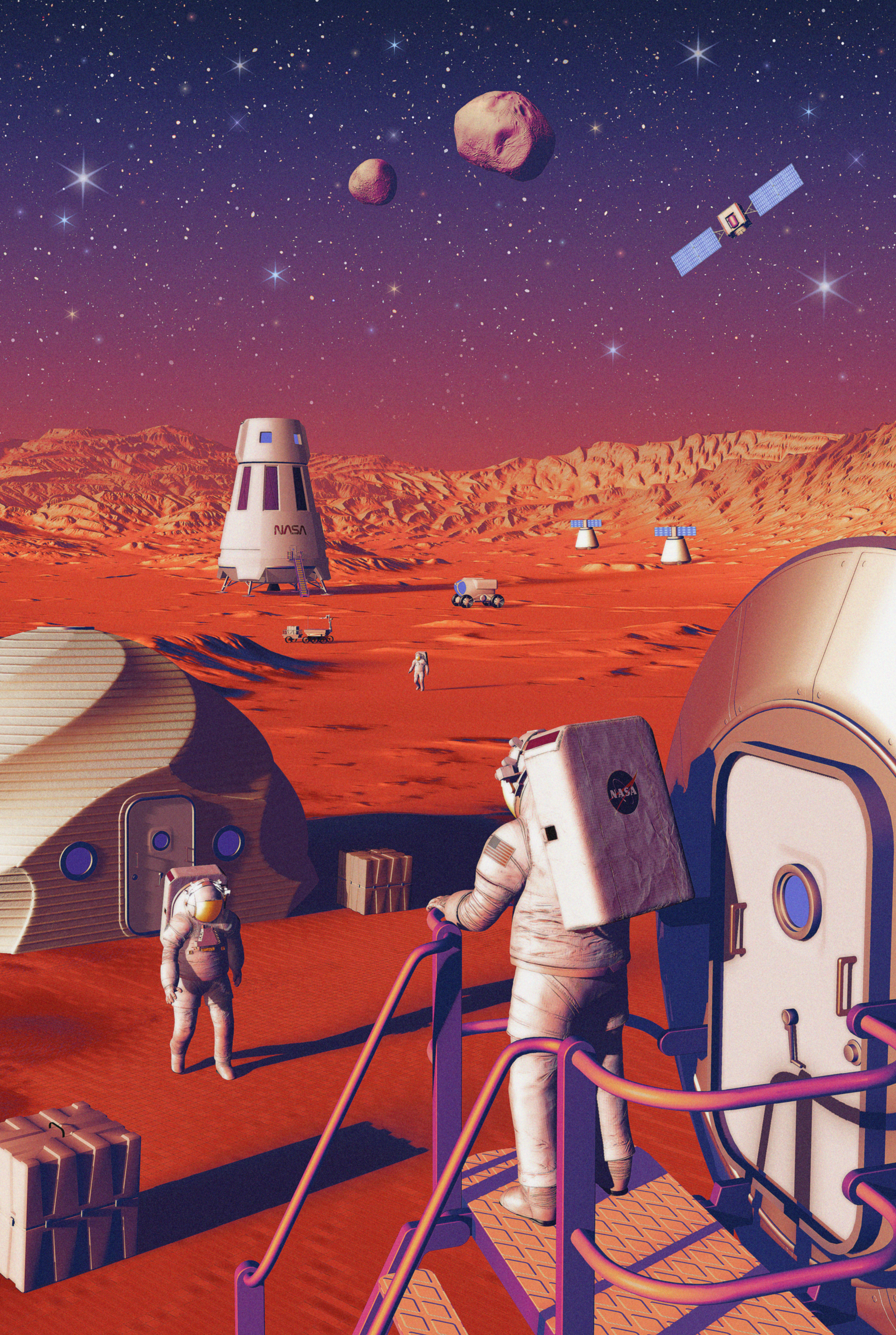
This illustration of Moon to Mars infrastructure shows astronauts living and working on the surface of Mars. NASA’s Moon to Mars Objectives establish an objectives-based approach to the agency’s human deep space exploration efforts; NASA’s Moon to Mars Architecture approach distills the objectives into operational capabilities and elements.
NASA is getting ready to send four astronauts around the Moon with Artemis II, laying the foundation for sustainable missions to the lunar surface and paving the way for human exploration on Mars. As the agency considers deep space endeavors that could last months or years, it must develop ways to feed astronauts beyond sending supplies from Earth.
That is why NASA is launching the Deep Space Food Challenge: Mars to Table, a new global competition inviting chefs, innovators, culinary experts, higher-education students, and citizen scientists to design a complete, Earth-independent food system for long-duration space missions.
“In the future, exploration missions will grow in both duration and distance from Earth. This will make the critical question of feeding our astronauts more complex, requiring innovative solutions to allow for long-term human exploration of space,” said Greg Stover, acting associate administrator of NASA’s Space Technology Missions Directorate at NASA Headquarters in Washington. “Opening the door to ideas from beyond the agency strengthens NASA’s ability to operate farther from Earth with greater independence.”
Mars to Table builds on NASA’s first Deep Space Food Challenge by seeking to integrate multiple food production and preparation methods into a holistic, self-sustaining system designed for use on Mars. This new challenge is open now until July 31 to the global public and carries a prize purse of up to $750,000.
“Future crews on the Moon and Mars will need food systems that are nutritious, sustainable, and fully independent from Earth,” said Jarah Meador, program executive for NASA’s Prizes, Challenges, and Crowdsourcing Program at NASA Headquarters. “Food will play a pivotal role in the overall health and happiness of future deep space explorers. The Mars to Table Challenge is about bringing all those pieces together into one comprehensive design.”
Solvers are tasked with creating a complete meal plan suitable for astronauts living on Mars, using a NASA-created mission scenario as their guide. Each team will design a full food system concept, including a detailed operations plan and system design layout that supports a surface mission. Teams must consider every detail – from nutritional balance and taste to safety, usability, and integration with NASA’s Environmental Control and Life Support Systems.
Participants in the Mars to Table Challenge are also encouraged to address food security on Earth. Innovative growth systems designed for space could make fresh food production possible in harsh, remote, or resource-limited areas, such as research stations located at Earth’s poles or in rural areas with limited access to traditional supply chains.
“This challenge isn’t just about feeding astronauts; it’s about feeding people anywhere,” said Jennifer Edmunson, acting program manager for NASA’s Centennial Challenges at NASA’s Marshall Spaceflight Center in Huntsville, Alabama. “Novel meals that are compact, shelf-stable, and nutrient-rich could expand culinary options for groups like military personnel or disaster relief responders. By solving for Mars and future planetary expeditions, we can also find solutions for Earth.”
NASA’s Centennial Challenges have a 20-year legacy of engaging the public to solve complex problems that benefit NASA’s broader initiatives. Past challenges have spurred advances in robotics, additive manufacturing, power and energy, textiles, chemistry, and biology.
Mars to Table is a collaborative, cross-program Centennial Challenge with support from NASA’s Division of Biological and Physical Sciences, Heliophysics Division, Planetary Science Program, Human Research Program, and Mars Campaign Office. Subject matter experts at the agency’s Johnson Space Center in Houston and Kennedy Space Center in Florida support the challenge. This challenge is part of the Prizes, Challenges and Crowdsourcing program within NASA’s Space Technology Mission Directorate. NASA has partnered with the Methuselah Foundation and contracted Floor23 Digital to support the administration and management of this challenge.
To learn more about the challenge, including timelines, submission requirements, and future webinar dates, visit:
NASA is launching the Deep Space Food Challenge: Mars to Table, a new global competition inviting chefs, innovators, culinary experts, higher-education stude...
In sending a car-sized rotorcraft to explore Saturn’s moon Titan, NASA’s Dragonfly mission will undertake an unprecedented voyage of scientific discovery. And the work to ensure that this first-of-its-kind project can fulfill its ambitious exploration vision is underway in some of the nation’s most advanced space simulation and testing laboratories.
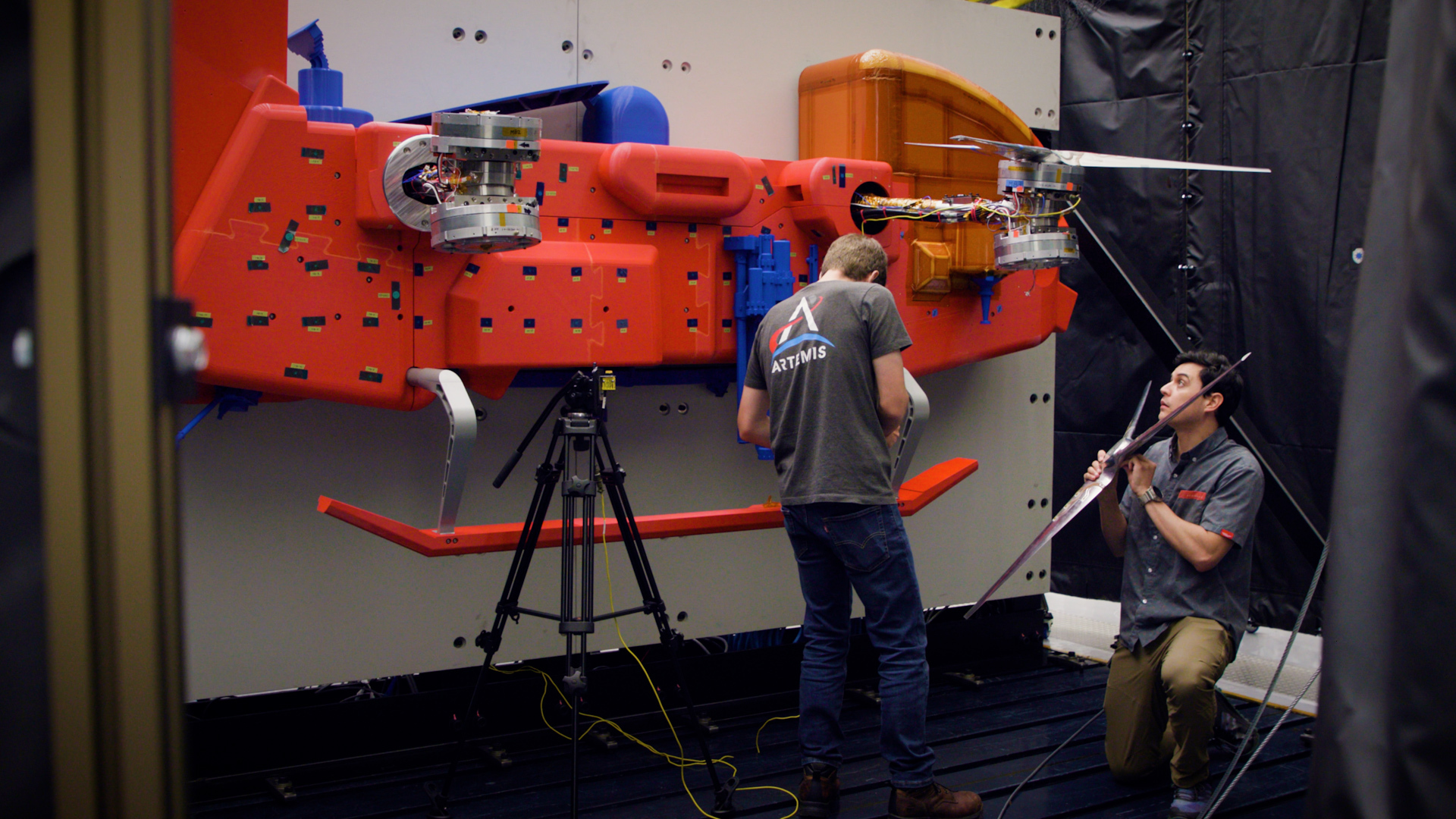
From left, Johns Hopkins APL engineers Tyler Radomsky and Felipe Ruiz install a rotor on the Dragonfly test model at the Transonic Dynamics Tunnel at NASA’s Langley Research Center in Virginia.
NASA
Set for launch in in 2028, the Dragonfly rotorcraft is being designed and built at the Johns Hopkins Applied Physics Laboratory (APL) in Laurel, Maryland, with contributions from organizations around the world. On arrival in 2034, Dragonfly will exploit Titan’s dense atmosphere and low gravity to fly to dozens of locations, exploring varied environments from organic equatorial dunes to an impact crater where liquid water and complex organic materials essential to life (at least as we know it) may have existed together.
Aerodynamic testing
When full rotorcraft integration and testing begins in February, the team will tap into a trove of data gathered through critical technical trials conducted over the past three years, including, most recently, two campaigns at the Transonic Dynamics Tunnel (TDT) facility at NASA’s Langley Research Center in Hampton, Virginia.
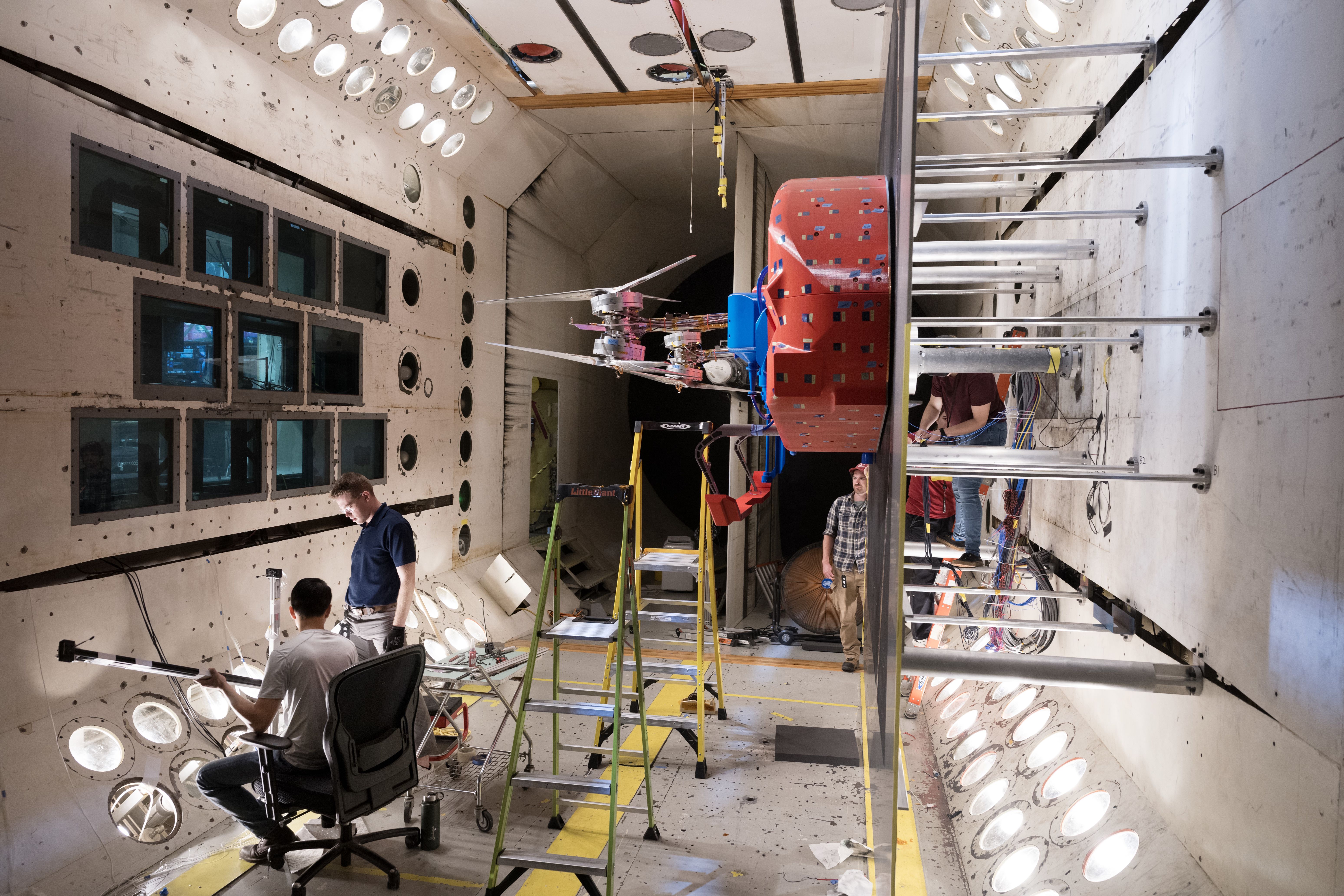
From left, Charles Pheng, Ryan Miller, John Kayrouz, Kristen Carey and Josie Ward prepare for the first aeromechanical performance tests of the full-scale Dragonfly rotors in the Transonic Dynamics Tunnel at NASA’s Langley Research Center in Virginia.
NASA
The TDT is a versatile 16-foot-high, 16-foot-wide, 20-foot-long testing hub that has hosted studies for NASA, the Department of War, the aircraft industry and an array of universities.
Over five weeks, from August into September, the team evaluated the performance of Dragonfly’s rotor system – which provides the lift for the lander to fly and enables it to maneuver – in Titan-like conditions, looking at aeromechanical performance factors such as stress on the rotor arms, and effects of vibration on the rotor blades and lander body. In late December, the team also wrapped up a set of aerodynamics tests on smaller-scale Dragonfly rotor models in the TDT.
“When Dragonfly enters the atmosphere at Titan and parachutes deploy after the heat shield does its job, the rotors are going to have to work perfectly the first time,” said Dave Piatak, branch chief for aeroelasticity at NASA Langley. “There’s no room for error, so any concerns with vehicle structural dynamics or aerodynamics need to be known now and tested on the ground. With the Transonic Dynamics Tunnel here at Langley, NASA offers just the right capability for the Dragonfly team to gather this critical data.”
Critical parts
In his three years as an experimental machinist at APL, Cory Pennington has crafted parts for projects dispatched around the globe. But fashioning rotors for a drone to explore another world in our solar system? That was new – and a little daunting.
“The rotors are some of the most important parts on Dragonfly,” Pennington said. “Without the rotors, it doesn’t fly – and it doesn’t meet its mission objectives at Titan.”
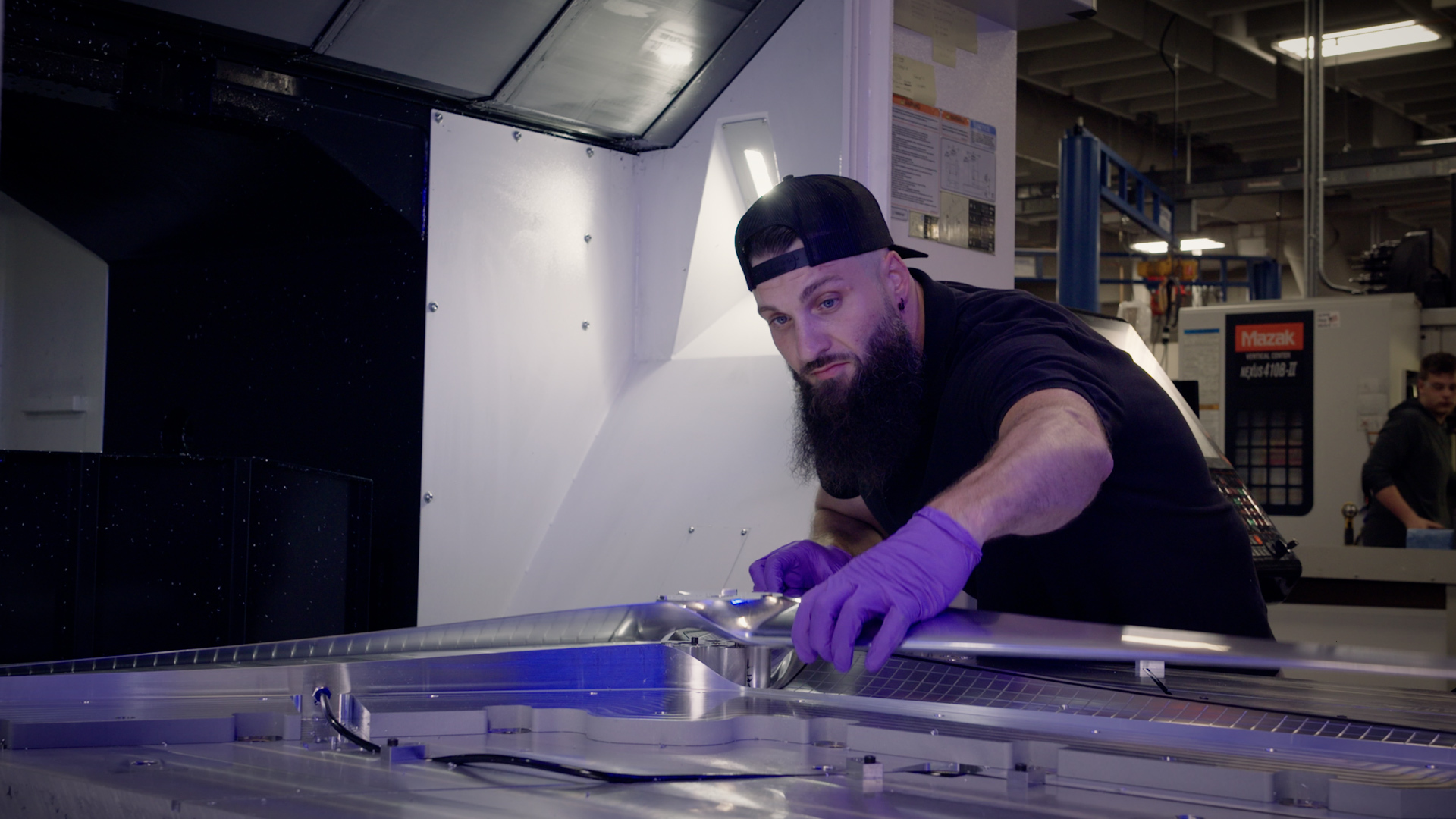
Experimental machinist Cory Pennington examines a freshly milled, full-scale Dragonfly rotor in the machine shop at the Johns Hopkins Applied Physics Laboratory (APL) in Laurel, Maryland.
NASA/Johns Hopkins APL
Pennington and team cut Dragonfly’s first rotors on Nov. 1, 2024. They refined the process as they went: starting with waterjet paring of 1,000-pound aluminum blocks, followed by rough machining, cover fitting, vent-hole drilling and hole-threading. After an inspection, the parts were cleaned, sent out for welding and returned for final finishing.
“We didn’t have time or materials to make test parts or extras, so every cut had to be right the first time,” Pennington said, adding that the team also had to find special tools and equipment to accommodate some material changes and design tweaks.
The team was able to deliver the parts a month early. Engineers set up and spin-tested the rotors at APL – attached to a full-scale model representing half of the Dragonfly lander – before transporting the entire package to the TDT at NASA Langley in late July.
“On Titan, we’ll control the speeds of Dragonfly’s different rotors to induce forward flight, climbs, descents and turns,” said Felipe Ruiz, lead Dragonfly rotor engineer at APL.
“It’s a complicated geometry going to a flight environment that we are still learning about. So the wind tunnel tests are one of the most important venues for us to demonstrate the design.”
And the rotors passed the tests.
“Not only did the tests validate the design team’s approach, we’ll use all that data to create high-fidelity representations of loads, forces and dynamics that help us predict Dragonfly’s performance on Titan with a high degree of confidence,” said Rick Heisler, wind tunnel test lead from APL.
Next, the rotors will undergo fatigue and cryogenic trials under simulated Titan conditions, where the temperature is minus 290 degrees Fahrenheit (minus 178 degrees Celsius), before building the actual flight rotors.
“We’re not just cutting metal — we’re fabricating something that’s going to another world,” Pennington said. “It’s incredible to know that what we build will fly on Titan.”
Collaboration, innovation
Elizabeth “Zibi” Turtle, Dragonfly principal investigator at APL, says the latest work in the TDT demonstrates the mission’s innovation, ingenuity and collaboration across government and industry.
“The team worked well together, under time pressure, to develop solutions, assess design decisions, and execute fabrication and testing,” she said. “There’s still much to do between now and our launch in 2028, but everyone who worked on this should take tremendous pride in these accomplishments that make it possible for Dragonfly to fly on Titan.”
When NASA's Dragonfly begins full rotorcraft integration and testing in early 2026, the mission team will tap into a trove of data gathered through critical technical trials conducted over the past three years, including, most recently, a testing campaign in at the Transonic Dynamics Tunnel (TDT) Facility at NASA’s Langley Research Center in Hampton, Virginia.
NASA/Johns Hopkins APL
Dragonfly has been a collaborative effort from the start. Kenneth Hibbard, mission systems engineer from APL, cites the vertical-lift expertise of Penn State University on the initial rotor design, aero-related modeling and analysis, and testing support in the TDT, as well as NASA Langley’s 14-by-22-foot Subsonic Tunnel. Sikorsky Aircraft of Connecticut has also supported aeromechanics and aerodynamics testing and analysis, as well as flight hardware modeling and simulation.
The Johns Hopkins Applied Physics Laboratory (APL) in Laurel, Maryland, leads the Dragonfly mission for NASA in collaboration with several NASA centers, industry partners, academic institutions and international space agencies. Elizabeth “Zibi” Turtle of APL is the principal investigator. Dragonfly is part of NASA’s New Frontiers Program, managed by the Planetary Missions Program Office at NASA Marshall Space Flight Center in Huntsville, Alabama, for the agency’s Science Mission Directorate in Washington.
For more information on NASA’s Dragonfly mission, visit:
Preparations for Next Moonwalk Simulations Underway (and Underwater)
This artist’s concept depicts NASA’s Cassini spacecraft performing one of its many close flybys of Titan, Saturn’s largest moon. By analyzing the Doppler shift of radio signals traveling to and from Earth, the mission precisely measured Titan’s gravity field.
NASA/JPL-Caltech
A key discovery from NASA’s Cassini mission in 2008 was that Saturn’s largest moon Titan may have a vast water ocean below its hydrocarbon-rich surface. But reanalysis of mission data suggests a more complicated picture: Titan’s interior is more likely composed of ice, with layers of slush and small pockets of warm water that form near its rocky core.
Led by researchers at NASA’s Jet Propulsion Laboratory in Southern California and published in the journal Nature on Wednesday, the new study could have implications for scientists’ understanding of Titan and other icy moons throughout our solar system.
“This research underscores the power of archival planetary science data. It is important to remember that the data these amazing spacecraft collect lives on so discoveries can be made years, or even decades, later as analysis techniques get more sophisticated,” said Julie Castillo-Rogez, senior research scientist at JPL and a coauthor of the study. “It’s the gift that keeps giving.”
To remotely probe planets, moons, and asteroids, scientists study the radio frequency communications traveling back and forth between spacecraft and NASA’s Deep Space Network. It’s a multilayered process. Because a moon’s body may not have a uniform distribution of mass, its gravity field will change as a spacecraft flies through it, causing the spacecraft to speed up or slow down slightly. In turn, these variations in speed alter the frequency of the radio waves going to and from the spacecraft — an effect known as Doppler shift. Analyzing the Doppler shift can lend insight into a moon’s gravity field and its shape, which can change over time as it orbits within its parent planet’s gravitational pull.
This shape shifting is called tidal flexing. In Titan’s case, Saturn’s immense gravitational field squeezes the moon when Titan is closer to the planet during its slightly elliptical orbit, and it stretches the moon when it is farthest. Such flexing creates energy that is lost, or dissipated, in the form of internal heating.
When mission scientists analyzed radio-frequency data gathered during the now-retired Cassini mission’s 10 close approaches of Titan, they found the moon to be flexing so much that they concluded it must have a liquid interior, since a solid interior would have flexed far less. (Think of a balloon filled with water versus a billiard ball.)
New technique
The new research highlights another possible explanation for this malleability: an interior composed of layers featuring a mix of ice and water that allows the moon to flex. In this scenario, there would be a lag of several hours between Saturn’s tidal pull and when the moon shows signs of flexing — much slower than if the interior were fully liquid. A slushy interior would also exhibit a stronger energy dissipation signature in the moon’s gravity field than a liquid one, because these slush layers would generate friction and produce heat when the ice crystals rub against one another. But there was nothing apparent in the data to suggest this was happening.
So the study authors, led by JPL postdoctoral researcher Flavio Petricca, looked more closely at the Doppler data to see why. By applying a novel processing technique, they reduced the noise in the data. What emerged was a signature that revealed strong energy loss deep inside Titan. The researchers interpreted this signature to be coming from layers of slush, overlaid by a thick shell of solid ice.
Based on this new model of Titan’s interior, the researchers suggest that the only liquid would be in the form of pockets of meltwater. Heated by dissipating tidal energy, the water pockets slowly travel toward the frozen layers of ice at the surface. As they rise, they have the potential to create unique environments enriched by organic molecules being supplied from below and from material delivered via meteorite impacts on the surface.
“Nobody was expecting very strong energy dissipation inside Titan. But by reducing the noise in the Doppler data, we could see these smaller wiggles emerge. That was the smoking gun that indicates Titan’s interior is different from what was inferred from previous analyses,” said Petricca. “The low viscosity of the slush still allows the moon to bulge and compress in response to Saturn’s tides, and to remove the heat that would otherwise melt the ice and form an ocean.”
Potential for life
“While Titan may not possess a global ocean, that doesn’t preclude its potential for harboring basic life forms, assuming life could form on Titan. In fact, I think it makes Titan more interesting,” Petricca added. “Our analysis shows there should be pockets of liquid water, possibly as warm as 20 degrees Celsius (68 degrees Fahrenheit), cycling nutrients from the moon’s rocky core through slushy layers of high-pressure ice to a solid icy shell at the surface.”
More definitive information could come from NASA’s next mission to Saturn. Launching no earlier than 2028, the agency’s Dragonfly mission to the hazy moon could provide the ground truth. The first-of-its-kind rotorcraft will explore Titan’s surface to investigate the moon’s habitability. Carrying a seismometer, the mission may provide key measurements to probe Titan’s interior, depending on what seismic events occur while it is on the surface.
More about Cassini
The Cassini-Huygens mission was a cooperative project of NASA, ESA (European Space Agency), and the Italian Space Agency. A division of Caltech in Pasadena, JPL managed the mission for NASA’s Space Mission Directorate in Washington and designed, developed, and assembled the Cassini orbiter.
To learn more about NASA’s Cassini mission, visit:

 Login
Login