❌

Normal view

There are new articles available, click to refresh the page.
Before yesterdayMain stream

10 Years of Students Helping NASA Grow Space Food with Growing Beyond Earth

21 November 2025 at 13:25

3 min read

10 Years of Students Helping NASA Grow Space Food with Growing Beyond Earth

Student from 71 Classrooms engaged with NASA scientists to learn about how their Growing Beyond Earth research is contributing to feeding astronauts for long distance space travel.
Students from 71 Classrooms engaged with NASA scientists to learn about how their Growing Beyond Earth research is contributing to feeding astronauts for long distance space travel.

Nearly 1,250 middle and high school students from 71 schools around the world joined Fairchild Tropical Botanic Garden for the Growing Beyond Earth (GBE) Student Launch Chat with the Scientists, marking an inspiring milestone in the program’s 10th anniversary year.

The live session, held in collaboration with NASA, connected classrooms directly with Dr. Gioia Massa and Trent M. Smith, senior leaders of NASA Kennedy Space Center’s Space Crop Production team. Students heard firsthand how their classroom experiments are helping NASA identify and grow the best crops for future astronauts on long-duration missions to the Moon and Mars.

β€œOur students are contributing to real NASA science,” said one participating teacher. β€œIt’s incredibly motivating for them to know their data could influence what astronauts eat in space someday.”

Connecting Classrooms with NASA Science

Growing Beyond Earth, led by Fairchild Tropical Botanic Garden in Miami, Florida, brings authentic NASA research into classrooms in a way that few science programs can. For more than a decade, the 83-acre botanic garden – renowned for its conservation, education, and research programs – has worked hand-in-hand with NASA to advance understanding of food production in space.

Students use specially designed plant growth chambers to test how different crops perform under conditions that mimic spacecraft environments. The data they collect are shared with NASA scientists, who use the findings to refine ongoing space crop production research.

Since the program’s inception, more than 120,000 students across 800+ classrooms have tested over 250 plant cultivars, with five student-tested crops already grown aboard the International Space Station.

Cultivating the Future STEM (Science, Technology, Engineering, & Mathematics) Workforce

The Growing Beyond Earth project exemplifies the mission of NASA’s Science Activation (SciAct) program, which connects NASA Science with people of all ages and backgrounds in ways that activate minds and promote a deeper understanding of our world and beyond, with the ultimate Vision: To increase learners’ active participation in the advancement of human knowledge. By engaging students as active participants in cutting-edge research, projects like GBE not only advance NASA’s goals but also cultivate curiosity, creativity, and confidence in the next generation of scientists and explorers. This year’s GBE Student Launch Chat celebrated that impact, showing how student research from classrooms around the globe contributes to the future of space exploration.

β€œWhen students see themselves as part of NASA’s mission, they realize science isn’t something distant, it’s something they can do,” said Dr. Massa. Teacher Espy Rodriguez from Hialeah Senior High School said, β€œIt made their [her students] projects matter. I think it gave the kids a real sense of community. We are far, but we are one.” By growing plants, analyzing data, and sharing results with NASA, these students are helping humanity prepare for life beyond Earth, proving that the seeds of tomorrow’s discoveries are being planted in today’s classrooms.

GBE is supported by NASA under cooperative agreement award number 80NCCS2M0125 and is part of NASA’s Science Activation Portfolio. Learn more about how Science Activation connects NASA science experts, real content, and experiences with community leaders to do science in ways that activate minds and promote deeper understanding of our world and beyond: https://science.nasa.gov/learn/about-science-activation/.

www.fairchildgarden.org/gbe

25 Years of Scientific Discovery Aboard the International Space Station

21 November 2025 at 10:00
8 Min Read

25 Years of Scientific Discovery Aboard the International Space Station

NASA astronaut Kate Rubins is looking towards the left at her hands while working on an experiment on the International Space Station.

November marks 25 years of human presence aboard the International Space Station, a testament to international collaboration and human ingenuity. Since the first crew arrived on Nov. 2, 2000, NASA and its partners have conducted thousands of research investigations and technology demonstrations to advance exploration of the Moon and Mars and benefit life on Earth.

Researchers have taken advantage of the unique microgravity environment to conduct experiments impossible to replicate on Earth, transforming research across disciplines. More than 4,000 experiments have pushed the boundaries of science, sparked discoveries, and driven scientific breakthroughs.

β€œ25 years ago, Expedition 1 became the first crew to call the International Space Station home, beginning a period of continuous human presence in space that still continues to this day,” said NASA acting administrator Sean Duffy. β€œThis historic milestone would not have been possible without NASA and its partners, as well as every astronaut and engineer who works to keep the lights on in low Earth orbit.”

To celebrate a quarter century of innovation in microgravity, NASA is highlighting 25 scientific breakthroughs that exemplify the station’s enduring impact on science, technology, and exploration.

Building the road to the Moon and Mars

A sliver of the Moon rises above Earth’s thin blue atmosphere, seen against the blackness of space. On the left side of the image, part of the International Space Station’s orange solar array comes into view with square grid sections along its surface.
The waxing crescent moon appears just above the Earth’s atmosphere as the International Space Station orbits the Earth.
NASA

NASA uses the space station as a proving ground to develop new systems and technologies for missions beyond low Earth orbit.

  • Navigation, communication, and radiation shielding technologies proven aboard the space station are being integrated into spacecraft and missions to reach the Moon and Mars.
  • Robotic systems, for example a robotic surgeon and autonomous assistants, will expand available medical procedures and allow astronauts to dedicate time to more crucial tasks during missions far from Earth.Β 
  • Astronauts have used recycled plastic and stainless steel to 3D print tools and parts. The ability to 3D print in space lays the groundwork for on-demand repair and fabrication during future deep space missions where resupply isn’t readily available.
  • From the deployment of the first wooden satellite to laser communications and self-healing quantum communications, the space station is a proving ground for cutting-edge space technologies.

Why this matters:

Humanity’s push to the Moon and Mars begins with discoveries in low Earth orbit. From demonstrating how astronauts can live, work, and repair equipment off Earth to testing life-support systems and advanced materials, every innovation aboard the station helps to advance NASA’s Artemis and other exploration initiatives and brings humanity closer to thriving beyond our planet.

Sustaining life beyond Earth

Jessica Watkins wears safety goggles and blue gloves while holding a plant growth unit with leafy greens and a large tangle of roots exposed. Bob Hines, in a black shirt, looks on from the background inside the space station laboratory.
NASA astronauts Jessica Watkins, front, and Bob Hines, back, work on XROOTS aboard the International Space Station. This experiment used the station’s Veggie facility to test soilless hydroponic and aeroponic plant growth.
NASA

As NASA prepares to return humans to the Moon through the Artemis program and push onward to Mars, sustaining life beyond Earth is more critical than ever.

  • Astronauts have grown more than 50 species of plants in space, including tomatoes, bok choi, romaine lettuce, and chili peppers.
  • Advanced life support systems are capable of recycling up to 98% of water in the U.S. segment aboard the space station, the ideal level needed for exploration missions.
  • Crew health data shows how space affects the brain, vision, balance and control, and Β muscle and bone density, guiding strategies to maintain astronaut performance during extended missions and improve health on Earth.
  • Researchers have sequenced DNA in orbit and are advancing techniques to enable real-time assessment of microbial life in space, which is essential to maintaining astronaut health.

Why this matters:

By growing food, recycling water, and improving medical care in space, NASA is paving the way for future long-duration missions to the Moon and Mars while revolutionizing agriculture and medicine back home.

Helping humanity on Earth

Crystals cover the left side of the frame against a rust-colored background. The crystals are translucent and vary in shape and size, most resemble a rectangular prism. A bright yellow light shines through the crystals from the background.
Pharmaceutical crystals grown aboard the International Space Station are shown after returning to Earth.
Redwire

Research aboard the orbiting laboratory not only pushes humanity farther into the cosmos but can help address complex human health issues on the ground. By providing a platform for long-term microgravity research, the space station fosters breakthroughs that yield direct benefits to people on Earth.

  • Research aboard the space station provides new insights to develop treatments for diseases like cancer, Alzheimer’s, Parkinson’s, and heart disease by revealing how microgravity alters cellular functions.
  • New developments in medicine for cancer, muscular dystrophy, and neurodegenerative diseases have come from growing protein crystals in microgravity with larger, more organized structures.
  • High quality stem cells can be grown in greater quantities in space, helping to develop new regenerative therapies for neurological, cardiovascular, and immunological conditions.
  • Pioneering efforts in 3D bioprinting, which uses cells, proteins, and nutrients as source material, have produced human tissue structures such as a knee meniscus and heart tissue, a major step toward manufacturing organs in space for transplant patients on Earth.
  • Researchers are using miniaturized tissue models to observe how space affects tissues and organ systems, offering new ways to develop and test medicines to protect astronauts on future missions and improve treatments on Earth.
  • Photos taken by astronauts have supported emergency response to natural disasters, such as hurricanes, with targeted views from space.
  • Instruments mounted on the space station protect critical space infrastructure and provide data on the planet’s natural patterns by measuring Earth’s resources and space weather.

Why this matters:

Microgravity research is moving us closer to manufacturing human organs in space for transplant and revealing new ways to fight cancer, heart disease, osteoporosis, neurodegenerative disease, and other serious illnesses that affect millions of people worldwide. The station also serves as an observation platform to monitor natural disasters, weather patterns, and Earth’s resources.

Understanding our universe

Six red lasers shine into the middle of a clear, rectangular chamber, fixating on a small, blueish white sphere.
Artist concept of operations inside NASA’s Cold Atom Laboratory aboard the International Space Station.
NASA

The space station offers scientists an unparalleled vantage point to learn about the fundamental behavior of the universe. By studying cosmic phenomena typically blocked or absorbed by Earth’s atmosphere and observing physics at an atomic level, researchers can probe mysteries impossible to study from Earth.

Why this matters:

Research aboard the space station is helping us unravel the deepest mysteries of our universe, from the smallest quantum particles to the most powerful cosmic explosions. Observations of collapsing stars and black holes could inspire new navigation tools using cosmic signals and expand our grasp of space-time. Studies of antimatter and dark matter bring us closer to understanding the 95% of the universe invisible to the human eye. Creating the fifth state of matter in space unlocks new quantum pathways that could transform technology on Earth and in space.

Learning new physics

Small yellow flame spots cover a spherical space against a dark background. There is a faint blue ring surrounding the yellow clusters.
This image shows a flame ignited as part of the Flame Design investigation on the International Space Station.
NASA

Physical processes behave differently in microgravity, offering scientists a new lens for discovery.

  • Engineers can design more efficient fuel and life support systems for future spacecraft thanks to studies of fluid boiling, containment, and flow.
  • Analyzing gels and liquids mixed with tiny particles in space helps researchers fine-tune material compositions and has led to new patents for consumer products.
  • The discovery of cool flames in space, a phenomenon difficult to study on Earth, has opened new frontiers in combustion science and engine design. Β 

Why this matters:

Breakthroughs in fundamental physics aboard the space station drive innovation on Earth and advance spacecraft fuel, thermal control, plant watering, and water purification systems. Research in soft materials is improving products in medicine, household products, and renewable energy, while cool flames studies may lead to cleaner, more efficient engines.

Enabling global access to space

Nichole Ayers smiles at the camera while holding a hand-held radio aboard the space station. Her long blonde hair floats upward in microgravity. To her left, a laptop and cables are mounted on the wall, and the wall behind her is decorated with several mission stickers.
NASA astronaut Nichole Ayers talks on a ham radio with students from Lakeside Junior High School in Springdale, Arkansas. Ayers answered questions from the students about her experience living and working aboard the International Space Station.
NASA

Since 2000, the space station has opened doors for private companies, researchers, students, and astronauts around the world to participate in exploration and help propel humanity forward to the Moon and Mars.

  • The space station is a launchpad for the commercial space economy, enabling private astronaut missions and hosting hundreds of experiments from commercial companies, giving them the chance to strengthen their technologies through in-orbit research, manufacturing demonstrations, and innovation.
  • CubeSats deployed from the space station enable students and innovators around the world to test radio antennas, small telescopes, and other scientific demonstrations in space.
  • More than one million students have engaged with astronauts via ham radio events, inspiring the next generation to participate in science, technology, engineering, and mathematics.
  • More than 285 crew members from more than 25 countries have visited humanity’s longest-operating outpost in space, making it a symbol of global collaboration.

Why this matters:

The space station has enabled the space economy, where commercial research, manufacturing, and technology demonstrations are shaping a new global marketplace. NASA and its international partners have established a leadership position in low Earth orbit, creating new opportunities for industry and paving the way for exploration missions to the Moon, Mars, and beyond.

Learn more about the research aboard the International Space Station at:

www.nasa.gov/iss-science

Revisit the 20th anniversary for more information.

OSDR and PSI Unveil New Consolidated Website

30 September 2025 at 11:01
Image of the new OSDR/PSI splash page

The Open Science Data Repository (OSDR) and Physical Sciences Informatics (PSI) has a new home. As part of NASA’s website consolidation initiative, the OSDR and PSI site have officially transitioned to the Biological and Physical Sciences (BPS) Data page, accessible through the β€œData” menu on the Science Mission Directorate’s (SMD) website at science.nasa.gov. This strategic move reflects NASA’s broader effort to streamline user access to resources, unify digital platforms, and provide a more consistent experience across the SMD divisions.

The OSDR and PSI consolidation brings together two powerful resources, giving researchers a single point of access to search both biological and physical sciences datasets. By integrating these repositories, NASA is expanding opportunities for cross-disciplinary research, enabling scientists to draw connections across fields and gain deeper insights into how biology and physical systems respond to spaceflight environments.

The redesigned OSDR website continues to serve as a hub for open access to space science data, offering a modernized layout, improved navigation, and direct pathways to explore datasets and analysis tools, and submit data through the submission portals enabled by OSDR and PSI. Whether you are a scientist seeking resources for new investigations, a student learning about space research, or a collaborator from another discipline, the updated platform makes accessing NASA’s open science data easier than ever. Check out the new BPS Data and OSDR, and PSI websites now!

The launch of the new consolidated OSDR and PSI websites underscores NASA’s commitment to open science and to advancing knowledge through transparent, accessible, and reusable data. By situating OSDR under the BPS data ecosystem and combining it with PSI, NASA is strengthening visibility, fostering collaboration, and ensuring that both biological and physical sciences research in space continues to thrive.

Joe A. Adam Presents Ring Sheared Drop (RSD) Research at 2025 ISSRDC

29 September 2025 at 14:09

3 min read

Joe A. Adam Presents Ring Sheared Drop (RSD) Research at 2025 ISSRDC

The Ring-Sheared Drop (RSD) experiment, conducted in the Microgravity Glovebox on ISS, helps scientists learn more about Alzheimer’s & Dementia in hopes of a future cure to similar neurological diseases.
NASA

At the virtual 2025 ISS Research and Development Conference (ISSDRC), Joe A. Adam of Rensselaer Polytechnic Institute, presented the topic titled β€œSurface Science in Microgravity – Fluid Geometry in the Ring-Sheared Drop,” presented to a broad audience from academia and the scientific community during the Physical Sciences and Materials Development session.

Dr. Adam provided a comprehensive overview of the Ring Sheared Drop (RSD) hardware, experiment campaigns and the evolving role of RSD in advancing biophysical science, particularly in the characterization of proteins. Leveraging the absence of gravity aboard the ISS, the RSD enables researchers to isolate shear-induced aggregation processes relevant to neurodegenerative diseases such as Alzheimer’s and Parkinson’s, offering insight into mechanisms that are difficult to observe with ground-based experiments.

The presentation traced the RSD development, beginning with the initial campaign in 2016 which was funded by Biological and Physical Sciences (BPS) for hardware development and the first science campaign, and culminating in the most recent 2025 flight campaign, which involved the study of three key proteins: Immunoglobulin G (IgG), Insulin, and Human Serum Albumin (HSA).

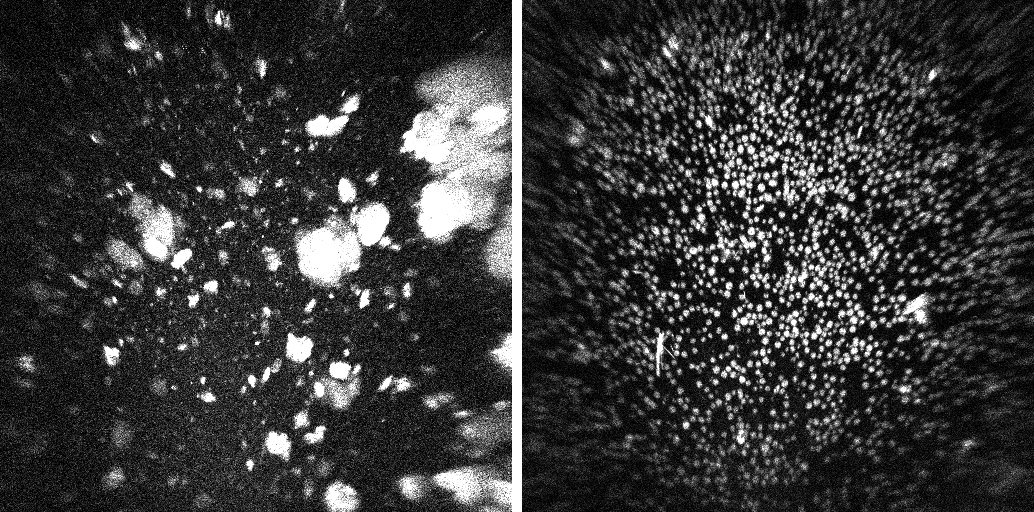
A highlight of the session was a discussion of the RSD’s custom camera configuration, which has enabled a novel fluid characterization technique known as Particle Tracking Velocimetry (PTV). This method allows researchers to visually track particle motion within the fluid drop, supporting the validation and refinement of theoretical and computational models describing protein behavior in microgravity.

Adam further explained how in-situ imaging and velocimetry techniques, enabled by the unique RSD camera setup, enhance the analysis of fluid flow and shear-driven aggregation at the molecular level.

The presentation showcased a series of comparative videos from past and current RSD campaigns, illustrating protein dynamics under varying sample compositions. He emphasized how flight data are being compared against Earth analog experiments to 1) validate predictive models and 2) inform the design of future microgravity research – the two-fold focus of the research from the beginning.

The session concluded with a summary of preliminary findings from the 2025 campaign, including multi-geometry rheometry results, which offer deeper insight into the viscoelastic behavior of proteins under shear. These findings may well contribute to the development of future pharmaceutical and therapeutic strategies.

To view the entire presentation, a recording is available for downloaded from the 2025 ISSRDC site.

Visit the Physical Sciences Informatics (PSI) database to access experiment data from two RSD campaigns, Interfacial Bioprocessing of Pharmaceuticals (IBP-I) and Amyloid Fibril Formation (AFF) with additional RSD data planned for release in 2026.

Lettuce Find Healthy Space Food! Citizen Scientists Study Space Salads

22 September 2025 at 14:47

Lettuce Find Healthy Space Food! Citizen Scientists Study Space Salads

Diagram illustrating research on lettuce grown in space stations and its effects on astronaut health. Lettuce nutritional content is linked to astronaut diet, potential diseases, and astronaut biological response. Missions including I4, JAXA, and NASA’s Twin Study are shown, with graphics of spacecraft, astronauts, the ISS, and biological diagrams.
Volunteer members of the OSDR-Analysis Working Groups examined the nutritional quality of crops grown in Low Earth Orbit and the physiological effects of space-induced nutrient deficiencies on astronauts. You can join the team here!
Credit: npj Microgravity/Barbero et al., 2025

Missions to the Moon and Mars pose nutritional challenges for astronauts, but volunteers from NASA’s Open Science Data Repository Analysis Working Groups (OSDR-AWG) are working together to analyze data on astronaut health. The Analysis Working Groups examine biomedical data from NASA missions and space experiments collected in the NASA Open Science Data Repository. These teams use the data to answer questions in basic science, applied science, and health outcomes for space exploration.

For example,Β a recent paperΒ on space-grown food examined data on lettuce grown on the International Space Station and the Tiangong II space station. It found that the crop contained 29-31% less calcium and 25% less magnesium than Earth lettuce, falling short of astronaut requirements.

Lettuce tell you more! The study revealed two further health challenges for astronauts relying on space grown veggies.

  • Disrupted calcium signaling: the analysis revealed that astronauts experienced changes in the expression of 163 calcium genes, which could accelerate bone loss.Β 
  • Leaky gut syndrome: data from the Japan Aerospace Exploration Agency (JAXA) show astronauts experienced compromised intestinal barriers due to altered protein production and regulation, likely disrupting their ability to absorb nutrients.

The researchers proposed a solution to these problems,Β too: bioengineered crops.!Β Perhaps plants could be developed that are enriched in calcium or therapeutic proteins to compensate for the deficiencies observed in the space-grown lettuce.Β 

This research was a collaboration between the ALSDA (Ames Life Sciences Data Archive), the Human Analysis and Plant Working Groups of the OSDR (the expansion of NASA Genelab centered at NASA Ames), along with BioAstra, a space life science non-profit. The data came primarily from OSDR with contributions from the Space Omics and Medical Atlas at Weill Cornell.

You can join the OSDR-Analysis Working Groups yourself and help plan the future of human space exploration. Dozens of project groups are active at any time. Learn more about the AWGs: Learn more about the AWGs.

Facebook logo
Instagram logo
Linkedin logo

Share

Details

Last Updated
Sep 23, 2025
❌
❌