Normal view

There are new articles available, click to refresh the page.
Before yesterdayMain stream

NASA Tests Technology Offering Potential Fuel Savings for Commercial Aviation

21 January 2026 at 13:32

4 min read

Preparations for Next Moonwalk Simulations Underway (and Underwater)
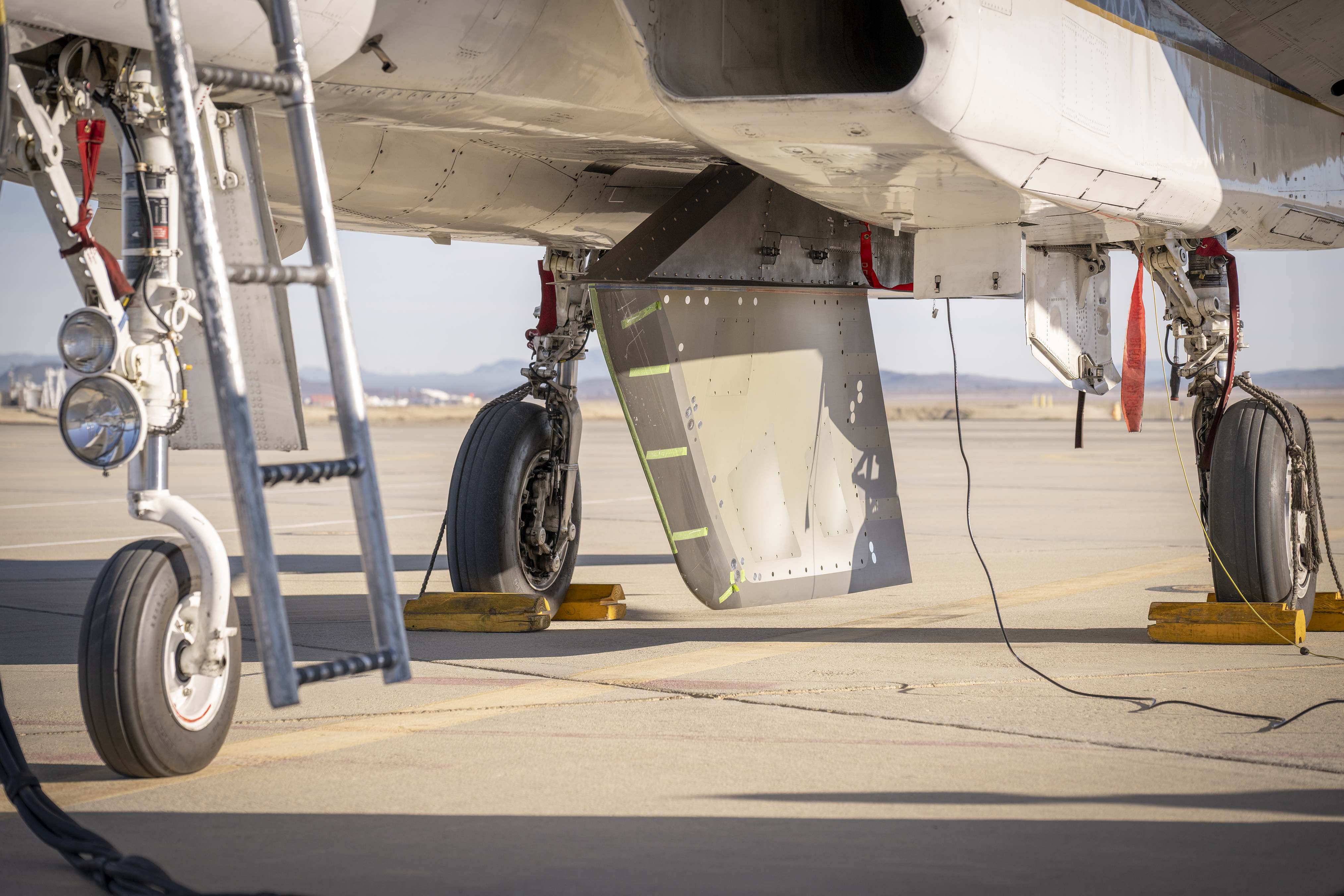
A NASA F-15 research aircraft is parked on a ramp at NASA’s Armstrong Flight Research Center in Edwards, California, with an experimental wing design mounted beneath its fuselage. The gray and silver test article is positioned vertically, resembling a ventral fin.
NASA’s Cross Flow Attenuated Natural Laminar Flow test article is mounted beneath the agency’s F-15 research aircraft ahead of the design’s high-speed taxi test on Tuesday, Jan. 12, 2026, at NASA’s Armstrong Flight Research Center in Edwards, California. The 3-foot-tall scale model is designed to increase a phenomenon known as laminar flow and reduce drag, improving efficiency in large, swept wings like those found on most commercial aircraft.
NASA/Christopher LC Clark

NASA researchers successfully completed a high-speed taxi test of a scale model of a design that could make future aircraft more efficient by improving how air flows across a wing’s surface, saving fuel and money.

On Jan. 12, the Crossflow Attenuated Natural Laminar Flow (CATNLF) test article reached speeds of approximately 144 mph, marking its first major milestone. The 3-foot-tall scale model looks like a fin mounted under the belly of one of the agency’s research F-15B testbed jets. However, it’s a scale model of a wing, mounted vertically instead of horizontally. The setup allows NASA to flight-test the wing design using an existing aircraft.

The CATNLF concept aims to increase a phenomenon known as laminar flow and reduce wind resistance, also known as drag.

A NASA computational study conducted between 2014 and 2017 estimated that applying a CATNLF wing design to a large, long-range aircraft like the Boeing 777 could achieve annual fuel savings of up to 10%.  Although quantifying the exact savings this technology could achieve is difficult, the study indicates it could approach millions of dollars per aircraft each year.
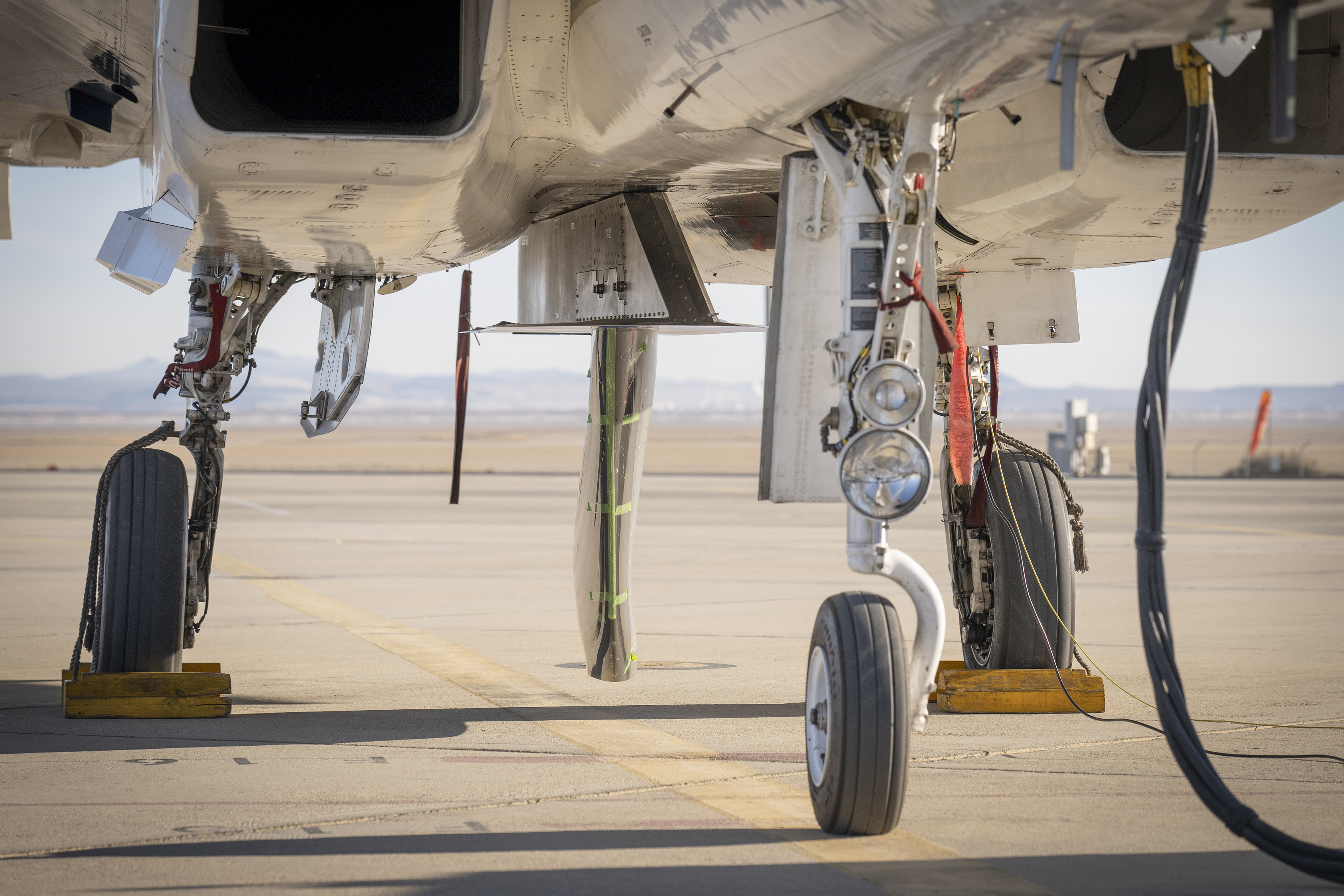
A NASA F-15 research aircraft is parked on a ramp at NASA’s Armstrong Flight Research Center in Edwards, California, with an experimental wing design mounted beneath its fuselage. The gray and silver test article is positioned vertically, resembling a ventral fin.
NASA’s Cross Flow Attenuated Natural Laminar Flow test article is mounted beneath the agency’s F-15 research aircraft ahead of the design’s high-speed taxi test on Tuesday, Jan. 12, 2026, at NASA’s Armstrong Flight Research Center in Edwards, California. The 3-foot-tall scale model is designed to increase a phenomenon known as laminar flow and reduce drag, improving efficiency in large, swept wings like those found on most commercial aircraft.
NASA/Christopher LC Clark

“Even small improvements in efficiency can add up to significant reductions in fuel burn and emissions for commercial airlines,” said Mike Frederick, principal investigator for CATNLF at NASA’s Armstrong Flight Research Center in Edwards, California.

Reducing drag is key to improving efficiency. During flight, a thin cover of air known as the boundary layer forms very near an aircraft’s surface. In this area, most aircraft experience increasing friction, also known as turbulent flow, where air abruptly changes direction. These abrupt changes increase drag and fuel consumption. CATNLF increases laminar flow, or the smooth motion of air, within the boundary layer. The result is more efficient aerodynamics, reduced friction, and less fuel burn.

The CATNLF testing falls under NASA’s Flight Demonstrations and Capabilities project, a part of the agency’s Integrated Aviation Systems Program under the Aeronautics Research Mission Directorate. The concept of was first developed by NASA’s Advanced Air Transport Technology project, and in 2019, NASA Armstrong researchers developed the initial shape and parameters of the model. The design was later refined for efficiency at NASA’s Langley Research Center in Hampton, Virginia.

“Laminar flow technology has been studied and used on airplanes to reduce drag for many decades now, but laminar flow has historically been limited in application,” said Michelle Banchy, Langley principal investigator for CATNLF.
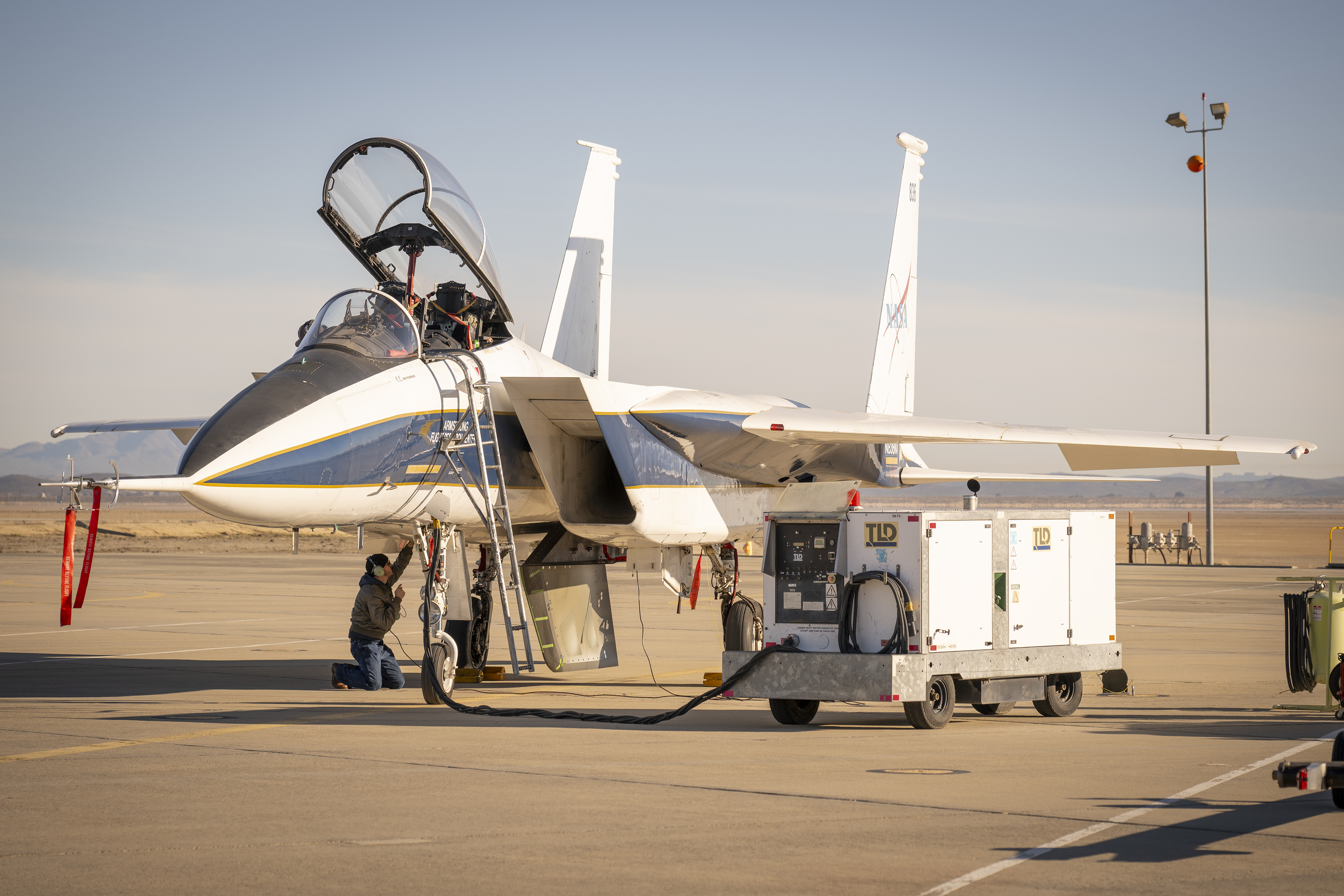
A NASA F-15 research aircraft is parked on a ramp at NASA’s Armstrong Flight Research Center in Edwards, California. Ground crew work beneath the aircraft on an experimental test article, resembling a ventral fin, mounted under the aircraft’s fuselage.
NASA ground crew prepares the agency’s F-15 research aircraft and Cross Flow Attenuated Natural Laminar Flow (CATNLF) test article ahead of its first high-speed taxi test on Tuesday, Jan. 12, 2026, at NASA’s Armstrong Flight Research Center in Edwards, California. The CATNLF design aims to reduce drag on wing surfaces to improve efficiency and, in turn, reduce fuel burn.
NASA/Christopher LC Clark

This limitation is due to crossflow, an aerodynamic phenomenon on angled surfaces that can prematurely end laminar flow. While large, swept wings like those found on most commercial aircraft provide aerodynamic efficiencies, crossflow tendencies remain.

In a 2018 wind tunnel test at Langley, researchers confirmed that the CATNLF design successfully achieved prolonged laminar flow.

“After the positive results in the wind tunnel test, NASA saw enough promise in the technology to progress to flight testing,” Banchy said. “Flight testing allows us to increase the size of the model and fly in air that has less turbulence than a wind tunnel environment, which are great things for studying laminar flow.”

NASA Armstrong’s F-15B testbed aircraft provides the necessary flight environment for laminar flow testing, Banchy said. The aircraft enables researchers to address fundamental questions about the technology while keeping costs lower than alternatives, such as replacing a test aircraft’s wing with a full-scale CATNLF model or building a dedicated demonstrator aircraft.
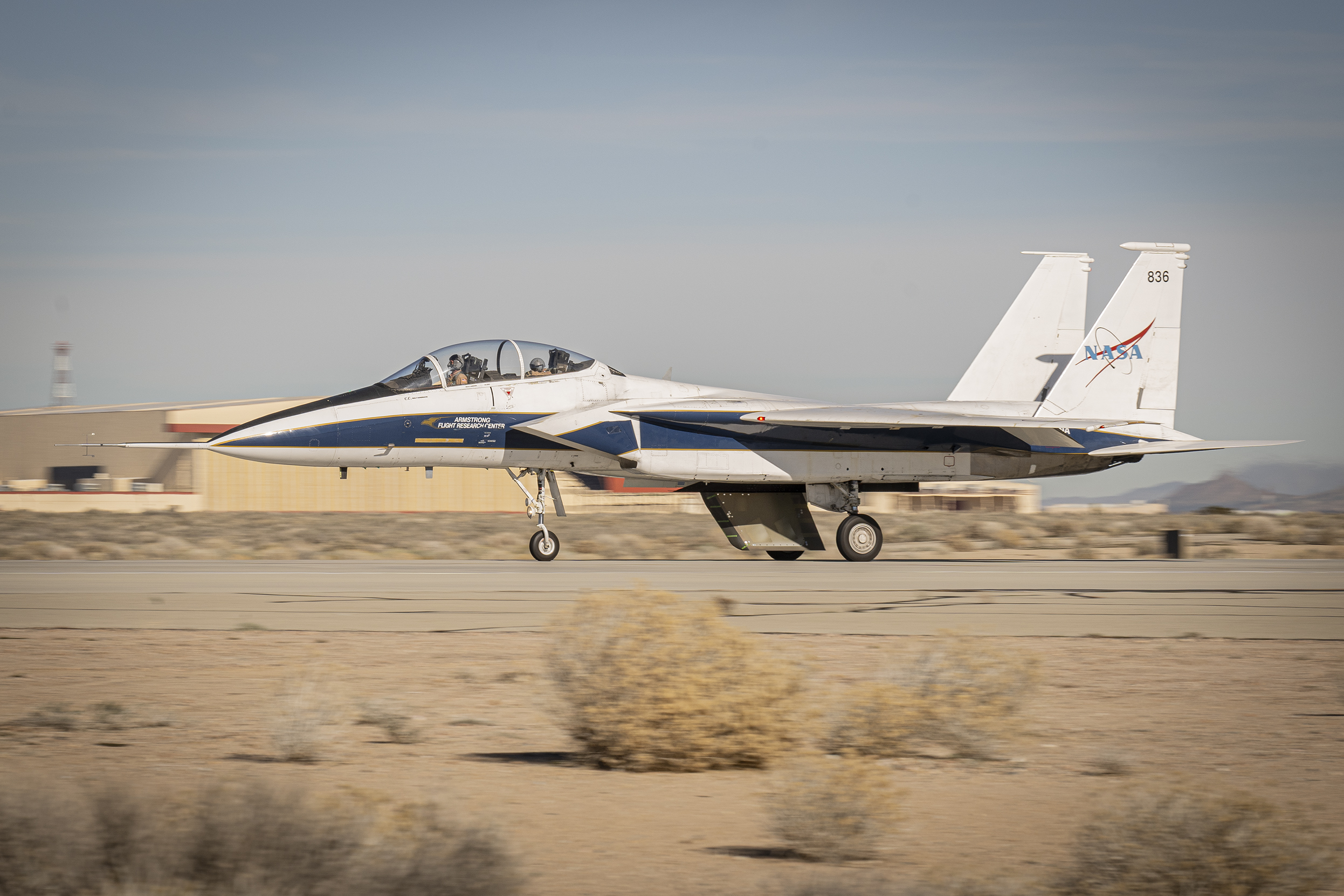
A white and blue NASA F-15 research aircraft taxis down a runway at Edwards Air Force Base with an experimental wing design mounted beneath the fuselage, resembling a ventral fin. In the background, a desert landscape with mountains and tan buildings stretches as the aircraft moves past.
NASA’s Cross Flow Attenuated Natural Laminar Flow (CATNLF) scale model completes its first major milestone – high-speed taxi test – Tuesday, Jan. 12, 2026, at Edwards Air Force Base in California. NASA’s F-15 research aircraft, with the 3-foot-tall test article mounted on its underside, reached speeds of approximately 144 mph during testing. If successful, the technology could be applied to future commercial aircraft to improve efficiency and potentially reduce fuel consumption.
NASA/Christopher LC Clark

CATNLF currently focuses on commercial aviation, which has steadily increased over the past 20 years, with passenger numbers expected to double in the next 20, according to the International Civil Aviation Organization. Commercial passenger aircraft fly at subsonic speeds, or slower than the speed of sound.

“Most of us fly subsonic, so that’s where this technology would have the greatest impact right now,” Frederick said. NASA’s previous computational studies also confirmed that technology like CATNLF could be adapted for supersonic application.

In the coming weeks, CATNLF is expected to begin its first flight, kicking off a series of test flights designed to evaluate the design’s performance and capabilities in flight.

Looking ahead, NASA’s work on CATNLF could lay the groundwork for more efficient commercial air travel and might one day extend similar capabilities to supersonic flight, improving fuel efficiency at even higher speeds.

“The CATNLF flight test at NASA Armstrong will bring laminar technology one step closer to being implemented on next-generation aircraft,” Banchy said.

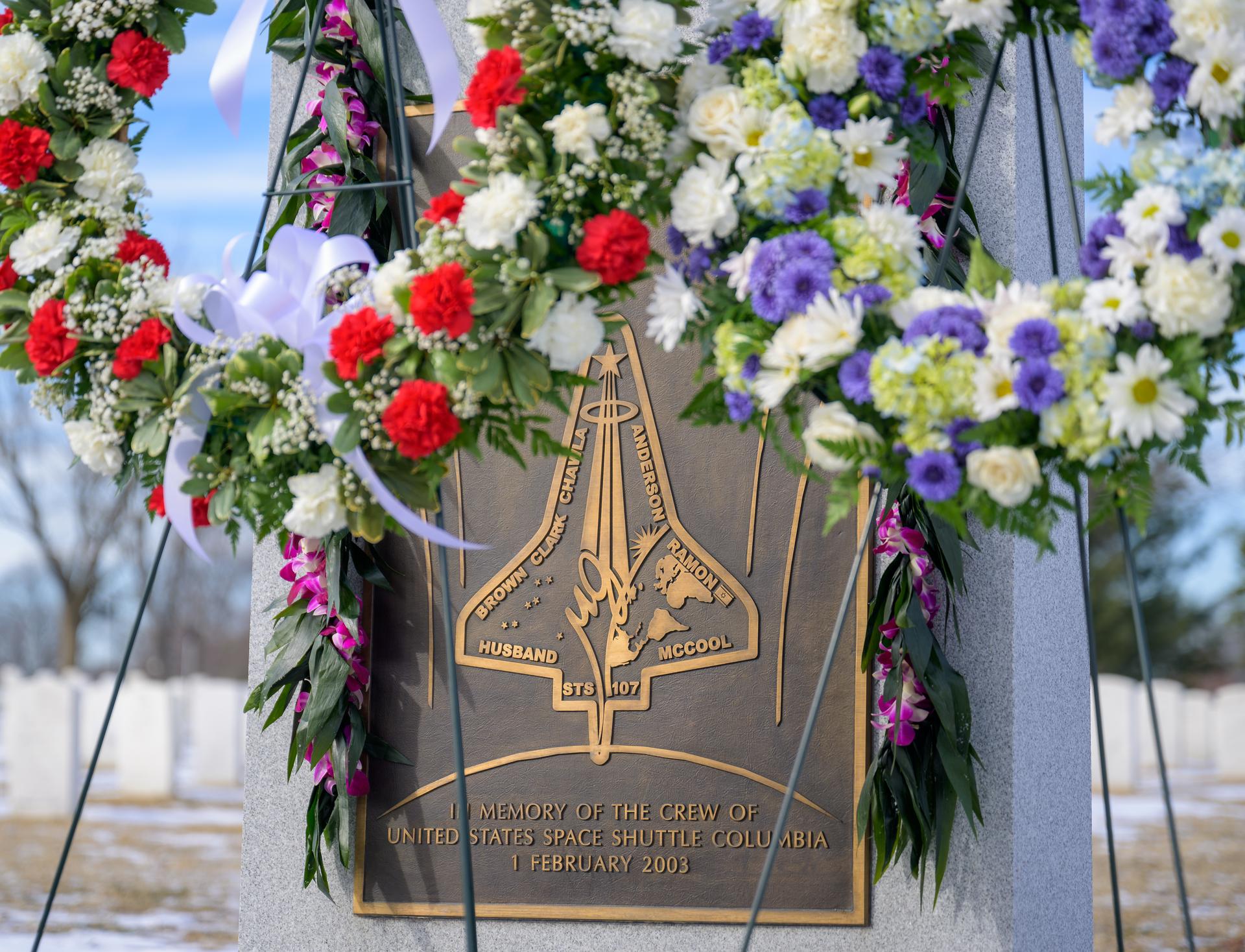
NASA’s Day of Remembrance Honors Fallen Heroes of Exploration

20 January 2026 at 18:17
The Space Shuttle Columbia Memorial is seen during a wreath laying ceremony that was part of NASA’s Day of Remembrance, Thursday, Jan. 23, 2025, at Arlington National Cemetery in Virginia. Wreaths were laid in memory of those men and women who lost their lives in the quest for space exploration.
Credit: NASA/Bill Ingalls

NASA will observe its annual Day of Remembrance on Thursday, Jan. 22, which includes commemorating the crews of Apollo 1 and the space shuttles Challenger and Columbia. The event is traditionally held every year on the fourth Thursday of January, as all three astronaut accidents happened around the end of the month.

“On NASA’s Day of Remembrance, we pause to honor the members of the NASA family who lost their lives while pushing the boundaries of exploration and discovery,” said NASA Administrator Jared Isaacman. “We remember them not to retreat from risk, but to respect it — to learn, to improve, and continue onward. Their sacrifice and the strength of their families will forever inspire us as we continue to reach for the stars and pursue the secrets of the universe.”

Isaacman will lead an observance at 1 p.m. EST at Arlington National Cemetery in Virginia, which will begin with a wreath-laying ceremony at the Tomb of the Unknown Soldier, followed by observances for the Apollo 1, Challenger, and Columbia crews.

Several agency centers also will hold observances:

Johnson Space Center in Houston

NASA Johnson will hold a commemoration at 10 a.m. CST at the Astronaut Memorial Grove with remarks by Center Director Vanessa Wyche, NASA astronaut Jasmin Moghbeli, and Cheryl McNair, widow of Challenger astronaut Ronald McNair. The event will have a moment of silence, a NASA T-38 flyover, taps performed by the Texas A&M Squadron 17, and a procession placing flowers at Apollo I, Challenger, and Columbia memorial trees.

Kennedy Space Center in Florida

NASA Kennedy and the Astronauts Memorial Foundation will host a ceremony at the Space Shuttle Atlantis building at Kennedy’s Visitor Complex at 11 a.m. EST. The event will include musical guests, a bell ringing commemoration, a moment of silence, and wreath-laying. Kelvin Manning, deputy director at NASA Kennedy, and Bob Cabana, former NASA associate administrator and Kennedy center director, will provide remarks during the ceremony, which will livestream on the center’s Facebook page.

Ames Research Center in California’s Silicon Valley

NASA Ames will hold a remembrance ceremony at 1 p.m. PST that includes remarks from Center Director Eugene Tu, a moment of silence, and bell ringing commemoration for each astronaut lost in service.

Langley Research Center in Hampton, Virginia

NASA Langley will hold a remembrance ceremony at 1 p.m. EST with acting Center Director Trina Dyal, followed by placing flags at the Langley Workers Memorial.

Marshall Space Flight Center in Huntsville, Alabama

NASA Marshall will hold a candle-lighting ceremony and wreath placement at 9:30 a.m. CST and include remarks from Rae Ann Meyer, Marshall’s acting center director, and Bill Hill, director of Safety and Mission Assurance at Marshall.

Stennis Space Flight Center in Bay St. Louis, Mississippi

NASA Stennis and the NASA Shared Services Center will hold a wreath-laying ceremony and moment of silence at 10:30 a.m. CST with remarks from Center Director John Bailey and Anita Harrell, NASA Shared Services Center executive director.

The agency also is paying tribute to its fallen astronauts with special online content, updated on NASA’s Day of Remembrance, at:

https://www.nasa.gov/dor

-end-

Bethany Stevens / Elizabeth Shaw
Headquarters, Washington
202-358-1600
bethany.c.stevens@nasa.gov / elizabeth.a.shaw@nasa.gov

NASA Adds Two F-15 Aircraft to Support Supersonic Flight Research

15 January 2026 at 15:58

3 min read

Preparations for Next Moonwalk Simulations Underway (and Underwater)

Alt Text: A ground crew member wearing hearing protection raises both arms to guide an F-15 aircraft taxiing on the ramp at NASA Armstrong Flight Research Center.
Oregon Air National Guard ground crew guides one of the NASA’s newest F-15 aircraft onto the ramp at the agency’s Armstrong Flight Research Center in Edwards, California, on Monday, Dec. 22, 2025. The retired U.S. Air Force F-15s come from the Oregon Air National Guard’s 173rd Fighter Wing and will transition from military service to support NASA’s flight research fleet.
NASA/Christopher LC Clark
U.S. Air Force and NASA flight crew stand on the ramp at NASA’s Armstrong Flight Research Center, facing the runway, with a desert landscape and an aircraft visible in the distance.
Oregon Air National Guard and NASA flight crew look out across the desert while awaiting the arrival of the NASA’s newest F-15 aircraft from the Oregon Air National Guard’s 173rd Fighter Wing to NASA’s Armstrong Flight Research Center in Edwards, California, on Monday, Dec. 22, 2025
NASA/Christopher LC Clark
Two F-15 aircraft sit side by side on the ramp at NASA’s Armstrong Flight Research Center, displaying tail numbers 045 and 063 and tail markings that read “Oregon” above an eagle graphic. A NASA hangar with the agency’s logo is visible in the background
NASA’s newest F-15 aircraft arrive at the agency’s Armstrong Flight Research Center in Edwards, California, on Monday, Dec. 22, 2025. The two retired U.S. Air Force F-15s will support ongoing supersonic flight research for NASA’s Flight Demonstrations and Capabilities Project and the Quesst mission’s X-59 quiet supersonic research aircraft.
NASA/Christopher LC Clark
U.S. Air Force service members in uniform and NASA civilians stand in two rows in front of a gray F-15 with its canopy open and a ladder attached on the ramp at NASA Armstrong Flight Research Center, posing for a photo with a hangar and NASA logo visible in the background.
NASA staff and Oregon Air National Guard’s 173rd Fighter Wing crew pose for a group photo at NASA’s Armstrong Flight Research Center in Edwards, California, on Monday, Dec. 22, 2025. The group stands in front of one of two F-15 aircraft added to the agency’s flight research fleet.
NASA/Christopher LC Clark
Two U.S. Air Force pilots in flight suits and a NASA civilian walk away from the agency’s newest F-15 aircraft; two gray F-15s, a white truck, and the desert are visible in the background.
Oregon Air National Guard pilots deliver NASA’s newest F-15 aircraft from the Oregon Air National Guard’s 173rd Fighter Wing at Kingsley Field to NASA’s Armstrong Flight Research Center in Edwards, California, on Monday, Dec. 22, 2025. After completing their final flights with the Air Force, the two aircraft begin their new role supporting NASA’s flight research.
NASA/Christopher LC Clark

Two retired U.S. Air Force F-15 jets have joined the flight research fleet at NASA’s Armstrong Flight Research Center in Edwards, California, transitioning from military service to a new role enabling breakthrough advancements in aerospace.

The F-15s will support supersonic flight research for NASA’s Flight Demonstrations and Capabilities project, including testing for the Quesst mission’s X-59 quiet supersonic research aircraft. One of the aircraft will return to the air as an active NASA research aircraft. The second will be used for parts to support long-term fleet sustainment.

“These two aircraft will enable successful data collection and chase plane capabilities for the X-59 through the life of the Low Boom Flight Demonstrator project” said Troy Asher, director for flight operations at NASA Armstrong. “They will also enable us to resume operations with various external partners, including the Department of War and commercial aviation companies.”

The aircraft came from the Oregon Air National Guard’s 173rd Fighter Wing at Kingsley Field. After completing their final flights with the Air Force, the two aircraft arrived at NASA Armstrong Dec. 22, 2025. 

“NASA has been flying F-15s since some of the earliest models came out in the early 1970s,” Asher said. “Dozens of scientific experiments have been flown over the decades on NASA’s F-15s and have made a significant contribution to aeronautics and high-speed flight research.”

The F-15s allow NASA to operate in high-speed, high-altitude flight-testing environments. The aircraft can carry experimental hardware externally – under its wings or slung under the center – and can be modified to support flight research.

Now that these aircraft have joined NASA’s fleet, the team at Armstrong can modify their software, systems, and flight controls to suit mission needs. The F-15’s ground clearance allows researchers to install instruments and experiments that would not fit beneath many other aircraft.

NASA has already been operating two F-15s modified so their pilots can operate safely at up to 60,000 feet, the top of the flight envelop for the X-59, which will cruise at 55,000 feet. The new F-15 that will fly for NASA will receive the same modification, allowing for operations at altitudes most standard aircraft cannot reach. The combination of capability, capacity, and adaptability makes the F-15s uniquely suited for flight research at NASA Armstrong.

“The priority is for them to successfully support the X-59 through completion of that mission,” Asher said. “And over the longer term, these aircraft will help position NASA to continue supporting advanced aeronautics research and partnerships.”

Flight Engineers Give NASA’s Dragonfly Lift

9 January 2026 at 13:17

In sending a car-sized rotorcraft to explore Saturn’s moon Titan, NASA’s Dragonfly mission will undertake an unprecedented voyage of scientific discovery. And the work to ensure that this first-of-its-kind project can fulfill its ambitious exploration vision is underway in some of the nation’s most advanced space simulation and testing laboratories.

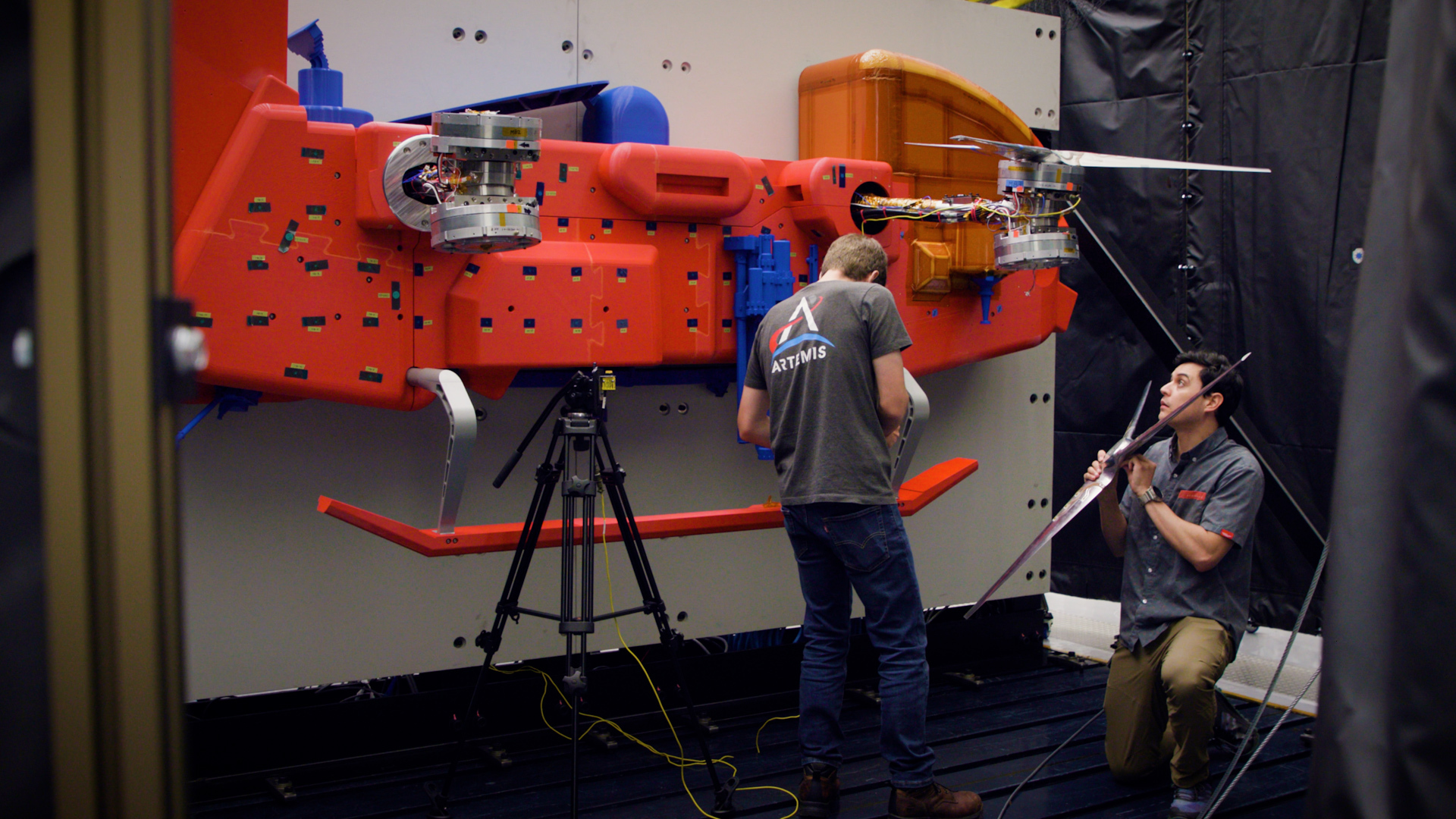
Two men in dark shirts work on a red car-sized rotorcraft protype in a testing chamber.
From left, Johns Hopkins APL engineers Tyler Radomsky and Felipe Ruiz install a rotor on the Dragonfly test model at the Transonic Dynamics Tunnel at NASA’s Langley Research Center in Virginia.
NASA

Set for launch in in 2028, the Dragonfly rotorcraft is being designed and built at the Johns Hopkins Applied Physics Laboratory (APL) in Laurel, Maryland, with contributions from organizations around the world. On arrival in 2034, Dragonfly will exploit Titan’s dense atmosphere and low gravity to fly to dozens of locations, exploring varied environments from organic equatorial dunes to an impact crater where liquid water and complex organic materials essential to life (at least as we know it) may have existed together.

Aerodynamic testing

When full rotorcraft integration and testing begins in February, the team will tap into a trove of data gathered through critical technical trials conducted over the past three years, including, most recently, two campaigns at the Transonic Dynamics Tunnel (TDT) facility at NASA’s Langley Research Center in Hampton, Virginia.

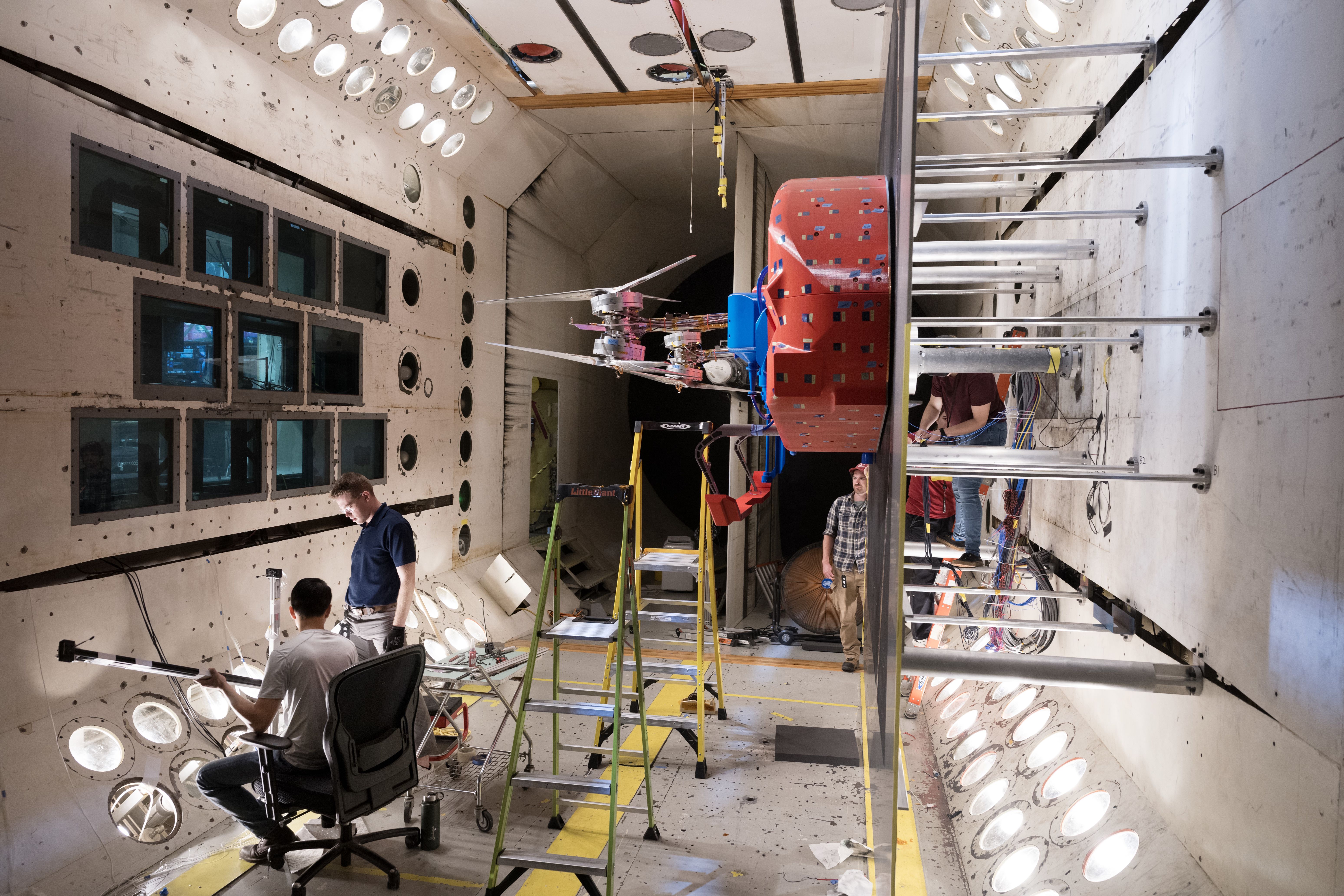
Five people in a large white room work in and around a red car-sized rotorcraft prototype mounted on a wall.
From left, Charles Pheng, Ryan Miller, John Kayrouz, Kristen Carey and Josie Ward prepare for the first aeromechanical performance tests of the full-scale Dragonfly rotors in the Transonic Dynamics Tunnel at NASA’s Langley Research Center in Virginia.
NASA

The TDT is a versatile 16-foot-high, 16-foot-wide, 20-foot-long testing hub that has hosted studies for NASA, the Department of War, the aircraft industry and an array of universities.

Over five weeks, from August into September, the team evaluated the performance of Dragonfly’s rotor system – which provides the lift for the lander to fly and enables it to maneuver – in Titan-like conditions, looking at aeromechanical performance factors such as stress on the rotor arms, and effects of vibration on the rotor blades and lander body. In late December, the team also wrapped up a set of aerodynamics tests on smaller-scale Dragonfly rotor models in the TDT.

“When Dragonfly enters the atmosphere at Titan and parachutes deploy after the heat shield does its job, the rotors are going to have to work perfectly the first time,” said Dave Piatak, branch chief for aeroelasticity at NASA Langley. “There’s no room for error, so any concerns with vehicle structural dynamics or aerodynamics need to be known now and tested on the ground. With the Transonic Dynamics Tunnel here at Langley, NASA offers just the right capability for the Dragonfly team to gather this critical data.”

Critical parts

In his three years as an experimental machinist at APL, Cory Pennington has crafted parts for projects dispatched around the globe. But fashioning rotors for a drone to explore another world in our solar system? That was new – and a little daunting.

“The rotors are some of the most important parts on Dragonfly,” Pennington said. “Without the rotors, it doesn’t fly – and it doesn’t meet its mission objectives at Titan.”

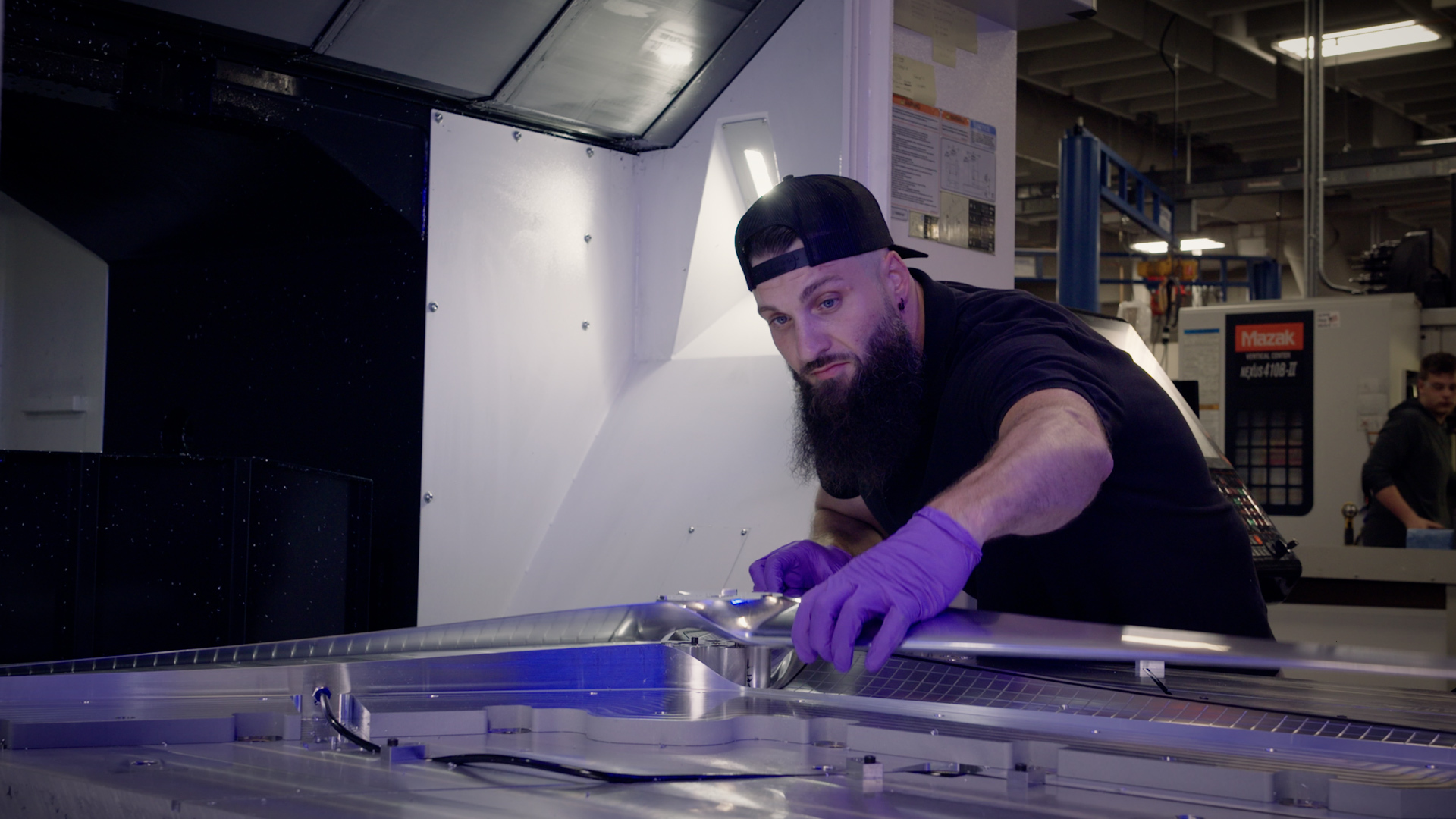
A man wearing dark clothes and purple gloves works on a silver rotor on a table.
Experimental machinist Cory Pennington examines a freshly milled, full-scale Dragonfly rotor in the machine shop at the Johns Hopkins Applied Physics Laboratory (APL) in Laurel, Maryland.
NASA/Johns Hopkins APL

Pennington and team cut Dragonfly’s first rotors on Nov. 1, 2024. They refined the process as they went: starting with waterjet paring of 1,000-pound aluminum blocks, followed by rough machining, cover fitting, vent-hole drilling and hole-threading. After an inspection, the parts were cleaned, sent out for welding and returned for final finishing.

“We didn’t have time or materials to make test parts or extras, so every cut had to be right the first time,” Pennington said, adding that the team also had to find special tools and equipment to accommodate some material changes and design tweaks.

The team was able to deliver the parts a month early. Engineers set up and spin-tested the rotors at APL – attached to a full-scale model representing half of the Dragonfly lander – before transporting the entire package to the TDT at NASA Langley in late July.

“On Titan, we’ll control the speeds of Dragonfly’s different rotors to induce forward flight, climbs, descents and turns,” said Felipe Ruiz, lead Dragonfly rotor engineer at APL.

“It’s a complicated geometry going to a flight environment that we are still learning about. So the wind tunnel tests are one of the most important venues for us to demonstrate the design.”

And the rotors passed the tests.

“Not only did the tests validate the design team’s approach, we’ll use all that data to create high-fidelity representations of loads, forces and dynamics that help us predict Dragonfly’s performance on Titan with a high degree of confidence,” said Rick Heisler, wind tunnel test lead from APL.

Next, the rotors will undergo fatigue and cryogenic trials under simulated Titan conditions, where the temperature is minus 290 degrees Fahrenheit (minus 178 degrees Celsius), before building the actual flight rotors.

“We’re not just cutting metal — we’re fabricating something that’s going to another world,” Pennington said. “It’s incredible to know that what we build will fly on Titan.”

Collaboration, innovation

Elizabeth “Zibi” Turtle, Dragonfly principal investigator at APL, says the latest work in the TDT demonstrates the mission’s innovation, ingenuity and collaboration across government and industry.

“The team worked well together, under time pressure, to develop solutions, assess design decisions, and execute fabrication and testing,” she said. “There’s still much to do between now and our launch in 2028, but everyone who worked on this should take tremendous pride in these accomplishments that make it possible for Dragonfly to fly on Titan.”

When NASA's Dragonfly begins full rotorcraft integration and testing in early 2026, the mission team will tap into a trove of data gathered through critical technical trials conducted over the past three years, including, most recently, a testing campaign in at the Transonic Dynamics Tunnel (TDT) Facility at NASA’s Langley Research Center in Hampton, Virginia.
NASA/Johns Hopkins APL

Dragonfly has been a collaborative effort from the start. Kenneth Hibbard, mission systems engineer from APL, cites the vertical-lift expertise of Penn State University on the initial rotor design, aero-related modeling and analysis, and testing support in the TDT, as well as NASA Langley’s 14-by-22-foot Subsonic Tunnel. Sikorsky Aircraft of Connecticut has also supported aeromechanics and aerodynamics testing and analysis, as well as flight hardware modeling and simulation.

The Johns Hopkins Applied Physics Laboratory (APL) in Laurel, Maryland, leads the Dragonfly mission for NASA in collaboration with several NASA centers, industry partners, academic institutions and international space agencies. Elizabeth “Zibi” Turtle of APL is the principal investigator. Dragonfly is part of NASA’s New Frontiers Program, managed by the Planetary Missions Program Office at NASA Marshall Space Flight Center in Huntsville, Alabama, for the agency’s Science Mission Directorate in Washington.

For more information on NASA’s Dragonfly mission, visit:

https://science.nasa.gov/mission/dragonfly/

by Mike Buckley
Johns Hopkins Applied Physics Laboratory


MEDIA CONTACTS:

Karen Fox / Molly Wasser
Headquarters, Washington
240-285-5155 / 240-419-1732
karen.c.fox@nasa.gov / molly.l.wasser@nasa.gov

Joe Atkinson
NASA’s Langley Research Center, Hampton, Virginia
757-755-5375
joseph.s.atkinson@nasa.gov

Mike Buckley
Johns Hopkins Applied Physics Laboratory, Laurel, Maryland
443-567-3145
michael.buckley@jhuapl.edu

NASA, Boeing Test How to Improve Performance of Longer, Narrower Aircraft Wings 

By: Jim Banke
18 December 2025 at 14:00

5 min read

Preparations for Next Moonwalk Simulations Underway (and Underwater)

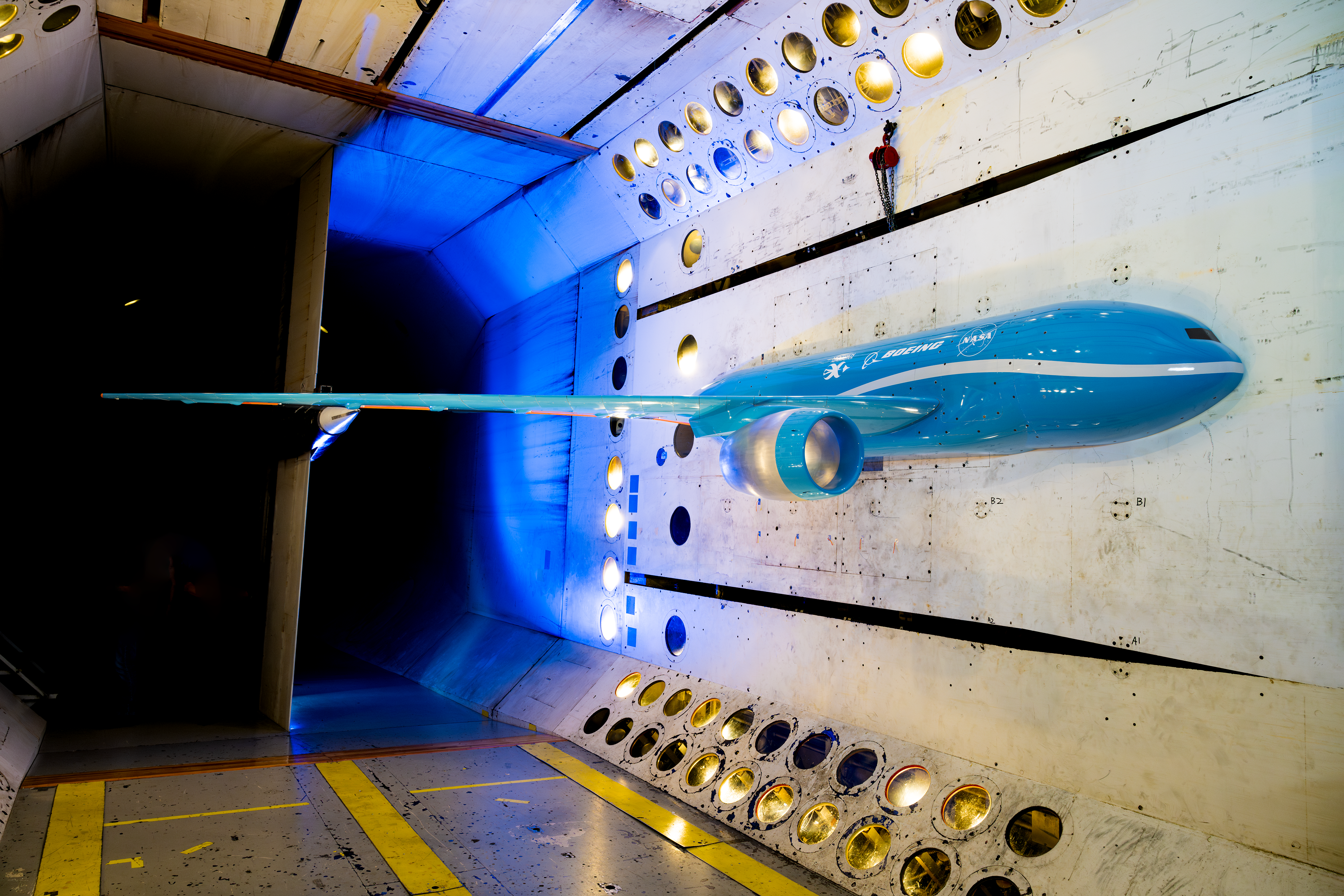
A scale model of possible future commercial jet airplane sits inside a NASA wind tunnel where the aircraft wing was tested.
The Integrated Adaptive Wing Technology Maturation wind-tunnel model installed in the Transonic Dynamics Tunnel at NASA Langley Research Center in Hampton, Virginia.
NASA / Mark Knopp

The airliner you board in the future could look a lot different from today’s, with longer, thinner wings that provide a smoother ride while saving fuel.

Those wings would be a revolutionary design for commercial aircraft, but like any breakthrough technology, they come with their own development challenges – which experts from NASA and Boeing are now working to solve. 

When creating lift, longer, thinner wings can reduce drag, making them efficient. However, they can become very flexible in flight.

Through their Integrated Adaptive Wing Technology Maturation collaboration, NASA and Boeing recently completed wind tunnel tests of a “higher aspect ratio wing model” looking for ways to get the efficiency gains without the potential issues these kinds of wings can experience. 

“When you have a very flexible wing, you’re getting into greater motions,” said Jennifer Pinkerton, a NASA aerospace engineer at NASA Langley Research Center in Hampton, Virginia. “Things like gust loads and maneuver loads can cause even more of an excitation than with a smaller aspect ratio wing. Higher aspect ratio wings also tend to be more fuel efficient, so we’re trying to take advantage of that while simultaneously controlling the aeroelastic response.”  


Take a minute to watch this video about the testing NASA and Boeing are doing on longer, narrower aircraft wings.

Without the right engineering, long, thin wings could potentially bend or experience a condition known as wing flutter, causing aircraft to vibrate and shake in gusting winds.  

“Flutter is a very violent interaction,” Pinkerton said. “When the flow over a wing interacts with the aircraft structure and the natural frequencies of the wing are excited, wing oscillations are amplified and can grow exponentially, leading to potentially catastrophic failure. Part of the testing we do is to characterize aeroelastic instabilities like flutter for aircraft concepts so that in actual flight, those instabilities can be safely avoided.” 

To help demonstrate and understand this, researchers from NASA and Boeing sought to soften the impacts of wind gusts on the aircraft, lessen the wing loads from aircraft turns and movements, and suppress wing flutter.

Reducing or controlling those factors can have a significant impact on an aircraft’s performance, fuel efficiency, and passenger comfort. 

Testing for this in a controlled environment is impossible with a full-sized commercial airliner, as no wind tunnel could accommodate one.

However, NASA Langley’s Transonic Dynamics Tunnel, which has been contributing to the design of U.S. commercial transports, military aircraft, launch vehicles, and spacecraft for over 60 years, features a test section 16 feet high by 16 feet wide, big enough for large-scale models. 

 To shrink a full-size plane down to scale, NASA and Boeing worked with NextGen Aeronautics, which designed and fabricated a complex model resembling an aircraft divided down the middle, with one 13-foot wing.

Mounted to the wall of the wind tunnel, the model was outfitted with 10 control surfaces – moveable panels – along the wing’s rear edge. Researchers adjusted those control surfaces to control airflow and reduce the forces that were causing the wing to vibrate.

Instruments and sensors mounted inside the model measured the forces acting on the model, as well as the vehicle’s responses.

A scale model of possible future commercial jet airplane sits inside a NASA wind tunnel where the aircraft wing was tested.
Another view of the Integrated Adaptive Wing Technology Maturation wind-tunnel model installed in the Transonic Dynamics Tunnel at NASA Langley Research Center in Hampton, Virginia.
NASA / Mark Knopp

The model wing represented a leap in sophistication from a smaller one developed during a previous NASA-Boeing collaboration called the Subsonic Ultra Green Aircraft Research (SUGAR).

“The SUGAR model had two active control surfaces,” said Patrick S. Heaney, principal investigator at NASA for the Integrated Adaptive Wing Technology Maturation collaboration. “And now on this particular model we have ten. We’re increasing the complexity as well as expanding what our control objectives are.”  

A first set of tests, conducted in 2024, gave experts baseline readings that they compared to NASA computational simulations, allowing them to refine their models. A second set of tests in 2025 used the additional control surfaces in new configurations.

The most visible benefits of these new capabilities appeared during testing to alleviate the forces from gusting winds, when researchers saw the wing’s shaking greatly reduced.

With testing completed, NASA and Boeing experts are analyzing data and preparing to share their results with the aviation community. Airlines and original equipment manufacturers can learn and benefit from the lessons learned, deciding which to apply to the next generation of aircraft.  

“Initial data analyses have shown that controllers developed by NASA and Boeing and used during the test demonstrated large performance improvements,” Heaney said. “We’re excited to continue analyzing the data and sharing results in the months to come.” 

NASA’s Advanced Air Transport Technology project works to advance aircraft design and technology under the agency’s Advanced Air Vehicles program, which studies, evaluates, and develops technologies and capabilities for new aircraft systems. The project and program fall within NASA’s Aeronautics Research Mission Directorate. 

Facebook logo
Instagram logo
Linkedin logo
Keep Exploring

Discover More Topics From NASA

💾

What can we do to help aircraft wings perform better in flight, creating a smoother, more fuel efficient, and safer experience for travelers? This is a quest...

NASA Langley Research Center: 2025 Year in Review 

By: NASA
17 December 2025 at 09:58
10 Min Read

NASA Langley Research Center: 2025 Year in Review 

Langley flyover

The future of flight, space exploration, and science starts at NASA’s Langley Research Center in Hampton, Virginia, where we have been advancing innovation for more than 100 years. Join us as we look back at NASA Langley’s achievements in 2025 that continued our storied legacy of pushing the boundaries of what is possible. 

Langley Researchers Explore MARVL-ous Technology for Future Trips to Mars   

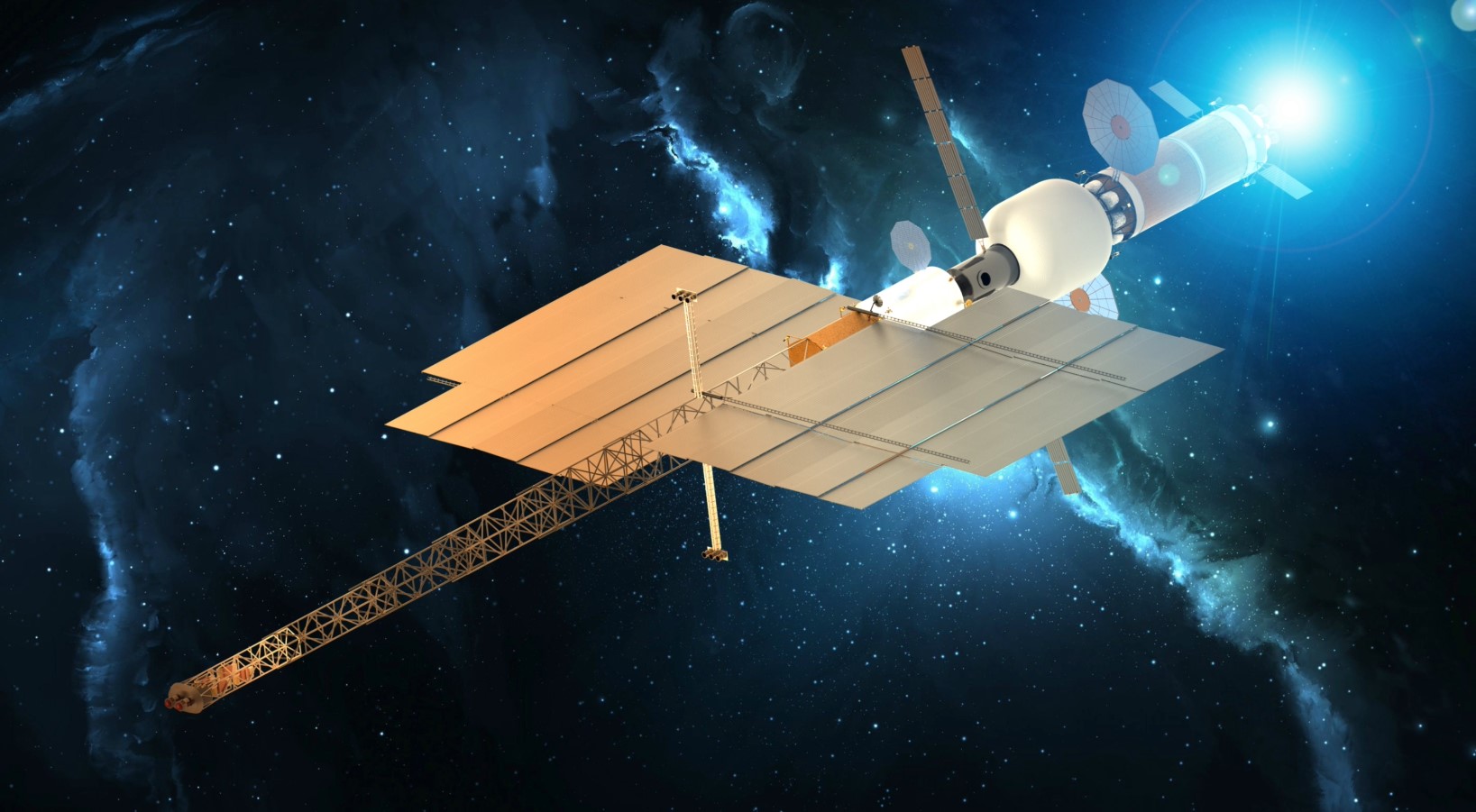
Modular Assembled Radiators for Nuclear Electric Propulsion Vehicles, or MARVL, aims to take a critical element of nuclear electric propulsion, its heat dissipation system, and divide it into smaller components that can be assembled robotically and autonomously in space. This is an artist's rendering of what the fully assembled system might look like.
Modular Assembled Radiators for Nuclear Electric Propulsion Vehicles, or MARVL, aims to take a critical element of nuclear electric propulsion, its heat dissipation system, and divide it into smaller components that can be assembled robotically and autonomously in space. This is an artist’s rendering of what the fully assembled system might look like.
NASA

As NASA returns astronauts to the Moon through the agency’s Artemis campaign in advance of human exploration of Mars, researchers at Langley are exploring technology that could significantly reduce travel time to the Red Planet. Modular Assembled Radiators for Nuclear Electric Propulsion Vehicles, or MARVL, would use robots for in-space assembly of elements needed to enable nuclear electric propulsion of future spacecraft, which could transform travel to deep space. 

NASA Cameras Catch First-of-its-Kind Moon Close-up 

The Moon was ready for its close-up in March, when cameras developed by a Langley team captured first-of-its-kind imagery of a lunar lander’s engine plumes interacting with the Moon’s surface during Firefly Aerospace’s Blue Ghost Mission 1. Information gathered from images like this is critical in helping NASA prepare for future crewed and uncrewed lunar landings.    

Stellar Event Offers NASA Rare Look at Uranus 

This rendering demonstrates what is happening during a stellar occultation and illustrates an example of the light curve data graph recorded by scientists that enables them to gather atmospheric measurements, like temperature and pressure, from Uranus as the amount of starlight changes when the planet eclipses the star.
NASA/Langley Research Center Advanced Concepts Laboratory

In April, planetary scientists at Langley led an international team of astronomers during a cosmic alignment three decades in the making: a rare opportunity to study Uranus. The one-hour event gave them a glimpse into the planet’s atmosphere, information that could enable future Uranus exploration efforts.  

NASA Instrument Measures Wind for Improved Weather Forecasts 

This visualization shows AWP 3D measurements gathered on Oct. 15, 2024, as NASA’s G-III aircraft flew along the East Coast of the U.S. and across the Great Lakes region. Laser light that returns to AWP as backscatter from aerosol particles and clouds allows for measurement of wind direction, speed, and aerosol concentration as seen in the separation of data layers.
NASA Scientific Visualization Studio

Severe or extreme weather can strike in a moment’s notice, and having the tools to accurately predict weather events can help save lives and property. Scientists at Langley have developed and are testing an instrument that uses laser technology to gather precise wind measurements, data that is a crucial element for accurate weather forecasting. 

Langley Researchers Develop New Technique to Test Long, Flexible Booms 

Researchers look at a bend that occurred in a 94-foot triangular, rollable and collapsible boom during an off-axis compression test.
Researchers look at a bend that occurred in the 94-foot triangular, rollable and collapsible boom during an off-axis compression test.
NASA/David C. Bowman

Gravity can create issues when testing materials for space, but Langley researchers have found a way to successfully use gravity and height when testing long composite booms. Testing these composite booms is important because they could support space exploration in a variety of ways, including being used to build structures that could support humans living and working on the Moon. 

NASA Imaging Team Supports Missions to Advance Space Exploration, Science 

A rendering of a space capsule from The Exploration Company re-entering Earth's atmosphere.
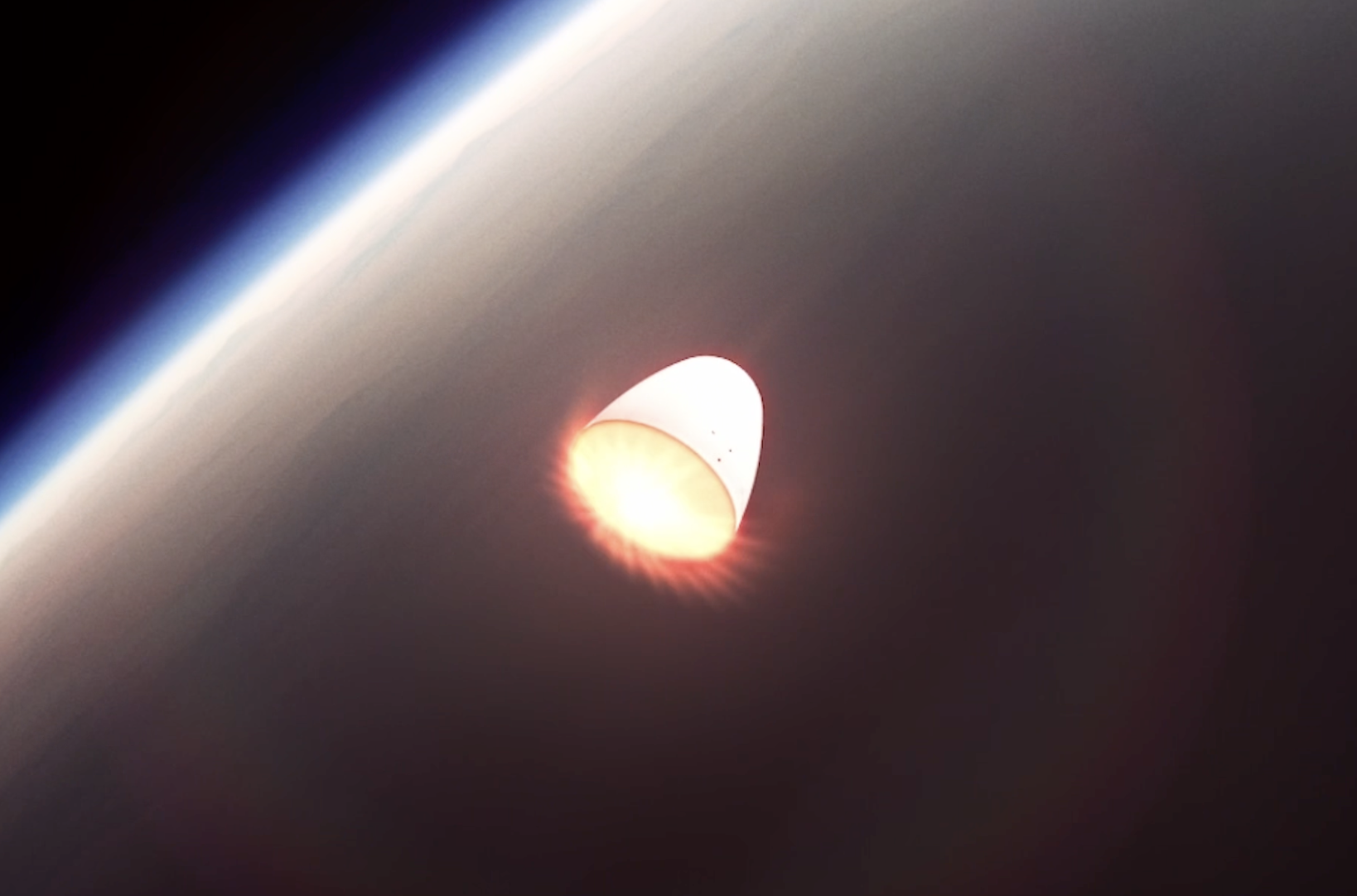
A rendering of a space capsule from The Exploration Company re-entering Earth’s atmosphere.
Image courtesy of The Exploration Company

A Langley team that specializes in capturing imagery-based engineering datasets from spacecraft during launch and reentry continued its work in 2025, including support of a European aerospace company’s test flight in June. Not only does the team support a variety of missions to advance the agency’s work, but they also collaborate with the private sector as NASA works to open space to more science, people, and opportunities. 

NASA Instrument Uses Moonlight for Improved Space Measurements 

An artist's rendering of NASA's Arcstone instrument on-orbit gathering measurements of lunar reflectance.
An artist’s rendering of NASA’s Arcstone instrument on-orbit gathering measurements of lunar reflectance.
Blue Canyon Technologies

One of the most challenging tasks in remote sensing from space is achieving required instrument calibration on-orbit. Langley scientists are addressing the challenge head on through the Arcstone mission, an instrument that launched in June and aims to establish the Moon as a cost-efficient, high-accuracy calibration reference. Once established, the new standard can be applied to past, present, and future spaceborne sensors and satellite constellations. Arcstone uses a spectrometer, a scientific instrument that measures and analyzes light, to measure lunar spectral reflectance.  

NASA Mission Continues Monitoring Air We Breathe 

By measuring nitrogen dioxide (NO2) and formaldehyde (HCHO), TEMPO can derive the presence of near-surface ozone. On Aug. 2, 2024 over Houston, TEMPO observed exceptionally high ozone levels in the area. On the left, NO2 builds up in the atmosphere over the city and over the Houston Ship Channel. On the right, formaldehyde levels are seen reaching a peak in the early afternoon. Formaldehyde is largely formed through the oxidation of hydrocarbons, an ingredient of ozone production, such as those that can be emitted by petrochemical facilities found in the Houston Ship Channel.
NASA’s Scientific Visualization Studio

The success of NASA’s Tropospheric Emissions: Monitoring of Pollution mission, or TEMPO, earned the mission an extension, meaning the work to monitor Earth’s air quality from 22,000 miles above the ground will continue through at least September 2026. The Langley-led mission launched in 2023 and is NASA’s first to use a spectrometer, a scientific instrument that measures and analyzes light, to gather hourly air quality data continuously over North America during daytime hours. The data gathered is distributed freely to the public, giving air quality forecasters, scientists, researchers, and your next-door neighbor access to quality information about the air we breathe down to the neighborhood level. 

NASA Tests New, Innovative Tech to Enable Faster Launches at Lower Costs 

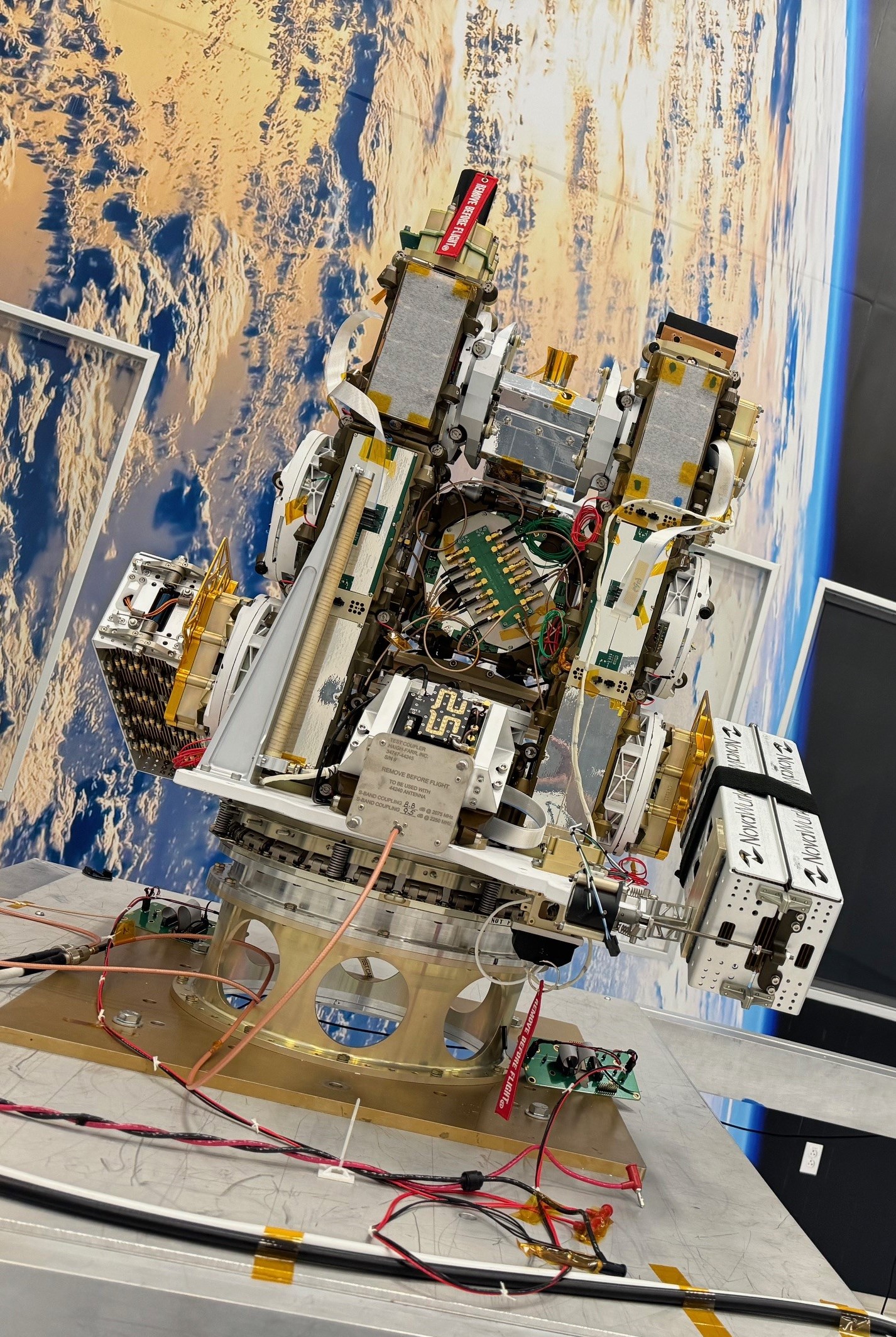
The fully assembled and tested Athena EPIC satellite which incorporates eight HISats mounted on a mock-up of a SpaceX provided launch pedestal which will hold Athena during launch.
NovaWurks

 NASA’s Athena Economical Payload Integration Cost mission, or Athena EPIC, launched in July with the goal to shape a future path to launch that saves taxpayers money and expedites access to space. Athena EPIC was the first NASA-led mission to utilize HISat technology, small satellites engineered to aggregate, share resources, and conform to different sizes and shapes. Langley’s scientists designed and built the Athena sensor with spare parts from NASA’s CERES (Clouds and the Earth’s Radiant Energy System) mission to gather top of atmosphere measurements. Athena EPIC demonstrates a novel way to launch Earth-observing instruments into orbit quicker and more economically. 

Drop Test at Langley Offers Research, Data for Potential Air Taxi Designs  

The future of air travel includes the safe integration of drones and air taxis into our airspace for passenger transport, cargo delivery, and public service capabilities. That is why NASA is investigating and testing potential air taxi materials and designs to help the aviation industry better understand how those materials behave under impact. Data collected from a drop test at Langley’s Landing and Impact Research Facility in June will help in the development of safety regulations for advanced air mobility aircraft, leading to safer designs.    

Langley Wind Tunnel Tests Help Support Advanced Air Mobility Aircraft Development 

A man is adjusting a propeller blade attached to a test model, with a blue-lit background.
NASA researcher Norman W. Schaeffler adjusts a propellor, which is part of a 7-foot wing model that was recently tested at NASA’s Langley Research Center in Hampton, Virginia. In May and June, NASA researchers tested the wing in the 14-by-22-Foot Subsonic Wind Tunnel to collect data on critical propeller-wing interactions. The lessons learned will be shared with the public to support advanced air mobility aircraft development.
NASA/Mark Knopp

NASA advanced the future of air taxis and autonomous cargo drones by testing a 7-foot wing model in Langley’s 14-by-22-Foot Subsonic Wind Tunnel. This effort produced data on critical propeller-wing interactions, as well as data relevant to cruise, hover, and transition conditions for advanced air mobility aircraft. The results will help validate next-generation design tools and accelerate safe, reliable development across the advanced air mobility industry. 


NASA Tests Air Taxi Tech for Future Aircraft Development 

An orange-colored small aircraft flying in the air.
The Research Aircraft for electric Vertical takeoff and landing Enabling techNologies Subscale Wind Tunnel and Flight Test undergoes a free flight test on the City Environment Range Testing for Autonomous Integrated Navigation range at NASA’s Langley Research Center in Hampton, Virginia on April 22, 2025.
NASA/Rob Lorkiewicz

The lack of publicly available engineering and flight data to help address technical barriers in the design and development of new electric vertical takeoff and landing (eVTOL) aircraft is a challenge for researchers and engineers. That is why Langley researchers are using a research aircraft that provides real-world data, obtained through wind tunnel and flight tests, to help fill the information gap and check the accuracy of computer models for flight dynamics and controls. Making this data available to all is a key step in transforming the way we fly and safely integrating new aircraft into our nation’s airspace. 

NASA Material Flies High for Study of Long-Term Effects of Space  

Robert Mosher, HIAD materials and processing lead at NASA Langley, holds up a piece of f webbing material, known as Zylon, which comprise the straps of the HIAD.
NASA/Joe Atkinson

A material from NASA Langley is riding high as it orbits the Earth aboard a United States Space Force test vehicle, giving researchers a better understanding of how the material responds to long-duration exposure to the harsh vacuum of space. The strap material is a part of a Langley-developed aeroshell to protect spacecraft re-entering Earth’s atmosphere or to ensure their safe landing on other celestial bodies, such as Mars. Understanding how extended exposure to space affects the material is important as NASA prepares to send humans beyond the Moon. 

NASA Flights Study Impacts of Space Weather on Travelers 

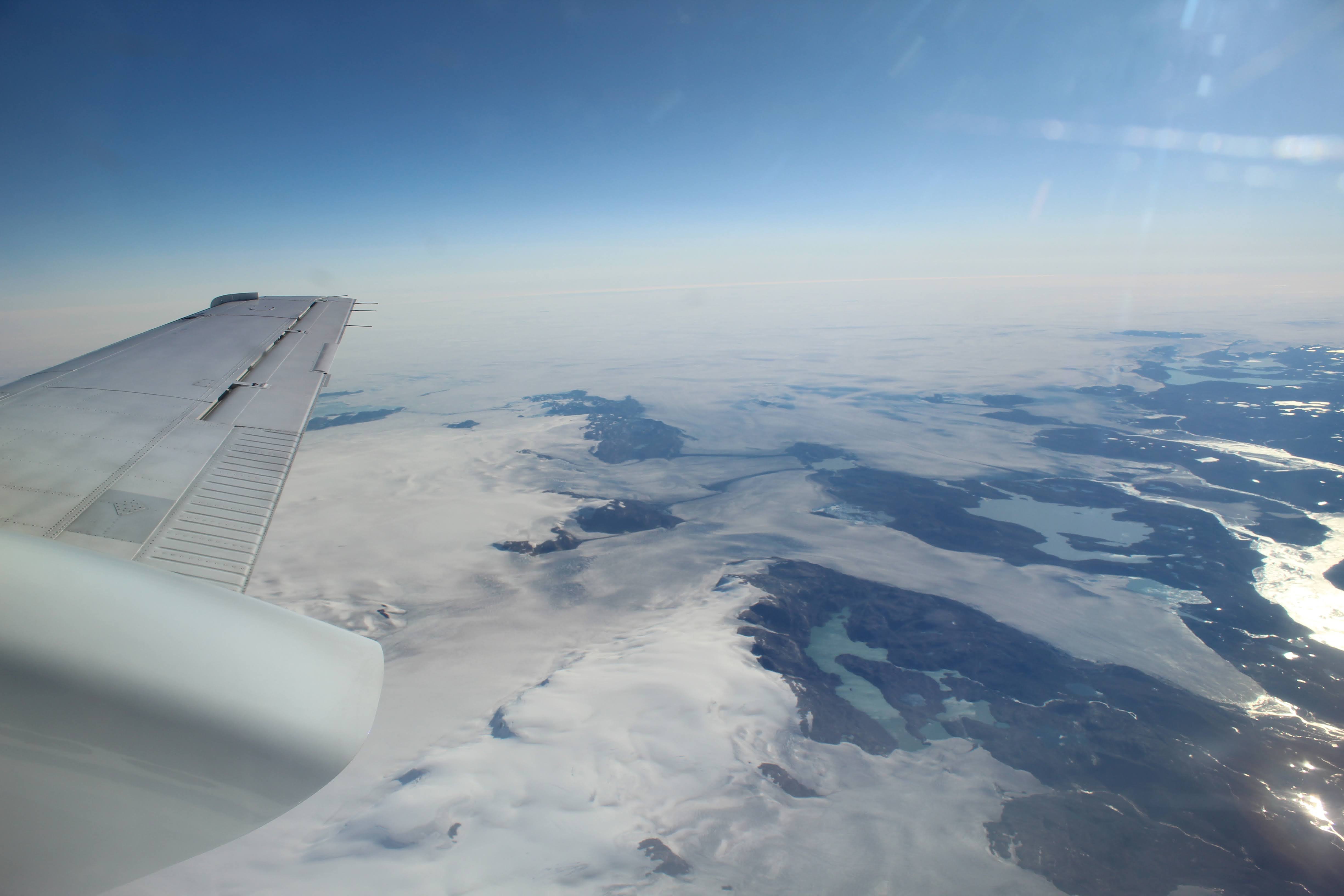
A view out of the window of the B200 King Air aircraft. A blue sky is seen at the top, then a cloud layer and water, ice and rock below. The tip of the plane is visible on the left.
Frozen and rocky terrain in the Polar region observed from above Nuuk, Greenland during NASA’s SWXRAD science flights.
NASA/Guillaume Gronoff

Data gathered during a Langley-led airborne science campaign late this summer could help protect air travelers on Earth and future space travelers to the Moon, Mars, and beyond from the health risks associated with radiation exposure. NASA’s Space Weather Aviation Radiation (SWXRAD) aircraft flight campaign took place in Greenland and measured the radiation dose level to air travelers from cosmic radiation. Researchers are using the information to enhance a modeling system that offers real-time global maps of the hazardous radiation in the atmosphere and creates exposure predictions for aircraft and spacecraft. 

NASA’s Dragonfly Completes Wind Tunnel Tests at Langley 

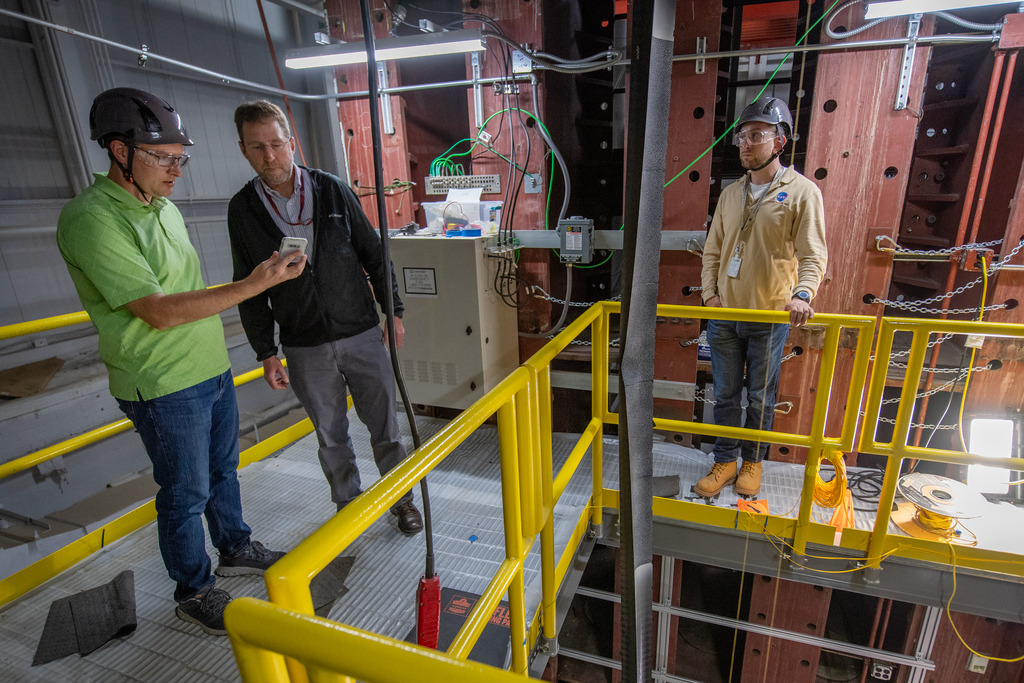
Set up and testing of Dragonfly model in the Transonic Dynamics Tunnel
NASA/David C. Bowman

As NASA returns astronauts to the Moon through the Artemis campaign in preparation for human exploration of Mars, the agency also has its sights set on Saturn, specifically Saturn’s moon Titan. NASA’s Dragonfly, a car-sized rotorcraft set to launch no earlier than 2028, will explore Titan and try to discover how life began. This fall, engineers placed a full-scale test model representing half of the Dragonfly lander in Langley’s Transonic Dynamics Tunnel to evaluate how its rotor system performed in Titan-like conditions. The data will be integral in developing the rotorcraft’s flight plans and navigation software as it investigates multiple landing sites on Titan. 

NASA Offers Science, Technology, and Expertise During Disaster Response 

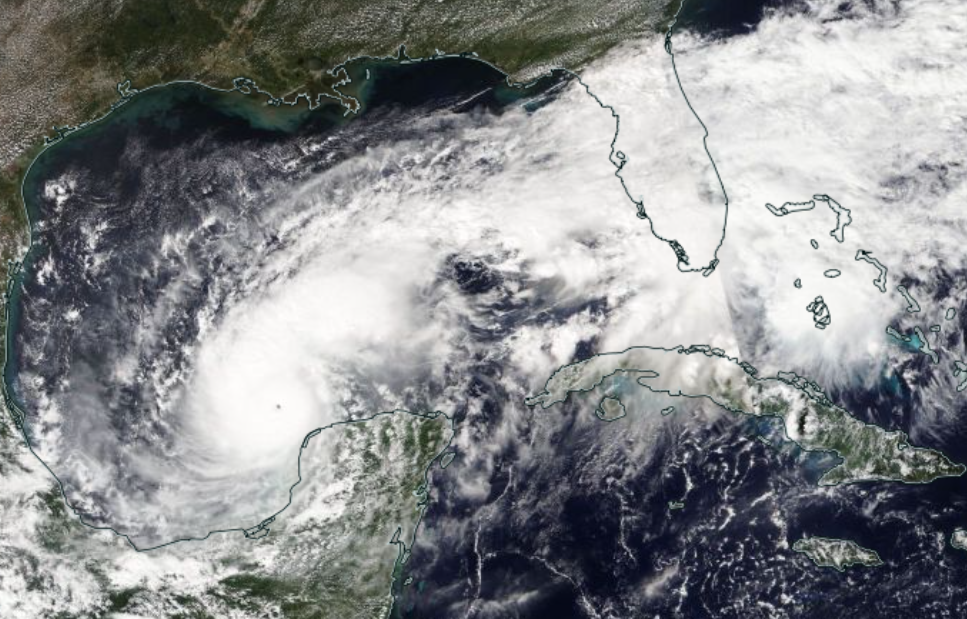
True color imagery of Hurricane Milton on Oct. 7, 2024, from the NOAA-21 satellite.
NASA / NOAA

In response to severe weather that impacted at least 10 states in April, the NASA Disasters Response Coordination System (DRCS) activated to support national partners. The DRCS is headquartered at Langley. NASA worked closely with the National Weather Service and the Federal Emergency Management Agency serving the central and southeastern U.S. to provide satellite data and expertise that help communities better prepare, respond, and recover. 

NASA’s X-59 Takes Flight 

In October, NASA’s Quesst mission celebrated a major milestone – the X-59 quiet supersonic one-of-a-kind research aircraft flew for the first time, a historic moment for aviation. The hard work, talent, and innovation of NASA engineers and project team members, including many based at NASA Langley, made this achievement possible. One of the notable traits of the X-59 is the eXternal Vision System (XVS) which allows the test pilots to safely maneuver the skies without a forward-facing window. This unique supersonic design feature was developed and tested at NASA Langley. 

The X-59’s first flight was a major step toward quiet supersonic flight over land, which could revolutionize air travel.

What a Blast! Langley Begins Plume-Surface Interaction Tests 

Views of the 60-foot vacuum sphere in the which the plume-surface interaction testing is happening.
NASA/Joe Atkinson

A team at NASA Langley is firing engine plumes into simulated lunar soil because as the United States returns to the Moon, both through NASA’s Artemis campaign and the commercialization of space, researchers need to understand the hazards that may occur when a lander’s engines blast away at the lunar dust, soil, and rocks. 

Langley Inspires Through Community Engagement, Educational Opportunities 

NASA Langley highlights its Cirrus Design SR22 during Air Power Over Hampton Roads STEM Day.
NASA/Angelique Herring

Langley connected with communities across Virginia and beyond to share the center’s work and impact, and inspire the next generation of explorers, scientists, and researchers. Thousands of spectators enjoyed hands-on activities and exhibits during the Air Power over Hampton Roads air show at Joint Base Langley-Eustis in Hampton, Virginia, where NASA Langley’s aviation past, present, and future were on full display. More than 2,300 students from across the nation eagerly participated in Langley’s 2025 Student Art Contest, and shared their artistic spin on the theme, “Our Wonder Changes the World.” Langley and Embry-Riddle Aeronautical University announced an agreement in September that will leverage Langley’s aerospace expertise and Embry-Riddle’s specialized educational programs and research to drive innovation in aerospace, research, education, and technology, while simultaneously developing a highly skilled workforce for the future of space exploration and advanced air mobility.  

Langley looks forward to another year of successes and advancements in 2026, as we continue to make the seemingly impossible, possible. 

Share

Details

Last Updated
Dec 18, 2025

💾

This compressed, resolution-limited video features a preliminary sequence of the Blue Ghost final descent and landing that NASA researchers stitched together...
❌
❌