Preparations for Next Moonwalk Simulations Underway (and Underwater)
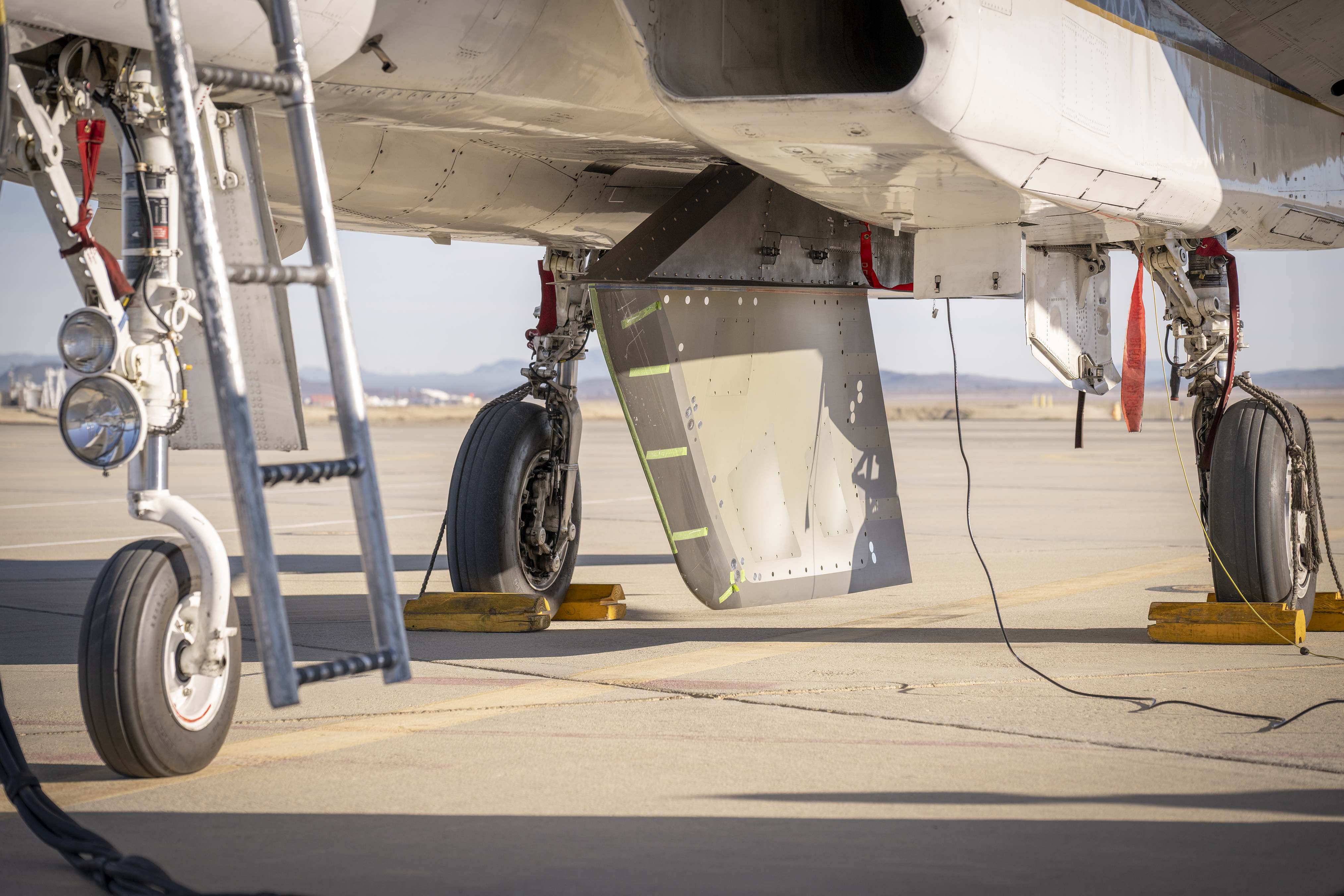
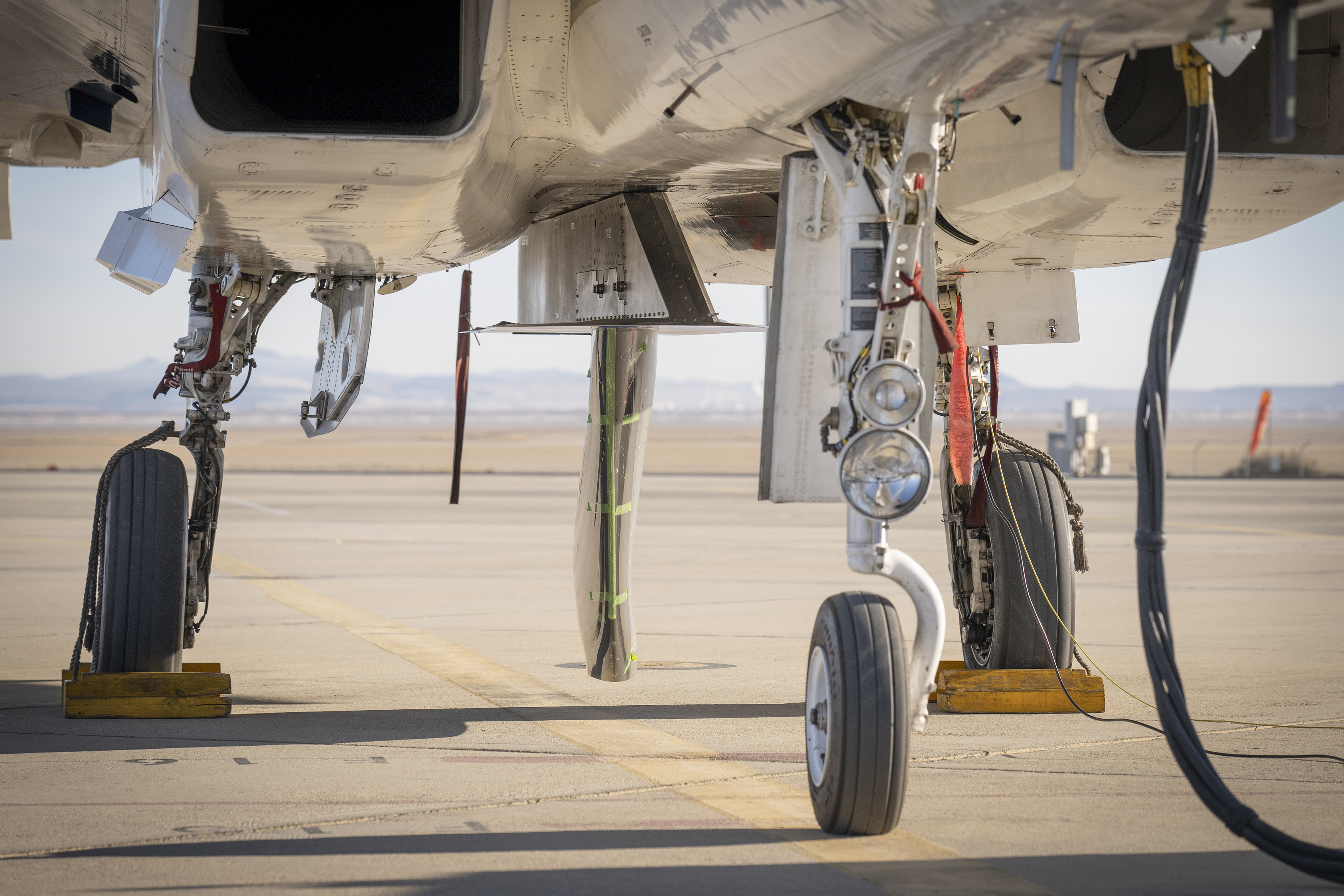
NASA’s Cross Flow Attenuated Natural Laminar Flow test article is mounted beneath the agency’s F-15 research aircraft ahead of the design’s high-speed taxi test on Tuesday, Jan. 12, 2026, at NASA’s Armstrong Flight Research Center in Edwards, California. The 3-foot-tall scale model is designed to increase a phenomenon known as laminar flow and reduce drag, improving efficiency in large, swept wings like those found on most commercial aircraft.
NASA/Christopher LC Clark
NASA researchers successfully completed a high-speed taxi test of a scale model of a design that could make future aircraft more efficient by improving how air flows across a wing’s surface, saving fuel and money.
On Jan. 12, the Crossflow Attenuated Natural Laminar Flow (CATNLF) test article reached speeds of approximately 144 mph, marking its first major milestone. The 3-foot-tall scale model looks like a fin mounted under the belly of one of the agency’s research F-15B testbed jets. However, it’s a scale model of a wing, mounted vertically instead of horizontally. The setup allows NASA to flight-test the wing design using an existing aircraft.
The CATNLF concept aims to increase a phenomenon known as laminar flow and reduce wind resistance, also known as drag.
A NASA computational study conducted between 2014 and 2017 estimated that applying a CATNLF wing design to a large, long-range aircraft like the Boeing 777 could achieve annual fuel savings of up to 10%. Although quantifying the exact savings this technology could achieve is difficult, the study indicates it could approach millions of dollars per aircraft each year.
NASA’s Cross Flow Attenuated Natural Laminar Flow test article is mounted beneath the agency’s F-15 research aircraft ahead of the design’s high-speed taxi test on Tuesday, Jan. 12, 2026, at NASA’s Armstrong Flight Research Center in Edwards, California. The 3-foot-tall scale model is designed to increase a phenomenon known as laminar flow and reduce drag, improving efficiency in large, swept wings like those found on most commercial aircraft.
NASA/Christopher LC Clark
“Even small improvements in efficiency can add up to significant reductions in fuel burn and emissions for commercial airlines,” said Mike Frederick, principal investigator for CATNLF at NASA’s Armstrong Flight Research Center in Edwards, California.
Reducing drag is key to improving efficiency. During flight, a thin cover of air known as the boundary layer forms very near an aircraft’s surface. In this area, most aircraft experience increasing friction, also known as turbulent flow, where air abruptly changes direction. These abrupt changes increase drag and fuel consumption. CATNLF increases laminar flow, or the smooth motion of air, within the boundary layer. The result is more efficient aerodynamics, reduced friction, and less fuel burn.
The CATNLF testing falls under NASA’s Flight Demonstrations and Capabilities project, a part of the agency’s Integrated Aviation Systems Program under the Aeronautics Research Mission Directorate. The concept of was first developed by NASA’s Advanced Air Transport Technology project, and in 2019, NASA Armstrong researchers developed the initial shape and parameters of the model. The design was later refined for efficiency at NASA’s Langley Research Center in Hampton, Virginia.
“Laminar flow technology has been studied and used on airplanes to reduce drag for many decades now, but laminar flow has historically been limited in application,” said Michelle Banchy, Langley principal investigator for CATNLF.
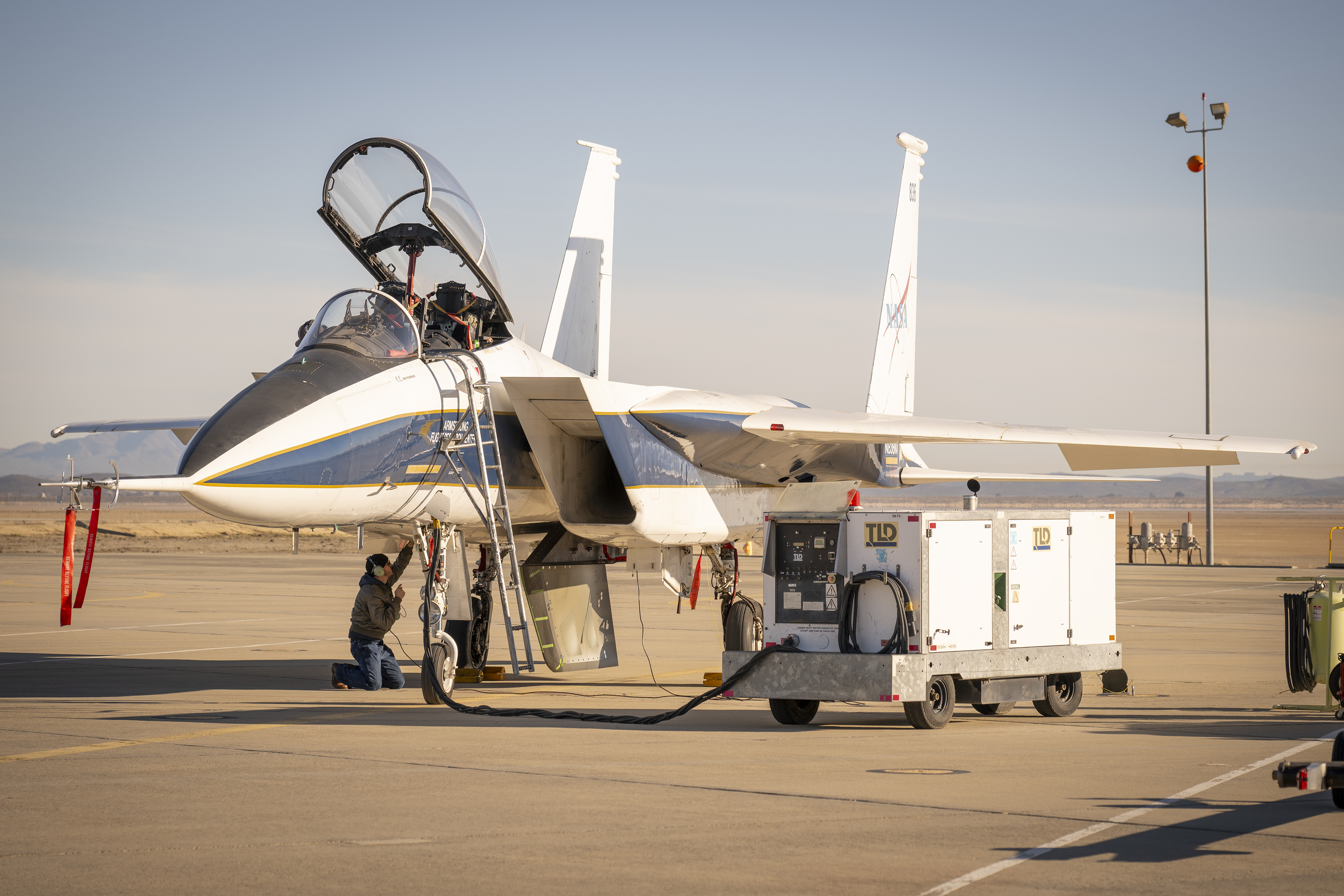
NASA ground crew prepares the agency’s F-15 research aircraft and Cross Flow Attenuated Natural Laminar Flow (CATNLF) test article ahead of its first high-speed taxi test on Tuesday, Jan. 12, 2026, at NASA’s Armstrong Flight Research Center in Edwards, California. The CATNLF design aims to reduce drag on wing surfaces to improve efficiency and, in turn, reduce fuel burn.
NASA/Christopher LC Clark
This limitation is due to crossflow, an aerodynamic phenomenon on angled surfaces that can prematurely end laminar flow. While large, swept wings like those found on most commercial aircraft provide aerodynamic efficiencies, crossflow tendencies remain.
In a 2018 wind tunnel test at Langley, researchers confirmed that the CATNLF design successfully achieved prolonged laminar flow.
“After the positive results in the wind tunnel test, NASA saw enough promise in the technology to progress to flight testing,” Banchy said. “Flight testing allows us to increase the size of the model and fly in air that has less turbulence than a wind tunnel environment, which are great things for studying laminar flow.”
NASA Armstrong’s F-15B testbed aircraft provides the necessary flight environment for laminar flow testing, Banchy said. The aircraft enables researchers to address fundamental questions about the technology while keeping costs lower than alternatives, such as replacing a test aircraft’s wing with a full-scale CATNLF model or building a dedicated demonstrator aircraft.
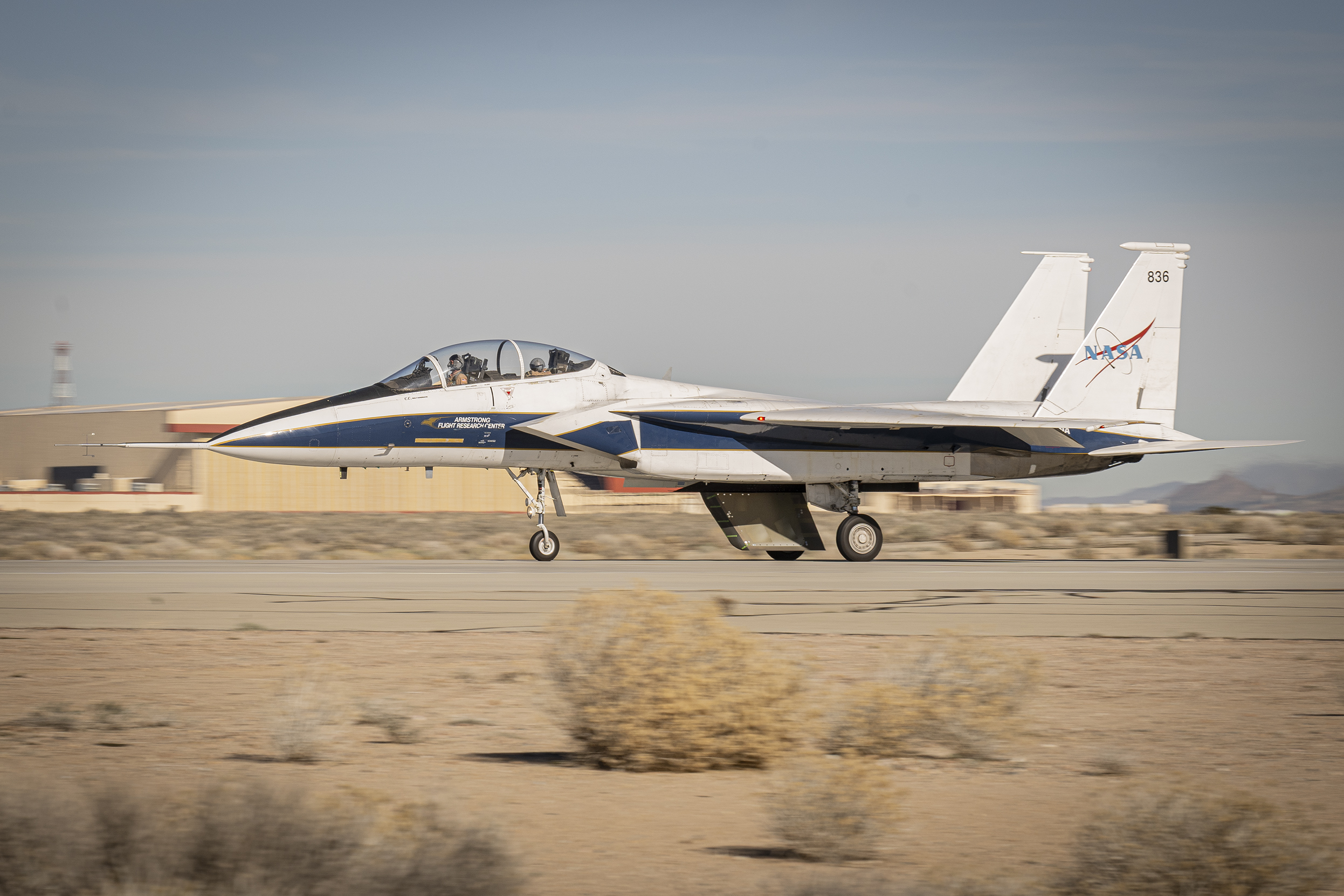
NASA’s Cross Flow Attenuated Natural Laminar Flow (CATNLF) scale model completes its first major milestone – high-speed taxi test – Tuesday, Jan. 12, 2026, at Edwards Air Force Base in California. NASA’s F-15 research aircraft, with the 3-foot-tall test article mounted on its underside, reached speeds of approximately 144 mph during testing. If successful, the technology could be applied to future commercial aircraft to improve efficiency and potentially reduce fuel consumption.
NASA/Christopher LC Clark
CATNLF currently focuses on commercial aviation, which has steadily increased over the past 20 years, with passenger numbers expected to double in the next 20, according to the International Civil Aviation Organization. Commercial passenger aircraft fly at subsonic speeds, or slower than the speed of sound.
“Most of us fly subsonic, so that’s where this technology would have the greatest impact right now,” Frederick said. NASA’s previous computational studies also confirmed that technology like CATNLF could be adapted for supersonic application.
In the coming weeks, CATNLF is expected to begin its first flight, kicking off a series of test flights designed to evaluate the design’s performance and capabilities in flight.
Looking ahead, NASA’s work on CATNLF could lay the groundwork for more efficient commercial air travel and might one day extend similar capabilities to supersonic flight, improving fuel efficiency at even higher speeds.
“The CATNLF flight test at NASA Armstrong will bring laminar technology one step closer to being implemented on next-generation aircraft,” Banchy said.
Preparations for Next Moonwalk Simulations Underway (and Underwater)
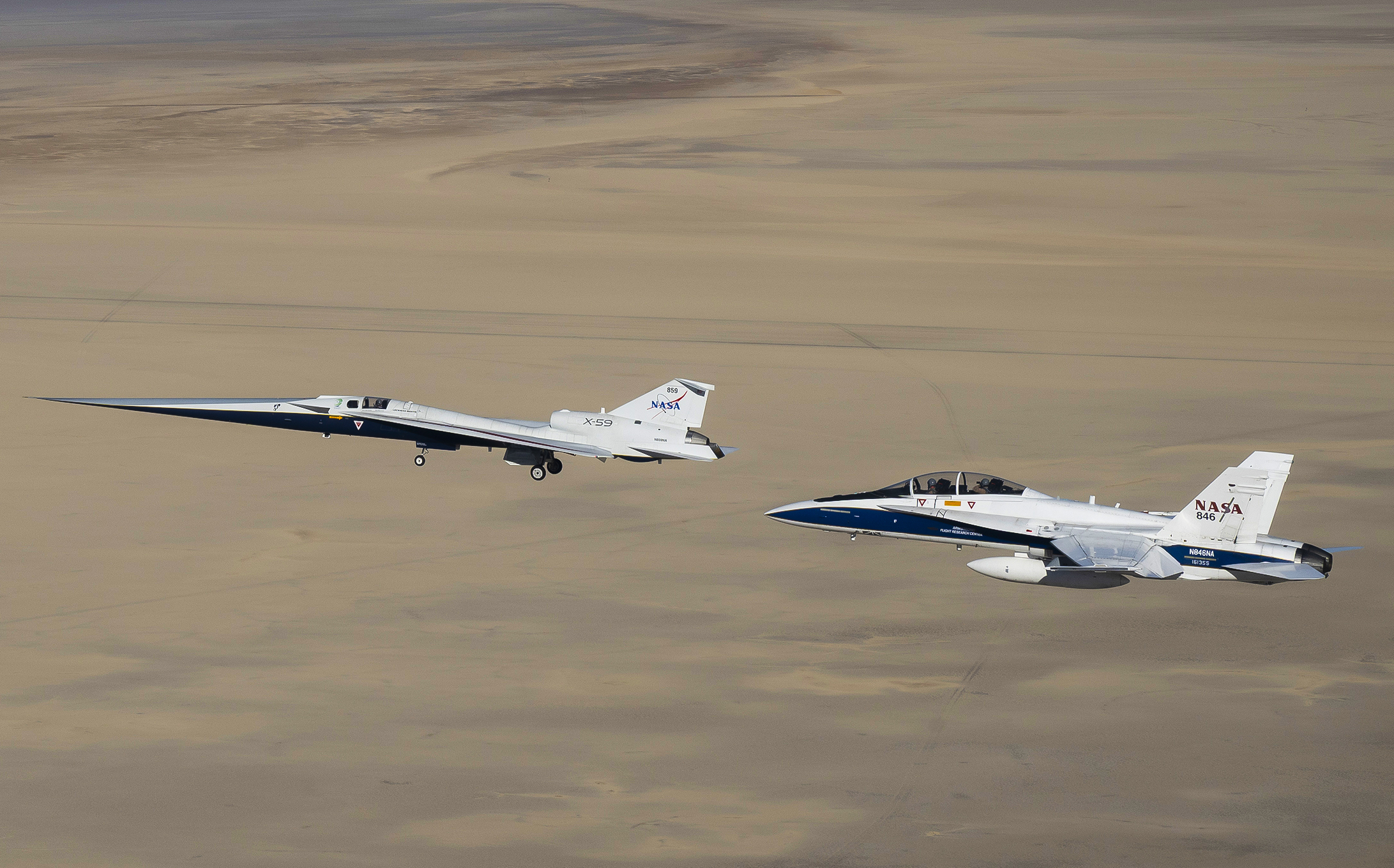
NASA’s X-59 quiet supersonic research aircraft flies above Palmdale and Edwards, California, during its first flight Oct. 28, 2025, accompanied by a NASA F/A-18 research aircraft serving as chase.
NASA/Jim Ross
As NASA’s X-59 quiet supersonic research aircraft continues a series of flight tests over the California high desert in 2026, its pilot will be flying with a buddy closely looking out for his safety.
That colleague will be another test pilot in a separate chase aircraft. His job as chase pilot: keep a careful watch on things as he tracks the X-59 through the sky, providing an extra set of eyes to help ensure the flight tests are as safe as possible.
Having a chase pilot watch to make sure operations are going smoothly is an essential task when an experimental aircraft is exercising its capabilities for the first time. The chase pilot also takes on tasks like monitoring local weather and supplementing communications between the X-59 and air traffic control.
“All this helps reduce the test pilot’s workload so he can concentrate on the actual test mission,” said Jim “Clue” Less, a NASA research pilot since 2010 and 21-year veteran U.S. Air Force flyer.
Less served as chase pilot in a NASA F/A-18 research jet when NASA test pilot Nils Larson made the X-59’s first flight on Oct. 28. Going forward, Less and Larson will take turns flying as X-59 test pilot or chase pilot.
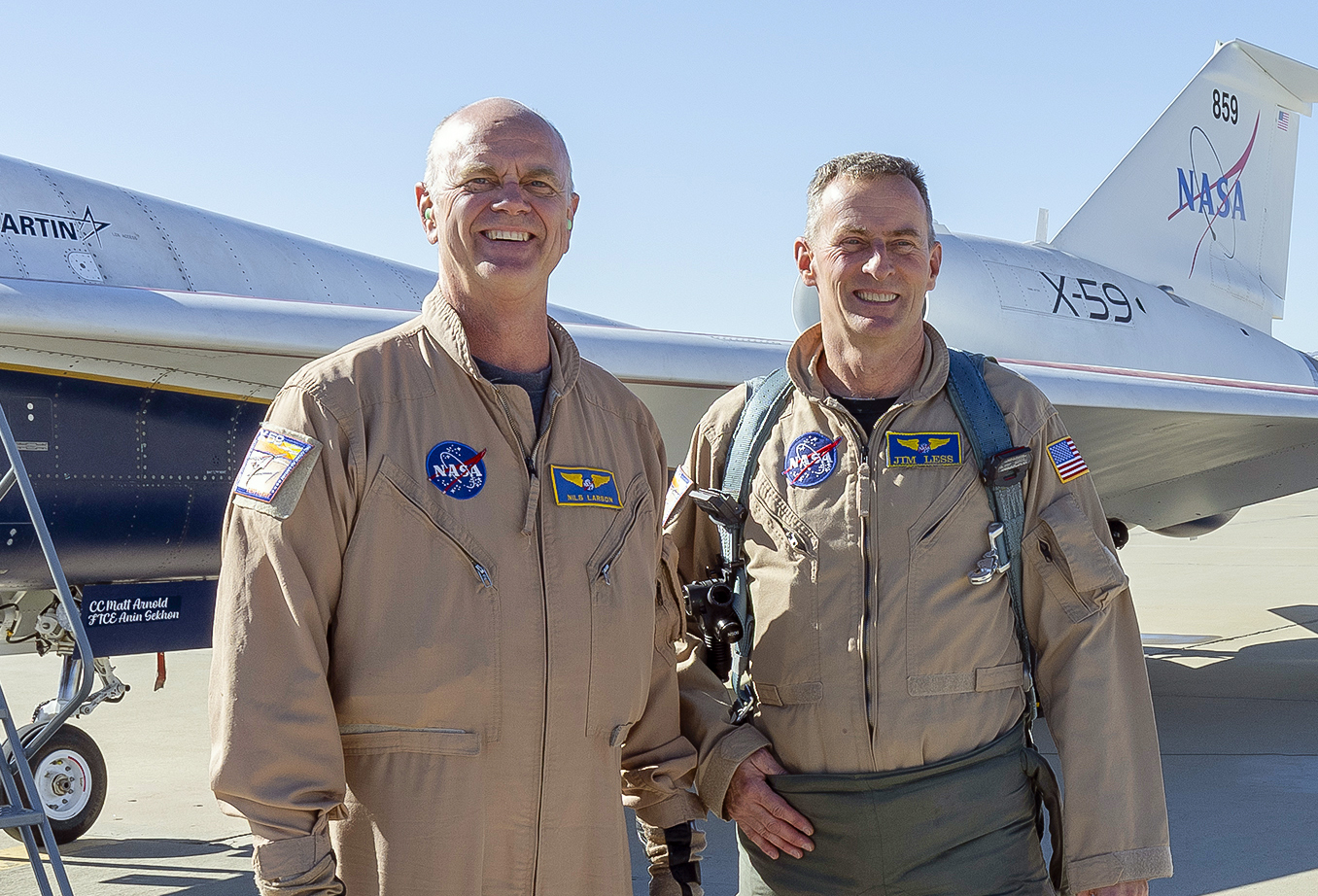
NASA pilots Jim “Clue” Less (left) and Nils Larson celebrate the X-59’s first flight on Oct. 28, 2025. Less flew an F-18 chase aircraft while Larson flew the X-59.
NASA/Genaro Vavuris
Staying Close
So how close does a chase aircraft fly to the X-59?
“We fly as close as we need to,” Less said. “But no closer than we need to.”
The distance depends on where the chase aircraft needs to be to best ensure the success of the test flight. Chase pilots, however, never get so close as to jeopardize safety.
We fly as close as we need to, but no closer than we need to.
Jim "clue" LESS
NASA Test Pilot
For example, during the X-59’s first flight the chase aircraft moved to within a wingspan of the experimental aircraft. At that proximity, the airspeed and altitude indicators inside both aircraft could be compared, allowing the X-59 team to calibrate their instruments.
Generally, the chase aircraft will remain about 500 and 1,000 feet away—or about 5-10 times the length of the X-59 itself—as the two aircraft cruise together.
“Of course, the chase pilot can move in closer if I need to look over something on the aircraft,” Less said. “We would come in as close as needed, but for the most part the goal is to stay out of the way.”
Airborne Photo Op
In a view captured from a NASA F/A-18 chase aircraft, the X-59 quiet supersonic research aircraft lifts off for its first flight Oct. 28, 2025, from U.S. Air Force Plant 42 in Palmdale, California.
NASA/Lori Losey
The up-close-and-personal vantage point of the chase aircraft also affords the opportunity to capture photos and video of the test aircraft.
For the initial X-59 flight, a NASA photographer—fully trained and certified to fly in a high-performance jet—sat in the chase aircraft’s rear seat to record images and transmit high-definition video down to the ground.
“We really have the best views,” Less said. “The top focus of the test team always is a safe flight and landing. But if we get some great shots in the process, it’s an added bonus.”
Chase aircraft can also carry sensors that gather data during the flight that would be impossible to obtain from the ground. In a future phase of X-59 flights, the chase aircraft will carry a probe to measure the X-59’s supersonic shock waves and help validate that the airplane is producing a quieter sonic “thump,” rather than a loud sonic boom to people on the ground.
The instrumentation was successfully tested using a pair of NASA F-15 research jets earlier this year.
As part of NASA’s Quesst mission, the data could help open the way for commercial faster-than-sound air travel over land.
Choice of Chase Aircraft
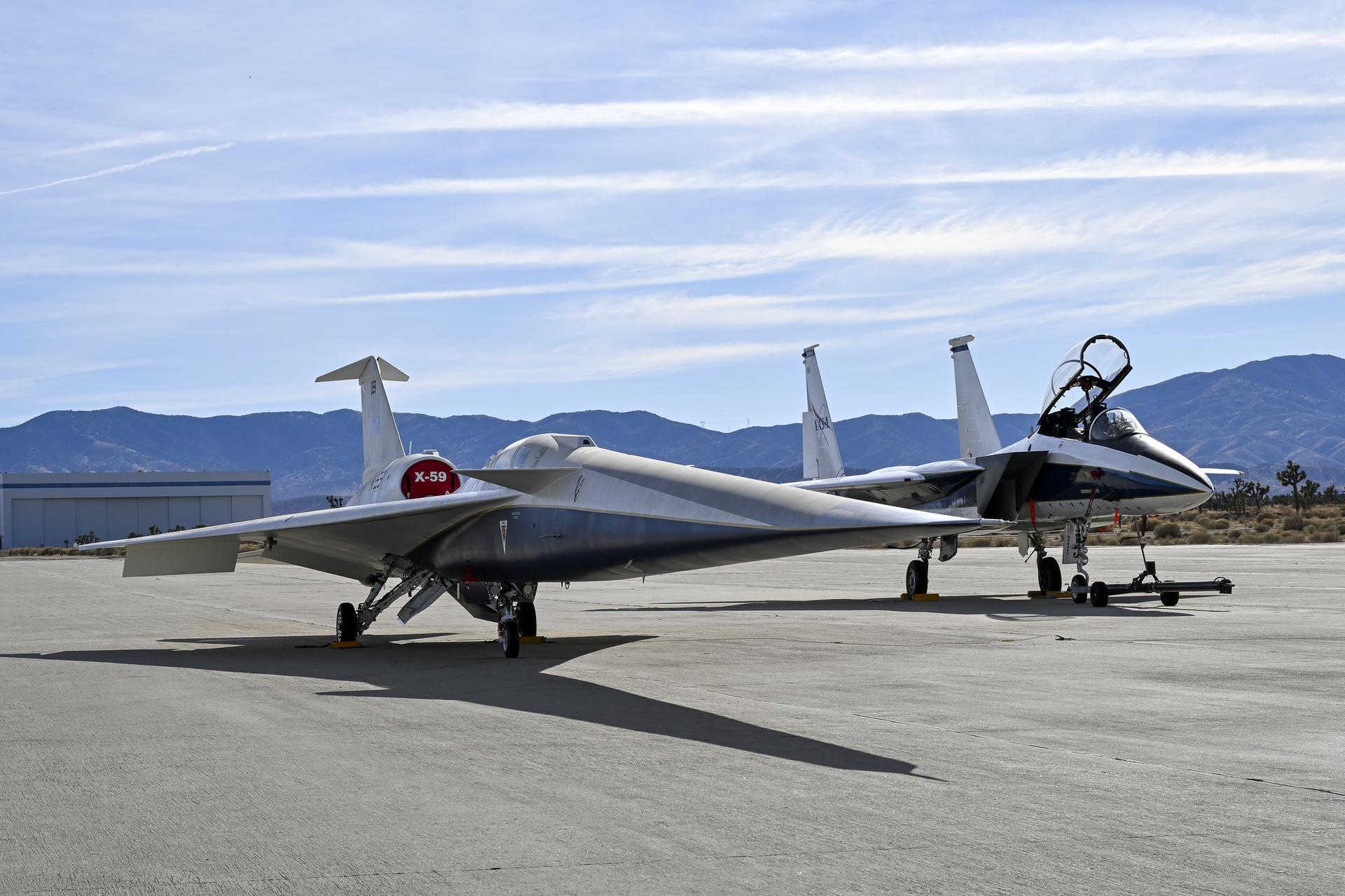
A NASA F-15 aircraft sits 20 feet off the left side of the X-59 aircraft, with a white hangar and hills in the background, during electromagnetic interference testing.
NASA/Carla Thomas
Chase aircraft have served as a staple of civilian and military flight tests for decades, with NASA and its predecessor—the National Advisory Committee for Aeronautics—employing aircraft of all types for the job.
While both types are qualified as chase aircraft for the X-59, each has characteristics that make them appropriate for certain tasks.
The F/A-18 is a little more agile flying at lower speeds. One of NASA’s F/A-18s has a two-seat cockpit, and the optical quality and field of view of its canopy makes it the preferred aircraft for Armstrong’s in-flight photographers.
At the same time, the F-15 is more capable of keeping pace with the X-59 during supersonic test flights and carries the instrumentation that will measure the X-59’s shock waves.
“The choice for which chase aircraft we will use for any given X-59 test flight could go either way depending on other mission needs and if any scheduled maintenance requires the airplane to be grounded for a while,” Less said.
About the Author
Jim Banke
Managing Editor/Senior Writer
Jim Banke is a veteran aviation and aerospace communicator with more than 40 years of experience as a writer, producer, consultant, and project manager based at Cape Canaveral, Florida. He is part of NASA Aeronautics' Strategic Communications Team and is Managing Editor for the Aeronautics topic on the NASA website.
After years of design, development, and testing, NASA’s X-59 quiet supersonic research aircraft took to the skies for the first time on Oct. 28, 2025, markin...
Preparations for Next Moonwalk Simulations Underway (and Underwater)
Oregon Air National Guard ground crew guides one of the NASA’s newest F-15 aircraft onto the ramp at the agency’s Armstrong Flight Research Center in Edwards, California, on Monday, Dec. 22, 2025. The retired U.S. Air Force F-15s come from the Oregon Air National Guard’s 173rd Fighter Wing and will transition from military service to support NASA’s flight research fleet.
NASA/Christopher LC Clark
Oregon Air National Guard and NASA flight crew look out across the desert while awaiting the arrival of the NASA’s newest F-15 aircraft from the Oregon Air National Guard’s 173rd Fighter Wing to NASA’s Armstrong Flight Research Center in Edwards, California, on Monday, Dec. 22, 2025
NASA/Christopher LC Clark
NASA’s newest F-15 aircraft arrive at the agency’s Armstrong Flight Research Center in Edwards, California, on Monday, Dec. 22, 2025. The two retired U.S. Air Force F-15s will support ongoing supersonic flight research for NASA’s Flight Demonstrations and Capabilities Project and the Quesst mission’s X-59 quiet supersonic research aircraft.
NASA/Christopher LC Clark
NASA staff and Oregon Air National Guard’s 173rd Fighter Wing crew pose for a group photo at NASA’s Armstrong Flight Research Center in Edwards, California, on Monday, Dec. 22, 2025. The group stands in front of one of two F-15 aircraft added to the agency’s flight research fleet.
NASA/Christopher LC Clark
Oregon Air National Guard pilots deliver NASA’s newest F-15 aircraft from the Oregon Air National Guard’s 173rd Fighter Wing at Kingsley Field to NASA’s Armstrong Flight Research Center in Edwards, California, on Monday, Dec. 22, 2025. After completing their final flights with the Air Force, the two aircraft begin their new role supporting NASA’s flight research.
NASA/Christopher LC Clark
Two retired U.S. Air Force F-15 jets have joined the flight research fleet at NASA’s Armstrong Flight Research Center in Edwards, California, transitioning from military service to a new role enabling breakthrough advancements in aerospace.
The F-15s will support supersonic flight research for NASA’s Flight Demonstrations and Capabilities project, including testing for the Quesst mission’s X-59 quiet supersonic research aircraft. One of the aircraft will return to the air as an active NASA research aircraft. The second will be used for parts to support long-term fleet sustainment.
“These two aircraft will enable successful data collection and chase plane capabilities for the X-59 through the life of the Low Boom Flight Demonstrator project” said Troy Asher, director for flight operations at NASA Armstrong. “They will also enable us to resume operations with various external partners, including the Department of War and commercial aviation companies.”
The aircraft came from the Oregon Air National Guard’s 173rd Fighter Wing at Kingsley Field. After completing their final flights with the Air Force, the two aircraft arrived at NASA Armstrong Dec. 22, 2025.
“NASA has been flying F-15s since some of the earliest models came out in the early 1970s,” Asher said. “Dozens of scientific experiments have been flown over the decades on NASA’s F-15s and have made a significant contribution to aeronautics and high-speed flight research.”
The F-15s allow NASA to operate in high-speed, high-altitude flight-testing environments. The aircraft can carry experimental hardware externally – under its wings or slung under the center – and can be modified to support flight research.
Now that these aircraft have joined NASA’s fleet, the team at Armstrong can modify their software, systems, and flight controls to suit mission needs. The F-15’s ground clearance allows researchers to install instruments and experiments that would not fit beneath many other aircraft.
NASA has already been operating two F-15s modified so their pilots can operate safely at up to 60,000 feet, the top of the flight envelop for the X-59, which will cruise at 55,000 feet. The new F-15 that will fly for NASA will receive the same modification, allowing for operations at altitudes most standard aircraft cannot reach. The combination of capability, capacity, and adaptability makes the F-15s uniquely suited for flight research at NASA Armstrong.
“The priority is for them to successfully support the X-59 through completion of that mission,” Asher said. “And over the longer term, these aircraft will help position NASA to continue supporting advanced aeronautics research and partnerships.”
Preparations for Next Moonwalk Simulations Underway (and Underwater)
In 2025, NASA’s Armstrong Flight Research Center in Edwards, California, advanced work across aeronautics, Earth science, exploration technologies, and emerging aviation systems, reinforcing its role as one of the agency’s primary test sites for aeronautics research. From early concept evaluations to full flight test campaigns, teams enhanced measurement tools, refined safety systems, and generated data that supported missions across NASA. Operating from the Mojave Desert, NASA Armstrong continued applying engineering design with real-world performance, carrying forward research that informs how aircraft operate today and how new systems may function in the future.
The year’s progress also reflects the people behind the work – engineers, technicians, pilots, operators, and mission support staff who navigate complex tests and ensure each mission advances safely and deliberately. Their efforts strengthened partnerships with industry, small businesses, and universities while expanding opportunities for students and early career professionals. Together they sustained NASA Armstrong’s long-standing identity as a center where innovation is proven in flight and where research helps chart the course for future aviation and exploration.
“We executed our mission work safely, including flight of the first piloted NASA X-plane in decades, while under challenging conditions,” said Brad Flick, center director of NASA Armstrong. “It tells me our people embrace the work we do and are willing to maintain high levels of professionalism while enduring personal stress and uncertainty. It’s a testimony to the dedication of our NASA and contractor workforce.”
Teams continued advancing key projects, supporting partners, and generating data that contributes to NASA’s broader mission.
Quiet supersonic flight and the Quesst mission
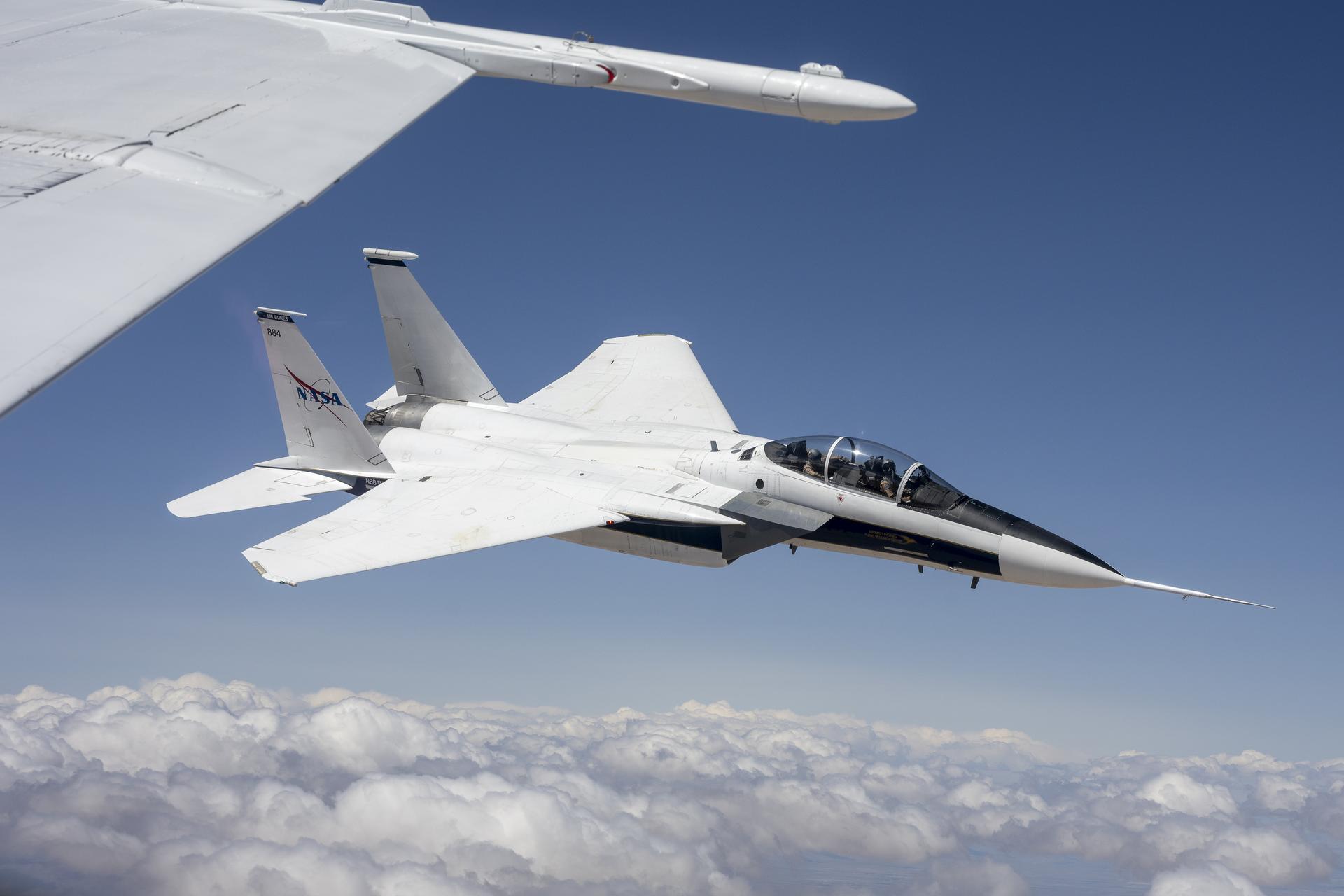
NASA’s F-15D research aircraft conducts a calibration flight of a shock-sensing probe near NASA’s Armstrong Flight Research Center in Edwards, California. The shock-sensing probe is designed to measure the signature and strength of shock waves in flight. The probe was validated during dual F-15 flights and will be flown behind NASA’s X-59 to measure small pressure changes caused by shock waves in support of the agency’s Quesst mission.
NASA/Jim Ross
NASA Armstrong continued its quiet supersonic research, completing a series of activities in support of NASA’s Quesst mission. On the X-59 quiet supersonic research aircraft, the team performed electromagnetic interference tests and ran engine checks to prepare the aircraft for taxi tests. The Schlieren, Airborne Measurements, and Range Operations for Quesst (SCHAMROQ) team completed aircraft integration and shock-sensing probe calibration flights, refining the tools needed to characterize shock waves from the X-59. These efforts supported the aircraft’s progression toward its first flight on Oct. 28, marking a historic milestone and the beginning of its transition to NASA Armstrong for continued testing.
The center’s Commercial Supersonic Technology (CST) team also conducted airborne validation flights using NASA F-15s, confirming measurement systems essential for Quesst’s next research phase. Together, this work forms the technical backbone for upcoming community response studies, where NASA will evaluate whether quieter supersonic thumps could support future commercial applications.
The X-59 team completed electromagnetic interference testing on the aircraft, verifying system performance and confirming that all its systems could reliably operate together.
NASA’s X-59 engine testing concluded with a maximum afterburner test that demonstrated the engine’s ability to generate the thrust required for supersonic flight.
Engineers conducted engine speed-hold evaluations to assess how the X-59’s engine responds under sustained throttle conditions, generating data used to refine control settings for upcoming flight profiles.
NASA Armstrong’s CST team validated the tools that will gather airborne data in support the second phase of the agency’s Quesst mission.
NASA’s X-59 team advanced preparations on the aircraft through taxi tests, ensuring aircraft handling systems performed correctly ahead of its first flight.
NASA Armstrong’s photo and video team documented X-59 taxi tests as the aircraft moved under its own power for the first time.
The X-59 team evaluated braking, steering, and integrated systems performance after the completion of the aircraft’s low-speed taxi tests marking one of the final steps before flight.
NASA Armstrong teams advanced the X-59 toward first flight by prioritizing safety at every step, completing checks, evaluations, and system verifications to ensure the aircraft was ready when the team was confident it could move forward.
NASA and the Lockheed Martin contractor team completed the X-59’s historic first flight, delivering the aircraft to NASA Armstrong for the start of its next phase of research.
Ultra-efficient and high-speed aircraft research
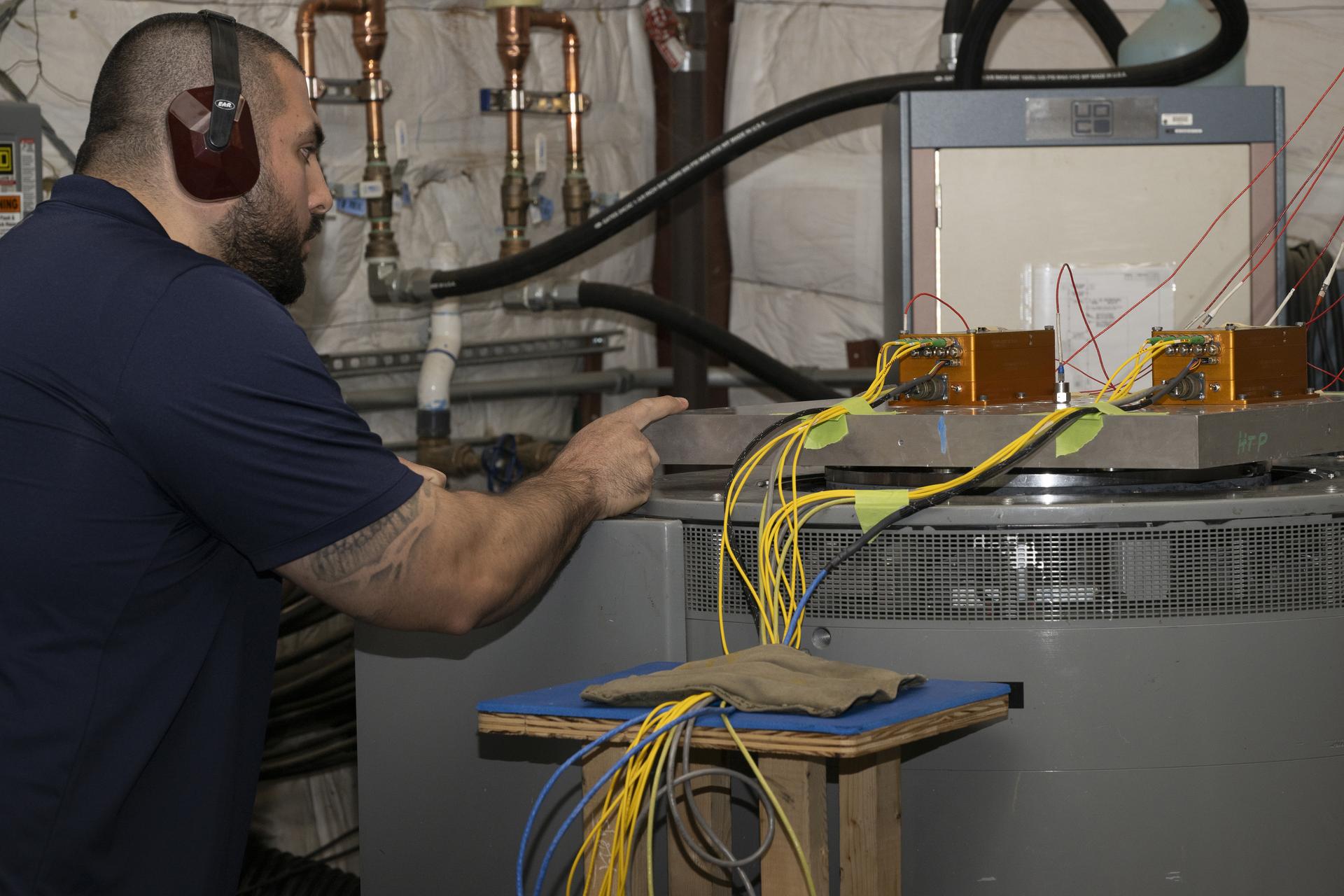
Jonathan Lopez prepares the hypersonic Fiber Optic Sensing System for vibration tests in the Environmental Laboratory at NASA’s Armstrong Flight Research Center in Edwards, California. Testing on a machine called a shaker proved that the system could withstand the severe vibration it will endure in hypersonic flight, or travel at five times the speed of sound.
NASA/Jim Ross
Across aeronautics programs, Armstrong supported work that strengthens NASA’s ability to study sustainable, efficient, and high-performance aircraft. Teams conducted aerodynamic measurements and improved test-article access for instrumentation, enabling more precise evaluations of advanced aircraft concepts. Engineers continued developing tools and techniques to study aircraft performance under high-speed and high-temperature conditions, supporting research in hypersonic flight.
The Sustainable Flight Demonstrator research team measured airflow over key wing surfaces in a series of wind tunnel tests, generating data used to refine future sustainable aircraft designs.
Technicians at NASA Armstrong installed a custom structural floor inside the X-66 demonstrator, improving access for instrumentation work and enabling more efficient modification and evaluation.
Transforming air mobility and new aviation systems
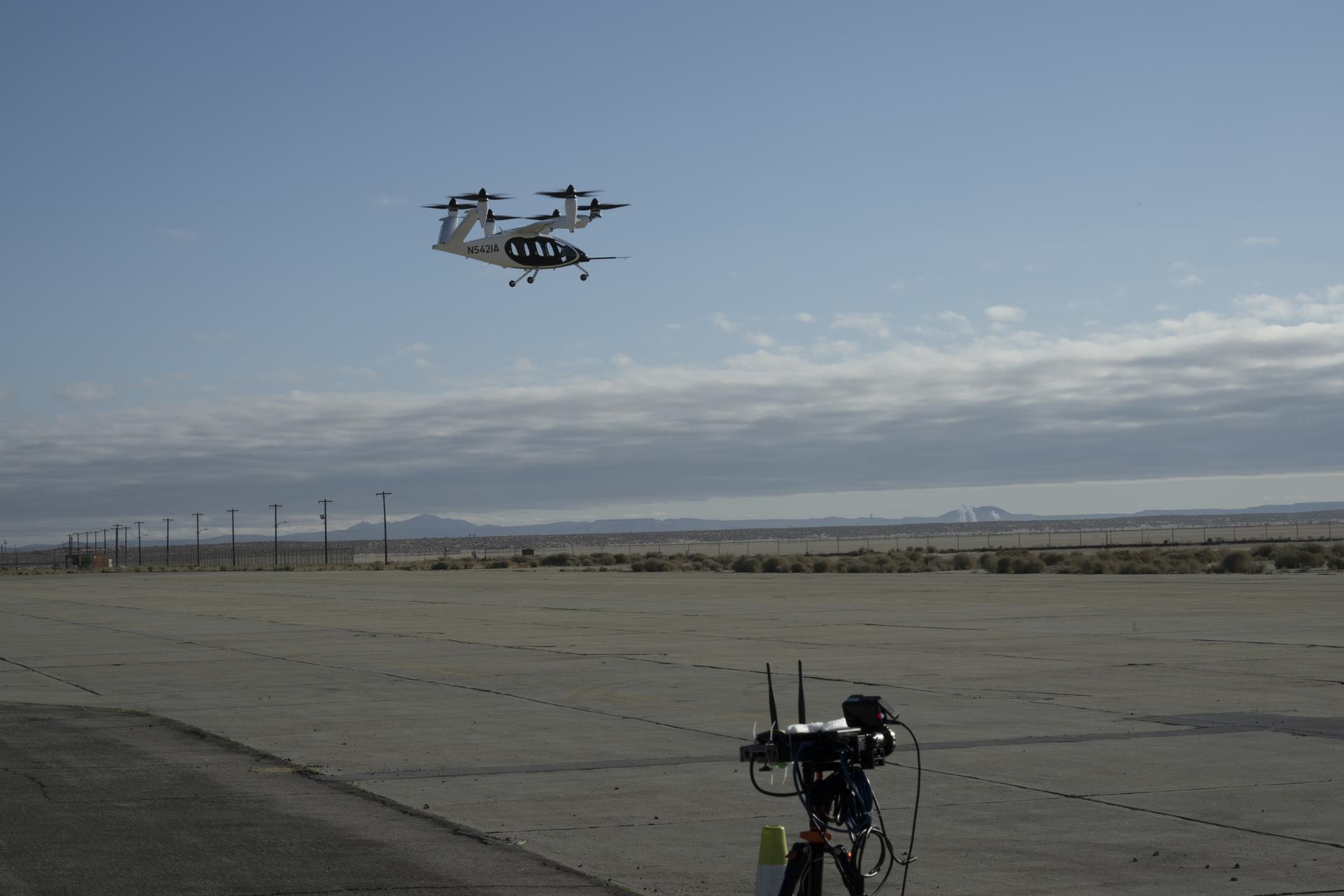
One of multiple NASA distributed sensing ground nodes is set up in the foreground while an experimental air taxi aircraft owned by Joby Aviation hovers in the background near NASA’s Armstrong Flight Research Center in Edwards, California, on March 12, 2025. NASA is collecting information during this study to help advance future air taxi flights, especially those occurring in cities, to track aircraft moving through traffic corridors and around landing zones.
NASA/Genaro Vavuris
NASA Armstrong supported multiple aspects of the nation’s growing air mobility ecosystem. Researchers conducted tests and evaluations to better understand aircraft performance, airflow, and passenger experience. Additional work included assessing drone-based inspection techniques, developing advanced communication networks, performing drop tests, and refining methods to evaluate emerging mobility aircraft.
These studies support NASA’s broader goal of integrating new electric, autonomous, and hybrid aircraft safely into the national airspace.
A small business partnership demonstrated drone-based inspection techniques that could reduce maintenance time and improve safety for commercial aircraft operations.
NASA Armstrong researchers tested air traffic surveillance technology against the demands of air taxis flying at low altitudes through densely populated cities, using the agency’s Pilatus PC-12 to support safer air traffic operations.
Researchers at NASA Armstrong collected airflow data from Joby using a ground array of sensors to examine how its circular wind patterns might affect electric air taxi performance in future urban operations.
NASA Armstrong’s Ride Quality Laboratory conducted air taxi passenger comfort studies in support of the agency’s Advanced Air Mobility mission to better understand how motion, vibration, and other factors affect ride comfort, informing the industry’s development of electric air taxis and drones.
Earth observation and environmental research
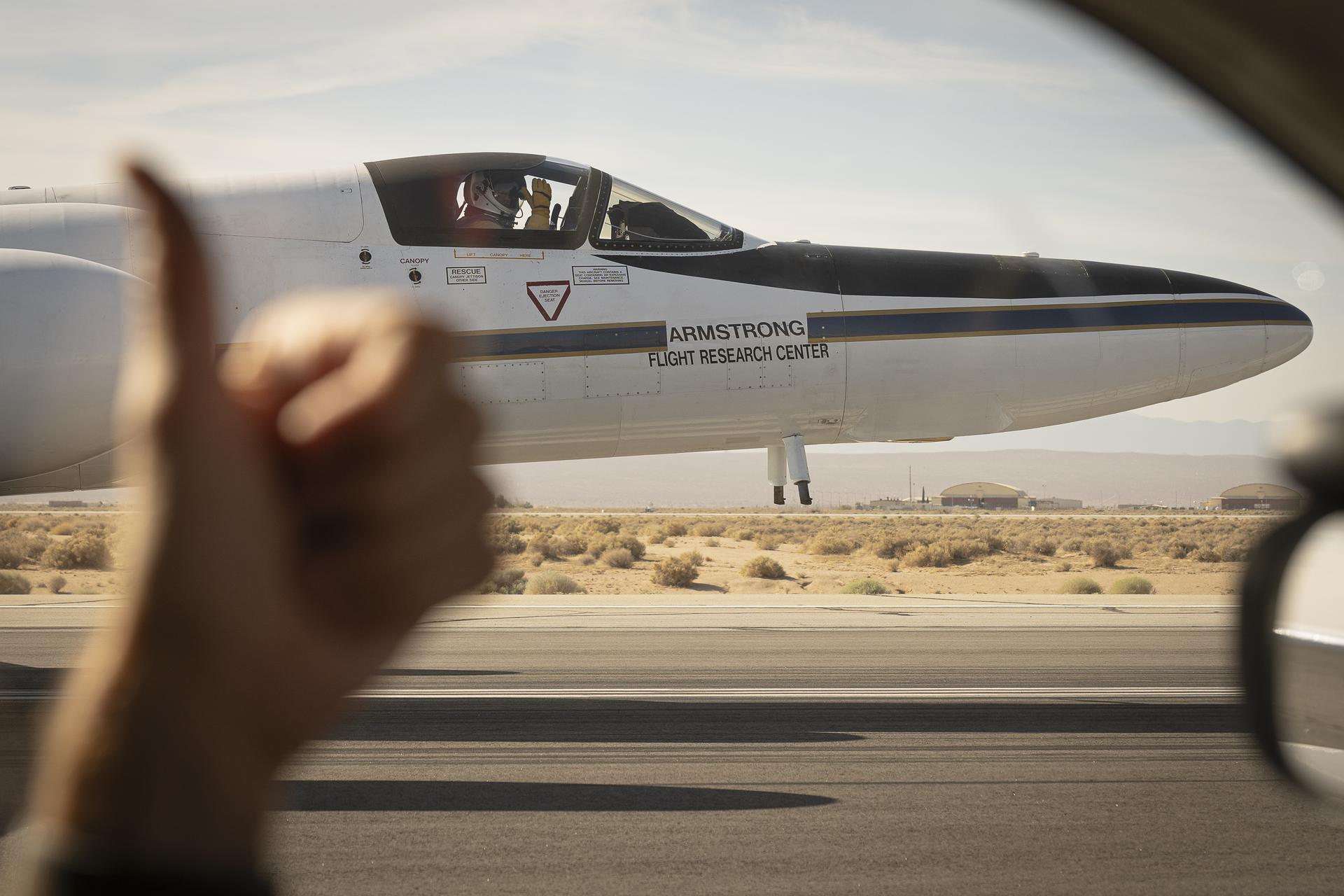
From the window of the ER-2 chase car, a crew member gives a thumbs up to the pilot as NASA Armstrong Flight Research Center’s ER-2 aircraft taxis at Edwards, California, on Thursday, Aug. 21, 2025. The gesture signals a final check before takeoff for the high-altitude mission supporting the Geological Earth Mapping Experiment (GEMx).
NASA/Christopher LC Clark
Earth science campaigns at NASA Armstrong contributed to the agency’s ability to monitor environmental changes and improve satellite data accuracy. Researchers tested precision navigation systems that keep high-speed aircraft on path, supporting more accurate atmospheric and climate surveys. Airborne measurements and drone flights documented wildfire behavior, smoke transport, and post-fire impacts while gathering temperature, humidity, and airflow data during controlled burns. These efforts also supported early-stage technology demonstrations, evaluating new wildfire sensing tools under real flight conditions to advance fire response research. High-altitude aircraft contributed to missions that improved satellite calibration, refined atmospheric measurements, and supported snowpack and melt studies to enhance regional water-resource forecasting.
Researchers at NASA Armstrong tested a new precision‑navigation system that can keep high‑speed research aircraft on exact flight paths, enabling more accurate Earth science data collection during airborne environmental and climate‑survey missions.
NASA’s B200 King Air flew over wildfire‑affected regions equipped with the Compact Fire Infrared Radiance Spectral Tracker (c‑FIRST), collecting thermal‑infrared data to study wildfire behavior, smoke spread, and post‑fire ecological impacts in near real time.
NASA Armstrong’s Alta X drone carried a 3D wind sensor and a radiosonde to measure temperature, pressure, humidity, and airflow during a prescribed burn in Geneva State Forest, gathering data to help improve wildland fire behavior models and support firefighting agencies.
NASA’s ER‑2 aircraft carried the Airborne Lunar Spectral Irradiance (air-LUSI) instrument on night flights, measuring moonlight reflectance to generate calibration data – improving the accuracy of Earth‑observing satellite measurements.
The center’s ER-2 also flew above cloud layers with specialized instrumentation to collect atmospheric and cloud measurements. These data help validate and refine Earth observing satellite retrievals, improving climate, weather, and aerosol observations.
Airborne campaigns at NASA Armstrong measured snowpack and melt patterns in the western U.S., providing data to improve water-resource forecasting for local communities.
Exploration technology and Artemis support
An Alta X drone is positioned at altitude for an air launch of the Enhancing Parachutes by Instrumenting the Canopy test experiment on June 4, 2025, at NASA’s Armstong Flight Research Center in Edwards, California. NASA researchers are developing technology to make supersonic parachutes safer and more reliable for delivering science instruments and payloads to Mars.
NASA/Christopher LC Clark
NASA Armstrong supported exploration technologies that will contribute to agency’s return to the Moon and future missions deeper into the solar system, including sending the first astronauts – American astronauts – to Mars. Teams advanced sensor systems and conducted high-altitude drop tests to capture critical performance data, supporting the need for precise entry, descent, and landing capabilities on future planetary missions.
Contributions from NASA Armstrong also strengthen the systems and technologies that help make Artemis – the agency’s top priority – safer, more reliable, and more scientifically productive, supporting a sustained human presence on the Moon and preparing for future human exploration of Mars.
The EPIC team at NASA Armstrong conducted research flights to advance sensor technology for supersonic parachute deployments, evaluating performance during high-speed, high-altitude drops relevant to future planetary missions.
Imagery from the EPIC test flights at NASA Armstrong highlights the parachute system’s high-altitude deployment sequence and demonstrated its potential for future Mars delivery concepts.
People, workforce, and community engagement
The center expanded outreach, education, and workforce development efforts throughout the year. Students visited NASA Armstrong for hands-on exposure to careers in aeronautics, while staff and volunteers supported a regional robotics competition that encouraged exploration of the field. Educators brought aeronautics concepts directly into classrooms across the region, and interns from around the country gained experience supporting real flight research projects.
NASA Armstrong also highlighted unique career pathways and recognized employees whose work showcases the human side of NASA missions. A youth aviation program launched with a regional museum provided additional opportunities for young learners to explore flight science, further strengthening the center’s community impact:
Students from Palmdale High School Engineering Club visited NASA Armstrong, where staff engaged with them to explore facilities, discuss aerospace work, and promote STEM careers as part of the center’s community outreach.
NASA Armstrong staff and volunteers mentored high school teams at the 2025 Aerospace Valley FIRST Robotics Competition, helping students build and test robots and providing hands-on experience with engineering to foster interest in STEM careers.
In April, NASA Armstrong expanded outreach in 2025 by bringing aeronautics concepts to students through classroom workshops, presentations, and hands-on activities, giving young learners direct exposure to NASA research and inspiring possible future careers in science and engineering.
Students from across the country participated in internships at NASA Armstrong, gaining hands-on experience in flight research and operations while contributing to real-world aerospace projects.
In May, a NASA Armstrong videographer earned national recognition for work that highlights the people behind the center’s research missions, showing how scientists, engineers, and flight crews collaborate to advance aeronautics and space exploration.
Daniel Eng, a systems engineer with NASA’s Air Mobility Pathfinders project, shared his career path from the garment industry to aerospace, illustrating how diverse experiences contribute to the center’s technical workforce and support its advanced flight research and engineering projects.
In June, NASA Armstrong recognized one of its interns for hands-on work with the center’s aircraft. With more than a decade in the auto industry, they demonstrated how early career engineers can gain real-world experience and develop skills for careers in aerospace and flight research.
NASA Armstrong partnered with a regional museum to create a youth aviation program that introduces students to flight science and operations, providing hands-on learning opportunities and inspiring interest in aerospace and STEM careers.
Center infrastructure and research capabilities
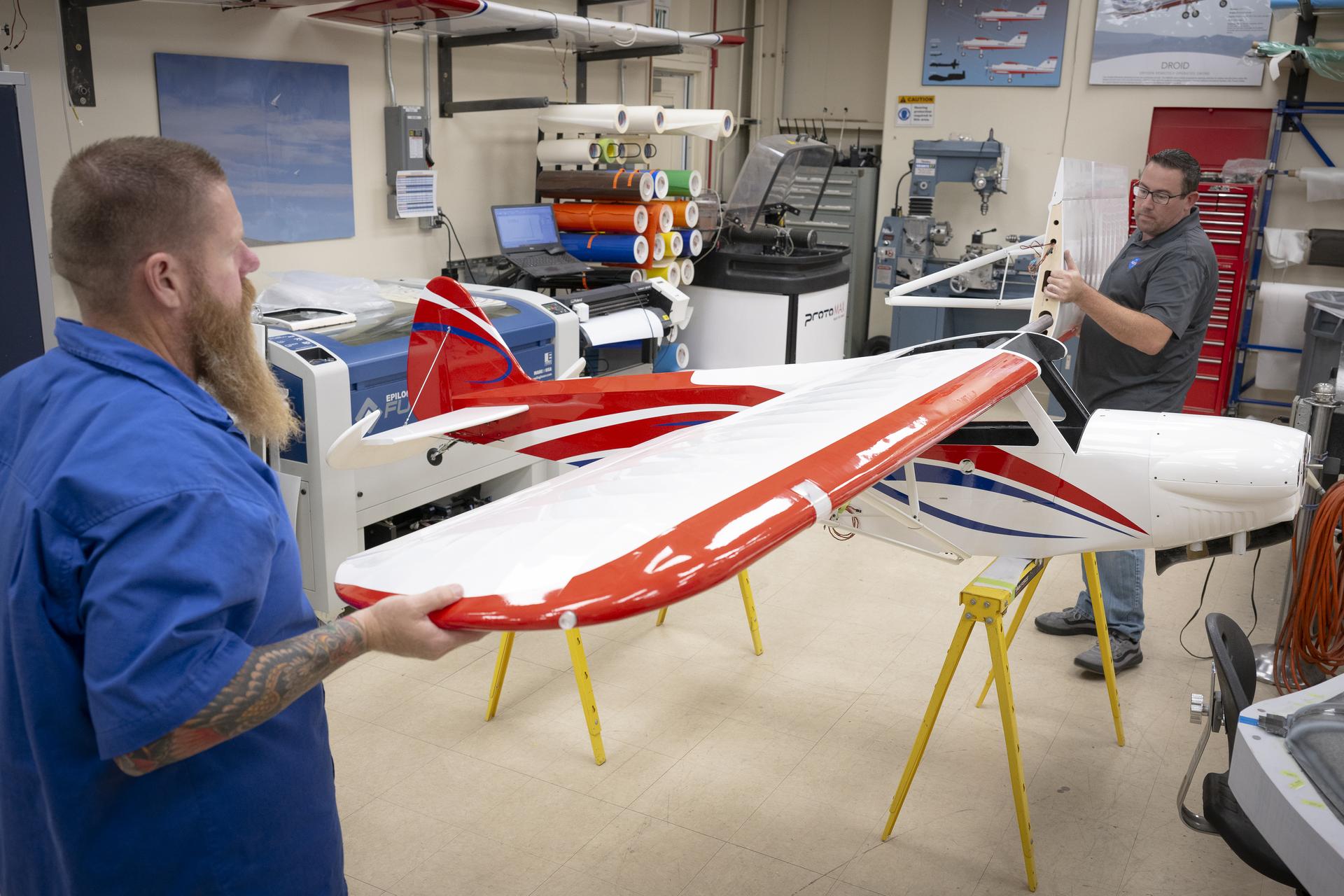
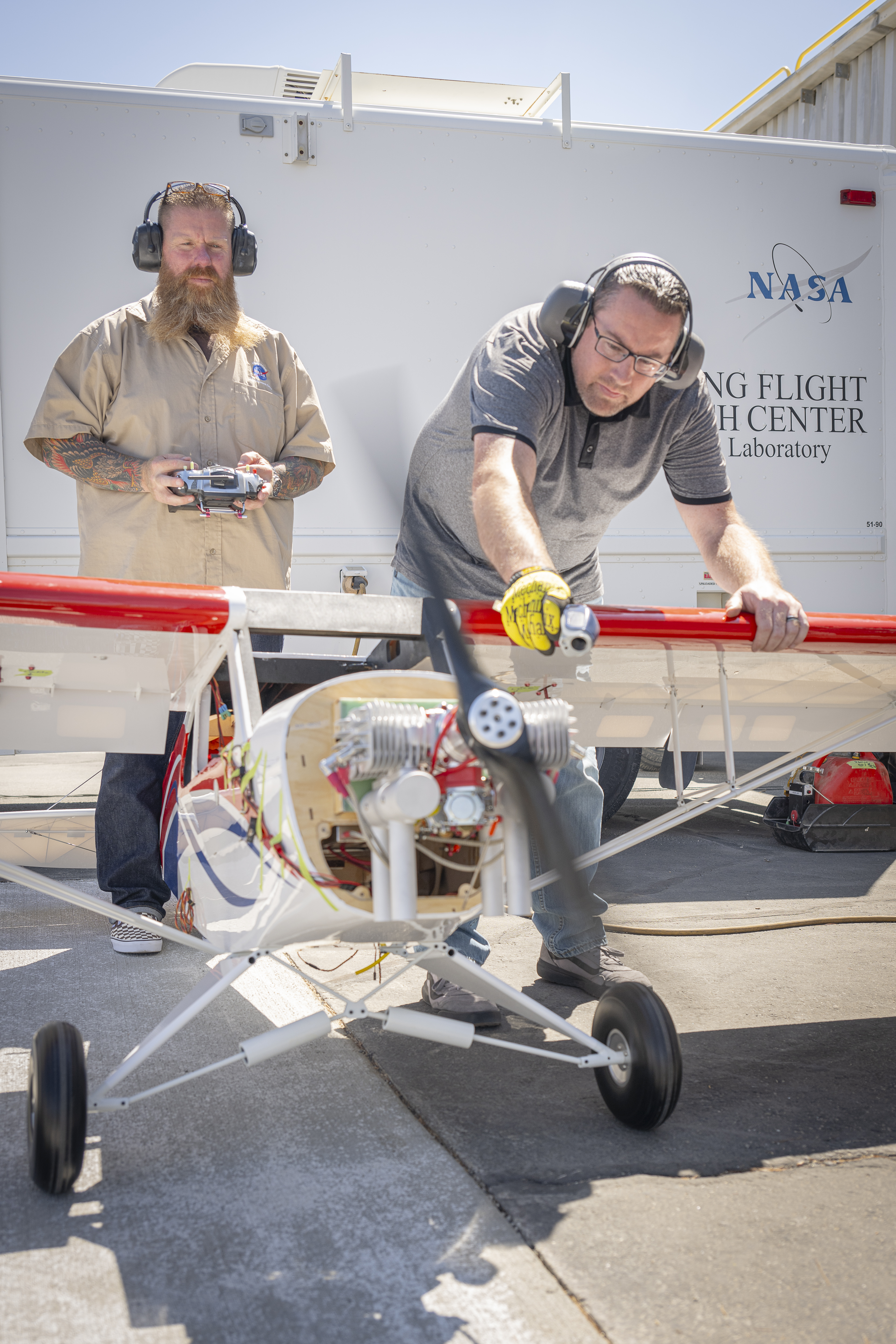
Justin Hall, left, and Justin Link attach the wings onto a subscale aircraft on Wednesday, Sept. 3, 2025, at NASA’s Armstong Flight Research Center in Edwards, California. Hall is chief pilot at the center’s Dale Reed Subscale Flight Research Laboratory and Link is a pilot for small uncrewed aircraft systems.
NASA/Christopher LC Clark
Facility improvements and new platforms strengthened NASA Armstrong’s research capabilities. A rooftop operation removed a historic telemetry pedestal to make way for updated infrastructure, while preserving an important artifact of the center’s flight test heritage. Engineers also completed a new subscale research aircraft, providing a flexible, cost-effective platform for evaluating aerodynamics, instrumentation, and flight control concepts in preparation for full-scale testing:
The center improved workspace access and supported a re-roofing project during a helicopter crew operation that removed a 2,500-pound telemetry pedestal from a building rooftop, preserving a piece of the center’s flight history heritage.
Engineers at NASA Armstrong built a new subscale experimental aircraft to replace the center’s aging MicroCub. The 14-foot wingspan, 60-pound aircraft provides a flexible, cost-effective platform for testing aerodynamics, instrumentation, and flight control concepts while reducing risk before full-scale or crewed flight tests.
Looking ahead
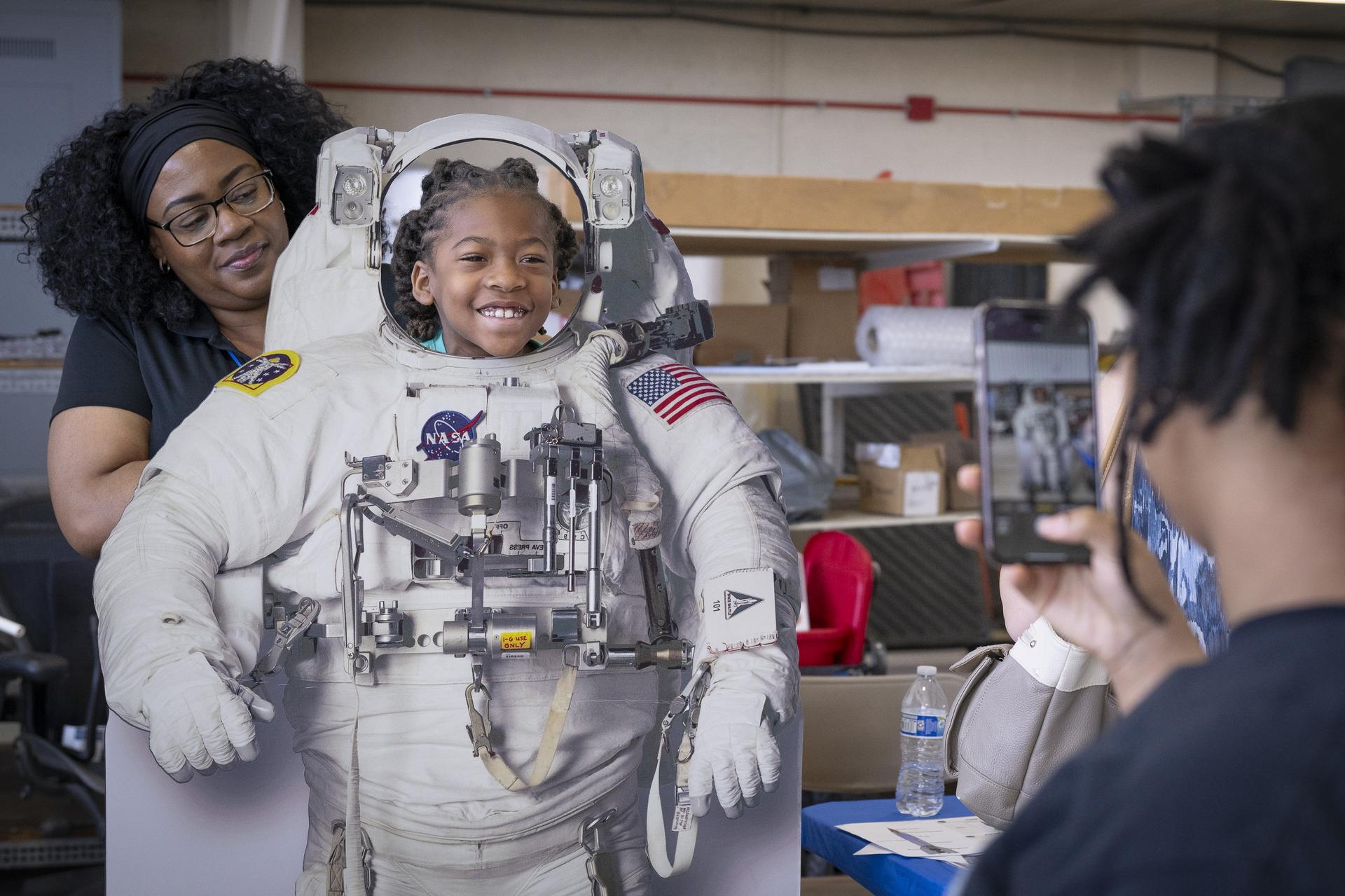
On June 17, 2025, NASA’s Armstrong Flight Research Center in Edwards, California, hosted Bring Kids to Work Day, offering hands-on activities that introduced children and their families to the exciting world of aeronautics and flight research.
NASA/Christopher LC Clark
NASA Armstrong will continue advancing flight research across aeronautics and Earth science, building on this year’s achievements. Upcoming efforts include additional X-59 flights, expanded quiet supersonic studies, new air mobility evaluations, high-altitude science campaigns, and maturing technologies that support hypersonic research and the Artemis program for future planetary missions.
“Next year will be a year of continuity, but also change,” Flick said. “The agency’s new Administrator, Jared Isaacman, will bring a renewed mission-first focus to the agency, and NASA Armstrong will push the boundaries of what’s possible. But the most important thing we can do is safely and successfully execute our portfolio of work within budget and schedule.”
For more than seven decades, NASA Armstrong has strengthened the nation’s understanding of flight. This year’s work builds on that legacy, helping shape the future of aviation and exploration through research proven in the air.
To explore more about NASA Armstrong’s missions, research, and discoveries, visit:
NASA videographer Jacob Shaw recently earned first place for outstanding documentation for his film, Reflections, which chronicles the 2024 Airborne Science ...
Justin Hall, left, controls a subscale aircraft as Justin Link holds the aircraft in place during preliminary engine tests on Friday, Sept. 12, 2025, at NASA’s Armstong Flight Research Center in Edwards, California.
Hall, chief pilot at the center’s Dale Reed Subscale Flight Research Laboratory, and Link, a pilot for small uncrewed aircraft systems, are building the large subscale aircraft to support increasingly complex flight research, offering a more flexible and cost-effective alternative to crewed missions. Once ready, the aircraft will help evaluate new concepts, technologies, and flight controls to support NASA missions on Earth and beyond.

 Login
Login