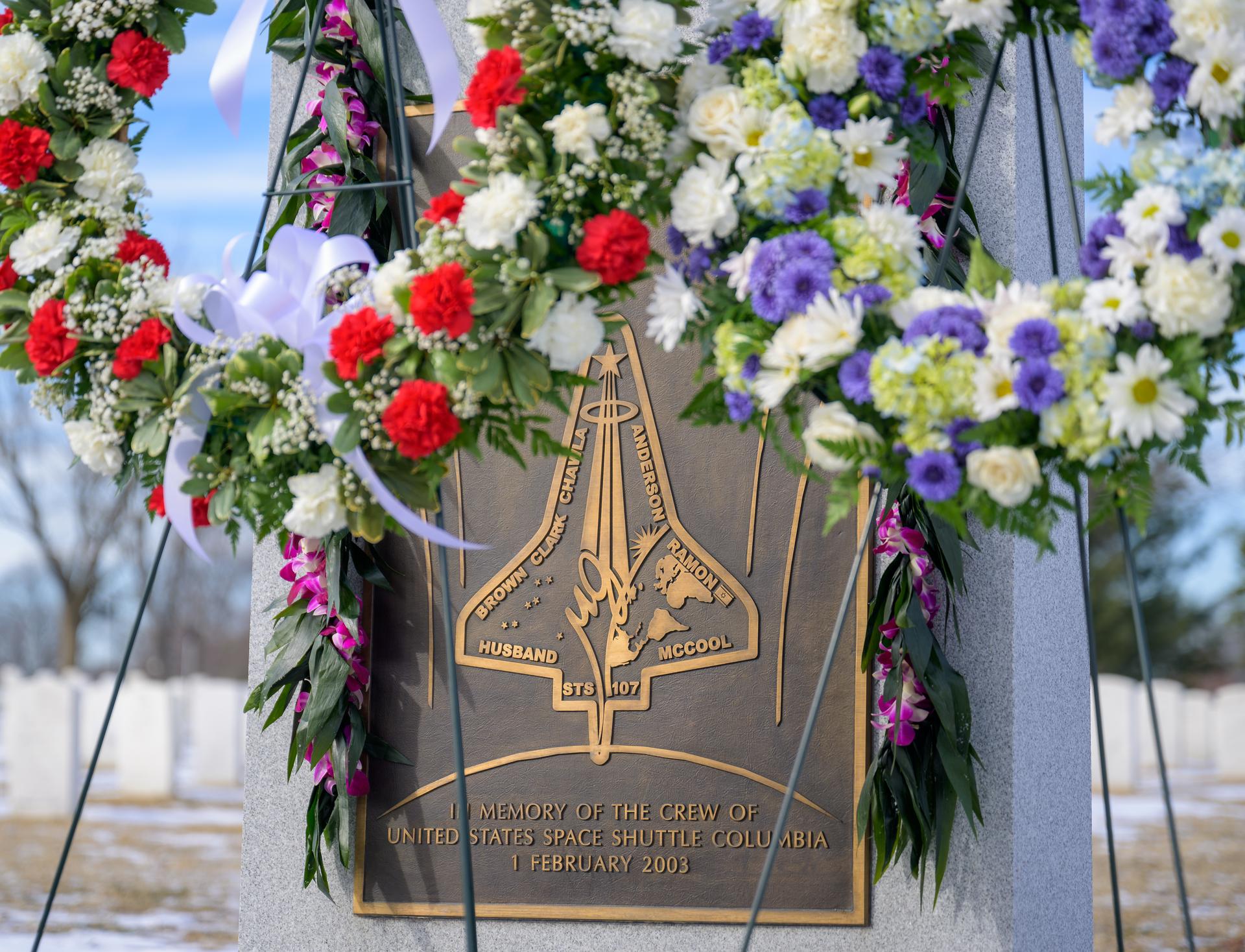
The Space Shuttle Columbia Memorial is seen during a wreath laying ceremony that was part of NASA’s Day of Remembrance, Thursday, Jan. 23, 2025, at Arlington National Cemetery in Virginia. Wreaths were laid in memory of those men and women who lost their lives in the quest for space exploration.
Credit: NASA/Bill Ingalls
NASA will observe its annual Day of Remembrance on Thursday, Jan. 22, which includes commemorating the crews of Apollo 1 and the space shuttles Challenger and Columbia. The event is traditionally held every year on the fourth Thursday of January, as all three astronaut accidents happened around the end of the month.
“On NASA’s Day of Remembrance, we pause to honor the members of the NASA family who lost their lives while pushing the boundaries of exploration and discovery,” said NASA Administrator Jared Isaacman. “We remember them not to retreat from risk, but to respect it — to learn, to improve, and continue onward. Their sacrifice and the strength of their families will forever inspire us as we continue to reach for the stars and pursue the secrets of the universe.”
Isaacman will lead an observance at 1 p.m. EST at Arlington National Cemetery in Virginia, which will begin with a wreath-laying ceremony at the Tomb of the Unknown Soldier, followed by observances for the Apollo 1, Challenger, and Columbia crews.
Several agency centers also will hold observances:
Johnson Space Center in Houston
NASA Johnson will hold a commemoration at 10 a.m. CST at the Astronaut Memorial Grove with remarks by Center Director Vanessa Wyche, NASA astronaut Jasmin Moghbeli, and Cheryl McNair, widow of Challenger astronaut Ronald McNair. The event will have a moment of silence, a NASA T-38 flyover, taps performed by the Texas A&M Squadron 17, and a procession placing flowers at Apollo I, Challenger, and Columbia memorial trees.
Kennedy Space Center in Florida
NASA Kennedy and the Astronauts Memorial Foundation will host a ceremony at the Space Shuttle Atlantis building at Kennedy’s Visitor Complex at 11 a.m. EST. The event will include musical guests, a bell ringing commemoration, a moment of silence, and wreath-laying. Kelvin Manning, deputy director at NASA Kennedy, and Bob Cabana, former NASA associate administrator and Kennedy center director, will provide remarks during the ceremony, which will livestream on the center’s Facebook page.
Ames Research Center in California’s Silicon Valley
NASA Ames will hold a remembrance ceremony at 1 p.m. PST that includes remarks from Center Director Eugene Tu, a moment of silence, and bell ringing commemoration for each astronaut lost in service.
Langley Research Center in Hampton, Virginia
NASA Langley will hold a remembrance ceremony at 1 p.m. EST with acting Center Director Trina Dyal, followed by placing flags at the Langley Workers Memorial.
Marshall Space Flight Center in Huntsville, Alabama
NASA Marshall will hold a candle-lighting ceremony and wreath placement at 9:30 a.m. CST and include remarks from Rae Ann Meyer, Marshall’s acting center director, and Bill Hill, director of Safety and Mission Assurance at Marshall.
Stennis Space Flight Center in Bay St. Louis, Mississippi
NASA Stennis and the NASA Shared Services Center will hold a wreath-laying ceremony and moment of silence at 10:30 a.m. CST with remarks from Center Director John Bailey and Anita Harrell, NASA Shared Services Center executive director.
The agency also is paying tribute to its fallen astronauts with special online content, updated on NASA’s Day of Remembrance, at:
KENNEDY SPACE CENTER, Florida—Preparations for the first human spaceflight to the Moon in more than 50 years took a big step forward this weekend with the rollout of the Artemis II rocket to its launch pad.
The rocket reached a top speed of just 1 mph on the four-mile, 12-hour journey from the Vehicle Assembly Building to Launch Complex 39B at NASA's Kennedy Space Center in Florida. At the end of its nearly 10-day tour through cislunar space, the Orion capsule on top of the rocket will exceed 25,000 mph as it plunges into the atmosphere to bring its four-person crew back to Earth.
"This is the start of a very long journey," said NASA Administrator Jared Isaacman. "We ended our last human exploration of the moon on Apollo 17."
KENNEDY SPACE CENTER, Florida—The rocket NASA is preparing for sending four astronauts on a trip around the Moon will emerge from its assembly building on Florida's Space Coast early Saturday for a slow crawl to its seaside launch pad.
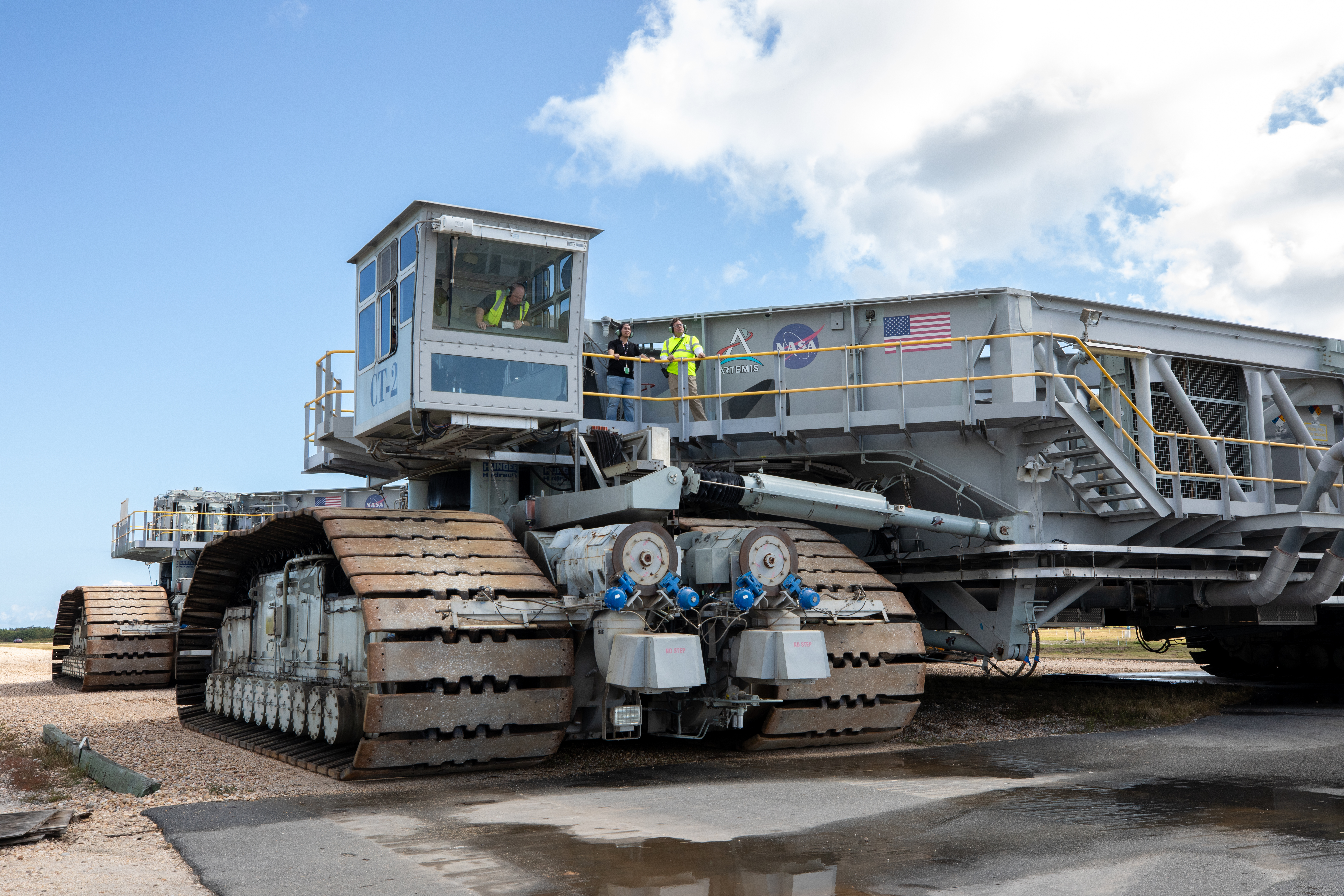
Riding atop one of NASA's diesel-powered crawler transporters, the Space Launch System rocket and its mobile launch platform will exit the Vehicle Assembly Building at Kennedy Space Center around 7:00 am EST (11:00 UTC). The massive tracked transporter, certified by Guinness as the world's heaviest self-propelled vehicle, is expected to cover the four miles between the assembly building and Launch Complex 39B in about eight to 10 hours.
The rollout marks a major step for NASA's Artemis II mission, the first human voyage to the vicinity of the Moon since the last Apollo lunar landing in December 1972. Artemis II will not land. Instead, a crew of four astronauts will travel around the far side of the Moon at a distance of several thousand miles, setting the record for the farthest humans have ever ventured from Earth.
NASA’s Crawler-transporter 2 moves toward the Vehicle Assembly Building at NASA’s Kennedy Space Center in Florida on Friday, Jan. 9, 2026. The crawler will transport NASA’s SLS (Space Launch System) rocket with the Orion spacecraft to Launch Complex 39B ahead of the Artemis II launch which will journey Commander Reid Wiseman, Pilot Victor Glover, and Mission Specialist Christina Koch from NASA, and Mission Specialist Jeremy Hansen from the CSA (Canadian Space Agency), around the Moon and back to Earth no later than April 2026.
The crawler-transporters have carried the load of taking rockets and spacecraft to the launch pad for more than 50 years at NASA’s Kennedy Space Center in Florida. Each the size of a baseball infield and powered by locomotive and large electrical power generator engines, the crawler-transporters stand ready to keep up the work for the next generation of launch vehicles to lift astronauts into space; Crawler-transporter 2 in particular is integral to the Artemis missions.
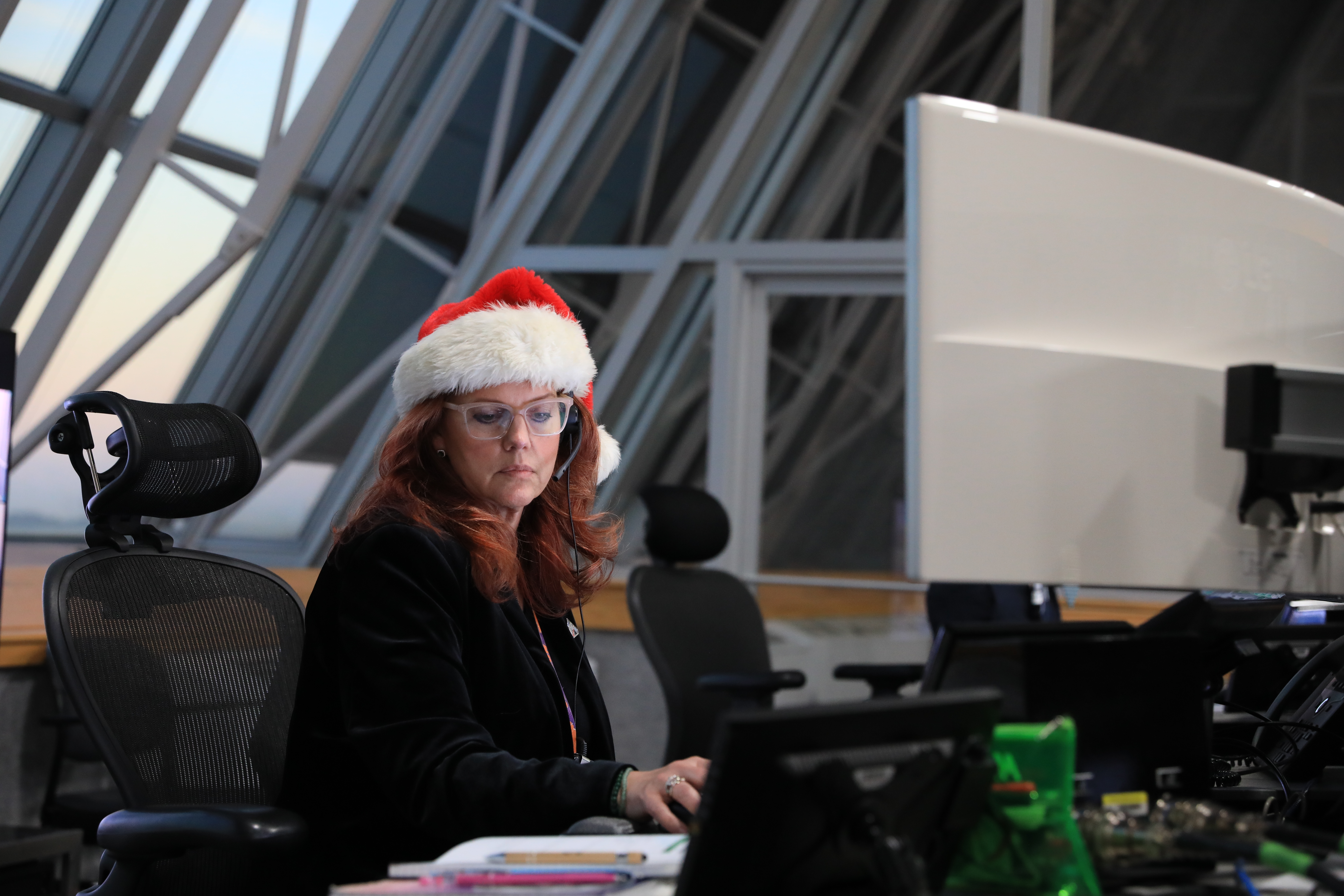
Santa Claus (NASA engineer Guy Naylor) poses with NASA’s Artemis II Orion spacecraft and SLS (Space Launch System) rocket in the Vehicle Assembly Building at NASA’s Kennedy Space Center in Florida on Dec. 11, 2025. The Orion spacecraft was stacked atop the SLS in October 2025.
Set to launch in early 2026, the Artemis II test flight will be NASA’s first mission with crew under Artemis. Astronauts on their first flight aboard Orion will confirm all the spacecraft’s systems operate as designed with crew aboard in the actual environment of deep space. Through the Artemis campaign, NASA will send astronauts to explore the Moon for scientific discovery, economic benefits, and to build the foundation for the first crewed missions to Mars – for the benefit of all.
Get In, We’re Going Moonbound: Meet NASA’s Artemis Closeout Crew
Members of the Artemis II closeout crew, from left, William Sattler; Tyler Sutherland; Michael Heinemann; Christian Warriner; Jenni Gibbons, Artemis II backup crew member; Bill Owens; Taylor Hose; and Andre Douglas, Artemis II backup crew member, pose for a photo with NASA’s Vehicle Assembly Building behind them at the agency’s Kennedy Space Center in Florida on Thursday, Dec. 19, 2025.
Credits: NASA/Jim Ross
For most, getting into a car is a task that can be done without assistance. Yet for those whose destination is the Moon, the process of getting inside and secured – in this case, in NASA’s Orion spacecraft – requires help. That’s the role of the Artemis closeout crew.
Trained to support Artemis II and future Moon missions, the five closeout crew members will be the last people to see NASA astronauts Reid Wiseman, Victor Glover, and Christina Koch, and CSA (Canadian Space Agency) astronaut Jeremy Hansen before their lunar journey.
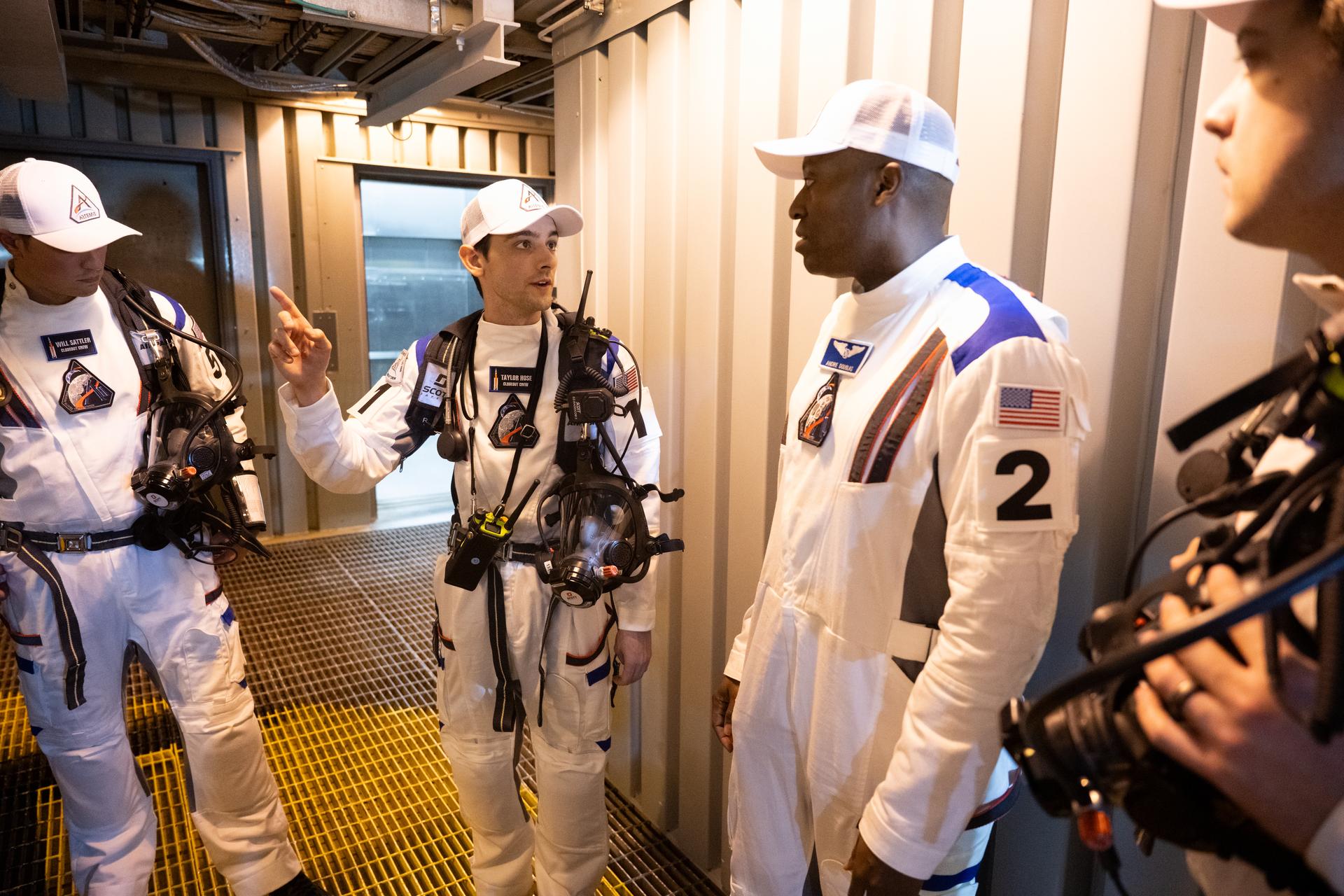
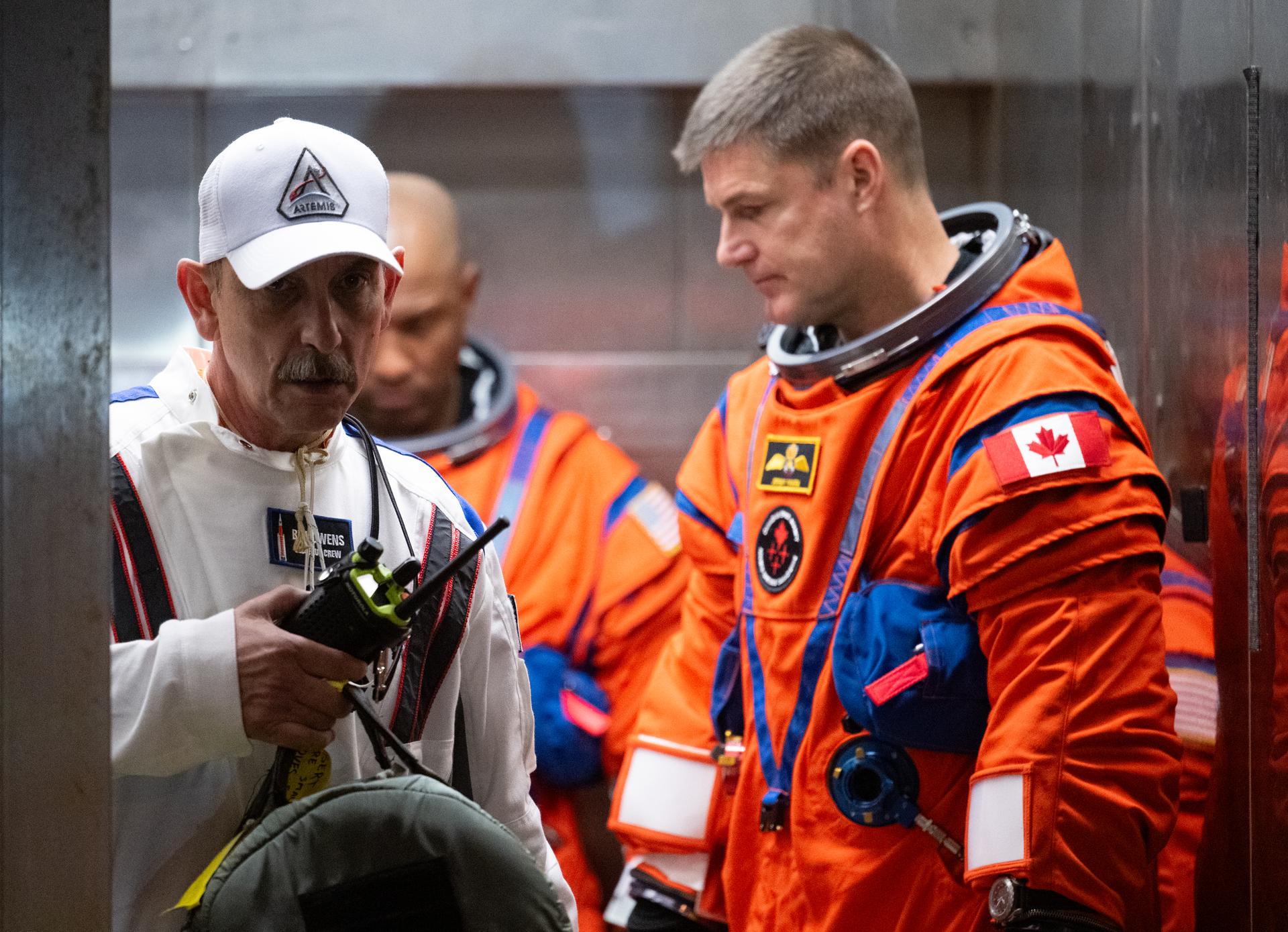
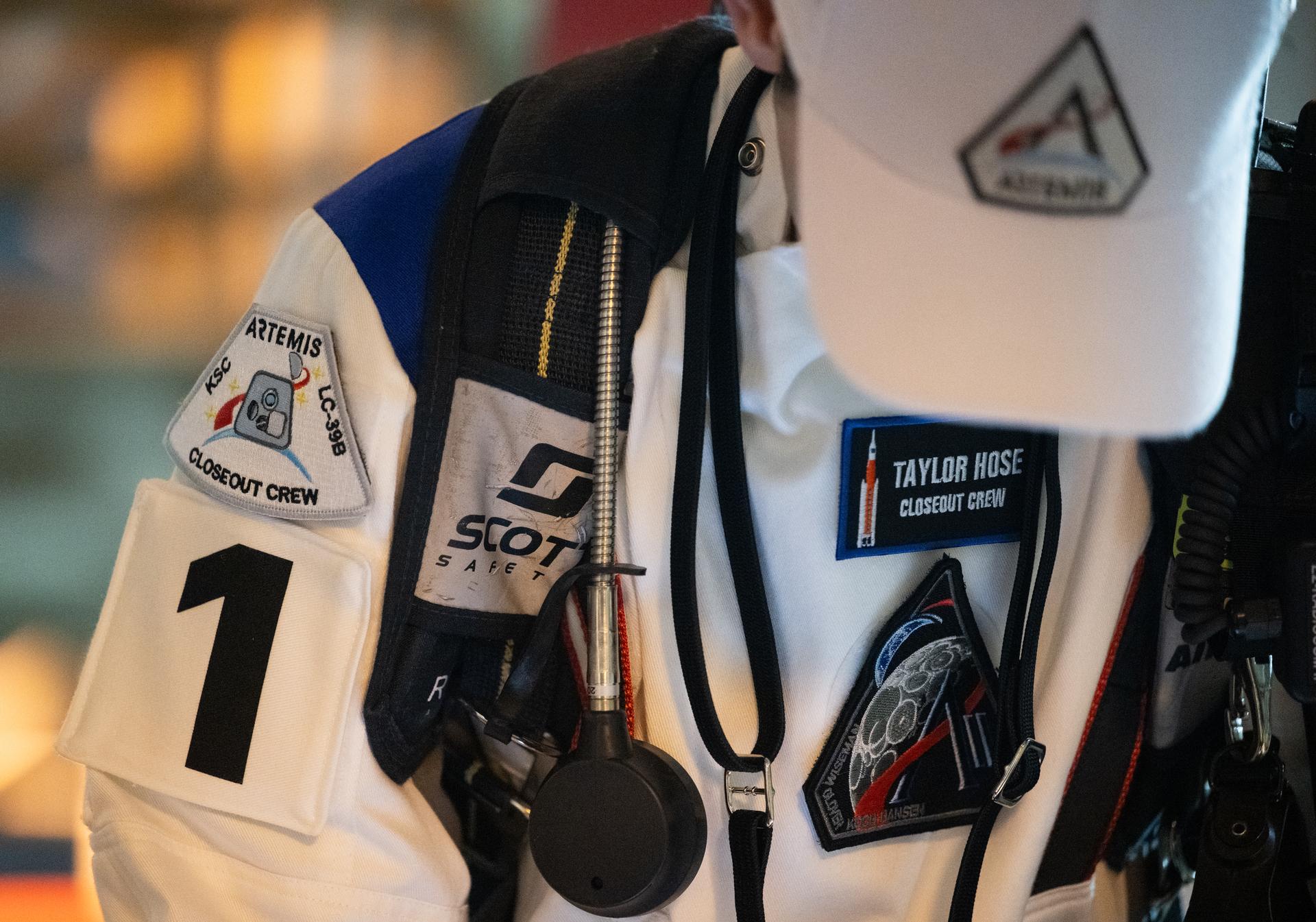
The Artemis II closeout team consists of a lead, Taylor Hose; an astronaut support person, astronaut Andre Douglas; one technician specially trained on Orion crew survival system spacesuits, Bill Owens; and two Orion technicians, Christian Warriner and Ricky Ebaugh.
We are responsible for getting the astronauts strapped in their spacecraft, getting all their connections attached to their spacesuits, and then we close the hatch and close out Orion for launch.
Taylor Hose
Artemis II Closeout Team Lead
Think of them like a pit crew for car races.
When the astronauts arrive on launch day at Launch Complex 39B at NASA’s Kennedy Space Center in Florida, the closeout crew will already be in place. First, the team will help the astronauts don their helmets and gloves before entering the Orion spacecraft.
Closeout Crew lead Taylor Hose, second from left, talks with NASA astronaut Andre Douglas, second from right as he and closeout crewmembers Will Sattler, left, and Christian Warriner prepare for the arrival of Artemis II crewmembers NASA astronauts Reid Wiseman, commander; Victor Glover, pilot; Christina Koch, mission specialist; and CSA (Canadian Space Agency) astronaut Jeremy Hansen, mission specialist; at the 275-foot level of the mobile launcher as they prepare to board their Orion spacecraft atop NASA’s Space Launch System rocket during the Artemis II countdown demonstration test, Saturday, Dec. 20, 2025, inside the Vehicle Assembly Building at NASA Kennedy.
NASA/Joel Kowsky
Once inside, Owens and Douglas will assist each crew member with buckling up – except instead of using just one seatbelt like in a car, the crew needs several more intricate connections. Each seat includes five straps to secure the astronauts inside the crew module and several additional connections to the environmental control and life support systems and communications system aboard.
After the astronauts are secured, the hatch technicians will begin closing the spacecraft hatch. Unlike a car door that easily opens and closes with the pull of a handle, Orion’s hatch requires more effort to securely close.
“The hatch is pneumatically driven so we have to have air lines hooked up to it, and we need the help of the ground support system to close it,” said Hose.
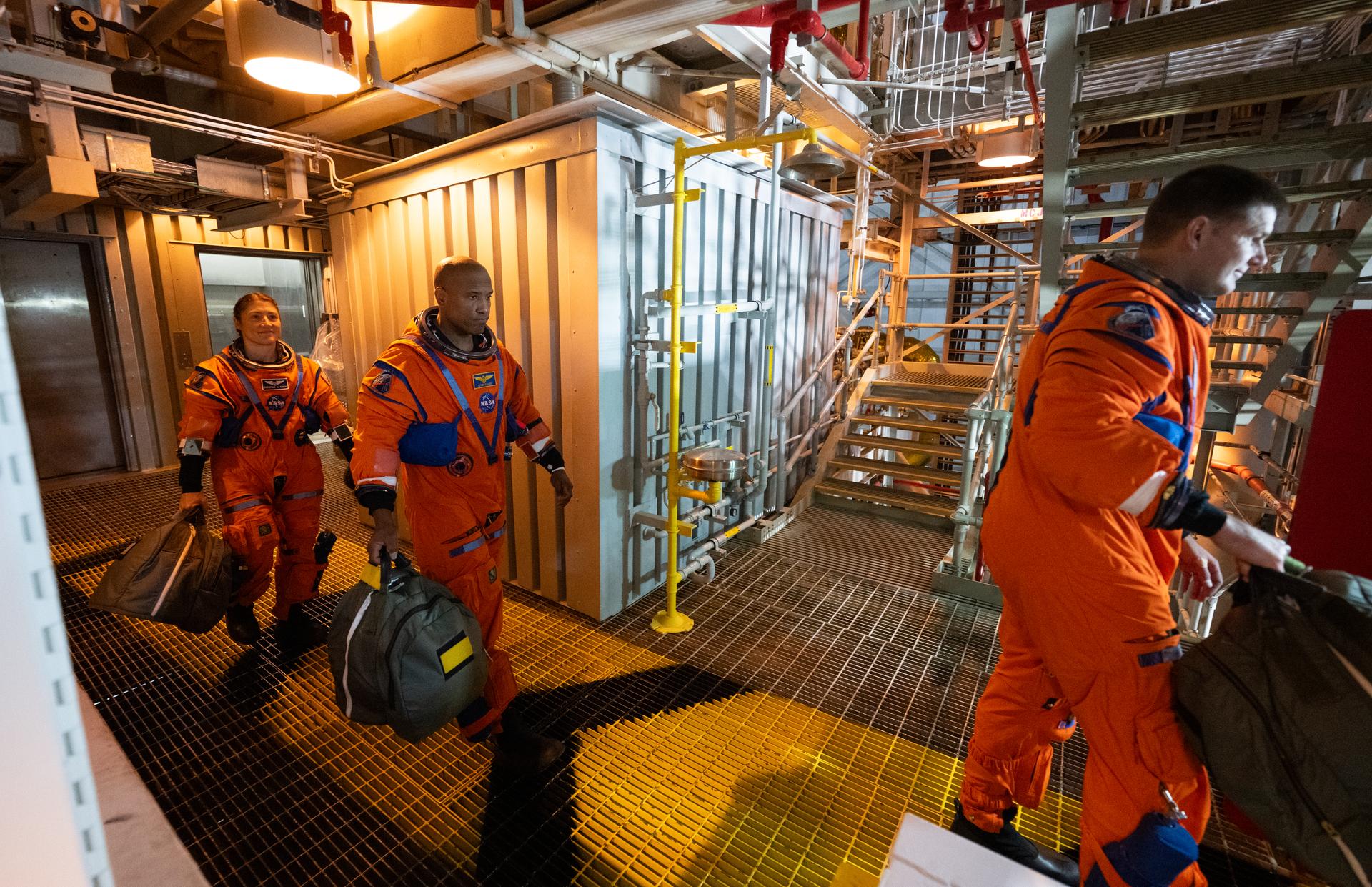
Bill Owens of the Closeout Crew is seen as he leads Artemis II crewmembers CSA (Canadian Space Agency) astronaut Jeremy Hansen, mission specialist; and NASA astronauts Reid Wiseman, commander; Victor Glover, pilot; and Christina Koch, mission specialist; out of at the elevator towards the crew access arm at the 275-foot level of the mobile launcher as they prepare to board their Orion spacecraft atop NASA’s Space Launch System rocket during the Artemis II countdown demonstration test, Saturday, Dec. 20, 2025, inside the Vehicle Assembly Building at NASA Kennedy.
NASA/Joel Kowsky
On launch day, it will take about four hours for the crew to get situated inside Orion and for the closeout process, including buttoning up both the crew module hatch and an exterior launch abort system hatch, to be complete. Even a single strand of hair inside the hatch doors could potentially pose issues with closing either hatch, so the process is carefully done.
“We have a lot of work to do with the seals alone – greasing, cleaning, taking the hatch cover off – and then we get into crew module hatch closure,” Hose said. “So after latching the hatch, we take window covers off, install thermal protection panels, and remove the purge barrier in between the vehicle and the ogive panels, which help protect the crew module during launch and ascent.”
The team then closes the launch abort system hatch and finishes final preparations before launch. Following the abort system hatch closure, the closeout crew departs the launch pad but stays nearby in case they need to return for any reason.
Taylor Hose prepares for the arrival of Artemis II crewmembers NASA astronauts Reid Wiseman, commander; Victor Glover, pilot; Christina Koch, mission specialist; and CSA (Canadian Space Agency) astronaut Jeremy Hansen, mission specialist; at the 275-foot level of the mobile launcher to board their Orion spacecraft atop NASA’s Space Launch System rocket during the Artemis II countdown demonstration test, Saturday, Dec. 20, 2025, inside the Vehicle Assembly Building at NASA Kennedy.
NASA/Joel Kowsky
My life goal was to be an astronaut. To help send people to the Moon for the first time since 1972 to not just go and visit, but this time to stay, I think that’s everything. That's our first steppingstone of going to Mars and expanding into the solar system.
Taylor Hose
Artemis II Closeout Team Lead
After launch, several team members will head to San Diego, to help with post-splashdown efforts once the mission concludes.
As part of a Golden Age of innovation and exploration, the Artemis II test flight is the first crewed flight under NASA’s Artemis campaign. It is another step toward new U.S.-crewed missions on the Moon’s surface that will help the agency prepare to send the first astronauts – Americans – to Mars.
Artemis II Flight Crew, Teams Conduct Demonstration Ahead of Launch
NASA’s launch and mission teams, along with the Artemis II crew, completed a key test Dec. 20, a countdown demonstration test, ahead of the Artemis II flight around the Moon early next year. The astronauts, supported by launch and flight control teams, dressed in their launch and entry suits, boarded their spacecraft on top of its towering rocket at the agency’s Kennedy Space Center in Florida to validate their launch date timeline.
Winding the clock down to a point just before liftoff, the rehearsal enabled NASA teams to practice the exact steps teams will take as they move toward launch of the test flight.
This test marks the passage of a key milestone on America’s journey to the launchpad. We have many more to go, but I’m encouraged by the expertise and precision demonstrated by our teams as we continue NASA’s ambitious lunar exploration legacy.
Jared Isaacman
NASA Administrator
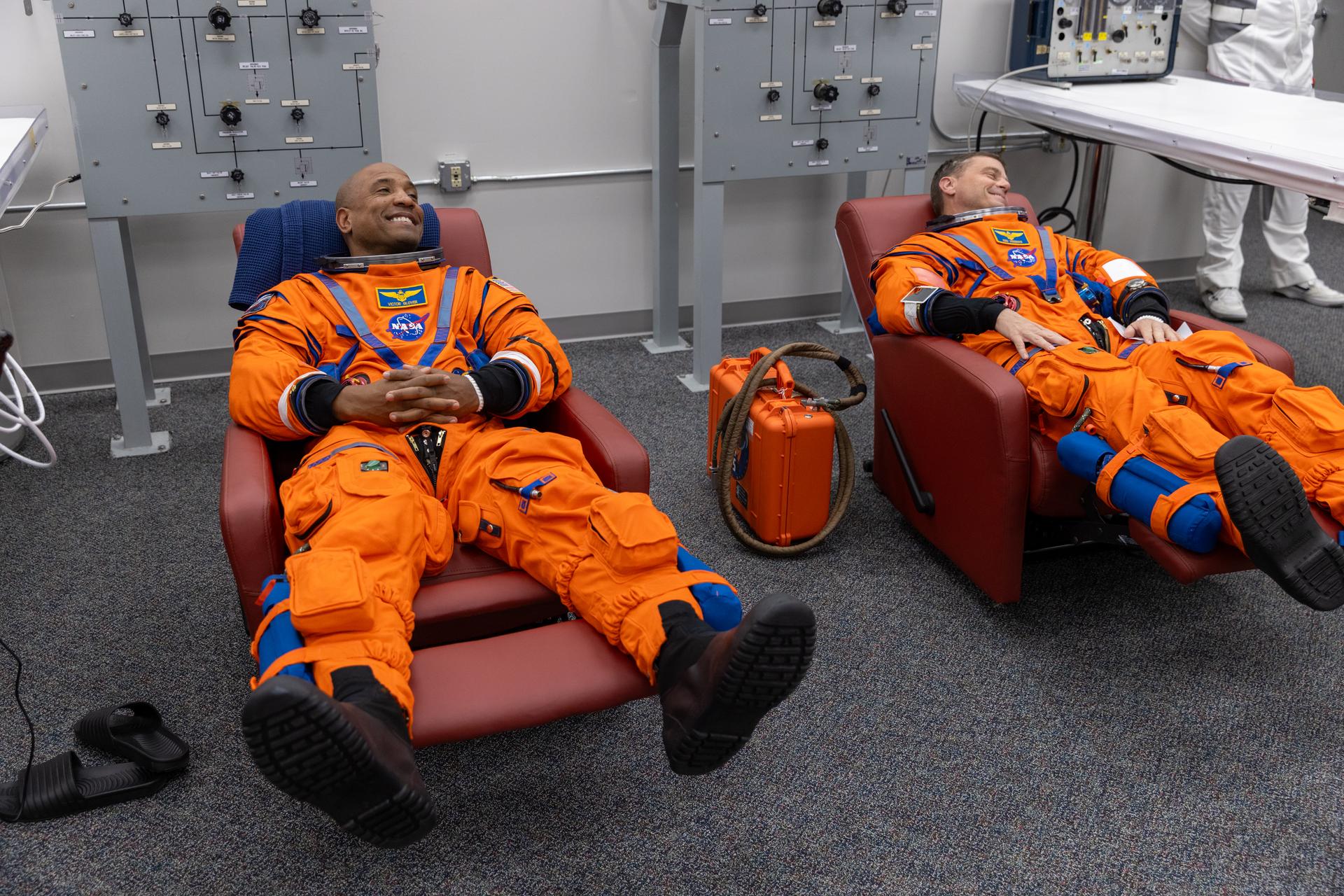
While launch teams in the firing rooms of Kennedy’s Launch Control Center ran through procedures just as they would on launch day, the Artemis II crew members – NASA astronauts Reid Wiseman, Victor Glover, and Christina Koch, and CSA (Canadian Space Agency) astronaut Jeremy Hansen – donned their Orion crew survival system spacesuits in the Astronaut Crew Quarters inside Kennedy’s Neil A. Armstrong Operations and Checkout Building.
From left, NASA astronauts Victor Glover, Artemis II pilot, and Reid Wiseman, Artemis II commander, undergo spacesuit checks inside the crew quarters suit-up room in the Neil A. Armstrong Operations and Checkout Building part of the countdown demonstration test at NASA Kennedy on Saturday, Dec. 20, 2025.
NASA/Glenn Benson
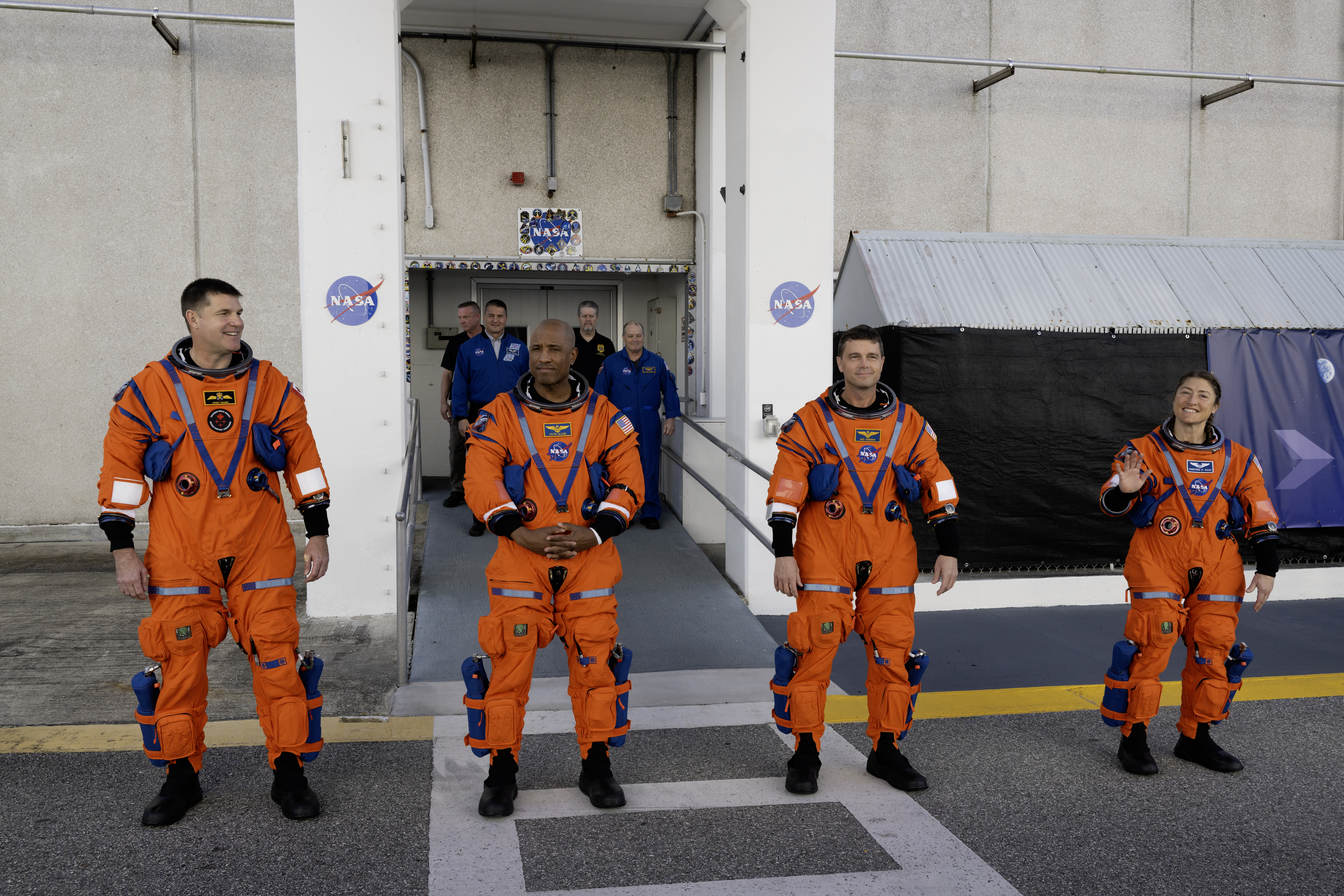
Once suited, the crew made the same walk taken by Gemini, Apollo, space shuttle, and Commercial Crew Program astronauts launching from Florida’s Space Coast during the last six decades. Through the suit-up room, down the hallway, and after a quick ride on an elevator, the Artemis II crew exited the building through the double doors featuring dozens of human spaceflight mission patch stickers.
The Artemis astronaut van waited outside to take the crew members to their SLS (Space Launch System) rocket. On the actual launch day, the four astronauts will complete a 20-minute ride to Kennedy’s Launch Complex 39B ahead of liftoff. But, for the countdown test the destination was High Bay 3 of Kennedy’s Vehicle Assembly Building, where the Artemis II Moon rocket is undergoing final processing and checkouts before rolling out to the launch pad. A convoy of support vehicles, as well as Artemis II backup crew members, NASA astronaut Andre Douglas and CSA astronaut Jenni Gibbons, escorted the crew to its destination.
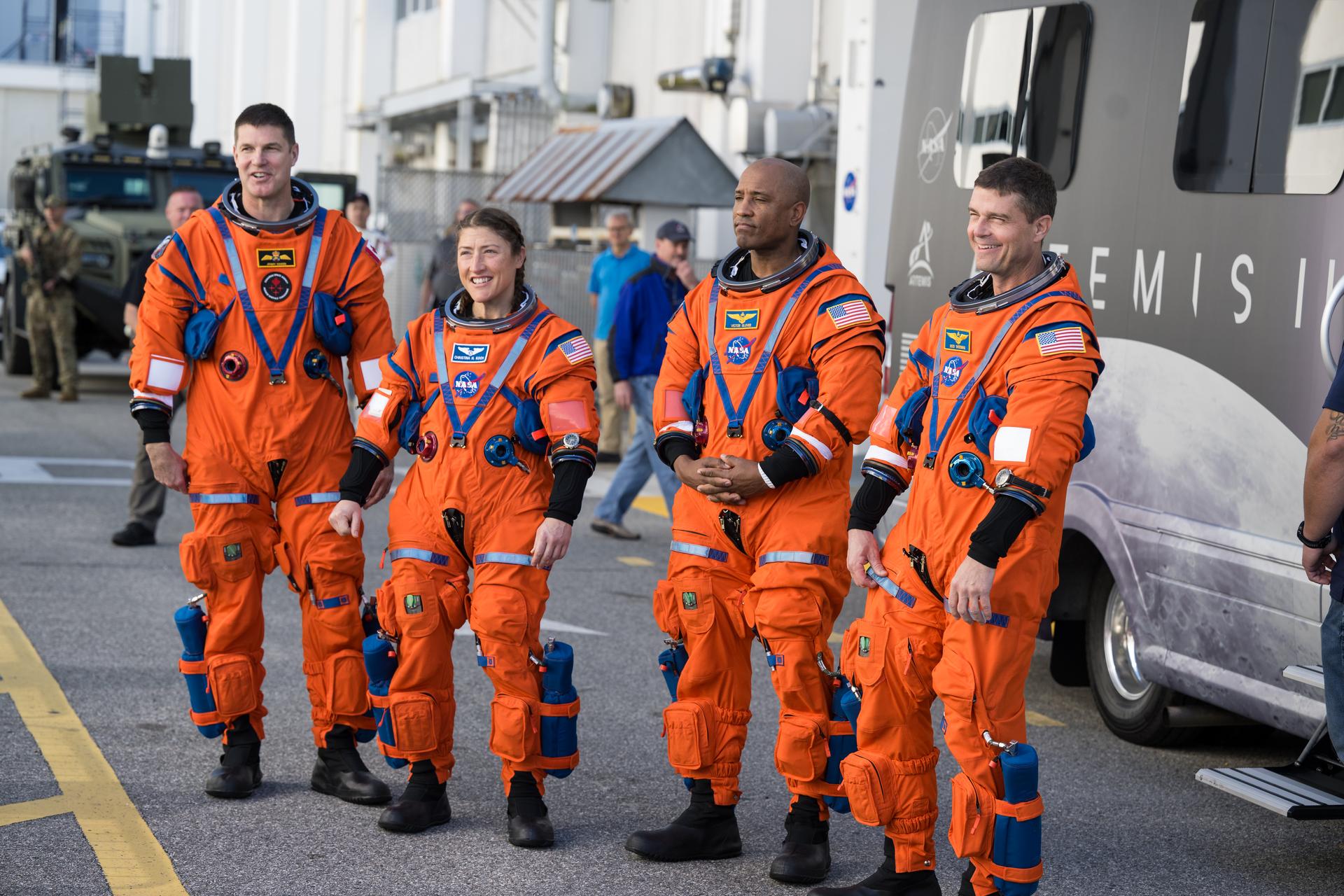
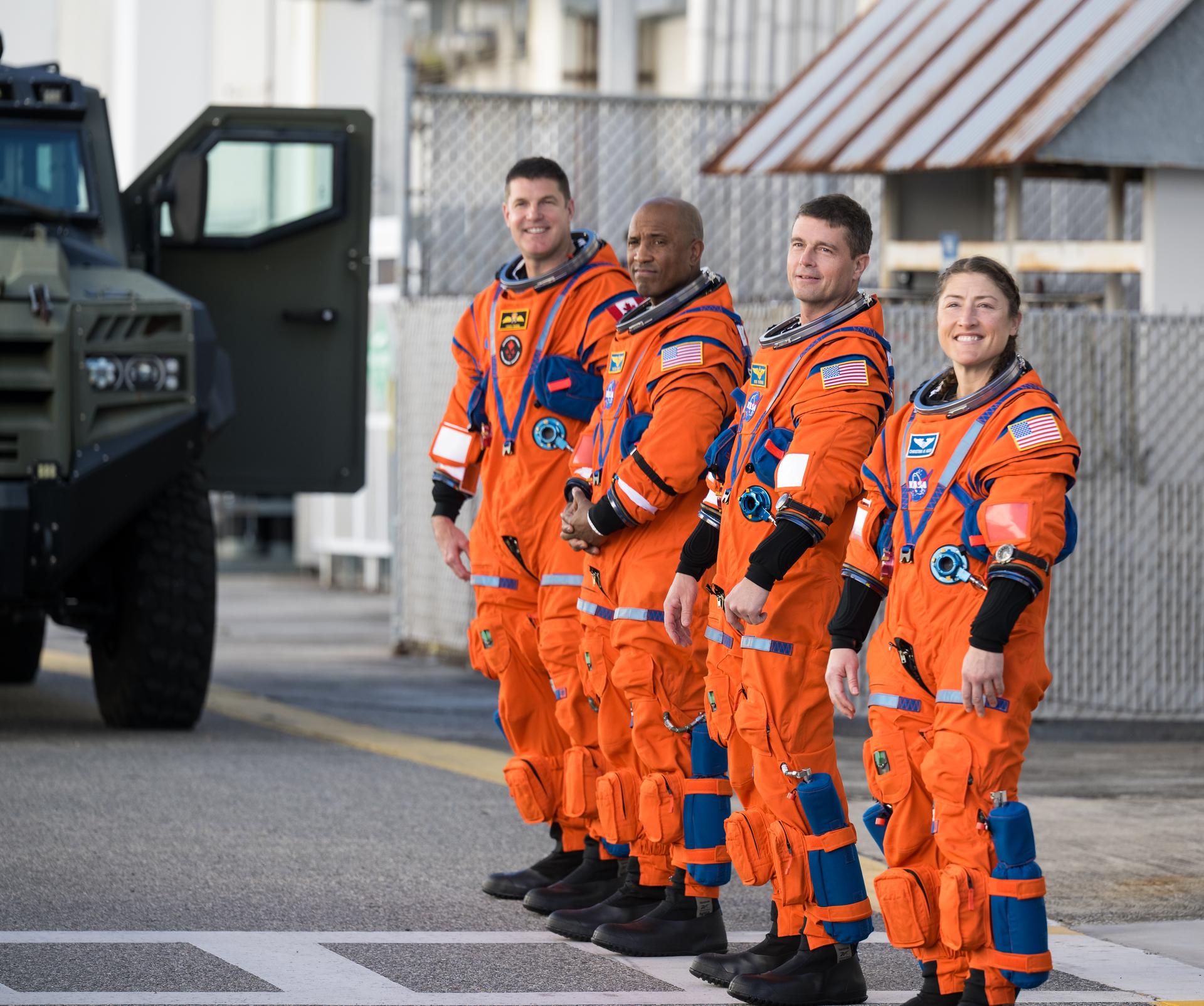
From right to left, NASA astronauts Reid Wiseman, commander; Victor Glover, pilot; Christina Koch, mission specialist; and CSA (Canadian Space Agency) astronaut Jeremy Hansen, mission specialist are seen as they depart the Neil A. Armstrong Operations and Checkout Building to board their Orion spacecraft atop NASA’s Space Launch System rocket inside the Vehicle Assembly Building as part of the Artemis II countdown demonstration test, Saturday, Dec. 20, 2025, at NASA Kennedy.
NASA/Aubrey Gemignani
After a short trip to the building, the flight crew rode the mobile launcher’s elevator up nearly 300 feet to the crew access arm and the White Room, the enclosed area where the crew enters the spacecraft. The closeout crew, whose job it is to ensure the flight crew enters the spacecraft without issue, helped the astronauts enter Orion, which they have named Integrity. The closeout team assisted the astronauts by strapping them into their seats and closed the hatch once all closeout operations were completed. With the crew secured in Orion, teams conducted suit leak and communications checks, just as they will on launch day.
Artemis II crewmembers CSA astronaut Jeremy Hansen, mission specialist, right, and NASA astronauts Victor Glover, pilot; Christina Koch, mission specialist; after exiting the elevator at the 275-foot level of the mobile launcher as they walk towards the crew access arm prepare to board their Orion spacecraft atop NASA’s Moon rocket during the Artemis II countdown demonstration test, Saturday, Dec. 20, 2025, inside the Vehicle Assembly Building at NASA Kennedy.
NASA/Joel Kowsky
Throughout the testing, teams ran through the final 5.5 hours of launch day procedures, completing the countdown test about 30 seconds before what will be the time of liftoff on launch day. As they may encounter on launch day, teams navigated through several real-time issues, including audio communications and environmental control and life support systems closeout activities during the test. All objectives were met, and the countdown demonstration provided a valuable opportunity to conduct operations in a day-of-launch configuration to minimize first-time learnings on launch day.
Charlie Blackwell-Thompson, NASA’s Artemis launch director, monitors the progress of Artemis II countdown demonstration test with Artemis II crew members onboard their Orion spacecraft from Firing Room 1 of the Rocco A. Petrone Launch Control Center at NASA Kennedy on Saturday, Dec. 20.
NASA/Glenn Benson
Although Artemis II teams have performed parts of the launch countdown testing previously, this test was the first full end-to-end rundown with the crew and Orion in the launch configuration. The crew will participate in additional countdown testing after the rocket arrives to the launchpad, focusing on emergency operations.
As part of a Golden Age of innovation and exploration, the Artemis II test flight is the first crewed mission under NASA’s Artemis campaign. It is another step toward new U.S.-crewed missions on the Moon’s surface that will help the agency prepare to land American astronauts on Mars.
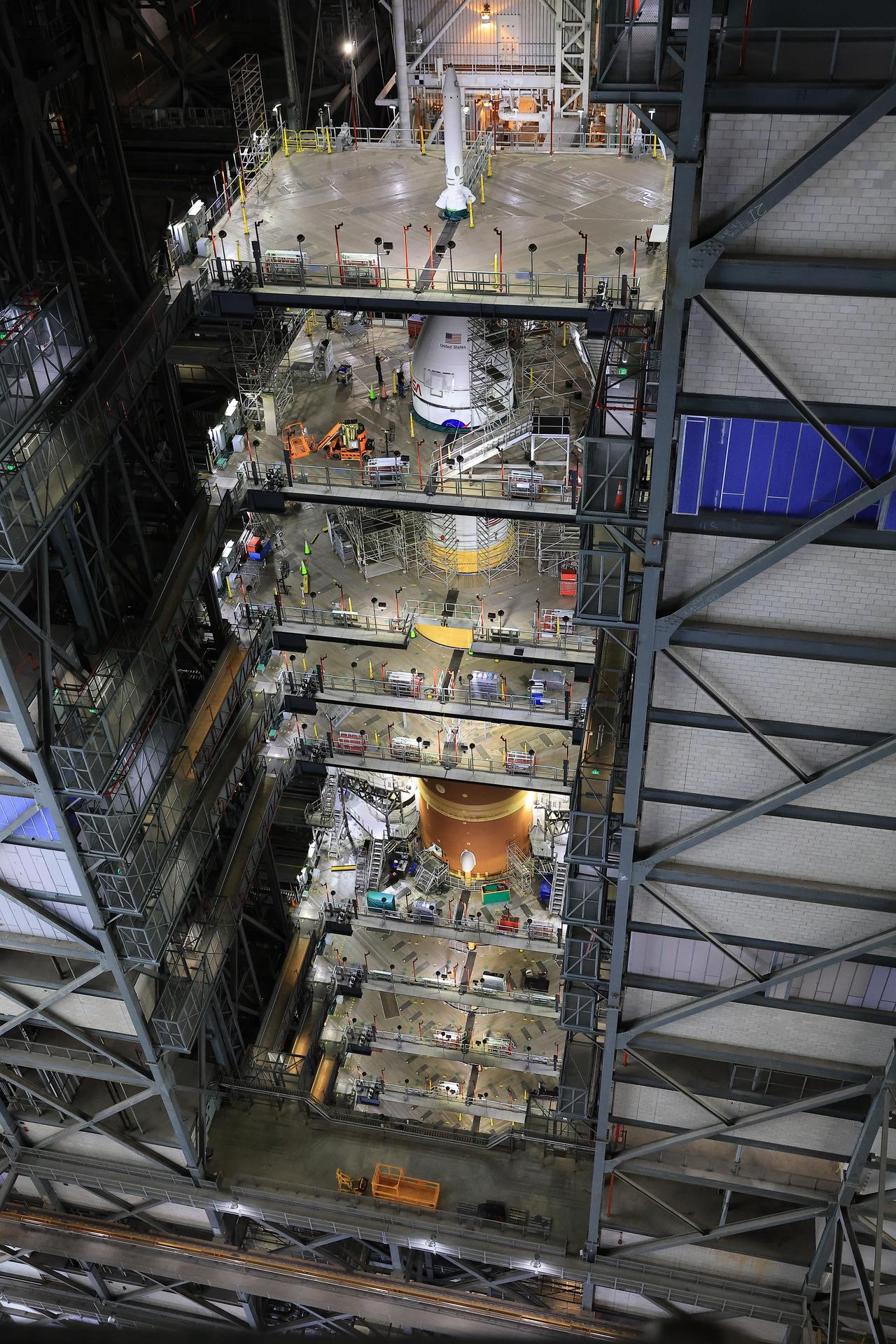
NASA’s Artemis II Orion spacecraft with its launch abort system is stacked atop the agency’s SLS (Space Launch System) rocket in High Bay 3 of the Vehicle Assembly Building at NASA’s Kennedy Space Center in Florida on Monday, Oct. 20, 2025. The spacecraft will carry NASA astronauts Reid Wiseman, Victor Glover, Christina Koch, and CSA (Canadian Space Agency) astronaut Jeremy Hansen on a 10-day mission around the Moon and back in early 2026. Teams will begin conducting a series of verification tests ahead of rolling out the integrated SLS rocket to NASA Kennedy’s Launch Complex 39B for the wet dress rehearsal.
NASA/Kim Shiflett
Teams at NASA’s Kennedy Space Center in Florida spent 2025 preparing the launch vehicle and its powerhouse SLS (Space Launch System) rocket to launch four astronauts around the Moon for Artemis II in early 2026. The center also celebrated milestones by conducting science experiments at the International Space Station to studying the Sun’s solar wind impacts on Earth to traveling to Mars in hopes of one day exploring the Red Planet in person.
JANUARY NASA Kennedy Marks New Chapter for Florida Space Industry

Kennedy Space Center Director Janet Petro and charter members of the Florida University Space Research Consortium sign a memorandum of understanding in research and development to assist with missions and contribute to NASA’s Moon to Mars exploration approach.
From left: Jennifer Kunz, Associate Director, Technical, Kennedy Space Center; Kelvin Manning, Deputy Director, Kennedy Space Center; Dr. Kent Fuchs, Interim President, University of Florida; Janet Petro, Director, Kennedy Space Center; Jeanette Nuñez, Florida Lieutenant Governor; Dr. Alexander Cartwright, President, University of Central Florida; Dr. Barry Butler, President, Embry-Riddle Aeronautical University.
NASA/Kim Shifflet
Firefly Launches Blue Ghost Mission One
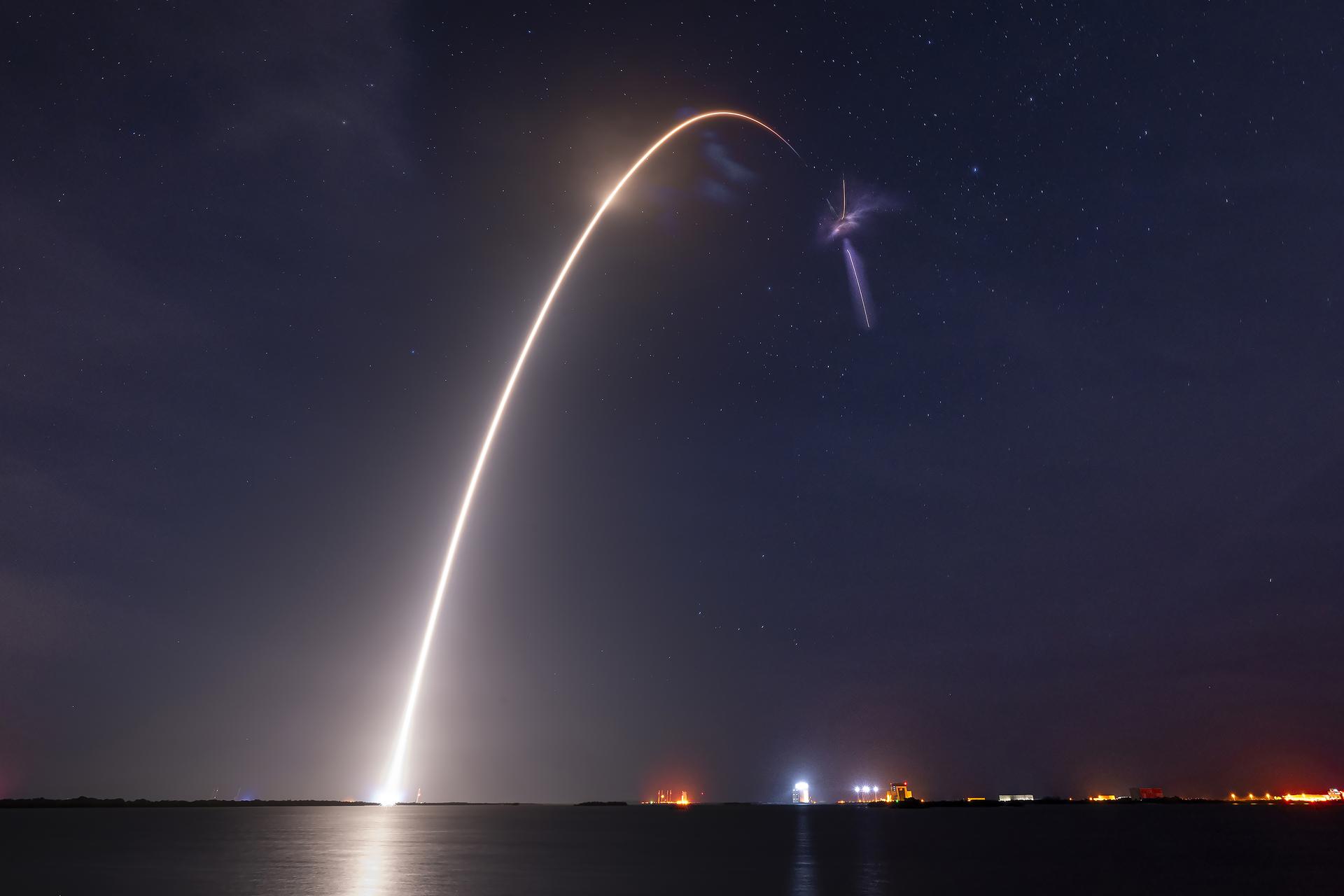
Firefly Aerospace launched Blue Ghost Mission One lunar lander with a suite of NASA scientific instruments on January 15, from Launch Complex 39A at NASA Kennedy. The lander and instruments landed March 2 on the Moon.
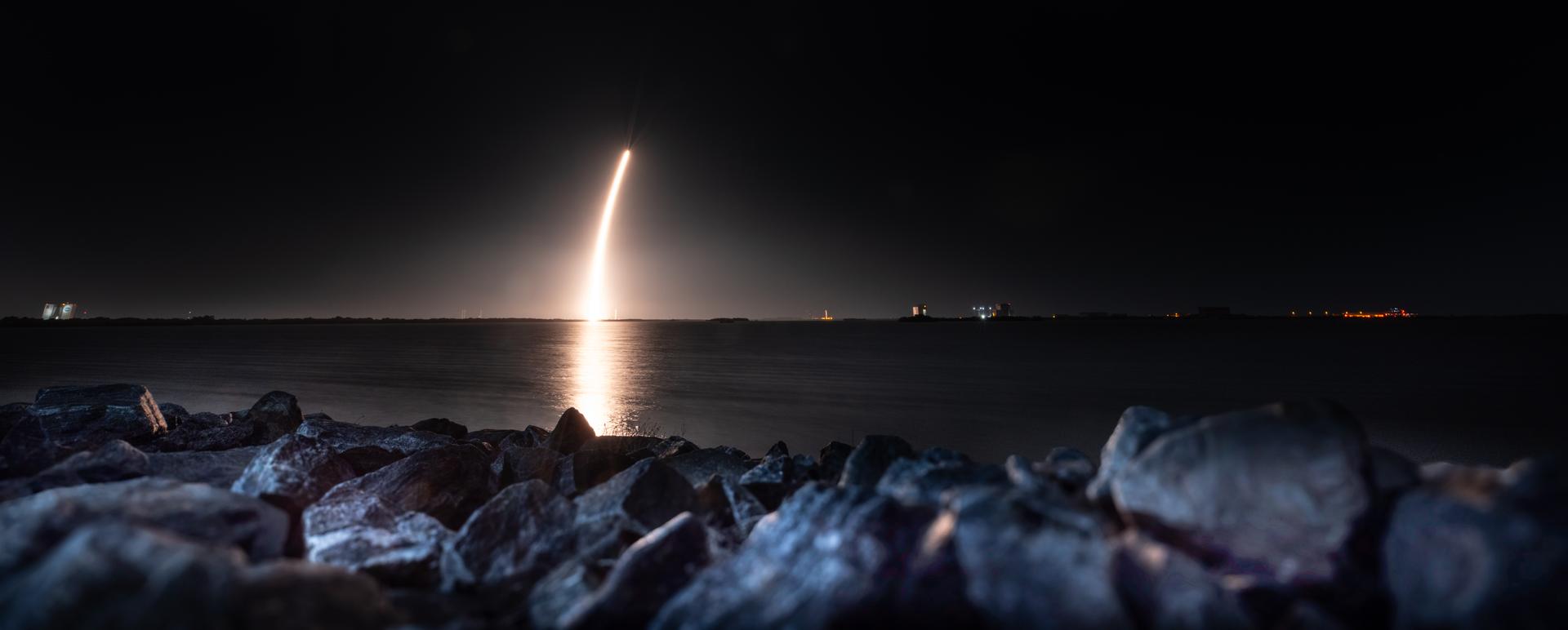
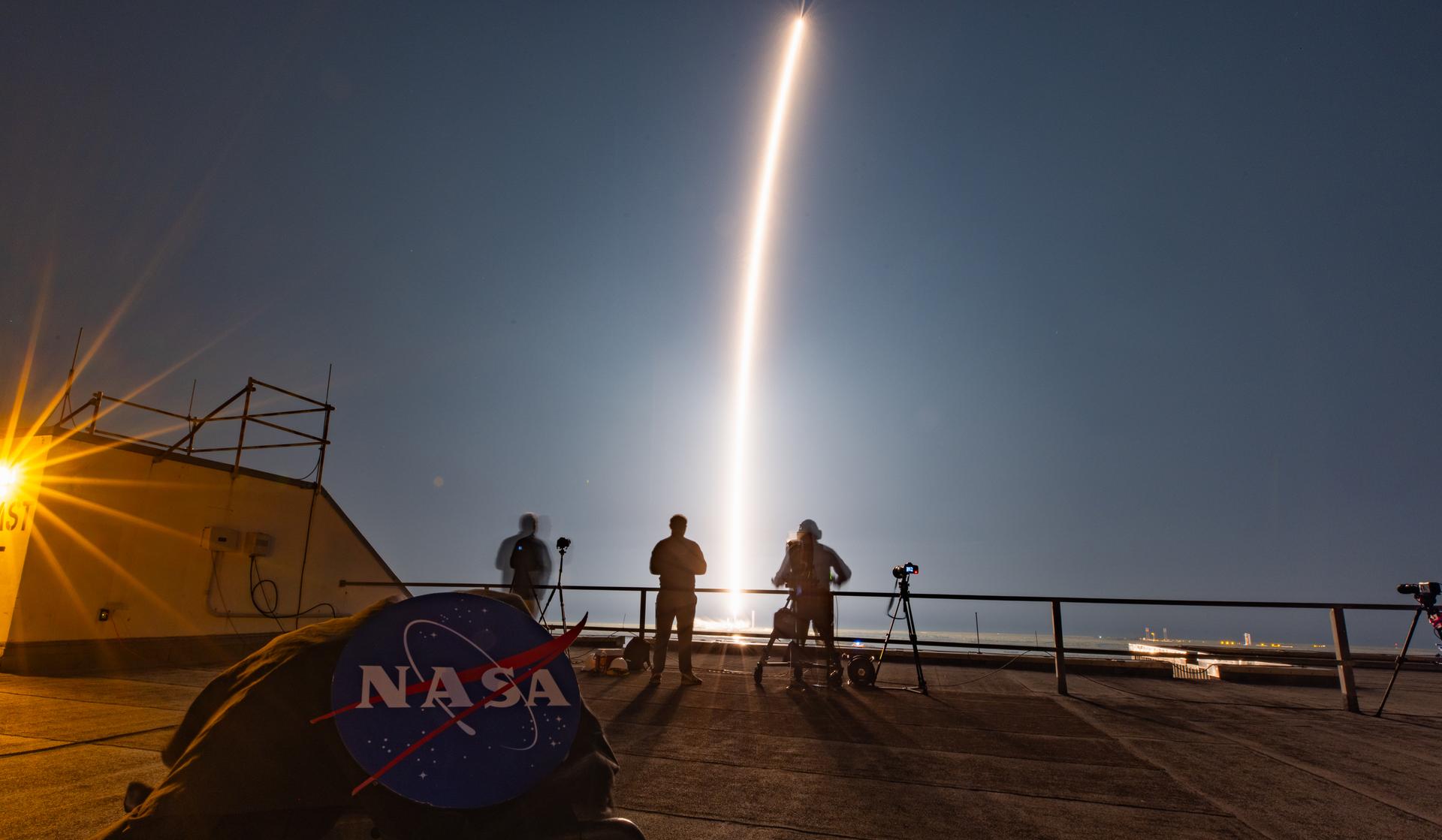
Creating a golden streak in the night sky, a SpaceX Falcon 9 rocket carrying Firefly Aerospace’s Blue Ghost Mission One lander soars upward after liftoff from Launch Complex 39A at NASA’s Kennedy Space Center in Florida on Wednesday, Jan. 15, 2025 as part of NASA’s CLPS (Commercial Lunar Payload Services) initiative.
NASA/Cory S Huston
FEBRUARY Intuitive Machines Launches to the Moon
Intuitive Machines’ IM-2 Nova C lunar lander launched Feb. 26 from Launch Complex 39A, carrying NASA science and technology demonstrations to the Mons Mouton region of the Moon. IM-2 reached the surface of the Moon on March 6.
Creating a golden streak in the night sky, a SpaceX Falcon 9 rocket carrying Intuitive Machines’ Nova-C lunar lander (IM-2) soars upward after liftoff from Launch Complex 39A at NASA’s Kennedy Space Center in Florida at 7:16 p.m. EST Wednesday, Feb. 26, 2025, as part of NASA’s CLPS (Commercial Lunar Payload Services) initiative.
NASA/Frank Michaux
MARCH NASA’s SpaceX Crew-10 Launch
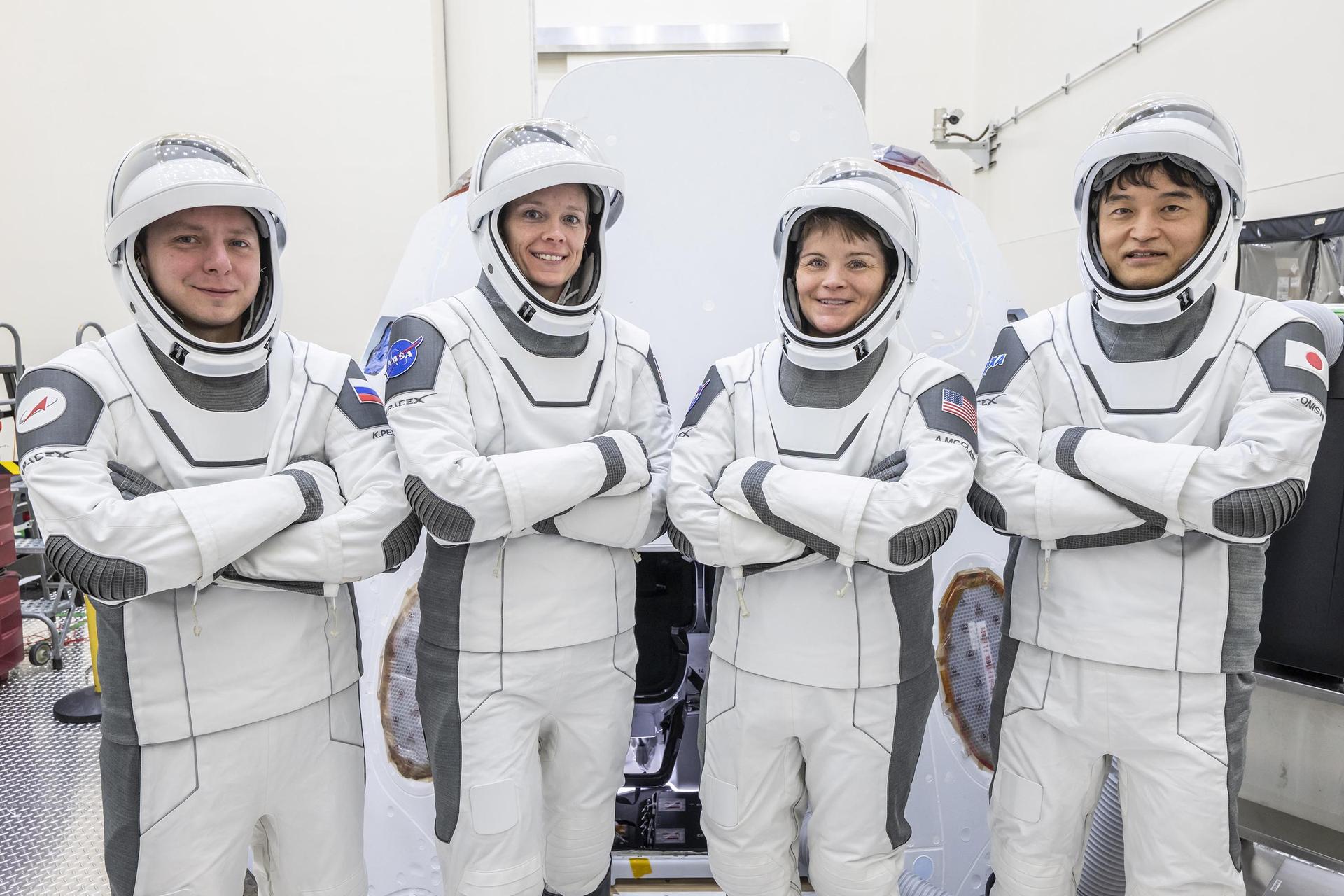
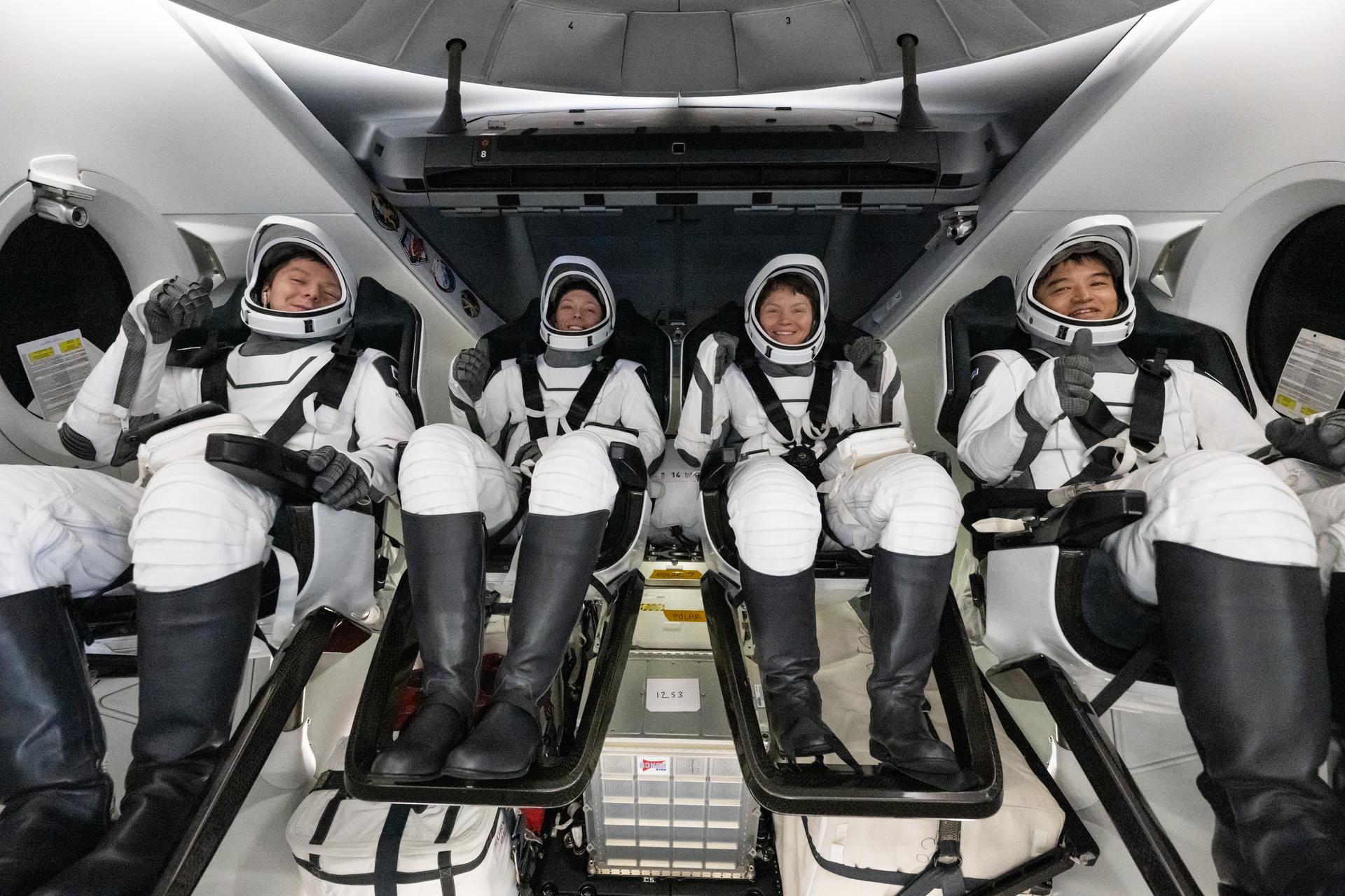
NASA astronauts Anne McClain and Nicole Ayers, JAXA (Japan Aerospace Exploration Agency) Takuya Onishi, and Roscosmos cosmonaut Kirill Peskov launched March 14 from Launch Complex 39A to the International Space Station for a five-month science mission.
Members of NASA’s SpaceX Crew-10, from left, Roscosmos cosmonaut Kirill Peskov, mission specialist; NASA astronauts Nichole Ayers, pilot and Anne McClain, commander; and JAXA (Japan Aerospace Exploration Agency) astronaut Takuya Onishi, mission specialist.
SpaceX
NASA’s SPHEREx, PUNCH Missions Launch
A SpaceX Falcon 9 rocket launched on March 11, from Space Launch Complex 4 East at Vandenberg Space Force Base in California carrying NASA’s SPHEREx (Spectro-Photometer for the History of the Universe, Epoch of Reionization and Ices Explorer) and PUNCH (Polarimeter to Unify the Corona and Heliosphere) missions. NASA’s Launch Services Program, based at NASA Kennedy managed the launch service for SPHEREx.
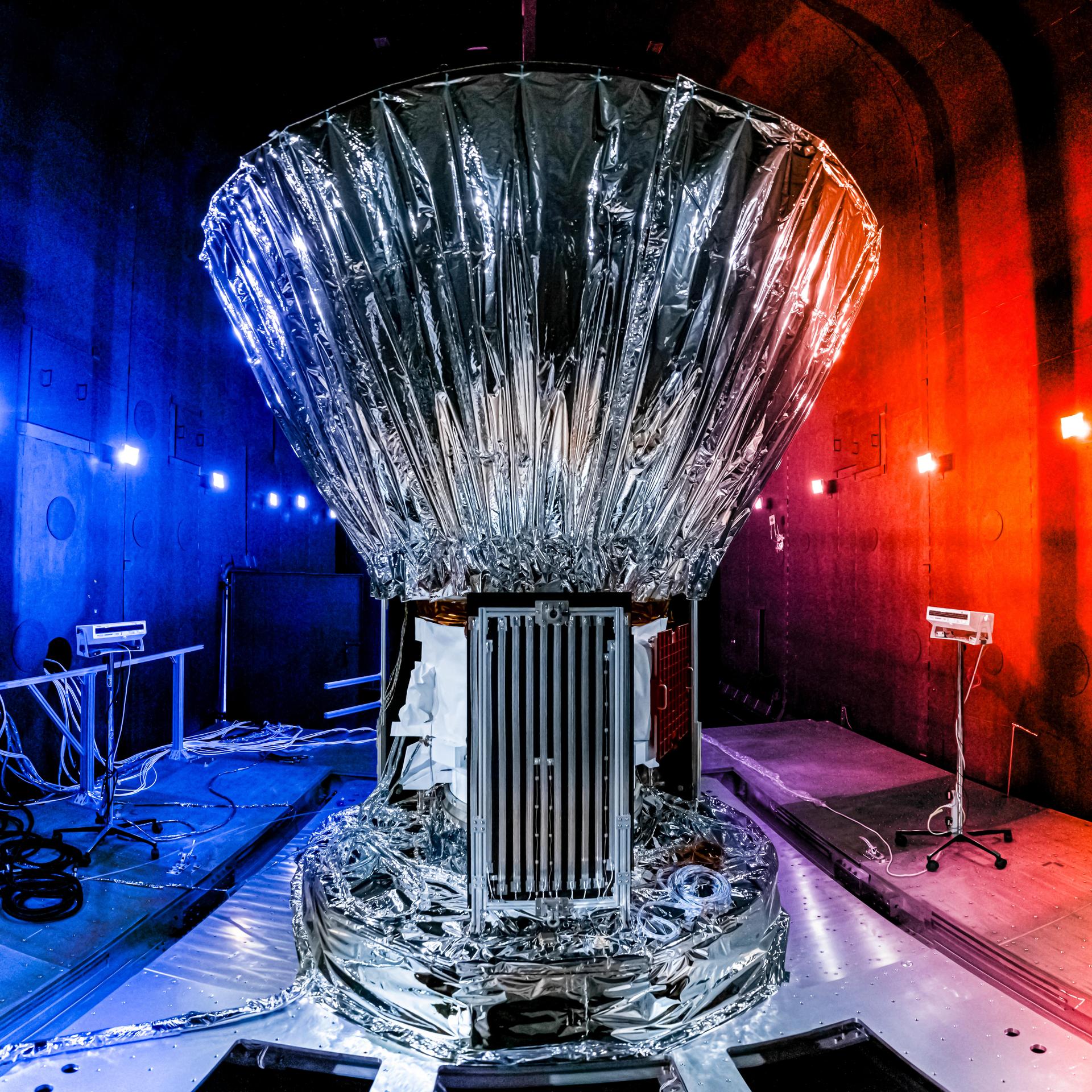
NASA’s SPHEREx observatory is installed in the Titan Thermal Vacuum (TVAC) test Chamber at BAE Systems in Boulder, Colorado, in June 2024. As part of the test setup, the spacecraft and photon shield are covered in multilayer insulation and blankets and surrounded by ground support equipment.
Jet Propulsion Laboratory
NASA’s SpaceX Crew-9 Returns
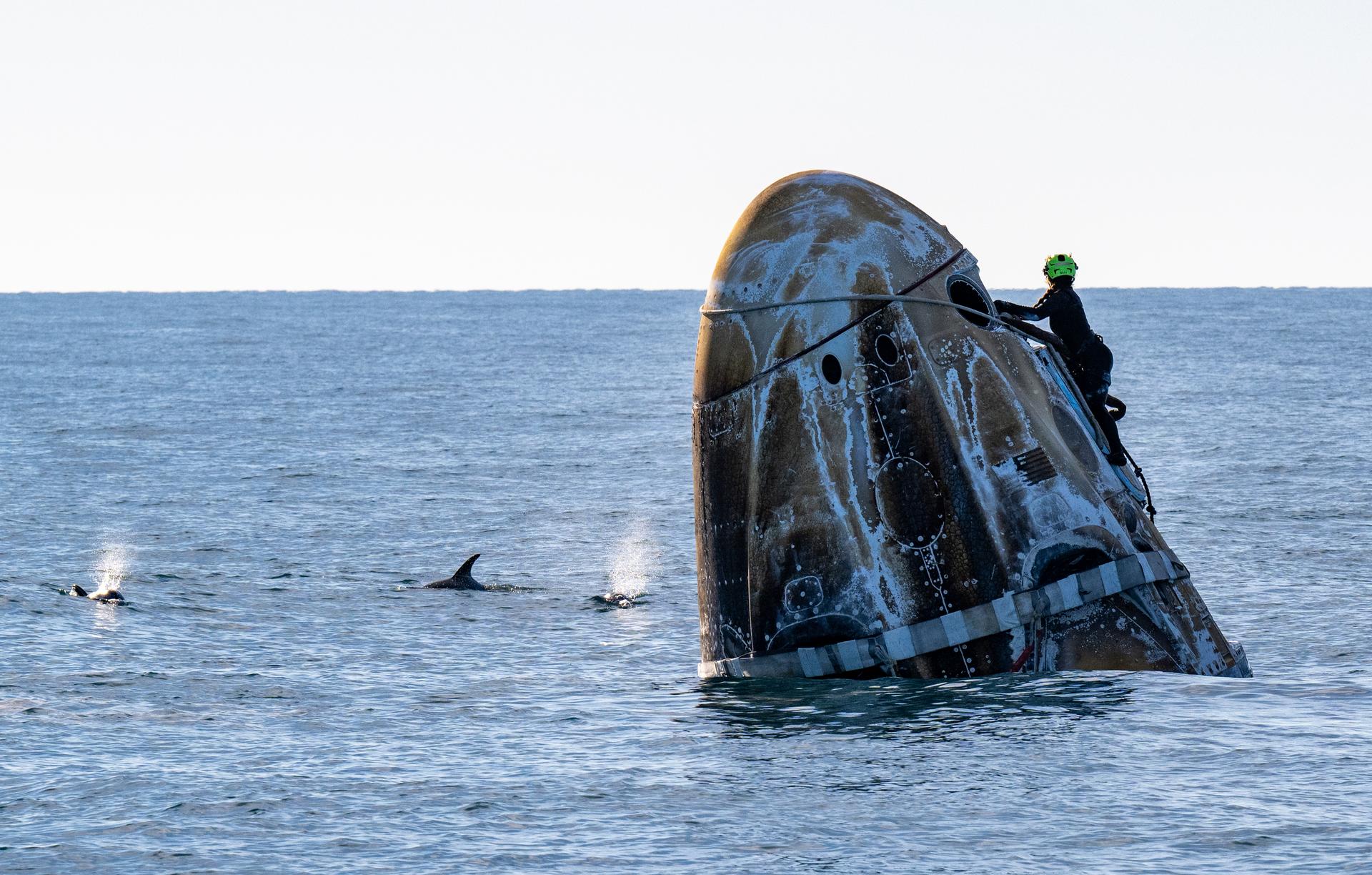
NASA astronauts Nick Hague, Suni Williams, and Butch Wilmore were greeted by dolphins and recovery teams after their SpaceX Dragon spacecraft splashed down on March 18, off the coast of Tallahassee, Florida following their long-duration mission at the International Space Station.
Support teams work around a SpaceX Dragon spacecraft shortly after it landed with NASA astronauts Nick Hague, Suni Williams, Butch Wilmore, and Roscosmos cosmonaut Aleksandr Gorbunov aboard in the water off the coast of Tallahassee, Florida, Tuesday, March 18, 2025. Hague, Gorbunov, Williams, and Wilmore are returning from a long-duration science expedition aboard the International Space Station.
NASA/Keegan Barber
NASA Causeway Bridge Opens
The Florida Department of Transportation opened the westbound portion of the NASA Causeway Bridge on March 19, completing construction in both directions spanning the Indian River Lagoon and connecting NASA Kennedy and Cape Canaveral Space Force Station to the mainland.
Cars drive over the newly completed westbound portion (right side of photo) of the NASA Causeway Bridge leading away from NASA’s Kennedy Space Center in Florida on Wednesday, March 19, 2025. The Florida Department of Transportation (FDOT) opened the span on Tuesday, March 18, 2025, alongside its twin on the eastbound side, which has accommodated traffic in both directions since FDOT opened it on June 9, 2023.
NASA/Glenn Benson
NASA Artemis Teams Complete URT-12
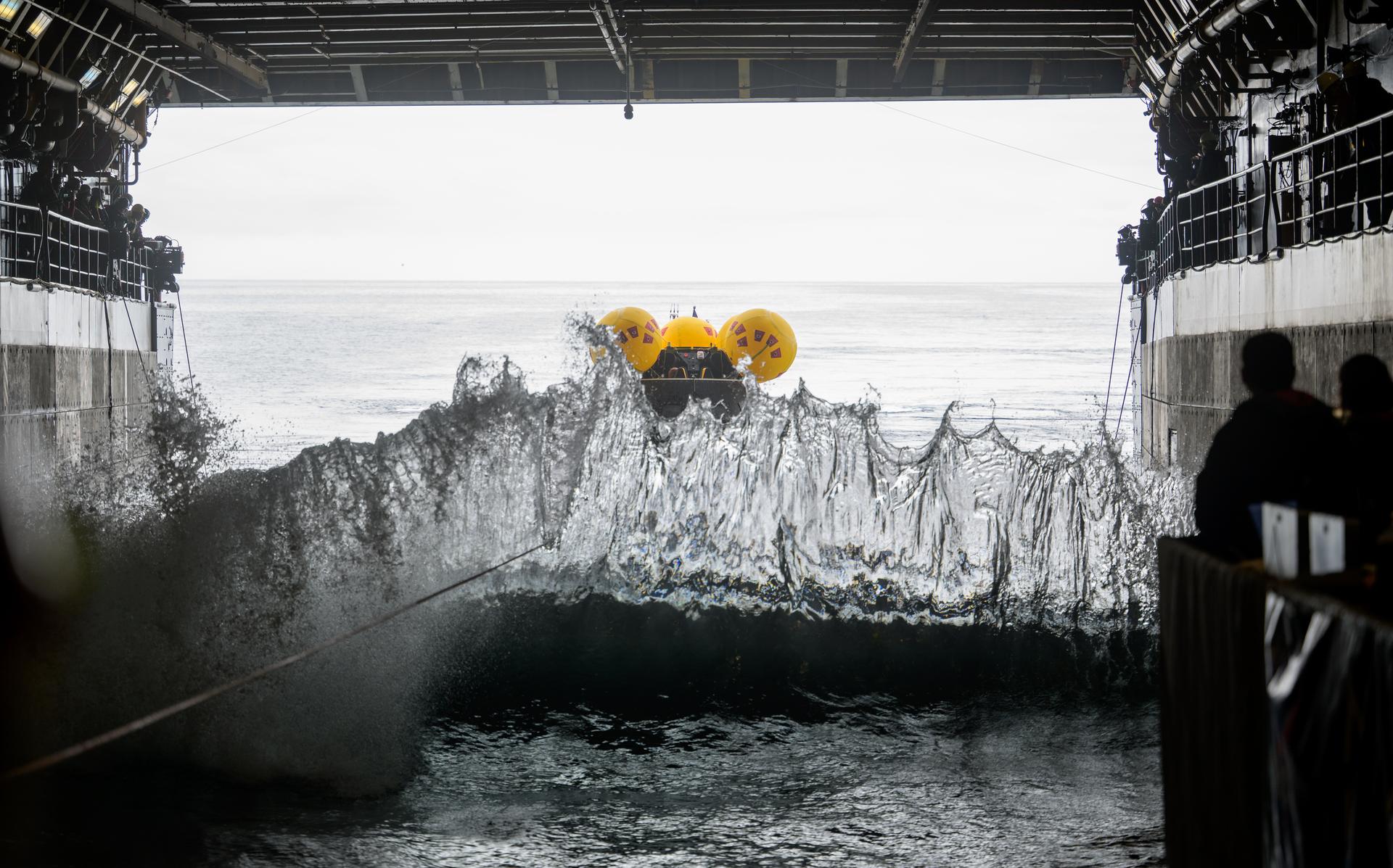
Teams from NASA and the Department of War train during a week-long Underway Recovery Test-12 in March off the coast of California for Artemis II test flight crewmembers and the Orion spacecraft. The series of tests demonstrate and evaluate the processes, procedures, and hardware used in recovery operations for crewed lunar missions.
Waves break inside USS Somerset as the Crew Module Test Article, a full scale mockup of the Orion spacecraft, is tethered during Underway Recovery Test-12 off the coast of California, Wednesday, March 26, 2025. During the test, NASA and Department of Defense teams are practicing to ensure recovery procedures are validated as NASA plans to send Artemis II astronauts around the Moon and splashdown in the Pacific Ocean.
NASA/Joel Kowsky
APRIL NASA’s SpaceX 32nd Commercial Resupply Mission
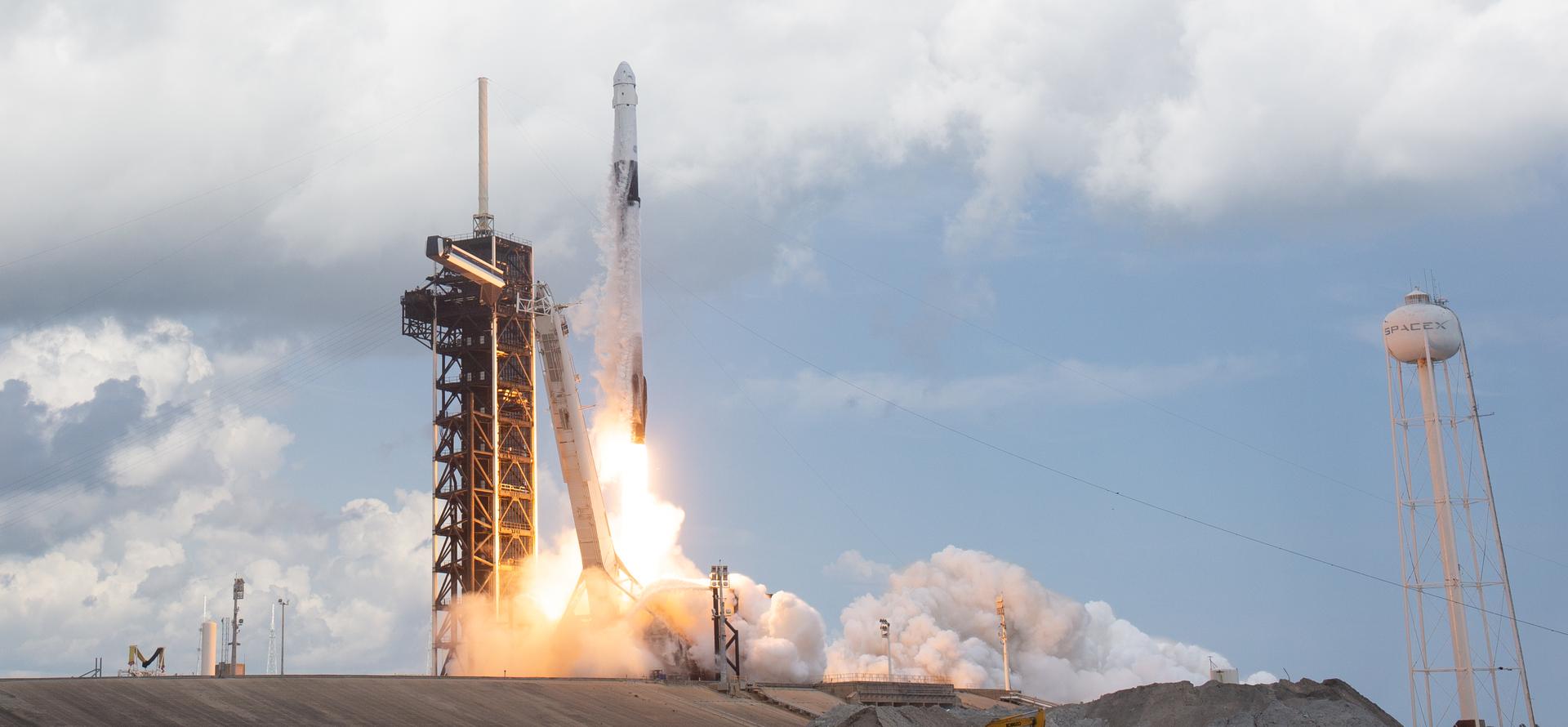
A SpaceX Falcon 9 rocket and a Dragon spacecraft carrying nearly 6,700 pounds of scientific investigations, food, supplies, and equipment launched on April 21 from Launch Complex 39A to the International Space Station.
The SpaceX Falcon 9 rocket carrying the Dragon spacecraft lifts off from Launch Complex 39A at NASA’s Kennedy Space Center in Florida on Monday, April 21, on the company’s 32nd commercial resupply services mission for the agency to the International Space Station.
SpaceX
JULY Artemis III Begins Processing
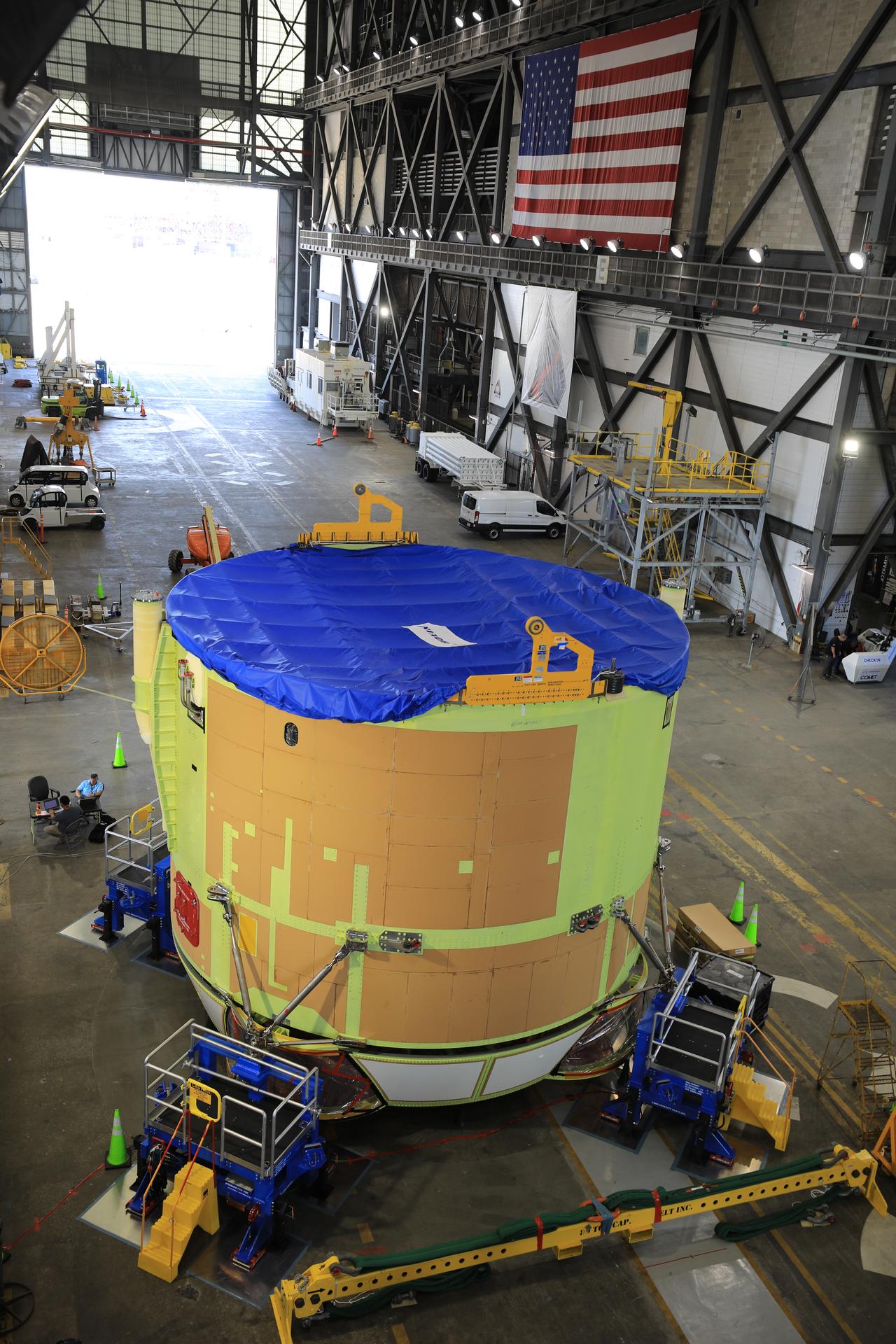
NASA’s Artemis III SLS engine section and boat-tail made the journey from the Space Systems Processing Facility at NASA Kennedy to the spaceport’s Vehicle Assembly Building in July to complete integration and check-out testing. Beginning with the Artemis III hardware, NASA moved certain operations to NASA Kennedy to streamline the manufacturing process and enable simultaneous production operations of two core stages.
Teams from NASA’s Kennedy Space Center in Florida integrate NASA’s Artemis III SLS (Space Launch System) core stage engine section with its boat-tail inside the spaceport’s Vehicle Assembly Building on Wednesday, July 30, 2025. The boat-tail is a fairing-like structure that protects the bottom end of the core stage, while the engine section is one the most complex and intricate parts of the rocket stage that will help power the Artemis missions to the Moon.
NASA/Ronald Beard
AUGUST NASA’s SpaceX Crew-11 Launches
NASA astronauts Zena Cardman and Mike Fincke, JAXA (Japan Aerospace Exploration Agency) astronaut Kimiya Yui, and Roscosmos cosmonaut Oleg Platonov launched aboard a SpaceX Dragon spacecraft and its Falcon 9 rocket on Aug. 1 from Launch Complex 39A bound for a long-duration mission to the International Space Station.
NASA’s SpaceX Crew-11 mission is the eleventh crew rotation mission of the SpaceX Dragon spacecraft and Falcon 9 rocket to the International Space Station as part of the agency’s Commercial Crew Program.
NASA/Joel Kowsky
NASA’s SpaceX Crew-10 Returns
NASA astronauts Anne McClain and Nicole Ayers, JAXA (Japan Aerospace Exploration Agency) astronaut Takuya Onishi, and Roscosmos cosmonaut Kirill Peskov became the first Commercial Crew to splash down in the Pacific Ocean off the coast of California on Aug. 9, completing their nearly five-month mission at the orbiting outpost as part of the agency’s Commercial Crew Program.
Roscosmos cosmonaut Kirill Peskov, left, NASA astronauts Nichole Ayers, Anne McClain, and JAXA (Japan Aerospace Exploration Agency) astronaut Takuya Onishi returned after 147 days in space as part of Expedition 73 aboard the International Space Station.
NASA/Keegan Barber
NASA’s SpaceX 33rd Commercial Resupply Mission
A SpaceX Falcon 9 launched the company’s Dragon spacecraft carrying more than 5,000 pounds of food, crew supplies, science investigations, spacewalk equipment, and more to the space station on Aug. 24 from Launch Complex 39A.
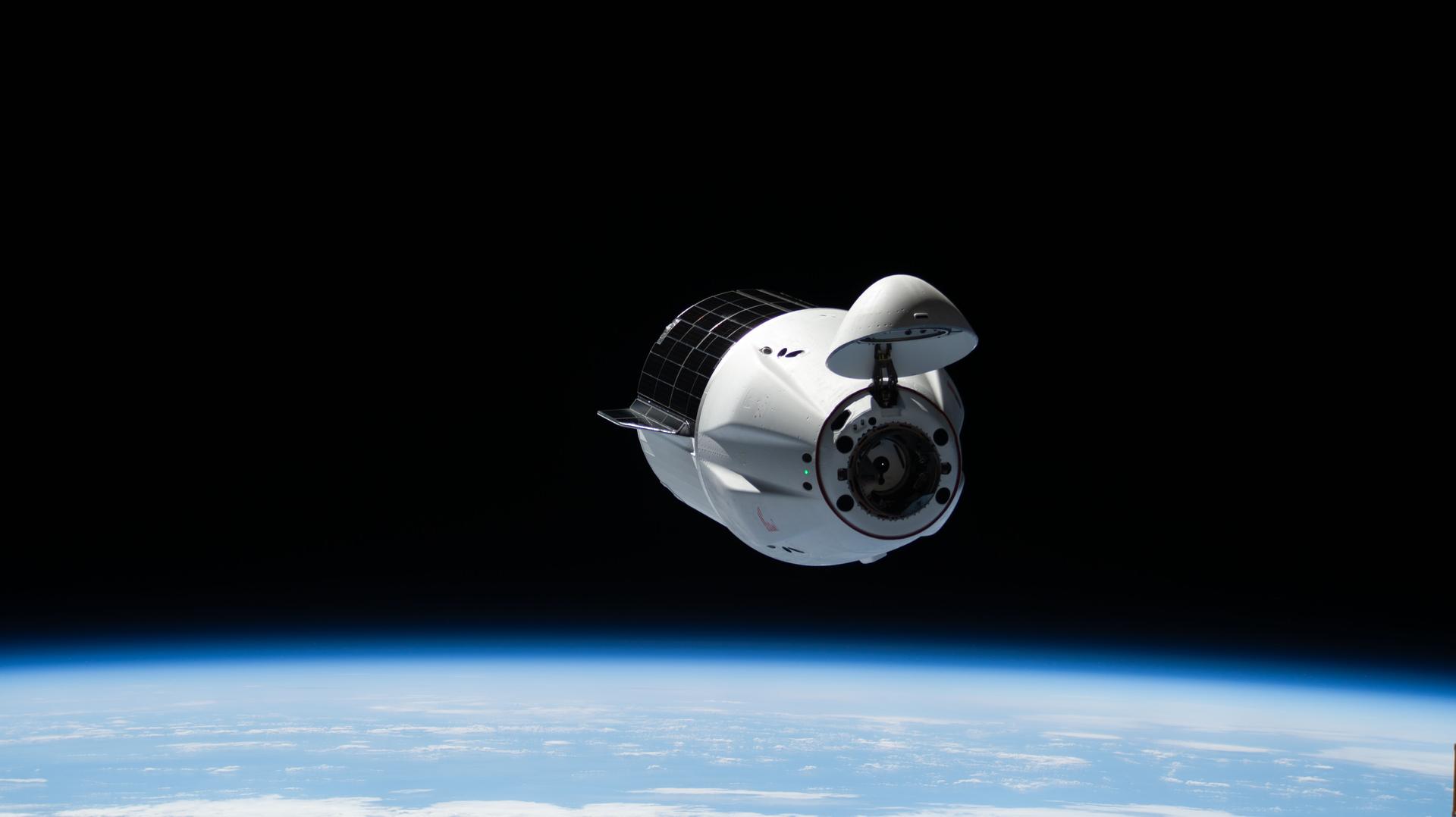
A SpaceX Dragon cargo spacecraft with its nosecone open and carrying over 5,000 pounds of science, supplies, and hardware for NASA’s SpaceX CRS-33 mission approaches the International Space Station for an automated docking to the Harmony module’s forward port.
NASA
Orion Tested, Stacked With Hardware
Teams transported NASA’s Orion spacecraft from Kennedy’s Multi-Payload Processing Facility to the Launch Abort System Facility in August where crews integrated the 44-foot-tall launch abort system. The Orion spacecraft will send NASA astronauts Reid Wiseman, Victor Glover, Christina Koch, and CSA (Canadian Space Agency) astronaut Jeremy Hansen around the Moon for the Artemis II mission in early 2026. The launch abort system is designed to carry the crew to safety in the event of an emergency atop the SLS.
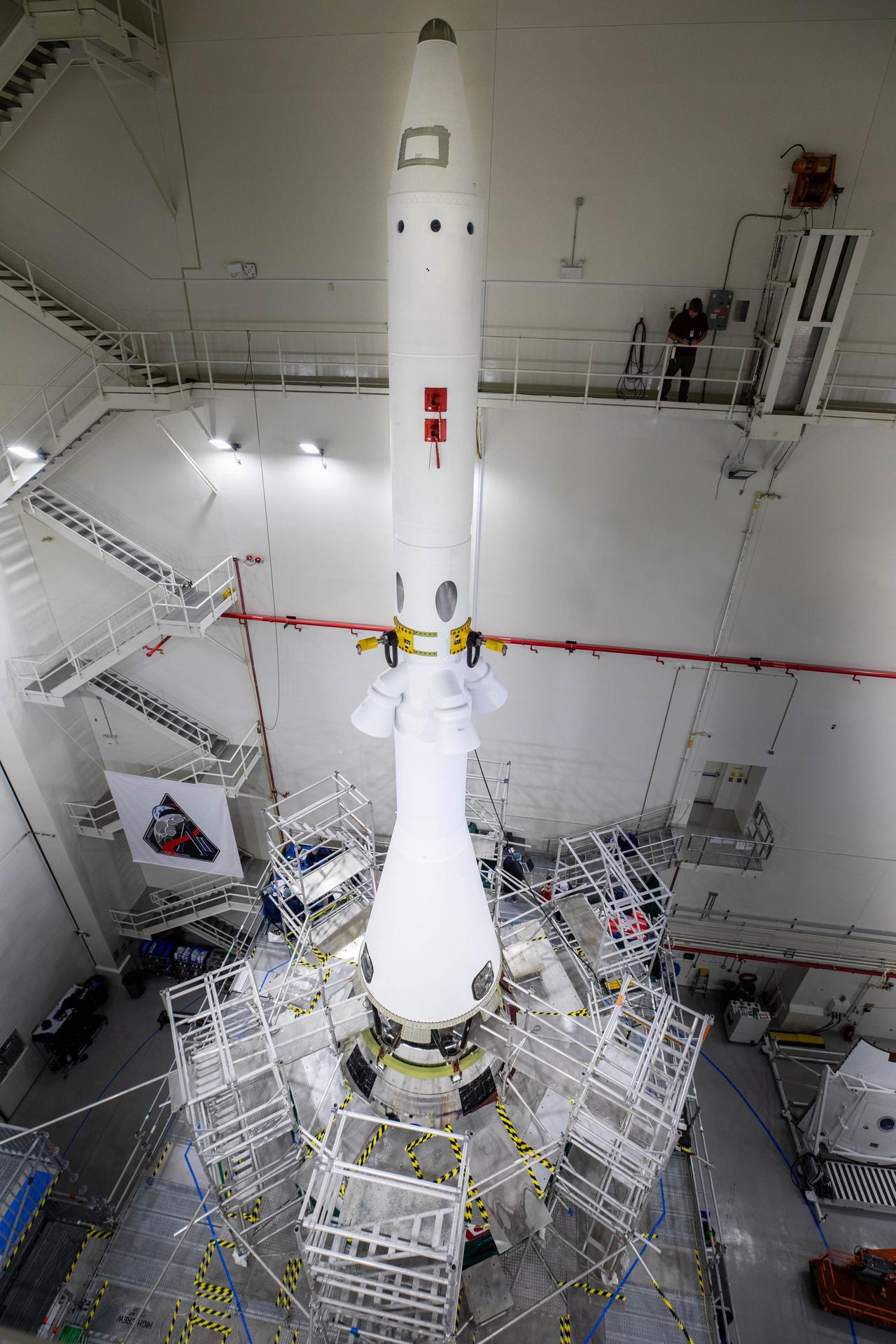
The launch abort tower on NASA’s Artemis II Orion spacecraft is pictured inside the Launch Abort System Facility at the agency’s Kennedy Space Center in Florida on Wednesday, Aug. 27, 2025, after teams with NASA’s Exploration Ground Systems Program installed the tower on Wednesday, Aug. 20, 2025. Positioned at the top of Orion, the 44-foot-tall launch abort system is designed to carry the crew to safety in the event of an emergency during launch or ascent, with its three solid rocket motors working together to propel Orion – and astronauts inside – away from the rocket for a safe landing in the ocean, or detach from the spacecraft when it is no longer needed. The final step to complete integration will be the installation of the ogive fairings, which are four protective panels that will shield the crew module from the severe vibrations and sounds it will experience during launch.
NASA/Cory Huston
SEPTEMBER NASA Launches IMAP Mission
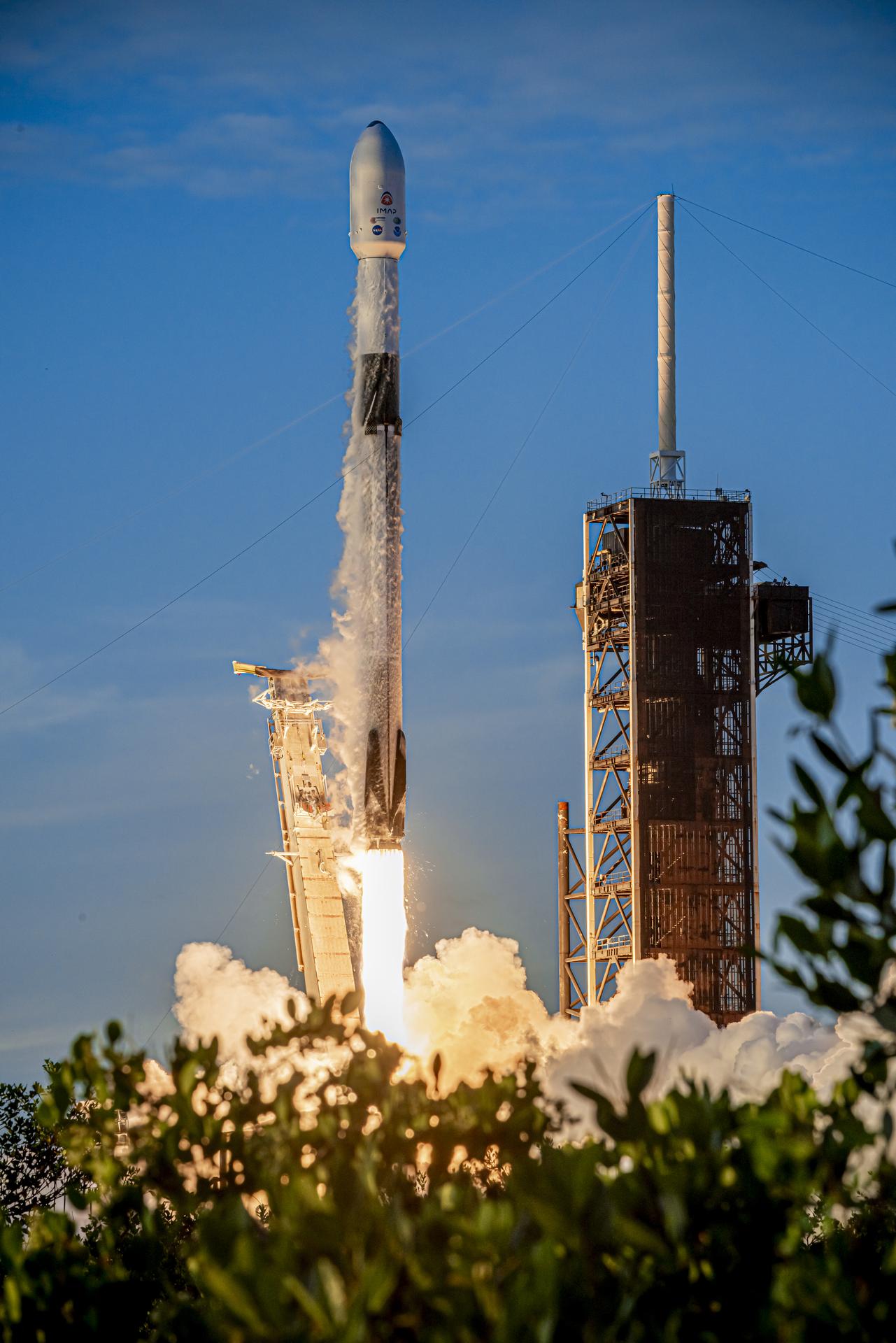
NASA’s IMAP (Interstellar Mapping and Acceleration Probe) launched from Launch Complex 39A on Sept. 24, to help researchers better understand the boundary of the heliosphere, a huge bubble created by the Sun surrounding and protecting our solar system.
A SpaceX Falcon 9 rocket carrying NASA’s IMAP (Interstellar Mapping and Acceleration Probe), the agency’s Carruthers Geocorona Observatory, and National Oceanic and Atmospheric Administration’s (NOAA) Space Weather Follow On–Lagrange 1 (SWFO-L1) spacecraft lifts off from Launch Complex 39A at NASA’s Kennedy Space Center in Florida at 7:30 a.m. EDT Wednesday, Sept. 24, 2025. The missions will each focus on different effects of the solar wind — the continuous stream of particles emitted by the Sun — and space weather — the changing conditions in space driven by the Sun — from their origins at the Sun to their farthest reaches billions of miles away at the edge of our solar system.
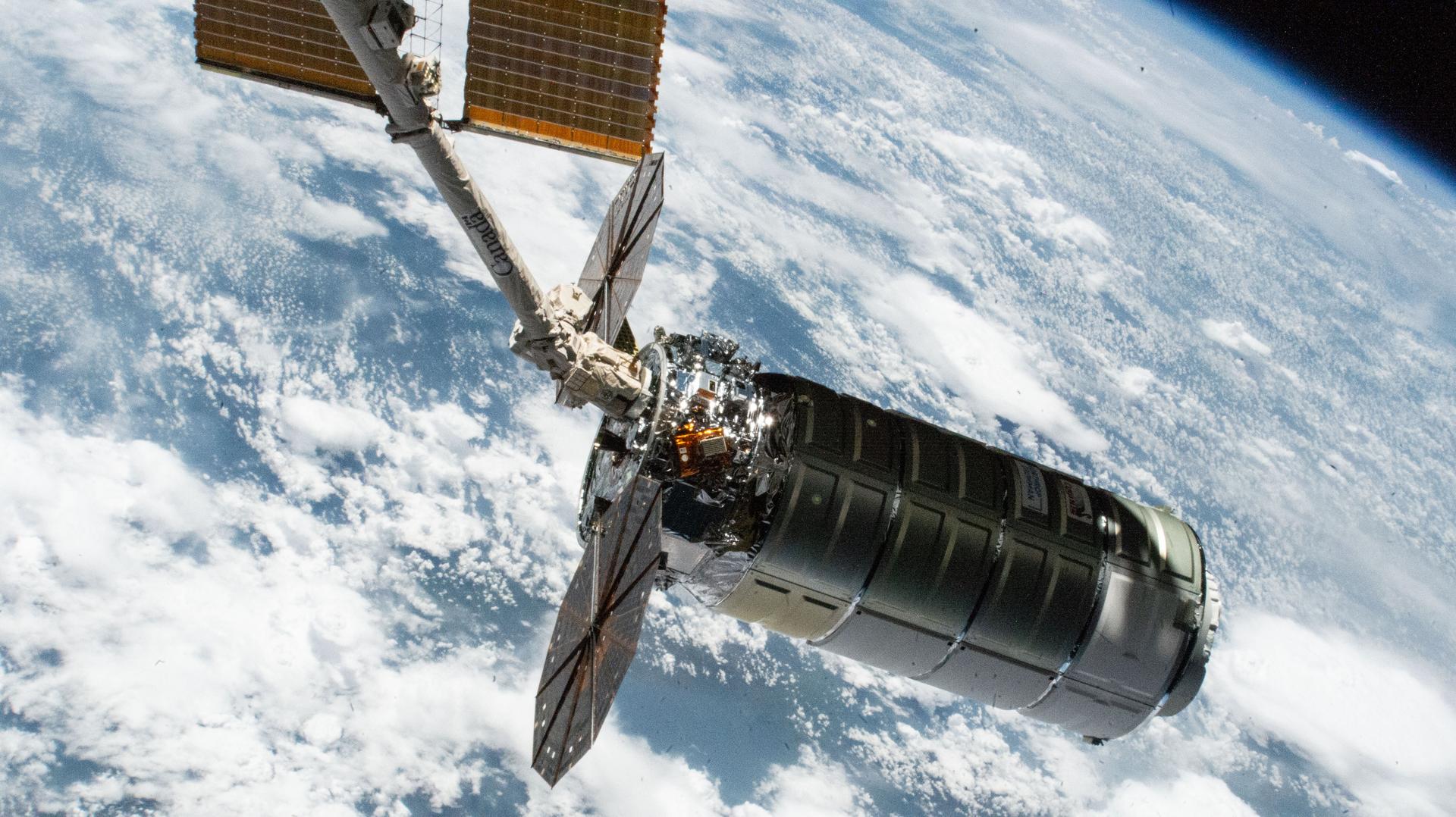
A Northrop Grumman Cygnus XL spacecraft atop a SpaceX Falcon 9 rocket lifted off from Launch Complex 39A to the International Space Station delivering NASA science investigations, supplies, and equipment as part of the agency’s partnership to resupply the orbiting laboratory.
Northrop Grumman’s Cygnus XL cargo craft, carrying over 11,000 pounds of new science and supplies for the Expedition 73 crew, is pictured in the grips of the International Space Station’s Canadarm2 robotic arm following its capture. Both spacecraft were orbiting 257 miles above Tanzania. Cygnus XL is Northrop Grumman’s expanded version of its previous Cygnus cargo craft increasing its payload capacity and pressurized cargo volume.
NASA
OCTOBER Orion Integrated With SLS Rocket
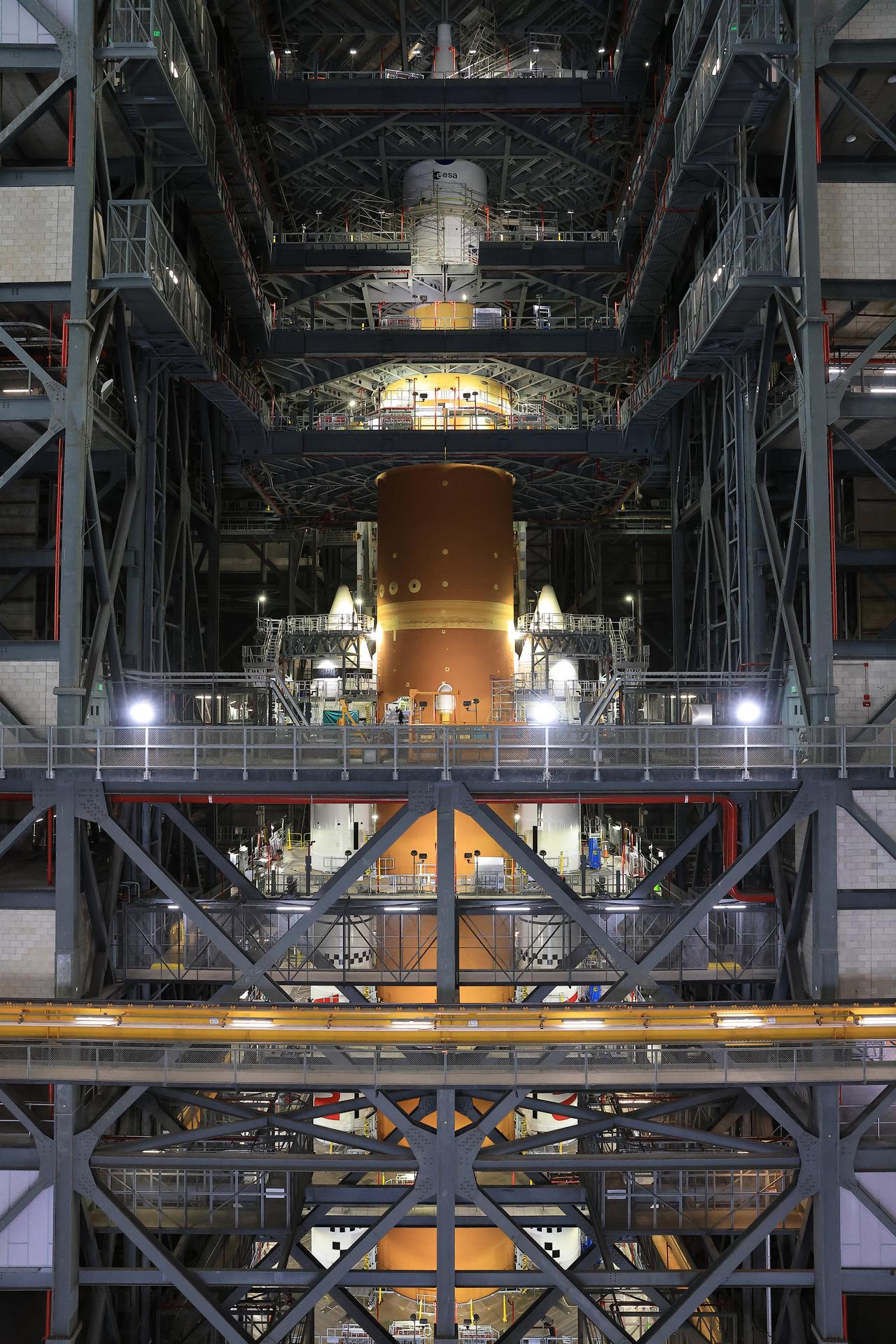
Teams stacked NASA’s Orion spacecraft with its launch abort system on the agency’s SLS rocket in High Bay 3 of the Vehicle Assembly Building at NASA Kennedy on Oct. 20 for the agency’s Artemis II mission. Teams will begin conducting a series of verification tests ahead of rolling out the integrated SLS rocket to Launch Complex 39B for the wet dress rehearsal.
NASA’s Artemis II Orion spacecraft with its launch abort system is stacked atop the agency’s SLS (Space Launch System) rocket in High Bay 3 of the Vehicle Assembly Building at NASA’s Kennedy Space Center in Florida on Monday, Oct. 20, 2025.
NASA/Kim Shiflett
NOVEMBER NASA’s ESCAPADE Begins Journey to Mars
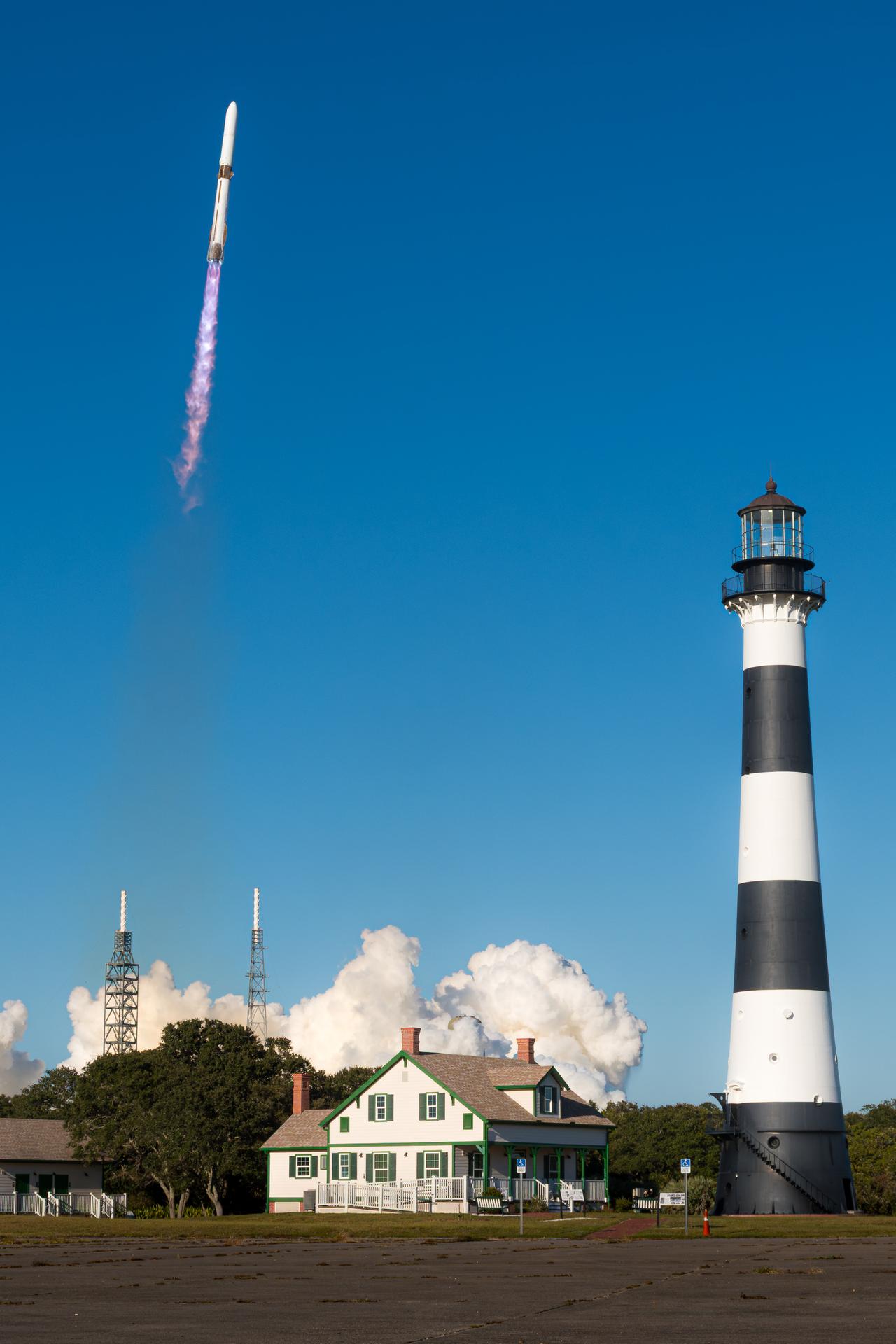
NASA’s ESCAPADE (Escape and Plasma Acceleration and Dynamics Explorers) twin spacecraft launched aboard Blue Origin’s New Glenn rocket on Nov. 13 from Launch Complex 36 at Cape Canaveral Space Force Station. Its twin orbiters will take simultaneous observations from different locations around Mars to reveal how the solar wind interacts with Mars’ magnetic environment and how this interaction drives the planet’s atmospheric escape.
Near Cape Canaveral Lighthouse, Blue Origin’s New Glenn rocket carrying NASA’s twin ESCAPADE (Escape and Plasma Acceleration and Dynamics Explorers) spacecraft launches at 3:55 p.m. EST, Thursday, Nov. 13, 2025, from Launch Complex 36 at Cape Canaveral Space Force Station in Florida. The ESCAPADE mission, built by Rocket Lab, will study how solar wind and plasma interact with Mars’ magnetosphere and how this interaction drives the planet’s atmospheric escape to prepare for future human missions on Mars.
Blue Origin
NASA, European Partners Launch Sea Satellite
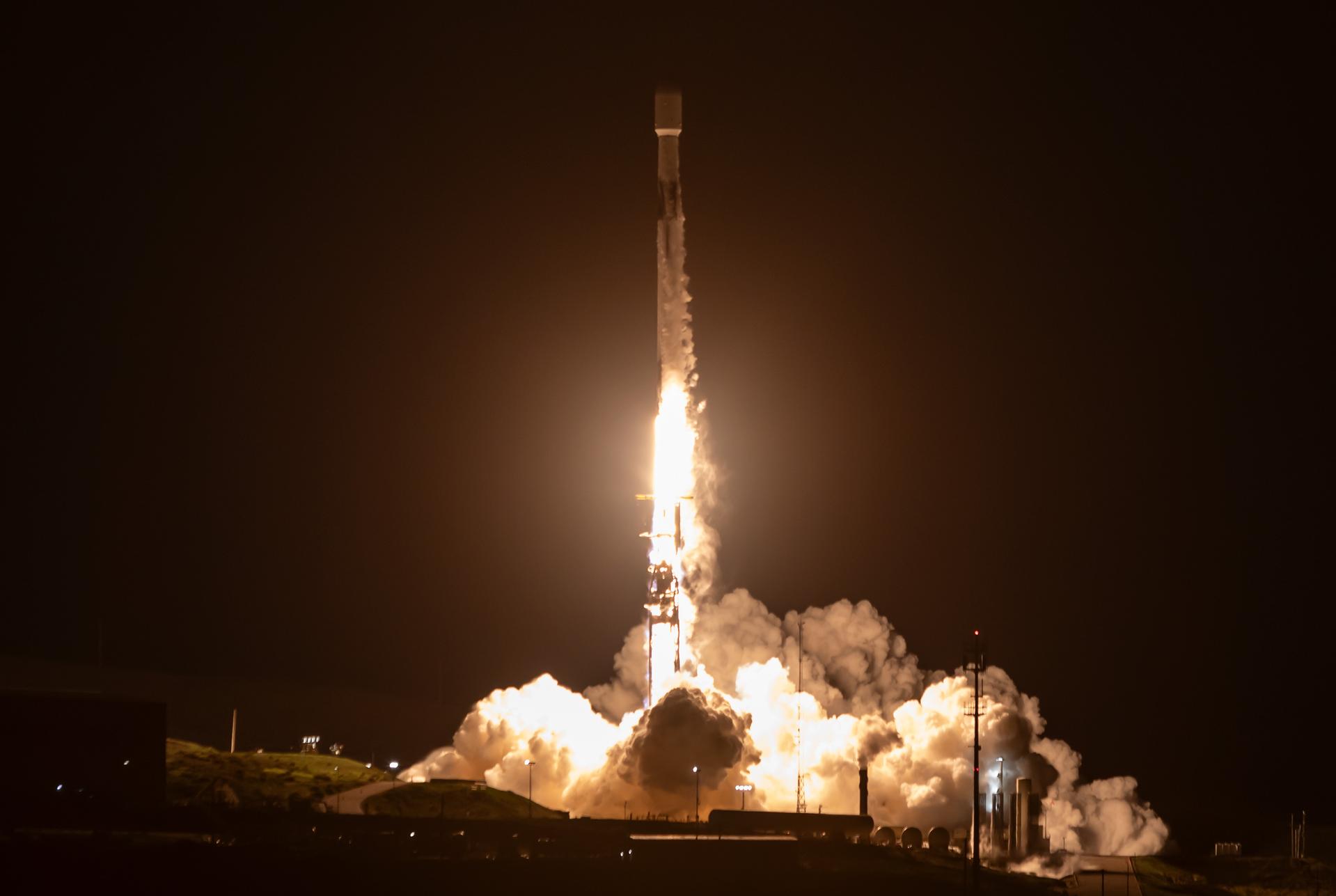
A SpaceX Falcon 9 rocket carrying the U.S.-European Sentinel-6B satellite launched at Nov. 16 from Space Launch Complex 4 East at Vandenberg Space Force Base in California. Sentinel-6B will observe Earth’s ocean, measuring sea levels to improve weather forecasts and flood predictions, safeguard public safety, benefit commercial industry, and protect coastal infrastructure.
A SpaceX Falcon 9 rocket carrying the international Sentinel-6B spacecraft lifts off from Space Launch Complex 4 East at Vandenberg Space Force Base in California at 9:21 p.m. PST Sunday, Nov. 16, 2025. A collaboration between NASA, ESA (European Space Agency), EUMETSAT (European Organisation for the Exploitation of Meteorological Satellites), and the National Oceanic and Atmospheric Administration (NOAA), Sentinel-6B is designed to measure sea levels down to roughly an inch for about 90% of the world’s oceans.
SpaceX
DECEMBER
NASA astronauts Reid Wiseman, Victor Glover, Christina Koch, and CSA astronaut Jeremy Hansen participated in a dry dress rehearsal at NASA Kennedy on Dec. 20 to mimic launch day operations for the Artemis II launch. The crew donned their spacesuits, exited the Neil A. Operations and Checkout Building, and took the journey to the Vehicle Assembly Building, up the mobile launcher to the crew access arm, and entered the Orion spacecraft that will take them around the Moon and back to Earth.
From right to left, NASA astronauts Christina Koch, mission specialist; Reid Wiseman, commander; Victor Glover, pilot; and CSA (Canadian Space Agency) astronaut Jeremy Hansen, mission specialist are seen as they depart the Neil A. Armstrong Operations and Checkout Building to board their Orion spacecraft atop NASA’s Space Launch System rocket inside the Vehicle Assembly Building as part of the Artemis II countdown demonstration test, Saturday, Dec. 20, 2025, at NASA’s Kennedy Space Center in Florida. For this operation, the Artemis II crew and launch teams are simulating the launch day timeline including suit-up, walkout, and spacecraft ingress and egress. Through the Artemis campaign, NASA will send astronauts to explore the Moon for scientific discovery, economic benefits, and to build the foundation for the first crewed missions to Mars, for the benefit of all.
The four astronauts set to fly around the Moon during NASA’s Artemis II test flight depart the Neil A. Armstrong Operations and Checkout Building at the agency’s Kennedy Space Center in Florida, during a dress rehearsal for launch day on Dec. 20, 2025. From left are CSA (Canadian Space Agency) astronaut Jeremy Hansen, NASA astronauts Victor Glover, Reid Wiseman, and Christina Koch.
The launch day rehearsal, called a countdown demonstration test, simulated the launch day timeline, including the crew suiting up in their spacesuits and climbing in and out of their Orion spacecraft. Because the SLS (Space Launch System) rocket upon which they will launch is not yet at the launch pad, the crew boarded Orion inside Kennedy’s Vehicle Assembly Building, where engineers are conducting final preparations on the spacecraft, rocket, and ground systems.
Through Artemis, NASA will send astronauts to explore the Moon for scientific discovery, economic benefits, and build the foundation for the first crewed missions to Mars.

 Login
Login