
Normal view

There are new articles available, click to refresh the page.
Before yesterdayMain stream

NASA Develops Blockchain Technology to Enhance Air Travel Safety and Security 

16 January 2026 at 15:11

3 min read

Preparations for Next Moonwalk Simulations Underway (and Underwater)

By Supreet Kaur

In an era where data security is critical to aviation safety, NASA is exploring bold new solutions. 
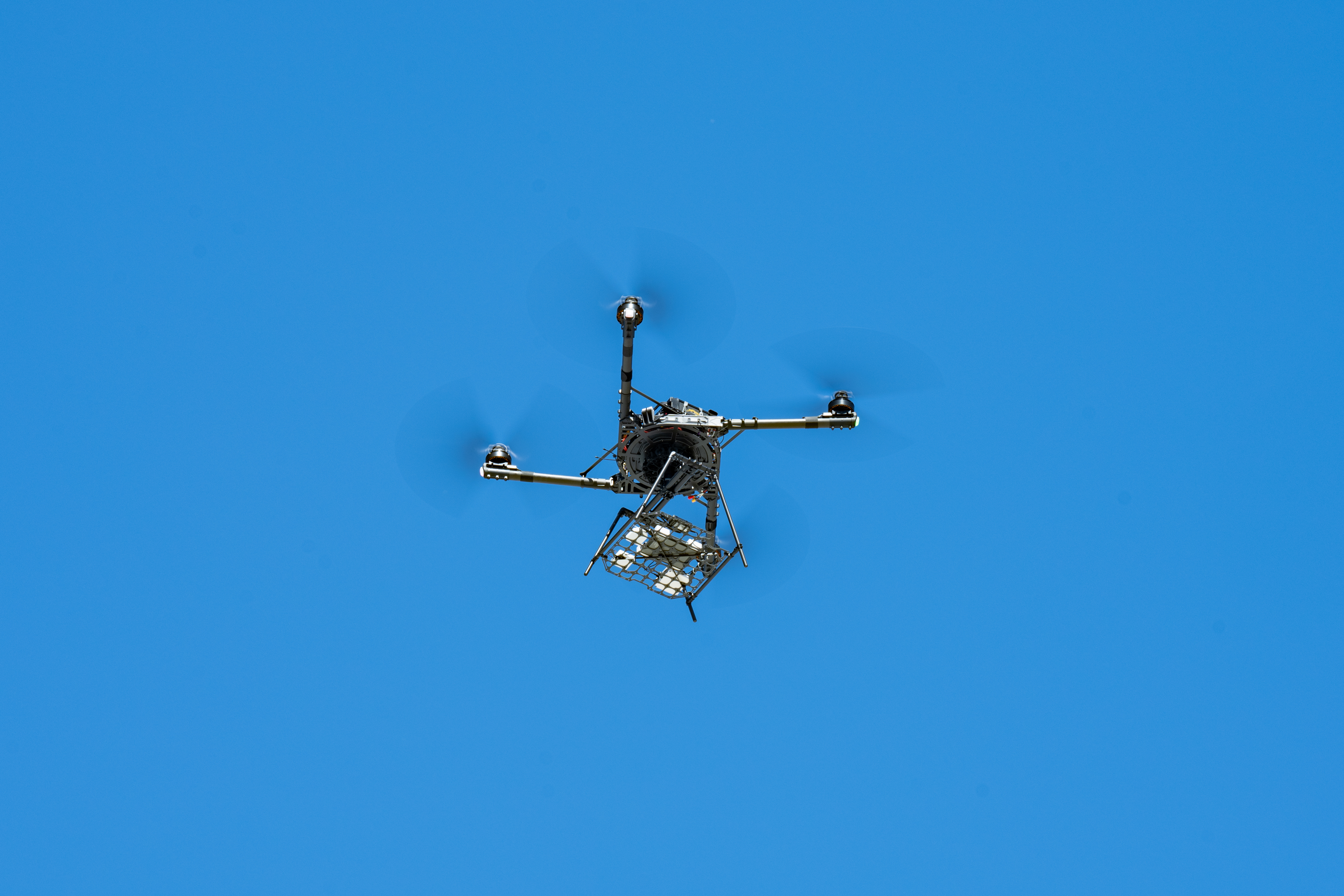
An Alta-X drone carries a custom built simulated Unmanned Aircraft Systems environment payload for the new blockchain system tests.   
Credit: NASA/Brandon Torres Navarette 

Through a drone flight test at NASA’s Ames Research Center in California’s Silicon Valley, researchers tested a blockchain-based system for protecting flight data. The system aims to keep air traffic management safe from disruption and protect data transferred between aircraft and ground stations from being intercepted or manipulated. 

For aviation and airspace operations to remain safe, users need to be able to trust that data is reliable and transparent. While current systems have been able to protect flight data systems, cyberthreats continue to evolve, requiring new approaches. NASA researchers found the blockchain-based system can safely transmit and store information in real time. 

Blockchain operates like a decentralized database — it does not rely on a single computer or centralized system. Instead, it shares information across a vast network, recording and verifying every change to a dataset. The system ensures the data stays safe, accurate, and trustworthy.  

Previous cybersecurity research focused on implementing a layered security architecture — using multiple physical and digital security measures to control system access. For this test, researchers took a different approach using blockchain to address potential threats.  

Using drones allowed the team to show that the blockchain framework could yield benefits across several priority areas in aviation development, including autonomous air traffic management, urban air mobility, and high-altitude aircraft.  
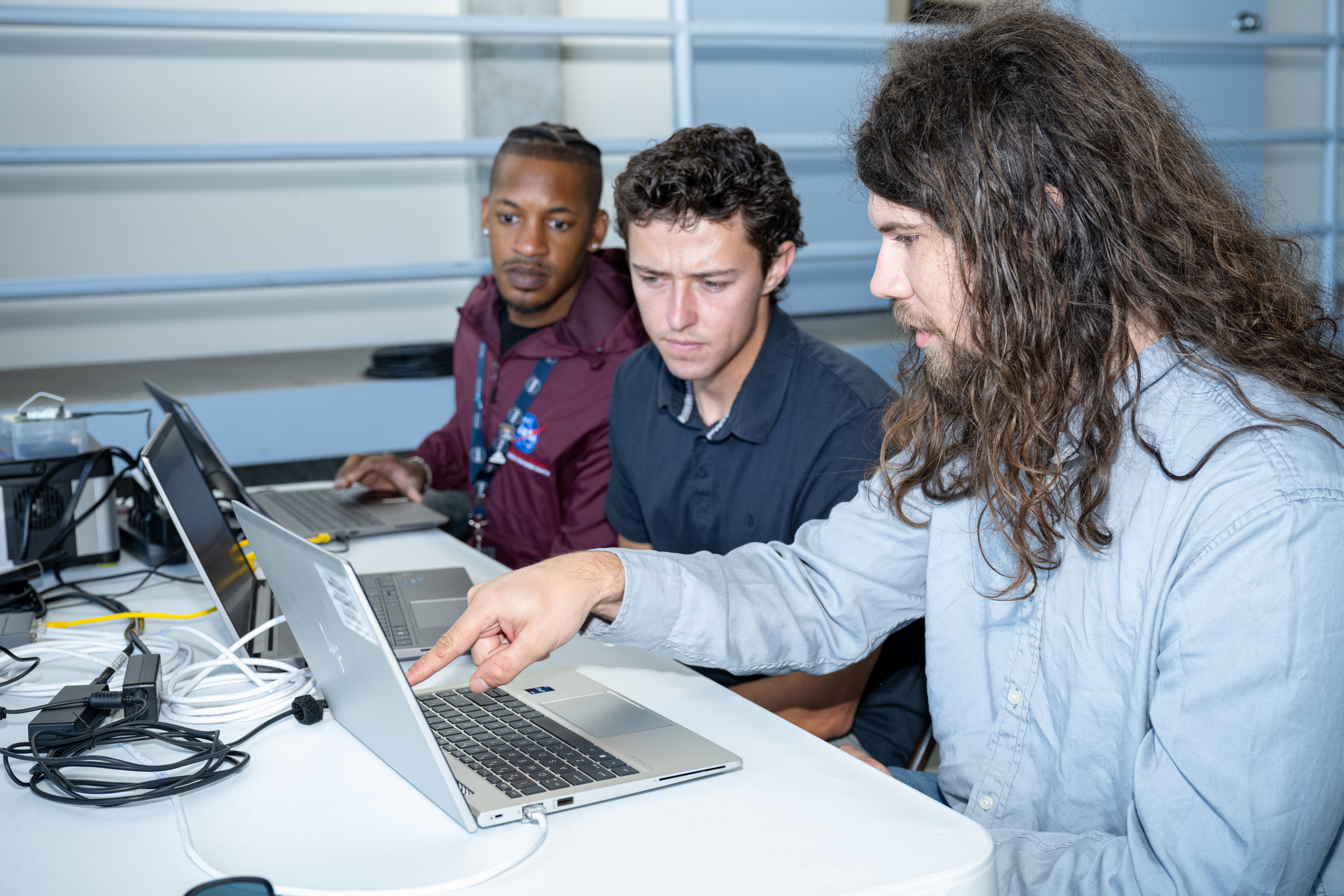
Three people sit at a table looking over laptop computers. The one nearest the camera is pointing at the laptop monitor.
Terrence D. Lewis (left), Kale Dunlap (center), and Aidan Jones monitor the flow of telemetry from both actual and simulated flights, ensuring the simulation and blockchain systems are processing and recording data accurately. 
Credit: NASA/Brandon Torres Navarette 

This NASA research explored how blockchain can secure digital transactions between multiple systems and operators. The team used an open-source blockchain framework that allows trusted users real-time sharing and storage of critical data like aircraft operator registration information, flight plans, and telemetry. This framework restricts access to this data to trusted parties and approved users only. 

To further examine system resilience, the team introduced a set of cybersecurity tests designed to assess, improve, and reinforce security during operations in airspace environments. During an August flight at Ames, the team demonstrated these capabilities using an Alta-X drone with a custom-built software and hardware package that included a computer, radio, GPS system, and battery.  

The test simulated an environment with a drone flying in real-world conditions, complete with a separate ground control station and the blockchain and security infrastructure. The underlying blockchain framework and cybersecurity protocols can be extended to support high-altitude operations at 60,000 feet and higher and Urban Air Mobility operations, paving the way for a more secure, scalable, and trusted ecosystem. 

NASA researchers will continue to look at the data gathered during the test and apply what they’ve learned to future work. The testing will ultimately benefit U.S. aviation stakeholders looking for new tools to improve operations. 

Through its Air Traffic Management and Safety project, NASA performed research to transform air traffic management systems to safely accommodate the growing demand of new air vehicles. The project falls under NASA’s Airspace Operations and Safety Program, a part the agency’s Aeronautics Research Mission Directorate that works to enable safe, efficient aviation transportation operations that benefit the flying public and industry.

NASA’s Carruthers Geocorona Observatory Reveals ‘First Light’ Images

16 December 2025 at 09:30

3 min read

NASA’s Carruthers Geocorona Observatory Reveals ‘First Light’ Images

NASA’s Carruthers Geocorona Observatory has captured its first images from space, revealing rare views of Earth and the Moon in ultraviolet light. Taken on Nov. 17 — still months before the mission’s science phase begins — these “first light” images confirm the spacecraft is healthy while hinting at the incredible views to come.

The initial images consist of two from Carruthers’ Wide Field Imager and two from its Narrow Field Imager. Each imager captured two different views: one showing a broad spectrum of far ultraviolet light, and one revealing light from Earth’s geocorona.

Comparison of wide field and narrow field images from NASA's Carruthers Geocorona Observatory: Each column shows far ultraviolet and Lyman-alpha views of Earth, with brightness color scales, using wide and narrow field imagers.
These four images constitute the “first light” for the Carruthers Geocorona Observatory mission. The images were taken on Nov. 17, 2025, from a location near the Sun-Earth Lagrange point 1 by the spacecraft’s Wide Field Imager (left column) and Narrow Field Imager (right column) in far ultraviolet light (top row) and the specific wavelength of light emitted by atomic hydrogen known as Lyman-alpha (bottom row). Earth is the larger, bright circle near the middle of each image; the Moon is the smaller circle below and to the left of it. The fuzzy “halo” around Earth in the images in the bottom row is the geocorona: the ultraviolet light emitted by Earth’s exosphere, or outermost atmospheric layer. The lunar surface still shines in Lyman-alpha because its rocky surface reflects all wavelengths of sunlight — one reason it is important to compare Lyman-alpha images with the broad ultraviolet filter. The far ultraviolet light imagery from the Narrow Field Imagery also captured two background stars, whose surface temperatures must be approximately twice as hot as the our Sun’s to be so bright in this wavelength of light.
NASA/Carruthers Geocorona Observatory

When Carruthers captured these images, the Moon was also in its field of view and slightly closer to the spacecraft than Earth was, making the Moon appear larger and closer to Earth than usual.

The specific wavelength Carruthers observed in two of the images, called Lyman-alpha, is light emitted by atomic hydrogen. The faint glow of Lyman-alpha from hydrogen in Earth’s outer atmosphere is called the “geocorona,” Latin for “Earth crown.”

In the broad-spectrum images, the Moon and Earth look similar: both are spheres with well-defined edges. However, in the Lyman-alpha filter, the Moon still appears as a crisp, sharp sphere while Earth appears surrounded by a bright “fuzz” extending out to space. This glow is the geocorona, the primary focus of the Carruthers mission. It is the only way to “see” Earth’s outermost atmospheric layer, although the light of the geocorona has only been photographed a handful of times in history. Carruthers will be the first mission to image it repeatedly, and from far enough away to see its great extent and discover how it changes over time.

These first images also offer a rare treat: sunlight reflected off the far side of the Moon, a view impossible to capture from Earth.


Original
Annotated

An interactive slider image allowing the user to swipe between two versions of an image, one with annotations and one without. The image shows a spacecraft’s view of Earth (at center) and the Moon (lower left) in ultraviolet light. The image includes a circular heatmap with a bright yellow center (Earth) fading to green and blue at the edges, showing Earth’s geocorona. A smaller bright spot appears near the bottom edge (the Moon). A vertical color bar labeled

An interactive slider image allowing the user to swipe between two versions of an image, one with annotations and one without. The image shows a spacecraft’s view of Earth (at center) and the Moon (lower left) in ultraviolet light. The image includes a circular heatmap with a bright yellow center (Earth) fading to green and blue at the edges, showing Earth’s geocorona. A smaller bright spot appears near the bottom edge (the Moon). A vertical color bar labeled

An interactive slider image allowing the user to swipe between two versions of an image, one with annotations and one without. The image shows a spacecraft’s view of Earth (at center) and the Moon (lower left) in ultraviolet light. The image includes a circular heatmap with a bright yellow center (Earth) fading to green and blue at the edges, showing Earth’s geocorona. A smaller bright spot appears near the bottom edge (the Moon). A vertical color bar labeled

Original

Annotated

Carruthers Geocorona ObservatorY

A View of Earth’s Geocorona

Narrow Field Imager/Lyman-alpha filter


This view of the Earth, Moon, and Earth’s geocorona was captured by the Carruthers Geocorona Observatory’s Narrow Field Imager on Nov. 17, 2025. Move the slider to switch between the original version and one with overlaid annotations. In the annotated version, labels for Earth, the Moon, and Earth’s geocorona are overlaid on the image. The circle around Earth represents Earth’s surface, and the arc around Earth’s middle represents the orientation of Earth’s equator. The arrow pointing up and slightly to the left from Earth represents Earth’s rotational axis. The arrow pointing out to the right from Earth represents the direction to the Sun. The color scale indicates brightness, with brighter light appearing more yellow and dimmer light appearing more blue. The ‘glow’ that extends beyond Earth’s surface and out into space is Earth’s geocorona, which is emitted by hydrogen atoms in Earth’s exosphere in a wavelength of ultraviolet light known as Lyman-alpha.

These initial images were taken with short, five-minute exposures — just long enough to confirm that the instrument is performing well. During the main science phase, Carruthers will take 30-minute exposures, allowing it to reveal even fainter details of the geocorona and trace how Earth’s outer atmosphere responds to the changing Sun.

Carruthers launched on Sept. 24 and is just a few weeks from completing its journey to the Sun-Earth Lagrange point 1, a point of gravitational balance roughly 1 million miles closer to the Sun than Earth is. Carruthers will begin its primary science phase in March 2026, when it will begin sending back a steady stream of ultraviolet portraits of our planet’s ever-shifting outer atmosphere.

By Miles Hatfield
NASA’s Goddard Space Flight Center, Greenbelt, Md.

About the Author

Miles Hatfield

Miles Hatfield

Keep Exploring

Discover More Topics From NASA

❌
❌