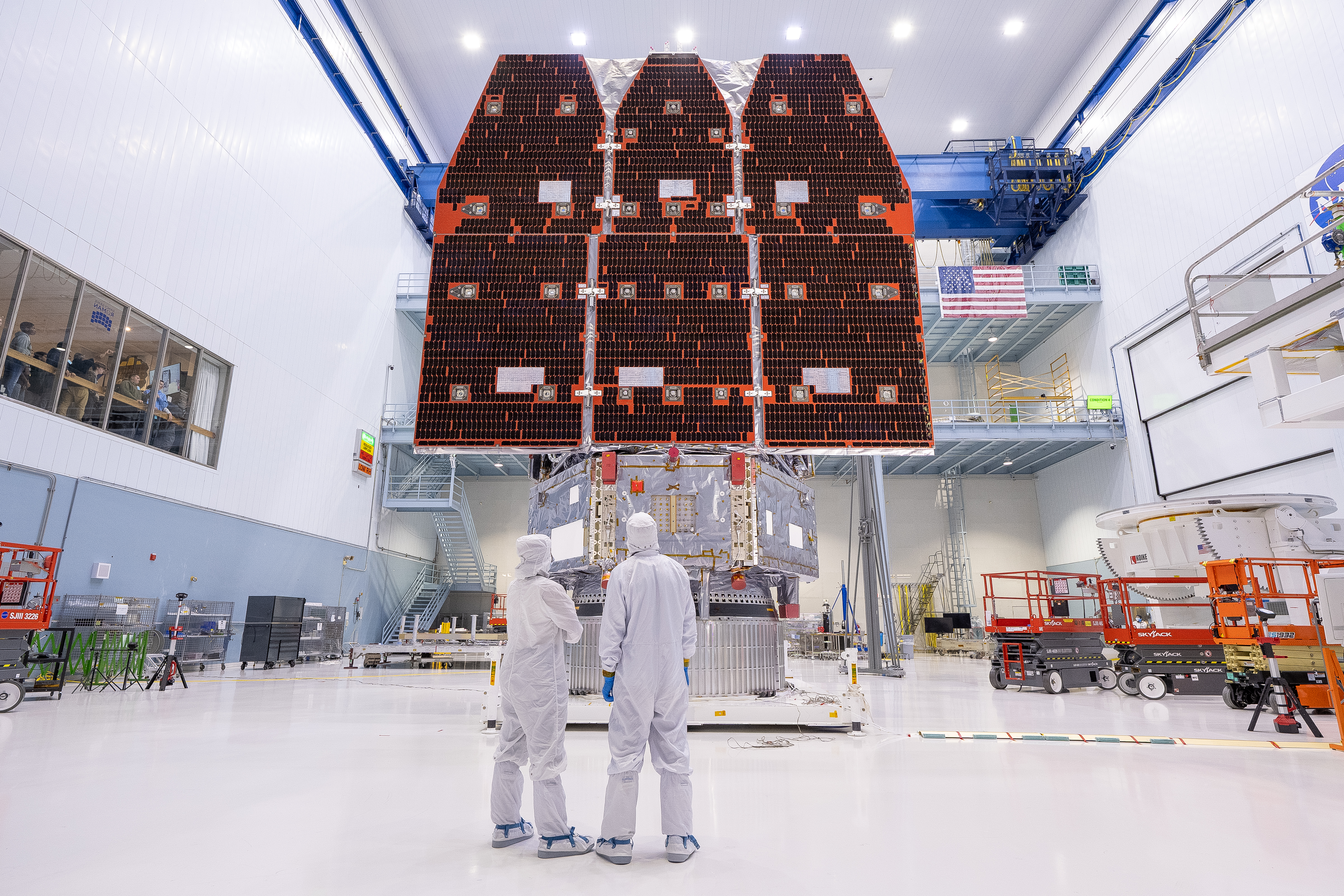
A few weeks ago, technicians inside a cavernous clean room in Maryland made the final connection to complete assembly of NASA’s Nancy Grace Roman Space Telescope.
Parts of this new observatory, named for NASA’s first chief astronomer, recently completed a spate of tests to ensure it can survive the shaking and intense sound of a rocket launch. Engineers placed the core of the telescope inside a thermal vacuum chamber, where it withstood the airless conditions and extreme temperature swings it will see in space.
Then, on November 25, teams at NASA’s Goddard Space Flight Center in Greenbelt, Maryland, joined the inner and outer portions of the Roman Space Telescope. With this milestone, NASA declared the observatory complete and on track for launch as soon as fall 2026.
Our universe is filled with galaxies, in all directions as far as our instruments can see. Some researchers estimate that there are as many as two trillion galaxies in the observable universe. At first glance, these galaxies might appear to be randomly scattered across space, but they’re not. Careful mapping has shown that they are distributed across the surfaces of giant cosmic “bubbles” up to several hundred million light-years across. Inside these bubbles, few galaxies are found, so those regions are called cosmic voids. NASA’s Nancy Grace Roman Space Telescope will allow us to measure these voids with new precision, which can tell us about the history of the universe’s expansion.
This narrated video sequence illustrates how NASA's Nancy Grace Roman Space Telescope will be able to observe cosmic voids in the universe. These highly detailed measurements will help constrain cosmological models.
Credit: Video: NASA, STScI; Visualization: Frank Summers (STScI); Script Writer: Frank Summers (STScI); Narration: Frank Summers (STScI); Audio: Danielle Kirshenblat (STScI); Science: Giulia Degni (Roma Tre University), Alice Pisani (CPPM), Giovanni Verza (Center for Computational Astrophysics/Flatiron Inst.)
“Roman’s ability to observe wide areas of the sky to great depths, spotting an abundance of faint and distant galaxies, will revolutionize the study of cosmic voids,” said Giovanni Verza of the Flatiron Institute and New York University, lead author on a paper published in The Astrophysical Journal.
Cosmic Recipe
The cosmos is made of three key components: normal matter, dark matter, and dark energy. The gravity of normal and dark matter tries to slow the expansion of the universe, while dark energy opposes gravity to speed up the universe’s expansion. The nature of both dark matter and dark energy are currently unknown. Scientists are trying to understand them by studying their effects on things we can observe, such as the distribution of galaxies across space.
“Since they’re relatively empty of matter, voids are regions of space that are dominated by dark energy. By studying voids, we should be able to put powerful constraints on the nature of dark energy,” said co-author Alice Pisani of CNRS (the French National Centre for Scientific Research) in France and Princeton University in New Jersey.
To determine how Roman might study voids, the researchers considered one potential design of the Roman High-Latitude Wide-Area Survey, one of three core community surveys that Roman will conduct. The High-Latitude Wide-Area Survey will look away from the plane of our galaxy (hence the term high latitude in galactic coordinates). The team found that this survey should be able to detect and measure tens of thousands of cosmic voids, some as small as just 20 million light-years across. Such large numbers of voids will allow scientists to use statistical methods to determine how their observed shapes are influenced by the key components of the universe.
To determine the actual, 3D shapes of the voids, astronomers will use two types of data from Roman — the positions of galaxies in the sky and their cosmological redshift, the latter of which is determined using spectroscopic data. To convert redshift to a physical distance, astronomers make assumptions about the components of the universe, including the strength of dark energy and how it might have evolved over time.
Pisani compared it to trying to infer a cake recipe (i.e., the universe’s makeup) from the final dessert served to you. “You try to put in the right ingredients — the right amount of matter, the right amount of dark energy — and then you check whether your cake looks as it should. If it doesn’t, that means you put in the wrong ingredients.”
In this case, the appearance of the “cake” is the shape found by statistically stacking all of the voids detected by Roman on top of each other. On average, voids are expected to have a spherical shape because there is no “preferred” location or direction in the universe (i.e., the universe is both homogeneous and isotropic on large scales). This means that, if the stacking is done correctly, the resulting shape will be perfectly round (or spherically symmetric). If not, then you have to adjust your cosmic recipe.
Power of Roman
The researchers emphasized that to study cosmic voids in large numbers, an observatory must be able to probe a large volume of the universe, because the voids themselves can be tens or hundreds of millions of light-years across. The spectroscopic data necessary to study voids will come from a portion of the Roman High-Latitude Wide-Area Survey that will cover on the order of 2,400 square degrees of the sky, or 12,000 full moons. It will also be able to see fainter and more distant objects, yielding a greater density of galaxies than complementary missions like ESA’s (European Space Agency’s) Euclid.
“Voids are defined by the fact that they contain so few galaxies. So to detect voids, you have to be able to observe galaxies that are quite sparse and faint. With Roman, we can better look at the galaxies that populate voids, which ultimately will give us greater understanding of the cosmological parameters like dark energy that are sculpting voids,” said co-author Giulia Degni of Roma Tre University and INFN (the National Institute of Nuclear Physics) in Rome.
The Nancy Grace Roman Space Telescope is managed at NASA’s Goddard Space Flight Center in Greenbelt, Maryland, with participation by NASA’s Jet Propulsion Laboratory in Southern California; Caltech/IPAC in Pasadena, California; the Space Telescope Science Institute in Baltimore; and a science team comprising scientists from various research institutions. The primary industrial partners are BAE Systems, Inc. in Boulder, Colorado; L3Harris Technologies in Melbourne, Florida; and Teledyne Scientific & Imaging in Thousand Oaks, California.
By Christine Pulliam Space Telescope Science Institute, Baltimore, Md. cpulliam@stsci.edu
NASA’s next big eye on the cosmos is now fully assembled. On Nov. 25, technicians joined the inner and outer portions of the Nancy Grace Roman Space Telescope in the largest clean room at the agency’s Goddard Space Flight Center in Greenbelt, Maryland.
NASA’s Nancy Grace Roman Space Telescope is now fully assembled following the integration of its two major segments on Nov. 25 at the agency’s Goddard Space Flight Center in Greenbelt, Md. The mission is slated to launch by May 2027, but the team is on track for launch as early as fall 2026.
Credit: NASA/Jolearra Tshiteya
“Completing the Roman observatory brings us to a defining moment for the agency,” said NASA Associate Administrator Amit Kshatriya. “Transformative science depends on disciplined engineering, and this team has delivered—piece by piece, test by test—an observatory that will expand our understanding of the universe. As Roman moves into its final stage of testing following integration, we are focused on executing with precision and preparing for a successful launch on behalf of the global scientific community.”
After final testing, Roman will move to the launch site at NASA’s Kennedy Space Center in Florida for launch preparations in summer 2026. Roman is slated to launch by May 2027, but the team is on track for launch as early as fall 2026. A SpaceX Falcon Heavy rocket will send the observatory to its final destination a million miles from Earth.
“With Roman’s construction complete, we are poised at the brink of unfathomable scientific discovery,” said Julie McEnery, Roman’s senior project scientist at NASA Goddard. “In the mission’s first five years, it’s expected to unveil more than 100,000 distant worlds, hundreds of millions of stars, and billions of galaxies. We stand to learn a tremendous amount of new information about the universe very rapidly after Roman launches.”
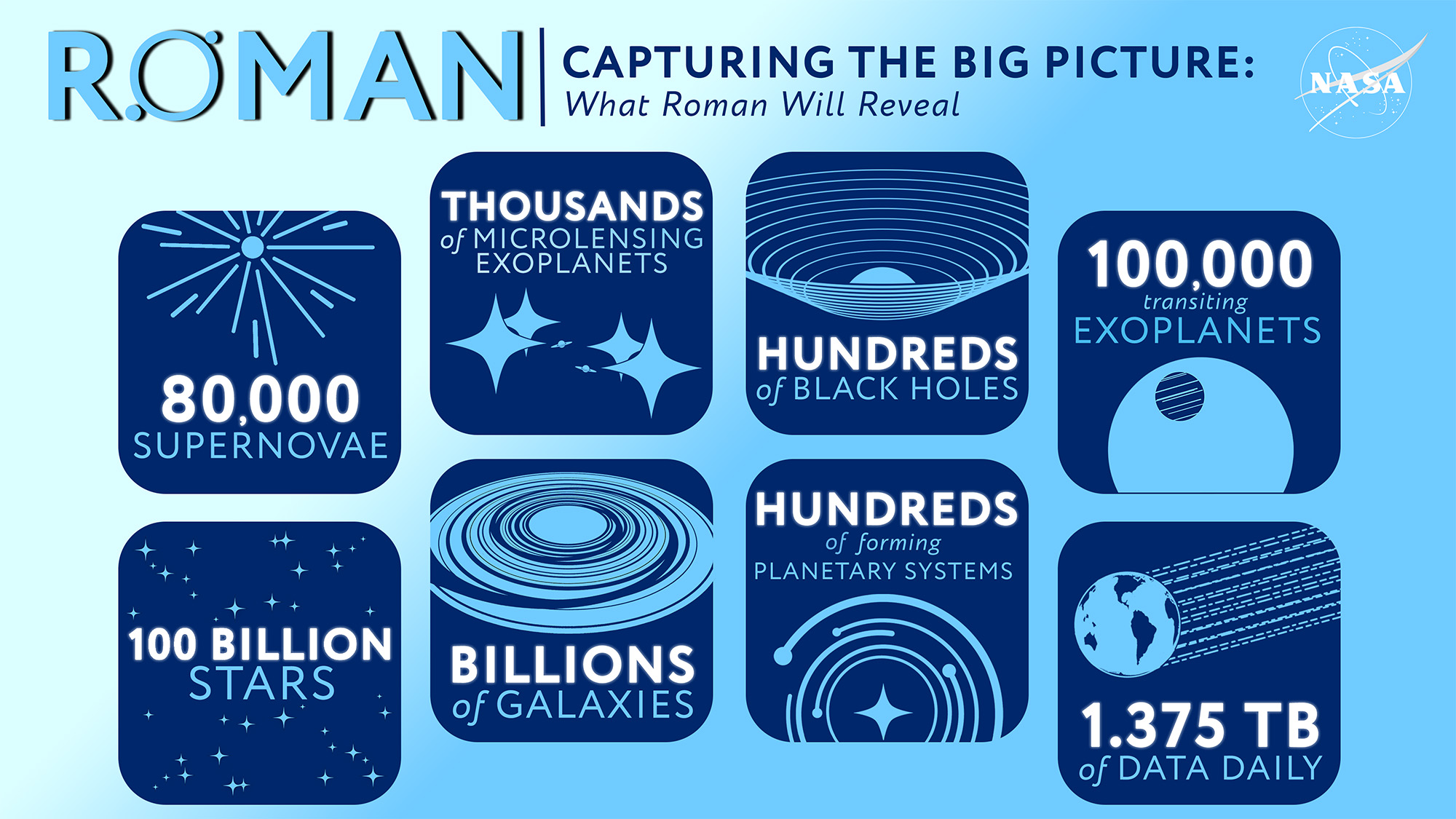
NASA’s Nancy Grace Roman Space Telescope will survey vast swaths of sky during its five-year primary mission. During that time, scientists expect it to see an incredible number of new objects, including stars, galaxies, black holes and planets outside our solar system, known as exoplanets. This infographic previews some of the discoveries scientists anticipate from Roman’s data deluge.
Credit: NASA’s Goddard Space Flight Center
Observing from space will make Roman very sensitive to infrared light — light with a longer wavelength than our eyes can see — from far across the cosmos. Pairing its crisp infrared vision with a sweeping view of space will allow astronomers to explore myriad cosmic topics, from dark matter and dark energy to distant worlds and solitary black holes, and conduct research that would take hundreds of years using other telescopes.
“Within our lifetimes, a great mystery has arisen about the cosmos: why the expansion of the universe seems to be accelerating. There is something fundamental about space and time we don’t yet understand, and Roman was built to discover what it is,” said Nicky Fox, associate administrator, Science Mission Directorate, NASA Headquarters in Washington. “With Roman now standing as a complete observatory, which keeps the mission on track for a potentially early launch, we are a major step closer to understanding the universe as never before. I couldn’t be prouder of the teams that have gotten us to this point.”
The coronagraph will demonstrate new technologies for directly imaging planets around other stars. It will block the glare from distant stars and make it easier for scientists to see the faint light from planets in orbit around them. The Coronagraph aims to photograph worlds and dusty disks around nearby stars in visible light to help us see giant worlds that are older, colder, and in closer orbits than the hot, young super-Jupiters direct imaging has mainly revealed so far.
“The question of ‘Are we alone?’ is a big one, and it’s an equally big task to build tools that can help us answer it,” said Feng Zhao, the Roman Coronagraph Instrument manager at NASA’s Jet Propulsion Laboratory in Southern California. “The Roman Coronagraph is going to bring us one step closer to that goal. It’s incredible that we have the opportunity to test this hardware in space on such a powerful observatory as Roman.”
The coronagraph team will conduct a series of pre-planned observations for three months spread across the mission’s first year-and-a-half of operations, after which the mission may conduct additional observations based on scientific community input.
The Wide Field Instrument is a 288-megapixel camera that will unveil the cosmos all the way from our solar system to near the edge of the observable universe. Using this instrument, each Roman image will capture a patch of the sky bigger than the apparent size of a full moon. The mission will gather data hundreds of times faster than NASA’s Hubble Space Telescope, adding up to 20,000 terabytes (20 petabytes) over the course of its five-year primary mission.
“The sheer volume of the data Roman will return is mind-boggling and key to a host of exciting investigations,” said Dominic Benford, Roman’s program scientist at NASA Headquarters.
Over the course of several hours, technicians meticulously connected the inner and outer segments of NASA’s Nancy Grace Roman Space Telescope, as shown in this time-lapse. Next, Roman will undergo final testing prior to moving to the launch site at NASA’s Kennedy Space Center in Florida for launch preparations in summer 2026.
Credit: NASA/Sophia Roberts
Survey trifecta
Using the Wide Field Instrument, Roman will conduct three core surveys which will account for 75% of the primary mission. The High-Latitude Wide-Area Survey will combine the powers of imaging and spectroscopy to unveil more than a billion galaxies strewn across a wide swath of space and time. Astronomers will trace the evolution of the universe to probe dark matter — invisible matter detectable only by how its gravity affects things we can see — and trace the formation of galaxies and galaxy clusters over time.
The High-Latitude Time-Domain Survey will probe our dynamic universe by observing the same region of the cosmos repeatedly. Stitching these observations together to create movies will allow scientists to study how celestial objects and phenomena change over time periods of days to years. That will help astronomers study dark energy — the mysterious cosmic pressure thought to accelerate the universe’s expansion — and could even uncover entirely new phenomena that we don’t yet know to look for.
Roman’s Galactic Bulge Time-Domain Survey will look inward to provide one of the deepest views ever of the heart of our Milky Way galaxy. Astronomers will watch hundreds of millions of stars in search of microlensing signals — gravitational boosts of a background star’s light caused by the gravity of an intervening object. While astronomers have mainly discovered star-hugging worlds, Roman’s microlensing observations can find planets in the habitable zone of their star and farther out, including worlds like every planet in our solar system except Mercury. Microlensing will also reveal rogue planets—worlds that roam the galaxy untethered to a star — and isolated black holes. The same dataset will reveal 100,000 worlds that transit, or pass in front of, their host stars.
The remaining 25% of Roman’s five-year primary mission will be dedicated to other observations that will be determined with input from the broader scientific community. The first such program, called the Galactic Plane Survey, has already been selected.
Because Roman’s observations will enable such a wide range of science, the mission will have a General Investigator Program designed to support astronomers to reveal scientific discoveries using Roman data. As part of NASA’s commitment to Gold Standard Science, NASA will make all of Roman’s data publicly available with no exclusive use period. This ensures multiple scientists and teams can use data at the same time, which is important since every Roman observation will address a wealth of science cases.
NASA’s freshly assembled Nancy Grace Roman Space Telescope will revolutionize our understanding of the universe with its deep, crisp, sweeping infrared views of space. The mission will transform virtually every branch of astronomy and bring us closer to understanding the mysteries of dark energy, dark matter, and how common planets like Earth are throughout our galaxy. Roman is on track for launch by May 2027, with teams working toward a launch as early as fall 2026. Credit: NASA’s Goddard Space Flight Center
Roman’s namesake — Dr. Nancy Grace Roman, NASA’s first chief astronomer — made it her personal mission to make cosmic vistas readily accessible to all by paving the way for telescopes based in space.
“The mission will acquire enormous quantities of astronomical imagery that will permit scientists to make groundbreaking discoveries for decades to come, honoring Dr. Roman’s legacy in promoting scientific tools for the broader community,” said Jackie Townsend, Roman’s deputy project manager at NASA Goddard. “I like to think Dr. Roman would be extremely proud of her namesake telescope and thrilled to see what mysteries it will uncover in the coming years.”
The Nancy Grace Roman Space Telescope is managed at NASA’s Goddard Space Flight Center in Greenbelt, Maryland, with participation by NASA’s Jet Propulsion Laboratory in Southern California; Caltech/IPAC in Pasadena, California; the Space Telescope Science Institute in Baltimore; and a science team comprising scientists from various research institutions. The primary industrial partners are BAE Systems Inc. in Boulder, Colorado; L3Harris Technologies in Rochester, New York; and Teledyne Scientific & Imaging in Thousand Oaks, California.

 Login
Login