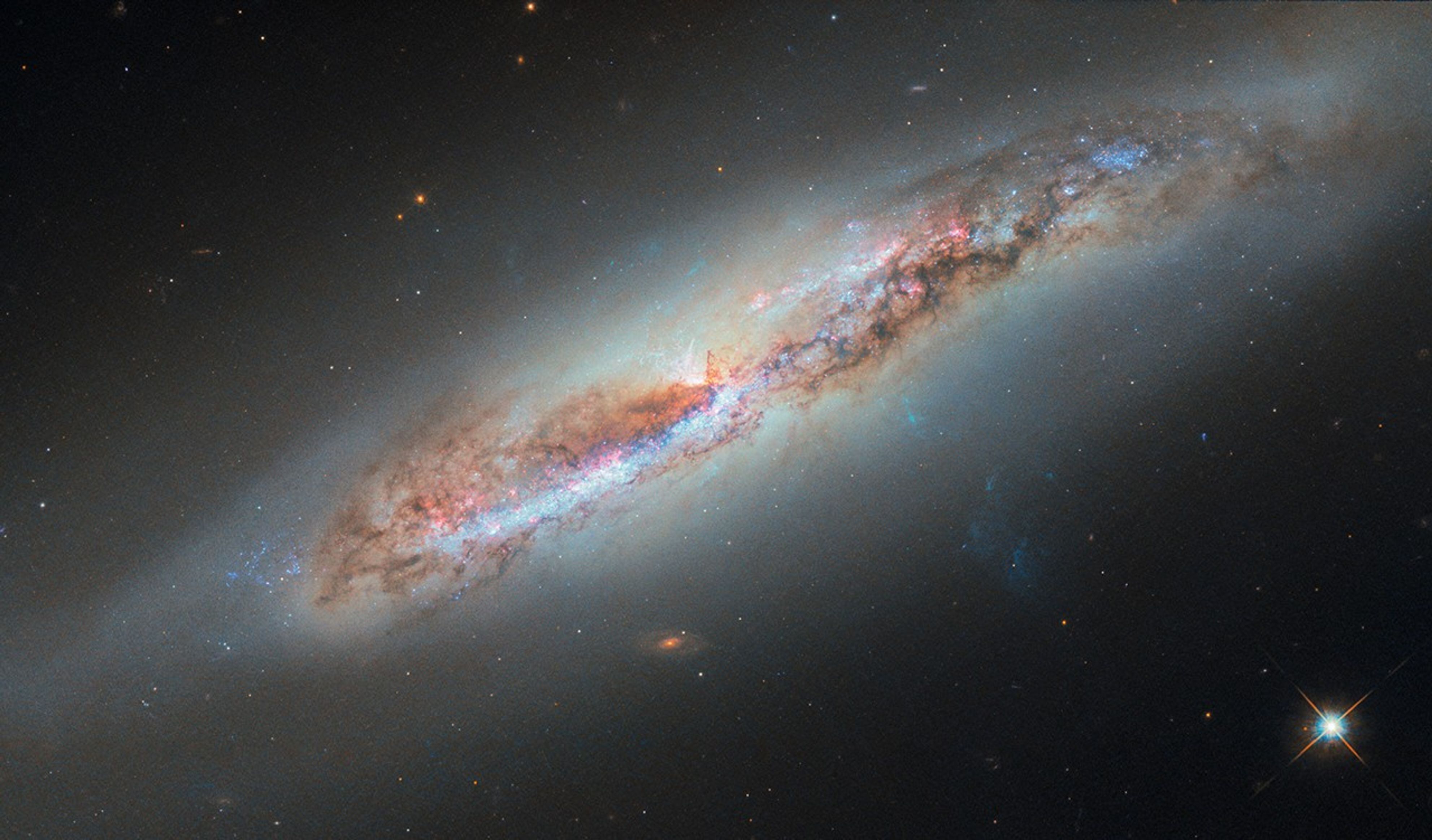
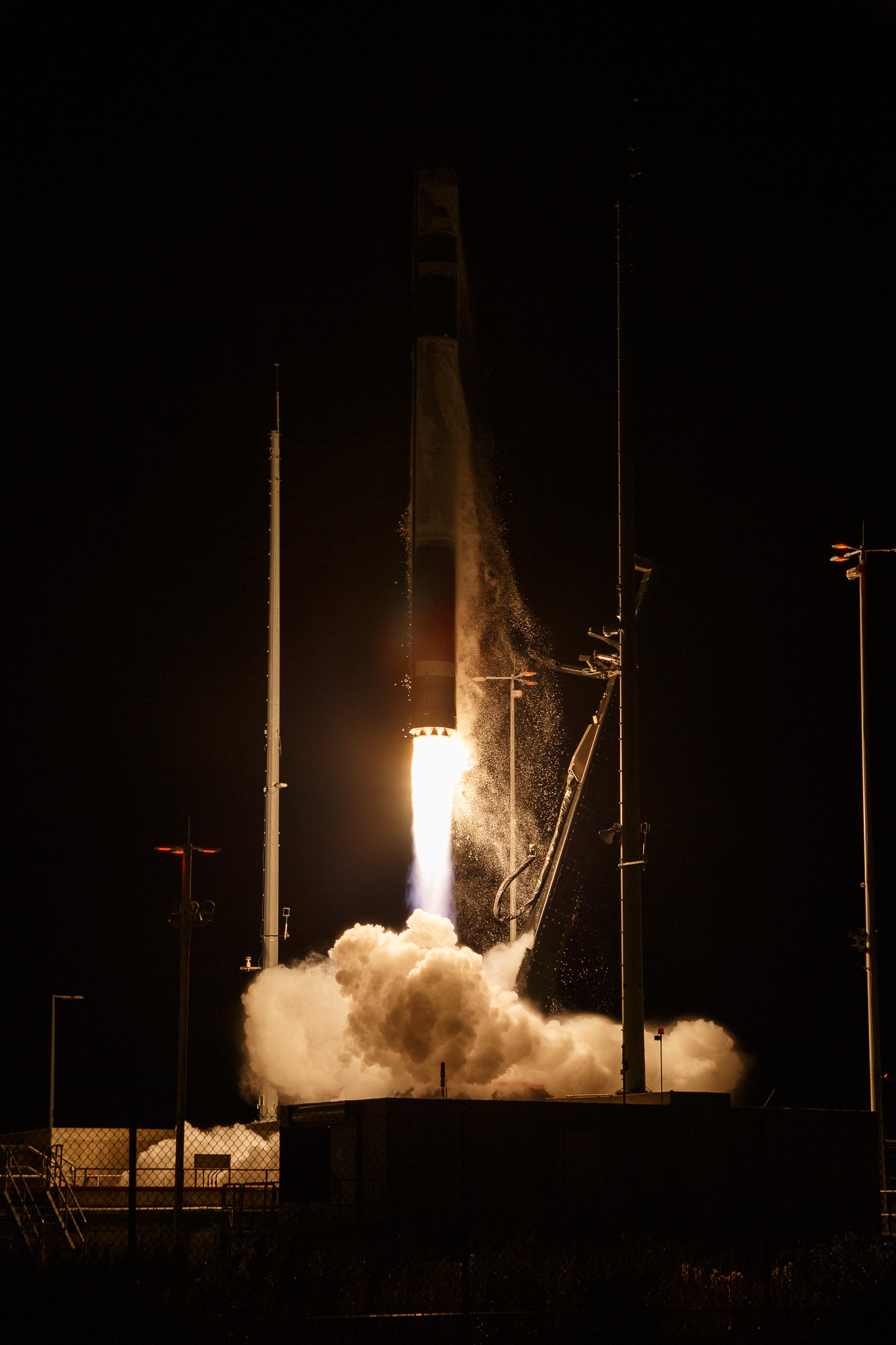
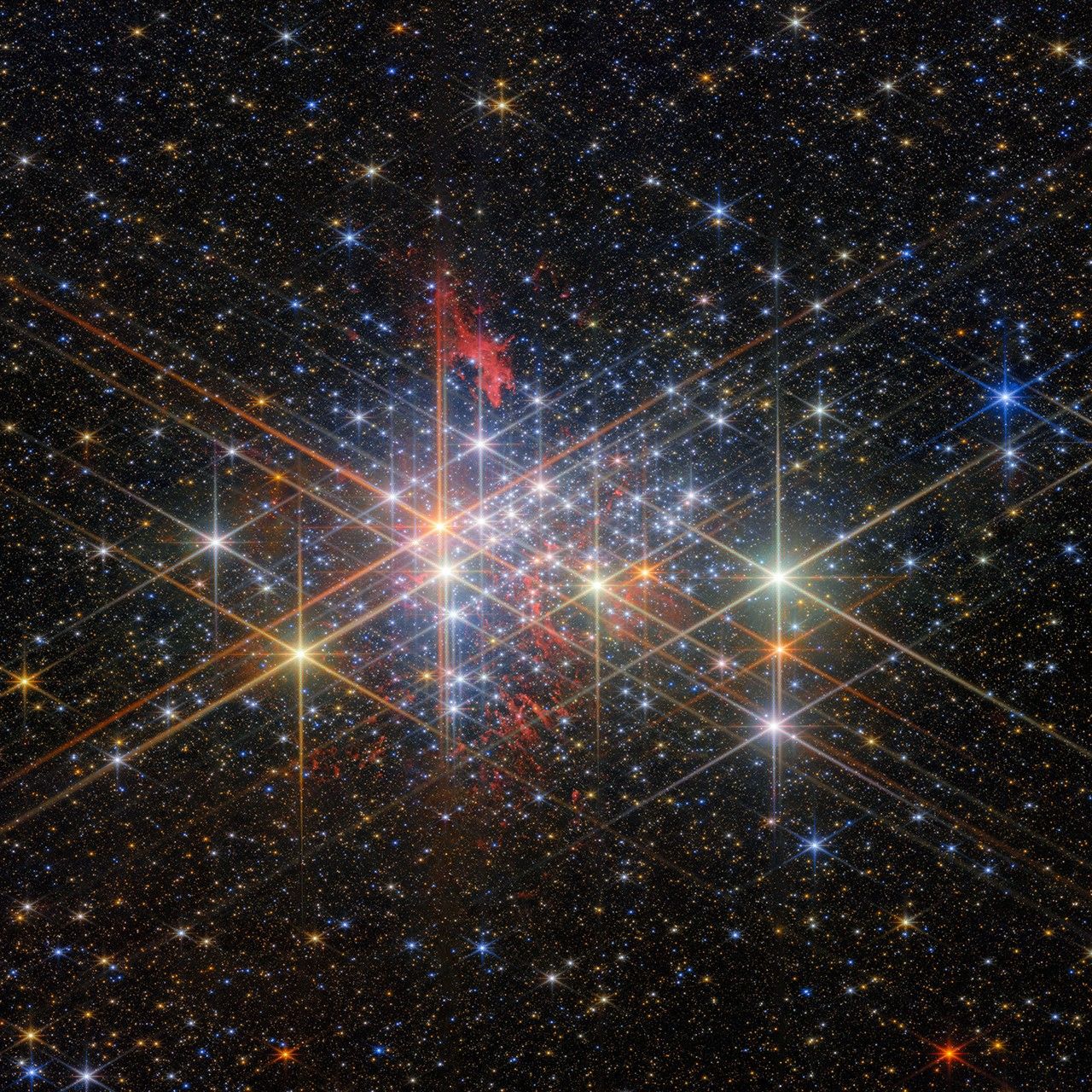
This NASA/ESA Hubble Space Telescope image features the galaxy NGC 4388, a member of the Virgo galaxy cluster.
ESA/Hubble & NASA, S. Veilleux, J. Wang, J. Greene
A sideways spiral galaxy shines in this NASA/ESA Hubble Space Telescope image. Located about 60 million light-years away in the constellation Virgo (the Maiden), NGC 4388 is a resident of the Virgo galaxy cluster. This enormous cluster of galaxies contains more than a thousand members and is the nearest large galaxy cluster to the Milky Way.
NGC 4388 appears to tilt at an extreme angle relative to our point of view, giving us a nearly edge-on prospect of the galaxy. This perspective reveals a curious feature that wasn’t visible in a previous Hubble image of this galaxy released in 2016: a plume of gas from the galaxy’s nucleus, here seen billowing out from the galaxy’s disk toward the lower-right corner of the image. But where did this outflow come from, and why does it glow?
The answer likely lies in the vast stretches of space that separate the galaxies of the Virgo cluster. Though the space between galaxies appears empty, this space is occupied by hot wisps of gas called the intracluster medium. As NGC 4388 moves within the Virgo cluster, it plunges through the intracluster medium. Pressure from hot intracluster gas whisks away gas from within NGC 4388’s disk, causing it to trail behind as NGC 4388 moves.
The source of the ionizing energy that causes this gas cloud to glow is more uncertain. Researchers suspect that some of the energy comes from the center of the galaxy, where a supermassive black hole spins gas around it into a superheated disk. The blazing radiation from this disk might ionize the gas closest to the galaxy, while shock waves might be responsible for ionizing filaments of gas farther out.
This image incorporates new data, including several additional wavelengths of light, that bring the ionized gas cloud into view. The image holds data from several observing programs that aim to illuminate galaxies with active black holes at their centers.
Betelgeuse and the Crab Nebula: Stellar Death and Rebirth
This highly detailed image of the Crab Nebula was assembled by combining data from five telescopes spanning nearly the entire breadth of the electromagnetic spectrum: The Very Large Array (radio) in red; Spitzer Space Telescope (infrared) in yellow; Hubble Space Telescope (visible) in green; XMM-Newton (ultraviolet) in blue; and Chandra X-ray Observatory (X-ray) in purple.
Credits: NASA, ESA, G. Dubner (IAFE, CONICET-University of Buenos Aires) et al.; A. Loll et al.; T. Temim et al.; F. Seward et al.; VLA/NRAO/AUI/NSF; Chandra/CXC; Spitzer/JPL-Caltech; XMM-Newton/ESA; and Hubble/STScI
What happens when a star dies? In 2019, Betelgeuse dimmed in brightness, sparking speculation that it may soon explode as a supernova. While it likely won’t explode quite yet, we can preview its fate by observing the nearby Crab Nebula.
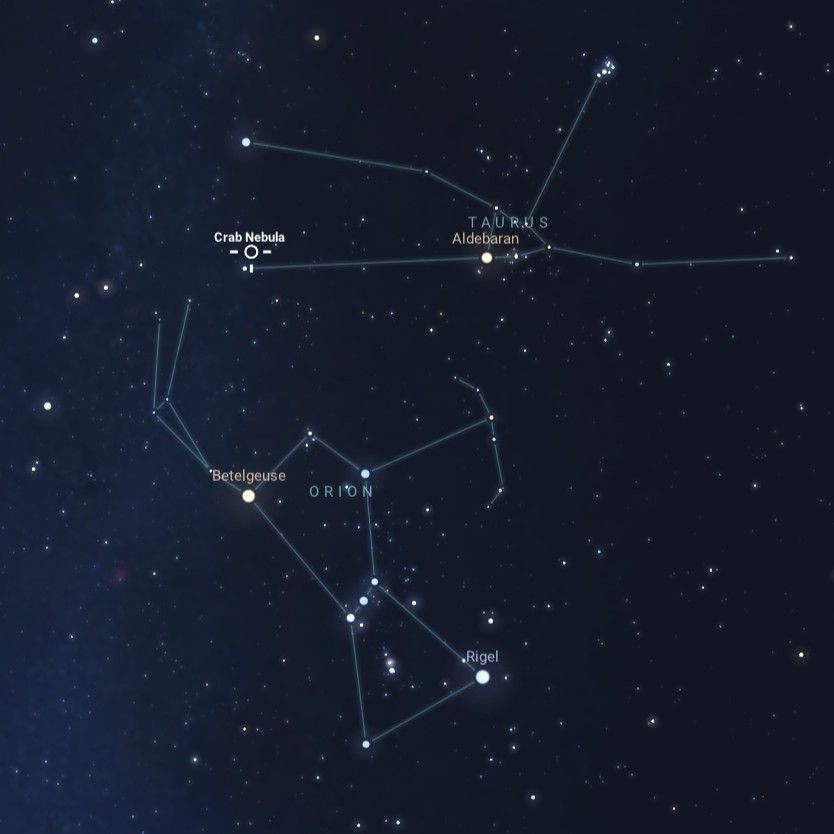
A view of the constellations Orion and Taurus, along with notable features: Betelgeuse in Orion, and Aldebaran and the Crab Nebula in Taurus.
Stellarium Web
Betelgeuse is easy to find as the red-hued shoulder star of Orion. A variable star, Betelgeuse, usually competes with the brilliant blue-white Rigel for the position of the brightest star in Orion. Betelgeuse is a young star, estimated to be a few million years old, but due to its giant size, it leads a fast and furious life. This massive star, known as a supergiant, exhausted the hydrogen fuel in its core and began to fuse helium instead, which caused the outer layers of the star to cool and swell dramatically in size. Betelgeuse is one of the few stars for which we have any detailed surface observations, due to its vast size – somewhere between the diameters of the orbits of Mars and Jupiter – and its relatively close distance of about 642 light-years. Betelgeuse is also a “runaway star,” with its remarkable speed possibly triggered by a merger with a smaller companion star. If that is the case, Betelgeuse may actually have millions of years left! So, Betelgeuse may not explode soon after all, or it might explode tomorrow! We have much more to learn about this intriguing star.
This image of the Crab Nebula combines data from five different telescopes: The Very Large Array (radio) in red; Spitzer Space Telescope (infrared) in yellow; Hubble Space Telescope (visible) in green; XMM-Newton (ultraviolet) in blue; and Chandra X-ray Observatory (X-ray) in purple. It is known as the expanding gaseous remnant from a star that self-detonated as a supernova, briefly shining as brightly as 400 million suns.
NASA, ESA, G. Dubner (IAFE, CONICET-University of Buenos Aires) et al.; A. Loll et al.; T. Temim et al.; F. Seward et al.; VLA/NRAO/AUI/NSF; Chandra/CXC; Spitzer/JPL-Caltech; XMM-Newton/ESA; and Hubble/STScI
The Crab Nebula (M1) is relatively close to Betelgeuse in the sky, in the nearby constellation of Taurus. Its ghostly, spidery gas clouds result from a massive explosion; a supernova observed by astronomers in 1054! A backyard telescope allows you to see some details. Still, only advanced telescopes reveal the rapidly spinning neutron star found in its center: the last stellar remnant from that cataclysmic event. These gas clouds were created during the giant star’s violent demise and expand ever outward to enrich the universe with heavy elements like silicon, iron, and nickel. These element-rich clouds are like a cosmic fertilizer, making rocky planets like our own Earth possible. Supernovae also send out powerful shock waves that help trigger star formation. In fact, if it weren’t for a long-ago supernova, our solar system – along with all of us – wouldn’t exist! You can learn much more about the Crab Nebula in a video from NASA’s James Webb Space Telescope: bit.ly/CrabNebulaVisual
Want to know more about the life cycle of stars? Explore stellar evolution with “The Lives of Stars” activity and handout at bit.ly/starlifeanddeath, part of our SUPERNOVA! toolkit.
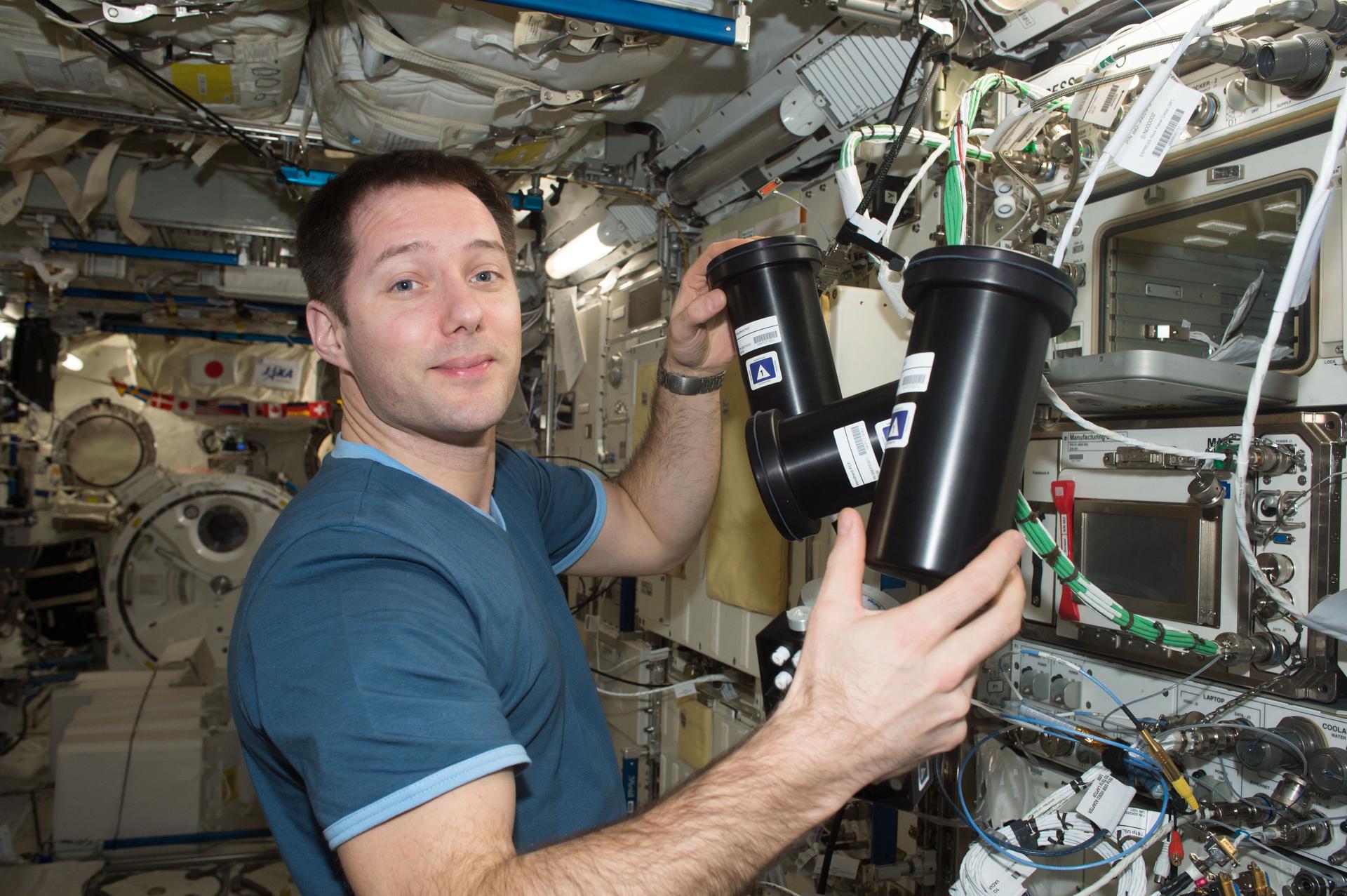
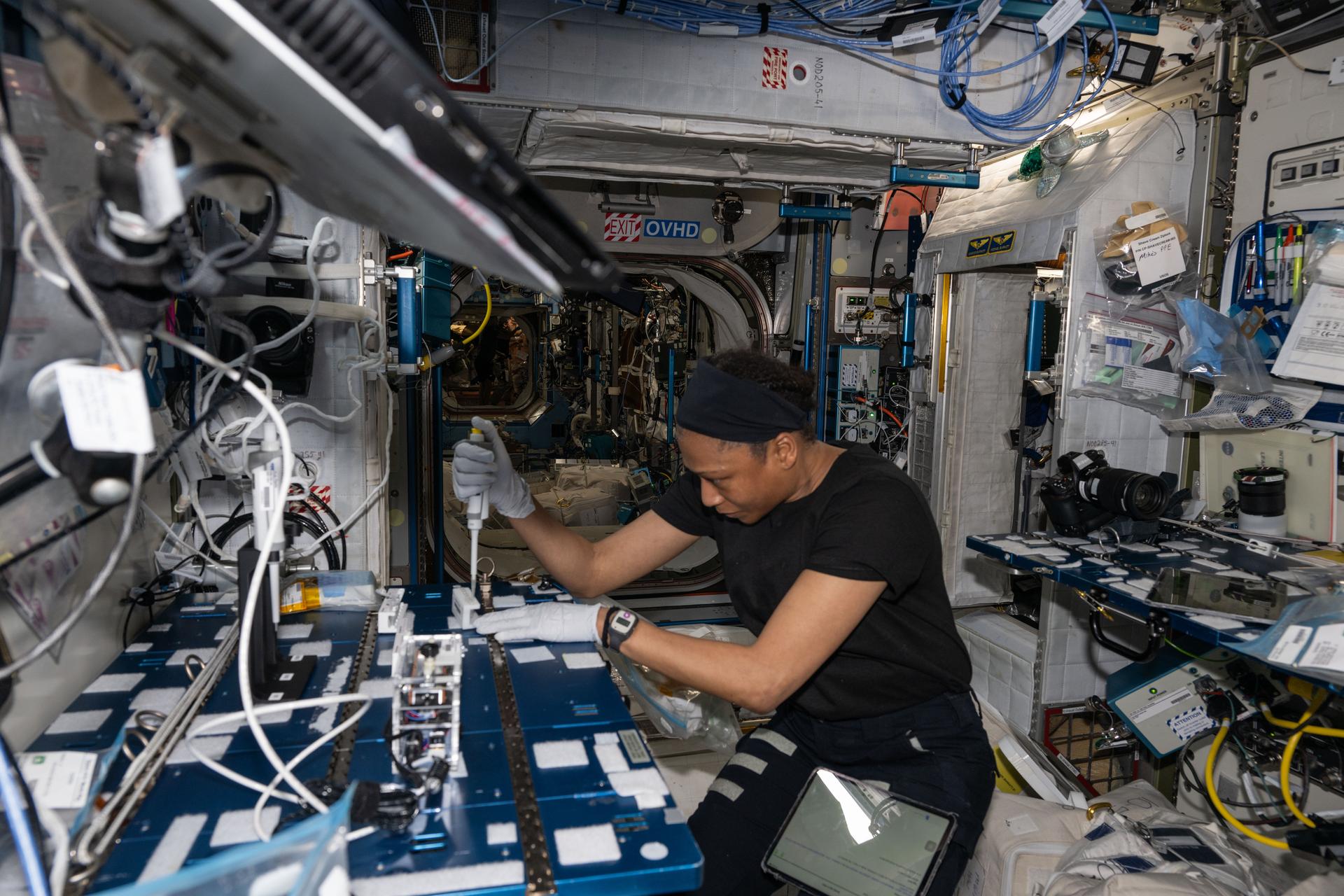
European Space Agency (ESA) astronaut Thomas Pesquet removes the Protein Crystallization Facility hardware from an incubator aboard the International Space Station for the CASIS PCG-5 investigation, which crystallized a monoclonal antibody developed by Merck Research Labs.
NASA
NASA opens the International Space Station for scientists and researchers, inviting them to use the benefits of microgravity for private industry research, technology demonstrations, and more. Today, half of the crew’s time aboard station is devoted to these aims, including medical research that addresses complex health challenges on Earth and prepares astronauts for future deep space missions.
Supported by knowledge gained from space station experiments, researchers at Merck Research Labs received approval in September from the U.S. Food and Drug Administration for a new injectable version of a medication used to treat several types of early-stage cancers called pembrolizumab, also known by its brand name KEYTRUDA. The development of the injectable formula has been supported by research efforts aboard the space station through the ISS National Laboratory, resulting in reduced treatment times while maintaining its efficacy.
Originally, the treatment was delivered during an in-office visit via infusion therapy into the patient’s veins, a process that could take up to two hours. Initial delivery improvements reduced infusion times to less than 30 minutes every three weeks. The newly approved subcutaneous injectable form takes about one minute every three weeks, promising to reduce cost and significantly reduce treatment time for patients and healthcare providers.
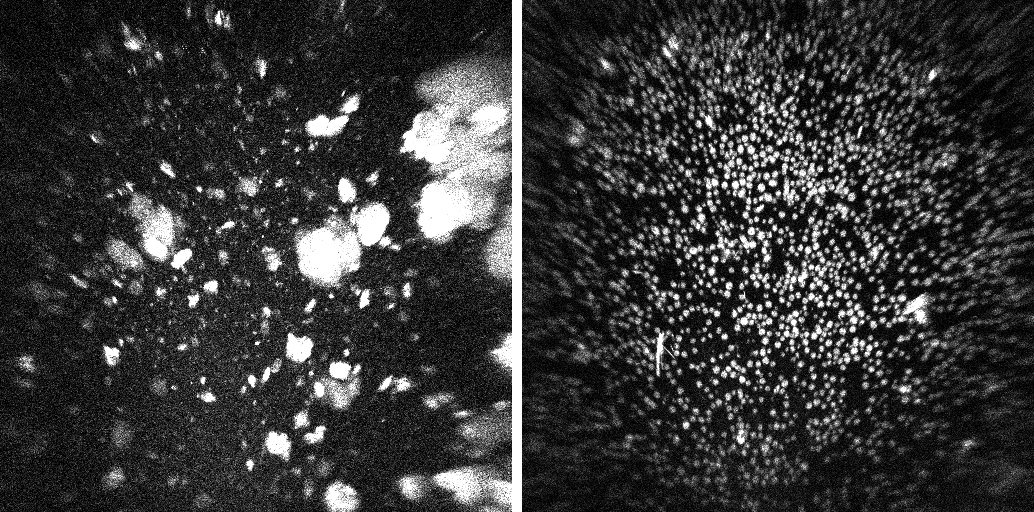
UV imaging of a ground control sample (left) and spaceflight sample (right) from Merck’s research shows the much more uniform size and distribution of crystals grown in microgravity. These results helped researchers to refine ground-based production of uniform crystalline suspensions required for an injectable version of KEYTRUDA.
Merck
Since 2014, Merck has flown crystal growth experiments to the space station to better understand how crystals form, including the monoclonal antibody used in this cancer treatment. Monoclonal antibodies are lab-made proteins that help the body fight diseases. This research focused on producing crystalline suspensions that dissolve easily in liquid, making it possible to deliver the medication by injection. In microgravity, the absence of gravity’s physical forces allows scientists to grow larger, more uniform, and higher-quality crystals than those grown in ground-based labs, advancing medication development and structural modeling.
Research aboard the space station has provided valuable insights into how gravity influences crystallization, helping to improve drug formulations. The work of NASA and its partners aboard the space station improves lives on Earth, grows a commercial economy in low Earth orbit, and prepares for human exploration of the Moon and Mars.
Curiosity Blog, Sols 4743-4749: Polygons in the Hollow
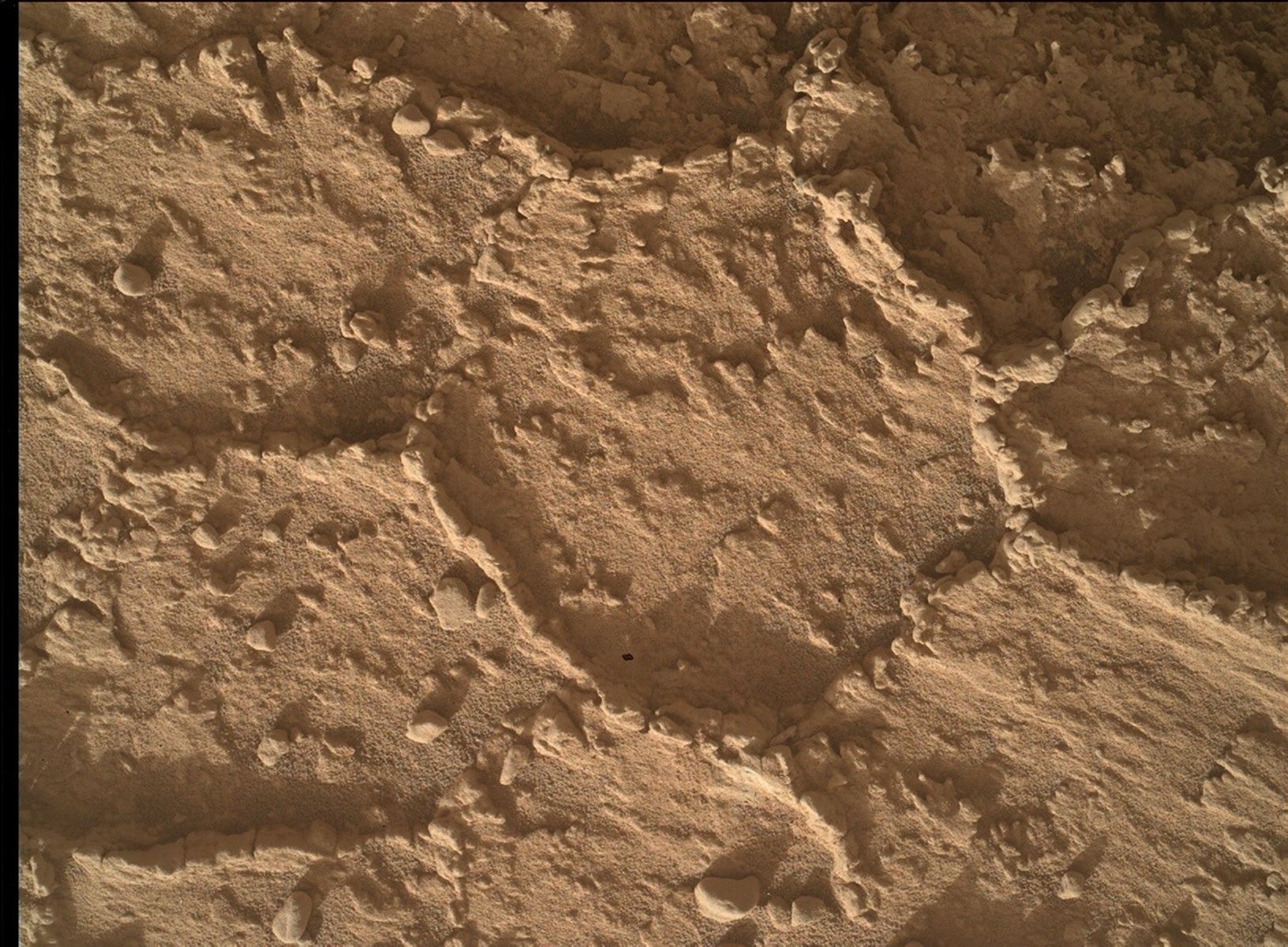
NASA’s Mars rover Curiosity acquired this close-up image of polygon-shaped features in the “Monte Grande” boxwork hollow. Similar polygonal patterns in various strata were seen previously, elsewhere in Gale Crater. Curiosity captured the image using its Mars Hand Lens Imager (MAHLI), located on the turret at the end of the rover’s robotic arm, on Dec. 11, 2025 — Sol 4745, or Martian day 4,745 of the Mars Science Laboratory mission — at 16:55:37 UTC.
NASA/JPL-Caltech/MSSS
Written by Lucy Lim, Planetary Scientist at NASA’s Goddard Space Flight Center
Earth Planning Date: Friday, Dec. 12, 2025
The weekend drive starting from the “Nevado Sajama” drill site brought Curiosity back into the “Monte Grande” boxwork hollow. We’ve been in this hollow before for the “Valle de la Luna” drill campaign, but now that the team has seen the results from both the “Valle de la Luna” and “Nevado Sajama” drilled samples, we’ve decided that there’s more work to do here.
Overall science goals here included analysis of the other well-exposed bedrock block in Monte Grande to improve our statistics on the composition of the bedrock in the hollows, and also high-resolution imaging and compositional analysis of portions of the walls of the hollow, other than those that had been covered during the Valle de la Luna campaign. These are part of a systematic mini-campaign to map a transect over the hollow-to-ridge structure from top to bottom at this site.
The post-drive imaging revealed a surprise — Valle de la Luna’s neighboring block was covered with polygons! As it turned out, the rover’s position during our previous visit for the Valle de la Luna drill campaign happened to have stood in the way of imaging of the polygonal features on this block so this was our first good look at them. We have seen broadly similar polygonal patterns in various strata in Gale Crater before — recently in the layered sulfate units (for instance, during Sols 4532-4533 and Sols 4370-4371) but we hadn’t seen them in the bottom of a boxwork hollow. Interestingly, this block looks more rubbly in texture than many of the previously observed polygon-covered blocks.
We’re interested in the relationship of the visibly protruding fracture-filling material here to fracture-filling materials seen in previous polygons, and also in the relationship of the polygonal surface on top to the more chaotic-appearing exposures lower on the block, and to the equivalent strata in the nearby wall of the hollow. We therefore planned a super-sized MAHLI mosaic that will support three-dimensional modeling of the upper and lower exposed surfaces of the polygon-bearing block. Several APXS and ChemCam LIBS observations targeted on the polygon centers and polygon ridges were also planned, to measure composition. Meanwhile, Mastcam has been busy planning stereo images of the nearby hollow wall in addition to the various blocks on the hollow floor.
The hollow also included freshly exposed light-toned material from where the rover had driven over and scuffed some bedrock, so another APXS measurement and a ChemCam LIBS went to the scuffed patch to measure the fresh surface.
We’ll be driving on Sol 4748. As we drive we’ll be taking a MARDI “sidewalk” observation, to image the ground beneath the rover as we approach the wall for a closer view, and hopefully some contact science in next week’s plans.
Preparations for Next Moonwalk Simulations Underway (and Underwater)
A graphic for the Moon Mascot: NASA Artemis II ZGI Design Challenge.
Freelancer
Whose Moon Mascot design will join the Artemis II astronauts on their historic voyage around the Moon in early 2026?
Between March 7 and Jun. 16, 2025, NASA worked with crowdsourcing company Freelancer to seek design ideas from global creators for a zero gravity indicator that will fly aboard the agency’s Artemis II test flight.
Zero gravity indicators are small, plush items carried aboard spacecraft to provide a visual indication of when the spacecraft and its crew reach space.
For the first eight minutes after liftoff, the crew and their indicator nearby will still be pushed into their seats by gravity, and the force of the climb into space. When the main engines of the SLS (Space Launch System) rocket’s core stage cut off, gravity’s restraints are lifted, but the crew will still be strapped safely into their seats – their zero gravity indicator’s ability to float will provide proof that they’ve made it into space.
Artemis II marks the first time that the public has had a hand in creating a crew’s mascot.
The Mission
Over the course of about ten days, four astronauts will travel approximately 685,000 miles from Earth, venture around the Moon, and return home. The flight will—for the first time with astronauts—test NASA’s human deep space exploration capabilities, including the agency’s Exploration Ground Systems, SLS (Space Launch System) rocket, and Orion spacecraft.
NASA has a long history of flying zero gravity indicators for human spaceflight missions. Many missions to the International Space Station include a plush item. A plush Snoopy rode inside Orion during NASA’s uncrewed Artemis I mission.
NASA astronauts Reid Wiseman, Victor Glover, and Christina Koch, and CSA (Canadian Space Agency) astronaut Jeremy Hansen will venture around the Moon and back. The mission is the first crewed flight under NASA’s Artemis campaign and is another step toward missions on the lunar surface and helping the agency prepare for future human missions to Mars.
The Contest
The Artemis II astronauts attended SXSW 2025 on March 7, 2025, and sat on a panel to discuss their upcoming mission around the Moon and answer questions from the audience. During the panel, commander Reid Wiseman showed the audience his zero gravity indicator from his Expedition 40 mission to the International Space Station. His zero gravity indicator was a toy giraffe named Giraffiti. Wiseman’s mother gifted Giraffiti to his oldest daughter when she was born. When Wiseman embarked on his first mission to space, his kids gave him Giraffiti to take with him to space.
“This little guy spent every day with me in my crew quarters,” said Wiseman. “It was a connection back home to my kids.”
June 4, 2014
NASA Astronaut Reid Wiseman photographed in front of the Cupola windows during his Expedition 40 mission with his zero gravity indicator, Giraffiti.
NASA
March 7, 2025
NASA astronaut Reid Wiseman shows the zero gravity indicator, “Giraffiti” used during his launch to the International Space Station as he and fellow Artemis II astronauts announce that NASA is seeking design ideas from global creators for a zero gravity indicator that will fly aboard the agency’s Artemis II test flight, Friday, March 7, 2025, at SXSW in Austin, Texas.
NASA/Bill Ingalls
March 7, 2025
NASA astronaut Reid Wiseman shows the zero gravity indicator, “Giraffiti” used during his launch to the International Space Station as he and fellow Artemis II astronauts announce that NASA is seeking design ideas from global creators for a zero gravity indicator that will fly aboard the agency’s Artemis II test flight, Friday, March 7, 2025, at SXSW in Austin, Texas.
NASA/Bill Ingalls
Then, Wiseman and the other crew members revealed that they were opening up the opportunities to people of all ages from all over the world to design the zero gravity indicator for the Artemis II mission around the Moon.
What better way to fly a mission around the Moon than to invite the public inside NASA’s Orion spacecraft with us and ask for help in designing our zero gravity indicator?
Reid Wiseman
NASA Astronaut and Commander of the Artemis II Mission
The Moon Mascot contest was hosted by the freelancing and crowdsourcing company Freelancer on behalf of the agency through the NASA Tournament Lab. The contest lasted about three months and received thousands of submissions from over 50 countries. Over the course of the contest, the agency hosted a Twitch stream on NASA’s Twitch channel to discuss zero gravity indicators and practice creating a design with a live artist. Adobe also released an Adobe Express template to help participants with their designs.
An Adobe Express template for the Moon Mascot competition.
Adobe
The Finalists
On Aug. 22, NASA and Freelancer announced the 25 finalists of the contest. These designs – ideas spanning from Moon-related twists on Earthly creatures to creative visions of exploration and discovery – were selected from more than 2,600 submissions from over 50 countries, including from K-12 students. The finalists represent 10 countries including the United States, Canada, Colombia, Finland, France, Germany, Japan, Peru, Singapore, and Wales.
Lucas Ye | Mountain View, California
“Rise”
Kenan Ziyan | Canyon, Texas
“Zappy Zebra”
Royal School, SKIES Space Club | Winnipeg, Manitoba, Canada
“Luna the Space Polar Bear”
Garden County Schools | Oshkosh, Nebraska
“Team GarCo”
Richellea Quinn Wijaya | Singapore
“Parsec – The Bird That Flew to the Moon”
Anzhelika Iudakova | Finland
“Big Steps of Little Octopus”
Congressional School | Falls Church, Virginia
“Astra-Jelly”
Congressional School | Falls Church, Virginia
“Harper, Chloe, and Mateo’s ZGI”
Alexa Pacholyk | Madison, Connecticut
“Artemis”
Leila Fleury | Rancho Palos Verdes, California
“Beeatrice”
Oakville Trafalgar School | Oakville, Ontario, Canada
“Lepus the Moon Rabbit”
Avon High School | Avon, Connecticut
“Sal the Salmon”
Daniela Colina | Lima, Peru
“Corey the Explorer”
Caroline Goyer-Desrosiers | St. Eustache, Quebec, Canada
“Flying Squirrel Ready for Its Take Off to Space!”
Giulia Bona | Berlin, Germany
“Art & the Giant”
Tabitha Ramsey | Frederick, Maryland
“Lunar Crust-acean”
Gabriela Hadas | Plano, Texas
“Celestial Griffin”
Savon Blanchard | Pearland, Texas
“Soluna Flier”
Ayako Moriyama | Kyoto, Japan
“MORU: A Cloud Aglow with Moonlight and Hope”
Johanna Beck | McPherson, Kansas
“Creation Mythos”
Guillaume Truong | Toulouse, France
“Space Mola-mola (aka Moon Fish) Plushie”
Arianna Robins | Rockledge, Florida
“Terra the Titanosaurus”
Sandy Moya | Madrid, Colombia
“MISI: Guardian of the Journey”
Bekah Crowmer | Mooresville, Indiana
“Mona the Moon Moth”
Courtney John | Llanelli, Wales
“Past, Present, Future”
The Winner
Once the crew has selected a final design, NASA’s Thermal Blanket Lab will fabricate it for flight. The indicator will be tethered inside the Orion spacecraft before launch.
The winner of the contest and the design that will accompany the astronauts on their historic mission will be unveiled closer to launch. Launch is currently targeted for early next year, with launch opportunities as soon as February 2026.
Have you ever wanted to design something that could fly around the Moon? This is your opportunity. The Artemis II astronauts will use a zero gravity indicato...
NASA Space Apps announced Thursday 10 winners of the 2025 NASA Space Apps Challenge. During this two-day hackathon, participants gathered at 551 local events across 167 countries and territories to showcase their STEM skills and proposed ways to transform NASA’s open data into actionable tools.
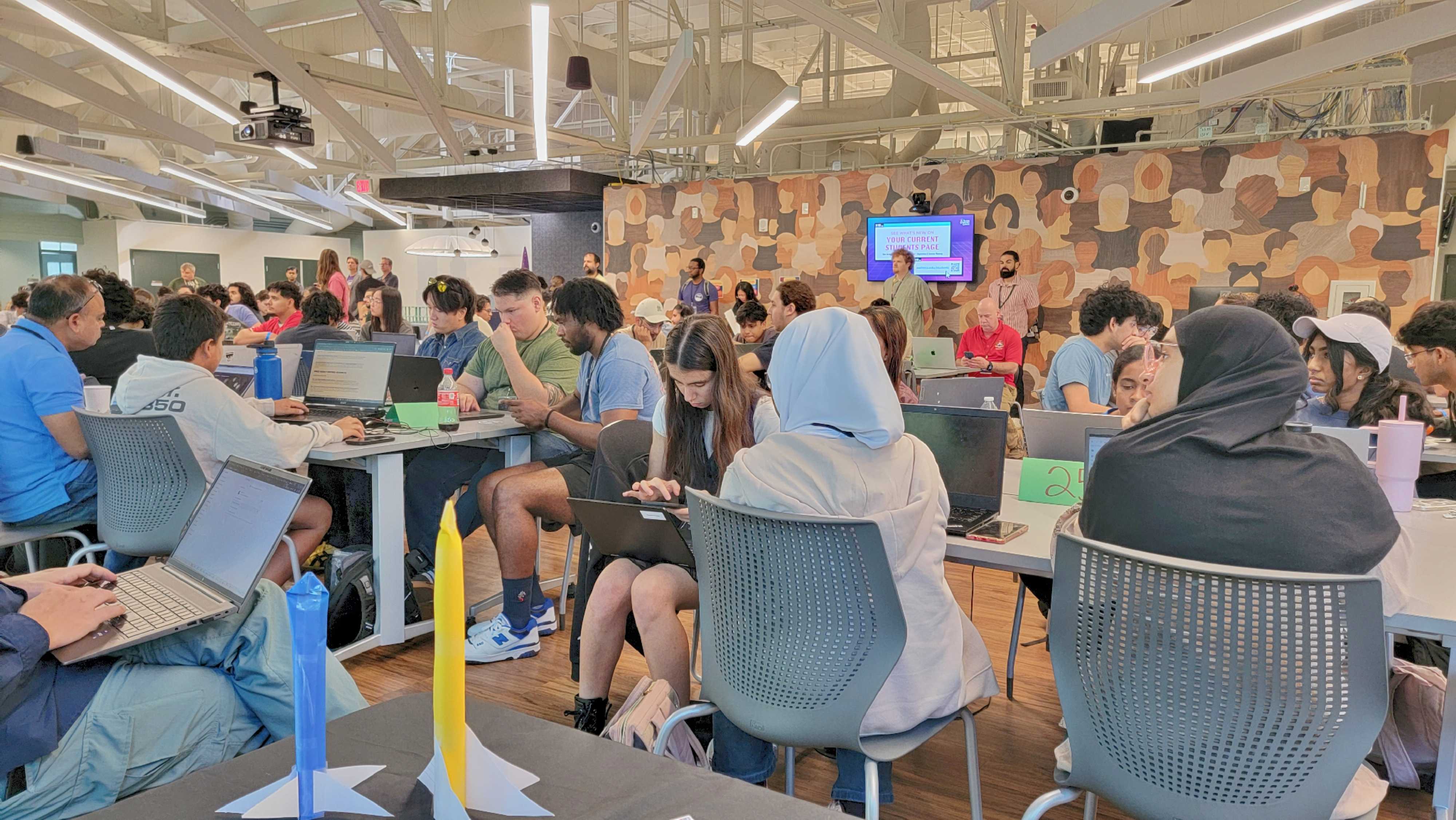
Participants work on their projects at the NASA Space Apps Challenge in Austin, Texas, at one of more than 50 local events held in the United States.
NASA Space Apps
More than 114,000 participants came together to address challenges created by NASA subject matter experts. These challenges ranged in complexity and topic, tasking participants with everything from leveraging artificial intelligence, to improving access to NASA research, and developing tools to evaluate air quality.
“The Space Apps Challenge puts NASA’s free and open data into the hands of explorers around the world,” said Karen St. Germain, director, NASA Earth Science Division at NASA Headquarters in Washington. “With participants as varied as NASA enthusiasts, future scientists, regional decision-makers and members of the public, this challenge demonstrates the excitement of discovery and the real-world applications of agency data. Space apps also fosters a global community of creative and innovative ideas.”
The winners were determined from more than 11,500 project submissions and judged by subject matter experts from NASA and agency partners:
Best Use of Science Award: SpaceGenes+ Team Members: Saloni T. Challenge: Build a Space Biology Knowledge Engine Country/Territory: Germany
Team SpaceGenes+ created an interactive dashboard designed to help researchers uncover how radiation and microgravity together impact astronaut health at the molecular level. It gives researchers and mission planners an easy way to identify important molecular changes, supporting more effective protection strategies for long-duration spaceflight. Learn more about SpaceGenes+’ project
Best Use of Data Award: Resonant Exoplanets Team Members: Adhvaidh S., Gabriel S., Jack A., Sahil S. Challenge: A World Away: Hunting for Exoplanets with AI Country/Territory: United States
Team Resonant Exoplanets developed an AI-powered system that ingests large sets of telescope and satellite data, including spectra from missions like the James Webb Space Telescope. This tool automatically analyzes data for exoplanets and detects possible biosignatures, rather than identifying them manually. Learn more about Resonant Exoplanets’ project
Best Use of Technology Award: Twisters Team Members: Fernando A., Marcelo T., Mariana D., Regina R., Regina F. Challenge: Will It Rain on My Parade? Country/Territory: Mexico
Team Twisters developed SkySense, a web-app platform that uses NASA Earth observation data and AI analysis to provide ultra-local, personalized weather predictions and to analyze weather variables such as rain, wind, temperature, humidity, and visibility, generating real-time risk assessments and suggesting the safest time windows for activities. Learn more about Twisters’ project
Galactic Impact Award: Astro Sweepers: We Catch What Space Leaves Behind Team Members: Harshiv T., Pragathy S., Pratik J., Sherlin D., Yousra H., Zienab E. Challenge: Commercializing Low Earth Orbit (LEO) Country/Territory: Universal Event
Team Astro Sweepers developed an end-to-end orbital debris compliance and risk intelligence platform that automatically ingests public orbital data to generate Debris Assessment Software reports and compute the Astro Sweepers Risk Index for every resident space object. This project considers the operational, regulatory, and environmental challenges of commercialized space travel. Learn more about Astro Sweepers’ project
Best Mission Concept Award: PureFlow Team Members: Esthefany M., João F., Laiza L., Lara D., Pedro H., Thayane D. Challenge: Your Home in Space: The Habitat Layout Creator Country/Territory: Brazil
PureFlow developed an interactive systems engineering platform that allows users to design, model in 3D, and validate space habitats, and then test the design against real space-weather threats, such as solar storms. This system considers the critical functions required for living in space, including waste management, power, life support, communications, and more. Learn more about PureFlows’ project
Most Inspirational Award: Photonics Odyssey Team Members: Manish D., M. K., Prasanth G., Rajalingam N., Rashi M., Sakthi R. Challenge: Commercializing Low Earth Orbit (LEO) Country/Territory: India
Photonics Odyssey reimagined satellite internet as a sovereign national infrastructure rather than a private service, proposing a phased-array antenna approach that reduces ground dependency and expands broadband access to remote regions of India. The concept aims to help connect more than 700 million people who lack access to broadband internet. Learn more about Photonics Odysseys’ project
Best Use of Storytelling Award: HerCode Space Team Members: Alice R., Joselyn R., Paula C., Pierina J. Challenge: Stellar Stories: Space Weather Through the Eyes of Earthlings Country/Territory: Universal Event
HerCode Space combined NASA data and heliophysics concepts with powerful storytelling and vibrant illustrations to teach kids how space weather affects daily life and why it matters. HerCode Science hopes their story, “A Solar Tale,” can bridge science and imagination, and bring heliophysics to life in classrooms, libraries, and outreach programs. Learn more about HerCode Spaces’ project
Global Connection Award: Gaia+LEO Team Members: Adam H., Katia L., Prajwal S., Upendra K. Challenge: Commercializing Low Earth Orbit (LEO) Country/Territory: United States
Team Gaia+LEO developed a mixed-integer optimization framework that co-designs orbital and terrestrial data-center networks to support large-scale AI training and climate modeling in orbit. Their goal is to reduce the power, and water demands of Earth-based systems and help accelerate the shift toward space-based, green computing within the emerging orbital economy. Learn more about Gaia+LEOs’ project
Art & Technology Award: Zumorroda-X Team Members: Alaa A., Esraa A., Malak S., Mennatulla E. Challenge: NASA Farm Navigators: Using NASA Data Exploration in Agriculture Country/Territory: Egypt
Team Zumorroda-X created mini games that allow players to step into the shoes of a farmer who sets off on an epic journey around the world. Through this game, players can learn how farmers globally adapt to heat waves, flooding, and other environmental challenges. Learn more about Zumorroda-Xs’ project
Local Impact Award: QUEÑARIS Team Members: Borax Q., Carlos Y., Marcelo S., Máximo S., Oscar M., Pamela P. Challenge: BloomWatch: An Earth Observation Application for Global Flowering Phenology Country/Territory: Peru
Team QUEÑARIS’ project addresses critical water scarcity in Peru’s second-largest city, Arequipa, caused by the degradation of queñua forests, which are vital for water retention. Their platform combines native microorganisms, NASA satellite data, drones, and artificial intelligence to accelerate tree growth, identify the best areas for reforestation, and monitor ecosystem health. Learn more about QUEÑARIS’ project
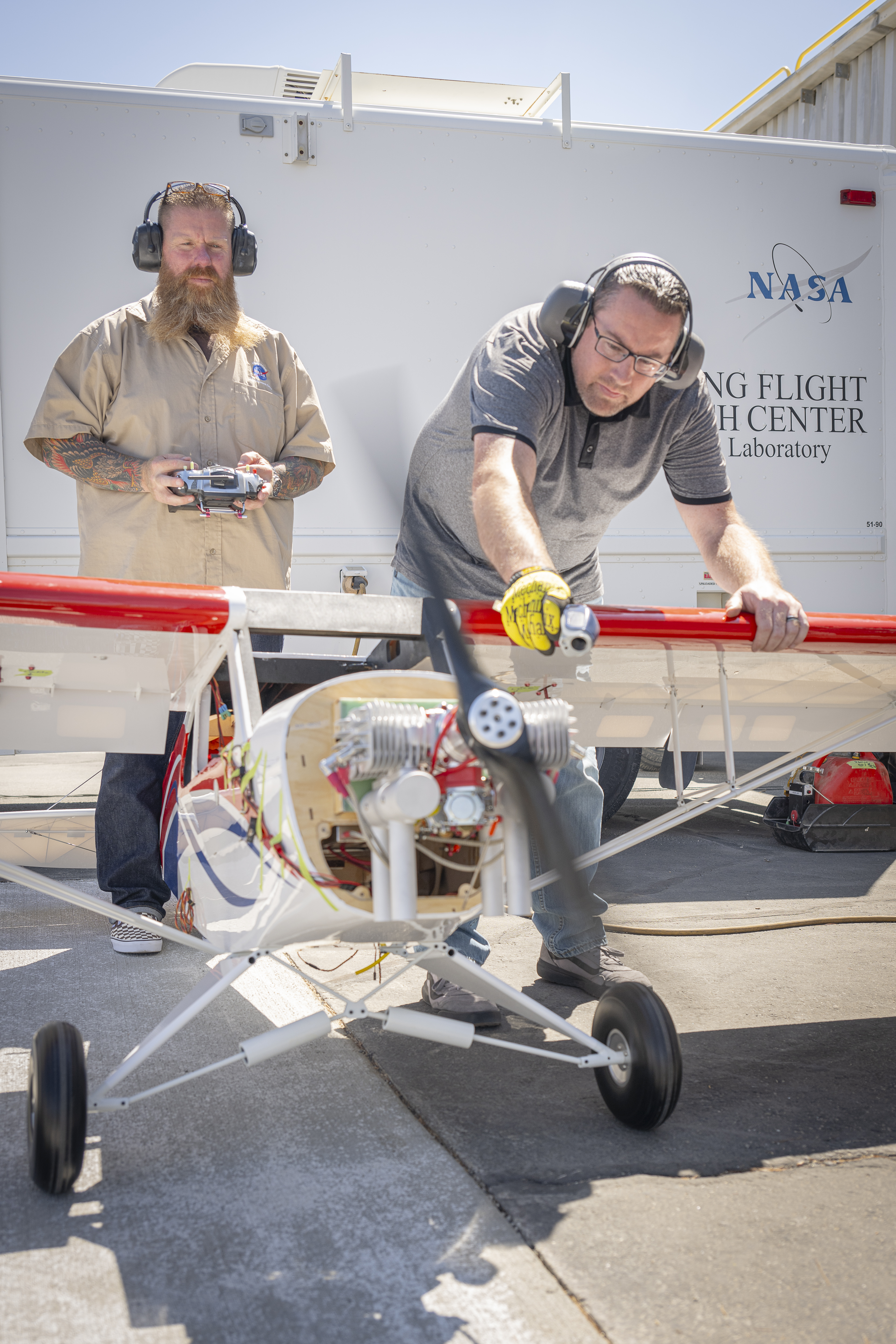
Justin Hall, left, controls a subscale aircraft as Justin Link holds the aircraft in place during preliminary engine tests on Friday, Sept. 12, 2025, at NASA’s Armstong Flight Research Center in Edwards, California.
Hall, chief pilot at the center’s Dale Reed Subscale Flight Research Laboratory, and Link, a pilot for small uncrewed aircraft systems, are building the large subscale aircraft to support increasingly complex flight research, offering a more flexible and cost-effective alternative to crewed missions. Once ready, the aircraft will help evaluate new concepts, technologies, and flight controls to support NASA missions on Earth and beyond.
NASA’s Hubble Sees Asteroids Colliding at Nearby Star for First Time
Like a game of cosmic bumper cars, scientists think the early days of our solar system were a time of violent turmoil, with planetesimals, asteroids, and comets smashing together and pelting the Earth, Moon, and the other inner planets with debris. Now, in a historical milestone, NASA’s Hubble Space Telescope has directly imaged similar catastrophic collisions in a nearby planetary system around another star, Fomalhaut.
“This is certainly the first time I’ve ever seen a point of light appear out of nowhere in an exoplanetary system,” said principal investigator Paul Kalas of the University of California, Berkeley. “It’s absent in all of our previous Hubble images, which means that we just witnessed a violent collision between two massive objects and a huge debris cloud unlike anything in our own solar system today. Amazing!”
Just 25 light-years from Earth, Fomalhaut is one of the brightest stars in the night sky. Located in the constellation Piscis Austrinus, also known as the Southern Fish, it is more massive and brighter than the Sun and is encircled by several belts of dusty debris.
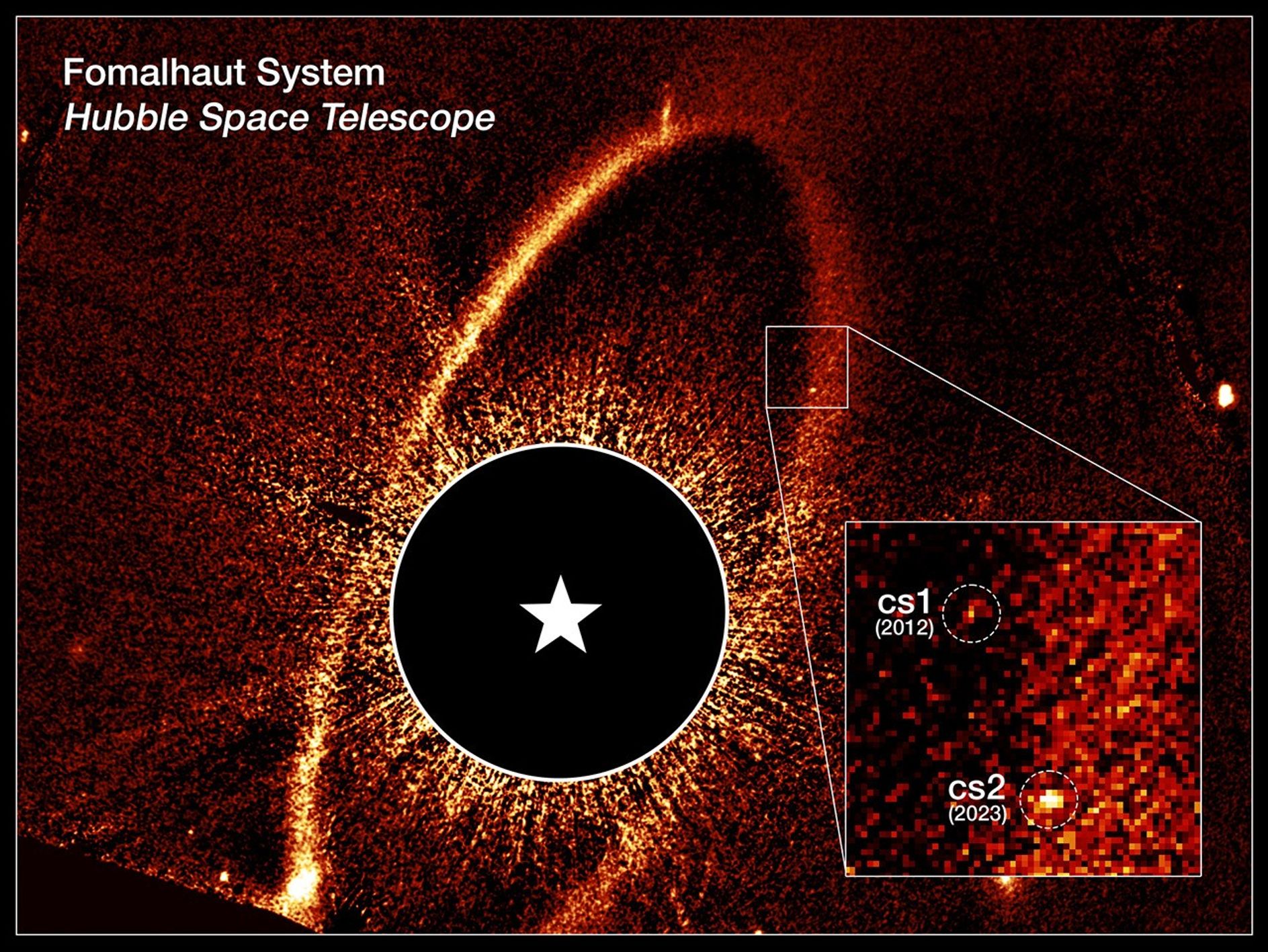
This composite Hubble Space Telescope image shows the debris ring and dust clouds cs1 and cs2 around the star Fomalhaut. Fomalhaut itself is masked out to allow the fainter features to be seen. Its location is marked by the white star.
Image: NASA, ESA, Paul Kalas (UC Berkeley); Image Processing: Joseph DePasquale (STScI)
In 2008, scientists used Hubble to discover a candidate planet around Fomalhaut, making it the first stellar system with a possible planet found using visible light. That object, called Fomalhaut b, now appears to be a dust cloud masquerading as a planet—the result of colliding planetesimals. While searching for Fomalhaut b in recent Hubble observations, scientists were surprised to find a second point of light at a similar location around the star. They call this object “circumstellar source 2” or “cs2” while the first object is now known as “cs1.”
Tackling Mysteries of Colliding Planetesimals
Why astronomers are seeing both of these debris clouds so physically close to each other is a mystery. If the collisions between asteroids and planetesimals were random, cs1 and cs2 should appear by chance at unrelated locations. Yet, they are positioned intriguingly near each other along the inner portion of Fomalhaut’s outer debris disk.
Another mystery is why scientists have witnessed these two events within such a short timeframe. “Previous theory suggested that there should be one collision every 100,000 years, or longer. Here, in 20 years, we’ve seen two,” explained Kalas. “If you had a movie of the last 3,000 years, and it was sped up so that every year was a fraction of a second, imagine how many flashes you’d see over that time. Fomalhaut’s planetary system would be sparkling with these collisions.”
Collisions are fundamental to the evolution of planetary systems, but they are rare and difficult to study.
This artist’s concept shows the sequence of events leading up to the creation of dust cloud cs2 around the star Fomalhaut. In Panel 1, the star Fomalhaut appears in the top left corner. Two white dots, located in the bottom right corner, represent the two massive objects in orbit around Fomalhaut. In Panel 2, the objects approach each other. Panel 3 shows the violent collision of these two objects. In Panel 4, the resulting dust cloud cs2 becomes visible and starlight pushes the dust grains away from the star.
Artwork: NASA, ESA, STScI, Ralf Crawford (STScI)
“The exciting aspect of this observation is that it allows researchers to estimate both the size of the colliding bodies and how many of them there are in the disk, information which is almost impossible to get by any other means,” said co-author Mark Wyatt at the University of Cambridge in England. “Our estimates put the planetesimals that were destroyed to create cs1 and cs2 at just 37 miles or 60 kilometers across, and we infer that there are 300 million such objects orbiting in the Fomalhaut system.”
“The system is a natural laboratory to probe how planetesimals behave when undergoing collisions, which in turn tells us about what they are made of and how they formed,” explained Wyatt.
Cautionary Tale
The transient nature of Fomalhaut cs1 and cs2 poses challenges for future space missions aiming to directly image exoplanets. Such telescopes may mistake dust clouds like cs1 and cs2 for actual planets.
“Fomalhaut cs2 looks exactly like an extrasolar planet reflecting starlight,” said Kalas. “What we learned from studying cs1 is that a large dust cloud can masquerade as a planet for many years. This is a cautionary note for future missions that aim to detect extrasolar planets in reflected light.”
Looking to Future
Kalas and his team have been granted Hubble time to monitor cs2 over the next three years. They want to see how it evolves—does it fade, or does it get brighter? Being closer to the dust belt than cs1, the expanding cs2 cloud is more likely to start encountering other material in the belt. This could lead to a sudden avalanche of more dust in the system, which could cause the whole surrounding area to get brighter.
Credit: NASA’s Goddard Space Flight Center; Lead Producer: Paul Morris
“We will be tracing cs2 for any changes in its shape, brightness, and orbit over time,” said Kalas, “It’s possible that cs2 will start becoming more oval or cometary in shape as the dust grains are pushed outward by the pressure of starlight.”
The team also will use the NIRCam (Near-Infrared Camera) instrument on NASA’s James Webb Space Telescope to observe cs2. Webb’s NIRCam has the ability to provide color information that can reveal the size of the cloud’s dust grains and their composition. It can even determine if the cloud contains water ice.
Hubble and Webb are the only observatories capable of this kind of imaging. While Hubble primarily sees in visible wavelengths, Webb could view cs2 in the infrared. These different, complementary wavelengths are needed to provide a broad multi-spectral investigation and a more complete picture of the mysterious Fomalhaut system and its rapid evolution.
This research appears in the December 18 issue of Science.
The Hubble Space Telescope has been operating for over three decades and continues to make ground-breaking discoveries that shape our fundamental understanding of the universe. Hubble is a project of international cooperation between NASA and ESA (European Space Agency). NASA’s Goddard Space Flight Center in Greenbelt, Maryland, manages the telescope and mission operations. Lockheed Martin Space, based in Denver, also supports mission operations at Goddard. The Space Telescope Science Institute in Baltimore, which is operated by the Association of Universities for Research in Astronomy, conducts Hubble science operations for NASA.
This composite Hubble Space Telescope image shows the debris ring and dust clouds cs1 and cs2 around the star Fomalhaut. Fomalhaut itself is masked out to allow the fainter features to be seen. Its location is marked by the white star.
Fomalhaut cs2 Illustration
This artist’s concept shows the sequence of events leading up to the creation of dust cloud cs2 around the star Fomalhaut.
Fomalhaut cs2 Video
Hubble captured the violent collision of two massive objects around the star Fomalhaut. This extraordinary event is unlike anything in our own present-day solar system. The video shows the sequence of events leading up to the creation of dust cloud cs2 around the star Fomalhaut. …
Hubble Captures Destruction of Worlds Video
NASA’s Hubble Space Telescope captured a rare and violent event unfolding around the nearby star Fomalhaut. This discovery sheds light on the chaotic processes that may have shaped our own solar system billions of years ago. With support from both Hubble and the James Webb Space Telescope, astronomers are now closely monitoring the aftermath.
From 2020: Exoplanet Apparently Disappears in Latest Hubble Observations
From 2013: Hubble Reveals Rogue Planetary Orbit for Fomalhaut b
Newly released Hubble Space Telescope images of a vast debris disk encircling the nearby star Fomalhaut, and of a mysterious planet circling it, may provide forensic evidence of a titanic planetary disruption in the system.
From 2008: Hubble Directly Observes Planet Orbiting Fomalhaut
NASA’s Hubble Space Telescope has taken the first visible-light snapshot of a planet circling another star.
From 2005: Elusive Planet Reshapes a Ring Around Neighboring Star
NASA Hubble Space Telescope’s most detailed visible-light image ever taken of a narrow, dusty ring around the nearby star Fomalhaut (HD 216956), offers the strongest evidence yet that an unruly and unseen planet may be gravitationally tugging on the ring.
Preparations for Next Moonwalk Simulations Underway (and Underwater)
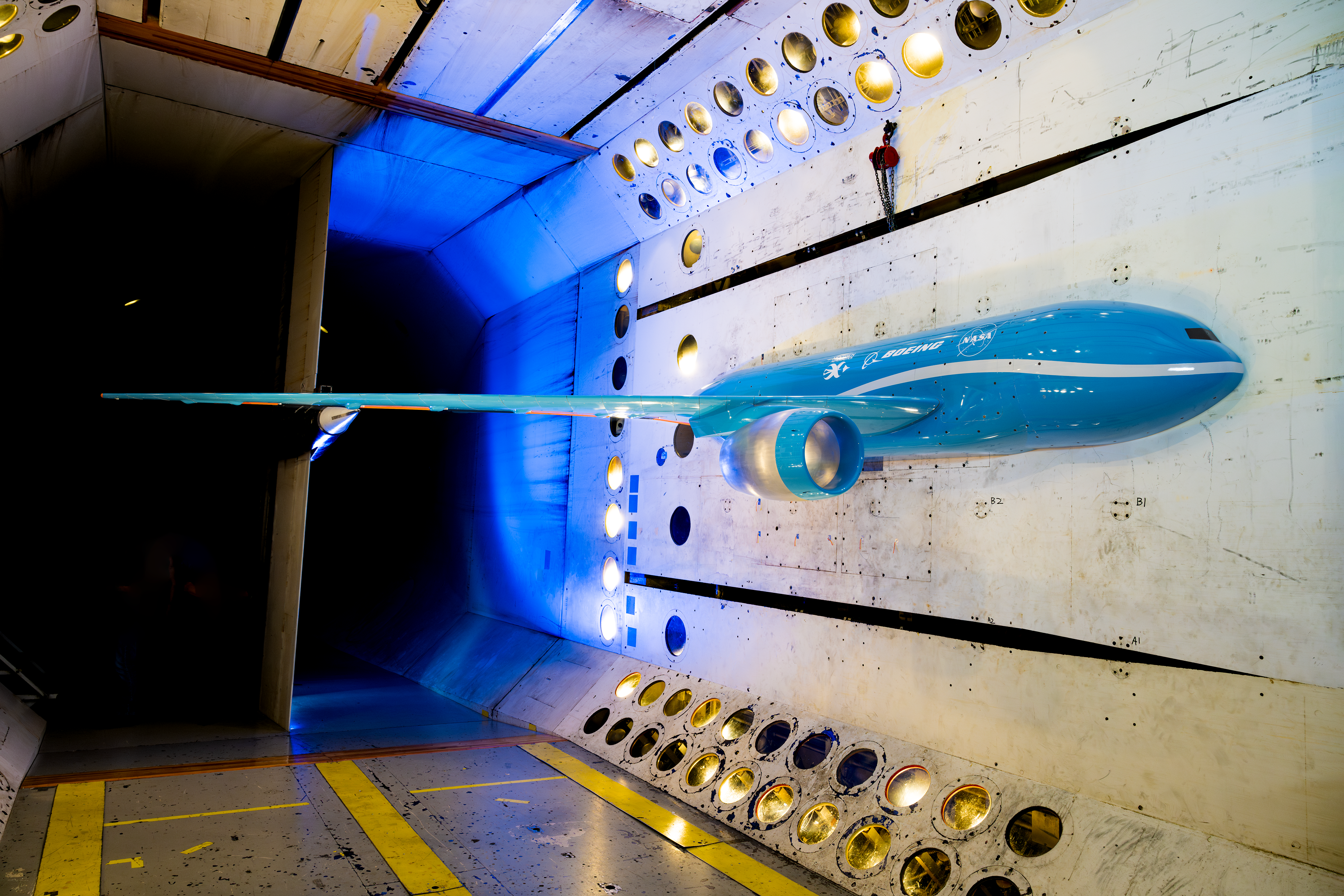
The Integrated Adaptive Wing Technology Maturation wind-tunnel model installed in the Transonic Dynamics Tunnel at NASA Langley Research Center in Hampton, Virginia.
NASA / Mark Knopp
The airliner you board in the future could look a lot different from today’s, with longer, thinner wings that provide a smoother ride while saving fuel.
Those wings would be a revolutionary design for commercial aircraft, but like any breakthrough technology, they come with their own development challenges – which experts from NASA and Boeing are now working to solve.
When creating lift, longer, thinner wings can reduce drag, making them efficient. However, they can become very flexible in flight.
Through their Integrated Adaptive Wing Technology Maturation collaboration, NASA and Boeing recently completed wind tunnel tests of a “higher aspect ratio wing model” looking for ways to get the efficiency gains without the potential issues these kinds of wings can experience.
“When you have a very flexible wing, you’re getting into greater motions,” said Jennifer Pinkerton, a NASA aerospace engineer at NASA Langley Research Center in Hampton, Virginia. “Things like gust loads and maneuver loads can cause even more of an excitation than with a smaller aspect ratio wing. Higher aspect ratio wings also tend to be more fuel efficient, so we’re trying to take advantage of that while simultaneously controlling the aeroelastic response.”
Take a minute to watch this video about the testing NASA and Boeing are doing on longer, narrower aircraft wings.
Without the right engineering, long, thin wings could potentially bend or experience a condition known as wing flutter, causing aircraft to vibrate and shake in gusting winds.
“Flutter is a very violent interaction,” Pinkerton said. “When the flow over a wing interacts with the aircraft structure and the natural frequencies of the wing are excited, wing oscillations are amplified and can grow exponentially, leading to potentially catastrophic failure. Part of the testing we do is to characterize aeroelastic instabilities like flutter for aircraft concepts so that in actual flight, those instabilities can be safely avoided.”
To help demonstrate and understand this, researchers from NASA and Boeing sought to soften the impacts of wind gusts on the aircraft, lessen the wing loads from aircraft turns and movements, and suppress wing flutter.
Reducing or controlling those factors can have a significant impact on an aircraft’s performance, fuel efficiency, and passenger comfort.
Testing for this in a controlled environment is impossible with a full-sized commercial airliner, as no wind tunnel could accommodate one.
However, NASA Langley’s Transonic Dynamics Tunnel, which has been contributing to the design of U.S. commercial transports, military aircraft, launch vehicles, and spacecraft for over 60 years, features a test section 16 feet high by 16 feet wide, big enough for large-scale models.
To shrink a full-size plane down to scale, NASA and Boeing worked with NextGen Aeronautics, which designed and fabricated a complex model resembling an aircraft divided down the middle, with one 13-foot wing.
Mounted to the wall of the wind tunnel, the model was outfitted with 10 control surfaces – moveable panels – along the wing’s rear edge. Researchers adjusted those control surfaces to control airflow and reduce the forces that were causing the wing to vibrate.
Instruments and sensors mounted inside the model measured the forces acting on the model, as well as the vehicle’s responses.
Another view of the Integrated Adaptive Wing Technology Maturation wind-tunnel model installed in the Transonic Dynamics Tunnel at NASA Langley Research Center in Hampton, Virginia.
NASA / Mark Knopp
The model wing represented a leap in sophistication from a smaller one developed during a previous NASA-Boeing collaboration called the Subsonic Ultra Green Aircraft Research (SUGAR).
“The SUGAR model had two active control surfaces,” said Patrick S. Heaney, principal investigator at NASA for the Integrated Adaptive Wing Technology Maturation collaboration. “And now on this particular model we have ten. We’re increasing the complexity as well as expanding what our control objectives are.”
A first set of tests, conducted in 2024, gave experts baseline readings that they compared to NASA computational simulations, allowing them to refine their models. A second set of tests in 2025 used the additional control surfaces in new configurations.
The most visible benefits of these new capabilities appeared during testing to alleviate the forces from gusting winds, when researchers saw the wing’s shaking greatly reduced.
With testing completed, NASA and Boeing experts are analyzing data and preparing to share their results with the aviation community. Airlines and original equipment manufacturers can learn and benefit from the lessons learned, deciding which to apply to the next generation of aircraft.
“Initial data analyses have shown that controllers developed by NASA and Boeing and used during the test demonstrated large performance improvements,” Heaney said. “We’re excited to continue analyzing the data and sharing results in the months to come.”
NASA’s Advanced Air Transport Technology project works to advance aircraft design and technology under the agency’s Advanced Air Vehicles program, which studies, evaluates, and develops technologies and capabilities for new aircraft systems. The project and program fall within NASA’s Aeronautics Research Mission Directorate.
What can we do to help aircraft wings perform better in flight, creating a smoother, more fuel efficient, and safer experience for travelers? This is a quest...
Preparations for Next Moonwalk Simulations Underway (and Underwater)
This panoramic view of SPHEREx’s first all-sky map shows how the sky looks to the telescope. It transitions between observations of colors emitted by hot hydrogen gas (blue) and cosmic dust (red), and those primarily emitted by stars. Credit: NASA/JPL-Caltech
Launched in March, NASA’s SPHEREx space telescope has completed its first infrared map of the entire sky in 102 colors. While not visible to the human eye, these 102 infrared wavelengths of light are prevalent in the cosmos, and observing the entire sky this way enables scientists to answer big questions, including how a dramatic event that occurred in the first billionth of a trillionth of a trillionth of a second after the big bang influenced the 3D distribution of hundreds of millions of galaxies in our universe. In addition, scientists will use the data to study how galaxies have changed over the universe’s nearly 14 billion-year history and learn about the distribution of key ingredients for life in our own galaxy.
“It’s incredible how much information SPHEREx has collected in just six months — information that will be especially valuable when used alongside our other missions’ data to better understand our universe,” said Shawn Domagal-Goldman, director of the Astrophysics Division at NASA Headquarters in Washington. “We essentially have 102 new maps of the entire sky, each one in a different wavelength and containing unique information about the objects it sees. I think every astronomer is going to find something of value here, as NASA’s missions enable the world to answer fundamental questions about how the universe got its start, and how it changed to eventually create a home for us in it.”
Circling Earth about 14½ times a day, SPHEREx (which stands for Spectro-Photometer for the History of the Universe, Epoch of Reionization, and Ices Explorer) travels from north to south, passing over the poles. Each day it takes about 3,600 images along one circular strip of the sky, and as the days pass and the planet moves around the Sun, SPHEREx’s field of view shifts as well. After six months, the observatory has looked out into space in every direction, capturing the entire sky in 360 degrees.
Managed by NASA’s Jet Propulsion Laboratory in Southern California, the mission began mapping the sky in May and completed its first all-sky mosaic in December. It will complete three additional all-sky scans during its two-year primary mission, and merging those maps together will increase the sensitivity of the measurements. The entire dataset is freely available to scientists and the public.
“SPHEREx is a mid-sized astrophysics mission delivering big science,” said JPL Director Dave Gallagher. “It’s a phenomenal example of how we turn bold ideas into reality, and in doing so, unlock enormous potential for discovery.”
NASA’s SPHEREx has mapped the entire sky in 102 infrared colors, which are invisible to the human eye but can be used to reveal different features of the cosmos. This image features a selection of colors emitted primarily by stars (blue, green, and white), hot hydrogen gas (blue), and cosmic dust (red).
NASA/JPL-Caltech
This SPHEREx image shows a selection of the infrared colors primarily emitted by stars and galaxies. The space telescope is observing hundreds of millions of distant galaxies across the sky. Its multiwavelength view will help astronomers measure the distance to those galaxies.
NASA/JPL-Caltech
The infrared colors emitted primarily by dust (red) and hot gas (blue), key ingredients for forming new stars and planets, are seen in this SPHEREx image. Though these clouds of material cover a massive portion of the sky, they are invisible in most wavelengths of light, including those the human eye can detect.
NASA/JPL-Caltech
Superpowered telescope
Each of the 102 colors detected by SPHEREx represents a wavelength of infrared light, and each wavelength provides unique information about the galaxies, stars, planet-forming regions, and other cosmic features therein. For example, dense clouds of dust in our galaxy where stars and planets form radiate brightly in certain wavelengths but emit no light (and are therefore totally invisible) in others. The process of separating the light from a source into its component wavelengths is called spectroscopy.
And while a handful of previous missions has also mapped the entire sky, such as NASA’s Wide-field Infrared Survey Explorer, none have done so in nearly as many colors as SPHEREx. By contrast, NASA’s James Webb Space Telescope can do spectroscopy with significantly more wavelengths of light than SPHEREx, but with a field of view thousands of times smaller. The combination of colors and such a wide field of view is why SPHEREx is so powerful.
“The superpower of SPHEREx is that it captures the whole sky in 102 colors about every six months. That’s an amazing amount of information to gather in a short amount of time,” said Beth Fabinsky, the SPHEREx project manager at JPL. “I think this makes us the mantis shrimp of telescopes, because we have an amazing multicolor visual detection system and we can also see a very wide swath of our surroundings.”
To accomplish this feat, SPHEREx uses six detectors, each paired with a specially designed filter that contains a gradient of 17 colors. That means every image taken with those six detectors contains 102 colors (six times 17). It also means that every all-sky map that SPHEREx produces is really 102 maps, each in a different color.
The observatory will use those colors to measure the distance to hundreds of millions of galaxies. Though the positions of most of those galaxies have already been mapped in two dimensions by other observatories, SPHEREx’s map will be in 3D, enabling scientists to measure subtle variations in the way galaxies are clustered and distributed across the universe.
Each frame of this movie shows the entire sky in a different infrared wavelength, indicated by the color bar in the top right corner. Taken by NASA’s SPHEREx observatory, the maps illustrate how viewing the universe in different wavelengths of light can reveal unique cosmic features. Credit: NASA/JPL-Caltech
Those measurements will offer insights into an event that took place in the first billionth of a trillionth of a trillionth of a second after the big bang. In this moment, called inflation, the universe expanded by a trillion-trillionfold. Nothing like it has occurred in the universe since, and scientists want to understand it better. The SPHEREx mission’s approach is one way to help in that effort.
More about SPHEREx
The SPHEREx mission is managed by JPL for NASA’s Astrophysics Division within the Science Mission Directorate in Washington. The telescope and the spacecraft bus were built by BAE Systems. The science analysis of the SPHEREx data is being conducted by a team of scientists at 10 institutions across the U.S., and in South Korea and Taiwan. Data is processed and archived at IPAC at Caltech in Pasadena, which manages JPL for NASA. The mission’s principal investigator is based at Caltech with a joint JPL appointment. The SPHEREx dataset is publicly available.
For more information about the SPHEREx mission visit:
Each frame of this movie shows the entire sky in a different infrared wavelength, indicated by the widget in the top right corner. Taken by NASA’s SPHEREx ob...
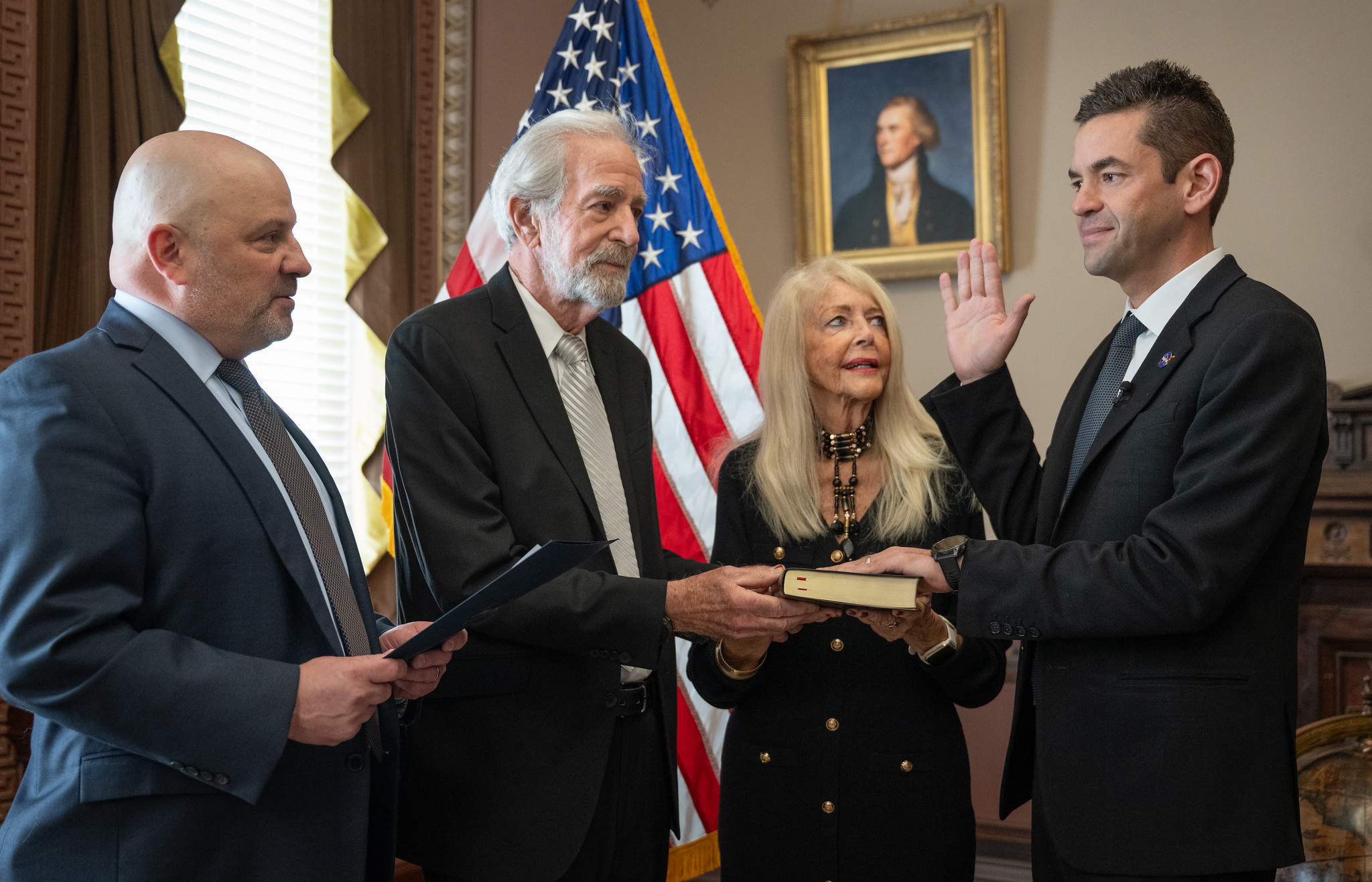
U.S. District Judge Timothy Kelly, left, swears in Jared Isaacman, right, as the 15th administrator of NASA, as Isaacman’s parents, Donald and Sandra Marie, join on Dec. 18, 2025, at the Eisenhower Executive Office Building in Washington.
Credit: NASA/Bill Ingalls
Jared Isaacman was sworn in Thursday as NASA’s 15th administrator by District Judge Timothy J. Kelly. The oath was taken during a ceremony held at the Eisenhower Executive Office Building in Washington.
As NASA administrator, Isaacman will lead the agency in bold pursuit of exploration, innovation, and scientific discovery.
“I am deeply honored to be sworn in as NASA administrator,” said Isaacman. “NASA’s mission is as imperative and urgent as ever — to push the boundaries of human exploration, ignite the orbital economy, drive scientific discovery, and innovate for the benefit of all of humanity. I look forward to serving under President Trump’s leadership and restoring a mission-first culture at NASA — focused on achieving ambitious goals, to return American astronauts to the Moon, establish an enduring presence on the lunar surface, and laying the groundwork to deliver on President Trump’s vision of planting the Stars and Stripes on Mars.”
Isaacman, nominated by President Donald J. Trump on Nov. 4th, was confirmed to serve as NASA administrator by the U.S. Senate on Dec. 17. Isaacman is expected to address the workforce this week.
Jared “Rook” Isaacman is the 15th administrator of NASA, a pilot, astronaut, seasoned entrepreneur, philanthropist, and pioneer in commercial spaceflight. Read Isaacman’s official biography online.
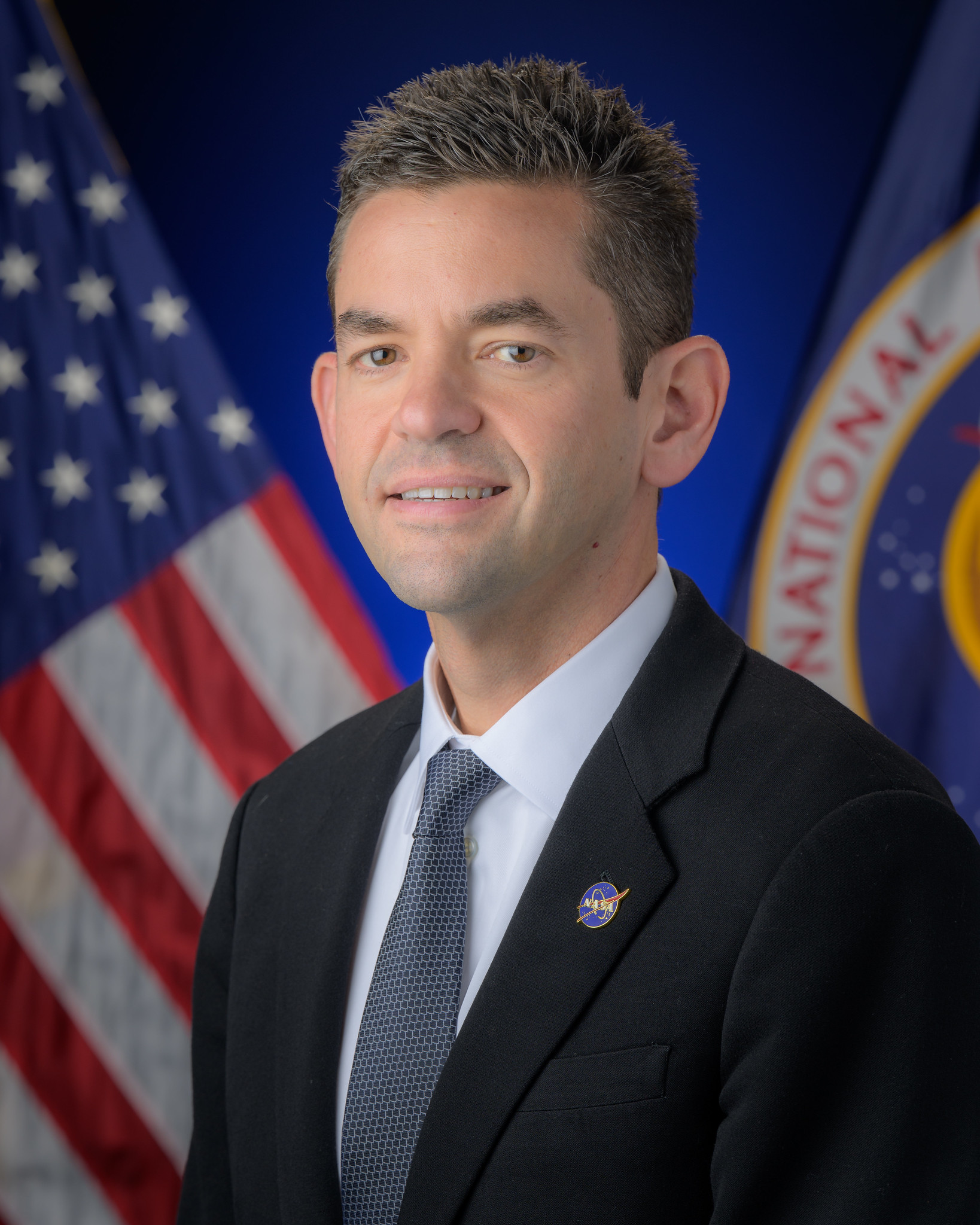
Official portrait of NASA Administrator Jared Isaacman
Preparations for Next Moonwalk Simulations Underway (and Underwater)
In 2025, NASA’s Stennis Space Center near Bay St. Louis, Mississippi, marked a year of progress by supporting NASA’s Artemis campaign, celebrating historic milestones, and continuing its role as a trusted propulsion test partner at America’s largest rocket propulsion test site.
“For more than six decades, NASA Stennis has proudly represented the Gulf Coast region and America in advancing our nation’s space exploration goals,” said NASA Stennis Director John Bailey. “This year, we continued our progress forward as we near the launch of Artemis II, while honoring milestones that have brought our center to this point.”
Supporting Artemis
As NASA prepares for the launch of Artemis II in early 2026, with the first crewed mission to the Moon in over 50 years, NASA Stennis continues its frontline work.
Every RS-25 engine used to help launch NASA’s SLS (Space Launch System) rocket to the Moon is tested in south Mississippi.
NASA Stennis teams provided data to lead engines contractor L3Harris Technologies by successfully testing two new production RS-25 flight engines.
NASA tested RS-25 engine No. 20001 at the Fred Haise Test Stand in June, and RS-25 engine No. 20002 in November. Each engine fired for 500 seconds, reaching 111% of its rated power, while simulating launch conditions.
Teams at NASA’s Stennis Space Center deliver, lift, and install the first new production RS-25 engine on the Fred Haise Test Stand on Feb. 18, 2025.
NASA/Danny Nowlin
Teams at NASA’s Stennis Space Center deliver, lift, and install the first new production RS-25 engine on the Fred Haise Test Stand on Feb. 18, 2025.
NASA/Danny Nowlin
Teams at NASA’s Stennis Space Center deliver, lift, and install the first new production RS-25 engine on the Fred Haise Test Stand on Feb. 18, 2025.
NASA/Danny Nowlin
Teams at NASA’s Stennis Space Center deliver, lift, and install the first new production RS-25 engine on the Fred Haise Test Stand on Feb. 18, 2025.
NASA/Danny Nowlin
Teams at NASA’s Stennis Space Center deliver, lift, and install the first new production RS-25 engine on the Fred Haise Test Stand on Feb. 18, 2025.
NASA/Danny Nowlin
Teams at NASA’s Stennis Space Center deliver, lift, and install the first new production RS-25 engine on the Fred Haise Test Stand on Feb. 18, 2025.
NASA/Danny Nowlin
NASA tests RS-25 engine No. 20001 on June 20, 2025, at the Fred Haise Test Stand at NASA’s Stennis Space Center at Bay St. Louis, Mississippi.
NASA/Danny Nowlin
Supporting Commercial Propulsion
The commercial aerospace industry is growing, and NASA Stennis is a secure location providing support for it. Companies that have conducted work at NASA Stennis include Blue Origin, Boeing, Evolution Space; Launcher, a Vast company; Relativity Space and Rolls-Royce.
Three companies – Relativity Space, Rocket Lab, and Evolution Space – have established, or continue progress to establish, production and/or test operations at NASA Stennis.
Infrastructure upgrades and planning efforts across the test complex are laying the foundation for future propulsion test projects as well.
“As the commercial space industry continues to accelerate their development, NASA Stennis is adapting to meet their propulsion testing needs,” said Joe Schuyler, director of the NASA Stennis Engineering and Test Directorate. “We are proud that our proven experience makes us a trusted partner.”
Honoring the Past
In 2025, NASA Stennis honored a defining era of space shuttle main engine testing. An image shows the first space shuttle main engine installed on May 8, 1975, at the Fred Haise Test Stand (formerly A-1).
NASA
While NASA Stennis operates as the nation’s largest rocket propulsion test site, the NASA Stennis Federal City also is home to more than 50 federal, state, academic, and commercial tenants.
This year marked the birth of the federal city concept 55 years ago. The unique operating approach serves as a model of government efficiency and a powerful economic engine for the Gulf Coast region.
Meanwhile, the 50thanniversary of space shuttle main engine testing honored a defining era for NASA Stennis.
From May 1975 to July 2009, NASA Stennis tested space shuttle main engines that enabled 135 shuttle missions and notable space milestones, like deployment of the Hubble Space Telescope and construction of the International Space Station.
Both the federal city model and the decades of propulsion excellence continue to inform work at NASA Stennis.
Engineering the Future
Innovation extended beyond the test stands. The versatile testing environment at NASA Stennis is uniquely positioned to support unmanned systems testing across air, land, and water. With restricted airspace, a closed canal system, and vast protected terrain, the site offers a safe, flexible environment for range operations.
In addition to physical infrastructure, NASA Stennis progressed in digital innovation with the release of its first open-source software tool to streamline propulsion test data collection and collaboration across NASA and industry. The peer review tool is designed to facilitate more efficient and collaborative creation of systems applications, such as those used in frontline government and propulsion test work.
U.S. Naval Research Laboratory personnel conduct a field experiment involving an unmanned aerial system at NASA Stennis in March 2024.
NASA/Danny Nowlin
U.S. Naval Research laboratory personnel conduct tests on The Blue Boat made by Blue Robotics, an unmanned surface vessel, at NOAA’s National Data Buoy Center basin at NASA Stennis on Dec. 19, 2024.
NASA/Danny Nowlin
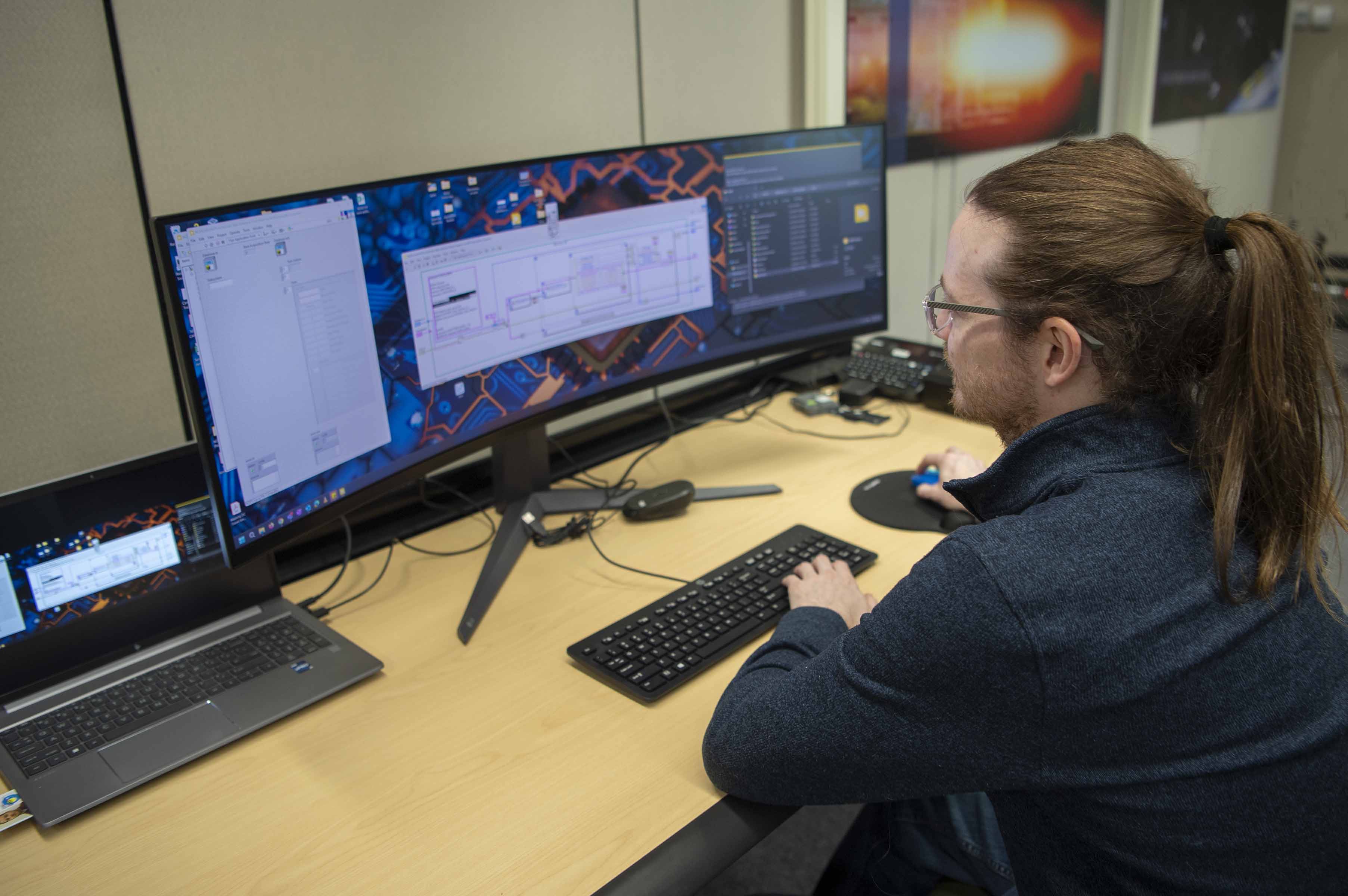
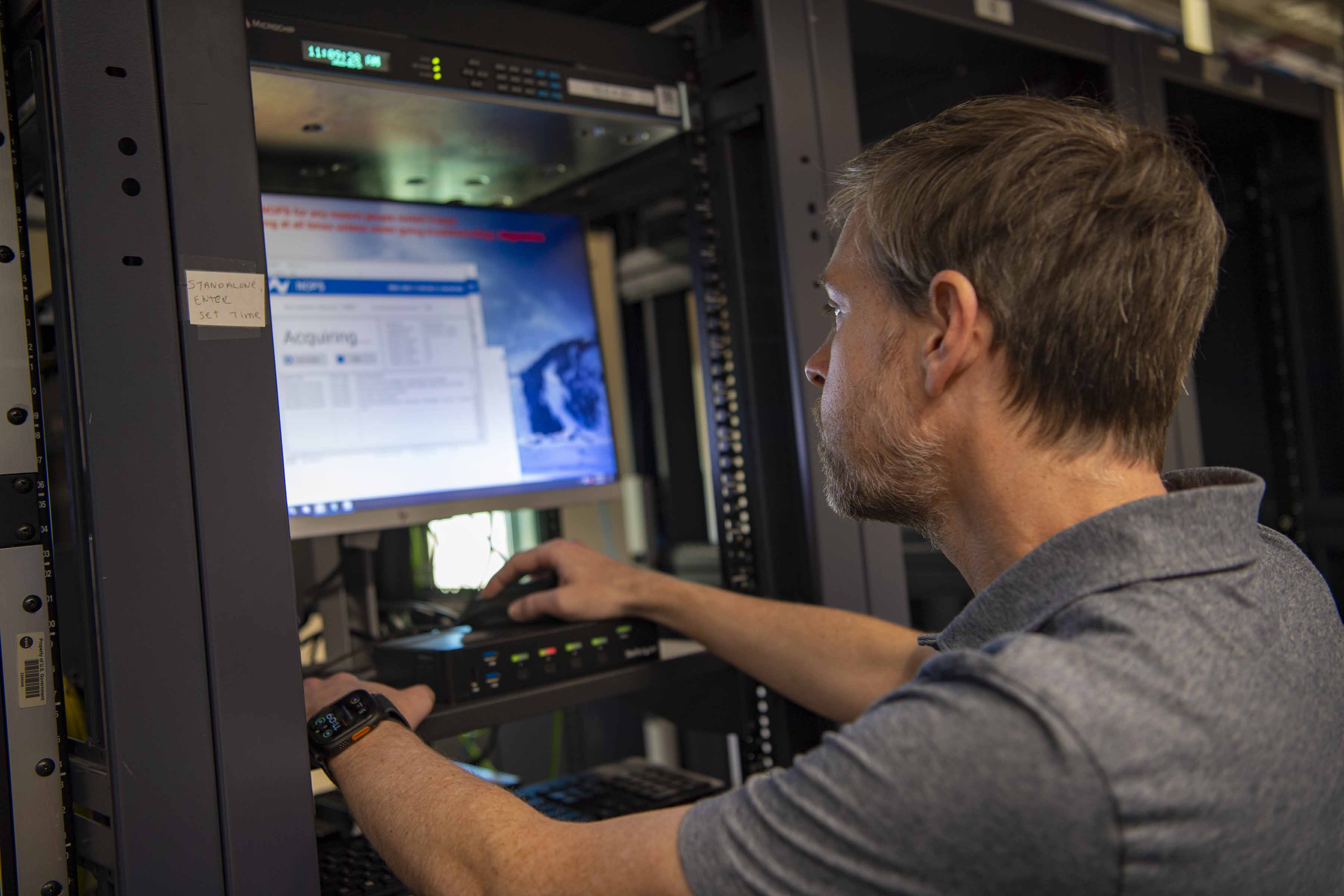
NASA software engineer Brandon Carver updates how the main data acquisition software processes information on March 5, 2025, at NASA’s Stennis Space Center, where he has contributed to the creation of the center’s first-ever open-source software.
NASA/Danny Nowlin
Syncom Space Services software engineer Shane Cravens, the chief architect behind the first-ever open-source software at NASA’s Stennis Space Center, verifies operation of the site’s data acquisition hardware.
NASA/Danny Nowlin
Community and Inspiration
NASA Stennis connected with communities in creative ways in 2025.
During Super Bowl week, NASA Stennis representatives inspired future explorers by bringing Artemis mission displays and hands-on activities to families at the Audubon Aquarium in New Orleans.
In March, NASA Stennis supported the third annual FIRST Robotics Magnolia Regional as a lead sponsor with employees and interns volunteering at the event. The competition in Laurel, Mississippi, brought together 37 teams from eight U.S. states (Alabama, California, Florida, Louisiana, Minnesota, Mississippi, Missouri, and Tennessee) and Mexico. The FIRST (For the Inspiration and Recognition of Science and Technology) Robotics event joined NASA’s Robotics Alliance Project to combine the excitement of sport with the rigors of science, technology, engineering, and mathematics (STEM) in field games using industrial-sized robots.
That same spirit of hands-on learning continues at INFINITY Science Center, the official visitor center of NASA Stennis. A new interactive exhibit has provided visitors a chance to become a test conductor and simulate RS-25 engine tests for the engines that will help power NASA’s Artemis missions.
A pair of young visitors to INFINITY Science Center carry out the steps of a simulated RS-25 engine hot fire on Dec. 19, 2024. The engine test simulator exhibit provided by NASA’s Stennis Space Center takes users through the hot fire process just as real engineers do at NASA Stennis.
NASA/Danny Nowlin
NASA Stennis representatives inspire the Artemis Generation at the Audubon Aquarium in New Orleans on Feb. 7-8, 2025, with activities and displays highlighting space exploration, including NASA’s Artemis missions to the Moon.
NASA/Danny Nowlin
NASA Stennis representatives inspire the Artemis Generation at the Audubon Aquarium in New Orleans on Feb. 7-8, 2025, with activities and displays highlighting space exploration, including NASA’s Artemis missions to the Moon.
NASA/Danny Nowlin
NASA serves as a lead sponsor, along with NASA Stennis employees and interns volunteering, for the third annual FIRST Robotics Magnolia Regional Competition on March 14, 2025. The event in Laurel, Mississippi, welcomed 37 teams from eight states (Alabama, California, Florida, Louisiana, Minnesota, Missouri, Mississippi, and Tennessee) and one team from Mexico. The FIRST (For the Inspiration and Recognition of Science and Technology) Robotics event joined NASA’s Robotics Alliance Project to combine the excitement of sport with the rigors of science, technology, engineering, and mathematics (STEM) in field games using industrial-sized robots.
NASA/Danny Nowlin
NASA serves as a lead sponsor, along with NASA Stennis employees and interns volunteering, for the third annual FIRST Robotics Magnolia Regional Competition on March 14, 2025. The event in Laurel, Mississippi, welcomed 37 teams from eight states (Alabama, California, Florida, Louisiana, Minnesota, Missouri, Mississippi, and Tennessee) and one team from Mexico. The FIRST (For the Inspiration and Recognition of Science and Technology) Robotics event joined NASA’s Robotics Alliance Project to combine the excitement of sport with the rigors of science, technology, engineering, and mathematics (STEM) in field games using industrial-sized robots.
NASA/Danny Nowlin
A Winter Wonderland
Hancock County, where NASA Stennis is located, received five to seven inches of snow on Jan. 21, 2025, according to the National Weather Service. It marked the most snow Hancock County, Mississippi, has received in 61 years. The Dec. 31, 1963, snowfall holds the record at 10 inches of snow for Bay St. Louis, Mississippi.
A series of cell phone and stationary camera images record snowfall at NASA’s Stennis Space Center on Jan. 21, 2025.
NASA/Stennis
A series of cell phone and stationary camera images record snowfall at NASA’s Stennis Space Center on Jan. 21, 2025.
NASA/Stennis
A series of cell phone and stationary camera images record snowfall at NASA’s Stennis Space Center on Jan. 21, 2025.
NASA/Stennis
A series of cell phone and stationary camera images record snowfall at NASA’s Stennis Space Center on Jan. 21, 2025.
NASA/Stennis
A series of cell phone and stationary camera images record snowfall at NASA’s Stennis Space Center on Jan. 21, 2025.
NASA/Stennis
A series of cell phone and stationary camera images record snowfall at NASA’s Stennis Space Center on Jan. 21, 2025.
NASA/Stennis
A series of cell phone and stationary camera images record snowfall at NASA’s Stennis Space Center on Jan. 21, 2025.
NASA/Stennis
A series of cell phone and stationary camera images record snowfall at NASA’s Stennis Space Center on Jan. 21, 2025.
NASA/Stennis
A series of cell phone and stationary camera images record snowfall at NASA’s Stennis Space Center on Jan. 21, 2025.
NASA/Stennis
Looking Ahead
All in all, the year closes with members of the NASA Stennis team focused on what is to come.
“As we close out 2025, NASA Stennis looks forward to the next chapter of our center as NASA sends astronauts to the Moon to prepare for future human exploration of Mars through the agency’s Artemis campaign,” said NASA Stennis Deputy Director Christine Powell. “We are ready for what’s next.”
NASA Science encourages all people to actively participate in science through activities and resources developed by a collaborative network of project teams drawing on NASA SMD assets (science content, experts, data, etc.). Your team can apply to be part of this program.
Opportunity
NASA SMD seeks a portfolio of projects that together :
Cover the full breadth of NASA science disciplines
Operate across all 50 states plus U.S. territories
Reach people of all ages and backgrounds
Work in both formal and informal learning contexts
Engage community partners to deepen and extend the reach and impact of NASA science
Projects
NASA seeks a balance of projects that (1) seek to broadly share resources and opportunities that leverage NASA assets, and (2) seek to meet specific community (both geographically- and interest-based) needs through NASA assets .
Eligibility
Participation is open to all categories of U.S. institutions, except media organizations since broadcast communication is not a focus.
Non-U.S. participation in teaming arrangements or leveraging relationships on proposals submitted by U.S. institutions may only be proposed at no cost to NASA.
Important Dates
January 9, 2 pm Eastern: Pre-proposal Webinar (see opportunity for access details)
The NASA Shared Services Center (NSSC) Payroll Office (NPO) reviews, validates, and delivers time and attendance data to the Department of the Interior (DOI) Interior Business Center (IBC) for NASA Centers. NPO acts as liaison between Centers, employees and IBC for other payroll related activities such as supplemental payments, prior pay period adjustments (PPPA) and settlement agreements.
NASA’s Ames Research Center in California’s Silicon Valley continued to make strides in research, technology, engineering, science, and innovation this past year. Join us as we take a look back at some of the highlights from 2025.
From Supercomputers to Wind Tunnels: NASA’s Road to Artemis II
This video shows two simulations of the SLS (Space Launch System) rocket using NASA’s Launch Ascent and Vehicle Aerodynamics solver. For the Artemis II test flight, a pair of six-foot-long strakes will be added to the core stage of SLS that will smooth vibrations induced by airflow during ascent. The top simulation is without strakes while the bottom shows the airflow with strakes. The green and yellow colors on the rocket’s surface show how the airflow scrapes against the rocket’s skin. The white and gray areas show changes in air density between the boosters and core stage, with the brightest regions marking shock waves. The strakes reduce vibrations and improves the safety of the integrated vehicle.
NASA/NAS/Gerrit-Daniel Stich, Michael Barad, Timothy Sandstrom, Derek Dalle
By combining the technologies of the NASA Advanced Supercomputing facility and Unitary Plan Wind Tunnel at NASA Ames, researchers were able to simulate and model an adjustment to the Space Launch System (SLS) rocket that could improve airflow and stability to the vehicle during the launch of Artemis II. The collaborative effort between researchers is the next step on NASA’s journey to send astronauts to explore the Moon for scientific discovery, economic benefits, and build the foundation for the first crewed missions to Mars.
New Discoveries in Early Solar System Samples
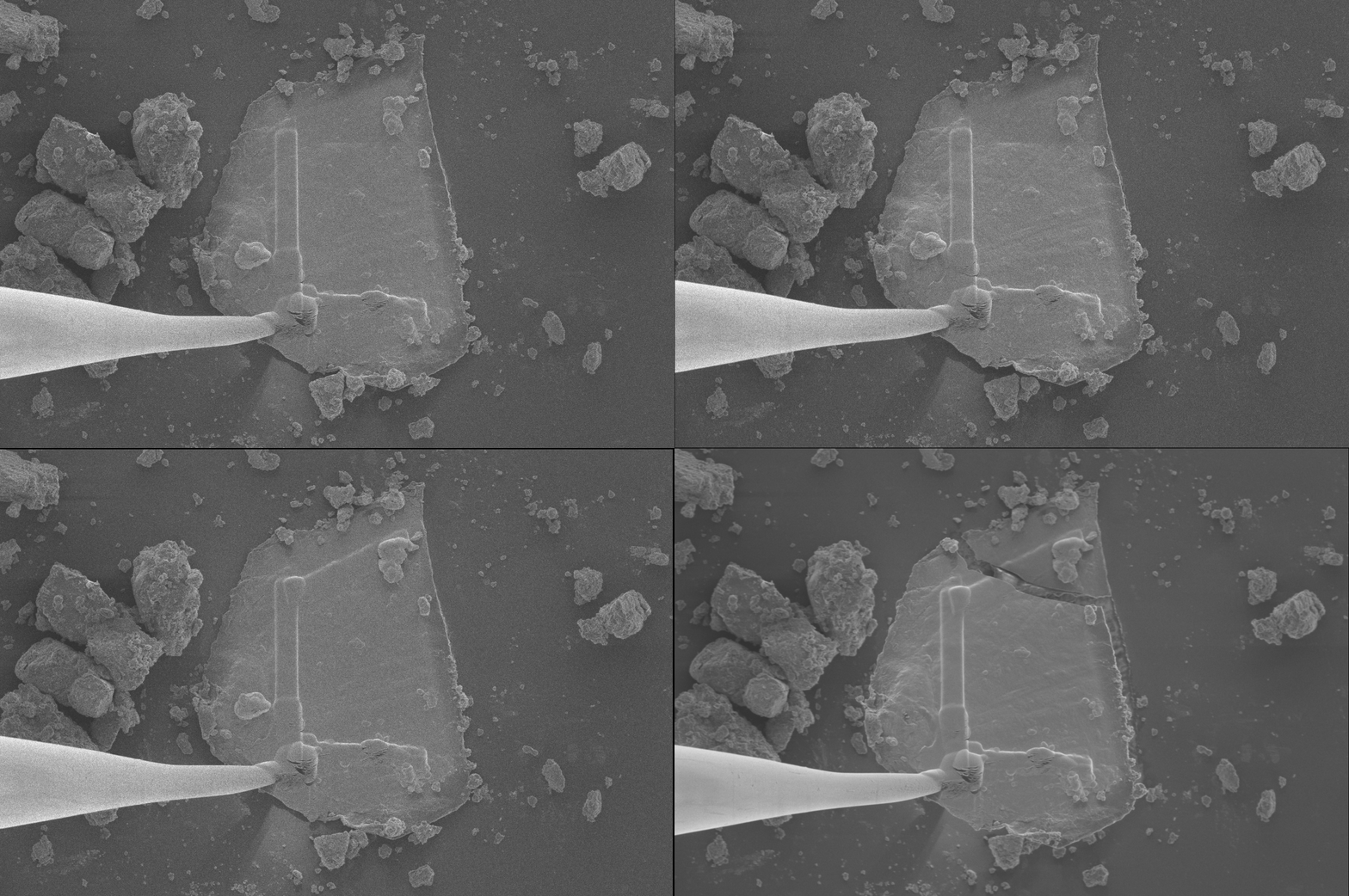
A microscopic particle of asteroid Bennu, brought to Earth by NASA’s OSIRIS-REx mission, is manipulated under a transmission electron microscope. In order to move the fragment for further analysis, researchers first reinforced it with thin strips of platinum (the “L” shape on the particle’s surface) then welded a tungsten microneedle to it. The asteroid fragment measures 30 micrometers (about one-one thousandth of an inch) across.
NASA
Researchers at NASA Ames discovered a never-before-seen “gum-like” material in pristine asteroid samples delivered to Earth by NASA’s OSIRIS-REx (Origins, Spectral Interpretation, Resource Identification, and Security-Regolith Explorer) spacecraft. The surprising substance was likely formed in the early days of the solar system, as Bennu’s young parent asteroid warmed. Such complex molecules could have provided some of the chemical precursors that helped trigger life on Earth, and finding them in the pristine samples from Bennu is important for scientists studying how life began and whether it exists beyond our planet.
This artist’s concept shows Blue Origin’s Blue Moon Mark 1 lander and NASA’s VIPER (Volatiles Investigating Polar Exploration Rover) on the lunar surface.
Credit: Courtesy of Blue Origin
NASA’s VIPER (Volatiles Investigating Polar Exploration Rover) will search for volatile resources, such as ice, on the lunar surface and collect science data to support future exploration at the Moon and Mars. As part of the agency’s Artemis campaign, NASA awarded Blue Origin of Kent, Washington, a Commercial Lunar Payload Services task order with an option to deliver a rover to the Moon’s South Pole region. With this new award, Blue Origin will deliver VIPER to the lunar surface in late 2027.
Taking to the Skies to Test Remote Wildfire Response
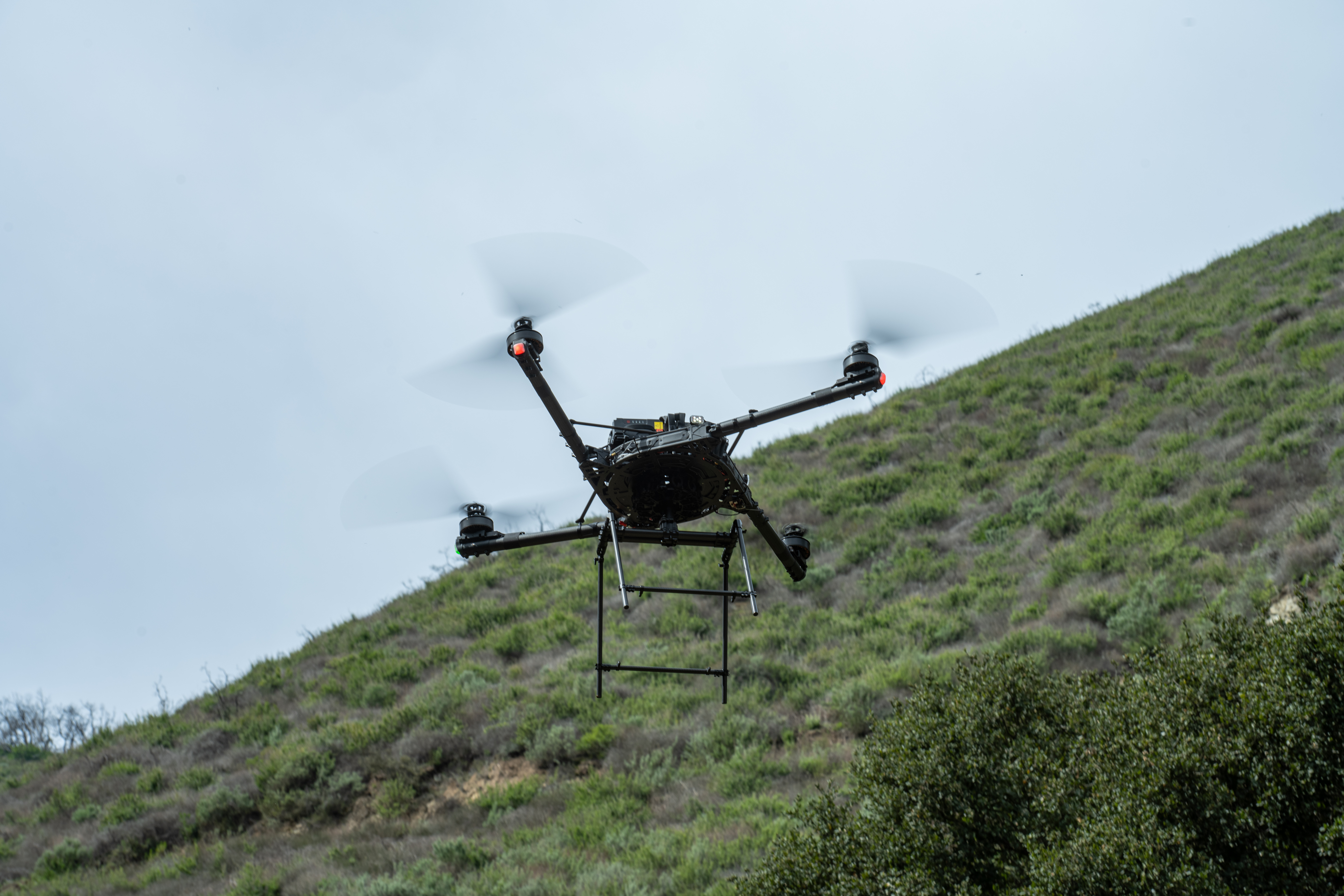
NASA Ames drone team tests the information sharing, airspace management, communication relay, and aircraft deconfliction capabilities of the x-altas drone as it communicates through the Advanced Capabilities for Emergency Response Operations (ACERO) Portable Airspace Management System (PAMS) in Salinas, California in March 2025. This was a part of the project’s first flight demonstration.
NASA/Brandon Torres Navarrete
NASA researchers are advancing airborne systems that can fight and monitor wildfires 24 hours a day, even during low-visibility conditions. NASA’s Advanced Capabilities for Emergency Response Operations (ACERO) conducted field tests of remotely piloted aircraft for monitoring, suppression, and logistics support in wildland fire situations. The ACERO team was able to safely conduct flight operations of a vertical takeoff and landing aircraft operated by Overwatch Aero, LLC, of Solvang, California, and two small NASA drones.
NASA Installs Heat Shield on First Private Spacecraft Bound for Venus
Engineers at NASA’s Ames Research Center in California’s Silicon Valley, Eli Hiss, left, and Bohdan Wesely complete a fit check of the two halves of a space capsule that will study the clouds of Venus for signs of life. Led by Rocket Lab of Long Beach, California, it will be the first private mission to the planet.
NASA/Brandon Torres Navarrete
NASA helps the commercial space endeavor succeed by providing expertise in thermal protection of small spacecraft. NASA Ames teams work with private companies to turn NASA materials into solutions, such as the heat shield tailor-made for a spacecraft destined for Venus, supporting growth of the new space economy. Invented at NASA Ames, NASA’s Heatshield for Extreme Entry Environment Technology covers the bottom of the space capsule that will study the clouds of Venus for signs of life during the first private mission to the planet. This mission is led by Rocket Lab of Long Beach, California, and their partners at the Massachusetts Institute of Technology in Cambridge.
Artemis Astronauts & Orion Leadership Visit NASA Ames
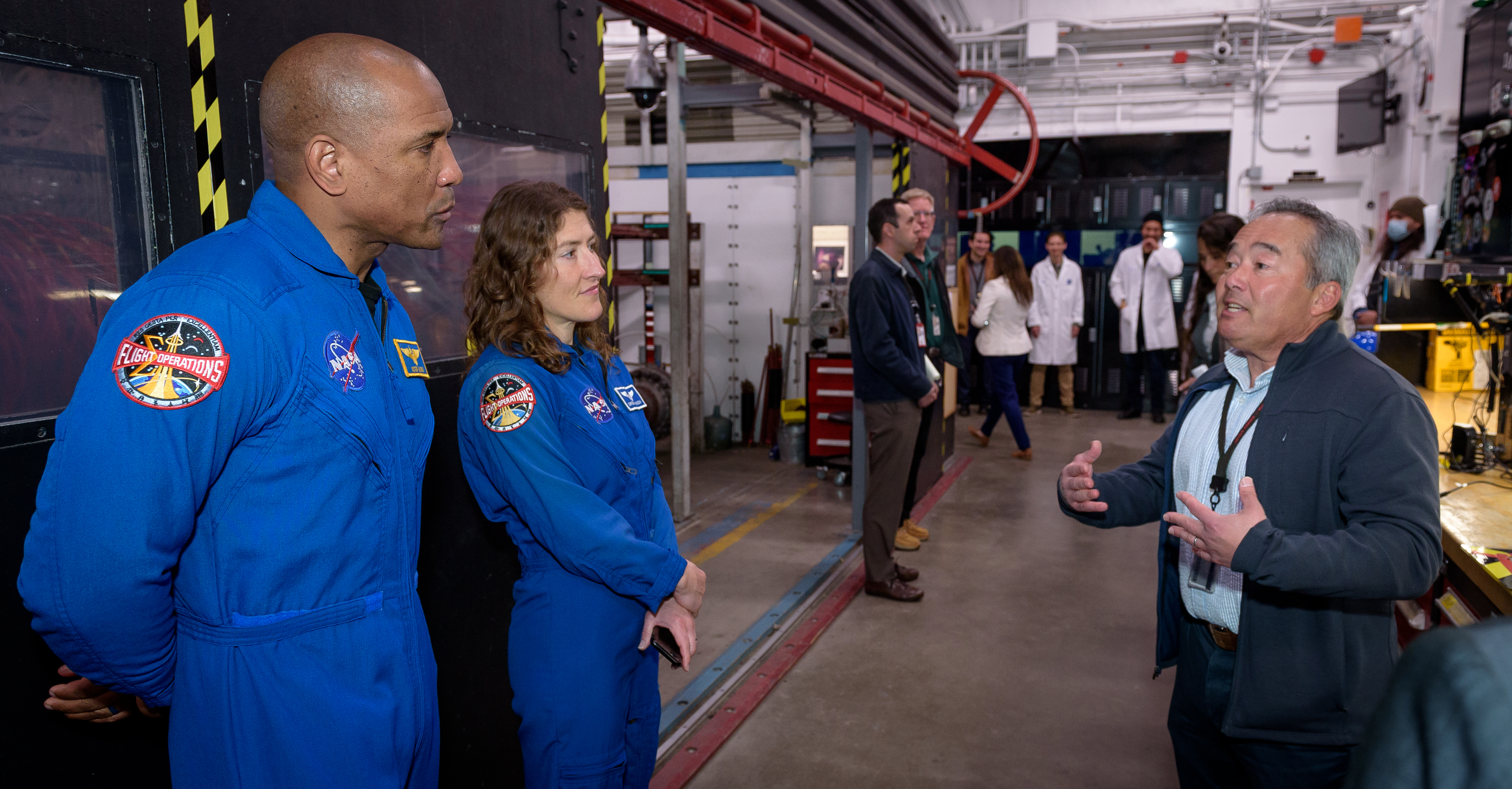
Astronauts Victor Glover and Christina Koch tour the Arc Jet Facility at NASA’s Ames Research Center, learning more about the testing equipment’s capabilities to analyze thermal protection systems from George Raiche, thermophysics facilities branch chief at Ames.
NASA/Donald Richey
Artemis II astronauts Christina Koch and Victor Glover, along with Orion leaders Debbie Korth, deputy program manager, and Luis Saucedo, deputy crew and service module manager, visited NASA Ames facilities that support the Orion program to celebrate the achievements of employees. Ames facilities were used to develop and test Orion’s thermal protection system and analyze the Artemis I heat shield after its successful return to Earth.
Curiosity Mars Rover Uncovers Subsurface Clues to the Planet’s Evolution
NASA’s Curiosity Mars rover sees its tracks receding into the distance at a site nicknamed “Ubajara” on April 30, 2023. This site is where Curiosity made the discovery of siderite, a mineral that may help explain the fate of the planet’s thicker ancient atmosphere.
NASA/JPL-Caltech/MSSS
NASA’s Curiosity Mars rover helped shed new light on what happened to the planet’s ancient atmosphere. Researchers have long believed that Mars once had a thick, carbon dioxide-rich atmosphere and liquid water on the planet’s surface. That carbon dioxide and water should have reacted with Martian rocks to create carbonate minerals, but previous investigations haven’t found expected amounts of carbonate on the planet’s surface. Curiosity used onboard instruments to study powdered Martian rock samples from the subsurface of the planet, finding the presence of siderite, an iron carbonate mineral, within the sulfate-rich rocky layers of Mount Sharp in Mars’ Gale Crater.
Managing Satellite Traffic in Orbit
The Starling swarm’s extended mission tested advanced autonomous maneuvering capabilities.
NASA/Daniel Rutter
Managed at NASA Ames, the Starling mission, in collaboration with SpaceX’s Starlink constellation, successfully demonstrated autonomous coordination between spacecraft to improve space traffic management in low Earth orbit. The extended mission, called Starling 1.5, tested how satellite swarms can share maneuver responsibilities and respond more quickly to avoid collisions without relying on time-consuming ground-based communication. This approach aims to streamline space traffic coordination as orbital congestion increases, enabling faster, safer, and more efficient satellite operations.
Proven True: A Companion Star to Betelgeuse
An image of Betelgeuse, the yellow-red star, and the signature of its close companion, the faint blue object.
Data: NASA/JPL/NOIRlab. Visualization: NOIRLAB.
Researchers validated a century-old hypothesis that there’s an orbiting companion star to Betelgeuse, the 10th brightest star in our night sky. Steve Howell, a senior research scientist at Ames, used both the ground-based Gemini North telescope in Hawai’i and a special, high-resolution camera built by NASA to directly observe the close companion to Betelgeuse. This discovery may explain why other similar red supergiant stars undergo periodic changes in their brightness on the scale of many years.
Space-Fermented Foods Make Vital Nutrients

NASA astronaut and Expedition 72 Commander Suni Williams displays a set of BioNutrients production packs during an experiment aboard the International Space Station. The experiment uses engineered yeast to produce nutrients and vitamins to support future astronaut health.
NASA
NASA’s BioNutrients experiments are helping us better understand the shelf stability of nutrients essential to support astronaut health during future long-duration deep space exploration, such as missions to the Moon and Mars. The project uses microorganisms to make familiar fermented foods, such as yogurt, and includes specific types and amounts of nutrients that crew will be able to consume in the future. The first experiment tested the performance of a biomanufacturing system for almost six years aboard the International Space Station. The latest experiment launched to the station in August.
Enabling Satellite Swarms for Future Astronauts
Caleb Adams, Distributed Spacecraft Autonomy project manager, monitors testing alongside the test racks containing 100 spacecraft computers at NASA’s Ames Research Center in California’s Silicon Valley. The DSA project develops and demonstrates software to enhance multi-spacecraft mission adaptability, efficiently allocate tasks between spacecraft using ad-hoc networking, and enable human-swarm commanding of distributed space missions.
NASA/Brandon Torres Navarrete
NASA Ames’ Distributed Spacecraft Autonomy (DSA) project tested software that enables swarms of satellites to make decisions and adapt to changing conditions with minimal human intervention. By distributing decision-making autonomy across multiple spacecraft, the system allows satellites to coordinate tasks, optimize scientific observations, and respond to challenges in real time while freeing human explorers to focus on critical tasks. The technology was first demonstrated in space aboard the Starling mission, showcasing how autonomous swarms can enhance mission efficiency and resilience.
Exploring Remotely Piloted Aircraft in U.S. Airspace
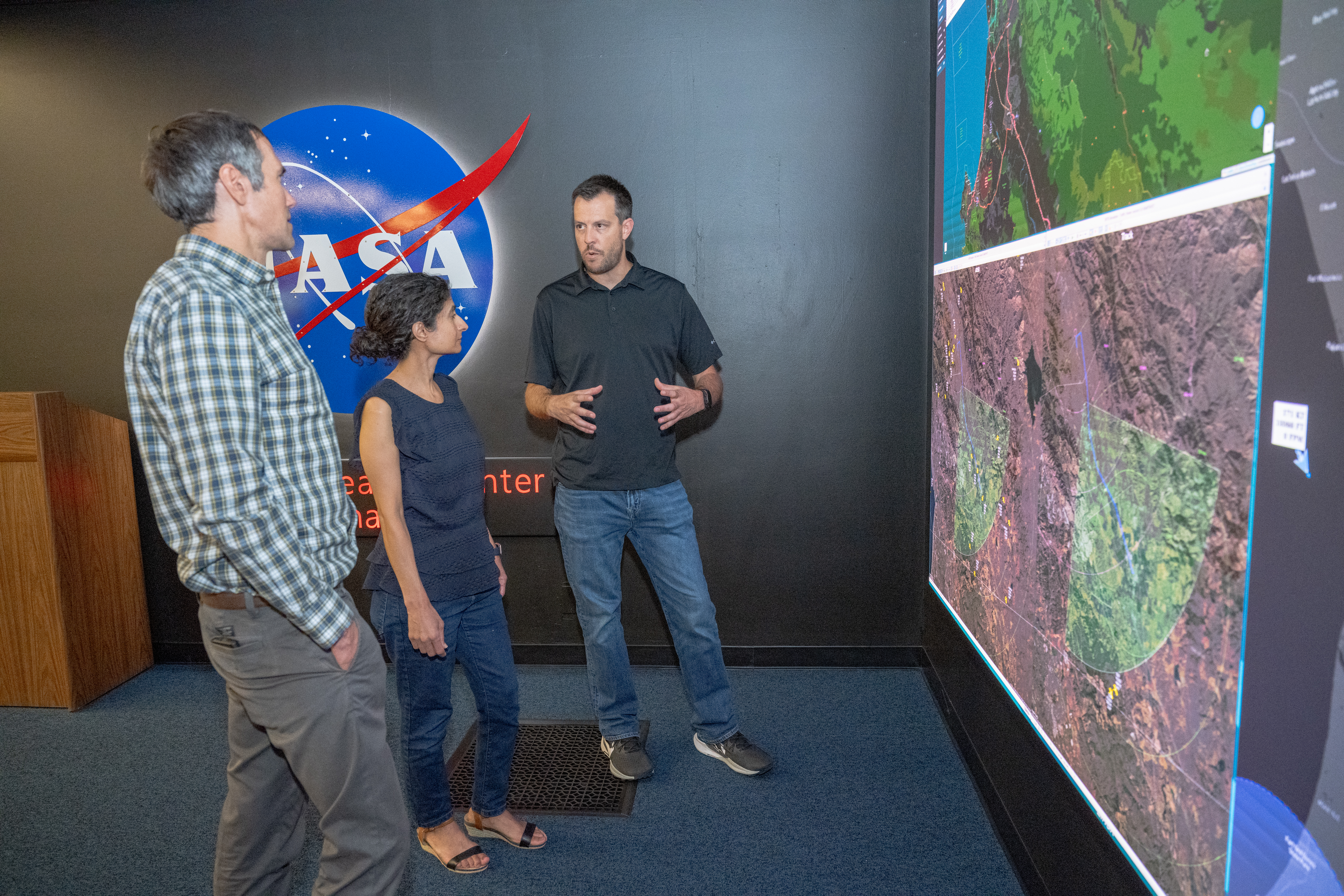
NASA researchers Matt Gregory, right, Arwa Awiess, center, and Andrew Guion discuss live flight data being ingested at the Mission Visualization and Research Control Center (MVRCC) at NASA’s Ames Research Center on Aug. 21, 2025.
NASA/Brandon Torres Navarrete
NASA Ames partnered to ensure that remotely piloted aircraft can take to the skies safely without overburdening air traffic controllers. NASA’s Air Traffic Management eXploration Project (ATM-X) supported Wisk Aero in a flight test designed to evaluate a ground-based radar developed by Collins Aerospace, which could be used during future remotely piloted operations to detect and avoid other aircraft.
Pushing the Boundaries of Autonomous Cargo Drones
Christopher Bryant shows the simulated vehicle as part of the Federal Uncrewed Aircraft System Service Supplier Synthesis Effort (FUSE) live flight simulation in the Verification and Validation (V&V) lab in N210.
NASA/Donald Richey
NASA partnered with the Department of War in a live flight demonstration showcasing how drones can successfully fly without their operators being able to see them, a concept known as beyond visual line of sight. Cargo drones successfully carried payloads more than 75 miles across North Dakota in tests designed to demonstrate that the aircraft could operate safely even in complex, shared airspace.
Advancing Mixed Reality for Pilot Training
Damian Hischier of the National Test Pilot School in Mojave, California, takes part in testing of a virtual reality-infused pilot simulation in the Vertical Motion Simulator (VMS) at NASA’s Ames Research Center in California’s Silicon Valley on May 30, 2025.
NASA/Brandon Torres Navarrete
A NASA research project is accelerating alternatives to conventional flight simulator training, using mixed reality systems that combines physical simulators with virtual reality headsets to train pilots. The agency invited a dozen pilots to NASA Ames to participate in a study to test how a mixed-reality flight simulation would perform in the world’s largest flight simulator for the first time. The technology could reduce costs and allow for a smaller footprint while training pilots on next-generation aircraft.
Flies and Fly Food for Space Station DNA Studies
The Vented Fly Box holds and safely transports vials containing flies and fly food. It includes environmental sensors that monitor temperature and relative humidity.
NASA/Dominic Hart
New technology for housing and supporting fruit flies is enabling new research on the effects of space travel on the human body. Through a Space Act Agreement between NASA and Axiom Space, the Vented Fly Box contained fruit flies (Drosophila melanogaster) launched aboard a SpaceX Dragon spacecraft from NASA’s Kennedy Space Center in Florida. Because humans and fruit flies share a lot of similar genetic code, they squeeze a lot of scientific value into a conveniently small, light package.
Studying Antibiotic-Resistant Bacteria in Space
Astronaut Jeanette Epps extracts DNA samples from bacteria colonies for genomic analysis aboard the International Space Station’s Harmony module.
NASA
New studies aboard the International Space Station are advancing the detection of antibiotic-resistant bacteria, thus improving the health safety not only of astronauts but patients back on Earth. Future astronauts visiting the Moon or Mars will need to rely on a pre-determined supply of antibiotics in case of illness, and ensuring those antibiotics remain effective is an important safety measure for future missions. Infections caused by antibiotic-resistant bacteria can be difficult or impossible to treat, making antibiotic resistance a leading cause of death worldwide and a global health concern.
Happy Third Anniversary to BioSentinel Deep Space Mission!
NASA’s BioSentinel – a shoebox-sized CubeSat – is travelling far from Earth. But that also means it’s closer than ever to being the first long-duration biology experiment in deep space.
NASA/Daniel Rutter
The BioSentinel mission, currently orbiting the Sun more than 48 million miles from Earth, celebrated three years in deep space after launching aboard NASA’s Artemis I in 2022. BioSentinel, managed at NASA Ames, continues to collect valuable information for scientists trying to understand how solar radiation storms move through space and where their effects – and potential impacts on life beyond Earth – are most intense.
Astrobee Partners to Advance Space Robotics
NASA astronaut Anne McClain poses with Astrobee robots Bumble (left) and Honey during their latest in orbit activity in May, 2025
NASA
NASA is working with Arkisys, Inc., of Los Alamitos, California, to sustain the Astrobee robotic platform aboard the International Space Station. NASA launched the Astrobee mission to the space station in 2018. Since then, the free-flying robots have marked multiple first-in-space milestones for robots working alongside astronauts. As the agency returns astronauts to the Moon, robotic helpers like Astrobee could one day take over routine maintenance tasks and support future spacecraft at the Moon and Mars without relying on humans for continuous operation.
A team of engineers at The Aerospace Corporation’s facility in El Segundo, California, gather around two completed DiskSats as they conduct final checks before shipment. From left: Albert Lin, DiskSat system engineer, Elijah Balcita, intern, Darren Rowen, DiskSat chief engineer, Catherine Venturini, DiskSat principal investigator, and Eric Breckheimer, NASA program office program manager at The Aerospace Corporation; Roger Hunter, Small Spacecraft & Distributed Systems program manager at NASA; and Ziba Shahriary, DiskSat program manager at The Aerospace Corporation.
The Aerospace Corporation
NASA’s DiskSat technology demonstration mission will test the performance of a new small spacecraft platform designed to expand the capabilities of current small spacecraft. By demonstrating the advantages of a flat, disk-shaped architecture over the conventional CubeSat design, DiskSat aims to enable lower-cost space missions, broaden scientific opportunities, and increase overall access to space.
At 12:03 a.m. EST on Thursday, Dec. 18, DiskSat launched aboard a Rocket Lab Electron rocket from the company’s Launch Complex 2 on Wallops Island, Virginia.
The demonstration will evaluate the performance of the DiskSat spacecraft themselves and a specialized dispenser mechanism. The dispenser is engineered to securely contain four DiskSat spacecraft during launch, then sequentially deploy them into low Earth orbit where they will perform maneuvers. Each DiskSat is a circular, flat spacecraft 40 inches (one meter) in diameter and one inch (two-and-a-half centimeters) thick – similar to a small coffee table. Each has an electric propulsion system to allow for orbit changes and maintenance. The DiskSat design is also conducive to operations in very low Earth orbit, which can offer sharper Earth imaging and sensing capabilities as well as lower latency communications solutions.
DiskSat boosts U.S. innovation and commercial space opportunities while providing mission designers new flexibility, enabling them to pursue and achieve NASA’s goals faster and more affordably. DiskSats offer an alternative platform that could significantly expand the scope of future small spacecraft missions for NASA, the commercial space industry, other government agencies, and academia. The DiskSat demonstration also supports NASA’s long-term plans for sustained exploration at the Moon and Mars as well as advancing our ability to study and better understand our home planet.
An Electron Rocket launches from Wallops Island, Virginia, Dec. 18; 2025, at 12:03 a.m. EST from Rocket Lab’s Launch Complex 2. The rocket carried NASA’s DiskSat technology demonstration mission, which will test the performance of a new small spacecraft platform designed to expand the capabilities of current small spacecraft.
NASA/Garon Clark
The Aerospace Corporation, headquartered in Chantilly, Virginia, is leading the design and development of the DiskSat concept as well as the DiskSat spacecraft. NASA’s Small Spacecraft & Distributed Systems program within the agency’s Space Technology Mission Directorate funded the development of the DiskSat technology and demonstration mission. The program is based at NASA’s Ames Research Center in California’s Silicon Valley. The DiskSat launch and in-orbit operations are funded by the U.S. Space Force’s Rocket Systems Launch Program (RSLP) and Department of War Space Test Program (STP), respectively. Rocket Lab USA, Inc., of Long Beach, California is providing launch services. NASA’s Wallops Flight Facility, the agency’s only owned and operated launch range, enabled the mission providing services such as tracking, telemetry, and range safety to ensure a safe and successful mission.
Members of the news media interested in covering this topic should reach out to the NASA Ames newsroom.
NASA eClips STEM Student Ambassadors Shine at STEM Exploration Community Event
STEM Student Ambassadors engage the community in learning about auroras.
The 5th Annual Science, Technology, Engineering, & Mathematics (STEM) Exploration Community Event hosted by the Coastal Virginia STEM Hub and the NASA eClips Education Team from the National Institute of Aerospace Center for Integrative STEM Education (NIA-CISE) lit up the Professional Workforce Development Center at Virginia Peninsula Community College on Saturday, November 8, 2025. The hard work of 12 NASA eClips STEM Student Ambassadors brought extraordinary energy, expertise, and heart to the more than 1,000 attendees on National STEM Day.
The STEM Student Ambassador Program was initiated to help grow the STEM ecosystem in coastal Virginia by extending the reach of the NASA eClips Education Team. The Ambassadors are high school students selected through a highly competitive regional recruiting process who undergo a rigorous training with the NASA eClips Education Team and NASA Science Communication interns.
“NASA eClips STEM Student Ambassadors enjoyed inspiring community members by sharing their knowledge about the Sun.”
Betsy McAllister
Educator in Residence National Institute of Aerospace – Center for Integrative STEM Education
At the STEM Exploration Community Event, the NASA eClips exhibit quickly became a hub of excitement as the Ambassadors used art as a launchpad to explore heliophysics concepts, guiding visitors from preK-adult in creating chalk coronas and pastel auroras. The enthusiasm was contagious: children leaned in, families asked questions, and even adults rediscovered a sense of wonder as the Ambassadors connected hands-on creativity to the science of the Sun. The Ambassadors shared their personal STEM journeys, encouraged younger learners to pursue curiosity, and modeled what it looks like to be confident, informed science communicators.
The Ambassadors worked behind the scenes to support event logistics, networked with STEM leaders, and even represented the high-school perspective on a STEM panel. Ambassador Layla Criner offered practical advice on how students can get involved, and stay involved, in STEM. The powerful impact of the Ambassadors underscored why this NASA eClips program matters: it empowers students not only to communicate NASA science, but to lead it.
NASA eClips, led by the NIA-CISE, is supported by NASA under cooperative agreement award number NNX16AB91A and is part of NASA’s Science Activation Portfolio. The mission of NASA eClips is to engage and inspire students in STEM through the lens of NASA by delivering standards-aligned, web-based resources that support learning both in and out of the classroom. The STEM Student Ambassador Program is funded by a grant from the Virginia Coastal STEM Hub through the Virginia General Assembly. Learn more about how Science Activation connects NASA science experts, real content, and experiences with community leaders to do science in ways that activate minds and promote deeper understanding of our world and beyond: https://science.nasa.gov/learn/about-science-activation/
NASA’s Fermi Spots Young Star Cluster Blowing Gamma-Ray Bubbles
For the first time, astronomers using NASA’s Fermi Gamma-ray Space Telescope have traced a budding outflow of gas from a cluster of young stars in our galaxy — insights that help us understand how the universe has evolved as NASA explores the secrets of the cosmos for the benefit of all.
The cluster, called Westerlund 1, is located about 12,000 light-years away in the southern constellation Ara. It’s the closest, most massive, and most luminous super star cluster in the Milky Way. The only reason Westerlund 1 isn’t visible to the unaided eye is because it’s surrounded by thick clouds of dust. Its outflow extends below the plane of the galaxy and is filled with high-speed, hard-to-study particles called cosmic rays.
“Understanding cosmic ray outflows is crucial to better comprehending the long-term evolution of the Milky Way,” said Marianne Lemoine-Goumard, an astrophysicist at the University of Bordeaux in France. “We think these particles carry a large amount of the energy released within clusters. They could help drive galactic winds, regulate star formation, and distribute chemical elements within the galaxy.”
A paper detailing the results published Dec. 9 in Nature Communications. Lemoine-Goumard led the research with Lucia Härer and Lars Mohrmann, both at the Max Planck Institute for Nuclear Physics in Heidelberg, Germany.
This image of super star cluster Westerlund 1 was captured with the Near-InfraRed Camera on NASA’s James Webb’s Space Telescope. The cluster is largely hidden at visible wavelengths by dust clouds, which infrared light penetrates. Westerlund 1’s large, dense, and diverse stellar population of massive stars has no other known counterpart in the Milky Way.
ESA/Webb, NASA & CSA, M. Zamani (ESA/Webb), M. G. Guarcello (INAF-OAPA) and the EWOCS team
Super star clusters like Westerlund 1 contain more than 10,000 times our Sun’s mass. They are also more luminous and contain higher numbers of rare, massive stars than other clusters.
Scientists think that supernova explosions and stellar winds within star clusters push ambient gas outward, propelling cosmic rays to near light speed. About 90% of these particles are hydrogen nuclei, or protons, and the remainder are electrons and the nuclei of heavier elements.
Because cosmic ray particles are electrically charged, they change course when they encounter magnetic fields. This means scientists can’t trace them back to their sources. Gamma rays, however, travel in a straight line. Gamma rays are the highest-energy form of light, and cosmic rays produce gamma rays when they interact with matter in their environment.
Most gamma-ray observations of stellar clusters have limited resolution, so astronomers effectively see them as indistinct areas of emission. Because Westerlund 1 is so close and bright, however, it’s easier to study.
Westerlund 1 is located closer to the center of the Milky Way than our Sun, as shown in this artist’s concept. Westerlund 1 is one of only a few known super star clusters in our galaxy and is the closest, brightest, and most massive one discovered so far.
NASA’s Goddard Space Flight Center/Conceptual Image Lab
This artist’s concept shows the location of Westerlund 1 relative to our Sun as seen from the underside of our Milky Way galaxy. The magenta bubble illustrates what the nascent outflow might look like in gamma rays. Westerlund 1 is located slightly below the middle of the galactic disk, so stellar activity pushes gas preferentially along a path of lower density beneath the disk.
NASA’s Goddard Space Flight Center/Conceptual Image Lab
In 2022, scientists using a group of telescopes in Namibia operated by the Max Planck Institute called the High Energy Spectroscopic System detected a distinct ring of gamma rays around Westerlund 1 with energies trillions of times higher than visible light.
Lemoine-Goumard, Härer, and Mohrmann wondered if the cluster’s unique properties might allow them to see other details by looking back through nearly two decades of Fermi data at slightly lower energies — millions to billions of times the energy of visible light.
Fermi’s sensitivity and resolution allowed the researchers to filter out other gamma-ray sources like rapidly spinning stellar remnants called pulsars, background radiation, and Westerlund 1 itself.
What was left was a bubble of gamma rays extending over 650 light-years from the cluster below the plane of the Milky Way. That means the outflow is about 200 times larger than Westerlund 1 itself.
Data from NASA’s Fermi Gamma-ray Space Telescope reveal the budding gas bubble of star cluster Westerlund 1. Brighter colors indicate a stronger likelihood that gamma rays arise from specific types of point sources, notably two pulsars located at center and in the brightest portion of the image. Pink contours denote steep changes in likelihood. An underlying orange-magenta feature extends down the image, starting from the cluster’s location, and represents the nascent outflow. The grey lines indicate distance below the galactic plane. The bubble is over 650 light-years long and angles slightly away from us. Westerlund 1’s stellar activity more easily pushes gas outward into lower-density regions of the galaxy’s disk.
NASA’s Goddard Space Flight Center/Lemoine-Goumard et al. 2025; ESA/Webb, NASA & CSA, M. Zamani (ESA/Webb), M. G. Guarcello (INAF-OAPA) and the EWOCS team
The researchers call this a nascent, or early stage, outflow because it was likely recently produced by massive young stars within the cluster and hasn’t yet had time to break out of the galactic disk. Eventually it will stream into the galactic halo, the hot gas surrounding the Milky Way.
Westerlund 1 is located slightly below the galactic plane, so the researchers think the gas expanded asymmetrically, following the path of least resistance into a zone of lower density below the disk.
“One of the next steps is to model how the cosmic rays travel across this distance and how they create a changing gamma-ray energy spectrum,” Härer said. “We’d also like to look for similar features in other star clusters. We got very lucky with Westerlund 1, though, since it’s so massive, bright, and close. But now we know what to look for, and we might find something even more surprising.”
“Since it started operations 17 years ago, Fermi has continued to advance our understanding of the universe around us,” said Elizabeth Hays, Fermi’s project scientist at NASA’s Goddard Space Flight Center in Greenbelt, Maryland. “From activity in distant galaxies to lightning storms in our own atmosphere, the gamma-ray sky continues to astound us.”
STS110-E-5541 (13 April 2002) — Astronaut Lee M.E. Morin carries an affixed 35mm camera to record work which is being performed 240 miles above Earth on the International Space Station (ISS).
NASA astronaut and retired United States Navy Capt. Lee Morin has retired from the agency after 30 years of service. He served as a mission specialist on STS-110 and went on to oversee the Rapid Prototyping Laboratory and technology development for the International Space Station and NASA’s Commercial Crew Program, as well as its Artemis campaign.
“Lee’s contributions throughout his career are immense and immeasurable,” said Vanessa Wyche, director of NASA’s Johnson Space Center in Houston. “His expertise and enthusiasm followed him whether he was working with the agency’s most seasoned engineers, or an intern just starting out. We’ll feel the impact of his innovations for decades to come, and I cannot thank him enough for his service.”
The New Hampshire native and physician flew aboard space shuttle Atlantis in support of STS-110 in 2002. The mission delivered the cornerstone truss to the space station. It also marked the first time the station’s robotic arm was used to assist spacewalkers, and the first spacewalks conducted from the station’s Quest airlock. During the mission, Morin performed two spacewalks, spending a total of 14 hours and 9 minutes working outside the station. He accumulated 10 days and 19 hours in space.
“Lee’s footprint on human spaceflight can be felt by every astronaut in our corps,” said Chief Astronaut Scott Tingle. “He set the new standard for the way spacecraft cockpits are designed and built, resulting in more efficient astronaut training and safer spaceflight overall. I have long admired his drive to always try something new. I’m proud to call him my lifelong friend and wish him nothing but the best.”
After his spaceflight, Morin used his experience to improve how astronauts interact with spacecraft systems. He helped design the software displays used during missions aboard the space station and Orion spacecraft. As lead astronaut on a team that created a standardized graphical interface for space station crews, Morin ensured early missions had clear, consistent displays and procedures. His work bridged the gap between engineering and usability, earning recognition from the U.S. Patent and Trademark Office for innovations that continue to make spaceflight safer and more efficient.
“Working with the brilliant teams here at NASA has been the honor of a lifetime,” Morin said. “Throughout my career I’ve had the honor of seeing some of the greatest achievements in human spaceflight, and I couldn’t have done it without the support of the countless mentors, collaborators, and friends I’ve met along the way. While I’m departing the agency, I will remain an avid follower to see where human spaceflight goes next, and I am humbled and proud to say that I got to be a part of where it all began.”
Morin was selected as an astronaut in 1996. He holds multiple degrees, including master’s degrees in biochemistry, public health, and physics. He earned his medical degree from New York University. Before he came to NASA, he served as a Naval flight surgeon, diving medical officer, and held key roles in aerospace medicine.
Learn more about how NASA explores the unknown and innovates for the benefit of humanity at:
This image from NASA’s Mars Perseverance rover shows a potential megablock on the Jezero crater rim, taken by the Mastcam-Z instrument’s “right eye.” Mastcam-Z is a pair of cameras located high on the rover’s mast. Perseverance acquired this image looking east across the rim heading towards “Lac de Charmes” on Dec. 7, 2025 — Sol 1706, or Martian day 1,706 of the Mars 2020 mission — at the local mean solar time of 13:38:46.
NASA/JPL-Caltech/ASU
Written by Margaret Deahn, Ph.D. student at Purdue University
NASA’s Mars 2020 rover is currently trekking towards exciting new terrain. After roughly four months of climbing up and over the rim of Jezero crater, the rover is taking a charming tour of the plains just beyond the western crater rim, fittingly named “Lac de Charmes.” This area just beyond Jezero’s rim will be the prime place to search for pre-Jezero ancient bedrock and Jezero impactites — rocks produced or affected by the impact event that created Jezero crater.
The formation of a complex crater like Jezero is, well… complex. Scientists who study impact craters like to split the formation process into three stages: contact & compression (when the impactor hits), excavation (when materials are thrown out of the crater), and modification (when gravity causes everything to collapse). This process happens incredibly fast, fracturing the impacted rock and even melting some of the target material. Sometimes on Earth, the classic “bowl” shaped crater has been completely weathered and unrecognizable, so geologists are able to identify craters by the remnants of their impactites. Just when you thought it couldn’t get any more complicated — Jezero crater’s rim is located on the rim of another, even bigger basin called Isidis. That means there is an opportunity to have impactites from both cratering events exposed in and just around the rim — some of which could be several billions of years old! We may have already encountered one of these blocks on our trek towards Lac de Charmes. In the foreground of this image taken by the Mastcam-Z instrument on the rover, there is a potential impactite called a “megablock” that the team has named “Hyha.” We can actually see this block from orbit, it is that large! The team is excited to continue exploring these ancient rocks as we take our next steps off Jezero’s rim.
Want to read more posts from the Perseverance team?

 Login
Login