NASA has selected ARES Technical Services Corporation of McLean, Virginia, to provide launch range operations support at the agency’s Wallops Flight Facility in Virginia.
The Wallops Range Contract has a total potential value of $339.8 million with a one-year base period expected to begin Tuesday, Feb. 10, and four one-year option periods that if exercised would extend it to 2031. The contract includes a cost-plus-fixed-fee core with an indefinite-delivery/indefinite-quantity component and the ability to issue cost-plus-fixed-fee or firm-fixed-price task orders.
The scope of the work includes launch range operations support such as radar, telemetry, logistics, tracking, and communications services for flight vehicles including orbital and suborbital rockets, aircraft, satellites, balloons, and unmanned aerial systems. Additional responsibilities include information and computer systems services; testing, modifying, and installing communications and electronic systems at launch facilities, launch control centers, and test facilities; and range technology sustainment engineering services.
Work will primarily occur at NASA Wallops with additional support at sites such as the agency’s Bermuda Tracking Station, Poker Flat Research Range in Alaska, and other temporary duty locations.
For information about NASA and agency programs, visit:
A team of engineers at The Aerospace Corporation’s facility in El Segundo, California, gather around two completed DiskSats as they conduct final checks before shipment. From left: Albert Lin, DiskSat system engineer, Elijah Balcita, intern, Darren Rowen, DiskSat chief engineer, Catherine Venturini, DiskSat principal investigator, and Eric Breckheimer, NASA program office program manager at The Aerospace Corporation; Roger Hunter, Small Spacecraft & Distributed Systems program manager at NASA; and Ziba Shahriary, DiskSat program manager at The Aerospace Corporation.
The Aerospace Corporation
NASA’s DiskSat technology demonstration mission will test the performance of a new small spacecraft platform designed to expand the capabilities of current small spacecraft. By demonstrating the advantages of a flat, disk-shaped architecture over the conventional CubeSat design, DiskSat aims to enable lower-cost space missions, broaden scientific opportunities, and increase overall access to space.
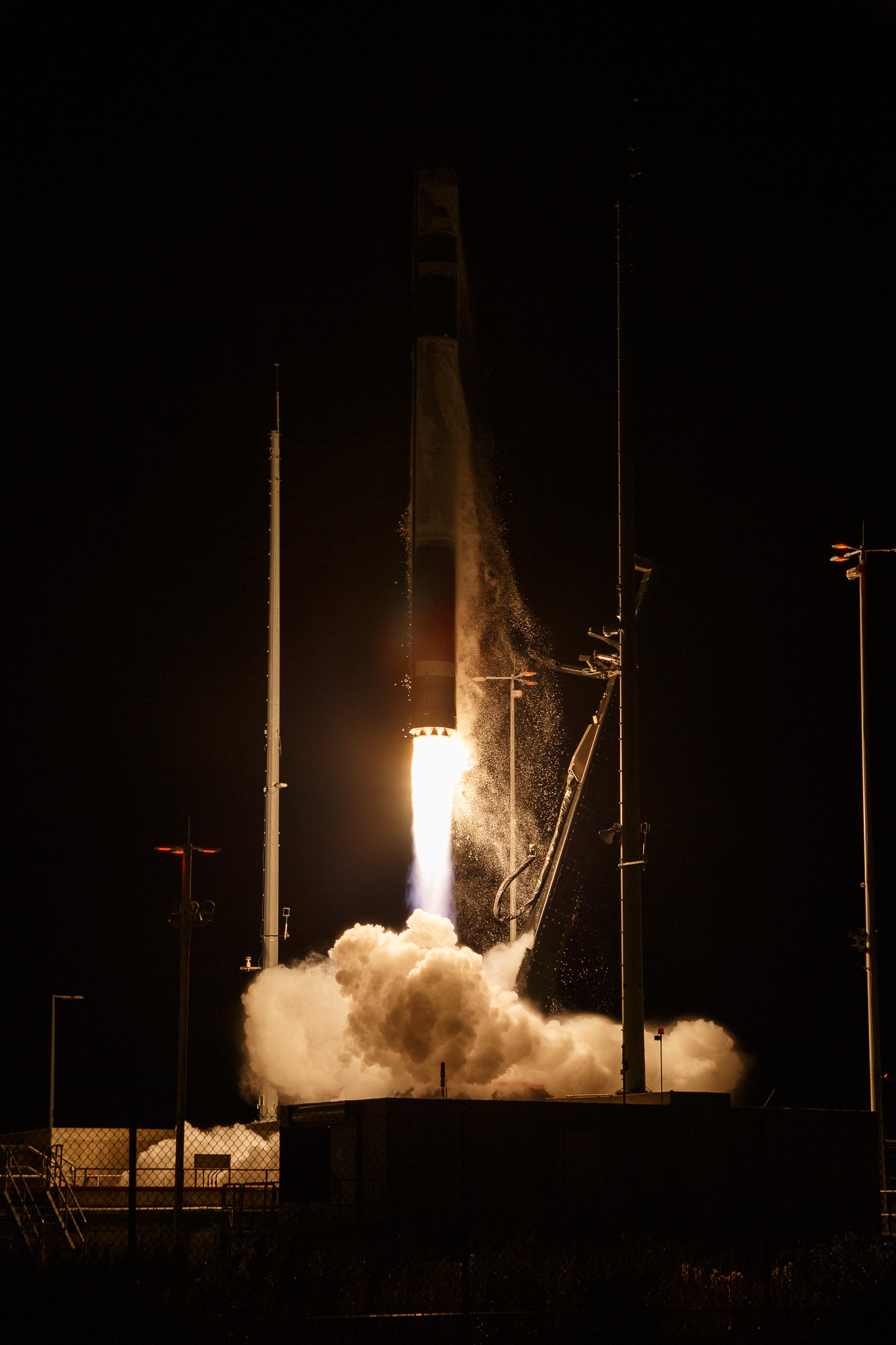
At 12:03 a.m. EST on Thursday, Dec. 18, DiskSat launched aboard a Rocket Lab Electron rocket from the company’s Launch Complex 2 on Wallops Island, Virginia.
The demonstration will evaluate the performance of the DiskSat spacecraft themselves and a specialized dispenser mechanism. The dispenser is engineered to securely contain four DiskSat spacecraft during launch, then sequentially deploy them into low Earth orbit where they will perform maneuvers. Each DiskSat is a circular, flat spacecraft 40 inches (one meter) in diameter and one inch (two-and-a-half centimeters) thick – similar to a small coffee table. Each has an electric propulsion system to allow for orbit changes and maintenance. The DiskSat design is also conducive to operations in very low Earth orbit, which can offer sharper Earth imaging and sensing capabilities as well as lower latency communications solutions.
DiskSat boosts U.S. innovation and commercial space opportunities while providing mission designers new flexibility, enabling them to pursue and achieve NASA’s goals faster and more affordably. DiskSats offer an alternative platform that could significantly expand the scope of future small spacecraft missions for NASA, the commercial space industry, other government agencies, and academia. The DiskSat demonstration also supports NASA’s long-term plans for sustained exploration at the Moon and Mars as well as advancing our ability to study and better understand our home planet.
An Electron Rocket launches from Wallops Island, Virginia, Dec. 18; 2025, at 12:03 a.m. EST from Rocket Lab’s Launch Complex 2. The rocket carried NASA’s DiskSat technology demonstration mission, which will test the performance of a new small spacecraft platform designed to expand the capabilities of current small spacecraft.
NASA/Garon Clark
The Aerospace Corporation, headquartered in Chantilly, Virginia, is leading the design and development of the DiskSat concept as well as the DiskSat spacecraft. NASA’s Small Spacecraft & Distributed Systems program within the agency’s Space Technology Mission Directorate funded the development of the DiskSat technology and demonstration mission. The program is based at NASA’s Ames Research Center in California’s Silicon Valley. The DiskSat launch and in-orbit operations are funded by the U.S. Space Force’s Rocket Systems Launch Program (RSLP) and Department of War Space Test Program (STP), respectively. Rocket Lab USA, Inc., of Long Beach, California is providing launch services. NASA’s Wallops Flight Facility, the agency’s only owned and operated launch range, enabled the mission providing services such as tracking, telemetry, and range safety to ensure a safe and successful mission.
Members of the news media interested in covering this topic should reach out to the NASA Ames newsroom.

 Login
Login