Normal view

There are new articles available, click to refresh the page.
Today — 25 January 2026Main stream

Hackers Impersonate X Staff Using Compromised Scroll Founder Account

25 January 2026 at 06:49

Scroll co-founder Ye Chen’s X account was hijacked in a sophisticated phishing operation where attackers posed as platform employees to target crypto industry figures.

The compromised account, which commands substantial influence among crypto leaders, began distributing fraudulent messages claiming copyright violations and threatening account restrictions unless users clicked on malicious links within 48 hours.

The hackers transformed Chen’s profile to mimic X’s official branding, updating the bio to reference Twitter and nCino while warning followers about security breaches.

Scroll Founder Account Hack - Changed Profile Info
Screenshot from X

The attackers flooded the feed with reposts from X’s verified accounts to enhance perceived legitimacy, then launched their phishing campaign via direct messages.

Sophisticated Attack Mirrors Growing Pattern

The breach follows established tactics where hackers exploit trusted accounts to distribute malicious links disguised as urgent platform notifications.

Recipients received messages appearing to come from X’s rights management team, complete with fake compliance warnings and time-sensitive appeals processes designed to create panic and bypass security awareness.

Blockchain security researcher Wu Blockchain first identified the compromise and alerted the community to ignore any communications from the account.

The warning emphasized particular concern given Chen’s extensive network of high-profile cryptocurrency executives, developers, and investors who might trust messages from his verified account.

Scroll co-founder @shenhaichen's X account has been hacked and is currently sending phishing private messages impersonating X employees. This account has a large following among prominent figures in the crypto industry; the community and users are advised to be aware of the… pic.twitter.com/ctXk2G0bQm

— Wu Blockchain (@WuBlockchain) January 25, 2026

The attack represents the latest escalation in social media compromises targeting crypto industry leaders, in which hackers increasingly leverage delegated account access and expired domain registrations to bypass security measures, including two-factor authentication.

Industry Faces Relentless Social Engineering Wave

BNB Chain’s official account suffered a similar breach in October when hackers posted fake reward programs with phishing links after Binance co-founder CZ warned followers against clicking suspicious content.

The compromised account promoted fraudulent BSC token distributions, promising early payouts to users who voted on reward dates through malicious URLs designed to drain digital wallets.

Binance co-CEO Yi He’s WeChat account was also hijacked in December to promote meme coin schemes, with attackers conducting a coordinated pump-and-dump operation around the token MUBARA.

Two wallets created hours before the breach accumulated 21.16 million tokens before dumping holdings as retail traders flooded in, netting attackers approximately $55,000 while leaving later buyers exposed to price collapse.

🚨Changpeng Zhao @cz_binance warned that new co-CEO Yi He’s @heyibinance abandoned WeChat account was hacked and used to push a meme coin called MUBARA.#Binance #Memecoins https://t.co/sdyH325OMD

— Cryptonews.com (@cryptonews) December 10, 2025

Among other notable accounts hacked were ZKsync and Matter Labs, which were compromised in May through what the team described as “delegated accounts” with limited posting privileges.

Hackers published false claims about an SEC investigation alongside fake airdrop promotions, triggering a 5% drop in the ZK token price despite a prior 38.5% weekly rally.

The prominent crypto media company, Watcher.Guru also confirmed its account breach in March after fake Ripple-SWIFT partnership claims spread across connected Telegram, Facebook, and Discord channels through automated content bots.

The team suspects the compromise originated from a suspicious link containing unusual query strings shared in their Telegram group weeks earlier.

Record Theft Year Exposes Escalating Threats

The crypto ecosystem witnessed over $3.4 billion stolen in 2025, according to Chainalysis’s 2026 Crypto Crime Report, with North Korean state-backed hackers accounting for a record $2.02 billion across fewer but increasingly sophisticated attacks.
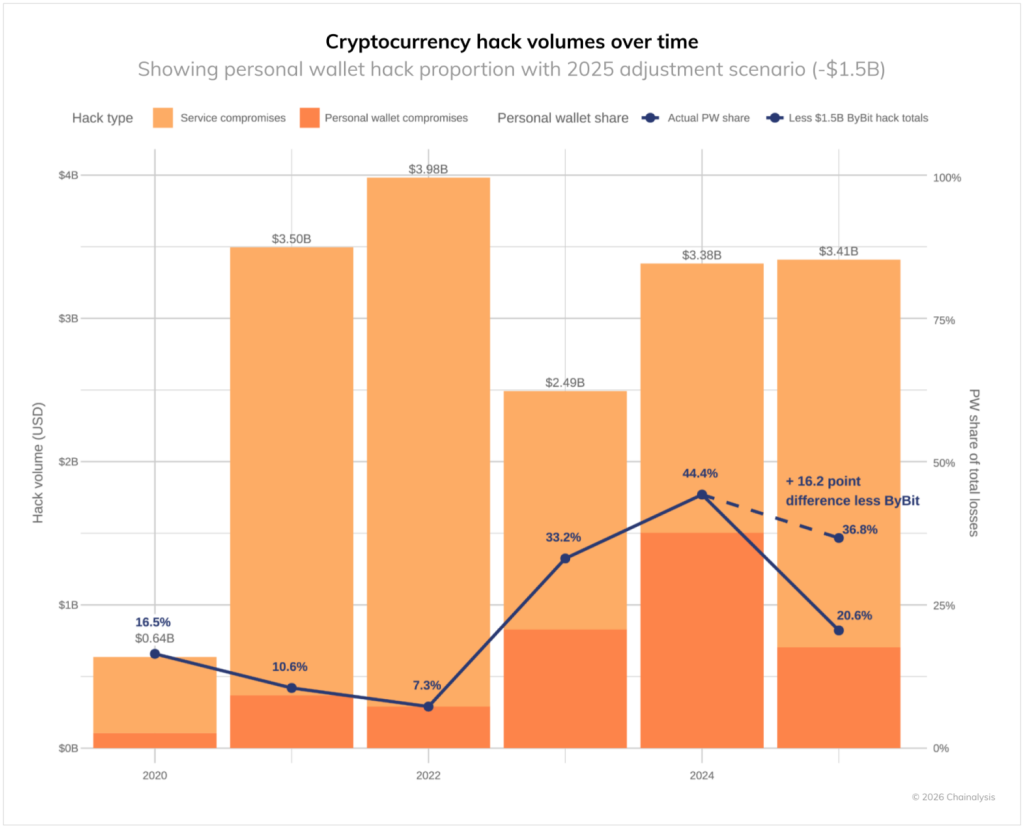
Scroll Founder Account Hack - Chainalysis Chart
Source: Chainalysis

The Democratic People’s Republic of Korea now represents 76% of all service compromises, bringing cumulative DPRK cryptocurrency theft to $6.75 billion since operations began.

Personal wallet compromises surged to 158,000 incidents affecting at least 80,000 unique victims, triple the 54,000 cases recorded in 2022.

Address poisoning scams drove December’s single-largest loss, when one victim transferred $50 million to a fraudulent wallet mimicking their intended destination, while private key leaks resulted in $27.3 million stolen from multi-signature wallets.

Personal Security Breaches Surge Across Platforms

Most recently, Ubuntu developer Alan Pope warned that attackers are hijacking Snap Store publisher accounts by registering expired domains linked to legitimate developers, then pushing malicious updates to previously trusted packages.

The technique exploits automatic update systems and established trust signals, with at least 2 confirmed cases of wallet-stealing malware distributed through seemingly normal applications.

⚠ Hackers are exploiting trusted Snap Store packages to steal cryptocurrency by hijacking existing publisher accounts.#Hack #Cryptohttps://t.co/YV5Yoiwb0F

— Cryptonews.com (@cryptonews) January 21, 2026

Given these growing, multifaceted attack vectors, Better Business Bureau officials are warning consumers about phishing campaigns that lock X users out of their accounts and are subsequently used for cryptocurrency promotions.

Kentucky journalist Jennie Rees described receiving direct messages from apparent colleagues requesting contest votes, only to find her account posting fake Audi purchase claims tied to crypto earnings after clicking the malicious link.

The post Hackers Impersonate X Staff Using Compromised Scroll Founder Account appeared first on Cryptonews.
Stablecoin Trading Surges 62% in Korea as Dollar Strengthens Against Won

25 January 2026 at 05:37

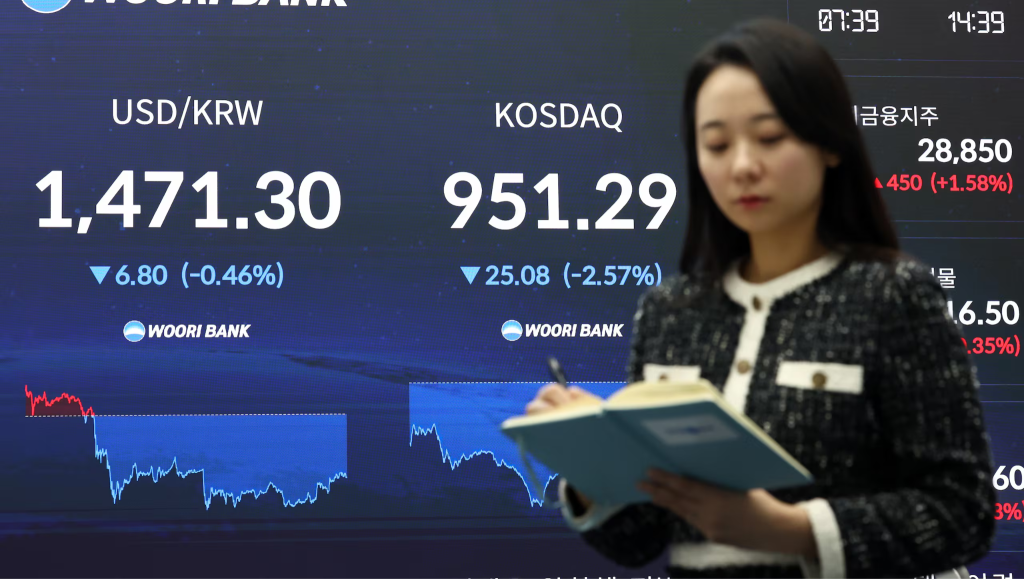
South Korean crypto exchanges recorded a 62% surge in stablecoin trading volumes as the won fell to multi-year lows against the dollar, prompting platforms to intensify marketing campaigns around dollar-pegged tokens.

According to The Korea Times, trading volume in Tether (USDT) across the nation’s five major won-based exchanges climbed to 378.2 billion won ($261 million) when the exchange rate exceeded 1,480 won per dollar last Wednesday, citing CryptoQuant data.

The spike follows mounting currency pressures that pushed the won through nine consecutive days of declines against the dollar, marking its longest losing streak since 2008, Bloomberg reported.

Stablecoin Korea Dollar WON/USD Chart Bloomberg
Source: Bloomberg

Major exchanges, including Korbit, Coinone, Upbit, and Bithumb, launched aggressive promotional campaigns centered on stablecoins, including USDC and USDe, waiving trading fees and distributing rewards to boost volumes during what industry officials described as a downturn in broader crypto markets.

Banks Slash Dollar Rates as Government Defends Currency

According to The Chosun Daily, South Korea’s major commercial banks slashed dollar deposit interest rates to near zero in response to government pressure to defend the exchange rate.

Shinhan Bank cut its annual rate from 1.5% to 0.1% starting January 30, while Hana Bank reduced rates from 2% to 0.05% for its Travelog Foreign Currency Account.

The coordinated move followed the authorities’ summoning of bank executives and their request that they “refrain from excessive marketing that encourages foreign currency deposits such as dollars.

Banks responded by introducing incentives for won conversion, with Shinhan offering a 90% preferential rate for customers converting dollar deposits back to won, plus an additional 0.1 percentage point rate boost for those subscribing to won-term deposits afterward.

Dollar deposit balances at the five major banks fell 3.8% from month-end to 63.25 billion dollars as of January 22, marking the first decline after three consecutive months of surges.

Corporate deposits, which account for 80% of all dollar holdings, dropped sharply from 52.42 billion dollars at year-end to 49.83 billion dollars, suggesting that the authorities’ recommendation to sell dollars spot, combined with perceptions that the exchange rate had peaked, was driving the decline.

Individual dollar deposits grew at a significantly slower pace, rising just 109.64 million dollars, compared with the previous month’s 1.09 billion dollar surge.

Presidential Intervention Accelerates Won Stabilization

President Lee Jae-myung delivered a rare verbal intervention on the exchange rate during a January 21 press conference, stating authorities predicted the rate would drop to around 1,400 won within one to two months.

The won-dollar rate immediately fell from 1,481.4 won to 1,467.7 won following his remarks, closing at 1,471.3 won.

Stablecoin Korea Dollar
Source: TheChosunDaily

Market observers noted the unprecedented nature of a sitting president specifying both an exchange rate target and timeline, with Lee’s statement carrying significantly more weight than U.S. Treasury Secretary Scott Bessent’s earlier comment that the won’s recent decline was “inconsistent with Korea’s strong fundamentals.

Meanwhile, demand for dollar exchange slowed as average daily won-to-dollar conversions reached 16.54 million dollars from January 1-22, while dollar-to-won conversions surged to 5.2 million dollars daily, significantly exceeding last year’s 3.78 million dollar average and indicating increased profit-taking.

In fact, according to CNBC, South Korea’s fourth-quarter GDP growth slowed to 1.5% year over year, missing economists’ forecasts of 1.9%, as construction investment shrank 3.9% and exports pulled back 2.1% from the previous quarter.

The won has lost nearly 2% against the greenback this year, making it one of Asia’s worst-performing currencies, while South Korean retail investors bought approximately 2.4 billion dollars of U.S. equities on a net basis through mid-January, up roughly 60% from the same period last year.

The broader economic slowdown comes as Seoul advances major crypto policy reforms despite regulatory gridlock over stablecoin governance.

Earlier this month, South Korea ended its nine-year corporate crypto trading ban, permitting listed companies to invest up to 5% of equity capital in top-20 cryptocurrencies, while lawmakers passed amendments to the Capital Markets Act and Electronic Securities Act establishing legal frameworks for tokenized securities trading beginning January 2027.

🇰🇷South Korea has launched guidelines, allowing listed companies and professional investors to invest up to 5% of their equity capital crypto.#SouthKorea #CorporateCryptoInvestment #CryptoInvestmenthttps://t.co/d55u3TDsBF

— Cryptonews.com (@cryptonews) January 12, 2026

Korea Exchange Chairman Jeong Eun-bo pledged to launch spot Bitcoin ETFs and extend trading hours to 24/7 as part of efforts to eliminate the “Korea discount,” though comprehensive digital asset legislation remains stalled amid disputes between the Financial Services Commission and the Bank of Korea over stablecoin issuance rules.

The post Stablecoin Trading Surges 62% in Korea as Dollar Strengthens Against Won appeared first on Cryptonews.

Yesterday — 24 January 2026Main stream

Ethereum Launches $2M Quantum Defense Team as Threat Timeline Accelerates

24 January 2026 at 09:01

The Ethereum Foundation has officially elevated quantum resistance to a top strategic priority with the formation of a dedicated Post Quantum team backed by $2 million in funding.

The new initiative comes as blockchain networks face mounting pressure to defend against quantum computing threats that industry experts increasingly warn could materialize within years rather than decades.

Ethereum researcher Justin Drake announced the team formation on Friday, revealing that Thomas Coratger will lead the effort alongside Emile, a core contributor to leanVM.

After years of quiet R&D, EF management has officially declared PQ security a top strategic priority,” Drake said, adding that the foundation has been developing its quantum strategy since a 2019 presentation at StarkWare Sessions.

Today marks an inflection in the Ethereum Foundation's long-term quantum strategy.

We've formed a new Post Quantum (PQ) team, led by the brilliant Thomas Coratger (@tcoratger). Joining him is Emile, one of the world-class talents behind leanVM. leanVM is the cryptographic…

— Justin Drake (@drakefjustin) January 23, 2026

Foundation Commits Resources Across Multiple Fronts

The Ethereum Foundation is launching comprehensive defensive measures spanning research, development, and infrastructure testing.

Antonio Sanso will kick off bi-weekly All Core Devs Post Quantum breakout calls next month, focusing on user-facing security, including dedicated precompiles, account abstraction, and transaction signature aggregation with leanVM.

The foundation announced two $1 million prize competitions to strengthen cryptographic foundations.

The newly launched Poseidon Prize targets the hardening of the Poseidon hash function, while the existing Proximity Prize continues to drive hash-based cryptography research.

We are betting big on hash-based cryptography to enjoy the strongest and leanest cryptographic foundations,” Drake stated.

Multi-client post-quantum consensus development networks are already operational, with pioneer teams including Zeam, Ream Labs, PierTwo, Gean client, and Ethlambda working alongside established consensus clients Lighthouse, Grandine, and Prysm.

Weekly post-quantum interop calls, coordinated by Will Corcoran, are managing collaborative technical development across these diverse implementation teams.

The foundation will host a three-day expert workshop in October, bringing together top specialists from around the world, building on last year’s post-quantum workshop in Cambridge.

An additional dedicated post-quantum day is scheduled for March 29 in Cannes, ahead of EthCC, to create multiple forums for advancing research and coordination across the global Ethereum development community.

Industry Voices Split on Timeline Urgency

The quantum threat has divided blockchain leaders on both timeline predictions and strategic priorities.

Independent Ethereum educator sassal.eth called quantum computing “a very real threat for blockchains” that is “coming sooner than most people think,” praising the foundation’s defensive preparations.

Pantera Capital General Partner Franklin Bi predicted that traditional financial institutions will struggle with the transition to post-quantum cryptography.

People are over-estimating how quickly Wall Street will adapt to post-quantum cryptography,” Bi said, adding that blockchain networks possess unique capabilities for system-wide upgrades at a global scale.

The post-quantum race begins.

My prediction:

People are over-estimating how quickly Wall Street will adapt to post-quantum cryptography. Like any systemic software upgrade, it'll be slow & chaotic with single points of failure for years. Traditional systems are only as strong… https://t.co/6mEdFKcXrm

— Franklin Bi (@FranklinBi) January 23, 2026

He argued that successful quantum resistance could transform select blockchains into “post-quantum safe havens for data and assets,” particularly as traditional systems face prolonged periods of vulnerability due to single points of failure.

Bitcoin community assessments remain sharply contested. Vitalik Buterin previously shared Metaculus data showing a median 2040 timeline for quantum computers breaking modern cryptography, with roughly a 20% probability before the end of 2030.

Metaculus's median date for when quantum computers will break modern cryptography is 2040:https://t.co/Li8ni8A9Ox

Seemingly about a 20% chance it will be before end of 2030.

— vitalik.eth (@VitalikButerin) August 27, 2025

Blockstream CEO Adam Back has dismissed near-term concerns, claiming practical threats remain decades away and accusing critics of creating unnecessary market alarm.

Project ZKM contributor Stephen Duan acknowledged transition challenges while calling quantum resistance “inevitable,” noting that his team will soon upgrade multiset hashing to a lattice-based construction.

ZKsync inventor Alex Gluk also said the network’s Airbender prover is already “100% PQ-proof,” highlighting Ethereum’s unmatched ability to adapt to emerging threats while maintaining its position as the global financial settlement layer.

Foundation Plans Comprehensive Roadmap Release

The Ethereum Foundation will publish detailed strategic guidance on pq.ethereum.org covering full transition planning to achieve zero loss of funds and zero downtime over the coming years.

Drake highlighted recent artificial intelligence breakthroughs in formal proof generation, noting that specialized mathematics AI recently completed one of the hardest lemmas in hash-based SNARK foundations in a single eight-hour run costing $200.

The foundation is developing educational materials, including a six-part video series with ZKPodcast and enterprise-focused resources through EF Enterprise Acceleration.

Quantum Threatens $600B of Bitcoin 🎧🤖@nic_carter joins me for an in-person @PodcastDelphi to cover his 6 months of research on Quantum's effect on $BTC

Nic's first and only podcast on Quantum

Listen directly here, or on any of the links below pic.twitter.com/CSnv7xekqn

— Tommy (@Shaughnessy119) January 9, 2026

Ethereum now has representation on the post-quantum advisory board, Coinbase announced this week, bringing together leading cryptography researchers to assess long-term blockchain security risks as quantum computing capabilities advance across government and private-sector development programs.

The post Ethereum Launches $2M Quantum Defense Team as Threat Timeline Accelerates appeared first on Cryptonews.

Las Vegas Businesses Ditch Credit Card Fees for Bitcoin Payments

24 January 2026 at 06:11

Las Vegas Valley businesses, from restaurant chains to small juice bars, are embracing Bitcoin payments as mainstream adoption accelerates, with companies avoiding credit card processing fees averaging 2.5% to 3.5% while tapping into a growing customer base actively seeking crypto-friendly merchants.

The shift follows Square’s November 2025 decision to enable roughly 4 million U.S. merchants to accept Bitcoin payments with zero processing fees through 2026.

According to Fox5Vegas, at Cane Juice Bar and Cafe on Rainbow near Windmill, district manager Tyler Peterson serves fresh-pressed sugar cane juice that customers can pay for with cash, card, or Bitcoin after eight months of crypto implementation.

Bitcoin is getting very popular with mainstream people, not just the people that are actually into things like cryptocurrencies,” Peterson said, noting the payment option helps the business “move forward” while attracting new customers who specifically seek Bitcoin-accepting locations.

According to FOX5, more businesses across Las Vegas are now accepting Bitcoin payments, from chains like Steak ’n Shake to small shops and medical practices. Merchants said Bitcoin helps attract new customers and cut costs, while Square has enabled about 4 million U.S. merchants…

— Wu Blockchain (@WuBlockchain) January 24, 2026

Small Business Growth Through Bitcoin Maps

Peterson confirmed customers who normally wouldn’t know about his shop come in specifically to use Bitcoin, with calls and inquiries arriving regularly.

So actually some customers we have generated off of accepting Bitcoin,” Peterson said. “That Bitcoin map is helping us out a lot.”

Consumers can locate Bitcoin-accepting businesses through dedicated Bitcoin maps or Cash App’s directory feature, creating organic discovery channels for merchants willing to accept crypto payments.

Jeremy Querci, a Bitcoin consultant with Sovreign, explained that businesses accepting Bitcoin now range from medical practices to juice bars to children’s play places, with payment processing requiring just a few taps on a phone.

At the time of checkout, you say you want to pay in Bitcoin and the business can bring up a QR code that you scan with your phone with any Bitcoin app,” Querci said, while Peterson asserted the technology will become progressively easier as “it’s the future.”

National Chains Lead Corporate Bitcoin Adoption

The momentum extends beyond small businesses into major restaurant chains, with Steak ‘n Shake announcing this week plans to pay all hourly employees at company-operated restaurants a Bitcoin bonus of $0.21 for every hour worked starting March 1, with funds accessible after a two-year vesting period.

🚀 Steak 'n Shake announces Bitcoin hourly bonus for workers starting March 1, expanding its treasury strategy that contributed to 15% same-store sales growth.#Bitcoin #Salaryhttps://t.co/HjlPK3TLtN

— Cryptonews.com (@cryptonews) January 21, 2026

CEO Will Reeves positioned the move as part of the 91-year-old burger chain’s transformation into “a real bitcoin company, putting sound money into the hands of working Americans.

Lightning Network payments enabled across all U.S. Steak ‘n Shake locations in mid-May 2025 brought transaction fee savings of nearly 50% compared with credit cards, alongside roughly 15% increases in same-store sales in the months following launch.

The rollout received public backing from Jack Dorsey, who enthusiastically endorsed the chain’s Bitcoin adoption plans when the company first polled followers about accepting crypto.

Infrastructure Advances Enable Mainstream Payments

Cash App rolled out Bitcoin Lightning payments and stablecoin transfers in November 2025, allowing eligible users to pay over the Lightning Network in seconds with no fee using either BTC or USD balances after scanning a Lightning QR code.

The app introduced Bitcoin Map, an in-app directory that helps customers find nearby Square merchants and other businesses accepting Bitcoin, enabling users to locate stores, get directions, and pay directly over Lightning at checkout.

Just yesterday, crypto payments firm Mercuryo partnered with Visa to enable near-real-time conversion of digital assets into fiat currency, allowing users to send proceeds directly to Visa debit and credit cards via Visa Direct.

This partnership with Visa will further enhance Mercuryo’s ability to deliver a fast, low-cost user experience,” said Mercuryo co-founder and CEO Petr Kozyakov, noting the integration reduces friction historically associated with moving funds across borders or cashing out digital assets.

The corporate adoption mirrors explosive growth across the broader crypto payments landscape, with crypto card volumes surging from roughly $100 million monthly in early 2023 to over $1.5 billion by late 2025, representing a 106% compound annual growth rate, according to Artemis Analytics.

Las Vegas Bitcoin Payments - Artemis Chart
Source: Artemis

Annualized volumes now exceed $18 billion, while traditional peer-to-peer stablecoin transfers grew just 5% to $19 billion over the same period.

At the time of publication, Bitcoin is trading around $89,500, down roughly 5% over the previous week, as Bitcoin spot ETFs experienced steep outflows totaling $1.62 billion across four trading days amid compressed yields on basis trades that dropped below 5% from around 17% a year ago.

The post Las Vegas Businesses Ditch Credit Card Fees for Bitcoin Payments appeared first on Cryptonews.

Before yesterdayMain stream

XRP Price Prediction: Ripple’s Turkey Push Fuels $2.50 Target – But $2.00 Must Crack

23 January 2026 at 17:55

Ripple has extended its custody partnership with Garanti BBVA Kripto, reinforcing its commitment to the Turkish cryptocurrency market.

Analyst says this is bullish for the XRP price prediction as technical indicators point to a $2.50 breakout if the $2.00 psychological resistance is overcome in the coming days.

Ripple Wins Turkish Garanti BBVA Partnership

Reece Merrick, Ripple’s Managing Director for the Middle East and Africa, announced the partnership extension on X (formerly Twitter), emphasizing the continuation of their existing relationship.

JUST IN: 🇹🇷Ripple has renewed its custody partnership with Garanti BBVA Crypto, strengthening institutional access to XRP and expanding its footprint in Turkey. pic.twitter.com/GZcqPPev8m

— Crypto Briefing (@Crypto_Briefing) January 23, 2026

The collaboration ensures that Garanti BBVA’s retail customers maintain access to secure custody and transfer services for multiple cryptocurrencies, including XRP, Bitcoin, and Ethereum.

Garanti BBVA’s cryptocurrency journey began in late 2024 following a successful pilot program conducted with both Ripple and IBM.

The initial phase attracted approximately 14,000 early adopters.

This partnership was specifically designed to provide the bank with enterprise-grade key management infrastructure, enabling secure deployment and management of digital asset services.

Beyond the Turkish partnership, Ripple has secured another important regulatory milestone.

The company recently obtained a “Green Light Letter” from Luxembourg’s Commission de Surveillance du Secteur Financier (CSSF), representing preliminary approval for an Electronic Money Institution (EMI) license.

While the regulator has completed its legal assessment, final authorization remains pending.

This development adds to Ripple’s extensive regulatory portfolio, which now includes over 75 licenses across global jurisdictions.

XRP Price Prediction: XRP Forms Rare W-Pattern at $1.95 Support

The 4-hour XRP/USDT chart reveals several compelling technical patterns. Price action has been consolidating within a falling wedge formation, a pattern that frequently precedes bullish breakouts rather than continued downtrends.

The narrowing range between lower highs and lower lows suggests diminishing selling pressure as the asset approaches a critical decision point.

A notable W-pattern has formed near the wedge’s lower boundary, with the $1.88–$1.90 zone demonstrating robust support.

XRP Price Prediction - XRP Price Chart
Source: TradingView/Suryapro

This repeated defense of key levels indicates strong buying interest at these prices, establishing a potential launching pad for upward movement.

Currently trading around $1.95, XRP faces immediate resistance in the $1.98–$2.00 zone, which coincides with the wedge’s upper trendline.

A decisive 4-hour close above this critical area would confirm both the falling wedge breakout and the W-pattern reversal signal.

If XRP successfully breaks through the $2.00 psychological barrier, analysts anticipate initial upside targets between $2.10 and $2.20.

Strong momentum could extend the rally toward the $2.35–$2.40 region, with some optimistic projections suggesting movement toward $2.50.

However, traders should remain cautious of potential downside scenarios.

A rejection at the $2.00 resistance level, followed by a breakdown below wedge support, could postpone the bullish thesis.

Such a development might result in renewed consolidation or a retest of the lower $1.80 range.

Beyond XRP: Bitcoin Hyper Raises $30M As First True BTC Layer 2

While XRP attracts attention for its potential breakout, investors are also watching Bitcoin Hyper ($HYPER), a project creating the first authentic Layer 2 solution for Bitcoin using Solana-based technology.

The platform combines speed and scalability while maintaining Bitcoin’s security framework.

The Bitcoin Hyper presale has already raised over $30 million, demonstrating strong market interest.

Bitcoin Hyper Banner

The project’s Solana-powered Layer 2 infrastructure enables developers to build Bitcoin-native decentralized applications, offering BTC holders new opportunities to utilize their assets through purpose-built on-chain tools.

As major wallets and exchanges prepare to integrate this scaling solution, demand for $HYPER is expected to increase rapidly.

The token is currently available during the presale phase at $0.013625.

Interested investors can visit the official Bitcoin Hyper website and connect their preferred wallet (such as Best Wallet) to swap USDT or SOL for $HYPER, or purchase directly using a bank card before the next price increase.

Visit the Official Bitcoin Hyper Website Here

The post XRP Price Prediction: Ripple’s Turkey Push Fuels $2.50 Target – But $2.00 Must Crack appeared first on Cryptonews.

Binance Plans to Reintroduce Stock Trading Four Years After Removal

23 January 2026 at 17:31

Binance is exploring plans to bring back stock trading on its platform four years after discontinuing the feature, according to a report from The Information.

The world’s largest crypto exchange removed stock tokens in 2021 amid regulatory scrutiny, but now appears ready to re-enter equity markets as competitors push toward unified investment platforms.

The timing aligns with a broader industry shift toward “everything exchanges” that combine crypto and traditional assets under a single platform.

Coinbase began rolling out stock trading to select users earlier this month while positioning itself against traditional brokerages and rival Robinhood, which has offered blended stock and crypto trading for years.

JUST IN: Binance considers bringing back stock trading, The Information reports.

— Watcher.Guru (@WatcherGuru) January 23, 2026

Exchanges Race to Build Unified Platforms

Binance’s potential return to stock trading comes as multiple crypto platforms accelerate efforts to merge digital assets with conventional financial products.

Coinbase CEO Brian Armstrong defended his company’s push into equities in a recent Fortune interview, arguing the exchange is positioned to lead as financial assets migrate to blockchain infrastructure.

We have deep crypto expertise. We have the most trusted brand in crypto,” Armstrong said, adding that Coinbase aims to bridge traditional finance and crypto while advancing tokenized equities.

The exchange currently offers stocks through Apex Fintech Solutions with plans to expand access to all customers in the coming weeks, though fully tokenized equities remain years away pending SEC coordination.

Austria’s Bitpanda also announced Wednesday it will launch a unified investing platform on January 29, bringing stocks, ETFs, crypto, and precious metals together under one app.

The expanded platform will offer more than 10,000 stocks and ETFs at a flat €1 trading fee with zero custody fees and no payment for order flow.

Infrastructure Moves Toward On-Chain Markets

Traditional market operators are also simultaneously advancing blockchain-based trading systems.

Earlier this week, the New York Stock Exchange unveiled plans to develop a platform for 24/7 trading and on-chain settlement of tokenized securities, combining its Pillar matching engine with blockchain-based post-trade systems across multiple blockchains.

For more than two centuries, the NYSE has transformed the way markets operate,” said Lynn Martin, President of NYSE Group.

She said the exchange is now leading the industry toward fully on-chain solutions that combine trust, regulatory rigor, and modern technology.

Yesterday, January 22, Binance founder Changpeng “CZ” Zhao also told a World Economic Forum panel in Davos that he is negotiating with over a dozen governments to tokenize state-owned assets as the next major step in crypto adoption.

🚀 Binance’s @cz_binance confirms talks with governments to tokenize national assets on-chain, calling it the next phase after exchanges and stablecoins. #Crypto #Tokenizationhttps://t.co/1mv1mt5WwR

— Cryptonews.com (@cryptonews) January 22, 2026

Zhao positioned tokenization as the third stage following exchanges and stablecoins, explaining that governments want to directly capture financial upside from their own assets rather than outsourcing value creation to private intermediaries.

Regulatory Clarity Fuels Institutional Momentum

Last month, the Securities and Exchange Commission (SEC) issued a rare no-action letter to the Depository Trust and Clearing Corporation, allowing it to proceed with a controlled tokenization program covering U.S. Treasuries, ETFs, and Russell 1000 equities.

The service is scheduled to launch in late 2026 and will operate on approved blockchains with tokenized assets carrying the same legal rights as traditional securities.

Market data and institutional research suggest this regulatory momentum is already translating into measurable growth.

Earlier this month, venture capital firm Andreessen Horowitz identified stablecoins, real-world asset tokenization, and privacy infrastructure as key forces shaping crypto in 2026.

These assertions come as monthly transfer volumes for tokenized equities are down roughly 17% over 30 days to about $2.05 billion, according to rwa.xyz.

However, the number of Monthly Active Addresses is up nearly 98%, with over 98,167 addresses active in the past month alone.

Binance Stock Trading - Tokenized Stock Metrics Chart RWA.xyz
Source: RWA.xyz

David Duong, Coinbase’s head of investment research, also recently said regulatory clarity improvements and deepening institutional participation are creating favorable conditions ahead.

We expect these forces to compound in 2026 as ETF approval timelines compress, stablecoins take a larger role in delivery-vs-payment structures, and tokenized collateral is recognized more broadly,” Duong wrote in a year-end outlook.

Meanwhile, Binance confirmed today that it submitted a Markets in Crypto-Assets license application in Greece as crypto firms across Europe rush to secure regulatory approval before June 2026 transitional deadlines expire.

The post Binance Plans to Reintroduce Stock Trading Four Years After Removal appeared first on Cryptonews.

$100 Trillion Inheritance Wave Could Send Crypto Prices Soaring, CEO Says

23 January 2026 at 14:07

A massive generational wealth transfer could reshape crypto markets over the next two decades as younger investors inherit trillions in assets and redirect capital toward digital assets at unprecedented rates.

Nansen founder Alex Svanevik predicts the impending shift will fundamentally alter crypto market dynamics, while recent data shows younger generations already allocating significantly more portfolio exposure to digital assets than their predecessors.

The transfer involves roughly $100 trillion changing hands globally within 20 years, with younger heirs demonstrating markedly different investment preferences than current asset holders.

It’s like a tidal wave, you know, a tsunami that’s coming,” Svanevik told Magazine, explaining that even modest allocation shifts could double crypto’s current $3.05 trillion market cap. “There are all these kinds of forces that I think just drive crypto upwards.

⚡ INSIGHT: Nansen co-founder Alex Svanevik believes a "tidal wave" of new money is set to enter crypto, potentially doubling the total market cap.

Via Cointelegraph Magazine pic.twitter.com/4x3EIa57xm

— Cointelegraph (@Cointelegraph) January 23, 2026

Younger Generations Demonstrate Radically Different Asset Preferences

A recent Coinbase research found 45% of younger U.S. investors currently own crypto, compared to just 18% of older generations, with younger cohorts allocating 25% of portfolios to non-traditional assets, triple the 8% allocation among older investors.

Four in five younger adults believe crypto will play a larger role in future financial systems.

The preference gap extends globally. Asia Pacific’s high net worth people now see nearly half allocating over 10% of portfolios to digital assets, with 87% already holding crypto and 60% planning to increase allocations.

In fact, a very recent Bitget Research found 20% of Gen Z and Alpha respondents expressing openness to receiving retirement funds in cryptocurrencies, while 78% showed more confidence in alternative savings methods than traditional pension funds.

Similar to Svanevik, Galaxy Digital’s Zac Prince also emphasized the demographic inevitability earlier this month, noting younger investors prefer “an app first” platform approach over traditional brokerage relationships.

The older people are going to pass away and pass the money down to younger people,” Prince explained.

He added that younger investors are “much more familiar with platforms like the one that we have at GalaxyOne, where it’s kind of an app first. Multiple kinds of products in one place, really intuitive user interface versus the traditional, you have to pick up a phone and call your broker.

🚀 Galaxy Digital says $83 trillion Baby Boomer wealth transfer could fuel crypto adoption as 45% of younger US investors already hold digital assets versus 18% of older generations.#Crypto #Adoptionhttps://t.co/DviS4QCNBm

— Cryptonews.com (@cryptonews) January 7, 2026

2025 UBS data reveals $83 trillion will transfer between generations over the next 20-25 years, with $29 trillion in the United States alone.

Prince noted that wealth transfer patterns don’t strictly correlate with population size or GDP, pointing to Italy, which, despite having half Japan’s population and 60% of its GDP, is projected to see higher inter-generational wealth transfers due to higher savings rates and home ownership among elderly citizens.

Infrastructure Maturation Allows Sophisticated Product Development

The crypto industry has reached a level of key infrastructure maturity, allowing institutional-grade products that were previously impossible to build.

The product we have built could not have been built two or three years ago because the infrastructure wasn’t there,” Svanevik explained, pointing to improved wallet technology and execution capabilities. “The wallet technology wasn’t good enough.

Institutional adoption has accelerated alongside infrastructure improvements.

Morgan Stanley launched Bitcoin ETFs while traditional financial platforms expanded crypto access, even as retail sentiment remains cautious.

Last month, FINRA Foundation data shows crypto consideration among U.S. investors dropped from 33% to 26% between 2021 and 2024, with 66% viewing digital assets as extremely or very risky, up from 58%.

🇺🇸 US crypto purchase interest falls to 26% from 33% in 2021 as investor risk appetite declines sharply, FINRA study shows.#US #Cryptohttps://t.co/4mTMJ49hLC

— Cryptonews.com (@cryptonews) December 5, 2025

However, institutional products continue proliferating.

Prince noted distribution channels remain partially closed but expects continued expansion throughout 2025.

The ETFs just came around last year. Some warehouses and other firms have a one-year lockdown on new ETFs being able to be made available to their clients.

Gulf-region families show the wealth-transfer pattern already unfolding.

Bahrain’s Kanoo family backed Bitcoin in 2020 despite initial skepticism, later selling at a profit before continuing digital asset investments through hedge fund structures.

Banks, including Citigroup, Barclays, and Deutsche Bank, are scaling Gulf wealth divisions to capture an estimated $1 trillion in regional wealth transfers.

Svanevik believes passage of the CLARITY Act will usher in “a new era for crypto in the US,” with global implications. “The rest of the world is going to follow.

Bitcoin Struggles Despite Wealth Transfer Optimism

Despite long-term adoption trends, Bitcoin has lost roughly 25,000 millionaire addresses in the year since President Donald Trump returned to the White House, falling from 157,563 addresses at his January 2025 inauguration to 132,383 by Jan. 20, 2026.

$100 Trillion Inheritance Crypto - Bitcoin Price Chart
Source: TradingView

The crypto dipped below $90,000 today amid broader market volatility, even as institutional products continue proliferating and younger generations position themselves to inherit trillions in assets over the coming decades.

The post $100 Trillion Inheritance Wave Could Send Crypto Prices Soaring, CEO Says appeared first on Cryptonews.

World’s Second-Largest Wealth Manager UBS to Offer Crypto Investing to Wealth Clients

23 January 2026 at 10:59

UBS Group AG, the world’s second-largest wealth manager with over $7 trillion in invested assets, is preparing to offer crypto investments to select wealthy clients, starting with Bitcoin and Ethereum.

According to a January 23 Bloomberg report, UBS is expected to begin offering crypto services in Switzerland, with potential expansion to the Asia-Pacific region and the U.S. The Swiss banking powerhouse is still selecting partners and hasn’t finalized plans.

The initiative reflects growing demand for digital assets among high-net-worth individuals and positions UBS alongside Wall Street competitors who have already entered the crypto wealth management space.

UBS plans to make cryptocurrency investing available for some private banking clients in what could become a significant move into digital assets for the wealth manager https://t.co/pWi6Inm9AP

— Bloomberg (@business) January 23, 2026

Wall Street’s Crypto Wealth Management Rush

UBS’s planned offering follows a wave of similar initiatives from major banking competitors throughout 2024 and 2025.

Last October, Morgan Stanley opened the door for all its wealth management clients to invest in crypto.

According to CNBC, the bank informed its financial advisers that starting October 15, crypto investments became available to all clients, regardless of risk profile or account type, including retirement accounts.

🚀 @MorganStanley has prepared to unlock $1.3T in crypto trading via E-Trade in 2026, starting with Bitcoin, Ether, and Solana.#Bitcoin #Crypto #MorganStanleyhttps://t.co/MvIWz1XTBe

— Cryptonews.com (@cryptonews) September 23, 2025

Previously, access to crypto funds at Morgan Stanley was limited to clients with aggressive risk tolerance and at least $1.5 million in investable assets who wanted exposure through taxable brokerage accounts.

The new policy removes those barriers, allowing any client to add crypto funds to their portfolio under adviser supervision.

Morgan Stanley is also preparing to bring cryptocurrency trading for E-Trade clients in the first half of 2026, a move that could unlock access to as much as $1.3 trillion in trading volume.

UBS Crypto Investing - BTC Price Vs Institutional Interest Chart
Source: KPMG

According to Bloomberg, the offering will begin with Bitcoin, Ether, and Solana, with plans to expand to broader services.

Morgan Stanley recently took another step into the U.S. crypto market after filing a Form S-1 registration statement with the Securities and Exchange Commission for a Morgan Stanley Ethereum Trust, adding to growing expectations that large Wall Street firms are positioning for broader spot crypto products beyond Bitcoin.

The Morgan Stanley Global Investment Committee (GIC) is now advising clients to allocate a small portfolio portion to cryptocurrency, recommending between 2% and 4% depending on risk appetite.

JPMorgan, BofA, Wells Fargo Join Crypto Push

Similarly, JPMorgan Chase & Co. allows select trading and wealth clients to use cryptocurrency exchange-traded funds (ETFs) as collateral for loans, according to Bloomberg, published on June 4.

The bank began with BlackRock’s iShares Bitcoin Trust (IBIT) and plans to expand access to other funds after rollout.

Traditional banking giants Bank of America and Wells Fargo are also offering eligible wealth management clients access to spot Bitcoin exchange-traded funds (ETFs).

The ETFs have been available to clients for several weeks, a source familiar with Bank of America’s plans told Reuters.

The move follows the Securities and Exchange Commission’s (SEC) approval of these investment vehicles in January 2024, marking a major milestone in cryptocurrency acceptance within traditional financial systems.

UBS already active in Hong Kong and Blockchain Integration

Currently, UBS Group AG and rivals such as HSBC Holdings Plc offer select clients in Hong Kong the ability to trade specific crypto-linked exchange-traded funds (ETFs).

Affluent clients have been granted access to the Samsung Bitcoin Futures Active, CSOP Bitcoin Futures, and CSOP Ether Futures ETFs since the initiative went live in 2023.

UBS is also taking a major step in integrating blockchain technology into traditional finance by experimenting with digital gold investments for retail investors.

Last February, UBS completed a proof-of-concept for its fractional gold investment product, UBS Key4 Gold, on the Ethereum layer-2 network ZKsync Validium.

🇨🇭 Swiss banking giant @UBS has successfully tested its new blockchain-based payment system, UBS Digital Cash.#Blockchain #Payments https://t.co/yuiiHesUBw

— Cryptonews.com (@cryptonews) November 8, 2024

In November 2024, the bank launched UBS Digital Cash, a private blockchain pilot for multi-currency cross-border payments.

UBS Tokenize, another initiative, enables on-chain issuance of tokenized financial products, including the first tokenized money market fund on Ethereum.

The post World’s Second-Largest Wealth Manager UBS to Offer Crypto Investing to Wealth Clients appeared first on Cryptonews.

DOJ Drops OpenSea NFT Fraud Case After Appeals Court Overturns Conviction

23 January 2026 at 07:06

US prosecutors have formally dropped their case against former OpenSea manager Nathaniel Chastain following an appeals court reversal that dismantled what was once positioned as the first NFT insider trading prosecution in American history.

According to sources, the Justice Department announced Wednesday it would enter a one-month deferred prosecution agreement before dismissing the indictment with prejudice.

The decision closes a chapter that began in June 2022 when Chastain was arrested and charged with wire fraud and money laundering for using confidential information to purchase NFTs before they were featured on OpenSea’s homepage.

The case attracted widespread attention as prosecutors attempted to apply traditional financial crime statutes to emerging digital asset markets.

Appeals Court Ruling Undermines Prosecution’s Foundation

Manhattan US Attorney Jay Clayton, a former SEC chair, told the federal court that prosecutors would not retry the case given Chastain had already served three months in prison and agreed not to contest forfeiture of 15.98 ETH worth $47,330.

The interest of the United States will be best served by deferring prosecution of this matter and not retrying the case,” Clayton wrote in the court filing.

DOJ OpenSea NFT Fraud Case - Clayton's Letter
Jay Clayton’s letter. | Source: Cointelegraph

The collapse stems from a July 2024 appeals court decision that found the trial jury received flawed instructions.

The 2nd US Circuit Court of Appeals ruled 2-1 that jurors were improperly told they could convict Chastain based solely on unethical behavior rather than actual theft of property with commercial value.

Judge Steven Menashi wrote last year August that the lower court erred by allowing conviction even if the information Chastain used lacked tangible value to OpenSea.

The appeals panel sharply criticized jury instructions that permitted conviction based on violations of “broad notions of honesty and fair play,” warning such standards could criminalize nearly any deceptive act.

The court found the featured NFT data was not monetized by OpenSea and was not treated internally as a valuable asset, making it too “ethereal” to qualify as property under federal wire fraud statutes.

Original Conviction Built on Novel Legal Theory

Chastain was convicted in May 2023 after prosecutors accused him of exploiting his role to buy dozens of NFTs shortly before they appeared on OpenSea’s homepage between June and September 2021.

After tokens were featured and prices increased, he sold them at two- to five-times profit using anonymous wallets. The government alleged he made over $57,000 through the scheme.

US Attorney Damian Williams had described the case as a warning to digital asset markets when announcing charges. “NFTs might be new, but this type of criminal scheme is not,” Williams said.

As alleged, Nathaniel Chastain betrayed OpenSea by using its confidential business information to make money for himself.

The conviction came after a week-long trial, with prosecutors charging wire fraud rather than securities fraud since NFTs have not been legally classified as securities.

More than 300 defense attorneys had filed letters supporting dismissal, arguing that treating confidential business information as property would “criminalize a broad swath of conduct.

Broader Regulatory Retreat Under Trump Administration

The dropped prosecution aligns with a broader shift in federal crypto enforcement under the Trump administration.

As reported by Cryptonews earlier today, a Cornerstone Research report found the SEC initiated just 13 crypto-related actions in 2025, down 60% from 33 in 2024 and the lowest level since 2017.

The agency has dismissed multiple high-profile cases including those against Coinbase, Kraken, Consensys, and Cumberland DRW.

The SEC also closed its investigation into OpenSea in February 2025 after issuing a Wells notice in August 2024 that alleged the platform functioned as an unregistered securities marketplace.

🌊 The SEC has officially ended its investigation into NFT marketplace @OpenSea, according to the company’s founder, @dfinzer.#SEC #OpenSeahttps://t.co/OtOT6c3WMd

— Cryptonews.com (@cryptonews) February 22, 2025

At that time, OpenSea founder Devin Finzer called the closure “a win for everyone who is creating and building in our space.

For now, Chastain will not face supervision by US Pretrial Services and can seek return of the $50,000 fine and special assessment paid following his conviction.

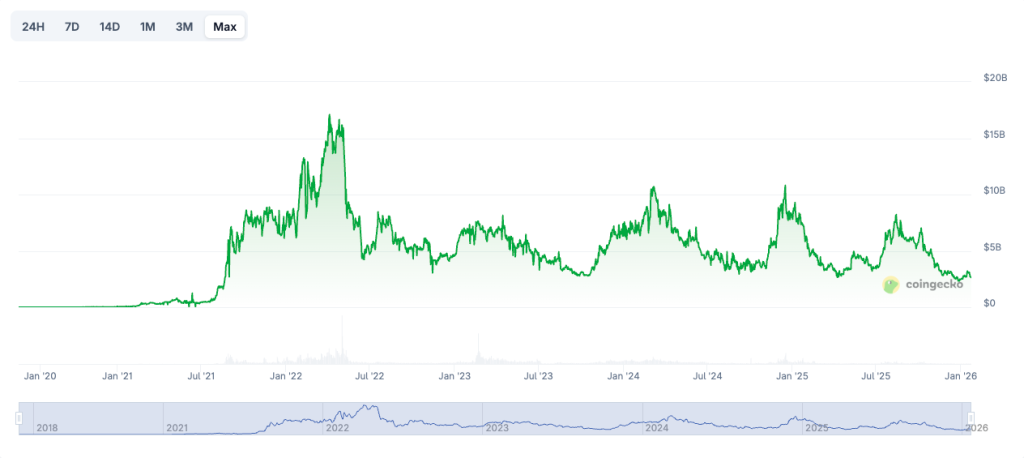
Notably, the global NFT market cap currently stands at $2.56 billion, down 6.72% in the last 24 hours with total sales volume reaching $3.68 million, according to CoinGecko data.

DOJ OpenSea NFT Fraud Case - CoinGecko Chart
Source: CoinGecko

The figure represents an 84.78% decline from the market’s peak of $16.82 billion in April 2022, when digital collectibles were among the hottest assets in crypto and the Chastain case was first unfolding.

The post DOJ Drops OpenSea NFT Fraud Case After Appeals Court Overturns Conviction appeared first on Cryptonews.

SEC’s Atkins and CFTC’s Selig Unite to End Crypto Regulatory Chaos

23 January 2026 at 05:01

SEC Chairman Paul Atkins and CFTC Chairman Michael Selig will hold a joint event on January 27 to discuss regulatory harmonization and efforts to make the United States the global crypto capital.

The two regulators issued a joint statement announcing the event will take place at CFTC headquarters from 10 a.m. to 11 a.m. ET, marking another step in their ongoing coordination efforts.

For too long, market participants have been forced to navigate regulatory boundaries that are unclear in application and misaligned in design, based solely on legacy jurisdictional silos,” the chairmen said in their statement.

This event will build on our broader harmonization efforts to ensure that innovation takes root on American soil, under American law, and in service of American investors, consumers, and economic leadership.

I'm looking forward to joining @ChairmanSelig next week at our @SECgov and @CFTC joint event to discuss harmonization between our two agencies.

Together we will discuss our efforts to deliver on President Trump’s promise to make the US the crypto capital of the world.

Join us! https://t.co/qgJwmiHYus

— Paul Atkins (@SECPaulSAtkins) January 22, 2026

Regulators Build on September’s Historic Turf War Resolution

The upcoming event continues momentum from a September 29 roundtable where both agencies publicly declared an end to their jurisdictional conflicts.

CFTC Commissioner Caroline Pham told attendees at that gathering that “the turf war is over,” while Atkins described it as “a turning point for American financial markets.

That roundtable brought together executives from major platforms, including Kraken, Polymarket, Kalshi, Nasdaq, CME Group, and Robinhood, to discuss coordinated oversight of digital assets.

Atkins emphasized at the time that “for years, the SEC and CFTC have worked in silos, sometimes at odds,” but that era had ended.

The January 27 event will feature opening remarks from both chairmen, followed by a fireside chat moderated by Eleanor Terrett, co-founder of Crypto in America.

Doors open at 9:30 a.m., and the session will be broadcast live on the SEC’s website.

Agencies Accelerate Crypto Policy After Leadership Changes

Both regulators have moved aggressively on digital asset policy since new leadership took over in 2025.

Atkins assumed the SEC chairmanship in April after Gary Gensler’s departure, immediately shifting away from enforcement-based regulation toward clearer frameworks and guidance.

As reported by Cryptonews today, under Atkins, the SEC opened just 13 crypto-related enforcement actions in 2025 compared to 33 in 2024, a 60% decline and the lowest level since 2017, according to Cornerstone Research.

Eight of those cases involved fraud allegations, indicating a narrower focus on investor harm rather than broad registration theories.

The agency also dismissed seven ongoing actions and reduced total monetary penalties to $142 million, less than 3% of 2024 levels.

🏛The SEC opened just 13 crypto enforcement cases in 2025, down 60% from 2024, with most new actions under Chair Paul Atkins focused on fraud.#SEC #CryptoEnforcement https://t.co/YI5S1uVisH

— Cryptonews.com (@cryptonews) January 23, 2026

Selig took the CFTC helm on December 22 after Senate confirmation, replacing acting chair Caroline Pham.

He immediately launched the Future-Proof initiative, a comprehensive review aimed at updating decades-old regulations for blockchain, AI-driven trading, and prediction markets.

We are at a unique moment as a wide range of novel technologies, products, and platforms are emerging,” Selig said after his swearing-in.

Under my leadership, the CFTC will conquer these great frontiers and ensure that the innovations of tomorrow are Made in America.

Joint Efforts Face Congressional Pressure on Market Structure Bills

The harmonization push comes as Congress advances competing digital asset legislation.

The Senate Agriculture Committee released updated text for its Digital Commodity Intermediaries Act and scheduled a January 27 markup at 3 p.m., just hours after the Atkins-Selig event concludes.

Chairman John Boozman acknowledged that “differences remain on fundamental policy issues” with Democrats, who failed to support the bill despite extended negotiations.

The markup could proceed on party lines, unlike the House Agriculture Committee’s bipartisan 47-6 vote on similar legislation.

According to Eleanor Terrett, Senator Cory Booker’s team told Politico that he will continue working with Boozman to pass and sign the legislation, though no Democrats have publicly supported the text.

🚨NEW: Where do we stand on crypto market structure legislation right now? The @SenateAg Committee released its latest legislative text last night, with Chairman @JohnBoozman (R-AR) acknowledging that Republicans and Democrats failed to reach a deal despite an extra two weeks of…

— Eleanor Terrett (@EleanorTerrett) January 22, 2026

Meanwhile, the Senate Banking Committee delayed its markup of the CLARITY Act until late February or March to focus on housing legislation.

Industry divisions over stablecoin yield provisions have complicated negotiations, with Coinbase CEO Brian Armstrong calling certain restrictions “catastrophic” before withdrawing support.

However, President Trump confirmed at Davos 2026 that he expects to sign crypto market structure legislation “very soon,” stating his administration is working to ensure “America remains the crypto capital of the world.”

For now, the joint regulatory event indicates that both agencies are preparing to implement whatever framework Congress ultimately delivers.

The post SEC’s Atkins and CFTC’s Selig Unite to End Crypto Regulatory Chaos appeared first on Cryptonews.

Banks Make Killing Stablecoin Yields Their Top 2026 Priority

23 January 2026 at 03:43

The American Bankers Association placed stablecoin rewards at the forefront of its 2026 policy agenda, escalating an industry-wide campaign against digital-dollar incentive programs that banks claim threaten deposit bases and community lending capacity.

The trade group’s newly released Blueprint for Growth explicitly calls on Congress to “stop payment stablecoins from becoming deposit substitutes that slash community bank lending by prohibiting paying interest, yield or rewards regardless of the platform.

ABA President and CEO Rob Nichols said the priorities were developed through collaboration with all 52 state bankers’ associations to advance policies that “bolster the economy, expand access to credit and enhance competition in the financial services marketplace.

The document positions stablecoin yield restrictions as the association’s leading economic priority ahead of fraud prevention, regulatory threshold indexing, and support for minority-serving financial institutions.

Just released – ABA’s 2026 Blueprint for Growth outlines key policy priorities: https://t.co/KsOScu1Lgs pic.twitter.com/C3gMrXQn84

— American Bankers Association (@ABABankers) January 20, 2026

Banking Industry Intensifies Pressure on Lawmakers

The coordinated push comes as Senate Banking Committee negotiations over digital asset market structure legislation remain deadlocked over stablecoin reward provisions.

Banking executives have spent months warning that yield-bearing tokens could trigger massive deposit outflows, with Bank of America CEO Brian Moynihan estimating that $6 trillion in deposits could migrate into stablecoins under permissive regulatory frameworks.

JPMorgan CFO Jeremy Barnum also warned during the bank’s fourth-quarter earnings call that interest-bearing stablecoins risk creating “a parallel banking system that sort of has all the features of banking, including something that looks a lot like a deposit that pays interest, without the associated prudential safeguards.

⚠ @JPMorgan backs blockchain innovation but warns yield-bearing stablecoins mimic bank deposits without oversight.#JPMorgan #Stablecoinhttps://t.co/4Fbu8pMOwk

— Cryptonews.com (@cryptonews) January 14, 2026

Community bankers have been particularly vocal, with the Community Bankers Council urging Congress in early January to close what it called a “loophole” allowing stablecoin issuers to indirectly fund yield through exchange partners.

The group warned that large-scale deposit outflows could reduce credit availability for small businesses, farmers, students, and homebuyers in local communities.

Senator Tim Scott’s draft crypto market structure bill released January 9 includes language prohibiting digital asset service providers from paying interest or yield solely for holding stablecoins, though the provision allows activity-based rewards tied to functions like staking and liquidity provision.

Crypto Coalition Mobilizes Against Expanded Restrictions

A coalition of 125 crypto and fintech organizations, including Coinbase, PayPal, Stripe, Ripple, and Kraken, delivered a forceful rejection of expanded yield restrictions in December.

The Blockchain Association-led group argued that banking industry efforts represent “overtly protectionist” measures rather than consumer protection, noting that banks face no similar restrictions on credit card rewards despite engaging in riskier balance-sheet activities.

The push to restrict stablecoin rewards beyond that agreed to in GENIUS is not a technical refinement or a consumer protection fix,” the coalition stated.

It would prohibit the same types of incentive programs for stablecoin payments that banks have long offered on credit cards and other types of payment services.

Just yesterday, Circle CEO Jeremy Allaire called banking concerns “totally absurd” during a World Economic Forum panel, drawing parallels to historical opposition to money market funds.

🙅‍♂️ Circle CEO rejects bank warnings on stablecoin yields as "absurd," citing money market precedent as transaction volumes reach $33 trillion in 2025.#Stablecoin #Circlehttps://t.co/kPQw5xYpBh

— Cryptonews.com (@cryptonews) January 22, 2026

The exact same arguments were made,” Allaire stated, noting that roughly $11 trillion in money market funds has grown without preventing lending activity.

He emphasized that all major stablecoin regulations prohibit issuers from paying interest directly, while partner platforms may offer rewards based on commercial arrangements.

Rewards around financial products exist in every balance that you have with a credit card that you use,” Allaire said.

The crypto coalition disputed Treasury projections suggesting yield-bearing stablecoins could result in up to $6.6 trillion in deposit flight, citing analysis that found no evidence of disproportionate deposit outflows from community banks.

The groups questioned how banks can claim deposit constraints while holding $2.9 trillion in reserve balances at the Federal Reserve.

Coinbase CEO Brian Armstrong said the exchange could not back Scott’s draft bill, citing provisions that would eliminate stablecoin rewards.

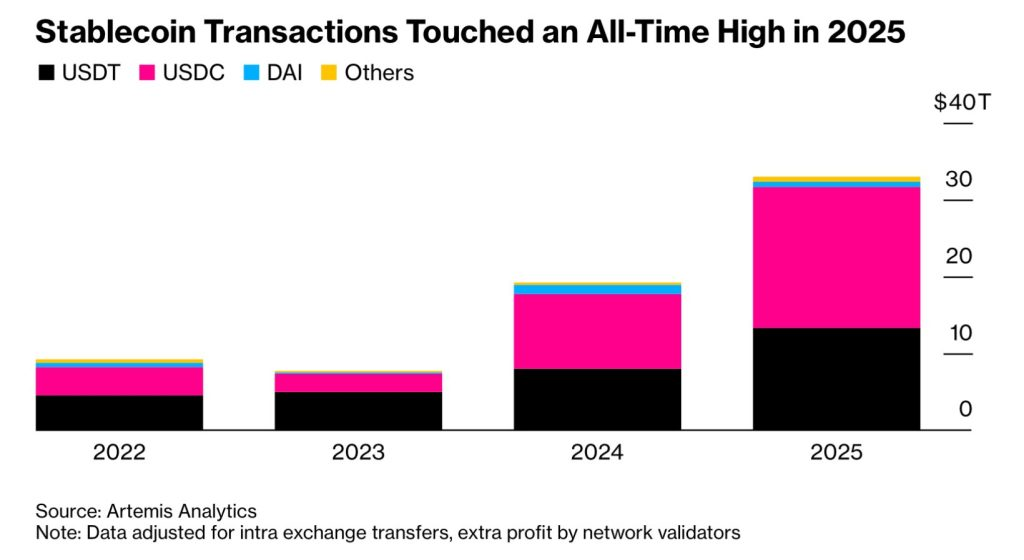
These divisions come as global stablecoin transaction volumes reached $33 trillion in 2025, up 72% from the previous year, with USDC processing $18.3 trillion.

Banks Stablecoin Yields - Stablecoin Transactions Volume 2025 Chart
Source: Artemis Analytics

Bloomberg Intelligence predicted that flows could reach $56 trillion by 2030 as institutional payment infrastructure adoption accelerates.

For now, the Banking Committee may postpone further work until late February or March, following Coinbase’s withdrawal of support and divided attention to the new housing policy agenda demanded by Trump.

However, the Senate Agriculture Committee has scheduled a markup of competing legislation for January 27 that takes a fundamentally different approach by excluding payment stablecoins from CFTC authority entirely and deferring regulation to frameworks like the GENIUS Act rather than setting specific yield rules.

The post Banks Make Killing Stablecoin Yields Their Top 2026 Priority appeared first on Cryptonews.

XRP Price Prediction: XRP Nears Accumulation Breakout as $1.85 Holds – Bulls Target $4

22 January 2026 at 17:43

The Long-Term Holder Net Unrealized Profit/Loss (LTH-NUPL) indicator reveals XRP has reset to levels historically associated with accumulation phases after defending a local price floor near $1.85.

Today’s XRP price prediction shows that if the $2.00 psychological level is reclaimed, a price discovery breakout toward the $4.00 high is next.

Ripple’s President Says 2026 Set to Be XRP’s Breakthrough Year

Ripple President Monica Long recently predicted 2026 is set to be XRP’s big year as real utility sees banks, corporates, and providers pilot stablecoins like RLUSD, on-chain assets, crypto custody, and broader institutional investment.

After one of crypto’s most exciting years (and Ripple’s), the industry is entering its production era. In 2026 we’ll see the institutionalization of crypto — trusted infrastructure and real utility will push banks, corporates, and providers from pilots to scale — across…

— Monica Long (@MonicaLongSF) January 20, 2026

“Crypto is no longer speculative—it’s becoming the operating layer of modern finance,” Long stated.

She projected that this year, approximately 50% of Fortune 500 companies will have crypto exposure or formalized Digital Asset Treasury (DAT) strategies, actively holding tokenized assets, on-chain T-bills, stablecoins, and programmable financial instruments.

Research shows that last year, B2B payments became the largest real-world use case for stablecoins, reaching an annualized run-rate of $76 billion. That’s a dramatic jump from early 2023, when monthly B2B stablecoin transfers sat below $100 million.

Source: Flagship Advisory

According to Long, the opportunity with XRP and crypto generally goes far beyond faster settlement. Companies are sitting on unprecedented amounts of trapped working capital, over $700 billion sitting idle on S&P 1500 balance sheets alone, and more than €1.3 trillion across Europe.

“By the end of 2026, balance sheets will hold over $1 trillion in digital assets, and roughly half of Fortune 500 companies will have formalized digital asset strategies,” Long concluded.

Similarly, according to observations shared by crypto analyst Paul Bennett, while “weak hands” are panic-selling, the XRP Ledger (XRPL) is signaling “bull market.”

Activity on the XRP blockchain just hit a massive 24-hour peak of 1.59 million transactions.

Although XRP’s price recently dipped 13% following geopolitical tensions that sent retail into “extreme fear,” historically, when activity stays high while price drops, it’s a coiled spring ready for an impulsive reversal.

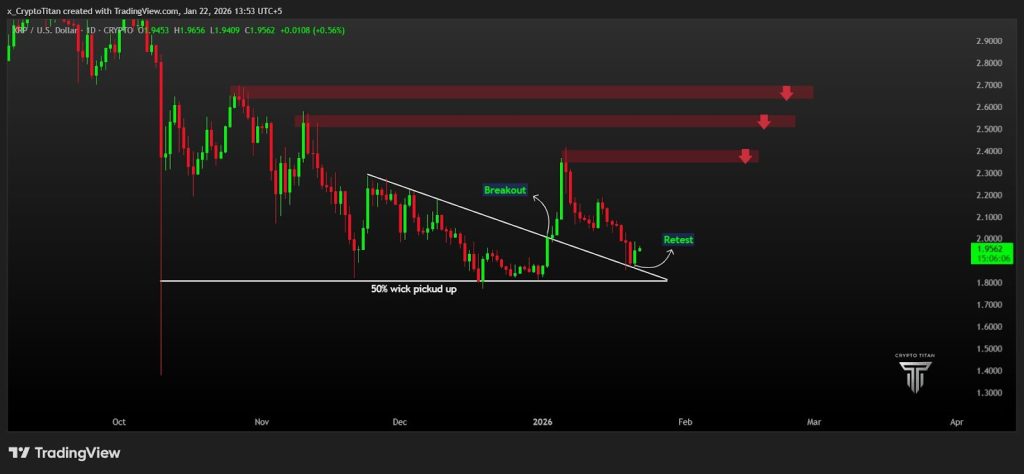
XRP Price Prediction: Daily Chart Shows Constructive Retest

The daily XRP/USD chart shows price previously respected a well-defined descending trendline, then broke above it with a strong impulsive move, signaling a momentum shift.

The subsequent pullback has behaved constructively thus far, with XRP retesting the former breakout zone near the $1.90-$2.00 area and holding above it, suggesting buyers are still defending this level rather than capitulating.

XRP Price Prediction - XRP Price Chart
Source: X/ CryptoTitan

However, the chart also makes clear upside is not yet free. Multiple supply zones are stacked above price, particularly between roughly $2.30 and $2.70, where prior breakdowns and aggressive selling occurred.

These zones represent areas where rallies are likely to face selling pressure and potential rejection.

From here, provided XRP continues holding above the retest area near $1.90-$2.00, the structure favors a gradual push higher, with a likely attempt to revisit the $2.30-$2.40 resistance first.

A clean daily close above that zone would strengthen the bullish case and open the door to higher resistance near the mid-$2.60s.

Maxi Doge Presale Offers Investors 70% APY Ahead of XRP Rally

If XRP reclaims $3.00 and resumes a bullish trajectory, presale projects like Maxi Doge (MAXI) would attract capital from investors pursuing high ROI opportunities.

Maxi Doge is an early-stage memecoin following the Dogecoin playbook, which helped it surge over 10x during the 2023-2024 breakout.

MAXI presale has raised over $4.5million and offers 70% annual staking rewards for early participants at the current $0.000278 price.

The presale has established an alpha channel to help traders share trade ideas, mirroring early Dogecoin days.

To buy early, visit the official Maxi Doge website and connect a crypto wallet like Best Wallet.

You can pay with USDT, ETH, or use a bank card immediately.

Visit the Official Maxi Doge Website Here

The post XRP Price Prediction: XRP Nears Accumulation Breakout as $1.85 Holds – Bulls Target $4 appeared first on Cryptonews.

Circle CEO Rejects Claims Stablecoin Yields Threaten Banks

22 January 2026 at 12:58

Circle CEO Jeremy Allaire dismissed banking industry warnings that stablecoin rewards could destabilize traditional finance, calling such concerns “totally absurd” during a World Economic Forum panel discussion on Thursday.

His remarks came amid escalating tensions between crypto platforms and banks over provisions in pending U.S. market structure legislation.

Speaking at the Davos summit, Allaire defended the stablecoin industry’s growth trajectory while addressing claims from Bank of America CEO Brian Moynihan that yield-bearing digital dollars could trigger massive deposit flight from commercial banks.

The panel, which included International Monetary Fund First Deputy Managing Director Dan Katz and development finance expert Vera Songwe, examined stablecoins’ expanding role in global payments following last year’s passage of the GENIUS Act.

Banks Warn of “Parallel Banking System”

Banking executives have intensified lobbying against stablecoin rewards programs, with JPMorgan CFO Jeremy Barnum recently warning that interest-paying tokens create “a parallel banking system that sort of has all the features of banking, including something that looks a lot like a deposit that pays interest, without the associated prudential safeguards.

The Community Bankers Council of the American Bankers Association also urged Congress earlier this month to close what it called a “loophole” allowing stablecoin issuers to indirectly fund yield through exchange partners.

Community bankers warned that large-scale deposit outflows could reduce credit availability for small businesses and homebuyers.

⚠ @JPMorgan backs blockchain innovation but warns yield-bearing stablecoins mimic bank deposits without oversight.#JPMorgan #Stablecoinhttps://t.co/4Fbu8pMOwk

— Cryptonews.com (@cryptonews) January 14, 2026

Allaire countered that such arguments ignore financial market history and mischaracterize how stablecoins function within regulatory frameworks.

Rewards around financial products exist in every balance that you have with a credit card that you use,” he said, noting these incentives help with customer retention without functioning as monetary policy dampeners.

Money Market Funds Precedent Cited

The Circle chief executive drew parallels to government money market funds, which banking groups once claimed would devastate deposit bases.

The exact same arguments were made,” Allaire stated, pointing out that roughly $11 trillion in money market funds has grown without preventing lending activity.

He argued that lending itself has shifted toward private credit markets, with “the vast vast majority of GDP growth in the United States” historically funded through capital market formation around junk bonds rather than bank credit.

Allaire emphasized that all major stablecoin regulations (including the GENIUS Act, Europe’s MiCA framework, and laws in Japan, UAE, Hong Kong, and Singapore) explicitly prohibit stablecoin issuers from paying interest.

Circle CEO Stablecoin Yields Threaten Banks - Jeremy Allaire Image
Source: YouTube

Payment stablecoins” are legally defined as cash instruments used for settlement and require cash-level safeguards under supervision by central bankers and global standard-setters.

While Circle generates income from reserves and revenue-sharing partnerships with platforms like Coinbase, Binance, and Visa, the company itself cannot pay interest directly to tokenholders.

Partner platforms may offer rewards based on their own commercial arrangements, but Allaire argued that this mirrors loyalty programs across traditional financial products.

IMF Acknowledges Benefits Amid Risks

The IMF’s Katz acknowledged stablecoins present “very significant potential benefits” for cross-border payments and financial inclusion while noting risks including banking disintermediation and currency substitution in emerging markets.

Transaction volumes reached $33 trillion in 2025, up 72% from the previous year, with USDC processing $18.3 trillion to lead all stablecoins by payment flow.

Stablecoin Transactions Volume Chart
Source: Artemis Analytics

Katz emphasized the importance of international regulatory interoperability, stating that realizing stablecoins’ full benefits requires scale and effective cross-border frameworks.

He pointed out the competitive pressures stablecoins create for traditional finance and weak fiscal regimes alike.

Songwe detailed stablecoins’ transformative impact across Africa, where remittance costs averaging 6% can drop to under $1 with digital dollar transfers that complete in minutes, versus five-day settlement delays.

With 650 million Africans lacking bank accounts and 12-15 countries experiencing inflation above 20%, stablecoins provide dollar-denominated savings accessible via smartphones.

Egypt, Nigeria, and Ethiopia lead African adoption, with most transactions below $1 million, indicating heavy small-business use.

In fact, according to Chainalysis, Sub-Saharan Africa received over $205 billion in on-chain value, up roughly 52% from the previous year between July 2024 and June 2025.

However, Songwe noted that 75% of stablecoin reserves remain dollar-denominated, prompting the development of SDR-backed alternatives to reduce dollar dependency and improve transparency around illicit financial flows.

Allaire concluded that stablecoins should remain “cash instrument money, credentially supervised, very very safe money,” with efficient credit delivery systems built atop them through decentralized finance protocols that can be “safer, more transparent, more efficient, more inclusive, and more globally available than what we have with bank credit today.

The post Circle CEO Rejects Claims Stablecoin Yields Threaten Banks appeared first on Cryptonews.

Tron Founder Justin Sun Invests $8M in River’s Stablecoin Abstraction Technology

22 January 2026 at 09:59

Tron founder Justin Sun invested $8 million in DeFi project River to support ecosystem integration on the Tron blockchain and deployment of River’s chain abstraction stablecoin infrastructure.

The deal positions Tron to leverage River’s cross-chain technology through satUSD, a stablecoin mintable at a 1:1 ratio with USDT, USDD, or USD1.

River announced the funding on X, emphasizing its mission to build a system that connects every asset to its opportunity while allowing value to flow freely across ecosystems without locking capital away.

$8M Strategic investment by @justinsuntron

This investment supports ecosystem integration on @trondao and the deployment of River’s chain abstraction stablecoin infrastructure.

River connects cross ecosystem assets and liquidity into TRON through satUSD, which can be minted 1… pic.twitter.com/3t9P069tPI

— River (@RiverdotInc) January 21, 2026

The investment comes weeks after MaelstromFund, founded by BitMEX co-founder Arthur Hayes, also backed the project in early January.

River Bags Stablecoin Integration Across the Tron Ecosystem

Per the announcement, Justin Sun’s capital will support multiple deployments, including stablecoin pools alongside USDT and USDD on SUN, lending and borrowing on JustLend, and price feeds provided by WinkLink.

Integration extends across core assets,s including USDT, TRX, wBTC, BTT, JST, SUN, WIN, and NFT use cases, with native sTRX staking yield serving as the initial entry point.

River also plans to launch Smart Vault and Prime Vault products targeting yield strategies for stablecoins, TRX, and other core Tron assets.

Since the funding announcement, River’s ($RIVER) token appreciated over 20%, reaching an all-time high of $48.74.

The token posted over 800% gains in the last 30 days to reach a market capitalization of around $840 million, jumping from $8 to the current $42.68 after starting January with approximately $100 million market cap.

Justin Sun River's Stablecoin Abstraction Technology - RIVER Token Chart
Source: Coingecko

Hayes’ Maelstrom investment in early January triggered a 600% surge for RIVER within weeks, with the token rising from around $3 to $19.

Market observers attributed the rally to Hayes’ endorsement and his stated belief in chain abstraction technology as fundamental to DeFi’s next growth phase.

River currently integrates with over 30 protocols across major ecosystems, including Ethereum, BNB Chain, and Base, with satUSD circulation exceeding $100 million.

Legal Challenges Shadow Sun’s Investment Activity

Sun’s recent capital commitment unfolds amid ongoing legal scrutiny around the alleged misappropriation of TrueUSD (TUSD) stablecoin reserves.

Last November, a judge at the Dubai International Financial Centre imposed a worldwide freeze on $456 million in assets tied to TUSD reserves, linked to Sun’s earlier bailout of the token.

According to case filings, Techteryx, which acquired TrueUSD in 2020, failed to redeem a large portion of its U.S. dollar reserves managed by First Digital Trust between 2022 and 2023.

Counsel for Techteryx stated that reserves originally custodied in Hong Kong saw around $468 million invested in the Aria Commodity Finance Fund, though nearly $456 million was transferred directly to Aria Commodities DMCC.

The diverted funds gave rise to claims of breach of trust and knowing receipt, prompting the proprietary injunction and subsequent global asset freeze.

Beyond Dubai, Congressional Democrats on January 15 formally accused the Securities and Exchange Commission of operating a pay-to-play scheme in its handling of crypto enforcement cases, with particular focus on the agency’s treatment of Sun.

Representative Maxine Waters sent a detailed letter to SEC Chairman Paul Atkins highlighting Sun’s extensive financial relationship with Trump family ventures, noting his $75 million investment in World Liberty Financial.

Sun is also a top holder of Trump’s memecoin, which earned him an invitation to a May 2025 White House dinner for major investors.

🎁 Tron founder @justinsuntron has received a Trump-branded Golden Tourbillon watch for being the top holder of President @realDonaldTrump’s memecoin.#Trump #Sunhttps://t.co/NI4bVy3smJ

— Cryptonews.com (@cryptonews) May 23, 2025

Regulators also claimed Sun engineered the offer and sale of two crypto asset securities without proper registration while directing hundreds of thousands of TRX wash trades that generated approximately $31 million from unsuspecting investors.

Judge Vernon Broderick of the Southern District of New York sustained core allegations in a parallel private class action, finding that plaintiffs plausibly alleged Sun and Tron illegally sold TRX as an unregistered security.

Despite these ongoing legal challenges, Sun continues to expand his cryptocurrency portfolio and investments, with Bloomberg estimating his net worth at approximately $12.5 billion.

The post Tron Founder Justin Sun Invests $8M in River’s Stablecoin Abstraction Technology appeared first on Cryptonews.

Strive Eyes $150M Capital Raise to Fuel Bitcoin Accumulation Push

22 January 2026 at 08:24

Asset management firm Strive has announced plans for a $150 million follow-on offering of its Variable Rate Series A Perpetual Preferred Stock, with proceeds earmarked primarily for Bitcoin acquisition and debt reduction.

The Dallas-based company, which currently holds approximately 12,798 BTC as of January 16, disclosed the capital raise on Wednesday as part of its strategy to transition toward a “perpetual-preferred only amplification model” while expanding its Bitcoin treasury operations.

The offering comes amid significant on-chain shifts in Bitcoin’s holder composition and heightened market volatility.

CryptoQuant data reveals that 2024 and 2025 marked “the largest long-term Bitcoin supply release in history,” with dormant coins held for over two years moving at unprecedented rates.

Strive Bitcoin Accumulation - Bitcoin Revived Supply by Year Chart
Source: CryptoQuant

Analysts interpret this as a fundamental shift in ownership from early holders focused on halving cycles to newer participants driven by macro factors and liquidity considerations.

Strategic Debt Reduction and Treasury Expansion

Strive intends to deploy capital from the stock sale alongside existing cash reserves and proceeds from terminating capped call transactions tied to Semler Scientific’s outstanding $4.25% Convertible Senior Notes due 2030.

The company plans to use funds for “the redemption, repurchase, repayment, satisfaction and discharge or other payment of all or a portion” of these convertible notes and Semler Scientific’s borrowings under its master loan agreement with Coinbase Credit Inc., according to the announcement.

The firm is simultaneously negotiating separate transactions with certain noteholders to exchange portions of the Semler Convertible Notes for shares of SATA Stock.

Strive expects to reduce the offering size proportionally if these exchanges proceed, though the company emphasized that “this offering is not conditioned on the closing of any such exchange.

Any completed exchanges would be conducted under Section 4(a)(2) of the Securities Act as private transactions not involving public offerings.

Barclays and Cantor are serving as joint book-running managers for the offering, with Clear Street acting as co-manager.

The sale follows regulatory protocols under an effective shelf registration statement filed with the Securities and Exchange Commission.

Market Dynamics Support Institutional Accumulation

The capital raise unfolds against a backdrop of continued institutional Bitcoin accumulation despite short-term price volatility.

CryptoQuant analysis shows that “since January, Bitcoin whales have continued to accumulate aggressively despite short-term volatility and corrective phases, while retail investors have exited.

Strive Bitcoin Accumulation - Total Whale Holdings and Monthly % Chnage
Source: CryptoQuant

Even after recent geopolitical escalation, whale holdings on a monthly basis “have not declined but instead continued to increase, indicating that the current phase is structural accumulation rather than distribution.

Market conditions remain mixed, however.

Bitcoin’s estimated leverage ratio on Binance surged to approximately 0.184 near the $90,000 price level, marking its highest reading since last November and reflecting “a notable return to leverage following a period of relative risk aversion.

Strive Bitcoin Accumulation - Bitcoin Estimated Leverage Ratio Binance
Source: CryptoQuant

This elevated borrowing among futures traders increases market susceptibility to sharp liquidation events during rapid price movements in either direction.

Asian markets opened higher today as Bitcoin edged toward $90,000 following President Donald Trump’s comments indicating a “framework of a future deal” involving NATO over Greenland, easing immediate tariff concerns.

Bitfinex analysts noted the focus now centers on stabilization signals, including flattening ETF flows, positive spot taker cumulative volume delta, and sustained price action above $90,000 with declining volatility.

Aggressive Treasury Strategy Follows Industry Leaders

Strive’s expansion follows significant corporate moves to accumulate Bitcoin.

The company previously announced a $500 million preferred stock offering in December 2025 and completed a merger with Semler Scientific in an all-stock transaction valued at a 210% premium.

The combined entity now pursues Bitcoin-per-share growth to “outperform Bitcoin over the long run,” according to Chairman and CEO Matt Cole.

Strategy, led by Michael Saylor, purchased 22,305 BTC for approximately $2.13 billion between January 12-19 at an average price of $95,284 per coin, bringing total holdings to 709,715 Bitcoin.

🟠 Michael Saylor’s @Strategy bought 22,305 $BTC for $2.13B at $95,284 per coin, lifting total holdings to 709,715 bitcoin.#Strategy #Bitcoinhttps://t.co/orZmJ4iT5E

— Cryptonews.com (@cryptonews) January 20, 2026

Meanwhile, 91-year-old burger chain Steak ‘n Shake also entered corporate Bitcoin ownership with a $10 million treasury purchase, establishing a “Strategic Bitcoin Reserve” that channels all Bitcoin received from Lightning Network payments directly into holdings rather than converting to cash.

The post Strive Eyes $150M Capital Raise to Fuel Bitcoin Accumulation Push appeared first on Cryptonews.

US Senate Crypto Bill Heads to Markup Without Democrat Support

22 January 2026 at 05:33

The Senate Agriculture Committee has released updated crypto market structure legislation and scheduled a markup for January 27 despite failing to secure Democratic backing, marking a potential shift toward partisan passage after months of bipartisan negotiations stalled.

Chairman John Boozman announced the legislative text yesterday, acknowledging that “differences remain on fundamental policy issues” while expressing gratitude for collaboration with Senator Cory Booker.

Although it’s unfortunate that we couldn’t reach an agreement, I am grateful for the collaboration that has made this legislation better,” Boozman said, noting the markup will proceed at 3 p.m. in the Russell Senate Office Building.

🚨BREAKING: Chairman @JohnBoozman releases updated market structure legislation ahead of January 27th markup. https://t.co/PB7O9FMJlZ pic.twitter.com/k7FuIBgEsk

— Senate Ag Committee Republicans (@SenateAgGOP) January 22, 2026

Legislative Path Narrows as Banking Panel Delays CLARITY Act

The Agriculture Committee’s decision to advance its Digital Commodity Intermediaries Act comes as the Senate Banking Committee postponed work on the parallel CLARITY Act until late February or March, according to sources.

The Banking panel has pivoted to housing legislation following President Trump’s push for affordability, with the president writing that he is taking “immediate steps” on the housing bill, which remains a priority and “American Dream.

That delay followed Coinbase CEO Brian Armstrong’s public withdrawal of support over provisions he called “catastrophic,” including restrictions on tokenized equities and stablecoin yield.

Patrick Witt, White House Executive Director of the President’s Crypto Council, pushed back against Armstrong’s “no bill is better than a bad bill” stance, warning that delaying legislation risks future Democratic lawmakers writing “punitive legislation in the wake of a crisis, à la Dodd-Frank.

You might not love every part of the CLARITY Act, but I can guarantee you’ll hate a future Dem version even more,” Witt wrote.

Meanwhile, President Trump confirmed at Davos 2026 that he expects to sign crypto market structure legislation “very soon,” stating his administration is working to ensure “America remains the crypto capital of the world.

JUST IN: 🇺🇸 President Trump says he hopes to sign the crypto market structure bill (CLARITY Act) soon. pic.twitter.com/2tQQqeefwP

— Altcoin Daily (@AltcoinDaily) January 21, 2026

Democratic opposition has intensified over ethics concerns, with Senator Adam Schiff demanding controls covering the White House and Senator Ruben Gallego calling ethics guardrails “a red line.”

Key Differences Between Competing Bills Shape Industry Response

The updated bill diverges from Banking’s CLARITY Act on several critical points, particularly regarding stablecoin yield, which has been the single biggest source of industry division.

CLARITY’s Section 404 explicitly prohibits digital asset service providers from paying interest or yield solely for holding payment stablecoins, though it permits “activity-based” rewards for transactions, loyalty programs, staking, or governance participation.

The new bill takes a fundamentally different approach by excluding “permitted payment stablecoins” from CFTC authority entirely, deferring regulation to frameworks like the GENIUS Act rather than setting specific yield rules.

Notably, the bill also explicitly classifies meme coins as digital commodities under CFTC jurisdiction, defining them as assets “inspired by internet memes, characters, or current events, where promoters seek to attract an enthusiastic community primarily for speculative purposes.

An excerpt of the Republican draft crypto bill. | ource: Senate Agriculture Committee

CLARITY instead introduces “ancillary assets” concepts with exemptions for tokens that were principal assets of ETFs listed as of January 1, 2026.

On developer protections, the bill establishes an Office of the Digital Commodity Retail Advocate within the CFTC, while CLARITY creates a CFTC-SEC Micro-Innovation Sandbox for small firms.

Both protect software developers from regulation, though CLARITY’s Section 604 sparked warnings from Judiciary Committee leaders Chuck Grassley and Dick Durbin that it could “materially limit prosecutors’ ability to pursue financial crime cases.

Banking Lobby Secures Stablecoin Restrictions Amid Industry Split

The stablecoin yield debate has exposed deep rifts between crypto platforms and traditional banks.

Bank of America CEO Brian Moynihan recently warned that as much as $6 trillion in deposits (roughly 30% to 35% of US commercial bank deposits) could migrate into stablecoins, while JPMorgan CFO Jeremy Barnum called yield-bearing stablecoins “a parallel banking system that includes something that looks a lot like a deposit that pays interest, without the associated safeguards.

Galaxy Digital also warned that Banking’s draft could grant Treasury “Patriot Act–style” surveillance powers, including authority to freeze transactions for up to 30 days without court orders.

Given this increasing friction with banks, Armstrong said Coinbase is exploring compromises with them during Davos talks, stating, “we’re going to continue to work on the market structure legislation, and meet with some of the bank CEOs to figure out how we can make this a win-win.

🤝 Coinbase CEO @brian_armstrong said he will take US crypto market structure talks to Davos, seeking a compromise with banks as legislation stalls in Washington.#Coinbase #CryptoMarketStructure https://t.co/GKvYIkcTSs

— Cryptonews.com (@cryptonews) January 20, 2026

Despite regulatory uncertainty, Clear Street analyst Owen Lau noted that “institutional use cases continue to expand even without a favorable Clarity Act,” pointing to continued blockchain adoption by major financial institutions.

The post US Senate Crypto Bill Heads to Markup Without Democrat Support appeared first on Cryptonews.
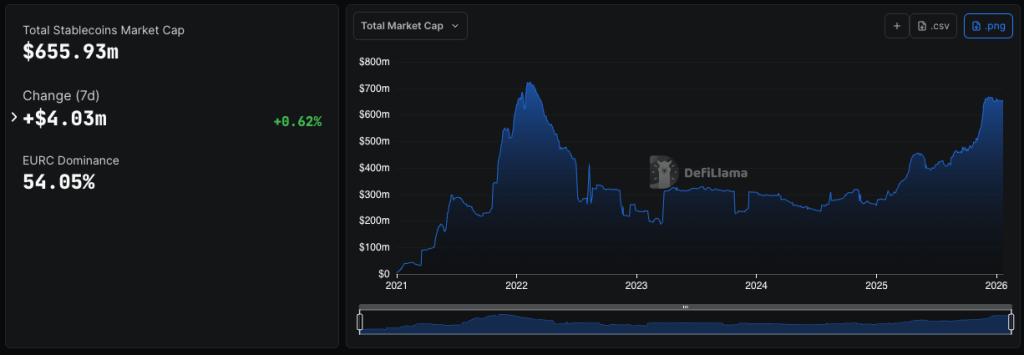
Thailand Targets Early 2026 for Crypto ETF Regulations

22 January 2026 at 03:13

Thailand’s Securities and Exchange Commission is finalizing regulations to introduce crypto exchange-traded funds early this year, alongside rules for crypto futures trading and expanded tokenized investment products, as the regulator moves to align the country’s capital market framework with accelerating global trends in digital asset adoption.

According to the Bangkok Post, Deputy Secretary-General Jomkwan Kongsakul confirmed that the SEC plans to issue formal guidelines supporting the establishment of crypto ETFs early this year, while working to enable crypto futures trading on the Thailand Futures Exchange.

The regulatory push builds on the SEC board’s approval of crypto ETFs in principle, with detailed investment and operational rules now undergoing final development requiring close cooperation between asset management companies and licensed digital asset exchanges.

THAILAND MOVES TO SUPPORT CRYPTO INVESTMENTS

Thailand’s 'SEC' says new rules are coming for crypto ETFs, crypto futures, and tokenized investments, formally recognizing digital assets as an official asset class under the law. pic.twitter.com/o5qMMBbZG4

— Coin Bureau (@coinbureau) January 22, 2026

Crypto ETFs Designed to Lower Barriers and Security Risks

Kongsakul emphasized that crypto ETFs offer significant advantages for Thai investors who already have access to similar products in overseas markets.

A key advantage of crypto ETFs is ease of access; they eliminate concerns over hacking and wallet security, which has been a major barrier for many investors,” she stated.

The products allow exposure to digital assets without opening digital wallets or managing private keys, substantially reducing operational and cybersecurity risks that have deterred mainstream participation.

The SEC is considering introducing market makers for crypto ETFs to ensure adequate liquidity, potentially including digital asset exchanges, financial institutions, corporations, and entities holding cryptocurrencies on their balance sheets.

Once finalized, jointly developed products between asset managers and licensed exchanges could be listed and traded on the Stock Exchange of Thailand.

The regulator is also pursuing formal recognition of digital assets as an underlying asset class under the Derivatives Act, paving the way for crypto futures trading on TFEX under the Futures Trading Act.

Crypto futures would be traded on TFEX under the Futures Trading Act,” Kongsakul explained, adding the move would provide investors with hedging tools and sophisticated risk management options.

Regulators Position Digital Assets as Portfolio Diversification Tool

The SEC emphasized that crypto should be treated as “another asset class” rather than a speculative instrument, recommending that investors with a higher risk tolerance allocate 4-5% of their portfolios to digital assets while maintaining diversification.

Thailand approved its first spot Bitcoin ETF in 2024 through One Asset Management, structured as a “fund of funds” that provides institutional clients with regulated access through global investment vehicles, following similar moves in the United States and Hong Kong.

The upcoming expansion into altcoin ETFs represents the next policy development stage, with Bloomberg reporting in October 2025 that the SEC was drafting rules in coordination with other agencies to widen crypto ETF offerings beyond Bitcoin to include a basket of digital tokens.

Thailand plans to expand its crypto ETF market beyond Bitcoin to include multiple tokens, with new rules expected early next year.#Thailand #CryptoETFs https://t.co/ob28LM5N0g

— Cryptonews.com (@cryptonews) October 2, 2025

Beyond new investment products, the SEC intends to strengthen oversight of online financial personalities by establishing clearer boundaries between general market commentary and services that require professional licensing.

Providing factual information may not require a licence, but any recommendation related to securities or investment returns will require proper authorisation as either an investment advisor or introducing broker,” Kongsakul stated.

Thailand Joins Global Push Toward Regulated Crypto Products

The regulator is collaborating with the Bank of Thailand to establish a sandbox to promote tokenization and distributed ledger technology, believing that tokenization could significantly lower barriers for retail investors and help digital assets become a meaningful driver of Thailand’s economic growth.

The SEC also wants to expand the use of digital tokens for investment beyond existing investment tokens to include bond tokens and tokenized fund units, with Thailand’s first green token expected to launch, supporting sustainable finance and ESG-linked investment.

🇹🇭 Thailand chooses KuCoin as lead partner for historic $153M tokenized government securities with $3 minimum investment.#Thailand #Cryptohttps://t.co/do6x6GRhEE

— Cryptonews.com (@cryptonews) August 27, 2025

Thailand’s preparations for a crypto ETF align with broader momentum across Asia and Western markets, as South Korea announced plans to introduce spot Bitcoin ETFs in 2026 as part of its Economic Growth Strategy, despite ongoing legislative disputes over stablecoin governance.

Vietnam has also introduced a crypto pilot licensing regime this week, requiring a minimum capital of $380 million, attracting interest from around 10 securities firms and banks.

Outside Asia, Vanguard has also reversed years of resistance by opening its $11 trillion brokerage platform to third-party crypto ETFs and mutual funds in December 2025, with its head of brokerage, Andrew Kadjeski, stating that “cryptocurrency ETFs and mutual funds have been tested through periods of market volatility, performing as designed while maintaining liquidity.

The post Thailand Targets Early 2026 for Crypto ETF Regulations appeared first on Cryptonews.

XRP Price Prediction: Ripple CEO at Davos Predicts Crypto ATHs This Year – $5 XRP Next?

21 January 2026 at 15:49

Speaking at the World Economic Forum in Davos, Switzerland, Ripple CEO Brad Garlinghouse predicts the crypto market will see new highs this year. “I’m very bullish, and yes, I’ll go on record as saying, I think we’ll see an all-time high,” he told CNBC.

Analysts say the XRP price prediction aligns with this projection as Ripple’s token continues gaining institutional support that could propel it toward $5 this year.

Ripple CEO Says Institutional Demand Enough to Send XRP to New Highs

Garlinghouse stated he believes this is the moment to use crypto and blockchain technology to enable economic access for a more efficient, more scalable, and utility-focused global financial system.

Spirited dialogue during today’s WEF session (to say the least), but one important point of agreement across the panelists was that innovation and regulation aren’t on opposite sides.

I firmly believe this is THE moment to use crypto and blockchain technology to enable economic… https://t.co/4d3jNeNC4h

— Brad Garlinghouse (@bgarlinghouse) January 21, 2026

He added that “major” financial institutions showing interest in crypto is a “massive sea change.” “I don’t think that’s priced into the crypto market as much as I would have expected right now.”

XRP, Ripple’s payments token, became a breakout trade of this month’s crypto rally after gaining over 20% before its recent cooling toward $1.90 at the time of writing.

Ripple has positioned the token as a compliant alternative for institutions navigating tighter oversight of dollar-pegged assets.

Recently, Ripple’s U.S. dollar-backed stablecoin RLUSD debuted its spot trading on Binance, expanding the token’s reach on one of the world’s largest digital asset exchanges.

The listing marks a notable step in RLUSD’s rollout and reflects Ripple’s push to position the stablecoin as a payments-focused asset with institutional-grade infrastructure.

Analyst ChartNerd revealed that XRP has already broken out of a textbook falling wedge pattern, accompanied by strong bullish RSI divergence.

Now, it’s successfully backtesting the upper trendline of the RSI compression and the falling wedge breakout, which could see it reclaim the $2.50 zone and target a new high around $5.00.

XRP Price Prediction: Weekly Chart Shows Critical $2.00 Support Test

The weekly XRP/USDT chart shows a market in a corrective phase following a strong impulsive rally, with price now compressing around a decisive inflection zone.

XRP continues respecting the critical $2.00 support area, which has repeatedly absorbed selling pressure and acted as a base for short-term stabilization.

However, the broader structure remains capped by a descending trendline from the July peak and clearly defined horizontal resistance near $3.00, which previously marked distribution and aggressive profit-taking.

XRP Price Prediction - XRP Price Chart
Source: TradingView

Momentum indicators reinforce this cautious tone. RSI hovers in the low-40s and trends lower, reflecting weakening bullish momentum and confirming the bearish divergence that formed near cycle highs.

This suggests upside attempts remain vulnerable to rejection unless momentum meaningfully improves.

Price action also remains below key Fibonacci retracement levels between roughly $2.80 and $3.25—an area that now represents a heavy supply zone where sellers are likely to re-emerge on rallies.

Provided XRP holds above this level, price will likely continue consolidating with a slight bullish bias, potentially attempting a grind toward the descending trendline around the mid-$2 range.

Maxi Doge Presale Raises $4.5M To Position for XRP Rally

If XRP reclaims the $3.00 level and resumes its bullish rally, presale projects like Maxi Doge (MAXI) would attract capital from investors seeking high ROI opportunities.

Maxi Doge is an early-stage memecoin following the Dogecoin playbook that helped it surge over 10x during the 2023-2024 breakout rally.

The presale project has established an alpha channel to help traders exchange insider tips and share trade ideas, mirroring the early days of Dogecoin.

Maxidoge Banner

The MAXI presale has already raised over $4.5 million and offers 70% annual staking rewards for early participants at the current $0.000279 price.

To buy early before price increases, visit the official Maxi Doge website and connect a crypto wallet like Best Wallet.

You can pay with existing crypto like USDT and ETH, or use a bank card to complete your purchase immediately.

Visit the Official Maxi Doge Website Here

The post XRP Price Prediction: Ripple CEO at Davos Predicts Crypto ATHs This Year – $5 XRP Next? appeared first on Cryptonews.

Bank of Italy Chief Warns Banks Must Tokenize Money to Compete with Stablecoins

21 January 2026 at 15:26

Bank of Italy Governor Fabio Panetta told the country’s banking association on Wednesday that commercial banks must convert their money into digital tokens to remain competitive as stablecoins gain momentum, backed by what he described as strong support from the United States administration.

According to Reuters, the European Central Bank policymaker’s comments come as European officials debate how to preserve the continent’s monetary sovereignty while American policymakers accelerate efforts to establish dollar-backed digital assets as a global payment standard.

Addressing bankers in Milan, Panetta said traditional money would continue to anchor the financial system, but warned that both central bank and commercial bank money must become fully digital.

I expect commercial bank money will also become mostly tokenised,” he stated, referring to the process of converting financial assets into digital tokens issued on distributed ledgers such as blockchain.

Banks Stablecoins - Fabio Panetta Image
Source: Bloomberg

U.S. Push Drives Stablecoin Expansion

Panetta acknowledged that stablecoin use would grow substantially in line with Washington’s strategic priorities.

They’ll definitely develop because there’s a big push by the U.S. administration,” he said, explaining that American officials view digital assets as tools to reinforce global dollar demand.

The governor emphasized uncertainty around stablecoins’ ultimate role but insisted they would not displace traditional money, which he called the financial system’s only stable anchor.

It’s not clear what role they’ll have … but I expect the system will remain centred around central bank and commercial bank money, both of which will need to become digital,” Panetta added during his address to Italy’s banking leaders.

His warning arrives amid escalating European concerns about dollar-denominated stablecoins controlling 99.58% of the $300 billion global market while euro-backed alternatives remain marginal at just $680 million.

Banks Stablecoins - Euro Stablecoins Marketcap Chart
Source: DefiLlama

The ECB has repeatedly flagged systemic risks from rapid stablecoin growth, particularly as leading issuers now rank among the world’s largest U.S. Treasury holders, creating potential spillover effects into traditional markets during stress events.

The ECB seeks to launch a digital euro by 2029 to maintain the relevance of central bank money in an increasingly digital economy and to protect Europe’s monetary sovereignty.

Panetta noted recent geopolitical developments showed Europe’s risky dependence on American firms like Visa, Mastercard, and PayPal for over two-thirds of its payments.

Banks Resisted Digital Euro Over Competition Fears

The digital euro project has faced strong opposition from commercial banks, particularly in Germany, which fear competition from the ECB for deposits.

Panetta addressed this resistance directly, recounting discussions with banks in a large European country that opposed the project because they worried about losing 30% of the payments they handled digitally.

When I discussed this with the banks of a large European country that opposed the digital euro because they worried they’d lose the 30% of payments they handled digitally, I told them: instead of worrying about the 30% think about who controls the 70% you’ve already lost,” Panetta said.

His remarks contrast sharply with a December open letter from 70 European economists who urged EU lawmakers to prioritize public digital currency over private stablecoins, warning that poor design choices could leave Europe dependent on foreign payment systems.

🇪🇺 Seventy European economists warn that weak digital euro design could leave Europe reliant on US payment systems and dollar-backed stablecoins.#DigitalEuro #EU #Stablecoinhttps://t.co/FqcWLtAyEG

— Cryptonews.com (@cryptonews) January 12, 2026

The academics, including Thomas Piketty and Paul De Grauwe, demanded that the digital euro serve as “the backbone of a sovereign, resilient European payment infrastructure,” with generous holding limits and broad accessibility.

Meanwhile, ten major European banks, including BNP Paribas, ING, and UniCredit, formed a consortium in December to launch a euro-backed stablecoin by mid-2026 through a Dutch entity called Qivalis.

The initiative directly addresses concerns about dollar dominance, with euro-denominated stablecoins accounting for less than 1% of the global market despite the eurozone’s economic scale.

Panetta’s tokenization call reflects growing recognition that traditional banks risk irrelevance if they do not adapt to blockchain-based payment systems.

The ECB confirmed last month it would begin allowing distributed ledger technology transactions to settle in central bank money in 2026, marking concrete progress toward integrating digital assets into Europe’s monetary infrastructure while political negotiations continue over the digital euro’s final regulatory framework.

The post Bank of Italy Chief Warns Banks Must Tokenize Money to Compete with Stablecoins appeared first on Cryptonews.

Greenland Gambit Sparks Crypto Chaos: Tariff Threats Send Bitcoin Sliding – Analysts Eye $75K

21 January 2026 at 15:18

Markets convulsed after President Donald Trump threatened steep tariffs on eight European nations unless Denmark cedes Greenland, with rhetoric including hints the U.S. might seize the territory by force, triggering a global risk-off move on January 20.

Gold surged to record highs while Bitcoin plunged into the low-$90K range, with some intraday trades dipping as low as $87K.

Greenland Tariff Threats Bitcoin - Bitcoin Price Chart
Source: TradingView

The crypto market shed nearly $150 billion in market capitalization as leveraged positions unwound violently, exposing Bitcoin’s continued treatment as a speculative asset rather than the safe haven its proponents claim it to be.

Tariff Shock Drives Historic Divergence

Trump’s Saturday announcement targeted Germany, France, the UK, the Netherlands, Finland, Sweden, Norway, and Denmark with 10% tariffs starting February 1, escalating to 25% by June 1, unless a Greenland deal is reached.

ING economists warned that “additional tariffs of 25% would probably shave 0.2 percentage points off European GDP growth,” compounding recession fears already gripping the continent.

The tariff threat effectively reopened the trade war between the EU and the U.S., despite a temporary truce reached in late July, raising the stakes and bringing a far tougher approach.

European officials brought forward the option of activating the so-called anti-coercion instrument, the EU’s trade “bazooka“, allowing the bloc to impose tariffs and investment limits on offending nations.

French President Emmanuel Macron announced he would request the instrument’s activation, while Manfred Weber from the European Parliament’s largest party indicated the July deal was now “on ice.”

EU capitals is considering hitting U.S. with €93 billion worth of tariffs or restricting American companies from bloc’s market in response to President Donald Trump’s threats, per FT. pic.twitter.com/VuAefTw5yt

— Open Source Intel (@Osint613) January 18, 2026

European countries hold approximately $8 trillion in U.S. bonds and stocks, making Europe by far the largest U.S. lender and exposing the deep interdependence that could turn this standoff into a full-blown crisis.

Germany’s export-reliant economy faces particularly acute pressure, with ING economist Carsten Brzeski warning the new tariffs would be “absolute poison” for the fragile recovery underway.

German exports to the United States fell 9.4% from January to November compared with a year earlier, and the trade surplus dropped to its lowest level since 2021.

Meanwhile, gold’s parabolic rally pushed prices past $4,800 per ounce to all-time highs.

TD Securities’ Daniel Ghali told Bloomberg that “gold’s rally is about trust. For now, trust has bent, but hasn’t broken. If it breaks, momentum will persist for longer.

Crypto Markets Suffer Violent Unwind

Bitcoin’s collapse alongside traditional risk assets exposed the crypto’s failure to serve as a geopolitical hedge, despite years of positioning as “digital gold.”

CoinGlass liquidation data revealed $998.33 million in long positions wiped out over 24 hours, with Bitcoin accounting for $440.19 million as cascading margin calls accelerated during thin Asian trading hours.

Galaxy Digital’s Alex Thorn noted that “Bitcoin isn’t quite doing the thing that it’s built to do, at least in real time,” while Bitunix analyst Dean Chen observed that “among crypto-native investors, it is increasingly framed as a geopolitical hedge and a non-sovereign store of value.”

However, for the broader market, Bitcoin is still largely traded as a high-beta risk asset,” he concluded.

Derivatives markets paint an increasingly bearish picture for the months ahead.

Sean Dawson of Derive.xyz warned that “rising geopolitical tensions between the US and Europe—particularly around Greenland—raise the risk of a regime shift back into a higher-volatility environment, a dynamic not currently reflected in spot prices.

Options data shows strong put open interest concentrated across the $75K-$85K strikes for the June 26 expiry, with Dawson noting that “from an options perspective, the outlook remains mildly bearish through mid-year. Traders are paying a premium for downside protection.

Bloomberg Intelligence strategist Mike McGlone delivered an even more dire assessment, warning that Bitcoin’s inability to hold long-term averages in 2025 suggests the price could eventually drop as low as $10,000.

Duke University’s Campbell Harvey also claimed in academic research that Bitcoin “is hardly a safe-haven asset,” noting its correlation with gold has broken down completely.

Institutional Demand Offers Potential Floor

Despite the bearish technical picture, not all analysts have turned pessimistic.

MEXC data showed that on January 16 alone, Bitcoin ETFs added 1,474 BTC, accounting for $1.48 billion in weekly inflows, while 36,800 BTC left exchanges.

These are signs of strong institutional demand and tightening supply that could limit downside.

In fact, as Cryptonews noted recently, the chance of Trump turning back on the tariff decision is high, with 86%, and that would greatly benefit Bitcoin after February 1.

‼ Historical tariff patterns show 86% chance that Trump reverses Europe tariffs before February 1, as Bitcoin's 24/7 markets prepare to signal policy shifts first.#Trump #Tariffs #Europe #Bitcoinhttps://t.co/eGxEedfe06

— Cryptonews.com (@cryptonews) January 19, 2026

Speaking with Cryptonews, Bitfinex analysts also noted that “Bitcoin spot volumes remain normal, funding rates are close to neutral, and there has been no spike in exchange inflows that would signal reactive selling,” suggesting the selloff reflects macro-linked noise rather than a crypto-specific catalyst.

For now, whether Bitcoin’s current consolidation represents capitulation or merely the calm before a deeper storm remains the central question facing crypto markets as February approaches.

The post Greenland Gambit Sparks Crypto Chaos: Tariff Threats Send Bitcoin Sliding – Analysts Eye $75K appeared first on Cryptonews.

❌
❌