Normal view

There are new articles available, click to refresh the page.
Yesterday — 24 January 2026Main stream

Las Vegas Businesses Ditch Credit Card Fees for Bitcoin Payments

24 January 2026 at 06:11

Las Vegas Valley businesses, from restaurant chains to small juice bars, are embracing Bitcoin payments as mainstream adoption accelerates, with companies avoiding credit card processing fees averaging 2.5% to 3.5% while tapping into a growing customer base actively seeking crypto-friendly merchants.

The shift follows Square’s November 2025 decision to enable roughly 4 million U.S. merchants to accept Bitcoin payments with zero processing fees through 2026.

According to Fox5Vegas, at Cane Juice Bar and Cafe on Rainbow near Windmill, district manager Tyler Peterson serves fresh-pressed sugar cane juice that customers can pay for with cash, card, or Bitcoin after eight months of crypto implementation.

Bitcoin is getting very popular with mainstream people, not just the people that are actually into things like cryptocurrencies,” Peterson said, noting the payment option helps the business “move forward” while attracting new customers who specifically seek Bitcoin-accepting locations.

According to FOX5, more businesses across Las Vegas are now accepting Bitcoin payments, from chains like Steak ’n Shake to small shops and medical practices. Merchants said Bitcoin helps attract new customers and cut costs, while Square has enabled about 4 million U.S. merchants…

— Wu Blockchain (@WuBlockchain) January 24, 2026

Small Business Growth Through Bitcoin Maps

Peterson confirmed customers who normally wouldn’t know about his shop come in specifically to use Bitcoin, with calls and inquiries arriving regularly.

So actually some customers we have generated off of accepting Bitcoin,” Peterson said. “That Bitcoin map is helping us out a lot.”

Consumers can locate Bitcoin-accepting businesses through dedicated Bitcoin maps or Cash App’s directory feature, creating organic discovery channels for merchants willing to accept crypto payments.

Jeremy Querci, a Bitcoin consultant with Sovreign, explained that businesses accepting Bitcoin now range from medical practices to juice bars to children’s play places, with payment processing requiring just a few taps on a phone.

At the time of checkout, you say you want to pay in Bitcoin and the business can bring up a QR code that you scan with your phone with any Bitcoin app,” Querci said, while Peterson asserted the technology will become progressively easier as “it’s the future.”

National Chains Lead Corporate Bitcoin Adoption

The momentum extends beyond small businesses into major restaurant chains, with Steak ‘n Shake announcing this week plans to pay all hourly employees at company-operated restaurants a Bitcoin bonus of $0.21 for every hour worked starting March 1, with funds accessible after a two-year vesting period.

🚀 Steak 'n Shake announces Bitcoin hourly bonus for workers starting March 1, expanding its treasury strategy that contributed to 15% same-store sales growth.#Bitcoin #Salaryhttps://t.co/HjlPK3TLtN

— Cryptonews.com (@cryptonews) January 21, 2026

CEO Will Reeves positioned the move as part of the 91-year-old burger chain’s transformation into “a real bitcoin company, putting sound money into the hands of working Americans.

Lightning Network payments enabled across all U.S. Steak ‘n Shake locations in mid-May 2025 brought transaction fee savings of nearly 50% compared with credit cards, alongside roughly 15% increases in same-store sales in the months following launch.

The rollout received public backing from Jack Dorsey, who enthusiastically endorsed the chain’s Bitcoin adoption plans when the company first polled followers about accepting crypto.

Infrastructure Advances Enable Mainstream Payments

Cash App rolled out Bitcoin Lightning payments and stablecoin transfers in November 2025, allowing eligible users to pay over the Lightning Network in seconds with no fee using either BTC or USD balances after scanning a Lightning QR code.

The app introduced Bitcoin Map, an in-app directory that helps customers find nearby Square merchants and other businesses accepting Bitcoin, enabling users to locate stores, get directions, and pay directly over Lightning at checkout.

Just yesterday, crypto payments firm Mercuryo partnered with Visa to enable near-real-time conversion of digital assets into fiat currency, allowing users to send proceeds directly to Visa debit and credit cards via Visa Direct.

This partnership with Visa will further enhance Mercuryo’s ability to deliver a fast, low-cost user experience,” said Mercuryo co-founder and CEO Petr Kozyakov, noting the integration reduces friction historically associated with moving funds across borders or cashing out digital assets.

The corporate adoption mirrors explosive growth across the broader crypto payments landscape, with crypto card volumes surging from roughly $100 million monthly in early 2023 to over $1.5 billion by late 2025, representing a 106% compound annual growth rate, according to Artemis Analytics.

Las Vegas Bitcoin Payments - Artemis Chart
Source: Artemis

Annualized volumes now exceed $18 billion, while traditional peer-to-peer stablecoin transfers grew just 5% to $19 billion over the same period.

At the time of publication, Bitcoin is trading around $89,500, down roughly 5% over the previous week, as Bitcoin spot ETFs experienced steep outflows totaling $1.62 billion across four trading days amid compressed yields on basis trades that dropped below 5% from around 17% a year ago.

The post Las Vegas Businesses Ditch Credit Card Fees for Bitcoin Payments appeared first on Cryptonews.
Before yesterdayMain stream

Binance Plans to Reintroduce Stock Trading Four Years After Removal

23 January 2026 at 17:31

Binance is exploring plans to bring back stock trading on its platform four years after discontinuing the feature, according to a report from The Information.

The world’s largest crypto exchange removed stock tokens in 2021 amid regulatory scrutiny, but now appears ready to re-enter equity markets as competitors push toward unified investment platforms.

The timing aligns with a broader industry shift toward “everything exchanges” that combine crypto and traditional assets under a single platform.

Coinbase began rolling out stock trading to select users earlier this month while positioning itself against traditional brokerages and rival Robinhood, which has offered blended stock and crypto trading for years.

JUST IN: Binance considers bringing back stock trading, The Information reports.

— Watcher.Guru (@WatcherGuru) January 23, 2026

Exchanges Race to Build Unified Platforms

Binance’s potential return to stock trading comes as multiple crypto platforms accelerate efforts to merge digital assets with conventional financial products.

Coinbase CEO Brian Armstrong defended his company’s push into equities in a recent Fortune interview, arguing the exchange is positioned to lead as financial assets migrate to blockchain infrastructure.

We have deep crypto expertise. We have the most trusted brand in crypto,” Armstrong said, adding that Coinbase aims to bridge traditional finance and crypto while advancing tokenized equities.

The exchange currently offers stocks through Apex Fintech Solutions with plans to expand access to all customers in the coming weeks, though fully tokenized equities remain years away pending SEC coordination.

Austria’s Bitpanda also announced Wednesday it will launch a unified investing platform on January 29, bringing stocks, ETFs, crypto, and precious metals together under one app.

The expanded platform will offer more than 10,000 stocks and ETFs at a flat €1 trading fee with zero custody fees and no payment for order flow.

Infrastructure Moves Toward On-Chain Markets

Traditional market operators are also simultaneously advancing blockchain-based trading systems.

Earlier this week, the New York Stock Exchange unveiled plans to develop a platform for 24/7 trading and on-chain settlement of tokenized securities, combining its Pillar matching engine with blockchain-based post-trade systems across multiple blockchains.

For more than two centuries, the NYSE has transformed the way markets operate,” said Lynn Martin, President of NYSE Group.

She said the exchange is now leading the industry toward fully on-chain solutions that combine trust, regulatory rigor, and modern technology.

Yesterday, January 22, Binance founder Changpeng “CZ” Zhao also told a World Economic Forum panel in Davos that he is negotiating with over a dozen governments to tokenize state-owned assets as the next major step in crypto adoption.

🚀 Binance’s @cz_binance confirms talks with governments to tokenize national assets on-chain, calling it the next phase after exchanges and stablecoins. #Crypto #Tokenizationhttps://t.co/1mv1mt5WwR

— Cryptonews.com (@cryptonews) January 22, 2026

Zhao positioned tokenization as the third stage following exchanges and stablecoins, explaining that governments want to directly capture financial upside from their own assets rather than outsourcing value creation to private intermediaries.

Regulatory Clarity Fuels Institutional Momentum

Last month, the Securities and Exchange Commission (SEC) issued a rare no-action letter to the Depository Trust and Clearing Corporation, allowing it to proceed with a controlled tokenization program covering U.S. Treasuries, ETFs, and Russell 1000 equities.

The service is scheduled to launch in late 2026 and will operate on approved blockchains with tokenized assets carrying the same legal rights as traditional securities.

Market data and institutional research suggest this regulatory momentum is already translating into measurable growth.

Earlier this month, venture capital firm Andreessen Horowitz identified stablecoins, real-world asset tokenization, and privacy infrastructure as key forces shaping crypto in 2026.

These assertions come as monthly transfer volumes for tokenized equities are down roughly 17% over 30 days to about $2.05 billion, according to rwa.xyz.

However, the number of Monthly Active Addresses is up nearly 98%, with over 98,167 addresses active in the past month alone.

Binance Stock Trading - Tokenized Stock Metrics Chart RWA.xyz
Source: RWA.xyz

David Duong, Coinbase’s head of investment research, also recently said regulatory clarity improvements and deepening institutional participation are creating favorable conditions ahead.

We expect these forces to compound in 2026 as ETF approval timelines compress, stablecoins take a larger role in delivery-vs-payment structures, and tokenized collateral is recognized more broadly,” Duong wrote in a year-end outlook.

Meanwhile, Binance confirmed today that it submitted a Markets in Crypto-Assets license application in Greece as crypto firms across Europe rush to secure regulatory approval before June 2026 transitional deadlines expire.

The post Binance Plans to Reintroduce Stock Trading Four Years After Removal appeared first on Cryptonews.

$100 Trillion Inheritance Wave Could Send Crypto Prices Soaring, CEO Says

23 January 2026 at 14:07

A massive generational wealth transfer could reshape crypto markets over the next two decades as younger investors inherit trillions in assets and redirect capital toward digital assets at unprecedented rates.

Nansen founder Alex Svanevik predicts the impending shift will fundamentally alter crypto market dynamics, while recent data shows younger generations already allocating significantly more portfolio exposure to digital assets than their predecessors.

The transfer involves roughly $100 trillion changing hands globally within 20 years, with younger heirs demonstrating markedly different investment preferences than current asset holders.

It’s like a tidal wave, you know, a tsunami that’s coming,” Svanevik told Magazine, explaining that even modest allocation shifts could double crypto’s current $3.05 trillion market cap. “There are all these kinds of forces that I think just drive crypto upwards.

⚡ INSIGHT: Nansen co-founder Alex Svanevik believes a "tidal wave" of new money is set to enter crypto, potentially doubling the total market cap.

Via Cointelegraph Magazine pic.twitter.com/4x3EIa57xm

— Cointelegraph (@Cointelegraph) January 23, 2026

Younger Generations Demonstrate Radically Different Asset Preferences

A recent Coinbase research found 45% of younger U.S. investors currently own crypto, compared to just 18% of older generations, with younger cohorts allocating 25% of portfolios to non-traditional assets, triple the 8% allocation among older investors.

Four in five younger adults believe crypto will play a larger role in future financial systems.

The preference gap extends globally. Asia Pacific’s high net worth people now see nearly half allocating over 10% of portfolios to digital assets, with 87% already holding crypto and 60% planning to increase allocations.

In fact, a very recent Bitget Research found 20% of Gen Z and Alpha respondents expressing openness to receiving retirement funds in cryptocurrencies, while 78% showed more confidence in alternative savings methods than traditional pension funds.

Similar to Svanevik, Galaxy Digital’s Zac Prince also emphasized the demographic inevitability earlier this month, noting younger investors prefer “an app first” platform approach over traditional brokerage relationships.

The older people are going to pass away and pass the money down to younger people,” Prince explained.

He added that younger investors are “much more familiar with platforms like the one that we have at GalaxyOne, where it’s kind of an app first. Multiple kinds of products in one place, really intuitive user interface versus the traditional, you have to pick up a phone and call your broker.

🚀 Galaxy Digital says $83 trillion Baby Boomer wealth transfer could fuel crypto adoption as 45% of younger US investors already hold digital assets versus 18% of older generations.#Crypto #Adoptionhttps://t.co/DviS4QCNBm

— Cryptonews.com (@cryptonews) January 7, 2026

2025 UBS data reveals $83 trillion will transfer between generations over the next 20-25 years, with $29 trillion in the United States alone.

Prince noted that wealth transfer patterns don’t strictly correlate with population size or GDP, pointing to Italy, which, despite having half Japan’s population and 60% of its GDP, is projected to see higher inter-generational wealth transfers due to higher savings rates and home ownership among elderly citizens.

Infrastructure Maturation Allows Sophisticated Product Development

The crypto industry has reached a level of key infrastructure maturity, allowing institutional-grade products that were previously impossible to build.

The product we have built could not have been built two or three years ago because the infrastructure wasn’t there,” Svanevik explained, pointing to improved wallet technology and execution capabilities. “The wallet technology wasn’t good enough.

Institutional adoption has accelerated alongside infrastructure improvements.

Morgan Stanley launched Bitcoin ETFs while traditional financial platforms expanded crypto access, even as retail sentiment remains cautious.

Last month, FINRA Foundation data shows crypto consideration among U.S. investors dropped from 33% to 26% between 2021 and 2024, with 66% viewing digital assets as extremely or very risky, up from 58%.

🇺🇸 US crypto purchase interest falls to 26% from 33% in 2021 as investor risk appetite declines sharply, FINRA study shows.#US #Cryptohttps://t.co/4mTMJ49hLC

— Cryptonews.com (@cryptonews) December 5, 2025

However, institutional products continue proliferating.

Prince noted distribution channels remain partially closed but expects continued expansion throughout 2025.

The ETFs just came around last year. Some warehouses and other firms have a one-year lockdown on new ETFs being able to be made available to their clients.

Gulf-region families show the wealth-transfer pattern already unfolding.

Bahrain’s Kanoo family backed Bitcoin in 2020 despite initial skepticism, later selling at a profit before continuing digital asset investments through hedge fund structures.

Banks, including Citigroup, Barclays, and Deutsche Bank, are scaling Gulf wealth divisions to capture an estimated $1 trillion in regional wealth transfers.

Svanevik believes passage of the CLARITY Act will usher in “a new era for crypto in the US,” with global implications. “The rest of the world is going to follow.

Bitcoin Struggles Despite Wealth Transfer Optimism

Despite long-term adoption trends, Bitcoin has lost roughly 25,000 millionaire addresses in the year since President Donald Trump returned to the White House, falling from 157,563 addresses at his January 2025 inauguration to 132,383 by Jan. 20, 2026.

$100 Trillion Inheritance Crypto - Bitcoin Price Chart
Source: TradingView

The crypto dipped below $90,000 today amid broader market volatility, even as institutional products continue proliferating and younger generations position themselves to inherit trillions in assets over the coming decades.

The post $100 Trillion Inheritance Wave Could Send Crypto Prices Soaring, CEO Says appeared first on Cryptonews.

World’s Second-Largest Wealth Manager UBS to Offer Crypto Investing to Wealth Clients

23 January 2026 at 10:59

UBS Group AG, the world’s second-largest wealth manager with over $7 trillion in invested assets, is preparing to offer crypto investments to select wealthy clients, starting with Bitcoin and Ethereum.

According to a January 23 Bloomberg report, UBS is expected to begin offering crypto services in Switzerland, with potential expansion to the Asia-Pacific region and the U.S. The Swiss banking powerhouse is still selecting partners and hasn’t finalized plans.

The initiative reflects growing demand for digital assets among high-net-worth individuals and positions UBS alongside Wall Street competitors who have already entered the crypto wealth management space.

UBS plans to make cryptocurrency investing available for some private banking clients in what could become a significant move into digital assets for the wealth manager https://t.co/pWi6Inm9AP

— Bloomberg (@business) January 23, 2026

Wall Street’s Crypto Wealth Management Rush

UBS’s planned offering follows a wave of similar initiatives from major banking competitors throughout 2024 and 2025.

Last October, Morgan Stanley opened the door for all its wealth management clients to invest in crypto.

According to CNBC, the bank informed its financial advisers that starting October 15, crypto investments became available to all clients, regardless of risk profile or account type, including retirement accounts.

🚀 @MorganStanley has prepared to unlock $1.3T in crypto trading via E-Trade in 2026, starting with Bitcoin, Ether, and Solana.#Bitcoin #Crypto #MorganStanleyhttps://t.co/MvIWz1XTBe

— Cryptonews.com (@cryptonews) September 23, 2025

Previously, access to crypto funds at Morgan Stanley was limited to clients with aggressive risk tolerance and at least $1.5 million in investable assets who wanted exposure through taxable brokerage accounts.

The new policy removes those barriers, allowing any client to add crypto funds to their portfolio under adviser supervision.

Morgan Stanley is also preparing to bring cryptocurrency trading for E-Trade clients in the first half of 2026, a move that could unlock access to as much as $1.3 trillion in trading volume.

UBS Crypto Investing - BTC Price Vs Institutional Interest Chart
Source: KPMG

According to Bloomberg, the offering will begin with Bitcoin, Ether, and Solana, with plans to expand to broader services.

Morgan Stanley recently took another step into the U.S. crypto market after filing a Form S-1 registration statement with the Securities and Exchange Commission for a Morgan Stanley Ethereum Trust, adding to growing expectations that large Wall Street firms are positioning for broader spot crypto products beyond Bitcoin.

The Morgan Stanley Global Investment Committee (GIC) is now advising clients to allocate a small portfolio portion to cryptocurrency, recommending between 2% and 4% depending on risk appetite.

JPMorgan, BofA, Wells Fargo Join Crypto Push

Similarly, JPMorgan Chase & Co. allows select trading and wealth clients to use cryptocurrency exchange-traded funds (ETFs) as collateral for loans, according to Bloomberg, published on June 4.

The bank began with BlackRock’s iShares Bitcoin Trust (IBIT) and plans to expand access to other funds after rollout.

Traditional banking giants Bank of America and Wells Fargo are also offering eligible wealth management clients access to spot Bitcoin exchange-traded funds (ETFs).

The ETFs have been available to clients for several weeks, a source familiar with Bank of America’s plans told Reuters.

The move follows the Securities and Exchange Commission’s (SEC) approval of these investment vehicles in January 2024, marking a major milestone in cryptocurrency acceptance within traditional financial systems.

UBS already active in Hong Kong and Blockchain Integration

Currently, UBS Group AG and rivals such as HSBC Holdings Plc offer select clients in Hong Kong the ability to trade specific crypto-linked exchange-traded funds (ETFs).

Affluent clients have been granted access to the Samsung Bitcoin Futures Active, CSOP Bitcoin Futures, and CSOP Ether Futures ETFs since the initiative went live in 2023.

UBS is also taking a major step in integrating blockchain technology into traditional finance by experimenting with digital gold investments for retail investors.

Last February, UBS completed a proof-of-concept for its fractional gold investment product, UBS Key4 Gold, on the Ethereum layer-2 network ZKsync Validium.

🇨🇭 Swiss banking giant @UBS has successfully tested its new blockchain-based payment system, UBS Digital Cash.#Blockchain #Payments https://t.co/yuiiHesUBw

— Cryptonews.com (@cryptonews) November 8, 2024

In November 2024, the bank launched UBS Digital Cash, a private blockchain pilot for multi-currency cross-border payments.

UBS Tokenize, another initiative, enables on-chain issuance of tokenized financial products, including the first tokenized money market fund on Ethereum.

The post World’s Second-Largest Wealth Manager UBS to Offer Crypto Investing to Wealth Clients appeared first on Cryptonews.
Kansas Bill Proposes Bitcoin and Digital Assets Reserve Using Unclaimed Property

By: Amin Ayan
23 January 2026 at 06:42

Lawmakers in the US state of Kansas are weighing new legislation that would establish a state-managed Bitcoin and digital assets reserve funded by unclaimed digital property already held by the state.

Key Takeaways:

  • Kansas is weighing a state-managed Bitcoin reserve funded by unclaimed digital assets.
  • The proposal avoids direct Bitcoin purchases, relying instead on abandoned crypto, airdrops, and staking rewards.
  • The bill updates state law on how unclaimed digital assets are defined and managed.

Kansas Senate Bill 352 (SB 352), introduced on Wednesday by Senator Craig Bowser, proposes the creation of a “Bitcoin and digital assets reserve fund” within the state treasury.

The fund would be administered by the Kansas state treasurer and would rely on abandoned digital assets rather than taxpayer-funded cryptocurrency acquisitions.

Kansas Bitcoin Bill To Be Funded by Airdrops, Unclaimed Digital Assets

Under the bill, the reserve would be built from airdrops, staking rewards, and interest generated from digital assets that fall under Kansas’ unclaimed property laws.

These assets may include Bitcoin, cryptocurrencies, and other digital-only assets that have been deemed abandoned after owners fail to claim them within a legally defined period.

Notably, the proposal explicitly avoids direct purchases of Bitcoin by the state. Instead, it reflects a broader policy approach gaining traction at both state and federal levels, where governments seek exposure to digital assets without buying them on the open market.

This mirrors the White House’s plan to establish a US Strategic Bitcoin Reserve using forfeited Bitcoin rather than newly acquired coins.

SB 352 outlines how funds would be allocated once digital assets enter the reserve. Ten percent of each deposit would be transferred to Kansas’ general fund, while Bitcoin itself would be excluded from general fund use and retained within the reserve.

State of Kansas introduces State Senate Bill 352 to create a Strategic State Bitcoin and Crypto Reserve.

It would permit up to 10% of state trust fund assets to be invested into digital asset ETFs.https://t.co/LqRxRlkKMv pic.twitter.com/NVJYLEqj4N

— MartyParty (@martypartymusic) January 22, 2026

The remaining assets would stay under the reserve fund’s management, potentially allowing the state to benefit from long-term appreciation or yield.

The bill also introduces amendments to Kansas’ unclaimed property statutes, formally defining terms such as “digital assets” and “airdrops.”

It further clarifies how the state should custody, manage, and account for these assets once they are classified as abandoned.

After clearing the Federal and State Affairs Committee, SB 352 was referred on Thursday to the Senate Committee on Financial Institutions and Insurance, where it will face further review.

Kansas Bitcoin Reserve Proposal Follows Pension Fund ETF Bill

The proposal follows earlier digital asset initiatives in Kansas.

Senate Bill 34, introduced in January 2025, would allow the Kansas Public Employees Retirement System to allocate up to 10% of its portfolio to spot Bitcoin exchange-traded funds. That bill remains under consideration in the same committee.

Kansas is one of several US states exploring crypto-related legislation, including reserve concepts, regulatory task forces, and limited investment frameworks.

At the federal level, the administration of President Donald Trump has reiterated plans to move forward with a national Bitcoin reserve funded through seized assets.

A senior White House official said in January that the initiative remains a priority.

Internationally, countries such as El Salvador and Bhutan have already taken more direct approaches, incorporating Bitcoin into national strategies through state holdings, mining initiatives, and development projects tied to digital assets.

The post Kansas Bill Proposes Bitcoin and Digital Assets Reserve Using Unclaimed Property appeared first on Cryptonews.

Strive Eyes $150M Capital Raise to Fuel Bitcoin Accumulation Push

22 January 2026 at 08:24

Asset management firm Strive has announced plans for a $150 million follow-on offering of its Variable Rate Series A Perpetual Preferred Stock, with proceeds earmarked primarily for Bitcoin acquisition and debt reduction.

The Dallas-based company, which currently holds approximately 12,798 BTC as of January 16, disclosed the capital raise on Wednesday as part of its strategy to transition toward a “perpetual-preferred only amplification model” while expanding its Bitcoin treasury operations.

The offering comes amid significant on-chain shifts in Bitcoin’s holder composition and heightened market volatility.

CryptoQuant data reveals that 2024 and 2025 marked “the largest long-term Bitcoin supply release in history,” with dormant coins held for over two years moving at unprecedented rates.

Strive Bitcoin Accumulation - Bitcoin Revived Supply by Year Chart
Source: CryptoQuant

Analysts interpret this as a fundamental shift in ownership from early holders focused on halving cycles to newer participants driven by macro factors and liquidity considerations.

Strategic Debt Reduction and Treasury Expansion

Strive intends to deploy capital from the stock sale alongside existing cash reserves and proceeds from terminating capped call transactions tied to Semler Scientific’s outstanding $4.25% Convertible Senior Notes due 2030.

The company plans to use funds for “the redemption, repurchase, repayment, satisfaction and discharge or other payment of all or a portion” of these convertible notes and Semler Scientific’s borrowings under its master loan agreement with Coinbase Credit Inc., according to the announcement.

The firm is simultaneously negotiating separate transactions with certain noteholders to exchange portions of the Semler Convertible Notes for shares of SATA Stock.

Strive expects to reduce the offering size proportionally if these exchanges proceed, though the company emphasized that “this offering is not conditioned on the closing of any such exchange.

Any completed exchanges would be conducted under Section 4(a)(2) of the Securities Act as private transactions not involving public offerings.

Barclays and Cantor are serving as joint book-running managers for the offering, with Clear Street acting as co-manager.

The sale follows regulatory protocols under an effective shelf registration statement filed with the Securities and Exchange Commission.

Market Dynamics Support Institutional Accumulation

The capital raise unfolds against a backdrop of continued institutional Bitcoin accumulation despite short-term price volatility.

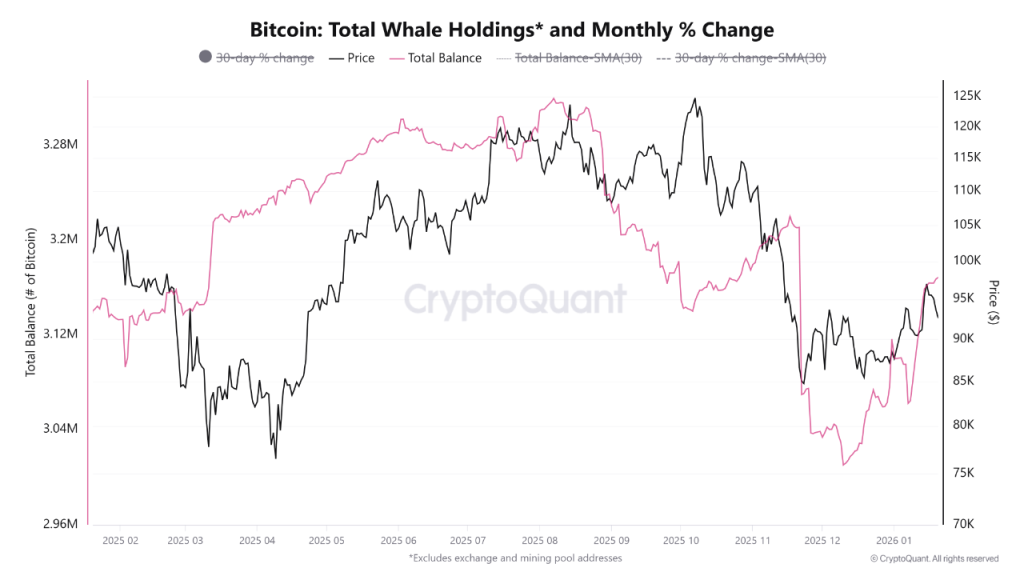
CryptoQuant analysis shows that “since January, Bitcoin whales have continued to accumulate aggressively despite short-term volatility and corrective phases, while retail investors have exited.

Strive Bitcoin Accumulation - Total Whale Holdings and Monthly % Chnage
Source: CryptoQuant

Even after recent geopolitical escalation, whale holdings on a monthly basis “have not declined but instead continued to increase, indicating that the current phase is structural accumulation rather than distribution.

Market conditions remain mixed, however.

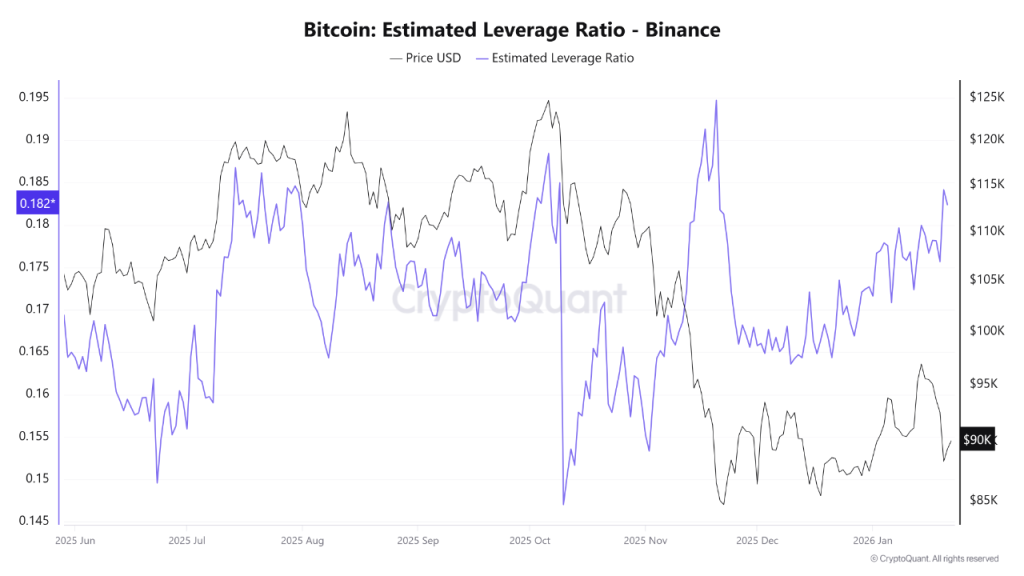
Bitcoin’s estimated leverage ratio on Binance surged to approximately 0.184 near the $90,000 price level, marking its highest reading since last November and reflecting “a notable return to leverage following a period of relative risk aversion.

Strive Bitcoin Accumulation - Bitcoin Estimated Leverage Ratio Binance
Source: CryptoQuant

This elevated borrowing among futures traders increases market susceptibility to sharp liquidation events during rapid price movements in either direction.

Asian markets opened higher today as Bitcoin edged toward $90,000 following President Donald Trump’s comments indicating a “framework of a future deal” involving NATO over Greenland, easing immediate tariff concerns.

Bitfinex analysts noted the focus now centers on stabilization signals, including flattening ETF flows, positive spot taker cumulative volume delta, and sustained price action above $90,000 with declining volatility.

Aggressive Treasury Strategy Follows Industry Leaders

Strive’s expansion follows significant corporate moves to accumulate Bitcoin.

The company previously announced a $500 million preferred stock offering in December 2025 and completed a merger with Semler Scientific in an all-stock transaction valued at a 210% premium.

The combined entity now pursues Bitcoin-per-share growth to “outperform Bitcoin over the long run,” according to Chairman and CEO Matt Cole.

Strategy, led by Michael Saylor, purchased 22,305 BTC for approximately $2.13 billion between January 12-19 at an average price of $95,284 per coin, bringing total holdings to 709,715 Bitcoin.

🟠 Michael Saylor’s @Strategy bought 22,305 $BTC for $2.13B at $95,284 per coin, lifting total holdings to 709,715 bitcoin.#Strategy #Bitcoinhttps://t.co/orZmJ4iT5E

— Cryptonews.com (@cryptonews) January 20, 2026

Meanwhile, 91-year-old burger chain Steak ‘n Shake also entered corporate Bitcoin ownership with a $10 million treasury purchase, establishing a “Strategic Bitcoin Reserve” that channels all Bitcoin received from Lightning Network payments directly into holdings rather than converting to cash.

The post Strive Eyes $150M Capital Raise to Fuel Bitcoin Accumulation Push appeared first on Cryptonews.

Vietnam Begins 5-Year Crypto Licensing Pilot To Regulate Exchanges

21 January 2026 at 23:00

Vietnam has launched a pilot program to license cryptocurrency exchanges, aiming to bring the rapidly growing market into a formal legal framework after years of regulatory uncertainty.

Vietnam’s Crypto Licensing Pilot Begins

On Tuesday, Vietnam began its pilot licensing regime to officially regulate crypto trading platforms in the country for the first time, in an effort to gradually move the sector from the shadows into a properly supervised framework under the local financial authorities.

According to local reports, the Ministry of Finance issued Decision No. 96/QD-BTC on January 20, introducing procedures necessary for the implementation of Government Resolution No. 05/2025/NQ-CP.

The three new administrative procedures cover the issuance, modification, and revocation of licenses for entities operating crypto asset trading platforms. The Ministry announced that it began accepting applications from businesses seeking to offer crypto asset trading services.

For context, the country’s cryptocurrency market lacked a clear legal framework, existing in an unsupervised, “gray area.” Last year, the National Assembly passed the “Law on Digital Technology Industry,” which took effect on January 1, 2026, to create a foundation for authorities to develop suitable management policies.

In September, Vietnam’s Deputy Prime Minister Ho Duc Phoc signed Government Resolution No. 05/2025/NQ-CP, allowing a five-year pilot program for the issuance and trading of crypto assets.

As reported by Bitcoinist, under Resolution No. 05, organizations seeking to provide services for crypto trading markets must be registered with the financial authorities and fully comply with a strict set of rules, including a minimum contributed charter capital of VND10 trillion, worth around $380.66 million.

Notably, at least 65% of the charter capital must be held by institutional investors, with more than 35% contributed by at least two institutions such as commercial banks, securities companies, fund management companies, insurance companies, or technology enterprises.

The general director must have at least two years of experience in finance, while the CTO must have at least five years of experience in information technology. Moreover, firms must hire at least 10 technology staff with cybersecurity certificates and at least 10 staff with securities practice certificates working in other departments.

Financial Institutions Dive Into Digital Assets

Following the issuance of Resolution No. 05, major financial players, including securities companies and banking institutions, have announced their intention to participate in the pilot and enter the sector, noted the report.

In June, two SSI’s subsidiaries, SSI Digital Technology JSC and SSI Asset Management Company Limited, signed Memorandums of Understanding with Tether, U2U Network, and Amazon Web Services to develop a digital financial ecosystem in Vietnam based on blockchain and cloud computing platforms.

In addition, VIX Securities contributed capital to establish the VIX Crypto Asset Exchange and partnered with tech giant FPT Corp. to prepare its technology infrastructure.

Meanwhile, the banking sector saw MBBank enter a technical cooperation agreement with Dunamu, the operator of the Korean exchange Upbit, to establish a crypto exchange in Vietnam while jointly developing the legal framework and investor protection mechanisms.

Techcombank also established the Techcom Crypto Asset Exchange with a charter capital of several hundred billion VND. Similarly, VPBank stated it is fully prepared to begin operations as soon as it receives regulatory approval.

Crypto, bitcoin, BTC, BTCUSDT

Bank of Italy Chief Warns Banks Must Tokenize Money to Compete with Stablecoins

21 January 2026 at 15:26

Bank of Italy Governor Fabio Panetta told the country’s banking association on Wednesday that commercial banks must convert their money into digital tokens to remain competitive as stablecoins gain momentum, backed by what he described as strong support from the United States administration.

According to Reuters, the European Central Bank policymaker’s comments come as European officials debate how to preserve the continent’s monetary sovereignty while American policymakers accelerate efforts to establish dollar-backed digital assets as a global payment standard.

Addressing bankers in Milan, Panetta said traditional money would continue to anchor the financial system, but warned that both central bank and commercial bank money must become fully digital.

I expect commercial bank money will also become mostly tokenised,” he stated, referring to the process of converting financial assets into digital tokens issued on distributed ledgers such as blockchain.

Banks Stablecoins - Fabio Panetta Image
Source: Bloomberg

U.S. Push Drives Stablecoin Expansion

Panetta acknowledged that stablecoin use would grow substantially in line with Washington’s strategic priorities.

They’ll definitely develop because there’s a big push by the U.S. administration,” he said, explaining that American officials view digital assets as tools to reinforce global dollar demand.

The governor emphasized uncertainty around stablecoins’ ultimate role but insisted they would not displace traditional money, which he called the financial system’s only stable anchor.

It’s not clear what role they’ll have … but I expect the system will remain centred around central bank and commercial bank money, both of which will need to become digital,” Panetta added during his address to Italy’s banking leaders.

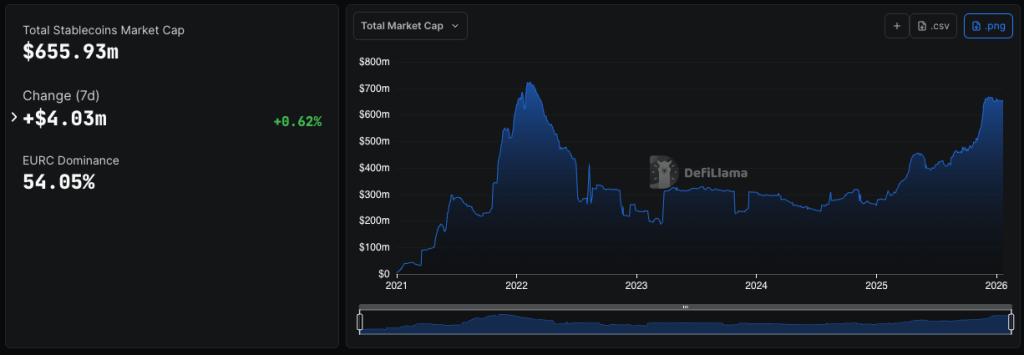
His warning arrives amid escalating European concerns about dollar-denominated stablecoins controlling 99.58% of the $300 billion global market while euro-backed alternatives remain marginal at just $680 million.

Banks Stablecoins - Euro Stablecoins Marketcap Chart
Source: DefiLlama

The ECB has repeatedly flagged systemic risks from rapid stablecoin growth, particularly as leading issuers now rank among the world’s largest U.S. Treasury holders, creating potential spillover effects into traditional markets during stress events.

The ECB seeks to launch a digital euro by 2029 to maintain the relevance of central bank money in an increasingly digital economy and to protect Europe’s monetary sovereignty.

Panetta noted recent geopolitical developments showed Europe’s risky dependence on American firms like Visa, Mastercard, and PayPal for over two-thirds of its payments.

Banks Resisted Digital Euro Over Competition Fears

The digital euro project has faced strong opposition from commercial banks, particularly in Germany, which fear competition from the ECB for deposits.

Panetta addressed this resistance directly, recounting discussions with banks in a large European country that opposed the project because they worried about losing 30% of the payments they handled digitally.

When I discussed this with the banks of a large European country that opposed the digital euro because they worried they’d lose the 30% of payments they handled digitally, I told them: instead of worrying about the 30% think about who controls the 70% you’ve already lost,” Panetta said.

His remarks contrast sharply with a December open letter from 70 European economists who urged EU lawmakers to prioritize public digital currency over private stablecoins, warning that poor design choices could leave Europe dependent on foreign payment systems.

🇪🇺 Seventy European economists warn that weak digital euro design could leave Europe reliant on US payment systems and dollar-backed stablecoins.#DigitalEuro #EU #Stablecoinhttps://t.co/FqcWLtAyEG

— Cryptonews.com (@cryptonews) January 12, 2026

The academics, including Thomas Piketty and Paul De Grauwe, demanded that the digital euro serve as “the backbone of a sovereign, resilient European payment infrastructure,” with generous holding limits and broad accessibility.

Meanwhile, ten major European banks, including BNP Paribas, ING, and UniCredit, formed a consortium in December to launch a euro-backed stablecoin by mid-2026 through a Dutch entity called Qivalis.

The initiative directly addresses concerns about dollar dominance, with euro-denominated stablecoins accounting for less than 1% of the global market despite the eurozone’s economic scale.

Panetta’s tokenization call reflects growing recognition that traditional banks risk irrelevance if they do not adapt to blockchain-based payment systems.

The ECB confirmed last month it would begin allowing distributed ledger technology transactions to settle in central bank money in 2026, marking concrete progress toward integrating digital assets into Europe’s monetary infrastructure while political negotiations continue over the digital euro’s final regulatory framework.

The post Bank of Italy Chief Warns Banks Must Tokenize Money to Compete with Stablecoins appeared first on Cryptonews.

Bitcoin Advocate Urges Federal Reserve to Add BTC to Stress Tests

21 January 2026 at 06:52

Pierre Rochard, CEO of The Bitcoin Bond Company, has formally requested that the Federal Reserve include Bitcoin as an explicit variable in its 2026 supervisory stress tests, arguing the asset’s extreme volatility and growing institutional adoption warrant standalone treatment in banking risk assessments.

The letter, submitted January 20 to the Federal Reserve Board, challenges the practice of grouping Bitcoin with other cryptocurrencies and proposes quantitative calibration based on the asset’s historical behavior dating back to 2015.

Rochard’s submission arrives as the US government navigates conflicting policies on Bitcoin holdings, amid recent confusion over whether forfeited assets from the Samourai Wallet case violated Executive Order 14233, which requires seized Bitcoin to be transferred to the Strategic Bitcoin Reserve rather than liquidated.

However, the Department of Justice later confirmed, through White House crypto advisor Patrick Witt, that the 57.5 BTC had “not been liquidated and will not be liquidated,” resolving speculation after blockchain analysts flagged a November transfer to a Coinbase Prime address.

It is in the United States national interest to become the Bitcoin Superpower.

To that end, the Federal Reserve should begin integrating bitcoin into its stress tests and scenarios.

I've sent in a comment letter explaining what I believe to be reasonable path forward. (🧵1/3) pic.twitter.com/rDILZMpFv5

— Pierre Rochard (@BitcoinPierre) January 20, 2026

Extreme Volatility Demands Separate Treatment

Rochard’s letter presents a detailed analysis showing Bitcoin’s 73.3% annualized realized volatility over the 2015-2026 sample period, compared to just 18.1% for the S&P 500 over the same timeframe.

The analysis documents a maximum drawdown of 83.8% from peak to trough, with daily return tails ranging from -10.0% at the 1st percentile to 10.7% at the 99th percentile, far exceeding typical asset behavior.

Bitcoin Stress Tests - Bitcoin drawdown from running peak
Source: X/@BitcoinPierre

Bitcoin’s risk profile is unusually idiosyncratic and materially non-linear: it has experienced repeated, deep peak-to-trough drawdowns and sustained periods of very high realized volatility,” Rochard wrote.

He argued these properties affect valuations, margin requirements, counterparty exposures, and liquidity demands “in ways that cannot be reliably inferred from other scenario variables.

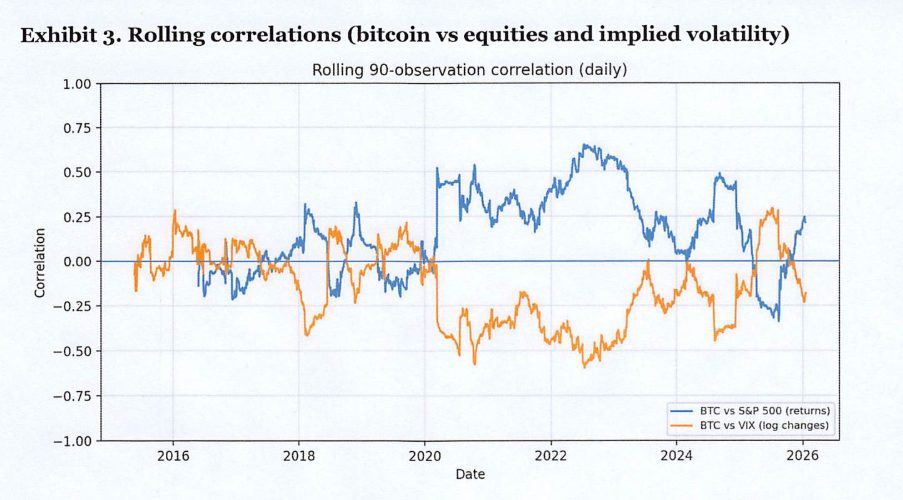
The submission includes rolling correlation analysis demonstrating Bitcoin’s unstable dependence structure with macro-financial variables, with correlation between Bitcoin and S&P 500 returns ranging from negative to strongly positive across 90-observation windows.

Bitcoin Stress Tests - rolling correlations (bitcoin vs equities and implied volatility)
Source: X/@BitcoinPierre

Rochard warned that “a fixed ‘beta’ mapping from equities (or risk sentiment) to bitcoin will understate risk in some regimes and overstate it in others,” making explicit scenario variables essential for consistent stress testing across banks.

Implementation Would Reduce Model Divergence

Rochard recommends that the Federal Reserve provide quarterly Bitcoin price paths for baseline, adverse, and severely adverse scenarios, with optional daily paths for global-market-shock datasets.

He suggests three calibration methods:

  • Historical feature matching tied to peak-to-trough drawdowns and realized-volatility percentiles
  • Regime-switching time-series models with different volatilities for bull and bear markets
  • Jump-diffusion frameworks with stochastic volatility explicitly representing tail risk

The calibration goal is not to forecast bitcoin, but to supply a consistent and severe, but plausible, path that stress tests can translate into market and counterparty outcomes,” Rochard explained.

He emphasized that firms without Bitcoin exposure could simply ignore the variable, while those with direct or indirect exposure would gain “transparency, reproducibility, and consistent scenario translation” rather than relying on inconsistent proxy assumptions.

The timing coincides with broader market stress, as Bitcoin plunged to $88,000 amid $1.07 billion in liquidations over 24 hours while gold surged past $4,800 per ounce.

The divergence has renewed debate over Bitcoin’s role as either a risk asset or a strategic reserve, particularly after President Trump’s threats to impose tariffs on Greenland triggered a flight from US assets.

CEO of Galaxy, Mike Novogratz, notedthe gold price is telling us we are losing reserve currency status at an accelerating rate,” adding that Bitcoin “is disappointing as it is still being met with selling.”

The gold price is telling us we are losing reserve currency status at an accelerating rate. The long bond selling off is not a good sign either. $BTC is disappointing as it is still being met with selling. I will reiterate it has to take out 100-103k to regain its upward…

— Mike Novogratz (@novogratz) January 20, 2026

The Federal Reserve’s comment period for the 2026 stress test scenarios closes February 21.

Senator Cynthia Lummis, who previously criticized potential government Bitcoin sales as squandering “strategic assets while other nations are accumulating bitcoin,” has proposed legislation to acquire up to 1 million Bitcoin over five years through budget-neutral methods, including tariff revenue and revalued gold reserves.

The post Bitcoin Advocate Urges Federal Reserve to Add BTC to Stress Tests appeared first on Cryptonews.

Dutch Crypto Securities Holdings Jump to €1.2B Since 2020, Central Bank Says

By: Amin Ayan
20 January 2026 at 09:47

Crypto-linked securities holdings in the Netherlands have risen sharply over the past five years, driven largely by price gains in underlying digital assets, according to new data from De Nederlandsche Bank (DNB).

Key Takeaways:

  • Dutch indirect crypto holdings rose to €1.2B by 2025, driven mainly by price gains.
  • Crypto securities still make up just 0.03% of the Dutch investment market.
  • Exposure is concentrated in a few foreign-issued crypto-linked securities.

In a recent report, the central bank said Dutch companies, institutions and households held around €1.2 billion in indirect crypto investments as of October 2025, up from roughly €81 million at the end of 2020.

The increase highlights how exposure to crypto assets has expanded across sectors, even as direct ownership remains limited for many investors.

Crypto Securities Make Up Just 0.03% of Dutch Investment Market

Despite the rapid growth, crypto securities still account for a very small share of the country’s overall securities market.

DNB said indirect crypto holdings represented about 0.03% of total Dutch securities, underlining that traditional assets continue to dominate household and institutional portfolios.

The central bank attributed much of the rise to valuation effects rather than large inflows of new capital. Prices of major crypto assets increased significantly over the period, lifting the value of related securities.

Bitcoin, for example, gained around 72% over the five-year window before falling sharply in late 2025, according to the report.

DNB examined three main categories of crypto securities: exchange-traded funds (ETFs), exchange-traded notes (ETNs), and so-called crypto treasury shares, equities in companies that hold crypto assets on their balance sheets.

Households held the largest share of crypto ETFs and ETNs by the end of October 2025, with holdings valued at €182 million and €213 million, respectively.

Dutch crypto securities holdings are now worth €1.2 billion https://t.co/VXyTEtQYMB pic.twitter.com/Q3cdStn3DY

— DutchNews.NL (@DutchNewsNL) January 20, 2026

Investment funds also maintained exposure to crypto ETFs, accounting for about €40 million.

Pension funds were the biggest holders of crypto treasury shares, with positions worth €287 million, while households held €243 million in the same category.

This distribution suggests that institutional investors are primarily accessing crypto through equity-linked structures rather than direct market products.

Although the number of crypto-related securities available to investors has expanded in recent years, DNB noted that holdings are highly concentrated.

Just seven securities, including four ETFs, one ETN and two crypto treasury shares, account for about 70% of total Dutch indirect crypto exposure. All are issued by foreign entities, mainly based in the United States and Sweden.

Dutch Firm Amdax Raises €30M to Launch Bitcoin Treasury Firm

Last year, Dutch crypto firm Amdax raised €30 million ($35 million) to launch Amsterdam Bitcoin Treasury Strategy (AMBTS), a dedicated Bitcoin treasury company that plans to accumulate up to 1% of the total BTC supply, or roughly 210,000 bitcoin.

AMBTS aims to use capital markets to steadily increase bitcoin per share, with a long-term target valued at around $26 billion at current prices.

CEO and co-founder Lucas Wensing said the milestone gives investors direct exposure to bitcoin as a distinct asset class, adding that Europe needs its own large-scale corporate bitcoin holder to match adoption trends seen in the US and Asia.

The post Dutch Crypto Securities Holdings Jump to €1.2B Since 2020, Central Bank Says appeared first on Cryptonews.

Bitcoin Falls Below $95K, But ETF Demand Just Hit Statistical Extremes – Are Whales Loading Up Again?

20 January 2026 at 08:52

Bitcoin has slipped below $95,000 this week after retreating from recent highs near $98,000, yet institutional demand signals are flashing their strongest readings in months as U.S. spot ETF inflows surge beyond statistical extremes.

Despite the price pullback, on-chain data shows tightening sell-side pressure and renewed accumulation, suggesting whales may be loading up during the consolidation.

Glassnode’s latest market pulse confirms that Bitcoin remains in a consolidation phase rather than in a trend deterioration, with the 14-day RSI cooling from 63.6 to 61.0 while remaining above neutral territory.

Spot trading volume climbed modestly from $8.8 billion to $9.3 billion, accompanied by a dramatic shift in net buy-sell imbalance that broke above its upper statistical band, soaring from -$4.6 million to $81.2 million, a 1,877% increase indicating an aggressive reduction in sell-side pressure.

Bitcoin ETF Demand - Spot CVD and Spot Volume Chart
Source: Glassnode

ETF Demand Reaches Statistical Extremes

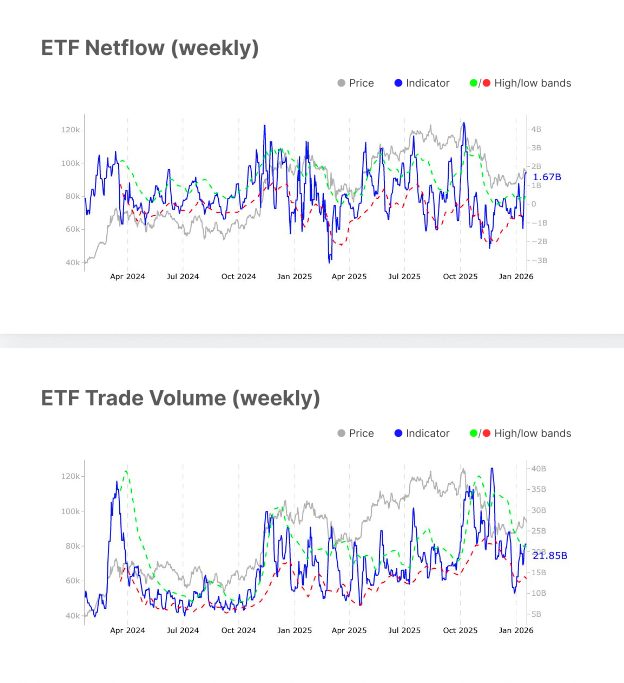
U.S. spot Bitcoin ETF flows executed a sharp reversal last week, swinging from $1.3 billion in outflows to $1.7 billion in inflows and pushing activity well beyond statistical norms.

The extreme reading indicates renewed institutional accumulation, with weekly ETF trading volume surging from $16.8 billion to $21.8 billion and both metrics sitting above their historical ranges.

Bitcoin ETF Demand - ETF Netflow and ETF Trade Volume Charts
Source: Glassnode

BlackRock’s IBIT dominated the inflow surge, capturing $1.035 billion during the January 12–16 trading week and accounting for nearly three-quarters of total Bitcoin ETF demand.

CryptoQuant CEO Ki Young Ju confirmed the institutional accumulation trend, stating, “Institutional demand for Bitcoin remains strong.

Institutional demand for Bitcoin remains strong.

US custody wallets typically hold 100-1,000 BTC each. Excluding exchanges and miners, this gives a rough read on institutional demand. ETF holdings included.

577K BTC ($53B) added over the past year, and still flowing in. pic.twitter.com/kG1c8dTvlq

— Ki Young Ju (@ki_young_ju) January 19, 2026

He noted that U.S. custody wallets (typically holding 100 to 1,000 BTC each) added 577,000 BTC worth $53 billion over the past year, with flows continuing into January despite price consolidation.

The ETF MVRV ratio edged up to 1.71, sitting just above its upper statistical band and indicating ETF holders remain comfortably in profit.

Glassnode analysts flagged this elevated profitability as introducing a mild near-term profit-taking risk, though overall sentiment remains constructive as institutions continue to build positions.

Mixed Derivatives Positioning Amid Cooling Leverage

Futures markets sent mixed signals as open interest rose from $31.0 billion to $31.5 billion, reflecting what Glassnode analysts term as “cautious” rebuilding of speculative engagement.

Funding rates collapsed by 60.6%, from $1.5 million to $0.6 million daily, indicating sharply reduced long-side urgency and a more balanced positioning after recent exuberance.

Perpetual cumulative volume delta improved from -$437.7 million to -$6.2 million, breaking above its upper statistical band.

Options markets continued to price elevated uncertainty, with open interest rising from $29.96 billion to $32.89 billion while the volatility spread widened from 42.8% to 44.6%, near the upper end of its historical range.

On-Chain Activity Stabilizes With Cautious Improvement

Fundamental blockchain metrics showed tentative recovery across multiple indicators.

Active addresses increased 3.8% to 656,294, remaining below the lower statistical band but suggesting improving network engagement without speculative excess.

Entity-adjusted transfer volume rose 3.9% to $8.6 billion, maintaining balanced on-chain activity.

Bitcoin fee volume climbed 13.2% to $241,100, rising above the lower statistical band.

The short-term-to-long-term holder supply ratio also increased from 16.7% to 17.0%, moving above its upper statistical band amid growing trading activity alongside potentially higher volatility.

Realized cap change also improved from -0.3% to -0.1%, indicating stabilizing capital flows and easing sell-side pressure.

The percent of supply in profit rose from 70.6% to 75.1%, while net unrealized profit/loss improved from -8.1% to -3.8%, with both metrics indicating reduced market stress and recovering investor sentiment.

Ethereum ETFs particularly demonstrated strength in December, with Fidelity’s FETH attracting $59.25 million and Grayscale’s Ethereum Mini Trust adding $39.21 million, ranking among the top 10 U.S. ETPs by net inflows.

January flows accelerated further, with spot Ethereum ETFs capturing $479 million during the Jan. 12–16 week, led by BlackRock’s ETHA at $219 million.

The post Bitcoin Falls Below $95K, But ETF Demand Just Hit Statistical Extremes – Are Whales Loading Up Again? appeared first on Cryptonews.

Wintermute Says Crypto’s Bull Cycle Is Over – Three Forces Will Drive 2026

20 January 2026 at 06:24

Cryptocurrency’s traditional four-year cycle has collapsed, replaced by a new market structure where liquidity concentration and investor positioning now determine price action, according to a comprehensive year-end analysis from leading OTC desk Wintermute.

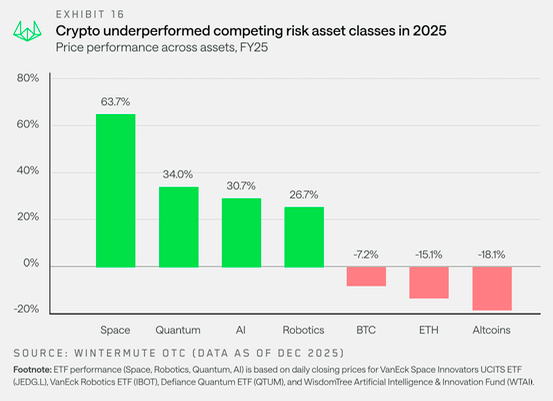
The firm’s proprietary trading data reveals that 2025 marked a fundamental shift in how digital assets trade, with the year’s muted performance indicating crypto’s transition from speculation-driven rallies to a more institutionally anchored asset class.

Wintermute’s OTC flow data shows the historic pattern of Bitcoin gains recycling into Ethereum, then blue chips, and finally altcoins has weakened dramatically.

2026 Crypto's Bull Cycle - Wintermute Chart
Source: Wintermute

Exchange-traded funds and digital asset treasury companies evolved into what the firm describes as “walled gardens,” providing sustained demand for large-cap assets without naturally rotating capital into the broader market.

With retail interest diverted toward equities, 2025 became a year of extreme concentration where a handful of major tokens absorbed the vast majority of new capital while the rest of the market struggled.

2026 Crypto's Bull Cycle - Wintermute Chart
Source: Wintermute

Traditional Seasonality Shattered by Structural Shifts

Trading activity in 2025 followed a distinctly different pattern than previous years, breaking what had felt like seasonal rhythms.

Early-year optimism around the pro-crypto U.S. administration quickly disappointed as risk sentiment deteriorated sharply through the first quarter when memecoin and AI-agent narratives faded.

Trump’s tariff announcement on April 2 further pressured markets, concentrating activity early in the year before broad softening through spring and summer.

The late-year pickup seen in 2023 and 2024 failed to materialize, shattering narratives around “Uptober and year-end rallies.

Wintermute’s data reveals these were never true seasonal patterns but rather rallies driven by idiosyncratic catalysts like ETF approvals in 2023 and the new U.S. administration in 2024.

Markets became increasingly choppy as macro forces took control, with flows turning reactive and episodic around headlines without sustained momentum.

Altcoin rallies shortened dramatically, averaging roughly 19 days in 2025, down from 61 days the prior year.

Themes including memecoin launchpads, perpetual DEXs, and the x402 meta sparked brief activity bursts but failed to develop into durable market-wide rallies, largely due to choppy macro conditions and market fatigue after 2024’s excesses.

Institutional Engagement Deepens Despite Muted Returns

Despite modest price activity, institutional counterparties showed staying power through 2025.

Wintermute saw 23% year-over-year growth among institutional participants, including crypto-native funds, asset managers, and traditional financial institutions.

Engagement deepened materially, with activity becoming more sustained and focused on deliberate execution rather than exploratory positioning.

The firm’s derivatives data also reveals options activity more than doubled year-over-year, with systematic yield and risk management strategies dominating flow for the first time rather than one-off directional bets.

By the fourth quarter, options notional reached 3.8 times first-quarter levels, while trade counts doubled, indicating sustained growth across both ticket size and frequency.

Both institutional and retail investors rotated back into majors by year-end following the October 10 deleveraging event that triggered roughly $19 billion in liquidations over 24 hours.

Altcoin open interest also collapsed by 55%, from around $70 billion to $30 billion by mid-December, as forced unwinding flushed out excess leverage concentrated outside Bitcoin and Ethereum.

Three Catalysts Could Broaden 2026 Recovery

Wintermute identifies three scenarios that would need to materialize for market breadth to recover beyond large-cap concentration.

First, ETFs and DATs must broaden their mandates, with early signs emerging in the Solana and XRP ETF filings.

Second, strong rallies in Bitcoin or Ethereum could generate wealth effects that spill over into the broader market, similar to 2024’s pattern, though capital recycling remains uncertain.

Third and least likely, retail investor mindshare could rotate back from equities and AI themes toward crypto, bringing fresh capital inflows and stablecoin minting.

2025 fell short of the expected rally, but it may mark the beginning of crypto’s transition from speculative to an established asset class,” Wintermute’s analysis concludes.

Independent analysis from Adler Asset Management reinforces the ongoing deleveraging theme, extending into 2026.

Adler pointed out that the Bitcoin Advanced Sentiment Index collapsed from the High Bull zone around 80% to 44.9%, breaking below neutral 50% and signaling a market regime shift.

The largest long liquidation cascade over their entire observation period occurred on January 19, with over $205 million liquidated in a single hour as the price dropped from $95,400 to $92,600 within 24 hours.

Whether concentration persists or liquidity broadens beyond a handful of large-cap assets will determine 2026 outcomes, with understanding where capital can flow and what structural changes are needed proving critical for navigating the post-cycle crypto market.

The post Wintermute Says Crypto’s Bull Cycle Is Over – Three Forces Will Drive 2026 appeared first on Cryptonews.

Revolut Applies for Full Banking License in Peru in Latin America Push

By: Amin Ayan
20 January 2026 at 02:45

Revolut has applied for a full banking license in Peru as it steps up its expansion across Latin America, according to a report by Bloomberg.

Key Takeaways:

  • Revolut is applying for a banking license in Peru to expand its regulated footprint in Latin America.
  • The company is targeting remittances in a highly concentrated banking market dominated by incumbents.
  • Growing crypto and stablecoin adoption is reinforcing Revolut’s regional strategy.

If approved, the move would allow the London-based digital bank to operate as a fully regulated lender in the country, adding Peru to a growing regional footprint that already includes Mexico, Colombia, Argentina and Brazil.

The company said the license would enable it to roll out localized banking products and compete directly with Peru’s incumbent banks rather than newer fintech challengers.

Revolut Targets Peru’s Concentrated Banking Market With Remittance Push

Peru’s financial system is highly concentrated, with the four largest banks accounting for roughly 82% of total loans, based on data from the national banking regulator SBS.

Revolut Peru CEO Julien Labrot said the company sees an opportunity to increase competition and improve access to financial services, particularly for underserved users.

Remittances are expected to play a central role in the strategy, with Labrot noting that around one million people in Peru rely on money sent from abroad.

According to the World Bank, personal remittances to Peru reached $4.93 billion in 2024.

The license application comes as Revolut continues to scale its broader platform, including its crypto and digital asset services.

Founded in 2015, the neobank reported a record year in April 2025, with 2024 net profit rising 130% to 790 million pounds ($1.06 billion), driven by customer growth and a rebound in cryptocurrency trading.

In October 2025, Revolut introduced 1:1 U.S. dollar conversions for stablecoins, allowing users to exchange dollars directly into USDC and USDT.

Revolut has applied for a full banking license in Peru, the 5th country in Latin America.

The license would allow the company to “roll out a comprehensive range of localised products and services, offering Peruvians greater control over their finances,” Revolut said in a… pic.twitter.com/BqUavQaEk0

— Max Karpis (@maxkarpis) January 19, 2026

Revolut’s push reflects a wider trend among fintech firms in Latin America moving deeper into crypto and stablecoin-based services.

Mercado Libre launched a dollar-pegged stablecoin in Brazil in 2024, while Nubank is developing stablecoin payments linked to its credit products.

A report from Chainalysis shows the region generated nearly $1.5 trillion in crypto transaction volume between July 2022 and June 2025, showing why global players like Revolut are accelerating their Latin America ambitions.

Stablecoin Payments on Revolut Surge as Everyday Use Gains Momentum

As reported, stablecoin usage on Revolut accelerated sharply in 2025, with payment volumes estimated to have jumped 156% year over year to about $10.5 billion.

While Revolut has not published official figures, onchain data suggests stablecoins nearly doubled their share of total payments on the platform compared with 2024, pointing to growing adoption beyond trading and transfers.

Blockchain data compiled via Dune Analytics shows that growth was steady throughout the year rather than driven by short-term spikes.

Much of the activity came from routine transactions, with transfers between $100 and $500 accounting for roughly 30% to 40% of stablecoin payments, indicating that users are increasingly relying on digital dollars for everyday spending.

The post Revolut Applies for Full Banking License in Peru in Latin America Push appeared first on Cryptonews.

AI Security: What Enterprises Are Getting Wrong

15 January 2026 at 11:40

The CSA Alliance has released their annual report on AI and security. Alan, Anton Chuvakin and Hillary Baron discuss the state of AI security and governance, how companies are actually adopting AI (both agentic and generative) and most importantly how organizations are integrating it into their business practices in a secure manner. AI adoption doesn’t..

The post AI Security: What Enterprises Are Getting Wrong appeared first on Security Boulevard.

The difficulty of driving an EV in the “most beautiful race in the world”

15 January 2026 at 07:00

On the first day of this year’s Mille Miglia, a voice rose from the crowds gathered on the shore of Lago di Garda to shout “no sound, no feeling!”at my Polestar 3. Italians love their cars, and they revealed a clear preference for internal combustion engines over the next four days and over 1,200 km of driving. But plenty of other spectators smiled and waved, and some even did a double-take at seeing an electric vehicle amid the sea of modern Ferraris and world-class vintage racers taking on this modern regulation rally.

I flew to Italy to join the Mille Miglia “Green,” which, for the past five years, has sought to raise awareness of sustainability and electric cars amid this famous (some might say infamous) race. And despite mixed reactions from the Italian crowds, our Polestar 3 performed quite well as it traced a historical route from Brescia to Rome and back.

The route snaked a trail through the Italian countryside based on the original speed race’s first 12 outings, but instead of going for overall pace, we spent five days competing against six other EVs for points based on time, distance, and average speed. Our team included a Polestar 2 and 4, and we faced a Mercedes-Benz G 580 with EQ Technology, an Abarth 600e, a Lotus Eletre, and a BYD Denza Z9GT saloon.

Read full article

Comments

© Polestar

Ethereum New Addresses Hit Record Levels: What’s Driving The Growth?

15 January 2026 at 05:00

On-chain data shows the Ethereum Network Growth has surged to a new all-time high (ATH), suggesting ETH’s adoption has been accelerating.

Ethereum Network Growth Has Shot Up Recently

In a new post on X, on-chain analytics firm Santiment has discussed about the recent increase in the Ethereum Network Growth. This metric measures the total number of addresses that are coming online on the network for the first time.

A wallet is said to come “online” when it participates in some kind of transaction activity on the blockchain. Thus, the addresses that the Network Growth tracks are the ones that are participating in their first transfer.

When the value of the metric is high, it means that the users are creating a high amount of new addresses on the network. Such a trend can be a sign that adoption of the asset is occurring.

On the other hand, the indicator having a low value can imply that the cryptocurrency isn’t attracting new users as not much wallet generation is taking place on the network.

Now, here is the chart shared by Santiment that shows the trend in the Ethereum Network Growth over the past year:

Ethereum Network Growth

As displayed in the above graph, the Ethereum Network Growth has witnessed a spike recently. Over the past week, address generation has averaged around 327,100 per day, with a particularly large level being observed on Sunday, when 393,600 new addresses popped up.

The Sunday high was a new record for the indicator, meaning that ETH saw an unprecedented amount of single-day address creation. As a result of the surge in the Network Growth, the Total Amount of Holders, an indicator tracking the number of non-empty addresses that exist on the blockchain, has also shot up to a new ATH of 172.97 million.

What’s driving all this adoption? According to the analytics firm, there can be several factors contributing to the trend. First is the Fusaka upgrade that occurred in December, and improved data handling and cut layer-2 fees.

The second is the record stablecoin activity that the Ethereum blockchain saw in late 2025, with the transaction volume reaching $8 trillion in the fourth quarter. “This kind of real financial activity tends to bring in new participants who create wallets to send, receive, or hold stablecoins and other tokens,” explained Santiment.

Lastly, the turn of the year saw growing interest and improvement in sentiment among traders, which would have led to fresh retail traders signing up new wallets.

ETH Price

The past day has been bullish for Ethereum as its price has jumped by more than 5%, recovering back to the $3,340 level.

Ethereum Price Chart

❌
❌