Normal view

There are new articles available, click to refresh the page.
Today — 25 January 2026Main stream

Hackers Impersonate X Staff Using Compromised Scroll Founder Account

25 January 2026 at 06:49

Scroll co-founder Ye Chen’s X account was hijacked in a sophisticated phishing operation where attackers posed as platform employees to target crypto industry figures.

The compromised account, which commands substantial influence among crypto leaders, began distributing fraudulent messages claiming copyright violations and threatening account restrictions unless users clicked on malicious links within 48 hours.

The hackers transformed Chen’s profile to mimic X’s official branding, updating the bio to reference Twitter and nCino while warning followers about security breaches.

Scroll Founder Account Hack - Changed Profile Info
Screenshot from X

The attackers flooded the feed with reposts from X’s verified accounts to enhance perceived legitimacy, then launched their phishing campaign via direct messages.

Sophisticated Attack Mirrors Growing Pattern

The breach follows established tactics where hackers exploit trusted accounts to distribute malicious links disguised as urgent platform notifications.

Recipients received messages appearing to come from X’s rights management team, complete with fake compliance warnings and time-sensitive appeals processes designed to create panic and bypass security awareness.

Blockchain security researcher Wu Blockchain first identified the compromise and alerted the community to ignore any communications from the account.

The warning emphasized particular concern given Chen’s extensive network of high-profile cryptocurrency executives, developers, and investors who might trust messages from his verified account.

Scroll co-founder @shenhaichen's X account has been hacked and is currently sending phishing private messages impersonating X employees. This account has a large following among prominent figures in the crypto industry; the community and users are advised to be aware of the… pic.twitter.com/ctXk2G0bQm

— Wu Blockchain (@WuBlockchain) January 25, 2026

The attack represents the latest escalation in social media compromises targeting crypto industry leaders, in which hackers increasingly leverage delegated account access and expired domain registrations to bypass security measures, including two-factor authentication.

Industry Faces Relentless Social Engineering Wave

BNB Chain’s official account suffered a similar breach in October when hackers posted fake reward programs with phishing links after Binance co-founder CZ warned followers against clicking suspicious content.

The compromised account promoted fraudulent BSC token distributions, promising early payouts to users who voted on reward dates through malicious URLs designed to drain digital wallets.

Binance co-CEO Yi He’s WeChat account was also hijacked in December to promote meme coin schemes, with attackers conducting a coordinated pump-and-dump operation around the token MUBARA.

Two wallets created hours before the breach accumulated 21.16 million tokens before dumping holdings as retail traders flooded in, netting attackers approximately $55,000 while leaving later buyers exposed to price collapse.

🚨Changpeng Zhao @cz_binance warned that new co-CEO Yi He’s @heyibinance abandoned WeChat account was hacked and used to push a meme coin called MUBARA.#Binance #Memecoins https://t.co/sdyH325OMD

— Cryptonews.com (@cryptonews) December 10, 2025

Among other notable accounts hacked were ZKsync and Matter Labs, which were compromised in May through what the team described as “delegated accounts” with limited posting privileges.

Hackers published false claims about an SEC investigation alongside fake airdrop promotions, triggering a 5% drop in the ZK token price despite a prior 38.5% weekly rally.

The prominent crypto media company, Watcher.Guru also confirmed its account breach in March after fake Ripple-SWIFT partnership claims spread across connected Telegram, Facebook, and Discord channels through automated content bots.

The team suspects the compromise originated from a suspicious link containing unusual query strings shared in their Telegram group weeks earlier.

Record Theft Year Exposes Escalating Threats

The crypto ecosystem witnessed over $3.4 billion stolen in 2025, according to Chainalysis’s 2026 Crypto Crime Report, with North Korean state-backed hackers accounting for a record $2.02 billion across fewer but increasingly sophisticated attacks.
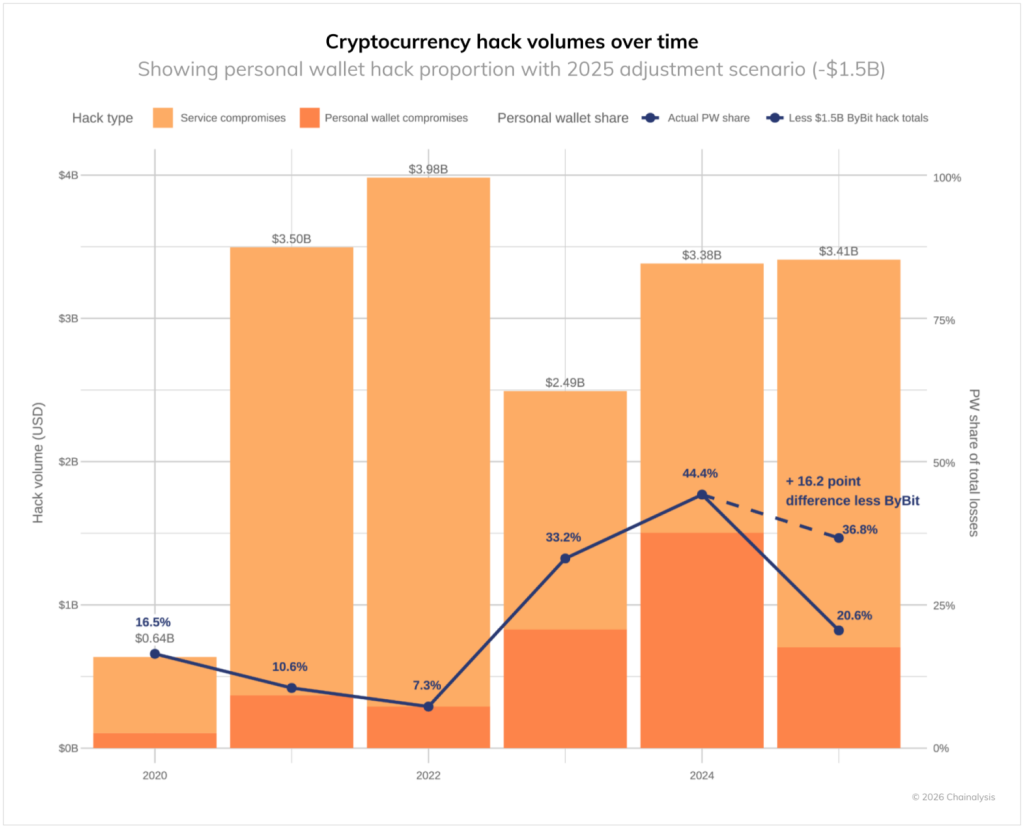
Scroll Founder Account Hack - Chainalysis Chart
Source: Chainalysis

The Democratic People’s Republic of Korea now represents 76% of all service compromises, bringing cumulative DPRK cryptocurrency theft to $6.75 billion since operations began.

Personal wallet compromises surged to 158,000 incidents affecting at least 80,000 unique victims, triple the 54,000 cases recorded in 2022.

Address poisoning scams drove December’s single-largest loss, when one victim transferred $50 million to a fraudulent wallet mimicking their intended destination, while private key leaks resulted in $27.3 million stolen from multi-signature wallets.

Personal Security Breaches Surge Across Platforms

Most recently, Ubuntu developer Alan Pope warned that attackers are hijacking Snap Store publisher accounts by registering expired domains linked to legitimate developers, then pushing malicious updates to previously trusted packages.

The technique exploits automatic update systems and established trust signals, with at least 2 confirmed cases of wallet-stealing malware distributed through seemingly normal applications.

⚠ Hackers are exploiting trusted Snap Store packages to steal cryptocurrency by hijacking existing publisher accounts.#Hack #Cryptohttps://t.co/YV5Yoiwb0F

— Cryptonews.com (@cryptonews) January 21, 2026

Given these growing, multifaceted attack vectors, Better Business Bureau officials are warning consumers about phishing campaigns that lock X users out of their accounts and are subsequently used for cryptocurrency promotions.

Kentucky journalist Jennie Rees described receiving direct messages from apparent colleagues requesting contest votes, only to find her account posting fake Audi purchase claims tied to crypto earnings after clicking the malicious link.

The post Hackers Impersonate X Staff Using Compromised Scroll Founder Account appeared first on Cryptonews.
Stablecoin Trading Surges 62% in Korea as Dollar Strengthens Against Won

25 January 2026 at 05:37

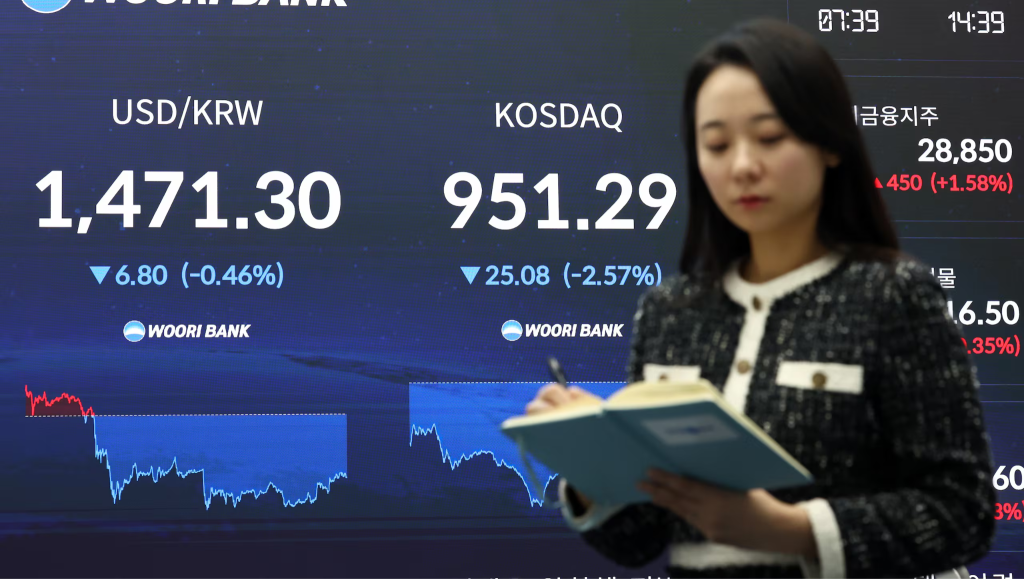
South Korean crypto exchanges recorded a 62% surge in stablecoin trading volumes as the won fell to multi-year lows against the dollar, prompting platforms to intensify marketing campaigns around dollar-pegged tokens.

According to The Korea Times, trading volume in Tether (USDT) across the nation’s five major won-based exchanges climbed to 378.2 billion won ($261 million) when the exchange rate exceeded 1,480 won per dollar last Wednesday, citing CryptoQuant data.

The spike follows mounting currency pressures that pushed the won through nine consecutive days of declines against the dollar, marking its longest losing streak since 2008, Bloomberg reported.

Stablecoin Korea Dollar WON/USD Chart Bloomberg
Source: Bloomberg

Major exchanges, including Korbit, Coinone, Upbit, and Bithumb, launched aggressive promotional campaigns centered on stablecoins, including USDC and USDe, waiving trading fees and distributing rewards to boost volumes during what industry officials described as a downturn in broader crypto markets.

Banks Slash Dollar Rates as Government Defends Currency

According to The Chosun Daily, South Korea’s major commercial banks slashed dollar deposit interest rates to near zero in response to government pressure to defend the exchange rate.

Shinhan Bank cut its annual rate from 1.5% to 0.1% starting January 30, while Hana Bank reduced rates from 2% to 0.05% for its Travelog Foreign Currency Account.

The coordinated move followed the authorities’ summoning of bank executives and their request that they “refrain from excessive marketing that encourages foreign currency deposits such as dollars.

Banks responded by introducing incentives for won conversion, with Shinhan offering a 90% preferential rate for customers converting dollar deposits back to won, plus an additional 0.1 percentage point rate boost for those subscribing to won-term deposits afterward.

Dollar deposit balances at the five major banks fell 3.8% from month-end to 63.25 billion dollars as of January 22, marking the first decline after three consecutive months of surges.

Corporate deposits, which account for 80% of all dollar holdings, dropped sharply from 52.42 billion dollars at year-end to 49.83 billion dollars, suggesting that the authorities’ recommendation to sell dollars spot, combined with perceptions that the exchange rate had peaked, was driving the decline.

Individual dollar deposits grew at a significantly slower pace, rising just 109.64 million dollars, compared with the previous month’s 1.09 billion dollar surge.

Presidential Intervention Accelerates Won Stabilization

President Lee Jae-myung delivered a rare verbal intervention on the exchange rate during a January 21 press conference, stating authorities predicted the rate would drop to around 1,400 won within one to two months.

The won-dollar rate immediately fell from 1,481.4 won to 1,467.7 won following his remarks, closing at 1,471.3 won.

Stablecoin Korea Dollar
Source: TheChosunDaily

Market observers noted the unprecedented nature of a sitting president specifying both an exchange rate target and timeline, with Lee’s statement carrying significantly more weight than U.S. Treasury Secretary Scott Bessent’s earlier comment that the won’s recent decline was “inconsistent with Korea’s strong fundamentals.

Meanwhile, demand for dollar exchange slowed as average daily won-to-dollar conversions reached 16.54 million dollars from January 1-22, while dollar-to-won conversions surged to 5.2 million dollars daily, significantly exceeding last year’s 3.78 million dollar average and indicating increased profit-taking.

In fact, according to CNBC, South Korea’s fourth-quarter GDP growth slowed to 1.5% year over year, missing economists’ forecasts of 1.9%, as construction investment shrank 3.9% and exports pulled back 2.1% from the previous quarter.

The won has lost nearly 2% against the greenback this year, making it one of Asia’s worst-performing currencies, while South Korean retail investors bought approximately 2.4 billion dollars of U.S. equities on a net basis through mid-January, up roughly 60% from the same period last year.

The broader economic slowdown comes as Seoul advances major crypto policy reforms despite regulatory gridlock over stablecoin governance.

Earlier this month, South Korea ended its nine-year corporate crypto trading ban, permitting listed companies to invest up to 5% of equity capital in top-20 cryptocurrencies, while lawmakers passed amendments to the Capital Markets Act and Electronic Securities Act establishing legal frameworks for tokenized securities trading beginning January 2027.

🇰🇷South Korea has launched guidelines, allowing listed companies and professional investors to invest up to 5% of their equity capital crypto.#SouthKorea #CorporateCryptoInvestment #CryptoInvestmenthttps://t.co/d55u3TDsBF

— Cryptonews.com (@cryptonews) January 12, 2026

Korea Exchange Chairman Jeong Eun-bo pledged to launch spot Bitcoin ETFs and extend trading hours to 24/7 as part of efforts to eliminate the “Korea discount,” though comprehensive digital asset legislation remains stalled amid disputes between the Financial Services Commission and the Bank of Korea over stablecoin issuance rules.

The post Stablecoin Trading Surges 62% in Korea as Dollar Strengthens Against Won appeared first on Cryptonews.

Before yesterdayMain stream

French Crypto Tax Platform Waltio Hit by 50,000-User Data Breach

23 January 2026 at 17:37

French authorities have opened a preliminary investigation into a data breach at Waltio, a cryptocurrency tax reporting platform used by tens of thousands of investors.

This occurred when hackers reportedly got access to sensitive user information and tried to blackmail the company.

The event has brought up new issues regarding the exposure of personal data in the crypto industry, as target fraud and physical attacks against holders are becoming more and more frequent in France.

Authorities Link Waltio Breach to Shiny Hunters’ Extortion Attempt

In a statement released this week, French cybersecurity institutions confirmed that, via its cybercrime division, the Paris Public Prosecutor’s Office had issued an order to the National Cyber Unit of the Gendarmerie to establish the extent of the breach and identify exposed users.

Source: Paris Public Prosecutor’s Office

Officials advised that users whose information might have been stolen should be wary of scammers who claim to be genuine service providers or other officials and force them to give up their digital assets using the stolen information.

The law enforcement agencies reported that some more recent fraudsters posed as crypto businesses, bank anti-fraud units, or even law enforcement officers and magistrates.

French newspaper Le Parisien stated that the attack at Waltio was associated with a ransom demand by a hacking organization called Shiny Hunters.

The group purportedly had obtained personal information of approximately 50,000 Waltio users, most of whom reside in France, and said it had samples of the stolen information as proof.

Waltio later filed a complaint of attempted extortion and unauthorized access to the automated data system.

Waltio said its initial internal assessment showed that the attackers accessed tax reports for the 2024 period. These documents included users’ email addresses, information on crypto profits or losses, and asset balances at the end of the year.

The company stated that banking details, administrative records, and tax identification data were not affected and that its core infrastructure was not compromised.

Waltio added that its services remain operational and that client funds are not at risk.

France Tightens Oversight After Crypto Data Breach Amid Rise in Kidnapping Cases

Waltio was founded in France and is headquartered in Clermont-Ferrand. It serves roughly 150,000 users and focuses on simplifying crypto tax compliance for European investors, particularly in France, Spain, and Belgium.

The platform aggregates transaction data from more than 700 exchanges, wallets, and blockchains to calculate capital gains, losses, and staking income, and generates tax-compliant reports for local filings.

The investigation comes amid heightened scrutiny of crypto-related data leaks in France.

In the last year, police have attributed a number of home invasions, kidnappings, and attempted kidnappings to the criminals who intended to use the knowledge of the victims having digital assets.

Although the leakage of data has not been directly linked to these crimes, the investigation teams have not eliminated the chances of the data being used to establish potential targets.

🇫🇷 Masked gunmen steal crypto USB in France as prosecutors reveal tax official sold government database access identifying crypto investors to criminal gangs for 800 euros per operation.#Crypto #Attack #Francehttps://t.co/GmfOkwsE6E

— Cryptonews.com (@cryptonews) January 9, 2026

Fraud victims have been cautioned to keep evidence, report to the police, and address the data protection authority in France in instances where they feel that their personal data has not been sufficiently safeguarded.

The Waltio incident is not the first case of data exposure in the crypto industry in the past.

Hardware wallet manufacturer Ledger announced earlier this month that a breach of a third-party payment processor, Global-e, took place, exposing the data of its customers.

Last month, crypto tax software developer Koinly also notified users of a potential email data breach related to the use of a third-party analytics platform.

The post French Crypto Tax Platform Waltio Hit by 50,000-User Data Breach appeared first on Cryptonews.

Binance Plans to Reintroduce Stock Trading Four Years After Removal

23 January 2026 at 17:31

Binance is exploring plans to bring back stock trading on its platform four years after discontinuing the feature, according to a report from The Information.

The world’s largest crypto exchange removed stock tokens in 2021 amid regulatory scrutiny, but now appears ready to re-enter equity markets as competitors push toward unified investment platforms.

The timing aligns with a broader industry shift toward “everything exchanges” that combine crypto and traditional assets under a single platform.

Coinbase began rolling out stock trading to select users earlier this month while positioning itself against traditional brokerages and rival Robinhood, which has offered blended stock and crypto trading for years.

JUST IN: Binance considers bringing back stock trading, The Information reports.

— Watcher.Guru (@WatcherGuru) January 23, 2026

Exchanges Race to Build Unified Platforms

Binance’s potential return to stock trading comes as multiple crypto platforms accelerate efforts to merge digital assets with conventional financial products.

Coinbase CEO Brian Armstrong defended his company’s push into equities in a recent Fortune interview, arguing the exchange is positioned to lead as financial assets migrate to blockchain infrastructure.

We have deep crypto expertise. We have the most trusted brand in crypto,” Armstrong said, adding that Coinbase aims to bridge traditional finance and crypto while advancing tokenized equities.

The exchange currently offers stocks through Apex Fintech Solutions with plans to expand access to all customers in the coming weeks, though fully tokenized equities remain years away pending SEC coordination.

Austria’s Bitpanda also announced Wednesday it will launch a unified investing platform on January 29, bringing stocks, ETFs, crypto, and precious metals together under one app.

The expanded platform will offer more than 10,000 stocks and ETFs at a flat €1 trading fee with zero custody fees and no payment for order flow.

Infrastructure Moves Toward On-Chain Markets

Traditional market operators are also simultaneously advancing blockchain-based trading systems.

Earlier this week, the New York Stock Exchange unveiled plans to develop a platform for 24/7 trading and on-chain settlement of tokenized securities, combining its Pillar matching engine with blockchain-based post-trade systems across multiple blockchains.

For more than two centuries, the NYSE has transformed the way markets operate,” said Lynn Martin, President of NYSE Group.

She said the exchange is now leading the industry toward fully on-chain solutions that combine trust, regulatory rigor, and modern technology.

Yesterday, January 22, Binance founder Changpeng “CZ” Zhao also told a World Economic Forum panel in Davos that he is negotiating with over a dozen governments to tokenize state-owned assets as the next major step in crypto adoption.

🚀 Binance’s @cz_binance confirms talks with governments to tokenize national assets on-chain, calling it the next phase after exchanges and stablecoins. #Crypto #Tokenizationhttps://t.co/1mv1mt5WwR

— Cryptonews.com (@cryptonews) January 22, 2026

Zhao positioned tokenization as the third stage following exchanges and stablecoins, explaining that governments want to directly capture financial upside from their own assets rather than outsourcing value creation to private intermediaries.

Regulatory Clarity Fuels Institutional Momentum

Last month, the Securities and Exchange Commission (SEC) issued a rare no-action letter to the Depository Trust and Clearing Corporation, allowing it to proceed with a controlled tokenization program covering U.S. Treasuries, ETFs, and Russell 1000 equities.

The service is scheduled to launch in late 2026 and will operate on approved blockchains with tokenized assets carrying the same legal rights as traditional securities.

Market data and institutional research suggest this regulatory momentum is already translating into measurable growth.

Earlier this month, venture capital firm Andreessen Horowitz identified stablecoins, real-world asset tokenization, and privacy infrastructure as key forces shaping crypto in 2026.

These assertions come as monthly transfer volumes for tokenized equities are down roughly 17% over 30 days to about $2.05 billion, according to rwa.xyz.

However, the number of Monthly Active Addresses is up nearly 98%, with over 98,167 addresses active in the past month alone.

Binance Stock Trading - Tokenized Stock Metrics Chart RWA.xyz
Source: RWA.xyz

David Duong, Coinbase’s head of investment research, also recently said regulatory clarity improvements and deepening institutional participation are creating favorable conditions ahead.

We expect these forces to compound in 2026 as ETF approval timelines compress, stablecoins take a larger role in delivery-vs-payment structures, and tokenized collateral is recognized more broadly,” Duong wrote in a year-end outlook.

Meanwhile, Binance confirmed today that it submitted a Markets in Crypto-Assets license application in Greece as crypto firms across Europe rush to secure regulatory approval before June 2026 transitional deadlines expire.

The post Binance Plans to Reintroduce Stock Trading Four Years After Removal appeared first on Cryptonews.

Bitcoin ETFs Bleed $1.62B in Four Days — Are Hedge Funds Dumping BTC?

23 January 2026 at 14:53

Bitcoin spot exchange-traded funds have experienced steep outflows over four trading days, losing a combined total of $1.62 billion.

The exit has raised a question on whether hedge funds are withdrawing their Bitcoin exposure as the market conditions change.

The withdrawals occur as Bitcoin fails to regain momentum around critical price points, while a once-popular institutional arbitrage strategy steadily loses its appeal.

BlackRock’s IBIT Leads Bitcoin ETF Outflows as BTC Slips Below $90K

As of January 22, 2026, US-listed spot Bitcoin ETFs recorded net daily outflows of $32.11 million, extending a streak of redemptions that peaked at $708.71 million on January 21, following $483.38 million on January 20, Sosovalue data shows.

In the last one week, net outflows amounted to 1.22 billion.

Trading activity stayed strong on January 22, with Bitcoin spot ETFs recording $3.30 billion in volume, even as assets under management dipped to $115.99 billion, about 6.49% of Bitcoin’s market cap.

BlackRock’s iShares Bitcoin Trust led daily outflows, with $22.35 million redeemed, equivalent to roughly 249.5 BTC.

Despite the withdrawal, IBIT remains the dominant product, holding $69.84 billion in assets and nearly 4% of the Bitcoin supply represented in ETFs.

Bitcoin ETFs data Source: Sosovalue

Fidelity’s FBTC followed with $9.76 million in outflows, while Grayscale’s GBTC reported flat daily flows but remains deeply negative overall, with $25.58 billion in cumulative net outflows as investors continue rotating away from its higher 1.5% fee.

Other issuers, including Bitwise, Ark and 21Shares, VanEck, Invesco, Valkyrie, Franklin, and WisdomTree, recorded largely unchanged flows, showing a pause rather than broad panic selling.

The ETF pullback has unfolded alongside weakness in Bitcoin’s price.

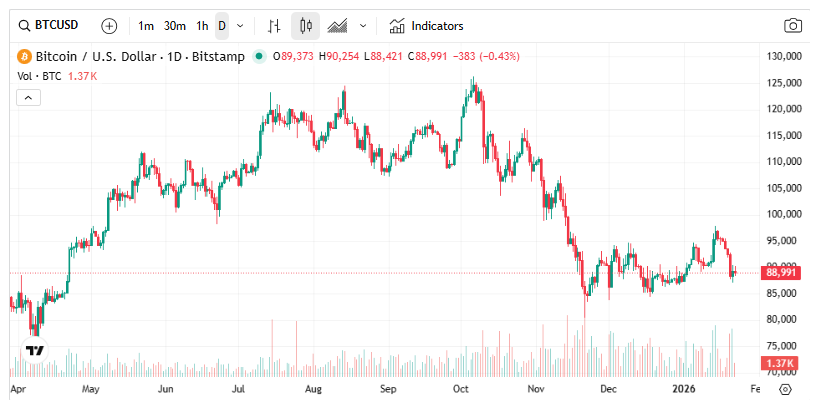
BTC was trading around $89,982 on January 22, down 1.3% on the day and nearly 5% over the past week, after briefly dipping to $88,600.

Source: Cryptonews

Trading volume has also cooled, falling nearly 28% to $37.77 billion, a sign that market participation is thinning as prices consolidate below $90,000.

Compressed Yields Trigger Hedge Fund Exit From Bitcoin ETFs

Market observers point to hedge fund positioning as a key driver behind the ETF outflows.

Amberdata shows that yields on the Bitcoin basis trade, a strategy that buys spot Bitcoin via ETFs while selling futures to capture price spreads, have dropped below 5%, down from around 17% a year ago.

As returns compress and approach the yield available on short-dated US Treasuries, fast-moving capital has less incentive to stay deployed.

Analyst noted that while hedge funds likely represent only 10% to 20% of ETF holders, their activity can overwhelm flows in the short term when the trade stops working.

Bloomberg data shows that the unwind is visible in derivatives markets as well.

Bitcoin futures open interest on Chicago Mercantile Exchange (CME) has fallen below Binance’s for the first time since 2023, showing reduced participation in cash-and-carry trades by US institutions after ETFs launched there.

One-month annualized basis yields now hover near 4.7%, barely clearing funding and execution costs, as spreads tighten and arbitrage opportunities fade.

CryptoQuant indicators show apparent demand turning negative, whale and dolphin wallets shifting from accumulation to distribution.

Also, the Coinbase premium remained deeply negative, suggesting weaker appetite from US institutions.

At the same time, leverage in Bitcoin futures has climbed to its highest level since November, increasing the market’s sensitivity to sharp moves in either direction.

Flows in other crypto ETFs underline that the sell-off is not uniform.

Ethereum spot ETFs also recorded heavy outflows this week, including $41.98 million on January 22, while XRP and Solana-linked products saw modest inflows, pointing to selective institutional repositioning rather than a wholesale exit from digital assets.

The post Bitcoin ETFs Bleed $1.62B in Four Days — Are Hedge Funds Dumping BTC? appeared first on Cryptonews.

$100 Trillion Inheritance Wave Could Send Crypto Prices Soaring, CEO Says

23 January 2026 at 14:07

A massive generational wealth transfer could reshape crypto markets over the next two decades as younger investors inherit trillions in assets and redirect capital toward digital assets at unprecedented rates.

Nansen founder Alex Svanevik predicts the impending shift will fundamentally alter crypto market dynamics, while recent data shows younger generations already allocating significantly more portfolio exposure to digital assets than their predecessors.

The transfer involves roughly $100 trillion changing hands globally within 20 years, with younger heirs demonstrating markedly different investment preferences than current asset holders.

It’s like a tidal wave, you know, a tsunami that’s coming,” Svanevik told Magazine, explaining that even modest allocation shifts could double crypto’s current $3.05 trillion market cap. “There are all these kinds of forces that I think just drive crypto upwards.

⚡ INSIGHT: Nansen co-founder Alex Svanevik believes a "tidal wave" of new money is set to enter crypto, potentially doubling the total market cap.

Via Cointelegraph Magazine pic.twitter.com/4x3EIa57xm

— Cointelegraph (@Cointelegraph) January 23, 2026

Younger Generations Demonstrate Radically Different Asset Preferences

A recent Coinbase research found 45% of younger U.S. investors currently own crypto, compared to just 18% of older generations, with younger cohorts allocating 25% of portfolios to non-traditional assets, triple the 8% allocation among older investors.

Four in five younger adults believe crypto will play a larger role in future financial systems.

The preference gap extends globally. Asia Pacific’s high net worth people now see nearly half allocating over 10% of portfolios to digital assets, with 87% already holding crypto and 60% planning to increase allocations.

In fact, a very recent Bitget Research found 20% of Gen Z and Alpha respondents expressing openness to receiving retirement funds in cryptocurrencies, while 78% showed more confidence in alternative savings methods than traditional pension funds.

Similar to Svanevik, Galaxy Digital’s Zac Prince also emphasized the demographic inevitability earlier this month, noting younger investors prefer “an app first” platform approach over traditional brokerage relationships.

The older people are going to pass away and pass the money down to younger people,” Prince explained.

He added that younger investors are “much more familiar with platforms like the one that we have at GalaxyOne, where it’s kind of an app first. Multiple kinds of products in one place, really intuitive user interface versus the traditional, you have to pick up a phone and call your broker.

🚀 Galaxy Digital says $83 trillion Baby Boomer wealth transfer could fuel crypto adoption as 45% of younger US investors already hold digital assets versus 18% of older generations.#Crypto #Adoptionhttps://t.co/DviS4QCNBm

— Cryptonews.com (@cryptonews) January 7, 2026

2025 UBS data reveals $83 trillion will transfer between generations over the next 20-25 years, with $29 trillion in the United States alone.

Prince noted that wealth transfer patterns don’t strictly correlate with population size or GDP, pointing to Italy, which, despite having half Japan’s population and 60% of its GDP, is projected to see higher inter-generational wealth transfers due to higher savings rates and home ownership among elderly citizens.

Infrastructure Maturation Allows Sophisticated Product Development

The crypto industry has reached a level of key infrastructure maturity, allowing institutional-grade products that were previously impossible to build.

The product we have built could not have been built two or three years ago because the infrastructure wasn’t there,” Svanevik explained, pointing to improved wallet technology and execution capabilities. “The wallet technology wasn’t good enough.

Institutional adoption has accelerated alongside infrastructure improvements.

Morgan Stanley launched Bitcoin ETFs while traditional financial platforms expanded crypto access, even as retail sentiment remains cautious.

Last month, FINRA Foundation data shows crypto consideration among U.S. investors dropped from 33% to 26% between 2021 and 2024, with 66% viewing digital assets as extremely or very risky, up from 58%.

🇺🇸 US crypto purchase interest falls to 26% from 33% in 2021 as investor risk appetite declines sharply, FINRA study shows.#US #Cryptohttps://t.co/4mTMJ49hLC

— Cryptonews.com (@cryptonews) December 5, 2025

However, institutional products continue proliferating.

Prince noted distribution channels remain partially closed but expects continued expansion throughout 2025.

The ETFs just came around last year. Some warehouses and other firms have a one-year lockdown on new ETFs being able to be made available to their clients.

Gulf-region families show the wealth-transfer pattern already unfolding.

Bahrain’s Kanoo family backed Bitcoin in 2020 despite initial skepticism, later selling at a profit before continuing digital asset investments through hedge fund structures.

Banks, including Citigroup, Barclays, and Deutsche Bank, are scaling Gulf wealth divisions to capture an estimated $1 trillion in regional wealth transfers.

Svanevik believes passage of the CLARITY Act will usher in “a new era for crypto in the US,” with global implications. “The rest of the world is going to follow.

Bitcoin Struggles Despite Wealth Transfer Optimism

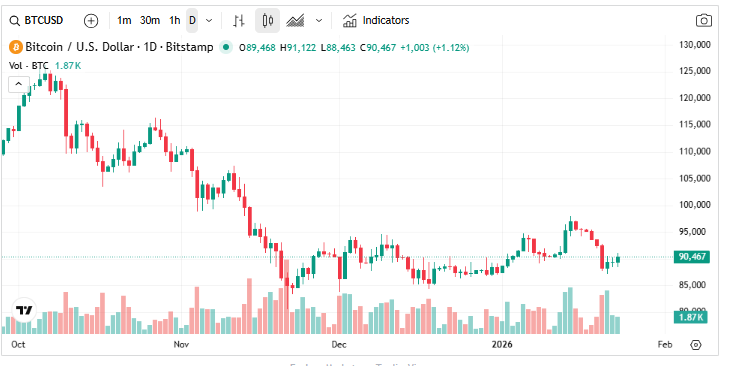
Despite long-term adoption trends, Bitcoin has lost roughly 25,000 millionaire addresses in the year since President Donald Trump returned to the White House, falling from 157,563 addresses at his January 2025 inauguration to 132,383 by Jan. 20, 2026.

$100 Trillion Inheritance Crypto - Bitcoin Price Chart
Source: TradingView

The crypto dipped below $90,000 today amid broader market volatility, even as institutional products continue proliferating and younger generations position themselves to inherit trillions in assets over the coming decades.

The post $100 Trillion Inheritance Wave Could Send Crypto Prices Soaring, CEO Says appeared first on Cryptonews.

Revolut Drops US Bank Merger Plan, Will Pursue Standalone License — Could This Speed Up Its Crypto Expansion?

23 January 2026 at 13:44

Fintech unicorn Crypto-friendly Revolut is dropping its planned acquisition of an American bank in favor of an independent banking license on its way to expand in the US market, the Financial Times reported on Friday.

The report referred to individuals who are knowledgeable of the issue that Revolut has been negotiating with authorities in the U.S. regarding submitting an application to obtain a bank license via the Office of the Comptroller of the Currency (OCC).

The shift comes as regulatory attitudes in Washington soften toward fintechs and crypto firms.

Revolut Points to Softer U.S. Regulation as It Adjusts Expansion Plans

The UK-based fintech, valued at about $75 billion following a November share sale, had spent much of 2025 exploring the purchase of a nationally chartered US bank.

An acquisition would have allowed Revolut to bypass the lengthy process of applying for a banking charter from scratch and immediately gain the ability to lend across all 50 states.

As recently as July, executives believed this approach would be the quickest way to scale operations in the US.

🏦 @RevolutApp may buy a US bank with a national charter to fast-track its American expansion and bypass the lengthy process of obtaining its own licence.#Revolut #Fintechhttps://t.co/xeDYK3miuI

— Cryptonews.com (@cryptonews) July 30, 2025

This perception has already changed, as the company is currently gambling that the approval process can be completed faster in the Trump administration since the regulatory environment has become a lot lighter than it was in the past few years.

Revolut admitted that the US is the key to its long-term growth strategy and emphasized that it wanted to have a bank in the country but noted that no final decision has been made yet and plans may change.

Revolut is “actively working with the regulator to launch the [UK] bank this year. That’s our ambition – that we’re going to launch the bank this year,” said Sid Jajodia, Revolut's CBO

Revolut “ask” regulators to be faster at making decisions.

“Anything regulators can do to… https://t.co/6AZl3CMTax pic.twitter.com/GR1J9dAbQ2

— Max Karpis (@maxkarpis) September 24, 2025

Internally, the rethink is based on fears of the purchase of a community bank being problematic, such as the necessity to use physical branches and a more complicated approval procedure for any changes in ownership.

De novo license application, which has traditionally been slow, is now considered more predictable (and consistent with the Revolut digital-first model).

National Trust Charters Emerge as Key Path for Crypto and Fintech Firms

The relocation will put Revolut on a list of increasingly popular fintech and crypto-native companies that are pursuing national charters.

The OCC itself has received approximately 13 new bank and trust license applications in 2025 alone, which is close to the number of the past four years combined.

The regulator, in December, gave conditional approval to five crypto-based companies to become national trust banks, as well as BitGo, Fidelity Digital Assets, and Paxos, to turn current state licenses into national ones.

✅ The OCC has conditionally approved five crypto firms, including @Circle and @Ripple, to launch national trust banks.#Ripple #Circlehttps://t.co/wCeTNrhOQZ

— Cryptonews.com (@cryptonews) December 13, 2025

The US banking license would provide Revolut with greater access to the dollar clearing, custody, and compliance infrastructure, which could be valuable to its stablecoin and crypto offerings at a time when federal oversight is becoming the selling point to both institutional and retail customers.

Although national trust charters prohibit taking deposits or lending, they do provide regulatory visibility that a number of crypto companies have long been craving.

Revolut Strengthens Role as Bridge Between Banks and Crypto

Notably, Revolut has gradually developed its crypto service and established itself as a gateway between conventional finance and digital assets.

In October, the company eliminated all fees and spreads on the conversions of the US dollar into major stablecoins USDC and USDT.

🚀 Revolut launches zero-fee stablecoin swaps for its 65 million users as crypto trading drives 298% revenue growth in its wealth division.#Revolut #Stablecoinhttps://t.co/rFY9zImV4j

— Cryptonews.com (@cryptonews) October 31, 2025

The volume of stablecoin payments on the platform is projected to have increased by 156% in 2025 to approximately 10.5 billion due to daily payment transactions and not because of speculative trading.

Additionally, Revolut has also increased its global growth, gaining banking licenses in Colombia and Mexico, a crypto regulatory license in Cyprus, and more than 1 billion investments in France by 2028.

It is also said to consider a dual listing in London and New York, the move that would further establish its position as one of the most valuable fintechs in the world.

The post Revolut Drops US Bank Merger Plan, Will Pursue Standalone License — Could This Speed Up Its Crypto Expansion? appeared first on Cryptonews.

Ethereum Founder Vitalik Buterin Ditches Big Tech: His 2026 “Self-Sovereign” Stack Reveals Surprising Changes

23 January 2026 at 11:19

Ethereum cofounder Vitalik Buterin has outlined a personal shift away from Big Tech platforms, framing 2026 as a pivotal year for what he calls “computing self-sovereignty.”

This is a concept that extends beyond blockchain and into how individuals use everyday software, communication tools, and artificial intelligence.

2026 is the year we take back lost ground in computing self-sovereignty.

But this applies far beyond the blockchain world.

In 2025, I made two major changes to the software I use:

* Switched almost fully to https://t.co/caFP0K5fYF (open source encrypted decentralized docs)
*…

— vitalik.eth (@VitalikButerin) January 22, 2026

In a post shared on X, Buterin described a series of changes he has made across his devices to reduce reliance on centralized, data-intensive services.

Vitalik Buterin Replaces Google, Telegram With Privacy-Focused Alternatives

He claimed that the process started in 2025 when he transferred nearly completely to the open-source and encrypted and decentralized document platform Fileverse, which is purported to be a privacy-focused alternative to Google Docs.

At roughly the same period, he reported having changed to Signal as his main messaging application, abandoning Telegram.

Signal supports end-to-end encryption on all conversations by default and only retains a little metadata, whereas Telegram encrypts messages only in optional so-called secret chats.

He further stated that it otherwise stores messages and metadata on its servers, a design that has attracted increased attention due to an increase in law enforcement requests in some jurisdictions.

🔒 Telegram CEO Pavel @Durov has issued a statement reaffirming the platform’s commitment to user privacy.#privacy #telegramhttps://t.co/ZPIeUno9K1

— Cryptonews.com (@cryptonews) April 21, 2025

The changes made in 2026 included more extensive ones, which were due to those initial adjustments.

Buterin claimed to have substituted Google Maps with OpenStreetMap, with Organic Maps on mobile phones, citing the advantage of local and offline use that restricted the volume of location data sent to third parties.

He also left Gmail for Proton Mail, citing encrypted messaging as a more powerful tool to use for confidential communication.

Simultaneously, he claimed to have started giving priority to decentralized social media and still tests the idea of running large language models locally, as opposed to using cloud-based AI services.

Buterin Sees Local AI as the Future of User Privacy

The rationale of these decisions is not purity in ideology but practicality, as Buterin wrote.

According to him, it is not necessary to send big amounts of personal information to centralized services, as there are tools that can be used to minimize this exposure.

He admitted that local AI systems still have usability and integration issues, especially for translation, transcription, and document search, but noted that there has been a lot of improvement in the last year.

He explained a more ambitious long-term vision where local models are integrated with cryptographic schemes like zero-knowledge proofs, trusted execution environments, and local data filtering to restrict the information that ever leaves a user’s device.

Rising AI Demand Puts Self-Sovereign Computing Back on the Map

The remarks made by Butterin come amidst the wider revival of interest in self-sovereign computing, which is a model that highlights the importance of individualized controls of data, identity, and computing resources.

The idea integrates identity systems based on decentralization, personal servers, and privacy-by-design software with the aim of minimizing reliance on platforms that are controlled by corporations.

Privacy activists, including Naomi Brockwell, have long held the position that the most consistent approach to ensuring autonomy is to run software and AI models in place.

The most private way to use AI is to host it locally, but you're limited by your own hardware. There are AI platforms that allow you to access more powerful models & also respect your privacy. Planning to update this video soon to include newcomers like https://t.co/ueOskOEx0g. pic.twitter.com/WlB6PUxlpA

— Naomi Brockwell priv/acc (@naomibrockwell) January 19, 2026

The time also stands out due to the re-evaluation of the strategic value of computing infrastructure by governments and corporations.

Analysts believe that 2026 will be the year of a change in the treatment of AI data centers, energy-backed compute and GPU capacity.

👀 Governments are expected to start treating AI data centers and energy-backed computing power as strategic infrastructure in 2026, similar to how oil reserves are managed.#AI #Energy #TokenizedDollars #Cryptohttps://t.co/DUYrsqn7iI

— Cryptonews.com (@cryptonews) January 13, 2026

With the demand of large-scale AI continuing to outpace its supply, compute and energy are becoming viewed as a source of geopolitical power.

In that environment, the appeal of local and decentralized computing models has grown, particularly as concerns mount over surveillance, data residency, and platform dependence.

The post Ethereum Founder Vitalik Buterin Ditches Big Tech: His 2026 “Self-Sovereign” Stack Reveals Surprising Changes appeared first on Cryptonews.

World’s Second-Largest Wealth Manager UBS to Offer Crypto Investing to Wealth Clients

23 January 2026 at 10:59

UBS Group AG, the world’s second-largest wealth manager with over $7 trillion in invested assets, is preparing to offer crypto investments to select wealthy clients, starting with Bitcoin and Ethereum.

According to a January 23 Bloomberg report, UBS is expected to begin offering crypto services in Switzerland, with potential expansion to the Asia-Pacific region and the U.S. The Swiss banking powerhouse is still selecting partners and hasn’t finalized plans.

The initiative reflects growing demand for digital assets among high-net-worth individuals and positions UBS alongside Wall Street competitors who have already entered the crypto wealth management space.

UBS plans to make cryptocurrency investing available for some private banking clients in what could become a significant move into digital assets for the wealth manager https://t.co/pWi6Inm9AP

— Bloomberg (@business) January 23, 2026

Wall Street’s Crypto Wealth Management Rush

UBS’s planned offering follows a wave of similar initiatives from major banking competitors throughout 2024 and 2025.

Last October, Morgan Stanley opened the door for all its wealth management clients to invest in crypto.

According to CNBC, the bank informed its financial advisers that starting October 15, crypto investments became available to all clients, regardless of risk profile or account type, including retirement accounts.

🚀 @MorganStanley has prepared to unlock $1.3T in crypto trading via E-Trade in 2026, starting with Bitcoin, Ether, and Solana.#Bitcoin #Crypto #MorganStanleyhttps://t.co/MvIWz1XTBe

— Cryptonews.com (@cryptonews) September 23, 2025

Previously, access to crypto funds at Morgan Stanley was limited to clients with aggressive risk tolerance and at least $1.5 million in investable assets who wanted exposure through taxable brokerage accounts.

The new policy removes those barriers, allowing any client to add crypto funds to their portfolio under adviser supervision.

Morgan Stanley is also preparing to bring cryptocurrency trading for E-Trade clients in the first half of 2026, a move that could unlock access to as much as $1.3 trillion in trading volume.

UBS Crypto Investing - BTC Price Vs Institutional Interest Chart
Source: KPMG

According to Bloomberg, the offering will begin with Bitcoin, Ether, and Solana, with plans to expand to broader services.

Morgan Stanley recently took another step into the U.S. crypto market after filing a Form S-1 registration statement with the Securities and Exchange Commission for a Morgan Stanley Ethereum Trust, adding to growing expectations that large Wall Street firms are positioning for broader spot crypto products beyond Bitcoin.

The Morgan Stanley Global Investment Committee (GIC) is now advising clients to allocate a small portfolio portion to cryptocurrency, recommending between 2% and 4% depending on risk appetite.

JPMorgan, BofA, Wells Fargo Join Crypto Push

Similarly, JPMorgan Chase & Co. allows select trading and wealth clients to use cryptocurrency exchange-traded funds (ETFs) as collateral for loans, according to Bloomberg, published on June 4.

The bank began with BlackRock’s iShares Bitcoin Trust (IBIT) and plans to expand access to other funds after rollout.

Traditional banking giants Bank of America and Wells Fargo are also offering eligible wealth management clients access to spot Bitcoin exchange-traded funds (ETFs).

The ETFs have been available to clients for several weeks, a source familiar with Bank of America’s plans told Reuters.

The move follows the Securities and Exchange Commission’s (SEC) approval of these investment vehicles in January 2024, marking a major milestone in cryptocurrency acceptance within traditional financial systems.

UBS already active in Hong Kong and Blockchain Integration

Currently, UBS Group AG and rivals such as HSBC Holdings Plc offer select clients in Hong Kong the ability to trade specific crypto-linked exchange-traded funds (ETFs).

Affluent clients have been granted access to the Samsung Bitcoin Futures Active, CSOP Bitcoin Futures, and CSOP Ether Futures ETFs since the initiative went live in 2023.

UBS is also taking a major step in integrating blockchain technology into traditional finance by experimenting with digital gold investments for retail investors.

Last February, UBS completed a proof-of-concept for its fractional gold investment product, UBS Key4 Gold, on the Ethereum layer-2 network ZKsync Validium.

🇨🇭 Swiss banking giant @UBS has successfully tested its new blockchain-based payment system, UBS Digital Cash.#Blockchain #Payments https://t.co/yuiiHesUBw

— Cryptonews.com (@cryptonews) November 8, 2024

In November 2024, the bank launched UBS Digital Cash, a private blockchain pilot for multi-currency cross-border payments.

UBS Tokenize, another initiative, enables on-chain issuance of tokenized financial products, including the first tokenized money market fund on Ethereum.

The post World’s Second-Largest Wealth Manager UBS to Offer Crypto Investing to Wealth Clients appeared first on Cryptonews.

Grayscale Files S-1 to Launch BNB-Tracking ETF in the U.S.

23 January 2026 at 10:37

Grayscale Investments has filed an S-1 registration with the U.S. Securities and Exchange Commission (SEC) to launch an exchange-traded fund tracking BNB.

According to a Form S-1 filed on Friday, the proposed product is titled the Grayscale BNB ETF. The filing seeks approval to offer a publicly traded ETF designed to track the price of BNB, the native token of the BNB Smart Chain ecosystem.

The fund is sponsored by Grayscale Investments and incorporated in Delaware. The registration statement notes that the offering would commence only after the SEC declares the filing effective, which is a standard requirement before shares can be sold to the public.

The preliminary prospectus outlines that the trust will issue shares representing fractional beneficial interests, with the value of those shares intended to reflect the performance of BNB.

As with other crypto ETFs proposed in the U.S., the product would not actively trade or use derivatives but would seek to provide passive exposure to the underlying digital asset.

Expanding the Scope of Crypto ETFs

The BNB ETF filing comes as asset managers continue to test the boundaries of U.S. crypto ETF approvals following the authorization of spot Bitcoin ETFs and, later, spot Ethereum products.

Market participants have increasingly viewed these approvals as a potential gateway for additional single-asset crypto ETFs tied to major blockchain networks.

BNB is among the largest digital assets by market capitalization and plays a central role in transaction fees, staking, and decentralized applications within the BNB Chain ecosystem.

Regulatory Context and Timeline

The SEC will review the registration statement for compliance with disclosure, custody, and market-integrity standards. The process can involve multiple rounds of comments and amendments, potentially extending over several months.

The prospectus shows that the ETF is “subject to completion” and may be revised before becoming effective. It also reflects standard risk disclosures, including price volatility, regulatory uncertainty surrounding digital assets, as well as operational risks tied to blockchain networks.

ETF Flows Pick Up

Digital asset investment products saw a sharp rebound in demand last week, recording $2.17 billion in net inflows, the strongest weekly total since October 2025, according to CoinShares data.

📊 Digital asset investment products saw $2.17bn in weekly inflows, the strongest since Oct 2025, according to CoinShares.#ETFs #Crypto https://t.co/Q41wIu0zLs

— Cryptonews.com (@cryptonews) January 19, 2026

The bulk of those inflows arrived early in the week before sentiment deteriorated, driven by rising geopolitical tensions, renewed tariff threats, and fresh uncertainty around U.S. monetary policy leadership.

By Friday, flows had reversed, with crypto investment products posting $378 million in outflows following diplomatic escalation linked to Greenland and renewed concerns over global trade policy.

The post Grayscale Files S-1 to Launch BNB-Tracking ETF in the U.S. appeared first on Cryptonews.

DOJ Targets Crypto Fraud in ‘America First’ Blitz as AI Scams Spike 450%

23 January 2026 at 09:59

The U.S. Department of Justice is intensifying its efforts on crypto-related fraud as it escalates to execute what the authorities refer to as an “America First” enforcement agenda in response to a surge of digital asset-related frauds driven more by artificial intelligence.

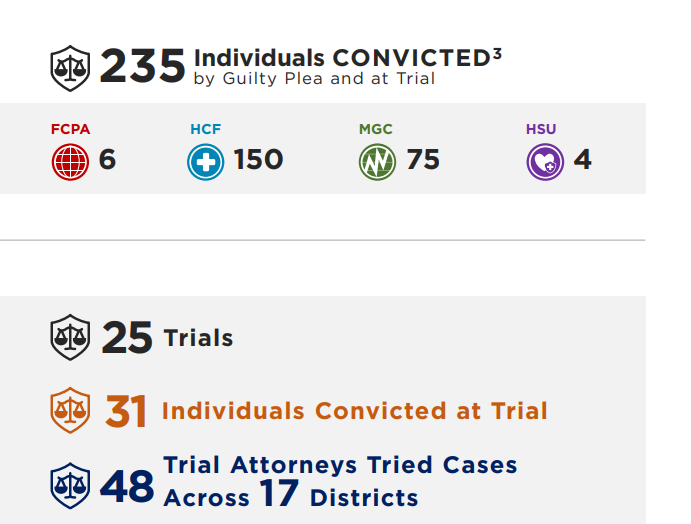
The shift was outlined in the DOJ Criminal Division Fraud Section 2025 Year in Review, published on Thursday, indicating prosecutors accused 265 defendants with a cumulative alleged loss on fraud cases of over $16 billion, nearly twice the amount reported the previous year.

Source: DOJ Criminal Division Fraud Section

Although the cases were in medical care, consumer protection, corporate fraud, and market manipulation, the DOJ said that cryptocurrency was increasingly becoming a type of payment rail, laundering, or asset category due to illicit funds.

In some significant cases, authorities seized crypto alongside cash, real estate, and luxury goods, showing the strong integration of digital assets into conventional fraudulent actions.

DOJ Health Care Fraud Crackdowns Lead to Major Crypto Seizures

One of the most prominent cases cited involved a $1 billion amniotic wound allograft fraud scheme that allegedly generated more than $600 million in improper Medicare payments.

Prosecutors charged Tyler Kontos, Joel Kupetz, and Jorge Kinds with targeting elderly and terminally ill patients for medically unnecessary procedures.

As part of the investigation, law enforcement seized more than $7.2 million in assets, including bank accounts and cryptocurrency.

The DOJ also highlighted the National Health Care Fraud Takedown carried out last year, the largest in the department’s history.

That operation charged 324 individuals across 50 federal districts for schemes involving more than $14.6 billion in intended losses.

Authorities confiscated more than $245 million in assets in the sweep, including significant amounts of cryptocurrency.

Simultaneously, the regulators prevented over $4 billion of fraudulent Medicare payments prior to their disbursement, indicating a more active, data-driven enforcement strategy.

Behind these cases is the DOJ Fraud Section, which operates through four specialized units that increasingly intersect with crypto-related crime.

Its units include foreign bribery, market and consumer fraud, healthcare fraud, and health and safety crimes, areas where digital assets and blockchain-based laundering are now frequently involved.

Source: DOJ Criminal Division Fraud Section

Prosecutors reported securing 235 convictions in 2025, including 25 trials across 17 federal districts.

AI-Assisted Scams Drive Sharp Rise in Crypto Fraud Losses

This enforcement surge comes as reported crypto fraud losses continue to climb. The FBI’s Internet Crime Complaint Center recorded more than 41,500 crypto investment scam complaints in 2024, with reported losses exceeding $5.8 billion.

Federal data shows total crypto scam losses reached roughly $9.3 billion last year, with older Americans disproportionately affected.

👾 The FBI recorded $9.3 billion losses spread across various crypto-related investment scams, extortion, ATM and kiosks, among others, in 2024.#FBI #CryptoFraud #CryptoScamhttps://t.co/1Eb8KStAHk

— Cryptonews.com (@cryptonews) April 24, 2025

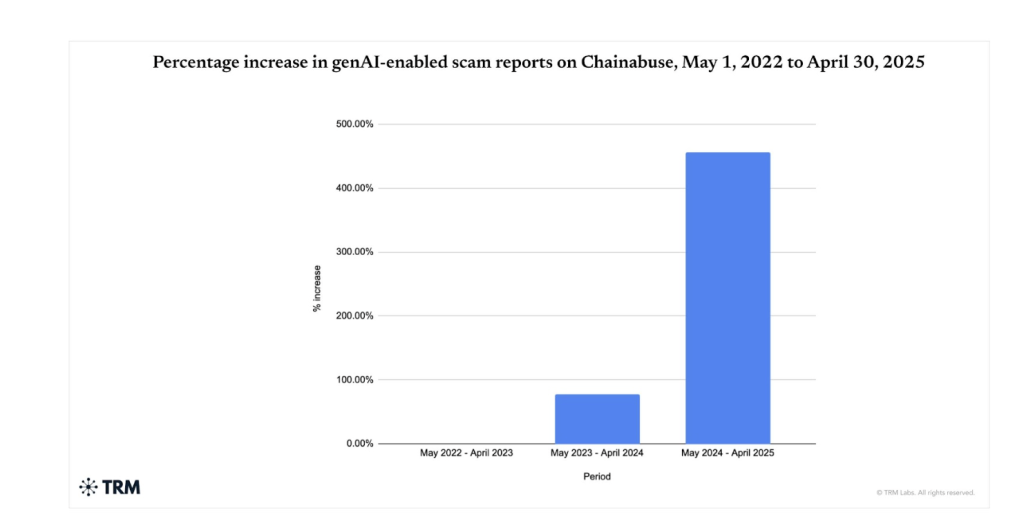
In 2025, blockchain analytics firms reported that average scam payments rose more than 250%, while AI-assisted scams have surged by more than 450%, as criminals deployed deepfake audio, synthetic identities, and automated phishing at scale.

Source: TRM Labs

In response, the DOJ and other agencies have launched coordinated initiatives aimed at transnational fraud networks, particularly so-called “pig butchering” scams linked to criminal groups operating in Southeast Asia.

A multi-agency strike force announced late last year has already seized and forfeited more than $401 million in cryptocurrency, including the largest bitcoin seizure in U.S. history.

Separately, the FBI’s Operation Level Up has notified thousands of potential victims and helped prevent hundreds of millions of dollars in additional losses.

Lawmakers have also moved to tighten the legal framework, as bipartisan bills introduced in Congress seek harsher penalties for AI-assisted fraud and stronger coordination across federal agencies to combat crypto-related scams.

In addition, two U.S. senators introduced the SAFE Crypto Act aimed at tightening the government’s response to cryptocurrency-related fraud.

The post DOJ Targets Crypto Fraud in ‘America First’ Blitz as AI Scams Spike 450% appeared first on Cryptonews.

Binance launches USD1 rewards programme with WLFI token airdrops

23 January 2026 at 05:34
  • Binance launched a USD1 rewards campaign, distributing $40m in WLFI tokens through weekly airdrops.
  • WLFI payouts are based on users’ net USD1 balances, with higher rewards for USD1 used as collateral.
  • USD1’s market cap has surpassed $3 billion, while WLFI activity has increased across DeFi and payroll uses.

Binance has rolled out a new rewards campaign for users holding USD1, offering weekly WLFI token airdrops with a total of $40 million in WLFI earmarked for distribution.

The exchange said eligible accounts that maintain a USD1 balance between Jan. 23 and Feb. 20 will receive rewards throughout the programme.

The initiative ties WLFI payouts directly to net USD1 balances on Binance, using a snapshot-based system to calculate qualifying amounts.

Binance is positioning the campaign as an incentive for users who hold or deploy USD1 across supported products, while both USD1 and WLFI continue to see growing activity across the wider crypto ecosystem.

How Binance will distribute WLFI rewards

Binance said WLFI rewards will be paid once a week, starting Feb. 2.

Each weekly distribution will cover activity from the previous seven days.

The campaign is structured to release roughly $10 million worth of WLFI tokens per week, spread across four consecutive weeks, which brings the total allocation to $40 million in WLFI.

The exchange said the rewards are designed to reflect users’ qualifying USD1 balances over time, rather than a single moment in the campaign window.

Which USD1 balances count for eligibility

Eligibility is based on users’ net USD1 balances held on Binance, with multiple account types included in the calculation.

Binance confirmed that USD1 stored in Spot, Funding, Margin, and USDⓈ-M Futures accounts will all count toward the campaign’s rewards calculation.

However, borrowed funds are excluded. Binance said reward calculations are based on net USD1 balances, meaning any USD1 that has been borrowed does not qualify for WLFI rewards.

The exchange also said that USD1 used as collateral in margin or futures accounts earns a higher reward rate.

This introduces an added incentive for users who allocate USD1 into collateral-based trading products, rather than keeping it entirely idle in standard wallets.

Snapshot and rate system used for payouts

Binance said it will take hourly snapshots of user balances throughout the campaign period. However, the rewards calculation does not rely on an hourly average.

Instead, Binance will use the lowest USD1 balance recorded each day to determine a user’s qualifying amount for that day.

For each weekly payout, Binance will then calculate rewards using a seven-day average balance.

This ties distributions to consistency because a single daily dip in holdings could reduce the qualifying amount for that day and then affect the overall weekly average.

Binance also said payouts will use an effective annualised rate, which will be set at the time of each distribution.

As a result, the rate applied could vary between weekly drops depending on the conditions Binance sets when rewards are released.

USD1 growth and WLFI activity in early 2026

USD1, launched in April 2025, is described as a multichain stablecoin that is fully backed one-to-one by US dollars and money market funds.

Since its launch, it has recorded sharp growth. According to data from DeFiLlama, USD1’s market capitalisation now exceeds $3 billion.

The stablecoin is available across several blockchains, including Monad, Ethereum, Solana, and Aptos.

WLFI, the main token of the World Liberty Financial ecosystem, has also seen increased activity in early 2026.

It has recently been added to payroll services, decentralised finance lending platforms, and on-chain liquidity venues.

The token has drawn new interest and partnerships in recent weeks, though its connection to US President Donald Trump has also faced criticism, with some pointing to concerns around a potential conflict of interest.

Binance said users must complete identity verification and live in eligible jurisdictions to take part in the programme.

The exchange added that broker accounts are excluded and noted that reward timing may vary due to operational conditions.

The post Binance launches USD1 rewards programme with WLFI token airdrops appeared first on CoinJournal.

Banks Make Killing Stablecoin Yields Their Top 2026 Priority

23 January 2026 at 03:43

The American Bankers Association placed stablecoin rewards at the forefront of its 2026 policy agenda, escalating an industry-wide campaign against digital-dollar incentive programs that banks claim threaten deposit bases and community lending capacity.

The trade group’s newly released Blueprint for Growth explicitly calls on Congress to “stop payment stablecoins from becoming deposit substitutes that slash community bank lending by prohibiting paying interest, yield or rewards regardless of the platform.

ABA President and CEO Rob Nichols said the priorities were developed through collaboration with all 52 state bankers’ associations to advance policies that “bolster the economy, expand access to credit and enhance competition in the financial services marketplace.

The document positions stablecoin yield restrictions as the association’s leading economic priority ahead of fraud prevention, regulatory threshold indexing, and support for minority-serving financial institutions.

Just released – ABA’s 2026 Blueprint for Growth outlines key policy priorities: https://t.co/KsOScu1Lgs pic.twitter.com/C3gMrXQn84

— American Bankers Association (@ABABankers) January 20, 2026

Banking Industry Intensifies Pressure on Lawmakers

The coordinated push comes as Senate Banking Committee negotiations over digital asset market structure legislation remain deadlocked over stablecoin reward provisions.

Banking executives have spent months warning that yield-bearing tokens could trigger massive deposit outflows, with Bank of America CEO Brian Moynihan estimating that $6 trillion in deposits could migrate into stablecoins under permissive regulatory frameworks.

JPMorgan CFO Jeremy Barnum also warned during the bank’s fourth-quarter earnings call that interest-bearing stablecoins risk creating “a parallel banking system that sort of has all the features of banking, including something that looks a lot like a deposit that pays interest, without the associated prudential safeguards.

⚠ @JPMorgan backs blockchain innovation but warns yield-bearing stablecoins mimic bank deposits without oversight.#JPMorgan #Stablecoinhttps://t.co/4Fbu8pMOwk

— Cryptonews.com (@cryptonews) January 14, 2026

Community bankers have been particularly vocal, with the Community Bankers Council urging Congress in early January to close what it called a “loophole” allowing stablecoin issuers to indirectly fund yield through exchange partners.

The group warned that large-scale deposit outflows could reduce credit availability for small businesses, farmers, students, and homebuyers in local communities.

Senator Tim Scott’s draft crypto market structure bill released January 9 includes language prohibiting digital asset service providers from paying interest or yield solely for holding stablecoins, though the provision allows activity-based rewards tied to functions like staking and liquidity provision.

Crypto Coalition Mobilizes Against Expanded Restrictions

A coalition of 125 crypto and fintech organizations, including Coinbase, PayPal, Stripe, Ripple, and Kraken, delivered a forceful rejection of expanded yield restrictions in December.

The Blockchain Association-led group argued that banking industry efforts represent “overtly protectionist” measures rather than consumer protection, noting that banks face no similar restrictions on credit card rewards despite engaging in riskier balance-sheet activities.

The push to restrict stablecoin rewards beyond that agreed to in GENIUS is not a technical refinement or a consumer protection fix,” the coalition stated.

It would prohibit the same types of incentive programs for stablecoin payments that banks have long offered on credit cards and other types of payment services.

Just yesterday, Circle CEO Jeremy Allaire called banking concerns “totally absurd” during a World Economic Forum panel, drawing parallels to historical opposition to money market funds.

🙅‍♂️ Circle CEO rejects bank warnings on stablecoin yields as "absurd," citing money market precedent as transaction volumes reach $33 trillion in 2025.#Stablecoin #Circlehttps://t.co/kPQw5xYpBh

— Cryptonews.com (@cryptonews) January 22, 2026

The exact same arguments were made,” Allaire stated, noting that roughly $11 trillion in money market funds has grown without preventing lending activity.

He emphasized that all major stablecoin regulations prohibit issuers from paying interest directly, while partner platforms may offer rewards based on commercial arrangements.

Rewards around financial products exist in every balance that you have with a credit card that you use,” Allaire said.

The crypto coalition disputed Treasury projections suggesting yield-bearing stablecoins could result in up to $6.6 trillion in deposit flight, citing analysis that found no evidence of disproportionate deposit outflows from community banks.

The groups questioned how banks can claim deposit constraints while holding $2.9 trillion in reserve balances at the Federal Reserve.

Coinbase CEO Brian Armstrong said the exchange could not back Scott’s draft bill, citing provisions that would eliminate stablecoin rewards.

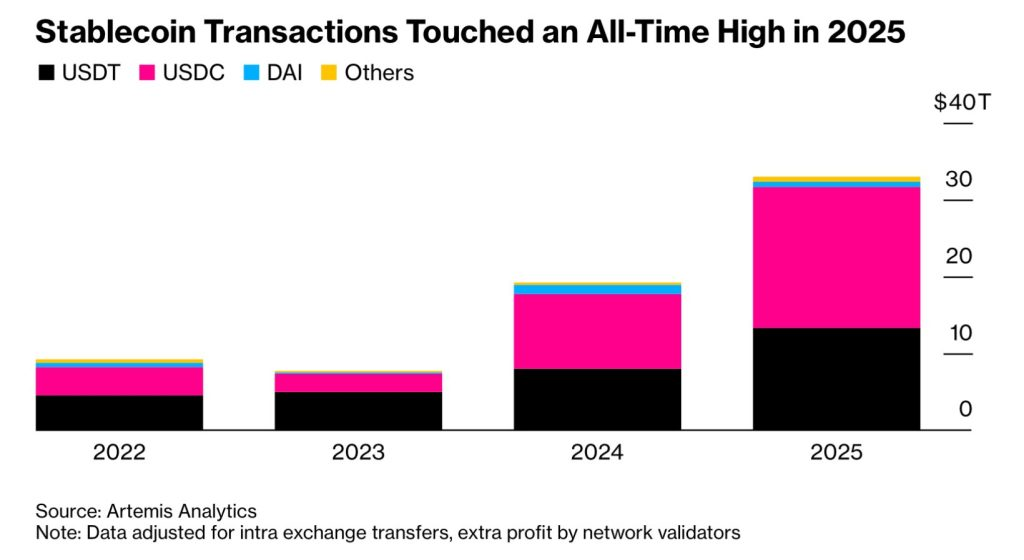
These divisions come as global stablecoin transaction volumes reached $33 trillion in 2025, up 72% from the previous year, with USDC processing $18.3 trillion.

Banks Stablecoin Yields - Stablecoin Transactions Volume 2025 Chart
Source: Artemis Analytics

Bloomberg Intelligence predicted that flows could reach $56 trillion by 2030 as institutional payment infrastructure adoption accelerates.

For now, the Banking Committee may postpone further work until late February or March, following Coinbase’s withdrawal of support and divided attention to the new housing policy agenda demanded by Trump.

However, the Senate Agriculture Committee has scheduled a markup of competing legislation for January 27 that takes a fundamentally different approach by excluding payment stablecoins from CFTC authority entirely and deferring regulation to frameworks like the GENIUS Act rather than setting specific yield rules.

The post Banks Make Killing Stablecoin Yields Their Top 2026 Priority appeared first on Cryptonews.

Asia Market Open: Bitcoin Dips Below $90K, Wall Street Rebound Lifts Asia Risk Mood

22 January 2026 at 22:34

Bitcoin dipped below $90,000 on Friday as Asian stocks posted modest gains after the Bank of Japan held rates steady, with investors weighing softer US tariff talk alongside signs of US economic resilience.

MSCI’s broadest index of Asia Pacific shares outside Japan rose 0.4%, while Japan’s Nikkei added 0.3%.

Japan’s central bank left its interest rate steady at about 0.75% after wrapping up its two-day policy meeting on Friday.

The hold followed a rate increase in December that lifted borrowing costs to their highest level in three decades, after policymakers judged the chances of meeting the 2% inflation target had improved.

BREAKING: BOJ revises inflation forecast up, keeps policy rate unchangedhttps://t.co/hn72uFUABs pic.twitter.com/KgWAHpmrqs

— Nikkei Asia (@NikkeiAsia) January 23, 2026

Market snapshot

  • Bitcoin: $89,795, down 0.1%
  • Ether: $2,960, down 1.7%
  • XRP: $1.91, down 1.6%
  • Total crypto market cap: $3.11 trillion, down 0.3%

Wall Street Extends Rebound After Trump Eases Tariff Rhetoric

Greg Magadini, director of derivatives at Amberdata, said: ”The biggest threat today for global risk-assets, including BTC and altcoins, is around debt sustainability. If yields rise too much, the cost of financing (and investment attractiveness) of risk-assets requires lower prices.”

On Wall Street, stocks extended a rebound for a second session on Thursday after President Donald Trump walked back earlier tariff threats on European goods and ruled out taking control of Greenland by force.

The S&P 500 gained 0.5% and the Nasdaq Composite rose 0.9%, with investors rotating back into equities after the midweek jitters.

The rally also broadened, with the small-cap Russell 2000 closing at a record high, even as the week stayed choppy, the S&P 500 and Nasdaq were down 0.4% for the week and the Dow was little changed.

Earnings Season Looms As A Fresh Market Test

In rates and FX, the dollar index held near 98.329 and hovered around its lowest levels of the year after its biggest one-day fall in six weeks.

Fed funds futures implied a 96% chance the Federal Reserve will keep rates on hold at its Jan. 28 meeting, and the 10-year Treasury yield ticked up to about 4.247%.

Commodities stayed in focus as precious metals pushed deeper into record territory, with gold up 0.3% to $4,951.47 per ounce and silver up 1.7% at $97.85.

South Korea led the regional move, the Kospi rose 1.1% for a third day after crossing 5,000 for the first time, a level President Lee Jae Myung had pledged to target through market reforms and tax measures aimed at narrowing the so-called Korea discount.

Tech also kept traders busy after Intel forecast quarterly revenue and profit below estimates, sending its shares down 11% in after-hours trading, a reminder that earnings season can still reshape sentiment quickly.

The post Asia Market Open: Bitcoin Dips Below $90K, Wall Street Rebound Lifts Asia Risk Mood appeared first on Cryptonews.

SEC Crypto Crackdown Shrinks 60% Under Trump Pick Paul Atkins

22 January 2026 at 20:04

US securities regulators opened far fewer crypto-related enforcement actions in 2025, with a Cornerstone Research report pointing to a sharp shift in priorities after President Donald Trump’s administration installed Paul Atkins as SEC chair.

The report found the SEC initiated 13 crypto-related actions in 2025, down from 33 in 2024, a 60% decline and the lowest level since 2017.

Part of that count reflects a handover at the top. Five of the 13 actions were initiated under Gary Gensler before his departure in Jan. 2025, while eight were initiated under Atkins. Those eight included allegations of fraud.

That mix matters for crypto markets that spent the last few years bracing for regulation by enforcement.

Image Source: Cornerstone Research

Fewer Cases, But A Sharper Focus Under Atkins

With the SEC focusing new crypto cases on fraud, the focus has shifted away from broad registration theories and toward cases built around clear investor harm that are easier to argue in court.

The same report also found 29 crypto-related actions were resolved in 2025, including seven that the SEC dismissed under Atkins.

Meanwhile, total monetary penalties imposed against digital asset market participants came to $142M in 2025, which Cornerstone said was less than 3% of the penalties imposed in 2024.

SEC Focus Turns To Frameworks Beyond Courtrooms

“Enforcement actions under Chair Atkins reflect a shift in the SEC’s approach to digital-asset oversight, consistent with the priorities laid out in early 2025,” said Robert Letson, a principal at Cornerstone Research.

“Digital asset regulation continues to evolve and is something we will be watching closely in 2026.”

Atkins took office in April 2025 after a brief period with an acting chair, and legal observers have tracked a broader reset in tone across the agency since the leadership change.

If the SEC keeps prioritizing cases it can frame as fraud, the next phase of US crypto oversight may hinge less on surprise lawsuits and more on what rulemaking, guidance, or negotiated standards the commission chooses to put on the table in 2026.

The post SEC Crypto Crackdown Shrinks 60% Under Trump Pick Paul Atkins appeared first on Cryptonews.

Crypto Fundamentals Hit Records in Q4 2025 as Prices Lagged

22 January 2026 at 15:22

Crypto markets ended 2025 with a paradox: prices declined while usage metrics surged to all-time highs.

Bitwise’s latest research data show ETH dropped 29% in Q4 2025, even as Ethereum transactions reached new peaks. The asset manager’s CIO, Matt Hougan, noted that this disconnect has appeared before at major inflection points. Markets often bottom when participants lose interest just as adoption quietly improves.

The latest Bitwise Crypto Market Review just dropped—and it’s the most important one we’ve ever published.

Why? Because it shows a tension in crypto markets that has historically signaled a bear-market bottom (see Q1 2023).

Receipts: During Q4 2025…

– ETH’s price fell 29% ……

— Bitwise (@BitwiseInvest) January 21, 2026

The divergence is striking. Crypto equities fell 20% in 2025 while industry revenues grew at triple the rate of any other sector. Bitwise’s Q1 2025 review documented Ethereum’s 45% price decline alongside a 30.14% surge in transaction volume and tokenized real-world assets hitting all-time highs.

Stablecoin Flows Tell a Different Story

The stablecoin market crossed $300 billion in October 2025. Daily average transaction volume reached $3.1 trillion, according to an October 2025 Arkham Research report.

TRON exemplifies the usage-price disconnect. The network ended 2025 with over $81 billion in stablecoin supply, with USDT accounting for 99% of that figure. Messari data show average daily USDT transfer volume hit $23.8 billion by Q4. TRON processed approximately $6-7 trillion in stablecoin transactions annually, commanding 65% of global retail USDT transfers under $1,000.

Network revenue tells the same story. TRON achieved $1.2 billion in Q3 2025 revenue, an all-time high. Yet TRX spent much of 2025 consolidating around $0.28.

DeFi Outpacing Centralized Venues

Decentralized exchange volume has structurally outpaced centralized competitors. CoinDesk data from August 2025 showed daily DEX volume at $12.8 billion versus Coinbase’s $3.5 billion. Uniswap alone processes between $1-2 billion daily across supported chains, commanding a 55% DEX market share.

Uniswap v4 achieved $1 billion TVL within 177 days of launch. The protocol generated over $985 million in fees year-to-date through October 2025. Coinbase responded by integrating DEX trading directly into its app, routing orders through aggregators like 0x and 1inch to access Uniswap liquidity.

The Q1 2023 Parallel

Bitwise’s analysis draws a direct comparison to Q1 2023, when similar conditions preceded a two-year bull run. That quarter saw blockchain revenues climb 139% quarter-over-quarter while Ethereum transactions hit all-time highs.

The current setup mirrors that period: falling prices, improving fundamentals, and capital quietly accumulating through stablecoin rails.

Current Market Snapshot

ETH is currently trading at $2,954.29, consolidating near its 200-day EMA around $3,200-$3,300. The asset sits 39% below its all-time high of $4,946.

Source: TradingView

Hougan’s thesis hinges on three checkpoints for a rally in 2026, with one already achieved. The structural case rests on staking locking roughly 30% of the ETH supply, fee burns reducing issuance, and Layer 2 expansion sustaining network activity.

For traders weighing the data against the price action, the question is timing. Fundamental strength without price follow-through can persist for quarters. But when adoption curves accelerate while valuations compress, the gap eventually closes. The direction of that convergence is what 2026 will determine.

The post Crypto Fundamentals Hit Records in Q4 2025 as Prices Lagged appeared first on Cryptonews.

Bitcoin & Ethereum ETFs Shed Over $1B – But Solana and XRP See Inflows

22 January 2026 at 13:22

U.S.-listed spot Bitcoin and Ethereum exchange-traded funds saw over $1 billion in outflow in a single trading day on January 21, as investors moved out of the two largest cryptocurrencies during a broader market downturn.

Meanwhile, smaller altcoin-linked products linked to Solana and XRP experienced net inflows, which points to an apparent institutional positioning difference during the most recent volatility.

According to SoSoValue, on January 21(ET), Bitcoin spot ETFs saw a total net outflow of $709 million yesterday, marking three consecutive days of net outflows, while Ethereum spot ETFs recorded a total net outflow of $298 million. Meanwhile, Solana spot ETFs saw a total net… pic.twitter.com/rQZrHfM8LK

— Wu Blockchain (@WuBlockchain) January 22, 2026

Bitcoin and Ethereum ETFs recorded more than $1 billion in withdrawals, despite both asset classes recording positive cumulative inflows since inception.

Bitcoin ETFs Post November-High Redemptions During Global Market Rally

Bloomberg reported that outflows from Bitcoin ETFs were the biggest one-day redemption since November, and came at a time when the conventional risk assets reversed against calmer geopolitical tensions.

The remarks by U.S. President Donald Trump at Davos, where he dismissed military action over Greenland and indicated a halt to tariffs imposed on Europe, contributed to the boost in equities in the U.S., Europe, and Asia.

The iShares Bitcoin Trust at BlackRock recorded the highest outflow of $356.64 million, with Fidelity’s FBTC in second place at $287.67 million. Grayscale’s GBTC still experienced smaller yet steady redemptions and has had a total cumulative net outflow of over $25 billion since conversion.

Bitcoin ETF data source: SoSoValue

The HODL was the only big Bitcoin ETF that recorded a net inflow, which was $6.35 million.

Bitcoin ETFs have already registered weekly net outflows of $1.19 billion, while January remains slightly positive overall, with net inflows of $17.56 million.

Source: Cryptonews

At the time of writing, Bitcoin was trading at approximately $89,100, a loss of almost 7% over the past week, and the trading volume was decreasing, indicating a low level of activity in the short term.

Selling Pressure Hits Ethereum ETFs, Led by BlackRock’s ETHA

Ethereum ETFs mirrored the pressure seen in Bitcoin. On January 21, spot Ether ETFs posted net outflows of $297.51 million, following another heavy outflow the previous day.

BlackRock’s ETHA accounted for the bulk of the redemptions, shedding more than $250 million, while Fidelity’s FETH and Grayscale’s ETHE also saw net withdrawals. Grayscale’s lower-fee ETH mini trust was a notable exception, recording a modest inflow.

Despite the outflows, Ethereum ETFs still managed close to $18.3 billion in assets, roughly 5% of Ethereum’s market capitalization.

Ethereum itself briefly reclaimed the $3,000 level before slipping back, trading near $2,900, and was down nearly 13% over the past week.

Capital Shifts to Solana and XRP ETFs Amid Broader ETF Selloff

In contrast to the sell-off in Bitcoin and Ethereum products, Solana and XRP spot ETFs attracted fresh capital. Solana ETFs recorded net inflows of $2.92 million on January 21, lifting cumulative inflows to nearly $870 million.

Assets under management rose to about $1.10 billion, supported by steady interest in products from Fidelity, VanEck, and Grayscale, even as SOL’s price fell more than 11% on the week.

XRP ETFs also rebounded, posting $7.16 million in net inflows after starting the week with outflows. Cumulative inflows since launch now stand at $1.23 billion, with total assets around $1.39 billion.

Funds from Bitwise, Franklin Templeton, and Canary Capital led the day’s inflows, despite XRP trading lower alongside the broader market.

Market watchers said the divergence reflected positioning, not fundamentals, with Bitcoin and Ethereum ETFs reacting to macro-driven rebalancing, while smaller Solana and XRP funds drew selective inflows after earlier declines.

The post Bitcoin & Ethereum ETFs Shed Over $1B – But Solana and XRP See Inflows appeared first on Cryptonews.

Circle CEO Rejects Claims Stablecoin Yields Threaten Banks

22 January 2026 at 12:58

Circle CEO Jeremy Allaire dismissed banking industry warnings that stablecoin rewards could destabilize traditional finance, calling such concerns “totally absurd” during a World Economic Forum panel discussion on Thursday.

His remarks came amid escalating tensions between crypto platforms and banks over provisions in pending U.S. market structure legislation.

Speaking at the Davos summit, Allaire defended the stablecoin industry’s growth trajectory while addressing claims from Bank of America CEO Brian Moynihan that yield-bearing digital dollars could trigger massive deposit flight from commercial banks.

The panel, which included International Monetary Fund First Deputy Managing Director Dan Katz and development finance expert Vera Songwe, examined stablecoins’ expanding role in global payments following last year’s passage of the GENIUS Act.

Banks Warn of “Parallel Banking System”

Banking executives have intensified lobbying against stablecoin rewards programs, with JPMorgan CFO Jeremy Barnum recently warning that interest-paying tokens create “a parallel banking system that sort of has all the features of banking, including something that looks a lot like a deposit that pays interest, without the associated prudential safeguards.

The Community Bankers Council of the American Bankers Association also urged Congress earlier this month to close what it called a “loophole” allowing stablecoin issuers to indirectly fund yield through exchange partners.

Community bankers warned that large-scale deposit outflows could reduce credit availability for small businesses and homebuyers.

⚠ @JPMorgan backs blockchain innovation but warns yield-bearing stablecoins mimic bank deposits without oversight.#JPMorgan #Stablecoinhttps://t.co/4Fbu8pMOwk

— Cryptonews.com (@cryptonews) January 14, 2026

Allaire countered that such arguments ignore financial market history and mischaracterize how stablecoins function within regulatory frameworks.

Rewards around financial products exist in every balance that you have with a credit card that you use,” he said, noting these incentives help with customer retention without functioning as monetary policy dampeners.

Money Market Funds Precedent Cited

The Circle chief executive drew parallels to government money market funds, which banking groups once claimed would devastate deposit bases.

The exact same arguments were made,” Allaire stated, pointing out that roughly $11 trillion in money market funds has grown without preventing lending activity.

He argued that lending itself has shifted toward private credit markets, with “the vast vast majority of GDP growth in the United States” historically funded through capital market formation around junk bonds rather than bank credit.

Allaire emphasized that all major stablecoin regulations (including the GENIUS Act, Europe’s MiCA framework, and laws in Japan, UAE, Hong Kong, and Singapore) explicitly prohibit stablecoin issuers from paying interest.

Circle CEO Stablecoin Yields Threaten Banks - Jeremy Allaire Image
Source: YouTube

Payment stablecoins” are legally defined as cash instruments used for settlement and require cash-level safeguards under supervision by central bankers and global standard-setters.

While Circle generates income from reserves and revenue-sharing partnerships with platforms like Coinbase, Binance, and Visa, the company itself cannot pay interest directly to tokenholders.

Partner platforms may offer rewards based on their own commercial arrangements, but Allaire argued that this mirrors loyalty programs across traditional financial products.

IMF Acknowledges Benefits Amid Risks

The IMF’s Katz acknowledged stablecoins present “very significant potential benefits” for cross-border payments and financial inclusion while noting risks including banking disintermediation and currency substitution in emerging markets.

Transaction volumes reached $33 trillion in 2025, up 72% from the previous year, with USDC processing $18.3 trillion to lead all stablecoins by payment flow.

Stablecoin Transactions Volume Chart
Source: Artemis Analytics

Katz emphasized the importance of international regulatory interoperability, stating that realizing stablecoins’ full benefits requires scale and effective cross-border frameworks.

He pointed out the competitive pressures stablecoins create for traditional finance and weak fiscal regimes alike.

Songwe detailed stablecoins’ transformative impact across Africa, where remittance costs averaging 6% can drop to under $1 with digital dollar transfers that complete in minutes, versus five-day settlement delays.

With 650 million Africans lacking bank accounts and 12-15 countries experiencing inflation above 20%, stablecoins provide dollar-denominated savings accessible via smartphones.

Egypt, Nigeria, and Ethiopia lead African adoption, with most transactions below $1 million, indicating heavy small-business use.

In fact, according to Chainalysis, Sub-Saharan Africa received over $205 billion in on-chain value, up roughly 52% from the previous year between July 2024 and June 2025.

However, Songwe noted that 75% of stablecoin reserves remain dollar-denominated, prompting the development of SDR-backed alternatives to reduce dollar dependency and improve transparency around illicit financial flows.

Allaire concluded that stablecoins should remain “cash instrument money, credentially supervised, very very safe money,” with efficient credit delivery systems built atop them through decentralized finance protocols that can be “safer, more transparent, more efficient, more inclusive, and more globally available than what we have with bank credit today.

The post Circle CEO Rejects Claims Stablecoin Yields Threaten Banks appeared first on Cryptonews.

Tron Founder Justin Sun Invests $8M in River’s Stablecoin Abstraction Technology

22 January 2026 at 09:59

Tron founder Justin Sun invested $8 million in DeFi project River to support ecosystem integration on the Tron blockchain and deployment of River’s chain abstraction stablecoin infrastructure.

The deal positions Tron to leverage River’s cross-chain technology through satUSD, a stablecoin mintable at a 1:1 ratio with USDT, USDD, or USD1.

River announced the funding on X, emphasizing its mission to build a system that connects every asset to its opportunity while allowing value to flow freely across ecosystems without locking capital away.

$8M Strategic investment by @justinsuntron

This investment supports ecosystem integration on @trondao and the deployment of River’s chain abstraction stablecoin infrastructure.

River connects cross ecosystem assets and liquidity into TRON through satUSD, which can be minted 1… pic.twitter.com/3t9P069tPI

— River (@RiverdotInc) January 21, 2026

The investment comes weeks after MaelstromFund, founded by BitMEX co-founder Arthur Hayes, also backed the project in early January.

River Bags Stablecoin Integration Across the Tron Ecosystem

Per the announcement, Justin Sun’s capital will support multiple deployments, including stablecoin pools alongside USDT and USDD on SUN, lending and borrowing on JustLend, and price feeds provided by WinkLink.

Integration extends across core assets,s including USDT, TRX, wBTC, BTT, JST, SUN, WIN, and NFT use cases, with native sTRX staking yield serving as the initial entry point.

River also plans to launch Smart Vault and Prime Vault products targeting yield strategies for stablecoins, TRX, and other core Tron assets.

Since the funding announcement, River’s ($RIVER) token appreciated over 20%, reaching an all-time high of $48.74.

The token posted over 800% gains in the last 30 days to reach a market capitalization of around $840 million, jumping from $8 to the current $42.68 after starting January with approximately $100 million market cap.

Justin Sun River's Stablecoin Abstraction Technology - RIVER Token Chart
Source: Coingecko

Hayes’ Maelstrom investment in early January triggered a 600% surge for RIVER within weeks, with the token rising from around $3 to $19.

Market observers attributed the rally to Hayes’ endorsement and his stated belief in chain abstraction technology as fundamental to DeFi’s next growth phase.

River currently integrates with over 30 protocols across major ecosystems, including Ethereum, BNB Chain, and Base, with satUSD circulation exceeding $100 million.

Legal Challenges Shadow Sun’s Investment Activity

Sun’s recent capital commitment unfolds amid ongoing legal scrutiny around the alleged misappropriation of TrueUSD (TUSD) stablecoin reserves.

Last November, a judge at the Dubai International Financial Centre imposed a worldwide freeze on $456 million in assets tied to TUSD reserves, linked to Sun’s earlier bailout of the token.

According to case filings, Techteryx, which acquired TrueUSD in 2020, failed to redeem a large portion of its U.S. dollar reserves managed by First Digital Trust between 2022 and 2023.

Counsel for Techteryx stated that reserves originally custodied in Hong Kong saw around $468 million invested in the Aria Commodity Finance Fund, though nearly $456 million was transferred directly to Aria Commodities DMCC.

The diverted funds gave rise to claims of breach of trust and knowing receipt, prompting the proprietary injunction and subsequent global asset freeze.

Beyond Dubai, Congressional Democrats on January 15 formally accused the Securities and Exchange Commission of operating a pay-to-play scheme in its handling of crypto enforcement cases, with particular focus on the agency’s treatment of Sun.

Representative Maxine Waters sent a detailed letter to SEC Chairman Paul Atkins highlighting Sun’s extensive financial relationship with Trump family ventures, noting his $75 million investment in World Liberty Financial.

Sun is also a top holder of Trump’s memecoin, which earned him an invitation to a May 2025 White House dinner for major investors.

🎁 Tron founder @justinsuntron has received a Trump-branded Golden Tourbillon watch for being the top holder of President @realDonaldTrump’s memecoin.#Trump #Sunhttps://t.co/NI4bVy3smJ

— Cryptonews.com (@cryptonews) May 23, 2025

Regulators also claimed Sun engineered the offer and sale of two crypto asset securities without proper registration while directing hundreds of thousands of TRX wash trades that generated approximately $31 million from unsuspecting investors.

Judge Vernon Broderick of the Southern District of New York sustained core allegations in a parallel private class action, finding that plaintiffs plausibly alleged Sun and Tron illegally sold TRX as an unregistered security.

Despite these ongoing legal challenges, Sun continues to expand his cryptocurrency portfolio and investments, with Bloomberg estimating his net worth at approximately $12.5 billion.

The post Tron Founder Justin Sun Invests $8M in River’s Stablecoin Abstraction Technology appeared first on Cryptonews.

Binance Founder CZ Confirms Government Talks to Tokenize National Assets On-Chain

22 January 2026 at 08:33

Founder of Binance Changpeng “CZ” Zhao has stated that several governments are currently engaged in deliberations on tokenizing their assets on blockchain networks.

In a panel at the World Economic Forum in Davos, Zhao said that he is negotiating with over a dozen governments to tokenize their state-owned assets, as the next big step in crypto adoption after exchanges and stablecoins.

.@cz_binance on what’s working in crypto – and what’s next – at @wef Davos 🔥

What's proven at scale: exchanges & stablecoins.

The next frontier:
> State-level tokenization of assets
> Crypto as the invisible payment rail
> AI agents transacting autonomously, using crypto as… pic.twitter.com/PG3eoNBMRV

— YZi Labs (@yzilabs) January 22, 2026

Zhao positioned tokenization as the next stage of crypto adoption following what he characterized as the initial two industries that have already been put to the test on a global scale: exchanges and stablecoins.

Tokenization Shifts Upstream as Governments Target Liquidity and Control

CZ noted that most other crypto sectors remain comparatively small or experimental.

Tokenization, however, is now being approached by governments as a way to directly capture financial upside from their own assets, rather than outsourcing value creation to private intermediaries.

He explained that governments want to tokenize large asset bases, realize gains earlier through improved liquidity and market access, and reinvest those proceeds into domestic market development and infrastructure.

The discussion places state-led tokenization in a different category from earlier private-sector efforts to tokenize real-world assets.

National assets such as government bonds, commodities like oil or gold, and public real estate can be represented as blockchain-based tokens that enable fractional ownership, continuous trading, faster settlement and automated payments through smart contracts.

For governments, this structure also offers transparency and direct control over issuance and distribution, while keeping financial returns within the public sector.

Zhao’s comments come as several countries and financial institutions are already moving in this direction.

Pakistan’s finance ministry announced plans this month to tokenize up to $2 billion in domestic sovereign debt as part of a broader effort to modernize public debt markets and attract retail participation.

In Europe, the DLT Pilot Regime of the European Union already offers a regulatory framework to trade and settle tokenized securities, and the UK already appoint a dedicated official to support the country’s transition to blockchain-based financial infrastructure.

🇬🇧 UK appoints digital lead to coordinate financial market tokenization, signaling institutional interest in blockchain-based infrastructure.#uk #tokenizationhttps://t.co/SAU9U8go3N

— Cryptonews.com (@cryptonews) October 8, 2025

Tokenization Gains Ground as NYSE and DTCC Move Forward

Traditional market infrastructure is also gaining steam with the NYSE on January 19 confirming that it is in the process of building a platform to facilitate the trade of tokenized stocks and exchange-traded funds with 24/7 trading and on-chain settlement, pending regulatory approval.

Zhao publicly welcomed the move, calling it bullish for crypto and exchanges.

This is bullish for crypto, and crypto exchanges. https://t.co/zqCOlbBW7V

— CZ 🔶 BNB (@cz_binance) January 19, 2026

Regulatory signals in the United States have also shifted as the Securities and Exchange Commission In December issued a rare no-action letter to the Depository Trust and Clearing Corporation, allowing it to proceed with a controlled tokenization program covering US Treasuries, ETFs and Russell 1000 equities.

👨🏻‍⚖️ The SEC has given a key green light to the Depository Trust and Clearing Corporation’s (DTCC) push into blockchain-based markets. #SEC #Cryptohttps://t.co/LOvN1BzjZ1

— Cryptonews.com (@cryptonews) December 12, 2025

The service is scheduled to launch in late 2026 and will operate on approved blockchains, with the DTCC emphasizing that tokenized assets will carry the same legal rights and investor protections as traditional securities.

Zhao also linked the rise of tokenization to other structural trends as he highlighted payments as another area where crypto is already functioning at scale, particularly through stablecoins.

He further noted that the next stage would be “invisible payments,” where users transact in fiat while crypto rails operate in the background.

Market data suggests tokenization is already gaining traction as tokenized gold products added nearly $2.8 billion in net value in 2025, with total market capitalization rising 177% year over year and trading volumes reaching levels comparable to major global gold investment vehicles.

Analysts see this as evidence that on-chain markets are beginning to absorb liquidity that traditionally flowed through conventional financial products.

The post Binance Founder CZ Confirms Government Talks to Tokenize National Assets On-Chain appeared first on Cryptonews.

❌
❌