Normal view

There are new articles available, click to refresh the page.
Yesterday — 24 January 2026Main stream

SEC Drops Enforcement Case Against Winklevoss-Founded Crypto Exchange Gemini

By: Amin Ayan
24 January 2026 at 03:34

The US Securities and Exchange Commission has agreed to dismiss its enforcement case against Gemini, the cryptocurrency exchange founded by billionaire twins Tyler and Cameron Winklevoss, after investors in its defunct lending program recovered their crypto assets in full.

Key Takeaways:

  • The SEC dropped its case after Gemini Earn investors were fully repaid in crypto.
  • Repayments came through the Genesis bankruptcy process in mid-2024.
  • The decision hinged on a 100% in-kind return of customer assets.

In a joint filing submitted Friday to federal court in Manhattan, the SEC and Gemini Space Station cited the complete repayment of assets to users of the Gemini Earn program through the Genesis Global Capital bankruptcy process.

The repayments were completed between May and June 2024, according to the court document.

SEC Drops Gemini Case After Earn Investors Made Whole

The regulator said the decision followed the “100 percent in-kind return” of crypto assets to affected investors, meaning customers received the same digital assets they had originally deposited rather than cash equivalents.

Based on that outcome, the SEC concluded that dismissing its claims against Gemini was appropriate.

The case stems from charges brought in January 2023, when the SEC accused Gemini Trust Company and Genesis Global Capital of offering unregistered securities through the Gemini Earn program.

Under the arrangement, Gemini users loaned their crypto to Genesis in exchange for yield, with Gemini acting as the platform intermediary.

The SEC has dismissed its lawsuit against the Winklevoss twins–backed Gemini over its earn product pic.twitter.com/aq35vpGxG7

— 0xMarioNawfal (@RoundtableSpace) January 23, 2026

At its peak, the Gemini Earn program held approximately $940 million in customer assets.

That balance was frozen in November 2022 when Genesis halted withdrawals amid broader market turmoil following the collapse of several major crypto firms.

Genesis later filed for bankruptcy, triggering months of negotiations among creditors, regulators, and counterparties.

Unlike many firms that failed during the 2022 crypto downturn, Genesis ultimately returned customer assets rather than liquidating holdings and distributing cash proceeds.

That outcome played a central role in the SEC’s decision to unwind its case against Gemini.

SEC Drops Gemini Case as Crypto Policy Softens and Exchange Grows

The dismissal comes amid a broader shift in the SEC’s approach to digital asset regulation under US President Donald Trump.

The administration has signaled a more accommodating stance toward the crypto sector, with Trump publicly pledging to support mainstream adoption of digital assets and ease regulatory pressure on the industry.

In its filing, the SEC stressed that the dismissal does not reflect its position on other crypto-related enforcement actions, underscoring that the decision was specific to the facts of the Gemini case.

The exchange has continued to expand its institutional footprint following the resolution of the Earn dispute.

Gemini made a high-profile debut on Nasdaq last year, reflecting renewed investor interest in regulated crypto platforms as the market rebounds. According to LSEG data, the company is currently valued at approximately $1.14 billion.

The post SEC Drops Enforcement Case Against Winklevoss-Founded Crypto Exchange Gemini appeared first on Cryptonews.

Before yesterdayMain stream

Weekly Crypto Regulation Roundup: Market Structure Stalls as Power Shifts From Congress to Regulators

23 January 2026 at 11:40

This week’s regulatory developments show a familiar reality in Washington: there is broad agreement that crypto needs rules, but little consensus on how those rules should be written or who should take the lead.

That tension was on full display as Senate Judiciary leaders Chuck Grassley and Dick Durbin raised concerns over a provision in Senate Banking Chair Tim Scott’s crypto market structure bill.

❌ Senate Judiciary leaders oppose blockchain developer protections in crypto bill, warning exemptions modeled on Lummis-Wyden BRCA could block money laundering prosecutions.#Senate #CryptoBill #Developershttps://t.co/onqKSmbDQ2

— Cryptonews.com (@cryptonews) January 19, 2026

The language would exempt certain blockchain software developers from financial licensing requirements, a move lawmakers warned could weaken law enforcement’s ability to pursue money laundering and other illicit financial activity.

In a private letter first reported by Politico, Grassley and Durbin argued that the provision falls squarely under the Judiciary Committee’s jurisdiction and noted that their panel was not consulted before the markup was scheduled and later postponed.

The section closely mirrors the Blockchain Regulatory Certainty Act, a bipartisan proposal led by Senators Cynthia Lummis and Ron Wyden, but its inclusion has now become another flashpoint in an already fragile legislative process.

Market Structure Bill Slips Further Down the Agenda

Momentum behind the broader market structure bill continues to slow. According to reports, the Senate Banking Committee has again delayed work on the legislation, pushing consideration to late February or March. Instead, lawmakers are shifting focus to housing legislation following President Donald Trump’s renewed push on affordability.

🏦 Crypto market structure bill – Clarity Act – has been further delayed by the US Senate Banking Committee until late February or March.#CryptoMarketStructureBill #ClarityAct #CryptoRegulationhttps://t.co/sfk07tyygY

— Cryptonews.com (@cryptonews) January 22, 2026

The delay reinforces a growing concern within the crypto industry: despite years of debate, market structure reform remains vulnerable to political reprioritization. What was once positioned as urgent now risks being sidelined by competing legislative priorities.

Partisan Cracks Begin to Show

While the Banking Committee hesitates, the Senate Agriculture Committee is moving ahead, even without Democratic support. Chair John Boozman has scheduled a markup for January 27, acknowledging that “differences remain on fundamental policy issues” but signaling a willingness to proceed regardless.

🇺🇸 Senate Agriculture Committee advances crypto bill for January 27 markup without Democratic support as Banking delays CLARITY Act over stablecoin disputes.#ClarityAct #Stablecoinhttps://t.co/Wjz1vpYh5d

— Cryptonews.com (@cryptonews) January 22, 2026

If passed, the move would mark a shift away from bipartisan consensus toward a more partisan approach, raising questions about the long-term durability of any resulting framework in a divided Congress.

Regulators Step In as Lawmakers Stall

As Congress struggles, regulators are increasingly filling the gap. Newly appointed CFTC Chair Michael Selig this week declared the start of a “golden age” for U.S. financial markets, launching a “Future-Proof” initiative intended to update decades-old rules to reflect crypto, blockchain, and artificial intelligence.

🚀 @CFTC Chair @MichaelSelig launches "Future-Proof" initiative to modernize derivatives rules, calling it America’s “GOLDEN AGE” for markets. #CFTC #MichaelSelig https://t.co/LMwHJ6NJLi

— Cryptonews.com (@cryptonews) January 20, 2026

At the White House, Digital Asset Advisor Patrick Witt added pressure from another angle, urging swift passage of a market structure bill. Pushing back against claims that “no bill is better than a bad bill,” Witt warned that failure to act now could invite far more punitive legislation under a future Democratic Congress, particularly in the aftermath of a market crisis.

Enforcement Pulls Back—Coordination Moves Forward

Meanwhile, enforcement trends continue to shift. A Cornerstone Research report found that SEC crypto enforcement actions fell 60% in 2025 following Paul Atkins’ appointment as chair, indicating a move away from regulation by enforcement and toward a more targeted focus on fraud.

🏛The SEC opened just 13 crypto enforcement cases in 2025, down 60% from 2024, with most new actions under Chair Paul Atkins focused on fraud.#SEC #CryptoEnforcement https://t.co/YI5S1uVisH

— Cryptonews.com (@cryptonews) January 23, 2026

That recalibration was reinforced this week as Atkins and Selig announced a joint event aimed at regulatory harmonization between the SEC and CFTC, a symbolic but meaningful step toward reducing the jurisdictional confusion that has long plagued U.S. crypto markets.

The Bigger Picture

Taken together, this week’s developments point to a clear pattern: legislative paralysis is pushing more responsibility onto regulators. Whether that results in clarity or further fragmentation will depend on whether coordination can replace congressional gridlock—and whether lawmakers can still reclaim leadership before agencies set the rules by default.

The post Weekly Crypto Regulation Roundup: Market Structure Stalls as Power Shifts From Congress to Regulators appeared first on Cryptonews.

DOJ Targets Crypto Fraud in ‘America First’ Blitz as AI Scams Spike 450%

23 January 2026 at 09:59

The U.S. Department of Justice is intensifying its efforts on crypto-related fraud as it escalates to execute what the authorities refer to as an “America First” enforcement agenda in response to a surge of digital asset-related frauds driven more by artificial intelligence.

The shift was outlined in the DOJ Criminal Division Fraud Section 2025 Year in Review, published on Thursday, indicating prosecutors accused 265 defendants with a cumulative alleged loss on fraud cases of over $16 billion, nearly twice the amount reported the previous year.

Source: DOJ Criminal Division Fraud Section

Although the cases were in medical care, consumer protection, corporate fraud, and market manipulation, the DOJ said that cryptocurrency was increasingly becoming a type of payment rail, laundering, or asset category due to illicit funds.

In some significant cases, authorities seized crypto alongside cash, real estate, and luxury goods, showing the strong integration of digital assets into conventional fraudulent actions.

DOJ Health Care Fraud Crackdowns Lead to Major Crypto Seizures

One of the most prominent cases cited involved a $1 billion amniotic wound allograft fraud scheme that allegedly generated more than $600 million in improper Medicare payments.

Prosecutors charged Tyler Kontos, Joel Kupetz, and Jorge Kinds with targeting elderly and terminally ill patients for medically unnecessary procedures.

As part of the investigation, law enforcement seized more than $7.2 million in assets, including bank accounts and cryptocurrency.

The DOJ also highlighted the National Health Care Fraud Takedown carried out last year, the largest in the department’s history.

That operation charged 324 individuals across 50 federal districts for schemes involving more than $14.6 billion in intended losses.

Authorities confiscated more than $245 million in assets in the sweep, including significant amounts of cryptocurrency.

Simultaneously, the regulators prevented over $4 billion of fraudulent Medicare payments prior to their disbursement, indicating a more active, data-driven enforcement strategy.

Behind these cases is the DOJ Fraud Section, which operates through four specialized units that increasingly intersect with crypto-related crime.

Its units include foreign bribery, market and consumer fraud, healthcare fraud, and health and safety crimes, areas where digital assets and blockchain-based laundering are now frequently involved.

Source: DOJ Criminal Division Fraud Section

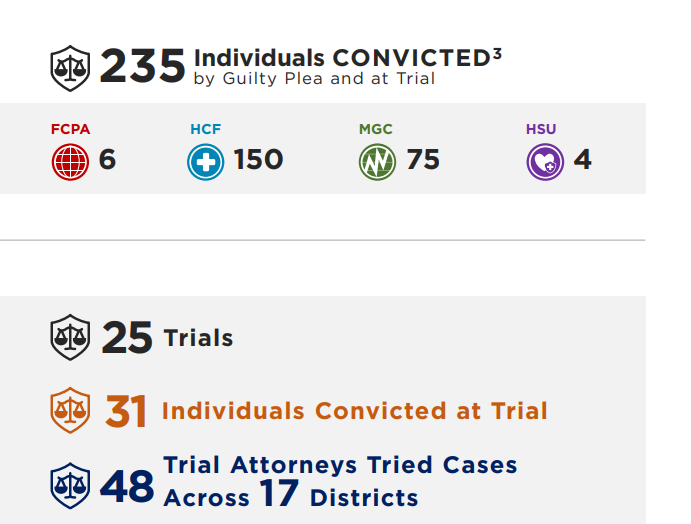
Prosecutors reported securing 235 convictions in 2025, including 25 trials across 17 federal districts.

AI-Assisted Scams Drive Sharp Rise in Crypto Fraud Losses

This enforcement surge comes as reported crypto fraud losses continue to climb. The FBI’s Internet Crime Complaint Center recorded more than 41,500 crypto investment scam complaints in 2024, with reported losses exceeding $5.8 billion.

Federal data shows total crypto scam losses reached roughly $9.3 billion last year, with older Americans disproportionately affected.

👾 The FBI recorded $9.3 billion losses spread across various crypto-related investment scams, extortion, ATM and kiosks, among others, in 2024.#FBI #CryptoFraud #CryptoScamhttps://t.co/1Eb8KStAHk

— Cryptonews.com (@cryptonews) April 24, 2025

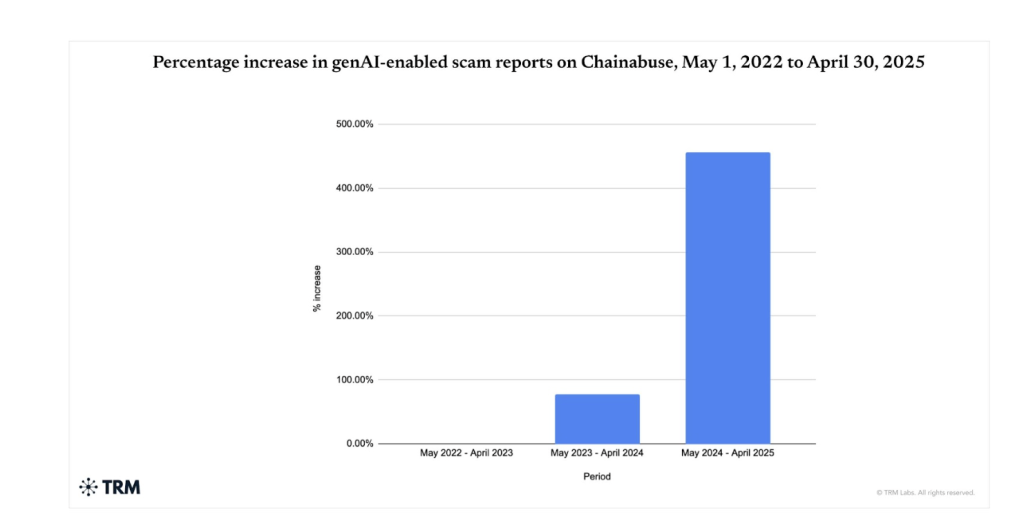
In 2025, blockchain analytics firms reported that average scam payments rose more than 250%, while AI-assisted scams have surged by more than 450%, as criminals deployed deepfake audio, synthetic identities, and automated phishing at scale.

Source: TRM Labs

In response, the DOJ and other agencies have launched coordinated initiatives aimed at transnational fraud networks, particularly so-called “pig butchering” scams linked to criminal groups operating in Southeast Asia.

A multi-agency strike force announced late last year has already seized and forfeited more than $401 million in cryptocurrency, including the largest bitcoin seizure in U.S. history.

Separately, the FBI’s Operation Level Up has notified thousands of potential victims and helped prevent hundreds of millions of dollars in additional losses.

Lawmakers have also moved to tighten the legal framework, as bipartisan bills introduced in Congress seek harsher penalties for AI-assisted fraud and stronger coordination across federal agencies to combat crypto-related scams.

In addition, two U.S. senators introduced the SAFE Crypto Act aimed at tightening the government’s response to cryptocurrency-related fraud.

The post DOJ Targets Crypto Fraud in ‘America First’ Blitz as AI Scams Spike 450% appeared first on Cryptonews.

Binance Seeks MiCA Approval in Greece Ahead of EU Regulatory Deadlines

23 January 2026 at 05:18

Binance, the world’s largest cryptocurrency exchange, confirmed it has submitted an application for a Markets in Crypto-Assets (MiCA) license in Greece as crypto firms across Europe speed up their efforts to secure regulatory approval before the transitional period expires.

The move adds Greece to the list of EU member states being considered by large digital asset platforms looking to preserve access to the bloc’s single market once MiCA’s licensing regime comes into force. Companies have until June 2026 to secure the license.

Engagement With Greek Authorities Begins

A Binance spokesperson confirmed to CryptoNews that the company has formally lodged its MiCA application and has begun discussions with the Hellenic Capital Market Commission (HCMC), the country’s financial regulator.

“We have submitted our MiCA application and are actively engaging with the Hellenic Capital Market Commission (HCMC),” the spokesperson said.

“We view MiCA as an important milestone for the crypto industry, bringing regulatory clarity, stronger consumer safeguards, and a clearer framework for responsible innovation.”

The spokesperson adds that Binance welcomes collaboration with Greek regulators as the EU-wide regime is implemented, noting the firm’s intention to support the long-term development of Europe’s digital finance ecosystem.

Unified EU Rules Drive Licensing Push

MiCA seeks to form a harmonized regulatory system for crypto-asset service providers operating in the European Union, replacing the fragmented national registration models.

Once authorized, member state firms can offer services across all 27 EU countries through passporting rights. With compliance timelines approaching, exchanges face mounting pressure to secure approval.

MiCA represents one of the most comprehensive regulatory frameworks for crypto-assets globally, intended to provide legal certainty, protect investors, and push innovation in the rapidly evolving digital finance space.

France Steps Up Oversight of Crypto Sector

Binance’s application in Greece comes as regulators in France intensify oversight of the crypto industry. In October, the French authorities launched anti-money laundering inspections covering dozens of crypto firms, including Binance and domestic exchange Coinhouse.

🇫🇷 France conducts AML inspections on Binance and Coinhouse among 100+ entities for MiCA licenses with only 4 firms approved before June 2026 deadline.#France #Binance #Coinbasehttps://t.co/AhYNEuNmzi

— Cryptonews.com (@cryptonews) October 17, 2025

The inspections were being led by France’s prudential supervision authority, the Autorité de Contrôle Prudentiel et de Résolution (ACPR), as it evaluates which of more than 100 registered entities will qualify for EU-wide authorization under MiCA.

As MiCA reshapes Europe’s crypto regulatory environment, the outcome of licensing applications over the coming months is expected to play a decisive role in determining which global platforms maintain access to one of the world’s most important digital asset markets.

The post Binance Seeks MiCA Approval in Greece Ahead of EU Regulatory Deadlines appeared first on Cryptonews.

SEC’s Atkins and CFTC’s Selig Unite to End Crypto Regulatory Chaos

23 January 2026 at 05:01

SEC Chairman Paul Atkins and CFTC Chairman Michael Selig will hold a joint event on January 27 to discuss regulatory harmonization and efforts to make the United States the global crypto capital.

The two regulators issued a joint statement announcing the event will take place at CFTC headquarters from 10 a.m. to 11 a.m. ET, marking another step in their ongoing coordination efforts.

For too long, market participants have been forced to navigate regulatory boundaries that are unclear in application and misaligned in design, based solely on legacy jurisdictional silos,” the chairmen said in their statement.

This event will build on our broader harmonization efforts to ensure that innovation takes root on American soil, under American law, and in service of American investors, consumers, and economic leadership.

I'm looking forward to joining @ChairmanSelig next week at our @SECgov and @CFTC joint event to discuss harmonization between our two agencies.

Together we will discuss our efforts to deliver on President Trump’s promise to make the US the crypto capital of the world.

Join us! https://t.co/qgJwmiHYus

— Paul Atkins (@SECPaulSAtkins) January 22, 2026

Regulators Build on September’s Historic Turf War Resolution

The upcoming event continues momentum from a September 29 roundtable where both agencies publicly declared an end to their jurisdictional conflicts.

CFTC Commissioner Caroline Pham told attendees at that gathering that “the turf war is over,” while Atkins described it as “a turning point for American financial markets.

That roundtable brought together executives from major platforms, including Kraken, Polymarket, Kalshi, Nasdaq, CME Group, and Robinhood, to discuss coordinated oversight of digital assets.

Atkins emphasized at the time that “for years, the SEC and CFTC have worked in silos, sometimes at odds,” but that era had ended.

The January 27 event will feature opening remarks from both chairmen, followed by a fireside chat moderated by Eleanor Terrett, co-founder of Crypto in America.

Doors open at 9:30 a.m., and the session will be broadcast live on the SEC’s website.

Agencies Accelerate Crypto Policy After Leadership Changes

Both regulators have moved aggressively on digital asset policy since new leadership took over in 2025.

Atkins assumed the SEC chairmanship in April after Gary Gensler’s departure, immediately shifting away from enforcement-based regulation toward clearer frameworks and guidance.

As reported by Cryptonews today, under Atkins, the SEC opened just 13 crypto-related enforcement actions in 2025 compared to 33 in 2024, a 60% decline and the lowest level since 2017, according to Cornerstone Research.

Eight of those cases involved fraud allegations, indicating a narrower focus on investor harm rather than broad registration theories.

The agency also dismissed seven ongoing actions and reduced total monetary penalties to $142 million, less than 3% of 2024 levels.

🏛The SEC opened just 13 crypto enforcement cases in 2025, down 60% from 2024, with most new actions under Chair Paul Atkins focused on fraud.#SEC #CryptoEnforcement https://t.co/YI5S1uVisH

— Cryptonews.com (@cryptonews) January 23, 2026

Selig took the CFTC helm on December 22 after Senate confirmation, replacing acting chair Caroline Pham.

He immediately launched the Future-Proof initiative, a comprehensive review aimed at updating decades-old regulations for blockchain, AI-driven trading, and prediction markets.

We are at a unique moment as a wide range of novel technologies, products, and platforms are emerging,” Selig said after his swearing-in.

Under my leadership, the CFTC will conquer these great frontiers and ensure that the innovations of tomorrow are Made in America.

Joint Efforts Face Congressional Pressure on Market Structure Bills

The harmonization push comes as Congress advances competing digital asset legislation.

The Senate Agriculture Committee released updated text for its Digital Commodity Intermediaries Act and scheduled a January 27 markup at 3 p.m., just hours after the Atkins-Selig event concludes.

Chairman John Boozman acknowledged that “differences remain on fundamental policy issues” with Democrats, who failed to support the bill despite extended negotiations.

The markup could proceed on party lines, unlike the House Agriculture Committee’s bipartisan 47-6 vote on similar legislation.

According to Eleanor Terrett, Senator Cory Booker’s team told Politico that he will continue working with Boozman to pass and sign the legislation, though no Democrats have publicly supported the text.

🚨NEW: Where do we stand on crypto market structure legislation right now? The @SenateAg Committee released its latest legislative text last night, with Chairman @JohnBoozman (R-AR) acknowledging that Republicans and Democrats failed to reach a deal despite an extra two weeks of…

— Eleanor Terrett (@EleanorTerrett) January 22, 2026

Meanwhile, the Senate Banking Committee delayed its markup of the CLARITY Act until late February or March to focus on housing legislation.

Industry divisions over stablecoin yield provisions have complicated negotiations, with Coinbase CEO Brian Armstrong calling certain restrictions “catastrophic” before withdrawing support.

However, President Trump confirmed at Davos 2026 that he expects to sign crypto market structure legislation “very soon,” stating his administration is working to ensure “America remains the crypto capital of the world.”

For now, the joint regulatory event indicates that both agencies are preparing to implement whatever framework Congress ultimately delivers.

The post SEC’s Atkins and CFTC’s Selig Unite to End Crypto Regulatory Chaos appeared first on Cryptonews.

South Korea Probes Theft of Seized Bitcoin Worth $48M in Suspected Phishing Heist

22 January 2026 at 18:16

South Korean prosecutors are investigating the disappearance of a significant amount of Bitcoin that had been confiscated as criminal proceeds, after an internal audit suggested the assets may have vanished while under state custody.

The Gwangju District Prosecutors’ Office believes the loss likely occurred during the management period last year and is treating the incident as a suspected phishing attack, raising fresh concerns over how seized digital assets are stored and safeguarded.

According to a senior prosecution source cited by local media, preliminary internal assessments suggest the missing Bitcoin was worth roughly 70 billion won, or about $48 million, at the time of the loss.

Seized Bitcoin Lost After Wallet Password Exposure, Officials Say

An official at the prosecutor’s office stated that the investigators are striving to establish the locations of the seized properties, but they could not verify any additional information at the moment.

Local news states that the bitcoin was linked to an illegal gambling situation and that it was being seized as an illegal piece of property when it was lost.

The estimates reported in the domestic media indicate that the value might be in tens of billions of won, which would translate to several million dollars, but those numbers have not been verified by prosecutors.

The early evidence indicates that the bitcoin was stored in a portable USB, as opposed to a more durable custody system.

The wallet password was also reported to have been revealed to a third party during a regular examination of confiscated items, which provided an opportunity to illegally access it and transfer money.

🚨 @KoinlyOfficial warns a third-party breach may have exposed user emails but stresses that no wallet, transaction, tax, or portfolio data was shared with Mixpanel.#CryptoSecurity #CryptoTax #Koinlyhttps://t.co/ASDxMchfyg

— Cryptonews.com (@cryptonews) December 23, 2025

The case is one of the most recent high-profile cases of stolen cryptocurrency being re-stolen by law enforcement via social engineering instead of technical merits.

Phishing attacks are deceptive, not technical, as they take advantage of a trusting party. In a more institutionalized environment, they usually prosper through human error and poor internal controls as opposed to blockchain weaknesses.

South Korea’s Expanding Authority Over Seized Digital Assets

The Gwangju District Prosecutors’ Office is no stranger to large crypto seizure cases. In March 2024, it pursued the recovery of roughly 170 billion won, or about $127 million at the time, in Bitcoin linked to another illegal gambling operation.

The seizure of digital assets has been gradually institutionalized in South Korea in recent years after several landmark Supreme Court decisions made it clear that cryptocurrencies can be regulated as property under the Criminal Procedure Act.

🇰🇷 South Korea's Supreme Court rules Bitcoin on exchanges can be legally seized under Criminal Procedure Act, establishing precedent as regulators expand asset freeze powers and AML enforcement.#SouthKorea #Bitcoinhttps://t.co/3fa5PxHMMG

— Cryptonews.com (@cryptonews) January 9, 2026

Such a legal basis was initially established in 2018, when the Supreme Court decided that cryptocurrencies are intangible assets and have economic value and thus can be seized in case they are linked to a crime.

Later judicial decisions have further broadened the power of the seizure, and a December case verified that the bitcoin kept on domestic exchanges like Upbit and Bithumb may also be confiscated.

The recent case arrived on the day when the South Korean regulators are busy increasing control over the crypto industry.

In January, financial regulators announced an intention to test a payment freeze system whereby investigators can temporarily freeze crypto-related accounts before the suspected illicit funds are taken off or deposited in an offshore account.

The post South Korea Probes Theft of Seized Bitcoin Worth $48M in Suspected Phishing Heist appeared first on Cryptonews.

US Senate Crypto Bill Heads to Markup Without Democrat Support

22 January 2026 at 05:33

The Senate Agriculture Committee has released updated crypto market structure legislation and scheduled a markup for January 27 despite failing to secure Democratic backing, marking a potential shift toward partisan passage after months of bipartisan negotiations stalled.

Chairman John Boozman announced the legislative text yesterday, acknowledging that “differences remain on fundamental policy issues” while expressing gratitude for collaboration with Senator Cory Booker.

Although it’s unfortunate that we couldn’t reach an agreement, I am grateful for the collaboration that has made this legislation better,” Boozman said, noting the markup will proceed at 3 p.m. in the Russell Senate Office Building.

🚨BREAKING: Chairman @JohnBoozman releases updated market structure legislation ahead of January 27th markup. https://t.co/PB7O9FMJlZ pic.twitter.com/k7FuIBgEsk

— Senate Ag Committee Republicans (@SenateAgGOP) January 22, 2026

Legislative Path Narrows as Banking Panel Delays CLARITY Act

The Agriculture Committee’s decision to advance its Digital Commodity Intermediaries Act comes as the Senate Banking Committee postponed work on the parallel CLARITY Act until late February or March, according to sources.

The Banking panel has pivoted to housing legislation following President Trump’s push for affordability, with the president writing that he is taking “immediate steps” on the housing bill, which remains a priority and “American Dream.

That delay followed Coinbase CEO Brian Armstrong’s public withdrawal of support over provisions he called “catastrophic,” including restrictions on tokenized equities and stablecoin yield.

Patrick Witt, White House Executive Director of the President’s Crypto Council, pushed back against Armstrong’s “no bill is better than a bad bill” stance, warning that delaying legislation risks future Democratic lawmakers writing “punitive legislation in the wake of a crisis, à la Dodd-Frank.

You might not love every part of the CLARITY Act, but I can guarantee you’ll hate a future Dem version even more,” Witt wrote.

Meanwhile, President Trump confirmed at Davos 2026 that he expects to sign crypto market structure legislation “very soon,” stating his administration is working to ensure “America remains the crypto capital of the world.

JUST IN: 🇺🇸 President Trump says he hopes to sign the crypto market structure bill (CLARITY Act) soon. pic.twitter.com/2tQQqeefwP

— Altcoin Daily (@AltcoinDaily) January 21, 2026

Democratic opposition has intensified over ethics concerns, with Senator Adam Schiff demanding controls covering the White House and Senator Ruben Gallego calling ethics guardrails “a red line.”

Key Differences Between Competing Bills Shape Industry Response

The updated bill diverges from Banking’s CLARITY Act on several critical points, particularly regarding stablecoin yield, which has been the single biggest source of industry division.

CLARITY’s Section 404 explicitly prohibits digital asset service providers from paying interest or yield solely for holding payment stablecoins, though it permits “activity-based” rewards for transactions, loyalty programs, staking, or governance participation.

The new bill takes a fundamentally different approach by excluding “permitted payment stablecoins” from CFTC authority entirely, deferring regulation to frameworks like the GENIUS Act rather than setting specific yield rules.

Notably, the bill also explicitly classifies meme coins as digital commodities under CFTC jurisdiction, defining them as assets “inspired by internet memes, characters, or current events, where promoters seek to attract an enthusiastic community primarily for speculative purposes.

An excerpt of the Republican draft crypto bill. | ource: Senate Agriculture Committee

CLARITY instead introduces “ancillary assets” concepts with exemptions for tokens that were principal assets of ETFs listed as of January 1, 2026.

On developer protections, the bill establishes an Office of the Digital Commodity Retail Advocate within the CFTC, while CLARITY creates a CFTC-SEC Micro-Innovation Sandbox for small firms.

Both protect software developers from regulation, though CLARITY’s Section 604 sparked warnings from Judiciary Committee leaders Chuck Grassley and Dick Durbin that it could “materially limit prosecutors’ ability to pursue financial crime cases.

Banking Lobby Secures Stablecoin Restrictions Amid Industry Split

The stablecoin yield debate has exposed deep rifts between crypto platforms and traditional banks.

Bank of America CEO Brian Moynihan recently warned that as much as $6 trillion in deposits (roughly 30% to 35% of US commercial bank deposits) could migrate into stablecoins, while JPMorgan CFO Jeremy Barnum called yield-bearing stablecoins “a parallel banking system that includes something that looks a lot like a deposit that pays interest, without the associated safeguards.

Galaxy Digital also warned that Banking’s draft could grant Treasury “Patriot Act–style” surveillance powers, including authority to freeze transactions for up to 30 days without court orders.

Given this increasing friction with banks, Armstrong said Coinbase is exploring compromises with them during Davos talks, stating, “we’re going to continue to work on the market structure legislation, and meet with some of the bank CEOs to figure out how we can make this a win-win.

🤝 Coinbase CEO @brian_armstrong said he will take US crypto market structure talks to Davos, seeking a compromise with banks as legislation stalls in Washington.#Coinbase #CryptoMarketStructure https://t.co/GKvYIkcTSs

— Cryptonews.com (@cryptonews) January 20, 2026

Despite regulatory uncertainty, Clear Street analyst Owen Lau noted that “institutional use cases continue to expand even without a favorable Clarity Act,” pointing to continued blockchain adoption by major financial institutions.

The post US Senate Crypto Bill Heads to Markup Without Democrat Support appeared first on Cryptonews.

Thailand Targets Early 2026 for Crypto ETF Regulations

22 January 2026 at 03:13

Thailand’s Securities and Exchange Commission is finalizing regulations to introduce crypto exchange-traded funds early this year, alongside rules for crypto futures trading and expanded tokenized investment products, as the regulator moves to align the country’s capital market framework with accelerating global trends in digital asset adoption.

According to the Bangkok Post, Deputy Secretary-General Jomkwan Kongsakul confirmed that the SEC plans to issue formal guidelines supporting the establishment of crypto ETFs early this year, while working to enable crypto futures trading on the Thailand Futures Exchange.

The regulatory push builds on the SEC board’s approval of crypto ETFs in principle, with detailed investment and operational rules now undergoing final development requiring close cooperation between asset management companies and licensed digital asset exchanges.

THAILAND MOVES TO SUPPORT CRYPTO INVESTMENTS

Thailand’s 'SEC' says new rules are coming for crypto ETFs, crypto futures, and tokenized investments, formally recognizing digital assets as an official asset class under the law. pic.twitter.com/o5qMMBbZG4

— Coin Bureau (@coinbureau) January 22, 2026

Crypto ETFs Designed to Lower Barriers and Security Risks

Kongsakul emphasized that crypto ETFs offer significant advantages for Thai investors who already have access to similar products in overseas markets.

A key advantage of crypto ETFs is ease of access; they eliminate concerns over hacking and wallet security, which has been a major barrier for many investors,” she stated.

The products allow exposure to digital assets without opening digital wallets or managing private keys, substantially reducing operational and cybersecurity risks that have deterred mainstream participation.

The SEC is considering introducing market makers for crypto ETFs to ensure adequate liquidity, potentially including digital asset exchanges, financial institutions, corporations, and entities holding cryptocurrencies on their balance sheets.

Once finalized, jointly developed products between asset managers and licensed exchanges could be listed and traded on the Stock Exchange of Thailand.

The regulator is also pursuing formal recognition of digital assets as an underlying asset class under the Derivatives Act, paving the way for crypto futures trading on TFEX under the Futures Trading Act.

Crypto futures would be traded on TFEX under the Futures Trading Act,” Kongsakul explained, adding the move would provide investors with hedging tools and sophisticated risk management options.

Regulators Position Digital Assets as Portfolio Diversification Tool

The SEC emphasized that crypto should be treated as “another asset class” rather than a speculative instrument, recommending that investors with a higher risk tolerance allocate 4-5% of their portfolios to digital assets while maintaining diversification.

Thailand approved its first spot Bitcoin ETF in 2024 through One Asset Management, structured as a “fund of funds” that provides institutional clients with regulated access through global investment vehicles, following similar moves in the United States and Hong Kong.

The upcoming expansion into altcoin ETFs represents the next policy development stage, with Bloomberg reporting in October 2025 that the SEC was drafting rules in coordination with other agencies to widen crypto ETF offerings beyond Bitcoin to include a basket of digital tokens.

Thailand plans to expand its crypto ETF market beyond Bitcoin to include multiple tokens, with new rules expected early next year.#Thailand #CryptoETFs https://t.co/ob28LM5N0g

— Cryptonews.com (@cryptonews) October 2, 2025

Beyond new investment products, the SEC intends to strengthen oversight of online financial personalities by establishing clearer boundaries between general market commentary and services that require professional licensing.

Providing factual information may not require a licence, but any recommendation related to securities or investment returns will require proper authorisation as either an investment advisor or introducing broker,” Kongsakul stated.

Thailand Joins Global Push Toward Regulated Crypto Products

The regulator is collaborating with the Bank of Thailand to establish a sandbox to promote tokenization and distributed ledger technology, believing that tokenization could significantly lower barriers for retail investors and help digital assets become a meaningful driver of Thailand’s economic growth.

The SEC also wants to expand the use of digital tokens for investment beyond existing investment tokens to include bond tokens and tokenized fund units, with Thailand’s first green token expected to launch, supporting sustainable finance and ESG-linked investment.

🇹🇭 Thailand chooses KuCoin as lead partner for historic $153M tokenized government securities with $3 minimum investment.#Thailand #Cryptohttps://t.co/do6x6GRhEE

— Cryptonews.com (@cryptonews) August 27, 2025

Thailand’s preparations for a crypto ETF align with broader momentum across Asia and Western markets, as South Korea announced plans to introduce spot Bitcoin ETFs in 2026 as part of its Economic Growth Strategy, despite ongoing legislative disputes over stablecoin governance.

Vietnam has also introduced a crypto pilot licensing regime this week, requiring a minimum capital of $380 million, attracting interest from around 10 securities firms and banks.

Outside Asia, Vanguard has also reversed years of resistance by opening its $11 trillion brokerage platform to third-party crypto ETFs and mutual funds in December 2025, with its head of brokerage, Andrew Kadjeski, stating that “cryptocurrency ETFs and mutual funds have been tested through periods of market volatility, performing as designed while maintaining liquidity.

The post Thailand Targets Early 2026 for Crypto ETF Regulations appeared first on Cryptonews.

Caroline Ellison Walks Free 10 Months Early After FTX Testimony – What Happens Next?

21 January 2026 at 17:44

Caroline Ellison, who used to be a co-CEO of Alameda Research and one of the main figures of the FTX downfall, is going to be released this week, nearly one year before her two-year prison sentence awarded by a federal court.

The U.S. Bureau of Prisons reported that Ellison, at 31 years old, will be released on Wednesday, the 21st of January, into a residential reentry management program in New York, the final step in her release from a federal prison.

Source: Federal Bureau of Prisons

Following the collapse of FTX in November 2022, amidst a liquidity crunch and claims of all-around misappropriation of customer funds, Ellison admitted the next month to seven felony counts.

The indictments are for such things as wire fraud, securities fraud, commodities fraud, and money laundering conspiracy.

Ellison’s Testimony Exposed the Inner Workings of the FTX Fraud

Her prosecutors claimed that under her tenure, Alameda Research had an open line of credit with FTX that had allowed the transfer of billions of dollars of customer deposits into the trading company without any obstruction.

Such funds were subsequently found to have been spent on covering the losses incurred by Alameda, on high-risk investments, political donations, and a range of other expenses, all the time letting customers think that their money was safely held by the exchange.

Ellison confessed in court that these were done under orders of Sam Bankman-Fried, the founder of both FTX and Alameda, and her evidence became the keystone of the government case.

Prosecutors described Ellison as a “remarkable” and “exemplary” witness who met with investigators roughly 20 times and helped decode the inner mechanics of the fraud.

During Bankman-Fried’s 2023 trial, she spent three days on the stand detailing how customer funds were misused and how Alameda was shielded from normal risk controls.

Bankman-Fried was ultimately convicted and sentenced in March to nearly 25 years in prison, along with an order to repay up to $11 billion in losses.

He has since filed an appeal and has publicly explored the possibility of a presidential pardon, which President Trump said was denied.

FTX's Sam Bankman-Fried files appeal to reduce 25-year sentence with November 4 oral arguments as 3AC plans October deposition.#FTX #SBFhttps://t.co/4ZRoQG88ck

— Cryptonews.com (@cryptonews) September 12, 2025

Ellison, by contrast, received a sharply reduced sentence.

In September 2024, she was sentenced by Judge Lewis Kaplan to serve 2 years in jail, declining the request of her lawyers to have no jail time but noting that her cooperation made her unlike other defendants.

In November 2024, she started her sentence in a low-security prison in Danbury, Connecticut, and was transferred to community confinement, sometimes known as a halfway house, in October 2025.

FTX Cooperators Exit Custody as Legal Penalties Remain

Residential reentry centers are constructed to assist inmates in integrating back into society under federal oversight.

Residents are kept under close supervision, restricted from movement unless under permit for approved activities, subject to frequent drug and alcohol testing, and required to meet financial requirements, such as paying a given percentage of income as part of living expenses.

The Bureau of Prisons typically uses these facilities in the final months of a sentence, and inmates housed there are still considered to be in federal custody.

The projected release date of Ellison was later changed to January 2026 based on time, good conduct, and the credit she enjoys due to providing substantial help to prosecutors.

Her discharge technically brings to an end the custodial period of the key cooperating witnesses in the FTX matter.

Former FTX Chief Technology Officer Gary Wang and former co-lead engineer Nishad Singh also cooperated and received no prison time, while former executive Ryan Salame, who did not cooperate, was sentenced to more than seven years in prison.

⚖ SEC seeks 10-year officer ban for Caroline Ellison and eight-year prohibitions for Gary Wang and Nishad Singh following FTX fraud cooperation and permanent injunctions.#SEC #FTXhttps://t.co/IsjAs2o0fE

— Cryptonews.com (@cryptonews) December 19, 2025

Although Ellison is leaving custody, her legal consequences are far from over.

She remains subject to supervision and has been ordered to forfeit $11 billion as part of the case.

In recent months, the Securities and Exchange Commission has also moved to bar Ellison, Wang, and Singh from serving as officers or directors of any public company for several years.

The post Caroline Ellison Walks Free 10 Months Early After FTX Testimony – What Happens Next? appeared first on Cryptonews.

SEC Crypto Task Force Pressed on Self-Custody Rights and DeFi ‘Dealer’ Rules in New Filings

21 January 2026 at 10:45

The US Securities and Exchange Commission’s Crypto Task Force is facing renewed pressure from industry groups and individual contributors as questions around self-custody rights and the scope of dealer regulation in decentralized finance move back into focus.

On Tuesday, the Task Force’s public “Written Input” page added two new submissions that reflect a broader tension shaping US crypto policy: how to protect investors without collapsing core features of on-chain markets, particularly self-custody and non-custodial trading.

SEC Filings Spotlight Self-Custody Protections and DeFi Market Structure

One submission, filed by an individual identified as DK Willard, centers on the experience of retail crypto users in Louisiana and ties state-level protections directly to the federal debate now unfolding in Washington.

Willard points to Louisiana legislation such as House Bill 488, which explicitly affirms residents’ right to self-custody digital assets, arguing that these protections should not be diluted by federal market structure proposals.

The filing shows that Congress is considering frameworks that include registration, transparency, and anti-fraud standards, but certain exemptions risk allowing developers or platforms to sidestep core investor protections.

In Willard’s view, weakening self-custody protections could expose consumers to fraud and financial crime rather than supporting responsible innovation.

At the same time, a more technical submission from the Blockchain Association’s Trading Firm Working Group focuses on how proprietary trading firms should be treated when providing liquidity in tokenized equity markets that operate on DeFi infrastructure.

Source: SEC

The group argues that long-standing distinctions in securities law between dealers and traders should continue to apply on-chain.

Trading for one’s own account, without customer solicitation, custody, or agency execution, should not trigger dealer registration under the Exchange Act, the filing says, even when that trading occurs through smart contracts and decentralized venues.

The association frames this issue as central to whether tokenized equity markets can function at all during any SEC-approved innovation exemption or sandbox.

Without legal certainty, proprietary trading firms may avoid on-chain markets altogether, leaving tokenized equities without reliable liquidity, price discovery, or arbitrage.

The group stresses that existing broker-dealer rules, including those governing clearing, custody, reporting, and capital, were designed for intermediated markets and will take time to adapt to atomic settlement and smart contract execution.

Allowing proprietary firms to participate immediately, they argue, would give regulators space to modernize those frameworks without freezing market activity in the interim.

SEC’s New Crypto Approach Takes Shape After 2025 Restructuring

These submissions land within a broader shift at the SEC that began after the agency’s restructuring in early 2025.

Under Commissioner Hester Peirce, the Crypto Task Force has moved away from what industry participants long criticized as regulation by enforcement and toward formal rulemaking and guidance.

Over the past year, that approach has included dismissing the SEC’s lawsuit against Coinbase, pausing enforcement actions against Binance, and closing investigations into other major platforms.

📉 The @SECGov plans to drop its enforcement case against @coinbase, with CEO @brian_armstrong calling a "huge day" for crypto. #Coinbase #SEChttps://t.co/8Q5mkqG1J8

— Cryptonews.com (@cryptonews) February 21, 2025

The agency has also rescinded restrictive custody guidance and clarified that certain crypto activities do not constitute securities transactions.

The latest filings also intersect with an increasingly complex legislative backdrop.

Negotiations over the CLARITY Act, which aims to establish a comprehensive federal market structure for digital assets, remain unsettled.

‼ Coinbase says crypto market structure bill more complex than stablecoin framework but global competition will force congressional action this year.#Coinbase #ClarityActhttps://t.co/PEuIKIZkwu

— Cryptonews.com (@cryptonews) January 3, 2026

A scheduled markup in the Senate Banking Committee was postponed following industry opposition, while the Senate Agriculture Committee is still expected to review the bill later this month.

Other recent submissions to the Crypto Task Force highlight how contested the custody question remains.

Industry groups, including SIFMA, have cautioned against granting broad exemptions to wallet providers that perform broker-dealer functions, while policy groups tied to the Solana ecosystem are calling for clearer distinctions between non-custodial software and regulated intermediaries.

The post SEC Crypto Task Force Pressed on Self-Custody Rights and DeFi ‘Dealer’ Rules in New Filings appeared first on Cryptonews.

White House Digital Asset Advisor Calls for Immediate Crypto Market Structure Bill

21 January 2026 at 02:27

Patrick Witt, White House Executive Director of the President’s Crypto Council, has advocated for the urgent passage of crypto market structure legislation.

Pushing back Coinbase CEO’s “no bill is better than a bad bill” line, Witt argues that it is a “privilege” to say that only because Donald Trump won in 2024 and installed a pro‑crypto administration.

He wrote on X on Wednesday that it is unrealistic to expect a multi-trillion-dollar industry to operate without a comprehensive regulatory framework.

“No bill is better than a bad bill.”

What a privilege it is to be able to say those words thanks to President Trump’s victory, and the pro-crypto administration he has assembled.

But let’s not kid ourselves. There *will* be a crypto market structure bill — it’s a question of…

— Patrick Witt (@patrickjwitt) January 21, 2026

Witt bluntly warned that if the bill fails to move ahead, a future Democratic Congress may write punitive legislation in the wake of a crisis, “à la Dodd‑Frank.”

“You might not love every part of the CLARITY Act, but I can guarantee you’ll hate a future Dem version even more,” he wrote.

Crypto Market Bill Delays – Disagreements Over Details

Patrick Witt’s comments follow the recent legislative slowdown, mainly due to disagreements over a specific section of the bill.

Notably, cryptocurrency exchange Coinbase withdrew its support for the legislation’s then-current version, labeling specific provisions as “problematic” and potentially harmful to innovation.

“This version would be materially worse than the current status quo. We’d rather have no bill than a bad bill. Hopefully, we can all get to a better draft,” wrote Brian Armstrong in a post last week.

The current version of the bill prompted the Senate Banking Committee to postpone its markup hearing. Chairman Tim Scott noted that the Committee did not set a new date.

The delay leaves crypto industry waiting again for a clear regulatory path that could replace years of enforcement with a proper framework.

Besides, Senate Agriculture Committee Chairman John Boozman said that lawmakers need more time to finalize remaining policy details and ensure broad congressional support.

The post White House Digital Asset Advisor Calls for Immediate Crypto Market Structure Bill appeared first on Cryptonews.

New CFTC Chair Declares “Golden Age,” Launches ‘Future-Proof’ Drive to Rewrite Crypto Rules

20 January 2026 at 17:17

The CFTC Chair Michael Selig called his chairmanship the beginning of what he calls a “golden age” for American financial markets as he takes over leadership of the U.S. Commodity Futures Trading Commission.

His remarks come as pressure intensifies on Washington to finally clarify how digital asset markets should be regulated.

Shortly after assuming office as chairman of the agency, Selig proclaimed a comprehensive plan to revamp the agency, the Future-Proof, which is a review to update decades-old CFTC regulations to more effectively reflect markets created by crypto, blockchain, and artificial intelligence.

🇺🇸 The Senate finally confirms @MichaelSelig as the new @CFTC Chair, ending a long leadership vacuum and setting the stage for clearer U.S. crypto regulation. #CFTC #MikeSelig https://t.co/IvLEpQhesH

— Cryptonews.com (@cryptonews) December 19, 2025

Selig Outlines Plan to Update CFTC Rules for Blockchain and AI Trading

In an announcement of the initiative put out publicly, Selig stated that the CFTC needs to be in place to provide services to the markets of the future, and that the present-day period is a turning point in U.S. finance.

Today, I am launching the “Future-Proof” initiative at the @CFTC.

We are at a pivotal moment in the evolution of American financial markets. The CFTC must be equipped to serve the markets of the future.

Read my full op-ed in today’s @washingtonpost: https://t.co/zWAAjXt4Kg. /1

— Mike Selig (@ChairmanSelig) January 20, 2026

He elaborated that opinion in a Washington Post opinion piece, in which he claimed that technological changes were altering the way that financial products are produced, traded, and consumed, and that Congress was now near enacting long-awaited legislation on digital asset market structure.

He said that legislation would have a straightforward mandate on regulators and would bring sanity to an industry that has become a market worth over 3 trillion dollars.

The message by Selig is the opposite of the regulative policy of the past few years.

His criticism of the former administration was that they operated based on enforcement measures instead of explicit rules, and that digital assets and perpetual futures were shoehorned into the systems of traditional markets.

According to Selig, the strategy outsourced innovation and reduced the input of the common American.

Under his leadership, he claimed that the CFTC will work on custom-fit, purpose-specific rules that safeguard against fraud and manipulation without choking new products before they can grow.

The Future-Proof initiative will mean that CFTC staff will undergo a thorough review of the existing rules, most of which were originally agricultural futures market rules.

Selig said those rules may still work for traditional products, but do not account for blockchain-based trading venues, prediction markets, or AI-driven risk tools.

His stated goal is to modernize requirements in a way that creates a level playing field for incumbents and new entrants, while delivering what he described as the “minimum effective dose” of regulation.

New CFTC Chair Inherits Expanding Crypto Agenda

Selig officially assumed the role on December 22 after being confirmed by the Senate on December 18, replacing acting chair Caroline Pham.

🤝 Michael Selig becomes CFTC chairman as Caroline Pham exits agency after implementing major crypto regulatory reforms including spot trading approval and prediction market relief.#CFTC #Pham #Selighttps://t.co/TznOLfEfQw

— Cryptonews.com (@cryptonews) December 23, 2025

Pham’s tenure was marked by an aggressive push to modernize the CFTC’s approach to crypto.

Over the past year, she launched the agency’s Crypto Sprint and oversaw the introduction of spot crypto trading on CFTC-regulated futures platforms.

She also implemented internal reforms, including the deployment of an automated market surveillance system that the agency said would save nearly $50 million annually.

Just before leaving office, Pham granted no-action relief to several prediction market operators, easing enforcement pressure while requiring full collateralization and transaction transparency.

✅ The CFTC granted narrow no-action relief to four prediction markets, reducing immediate enforcement risk.#CFTC #Cryptohttps://t.co/hqT6BcApBB

— Cryptonews.com (@cryptonews) December 12, 2025

Selig has shown continuity with that agenda, while also promising a broader reset.

Since taking office, Selig has moved quickly. On January 1, he appointed Amir Zaidi, a longtime CFTC veteran who previously worked on early regulated Bitcoin products, as his chief of staff.

On January 13, he launched the Innovation Advisory Committee, replacing the former Technology Advisory Committee, to bring in expertise from industry, academia, and public interest groups as the agency prepares rules for emerging technologies.

The post New CFTC Chair Declares “Golden Age,” Launches ‘Future-Proof’ Drive to Rewrite Crypto Rules appeared first on Cryptonews.

Cardano’s Charles Hoskinson Blasts Ripple CEO Over ‘Sabotaged’ Clarity Act – Why?

19 January 2026 at 14:40

Charles Hoskinson, the founder of Cardano, has publicly criticized Ripple CEO Brad Garlinghouse, who has endorsed the Digital Asset Market Clarity Act, a bill of the U.S. crypto market structure that has become controversial in the industry.

The controversy shows the continual gap between key crypto players on whether to have imperfect regulation instead of years of uncertainty, as the legislation waits longer for enactment due to deepening political and policy fears.

Hoskinson’s criticism surfaced during a live broadcast on X, where he questioned why Garlinghouse would back a bill that, in his view, risks handing regulatory authority back to agencies that have previously taken enforcement action against the industry.

Happy Sunday https://t.co/OqL64m7JEz

— Charles Hoskinson (@IOHK_Charles) January 18, 2026

Hoskinson said he was alarmed by the argument that any form of clarity is preferable to none, especially when the bill would empower the same institutions that have sued crypto companies in the past.

He framed the issue as one of trust, warning against conceding control to regulators who, he said, had already demonstrated hostility toward the sector.

Hoskinson Doubts CLARITY Act Can Survive This Quarter

The remarks were in response to Garlinghouse’s public endorsement of the CLARITY Act, which seeks to clarify the regulatory jurisdiction between the U.S. Securities and Exchange Commission and the Commodity Futures Trading Commission.

Garlinghouse has claimed that the bill is not flawless, but even with its passing, it would be an improvement in an industry that has been shrouded in legal ambiguity.

He has maintained that the crypto sector cannot afford to wait indefinitely for ideal legislation, particularly as lawmakers attempt to merge the Clarity Act with broader crypto market structure proposals.

Hoskinson’s objections go beyond the bill’s text and extend into the political environment surrounding it. He has blamed the Trump administration’s crypto policy leadership, particularly David Sacks, for undermining the bill’s early bipartisan momentum.

📉 The @SECGov has sharply scaled back its enforcement actions against the cryptocurrency industry since @realDonaldTrump returned to office.#SEC #Trumphttps://t.co/NCTPm62pCR

— Cryptonews.com (@cryptonews) December 16, 2025

Hoskinson said that what once had a realistic chance of passage became politically compromised after President Trump’s involvement in launching meme coins, which he said turned regulatory discussions into partisan theater.

Hoskinson has gone as far as calling for Sacks to resign if he fails to guide the legislation through Congress, arguing that the window for passage is rapidly closing.

🚨 Cardano’s Charles Hoskinson says Trump’s crypto czar should resign if the CLARITY Act fails this quarter, criticizing U.S. crypto policy and regulatory failures.#CLARITYAct #Cardano https://t.co/8PnQun55TI

— Cryptonews.com (@cryptonews) January 12, 2026

The Cardano founder suggested that the likelihood of passage diminishes with each week of inaction, as competing priorities and political calculations take over in Washington.

Optimism Meets Resistance as Crypto Leaders Disagree on Clarity Bill

Not all industry leaders share Hoskinson’s pessimism, as Galaxy Digital CEO Mike Novogratz has said he believes the bill could still move forward within weeks, citing conversations with bipartisan lawmakers who remain engaged.

🚨 @galaxyhq warns the Senate crypto bill could give the U.S. Treasury “Patriot Act-style” surveillance powers over DeFi.#DeFi #Senate #Treasury https://t.co/0u8PR3ueM5

— Cryptonews.com (@cryptonews) January 14, 2026

At the same time, Coinbase CEO Brian Armstrong has distanced his company from the bill in its current form, adding another layer of complexity to the debate.

Armstrong confirmed that Coinbase withdrew its support over concerns that the latest draft could harm decentralized finance, restrict tokenized stock offerings, and prohibit stablecoin yield-sharing with users.

Though he refuted claims of a rift between Coinbase and the White House, Armstrong stated that the exchange would prefer that the bill be stalled rather than enacted with what he called harmful provisions to innovation and consumers.

❌ @Coinbase CEO @brian_armstrong denied reports of a White House rift and said support for the CLARITY Act remains intact.#Coinbase #Cryptohttps://t.co/530Jslc9vX

— Cryptonews.com (@cryptonews) January 18, 2026

This position of Armstrong seems to correspond more with the concerns of Hoskinson than with those of Garlinghouse.

Lawmakers subsequently postponed a planned markup of the bill, showing that negotiations remain unresolved.

The debate has exposed broader tensions within the crypto sector, with some executives pushing for immediate regulatory clarity and others warning that rushed legislation could entrench restrictive rules for years.

The post Cardano’s Charles Hoskinson Blasts Ripple CEO Over ‘Sabotaged’ Clarity Act – Why? appeared first on Cryptonews.

Hong Kong Crypto Firms Warn CARF Tax Rules Could Backfire — How?

19 January 2026 at 11:34

Hong Kong’s crypto industry is warning that the city’s planned adoption of new global tax reporting rules could produce unintended consequences if regulators do not adjust how the framework is applied in practice.

The concerns center on the Crypto-Asset Reporting Framework (CARF), a standard developed by the Organisation for Economic Co-operation and Development to enable the automatic cross-border exchange of tax information related to crypto-asset transactions.

Hong Kong officials say the CARF is needed to protect the city’s role as an international financial hub, as OECD peer reviews increasingly judge jurisdictions on how well rules are enforced, not just whether they exist.

Hong Kong Weighs CARF as Industry Seeks Smoother Implementation

In a detailed submission sent this week to the Financial Services and the Treasury Bureau, the Hong Kong Securities & Futures Professionals Association urged authorities to refine how the rules are rolled out.

Source: HKSFPA

While the group said it broadly supports the goal of tax transparency, several elements of the proposed regime could expose local crypto firms to operational strain, legal uncertainty, and disproportionate penalties.

The association represents professionals working across securities, futures, and virtual asset markets and framed its comments as an effort to ensure Hong Kong remains competitive as a financial hub while meeting international obligations.

CARF is designed to close gaps left by existing tax reporting systems by capturing crypto-specific activity that falls outside traditional financial accounts.

Under CARF, crypto-asset service providers would be required to collect and report detailed information on users and transactions, which would then be shared automatically with other participating jurisdictions.

🇭🇰 Hong Kong is set to implement the Crypto Asset Reporting Framework by 2026, enhancing tax transparency and tackling cross-border tax evasion in the crypto space!#Crypto #Taxhttps://t.co/MU2Cg6ac0D

— Cryptonews.com (@cryptonews) December 17, 2024

Hong Kong is among 76 markets that have committed to the framework and is part of the first group of 27 jurisdictions expected to begin exchanging data by 2028.

The government plans to complete legislative amendments in 2026, following a public consultation that began late last year.

Progress Welcomed, but Data Rules Raise Red Flags

Industry participants say the direction of travel is clear, but the details matter.

One major concern is data collection, as the association said most firms favor a “wider approach,” collecting information on both reportable and non-reportable clients upfront.

However, it warned that without explicit legal protection, firms could face conflicts with Hong Kong’s personal data privacy rules for holding information on clients who are not yet reportable.

Record-keeping requirements are another pressure point. While the industry accepts a six-year retention period in line with existing tax rules, it raised alarms about proposals that could hold directors or senior officers personally responsible for maintaining records after a company is dissolved.

It argued that former officers may lack the legal authority or infrastructure to securely store sensitive client data once an entity no longer exists.

Firms Push Back on CARF Fines and Tight Reporting Deadlines

Penalties under CARF and the amended CRS also drew scrutiny.

While the industry supports the introduction of administrative penalties as an alternative to criminal prosecution, it warned that fines calculated on a “per account” basis could spiral into massive liabilities for firms hit by technical or software errors affecting thousands of users.

The association called for reasonable caps for unintentional breaches and a graduated approach that distinguishes between administrative mistakes and deliberate non-compliance.

Operationally, firms welcomed plans for electronic filing but said reliance on manual XML uploads could introduce avoidable risks.

Large institutions, in particular, are pushing for direct API connections to allow automated reporting.

They also warned that the proposed five-month filing deadline after year-end could be tight in the early years and suggested grace periods as systems are tested and refined.

The post Hong Kong Crypto Firms Warn CARF Tax Rules Could Backfire — How? appeared first on Cryptonews.

Kazakhstan Restricts Crypto Trading to Central Bank-Approved Coins Only

19 January 2026 at 10:00

Kazakhstan’s Head of State, Kassym-Jomart Tokayev, has enacted legislation concerning Banks and Banking Activities in the Republic of Kazakhstan, establishing a comprehensive regulatory framework for digital assets.

The law grants the nation’s central bank authority to determine which cryptocurrencies may be traded on regulated exchanges.

The legislation, detailed in a recent official document, encompasses over five distinct amendments and additions to various legislative acts addressing financial market regulation, communications, and bankruptcy procedures.

NEWS: 🇰🇿 Kazakhstan establishes a digital asset regulatory framework, licensing crypto exchanges and giving the central bank authority to approve tradable coins. pic.twitter.com/gxL7U61H0K

— CoinGecko (@coingecko) January 19, 2026

The law also introduces comprehensive regulatory frameworks for digital financial assets, while tightening controls on “unsecured” cryptocurrencies, such as Bitcoin and Ethereum.

Kazakhstan Introduces a Three-Tier Digital Asset Framework

A significant development is the authorization and regulatory introduction of digital financial assets as a new asset class in Kazakhstan.

The new regulatory structure categorizes digital financial assets into three distinct types, each subject to different oversight mechanisms.

Kazakhstan Crypto Trading - Government Announcement Translated to Russian
Translated from Russian. | Source Gov.kz

Stablecoins backed by fiat currency will fall under the National Bank’s requirements governing their issuance, circulation, and redemption.

Digital financial assets backed by financial instruments, property rights, goods, or other tangible assets represent the second category, while financial instruments issued electronically on digital platforms comprise the third tier.

Digital platform operators will function as newly licensed financial market entities authorized to issue these assets, subject to traditional financial instrument requirements, including risk management protocols and investor protection standards.

Additionally, the law addresses another digital asset category, “unsecured digital assets,” referring to cryptocurrencies such as Bitcoin (BTC) and Ether (ETH).

The legislation provides for the establishment of cryptocurrency exchange organizations, which will be licensed and supervised by the National Bank.

To safeguard investors, the National Bank will establish a list of approved cryptocurrencies for circulation, along with operational limits and restrictions on crypto exchanges.

For anti-money laundering and counter-terrorist financing purposes, crypto exchanges and digital asset market infrastructure participants are classified among entities subject to financial monitoring.

Aggressive Enforcement Against Illegal Operations

Kazakhstan’s regulatory push follows months of intensive enforcement action against unauthorized crypto activity.

Authorities shut down 130 illegal crypto exchanges in October 2024, seizing virtual assets worth $16.7 million suspected of laundering criminal proceeds.

Only platforms licensed by the Astana Financial Services Authority and integrated with local banks can legally operate under the Law on Digital Assets.

The crackdown extended beyond exchanges to 81 shadow cash-out groups discovered with a combined turnover reaching 24 billion KZT ($43 million) in 2024.

🇰🇿 Kazakhstan Seizes $16.7M from Unlicensed Crypto Exchanges, Shuts Down 130 Platforms

Kazakhstan has shut down 130 illegal crypto exchanges suspected of laundering criminal proceeds and seized virtual assets worth $16.7 million.https://t.co/WVKmsTRmf9 pic.twitter.com/aY75nl0eSJ

— Cryptonews.com (@cryptonews) October 8, 2025

Deputy Chairman of the Financial Monitoring Agency, Kairat Bizhanov, identified ATMs as a critical vulnerability, noting that cash withdrawals totaled 13.2 trillion KZT ($24.1 billion), 1 trillion more than the previous year.

Anonymous transactions using nominee-owned bank cards enable criminals, including cyber fraudsters and drug traffickers, to operate without sender or recipient identification.

Throughout 2023 and 2024, the Financial Monitoring Agency blocked over 3,500 illegal online crypto exchanges in coordination with the National Security Committee and the Ministry of Culture and Information.

In 2024 alone, regulators closed 36 illegal exchangers handling a total of 60 billion tenge ($112 million) in turnover, while Kazakhstan officially blocked Coinbase’s website for violating digital asset regulations.

Kazakhstan Greenlights Crypto Banks and National Reserve Fund

Despite strict enforcement measures, Kazakhstan is simultaneously exploring progressive digital asset initiatives.

Prime Minister Olzhas Bektenov announced plans to launch crypto banks as part of a broader strategy to build a sustainable, regulated ecosystem.

🚀 Kazakhstan is exploring the launch of crypto banks as part of its broader push to build a sustainable and regulated digital asset ecosystem.#Kazakhstan #Bitcoinhttps://t.co/egghK92tqY

— Cryptonews.com (@cryptonews) April 30, 2025

These institutions would offer digital asset exchange services, secure storage solutions, and transaction processing through infrastructure providers,s including digital asset platforms, custodians, brokers, and dealers.

Kazakhstan also intends to establish a national cryptocurrency reserve fund valued between $500 million and $1 billion by early 2026, according to Bloomberg reporting.

The initiative represents one of Central Asia’s most ambitious moves to integrate digital assets into state-managed investment portfolios, though authorities have indicated the fund will avoid direct exposure to volatile cryptocurrencies like Bitcoin and adopt a cautious investment approach.

The post Kazakhstan Restricts Crypto Trading to Central Bank-Approved Coins Only appeared first on Cryptonews.

Bipartisan Senators Warn Crypto Bill Could Weaken Money Laundering Enforcement

19 January 2026 at 04:36

Senate Judiciary leaders Chuck Grassley and senators have warned that a provision in Senate Banking Chair Tim Scott’s crypto bill could curtail law enforcement’s ability to prosecute money laundering and other illicit financial crimes.

The provision would exempt certain blockchain software developers from financial licensing requirements.

According to Politico, Grassley and Durbin wrote in a private letter to Scott and ranking member Elizabeth Warren that Section 604 of the crypto market structure legislation “falls squarely within the Judiciary Committee’s jurisdiction,” adding that their panel “was not consulted” about the language ahead of a since-postponed markup.

The section mirrors the Blockchain Regulatory Certainty Act, bipartisan legislation led by Senator Cynthia Lummis and Senator Ron Wyden.

Developer Safeguards Market Structure Bill - Letter Screenshot
Source: Politico

Law Enforcement Warns of Prosecution Gaps

The disputed provision exempts “a dangerously broad category of actors” from criminal law treatment, according to the Grassley-Durbin letter.

They warned it would have “likely precluded the government from bringing charges against” the founder of Tornado Cash, a crypto mixer platform prosecutors said was used to launder money.

A co-founder of the platform was found guilty of operating an unlicensed money transmitting business last year, though crypto proponents and congressional Republicans have decried the conviction.

Such a gap risks attracting illicit actors—like cartels and other sophisticated criminal organizations—to decentralized platforms,” the letter stated.

The National Association of Assistant United States Attorneys also echoed concerns, writing that the bill would “materially limit prosecutors’ ability to pursue financial crime cases involving the movement of funds outside established regulatory frameworks.

Developer Safeguards Market Structure Bill - The Full NAAUSA Letter
Source: Politico

A committee spokesperson for Scott defended the provision, stating the South Carolina Republican “remains committed to protecting software developers while ensuring that law enforcement has the necessary tools to prosecute actual illegal money transmission operations.

The parliamentarian has ruled that the Blockchain Regulatory Certainty Act falls squarely within the Banking Committee’s jurisdiction, according to spokesperson Jeff Naft.

Developer Protections Collide With Financial Crime Concerns

The debate centers on decentralized finance platforms that use software to facilitate trading and lending without centralized intermediaries.

Democratic senators negotiating with Republicans have raised concerns about DeFi being used for illicit finance and pushed for changes to the developer exemption language.

They were preparing to try to amend it during a markup before the session was postponed.

GOP crypto allies maintain new exemptions are essential for innovation.

Blockchain developers who have simply written code and maintain open-source infrastructure have lived under threat of being classified as money transmitters for far too long,Lummis said when introducing the standalone BRCA.

After months of hard work, we have bipartisan text ready for Thursday’s markup. I urge my Democrat colleagues: don’t retreat from our progress. The Digital Asset Market Clarity Act will provide the clarity needed to keep innovation in the U.S. & protect consumers. Let’s do this! pic.twitter.com/fuu5CIQa8X

— Senator Cynthia Lummis (@SenLummis) January 13, 2026

This designation makes no sense when they never touch, control, or have access to user funds, and unnecessarily limits innovation.

The Solana Policy Institute also recently asked the SEC to grant explicit exemptions for developers of open-source, non-custodial software, arguing that existing frameworks built around centralized intermediaries do not fit smart-contract-based systems in which users retain custody of their assets.

In DeFi systems, users retain custody of their assets, approve their own transactions, and interact directly with public blockchains without the software holding funds or exercising discretion.

SEC Chairman Paul Atkins has criticized the agency’s past reliance on regulation by enforcement, arguing that “engineers should not be subject to securities laws” simply for publishing code.

Commissioner Hester Peirce has similarly stated that regulators should not impose obligations on developers who do not custody assets or override user decisions.

Thousands of Developers Face Regulatory Uncertainty

The outcome affects thousands of blockchain developers across ecosystems.

Ethereum added 16,181 new developers from January to September 2025 alone, maintaining 31,869 total active developers, while Solana added 11,534 new developers and grew its developer count 83% year-over-year to reach 17,708 active contributors.

Bitcoin ranked third with 7,494 new developers and 11,036 total active contributors.

For now, Scott has postponed the Banking Committee markup following Coinbase’s withdrawal of support for the broader market structure bill.

🇺🇸 Senate sets January 27 crypto bill markup as banking lobby secures stablecoin yield limits and Democrats demand White House ethics guardrails.#Senate #Banking #CryptoBillhttps://t.co/iK8utlKRhr

— Cryptonews.com (@cryptonews) January 14, 2026

Coinbase CEO Brian Armstrong called the latest draft “catastrophic,” citing concerns over DeFi restrictions, tokenized equity bans, and stablecoin yield limitations.

We’d rather have no bill than a bad bill,” Armstrong wrote, while expressing hope for a better compromise.

Galaxy Digital also warned the bill could grant Treasury “Patriot Act–style” surveillance powers, including authority to freeze transactions for up to 30 days without court orders and label foreign jurisdictions or transaction categories as money-laundering concerns.

The legislative path remains uncertain as lawmakers attempt to balance developer protections with law enforcement capabilities while navigating industry opposition and jurisdictional disputes between Senate committees.

The post Bipartisan Senators Warn Crypto Bill Could Weaken Money Laundering Enforcement appeared first on Cryptonews.

❌
❌