
Normal view

There are new articles available, click to refresh the page.
Before yesterdayMain stream

DOJ Targets Crypto Fraud in ‘America First’ Blitz as AI Scams Spike 450%

23 January 2026 at 09:59

The U.S. Department of Justice is intensifying its efforts on crypto-related fraud as it escalates to execute what the authorities refer to as an “America First” enforcement agenda in response to a surge of digital asset-related frauds driven more by artificial intelligence.

The shift was outlined in the DOJ Criminal Division Fraud Section 2025 Year in Review, published on Thursday, indicating prosecutors accused 265 defendants with a cumulative alleged loss on fraud cases of over $16 billion, nearly twice the amount reported the previous year.

Source: DOJ Criminal Division Fraud Section

Although the cases were in medical care, consumer protection, corporate fraud, and market manipulation, the DOJ said that cryptocurrency was increasingly becoming a type of payment rail, laundering, or asset category due to illicit funds.

In some significant cases, authorities seized crypto alongside cash, real estate, and luxury goods, showing the strong integration of digital assets into conventional fraudulent actions.

DOJ Health Care Fraud Crackdowns Lead to Major Crypto Seizures

One of the most prominent cases cited involved a $1 billion amniotic wound allograft fraud scheme that allegedly generated more than $600 million in improper Medicare payments.

Prosecutors charged Tyler Kontos, Joel Kupetz, and Jorge Kinds with targeting elderly and terminally ill patients for medically unnecessary procedures.

As part of the investigation, law enforcement seized more than $7.2 million in assets, including bank accounts and cryptocurrency.

The DOJ also highlighted the National Health Care Fraud Takedown carried out last year, the largest in the department’s history.

That operation charged 324 individuals across 50 federal districts for schemes involving more than $14.6 billion in intended losses.

Authorities confiscated more than $245 million in assets in the sweep, including significant amounts of cryptocurrency.

Simultaneously, the regulators prevented over $4 billion of fraudulent Medicare payments prior to their disbursement, indicating a more active, data-driven enforcement strategy.

Behind these cases is the DOJ Fraud Section, which operates through four specialized units that increasingly intersect with crypto-related crime.

Its units include foreign bribery, market and consumer fraud, healthcare fraud, and health and safety crimes, areas where digital assets and blockchain-based laundering are now frequently involved.
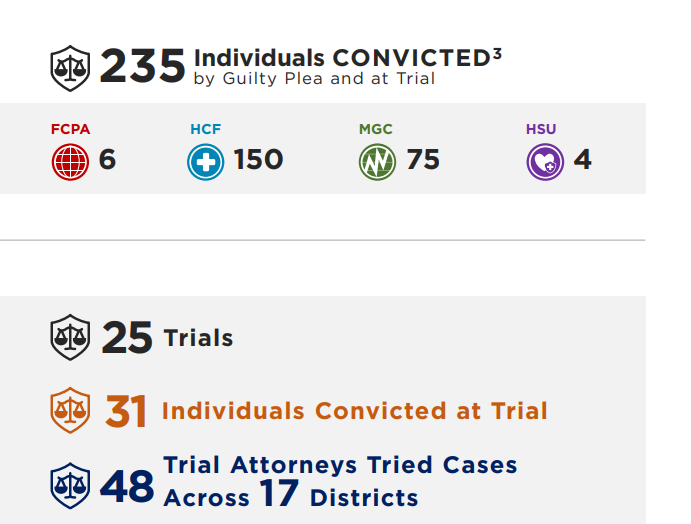
Source: DOJ Criminal Division Fraud Section

Prosecutors reported securing 235 convictions in 2025, including 25 trials across 17 federal districts.

AI-Assisted Scams Drive Sharp Rise in Crypto Fraud Losses

This enforcement surge comes as reported crypto fraud losses continue to climb. The FBI’s Internet Crime Complaint Center recorded more than 41,500 crypto investment scam complaints in 2024, with reported losses exceeding $5.8 billion.

Federal data shows total crypto scam losses reached roughly $9.3 billion last year, with older Americans disproportionately affected.

👾 The FBI recorded $9.3 billion losses spread across various crypto-related investment scams, extortion, ATM and kiosks, among others, in 2024.#FBI #CryptoFraud #CryptoScamhttps://t.co/1Eb8KStAHk

— Cryptonews.com (@cryptonews) April 24, 2025

In 2025, blockchain analytics firms reported that average scam payments rose more than 250%, while AI-assisted scams have surged by more than 450%, as criminals deployed deepfake audio, synthetic identities, and automated phishing at scale.
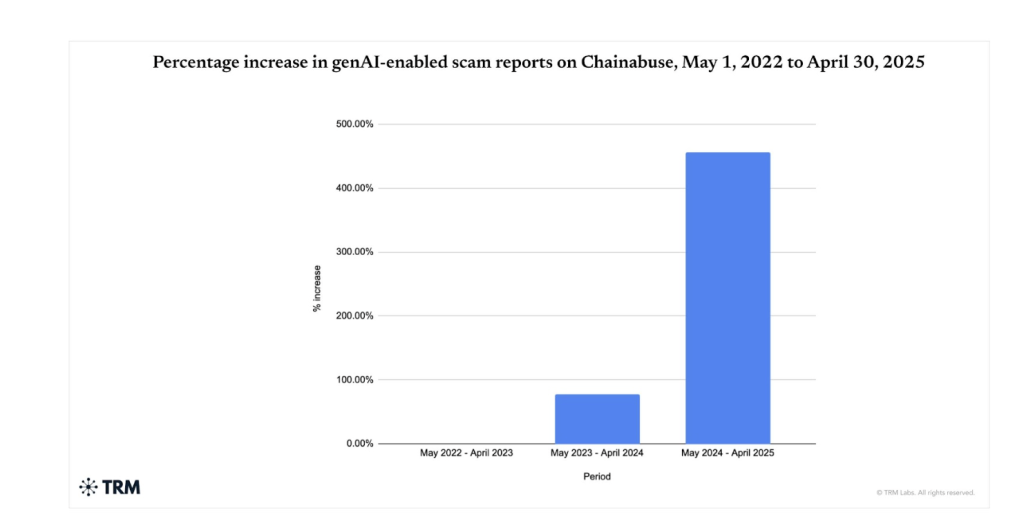
Source: TRM Labs

In response, the DOJ and other agencies have launched coordinated initiatives aimed at transnational fraud networks, particularly so-called “pig butchering” scams linked to criminal groups operating in Southeast Asia.

A multi-agency strike force announced late last year has already seized and forfeited more than $401 million in cryptocurrency, including the largest bitcoin seizure in U.S. history.

Separately, the FBI’s Operation Level Up has notified thousands of potential victims and helped prevent hundreds of millions of dollars in additional losses.

Lawmakers have also moved to tighten the legal framework, as bipartisan bills introduced in Congress seek harsher penalties for AI-assisted fraud and stronger coordination across federal agencies to combat crypto-related scams.

In addition, two U.S. senators introduced the SAFE Crypto Act aimed at tightening the government’s response to cryptocurrency-related fraud.

The post DOJ Targets Crypto Fraud in ‘America First’ Blitz as AI Scams Spike 450% appeared first on Cryptonews.
DOJ Drops OpenSea NFT Fraud Case After Appeals Court Overturns Conviction

23 January 2026 at 07:06

US prosecutors have formally dropped their case against former OpenSea manager Nathaniel Chastain following an appeals court reversal that dismantled what was once positioned as the first NFT insider trading prosecution in American history.

According to sources, the Justice Department announced Wednesday it would enter a one-month deferred prosecution agreement before dismissing the indictment with prejudice.

The decision closes a chapter that began in June 2022 when Chastain was arrested and charged with wire fraud and money laundering for using confidential information to purchase NFTs before they were featured on OpenSea’s homepage.

The case attracted widespread attention as prosecutors attempted to apply traditional financial crime statutes to emerging digital asset markets.

Appeals Court Ruling Undermines Prosecution’s Foundation

Manhattan US Attorney Jay Clayton, a former SEC chair, told the federal court that prosecutors would not retry the case given Chastain had already served three months in prison and agreed not to contest forfeiture of 15.98 ETH worth $47,330.

The interest of the United States will be best served by deferring prosecution of this matter and not retrying the case,” Clayton wrote in the court filing.

DOJ OpenSea NFT Fraud Case - Clayton's Letter
Jay Clayton’s letter. | Source: Cointelegraph

The collapse stems from a July 2024 appeals court decision that found the trial jury received flawed instructions.

The 2nd US Circuit Court of Appeals ruled 2-1 that jurors were improperly told they could convict Chastain based solely on unethical behavior rather than actual theft of property with commercial value.

Judge Steven Menashi wrote last year August that the lower court erred by allowing conviction even if the information Chastain used lacked tangible value to OpenSea.

The appeals panel sharply criticized jury instructions that permitted conviction based on violations of “broad notions of honesty and fair play,” warning such standards could criminalize nearly any deceptive act.

The court found the featured NFT data was not monetized by OpenSea and was not treated internally as a valuable asset, making it too “ethereal” to qualify as property under federal wire fraud statutes.

Original Conviction Built on Novel Legal Theory

Chastain was convicted in May 2023 after prosecutors accused him of exploiting his role to buy dozens of NFTs shortly before they appeared on OpenSea’s homepage between June and September 2021.

After tokens were featured and prices increased, he sold them at two- to five-times profit using anonymous wallets. The government alleged he made over $57,000 through the scheme.

US Attorney Damian Williams had described the case as a warning to digital asset markets when announcing charges. “NFTs might be new, but this type of criminal scheme is not,” Williams said.

As alleged, Nathaniel Chastain betrayed OpenSea by using its confidential business information to make money for himself.

The conviction came after a week-long trial, with prosecutors charging wire fraud rather than securities fraud since NFTs have not been legally classified as securities.

More than 300 defense attorneys had filed letters supporting dismissal, arguing that treating confidential business information as property would “criminalize a broad swath of conduct.

Broader Regulatory Retreat Under Trump Administration

The dropped prosecution aligns with a broader shift in federal crypto enforcement under the Trump administration.

As reported by Cryptonews earlier today, a Cornerstone Research report found the SEC initiated just 13 crypto-related actions in 2025, down 60% from 33 in 2024 and the lowest level since 2017.

The agency has dismissed multiple high-profile cases including those against Coinbase, Kraken, Consensys, and Cumberland DRW.

The SEC also closed its investigation into OpenSea in February 2025 after issuing a Wells notice in August 2024 that alleged the platform functioned as an unregistered securities marketplace.

🌊 The SEC has officially ended its investigation into NFT marketplace @OpenSea, according to the company’s founder, @dfinzer.#SEC #OpenSeahttps://t.co/OtOT6c3WMd

— Cryptonews.com (@cryptonews) February 22, 2025

At that time, OpenSea founder Devin Finzer called the closure “a win for everyone who is creating and building in our space.

For now, Chastain will not face supervision by US Pretrial Services and can seek return of the $50,000 fine and special assessment paid following his conviction.

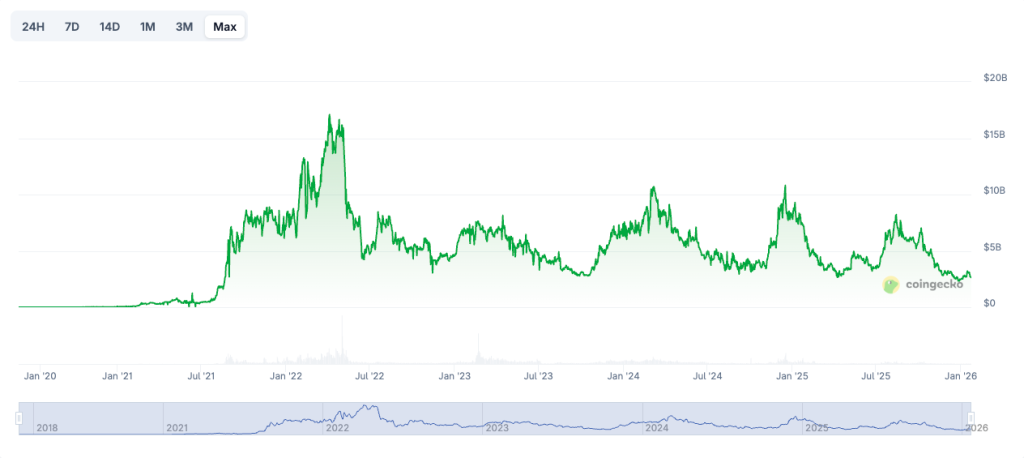
Notably, the global NFT market cap currently stands at $2.56 billion, down 6.72% in the last 24 hours with total sales volume reaching $3.68 million, according to CoinGecko data.

DOJ OpenSea NFT Fraud Case - CoinGecko Chart
Source: CoinGecko

The figure represents an 84.78% decline from the market’s peak of $16.82 billion in April 2022, when digital collectibles were among the hottest assets in crypto and the Chastain case was first unfolding.

The post DOJ Drops OpenSea NFT Fraud Case After Appeals Court Overturns Conviction appeared first on Cryptonews.

US Official Says Seized Bitcoin From Samourai Case Was Not Sold

17 January 2026 at 06:00

According to a senior White House crypto adviser, the Bitcoin tied to the Samourai Wallet forfeiture was not liquidated by federal authorities. The assets will remain held by the government under its strategic reserve plan, the adviser said on social media.

White House Advisor Confirms No Sale

Reports have disclosed that about 57.55 BTC — roughly $6.3 million at recent prices — moved through addresses that some observers tracked, which sparked claims the coins had been sold.

The White House adviser, Patrick Witt, stepped in to clear up the matter, saying the Department of Justice confirmed there was no sale.

The coins will be kept in the Strategic Bitcoin Reserve in line with Executive Order 14233, signed in March 2025 by US President Donald Trump. That order directs that seized Bitcoin be held rather than auctioned off.

UPDATE: we have received confirmation from DOJ that the digital assets forfeited by Samourai Wallet have not been liquidated and will not be liquidated, per EO 14233. They will remain on the USG balance sheet as part of the SBR. https://t.co/v2GchC3vk8

— Patrick Witt (@patrickjwitt) January 16, 2026

Movement Of Coins Triggered Questions

Based on reports from blockchain analysts, a transfer to a Coinbase Prime address led to speculation about a disposal. Market watchers noticed the trail and raised alarms because a sale could have put extra downward pressure on prices.

Some traders reacted quickly to the noise. But officials explain that transfers between custody systems do not always mean liquidation. In this case, the DOJ and related agencies say the transfer was an internal custody step and not a sale to private buyers.

Background On The Case

The legal action against the Samourai Wallet developers centered on charges tied to running an unlicensed money-transmitting service and aiding money laundering through mixer tools.

Those charged pleaded guilty. The forfeiture order followed those convictions, and the Bitcoin in question became part of the assets the government controls after the court rulings.

How the government manages such holdings has been a fast-moving policy issue since Executive Order 14233 was issued, which set new rules for seized crypto.

Policy And Market Effects

According to officials, holding seized Bitcoin in a national reserve is meant to avoid sudden market shocks that could follow large government sales.

Some critics argue the reserve gives the government a powerful financial tool, while supporters say it prevents volatile swings.

The announcement eased some short-term market worries because uncertainty about a possible sale had been cited as a potential pressure point for crypto prices.

Reactions From Industry Observers

Based on reports and social posts from crypto advocates, opinions remain split. Some welcomed the clarification as stabilizing.

Others want more transparency on how the Strategic Bitcoin Reserve will be run and when, if ever, coins might leave it.

Lawmakers on both sides of the aisle may ask for hearings or written briefings to get clearer answers about custody practices and future plans.

Featured image from Unsplash, chart from TradingView

Bitcoin Rally Reflects Buyer Conviction On Coinbase Spot Markets, Bull Run Back On?

15 January 2026 at 11:30

The recent Bitcoin rally may be driven by real spot demand on Coinbase. Data indicating elevated spot activity on Coinbase suggests that this move higher is bolstered by direct purchases rather than leveraged positioning in derivatives markets. This distinction matters because Spot buying reflects a real capital commitment, not a temporary bet.

Why Risk Management When Demand Is Structural

The Bitcoin rally since Sunday’s Powell subpoena news has been largely linked to Coinbase spot buyers. Crypto trader Alex Krüger has highlighted on X that both the Adjusted Coinbase Premium and Cumulative Volume Delta (CVD) show steady spot accumulation, which is exactly why this has been a true hated rally even among bitcoiners. For over a month, the dominant narrative in every crypto chat room has been that BTC is lagging while equities and commodities are moving upward.

However, the fun fact is that equities are not accurate, but 40% of the S&P 500 (Standard & Poor’s 500) stocks have actually closed red in 2025, (39.2% to be precise). Perception is doing a lot of work here, and the United States Department of Justice (DOJ) move on Powell represented a major macro litmus test for BTC. Kruger claims that the BTC long-term value proposition is about protecting against the tail risk of central bank profligacy. 

Bitcoin

On Monday, BTC surged upward, although the move was just a little surge. According to Krüger, the BTC key battlefield remains the 50-week moving average (WMA), which is currently around $101,420. Meanwhile, the trader is looking to take some profits into short liquidations right above the $100,000 mark.

Why Bitcoin Benefits First From Institutional Flows

The Digital Asset Market Clarity Act is set for markup today, January 15th, 2026, in the Senate Banking Committee. According to the update by BTC_road_to200k on X (Formally Twitter), this is where the lawmakers will debate and shape the final version of the bill before it moves forward.

This matters because the art aims to clear up the ongoing regulatory uncertainty between the Securities and Exchange Commission (SEC) and the Commodity Futures Trading Commission (CFTC), which has been a major source of hesitation for large institutional players looking to move into Bitcoin and other digital assets.

Furthermore, the Clarity Act will be a turning point as it aims to clear rules that will bring more confidence to banks, pension funds, and large investors, which often translates into higher demand and stronger price momentum for BTC. As the regulatory clouds lift, the market might start experiencing a renewed wave of institutional money flowing in, and that’s obviously bullish for BTC.

Bitcoin

Did DOJ Prosecutors Violate Trump’s Executive Order by Selling the Forfeited Samourai Wallet Bitcoin?

5 January 2026 at 14:03

Bitcoin Magazine

Did DOJ Prosecutors Violate Trump’s Executive Order by Selling the Forfeited Samourai Wallet Bitcoin?

It seems that the U.S. Marshall Service (USMS) has sold the $6.3 million worth of bitcoin that Samourai Wallet developers Keonne Rodriguez and William Lonergan Hill paid the U.S. Department of Justice (DOJ) as a fee that was part of their guilty plea.

In doing so, it has potentially violated Executive Order (EO) 14233, which mandates that bitcoin acquired via criminal or civil asset forfeiture proceedings should be held as part of the United States’ Strategy Bitcoin Reserve (SBR).

If the Southern District of New York (SDNY), the federal judicial district in which the Samourai case was to be tried, did, in fact, violate EO 14233, it would not be the first time employees of the SDNY have acted in defiance of direction from the federal government.

What Happened to the Bitcoin?

According to a document titled “Asset Liquidation Agreement”, which has been obtained exclusively by Bitcoin Magazine and has not until now been made public, the bitcoin that Rodriguez and Hill forfeited is to be sold — or already has been.

As per the document, the defendants agreed to transfer $6,367,139.69 worth of bitcoin — 57.55353033 bitcoin at the time the final party signed the agreement, which was Assistant United States Attorney Cecilia Vogelon November 3, 2025 — to the USMS.

The bitcoin, which was sent from address bc1q4pntkz06z7xxvdcers09cyjqz5gf8ut4pua22r on November 3, 2025, seems to have bypassed any direct custody by the USMS. Instead, it seems to have been sent directly to Coinbase Prime address 3Lz5ULL7nG7vv6nwc8kNnbjDmSnawKS3n8 (Arkham Intel attributes this address to the brokerage), presumably to be sold.

This Coinbase Prime address currently has a zero balance, indicating that the bitcoin may have already been sold.

Violating Executive Order 14233

If the USMS has sold the forfeited bitcoin, it likely contravened EO 14233, which orders that bitcoin acquired by the U.S. government via criminal forfeiture, termed “Government BTC” in the EO, “shall not be sold” and should be contributed into the U.S. SBR.

If the USMS sold the bitcoin, they did so at their own discretion and not as a legal mandate, which indicates that certain members of the DOJ may still view bitcoin as a taboo asset to be offloaded as opposed to a strategic asset that President Trump has directed government agencies to retain.

Given that the Samourai prosecution originated under the previous administration, which was notoriously hostile toward noncustodial crypto tools and their developers, the decision to ignore EO 14233 and sell the bitcoin despite a mandate from the executive branch fits a pattern of treating bitcoin as something that should be removed from government balance sheets as soon as possible.

Legal Details Regarding the Forfeiture and Liquidation

According to a legal source close to this matter, the Samourai developers’ forfeited their bitcoin under 18 U.S. Code § 982(a)(1), which stipulates that any offense that violates 18 U.S. Code § 1960, the statute that prohibits the operation of unlicensed money transmitting businesses, orders that person to forfeit to the United States any property involved in the offense.

Judging by § 982 and its incorporation of 21 U.S.C. § 853(c), a criminal forfeiture statute that stipulates that “property that is subsequently transferred to a person other than the defendant may be the subject of a special verdict of forfeiture and thereafter shall be ordered forfeited to the United States,” the bitcoin that Rodriguez and Hill forfeited fits the EO’s definition of “Government BTC”.

Neither § 982 nor the incorporated § 853 requires that property that is forfeited as part of a criminal offense be liquidated. Furthermore, the fund forfeiture statutes cited in section three of the EO — 31 U.S.C. § 9705 and 28 U.S.C. § 524(c) — regulate where forfeiture proceeds are deposited and how they may be used; they do not require that forfeited bitcoin be converted to cash rather than held in kind.

The EO also stipulates that “Government BTC” falls under the umbrella of “Government Digital Assets” and states that “the head of each agency shall not sell or otherwise dispose of any Government Digital Assets” except in certain scenarios, none of which apply in the Rodriguez or Hill cases and, in all of which, the U.S. attorney general would play a role in determining what should be done with the forfeited digital assets.

The Sovereign District of New York

When taking EO 14233 and the statutes cited in this article into account, the SDNY seems to have acted in a manner that defies the EO 14233’s mandate to transfer bitcoin obtained via criminal forfeiture to the U.S. SBR.

This would not mark the first time that the SDNY has acted in such a manner. 

The judicial jurisdiction, sometimes colloquially referred to as “Sovereign District of New York,” has earned a reputation for operating independently and unilaterally, despite being part of a federal system.

The fact that the SDNY proceeded with the cases against Rodriguez and Hill as well as the case against Tornado Cash developer Roman Storm, is further evidence of this.

On April 7, 2025, Deputy Attorney General Todd Blanche issued a memo entitled “Ending Regulation By Prosecution” in which he stated “the Department [of Justice] will no longer target virtual currency exchanges, mixing and tumbling services, and offline wallets for the acts of their end users…”

The SDNY seemed to disregard the language in this memo, though, as it proceeded with the Samourai Wallet or Tornado Cash cases.

And when the defense team for Hill and Rodrguez learned as per a Brady request that two high-ranking members of the U.S. Department of the Treasury’s Financial Crimes Enforcement Network (FinCEN) “strongly suggested” that Samourai Wallet wasn’t serving as a money transmitter due to the noncustodial nature of the service, the prosecution proceeded anyway.

When it comes to criminal cases tried within the federal court system, over 90% of defendants are convicted and sentenced, with as little as 0.4% being acquitted some years. And the prosecution for SDNY cases has a reputation for having an even higher win rate.

Rodriguez was aware of these statistics, as well as the fact that Judge Denise Cote, the judge who presided over his and Hill’s cases, has a reputation for harsh sentencing.

He told me as much the morning before he pleaded guilty to the conspiracy to operate an unlicensed money transmitter business charge.

Is the War on Crypto Really Over?

Many Bitcoin and crypto proponents who voted for President Trump in 2024 as well as the crypto industry, which supported the president in his reelection, are now beginning to question whether or not President Trump really does want to see an end to the war on crypto.

For this to happen, the DOJ under President Trump must honor what is mandated in EO 14233 and follow Deputy Attorney General Blanche’s guidance to stop prosecuting developers of noncustodial crypto technology.

To the latter point, President Trump recently stated that he is considering a pardon for Rodriguez.

His pardoning Rodriguez as well having the DOJ look into why it sold the bitcoin that the Samourai developers forfeited would send a signal that the president is quite serious about his pro-Bitcoin and pro-crypto stance.

This post Did DOJ Prosecutors Violate Trump’s Executive Order by Selling the Forfeited Samourai Wallet Bitcoin? first appeared on Bitcoin Magazine and is written by Frank Corva.

Why Trump Should Pardon The Developers of Bitcoins Non Custodial Samourai Wallet

By: Juan Galt
12 December 2025 at 12:55

Bitcoin Magazine

Why Trump Should Pardon The Developers of Bitcoins Non Custodial Samourai Wallet

On December 18th, days before Christmas, Keonne Rodriguez, co-founder of the Bitcoin Samourai Wallet, will have to surrender to prison. His crime? Creating a software tool that gave Bitcoin users comparable privacy to that which banks are expected to provide. Samourai Wallet, the brand and technology stack built by Rodriguez and William Lonergan Hill, was shut down by the U.S. Government in April 2024 on a variety of charges, including money laundering, but only one charge stuck after a high-profile trial, the weakest charge of all, “unlicensed money transmission”.

What does it mean to transmit money? According to prosecutors, custodial control over user funds is no longer a requirement to need an MSB license; “a USB cable transfers data from one device to another, and a frying pan transfers heat from a stove to the contents of the pan, although neither situation involves exercising ‘control’ over what is being transferred.” If the DoJ can indict a frying pan, then USB manufacturers better lawyer up! 

While I’m no genius, the Supreme Court has emphasized that laws should be clear enough for an AVERAGE PERSON to understand

Let’s get into the minutiae of the specific subsection of the charge they pled to

What Keonne and Bill pled to was a violation 18 U.S. Code § 1960(b)(1)(C) pic.twitter.com/yGoDpZf8Eg

— lauren emily (@leamuirleyn) December 11, 2025


Remarkably, even FinCEN disagrees with the DoJ’s novel legal interpretation of what constitutes a money transmitter, as guidance at the time said non-custodial services could not be money transmitters because they do not exert control over money flows. FinCEN reasserted this fact to the DoJ prosecutors in a written statement, but they went forward with the charges anyway. This critical fact was withheld from the defense for almost a year, when it was finally revealed, “the judge denied the motion to present this evidence in the hearings, without even any argument,” according to Rodriguez. Critics argue this misconduct by the DoJ prosecutors is a violation of Brady v. Maryland, denying access to material that could have undermined the unlicensed money transmission charges, or, as Donald J. Trump would put it, this prosecution was rigged.  

Zack Shapiro, head of policy at the Bitcoin Policy Institute, warns the Trump administration and American software industry about the potential ramifications of this legal case, arguing that “collapsing the distinction between developing a tool and operating a service would introduce an untenable level of risk for anyone building privacy-enhancing or security-critical software.”

“Rodriguez and Hill ultimately accepted plea agreements in the face of substantial sentencing exposure, even though government records undermined the central regulatory theory of the case,” Shapiro added in a letter published on the BPI website, asking the Trump admin to pardon the Samourai Wallet devs. 

Fundamentally, the prosecutorial approach in the Samourai Wallet case risks establishing an influential precedent that threatens the financial privacy of American citizens and stifles innovation in the U.S. crypto industry. It could shape future prosecutions and regulatory developments, potentially reclassifying non-custodial services as money transmitters under federal law—requiring national MSB registration with FinCEN—and prompting stricter state-level licensing in jurisdictions like New York or California.

Echoing the trial against Ross Ulbricht a decade earlier, this rigged case against Samourai Wallet was set up during the Biden administration with support from anti-crypto politicians whom Trump defeated in the 2025 elections with the popular mandate. During his campaign at the 2024 Bitcoin Nashville speech, Trump said, “I will always defend the right to self-custody,” and got major support from the Bitcoin and crypto industries through the shared vision of making the United States the crypto capital of the world.

“I pledge to the Bitcoin community that the day I take the oath of office, Joe Biden and Kamala Harris’ anti-crypto crusade will be over,” – Donald J. Trump, Nashville 2024. 

Many libertarians in the broader crypto industry see entrepreneurs like Keonne Rodriguez and William Lonergan Hill, in the same category as Roman Storm and Roman Sterlingov of Tornado Cash and radio host Ian Freeman, as nothing more than political prisoners of an entrenched banking cartel. 

David Sacks, the venture capitalist and White House A.I. & Crypto Czar, should also pay attention to this issue; otherwise, what does it even mean to be the Crypto Czar? If Bitcoin wallets end up regulated the same as banks, despite having no counterparty risk, then whose interests are really being served, Mainstreet’s or Wallstreet’s?

While the Trump admin has been very conservative during the DoJ’s prosecution and trial of the Samourai Wallet devs — and perhaps, understandably so — that stage of the legal battle is over. 

It is time for the Trump administration to meet its promise to the American public and defend self-custody and the crypto industry in America. It is time for Trump to set the record straight and pardon Keonne Rodriguez and William Lonergan Hill, as well as the Tornado Cash devs, while we are at it, lest we have another Ross Ulbricht-style miscarriage of justice. 

The Bitcoin and crypto industry is well behind this effort and has begun gathering signatures at Change.org, totaling over 5000 so far and growing, with the only official fundraising campaign at GiveSendGo.

Should Trump pardon the Samourai Wallet devs, he would be sending a clear signal to those who want surveillance-based, central bank digital currency systems to enslave Americans and the world that Americans will not stand for it. That the United States stands with the fundamental human right to privacy, dignity, due process, and the presumption of innocence, and not the tactics of intimidation developed by the likes of Joseph Gorbles, where privacy is a crime. Mass, indiscriminate surveillance, without a warrant, without due process, that is the real crime. 

This post Why Trump Should Pardon The Developers of Bitcoins Non Custodial Samourai Wallet first appeared on Bitcoin Magazine and is written by Juan Galt.

US Authorities Bust Billion-Dollar Crypto Laundering Network, Charge 2 Russians

27 September 2024 at 02:30
US Charges 2 Two Russians in Billion-Dollar Crypto Laundering Network, Seizes $7M in CryptoTwo Russian nationals have been charged with running a massive money laundering network that processed billions through cryptocurrency exchanges, the U.S. Department of Justice (DOJ) announced. These exchanges, including Cryptex and Joker’s Stash, enabled criminals to bypass regulations and funnel funds from fraud, ransomware, and darknet activities. U.S. authorities, in collaboration with international law enforcement, […]

US Sentences Nigerian Darknet Fraud Leader to Five Years in Prison for $6M Scheme

20 September 2024 at 22:30
US Sentences Nigerian Darknet Fraud Leader to Five Years in Prison for $6M SchemeA Nigerian national has been sentenced to five years in federal prison for his role in a massive darknet fraud scheme that intended to cause over $6 million in losses, according to the U.S. Department of Justice (DOJ). Using various online aliases, Kaura led a global network selling stolen payment card data, using cryptocurrencies like […]

DOJ Captures Alleged ‘Architect’ of Darknet Marketplace Incognito

DOJ Captures Alleged ‘Architect’ of Darknet Marketplace IncognitoAccording to the U.S. Department of Justice (DOJ), the operator of the darknet marketplace Incognito was apprehended at John F. Kennedy Airport on May 18. Law enforcement officials claim Rui-Siang Lin allegedly constructed the DNM and facilitated the sale of over $100 million worth of illegal drugs through the platform. Federal Authorities Nab Alleged Darknet […]

Hive Ransomware Network Dismantled by American, European Law Enforcement

27 January 2023 at 16:30
Hive Ransomware Network Dismantled by American, European Law Enforcement

Law enforcement authorities from over a dozen countries in Europe and North America have taken part in disrupting the activities of the Hive ransomware group, the U.S. Justice Department and Europol announced. Hive is believed to have targeted various organizations worldwide in the past couple of years, often extorting payments in cryptocurrency.

Captured Decryption Keys Helped Hive Victims Avoid Paying $130 Million in Ransom

Ransomware network Hive, which has had around 1,500 victims in more than 80 countries, has been hit in a months-long disruption campaign, the U.S. Department of Justice (DOJ) and the European Union Agency for Law Enforcement Cooperation (Europol) revealed. A total of 13 nations participated in the operation, including EU member states, the U.K. and Canada.

Hive has been identified as a major cybersecurity threat as the ransomware has been used by affiliated actors to compromise and encrypt data and computer systems of government facilities, oil multinationals, IT and telecom companies in the EU and U.S., Europol said. Hospitals, schools, financial firms, and critical infrastructure have been targeted, the DOJ noted.

It has been one of the most prolific ransomware strains, Chainalysis pointed out, which has collected at least $100 million from victims since its launch in 2021. A recent report by the blockchain forensics company unveiled that revenue from such attacks has decreased last year, with a growing number of affected organizations refusing to pay the demanded ransoms.

According to the announcements by the law enforcement authorities, the U.S. Federal Bureau of Investigation (FBI) penetrated Hive’s computers in July 2022 and captured its decryption keys, providing them to victims around the world which prevented them from paying another $130 million.

Working with the German Federal Police and the Dutch High Tech Crime Unit, the Bureau has now seized control over the servers and websites that Hive used to communicate with its members and the victims, including the darknet domain where the stolen data was sometimes posted. FBI Director Christopher Wray was quoted as stating:

The coordinated disruption of Hive’s computer networks … shows what we can accomplish by combining a relentless search for useful technical information to share with victims.

The Hive ransomware was created, maintained and updated by developers while being employed by affiliates in a ‘ransomware-as-a-service’ (RaaS) double extortion model, Europol explained. The affiliates would initially copy the data and then encrypt the files before asking for a ransom to decrypt the information and not publish it on the leak site.

The attackers exploited various vulnerabilities and used a number of methods, including single factor logins via Remote Desktop Protocol (RDP), virtual private networks (VPNs), and other remote network connection protocols as well as phishing emails with malicious attachments, the law enforcement agencies detailed.

Do you expect police authorities around the world to dismantle more ransomware networks in the near future? Tell us in the comments section below.

❌
❌