Japanese Bitcoin treasury firm Metaplanet reported a 104.6 billion yen ($680 million) impairment on its Bitcoin holdings, reflecting the impact of last year’s market downturn on the value of its digital asset portfolio.
Key Takeaways:
Metaplanet booked a $680 million Bitcoin impairment that will drive large reported losses but does not impact cash flow.
The write-down reflects aggressive Bitcoin accumulation, with holdings rising to over 35,000 BTC.
Bitcoin income strategies drove an upward revision to revenue forecasts.
In a press release issued Monday, the company said the impairment was recorded as a non-operating expense and does not affect cash flows or day-to-day operations.
Even so, the accounting charge is expected to weigh heavily on reported results for the fiscal year ended December 2025.
Metaplanet Forecasts Up to $640M Loss Following Bitcoin Write-Down
Including the Bitcoin-related write-down, Metaplanet now expects to post a consolidated ordinary loss of 98.56 billion yen ($640 million) and a consolidated net loss of 76.63 billion yen ($498 million).
The company also forecast a comprehensive loss attributable to shareholders of 54.02 billion yen ($351 million). Final earnings are scheduled for release on Feb. 16.
“While short-term accounting volatility is inherent to our business model, our medium-to-long-term BTC accumulation and capital strategy remain on track,” Metaplanet said, underscoring its commitment to maintaining Bitcoin as a core treasury asset.
The scale of the impairment reflects the company’s rapid accumulation of Bitcoin over the past year. By the end of 2025, Metaplanet held 35,102 BTC, up sharply from 1,762 BTC a year earlier.
According to a previous disclosure from Chief Executive Simon Gerovich, the firm spent $451.06 million during the fourth quarter of 2025 to expand its holdings, paying an average price of $105,412 per Bitcoin.
*Notice Regarding Revision of Full-Year Earnings Forecast for Fiscal Year Ending December 2025, Recording of Bitcoin Impairment Loss, and Announcement of Full-Year Earnings Forecast for Fiscal Year Ending December 2026* pic.twitter.com/VIKYRYb981
Bitcoin was trading near $87,500 at the end of December.
Despite the headline loss, Metaplanet raised its full-year 2025 guidance, pointing to stronger-than-expected performance in its Bitcoin income generation business.
That segment, which relies on derivatives and options strategies, has become a growing contributor to revenue.
The company now expects full-year revenue of 8.9 billion yen ($57.8 million), up 31% from its prior forecast, while operating income is projected at 6.3 billion yen ($41 million), representing a 33.8% increase.
Metaplanet cited more diversified funding, including the issuance of Series B perpetual convertible preferred stock and access to a $500 million credit facility, as key drivers of the upward revision.
Metaplanet Targets Strong 2026 Growth Despite Share Price Drop
Looking ahead, Metaplanet forecast revenue of 16 billion yen ($104 million) and operating income of 11.4 billion yen ($74 million) for fiscal 2026, with the Bitcoin income generation unit expected to account for the bulk of that growth.
Shares of Metaplanet listed in Tokyo fell 7.03% on Monday to 476 yen, while the company’s US-traded shares closed higher on Friday.
Last month, Metaplanet shareholders approved five proposals at an extraordinary meeting, clearing the way for two new classes of preferred shares designed to fund Bitcoin purchases while delivering fixed monthly and quarterly dividends to investors.
The Tokyo-listed company is now positioned to raise capital through dividend-paying securities rather than further diluting common stockholders.
Gold’s rally is showing little sign of slowing as global markets head into 2026 with investors increasingly looking for refuge in traditional safe-haven assets amid geopolitical uncertainty.
According to Gracy Chen the CEO of crypto exchange Bitget says gold continues to act as “the world’s ultimate insurance policy,” as demand remains firm while broader financial markets adjust to shifting macroeconomic risks.
“Technically, the market is still in expansion mode,” Chen said pointing to Fibonacci extension levels that suggest gold could climb toward the $5,325–$5,400 range in the months ahead.
She added that strong buying interest holding around $4,830 indicates the current move is part of a sustained trend rather than a topping pattern.
Gold Remains the Anchor in Uncertain Markets
Gold has benefited during periods of heightened global instability and Chen believes the current environment will continue to support its role as a defensive asset.
With many investors reassessing risk exposure across equities and emerging markets, the precious metal is once again being positioned as a portfolio hedge against inflation, geopolitical shocks and currency volatility.
The resilience of demand at key technical support levels suggests that gold’s rally is being driven by structural factors rather than short-term speculation.
Bitcoin Undervalued Despite Macro Headwinds
Chen also drew parallels between gold’s trajectory and Bitcoin’s outlook arguing that the world’s largest cryptocurrency remains undervalued relative to its long-term potential.
“Bitcoin is on a similar trajectory considering it is an undervalued asset currently,” she said.
While Bitcoin remains sensitive to macroeconomic events Chen highlights several forces that could support an increasingly bullish breakout over the next year.
ETF Inflows and US Regulation Fuel Bullish Setup
The key catalysts Chen points to continued institutional demand through spot Bitcoin ETFs which have provided steady inflows and reinforced Bitcoin’s growing role in mainstream portfolios.
She also notes that Bitcoin volatility has declined compared to major tech stocks showing maturation in the asset class.
In the policy arena ongoing progress on a US crypto market structure bill could also provide greater regulatory clarity, potentially unlocking further institutional participation.
Bitcoin Could Reach $180K by End of 2026?
Chen believes Bitcoin’s current market cycle may also be diverging from historical norms with structural adoption and regulatory momentum creating conditions for sustained upside.
“If these forces persist Bitcoin has a credible path toward $150,000–$180,000 by the end of 2026,” she said.
Traditional Safety Meets Digital Upside
Chen’s outlook shows a broader theme emerging across global markets: investors are increasingly balancing traditional stores of value like gold with digital alternatives such as Bitcoin.
As geopolitical risks continue to linger and financial systems evolve both assets may continue to benefit from their roles as hedges—one rooted in centuries of history – the other driven by institutional adoption and technological change.
Crypto markets entered the new week on the back foot as a wave of macro uncertainty sparked heavy liquidations across major digital assets.
Key Takeaways:
Macro uncertainty triggered over $550 million in crypto liquidations as bitcoin and ether came under pressure.
Tariff threats, US shutdown risks, and yen volatility are driving a broader risk-off shift toward safe-haven assets.
Derivatives markets have turned defensive, with rising volatility and increased demand for bitcoin downside protection.
After trading in a tight range over the weekend, prices slid during early Asian hours, triggering more than $550 million in leveraged long liquidations, according to market data cited by QCP Asia.
Bitcoin briefly dipped to the $86,000 level before stabilizing, while Ethereum fell toward the $2,785 area.
Tariff Threats, Shutdown Fears, and FX Uncertainty Weigh on Markets
Market participants point to a cluster of macro developments driving the move, according to QCP.
Chief among them were comments from President Donald Trump on the possibility of imposing 100% tariffs on Canadian imports, renewed concern over a looming partial shutdown of the US government, and ongoing uncertainty around potential US-Japan coordination to arrest further weakness in the yen.
Currency markets remain a key pressure point. A “rate check” on USD/JPY by the New York Fed late last week signaled growing sensitivity to yen depreciation, with the 160 level widely viewed as a threshold that could prompt intervention.
While the pair has since pulled back, it continues to trade near two-month highs around 154, prompting investors to unwind short-yen positions rather than risk sudden policy action.
QCP analysis notes that crypto assets traded in a narrow range over the weekend before coming under pressure in early Asian hours, triggering over $550 million in leveraged long liquidations. BTC briefly tested $86K before finding support, while Ethereum fell to the $2,785 area.…
US domestic politics are adding another layer of tension. Although broader risk sentiment found some relief after Canadian Prime Minister Mark Carney said Ottawa has no plans to pursue a free trade deal with China, fiscal negotiations in Washington remain unresolved.
House Republicans have advanced spending bills that include roughly $64.4 billion for border security and the Department of Homeland Security, while Senate Democrats have indicated they will block the measures.
With current government funding set to expire on January 30, failure to reach an agreement would result in a partial shutdown.
Markets appear to be taking that risk seriously. Polymarket odds currently imply roughly a 75% chance of a shutdown by January 31, a dynamic that echoes last autumn’s fiscal standoff, which coincided with a sharp drawdown in crypto prices.
Bitcoin Options Signal Rising Downside Protection as Volatility Climbs
Derivatives markets are already reflecting a more cautious stance. Put skews and implied volatility have risen across maturities, with traders rolling downside protection in bitcoin options from the 88,000 level toward 85,000, according to QCP.
Alongside ongoing geopolitical and fiscal headlines, markets face a busy week that includes major technology earnings and a Federal Reserve policy decision.
While the Fed is expected to hold rates steady, investors will be watching closely for any shift in Chair Jerome Powell’s guidance.
“With multiple macro risks unresolved, crypto prices are likely to chop around in the near term, pending greater clarity, particularly around the risk of a US government shutdown,” QCP said.
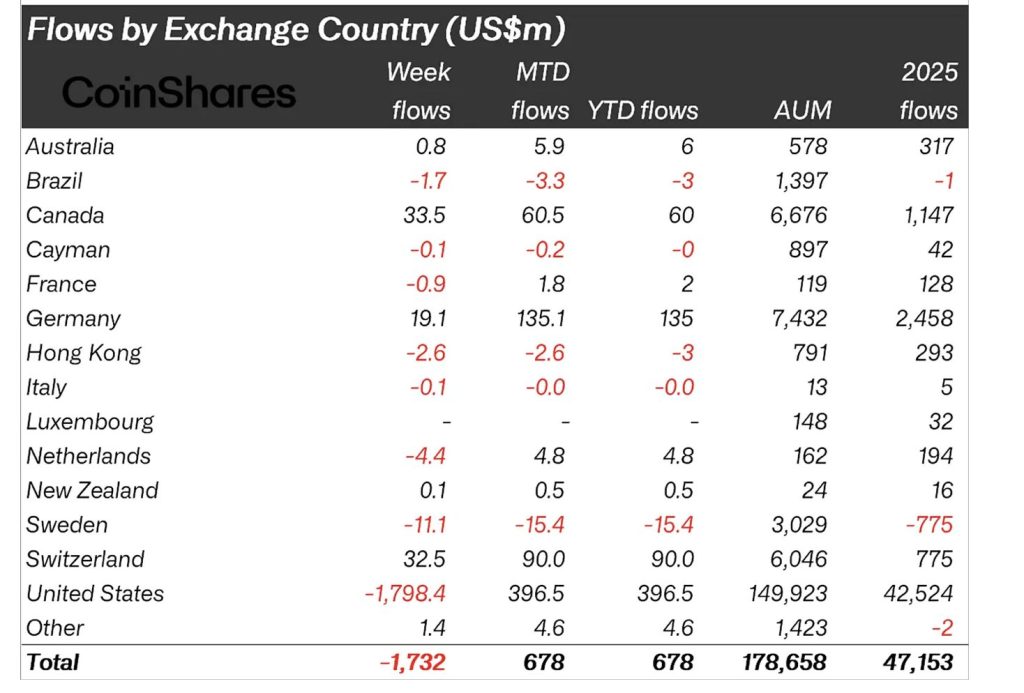
Digital asset investment products saw sharp outflows last week with investors pulling $1.73 billion, the largest weekly decline since mid-November 2025, according to CoinShares report authored by head of research James Butterfill.
CoinShares notes that the wave of redemptions reflects persistent bearish sentiment, driven by fading expectations for interest rate cuts, negative price momentum and growing disappointment that digital assets have not yet benefited from the broader “debasement trade.”
Outflows were heavily concentrated in the United States, which accounted for nearly $1.8 billion, while sentiment was more mixed across Europe and Canada.
Bitcoin and Ethereum Lead Weekly Redemptions
Bitcoin products recorded outflows of $1.09 billion, the largest since mid-November 2025, showing that investor confidence has yet to recover following the October 2025 price crash.
Ethereum followed with $630 million in outflows while XRP investment products saw an additional $18.2 million exit the market — highlighting broad-based weakness across major assets.
Butterfill addes that minor inflows into short-Bitcoin products — totalling just $0.5 million — suggest bearish positioning remains limited, but overall sentiment has not meaningfully improved.
Solana was also a notable exception attracting $17.1 million in inflows and bucking the wider negative trend. Smaller altcoins such as Binance-linked products ($4.6 million) and Chainlink ($3.8 million) also posted modest gains.
Regional Flows Diverge Outside the US
While the US dominated the outflows, CoinShares reports that other regions saw investors take advantage of price weakness to add to long positions.
Switzerland recorded inflows of $32.5 million, Canada added $33.5 million, and Germany saw $19.1 million in inflows. Sweden and the Netherlands both posted smaller outflows of $11.1 million and $4.4 million respectively.
The divergence suggests that while US-based investors are reducing exposure some international allocators continue to view pullbacks as entry opportunities.
Long-Term Adoption Model Points to $317K Bitcoin Floor by 2029
Despite near-term bearishness in fund flows CoinShares Research maintains a bullish long-term outlook based on its updated adoption-based valuation model.
The framework models Bitcoin as a global savings asset competing with deposits, gold, real estate, and bonds. Using conservative assumptions — including sub-1% disposable income allocation and a reduced flow-to-market-cap multiple of 3.5x — CoinShares projects Bitcoin ownership could rise from roughly 560 million owners in 2025 to 1.16 billion by 2029.
Under this scenario Bitcoin’s valuation floor could reach approximately $317,000 by 2029 implying a potential 3.2x return from mid-November 2025 levels, notes the firm.
CoinShares stressed that the model is designed to estimate price-supporting bottoms rather than speculative cycle peaks with ETF growth and emerging-market adoption continuing to accelerate global participation.
The U.S. Dollar Index extends its slide to the weakest level since Sept. 18, reinforcing investor demand for hard assets and alternative stores of value. The U.S. dollar continued its decline this month, with the U.S. Dollar Index falling 1.5%…
A new Bitcoin price prediction has been put forward following a long-term technical analysis shared on the social media platform X by crypto analyst Leshka.eth. The analysis compares Bitcoin’s current structure on the weekly timeframe to the 2021 market peak, showing how price behavior is repeating an identical pattern.
Based on how Bitcoin has interacted with a rising multi-year channel in previous cycles, the analysis proposes a projection as to how Bitcoin could be setting up for a powerful corrective move that sends the price back to as low as $30,000.
Bitcoin Weekly Structure About To Break
Technical analysis of Bitcoin’s price action on the weekly candlestick timeframe chart shows that the leading cryptocurrency has been trading with higher highs and higher lows since 2018. Interestingly, this trend of higher highs has led to repeated interaction with a rising resistance trendline that has defined every major cycle top.
As shown in the chart below, Bitcoin pushes into this upper boundary during each bull market, only to be rejected once momentum fades. These rejection points are clearly marked across multiple cycles, including the 2017 and 2021 peaks. This repeated failure is a defining feature of Bitcoin’s macro cycles of exhaustion after prolonged upside expansion.
Bitcoin once again rallied into this same long-term trendline when it broke to new all-time highs in October 2025 before stalling and rolling over. Bitcoin’s price failed to hold above the trendline and has corrected by about 30% since then. The leading cryptocurrency is now trading below $90,000, and this technical outlook introduces the possibility that the current pullback is not yet complete and could extend further.
The chart also highlights the depth of prior bear market declines once Bitcoin was rejected at this long-term structure. After the 2017 cycle top, Bitcoin fell roughly 84.99% from peak to trough. Following the 2021 high, Bitcoin once again declined by about 77.47% before finding a bottom near the lower boundary of the broader rising channel.
Based on the current setup, the projected downside move marked on the chart measures approximately 72.86%. Applying a drawdown of that magnitude from the recent cycle high places Bitcoin’s potential bottom around $30,000.
Interestingly, Grok AI offered a more optimistic interpretation of Bitcoin’s near-term outlook based on responses to questions under the same technical post. According to Grok, aggregated views from sources such as CNBC, Reddit, and Forbes suggest that the probability of Bitcoin dropping into the $30,000 to $40,000 range is relatively low, estimated at around 15% to 25% by bearish cycle models.
A severe Arctic blast sweeping across the United States has forced Bitcoin miners to take more than 110 exahashes per second of computing power offline, temporarily slowing block production to 12 minutes as operators curtail operations to ease strain on regional power grids, according to The Miner Mag.
The widespread shutdowns mark one of the largest coordinated mining curtailments since the 2021 Texas grid crisis, with FoundryUSA’s hashrate dropping nearly 60% since Friday.
Real-time data from Mining Pool Stats shows FoundryUSA’s hashrate fell from approximately 340 EH/s to roughly 242 EH/s over the weekend, while Luxor recorded a similar decline from about 45 EH/s to around 26 EH/s.
Smaller reductions appeared across Antpool and Binance Pool, though these pools serve less U.S.-concentrated operations, suggesting total curtailments may exceed the initial 110 EH/s estimate, The Miner Mag reported.
The hashrate pullback coincided with a severe Arctic air mass pushing subfreezing temperatures, snow, and ice deep into the central and eastern United States.
Grid operators across multiple states issued conservation alerts as heating demand surged, yet Texas’s grid operator ERCOT reported on Friday that conditions remained stable despite the cold weather.
The stability contrasts sharply with February 2021, when Winter Storm Uri triggered widespread outages and prolonged blackouts across the state.
Since that crisis, Texas has added substantial large-load capacity, much of it tied to Bitcoin mining and data center operations.
Unlike traditional industrial loads, many Bitcoin miners participate in demand response programs, allowing them to rapidly curtail consumption during periods of grid stress.
As noted by The Miner Mag, this flexible-load model represents a dynamic shift from the 2021 scenario, when such infrastructure did not exist to support grid balancing during extreme weather events.
The U.S. #AI compute boom is running into a familiar problem.
Local communities aren’t buying it.
If this sounds familiar to #bitcoin miners, that’s because it is.
Singapore-based miner Bitdeer, which operates over 293,000 rigs globally, including facilities in Texas, said in a statement that it does not anticipate major disruptions from the storm.
A company spokesperson explained that the Electric Reliability Council of Texas considers Bitcoin miners “large flexible loads,” meaning they can curtail electricity usage on request, unlike other industrial users with firm electrical demands.
“Bitdeer stands ready to fully support the grid should supply constraints occur,” the spokesperson added.
The curtailments come as Bitcoin’s seven-day average network hashrate had already declined to about 992 EH/s, down roughly 13.7% from the all-time high of above 1.15 ZH/s reached in October, according to data reported by The Miner Mag last week.
Storm Threatens 60 Million People Across 1,800 Miles
The massive winter storm extends for 1,800 miles from far west Texas to the mid-Atlantic coast, threatening to affect upwards of 60 million people across more than a dozen states, according to AccuWeather.
Source: AccuWeather
AccuWeather Senior Vice President Evan Myers warned that the combination of snow, ice, and bitter cold across such a large area would “stall daily life for days,” with some power outages lasting through extended periods as Arctic air charges in behind the storm.
About 60 million people will experience icing conditions, with potentially 1 million people without power for an extended period, AccuWeather estimated.
AccuWeather Chief Meteorologist Jon Porter noted that many areas hit hard by Hurricane Helene in September 2024 still have temporary power lines that “may come down more easily than permanent lines,” potentially stretching recovery resources and personnel to the limit across North Carolina and other affected states.
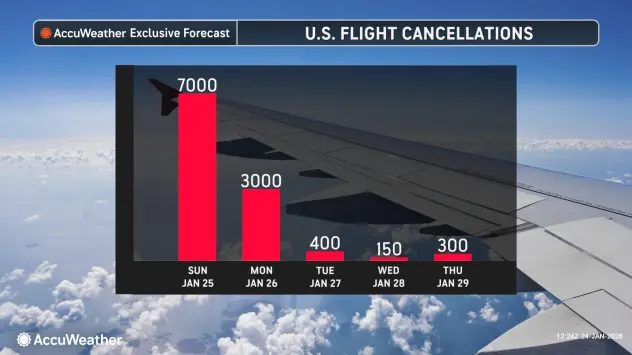
The storm’s intensity has already prompted thousands of flight cancellations across the region as airlines deal with displaced aircraft and crews.
Source: AccuWeather
AccuWeather Storm Warning Meteorologist William Clark cautioned that “entire supply chains may break down from prolonged days of extensive interstate closures,” warning that critical supplies, including pharmaceuticals and basic necessities, may become scarce in the hardest-hit areas.
The United States controls nearly 38% of the global Bitcoin hashrate according to estimates from Hashrate Index, making American mining operations critical to network security.
The crypto market was still reeling from losses on Monday as investors fled to gold amid fresh geopolitical and macroeconomic concerns that dampened investor appetite in the sector. According to data from crypto.news, the global crypto market fell below the…
How to hack Bitcoin? How does the blockchain calculate time? How does mining difficulty change? What happens if two miners mine a block simultaneously? Where are transactions stored before confirmation, how are fees calculated, and is it possible to send a transaction with zero fee? What types of nodes exist in the blockchain, and how do they differ? When can you use mining rewards?
This is roughly how I studied all the information around these topics.
Here I provide deeper answers to these questions because popular materials about Bitcoin either don’t explain these things at all or do so very superficially. To understand this article, you need a minimal understanding of how blockchain works, which you can get here: https://vas3k.com/blog/blockchain/
TL;DR
How to hack Bitcoin? A quantum computer will only be able to derive a private key from a public key after a transaction has been sent. If no transaction has occurred, the wallet is protected. A 51% attack only provides the ability to cancel your own or others’ transactions to double-spend your own coins; gaining control over others’ coins is impossible.
How does mining difficulty change? Difficulty is recalculated every ~2 weeks based on the mining time of the previous two weeks.
What happens if two miners mine a block at the same time? The chain temporarily splits until one branch becomes longer. The longer branch becomes the main one.
When can mining rewards be used? After 100 blocks.
How does the blockchain calculate time? Based on the median time of the past 11 blocks and the system time of the nodes.
Where are transactions stored before confirmation, how is the fee calculated, and can you send without one? They’re stored on nodes for no more than two weeks. A zero-fee transaction is theoretically possible but practically almost impossible to get confirmed.
What nodes are in the blockchain and how do they differ? Full nodes — hold the blockchain data and enforce the rules. Miners — query full nodes for data and build new blocks. Light nodes — often used in wallets on weak devices; they query full nodes for what they need.
What’s the point of Bitcoin (besides speculation), in plain English
At the end of researching.
Bitcoin is an alternative financial system that does not require user trust. When using traditional banks, we must trust them not to steal or lose our money, and if that happens, we must trust the state to be able to return it. We also have to hope that money won’t be blocked at the whim of authorities or bank employees.
The point of Bitcoin is the opposite: everything is tied to strict mathematics that removes the probability of all these potential problems (or drastically reduces), provided you store Bitcoin in a personal non-custodial wallet.
Non-custodial wallet: A wallet controlled only by whoever has the private key; essentially just a small file/program that stores keys and signs transactions.
Custodial wallet: An account on an exchange that controls your assets and stores your funds in its own non-custodial wallets. This allows the exchange to block or seize your funds if you violate its rules or national laws, though the exchange offers more convenient and expanded functionality in return.
Interesting fact: A Bitcoin wallet is not an object inside the blockchain, but a program that stores keys and signs transactions.
The blockchain stores UTXOs (Unspent Transaction Outputs). Each UTXO is “locked” by a condition (program), usually tied to an address (practically, a hash of a public key).
To spend a UTXO, the wallet creates a transaction referencing that UTXO as an input and adds a signature. Network nodes verify the signature and the script’s execution. As a result, the old UTXO becomes spent, and the transaction creates new outputs — new UTXOs for the recipients.
A private key is a number. A public key can be calculated if you have the private key, but the reverse is practically impossible (how that’s attacked is discussed later in the “attacks” section). Using a private key, you can sign data, but this signature cannot be forged with a public key. Meanwhile, the public key can verify that the signature was produced by the corresponding private key.
— — — — —END-PRIVATE-KEY — — — — —
In early versions, the wallet address was the public key. But later, addresses derived as a hash/encoding of the key or script began to be used. This is a crucial point for the section on quantum computer attacks.
Once a transaction is signed, it must be embedded in a block. First, it goes into a general pool of unconfirmed transactions (mempool), where any miner can take it to create a block.
But a transaction can exist only once in the blockchain, so the network can’t allow every miner to create their own block with the same set of transactions and have them all accepted.
Block Header
Each block has a header containing version data, the previous block’s hash, the merkle root (hash of all transactions in the current block), time, bits (mining difficulty), and a nonce.
All of these fields are combined and then hashed via SHA-256.
SHA-256 is a hashing technology: take some data and turn it into a different set of numbers that you can’t convert back into the original data if you only know the hash. But you _can_ verify it, because for a fixed input X the result is always the same output Y. So knowing X gives you Y; knowing Y does not practically give you X back — even with a quantum computer.
You can try hashing any data here. SHA-256 is also one of the core tools in the HTTPS connections we use every day, and it plays a key role in hundreds of internet protocols.
The nonce is needed to find out whose block to record. Miners change the nonce so the header’s hash is less than the target. In our example, the hash has 19 zeros.
Finding such a hash is hard. It takes roughly ~10 minutes of the entire Bitcoin network’s mining power. Blocks should appear roughly every 10 minutes — that’s how Satoshi Nakamoto designed it.
Why exactly this many zeros, and how does mining difficulty change?
Proof of Work in real life
It’s not actually about the zeros, but about the **target**. The target determines mining difficulty: the smaller the target, the higher the difficulty. A valid block header hash must be ≤ the target. Because small target numbers in hexadecimal start with zeros, hashes often appear with many leading zeros (e.g., ~19 or more). The smaller the target, the rarer it is for a random hash to land below it, so mining becomes harder.
Difficulty Calculation Hack: If the difficulty increases by 16 times, the required threshold becomes 16 times lower— often resulting in one additional leading hex-zero.
Difficulty adjustments (retarget) occur every 2016 blocks (roughly 2 weeks, 1 block ~10 minutes). The blockchain uses a simple formula:
Target_new= target_old*T_act/T_exp, 4Texp
Target_new = new target (new difficulty) Target_old = old target T_act = actual time it took to mine the last 2016 blocks T_exp = expected time for 2016 blocks: 2016*600 seconds (10 min = 600 sec) 4T_exp= The change is limited: difficulty can’t shift more than 4× either way.
If, since the last difficulty retarget, the network’s total hash rate (the combined power of all miners) has increased over the past 2,016 blocks, then with near-certainty the average time to mine a block will decrease. That means the actual time to produce those 2,016 blocks T_act will be less than the expected time T_exp, so T_act/T_exp < 1. As a result, the new target Target_new will go down: and the lower the target, the higher the difficulty and the harder it is to mine.
But what to do if two different miners mine a block at the same time?
That happens,and there’s a safety mechanism for it.
In theory, they can make practically identical blocks if the same transactions in the same order fall into each block. But blocks still won’t be identical because the first transaction in every block is the coinbase (the miner reward), and it pays to the miner’s address — so two miners can’t have the exact same block because their addresses differ.
But it is possible that two miners almost simultaneously mine different blocks. If the delay between the creation of a block and its distribution among nodes is 2 seconds, then this means that after the creation of the first block, there is a two-second gap in which a second block can be created. The longer this time, the higher the probability, but with each year this time is reduced. The probability of creating three blocks is almost negligible, but the protection system is the same.
If two blocks are created, they are saved in nodes, and these two chains are passed further. Miners then choose which block to build on — usually the one they saw first. And when they find the next block for one of the chains, it is distributed further and the nodes agree with it, and the shorter version is forgotten. This is the rule of the longer chain. Even if 2, 3, or more blocks in a row are formed in two chains, sooner or later one branch outpaces the other.
Transactions have 3 probable paths:
1. Fall into the chain that wins, then they remain in the blockchain. 2. Fall into both chains, then only the version in the winning chain remains relevant. 3. Fall into the chain that loses, then they go again into the pools of unconfirmed transactions (more on this below).
A few numbers:
Approx. probability of a fork given ~1s delay: 0.17%
A second block on the same competing branch: 0.00028%
Third: 4.6*10^⁻⁹
Fourth: 7.7*10^⁻¹²
That’s why exchanges don’t credit your deposit after 1 confirmation. Typically they wait for 6 confirmations — ~1 hour on average (6 blocks × 10 minutes).
There is no limit to the length of the second/third chain because they disappear quickly. Not counting these two cases:
Reorganization through 53 blocks due to a bug in the software (source).
Another incident with reorganization through 24 blocks (source).
And there is also the possibility of an attack through a second chain, but about this at the very end.
From this follows the next question:
Since the miner receives a reward for mining a block, what happens when two blocks are mined?
Simple: a miner can spend the reward only after 100 blocks.
If you are a miner and mined block № 1000, you will be able to use the reward for this block only starting from block №1100. This looks like a time-lock transaction, but technically it is not one. I will write about the time-lock technology next time, this is already turning into too much text.
Miners add transactions to the blockchain, receiving a fee for this. And from this follow a few more questions:
Where and for how long are unconfirmed transactions stored, and can a transaction with a zero fee pass in theory?
The fee in Bitcoin depends not on the number of tokens sent in the transaction, but on the size of the transaction and the occupancy of the network at the given moment. After sending your transaction from a non-custodial wallet, it goes to the nearest node(s), these nodes decide based on several characteristics whether to accept your transaction or not:
1. Does it comply with the rules and did you not assign yourself non-existent tokens or something else? 2. Is the specified transaction fee sufficient?
If the answer to one of these questions is no, the node will not take the transaction and it will not fall into the blockchain, and your balance will not change. It turns out that a zero fee, in most cases, will not pass into the blockchain, although theoretically a miner can include such a transaction in a block, it is extremely unlikely.
How does a node assign a fee?
The node has a certain amount of memory where it stores such unconfirmed transactions after receiving them, but until the moment they are recorded in the blockchain.
By default, it is limited to 300 MiB of RAM memory and 336 hours of storage. However, if the blocksonly setting is enabled in Bitcoin-Core 25.0, the RAM memory will be reduced to 5 MiB; this is often done for validating the blockchain.
All these data can be changed when setting up the node, but this is often not done, as for most it would be a simple waste of extra resources.
And what will happen if you send a transaction with the minimum allowable fee?
If the node does not throw it out after adoption due to overflow, and if miners will not take this transaction due of small fee, it will be deleted after 336 hours = 2 weeks.
After the transaction is accepted, nodes distribute it to other nodes, and miners insert transactions with the highest fees into the block.
Considering the limits on transaction size of 400,000 weight units ≈ 100KB (but it could be more with SegWit, but those are already too small details). A maximum of 10 such large transactions can fit into 1 block, and ≈ 10,000 of the smallest. But on average it comes out to 2500 transactions per 1 block.
The fee itself is calculated by the formula: fee (sat) = vsize (vB) * feerate (sat/vB)
fee = commission.
vsize = transaction size.
sat = satoshi, in one Bitcoin there are 100,000,000 satoshis.
vB = Virtual Byte.
Your wallet can find out the minimum feerate from the nodes, but this is the lower boundary of whether the transaction will be distributed, not a guarantee of its confirmation. To estimate how much you need to pay now, wallets use mempool statistics and confirmation history.
An average transaction weighs 150vB; if at the given moment the average sat/vB = 2, then the transaction will cost 300 sat. And it will cost $0.27.
For example, for this transaction of 45,177 BTC (several billion $), the fee was less than $1.
The highest sat/vB was in April 2024 during the halving and was from 1795 to 2751 sat/vB (source). On that day, an average transaction would have already cost from $160 to $245, depending on how quickly it needed to be processed.
The busier the network, the higher sat/vB. If you want your transaction to get confirmed faster, you set sat/vB above the current average.
Nodes define the fee as: fee = sum(inputs) — sum(outputs), then they look at the transaction size to check if it fits their internal policies.
Don’t forget about UTXO: if over time you received 10 separate incoming transactions, and now you want to send the entire balance in one transaction, the blockchain sees that as 10 inputs — meaning the transaction is larger and therefore more expensive.
To save on fees in the future, it is useful to sometimes do “consolidation” — sending yourself all small remnants in one transaction when the network is calm and sat/vB is minimal.
Returning to the first topic and the block header, the following question may arise:
How does the blockchain know that ~10 minutes passed, and that miners aren’t lying?
The blockchain receives information about the time from miners and nodes (nodes that store information but do not mine) in UTC format.
Miners write the time in the block header. Nodes have their own clocks and verify the median time received from other nodes.
Bitcoin is a closed system, so the blockchain cannot connect to ntp.org to check if the miners are writing the truth in the block header and the nodes or not.
How can the blockchain check if the nodes and especially the miners aren’t lying?
For this, there is MTP — Median Time Past.
Median Time Past is easier to understand than Past Simple.
Not the average, but precisely the median.
It is calculated from the last 11 blocks arranged in order. For example:
18, 2, 12000 (liar), 14, 6, 20, 10, 4, 16, 12, 8
If we take the average value, then we need to sum all these numbers and divide by 11, we get 1100. Because of the liar who put 12000, everything has changed a lot.
But if we take the median, then first we arrange them in order:
2, 4, 6, 8, 10, 12, 14, 16, 18, 20, 12000 (liar)
And we take the value from the middle, that is, 12. This is how MTP is calculated.
The time of a new block is always greater than the MTP; otherwise, the block will not be accepted by other miners/nodes and will not be inserted into the blockchain.
But if someone wants to go to the future, at what time gap should blocks be rejected?
What will affect my future more, 10 push-ups or this article?
In the past Bitcoin used NAT — Network Adjusted Time (time adjusted by the network), which compared median time from peers. Later NAT was removed as a consensus component.
Now nodes use their own system UTC time to check how far “into the future” a new block is. If a block’s timestamp is more than 2 hours ahead of a node’s local time, that node rejects it.
If some node’s time differs significantly from other nodes, then NAT warns about it — that’s basically the only remaining use.
Miners and other nodes, how do they differ and why are they needed?
There are 3 main types of nodes in Bitcoin: a full node with two variations (archival and pruned), a light node, and a miner.
The other nodes are superstructures on top of these three pillars of the blockchain.
Full archival node: a server that has all the information about the blockchain for all time. Validates or rejects blocks in accordance with the rules of the blockchain.
Full pruned node: also checks blocks but does not store all data, only the UTXO and part of the last blocks.
Relay node: a superstructure on top of a full node, which is connected to other nodes with a large number of peers for fast distribution of information. Like torrent seeders.
Light node: stores only block headers to check their hashes. For transactions, it ask information from full node. Great for phone wallets or weak devices where storing dozens/hundreds of GB is inconvenient.
Miner: takes information from a full node or is one; based on this information, searches for a nonce to produce a valid block, then broadcasts it to the network.
If you need a non-custodial wallet on a PC, then perhaps a full pruned node for this would be the best option. You can choose the one you need here: bitcoin.org/en/choose-your-wallet?step=1
How to hack Bitcoin?
There are many possible attack vectors. If I described all of them, the article would be longer than it already is. But someday I will write. For now, let’s briefly look at two hack variants that are often talked about.
Quantum Computer VS Bitcoin
A quantum computer could derive a private key from a public key — but there’s already partial protection. If you’ve never spent from your address, your wallet is protected because outsiders see only the hash of your public key, not the public key itself.
Even with a quantum computer, it is practically impossible to brute-force the hash of a public key. But after the first outgoing transaction, the public key becomes visible to everyone. Therefore, to protect against quantum attacks, you should use addresses once.
However, there’s still a possible “interception” scenario: if a quantum computer could, after you broadcast a transaction but before it’s confirmed, derive your private key from your revealed public key — it would have very little time, but that’s the idea.
But there are wallets (outputs) of old formats, where the public key is visible immediately, and such wallets can be hacked even if there was not a single transaction from them.
And there are also many “lost” wallets; transactions were made from some, but that was many years ago. And with the help of quantum computers, coins from these wallets will probably fall back into circulation and possibly crash the Bitcoin price. But let’s leave these speculations to analysts who were perfectly described by one satirical channel:
”Last week’s target for Bitcoin at 34 thousand dollars has been revised and now stands at 240 thousand.”
So, a quantum computer will not destroy Bitcoin in this way.
But they are already thinking about creating a reusable quantum-protected wallet. This will require a soft-fork (change of rules), which has been done more than once.
If 1 person has more than 51% of the mining power, it will be easy for him to create a second chain of blocks as he wants. In this case, he will be able to cancel transactions and rewrite the history of his spending.
But even in this case, he will not be able in any way to steal someone else’s coins that were never on his wallet. The older the transactions that need to be rewritten, the longer and harder it will be, and there is no 100% guarantee that it will work and he will be able to make his chain longer and faster than the other 49%.
Such an attack is possible even with 30% and 40%, but the probability is much lower.
How much money will be needed for such an attack? If we attack from scratch, then we essentially have to have a power 0.5% more than the entire power of Bitcoin miners. The hashrate today is approximately 1 ZH/s = 1,000,000,000,000,000,000,000 SHA-256 hash findings per second.
Modern ASICs (mining devices) have a power of approximately 200 TH/s, meaning 5,000,000 of them will be needed. Their efficiency is ≈ 17–20 J/TH. Multiply by 10⁹ and you get 17–20 GW. A bit less than the power of the largest hydroelectric dam in the world.
To this, we add the prices for the ASICs themselves, which comes out to ≈ $7.5 billion. Not counting extra infrastructure which will also be very expensive.
Even all these costs will lead at most to double spending of own coins in the blockchain and censorship of transactions. And even then, it will be visible to everyone and the price will probably crash and the game will not be worth the candle.
On-chain investigator ZachXBT says a $40 million-plus theft from US government crypto seizure wallets may trace back to John Daghita, an alleged threat actor who goes by “Lick,” and a contractor relationship tied to Daghita’s family.
The $40 Million+ Govt Crypto Wallet Robbery
In a Jan. 25 post, ZachXBT pointed to Command Services & Support (CMDSS), describing it as a firm with “an active IT government contract in Virginia,” and alleging it was “awarded a contract to assist the USMS in managing/disposing of seized/forfeited crypto assets.” ZachXBT added: “It still remains unclear at this point how John obtained access from his dad.”
In case you are curious how John Daghita (Lick) was able to steal $40M+ from US government seizure addresses.
John’s dad owns CMDSS, which currently has an active IT government contract in Virginia.
The allegation lands against a backdrop of earlier tracing work published Jan. 23, where ZachXBT linked wallet activity and recorded chats to the same persona. “Meet the threat actor John (Lick), who was caught flexing $23M in a wallet address directly tied to $90M+ in suspected thefts from the US Government in 2024 and multiple other unidentified victims from Nov 2025 to Dec 2025,” ZachXBT wrote.
ZachXBT’s thread centers on a dispute in a Telegram group chat between “John” and another threat actor, Dritan Kapplani Jr., in what the community calls “band for band (b4b)”, an on-the-spot contest to prove who controls more funds. ZachXBT said the interaction was “fully recorded,” and claims the footage includes screen-shared wallet balances and contemporaneous transfers that help establish control.
According to the thread, the recording shows John screen-sharing an Exodus wallet displaying a Tron address holding $2.3 million. In a second segment, ZachXBT said “another $6.7M worth of ETH” moved into an Ethereum address while the argument continued.
3/ In part 1 of the recording Dritan mocks John however John screenshares Exodus Wallet which shows the Tron address below with $2.3M:
TMrWCLMS3ibDbKLcnNYhLggohRuLUSoHJg pic.twitter.com/jvcjIVEpaE
ZachXBT framed the key evidentiary point as ownership continuity across addresses: “The recording captures that John clearly controls both addresses. Additional addresses can likely be found in the recordings. I then began tracing backwards to verify the source of funds.”
That tracing, ZachXBT said, connects the cluster to a March 2024 transfer of $24.9 million from a US government address tied to the Bitfinex crypto hack seizure. He also claimed $18.5 million “currently sits” at a cited address.
Beyond that 2024 linkage, ZachXBT asserted the primary address he tracked was tied to “$63M+ inflows from suspected victims and government seizure addresses in Q4 2025,” listing multiple transactions and chains, and separately flagged an additional 4.17K ETH ($12.4 million) flow from MEXC into the same cluster.
The Jan. 25 post attempts to explain a potential access path: if CMDSS was involved in US Marshals Service crypto asset management, the question becomes whether contractor-side systems, credentials, or processes provided an opening, intentionally or otherwise. ZachXBT stressed that the exact mechanism remains unknown.
Shortly after the post, ZachXBT said CMDSS’s X account, website, and LinkedIn “were all just deactivated,” and claimed Daghita “began trolling again on Telegram.”
On X, the claims drew sharp reactions from prominent Bitcoin commentators. Nakamoto Inc. CEO David Bailey wrote: “The son of the CEO of the company hired by the US Marshalls to safeguard the nation’s Bitcoin, stole $40m from it and now appears to be running. Treasury must secure the private keys from the Justice Department ASAP before more is stolen.”
Prominent Bitcoin advocate and co-founder of the Satoshi Nakamoto Institute Pierre Rochard framed the situation in national-security terms, posting, “This is a national security crisis,” and urging Congress to pass the BITCOIN Act.
The cryptocurrency market faced a sharp correction in the early hours of January 26, with BTC erasing its entire monthly progress. After peaking at $97,000 on January 14, Bitcoin slid approximately 10.9% to briefly dip below the $87,000 mark. This volatility has pushed the January return to -0.5%, reflecting a broader “risk-off” sentiment across the digital asset space. The pullback is being attributed largely to rising uncertainty around U.S. government shutdown, alongside broader risk-off sentiment across global markets.The GameFi sector bore the brunt of the sell-off, dropping nearly 5%, led by double-digit losses in Axie Infinity (AXS). While Ethereum fell below $2,900, some assets showed resilience; notably, River (RIVER) surged 30% and Beam (BEAM) rose 19%, suggesting that despite the macro-level decline, specific project catalysts continue to drive isolated pockets of growth.
But what else is happening in crypto news today? Follow our up-to-date live coverage below.
Bitcoin dipped under $88,000 as Asia opened to mixed trade, with investors leaning into safety and pushing gold to a record above $5,000 an ounce.
In China, stocks moved in different directions. The Shanghai index rose 0.12%, and China A50 gained 0.49%, while the SZSE Component slid 0.74% and DJ Shanghai eased 0.09%. Hong Kong’s Hang Seng edged up 0.04%.
Gold extended a rally that has reshaped the commodity market. Spot gold rose 1.79% to $5,071.96 an ounce by 0159 GMT after touching $5,085.50 earlier, and US gold futures for February delivery gained 1.79% to $5,068.70.
Total crypto market cap: $3.04 trillion, down 1.4%
Greenland Tariff Threat Rolled Back As Trade Risks Linger
Investors have treated the metal as a refuge through shifting policy expectations and geopolitical stress. Prices surged 64% in 2025, and they have gained more than 17% this year, supported by safe-haven demand, expectations of easier US monetary policy, central bank buying and ETF inflows.
President Donald Trump’s trade threats stayed in focus. He abruptly stepped back on Wednesday from threats to impose tariffs on European allies as leverage to seize Greenland, and he said over the weekend he would impose a 100% tariff on Canada if it followed through on a trade deal with China.
He has also threatened to hit French wines and champagnes with 200% tariffs in an apparent effort to pressure French President Emmanuel Macron into joining his “Board of Peace” initiative.
Some observers fear the board could undermine the United Nations’ role as the main global platform for conflict resolution, though Trump has said it will work with the UN.
US Futures Ease After Volatile Week Marked By Trade Risks
Currency markets also turned volatile. The yen jumped to more than a two-month high on speculation that coordinated intervention by US and Japanese authorities could be imminent, and Tokyo’s top currency diplomat left that prospect open while keeping markets guessing.
The yen rose as much as 1.2% to 153.89 per dollar, its strongest since November. The euro hit a four-month high of $1.1898 and was last up 0.4% at $1.18665, as traders trimmed dollar positions ahead of the Federal Reserve meeting and watched for a possible announcement by the Trump administration of a new Fed chairman.
Wall Street faces another busy week after a rocky stretch. US stock index futures fell modestly on Sunday evening as markets braced for the Fed decision on Wednesday and a wave of corporate earnings, after last week’s pullback tied to geopolitical strains and trade uncertainty.
Bitcoin price began the week under pressure after CME futures reopened well below Friday’s close, drawing attention to a large pricing gap. CME Bitcoin futures opened near $86,560 after closing the previous session around $89,500, leaving a downside gap of…
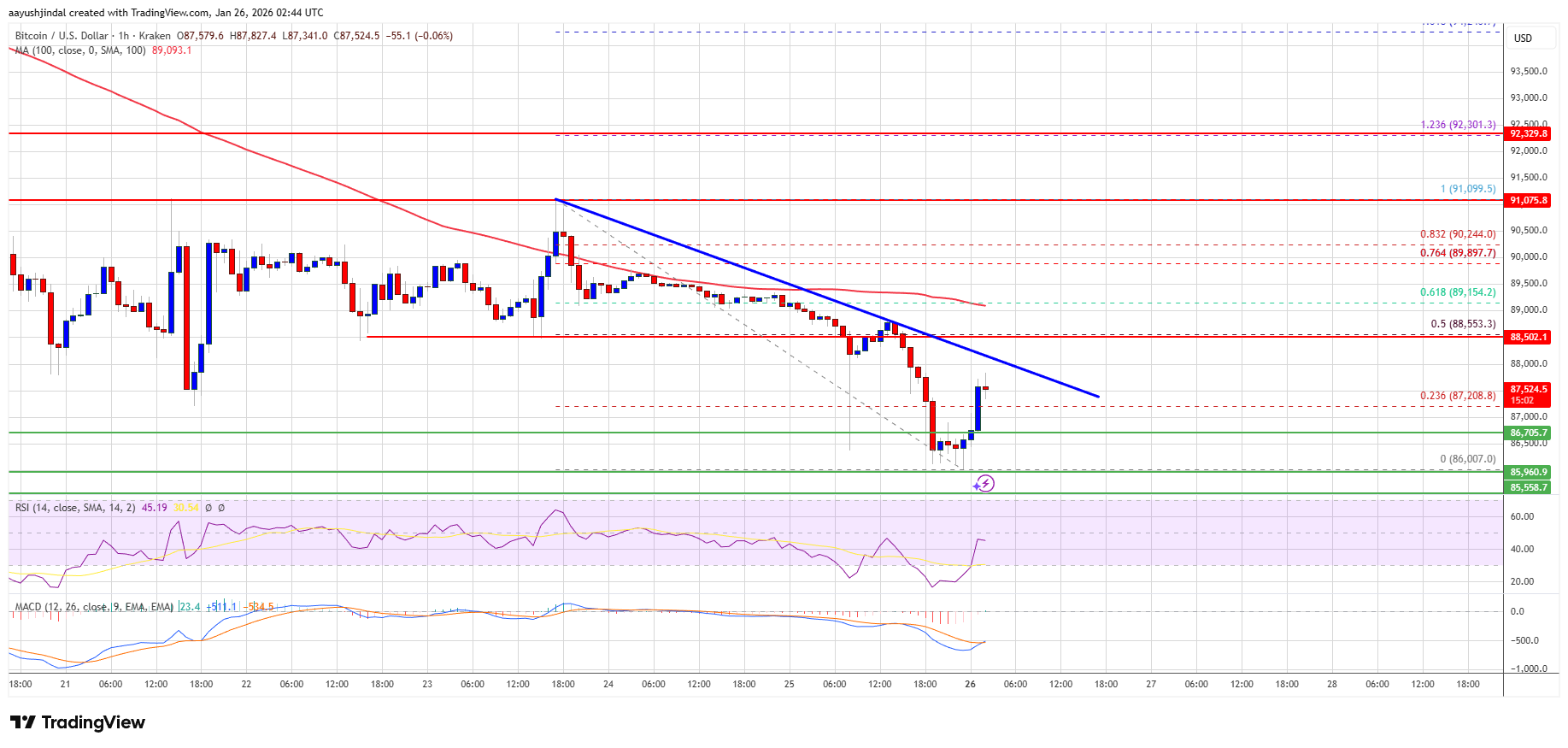
Bitcoin price extended losses and traded below $88,500. BTC is consolidating losses and might attempt a recovery wave if it clears $88,500.
Bitcoin started a minor recovery wave from the $86,000 level.
The price is trading below $88,200 and the 100 hourly Simple moving average.
There is a new bearish trend line forming with resistance at $88,000 on the hourly chart of the BTC/USD pair (data feed from Kraken).
The pair might recover if it manages to settle above $86,200 and $86,000.
Bitcoin Price Dips Further
Bitcoin price failed to stay above the $89,000 support and extended losses. BTC declined sharply below the $88,500 and $87,000 support levels.
The bears even pushed the price below $86,500. A low was formed at $86,007, and the price is now attempting a recovery wave. There was a move above the 23.6% Fib retracement level of the downward move from the $91,099 swing high to the $86,007 low.
Bitcoin is now trading below $88,500 and the 100 hourly Simple moving average. If the price remains stable above $86,500, it could attempt a fresh increase. Immediate resistance is near the $88,000 level. There is also a new bearish trend line forming with resistance at $88,000 on the hourly chart of the BTC/USD pair.
The first key resistance is near the $88,500 level since it is close to the 50% Fib retracement level of the downward move from the $91,099 swing high to the $86,007 low.
A close above the $88,500 resistance might send the price further higher. In the stated case, the price could rise and test the $89,200 resistance. Any more gains might send the price toward the $90,000 level. The next barrier for the bulls could be $91,000 and $91,500.
More Losses In BTC?
If Bitcoin fails to rise above the $88,500 resistance zone, it could start another decline. Immediate support is near the $86,700 level. The first major support is near the $86,200 level.
The next support is now near the $85,500 zone. Any more losses might send the price toward the $83,500 support in the near term. The main support sits at $82,500, below which BTC struggle to recover in the near term.
Technical indicators:
Hourly MACD – The MACD is now losing pace in the bearish zone.
Hourly RSI (Relative Strength Index) – The RSI for BTC/USD is now below the 50 level.
Major Support Levels – $86,700, followed by $86,000.
AFP Protección, Colombia’s second-largest private pension manager, is preparing a new product that will give some savers a way to gain exposure to Bitcoin. Reports say the move will be limited, targeted and tied to advisory checks rather than open to every account holder.
Bitcoin As An Option For Qualified Savers
Reports note the fund will be offered only to investors who meet a risk profile and pass a tailored advisory process. That means access won’t be automatic; it will be conditional on an assessment meant to match a person’s tolerance with a small, optional slice of crypto.
The product is designed for long-term allocation and not for quick trading or speculation, according to market coverage. AFP Protección’s executives emphasized that core pension portfolios will remain focused on traditional assets such as bonds and equities, and that any Bitcoin exposure would be a narrow, complementary allocation.
En primicia, Valora Analitik conoció que Protección se prepara para lanzar desde Colombia un fondo con exposición a Bitcoin. El producto no estará enfocado en la especulación de corto plazo, sino en ampliar las opciones de diversificación con una gestión integral de riesgos y… pic.twitter.com/nAO8mbsTLi
The language used by the firm frames the initiative as diversification rather than a wholesale shift of retirement capital. Juan David Correa, who serves as president of Protección SA, confirmed the plan in an interview with local media outlet Valora Analitik.
Size And Reach Of The Manager
AFP Protección manages assets for millions of clients and has a sizable balance sheet. Reports put its assets under management at roughly 220 trillion Colombian pesos — roughly US$55 billion — and note that the firm serves a broad base of workers through mandatory pensions, voluntary saving plans and severance accounts. The sheer scale of the manager helps explain why even a small, optional product gets wide attention.
Regulation And Reporting
Reports also point to a tightening regulatory backdrop in Colombia. Tax and customs authorities have rolled out new crypto reporting rules that align with international reporting standards.
Those rules are likely to affect how crypto products are structured and how returns or transfers are reported for tax purposes. The change in rules is one reason AFP Protección has framed its product as measured and compliant.
How This Fits A Regional Trend
Across Latin America, some institutional players have been experimenting with limited crypto exposure for years. Colombia’s move follows earlier steps by one or two other local managers and fits a regional pattern where established firms test small, controlled offerings before widening access. The step will be watched closely by investors and regulators overseas.
Reports say potential participants should expect thorough suitability checks, clear disclosures and limits on how much of a retirement portfolio can sit in the new vehicle.
Featured image from Pexels, chart from TradingView
Bitcoin ETFs recorded $1.33 billion in net outflows during the week ending January 23 and had the second-largest weekly redemption on record. The exodus reversed the previous week’s $1.42 billion inflow, as institutional investors reduced crypto exposure amid market volatility.…
The calls of a potential Bitcoin supercycle in 2026 intensified over the past week after former Binance CEO Changpeng ‘CZ’ Zhao — yet another prominent voice in crypto — laid out his predictions for the new year. However, a popular analyst on the social media platform X has released an opposing view, predicting a deep bottom for the BTC price this year.
BTC Price At Risk Of Further 65% Decline
In a January 25th post on the X platform, prominent crypto trader Ali Martinez said, in a sarcastic tone, that “the super cycle is super cycling.” In what seemed like a response to the buzz around CZ’s Bitcoin supercycle projection, the market pundit tempered the expectations with a $31,000 price bottom call for the premier cryptocurrency in 2026.
This bearish prediction is based on the appearance of price fractals on the BTC chart. For context, fractals are repeating patterns in price charts that can help map and project potential price movements for a particular cryptocurrency (Bitcoin, in this scenario).
As observed in the chart above, the price of BTC is currently following a similar movement pattern as in 2022. The premier cryptocurrency, after initially setting a then all-time high around $67,000 in early 2021, witnessed a nearly 55% correction to just above the $30,000 level by mid-July.
While the price of Bitcoin recovered and went back to set a record high of above $69,000 by the end of 2021, the market leader spent the majority of the following year in a downward trend. Exacerbated by the various bearish events of 2022, BTC ended the year at a low of around $15,500.
Martinez believes that the Bitcoin price is undergoing a similar movement pattern, having experienced an over 32% decline before climbing to the current all-time high of $126,080. The market pundit postulates that the premier cryptocurrency is currently witnessing the extended decline that saw its price reach $15,500 in 2022.
However, it is worth mentioning that the target this time around lies at $31,800, nearly 65% drop from the current price point. Hence, if the historical patterns highlighted by Martinez are to go by, there seems to be a higher likelihood of the Bitcoin price embarking on an extended downward trend rather than a supercycle.
Bitcoin Price At A Glance
As of this writing, the price of BTC stands at around $88,528, reflecting an over 1% decline in the past 24 hours.
Small shops and some bigger chains in Las Vegas are now taking Bitcoin for everyday buys. People scan a QR code, pay from a phone, and the merchant gets paid. According to local reports, owners are trying this out to cut the cost of credit card processing and to attract customers who prefer crypto.
Merchants Cut Costs With Bitcoin
Reports say the move is largely about fees. Credit card processing often takes away 2.5–3.5% of a sale. For many small operators, that is painful. Payment tools that accept Bitcoin — often routed over the Lightning Network or through services that can convert crypto to cash — have lowered that burden for merchants.
According to FOX5, more businesses across Las Vegas are now accepting Bitcoin payments, from chains like Steak ’n Shake to small shops and medical practices. Merchants said Bitcoin helps attract new customers and cut costs, while Square has enabled about 4 million U.S. merchants…
Square’s program, which lets millions of US merchants enable Bitcoin checkout with no processing fee through 2026, helped speed up adoption in the area.
Stores Report Real Transactions
Business owners are reporting real use, not just experiments. Juice stands and cafes have processed payments. Some larger outlets are listed on public payment maps so customers can find them.
This has meant more foot traffic from people who travel with crypto or who prefer to keep their cards for other uses. Reports note both new customers and savings on fees as clear benefits.
Lightning Network Speeds Up Payments
The Lightning Network is being used to make payments faster and cheaper at the cash register. It moves small Bitcoin payments quickly without the long wait a base-layer transfer can cause.
Merchants scan a code or show one on a screen. The payment is then sent from the buyer’s wallet and settled almost instantly. This technical fix has made in-person Bitcoin payments workable for the first time at many spots.
How Owners See It
Owners are balancing savings against new risks. Some keep crypto for a short time, then sell it for cash. Others leave part of their receipts in Bitcoin. Chargebacks, a problem with cards, are reduced when crypto is used.
A few places say small boosts in sales followed their switch to crypto, yet long-term patterns are still being watched. Reports have disclosed these mixed outcomes as part of a slow but clear shift.
Customers Find New Ways To Pay
Shoppers are adapting. Tourists who carry crypto find these spots useful. Locals who are curious try the method at least once. Payment apps and merchant directories make the process easier for everyone.
For those who like simple steps, scanning a QR code and approving a payment on a phone works fine. For others it is a novelty that might stick.
Featured image from Unsplash, chart from TradingView
Las Vegas Valley businesses are accepting Bitcoin as payment as the cryptocurrency continues to grow in popularity.For more Local News from KVVU: https://www...
“Bitcoin is the digital gold” is one of the most popular narratives in the cryptocurrency industry, reiterating BTC’s growing status as a formidable store of value. However, while the premier cryptocurrency has floundered over the past months, gold and the metals market have largely witnessed explosive growth.
These contrasting performances have led to conversations about capital rotation between Bitcoin and gold, as the crowd expects one to always outperform the other at any given time. Recent data, however, suggests that the relationship between the BTC and gold price action is overrated.
Capital Flow Link Between BTC And Gold Overestimated
In a January 24 post on the X platform, on-chain analyst with the pseudonym Darkfost weighed in on the discourse surrounding capital rotation between gold and Bitcoin. According to the market pundit, the idea that investor funds flow from gold to Bitcoin is somewhat overblown.
To highlight this overestimation, Darkfost shared a chart showing periods where BTC outperforms or underperforms depending on gold’s trend. This chart typically provides two signals: positive (BTC above the 180-day moving average [MA] and gold below the 180-day MA) and negative (BTC below the 180-day moving average and gold below the 180-day MA).
As observed in the chart above and stated by Darkfost, the relationship between Bitcoin and gold does not appear to be fully substantiated. The on-chain analyst revealed that there have been as many positive periods as the negative ones, suggesting that the flagship cryptocurrency moves independently of gold.
Darkfost wrote:
This suggests that BTC continues to evolve independently, without clear evidence of a sustained capital rotation from gold.
Furthermore, Darkfost noted that a positive signal does not necessarily mean that capital is flowing out of gold into Bitcoin. According to the on-chain analyst, it is simply not possible to determine whether there is a capital flow relationship between the world’s largest cryptocurrency and gold.
Bitcoin & Gold Price Overview
While Bitcoin started the new year on a pretty strong note, the bullish momentum has pretty much waned over the past two weeks. Meanwhile, the gold price has continued to flourish this year, recently reaching a new all-time high above $4,900 per ounce.
As of this writing, the price of BTC stands at around $89,230, reflecting no significant movement in the past 24 hours. According to data from CoinGecko, the flagship cryptocurrency is nearly 30% adrift its all-time high above the $126,000 level.
Reports say the Ethereum Foundation has started a new team to prepare the network for possible quantum computer attacks. These machines could one day break the math behind wallets and signatures. The team’s work is moving from research into practical tests and experiments, which has drawn attention across the crypto community.
Ethereum Launches Post-Quantum Team
Based on reports, Thomas Coratger will lead the effort. The team includes cryptographers and engineers already testing new systems on devnets. Some work ties into a project called leanVM and a researcher named Emile, who focuses on building simple quantum-safe tools. The goal is to test new algorithms in real software while keeping current transactions running smoothly.
Today marks an inflection in the Ethereum Foundation’s long-term quantum strategy.
We’ve formed a new Post Quantum (PQ) team, led by the brilliant Thomas Coratger (@tcoratger). Joining him is Emile, one of the world-class talents behind leanVM. leanVM is the cryptographic…
A $1 million prize has been set for improvements to the Poseidon hash function. Another $1 million prize supports broader post-quantum research. In total, roughly $2 million are being offered to labs and independent developers to design and test quantum-resistant solutions. Reports say this funding is meant to speed up work and show what can realistically replace current signatures.
Early Tests And Community Involvement
Multi-client devnets are already active. Developers are experimenting with new signature types to see what works and what fails. Biweekly sessions led by researchers like Antonio Sanso let teams share results and update code. A Post-Quantum Day is scheduled for March 2026 before ETHCC, with a larger event planned in October 2026 to show progress and plan next steps.
Quantum computers could, in theory, break the ECDSA and secp256k1 schemes used today. That risk is not immediate but serious enough that Ethereum is acting now. Reports note users should watch for official guidance, follow wallet updates, and avoid reusing addresses once upgrades roll out.
Community reaction has been mixed. Some online discussions praised the careful planning, while traders noticed a small dip in ETH price. Others questioned how upgrades would reach millions of wallets and what happens to old keys. The Foundation’s approach is to test solutions early so users and services are better protected when changes happen.
This step is part of Ethereum’s long-term plan for safety. Tests will continue, standards will be debated, and progress will be shared publicly. By acting now, Ethereum aims to reduce risk and make future transitions smoother for everyday users and the network as a whole.
Featured image from Unsplash, chart from TradingView

 Login
Login