WhatsApp's upcoming group chat history sharing feature aims to eliminate confusion for newly added members by letting admins share up to 100 recent messages.
Scroll co-founder Ye Chen’s X account was hijacked in a sophisticated phishing operation where attackers posed as platform employees to target crypto industry figures.
The compromised account, which commands substantial influence among crypto leaders, began distributing fraudulent messages claiming copyright violations and threatening account restrictions unless users clicked on malicious links within 48 hours.
The hackers transformed Chen’s profile to mimic X’s official branding, updating the bio to reference Twitter and nCino while warning followers about security breaches.
Screenshot from X
The attackers flooded the feed with reposts from X’s verified accounts to enhance perceived legitimacy, then launched their phishing campaign via direct messages.
Sophisticated Attack Mirrors Growing Pattern
The breach follows established tactics where hackers exploit trusted accounts to distribute malicious links disguised as urgent platform notifications.
Recipients received messages appearing to come from X’s rights management team, complete with fake compliance warnings and time-sensitive appeals processes designed to create panic and bypass security awareness.
Blockchain security researcher Wu Blockchain first identified the compromise and alerted the community to ignore any communications from the account.
The warning emphasized particular concern given Chen’s extensive network of high-profile cryptocurrency executives, developers, and investors who might trust messages from his verified account.
Scroll co-founder @shenhaichen's X account has been hacked and is currently sending phishing private messages impersonating X employees. This account has a large following among prominent figures in the crypto industry; the community and users are advised to be aware of the… pic.twitter.com/ctXk2G0bQm
The attack represents the latest escalation in social media compromises targeting crypto industry leaders, in which hackers increasingly leverage delegated account access and expired domain registrations to bypass security measures, including two-factor authentication.
Industry Faces Relentless Social Engineering Wave
BNB Chain’s official account suffered a similar breach in October when hackers posted fake reward programs with phishing links after Binance co-founder CZ warned followers against clicking suspicious content.
The compromised account promoted fraudulent BSC token distributions, promising early payouts to users who voted on reward dates through malicious URLs designed to drain digital wallets.
Binance co-CEO Yi He’s WeChat account was also hijacked in December to promote meme coin schemes, with attackers conducting a coordinated pump-and-dump operation around the token MUBARA.
Two wallets created hours before the breach accumulated 21.16 million tokens before dumping holdings as retail traders flooded in, netting attackers approximately $55,000 while leaving later buyers exposed to price collapse.
Among other notable accounts hacked were ZKsync and Matter Labs, which were compromised in May through what the team described as “delegated accounts” with limited posting privileges.
Hackers published false claims about an SEC investigation alongside fake airdrop promotions, triggering a 5% drop in the ZK token price despite a prior 38.5% weekly rally.
The prominent crypto media company, Watcher.Guru also confirmed its account breach in March after fake Ripple-SWIFT partnership claims spread across connected Telegram, Facebook, and Discord channels through automated content bots.
The team suspects the compromise originated from a suspicious link containing unusual query strings shared in their Telegram group weeks earlier.
Record Theft Year Exposes Escalating Threats
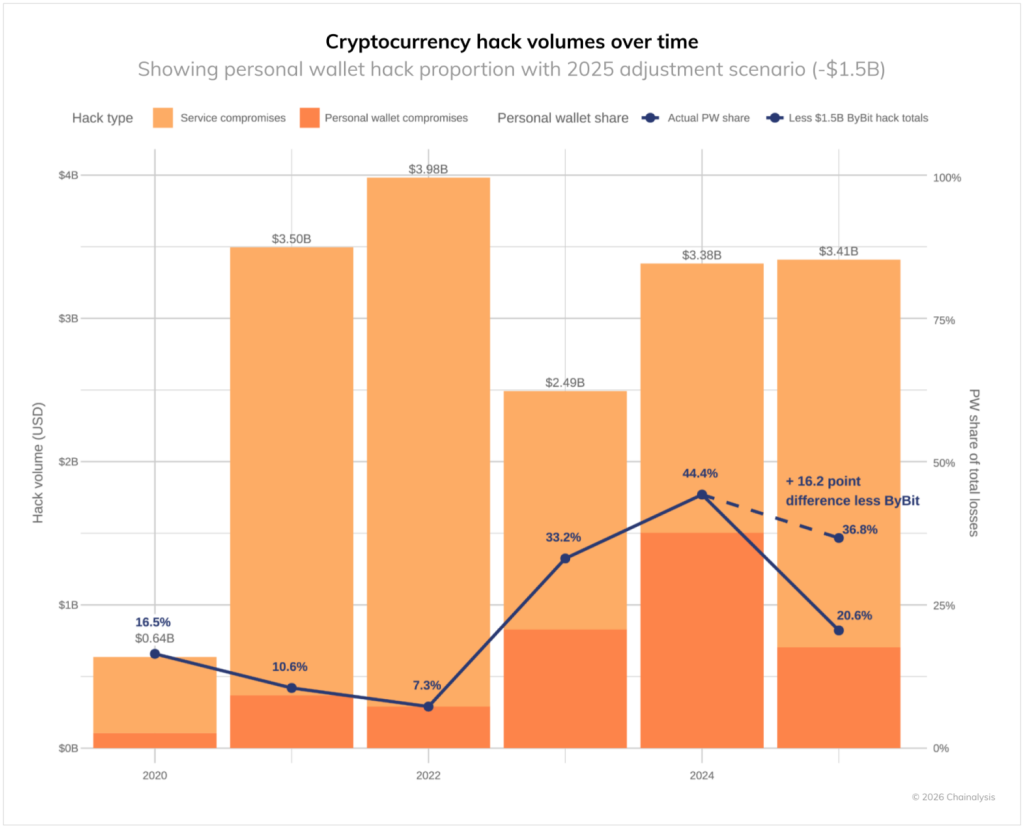
The crypto ecosystem witnessed over $3.4 billion stolen in 2025, according to Chainalysis’s 2026 Crypto Crime Report, with North Korean state-backed hackers accounting for a record $2.02 billion across fewer but increasingly sophisticated attacks.
Source: Chainalysis
The Democratic People’s Republic of Korea now represents 76% of all service compromises, bringing cumulative DPRK cryptocurrency theft to $6.75 billion since operations began.
Personal wallet compromises surged to 158,000 incidents affecting at least 80,000 unique victims, triple the 54,000 cases recorded in 2022.
Address poisoning scams drove December’s single-largest loss, when one victim transferred $50 million to a fraudulent wallet mimicking their intended destination, while private key leaks resulted in $27.3 million stolen from multi-signature wallets.
Personal Security Breaches Surge Across Platforms
Most recently, Ubuntu developer Alan Pope warned that attackers are hijacking Snap Store publisher accounts by registering expired domains linked to legitimate developers, then pushing malicious updates to previously trusted packages.
The technique exploits automatic update systems and established trust signals, with at least 2 confirmed cases of wallet-stealing malware distributed through seemingly normal applications.
Hackers are exploiting trusted Snap Store packages to steal cryptocurrency by hijacking existing publisher accounts.#Hack#Cryptohttps://t.co/YV5Yoiwb0F
Given these growing, multifaceted attack vectors, Better Business Bureau officials are warning consumers about phishing campaigns that lock X users out of their accounts and are subsequently used for cryptocurrency promotions.
Kentucky journalist Jennie Rees described receiving direct messages from apparent colleagues requesting contest votes, only to find her account posting fake Audi purchase claims tied to crypto earnings after clicking the malicious link.
TikTok users are freaking out over a mention of "immigration status" data collection, but lawyers explain the disclosure is related to state privacy laws.
Merkle Manufactory, the company behind the crypto-oriented social media protocol Farcaster, plans to return $180 million in venture funding to investors.
Key Takeaways:
Merkle Manufactory plans to return $180 million in venture funding while Farcaster continues operating.
Farcaster has been acquired by Neynar, which will take over development as the founding team steps back.
The protocol is shifting away from a social-first model toward infrastructure and developer-focused use cases.
Several investors, including former Coinbase executive Balaji Srinivasan, separately confirmed the plan to return the capital.
Romero: Farcaster Not Shutting Down as Merkle Plans to Repay $180M
“Farcaster is not shutting down,” Romero wrote, pushing back on rumors surrounding the platform’s status.
He said the protocol remains operational, citing roughly 250,000 monthly active users in December and more than 100,000 funded wallets.
Romero added that Merkle intends to repay the full amount raised over the past five years, saying the firm sought to be a responsible steward of investor capital.
The announcement comes shortly after Farcaster was acquired by Neynar, a venture-backed startup that has long built infrastructure within the Farcaster ecosystem.
Under the deal, Neynar will assume control of Farcaster’s smart contracts, code repositories, mobile application, and Clanker, an AI-driven token launchpad.
Given some rumors, wanted to post a few clarifications:
Farcaster is not shutting down. The protocol works and will continue to work. There were 250,000 MAU in December and over 100,000 funded wallets. The acquirer, Neynar, is a venture-backed startup and plans to shift…
Romero and fellow co-founder Varun Srinivasan, along with parts of the Merkle team, will step away from day-to-day development.
“This wasn’t an easy decision,” Romero wrote earlier this week. “But after five years, it’s clear Farcaster needs a new approach and leadership to reach its full potential.”
Farcaster was launched with the ambition of decentralizing social media by allowing users to control their identities and data rather than relying on centralized platforms.
The project drew significant attention in 2024 when it raised $150 million from major crypto venture firms, including Paradigm and Andreessen Horowitz’s crypto arm.
Despite early enthusiasm, Romero acknowledged that the platform struggled to achieve sustainable growth as a social-first product.
In December, the team shifted its focus toward in-app wallets and trading features in an effort to drive engagement, signaling a strategic pivot away from competing directly with mainstream social networks.
Neynar, which provides developer tools and APIs for applications built on Farcaster, said it plans to steer the protocol in a more builder-centric direction.
The company is expected to roll out a new roadmap focused on infrastructure and developer adoption rather than consumer-facing social features.
Offline Web3 Messaging Apps Gain Momentum
The controversy around Farcaster comes as Web3-style social media and messaging tools are gaining traction as governments increasingly restrict internet access during periods of political unrest.
In Uganda, Bitchat surged to the top of local app store rankings after authorities cut internet and mobile services ahead of a disputed election.
Downloads in the country have nearly quadrupled in recent months, with similar spikes reported in Iran as users seek ways to communicate during state-imposed blackouts.
The app operates without internet or cellular connections, relying instead on Bluetooth mesh technology that allows messages to hop between nearby devices.
A number of investors are competing for the opportunity to purchase the app, and if a deal were to go through, the platform's U.S. business could have its valuation soar to upward of $60 billion.
As Meta heads to trial in the state of New Mexico for allegedly failing to protect minors from sexual exploitation, the company is making an aggressive push to have certain information excluded from the court proceedings.
The company has petitioned the judge to exclude certain research studies and articles around social media and youth mental health; any mention of a recent high-profile case involving teen suicide and social media content; and any references to Meta’s financial resources, the personal activities of employees, and Mark Zuckerberg’s time as a student at Harvard University.
Meta’s requests to exclude information, known as motions in limine, are a standard part of pretrial proceedings, in which a party can ask a judge to determine in advance which evidence or arguments are permissible in court. This is to ensure the jury is presented with facts and not irrelevant or prejudicial information and that the defendant is granted a fair trial.
Snap settled before jury selection in a landmark social media addiction case, while Meta, ByteDance, and YouTube still face trial over “addictive design.”
Snap settled before jury selection in a landmark social media addiction case, while Meta, ByteDance, and YouTube still face trial over “addictive design.”
The company has made it easy for existing advertisers to expand their reach to include Threads by allowing them to automatically place ads through both Meta's Advantage+ program and via manual campaigns.

 Login
Login