Normal view

There are new articles available, click to refresh the page.
Today — 19 December 2025Main stream

Bitcoin Mirrors Q1 2025 Playbook, Is It Headed To $70,000 Before Year’s End?

19 December 2025 at 01:00

As the market volatility continues, Bitcoin (BTC) has failed to hold its short-lived momentum and reclaim a key resistance level for the second time this week. Some market watchers have affirmed that the flagship crypto may continue to have a disappointing end-of-year rally and potentially reach new lows before the pain is over.

New Lows Before A 2026 Recovery?

On Thursday, Bitcoin attempted to break past a crucial level after surging 2.9% from its daily opening. The cryptocurrency has been unable to reclaim $89,000-$90,000 area since the start-of-week correction, which sent the price to a two-week low of $85,145.

Notably, the flagship crypto retested the crucial resistance area twice in the past 24 hours but has been rejected, falling back to the local lows. Market observer Ted Pillows highlighted that BTC has been holding above the $85,000 support zone despite the volatility, which could lead to another retest of the key $90,000-$92,000 zone if it holds.

However, if price break below local support zone, Bitcoin would likely see a retest of the November lows, around the $80,000 mark. Ted also pointed out that the cryptocurrency may be mirroring its Q1 2025 price action, which suggests that a price drop below the recent lows could happen.

Per the chart, BTC briefly bounced in March from its early 2025 correction before recording a lower low in the next few weeks. This was then followed by the Q2 and Q3 recovery rallies that propelled the price to its latest all-time high (ATH) of $126,000.

bitcoin

Now, Bitcoin displays a similar performance, currently recovering from the initial corrective phase. If history repeats, the flagship crypto could see a 10%-15% drop to the $74,000-$76,000 area in the coming weeks before kicking off a rally toward new highs in 2026, the analyst suggested.

Bitcoin To Continue With ‘No Direction’

Similarly, Ali Martinez affirmed that the cryptocurrency is at an inflection point and risks dropping up to 20% if the $87,000 support doesn’t hold. He explained that BTC is breaking out of a bear flag, which could target the $70,000 level if selling pressure spikes.

Meanwhile, another analyst considers that “sentiment [is] flipping based on every last daily candle colour.” Daan Crypto Trades pointed out that Bitcoin has been trading within the $84,000-$93,500 for the past four weeks, “moving up and down in a choppy fashion, while trading in between these two larger levels.”

To the trader, the next few weeks will continue to be “generally very choppy and lack direction” due to lower liquidity and trading volume during the holiday season. “I don’t think you’d be missing much if you log off and come back somewhere early January,” he added.

On the contrary, analyst Crypto Jelle affirmed that despite the low-timeframe struggles, Bitcoin “still flat out refuses to drop lower, no matter how hard bears try.” He noted that price still sits “on a clear weekly support level” that has held since April, explaining that as long as this area holds, price can still reclaim the monthly opening, around the $90,300 area.

As of this writing, BTC trades at $86,138 a 5.3% decline in the weekly timeframe.

bitcoin, btc, btcusdt

Crypto Payments Firm MoonPay Set For $5 Billion Valuation With NYSE Owner’s Backing

19 December 2025 at 01:00

Crypto payment platform MoonPay is poised to receive a significant fundraising boost as recent reports suggest that Intercontinental Exchange (ICE), the owner of the New York Stock Exchange (NYSE), is exploring an investment in the company. 

According to a Bloomberg report, which cited sources familiar with the discussions, MoonPay is close to finalizing this fundraising round and is targeting a valuation around $5 billion.

New Regulatory Approval And Investment Talks

Based in New York, MoonPay specializes in simplifying the trading of cryptocurrencies through various payment methods, including PayPal, Apple Pay, and Venmo. The platform also offers tools for users to send, receive, and manage stablecoins. 

Notably, MoonPay recently obtained a Limited Purpose Trust Charter from the New York Department of Financial Services (NYDFS), a significant regulatory approval that complements its existing BitLicense. 

This charter enables MoonPay to expand its custody and other crypto services within New York, placing the company in league with established players like Coinbase (COIN) and PayPal, which also operate under the state’s strict digital asset regulations.

The momentum for MoonPay continues to build, particularly with news that Caroline Pham, the acting chair of the Commodity Futures Trading Commission (CFTC), plans to join the firm as its chief legal and administrative officer. 

CFTC Chair Caroline Pham to Join MoonPay

Pham has been a notable figure in the regulatory landscape, having served on the CFTC’s board since April 2022 and becoming acting chair in January 2025. 

She announced her intention to return to the private sector once a permanent chair was confirmed, which is expected to happen this week with Mike Selig’s anticipated confirmation.

Under Pham’s leadership, the CFTC expedited several initiatives focused on cryptocurrencies, including the allowance for spot crypto trading on futures exchanges and the launch of a digital assets pilot program permitting the use of assets like Bitcoin (BTC) and Ethereum (ETH) in derivatives markets. 

Additionally, Pham implemented various operational changes within the CFTC, reportedly leading to nearly $50 million in annual savings by enhancing governance and accountability.

Pham articulated that her agenda as acting chair concentrated on executing a range of presidential executive orders aimed at promoting regulatory clarity and efficiency across government agencies. 

Reflecting on her decision to join MoonPay, she emphasized the importance of people in her career choices, stating that meaningful connections guide her decisions.

Her connection to MoonPay began through a dinner hosted by Christie’s Art + Tech in 2023, where she met MoonPay’s president, Keith Grossman. A conversation that started at the dinner evolved into a friendship and later professional discussions as Pham considered her options post-government.

Grossman expressed confidence in Pham’s capabilities, stating, “MoonPay has really matured, and Caroline is the exact type of leader with the exact type of big bank and regulatory experience that’s needed for us to be able to move to the next level.”

MoonPay

Featured image from DALL-E, chart from TradingView.com

Dogecoin (DOGE) Sinks Further Into Red as Momentum Turns Sharply Bearish

19 December 2025 at 00:08

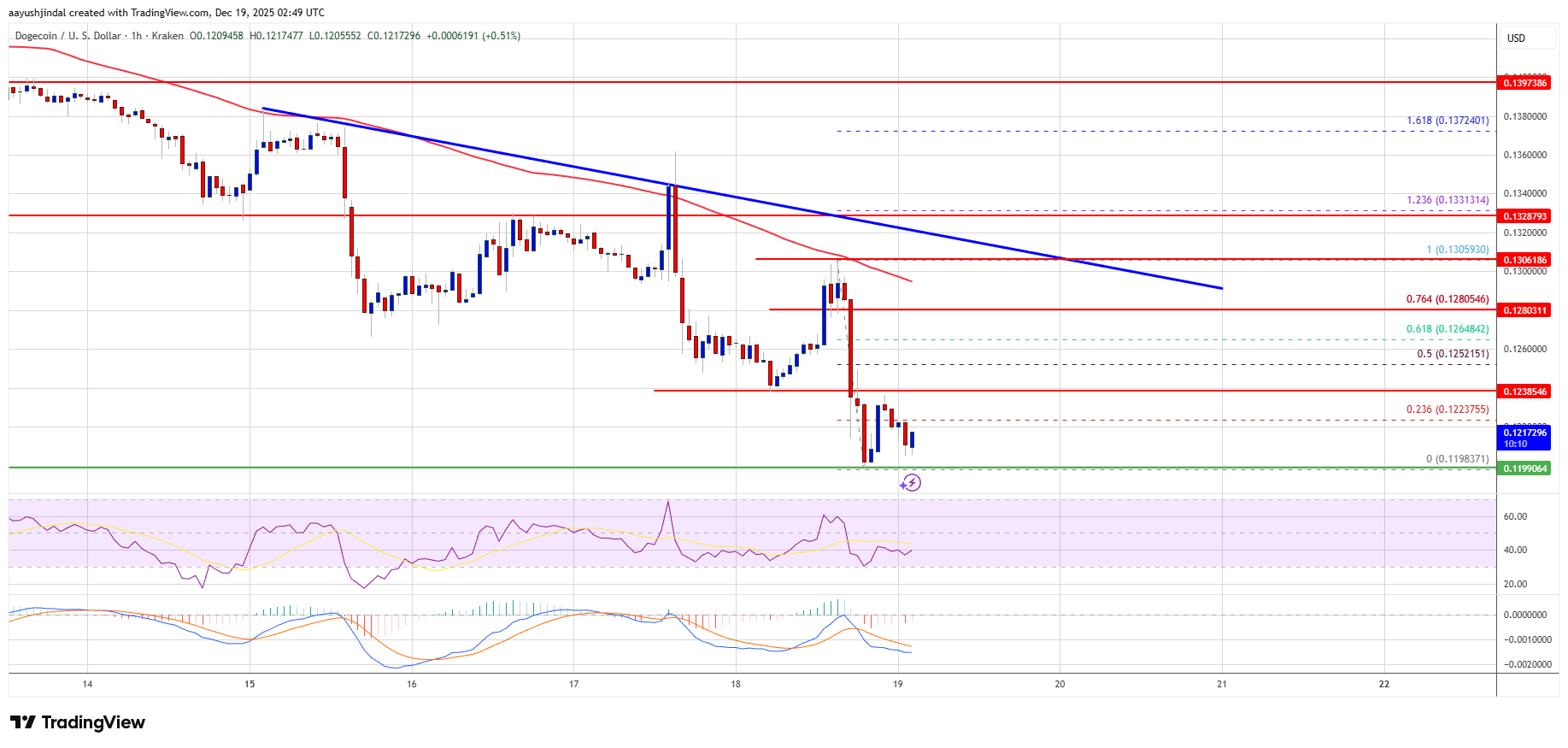
Dogecoin started a fresh decline below the $0.1250 zone against the US Dollar. DOGE is now consolidating losses and might face hurdles near $0.1235.

  • DOGE price started a fresh decline below the $0.1250 level.
  • The price is trading below the $0.1220 level and the 100-hourly simple moving average.
  • There is a key bearish trend line forming with resistance at $0.1300 on the hourly chart of the DOGE/USD pair (data source from Kraken).
  • The price could extend losses if it stays below $0.1280 and $0.1300.

Dogecoin Price Dips Further

Dogecoin price started a fresh decline after it closed below $0.1300, like Bitcoin and Ethereum. DOGE declined below the $0.1280 and $0.1250 support levels.

The price even traded below $0.1220. A low was formed near $0.1198, and the price is now showing bearish signs. It is consolidating below the 23.6% Fib retracement level of the downward move from the $0.1305 swing high to the $0.1198 low.

Dogecoin price is now trading below the $0.1280 level and the 100-hourly simple moving average. If there is a recovery wave, immediate resistance on the upside is near the $0.1235 level. The first major resistance for the bulls could be near the $0.1280 level or the 76.4% Fib retracement level of the downward move from the $0.1305 swing high to the $0.1198 low.

Dogecoin Price

The next major resistance is near the $0.1300 level. There is also a key bearish trend line forming with resistance at $0.1300 on the hourly chart of the DOGE/USD pair. A close above the $0.1300 resistance might send the price toward the $0.1350 resistance. Any more gains might send the price toward the $0.1372 level. The next major stop for the bulls might be $0.1400.

More Losses In DOGE?

If DOGE’s price fails to climb above the $0.1300 level, it could continue to move down. Initial support on the downside is near the $0.1200 level. The next major support is near the $0.1195 level.

The main support sits at $0.1150. If there is a downside break below the $0.1150 support, the price could decline further. In the stated case, the price might slide toward the $0.1050 level or even $0.10 in the near term.

Technical Indicators

Hourly MACD – The MACD for DOGE/USD is now gaining momentum in the bearish zone.

Hourly RSI (Relative Strength Index) – The RSI for DOGE/USD is now above the 50 level.

Major Support Levels – $0.1280 and $0.1250.

Major Resistance Levels – $0.1340 and $0.1350.

Yesterday — 18 December 2025Main stream

Bitcoin Price Retests Support—Is the Market Bracing for Volatility?

18 December 2025 at 21:30

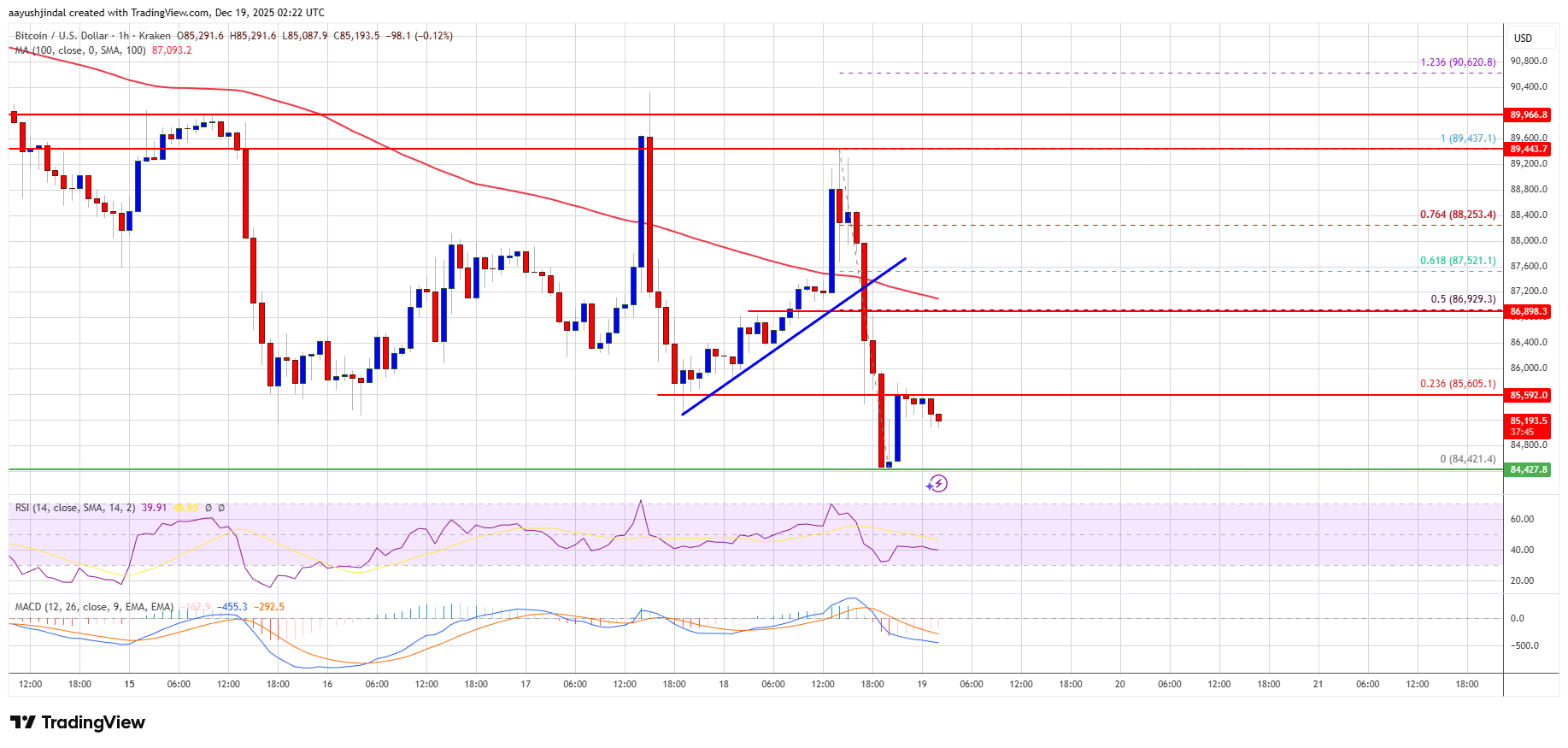
Bitcoin price attempted to start a fresh increase but failed at $89,500. BTC is now struggling below $86,500 and might continue to move down.

  • Bitcoin started a fresh decline below the $86,500 zone.
  • The price is trading below $86,500 and the 100 hourly Simple moving average.
  • There was a break below a bullish trend line with support at $87,250 on the hourly chart of the BTC/USD pair (data feed from Kraken).
  • The pair might continue to move down if it settles below the $85,000 zone.

Bitcoin Price Dips Again

Bitcoin price attempted a fresh recovery wave above $88,000 and $88,500. BTC tested the $89,500 resistance zone and reacted to the downside. There was a sharp decline below $88,000.

There was a break below a bullish trend line with support at $87,250 on the hourly chart of the BTC/USD pair. The price even spiked below the $85,000 support. However, the bulls were active near the $84,500 zone. A low was formed at $84,421 and the price is now consolidating losses below the 23.6% Fib retracement level of the downward move from the $89,437 swing high to the $84,421 low.

Bitcoin is now trading below $87,000 and the 100 hourly Simple moving average. If the bulls remain in action, the price could attempt more gains. Immediate resistance is near the $86,600 level. The first key resistance is near the $87,000 level and the 50% Fib retracement level of the downward move from the $89,437 swing high to the $84,421 low.

Bitcoin Price

The next resistance could be $88,000. A close above the $88,000 resistance might send the price further higher. In the stated case, the price could rise and test the $88,800 resistance. Any more gains might send the price toward the $89,500 level. The next barrier for the bulls could be $90,000 and $90,500.

More Losses In BTC?

If Bitcoin fails to rise above the $87,000 resistance zone, it could start another decline. Immediate support is near the $85,000 level. The first major support is near the $84,500 level.

The next support is now near the $83,200 zone. Any more losses might send the price toward the $82,500 support in the near term. The main support sits at $80,500, below which BTC might accelerate lower in the near term.

Technical indicators:

Hourly MACD – The MACD is now gaining pace in the bearish zone.

Hourly RSI (Relative Strength Index) – The RSI for BTC/USD is now below the 50 level.

Major Support Levels – $85,000, followed by $84,500.

Major Resistance Levels – $87,000 and $88,000.

XRP Ledger Upgrade Locks Out Almost Half Of Outdated Nodes

18 December 2025 at 20:00

XRP Ledger operators are staring down a familiar kind of “deadline drama” on Thursday, after one community tracker warned that a large chunk of XRPL servers are about to get amendment blocked, basically pushed to the sidelines until they upgrade.

“In about ~10 hours 418 (!!) out of 999 XRPL servers will go DOWN as they become amendment blocked!” wrote X user Krippenreiter, adding that amendment-blocked rippled servers can’t “determine the validity of a ledger,” “submit transactions,” “process transactions,” or “participate in the consensus process.”

XRP validator and node upgrade status

Will This Impact The XRP Ledger?

That sounds catastrophic if you’ve never watched XRPL governance do its thing. But the important nuance is right there in the name: amendment blocking is a safety feature, not a network failure mode. When new protocol rules activate, old software can’t reliably interpret ledgers anymore, so the network forces those servers into a non-participating state rather than letting them guess.

So does “almost half the servers” going amendment-blocked matter if activity spikes? “Not at all,” Krippenreiter replied to one user. “All dUNL validators are safe, so all ‘trusted’ validators will continue to validate as expected. (and behave under load)… For everything else there is ‘FeeEscalation’.” The point he’s making: consensus comes from a trusted validator set, and fee escalation is designed to push transaction costs higher as the ledger gets busy, throttling spam and overload attempts.

Other XRPL watchers mostly treated it as routine maintenance, not an existential moment. “Is this unusual or dangerous? No. This happens almost every amendment cycle,” another user wrote, listing prior change windows and noting that lagging nodes typically upgrade later. The XRPL amendment process itself is built around a long lead time: an amendment needs sustained supermajority support from trusted validators for two weeks before it flips on.

Still, the optics aren’t nothing. Having hundreds of public servers fall behind at once can be a real-world nuisance for wallets, explorers, and businesses that lean on third-party infrastructure. Even if consensus is fine, fewer up-to-date nodes can mean less redundancy at the edges — more brittle public endpoints, more support tickets, more “why is my transaction not going through?” posts.

And there is a concrete upgrade path. XRPL.org’s release notes for rippled 2.6.2 describe a new fixDirectoryLimit amendment plus a critical bug fix — the kind of stuff you don’t want to procrastinate on if you run production infrastructure.

The short version: no, XRPL isn’t “going down.” But if you’re still running old rippled in late 2025, the network is about to remind you that upgrades aren’t optional.

At press time, XRP traded alongside the broader market wide sentiment, down -1.5% over the past 24 hours.

XRP price chart

Solana Value Proposition Extends Beyond Tech Into Economic Infrastructure

18 December 2025 at 18:00

In the evolving landscape of blockchain technology, Solana has rapidly emerged as a platform not merely defined by its technical capabilities but by its broader implications for economic infrastructure. By enabling the class of decentralized applications, SOL is positioning itself as a high-performance blockchain and a foundational layer for the next-generation economic activity. 

Why Infrastructure That Enables Continuous Markets

In an X post, crypto analyst Vibhu mentioned that Solana is no longer just a piece of financial technology, but a fully functioning economy. What exists on SOL today has gone beyond transactions and smart contracts. 

According to the expert, there are dollars and native currencies, real-world assets, metals and rare minerals, energy market, information markets, manufacturing primitives, and global trade rails all operating in real-time on-chain. SOL also has politics, governance processes, divided factions, and ongoing debates about the leading network’s future.

At this point, we are witnessing the birth of a country that lives entirely on the internet. Measured through economic output, SOL would rank around the 157th largest country in the world by GDP (Gross Domestic Product), comparable in size to nations such as Eswatini or Fiji. However, SOL is globally integrated by default, and from a forex and asset-flow perspective, it punches above its weight, integrating with the largest banks and financial institutions across the globe.

Furthermore, SOL has withstood sustained network attacks from nation-state actors, defending itself with systems engineers instead of armies. Economically, SOL is already engaged in trade with countries like Bhutan, ranked 164, the Isle of Man, ranked 154, and even Kazakhstan, which ranks 49 in global economic standings. “Solana is a digital country, and I am proud to be a citizen,” Vibhu noted.

Why Real-Time On-Chain UX Finally Works On Solana

Solana continues to see key updates and integration that tend to bolster the network capabilities. Co-founder of TeamElevenX1 and Ambassador at Solflare, Kristofer_Sol, has highlighted that MagicBlock is quietly doing some of the most important work in the Solana ecosystem, pushing real-time SOL closer to true production scale. 

At the center of this shift is the deep integration of compressed accounts into the Light Protocol inside Ephemeral Rollups, reducing rent costs by up to 200 times, while still functioning like a normal account for developers. The compression demo is already live, and real applications are actively using it today. Others like Rush Trade deliver faster trades, and Pixels achieve smooth, real-time pixel updates. 

Kristofer_Sol stated that this is what a scalable on-chain user experience actually looks like. With low-cost reduction and speed improvements happening without forcing developers to rewrite everything, MagicBlock is quietly removing the friction that has held back games, social apps, and consumer products on SOL.

Solana

Dogecoin And Shiba Inu Make Coinbase’s List In Latest Product Launch

18 December 2025 at 19:00

Dogecoin and Shiba Inu have secured a place in Coinbase’s latest product expansion, a notable moment for meme coins within the regulated crypto derivatives market. Coinbase confirmed the launch of US perpetual-style futures trading in an announcement on X for a range of altcoins on Coinbase Derivatives, available around the clock.

Coinbase Expands Derivatives Access With Meme Coins Included

According to a recent announcement on X, US Perpetual-Style Futures are now live on Coinbase Derivatives. Among a lineup dominated by established layer-one networks and infrastructure tokens, Dogecoin and Shiba Inu stood out as the only meme-based assets included, showing how these tokens are being positioned within institutional-grade trading environments.

The new product rollout allows both retail and institutional traders to access US-regulated perpetual-style futures through approved Futures Commission Merchants. Coinbase is effectively placing both meme coins alongside assets such as Cardano, Chainlink, and Polkadot in its derivatives ecosystem with its extension of this offering to Dogecoin and Shiba Inu. In the case of Shiba Inu, the newly listed futures contract comes with a 1,000x multiplier.

This means that demand for structured exposure to these leading meme coins has grown beyond spot trading, with traders increasingly seeking hedging and leverage tools tied to them.

What This Means For DOGE And SHIB Moving Forward

Recent price action for both Dogecoin and Shiba Inu has offered little encouragement. Both cryptocurrencies are currently locked in an extended declining price action and low whale activity, except for a spike in whale activity witnessed by Shiba Inu earlier in the month. This occurred in tandem with a +1.06 trillion net change to the amount of SHIB on exchanges, which is also another sign of the intense selling pressure surrounding the meme coin.

However, behind the scenes, Dogecoin and Shiba Inu might be working towards a bullish momentum in their fundamentals. For one, the availability of perpetual-style futures for Dogecoin and Shiba Inu could add to how traders interact with these assets. Futures markets often attract higher trading volumes and more sophisticated participants, which can influence price discovery and volatility patterns. 

As the largest crypto exchange in the United States, Coinbase provides the best regulated gateway for institutional traders. Therefore, this development may increase institutional visibility for Dogecoin and Shiba Inu in the US market while also providing traders with new ways to manage risk.

At the time of writing, Shiba Inu is trading at $0.000007523, down by 3% in the past 24 hours. Notably, the meme coin is currently trading at its lowest price point in over a year. 

Dogecoin is also trading at its lowest price point in over a year. The king of meme coins is currently trading at $0.1256, down by 3.2% in the past 24 hours.

Dogecoin

Mixed Signals for XRP as Price Weakness Collides With Bold Analyst Targets

18 December 2025 at 18:00

XRP is closing out 2025 caught between two opposing forces. On one side, price action has weakened, technical indicators are flashing caution, and liquidity has thinned as the holidays approach.

On the other hand, analysts continue to publish ambitious upside targets, while fresh narratives around utility, adoption, and yield generation keep the token in focus. The result is a market struggling to reconcile near-term pressure with longer-term expectations.

After spending much of the year underperforming other large-cap cryptocurrencies, XRP has slipped below the closely watched $2 level. That breakdown has sharpened debate over whether the market is entering a deeper correction or simply extending a prolonged consolidation phase.

Ripple XRP XRPUSD XRPUSD_2025-12-18_12-34-04

XRP Price Structure Shows Growing Strain

Technical analysts point to mounting downside risks. XRP has formed what some describe as a higher-timeframe double-top near the $3.30–$3.40 region, with momentum indicators rolling over.

The $1.85–$1.90 zone is now acting as a critical support area. A confirmed break below that range could expose XRP to a deeper pullback toward the $1.60–$1.65 region, aligning with key Fibonacci retracement levels.

Additional on-chain metrics add to the cautious tone. XRP continues to trade well above its realized price, a condition that in previous cycles has preceded mean-reversion pullbacks.

Meanwhile, moving averages and momentum indicators, such as the MACD, remain tilted to the downside, reinforcing the view that sellers retain control in the short term.

Analysts Split Between Caution and Optimism

Despite the weak chart structure, some analysts argue that the broader narrative has not changed materially. Vincent Van Code has noted that while XRP’s price performance disappointed in 2025, there has been no clear fundamental shock to explain the decline.

Legal clarity around Ripple, ongoing institutional interest, and XRPL development remain intact, suggesting the disconnect may be driven more by market structure and liquidity than by fundamentals.

Others are more explicit with upside targets. Analyst Dark Defender, who previously identified the $1.88 support zone, argues that XRP has completed a corrective phase under Elliott Wave analysis.

From that perspective, targets around $5.85 remain possible in the next major advance, though timing depends heavily on broader market conditions.

Utility Narratives and Speculation Add Noise

Beyond price charts, new narratives are complicating sentiment. Reports highlighting XRP-based yield strategies, including mining-related platforms, have circulated widely; however, these claims vary in transparency and risk, and are not directly tied to XRP’s core protocol.

Separately, unconfirmed rumors suggesting that EA Sports may explore XRP for in-game payments have briefly reignited discussion around mass adoption, even as no official confirmation has emerged.

XRP currently sits at an uncomfortable crossroads. Technical pressure is real, downside risks remain, and patience is being tested. At the same time, bold analyst targets and recurring adoption stories ensure the token remains one of the most closely watched assets heading into early 2026.

Cover image from ChatGPT, XRPUSD chart from Tradingview

Federal Reserve Revamps Bank Crypto Rules, Opening New Channels for Digital Asset Trading

18 December 2025 at 17:00

The U.S. Federal Reserve has taken a notable step in reshaping how banks under its supervision can engage with crypto, reversing guidance introduced in 2023 that had sharply limited such activities.

The decision reflects a broader reassessment inside the central bank about how regulation should adapt to financial innovation, especially as digital assets continue to intersect with traditional banking infrastructure.

Under the earlier framework, uninsured state-chartered banks were required to follow the same constraints as federally insured institutions in order to remain under Federal Reserve supervision. That approach effectively barred some crypto banks from accessing core payment systems or Federal Reserve membership.

Crypto BTCUSD_2025-12-18_12-22-45

What the Policy Shift Changes for Banks

The new guidance establishes a formal pathway for both insured and uninsured banks supervised by the Federal Reserve to pursue certain innovative activities, including those related to cryptocurrencies.

Institutions will still be required to meet supervisory and risk-management standards, but they will no longer be automatically excluded based on their business models.

For uninsured banks, the implications are significant. Access to Federal Reserve membership would allow direct settlement through central bank payment systems rather than reliance on intermediary banks.

This idea could lower operational frictions for crypto custody, settlement, and related services, potentially expanding the role of banks in digital asset markets without changing existing safety and soundness expectations.

Custodia Case Highlights Regulatory Tensions

The policy reversal has renewed attention on Custodia Bank, a crypto-focused institution whose application for a Federal Reserve master account was denied in part due to the now-rescinded guidance.

Custodia CEO Caitlin Long has argued that the 2023 policy effectively blocked lawful access to the Fed’s infrastructure and welcomed its withdrawal as a correction of past regulatory overreach.

Not all policymakers agree. Federal Reserve Governor Michael Barr dissented from the decision, warning that loosening the framework could undermine a level competitive playing field and encourage regulatory arbitrage.

Michael Barr’s position highlights the ongoing debate within regulatory circles over how to strike a balance between innovation and financial stability.r

Broader Implications for Crypto Markets

While the Fed’s move does not directly change how cryptocurrencies such as Bitcoin or Ethereum trade, it may influence market structure over time. Easier access for banks could support deeper institutional participation, greater liquidity, and expanded custody and settlement options.

For now, the shift signals a more flexible regulatory posture, one that acknowledges the rapid evolution of digital asset markets and the banks that seek to serve them.

Cover image from ChatGPT, BTCUSD chart from Tradingview

Analyst Says This XRP Level Is Keeping Downside Pressure In Check

18 December 2025 at 16:00

Market analysts are closely watching the XRP price as recent movements test key support levels. A new technical analysis has highlighted a critical price zone that is currently helping contain further downside pressure on XRP. Over the past few months, the cryptocurrency has struggled to reclaim its previous highs, recently crashing below the $2 psychological level amid increased volatility and market uncertainty. 

XRP Key Support Contains Downside Risks

Crypto analyst Skipper shared a new technical update on XRP this week, highlighting current market dynamics and a critical support level that could help prevent further downturns. The analyst noted that XRP recently broke below $1.93, signaling heightened selling pressure and ongoing market repositioning.

Notably, XRP’s decline below $1.93 comes amid broader market weakness, as the cryptocurrency has struggled to hold key levels. Spot market data show the cryptocurrency is currently trading at $1.85, reflecting a significant drop of about 2.7% in the last 24 hours and more than 7.8% over the past seven days. 

XRP’s choppy price action has also kept it pinned below many resistance zones. However, Skipper reveals that sustained trading below $1.88 keeps the cryptocurrency’s downside pressure intact in the near term. The analyst also notes that the next meaningful area where buyers may attempt to stabilize price sits around $1.85. 

XRP

Despite ongoing Spot ETF inflows since its launch in November, Skipper noted that XRP’s short-term price action appears more driven by technical positioning than fundamental developments. He also highlighted that XRP’s market supply has contracted significantly, dropping by 45% from approximately 3.9 billion tokens at the beginning of 2025 to about 1.6 billion tokens by December. This reduction in supply could influence XRP’s price dynamics and overall market scarcity. 

XRP Faces Continued Downtrend Amid Market Weakness

In a subsequent post, Skipper reported that the XRP price fell 5% as the crypto market experienced fresh selling pressure with major altcoins extending recent declines. The analyst stated that the token had dipped to lows of around $1.81, reflecting growing investor risk aversion. Moreover, despite being one of the top-performing assets earlier in the year, XRP now risks slipping further.

According to Skipper, XRP has been in a steady downtrend since July 2025, with each price bounce weaker than the previous one. He emphasized that bulls must reverse this downtrend to restore a positive outlook, which would require XRP to rise above the $2.27 high from the last weak bounce in late November. 

The analyst also noted that in past cycles, when XRP breaks below the 50-week Simple Moving Average (SMA) and stays there for roughly 50 to 84 days, a strong rally typically follows. He disclosed that the price has now spent approximately 70 days below its 50-week SMA, placing it within the same historical window.

XRP

Fading ETF Interest Puts Pressure on Dogecoin as Price Approaches Critical Cost-Basis Zone

18 December 2025 at 15:00

Dogecoin (DOGE) is approaching a sensitive phase as weakening investor demand, stalled ETF inflows, and growing sell-side pressure converge near a key price area.

Related Reading: XRP Risks Double-Top Crash Toward $0.40, Peter Brandt Warns

Once driven largely by retail enthusiasm, the meme coin is now trading closer to levels where a significant share of holders last acquired their tokens, raising questions about downside risk if confidence continues to erode.

At the same time, isolated whale accumulation and long-term cost-basis data suggest the market is approaching a zone that could define the next major move.

Dogecoin DOGE DOGEUSD DOGEUSD_2025-12-18_12-27-20

Dogecoin ETF Inflows Stall as Sentiment Softens

One of the clearest shifts in Dogecoin’s recent market structure has been the loss of momentum in its exchange-traded funds. Data shows that the Grayscale and Bitwise DOGE ETFs have not recorded any inflows since December 11, with total inflows since launch standing at roughly $2 million.

Combined assets under management are around $5.2 million, representing a negligible fraction of Dogecoin’s overall market capitalization. The muted response contrasts sharply with other altcoin ETFs, particularly XRP and Solana products, which have attracted hundreds of millions of dollars in inflows.

The lack of sustained interest has raised questions about the long-term viability of DOGE-focused funds, especially given their low revenue potential at current asset levels. More broadly, the ETF slowdown reflects a risk-averse environment, with the crypto Fear and Greed Index remaining in fear territory.

On-Chain and Derivatives Data Point to Bearish Bias

Beyond ETFs, on-chain metrics show declining participation from large holders. Wallets holding between 100 million and 1 billion DOGE have reduced their balances by over 1 billion tokens since early December.

Similarly, the proportion of DOGE supply in profit has slipped to near 50%, suggesting fewer holders are sitting on unrealized gains.

Derivatives markets reinforce this cautious outlook. Short positions now account for more than half of open DOGE derivatives, while over $5 million in long positions were liquidated in a 24-hour period. Open interest has also declined, pointing to reduced speculative appetite rather than aggressive dip-buying.

Price Near Key Support as $0.10 Comes Into Focus

Technically, Dogecoin is trading near the $0.123–$0.126 range, an area that has repeatedly acted as support since April.

The price remains below key moving averages, with momentum indicators such as MACD and RSI signaling continued downside pressure. A decisive break lower could expose the psychological $0.10 level.

Related Reading: Ethereum Risks Slide To $2,000 If December Closes Below This Level: Analyst

Analysts have also projected deeper historical support near $0.074, where roughly 28 billion DOGE last changed hands. While a move to that level would require further deterioration in sentiment, current conditions suggest Dogecoin is approaching a cost-basis zone that could determine whether sellers remain in control or longer-term holders begin to step in.

Cover image from ChatGPT, DOGEUSD chart from Tradingview

Bitcoin Price Crashes to $84,000 – Is $70,000 Next?

18 December 2025 at 15:44

Bitcoin Magazine

Bitcoin Price Crashes to $84,000 – Is $70,000 Next?

The bitcoin price dropped sharply today after a brief pump near $90,000, sliding to $84,544 as the price sell-off continued into its second month. 

Bitcoin lost 2% over the past 24 hours. It remains 5% below its seven-day high of $89,220 and hovers near the week’s low of $84,596. Trading volume reached $56 billion. Bitcoin’s market capitalization stands at $1.69 trillion. The circulating supply is roughly 19.96 million BTC out of a total 21 million, according to Bitcoin Magazine Pro data. 

The drop follows a brief rally that earlier saw the Bitcoin price test $89,000. The surge came after the U.S. released new Consumer Price Index data. Inflation rose 2.7% year over year in November, lower than expected. Core CPI, which excludes food and energy, fell to 2.6%, the lowest since early 2021.

Bitcoin jumped from intraday lows near $86,000 to challenge $89,000. Traders viewed the cooler inflation report as a potential signal for looser Federal Reserve policy in 2026. CME FedWatch data suggested slightly higher odds of a rate cut by March, though January moves remain unlikely.

The rally did not last. The bitcoin price failed to break $90,000 and slid to $84,4000. This pattern is familiar: sharp spikes followed by quick retracements.

What’s dragging down the bitcoin price?

A persistent challenge is U.S.-listed spot Bitcoin ETFs. These funds, once a major source of demand, have seen net redemptions. The outflows remove institutional support that previously helped stabilize the price. Without consistent ETF inflows, breakouts above $89,000 are harder to sustain.

Other economic indicators add uncertainty. Recent labor market data showed U.S. unemployment rising to 4.6%, its highest since 2021. Job growth remains uneven. The mixed signals complicate Federal Reserve policy, suggesting a cautious approach despite easing inflation.

Political factors add to market complexity. President Donald Trump has publicly urged lower interest rates and suggested nominating a Fed chair favoring aggressive easing. Markets have largely treated the comments as noise, but the statements add a variable to the macro picture.

Technically, the bitcoin price is consolidating rather than trending. Resistance forms just below $90,000. Supply above this level remains strong, held by investors who bought during prior rallies. 

Analysts at Bitwise recently suggested Bitcoin could break its historical four-year cycle. The firm noted BTC might reach new all-time highs in 2026 with lower volatility and reduced correlation to equities.

The Bitcoin Fear and Greed Index currently sits at 17/100, signaling extreme fear. Historically, readings in this range have coincided with undervaluation. Contrarian investors see potential buying opportunities, though sentiment remains cautious.

Is $70,000 next? 

Technical analysts from Bitcoin Magazine wrote earlier this week that the $84,000 support level is under pressure. If the bitcoin price falls below this point, it could test the $72,000 to $68,000 zone. Initial bounces are expected, but a break below $84,000 could trigger faster declines toward $70,000.

Bitcoin’s price may drop to the $72,000–$68,000 support zone after breaking the $84,000 level, with bears currently in control. A strong bounce is likely from that lower zone, potentially retesting $84,000, though the 4-Year Cycle suggests further downside could occur later in 2026.

Resistance extends from $94,000 to $118,000. Bulls will need substantial buying volume to break above these levels, per Bitcoin Magazine analysts. 

Short-term momentum favors sellers. Last week, the Bitcoin price closed the weekly candle in red, failing to sustain gains near $94,000. Bears are well-positioned to push prices lower this week. 

At the time of writing, the bitcoin price is $84,812. Trading volume reached $56 billion. Bitcoin’s market capitalization stands at $1.69 trillion. The circulating supply is roughly 19.96 million BTC out of a total 21 million, according to Bitcoin Magazine Pro data. 

Bitcoin price

This post Bitcoin Price Crashes to $84,000 – Is $70,000 Next? first appeared on Bitcoin Magazine and is written by Micah Zimmerman.

Service members face a simple truth with complex consequences: follow lawful orders, refuse unlawful ones

18 December 2025 at 14:56


Interview transcript

Terry Gerton There’s been a lot of talk lately, certainly from lawmakers, from senior military leaders about the topic of lawful and unlawful orders. Describe the current situation from your perspective.

Frank Rosenblatt Well, military members have special license to use violence in armed conflict but this license is not unrestrained. Otherwise, we would just have mobs working. So a professional armed force really depends on discipline, and a key ingredient of discipline is obedience. So military members, have to follow orders. If you don’t like what your boss says at Starbucks, then they can fire you, but they can’t prosecute you. It’s different in the military. There are consequences if you don’t obey what your superiors tell you to do. But at the same time, this doesn’t work like they tried to do at Nuremberg, where I was just following orders. We do not want or expect our military members to unthinkingly obey, so orders are presumptively lawful that they receive, but they also have a duty to disobey any orders that are manifestly unlawful.

Terry Gerton That can be a tricky situation in execution. Describe for me or define for me what makes an order lawful or unlawful.

Frank Rosenblatt Well, the standard of manifestly [unlawful] is that an ordinary person of reasonable sense and understanding would know right away, I’m just not allowed to do this. And the classic example people think about is the My Lai massacre when Capt. Medina supposedly told his lieutenant, Calley, go clear the enemy out of there. Lt. Calley then did his translation of this and said, kill everyone. And the soldiers who worked for Calley should have known. I think it’s helpful to look beyond the Calley example because I think the reality of orders is more complex. There’s a story about a dog handler at Abu Ghraib. He was trained in the use of the military working dog, but he was told by his superiors when he worked at the prison, we need you to derogate from your training a little bit. We want you to use these dogs to help us with interrogations and to scare the prisoners. And so he thought, sure, I’ll go ahead and do this because my superiors are telling him to. It’s questionable whether everyone in that situation would have said, I know this is wrong. But looking years later, the military court looked and said, nope, you shouldn’t have obeyed that order. It’s manifestly unlawful.

Terry Gerton So how does that differ from a personal disagreement? I don’t think that’s the right answer, but maybe it’s lawful, maybe it is not. How does a service member decide?

Frank Rosenblatt We do see this. Matters of conscience, religious belief, or politics are no excuse. You must follow the orders even if you don’t like the president, even if you find the mission to be wrong or even distasteful. We’re seeing a lot of this because, Terry, I work with an organization called The Orders Project. It’s ordersproject.com. It is part of our national institute. And we receive calls from people who have questions about their orders. And here we see the spectrum. People say, what if I’m asked to do this? Or I’m told that we’re going to Chicago. What should I do? And so the National Guard deployments are very interesting because the legal status of them changes by the day. We just saw a new decision on the National Guard deployments in Los Angeles. So let’s say we get a call from someone who says, I’m being told that I’m going to deploy to Chicago in a couple months. It would take a crystal ball, not legal analysis, to say that’s going to be lawful or unlawful. We just don’t know how the courts will decide. So in that hypothetical, we would say you do need to plan and go on this mission unless you have an opportunity to not re-enlist. That is something that you presumptively will have to do, even if deploying to Chicago wasn’t the reason why you decided to join the military.

Terry Gerton I’m speaking with Professor Frank Rosenblatt from the Mississippi College School of Law. He’s a recognized expert in military justice, a former U.S. Army JAG officer, and president of the National Institute for Military Justice. Frank, you were talking there about a situation where a service member has some lead time between what they’re being told they’re going to have to do and actually having to go do it. In some of these operations, though, they’re making decisions in real time. So what should folks be thinking about? You know, if they get an order to fire and they have seconds to decide whether to do that or not.

Frank Rosenblatt This is really happening. And I’ll tell you one scenario that people talk about that’s based on reality. Let’s say a senior elected official says, I want you to shoot protesters in the legs. Then you would think and know, OK, that’s not lawful. But it’s not as easy as that. Because if you say, sir, that’s  unlawful, that might just pull you out of the picture and not be part of more consequential decisions. So that person does not have time to call a lawyer. And it’s really a test of their own judgment and mettle. What we would not expect would be direct compliance with that order. We think maybe we could seek clarification or interpret this in a way and give guidance to subordinates that excises that illegal element. You could take that and then translate that as we need to demonstrate our presence. We need to comply with the law. In other words, I’m saying that there are times when military members should disobey orders.

Terry Gerton Typically, it’s going to be a senior official who’s making the decision. We don’t necessarily rely on the junior operator to make this call in live action. But if they do refuse an order that later turns out to be lawful, or they execute an order that later turned out to unlawful, what are the repercussions?

Frank Rosenblatt This is why it’s so tricky. It’s really a high wire act that we’re asking our military members to do. We are putting them in legal jeopardy when we are boundary pushing in how we do military operations. On the one hand, if you push back on something and you don’t comply, and it turns out that was a lawful order, then you’re going to face consequences for that disobedience. Everything from administrative sanctions to being removed from your job, possibly even a court-martial. But if you do something that you find out later is unlawful, you can also be punished for that.

Terry Gerton So what is the role of the Orders Project in helping to clarify this really complicated conversation?

Frank Rosenblatt This topic obviously has received a lot of nationwide attention lately, and what that means is there are a lot voices out there that represent different religious beliefs, political beliefs, and they’re saying is we want to help soldiers. Sometimes they’re urging disobedience. That’s not what we do. What we’re trying to do is, you know, the National Institute, we’ve been around since 1991, we’re a collection of military law experts, and we want there to be some sort of source that is authenticated that military members know that when I call this, I’m going to get it straight. I’m gonna hear from somebody who, you know, thumbs through the judge’s bench book, the manual for courts martial, and can actually tell me and give me sound legal advice that’s actually based in military law and not based on, you know, some other agenda.

Terry Gerton I think we haven’t heard the end of this conversation, we’re going to continue to follow through on it. So are there reforms or education efforts that you would suggest that could help military service members, political appointees better understand the issues that are at stake here and make the right call from the beginning.

Frank Rosenblatt What I would like to emphasize is, you know, I’m a law professor and a former judge advocate, but I actually want to de-emphasize the role of lawyers in this. I think that the issues with orders come when we ask people on the fly to do something that they haven’t had the time to think through, rehearse, and train upon. I think these issues, Terry, of lawful and unlawful orders come down to if it’s not a legal briefing that’s going to solve everyone’s questions. But when they can practice and build their expertise and competence and see where the boundaries are of their behavior. Every time our military goes to do something, whether that’s operating in cities in Iraq or now in these boat strikes in the Caribbean, if we have the chance to practice this and work through contingencies, then our military members will be emboldened, they’ll be more confident, they’ll know exactly what the right and left limits are.

Terry Gerton It feels like the military is being asked to push a lot of boundaries right now. Would you say from your perspective, we’ve been in situations like this before? Are there lessons we can learn from the past that would help us better define the space right now?

Frank Rosenblatt When we think back to 9/11, for example, there was a strong demand to immediately begin military operations. And there wasn’t really a lot of chance to rehearse this and to know exactly what we were doing and to integrate all of the different perspectives. But I do think what’s important in this is that we have a process. At every military operational command, there are staff officers who each bring a different level of expertise. There are commanders who are trained. If we let them function, let them do their jobs, and we do this without trying to rush people or without political interference. Now sometimes we have to respond to emergencies and there isn’t that time. But we should trust and we should have a lot of confidence in our military members and our commanders. They want to do the right thing. Let’s give them the tools and the opportunity and they won’t let us down.

Terry Gerton Where do you hope this current discussion of lawful and unlawful orders takes us? What do you think the outcome will be?

Frank Rosenblatt In some sense, the temperature has been awful hot on this, and it’s not really, I think, wise for this to be a political issue. And actually, if you listen to Republicans and Democrats, they’re largely saying the same message about this, but they’re not trusting the motives of each other. But maybe the bright side of this, the opportunity here, is the attention on this will give a greater appreciation for the difficulty that we put military members in when we rush them to do things, and when we are really pushing the limits of what we have done before, whether that’s boat strikes in the Caribbean or National Guard deployments in cities.

The post Service members face a simple truth with complex consequences: follow lawful orders, refuse unlawful ones first appeared on Federal News Network.

© Getty Images/iStockphoto/roibu

Solana Price Could Crash Below $5 – The Document That Has Taken The Community By Storm

18 December 2025 at 15:00

A crypto analyst has issued a stark warning to the SOL community, predicting that the Solana price could crash below $5. The expert’s bearish thesis is based on an extensive review of US federal court documents, suggesting that ongoing legal challenges and potential flaws in the Solana blockchain could lead to the end of the cryptocurrency. 

Analyst Predicts Solana Price Crash And Annihilation

A crypto analyst who calls himself ‘NoLimit’ on X has released a report that has sent shockwaves through the Solana community. He shared court documents suggesting SOL could be nearing its end, with a potential price drop below $5 over the next two years. Currently trading at $122, this would represent a staggering 95.9% decline. 

In his post, NoLimit revealed that he had spent more than 12 hours analyzing court documents, claiming that the findings are highly concerning to Solana. The report highlights recent developments in a US federal court where a second amended class action complaint has been allowed to proceed. 

The analyst noted that the lawsuit involved Pump.fun, Solana Labs, and several other entities linked to the Solana ecosystem. He stated that the court’s decision to proceed shows there is enough evidence to pursue legal actions, putting SOL’s operations under significant scrutiny. 

The allegations focus on insiders seemingly gaining unfair advantages during meme coin launches. According to NoLimit, Plaintiffs claimed that Solana’s validator system and transaction-priority tools allowed certain players to buy tokens faster and cheaper. At the same time, retail investors were left at a disadvantage as prices exploded and collapsed minutes or seconds later. The analyst notes that many investors had experienced this same issue on Pump.fun

NoLimit disclosed that the lawsuit contends these outcomes, in which insiders sell for profit and retail loses everything, were not accidental but rather a result of the system. The complaint directly ties the alleged insider behavior to SOL, not just to the apps built on the blockchain. If this argument gains legal traction, the analyst notes that it could position the crypto network as a platform for risky coin launches, a host for bad actors, and a contributor to potential market manipulation

NoLimit also warns that if regulators or courts determine that these meme coin launches operate like unregistered securities or that Solana’s infrastructure enabled unfair access, the chain’s core narrative of being fast, cheap, and permissionless could become a liability. Such a development could scare off institutional investors and large-scale funds, possibly leading to the end of Solana. 

Solana Legal Troubles Put Market Trust At Risk

NoLimit warns that the most alarming part of Solana’s present legal issues is the potential impact on institutional confidence. According to him, nearly half of SOL’s circulating supply is controlled by ecosystem-linked institutions, insiders, early investors, VCs, and foundations. He emphasized that a mass sell-off from these holders could trigger a severe market reaction. 

The analyst highlighted that the key concern is what could happen if trust in SOL collapses. He stated that in crypto markets, trust drives prices, not fundamentals, and when it breaks, crashes can be substantial. Past cases like FTX, Luna, and Celsius show how quickly liquidity can disappear and valuations can plummet. 

Solana

XRP Enters Historical Window That Has Previously Led To Triple-Digit Rallies

18 December 2025 at 13:00

XRP’s weekly chart has entered a technical zone that has repeatedly acted as a turning point in recent years. A recent analysis shared on the social media platform X highlights a recurring relationship between XRP’s price behavior and its 50-week simple moving average, a long-term trend indicator closely watched by traders. 

Instead of focusing on XRP’s short-term volatility, which has been bearish, the analysis zeroes in on how extended periods below this moving average have coincided with the end of downside phases and the beginning of rally expansions.

The 50-Week SMA And Why It Matters For XRP Cycles

Technical analysis of XRP’s price action on the weekly candlestick chart, which was posted on the social media platform X by Steph, reveals a repeating cycle around the 50-week simple moving average (SMA). 

This analysis is interesting because the 50-week simple moving average functions as a structural divider between bearish compression and bullish continuation on higher timeframes. In XRP’s case, previous cycles show that brief dips below this level have not been as significant as sustained stretches beneath it. 

The XRP price chart below tracks how long XRP stayed below the 50-week SMA before a change in momentum. In the first instance in 2017, XRP spent roughly 10 weekly candles, equivalent to about 70 days, under the moving average before staging a sharp upside move. 

XRP

A similar pattern appeared in the 2021 cycle, where the duration was shorter, with 49 days, but still acted as an inflection point on the weekly chart. However, the most aggressive move highlighted on the chart came in the 2024 period, where XRP traded below the 50-week SMA for about 84 days before posting a much larger rebound of about +850%.

XRP Sitting Inside The Same Window Once Again

According to the analysis, XRP is currently approaching about seventy days below the 50-week SMA, placing it squarely within the same historical window observed in prior cycles. Particularly, Steph noted that XRP has now spent roughly 70 days below the 50-week SMA again, and this places an outlook on what to look for in the next price action.

Resulting price action in the past has seen XRP rallying anywhere from 70% in 2021 to 850% in 2024. If XRP resolves to the upside again from the current structure, history suggests the initial signal would be a decisive weekly reclaim of the 50-week SMA, followed by continuation rather than an immediate rejection.

XRP

Bitcoin On-Chain Movement Shifts From High Reward To Tight Margins – Here’s What It Means

18 December 2025 at 13:00

Bitcoin experienced a sharp bounce above the $90,000 price mark, but this rise was brief and was cut short by the prevailing volatile market environment. With the persistent waning price action observed over the past few weeks, the once lucrative BTC on-chain moves are no longer paying off as profits have dropped sharply.

Profits From Bitcoin On-Chain Flows Falls

The current Bitcoin market is entering a noticeably different phase, and the evidence is starting to show it. A key on-chain metric indicates that the once-reliable rewards from transferring coins throughout the network are diminishing, suggesting that it is becoming increasingly difficult to profit from rapid price fluctuations.

With volatility decreases and participant behavior changes, BTC may be moving away from a trader-driven ecosystem. This development is spotted in the Bitcoin Spent Output Profit Ratio (SOPR) Trend Signal metric. Bitcoin SOPR Trend Signal is a powerful metric that spots price regions where BTC has been moved at significant profit or loss.

In the past, this crucial indicator has produced precise signals for local highs and lows. As reported by Alphractal, an advanced investment and on-chain data analytics platform, the metric is currently experiencing a steady decline. A decline in the SOPR Trend Signal hints at BTC being moved with progressively lower profits or moving toward loss-making transfers.

Bitcoin

Furthermore, Alphractal highlighted that a continued drop in this metric is typical of a bear market phase. However, a true bottom of the price could occur only when green signals appear on the chart. Currently, all indications on the chart suggest that it will take several months for this trend to be validated.

Joao Wedson, the founder of Alphractal, shared his insight on the decline, noting that it is part of the longstanding Bitcoin fractal cycle. Given that the factors influencing its market behavior have expanded, many believe that BTC’s cycles have changed and that this time it is different.

However, on-chain analysis offers a clear view of BTC continuously following its fractal cycle just as it did before. After his analysis of the trend, Wedson claims that nothing in the Bitcoin market cycle has changed so far.

According to the expert, BTC has been one of the most predictable investment assets in the ever-evolving cryptocurrency sector. Meanwhile, many continue to maintain that it must adhere to traditional markets, even though statistics do not support this.

BTC Unrealized Loss At 10%

After the pullback in price, Bitcoin’s unrealized losses are at a level that signals resilience rather than widespread distress. CryptoRank, a leading data analytics platform and crypto industry researcher, revealed that unrealized losses now make up 10% of market capitalization.

Despite the recent drop in Bitcoin prices, this implies that the vast majority of holders are still in profit, potentially contributing to hesitation toward further upside in BTC’s price. Interestingly, this lessens panic-driven selling pressure and signals that the market has already absorbed most of its negative risk.

Bitcoin

Ripple Goes Institutional: What The Doppler Finance And SBI Partnership Means For XRP

18 December 2025 at 12:00

Ripple’s push to advance XRP’s institutional relevance took a concrete step forward following a post published by Doppler Finance confirming its partnership with SBI Ripple Asia. The announcement marks a strategic shift from retail-driven narratives to regulated, institution-ready financial infrastructure on the XRP Ledger. The collaboration positions XRP as part of a framework centered on yield generation, compliant custody, and real-world financial integration.

Doppler Finance And SBI Ripple Asia To Expand XRP’s Role Beyond Payments

The partnership between Doppler Finance and SBI Ripple Asia represents a major evolution in XRP’s role in finance. While XRP has long been valued for fast, low-cost cross-border payments, it has lacked infrastructure for institutional investors to earn a regulated yield. This collaboration aims to change that by developing XRP-based yield products designed specifically for compliance-conscious institutions, creating a pathway for professional investors to use XRP as a productive financial asset.

Unlike experimental DeFi initiatives, this effort prioritizes regulated access, risk management, and compliance. SBI Ripple Asia—a joint venture between SBI Holdings and Ripple—anchors the project within an established financial ecosystem, lending credibility and operational rigor. Notably, this is the first time SBI Ripple Asia has partnered with an XRP Ledger-native protocol, signaling that the focus is on building durable, scalable financial infrastructure rather than marketing hype.

Custody and security are central to making these yield products viable for institutional participants. SBI Digital Markets will provide segregated custody for all assets, meeting the strict standards required by asset managers, corporate treasuries, and funds. For traders and institutional users, this means they can access XRP-based yield opportunities without assuming self-custody responsibilities or exposure to smart-contract risks typical in retail DeFi. 

The framework transforms XRP from a token primarily used for payments into a balance-sheet-compatible asset that can generate regulated returns, opening new avenues for institutional adoption, portfolio diversification, and professional-grade risk management.

Strategic Implications For XRP And Ripple In The Broader Market

The partnership strengthens XRP’s role in real-world asset tokenization. Doppler Finance and SBI Ripple Asia plan to leverage the XRP Ledger to support regulated financial products tied to tangible value, positioning XRPL as infrastructure for institutional-grade applications beyond digital payments. This approach lays the groundwork for a structured rollout of XRP-based solutions.

Formalized as a memorandum of understanding, the collaboration signals phased implementation rather than immediate launches. While timelines and yield structures remain undisclosed, the framework reflects clear strategic intent, creating conditions for XRP to expand its role in institutional finance.

For XRP, the impact is structural. Combining yield generation, compliant custody, and real-world asset integration broadens its utility in capital markets and reinforces Ripple’s institutional narrative in Asia, where regulatory clarity typically precedes retail adoption.

Ultimately, the Doppler Finance–SBI partnership redefines XRP’s value proposition. The asset moves from a transaction medium to becoming an integral part of institutional financial architecture. If executed as intended, XRP’s role in global finance could shift from speed-focused transactions to long-term, durable adoption.

XRP price chart from Tradingview.com

The Decision That Could Change Everything For XRP Investors

18 December 2025 at 12:00

Crypto pundit ChartNerd has revealed that the XRP price is currently at a critical support, where the altcoin is set to decide its potential next move. The pundit urged XRP investors to remain patient as they await economic headwinds that could impact the price action.  

Pundit Points Out Level XRP Investors Should Keep An Eye On

In an X post, ChartNerd pointed to the multi-month support at around $1.8, noting that over the last 13 months, the XRP price typically rallies into the trading range resistance when the altcoin approaches that support territory. The analyst’s accompanying chart showed that the altcoin could bounce from this range to above $3, as it had historically. 

However, ChartNerd noted that with economic headwinds such as the potential BOJ rate increase, he questioned if this time could be different. He advised investors to hold on to their hats as they await a decision on the altcoin’s next move. The price and the broader crypto market have notably declined ahead of a potential rate hike by the Bank of Japan. 

XRP

This move by the BOJ could cause a liquidity squeeze and also spark a sell-off among market participants, which is what XRP and other crypto investors look to be pricing in. However, several fundamentals still paint a bullish picture for the altcoin, including the fact that the XRP ETFs just crossed $1 billion in net assets. They have also yet to record daily net outflows since they launched last month. 

A Drop To As Low As $1.64 Is Still On The Cards

Crypto analyst CasiTrades has predicted that the XRP price could drop to as low as $1.64, likely the final low of this correction. She noted that the token is in the subwave Wave 3 down, with momentum and RSI making new extremes. The analyst added that the next key levels to watch are $1.73 for potential short-term relief and $1.64, which is the macro .618 support. 

CasiTrades stated that there is a chance that the XRP price reaches $1.64 directly in this wave 3 down without a relief first. She noted that there won’t be a need for a second test of the area as support if that happens. The analyst expects a strong bounce from $1.64 that would likely open the door for a powerful move back to as high as $3. 

CasiTrades also mentioned that she expects this to play out by December 19, with a major time fib landing there. She remarked that this is the market making its decision right at the final moment and that this correction will end very soon. 

At the time of writing, the XRP price is trading at around $1.84, down almost 4% in the last 24 hours, according to data from CoinMarketCap.

XRP

Breakdown Or Bear Trap? BNB Loses Trendline But Flashes Strong Rebound Signals

18 December 2025 at 11:00

BNB has slipped below its long-standing bullish trendline, raising fresh concerns about a deeper pullback. However, the selloff is unfolding right into a key support zone, where multiple technical signals hint that buyers may be preparing for a counter-move. With breakdown risk clashing against early rebound signs, BNB now sits at a pivotal moment that could define the next major move.

Bullish Trendline Break Signals A Change In BNB Market Character

According to crypto analyst Marcus Corvinus, BNB has just experienced a significant structural shift by losing its long-held bullish trendline. This technical break is a critical development that is rapidly changing the market mood from optimism to caution, as a primary support trendline has been invalidated.

The analyst noted that while the price had been respecting this upward trend for a considerable period, this decisive break indicates that buyers are finally losing control. Momentum is visibly cooling off, providing sellers with the necessary opening to press and take command of the short-term price action.

BNB

Corvinus warned that if the price fails to reclaim the broken trendline, the path will likely open for a much deeper move to the downside. He emphasized that this current behavior appears to be a fundamental shift in market structure rather than just a typical small pullback, suggesting a more prolonged period of weakness.

Thus, the market has now entered a caution zone, with the analyst noting that bears are knocking on the door of lower support levels. The next major reaction from the market will be the deciding factor in whether BNB can recover its uptrend or embark on a new, sustained bearish trajectory.

Confluence Emerges At Key Support Zone

In a recent update shared on X, analyst Batman revealed that BNB is currently carving out a highly attractive long setup. The asset is exhibiting a rare alignment of multiple technical indicators, suggesting that the current price level may serve as a powerful launchpad for the next leg up.

This setup is rooted in a confluence of support levels. Specifically, BNB is resting within a strong bullish Fair Value Gap (FVG). This high-interest zone has seen a positive reaction from the market, as the price tapped the 0.618 Fibonacci retracement level.

To further bolster the bullish conviction, the momentum oscillators have aligned with the price action. Batman pointed out that the Stochastic indicator has officially formed a bullish divergence followed by a golden cross. Significantly, this combination signals that selling exhaustion has been reached and that buyers may be regaining control, thereby paving the way for a potential sustained price recovery.

BNB

Why Is Bitcoin And Ethereum Prices Down Today? BlackRock Deposits Spark Worry

18 December 2025 at 10:00

The Bitcoin and Ethereum prices are down today as the crypto market remains in a phase of extreme fear. This latest crash came amid BlackRock’s move, which sparked fear of a sell-off from the world’s largest asset manager. 

The Bitcoin and Ethereum prices are down today following BlackRock’s transfer of 2,257 BTC and 74,973 ETH to Coinbase, indicating plans to offload these coins. Notably, the BTC and ETH ETFs recorded outflows on December 16, likely why the asset manager moved these coins to redeem shares for its IBIT and ETHA ETFs, which were sold that day. 

Bitcoin and Ethereum Prices Decline Amid BlackRock’s Transfer

These Bitcoin and Ethereum ETFs have continued to record mixed flows, which have partly contributed to declines in BTC and ETH prices. Notably, the Bitcoin price had surged to around $90,000 yesterday from an intraday low of around $87,000, before retracing below $87,000 about an hour later. This immediately sparked theories of manipulation, with some crypto pundits revealing that BlackRock wasn’t the only one selling. 

Related Reading: The Bearish Structure That Puts Bitcoin Price At $92,550, And Then $82,000

Crypto pundit Kruse claimed that Binance first bought nonstop for over 30 minutes to pump the price, then started dumping millions of BTC and ETH to liquidate longs. He noted that the Bitcoin price pumped about $3,300 in 30 minutes, with $106 million in shorts wiped out during that period. 

Following that, BTC printed another volatile hourly candle to the downside, which flushed out $52 million in longs. A similar price action had also played out for the Ethereum price. Kruse declared that this wasn’t random volatility but rather liquidity hunting. The pundit further warned that this is how leverage gets punished in crypto. He then reiterated that the volatile Bitcoin and Ethereum price actions weren’t random, indicating the market is being manipulated. 

Onchain Sleuth Tracer also accused Binance of being responsible for the Bitcoin and Ethereum price declines. He claimed that the crypto exchange pumped and dumped millions of BTC to liquidate traders, with $194 million in shorts and longs liquidated in one hour. 

BTC And ETH To Hit New All-Time Highs Next Year?

Crypto asset manager Bitwise has predicted that the Bitcoin price will break the four-year cycle and set new all-time highs in 2026. The asset manager alluded to factors such as the Bitcoin halving and interest rate cycles as what will drive this rally for the flagship crypto. The firm also remarked that crypto booms and busts fueled by leverage are weaker than in past cycles. 

Bitwise also stated that institutions are likely to allocate more to Bitcoin ETFs, which is why they expect the Bitcoin price to reach new all-time highs next year. Furthermore, the firm noted that the pro-crypto regulatory shift will continue to allow companies to adopt crypto at a faster rate. The crypto asset manager also predicted that the Ethereum price could reach a new all-time high if the CLARITY Act passes.

Bitcoin

❌
❌