For most of the week, the Ethereum price has remained in a range-bound spell, putting in no significant movement outside of the $3,000 and $2,880 price boundaries. Amid rising speculations, an on-chain analysis has recently been put out, which provides an answer to the question.
Open Interest Across Exchanges Falls To $17 Billion
In their latest QuickTake post on CryptoQuant, analytics platform Arab Chain reveals that there has been a fall in active Ethereum derivatives contracts across major exchanges, as indicated by data from the Ethereum: Open Interest-All Exchanges, All Symbol metric. Typically, rising Open Interest (OI) across exchanges indicates that more traders are entering leveraged positions. On the other hand, falling OI reflects more exits of leveraged positions, and by extension, reduced aversion to risk.
In the Quicktake post, Arab Chain highlights that open interest across exchanges has dipped to about $16.9 billion, marking the lowest level reached since mid-December last year. This, in turn, reflects an overall reduction in risk appetite across the Ethereum derivatives market. Because there is less speculative activity, there are also reduced risks of liquidations. Hence, the Ethereum price stands a higher chance of consolidating.
What’s Happening On Binance?
While exchanges in general are recording significant pull-outs from the derivatives market, Binance has shown an outlier performance. Arab Chain highlights that the world’s largest exchange by trading volume has instead recorded about $7.5 billion in Open Interest. Interestingly, this reading slightly exceeds the December average range of $6.8–$7.4 billion.
The divergence between the Open Interest values across all exchanges and that of Binance suggests that, while market participants are reducing their risk exposure, there is still liquidity in the derivatives market. Rather than a blatant exit, it has been repositioned toward the deeper and more liquid venue.
Arab Chain also explains that this behavior indicates a change in market operations from a higher-risk trading environment to one more price and risk efficient. In conclusion, the large traders are yet to make their exits but are merely reducing their exposure, while holding high-quality positions on Binance.
In addition, Ethereum’s proximity to the $3,000 price — especially as OI declines — shows that the market has been absorbing the deleveraging events while showing little selling pressure. Ultimately, Binance’s OI retaining levels above December’s support the idea that the market still has strong derivatives backing. Hence, the broader picture remains bullish. As of this writing, Ethereum trades at $2,958, reflecting a 0.33% growth since the past day, according to CoinMarketCap data.
Featured image from Pexels, chart from Tradingview.com
The Bitcoin Spot ETFs continue to witness a volatile start to 2026, with back-to-back weeks showing sharply contrasting performance. After netting a staggering $1.42 billion in weekly netflows on January 16, market momentum soon swung the opposite way in line with a Bitcoin decline, forcing a net outflow of $1.33 billion over the last week. A similar phenomenon was seen in the first two weeks of the year, after an initial net deposit of $458.77 million by January 2 was followed by a net outflow of $681.01 million by January 9. This investor behavior suggests a highly reactive market with little long-term confidence.
No Positive Performance In Bitcoin Spot ETF Market Onslaught
In analyzing the most recent wave of withdrawals in the Bitcoin Spot ETF market, data from SoSoValue shows that the fourth trading week of January recorded no single day with a positive netflow. The heaviest outflows totaled $708.71 million on January 21, followed by the smallest daily outflow of $32.11 million on January 22.
Looking at individual funds, BlackRock’s IBIT, the market leader, suffered the largest net outflows valued at $537.49 million. As usual, Fidelity’s FBTC ranks a close second with redemptions surpassing deposits by $451.50 million. Other Bitcoin Spot ETFs with heavy net outflows also included Grayscale’s GBTC, Bitwise’s BITB, and Ark Invest’s ARKB, which suffered losses estimated at $172.09 million, $66.25 million, and $76.19 million, respectively.
Meanwhile, VanEck’s HODL, Valkyrie’s BRRR, and Franklin Templeton’s EZBC also experienced net outflows between $6 million and $11 million. Notably, Grayscale’s BTC, Invesco’s BTCO, WisdomTree’s BTCW, and Hashdex’s DEFI recorded the least activity with zero netflows. At press time, total net assets for the Bitcoin Spot ETFs stand at $115.88 billion, with BlackRock’s IBIT accounting for over 54% of these holdings, as the undisputed market leader. Meanwhile, total cumulative net inflow is presently valued at $56.49 billion.
Ethereum Spot ETFs Register $611M Outflows In Market Bloodbath
According to more data from SoSoValue, the Ethereum Spot ETFs also witnessed massive levels of redemptions in the last trading week, resulting in a net outflow of $611.17 million. Similar to its Bitcoin counterpart, the BlackRock ETHA also produced the largest net withdrawals valued at $431.50 million. Presently, the total net assets for the Ethereum Spot ETFs are valued at $17.70 billion, representing 4.99% of Ethereum’s market cap. Meanwhile, the cumulative total net inflow is valued at $12.30 billion.
Ethereum is trading in the $2,930–$2,950 range as of January 25, 2026, consolidating after a broader pullback from January highs above $3,400. The move lower reflects near-term macro caution and heavy ETF-related selling rather than a breakdown in network fundamentals.
With Bitcoin hovering near $89,000 and risk sentiment mixed, ETH has shifted into a range-bound phase where price is lagging underlying activity.
ETF Pressure Weighs on Price, Not Structure
Short-term pressure has largely come from spot ETH ETF outflows, which exceeded $600 million between January 20–23, led in part by a single-day $250 million exit from BlackRock’s ETHA. This selling has cooled momentum and kept ETH capped below the $3,000 handle.
However, the flow data points more toward rotation and profit-taking than institutional abandonment. On-chain tracking shows whales accumulating roughly $1 billion worth of ETH during the recent correction, while funding rates and open interest have reset from crowded long conditions. That combination suggests leverage is being flushed, not confidence.
On-Chain Activity Tells a Different Story
Beneath the price, Ethereum’s network activity remains strong. Daily active addresses have climbed toward 1.3 million, while transaction counts are holding between 1.9 million and 2.2 million per day.
Validator behavior reinforces this trend: exit queues are near zero, entry queues are rebuilding, and staking participation continues to rise, tightening circulating supply.
Low fees and improved efficiency post-upgrades are also driving sustained DeFi and app usage, reinforcing a “price weak, fundamentals firm” dynamic that has historically preceded larger trend moves.
Ethereum Rises Despite U.S.-Iran Tensions
On the geopolitical front, the tensions are rising between the U.S. and Iran as Iran’s Revolutionary Guard warns it is “more ready than ever” amid U.S. warships moving toward the Middle East. The warning comes after Iran’s recent crackdown on protests, which left thousands dead, and Trump has set strict red lines for military action, including preventing mass executions and violence against civilians.
Despite these geopolitical tensions, Ethereum (ETH) continues to rise. This shows that investors remain confident in Ethereum’s growth, likely supported by strong developments like the Ethereum Foundation prioritizing post-quantum security.
Today marks an inflection in the Ethereum Foundation's long-term quantum strategy.
We've formed a new Post Quantum (PQ) team, led by the brilliant Thomas Coratger (@tcoratger). Joining him is Emile, one of the world-class talents behind leanVM. leanVM is the cryptographic…
Ethereum Price Prediction: Compression Builds Near $2,950 as ETH Eyes Its Next Leg
Technically, Ethereum price prediction is bearish as ETH is holding above $2,850–$2,900, a key support zone aligned with prior demand and Fibonacci confluence. RSI remains subdued near 35–40, signaling caution but not capitulation.
A reset toward support followed by a reclaim of $3,060 would reopen upside toward $3,190–$3,400, while a clean break below $2,800 would risk a deeper retracement toward $2,700.
Ethereum Price Chart – Source: Tradingview
Looking ahead, Ethereum’s 2026 roadmap adds weight to the longer-term case. The upcoming Glamsterdam upgrade and later Hegota phase focus on scalability, efficiency, and sustainability, building on blob infrastructure progress and accelerating Layer-2 adoption.
With over 8.7 million new contracts deployed entering the year, analysts increasingly view 2026 as a potential breakout period if macro conditions stabilize.
Bitcoin Hyper: The Next Evolution of BTC on Solana?
Bitcoin Hyper ($HYPER) is bringing a new phase to the BTC ecosystem. While BTC remains the gold standard for security, Bitcoin Hyper adds what it always lacked: Solana-level speed. The result: lightning-fast, low-cost smart contracts, decentralized apps, and even meme coin creation, all secured by Bitcoin.
Audited by Consult, the project emphasizes trust and scalability as adoption builds. And momentum is already strong. The presale has surpassed $30.9 million, with tokens priced at just $0.013635 before the next increase.
As Bitcoin activity climbs and demand for efficient BTC-based apps rises, Bitcoin Hyper stands out as the bridge uniting two of crypto’s biggest ecosystems. If Bitcoin built the foundation, Bitcoin Hyper could make it fast, flexible, and fun again.
A growing number of analysts believe Ethereum’s current price action is being misunderstood. Although frustration is growing due to Ethereum’s inability to hold above $3,000, some technical analysts are quick to point out that the structure forming beneath the surface tells a very different story. According to one analyst, the real risk right now is not being bullish on Ethereum and trying to short in anticipation of a downside breakout.
Higher Lows And A Structure That Keeps Tightening
The analyst’s technical view on Ethereum is focused less on short-term momentum and more on the structure developing on the chart, which he argues is even clearer than what is currently visible on Bitcoin’s chart.
Notably, Ethereum’s price action is carving out a series of higher lows on the daily candlestick timeframe chart to form a tightening triangular pattern since December 2025. This kind of behavior shows that each pullback is being absorbed at progressively higher levels, which is how strong trends reset before continuation.
Ethereum needs to avoid a breakdown below key support zones in order for this trend continuation setup to still be valid. According to the analyst, a dip under $2,860 would begin to weaken the pattern, while a close below $2,780 would invalidate the higher-low structure.
At the time of writing, Ethereum is trading around $2,950, which is dangerously close to the lower boundary of this setup. Therefore, some traders will be tempted to short Ethereum at this level, but the analyst called it the dumbest thing to do here.
As long as those levels ($2,860 and $2,780) hold, the analyst sees no technical justification for betting against ETH, especially near the lower boundary of the channel where buyers have repeatedly stepped in.
If support holds, the next move would be a gradual return to the upper trendline of the channel, which is just below $3,340. A move into that region would bring price back into direct contact with overhead resistance and set the stage for a breakout if buying pressure continues to increase.
Ethereum is entering 2026 without clear bullish momentum, a reality that has dampened sentiment across the spot and derivatives markets. Spot ETF inflows into Ethereum and Bitcoin have slowed down, and issuers have been highlighted with consistent days of outflows.
Speaking of staking, BitMine Technologies recently amped up its ETH staking to over $5.71 billion worth of Ethereum. On-chain data from Arkham Intelligence shows that the firm has staked an additional 171,264, worth $503.2 million, pushing its total stake to over 1.94 million ETH.
Featured image from Unsplash, chart from TradingView
Swiss banking giant UBS, with assets under management (AuM) of up to $7 trillion, is set to launch Bitcoin trading for some of its clients. This comes amid predictions that regulatory clarity and broader adoption could send the BTC price to as high as $200,000.
UBS To Offer Bitcoin Trading To Some Wealth Clients
Bloomberg reported that UBS is planning to launch crypto trading for some of its wealth clients, starting with its private bank clients in Switzerland. The bank will reportedly begin by offering these clients the opportunity to invest in Bitcoin and Ethereum. At the same time, the crypto offering could further expand to clients in the Pacific-Asia region and the U.S.
The banking giant is currently in discussions with potential partners, and there is no clear timeline for when it could launch Bitcoin and Ethereum trading for clients. This move is said to be partly due to increased demand from wealth clients for crypto exposure. UBS also faces increased competition as other Wall Street giants are working to offer crypto trading.
Morgan Stanley, in partnership with Zerohash, announced plans to launch crypto trading in the first half of this year, starting with Bitcoin, Ethereum, and Solana. The banking giant may soon also be able to offer its crypto products, as it has filed with the SEC to launch spot BTC, ETH, and SOL ETFs.
Furthermore, JPMorgan, another of UBS’ competitors, is considering offering crypto trading to institutional clients, although this plan is still in the early stages. The bank already accepts Bitcoin and Ethereum as collateral from its clients. Last year, it also filed to offer BTC structured notes that will track the performance of the BlackRock Bitcoin ETF.
Can Bank’s Entry Trigger A BTC Rally To $200,000
Kevin O’Leary predicted that Bitcoin could rally to between $150,000 and $200,000 this year, driven by the passage of the CLARITY Act. His prediction came just as White House Crypto Czar David Sacks said banks would fully enter crypto once the bill passes. As such, there is a possibility that BTC could reach this $200,000 psychological level in anticipation of the amount of new capital that could flow into BTC from these banks once the bill passes.
BitMine’s Chairman, Tom Lee, also predicted during a CNBC interview that Bitcoin could reach between $200,000 and $250,000 this year, partly due to growing institutional adoption by Wall Street giants. Meanwhile, Binance founder Changpeng “CZ” Zhao said that a BTC rally to $200,000 is the “most obvious thing in the world” to him.
At the time of writing, the Bitcoin price is trading at around $89,600, up in the last 24 hours, according to data from CoinMarketCap.
Ethereum co-founder Vitalik Buterin said institutions seeking control over their own operations will drive decentralization rather than undermine it. Writing on Farcaster, Buterin argued that corporate and government demands for self-custody wallets and independent staking will strengthen Ethereum’s decentralization rather…
The Ethereum Foundation has officially elevated quantum resistance to a top strategic priority with the formation of a dedicated Post Quantum team backed by $2 million in funding.
The new initiative comes as blockchain networks face mounting pressure to defend against quantum computing threats that industry experts increasingly warn could materialize within years rather than decades.
Ethereum researcher Justin Drake announced the team formation on Friday, revealing that Thomas Coratger will lead the effort alongside Emile, a core contributor to leanVM.
“After years of quiet R&D, EF management has officially declared PQ security a top strategic priority,” Drake said, adding that the foundation has been developing its quantum strategy since a 2019 presentation at StarkWare Sessions.
Today marks an inflection in the Ethereum Foundation's long-term quantum strategy.
We've formed a new Post Quantum (PQ) team, led by the brilliant Thomas Coratger (@tcoratger). Joining him is Emile, one of the world-class talents behind leanVM. leanVM is the cryptographic…
Foundation Commits Resources Across Multiple Fronts
The Ethereum Foundation is launching comprehensive defensive measures spanning research, development, and infrastructure testing.
Antonio Sanso will kick off bi-weekly All Core Devs Post Quantum breakout calls next month, focusing on user-facing security, including dedicated precompiles, account abstraction, and transaction signature aggregation with leanVM.
The foundation announced two $1 million prize competitions to strengthen cryptographic foundations.
The newly launched Poseidon Prize targets the hardening of the Poseidon hash function, while the existing Proximity Prize continues to drive hash-based cryptography research.
“We are betting big on hash-based cryptography to enjoy the strongest and leanest cryptographic foundations,” Drake stated.
Multi-client post-quantum consensus development networks are already operational, with pioneer teams including Zeam, Ream Labs, PierTwo, Gean client, and Ethlambda working alongside established consensus clients Lighthouse, Grandine, and Prysm.
Weekly post-quantum interop calls, coordinated by Will Corcoran, are managing collaborative technical development across these diverse implementation teams.
The foundation will host a three-day expert workshop in October, bringing together top specialists from around the world, building on last year’s post-quantum workshop in Cambridge.
An additional dedicated post-quantum day is scheduled for March 29 in Cannes, ahead of EthCC, to create multiple forums for advancing research and coordination across the global Ethereum development community.
Industry Voices Split on Timeline Urgency
The quantum threat has divided blockchain leaders on both timeline predictions and strategic priorities.
Independent Ethereum educator sassal.eth called quantum computing “a very real threat for blockchains” that is “coming sooner than most people think,” praising the foundation’s defensive preparations.
Pantera Capital General Partner Franklin Bi predicted that traditional financial institutions will struggle with the transition to post-quantum cryptography.
“People are over-estimating how quickly Wall Street will adapt to post-quantum cryptography,” Bi said, adding that blockchain networks possess unique capabilities for system-wide upgrades at a global scale.
The post-quantum race begins.
My prediction:
People are over-estimating how quickly Wall Street will adapt to post-quantum cryptography. Like any systemic software upgrade, it'll be slow & chaotic with single points of failure for years. Traditional systems are only as strong… https://t.co/6mEdFKcXrm
He argued that successful quantum resistance could transform select blockchains into “post-quantum safe havens for data and assets,” particularly as traditional systems face prolonged periods of vulnerability due to single points of failure.
Bitcoin community assessments remain sharply contested. Vitalik Buterin previously shared Metaculus data showing a median 2040 timeline for quantum computers breaking modern cryptography, with roughly a 20% probability before the end of 2030.
Metaculus's median date for when quantum computers will break modern cryptography is 2040:https://t.co/Li8ni8A9Ox
Seemingly about a 20% chance it will be before end of 2030.
Blockstream CEO Adam Back has dismissed near-term concerns, claiming practical threats remain decades away and accusing critics of creating unnecessary market alarm.
Project ZKM contributor Stephen Duan acknowledged transition challenges while calling quantum resistance “inevitable,” noting that his team will soon upgrade multiset hashing to a lattice-based construction.
ZKsync inventor Alex Gluk also said the network’s Airbender prover is already “100% PQ-proof,” highlighting Ethereum’s unmatched ability to adapt to emerging threats while maintaining its position as the global financial settlement layer.
Foundation Plans Comprehensive Roadmap Release
The Ethereum Foundation will publish detailed strategic guidance on pq.ethereum.org covering full transition planning to achieve zero loss of funds and zero downtime over the coming years.
Drake highlighted recent artificial intelligence breakthroughs in formal proof generation, noting that specialized mathematics AI recently completed one of the hardest lemmas in hash-based SNARK foundations in a single eight-hour run costing $200.
The foundation is developing educational materials, including a six-part video series with ZKPodcast and enterprise-focused resources through EF Enterprise Acceleration.
Quantum Threatens $600B of Bitcoin @nic_carter joins me for an in-person @PodcastDelphi to cover his 6 months of research on Quantum's effect on $BTC
Ethereum now has representation on the post-quantum advisory board, Coinbase announced this week, bringing together leading cryptography researchers to assess long-term blockchain security risks as quantum computing capabilities advance across government and private-sector development programs.
Ethereum has slipped below the critical $3,000 level, adding fresh pressure to a market that is already showing clear signs of hesitation. After weeks of choppy price action, ETH is now entering a more fragile phase where failed recoveries are starting to shift sentiment. With sellers gaining control and bullish momentum fading, several analysts are warning that this breakdown could open the door for a deeper correction if demand does not return quickly.
The timing is important. Ethereum is moving through a pivotal zone where short-term price direction could shape the broader narrative for 2026. If ETH continues to trade below $3,000 and lower support levels fail to hold, the market may transition into a prolonged risk-off regime. On the other hand, a fast recovery back above this psychological threshold could signal that the breakdown was only a liquidity sweep, setting up a rebound toward higher resistance.
Despite a weakening price structure, on-chain activity suggests large players remain active. Market data shows that Bitmine staked another 171,264 ETH, worth roughly $503.2 million, just a few hours ago. The move adds to the firm’s growing exposure and reinforces the idea that institutional-scale actors are still positioning aggressively, even as Ethereum faces one of its most decisive moments of the year.
Bitmine’s ETH Staking Signals Long-Term Conviction Despite Short-Term Weakness
According to data from Arkham, Bitmine has now staked a total of 1,943,200 ETH, worth roughly $5.71 billion, marking one of the most aggressive Ethereum accumulation and yield-positioning moves currently visible on-chain.
Staking at this scale removes a significant amount of ETH from liquid circulation, effectively shifting supply away from exchanges and into long-term validator positions. In practical terms, it suggests Bitmine is not positioning for a short-term flip, but rather treating Ethereum as a strategic asset that can generate native yield while potentially appreciating over time.
This activity stands out because it is happening while Ethereum is under pressure after losing the $3,000 level. At the moment, the market is stuck in a fragile, risk-sensitive phase, where traders are reacting quickly to breakdowns and failed recoveries. Momentum has weakened, liquidity remains thin, and analysts are increasingly warning that a deeper correction could unfold if key supports continue to fail.
However, Bitmine’s staking expansion provides a counter-signal: large players appear willing to keep committing capital even as sentiment deteriorates. That divergence highlights the current split in the market—short-term participants are defensive, while longer-term allocators are still building exposure. If price stabilizes, this kind of staking-driven supply reduction can become a structural tailwind.
Ethereum Downtrend Pressure Builds
Ethereum is trading near $2,940 after losing the key $3,000 psychological level, putting the market back into a fragile position. The chart shows ETH has been trending lower since the October peak, with a clear sequence of lower highs and heavy sell-side volatility that accelerated into November. Although ETH managed to stabilize into a broad consolidation range between roughly $2,850 and $3,250, the most recent breakdown suggests buyers are struggling to defend support when momentum fades.
From a trend perspective, Ethereum remains capped beneath its major moving averages. Price is trading below the green long-term average and the blue mid-term average, both of which are sloping downward and acting as dynamic resistance.
The recent rebound attempt toward the $3,300–$3,400 zone failed right under the green line, reinforcing that sellers are still controlling rallies. Meanwhile, the red long-term average sits higher near the mid-$3,000s, highlighting that ETH remains far from reclaiming a macro bullish structure.
Volume has increased on the sharp red candles compared to the slower grind higher, which often signals distribution rather than healthy accumulation. If ETH cannot reclaim $3,000 quickly, downside risk opens toward the $2,850 range floor. A clean recovery back above $3,150–$3,250 would be needed to reduce bearish pressure and reset the near-term trend.
Featured image from ChatGPT, chart from TradingView.com
Wearing a pair of interesting sunglasses, Binance founder CZ said that Bitcoin could enter a supercycle in 2026. If that happens, altcoins like XRP and Ethereum could explode.
Bitcoin is currently trading around $88,000 after getting rejected near the $98,000 level for the second time.
Fundamentally, nothing has gone wrong. Bitcoin, XRP, and ETH continue to improve over time. Technically, though, these coins are still in a weak phase. Below is how things could play out for the three as we head into 2026.
Bitcoin (BTC)
24h7d30d1yAll time
Bitcoin Price Prediction: What If BTC Just Broke Out?
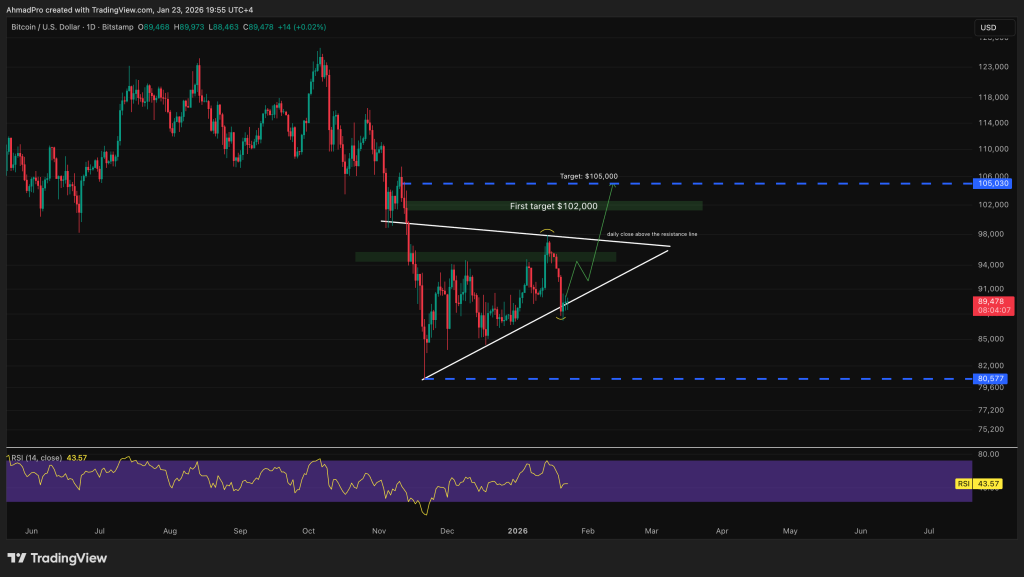
BTC is starting to tighten up inside a squeezing structure, with rising support pushing price into a descending resistance line. It is basically a classic compression setup.
The main level to watch is the $96,000–$98,000 resistance zone, which has shut down every bounce so far. A daily close above that area would be a big deal and could open the door for a move toward $102,000, then $105,000.
On the downside, rising support from the recent lows in the low $80,000s has held up well, keeping higher lows intact and stopping a deeper breakdown.
Momentum is neutral but slowly improving. For now, Bitcoin is stuck in consolidation after the recent drop, and this is a patience game.
Ethereum Price Prediction: ETH Holds Support but Lacks Conviction
Ethereum spot ETFs continue to record outflows. However, the recent outflows are low compared to past days’ outflows, which is a good sign. ETH spot ETFs recorded $42 million in outflows
ETH price is trying to hold its structure after a rough pullback, with price riding along rising support but struggling to break through the $3,400–$3,500 resistance zone.
That area has rejected price multiple times, which is why ETH keeps stalling instead of trending higher. As long as the rising support around the high $2,600s to $2,700 zone holds, the bigger structure stays constructive, and this move looks more like consolidation than a full breakdown.
A clean break above $3,500 would be the first real sign of strength and could open the door for a push toward $4,300, with $5,000 as the larger upside target.
Momentum is still weak but starting to stabilize. RSI needs to push back above 50 to support a stronger bullish move.
XRP Price Prediction: XRP Tries to Escape the Downtrend, Is $2.50 Next?
XRP is still stuck inside a well-defined descending channel, which explains why rallies keep getting sold into instead of turning into real trend reversals.
Price recently bounced from the $1.80 area, which is acting as a key demand zone and the main bullish invalidation level.
As long as XRP holds above that level, this bounce remains technically valid, but the structure is still weak overall. The first real test for buyers sits around the $2.40–$2.50 zone, where the price previously broke down and where the upper channel resistance lines up.
A clean break and daily hold above that area would be the first sign that momentum is shifting, opening the door for a move toward the $3.00 target zone.
Momentum is still mixed. RSI is sitting around 42. Notice something? All three are sitting at the same point waiting for the major move.
Holding above $1.80 keeps the bullish scenario alive, while a break below that level would invalidate the setup and likely send XRP back toward lower support
Bitcoin Hyper Is Loading While the Market Sleeps
With Bitcoin compressing under $100,000, Ethereum stuck below major resistance, and XRP still fighting its downtrend, the market is clearly in a waiting phase. That is usually when attention quietly shifts to projects that do not need a confirmed breakout to start moving.
That is where Bitcoin Hyper is starting to stand out.
Bitcoin Hyper is being positioned as a high-beta play built specifically for volatility cycles like the one CZ is hinting at. When Bitcoin enters a supercycle, capital does not just flow into majors. It spills into smaller, faster-moving narratives that offer asymmetric upside, especially while the big names are still consolidating.
The project has already raised over $30.9M, showing strong early conviction even while the broader market remains cautious. On top of that, Bitcoin Hyper offers staking rewards around 39% APY, giving holders an incentive to stay locked in instead of trading short-term noise.
Historically, the biggest winners of new cycles are rarely the assets that break out last. They are the ones accumulated quietly while Bitcoin ranges, Ethereum chops, and XRP frustrate traders. Bitcoin Hyper is clearly targeting that window.
If Bitcoin really does enter a supercycle in 2026, the projects built and accumulated during this compression phase are often the ones that move first and hardest once momentum returns. Bitcoin Hyper is shaping up to be one of those names traders keep an eye on.
Recent remarks from BlackRock CEO Larry Fink have pointed toward the need for a single, unified blockchain for tokenized markets, and have intensified the focus on platforms capable of handling institutional-scale liquidity, compliance, and settlement. With its long track record in smart contracts, extensive developer ecosystem, and growing role in regulated financial products, Ethereum is now emerging as the most likely candidate to serve as the settlement layer for tokenized capital markets.
Why Asset Managers Prefer Familiar Infrastructure
In an X post, the Ethereum Daily shared a video in which BlackRock CEO Larry Fink made it clear that tokenization is necessary. Speaking at the World Economic Forum, Fink said the financial system must move rapidly toward digitization, adding that a single, common blockchain could reduce corruption and improve transparency across the global markets.
While Fink did not name a specific network, the most plausible candidate could be ETH, based on BlackRock’s own initiatives and public statements that emphasized the role of ETH in asset tokenization. The firm has consistently highlighted ETH as a core platform for its on-chain strategy. Meanwhile, BlackRock launched its BUIDL tokenized money market fund directly on ETH, a product that has already grown to over $2 billion in total value locked. “There’s no second best,” Ethereum Daily noted.
In the staking space, Bitmine has turned Ethereum staking into a multi-billion-dollar business. An analyst known as Milk Road has revealed that the company now has 1.83 million ETH staked, worth roughly $6 million at current prices, and plans to scale that figure toward 4.2 million ETH over time. Over the past months, Bitmine Immersion Technologies Inc. (BMNR) has accounted for nearly 50% of all new ETH entering the staking queue.
Staking at this scale is important because it removes ETH from the liquid supply and locks it into long-term infrastructure rather than keeping it for short-term trading. When one player is willing to commit billions of dollars worth of ETH to staking, it reflects confidence in ETH’s future economic prospects. A lower liquid supply, combined with sustained network demand, will create structural pressure over time.
How Support Built Through Multiple Market Cycles
Analyst Milk Road has also highlighted that Ethereum is holding near a critical support zone around $3,000, hovering just above the lower boundary of its long-term rising structure, an area that has acted as a stress test for ETH throughout the cycle. Historically, when ETH drifts into this area, the market will need to decide whether the weakness is temporary or structural.
The $2,750 level remains the key line because it has repeatedly stopped downside pressure after macro-driven or narrative-driven pullbacks, making it a reliable floor for the broader trend. As long as ETH holds above that level, the broader multi-year uptrend will remain intact.
A massive generational wealth transfer could reshape crypto markets over the next two decades as younger investors inherit trillions in assets and redirect capital toward digital assets at unprecedented rates.
Nansen founder Alex Svanevik predicts the impending shift will fundamentally alter crypto market dynamics, while recent data shows younger generations already allocating significantly more portfolio exposure to digital assets than their predecessors.
The transfer involves roughly $100 trillion changing hands globally within 20 years, with younger heirs demonstrating markedly different investment preferences than current asset holders.
“It’s like a tidal wave, you know, a tsunami that’s coming,” Svanevik told Magazine, explaining that even modest allocation shifts could double crypto’s current $3.05 trillion market cap. “There are all these kinds of forces that I think just drive crypto upwards.“
INSIGHT: Nansen co-founder Alex Svanevik believes a "tidal wave" of new money is set to enter crypto, potentially doubling the total market cap.
In fact, a very recent Bitget Research found 20% of Gen Z and Alpha respondents expressing openness to receiving retirement funds in cryptocurrencies, while 78% showed more confidence in alternative savings methods than traditional pension funds.
Similar to Svanevik, Galaxy Digital’s Zac Prince also emphasized the demographic inevitability earlier this month, noting younger investors prefer “an app first” platform approach over traditional brokerage relationships.
“The older people are going to pass away and pass the money down to younger people,” Prince explained.
He added that younger investors are “much more familiar with platforms like the one that we have at GalaxyOne, where it’s kind of an app first. Multiple kinds of products in one place, really intuitive user interface versus the traditional, you have to pick up a phone and call your broker.“
Galaxy Digital says $83 trillion Baby Boomer wealth transfer could fuel crypto adoption as 45% of younger US investors already hold digital assets versus 18% of older generations.#Crypto#Adoptionhttps://t.co/DviS4QCNBm
2025 UBS data reveals $83 trillion will transfer between generations over the next 20-25 years, with $29 trillion in the United States alone.
Prince noted that wealth transfer patterns don’t strictly correlate with population size or GDP, pointing to Italy, which, despite having half Japan’s population and 60% of its GDP, is projected to see higher inter-generational wealth transfers due to higher savings rates and home ownership among elderly citizens.
Infrastructure Maturation Allows Sophisticated Product Development
The crypto industry has reached a level of key infrastructure maturity, allowing institutional-grade products that were previously impossible to build.
“The product we have built could not have been built two or three years ago because the infrastructure wasn’t there,” Svanevik explained, pointing to improved wallet technology and execution capabilities. “The wallet technology wasn’t good enough.“
Institutional adoption has accelerated alongside infrastructure improvements.
Last month, FINRA Foundation data shows crypto consideration among U.S. investors dropped from 33% to 26% between 2021 and 2024, with 66% viewing digital assets as extremely or very risky, up from 58%.
US crypto purchase interest falls to 26% from 33% in 2021 as investor risk appetite declines sharply, FINRA study shows.#US#Cryptohttps://t.co/4mTMJ49hLC
However, institutional products continue proliferating.
Prince noted distribution channels remain partially closed but expects continued expansion throughout 2025.
“The ETFs just came around last year. Some warehouses and other firms have a one-year lockdown on new ETFs being able to be made available to their clients.“
Gulf-region families show the wealth-transfer pattern already unfolding.
Banks, including Citigroup, Barclays, and Deutsche Bank, are scaling Gulf wealth divisions to capture an estimated $1 trillion in regional wealth transfers.
Svanevik believes passage of the CLARITY Act will usher in “a new era for crypto in the US,” with global implications. “The rest of the world is going to follow.“
Bitcoin Struggles Despite Wealth Transfer Optimism
Despite long-term adoption trends, Bitcoin has lost roughly 25,000 millionaire addresses in the year since President Donald Trump returned to the White House, falling from 157,563 addresses at his January 2025 inauguration to 132,383 by Jan. 20, 2026.
Source: TradingView
The crypto dipped below $90,000 today amid broader market volatility, even as institutional products continue proliferating and younger generations position themselves to inherit trillions in assets over the coming decades.
Ethereum is currently trading under pressure after failing to push above the $3,000 level again over the past 24 hours, a move that is reflecting trader sentiment across the derivatives markets. ETH is currently trading at $2,925, down 2.7% on the day, after moving within a 24-hour range capped at $3,012.99 and finding lows around $2,909.60, according to price data from CoinGecko.
As price action weakens, a notable change has been developing, with on-chain data showing funding rates drifting toward negative territory and derivative positioning beginning to tilt more defensively.
Funding Rates Slide As Shorts Gain Ground
Ethereum’s failure to hold above $3,000 is an important psychological break for traders, especially after several failed attempts to hold above that level in January. Price action over the past week shows sellers maintaining control after ETH rejected around $3,360 on January 18, followed by a steady push lower toward the high-$2,900s.
Although the pullback has so far been orderly above $2,900, this decline has come alongside fading momentum across the derivatives market.
One of the clearest signals for this can be seen in Ethereum’s OI-weighted funding rate, which has been steadily compressing and is now edging toward negative levels. At the time of writing, Ethereum’s OI-weighted is at 0.0008%, close to breaking into negative territory and far below readings around 0.009%, which it registered earlier in the month.
Funding rates turning negative typically indicate that short positions are paying longs, meaning stronger demand for downside exposure. Funding spikes that previously accompanied the price rebound in early January have faded, and the overall trend suggests bearish positioning is slowly gaining the upper hand.
Open Interest, Liquidations, And What’s Next
Although Ethereum’s price action fell below $3,000, derivatives traders have stayed in the market, keeping total open interest at high levels. Data from CoinGlass shows aggregate Ethereum open interest increasing by 0.68% in the past 24 hours, which shows that many traders are not exiting Ethereum entirely. At the time of writing, the total open interest is sitting at about 13.36 million ETH, equivalent to roughly $39.19 billion.
Looking across major exchanges, Binance has the largest share of ETH open interest, accounting for about $8.95 billion, but it is down by 0.8% in the past 24 hours. CME follows with approximately $5.73 billion in open interest, up by 3.72% in the past 24 hours. Gate comes next at around $4.01 billion, while MEXC comes in close at $3.51 billion worth of ETH open interest.
Over the past 24 hours, Ethereum liquidations totaled $64.34 million, with long positions ($52.52 million) accounting for the majority of losses.
A hold above $2,900 could allow Ethereum’s funding rates to normalize and open the door for another rebound attempt to $3,000. However, a continued fall in funding rates into negative territory could see bearish control pushing Ethereum below $2,900.
Over the years, Ethereum staking has become one of the most vital and successful aspects of the broader ETH ecosystem, with big companies steadily jumping into the field. The majority of these companies, especially Bitmine Immersion, are revolutionizing ETH staking, turning it into a massive financial sector and edge.
Bitmine Monetized Ethereum Staking At Scale
After the entry of institutional investors, Ethereum staking has been transformed into a significant business opportunity from a technical requirement. At the forefront of this evolution is Bitmine Immersion Technologies Inc. (BMNR), a leading digital asset platform dedicated to improving the ETH ecosystem.
With its remarkable involvement in ETH staking, Bitmine Immersion is proving just how large this opportunity can be. The digital asset platform has successfully transformed Ethereum staking into a multi-billion-dollar enterprise by growing its validator operations and staking infrastructure.
As outlined by Milk Road on the social media platform X, the company intends to increase its present investment of 1.83 million ETH, valued at approximately $6 billion at current rates, to 4.2 million ETH. Bitmine’s plan and robust participation in ETH staking are a clear sign of the growing institutional appetite for on-chain yield.
This expansion demonstrates how staking is now about creating profitable, long-lasting businesses around ETH’s proof-of-stake economy rather than just protecting the network. Over the past month, Bitmine has been responsible for almost half of all new ETH entering the staking queue.
Milk Road stated that staking at this scale removes Ethereum from the liquid supply and locks it away in long-term infrastructure rather than short-term trading. When a single player expresses a willingness to commit billions of dollars’ worth of ETH to staking, it points to an increased confidence in ETH’s future economics.
According to the expert, structural pressure is created by a reduced liquid supply and ongoing network demand over time. Given the sustained growth in institutional staking, Milk Road is confident that ETH’s price will move higher in the foreseeable future.
ETH Powering Crypto Native Financial Rails
With crypto native financial rails expanding, Ethereum is increasingly being positioned as the core infrastructure for major financial firms. JP Morgan asset management firm has confirmed this narrative with its latest fund launched on the ETH network.
Milk Road has reported that JP Morgan has introduced a tokenized money market fund on ETH, which is now live and already holds over $100 million in US treasuries. The rails are native to cryptocurrency, and the product appears to be traditional finance.
In reality, there is no separation, and there is only a financial product operating on the trains that make the most sense. Interestingly, this is how institutions move into new systems. “Incrementally, and only after the rules are clear enough to deploy real capital. Once they are live, they don’t leave,” Milk Road stated.
Ethereum cofounder Vitalik Buterin has outlined a personal shift away from Big Tech platforms, framing 2026 as a pivotal year for what he calls “computing self-sovereignty.”
This is a concept that extends beyond blockchain and into how individuals use everyday software, communication tools, and artificial intelligence.
2026 is the year we take back lost ground in computing self-sovereignty.
But this applies far beyond the blockchain world.
In 2025, I made two major changes to the software I use:
* Switched almost fully to https://t.co/caFP0K5fYF (open source encrypted decentralized docs) *…
In a post shared on X, Buterin described a series of changes he has made across his devices to reduce reliance on centralized, data-intensive services.
Vitalik Buterin Replaces Google, Telegram With Privacy-Focused Alternatives
He claimed that the process started in 2025 when he transferred nearly completely to the open-source and encrypted and decentralized document platform Fileverse, which is purported to be a privacy-focused alternative to Google Docs.
At roughly the same period, he reported having changed to Signal as his main messaging application, abandoning Telegram.
Signal supports end-to-end encryption on all conversations by default and only retains a little metadata, whereas Telegram encrypts messages only in optional so-called secret chats.
The changes made in 2026 included more extensive ones, which were due to those initial adjustments.
Buterin claimed to have substituted Google Maps with OpenStreetMap, with Organic Maps on mobile phones, citing the advantage of local and offline use that restricted the volume of location data sent to third parties.
He also left Gmail for Proton Mail, citing encrypted messaging as a more powerful tool to use for confidential communication.
Simultaneously, he claimed to have started giving priority to decentralized social media and still tests the idea of running large language models locally, as opposed to using cloud-based AI services.
Buterin Sees Local AI as the Future of User Privacy
The rationale of these decisions is not purity in ideology but practicality, as Buterin wrote.
According to him, it is not necessary to send big amounts of personal information to centralized services, as there are tools that can be used to minimize this exposure.
He admitted that local AI systems still have usability and integration issues, especially for translation, transcription, and document search, but noted that there has been a lot of improvement in the last year.
He explained a more ambitious long-term vision where local models are integrated with cryptographic schemes like zero-knowledge proofs, trusted execution environments, and local data filtering to restrict the information that ever leaves a user’s device.
Rising AI Demand Puts Self-Sovereign Computing Back on the Map
The remarks made by Butterin come amidst the wider revival of interest in self-sovereign computing, which is a model that highlights the importance of individualized controls of data, identity, and computing resources.
The idea integrates identity systems based on decentralization, personal servers, and privacy-by-design software with the aim of minimizing reliance on platforms that are controlled by corporations.
Privacy activists, including Naomi Brockwell, have long held the position that the most consistent approach to ensuring autonomy is to run software and AI models in place.
The most private way to use AI is to host it locally, but you're limited by your own hardware. There are AI platforms that allow you to access more powerful models & also respect your privacy. Planning to update this video soon to include newcomers like https://t.co/ueOskOEx0g. pic.twitter.com/WlB6PUxlpA
With the demand of large-scale AI continuing to outpace its supply, compute and energy are becoming viewed as a source of geopolitical power.
In that environment, the appeal of local and decentralized computing models has grown, particularly as concerns mount over surveillance, data residency, and platform dependence.
Ethereum may be down 3% in the past 24 hours, dropping to $2,915 as the broader crypto market cools, but behind the short-term dip lies a far bigger story.
Despite recent turbulence, Ethereum is still being positioned by BlackRock as a core pillar of the future financial system, with the asset management giant calling it a potential “toll road” for tokenization.
ETH has dropped 12% over the past week and 9% over the last year, but its long-term outlook remains strong.
With institutional interest rising and tokenization gaining momentum across global finance, 2026 could be the year Ethereum cements its role as the infrastructure layer for the next generation of money, supporting a highly bullish Ethereum price prediction.
Ethereum Price Prediction: Wall Street Giant BlackRock Sees Ethereum as Financial Infrastructure – Could ETH Become the Internet of Money?
In one section of its 2026 thematic outlook, BlackRock suggested that growing stablecoin adoption is a sign of increasing tokenization, and that “blockchains like Ethereum” are in a good position to benefit.
The asset manager also noted that 65% of all tokenized assets currently run on Ethereum, a strong indicator of the latter’s dominance in this sector, and in crypto more generally.
Source: BlackRock
And there has been a big drive towards tokenization among major financial institutions over the past year or so, with Deutsche Bank even predicting in November that tokenized capital markets could become “the default infrastructure for issuance and trading by 2030,” and that the market tokenized real-world assets (not including stablecoins) could reach $2 trillion by this year.
In other words, Ethereum is in a very bullish position right now, and its chart is reflecting this.
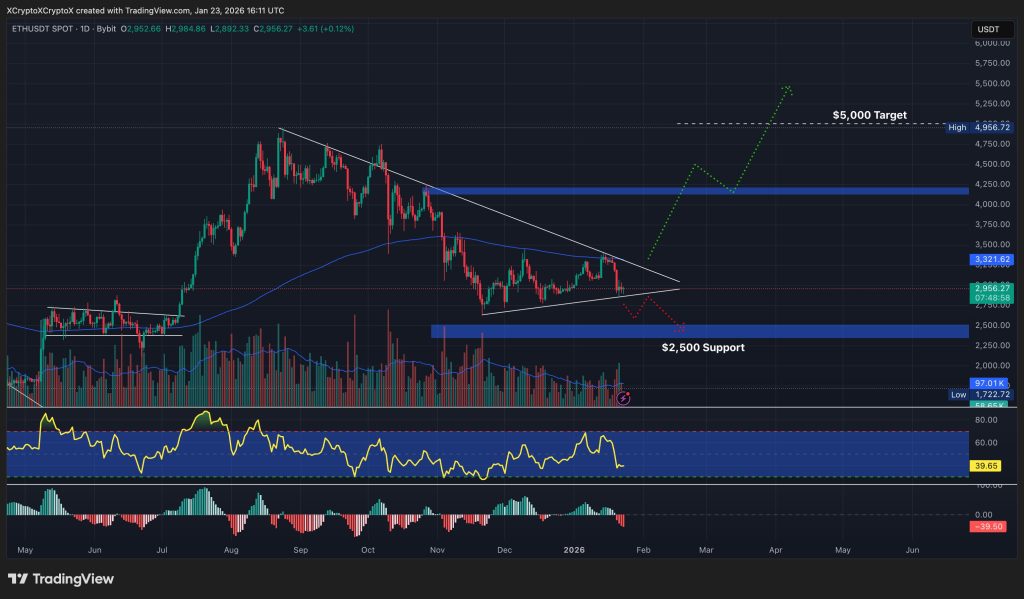
ETH is currently filling out a long-term triangle pattern and moving closer to a key decision point on the chart.
If it breaks to the upside, the next major target would be the $4,000 level, followed by a possible push toward all-time highs.
In the case of a pullback, ETH could dip to the $2,500 support zone before continuing its upward trend.
We could see price compression further in the coming days, with a breakout likely to set the tone for Ethereum’s next major move.
New SUBBD Presale is Bringing AI Content Creation to the Blockchain: Could It 100x in 2026?
Traders may also want to pursue a diversification strategy, in order to expand their exposure to potential gains.
Such a strategy should include an allocation to newer tokens, including presale coins, which can have the potential to rally exponentially when they list for the first time.
Are you interested in AI Agents? Meet Miss Zara Sole
It’s in the process of launching an adult content creation platform, one which offers users AI tools that can help with content generation and even generation of AI performers.
Such tools will make creators more productive, while the use of crypto – via native token SUBBD – will make payouts instant and transparent.
This is why SUBBD is already garnered a strong following, with investors able to join its sale by going to the SUBBD website.
An inactive Ethereum whale has just re-entered the trading scene, withdrawing over $15 million worth of ETH in just a single day. Considering Ethereum’s slow price growth over the past few months and the whale’s sudden appearance despite being dormant for months, there could be a possibility of insider trading.
Dormant Ethereum Whale Moves $15 Million ETH
A sudden $15.14 million Ethereum transaction has caught the crypto market’s attention, with the move either driven by insider knowledge or simple strategic positioning. According to data from blockchain analytics platform, Onchain Lens, the transfer shifted approximately 5,099 ETH from a dormant wallet address on Kraken into active circulation on Thursday, January 22.
Based on on-chain records, the whale, identified by the address ‘0x761F2F,’ has remained inactive in the market for more than three months. The last few times the whale was actively moving in the market were when it executed a series of stablecoin and HYPE transactions. The anonymous whale had initiated multiple million-dollar trades in UETH, USDT, and USDC. Meanwhile, the HYPE transactions were primarily token burns.
After withdrawing 5,099 ETH from Kraken, Arkham Intelligence reported that the whale had transferred the ETH to Lido Finance, converting it into 5,100 STETH. While there is currently no evidence of insider trading, the timing of the transaction raises questions, especially given Ethereum’s muted price action over the past few months and the mounting selling pressure from large scale holders.
Typically, insider trading in crypto occurs when individuals with non-public information make large transactions ahead of major market events that could influence market price. Currently, there has been no spike in Ethereum’s price, nor any major news that could suddenly affect its movements. In fact, ETH continues to trade lower, down by roughly 1.7% over the past 24 hours. Its daily trading volume is also down by 34.89%, signaling reduced confidence among traders and investors.
Whales Go Long On Ethereum
While dormant large-scale players are suddenly re-entering the market, some active whales remain bullish on Ethereum’s long-term prospects despite its ongoing downtrend. According to well-known market analyst Max Crypto, an anonymous whale has just opened a $202 million long position in ETH with 15x leverage.
The scale of the trade is extraordinary considering Ethereum’s recent volatility. It shows strong confidence in the cryptocurrency’s future price action and its potential to overcome its ongoing downtrend. Notably, the position has a liquidation price of $2,495, meaning that if ETH falls to that level, the trade could be forcibly closed by the crypto exchange, resulting in substantial losses for the whale.
Market participants are closely watching the whales’ positioning, with some calling it a brave but chaotic bet. Others have even speculated that the position may have been taken based on insider information, fueling discussions about potential market moves and a possible bullish turnaround for ETH.
Pi Network, XRP, and Ethereum all sold off over the past week as Trump’s Greenland ambitions unnerved risk markets, with on-chain and technical signals suggesting more volatility before any sustainable rebound. Pi Network (PI) is trading around $0.18 after a shallow bounce…
The crypto market is down today after a brief jump. The cryptocurrency market capitalisation decreased by 2.2% over the past 24 hours, pulling back to $3.11 trillion. At the time of writing, 70 of the top 100 coins have seen their prices drop. The total crypto trading volume stands at $110 billion.
TLDR:
Crypto market cap is down 2.2% on Friday morning (UTC);
70 of the top 100 coins and 8 of the top 10 coins are down;
BTC decreased by 0.4% to $89,477 and ETH fell by 2% to $2,945;
Geopolitical uncertainty may leave BTC oscillating between its safe-haven narrative and its high-beta risk asset role;
Ukraine-Russia talks may help ease markets’ tail-risk fears, but only temporarily;
BTC’s outlook is driven by macro conditions and actual capital flows;
BTC is no longer trading in a state of euphoria;
‘The most plausible near-term scenario is for Bitcoin to continue consolidating in a cautious manner’;
US SEC and CFTC Chairmen will hold a crypto-focused joint event on 27 January;
Ledger is reportedly planning a US IPO that could value it over $4 billion;
US BTC and ETH spot ETFs saw $32.11 million and $41.98 million in outflows, respectively;
Crypto market sentiment remained unchanged within the fear zone.
Crypto Winners & Losers
As of Friday morning (UTC), 8 of the top 10 coins per market capitalisation have seen their price drop over the past 24 hours.
Bitcoin (BTC) fell by 0.4%, currently trading at $89,477. This is the smallest drop on the list,
Bitcoin (BTC)
24h7d30d1yAll time
Ethereum (ETH) decreased by 2%, changing hands at $2,945. This is the second-highest drop in the category.
The highest fall among the top 10 is XRP’s 2.2%, now standing at $1.91.
On the other hand, two coins are currently green. Tron (TRX)appreciated by 3.3% to the price of $0.309.
Binance Coin (BNB) is technically also green, but its increase is so low that the price is practically unchanged. It’s up 0.1% to $890.
At the same time, of the top 100 coins per market cap, 70 have seen their price drop today.
Pump.fun (PUMP) fell the most among these: 6.4% to $0.002481.
On the green side, Rain (RAIN) appreciated the most: 8.4% to $0.00997.
River (RIVER)is next, with a rise of 7.4% to $49.83.
Meanwhile, in the US, SEC Chairman Paul Atkins and CFTC Chairman Michael Selig will hold a joint event on 27 January to discuss ending regulatory chaos, as well as efforts to make the United States the global crypto capital.
“For too long, market participants have been forced to navigate regulatory boundaries that are unclear in application and misaligned in design, based solely on legacy jurisdictional silos,” the chairmen said in their statement.
I'm looking forward to joining @ChairmanSelig next week at our @SECgov and @CFTC joint event to discuss harmonization between our two agencies.
Together we will discuss our efforts to deliver on President Trump’s promise to make the US the crypto capital of the world.
According to Bitunix analysts, the recent developments around the Russia-Ukraine war may be beneficial for the markets, but possibly only in the short term. The US will facilitate talks between Ukraine and Russia in Abu Dhabi today.
At the macro level, analysts say, “this initiative may help ease markets’ tail-risk fears of a full-scale escalation in the near term, but it does not imply a rapid end to the conflict.” A limited ceasefire could be more realistic.
Moreover, geopolitical risk premia could ease in the short term, supporting risk assets and dampening volatility in energy prices, they add.
Yet, the symbolism of these talks may outweigh any immediate breakthroughs. Over the medium term, “markets will need to see tangible room for Russian concessions; absent that, sentiment is likely to swing back and forth.”
For crypto markets, “a scenario in which geopolitical uncertainty merely ‘cools but does not thaw’ would leave Bitcoin oscillating between its safe-haven narrative and its role as a high-beta risk asset,” they conclude.
BTC is No Longer in State of Euphoria
Linh Tran, Senior Market Analyst at XS.com, commented that Bitcoin’s short-term outlook is centred on interest rates, liquidity, and institutional capital flows.
“After the sharp volatility seen toward the end of 2025, BTC is no longer trading in a state of euphoria, but instead reflects the cautious sentiment of global investors amid persistently high rates and financial conditions that have yet to meaningfully ease,” Tran writes.
One of the most important factors influencing BTC is the level of U.S. Treasury yields. “BTC struggles to attract sustained new inflows unless markets begin to believe that the monetary policy cycle is approaching a turning point.”
Meanwhile, the US Federal Reserve will likely hold a cautious stance at the late-January meeting. Therefore, “only sufficiently strong economic data capable of shifting expectations around the rate path are likely to generate meaningful volatility in BTC; otherwise, the market is likely to remain locked in a tug-of-war,” the analysts argue.
Still, the most decisive factor for BTC’s near-term outlook are institutional flows, they conclude. “Bitcoin only establishes a durable uptrend when ETF flows remain consistently positive, rather than through sporadic inflows that are quickly reversed.”
Moreover, the dip-buying demand has not been strong enough to push prices through key resistance levels. Therefore, “without the support of fresh inflows, each rebound risks turning into a profit-taking opportunity, leaving the short-term trend choppy and lacking clear direction.”
“From my perspective,” Tan writes, “the most plausible near-term scenario is for Bitcoin to continue consolidating in a cautious manner, with downside risks persisting if ETF outflows continue. For a more constructive scenario to emerge, the market would need to see improvement on two fronts simultaneously: easing financial conditions and a steady return of institutional net buying.”
Conversely, Tan says, “if yields rebound or global markets shift decisively into a defensive, risk-off stance, Bitcoin is likely to face renewed downside pressure in the short term, given its high sensitivity to changes in risk appetite.”
Levels & Events to Watch Next
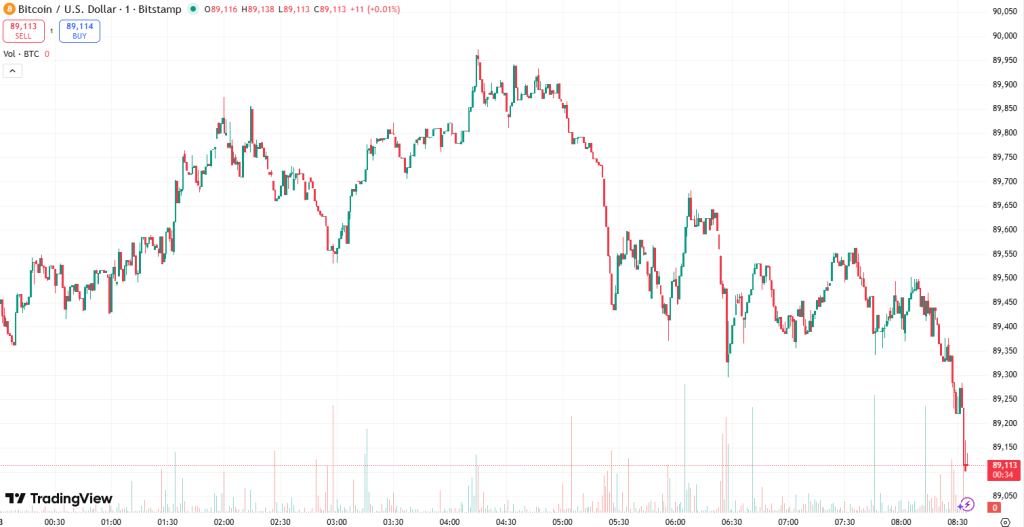
At the time of writing on Friday morning, BTC was changing hands at $89,477. It was quite a choppy trading day for the coin. The coin initially and briefly climbed to the intraday high of $90,159 and then dropped to the day’s low of $88,557. It continued trading in this range.
Over the past 7 days, BTC decreased by nearly 7%, trading in the $87,653–$95,649 range.
We now found the support at $89,300, followed by the $87,400 level. The latter previously acted as demand. On the other hand, the resistance levels stand at $91,800 and $94,200.
Bitcoin Price Chart. Source: TradingView
At the same time, Ethereum was trading at $2,945. It saw a similarly choppy trading day. Earlier in the day, it fell from $3,012 to the intraday low of $2,909. For most of the day, it traded in the $2,944-$2,953 range.
Moreover, ETH fell 11.3% over the past seven days, moving between $2,898 and $3,361.
Should the downward push continue, the price may fall further below $2,900, followed by $2,830 and $2,745. If the tide turns, ETH may reclaim the $3,000 level, and if it manages to hold it firmly, the move could open doors for additional notable increases.
Ethereum (ETH)
24h7d30d1yAll time
Meanwhile, the crypto market sentiment remained unchanged over the past day, firmly maintaining its position within the fear zone.
The crypto fear and greed index currently stands at 34 today, the same level as yesterday.
This highlights the overall uncertainty and caution in the market, with participants waiting to see in which direction the needle will move.
ETFs See the Highest Drop in Two Months
The US BTC spot exchange-traded funds (ETFs) posted minor outflows on 22 January, totalling $32.11 million. This is the lowest amount of flows in nearly a month. The total net inflow now stands at $56.6 billion.
Of the twelve ETFs, only two recorded outflows, and none saw inflows.
BlackRock let go of $22.35 million, and Fidelity followed with $9.76 million in outflows.
Additionally, the US ETH ETFs posted minor negative flows as well, with $41.98 million. Like their BTC counterparts, this is also the lowest amount since late December. With this, the total net inflow pulled back further for a third day in a row to $12.34 billion.
Of the nine funds, two ETH ETFs posted outflows, and two saw inflows. Grayscale took in 17.63 million in total.
At the same time, BlackRock recorded $44.44 million in outflows, followed by Bitwise’s $15.16 million.
It would do so in collaboration with Wall Street banks Goldman Sachs, Jefferies, and Barclays.
Exclusive: The French cryptocurrency group, which sells devices that allow investors to securely store tokens, is working with bankers at Goldman Sachs, Jefferies and Barclays on an initial public offering that could take place as soon as this year. https://t.co/SLDJma0xX1pic.twitter.com/FdoOGh6B58
After a single day of increases, the crypto market reverted to downward action that governed this week. Meanwhile, the US stock market closed the Thursday session higher for the second consecutive day. By the closing time on 22 January, the S&P 500 was up 0.55%, the Nasdaq-100 increased by 0.76%, and the Dow Jones Industrial Average rose by 0.63%. Presumably, the TradFi markers are still digesting the US’s apparent decision not to use military force in Greenland or impose tariffs on eight NATO allies.
Is this drop sustainable?
For now, we may continue to see further decreases in the crypto market, at least in the short term. Nonetheless, the price action is not closed for a renewed upward trajectory, though how stable it would be is still unclear.
Crypto researcher Axel has provided insights into why the Bitcoin, Ethereum, and Solana prices are still crashing. This comes as BTC continues to see a supply overhang, which threatens to put more downward pressure on crypto prices.
Why The Bitcoin, Ethereum, and Solana Prices Are Still Crashing
In a research report, Axel noted that anomalous exchange inflows accompanied the BTC breakdown below the $90,000 zone as sellers prepared in advance. The market is also still at risk of further selling pressure as the 1.0 level of the short-term holders’ SOPR is now acting as a resistance rather than support. As such, there is a possibility that Bitcoin, Ethereum, and Solana prices will decline further.
Further commenting on Bitcoin netflows into exchanges, Axel noted that between January 20 and 21, almost 17,000 BTC flowed into exchanges, coinciding with BTC dropping to as low as $87,000, while Ethereum and Solana prices also dropped. The crypto researcher explained that these anomalously high values followed a period of predominantly negative netflow in the first half of this month.
In the context of the falling Bitcoin price, Axel stated that such a spike is more likely to reflect supply preparation than neutral transfers. In other words, the breakdown below $90,000 appears to be structural rather than emotional. Meanwhile, Bitcoin netflow returned to neutral levels yesterday, but the accumulated inflow still creates a supply overhang, which could lead to further declines in the prices of Bitcoin, Ethereum, and Solana.
Axel noted that a signal of improvement would be if netflow turns negative again amid rising prices, which could indicate that the overhang has cleared. However, with the short-term holders’ 7-day SMA SOPR below 0.996, the crypto researcher suggested that BTC faces increased selling pressure on every recovery as these holders look to sell at breakeven. He added that a reversal trigger could be confirmed if the SOPR breaks above 1.0 from below, with the 7-day SMA holding unity for three to five days to filter out false spikes after the selloff.
Why A Break Above $100,000 Looks Unlikely For Now
In its latest research report, on-chain analytics platform Glassnode explained that a Bitcoin rally above $100,000 looks unlikely for now as the supply overhang persists. They noted how this overhang supply above $98,000 remains the dominant sell-side force capping short to mid-term rebounds.
Alluding to the Unspent Realized Price Distribution metric, Glassnode noted that the recent BTC rally has partially filled the prior air gap between $93,000 and $98,000, driven by redistribution from top buyers into newer market participants.
However, the unresolved supply overhang is expected to likely cap attempts above the $98,400 short-term holders’ cost basis and the $100,000 level. A meaningful and sustained acceleration in demand momentum is said to be required for a clean breakout above $100,000 to occur.

 Login
Login