XRP price has been in a downtrend for nearly three weeks, falling over 20% in the period. Can it backtrack its losses as technicals start leaning in favor of bulls? According to data from crypto.news, XRP (XRP) price dropped to…
Japan is edging closer to approving spot cryptocurrency exchange-traded funds, with regulators signaling that the first products could be cleared for listing as early as 2028. A report published by Nikkei Asia on Jan. 26 said the Financial Services Agency…
Bitcoin ETFs recorded $1.33 billion in net outflows during the week ending January 23 and had the second-largest weekly redemption on record. The exodus reversed the previous week’s $1.42 billion inflow, as institutional investors reduced crypto exposure amid market volatility.…
US-based spot Bitcoin exchange-traded funds pulled funds for a fifth straight trading day, and the totals added up quickly. According to Farside data, about $103.5 million left on Friday, bringing the five-day sum to roughly $1.72 billion.
Bitcoin was trading near $89,160 at the time of these reports — still well below the $100,000 mark it last reached on November 13. This movement has sent a clear signal: many investors are stepping back right now.
ETF Flows And Who Is Selling
Reports note that ETF flows are often on the radar as a quick read on investor mood, but the picture is not always simple. Large outflows can reflect institutional rebalancing or tactical moves by funds, not only mass retail selling.
The US market had a four-day trading week because of Martin Luther King Jr. Day on Monday, which may have concentrated trades into fewer sessions and amplified the numbers. Still, losing more than a billion dollars in a few days will get attention.
Market Mood And Metals
The wider mood has soured. The Crypto Fear & Greed Index registered an Extreme Fear score of 25, and sentiment trackers have been flashing caution. Reports say Santiment believes retail traders are pulling back while attention drifts toward more traditional assets.
Meanwhile, metals have been strong. Reports disclose that with gold trading near $5,000 and silver approaching $100, some market players feel Bitcoin has been left out of a rally that lifted metals, which has weighed on confidence in the crypto market.
Bitcoin Price Action
Bitcoin has struggled to find a steady rhythm over the past week. Prices slipped below the $89,000 to $90,000 range as traders reacted to fresh geopolitical tension and renewed trade worries, before stabilizing as nerves eased.
This was driven higher after some soft political indicators around tariff threats, only to substantiate the idea that markets rarely react to conflict but rather to changes in tone and expectations.
Signals That Could Matter
These movements illustrate how Bitcoin behaves more like a risk asset rather than an asset shelter, falling in tandem with equities when unexpected financial shocks hit the globe, before rebounding when the fever subsides to gather fresh buyers.
Current price patterns indicate caution, where traders are weighing short-term political risks against medium- and long-term macro patterns, as well as institutional interests.
There are some quieter indications that the rout could be losing steam. To this effect, there are assertions suggesting that supply distribution on-chain and social chatter can be circumstantial evidence showing there is less selling pressure.
Featured image from Money; Shutterstock, chart from TradingView
The Bitcoin Spot ETFs continue to witness a volatile start to 2026, with back-to-back weeks showing sharply contrasting performance. After netting a staggering $1.42 billion in weekly netflows on January 16, market momentum soon swung the opposite way in line with a Bitcoin decline, forcing a net outflow of $1.33 billion over the last week. A similar phenomenon was seen in the first two weeks of the year, after an initial net deposit of $458.77 million by January 2 was followed by a net outflow of $681.01 million by January 9. This investor behavior suggests a highly reactive market with little long-term confidence.
No Positive Performance In Bitcoin Spot ETF Market Onslaught
In analyzing the most recent wave of withdrawals in the Bitcoin Spot ETF market, data from SoSoValue shows that the fourth trading week of January recorded no single day with a positive netflow. The heaviest outflows totaled $708.71 million on January 21, followed by the smallest daily outflow of $32.11 million on January 22.
Looking at individual funds, BlackRock’s IBIT, the market leader, suffered the largest net outflows valued at $537.49 million. As usual, Fidelity’s FBTC ranks a close second with redemptions surpassing deposits by $451.50 million. Other Bitcoin Spot ETFs with heavy net outflows also included Grayscale’s GBTC, Bitwise’s BITB, and Ark Invest’s ARKB, which suffered losses estimated at $172.09 million, $66.25 million, and $76.19 million, respectively.
Meanwhile, VanEck’s HODL, Valkyrie’s BRRR, and Franklin Templeton’s EZBC also experienced net outflows between $6 million and $11 million. Notably, Grayscale’s BTC, Invesco’s BTCO, WisdomTree’s BTCW, and Hashdex’s DEFI recorded the least activity with zero netflows. At press time, total net assets for the Bitcoin Spot ETFs stand at $115.88 billion, with BlackRock’s IBIT accounting for over 54% of these holdings, as the undisputed market leader. Meanwhile, total cumulative net inflow is presently valued at $56.49 billion.
Ethereum Spot ETFs Register $611M Outflows In Market Bloodbath
According to more data from SoSoValue, the Ethereum Spot ETFs also witnessed massive levels of redemptions in the last trading week, resulting in a net outflow of $611.17 million. Similar to its Bitcoin counterpart, the BlackRock ETHA also produced the largest net withdrawals valued at $431.50 million. Presently, the total net assets for the Ethereum Spot ETFs are valued at $17.70 billion, representing 4.99% of Ethereum’s market cap. Meanwhile, the cumulative total net inflow is valued at $12.30 billion.
Swiss banking giant UBS, with assets under management (AuM) of up to $7 trillion, is set to launch Bitcoin trading for some of its clients. This comes amid predictions that regulatory clarity and broader adoption could send the BTC price to as high as $200,000.
UBS To Offer Bitcoin Trading To Some Wealth Clients
Bloomberg reported that UBS is planning to launch crypto trading for some of its wealth clients, starting with its private bank clients in Switzerland. The bank will reportedly begin by offering these clients the opportunity to invest in Bitcoin and Ethereum. At the same time, the crypto offering could further expand to clients in the Pacific-Asia region and the U.S.
The banking giant is currently in discussions with potential partners, and there is no clear timeline for when it could launch Bitcoin and Ethereum trading for clients. This move is said to be partly due to increased demand from wealth clients for crypto exposure. UBS also faces increased competition as other Wall Street giants are working to offer crypto trading.
Morgan Stanley, in partnership with Zerohash, announced plans to launch crypto trading in the first half of this year, starting with Bitcoin, Ethereum, and Solana. The banking giant may soon also be able to offer its crypto products, as it has filed with the SEC to launch spot BTC, ETH, and SOL ETFs.
Furthermore, JPMorgan, another of UBS’ competitors, is considering offering crypto trading to institutional clients, although this plan is still in the early stages. The bank already accepts Bitcoin and Ethereum as collateral from its clients. Last year, it also filed to offer BTC structured notes that will track the performance of the BlackRock Bitcoin ETF.
Can Bank’s Entry Trigger A BTC Rally To $200,000
Kevin O’Leary predicted that Bitcoin could rally to between $150,000 and $200,000 this year, driven by the passage of the CLARITY Act. His prediction came just as White House Crypto Czar David Sacks said banks would fully enter crypto once the bill passes. As such, there is a possibility that BTC could reach this $200,000 psychological level in anticipation of the amount of new capital that could flow into BTC from these banks once the bill passes.
BitMine’s Chairman, Tom Lee, also predicted during a CNBC interview that Bitcoin could reach between $200,000 and $250,000 this year, partly due to growing institutional adoption by Wall Street giants. Meanwhile, Binance founder Changpeng “CZ” Zhao said that a BTC rally to $200,000 is the “most obvious thing in the world” to him.
At the time of writing, the Bitcoin price is trading at around $89,600, up in the last 24 hours, according to data from CoinMarketCap.
Bitcoin ETFs recorded $103.57 million in net outflows on January 23, marking the fifth consecutive trading day of redemptions. BlackRock’s IBIT led withdrawals with $101.62 million in outflows, while Fidelity’s FBTC posted $1.95 million in redemptions. The five-day streak has…
In an interesting development, Grayscale has applied to the United States Securities and Exchange Committee to launch a spot exchange-traded fund (ETF) linked to BNB, the Binance Ecosystem’s native token. This move marks a power play by the asset management firm to further establish itself in the cryptocurrency space.
Grayscale Looks To Add To List Of Crypto-Linked ETFs
On Friday, January 23, Grayscale filed an S-1 registration statement with the SEC to launch a spot BNB exchange-traded fund in the US. According to the SEC filing, the proposed Grayscale ETF would hold the Binance ecosystem’s native token directly and issue shares designed to track the token’s market value.
This Grayscale investment product, if approved, would offer US investors exposure to the BNB token without having to own or hold the asset themselves. The asset manager’s registration statement also revealed that the exchange-traded fund would trade on the Nasdaq exchange under the ticker symbol GBNB, subject to regulatory approval.
It is worth mentioning that Grayscale is not the first asset manager to file for a spot BNB ETF, as VanEck applied as far back as April 2025. However, this latest filing reflects the firm’s resolve to expand its list of crypto-linked investment products, especially after the successful launch of the Bitcoin and Ethereum ETFs.
It was always only a matter of time before BNB, the fourth-largest cryptocurrency by market capitalization, received extra attention from institutions focused on exchange-traded products. As such, this move by Grayscale has caught the attention of the cryptocurrency market, including former Binance CEO Changpeng ‘CZ’ Zhao.
In a Friday post on the social media platform X, CZ said that Grayscale’s submission of its S-1 filing to the SEC represents a small step toward making the United States the capital of crypto. “A small step in helping to make America the Capital of Crypto, by giving access to the 3rd largest crypto,” the Binance co-founder wrote on Friday.
Meanwhile, Bloomberg ETF expert James Seyffart concurred that a spot ETF approval could mean that the BNB token will be classified as a commodity rather than a security. This is because the approval of an exchange-traded fund is often an indication that the SEC views the underlying asset as a commodity rather than as a security.
BNB Price At A Glance
After making a play for $900 on Friday afternoon, the price of BNB now stands at around $890. According to data from CoinGecko, the fourth-largest cryptocurrency is down by nearly 5% in the past seven days.
XRP has given back all of its early‑year gains, sliding toward the $1.90. Despite the pullback, several on‑chain and market indicators are pointing to a possible breakout from current levels, driven largely by a sharp decline in XRP held on exchanges.
XRP Exchange Balances Slide To 1.5B
Market analyst Sam Daodu notes that over the past months, a substantial portion of XRP has steadily moved off centralized trading platforms and into long‑term storage and institutional custody.
On‑chain figures indicate that XRP exchange balances dropped from roughly 4 billion tokens in early 2025 to about 1.5 billion by late December. This 57% decline represents the steepest annual reduction in XRP exchange supply on record.
Data from CryptoQuant reinforces this trend, showing shrinking XRP reserves on major trading platforms such as Binance, where balances continued to fall into early 2026. At the same time, wallet accumulation has increased, particularly among institutional custody accounts.
Daodu argues that with fewer tokens available on exchanges, buying pressure that previously moved XRP only marginally can now drive gains of 10% to 15% within days.
When combined with approximately $1.37 billion in XRP exchange-traded fund (ETF) inflows recorded since November 2025, Daodu believes the conditions favor a potential breakout toward the $4 to $5 range, rather than another rally that stalls below $3.
Bullish, Base, And Bearish Scenarios
Looking ahead, Daodu outlines three broad price paths for XRP, each tied to how exchange balances and ETF inflows evolve. In a bullish scenario, the altcoin could move into the $4 to $5 range if monthly ETF inflows average $300-$500 million and exchange balances fall below 1.5 billion tokens.
A more neutral outcome would see XRP trading between $2.50 and $3.50. This scenario assumes ETF inflows slow to roughly $50 million to $70 million per week and exchange balances continue to decline at a steadier pace.
The bearish case hinges on the possibility that the supply contraction thesis proves overstated. If rapid transfers refill exchange order books, escrow releases increase selling pressure, or ETF demand slows due to tighter macroeconomic conditions, XRP could lose support.
In that scenario, prices may fall below $2.00 and revisit the $1.60 level during periods of risk aversion. Prolonged uncertainty could see XRP trading between $1.50 and $2.00 for much of 2026, according to the analyst.
At the time of writing, the altcoin was trading at $1.94. This represented losses of 4% and 8% over seven and fourteen-day periods, respectively. This positions the fifth-largest cryptocurrency in terms of market cap 46% below the current all-time high of $3.64 reached back in July of last year.
Featured image from DALL-E, chart from TradingView.com
The US crypto market has welcomed a new entrant as 21Shares rolls out its Spot Dogecoin ETF, giving investors another avenue to engage with the infamous dog-themed meme coin. Trading kicked off amid a mix of curiosity and caution, with on-chain data already showing how much the DOGE ETF has performed so far.
21Shares Launches Dogecoin ETF
In a press release on Thursday, January 22, 21Shares announced the official launch of its Spot Dogecoin ETF, TDOG, which began trading on NASDAQ the same day. The new ETF provides investors with direct exposure to Dogecoin through a fully backed, regulated, and transparent vehicle. Each ETF share is also backed 1:1 by DOGE held in institutional-grade custody.
Notably, the launch of the new TDOG ETF brings the total number of US Dogecoin ETFs to three, joining Grayscale’s GDOG and Bitwise’s BWOW. 21Shares is also the only ETF provider endorsed by House of Doge, the official corporate arm of the Dogecoin foundation, highlighting the global asset manager’s close ties to the meme coin.
As one of the largest crypto ETF issuers, 21Shares continues to expand its crypto product lineup with the introduction of TDOG. This follows the investment company’s previous ETF offerings, including TSOL, a Solana ETF released in November 2025; ARKB, a Spot Bitcoin ETF launched in January 2024; and TETH, an Ethereum ETF introduced in July of the same year. Together, these products demonstrate 21Shares’ commitment to providing institutional-grade access to high-demand digital assets.
Federick Brokate, Global Head of Business Development at 21Shares, highlighted DOGE’s large and active global community, calling it a unique digital asset with constantly growing use cases. He added that the new TDOG ETF will give investors regulated, physically backed exposure through a familiar ETF structure they know and trust.
Marco Margiotta, the CEO of House of Doge, also shared comments on the recently launched 21Shares ETF. He said that TDOG is a step toward making Dogecoin easier to access through traditional financial systems. He also disclosed that House of Doge’s partnership with 21Shares will help more people get involved as the Dogecoin ecosystem grows.
How 21Shares Dogecoin ETF Has Performed So Far
Contrary to expectations, 21Shares’ recently launched Dogecoin ETF saw weak performance on the first day of trading, signaling investors’ lack of interest in the investment product. Data from SoSoValue shows that TDOG experienced no inflows on January 22 and instead declined by about 0.07%. Despite it being the second day of trading, the DOGE ETF has still not registered any flows.
This lackluster performance has been observed across all Dogecoin ETFs this week. Grayscales’ GDOG and Bitwise BWOW have reported zero inflows over the last week. The last time GDOG saw positive activity was on January 8, when it received around $333,083 in investments. Before that, the ETF recorded its highest inflows on January 2, totaling roughly $2.3 million. Since its launch in November 2025, GDOG ETF inflows have been unstable, with more days of inactivity than significant investment.
After a negative print on January 20, exchange-traded funds (ETFs) linked to XRP have resumed their accumulation. After a brief pullback on January 20, XRP-linked exchange-traded funds (ETFs) have resumed accumulation, adding fresh fuel to bullish XRP price prediction.
Data from SoSo Value shows that ETFs brought in $9 million in the past two days.
As a result, XRP’s ETF assets stand at $1.37 billion, still surpassing Solana-linked ETF products as Wall Street’s appetite for the top altcoin persists.
Ongoing accumulation seems to indicate that whales are aware of something that the rest of the market is ignoring.
Is XRP getting ready to make an explosive move?
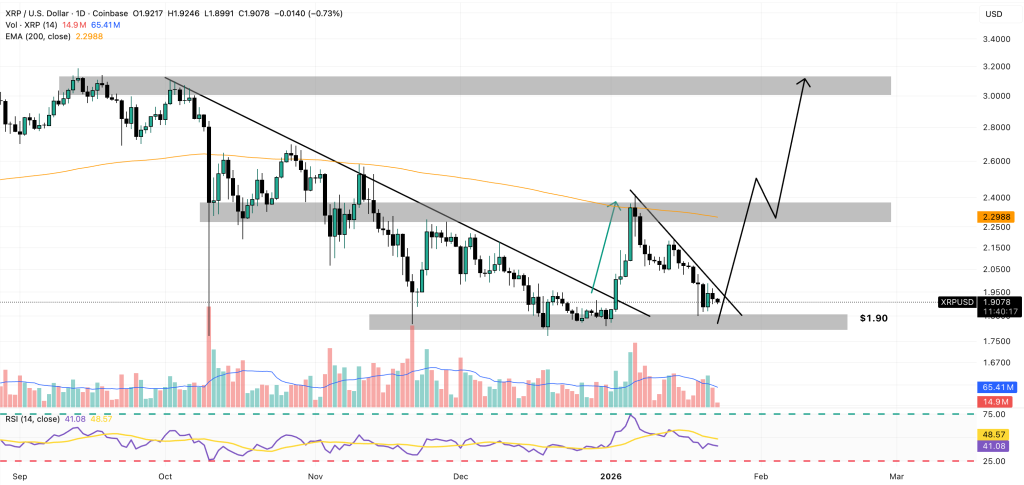
XRP Price Prediction: Descending Triangle Breakout Could Finally Push XRP Above Its 200-Day EMA
The price has bounced off the $1.90 support multiple times already, creating a strong floor from which XRP could start running higher.
The last rally started after the token broke out of the descending triangle shown in the chart, but faced strong selling pressure at the 200-day exponential moving average (EMA).
A similar setup has formed now, anticipating a potential move from bulls over the next few days if the $1.90 level holds.
If that happens, the odds of a bullish breakout above the 200-day EMA will rise. This translates into a short-term target of $2.50, followed by a much stronger move to $3.10 at least.
As altcoins regain momentum and prepare for the next major rally, top crypto presales like Bitcoin Hyper ($HYPER) are gaining serious traction.
This high-potential project has already raised over $30 million, aiming to bring Solana’s fast speeds and low costs to the Bitcoin network.
Bitcoin Hyper ($HYPER) Revamps BTC’s Use Cases by Leveraging Solana’s Power
While BTC is a great store of value, it has always been slow and expensive to move – until now.
Bitcoin Hyper ($HYPER) is a crypto presale that brings Solana’s world-class speed to the Bitcoin blockchain.
This new layer 2 solution solves the biggest problems Bitcoin has faced by reducing transaction fees to nearly zero and enabling instant asset transfers.
For the first time, BTC holders will get to do more than just buy and hold.
Through this L2, they will finally put their Bitcoin to work by lending, staking, and trading their assets without leaving the security of the Bitcoin network.
The crypto community is already moving fast, with over $30 million raised to bring this vision to life.
At the heart of this project is the $HYPER token. As adoption grows and more users tap into its fast, low-cost Layer 2 features, demand for $HYPER is expected to rise.
If you want to get in early, you can still grab $HYPER at its presale price.
Dogecoin’s attempt to join the institutional ETF lineup is running into a basic problem: institutions may not want it. In a Jan. 22 conversation on the Crypto Prime podcast, Bloomberg Intelligence ETF analyst James Seyffart and host Nate Geraci who is also the President of NovaDius Wealth Management said spot Dogecoin ETFs have attracted “near zero” demand so far, an outcome they tied to who typically buys DOGE, and how financial advisers think about reputational risk inside client portfolios.
The Dogecoin datapoint landed inside a broader discussion about a crowded crypto ETF pipeline. Seyffart said his running tally of crypto ETF filings has climbed “over 150 unquestionably,” with many products spanning spot and derivatives, income overlays, buffers, and multi-asset structures. The surge, he argued, looks like issuers “throw[ing] the spaghetti at the wall” in 2026.
Dogecoin ETF Reality Check
But volume of filings doesn’t guarantee demand, and Dogecoin is the clearest example offered of that gap thus far. Pressed on which existing products stood out, Seyffart said “nothing really stands out,” before singling out Dogecoin as the exception, precisely because it has not resonated.
“The real honest answer is like nothing really stands out to me […] honestly if I have to pick one thing that kind of stands out, it’s probably that the Doge ETFs have gotten almost no interest whatsoever,” he said. He added that while some newer altcoin products have done “decently well,” Dogecoin has not.
My conversation w/ @JSeyff on current state of crypto ETFs…
We discuss:
-Crypto ETF sentiment
-150+ crypto-related ETF filings
-Morgan Stanley crypto ETFs
-BlackRock’s next move
-Index & active crypto ETFs
-Recent flows
-What’s nexthttps://t.co/2TzJAnKXuK
Seyffart and Geraci converged on a demand thesis: the marginal buyer of DOGE likely already has the tooling and habit set to buy it directly, rather than through an ETF wrapper.
“I remember talking to the guys at Bitwise. I was like, I don’t think anyone’s going to buy this,” Seyffart said. “But maybe I’m wrong. I’ve been wrong plenty of times before. But I mean, literally no one has bought like the Doge ETFs […] I had pretty low expectations, but I thought maybe they could get to a point where they’re slightly profitable.”
Seyffart pointed to Bitwise’s product—ticker BWOW—as an early scoreboard: “it’s under a million in assets right now,” he said, calling that “near zero demand.” He cautioned the funds are still new, noting the Bitwise product launched at the end of November, but framed the initial traction as “very minuscule.”
Geraci’s explanation was blunter: ”The people who buy that, in general, these are degens and they already know how to access this. They already have digital wallets. They don’t need an ETF to access this […]. And I think that’s going to be a lot of these other coins that are much further down the market cap spectrum.”
Geraci argued Dogecoin faces an additional headwind that doesn’t show up in crypto-native narratives but matters in the ETF market: advisers.
“The other aspect here […] is what I call client statement risk,” Geraci said. “So financial advisors, they’re the biggest driver of ETF flows. And so let’s take Dogecoin as an example […] If you’re a financial adviser and you have a Dogecoin ETF show up on a client statement […] it’s like a flashing red light saying, ‘Please fire me and go find another adviser.’”
That framing matters because the episode repeatedly returned to distribution realities. Seyffart said he’s most excited about basket and index-style crypto ETFs, in part because advisers don’t want to “pick those winners and losers” across a growing long tail of assets. In Geraci’s view, a basket is the “easy button” for professional allocators who want crypto exposure without underwriting each token’s story or defending it to clients.
Seyffart also suggested “what the actual chain is doing” can shape adviser appetite, contrasting niche infrastructure plays such as Chainlink, which he described as connecting DeFi and TradFi, against meme assets like DOGE, which he implied may be less “appetizing” for ETF buyers.
Nasdaq has filed a rule change with the U.S. Securities and Exchange Commission seeking to remove position and exercise limits on options tied to spot Bitcoin exchange-traded funds, a move that would further integrate crypto-linked products into traditional derivatives markets.
The proposal, originally filed on Jan. 7 and made effective this week on the 21st, eliminates the current 25,000-contract cap on options linked to Bitcoin and Ethereum ETFs listed on Nasdaq.
Affected products include funds from BlackRock, Fidelity, Grayscale, Bitwise, ARK/21Shares and VanEck, according to the filing.
The SEC waived its standard 30-day waiting period, allowing the rule change to take effect immediately, while retaining the authority to suspend it within 60 days if further review is deemed necessary.
A public comment period is now open, with a final SEC determination expected by late February unless the rule is paused.
Nasdaq argued that lifting the limits would allow crypto ETF options to be treated “in the same manner as all other options that qualify for listing,” eliminating what it described as unequal treatment without undermining investor protections.
The exchange said the change would support market efficiency while maintaining safeguards against manipulation and excessive risk.
Options are derivative contracts that give traders the right, but not the obligation, to buy or sell an asset at a predetermined price before a set expiration date. Position and exercise limits are typically imposed to prevent concentrated positions that could amplify volatility or destabilize markets.
The filing builds on Nasdaq’s approval in late 2025 to list options on single-asset crypto ETFs as commodity-based trusts. While that decision allowed Bitcoin and Ethereum ETF options to trade on the exchange, existing position limits remained in place.
Nasdaq has steadily expanded its involvement in crypto markets in recent years.
Nasdaq’s bitcoin and digital asset push
In November, the exchange filed a separate proposal to raise position limits on options tied to BlackRock’s iShares Bitcoin Trust (IBIT) to as much as one million contracts, citing growing institutional demand and increased use of options for hedging strategies.
The exchange has also pushed into crypto indexing and tokenization. In January, Nasdaq and CME Group announced plans to unify their crypto benchmarks under the Nasdaq-CME Crypto Index, which tracks major digital assets including Bitcoin, Ether, XRP, Solana, Cardano and Avalanche.
If approved permanently, the latest rule change would mark another step toward normalizing Bitcoin derivatives within U.S. regulated markets, further blurring the line between traditional financial instruments and crypto-native assets.
Institutional demand for Bitcoin remained flat as the legacy crypto briefly lost another key support level ahead of the Bank of Japan interest rate decision. According to data from SoSoValue, the 12 spot Bitcoin ETFs in the U.S. recorded $32…
21Shares has announced the launch of the first spot DOGE Exchange-Traded Fund (ETF) backed by the Dogecoin Foundation, aiming to offer investors regulated, physically backed access to the largest memecoin by market capitalization.
Dogecoin Goes From Memecoin To Wall Street
On Wednesday, financial services company 21Shares announced the launch of its 21Shares Dogecoin ETF (TDOG) on Nasdaq to provide “a new way to gain physically-backed DOGE exposure in traditional portfolios.”
According to the announcement, the firm’s DOGE ETF is the only investment product of its category to be officially endorsed by the Dogecoin Foundation, the nonprofit organization dedicated to supporting the ecosystem’s development.
Notably, two other spot DOGE ETFs are live: Grayscale’s GDOG and Bitwise’s BWOW. As reported by NewsBTC, the funds debuted in late November, becoming the first DOGE ETFs in the US market.
TDOG’s launch builds on 21Shares’ collaboration with the House of Doge, the corporate arm of the foundation supporting the ecosystem, to create new opportunities across the Dogecoin ecosystem.
The newly launched product will offer investors direct exposure to DOGE through a fully backed, transparent, and exchange-traded vehicle, holding the asset on a 1:1 basis in institutional-grade custody.
Regarding its decision to launch a DOGE ETF, 21Shares affirmed that the memecoin “captures the spirit of internet culture and continues to evolve in our digital economy.” Moreover, the firm argued that it has “helped onboard many new users to crypto, and for many people, this may serve as their first step into crypto.”
Federico Brokate, 21Shares’s Global Head of Business Development, stated that “Dogecoin is a unique asset with a global community and expanding real-world use cases,” adding that “TDOG offers investors regulated, physically backed exposure to DOGE through an ETF structure they already understand and trust.”
DOGE Prepares For New Rally
Analyst Bitcoinsensus suggested that the leading memecoin “could be on for a massive rally to the upside” based on its performance throughout this cycle. The market watcher explained that the cryptocurrency has been experiencing “mini cycles” since 2023, which have led to “bigger and bigger rallies.”
According to the chart, after its late 2022 pump, Dogecoin consolidated within a tight range before a 190% breakout in early 2024. Similarly, the memecoin repeated the same pattern throughout 2024, accumulating for months before a 480% breakout at the end of that year.
Now, DOGE has been consolidating within the $0.125-$0.280 price range for nearly a year, leading the analyst to believe that a breakout towards a higher target near the $0.750 level is possible.
Meanwhile, Trader Tardigrade also suggested that Dogecoin may be preparing for a massive breakout as it appears to be following its performance between late 2022 and 2024.
At the time, the cryptocurrency had apparently bottomed out but ultimately recorded another local low before reversing. Based on this, the analyst affirmed that the memecoin “might see a slightly lower low” in the coming weeks, before the next massive surge occurs.
As of this writing, Dogecoin is trading at $0.1249, a 1.75% decline in the daily timeframe.
Bitwise has introduced a new actively managed exchange-traded fund aimed at navigating currency risk through a mix of digital and physical assets. Bitwise has launched an actively managed ETF that combines Bitcoin and gold as a hedge against currency debasement.…
Thailand is moving decisively to cement its position as one of Asia’s most crypto-friendly financial centers, with regulators finalizing new rules for bitcoin and crypto exchange-traded funds (ETFs), futures trading, and tokenized investment products in early 2026.
The country’s Securities and Exchange Commission (SEC) confirmed this week that it is preparing comprehensive regulatory guidelines that would allow crypto ETFs to be formally established, crypto futures to trade on the Thailand Futures Exchange (TFEX), and digital assets to be recognized as an official asset class under existing derivatives law.
SEC Deputy Secretary-General Jomkwan Kongsakul said the new framework is designed to expand access to digital assets while addressing security and custody risks that have historically deterred institutional investors.
“A key advantage of crypto ETFs is ease of access,” Kongsakul said, according to local reports. “They eliminate concerns over hacking and wallet security, which has been a major barrier for many investors.”
Bitcoin and crypto ETFs are moving closer to market
Thailand’s SEC board has already approved crypto ETFs in principle, with regulators now finalizing operational rules covering custody, liquidity, and cooperation between asset managers and licensed digital asset exchanges.
Thailand approved its first spot Bitcoin ETF in June 2024, initially restricting participation to institutional investors. By October 2025, the regulator signaled plans to expand offerings beyond bitcoin to include other cryptocurrencies, such as ether, potentially in the form of diversified crypto “basket” products.
Under the proposed framework, investors would be allowed to allocate up to 4–5% of diversified portfolios to digital assets—an approach aimed at balancing innovation with risk management.
Once approved, domestically listed crypto ETFs could trade on the Stock Exchange of Thailand, offering local exposure without requiring investors to directly hold or manage cryptocurrencies.
Alongside ETFs, the SEC is advancing plans to launch crypto futures trading on TFEX under the Futures Trading Act. Regulators also intend to formally recognize digital assets as an underlying asset class under the Derivatives Act, providing a clearer legal foundation for crypto-linked derivatives.
To support liquidity and price stability, the SEC plans to introduce market-making mechanisms in 2026. Potential market makers could include financial institutions, licensed digital asset exchanges, corporations, and entities holding cryptocurrencies on their balance sheets.
The futures market is expected to provide investors with hedging tools and more advanced risk management options, while expanding institutional participation in Thailand’s digital asset markets.
Thailand’s recent crypto incentives
Thailand’s regulatory push extends beyond ETFs and derivatives. The SEC is also developing rules for tokenized real-world assets (RWAs), including tokenized bonds and other securities that could be issued and traded on blockchain infrastructure.
These efforts align with broader global trends in asset tokenization and could eventually include baht-backed stablecoins. In 2025, Thailand approved U.S. dollar stablecoins for local trading, marking another step toward regulated digital finance.
Bitcoin is up 1% in the last 24 hours but continues to trade below $90k.
The performance comes despite Trump’s Davos speech on Wednesday, which ended the imposition of new tariffs on European nations against the US purchase of Greenland.
Bitcoin is currently in the green after adding 1% to its value in the last 24 hours, ending its six consecutive days of decline.
The price recovery comes following strengthened global risk sentiment in response to US President Trump’s U-turn on Greenland at the World Economic Forum in Davos.
On Wednesday, Trump mentioned that he had reached an agreement with the North Atlantic Treaty Organization (NATO) on a framework for a future deal on Greenland. This ended the need to impose new tariffs on European nations.
In addition to that, Trump added that he hopes to sign the bill on crypto soon, as the US Congress continues to work on a crypto market structure bill that was postponed last week by the Senate Banking Committee.
However, the positive news hasn’t affected Bitcoin’s price action as it continues to trade below the $90k threshold.
Institutional demand for Bitcoin is also on the decline. Data obtained from SoSoValue shows that spot Bitcoin ETFs recorded an outflow of $708.71 million on Wednesday, the third consecutive day of withdrawals and the highest single-day outflow since November 20.
BTC eyes $93k if the $87k support holds
The BTC/USD 4H chart is bearish and efficient as Bitcoin has lost 7% of its value over the last seven days.
It is currently trading below the 50-day Exponential Moving Average (EMA) at $92,044 and has lost the $90k psychological level. Bitcoin is trading at $89,900 after retesting the midpoint of a horizontal parallel channel at $87,787 earlier this week.
If BTC continues its ongoing recovery, it could extend the advance toward the 50-day EMA at $92,044.
The RSI on the 4-hour chart is 40, pointing upward toward the neutral 50 level, indicating fading bearish momentum. However, the RSI must stay above the neutral 50 for the bulls to push the price higher.
The Moving Average Convergence Divergence (MACD) indicator showed a bearish crossover on Tuesday, indicating downward pressure.
However, if BTC closes the daily candle below the $87,787 support, it could extend the fall toward the next support level at $85,569.
Ethereum price dropped below $2,900 for the first time in 5 weeks as recent geopolitical concerns drove investors away from the crypto market. According to data from crypto.news, Ethereum (ETH) fell to an intraday low of $2,872 on Thursday morning…
Residents of Thailand may soon have access to crypto exchange-traded funds as the Securities and Exchange Commission is working on formalizing regulations. Thai SEC deputy secretary-general, Jomkwan Kongsakul, has recently confirmed that the regulator plans on issuing formal guidelines that…

 Login
Login