Normal view

There are new articles available, click to refresh the page.
Today — 10 December 2025NewsBTC

Bitcoin Roars Back To $94K — Traders Rush In As FOMO Explodes: Data

10 December 2025 at 11:00

Bitcoin climbed to a three-week high on Tuesday before slipping back, a move that has traders and analysts watching closely.

According to TradingView data, Bitcoin price topped out at $94,600 late in the session — its highest level since November 25 — then eased to about $92,450 at the time of reporting.

Santiment, a blockchain analytics firm, said social chatter calling for “higher” and “above” exploded during the spike, but market action remained uneven.

Bitcoin: Trader Frenzy And Skepticism

Reports have disclosed that the surge drew heavy retail attention and a flurry of social-media posts urging more buying.

Some market watchers questioned how organic the rise was. A well-known long-term investor using the handle “NoLimit” told his 53,000 X followers that the $94,000 push looked engineered: big buys packed into a few minutes, thin order books, then little follow-through.

🤑 Bitcoin enjoyed a much needed rebound back to $94.6K today, reinvigorating traders, causing them to FOMO back in and expect higher prices. According to our social data scraping X, Reddit, Telegram, & other data, calls for “higher” & “above” exploded.

🟦 High bars indicate… pic.twitter.com/o3U3yWkwkk

— Santiment (@santimentfeed) December 9, 2025

That pattern, he argued, is how larger traders can create short-term fear of missing out so they can sell into strength.

Santiment also highlighted a behavioral twist: smaller traders appear to pile in after spikes, often leaving them on the wrong side of moves.

Volatility followed the high, as prices pulled back by a couple thousand dollars within hours. Exchange order depth and timing of large blocks, analysts say, matter a lot when liquidity is shallow.

Fed Decision Could Shift Momentum

The US central bank meeting this week is a key wildcard. Market pricing on CME Group futures showed an 88% chance of a 0.25% rate cut, which many traders think helped fuel the rally. Yet some analysts warned that any sign of hesitation about future cuts could dampen risk appetite.

Beyond US policy, next week’s potential Bank of Japan rate action is being watched because a tighter stance there could lift yields and pull capital back to Japan, tightening global liquidity. That kind of flow can pressure risky assets across markets.

Liquidity, Institutions And The Bigger Picture

Meanwhile, long-term holders pared back supply after a 36% correction from the all-time high, and some addresses now hold levels seen in March.

Jessica Gonzales, an analyst cited in reports, said M2 money supply sits at about $22.3 trillion and stablecoin reserves remain elevated, suggesting there is capital around but not necessarily evenly distributed in markets.

Institutional moves also feature: big firms such as BlackRock and Strategy have expanded crypto exposure, which could add a steadier buyer base — or simply shift where risk sits.

What Traders Should Watch

Short-term traders should track order-book depth, large trade clusters, and how price reacts to any Fed wording about future cuts.

The next 25 days were flagged as especially important by several observers because liquidity swings and regulatory updates could flip the narrative fast. If a true broad-based bid forms, prices could move quickly. If the Fed signals caution, the opposite could happen.

Featured image from Gemini, chart from TradingView
Here’s Why Strategy’s $1 Billion Bitcoin Purchase Did Not Trigger A Price Rally

10 December 2025 at 10:00

When Strategy disclosed its acquisition of more than 10,000 Bitcoin worth $1 billion, market watchers anticipated an immediate rally. Instead, Bitcoin’s price barely moved. The muted response was not a reflection of weak demand but the result of how the purchase was executed. In response to the confusion surrounding the stagnant price action, Quinten Francois explained the mechanics behind the transaction, clarifying why such a large buy left no visible impact on the chart.

The Invisible Plumbing Behind Institutional Bitcoin Accumulation

On 9 December 2025, Andrew Tate questioned why a massive 10,000 BTC buy failed to nudge the market. The answer, as analyst Francois explained, lies in the operational backbone of over-the-counter (OTC) desks—an ecosystem designed to absorb billion-dollar flows while keeping price action stable. These desks operate entirely outside exchanges. When a firm wants thousands of BTC, nothing is executed against the real-time order book. Instead, OTC operators start sourcing supply quietly from large holders looking to offload position size.

This pipeline includes deep private liquidity that retail traders never see: miners selling block rewards, VCs rotating out of token allocations, market makers rebalancing inventory, and even corporate treasuries restructuring reserves. None of these trades appear on exchange feeds. According to Francois, they do not trigger volatility, sweep liquidity pools, or create the upward pressure that retail investors typically expect from large buys.

More critically, Francois notes that these transactions do not occur in a single block. A 5,000–10,000 BTC order is never filled all at once. Instead, OTC desks spread procurement over days or even weeks, accumulating inventory piece by piece. Only when enough matched supply is gathered do they finalize the transaction, resulting in a smooth settlement with no visible footprint on price charts.

Why No Price Rally Emerges From Shadow-Side Demand

Shadow-side demand refers to large-scale institutional buying that occurs entirely outside public exchanges. These hidden transactions do not trigger price rallies because OTC infrastructure is designed to prevent slippage, volatility, and market distortion. Institutions acquiring strategic size deliberately avoid pushing prices higher, while liquidity providers are incentivized to maintain stability. By keeping trades off public exchanges, both sides protect execution quality and preserve overall market integrity.

A rally only emerges when open-market demand exceeds visible liquidity. In this case, the demand never hit the open market. OTC desks tap private channels first and only touch exchanges if supply dries up—and that is considered a last resort. If enough sellers are found privately, no exchange-side buying occurs at all.

This is why public charts often show sell pressure but rarely show institutional demand. The buys happen in the shadows, the sells appear on-chain, and the price remains anchored. Strategy’s $1 billion allocation did not fail to move the market; it was intentionally engineered not to.

Bitcoin price chart from Tradingview.com (Strategy)

More Details On The Wall Street $500 Million Investment In XRP

10 December 2025 at 09:00

Ripple’s most recent funding round has become one of the biggest crypto-related deals of the year, mainly because of who joined in and how the deal was structured. 

According to details shared in Bloomberg’s report, major Wall Street names, including affiliates of Citadel Securities, Fortress Investment Group, Brevan Howard, and Galaxy Digital, put $500 million into Ripple, giving the company a valuation of around $40 billion. This instantly turned the round into one of the strongest signs yet that traditional finance is taking a serious interest in the XRP ecosystem.

How Wall Street Structured The Deal To Protect Themselves

In early November 2025, Ripple closed a major private equity round that injected $500 million into the company, resulting in a valuation of roughly $40 billion. However, new details show that the most surprising part of the transaction is not the amount raised but the agreement behind it. Bloomberg reports that investors in this round did not simply buy Ripple shares and hope the value rises. Instead, they secured built-in protections that guarantee them profits later.

They were given the right to sell their shares back to Ripple in three to four years at a 10% yearly return, unless Ripple goes public before then. At that rate, Ripple would need to pay roughly $732 million to buy the shares back after four years. That means even if Ripple’s valuation stays flat or drops, the investors still walk away with guaranteed gains.

However, if Ripple decides to buy the shares back earlier, the investors get an even higher payout of around 25% annualized rate. A liquidation preference was also included, meaning these investors get paid first if anything goes wrong. Ripple noted in its announcement of the investment round that it has repurchased more than 25% of its outstanding shares over the past few years.

Why The Deal Is Really A Bet On XRP

Even though the investors bought equity in Ripple, not XRP itself, most of Ripple’s value still comes from its massive XRP holdings. According to Bloomberg, two of the funds that put in money noted that at least 90% of Ripple’s net value is tied to XRP. As of July 2025, Ripple held around $124 billion worth of XRP, although most of its XRP holdings are held in escrow.

This means the investment round, in reality, is also a bet on XRP’s long-term relevance and future market strength. If the price of XRP grows, Ripple benefits, and so do the investors who now hold equity backed by a company sitting on one of the world’s largest digital asset reserves. 

However, the $500 million investment does show that serious investors believe Ripple will continue growing, but just that Ripple’s success is still directly linked to the XRP price.

XRP

XRP Breakout Enters Critical Phase As Chart Targets $9–$13 Zone

10 December 2025 at 07:30

Crypto analyst Cryptollica published a new XRP/USD 2-week chart on December 8 via TradingView, arguing that the altcoin may be replaying the same structural pattern that preceded its explosive 2017 rally. With current price action pivoting around the key $1.95 level and technical targets projected as high as $9–$13.

What Happens If XRP Repeats The 2017 Fractal?

The analysis uses a long-range log chart from Binance, where the latest candle in the screenshot shows XRP trading around $2.0892. In this timeframe, the analyst divides XRP’s history into mirrored cycles: 2014–2017 on the left and 2021–2025 on the right, each broken into labeled segments “Part 1,” “Part 2” and “Part 3.”

According to Cryptollica, “the cycle experienced by XRP between 2014 and 2017 is almost an identical copy of the current cycle spanning 2021 to 2025.” In both cases, Part 1 is described as an accumulation phase, with XRP suppressed below a dashed blue resistance band for an extended period while forming higher lows along a rising dotted trendline.

XRP/USD 2-Week Chart Analysis

The current Part 1, roughly 2022–2024, is said to have lasted substantially longer than in the earlier cycle. The analyst cites the rule that “the bigger the base, the higher in space,” arguing that this extended sideways structure signals a large build-up of potential energy.

Part 2 is defined as the breakout and retest of that blue resistance band. Once XRP closes decisively above this zone and consolidates there, the chart treats the area as a new support and as confirmation that “the official end of the downtrend and the start of a bull market” has been registered. Cryptollica suggests XRP is now at the final stage of, or has just completed, this breakout phase on the 2-week timeframe.

The pivotal reference point for the entire setup is the $1.95 level, drawn in green on the chart. “The $1.95 level, marked in green, is of vital importance,” the analyst writes, emphasizing the classic principle that “once resistance is broken, it turns into support.” In this framework, XRP “currently holding above this level (performing a successful retest) is the most crucial confirmation point for the continuation of the uptrend.”

If that confirmation holds, the analysis moves to Part 3, labeled the “Parabolic Rise – Discovery Phase.” In 2017, this segment corresponded to a near-vertical advance that pushed XRP into its all-time high zone. Cryptollica argues that XRP now stands “right on the precipice of this ‘vertical lift-off’ in the current cycle,” illustrated by a steep yellow arrow on the logarithmic chart. The first major objective is the region around the prior all-time high at roughly $3.30–$3.84. If the 2017 fractal “plays out precisely,” the post projects an “implied target” between $9.00 and $13.00.

The analyst tempers this with several cautions. The crypto market is far larger than in 2017, and a move to $10+ would imply a “colossal market capitalization,” making a repeat of the exact 2017 multiple “mathematically more challenging,” even if “logic often takes a backseat in crypto mania.” The scenario also assumes supportive fundamentals, including the resolution of regulatory overhangs, potential XRP ETF developments and Ripple’s stablecoin strategy.

Parabolic phases, Cryptollica warns, are typically accompanied by “sudden drops of 30–40%,” making them “the most dangerous territory for leveraged trading.” The analyst characterizes the overall outlook as “extremely positive (bullish)” as long as the $1.95 support holds, concluding that XRP is at the moment of “breaking its chains” and that, if broader market conditions remain constructive, “double-digit targets ($10+) for XRP are technically on the table.”

At press time, XRP traded at $2.07.

XRP price

Dogecoin Price Set To Surge As Sellers Show Signs Of Exhaustion

10 December 2025 at 06:00

A new technical analysis shared by crypto analyst BitGuru on the social media platform X shows that Dogecoin is trading at an important price level that could set the stage for an upward shift. His chart shows a familiar structure forming at a major support level, one that has acted as the starting point for a previous rally in the year. The price action now developing is similar to this earlier setup, showing that Dogecoin may be preparing for another recovery move above $0.2.

Dogecoin Returns To An Important Support Zone

Dogecoin has spent the past few weeks trading between $0.13 and $0.15 without a clear path to bullish price action. This recent price action is an extension of a downturn that has been taking effect since mid-September from the $0.3 price level.

Notably, technical analysis of Dogecoin’s daily candlestick timeframe chart shows that the cryptocurrency is currently positioned on a significant historical support level, the same area that sparked previous rallies. This support is shown on the chart as between $0.139 and $0.141, the lower boundary of a wide accumulation zone, where price repeatedly stabilized before surging. 

Despite the broader market’s recent weakness, this price support range has held up. Price action in December has led to the creation of a few transition candles on the daily timeframe chart. This, in turn, has led to the creation of a higher low relative to the November breakdown, which had caused Dogecoin to break below $0.135.

Dogecoin price

Dogecoin Daily Candlestick Chart. Source: @bitgu_ru On X

Another notable feature highlighted by the analyst is the tight compression forming around Dogecoin’s candles. The chart shows a sequence of narrow movements, indicating that selling momentum has thinned out. 

BitGuru interpreted this as exhaustion from sellers, meaning the Dogecoin price is no longer displaying the heavy downward pressure seen in November. This type of narrowing range is expected to be the final stage of the downtrend and buyers are beginning to regain control.

Buyers Begin To Step In, Mid-Range Target Next

Early signs of buyer strength are now visible within this compressed zone. This is reflected in the price action in the past 24 hours, which has seen Dogecoin bounce from its intraday low of $0.14 and increase by 4.1%. That rebound is the first meaningful pushback from buyers after days of bearish activity.

The projected arrow in BitGuru’s chart points to the mid-range area around $0.188 as the first destination now that Dogecoin is rebounding from its support base. However, another higher price target is highlighted around $0.223 if Dogecoin completes its projected bounce from the support.

Depending on how Dogecoin reacts here, a bullish move will target the order block around $0.25, before further price targets at $0.284 and $0.306.

Dogecoin price chart from Tradingview.com

The Current Bitcoin Price Pump Will End In A Crash – Here’s When To Start Selling

10 December 2025 at 04:30

Over the last few days, the Bitcoin price has fluctuated, but the most prominent moves have been upwards, going from below $90,000 to over $94,000. As expected, this rapid climb already has investors calling for a return of the bull run, but not everyone is convinced. For some, the current Bitcoin price momentum is most likely a bull trap, and crypto analyst Xanrox highlights this in a recent analysis, outlining the best level to start selling the digital asset.

Why The Bitcoin Price Risks A Crash To $74,000

Xanrox’s analysis focuses on the bearish formations that have appeared on the Bitcoin price crash following the recent upward move. While many in the crypto community celebrate the rise above $90,000 again, the crypto analyst sounds an alarm that this is the time to go bearish on the cryptocurrency.

According to the analysis shared on the TradingView website, there has been a clear bear flag formation for the cryptocurrency. This bearish formation is visible on both the 12-hour chart and the 1-Day chart. Regardless, both of these charts point to one possible outcome, and that is an almost perfect textbook bear flag formation.

In addition to the bear flag formation, Xanrox also highlights that there is a WXY corrective pattern inside the bear flag. Both of these point to a possible continuation to the initial downtrend that began after the Bitcoin price hit $126,000 back in October.

Bitcoin price

As for how far the current rally could go, the crypto analyst sees it reaching as high as $96,000 before momentum runs out. This presents the “perfect” time to sell or enter a short as the price continues its decline. The target for this is an over 25% crash that will send the price going toward $74,000.

The $74,000 target makes an appearance as it is a swing low from April 2024, meaning that crypto traders who are long on the digital asset would have their stop losses below it. Thus, this makes it an attractive point for market makers to push the price towards in order to clear significant liquidity.

The timeframe for this to play out is placed over the next few weeks, riding out the end of 2025 and moving into January 2026. However, the swing low support at $74,000, if it holds up, could end up serving as the next bounce-off point for the Bitcoin price.

Bitcoin price chart from Tradingview.com

NFT Slump Worsens With Monthly Sales Hitting Rock Bottom

10 December 2025 at 04:00

A sharp slowdown in buying pushed the NFT market back toward its weakest levels of the year, as weekly and monthly totals fell sharply and overall valuations continued to slip.

According to market trackers, trading activity cooled significantly in November and the first week of December, raising fresh questions about demand heading into year end.

Sales And Volume Plunge

NFT sales fell to $320 million in November, down from close to $630 million in October, CryptoSlam data shows. That level is roughly on par with the $312 million recorded in September 2024.

Based on reports, the trend did not improve at the start of December: from Dec. 1–7, collections generated about $62 million in sales — the weakest weekly total recorded so far in 2025. Market participants are being hit by lower turnover and fewer big trades.

Market Cap Shrinks Dramatically

CoinGecko data shows the sector’s market cap sits at $3.1 billion, which is down 66% from a January high of $9.2 billion. Reports have disclosed a steep month-to-month swing as well: values dropped from $6.6 billion in October to $3.5 billion in November, a fall of 46% in roughly 30 days.

There was a brief uptick on Nov. 11 when market cap moved from $3.5 billion to nearly $4 billion during a memecoin-driven surge, but the recovery was short-lived and the market cap later retreated back to $3.1 billion. These moves show that prices are still volatile and driven by bursts of speculative interest.

Blue Chips Mostly Lose Ground

Top collections were not immune. Based on reports, CryptoPunks fell about 12% over the past month. Bored Ape Yacht Club slid 8.5%, while Pudgy Penguins dropped 10.6% in the same period.

Art-focused blue-chip works also fell: Chromie Squiggle lost 5.6%, Fidenza declined 14.6%, Moonbirds went down 17.9% and Mutant Ape Yacht Club slipped 13.4%. The biggest fall among major names came from Hypurr, which dropped 48%.

Two Collections Show Gains

Not every project followed the downward path. Infinex Patrons posted almost 15% rise in the last 30 days, and Autoglyphs outperformed the top ten with a 21% gain.

These outliers were lifted by collector interest, and in some cases by the projects’ small supply or unique on-chain history. Still, such gains remain the exception rather than the rule.

Outlook As Year Ends

The weak start to December suggests the pullback could continue into the close of the year. Liquidity is thinner now, and short-lived rallies driven by other crypto market events have failed to create lasting momentum.

Prices were pushed down across a wide set of collections, and trading volumes have not shown a sustained recovery.

Featured image from Unsplash, chart from TradingView

Standard Chartered Cuts 2026 Bitcoin Price Prediction By 50%

10 December 2025 at 03:00

Standard Chartered has sharply reduced its famously bullish Bitcoin roadmap, cutting its 2026 price target in half and acknowledging that its previous near-term projections were too aggressive, even as it keeps an ultra-optimistic long-term view intact.

Standard Chartered Downgrades Bitcoin Price Predictions

In a note shared on X by VanEck head of research Matthew Sigel, Standard Chartered argues that Bitcoin’s traditional halving cycle has been overtaken by ETF-driven flows. The bank writes: “With the advent of ETF buying, we think the BTC halving cycle is no longer a relevant price driver. The logic in previous cycles (when US ETFs did not exist) – i.e., prices would peak about 18 months after each halving and decline thereafter – is no longer valid, in our view.”

The report adds that it will “take a break of the current all-time high ($ 126,000 on 6 October 2025) to prove that; we expect this to happen in H1-2026.”

Alongside that shift in framework, the bank re-profiled its multi-year Bitcoin targets. According to the figures shared by Sigel, Standard Chartered has lowered its 2025 forecast from $200,000 to $100,000, its 2026 target from $300,000 to $150,000, its 2027 projection from $400,000 to $225,000, its 2028 estimate from $500,000 to $300,000, and its 2029 prediction from $500,000 to $400,000 while keeping a $500,000 target for 2030.

Bitcoin price predictions by Standard Chartered

Geoff Kendrick, Standard Chartered’s head of digital assets research, characterises the recent drawdown as painful but not structural. He describes the current phase as “a cold breeze,” explicitly rejecting the notion of a new crypto winter and noting that the magnitude of the pullback remains consistent with corrections seen in past bull cycles.

At the same time, he points out that weaker valuations for listed Bitcoin treasury companies have curtailed their ability to act as major marginal buyers, leaving spot ETFs as the primary driver of near-term gains.

Wall Street Giant Bernstein Agrees

The downgrade also lands in the context of a broader rethink on Wall Street. One day earlier, on December 8, Sigel shared a separate note from Bernstein that reached a similar conclusion about Bitcoin’s market structure.

Bernstein wrote that “the Bitcoin cycle has broken the 4-year pattern (cycle peaking every 4 years) and is now in an elongated bull-cycle with more sticky institutional buying offsetting any retail panic selling.”

Despite an approximately 30% correction, the firm notes that “we have seen less than 5% outflows via ETFs.” On that basis, Bernstein now moves its 2026 Bitcoin price target to $150,000, sees the cycle “potentially peaking in 2027E at $200,000,” and keeps its long-term 2033 target at roughly $1,000,000 per BTC.

Both Standard Chartered and Bernstein are converging on the same structural message: the halving alone no longer explains Bitcoin’s trajectory. ETF flows, institutional positioning and balance-sheet dynamics are now the core variables, even if their precise price targets and timelines diverge.

At press time, Bitcoin traded at $92,686.

Bitcoin price

Cathie Wood Says Bitcoin Is ‘Climbing Another Wall Of Worry’– Here’s Why

10 December 2025 at 02:00

Ark Invest’s CEO and CIO, Cathie Wood, joined Fox Business’s “Morning With Maria” to discuss her investment strategy as she believes the US is entering a “historic productivity surge,” and why she is bullish on Bitcoin (BTC) for 2026.

The Four-Year Cycle Will Be ‘Disrupted’

On Tuesday, Ark Invest’s CEO, Cathie Wood, shared her perspective on the recent Bitcoin performance, which has retraced over 10% in the past month and struggled to reclaim crucial levels over the past few weeks.

To Wood, Bitcoin has been behaving like a risk-on asset and is currently “climbing another wall of worry” that has made investors wary of the leading crypto asset’s upcoming performance.

As she explained, there is a fear of the four-year cycle, which suggests that 2026 will be a corrective year for Bitcoin. Historically, BTC has seen significant price pullbacks during bear markets, with retraces of up to 75% to 90% in previous cycles.

The aggressive Q4 2025 correction has shattered most investors’ expectations of an end-of-year bull run, raising concerns that the crypto market has already entered the bearish phase of the cycle after the more than 30% drop from the October highs.

However, Ark Invest’s CEO considers that “the four-year cycle is going to be disrupted” as volatility has significantly diminished over the past few years, and large-scale investors turn to the rapidly growing industry.

“We think that the move by institutions into this new asset class is going to prevent much more of a decline,” Wood affirmed, noting, “we might have seen it a couple of weeks ago,” when BTC managed to hold the $80,000 barrier during the late November correction.

She previously asserted that growing institutional adoption will be a powerful driver for long-term value for the cryptocurrency, adding that institutions “really have just dipped their toes into this space. We have just started, so we have a long way to go.”

Bitcoin To Outperform Gold Soon?


During the interview, Wood also reaffirmed her previous forecast that the flagship crypto will outperform gold next year, despite its choppy performance during the last quarter of 2025.

She highlighted that “gold is more of a risk-off asset,” and its 60% year-to-date (YTD) rise is “proof” that Bitcoin is climbing a wall of worry as investors “are using gold as a hedge against geopolitical risks.”

Nonetheless, Ark Invest’s CEO pointed out that between the early 80s and the late 90s, gold peaked and “went down as we were in the golden age of innovation, ending with the internet.”

Now, she believes that the same could happen soon, as what she calls “the AI age” starts and the market potentially recovers. Meanwhile, she forecasted that Bitcoin would remain risk-on and outperform gold in 2026.

“I really believe we are moving from a rolling recession where we’ve been for the last three years, into a rolling recovery, which we think we are entering now. Then, a productivity-driven boom the likes of which we have never seen before,” Wood concluded.

 As of this writing, Bitcoin is trading at $94,011, a 3.75% increase in the daily timeframe.

Bitcoin, btc, btcusdt

Ethereum Price Climbs Toward $3,300 For The First Time Since November: What’s Driving The Surge?

10 December 2025 at 01:00

On Tuesday, the Ethereum price experienced a notable surge, climbing by 6.5% and reclaiming the critical $3,300 mark for the first time in nearly a month. This has allowed Ethereum to outpace its peers among the top ten cryptocurrencies by market capitalization, showcasing a nearly 12% recovery for the leading altcoin over the past week.

ETH Grows In Demand 

Analysts from Bull Theory attribute this resurgence to several key factors, including significant institutional interest in Ethereum. The firm highlighted BitMine, which holds the largest public company collection of ETH, as a major player in this recovery phase. 

In a recent social media update on X (formerly Twitter), the analysts pointed out that demand for ETH is on the rise as Wall Street quietly builds on the Ethereum platform.

Notably, major financial institutions are beginning to make substantial moves in the Ethereum space. BlackRock, which manages $13.5 trillion, is launching tokenized funds and has filed for a staked Ethereum exchange-traded fund (ETF). 

Other notable players include JPMorgan with $4 trillion in assets, Deutsche Bank at $1.1 trillion, and Standard Chartered with $800 billion. These firms are developing tokenization and decentralized finance (DeFi) infrastructure specifically on Ethereum and its Layer 2 (L2) solutions.

In addition, well-known financial entities such as Amundi, HSBC, BNY Mellon, Coinbase (COIN), Kraken, and Robinhood (HOOD) are incorporating Ethereum into their operations for functions like custody, settlement, and rollup infrastructure. 

As a result, these large companies are holding and staking ETH to generate yield, significantly increasing the altcoin’s demand. BitMine, for instance, anticipates earning over $400 million annually from its staking position.

Could The Ethereum Price Hit $12,000?

Such institutional involvement has led market experts like Tom Lee to speculate that the Ethereum price could potentially reach $12,000 by 2026, driven by growing staking demand and the scaling of tokenization efforts. 

Adding to the momentum, Arkham reported that Tom Lee’s Ethereum treasury firm acquired 138,452 ETH since last week, valued at approximately $431.97 million. BitMine currently holds $12.05 billion in ETH and has an additional $1 billion allocated for further purchases. 

In a different development that could bolster the Ethereum price further, Chris MacDonald, an analyst for The Motley Fool, highlighted reports indicating that the Office of the Comptroller of the Currency (OCC) confirmed US banks can now legally conduct “riskless principal” transactions in crypto assets. 

The analyst asserted that this new regulatory approval may lead to an influx of capital into digital assets, which would likely benefit the Ethereum price and holders, as well as other top cryptocurrencies.

Ethereum price

As of this writing, the Ethereum price is trading at $3,325. Despite recent gains, the price is still nearly 33% below the all-time high of $4,946, which was reached earlier this year. 

Featured image from DALL-E, chart from TradingView.com 

Historic Reversal: Ethereum ETF Flows Plunge To Worst Month Since Launch

10 December 2025 at 01:00

Ethereum’s momentum in institutional markets just hit a major roadblock. After months of enthusiasm surrounding spot Ethereum exchange-traded funds (ETFs), new data has shown that ETF flows have sunk to their worst monthly total since their launch. The sharp drop reflects a broader cooldown in investor demand, as market volatility and shifting risk appetite weigh on crypto allocations.

Will Staking ETFs Emerge To Stabilize Flows?

In an X post, a crypto analyst known as Milk Road revealed that the Ethereum ETFs had just printed their worst month on record since launch, which is roughly $1.4 billion in net outflows, the largest single-month withdrawal that ETH has ever encountered. 

Historically, ETF flow reversals tell more about liquidity pressure in the broader financial system than the long-term fundamentals of the asset itself. When redemptions spike this hard, it’s usually a sign that broader risk sentiment is cracking, not that the asset itself broke.

Ethereum

Meanwhile, most investors don’t know that while ETFs were handing back, Digital Asset Treasuries (DATs) stepped in as aggressive buyers. BitMine Immersion Technologies (BMNR) quietly added over 300,000 ETH, worth nearly $800 million at the time, to its treasuries. If the ETF outflow continues to accelerate, the near-term price action will remain choppy as liquidity gets strained at the edges.

However, if DAT inflows continue scaling, it builds the foundation for a tighter supply setup into 2026. The tension between this panicked short-term selling pressure and the quiet structural long-term accumulation is the most important dynamic for positioning.

Why ETH Reserves Are Becoming Strategic Corporate Assets

Crypto trader Bull Theory has noted that last week, BitMine bought an astonishing 138,452 ETH, worth $437.7 million. This single transaction solidifies their position as the largest ETH treasury in the world, holding 3.86 million ETH, valued at $12.4 billion and accounting for 3.2% of the entire circulating supply.

The true source of rising ETH demand is that Wall Street is quietly building on ETH. BlackRock, with $13.5 trillion AUM, has launched tokenized funds on ETH and has filed for a staked ETH ETF. JPMorgan, with $4 trillion, Deutsche Bank, with $1.1 trillion, and Standard Chartered, with $800 billion, are developing tokenization and DeFi infrastructure using ETH and its Layer-2 networks. 

Institutions like Amundi, HSBC, BNY Mellon, Coinbase, Kraken, and Robinhood are all using ETH rails for custody and settlement or rollup infrastructure for scaling and security. Furthermore, large companies are now holding and staking ETH for yield. BitMine alone expects to generate $400 million+ a year in staking revenue from its position. 

Tom Lee believes that as staking demand grows and institutions scale tokenization increases, ETH could reach $12,000 in 2026. “A Bitcoin miner is now the largest Ethereum whale, Wall Street is building on ETH, and treasuries are shifting toward yield. ETH is quickly becoming part of the Global Financial System.” Bull Theory noted.

Ethereum

Solana (SOL) Turns Lower From Key Zone—Is Support About to Be Tested?

10 December 2025 at 00:08

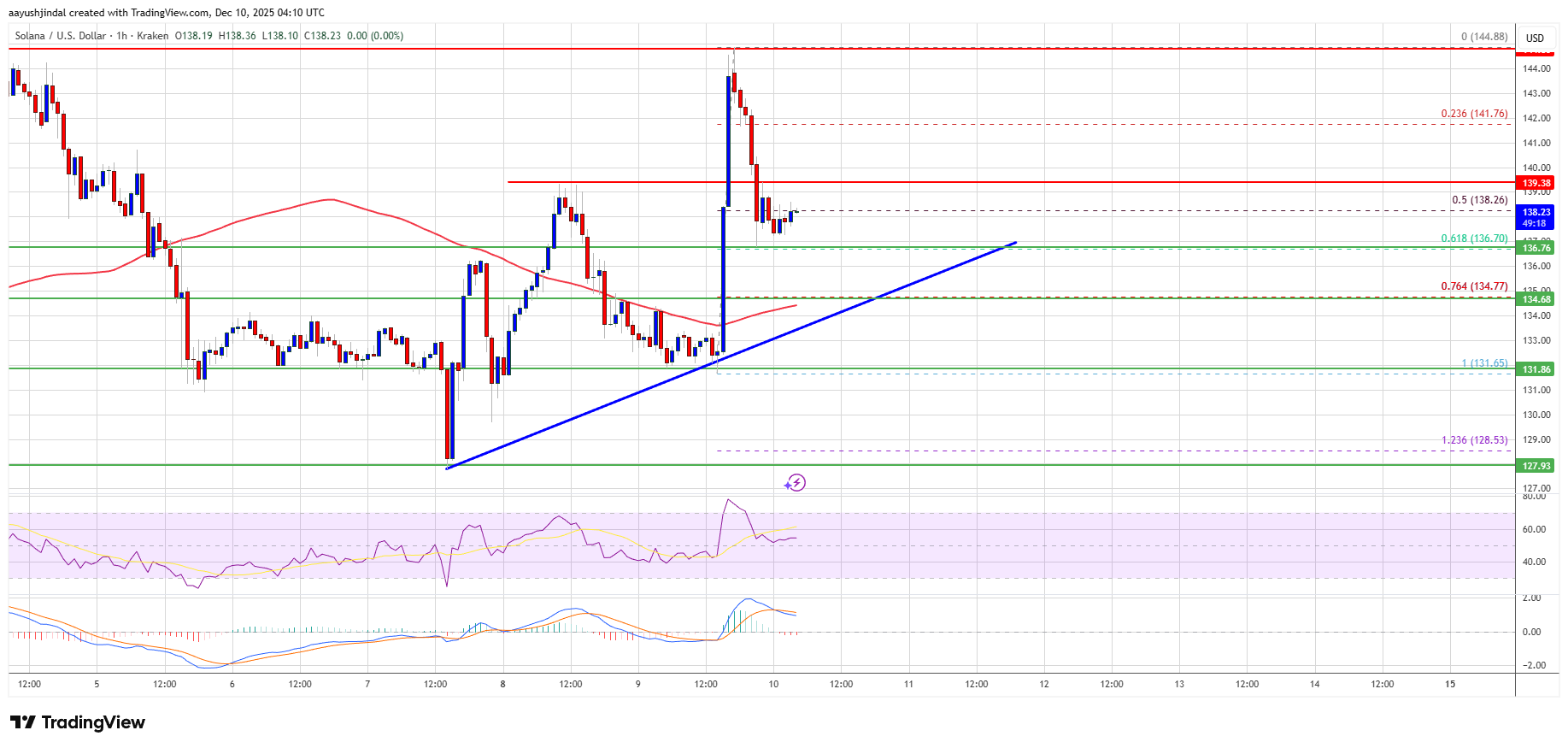
Solana failed to stay above $142 and corrected gains. SOL price is now trading below $140 and might find bids near the $135 zone.

  • SOL price started a downside correction below $142 against the US Dollar.
  • The price is now trading above $135 and the 100-hourly simple moving average.
  • There is a bullish trend line forming with support at $135 on the hourly chart of the SOL/USD pair (data source from Kraken).
  • The pair could extend losses if it dips below the $135 zone.

Solana Price Starts Downside Correction

Solana price failed to surpass $145 and started a downside correction, like Bitcoin and Ethereum. SOL dipped below $142 and $140 to enter a short-term bearish zone.

There was a move below the 50% Fib retracement level of the upward wave from the $131 swing low to the $145 high. However, the bulls are active near $136. There is also a bullish trend line forming with support at $135 on the hourly chart of the SOL/USD pair.

Solana Price

Solana is now trading above $135 and the 100-hourly simple moving average. On the upside, the price is facing resistance near the $140 level. The next major resistance is near the $145 level. The main resistance could be $148. A successful close above the $148 resistance zone could set the pace for another steady increase. The next key resistance is $155. Any more gains might send the price toward the $165 level.

More Losses In SOL?

If SOL fails to rise above the $142 resistance, it could start another decline. Initial support on the downside is near the $136 zone and the 61.8% Fib retracement level of the upward wave from the $131 swing low to the $145 high. The first major support is near the $135 level and the trend line.

A break below the $135 level might send the price toward the $132 support zone. If there is a close below the $132 support, the price could decline toward the $125 support in the near term.

Technical Indicators

Hourly MACD – The MACD for SOL/USD is gaining pace in the bearish zone.

Hourly Hours RSI (Relative Strength Index) – The RSI for SOL/USD is below the 50 level.

Major Support Levels – $135 and $132.

Major Resistance Levels – $142 and $145.

Bitcoin Exchange Reserves Fall To Lowest Levels on Record: The Bullish Signal Most Traders Are Missing

10 December 2025 at 00:00

Bitcoin is holding above $90,000 as the market heads into a highly anticipated FOMC meeting, a moment that could define the next direction for risk assets. But while price action keeps traders on edge, on-chain indicators are painting a surprisingly different picture beneath the surface. According to a new CryptoQuant report by XWIN Research Japan, Bitcoin’s exchange reserves have continued to fall sharply throughout 2025, even as price corrected toward the $90K range.

The data shows that the total amount of BTC held on centralized exchanges has dropped to 2.76 million BTC, reaching one of the lowest levels ever recorded. What makes this trend even more striking is its timing: during the steep November–December sell-off, exchange balances did not rise—they fell faster. The report highlights this behavior in the red-marked zone of the chart, showing accelerating outflows while the price was dropping.

This pattern signals something unusual: investors are not sending coins to exchanges to sell into weakness. Instead, they continue withdrawing BTC into long-term custody, suggesting confidence rather than capitulation. As volatility builds ahead of the FOMC decision, the contrast between short-term price fear and long-term accumulation is becoming one of the most important dynamics in the current Bitcoin market.

Shrinking Exchange Reserves Signal Structural Strength

The report emphasizes that Bitcoin’s rapidly shrinking exchange reserves carry important structural implications for the market. When fewer coins sit on centralized exchanges, it means less Bitcoin is available for immediate sale, effectively tightening the liquid supply. According to the data, this decline is not being driven by short-term speculators but by long-term holders and institutional entities steadily moving BTC into self-custody or cold storage.

Bitcoin Exchange Reserve | Source: CryptoQuant

What makes this trend remarkable is its timing. Historically, sharp price declines trigger a wave of inflows to exchanges as investors prepare to sell or panic-exit their positions. This cycle, however, tells a very different story. Even as Bitcoin corrected into the $90K region, exchange balances kept falling, suggesting that buyers with a long-term outlook are actively accumulating rather than retreating.

This divergence between price action and on-chain behavior signals underlying strength. While short-term volatility may continue—especially around macro catalysts like the FOMC meeting—the broader structure points toward a market quietly tightening its available supply. As reserves move toward historic lows, a future “supply shock” becomes increasingly plausible.

Despite the weak spot market performance, on-chain metrics are slowly turning bullish, hinting that the foundation for the next major trend may already be forming beneath the surface.

BTC Tests Critical Support as Market Awaits Direction

Bitcoin’s price action on the 3-day chart shows a market attempting to stabilize after a sharp corrective phase. BTC is currently trading around $90,437, hovering just above the 200-day moving average — a level that has historically acted as a major dynamic support during mid-cycle retracements. The recent bounce from the $87K–$88K region suggests that buyers are defending this zone, but the structure remains fragile as long as the price stays below the 50-day and 100-day moving averages, both of which are now sloping downward.

BTC consolidates around key level | Source: BTCUSDT chart on TradingView

The chart reveals a clear shift in momentum. After months of steady higher lows, Bitcoin broke its ascending structure in late November, leading to a fast drop toward the high-$80K range. Volume increased during the decline, indicating stronger participation on the sell side. However, the subsequent candles show shrinking sell volume, hinting at exhaustion among short-term sellers.

For a meaningful recovery, BTC must reclaim the $95K–$97K area, where previous support turned into resistance. Failure to break that zone would likely keep the market in a consolidation phase, with risks of another retest of the 200-day MA.

Featured image from ChatGPT, chart from TradingView.com

Yesterday — 9 December 2025NewsBTC

XRP Price Positive Streak Fades—Are Traders Bracing for Volatility?

9 December 2025 at 23:18

XRP price started a decent increase above $2.150. The price is now correcting gains and might struggle to stay in a positive zone.

  • XRP price started a downside correction and tested the $2.080 zone.
  • The price is now trading above $2.050 and the 100-hourly Simple Moving Average.
  • There is a bullish trend line forming with support at $2.070 on the hourly chart of the XRP/USD pair (data source from Kraken).
  • The pair could start another increase if it clears $2.120.

XRP Price Dips Again

XRP price started a downside correction from the $2.180 zone, like Bitcoin and Ethereum. The price dipped below the $2.150 and $2.120 levels to enter a consolidation phase.

The price even dipped below the 50% Fib retracement level of the upward move from the $2.042 swing low to the $2.1778 high. However, the bulls remained active above the $2.080 support. There is also a bullish trend line forming with support at $2.070 on the hourly chart of the XRP/USD pair.

The price is now trading above $2.050 and the 100-hourly Simple Moving Average. If there is a fresh upward move, the price might face resistance near the $2.120 level.

XRP Price

The first major resistance is near the $2.150 level, above which the price could rise and test $2.180. A clear move above the $2.180 resistance might send the price toward the $2.2250 resistance. Any more gains might send the price toward the $2.250 resistance. The next major hurdle for the bulls might be near $2.2880.

More Losses?

If XRP fails to clear the $2.120 resistance zone, it could start a fresh decline. Initial support on the downside is near the $2.070 level, the 76.4% Fib retracement level of the upward move from the $2.042 swing low to the $2.1778 high, and the trend line. The next major support is near the $2.050 level.

If there is a downside break and a close below the $2.050 level, the price might continue to decline toward $2.00. The next major support sits near the $1.9850 zone, below which the price could continue lower toward $1.920.

Technical Indicators

Hourly MACD – The MACD for XRP/USD is now gaining pace in the bearish zone.

Hourly RSI (Relative Strength Index) – The RSI for XRP/USD is now below the 50 level.

Major Support Levels – $2.070 and $2.050.

Major Resistance Levels – $2.120 and $2.180.

Expert Declares Bitcoin Has Reached Midpoint Of Bear Cycle: What Lies Ahead?

9 December 2025 at 23:00

During what many anticipated would be the year of a major Bitcoin (BTC) bull run, market expert Axel Adler has revealed that the leading cryptocurrency finds itself at the midpoint of a bear cycle. 

A Mild Bear Cycle Compared To History

As of now, Bitcoin has recorded a modest year-to-date decline of 4%. However, the cryptocurrency has shown some stability this week, consolidating in the range of $89,000 to $94,000, with the latter figure serving as immediate resistance. 

According to Adler, this current correction, which stands at approximately -32%, is considered less severe compared to previous bear cycles. He emphasizes that approximately 88% of Bitcoin holdings remain in unrealized profit, while only about 12% of the total supply is currently at a loss.

Adler points out that Bitcoin’s price action has remained relatively steady within the $90,000 zone, reflecting a mild drawdown in historical context. 

The crucial question as the year approaches its end is whether this correction will stabilize between -35% and -40% from its all-time high, indicating a new, more “flattened” cycle, or if the market will follow historical trends that typically lead to deeper declines of -60% to -70%.

Analyzing past cycles, Adler notes that major bear markets in 2011, 2016, 2019, and 2023 were characterized by a significant increase in the percentage of coins at a loss, often rising to around 60%. These levels typically marked capitulation points in the market. 

Bitcoin

In contrast, the current landscape shows only 12% of holders experiencing unrealized losses, which diverges sharply from the patterns observed during past bear markets.

Can Bitcoin Avoid Deeper Declines?

The expert further noted that during recent local cycle peaks, only about 17% of coins were in the red, a figure that remains three to four times lower than traditional capitulation levels. 

This unusual configuration suggests that the current market may resemble a correction within a bullish supercycle rather than the final downturn of a full-blown bear market.

Adler believes that the market appears to be testing the resilience of this correction structure, which stands at -32% from its peak, while maintaining a high ratio of profitable positions. 

He argues that if Bitcoin can sustain this maximum drawdown above the -35% zone alongside moderate unrealized losses, it could bolster the case for a shift towards more “flat” corrections influenced by institutional demand and a structural supply deficit.

On the contrary, should Bitcoin’s correction extend beyond the -40% mark, the likelihood of entering a classic bear market increases significantly. Such a scenario would pave the way for deeper declines, potentially reaching the -60% to -70% range, and could trigger a full capitulation phase in terms of unrealized loss metrics.

Bitcoin

At the time of writing, the market’s leading cryptocurrency is trading at $93,000, marking gains of 5% and nearly 9% in the 24-hour and 14-day time frames, respectively.

Featured image from DALL-E, chart from TradingView.com 

Ethereum Smashes Resistance—Bitcoin Left Behind as Momentum Flips Bullish

9 December 2025 at 22:18

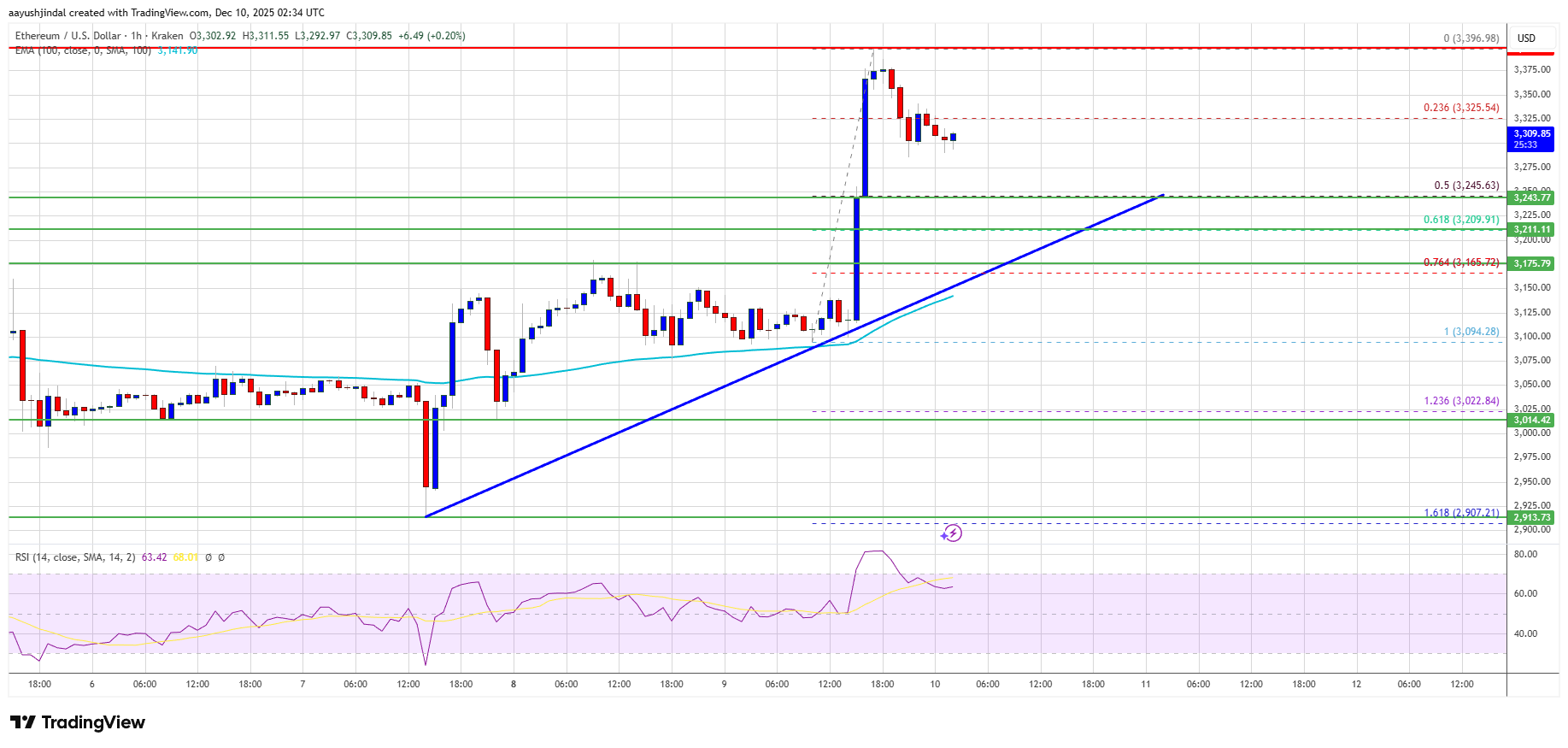
Ethereum price started a fresh increase above $3,250. ETH is now consolidating gains and might aim for more gains if it clears the $3,380 resistance.

  • Ethereum started a fresh increase above the $3,200 and $3,250 levels.
  • The price is trading above $3,200 and the 100-hourly Simple Moving Average.
  • There is a bullish trend line forming with support at $3,210 on the hourly chart of ETH/USD (data feed via Kraken).
  • The pair could continue to move up if it settles above the $3,350 zone.

Ethereum Price Rallies Over 8%

Ethereum price managed to stay above $3,000 and started a fresh increase, beating Bitcoin. ETH price gained strength for a move above the $3,120 and $3,250 resistance levels.

The bulls even pushed the price above $3,350. However, the bears were active below $3,400. A high was formed at $3,396 and the price is now consolidating. There was a minor drop below the 23.6% Fib retracement level of the upward wave from the $3,094 swing low to the $3,396 low.

Ethereum price is now trading above $3,200 and the 100-hourly Simple Moving Average. There is also a bullish trend line forming with support at $3,210 on the hourly chart of ETH/USD.

Ethereum Price

If there is another upward move, the price could face resistance near the $3,320 level. The next key resistance is near the $3,350 level. The first major resistance is near the $3,380 level. A clear move above the $3,380 resistance might send the price toward the $3,420 resistance. An upside break above the $3,420 region might call for more gains in the coming days. In the stated case, Ether could rise toward the $3,500 resistance zone or even $3,550 in the near term.

Pullback In ETH?

If Ethereum fails to clear the $3,380 resistance, it could start a fresh decline. Initial support on the downside is near the $3,250 level and the 50% Fib retracement level of the upward wave from the $3,094 swing low to the $3,396 low. The first major support sits near the $3,210 zone.

A clear move below the $3,210 support might push the price toward the $3,150 support. Any more losses might send the price toward the $3,050 region. The next key support sits at $3,000.

Technical Indicators

Hourly MACDThe MACD for ETH/USD is gaining momentum in the bullish zone.

Hourly RSIThe RSI for ETH/USD is now above the 50 zone.

Major Support Level – $3,210

Major Resistance Level – $3,380

Will The Crypto Market Benefit From The Trump Fed Takeover?

9 December 2025 at 22:00

The prospect of a “Trump Fed takeover” is rapidly becoming a central macro theme for 2026, with some traders arguing that markets still underestimate how radical the shift could be for global liquidity – and by extension for crypto.

Macro commentator plur daddy (@plur_daddy) describes it bluntly via X: “The Trump Fed takeover being underpriced is my primary theme going into 2026 (hence my gold bet). This is a momentous shift: the bigger and more convex the catalyst, the more difficult it is for markets to price it in properly.”

Former Fed trader Joseph Wang known as “Fed Guy” echoes the concern from inside the plumbing, warning: “The market underestimates the likelihood of a Trump Fed. The Administration is showing resourcefulness and determination for lower rates. That could set off the blow off top in equities, where implied vol shows speculation still has room to run.”

The Trump Fed Takeover Isn’t Price In

That determination is colliding with a bond market that appears to be pushing back via term premium. Plur highlights the spread between the 12-month T-bill and the 10-year Treasury as a clean gauge of that tension. He notes that the spread “peaked right before inauguration on the generic ‘Trump will run it hot’ viewpoint,” then “got crushed lower as DOGE and Tariffs got priced in.” It bottomed near the tariff lows and “is now back to the highs,” a pattern he reads as term-premium expansion as “a form of protest to [Kevin] Hassett,” Trump’s presumed Fed pick.

Against that backdrop, the administration still has powerful tools to compress term premium without formally announcing quantitative easing. Plur identifies three levers. First, de-regulating banks so they are allowed – in practice, pressured – to hold more Treasuries, boosting structural demand for government paper.

Second, reducing the Treasury’s weighted-average maturity by shifting issuance “to bills over longer dated notes,” which cuts the duration the market has to absorb. Third, specifically for mortgages, “lever up the GSEs to buy MBS,” narrowing mortgage spreads and transmitting easier policy to the housing market even if the policy rate moves more slowly. He argues that “all of these are quite bullish for risk overall but will take time to play out.”

For now, the environment remains awkward for directional risk bets, including crypto. “In the meantime, it has been a choppy and difficult market, across the board. Equity indices have grinded higher but the underlying rotations have been tricky to navigate. QT ended but liquidity is still relatively thin, and the fact that we are going into year end does not help. Better times will come.”

The bullish pivot in his framework arrives with the calendar. “In the new year, fiscal accommodation will re-expand on the implementation of OBBBA (+$10–15bn/mo). Meanwhile we have sell-side macro teams calling for $20–45bn/mo in T-bill repurchasing by the Fed, as soon as Jan 1.”

This mix would directly ease pressures visible in funding markets: “This would go a long way towards easing the current liquidity issues (see the SOFR–IORB spread chart below). This is not classic QE in that there is very little duration being absorbed from the private sector, and mainly has the effect of expanding bank reserves. This is still bullish because bank reserves are tight at the time, which is tied to the repo liquidity issues.”

Will The Crypto Market Rise Again?

On that basis, Plur expects the macro backdrop in 2026 to look “better than H2 ’25 has been, perhaps more on par with parts of 2024.” His expression of the trade is clear: “This should be enough for strong performance on gold given the Fed takeover angle, and continued melt-up in equities and select commodities.”

For Bitcoin and the broader crypto market, however, his stance is notably more cautious. “For BTC it is more difficult to say. My base case continues to be a frustrating period of chop and re-accumulation.” Improved liquidity “should be favorable for BTC,” but he questions whether there will be “a material shift in the supply/demand imbalances we have been seeing,” concluding: “I will keep watching it for now.”

In other words, the Trump Fed trade is already driving high-convexity bets in gold, equities and commodities. Crypto stands to benefit indirectly from easier reserves and lower term premium, but in this framework, the key constraint is no longer just macro liquidity – it is whether fresh demand is strong enough to meet an increasingly inelastic supply in the crypto market.

At press time, the total crypto market cap stood at $3.05 trillion.

Total crypto market cap

Bitcoin Price Shows Fresh Strength—Could This Spark a Rapid Rally?

9 December 2025 at 21:29

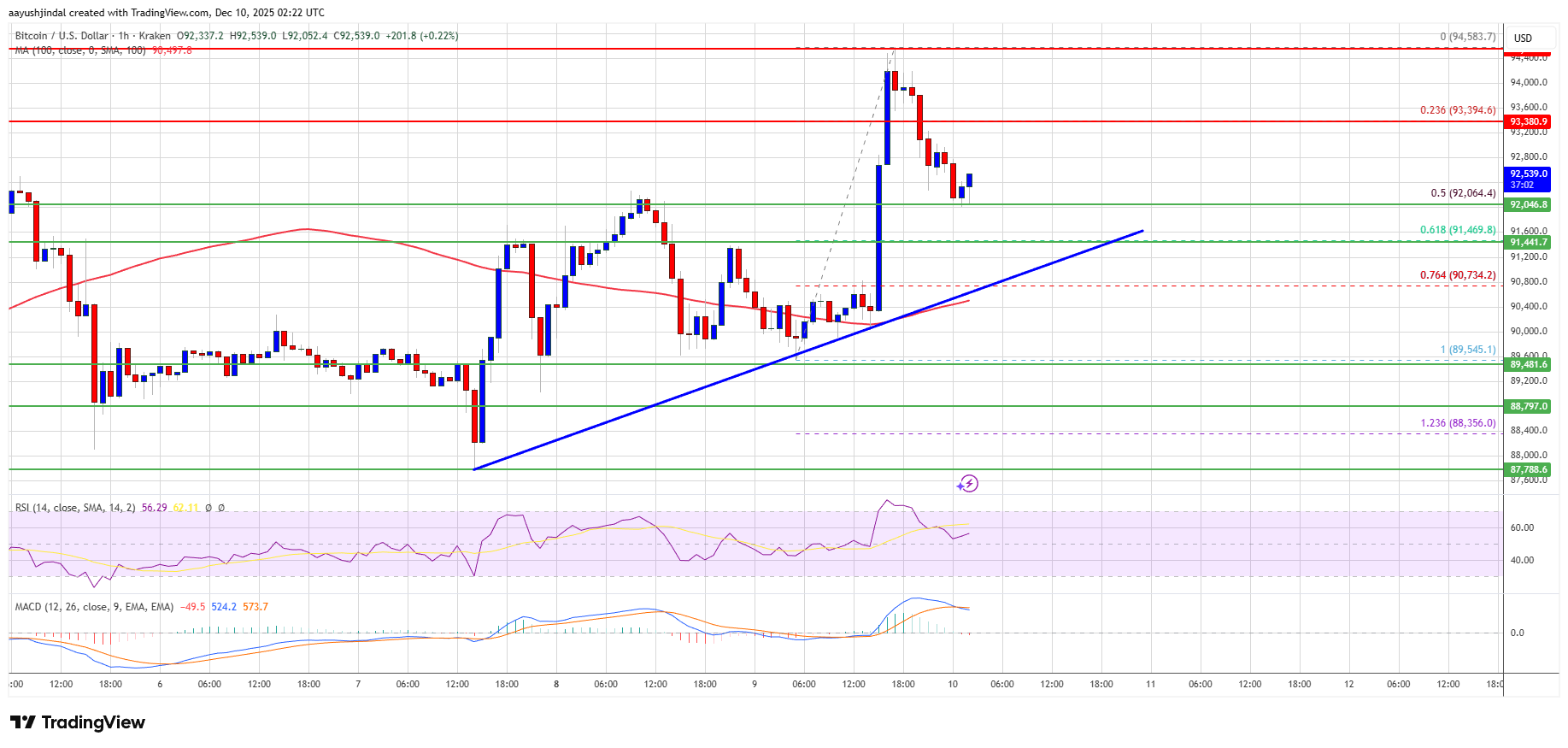
Bitcoin price started a decent increase above $92,000. BTC is now consolidating gains and might aim for another increase if it clears $93,400.

  • Bitcoin started a downside correction from the $94,500 zone.
  • The price is trading above $92,000 and the 100 hourly Simple moving average.
  • There is a bullish trend line forming with support at $91,500 on the hourly chart of the BTC/USD pair (data feed from Kraken).
  • The pair might continue to move up if it settles above the $93,400 zone.

Bitcoin Price Holds Support

Bitcoin price managed to stay above the $91,000 zone and started a fresh increase. BTC gained strength for a move above the $92,500 and $94,000 levels.

However, the bears were active near $94,500. A high was formed at $94,583 and the price recently corrected some gains. There was a drop toward the 50% Fib retracement level of the upward move from the $89,545 swing low to the $94,583 high.

However, the bulls were active near the $92,000 support. Bitcoin is now trading below $92,000 and the 100 hourly Simple moving average. Besides, there is a bullish trend line forming with support at $91,500 on the hourly chart of the BTC/USD pair.

Bitcoin Price

If the bulls remain in action, the price could attempt another increase. Immediate resistance is near the $92,800 level. The first key resistance is near the $93,200 level. The next resistance could be $94,000. A close above the $94,000 resistance might send the price further higher. In the stated case, the price could rise and test the $94,500 resistance. Any more gains might send the price toward the $95,500 level. The next barrier for the bulls could be $96,200 and $96,500.

More Losses In BTC?

If Bitcoin fails to rise above the $94,000 resistance zone, it could start another decline. Immediate support is near the $92,000 level. The first major support is near the $91,500 level and the 61.8% Fib retracement level of the upward move from the $89,545 swing low to the $94,583 high.

The next support is now near the $90,750 zone. Any more losses might send the price toward the $90,000 support in the near term. The main support sits at $88,800, below which BTC might accelerate lower in the near term.

Technical indicators:

Hourly MACD – The MACD is now gaining pace in the bullish zone.

Hourly RSI (Relative Strength Index) – The RSI for BTC/USD is now above the 50 level.

Major Support Levels – $92,000, followed by $91,500.

Major Resistance Levels – $93,200 and $94,000.

Institutions Scoop Up 9,000 Ether, Fueling Bullish Signals

9 December 2025 at 21:00

Ethereum saw a flurry of big moves that traders say could matter for its next price swing. In just a few hours, major accounts pulled large sums off an exchange and big wallets opened sizable margin longs. Market watchers are parsing those moves for clues.

Institutions Shift Big Stakes

According to Arkham Intelligence, Amber Group and Metalapha pulled out 9,000 Ether from Binance in a short span, a haul worth more than $28 million at current prices.

Based on reports, institutional flows have been heavy for months — nearly 4 million ETH has been accumulated by institutions over five months. Those kinds of transfers are often linked to custody setups or long-term holdings rather than quick trades.

Whales Add Margin Bets

Several large wallets added roughly $426 million in margin long exposure. Wallets named 1011short and Anti-CZ are among the accounts that expanded long bets.

That kind of activity raises the chance of sharper moves in either direction: if prices rise, longs can feed a rapid upswing; if a pullback hits, forced selling could amplify losses. Market structure is tighter now than it was several months ago.

🚨 INSTITUTIONS ARE ACCUMULATING $ETH ~ QUIETLY.

In the last few hours:

• Amber Group withdrew 6,000 ETH ($18.8M) from Binance • Metalapha withdrew 3,000 ETH ($9.4M)

That’s 9,000 ETH pulled off exchanges in a single morning.

This is the same pattern we’ve seen for weeks:… pic.twitter.com/MBgyXoPfJz

— BMNR Bullz (@BMNRBullz) December 8, 2025

Available Supply Shrinks

On-chain data shows only 8.7% of ETH is currently held on exchanges. More than 28 million ETH is locked up in staking, custody, and what reports call long-term storage.

Staking inflows remain high, with over 40,000 ETH added per day on average. Less supply on exchanges can lower immediate selling pressure, making price swings more dependent on fresh buy orders.

Price Range And Key Levels

Ethereum has gained 2.5% in the last 24 hours and is trading near $3,050. According to an analyst’s chart, ETH has been moving inside a tight range between $3,050 and $3,200, with $3,100 acting as a support line.

Traders say a clear break above the $3,300–$3,400 band could open the way toward $3,700 to $3,800. Failure at that resistance would likely push prices back toward $3,000, where buyers may step in again.

Regulatory Step Could Matter

In a related development, the US Commodity Futures Trading Commission has launched a pilot that allows Ethereum, USDC and Bitcoin to be used as collateral in regulated derivatives venues.

Acting Chair Caroline Pham unveiled the plan in Washington and said the move will let regulators observe how tokenized collateral behaves in stressed conditions.

The program sets rules for custody, segregation, and valuation tests inside a controlled environment.

Featured image from Unsplash, chart from TradingView

Bitcoin Treads Water At $90,000 — Market Braces For FOMC To End The Compression Phase

9 December 2025 at 20:00

Bitcoin is currently holding steady, trading water around the critical $90,000 level as the market enters a period of high compression. With ETF inflows slowing down, the price lacks the momentum to break through overhead resistance. The highly anticipated FOMC meeting is expected to provide the necessary catalyst to end the current consolidation and dictate Bitcoin’s next major directional move.

BTC Compression Intensifies: Scaling Back Intraday Scalps

According to a recent update from Lennaert Snyder, Bitcoin continues to tighten within a compression phase. The market has been trading in an increasingly narrow range, signaling that a larger move is approaching. Snyder noted that the scalp long and short setups from his previous analysis played out well.

He explained that as compression increases, the reward-to-risk ratio naturally declines. While the trades were profitable, they still fell into the category of “C-setups,” meaning they lacked the cleaner momentum and clarity found at range boundaries. Snyder emphasized that the best trading opportunities always emerge at the edges of a range.

With the current setup, his focus remains on the key resistance area around $94,000. A breakout above that level could offer long opportunities, while a failure there may open the door for shorts. On the downside, if price sweeps the lows and returns to the $87,400 support region, long entries are likely following signs of reversal.

Bitcoin

However, he added that if Bitcoin fails to show strength during this phase, he is not eager to take new long positions. A deeper retest of the $83,200 zone could become the next area of interest, though he expects any move toward that level to come with a liquidity sweep. 

Snyder also mentioned that he remains in shorts as a hedge, with scalp shorts still acceptable for traders who understand the increased risk at this stage. He concluded by highlighting the importance of the upcoming FOMC meeting, noting that the market is likely to stay muted until then.

Upcoming FOMC Meeting Dictates Bitcoin’s Next Major Move

Analyst Ted, in a recent update, revealed that BTC is currently in a state of consolidation around the $90,000 level. This tight range-bound movement suggests that while selling pressure is not dominant, buyers are also struggling to push the price higher aggressively.

Ted attributed the market’s current stagnation and its inability to break above major resistance levels to a slowdown in institutional investment. Specifically, he noted that recent ETF inflows have slowed down, removing a major source of directional buying pressure that typically drives breakouts.

Furthermore, the analyst highlighted that a critical macroeconomic event is pending: the FOMC meeting is scheduled for tomorrow, and the market’s next significant directional move will be heavily dependent on the outcome.

Bitco0in

❌
❌