NASA AI Model That Found 370 Exoplanets Now Digs Into TESS Data
This artist’s impression shows the star TRAPPIST-1 with two planets transiting across it. ExoMiner++, a recently updated open-source software package developed by NASA, uses artificial intelligence to help find new transiting exoplanets in data collected by NASA’s missions.
NASA, ESA, and G. Bacon (STScI)
Scientists have discovered over 6,000 planets that orbit stars other than our Sun, known as exoplanets. More than half of these planets were discovered thanks to data from NASA’s retired Kepler mission and NASA’s current TESS (Transiting Exoplanet Survey Satellite) mission. However, the enormous treasure trove of data from these missions still contains many yet-to-be-discovered planets. All of the data from both missions is publicly available in NASA archives, and many teams around the world have used that data to find new planets using a number of techniques.
In 2021, a team from NASA’s Ames Research Center in California’s Silicon Valley created ExoMiner, a piece of open-source software that used artificial intelligence (AI) to validate 370 new exoplanets from Kepler data. Now, the team has created a new version of the model trained on both Kepler and TESS data, called ExoMiner++.
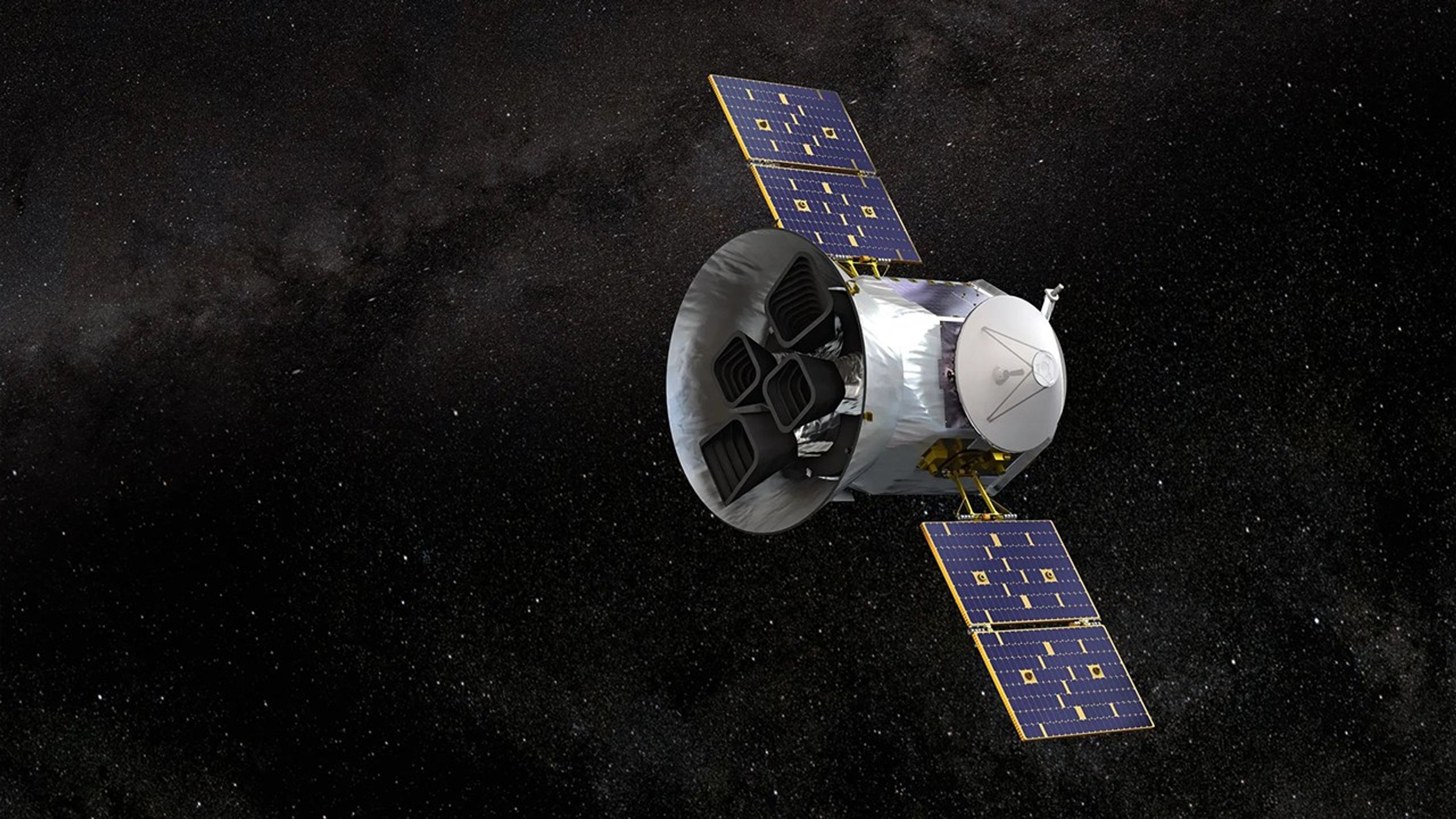
Artist’s impression of NASA’s Transiting Exoplanet Survey Satellite (TESS), which launched in 2018 and has discovered nearly 700 exoplanets so far. NASA’s ExoMiner++ software is working toward identifying more planets in TESS data using artificial intelligence.
NASA’s Goddard Space Flight Center
The new algorithm, which is discussed in a recent paper published in the Astronomical Journal, identified 7,000 targets as exoplanet candidates from TESS on an initial run. An exoplanet candidate is a signal that is likely to be a planet but requires follow-up observations from additional telescopes to confirm.
ExoMiner++ can be freely downloaded from GitHub, allowing any researcher to use the tool to hunt for planets in TESS’s growing public data archive.
“Open-source software like ExoMiner accelerates scientific discovery,” said Kevin Murphy, NASA’s chief science data officer at NASA Headquarters in Washington. “When researchers freely share the tools they’ve developed, it lets others replicate the results and dig deeper into the data, which is why open data and code are important pillars of gold-standard science.”
ExoMiner++ sifts through observations of possible transits to predict which ones are caused by exoplanets and which ones are caused by other astronomical events, such as eclipsing binary stars. “When you have hundreds of thousands of signals, like in this case, it’s the ideal place to deploy these deep learning technologies,” said Miguel Martinho, a KBR employee at NASA Ames who serves as the co-investigator for ExoMiner++.
This animation shows a graph of the tiny amount of dimming that takes place when a planet passes in front of its host star. NASA’s Kepler and TESS missions spot exoplanets by looking for these transits. ExoMiner++ uses artificial intelligence to help separate real planet transits from other, similar-looking astronomical phenomena.
NASA’s Goddard Space Flight Center
Kepler and TESS operate differently — TESS is surveying nearly the whole sky, mainly looking for planets transiting nearby stars, while Kepler looked at a small patch of sky more deeply than TESS. Despite these different observing strategies, the two missions produce compatible datasets, allowing ExoMiner++ to train on data from both telescopes and deliver strong results. “With not many resources, we can make a lot of returns,” said Hamed Valizadegan, the project lead for ExoMiner and a KBR employee at NASA Ames.
The next version of ExoMiner++ will improve the usefulness of the model and inform future exoplanet detection efforts. While ExoMiner++ can currently flag planet candidates when given a list of possible transit signals, the team is also working on giving the model the ability to identify the signals themselves from the raw data.
Open-source science and open-source software are why the exoplanet field is advancing as quickly as it is.
Jon Jenkins
Exoplanet Scientist, NASA Ames Research Center
In addition to the ongoing stream of data from TESS, future exoplanet-hunting missions will give ExoMiner users plenty more data to work with. NASA’s upcoming Nancy Grace Roman Space Telescope will capture tens of thousands of exoplanet transits — and, like TESS data, Roman data will be freely available in line with NASA’s commitment to Gold Standard Science and sharing data with the public. The advances made with the ExoMiner models could help hunt for exoplanets in Roman data, too.
“The open science initiative out of NASA is going to lead to not just better science, but also better software,” said Jon Jenkins, an exoplanet scientist at NASA Ames. “Open-source science and open-source software are why the exoplanet field is advancing as quickly as it is.”
NASA’s Office of the Chief Science Data Officer leads the open science efforts for the agency. Public sharing of scientific data, tools, research, and software maximizes the impact of NASA’s science missions. To learn more about NASA’s commitment to transparency and reproducibility of scientific research, visit science.nasa.gov/open-science. To get more stories about the impact of NASA’s science data delivered directly to your inbox, sign up for the NASA Open Science newsletter.
By Lauren Leese Web Content Strategist for the Office of the Chief Science Data Officer
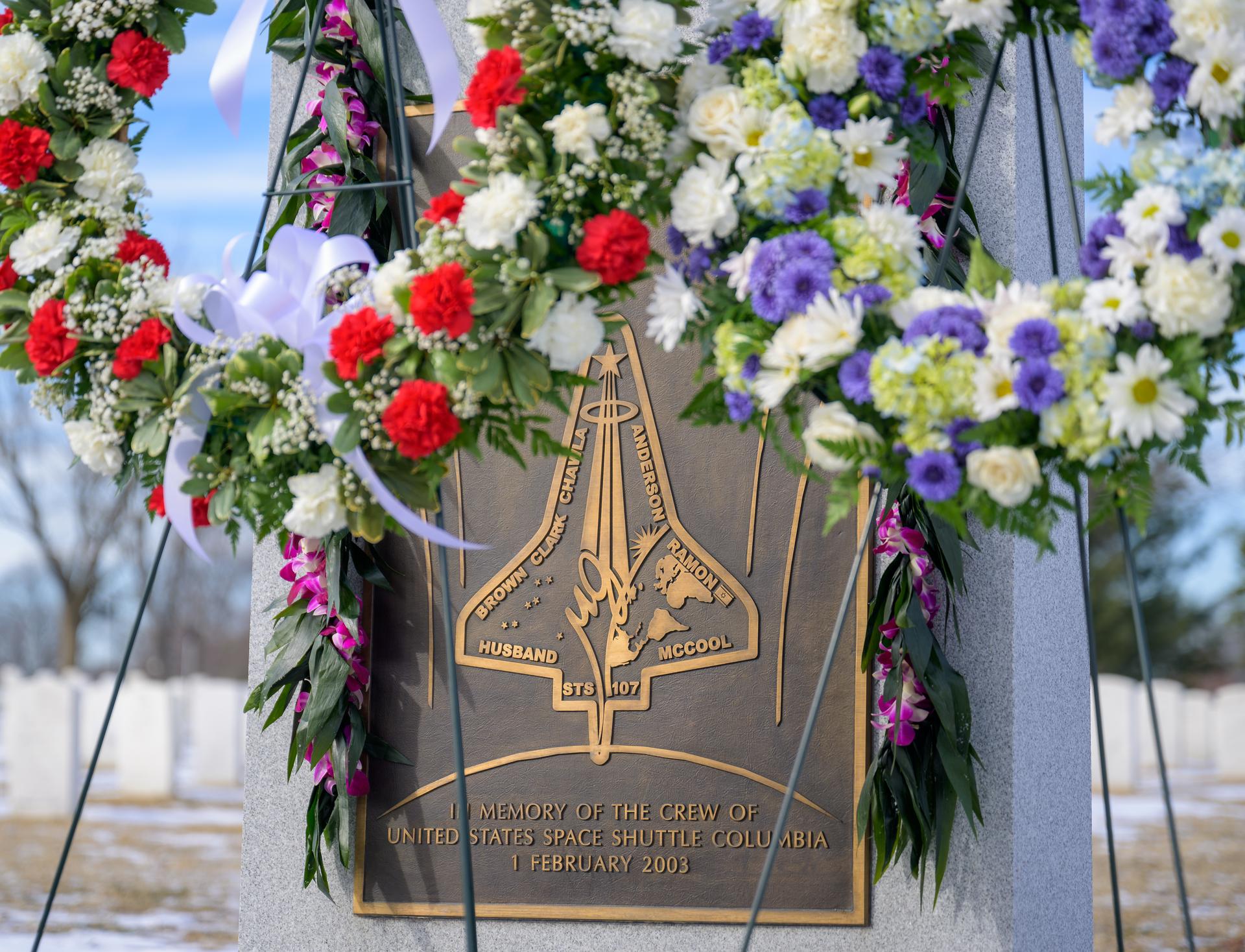
The Space Shuttle Columbia Memorial is seen during a wreath laying ceremony that was part of NASA’s Day of Remembrance, Thursday, Jan. 23, 2025, at Arlington National Cemetery in Virginia. Wreaths were laid in memory of those men and women who lost their lives in the quest for space exploration.
Credit: NASA/Bill Ingalls
NASA will observe its annual Day of Remembrance on Thursday, Jan. 22, which includes commemorating the crews of Apollo 1 and the space shuttles Challenger and Columbia. The event is traditionally held every year on the fourth Thursday of January, as all three astronaut accidents happened around the end of the month.
“On NASA’s Day of Remembrance, we pause to honor the members of the NASA family who lost their lives while pushing the boundaries of exploration and discovery,” said NASA Administrator Jared Isaacman. “We remember them not to retreat from risk, but to respect it — to learn, to improve, and continue onward. Their sacrifice and the strength of their families will forever inspire us as we continue to reach for the stars and pursue the secrets of the universe.”
Isaacman will lead an observance at 1 p.m. EST at Arlington National Cemetery in Virginia, which will begin with a wreath-laying ceremony at the Tomb of the Unknown Soldier, followed by observances for the Apollo 1, Challenger, and Columbia crews.
Several agency centers also will hold observances:
Johnson Space Center in Houston
NASA Johnson will hold a commemoration at 10 a.m. CST at the Astronaut Memorial Grove with remarks by Center Director Vanessa Wyche, NASA astronaut Jasmin Moghbeli, and Cheryl McNair, widow of Challenger astronaut Ronald McNair. The event will have a moment of silence, a NASA T-38 flyover, taps performed by the Texas A&M Squadron 17, and a procession placing flowers at Apollo I, Challenger, and Columbia memorial trees.
Kennedy Space Center in Florida
NASA Kennedy and the Astronauts Memorial Foundation will host a ceremony at the Space Shuttle Atlantis building at Kennedy’s Visitor Complex at 11 a.m. EST. The event will include musical guests, a bell ringing commemoration, a moment of silence, and wreath-laying. Kelvin Manning, deputy director at NASA Kennedy, and Bob Cabana, former NASA associate administrator and Kennedy center director, will provide remarks during the ceremony, which will livestream on the center’s Facebook page.
Ames Research Center in California’s Silicon Valley
NASA Ames will hold a remembrance ceremony at 1 p.m. PST that includes remarks from Center Director Eugene Tu, a moment of silence, and bell ringing commemoration for each astronaut lost in service.
Langley Research Center in Hampton, Virginia
NASA Langley will hold a remembrance ceremony at 1 p.m. EST with acting Center Director Trina Dyal, followed by placing flags at the Langley Workers Memorial.
Marshall Space Flight Center in Huntsville, Alabama
NASA Marshall will hold a candle-lighting ceremony and wreath placement at 9:30 a.m. CST and include remarks from Rae Ann Meyer, Marshall’s acting center director, and Bill Hill, director of Safety and Mission Assurance at Marshall.
Stennis Space Flight Center in Bay St. Louis, Mississippi
NASA Stennis and the NASA Shared Services Center will hold a wreath-laying ceremony and moment of silence at 10:30 a.m. CST with remarks from Center Director John Bailey and Anita Harrell, NASA Shared Services Center executive director.
The agency also is paying tribute to its fallen astronauts with special online content, updated on NASA’s Day of Remembrance, at:
Preparations for Next Moonwalk Simulations Underway (and Underwater)
By Supreet Kaur
In an era where data security is critical to aviation safety, NASA is exploring bold new solutions.
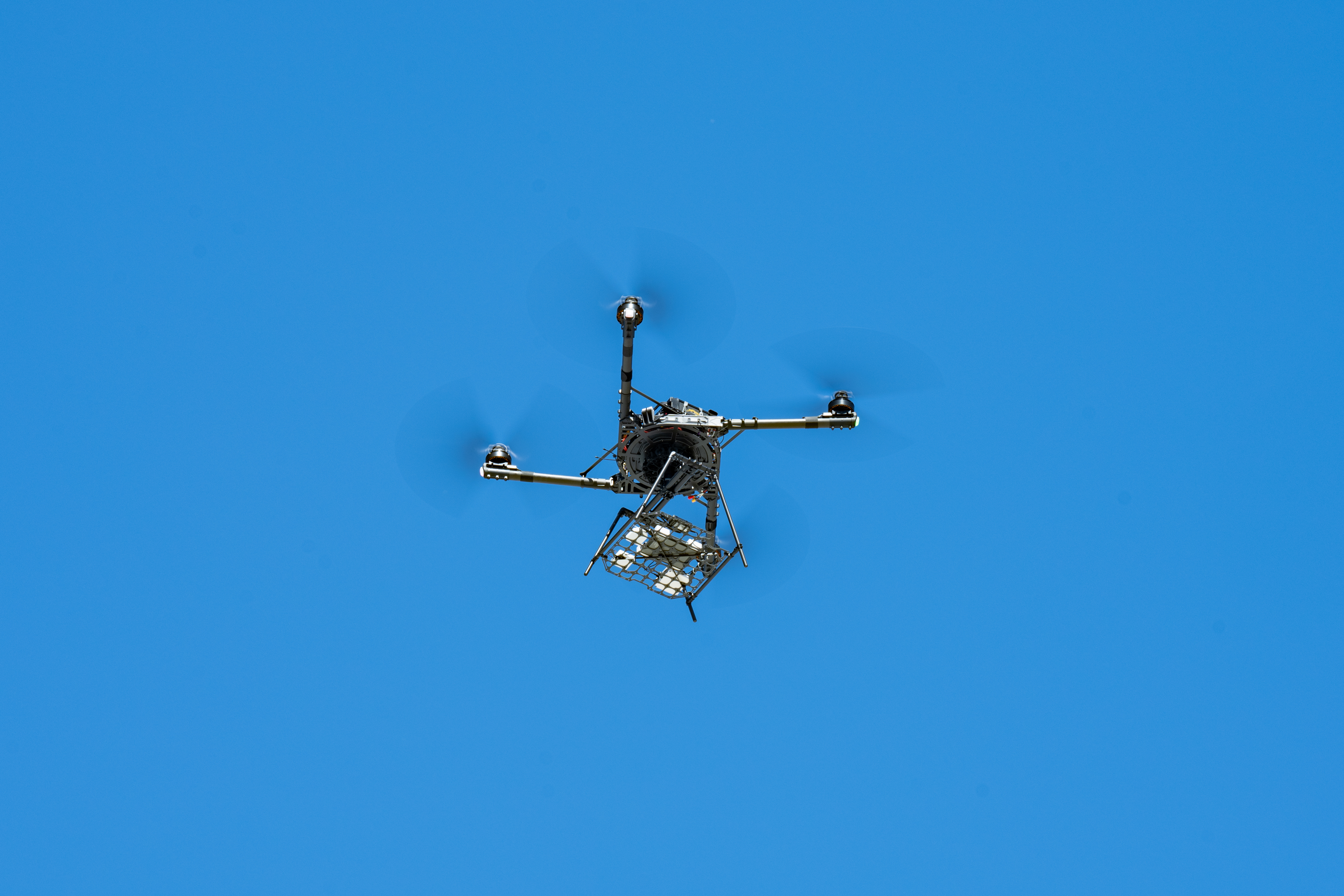
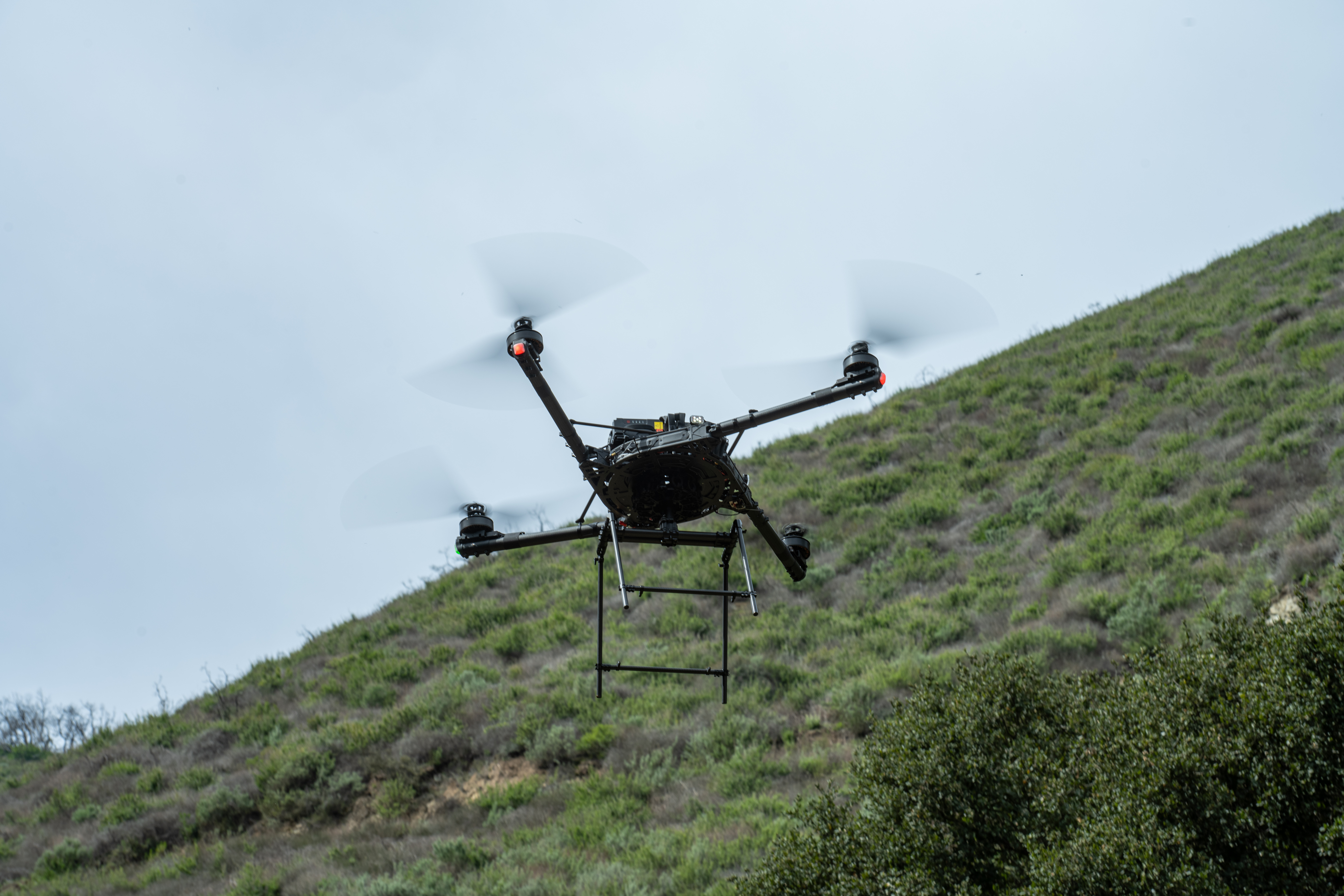
An Alta-X drone carries a custom built simulated Unmanned Aircraft Systems environment payload for the new blockchain system tests.
Credit: NASA/Brandon Torres Navarette
Through a drone flight test at NASA’s Ames Research Center in California’s Silicon Valley, researchers tested a blockchain-based system for protecting flight data. The system aims to keep air traffic management safe from disruption and protect data transferred between aircraft and ground stations from being intercepted or manipulated.
For aviation and airspace operations to remain safe, users need to be able to trust that data is reliable and transparent. While current systems have been able to protect flight data systems, cyberthreats continue to evolve, requiring new approaches. NASA researchers found the blockchain-based system can safely transmit and store information in real time.
Blockchain operates like a decentralized database — it does not rely on a single computer or centralized system. Instead, it shares information across a vast network, recording and verifying every change to a dataset. The system ensures the data stays safe, accurate, and trustworthy.
Previous cybersecurity research focused on implementing a layered security architecture — using multiple physical and digital security measures to control system access. For this test, researchers took a different approach using blockchain to address potential threats.
Using drones allowed the team to show that the blockchain framework could yield benefits across several priority areas in aviation development, including autonomous air traffic management, urban air mobility, and high-altitude aircraft.
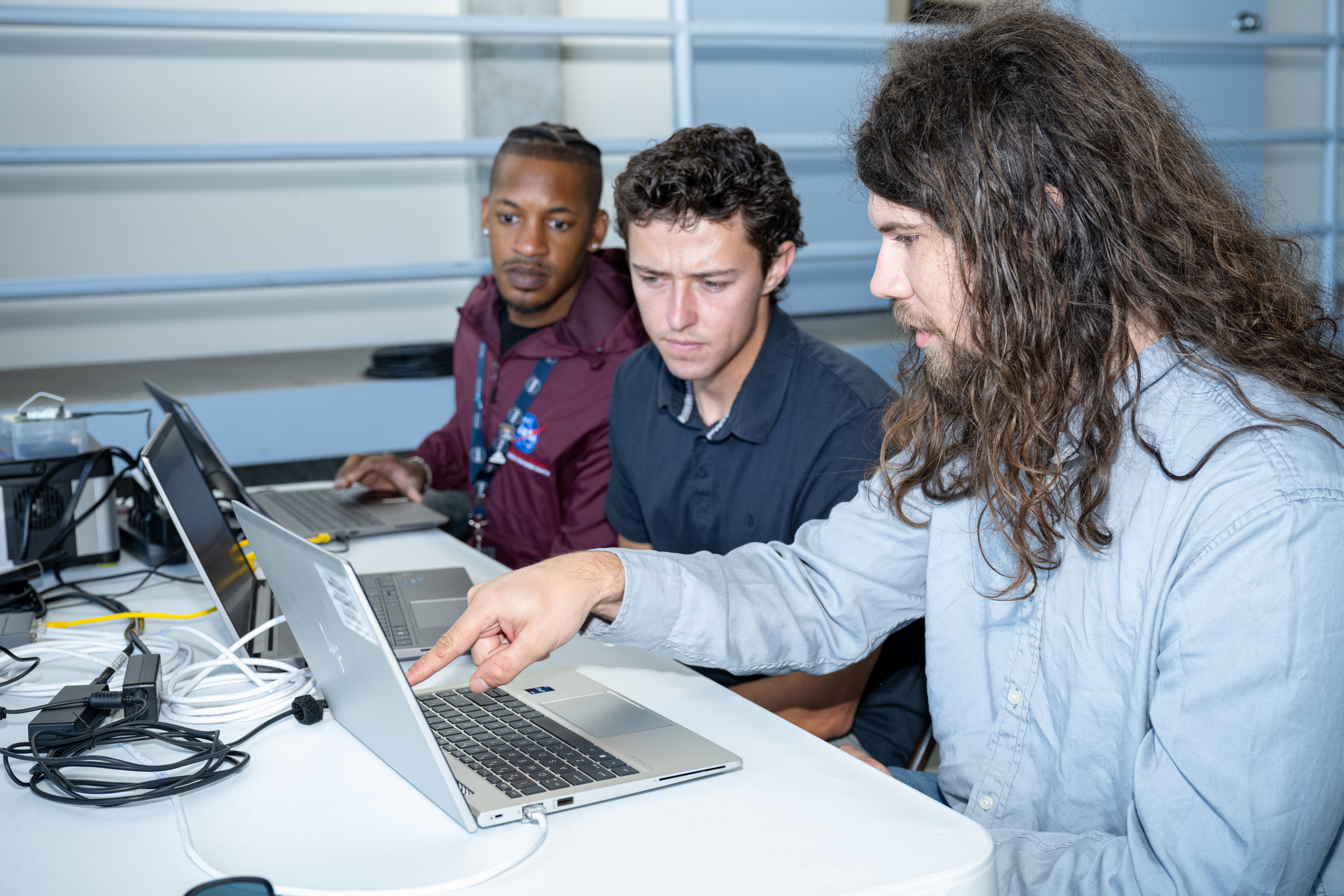
Terrence D. Lewis (left), Kale Dunlap (center), and Aidan Jones monitor the flow of telemetry from both actual and simulated flights, ensuring the simulation and blockchain systems are processing and recording data accurately.
Credit: NASA/Brandon Torres Navarette
This NASA research explored how blockchain can secure digital transactions between multiple systems and operators. The team used an open-source blockchain framework that allows trusted users real-time sharing and storage of critical data like aircraft operator registration information, flight plans, and telemetry. This framework restricts access to this data to trusted parties and approved users only.
To further examine system resilience, the team introduced a set of cybersecurity tests designed to assess, improve, and reinforce security during operations in airspace environments. During an August flight at Ames, the team demonstrated these capabilities using an Alta-X drone with a custom-built software and hardware package that included a computer, radio, GPS system, and battery.
The test simulated an environment with a drone flying in real-world conditions, complete with a separate ground control station and the blockchain and security infrastructure. The underlying blockchain framework and cybersecurity protocols can be extended to support high-altitude operations at 60,000 feet and higher and Urban Air Mobility operations, paving the way for a more secure, scalable, and trusted ecosystem.
NASA researchers will continue to look at the data gathered during the test and apply what they’ve learned to future work. The testing will ultimately benefit U.S. aviation stakeholders looking for new tools to improve operations.
Through its Air Traffic Management and Safety project, NASA performed research to transform air traffic management systems to safely accommodate the growing demand of new air vehicles. The project falls under NASA’s Airspace Operations and Safety Program, a part the agency’s Aeronautics Research Mission Directorate that works to enable safe, efficient aviation transportation operations that benefit the flying public and industry.
Preparations for Next Moonwalk Simulations Underway (and Underwater)
Oregon Air National Guard ground crew guides one of the NASA’s newest F-15 aircraft onto the ramp at the agency’s Armstrong Flight Research Center in Edwards, California, on Monday, Dec. 22, 2025. The retired U.S. Air Force F-15s come from the Oregon Air National Guard’s 173rd Fighter Wing and will transition from military service to support NASA’s flight research fleet.
NASA/Christopher LC Clark
Oregon Air National Guard and NASA flight crew look out across the desert while awaiting the arrival of the NASA’s newest F-15 aircraft from the Oregon Air National Guard’s 173rd Fighter Wing to NASA’s Armstrong Flight Research Center in Edwards, California, on Monday, Dec. 22, 2025
NASA/Christopher LC Clark
NASA’s newest F-15 aircraft arrive at the agency’s Armstrong Flight Research Center in Edwards, California, on Monday, Dec. 22, 2025. The two retired U.S. Air Force F-15s will support ongoing supersonic flight research for NASA’s Flight Demonstrations and Capabilities Project and the Quesst mission’s X-59 quiet supersonic research aircraft.
NASA/Christopher LC Clark
NASA staff and Oregon Air National Guard’s 173rd Fighter Wing crew pose for a group photo at NASA’s Armstrong Flight Research Center in Edwards, California, on Monday, Dec. 22, 2025. The group stands in front of one of two F-15 aircraft added to the agency’s flight research fleet.
NASA/Christopher LC Clark
Oregon Air National Guard pilots deliver NASA’s newest F-15 aircraft from the Oregon Air National Guard’s 173rd Fighter Wing at Kingsley Field to NASA’s Armstrong Flight Research Center in Edwards, California, on Monday, Dec. 22, 2025. After completing their final flights with the Air Force, the two aircraft begin their new role supporting NASA’s flight research.
NASA/Christopher LC Clark
Two retired U.S. Air Force F-15 jets have joined the flight research fleet at NASA’s Armstrong Flight Research Center in Edwards, California, transitioning from military service to a new role enabling breakthrough advancements in aerospace.
The F-15s will support supersonic flight research for NASA’s Flight Demonstrations and Capabilities project, including testing for the Quesst mission’s X-59 quiet supersonic research aircraft. One of the aircraft will return to the air as an active NASA research aircraft. The second will be used for parts to support long-term fleet sustainment.
“These two aircraft will enable successful data collection and chase plane capabilities for the X-59 through the life of the Low Boom Flight Demonstrator project” said Troy Asher, director for flight operations at NASA Armstrong. “They will also enable us to resume operations with various external partners, including the Department of War and commercial aviation companies.”
The aircraft came from the Oregon Air National Guard’s 173rd Fighter Wing at Kingsley Field. After completing their final flights with the Air Force, the two aircraft arrived at NASA Armstrong Dec. 22, 2025.
“NASA has been flying F-15s since some of the earliest models came out in the early 1970s,” Asher said. “Dozens of scientific experiments have been flown over the decades on NASA’s F-15s and have made a significant contribution to aeronautics and high-speed flight research.”
The F-15s allow NASA to operate in high-speed, high-altitude flight-testing environments. The aircraft can carry experimental hardware externally – under its wings or slung under the center – and can be modified to support flight research.
Now that these aircraft have joined NASA’s fleet, the team at Armstrong can modify their software, systems, and flight controls to suit mission needs. The F-15’s ground clearance allows researchers to install instruments and experiments that would not fit beneath many other aircraft.
NASA has already been operating two F-15s modified so their pilots can operate safely at up to 60,000 feet, the top of the flight envelop for the X-59, which will cruise at 55,000 feet. The new F-15 that will fly for NASA will receive the same modification, allowing for operations at altitudes most standard aircraft cannot reach. The combination of capability, capacity, and adaptability makes the F-15s uniquely suited for flight research at NASA Armstrong.
“The priority is for them to successfully support the X-59 through completion of that mission,” Asher said. “And over the longer term, these aircraft will help position NASA to continue supporting advanced aeronautics research and partnerships.”
NASA’s Pandora Satellite, CubeSats to Explore Exoplanets, Beyond
Editor’s Note, Jan. 11, 2026: NASA’s Pandora and the NASA-sponsored BlackCAT and SPARCS missions lifted off at 8:44 a.m. EST (5:44 a.m. PST) Sunday, Jan. 11.
A new NASA spacecraft called Pandora is awaiting launch ahead of its journey to study the atmospheres of exoplanets, or worlds beyond our solar system, and their stars.
All three missions are set to launch Jan. 11 on a SpaceX Falcon 9 rocket from Space Launch Complex 4 East at Vandenberg Space Force Base in California. The launch window opens at 8:19 a.m. EST (5:19 a.m. PST). SpaceX will livestream the event.
Artist’s concept of NASA’s Pandora mission, which will help scientists untangle the signals from the atmospheres of exoplanets — worlds beyond our solar system — and their stars.
NASA’s Goddard Space Flight Center/Conceptual Image Lab
“Pandora’s goal is to disentangle the atmospheric signals of planets and stars using visible and near-infrared light,” said Elisa Quintana, Pandora’s principal investigator at NASA’s Goddard Space Flight Center in Greenbelt, Maryland. “This information can help astronomers determine if detected elements and compounds are coming from the star or the planet — an important step as we search for signs of life in the cosmos.”
BlackCAT and SPARCS are small satellites that will study the transient, high-energy universe and the activity of low-mass stars, respectively.
Pandora will observe planets as they pass in front of their stars as seen from our perspective, events called transits.
As starlight passes through a planet’s atmosphere, it interacts with substances like water and oxygen that absorb characteristic wavelengths, adding their chemical fingerprints to the signal.
But while only a small fraction of the star’s light grazes the planet, telescopes also collect the rest of the light emitted by the star’s facing side. Stellar surfaces can sport brighter and darker regions that grow, shrink, and change position over time, suppressing or magnifying signals from planetary atmospheres. Adding a further complication, some of these areas may contain the same chemicals that astronomers hope to find in the planet’s atmosphere, such as water vapor.
All these factors make it difficult to be certain that important detected molecules come from the planet alone.
Pandora will help address this problem by providing in-depth study of at least 20 exoplanets and their host stars during its initial year. The satellite will look at each planet and its star 10 times, with each observation lasting a total of 24 hours. Many of these worlds are among the over 6,000 discovered by missions like NASA’s TESS (Transiting Exoplanet Survey Satellite).
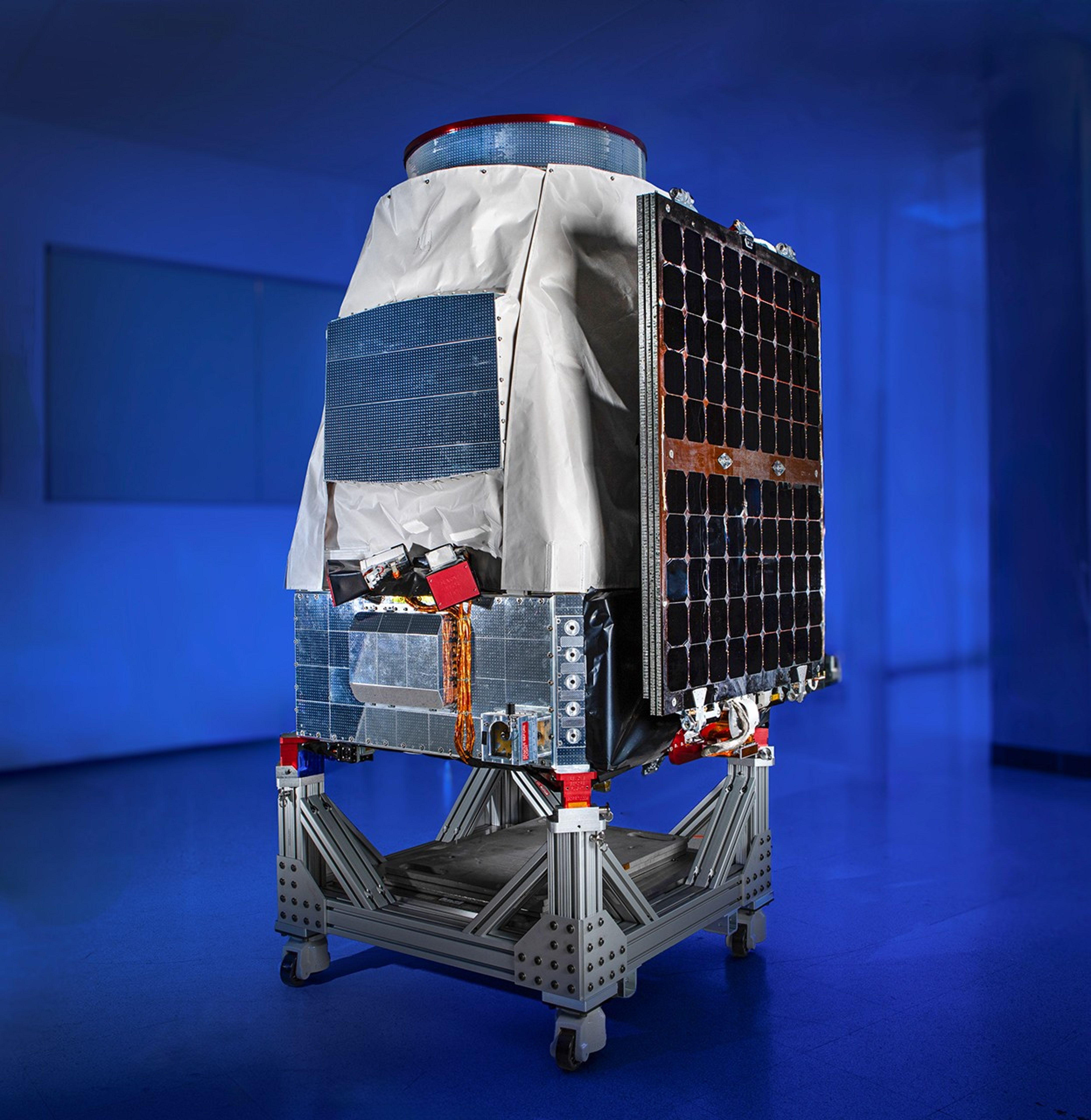
This view of the fully integrated Pandora spacecraft was taken May 19, 2025, following the mission’s successful environmental test campaign at Blue Canyon Technologies in Lafayette, Colorado. Visible are star trackers (center), multilayer insulation blankets (white), the end of the telescope (top), and the solar panel (right) in its launch configuration.
NASA/BCT
Pandora will collect visible and near-infrared light using a novel, all-aluminum 17-inch-wide (45-centimeter) telescope jointly developed by Lawrence Livermore National Laboratory in California and Corning Incorporated in Keene, New Hampshire. Pandora’s near-infrared detector is a spare developed for NASA’s James Webb Space Telescope.
Each long observation period will capture a star’s light both before and during a transit and help determine how stellar surface features impact measurements.
“These intense studies of individual systems are difficult to schedule on high-demand missions, like Webb,” said engineer Jordan Karburn, Pandora’s deputy project manager at Livermore. “You also need the simultaneous multiwavelength measurements to pick out the star’s signal from the planet’s. The long stares with both detectors are critical for tracing the exact origins of elements and compounds scientists consider indicators of potential habitability.”
Pandora is the first satellite to launch in the agency’s Astrophysics Pioneers program, which seeks to do compelling astrophysics at a lower cost while training the next generation of leaders in space science.
After launching into low Earth orbit, Pandora will undergo a month of commissioning before embarking on its one-year prime mission. All the mission’s data will be publicly available.
“The Pandora mission is a bold new chapter in exoplanet exploration,” said Daniel Apai, an astronomy and planetary science professor at the University of Arizona in Tucson where the mission’s operations center resides. “It is the first space telescope built specifically to study, in detail, starlight filtered through exoplanet atmospheres. Pandora’s data will help scientists interpret observations from past and current missions like NASA’s Kepler and Webb space telescopes. And it will guide future projects in their search for habitable worlds.”
Watch to learn more about NASA’s Pandora mission, which will revolutionize the study of exoplanet atmospheres. NASA’s Goddard Space Flight Center
The BlackCAT and SPARCS missions will take off alongside Pandora through NASA’s Astrophysics CubeSat program, the latter supported by the Agency’s CubeSat Launch Initiative.
CubeSats are a class of nanosatellites that come in sizes that are multiples of a standard cube measuring 3.9 inches (10 centimeters) across. Both BlackCAT and SPARCS are 11.8 by 7.8 by 3.9 inches (30 by 20 by 10 centimeters). CubeSats are designed to provide cost-effective access to space to test new technologies and educate early career scientists and engineers while delivering compelling science.
The BlackCAT mission will use a wide-field telescope and a novel type of X-ray detector to study powerful cosmic explosions like gamma-ray bursts, particularly those from the early universe, and other fleeting cosmic events. It will join NASA’s network of missions that watch for these changes. Abe Falcone at Pennsylvania State University in University Park, where the satellite was designed and built, leads the mission with contributions from Los Alamos National Laboratory in New Mexico. Kongsberg NanoAvionics US provided the spacecraft bus.
The SPARCS CubeSat will monitor flares and other activity from low-mass stars using ultraviolet light to determine how they affect the space environment around orbiting planets. Evgenya Shkolnik at Arizona State University in Tempe leads the mission with participation from NASA’s Jet Propulsion Laboratory in Southern California. In addition to providing science support, JPL developed the ultraviolet detectors and the associated electronics. Blue Canyon Technologies fabricated the spacecraft bus.
Pandora is led by NASA Goddard. Livermore provides the mission’s project management and engineering. Pandora’s telescope was manufactured by Corning and developed collaboratively with Livermore, which also developed the imaging detector assemblies, the mission’s control electronics, and all supporting thermal and mechanical subsystems. The near-infrared sensor was provided by NASA Goddard. Blue Canyon Technologies provided the bus and performed spacecraft assembly, integration, and environmental testing. NASA’s Ames Research Center in California’s Silicon Valley will perform the mission’s data processing. Pandora’s mission operations center is located at the University of Arizona, and a host of additional universities support the science team.
NASA’s Ames Research Center in California’s Silicon Valley continued to make strides in research, technology, engineering, science, and innovation this past year. Join us as we take a look back at some of the highlights from 2025.
From Supercomputers to Wind Tunnels: NASA’s Road to Artemis II
This video shows two simulations of the SLS (Space Launch System) rocket using NASA’s Launch Ascent and Vehicle Aerodynamics solver. For the Artemis II test flight, a pair of six-foot-long strakes will be added to the core stage of SLS that will smooth vibrations induced by airflow during ascent. The top simulation is without strakes while the bottom shows the airflow with strakes. The green and yellow colors on the rocket’s surface show how the airflow scrapes against the rocket’s skin. The white and gray areas show changes in air density between the boosters and core stage, with the brightest regions marking shock waves. The strakes reduce vibrations and improves the safety of the integrated vehicle.
NASA/NAS/Gerrit-Daniel Stich, Michael Barad, Timothy Sandstrom, Derek Dalle
By combining the technologies of the NASA Advanced Supercomputing facility and Unitary Plan Wind Tunnel at NASA Ames, researchers were able to simulate and model an adjustment to the Space Launch System (SLS) rocket that could improve airflow and stability to the vehicle during the launch of Artemis II. The collaborative effort between researchers is the next step on NASA’s journey to send astronauts to explore the Moon for scientific discovery, economic benefits, and build the foundation for the first crewed missions to Mars.
New Discoveries in Early Solar System Samples
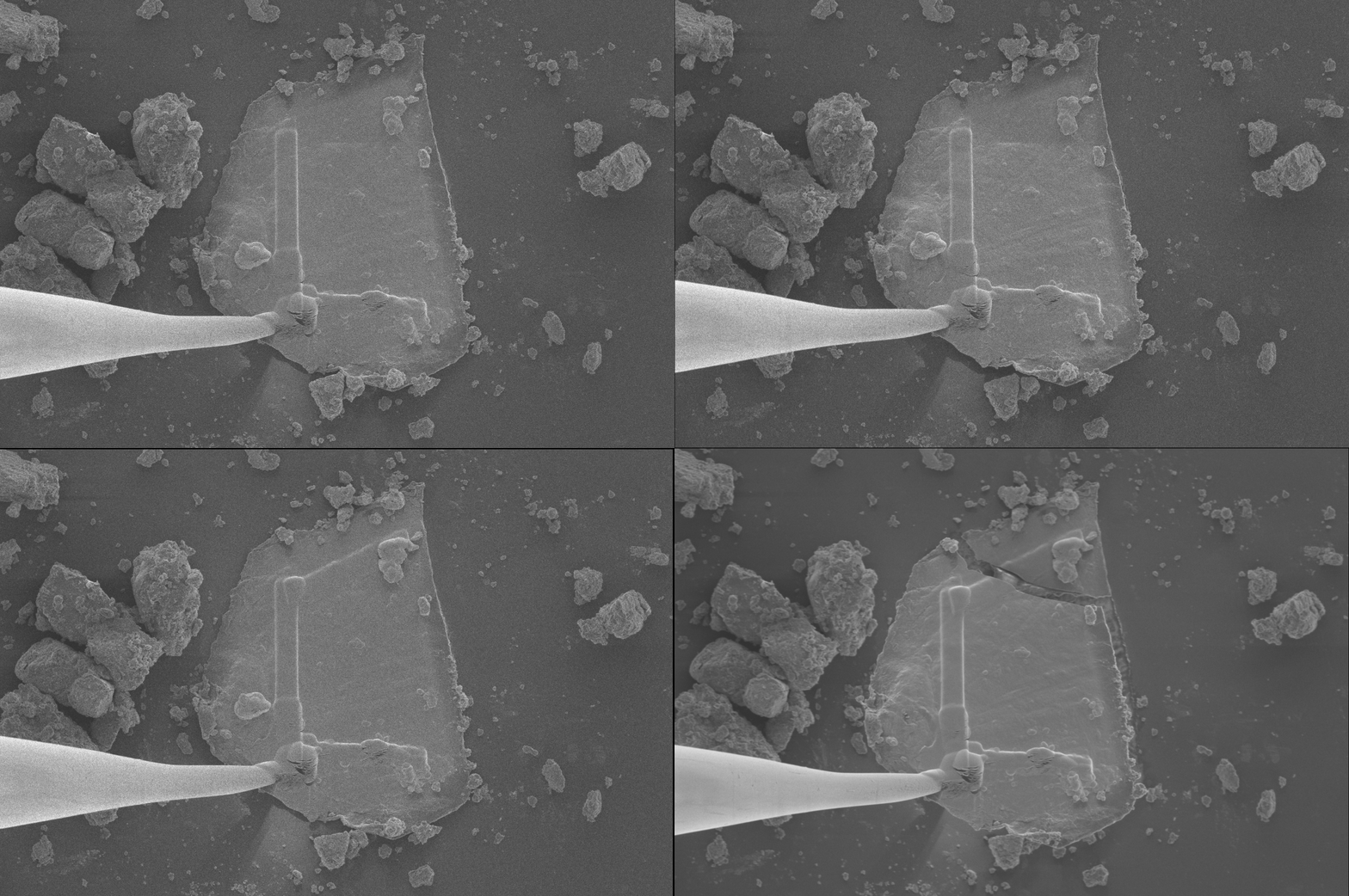
A microscopic particle of asteroid Bennu, brought to Earth by NASA’s OSIRIS-REx mission, is manipulated under a transmission electron microscope. In order to move the fragment for further analysis, researchers first reinforced it with thin strips of platinum (the “L” shape on the particle’s surface) then welded a tungsten microneedle to it. The asteroid fragment measures 30 micrometers (about one-one thousandth of an inch) across.
NASA
Researchers at NASA Ames discovered a never-before-seen “gum-like” material in pristine asteroid samples delivered to Earth by NASA’s OSIRIS-REx (Origins, Spectral Interpretation, Resource Identification, and Security-Regolith Explorer) spacecraft. The surprising substance was likely formed in the early days of the solar system, as Bennu’s young parent asteroid warmed. Such complex molecules could have provided some of the chemical precursors that helped trigger life on Earth, and finding them in the pristine samples from Bennu is important for scientists studying how life began and whether it exists beyond our planet.
This artist’s concept shows Blue Origin’s Blue Moon Mark 1 lander and NASA’s VIPER (Volatiles Investigating Polar Exploration Rover) on the lunar surface.
Credit: Courtesy of Blue Origin
NASA’s VIPER (Volatiles Investigating Polar Exploration Rover) will search for volatile resources, such as ice, on the lunar surface and collect science data to support future exploration at the Moon and Mars. As part of the agency’s Artemis campaign, NASA awarded Blue Origin of Kent, Washington, a Commercial Lunar Payload Services task order with an option to deliver a rover to the Moon’s South Pole region. With this new award, Blue Origin will deliver VIPER to the lunar surface in late 2027.
Taking to the Skies to Test Remote Wildfire Response
NASA Ames drone team tests the information sharing, airspace management, communication relay, and aircraft deconfliction capabilities of the x-altas drone as it communicates through the Advanced Capabilities for Emergency Response Operations (ACERO) Portable Airspace Management System (PAMS) in Salinas, California in March 2025. This was a part of the project’s first flight demonstration.
NASA/Brandon Torres Navarrete
NASA researchers are advancing airborne systems that can fight and monitor wildfires 24 hours a day, even during low-visibility conditions. NASA’s Advanced Capabilities for Emergency Response Operations (ACERO) conducted field tests of remotely piloted aircraft for monitoring, suppression, and logistics support in wildland fire situations. The ACERO team was able to safely conduct flight operations of a vertical takeoff and landing aircraft operated by Overwatch Aero, LLC, of Solvang, California, and two small NASA drones.
NASA Installs Heat Shield on First Private Spacecraft Bound for Venus
Engineers at NASA’s Ames Research Center in California’s Silicon Valley, Eli Hiss, left, and Bohdan Wesely complete a fit check of the two halves of a space capsule that will study the clouds of Venus for signs of life. Led by Rocket Lab of Long Beach, California, it will be the first private mission to the planet.
NASA/Brandon Torres Navarrete
NASA helps the commercial space endeavor succeed by providing expertise in thermal protection of small spacecraft. NASA Ames teams work with private companies to turn NASA materials into solutions, such as the heat shield tailor-made for a spacecraft destined for Venus, supporting growth of the new space economy. Invented at NASA Ames, NASA’s Heatshield for Extreme Entry Environment Technology covers the bottom of the space capsule that will study the clouds of Venus for signs of life during the first private mission to the planet. This mission is led by Rocket Lab of Long Beach, California, and their partners at the Massachusetts Institute of Technology in Cambridge.
Artemis Astronauts & Orion Leadership Visit NASA Ames
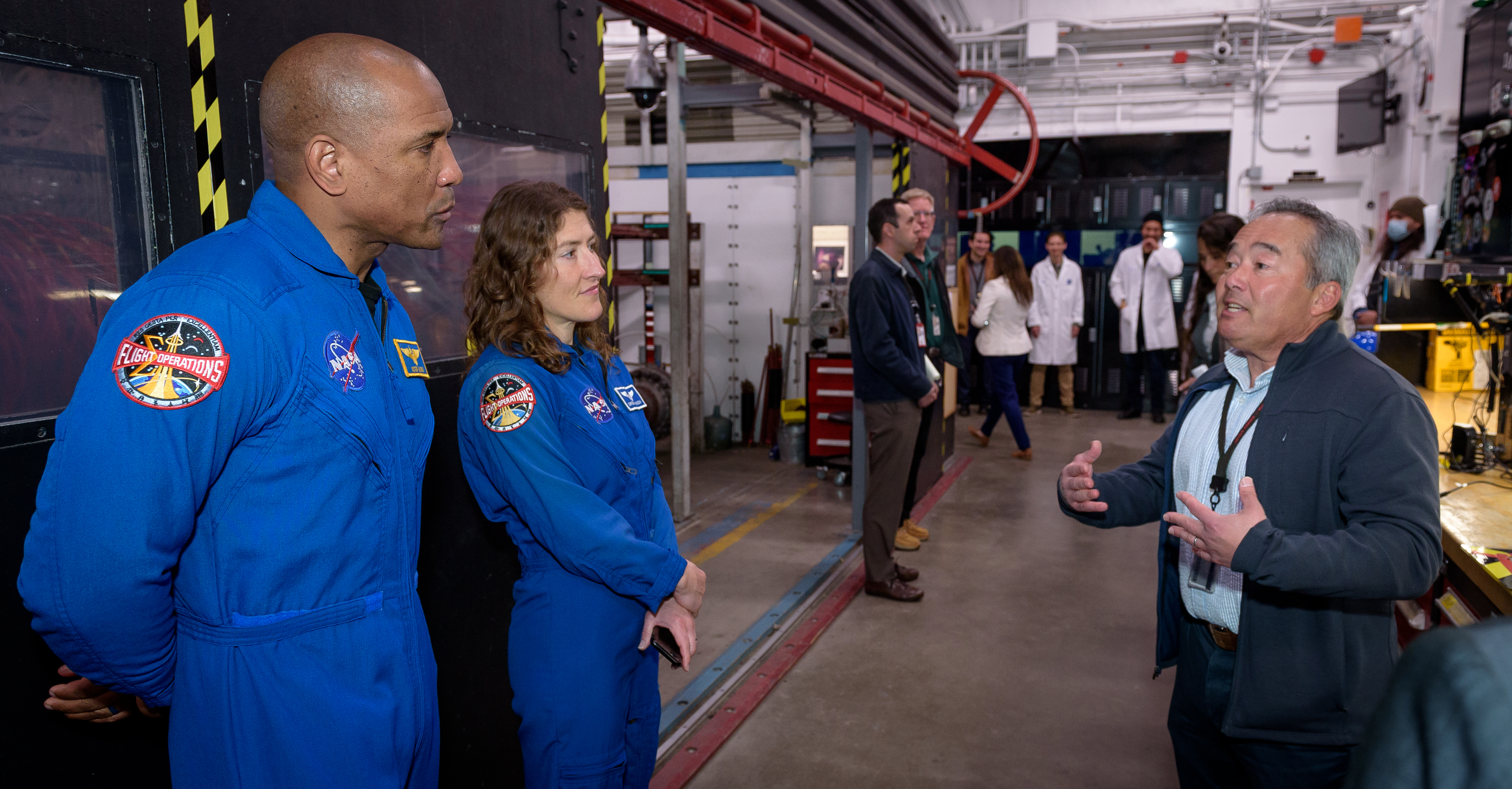
Astronauts Victor Glover and Christina Koch tour the Arc Jet Facility at NASA’s Ames Research Center, learning more about the testing equipment’s capabilities to analyze thermal protection systems from George Raiche, thermophysics facilities branch chief at Ames.
NASA/Donald Richey
Artemis II astronauts Christina Koch and Victor Glover, along with Orion leaders Debbie Korth, deputy program manager, and Luis Saucedo, deputy crew and service module manager, visited NASA Ames facilities that support the Orion program to celebrate the achievements of employees. Ames facilities were used to develop and test Orion’s thermal protection system and analyze the Artemis I heat shield after its successful return to Earth.
Curiosity Mars Rover Uncovers Subsurface Clues to the Planet’s Evolution
NASA’s Curiosity Mars rover sees its tracks receding into the distance at a site nicknamed “Ubajara” on April 30, 2023. This site is where Curiosity made the discovery of siderite, a mineral that may help explain the fate of the planet’s thicker ancient atmosphere.
NASA/JPL-Caltech/MSSS
NASA’s Curiosity Mars rover helped shed new light on what happened to the planet’s ancient atmosphere. Researchers have long believed that Mars once had a thick, carbon dioxide-rich atmosphere and liquid water on the planet’s surface. That carbon dioxide and water should have reacted with Martian rocks to create carbonate minerals, but previous investigations haven’t found expected amounts of carbonate on the planet’s surface. Curiosity used onboard instruments to study powdered Martian rock samples from the subsurface of the planet, finding the presence of siderite, an iron carbonate mineral, within the sulfate-rich rocky layers of Mount Sharp in Mars’ Gale Crater.
Managing Satellite Traffic in Orbit
The Starling swarm’s extended mission tested advanced autonomous maneuvering capabilities.
NASA/Daniel Rutter
Managed at NASA Ames, the Starling mission, in collaboration with SpaceX’s Starlink constellation, successfully demonstrated autonomous coordination between spacecraft to improve space traffic management in low Earth orbit. The extended mission, called Starling 1.5, tested how satellite swarms can share maneuver responsibilities and respond more quickly to avoid collisions without relying on time-consuming ground-based communication. This approach aims to streamline space traffic coordination as orbital congestion increases, enabling faster, safer, and more efficient satellite operations.
Proven True: A Companion Star to Betelgeuse
An image of Betelgeuse, the yellow-red star, and the signature of its close companion, the faint blue object.
Data: NASA/JPL/NOIRlab. Visualization: NOIRLAB.
Researchers validated a century-old hypothesis that there’s an orbiting companion star to Betelgeuse, the 10th brightest star in our night sky. Steve Howell, a senior research scientist at Ames, used both the ground-based Gemini North telescope in Hawai’i and a special, high-resolution camera built by NASA to directly observe the close companion to Betelgeuse. This discovery may explain why other similar red supergiant stars undergo periodic changes in their brightness on the scale of many years.
Space-Fermented Foods Make Vital Nutrients

NASA astronaut and Expedition 72 Commander Suni Williams displays a set of BioNutrients production packs during an experiment aboard the International Space Station. The experiment uses engineered yeast to produce nutrients and vitamins to support future astronaut health.
NASA
NASA’s BioNutrients experiments are helping us better understand the shelf stability of nutrients essential to support astronaut health during future long-duration deep space exploration, such as missions to the Moon and Mars. The project uses microorganisms to make familiar fermented foods, such as yogurt, and includes specific types and amounts of nutrients that crew will be able to consume in the future. The first experiment tested the performance of a biomanufacturing system for almost six years aboard the International Space Station. The latest experiment launched to the station in August.
Enabling Satellite Swarms for Future Astronauts
Caleb Adams, Distributed Spacecraft Autonomy project manager, monitors testing alongside the test racks containing 100 spacecraft computers at NASA’s Ames Research Center in California’s Silicon Valley. The DSA project develops and demonstrates software to enhance multi-spacecraft mission adaptability, efficiently allocate tasks between spacecraft using ad-hoc networking, and enable human-swarm commanding of distributed space missions.
NASA/Brandon Torres Navarrete
NASA Ames’ Distributed Spacecraft Autonomy (DSA) project tested software that enables swarms of satellites to make decisions and adapt to changing conditions with minimal human intervention. By distributing decision-making autonomy across multiple spacecraft, the system allows satellites to coordinate tasks, optimize scientific observations, and respond to challenges in real time while freeing human explorers to focus on critical tasks. The technology was first demonstrated in space aboard the Starling mission, showcasing how autonomous swarms can enhance mission efficiency and resilience.
Exploring Remotely Piloted Aircraft in U.S. Airspace
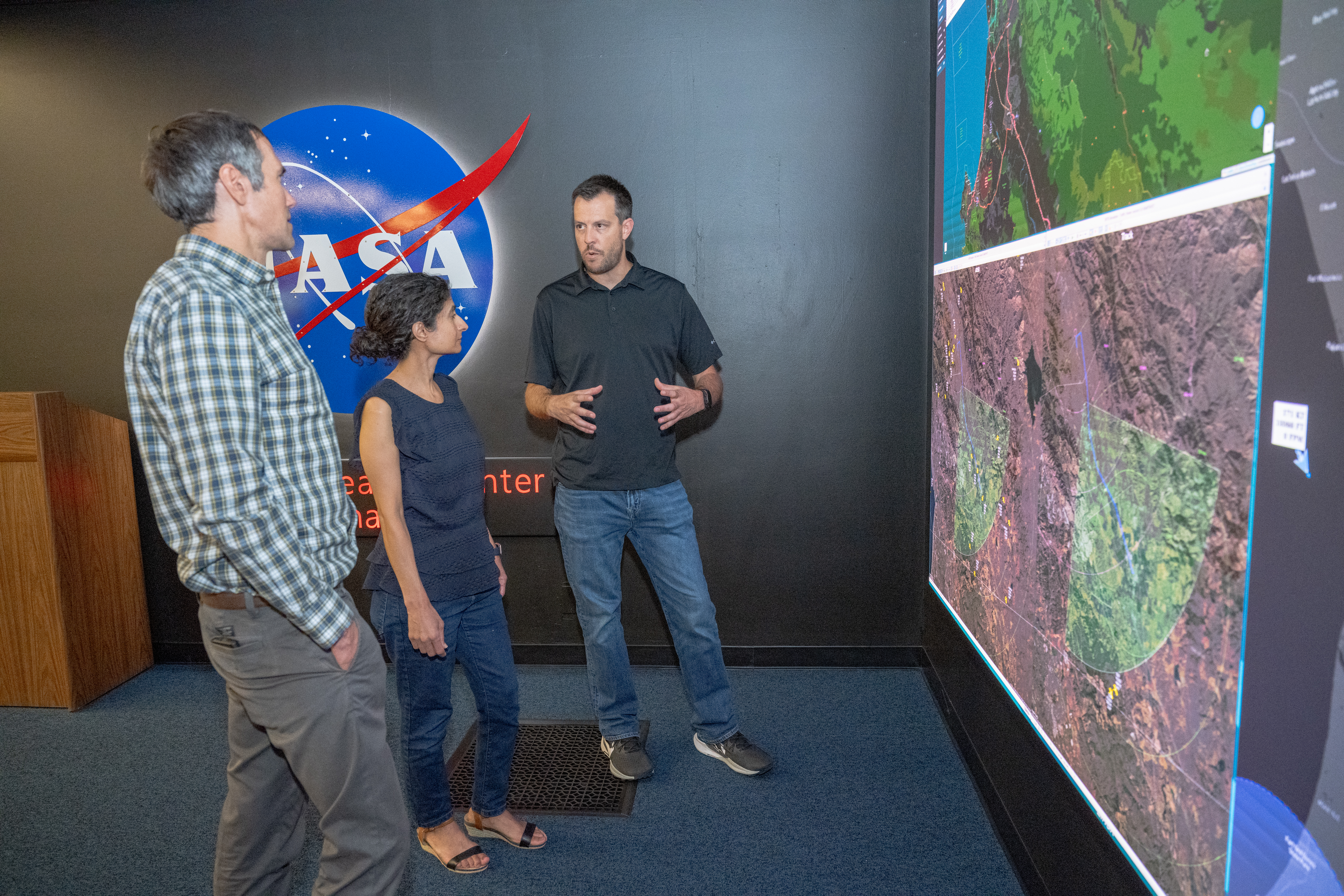
NASA researchers Matt Gregory, right, Arwa Awiess, center, and Andrew Guion discuss live flight data being ingested at the Mission Visualization and Research Control Center (MVRCC) at NASA’s Ames Research Center on Aug. 21, 2025.
NASA/Brandon Torres Navarrete
NASA Ames partnered to ensure that remotely piloted aircraft can take to the skies safely without overburdening air traffic controllers. NASA’s Air Traffic Management eXploration Project (ATM-X) supported Wisk Aero in a flight test designed to evaluate a ground-based radar developed by Collins Aerospace, which could be used during future remotely piloted operations to detect and avoid other aircraft.
Pushing the Boundaries of Autonomous Cargo Drones
Christopher Bryant shows the simulated vehicle as part of the Federal Uncrewed Aircraft System Service Supplier Synthesis Effort (FUSE) live flight simulation in the Verification and Validation (V&V) lab in N210.
NASA/Donald Richey
NASA partnered with the Department of War in a live flight demonstration showcasing how drones can successfully fly without their operators being able to see them, a concept known as beyond visual line of sight. Cargo drones successfully carried payloads more than 75 miles across North Dakota in tests designed to demonstrate that the aircraft could operate safely even in complex, shared airspace.
Advancing Mixed Reality for Pilot Training
Damian Hischier of the National Test Pilot School in Mojave, California, takes part in testing of a virtual reality-infused pilot simulation in the Vertical Motion Simulator (VMS) at NASA’s Ames Research Center in California’s Silicon Valley on May 30, 2025.
NASA/Brandon Torres Navarrete
A NASA research project is accelerating alternatives to conventional flight simulator training, using mixed reality systems that combines physical simulators with virtual reality headsets to train pilots. The agency invited a dozen pilots to NASA Ames to participate in a study to test how a mixed-reality flight simulation would perform in the world’s largest flight simulator for the first time. The technology could reduce costs and allow for a smaller footprint while training pilots on next-generation aircraft.
Flies and Fly Food for Space Station DNA Studies
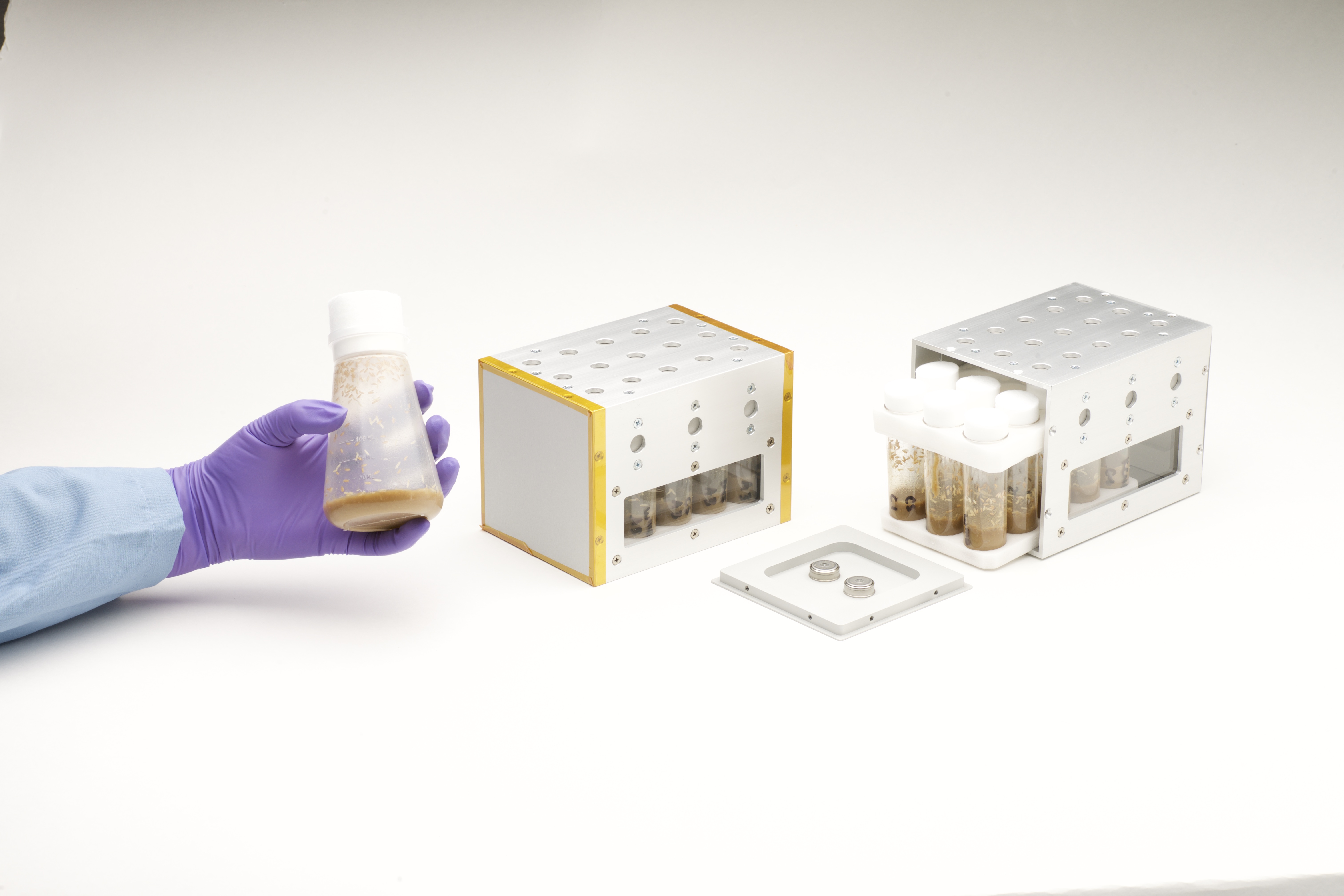
The Vented Fly Box holds and safely transports vials containing flies and fly food. It includes environmental sensors that monitor temperature and relative humidity.
NASA/Dominic Hart
New technology for housing and supporting fruit flies is enabling new research on the effects of space travel on the human body. Through a Space Act Agreement between NASA and Axiom Space, the Vented Fly Box contained fruit flies (Drosophila melanogaster) launched aboard a SpaceX Dragon spacecraft from NASA’s Kennedy Space Center in Florida. Because humans and fruit flies share a lot of similar genetic code, they squeeze a lot of scientific value into a conveniently small, light package.
Studying Antibiotic-Resistant Bacteria in Space
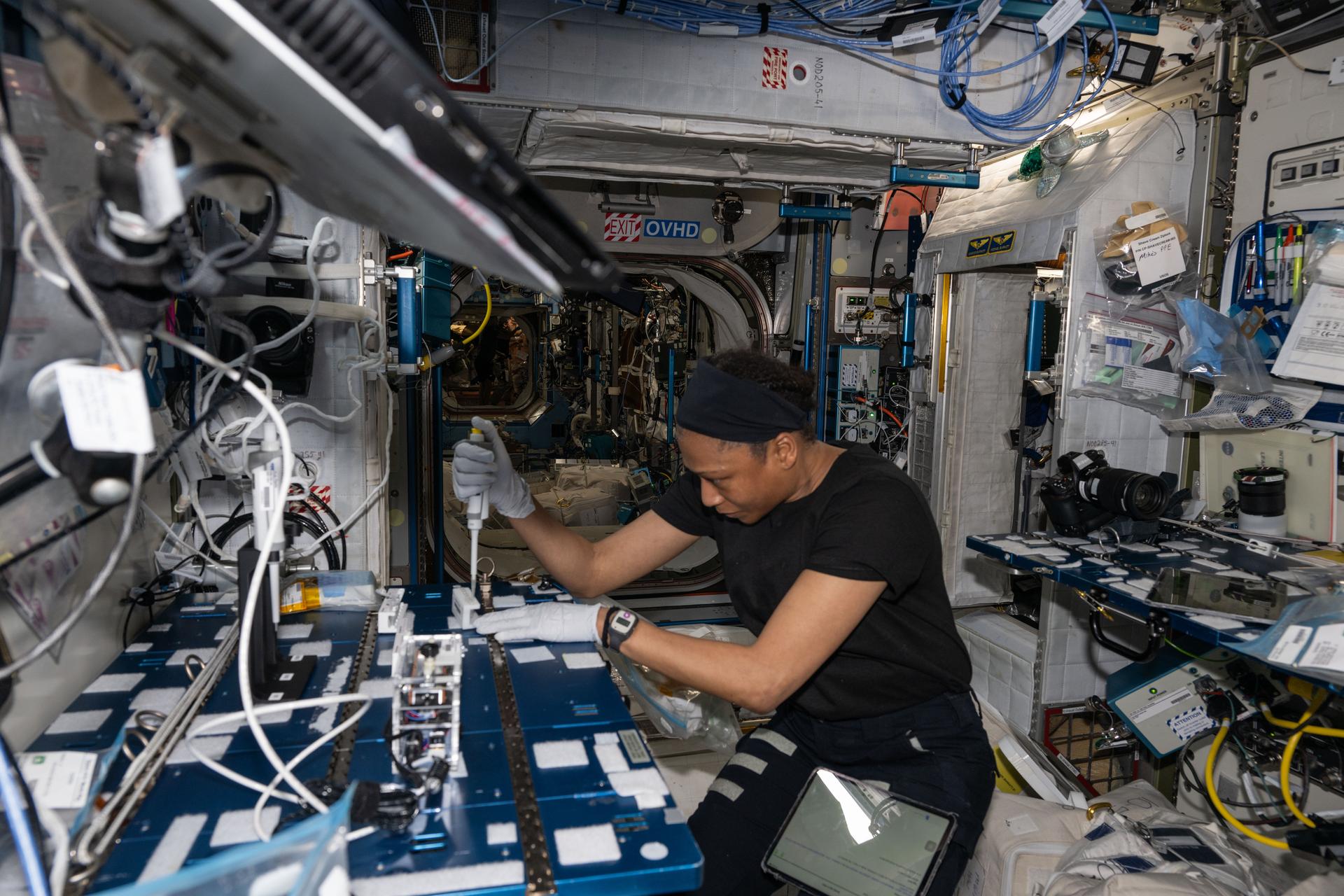
Astronaut Jeanette Epps extracts DNA samples from bacteria colonies for genomic analysis aboard the International Space Station’s Harmony module.
NASA
New studies aboard the International Space Station are advancing the detection of antibiotic-resistant bacteria, thus improving the health safety not only of astronauts but patients back on Earth. Future astronauts visiting the Moon or Mars will need to rely on a pre-determined supply of antibiotics in case of illness, and ensuring those antibiotics remain effective is an important safety measure for future missions. Infections caused by antibiotic-resistant bacteria can be difficult or impossible to treat, making antibiotic resistance a leading cause of death worldwide and a global health concern.
Happy Third Anniversary to BioSentinel Deep Space Mission!
NASA’s BioSentinel – a shoebox-sized CubeSat – is travelling far from Earth. But that also means it’s closer than ever to being the first long-duration biology experiment in deep space.
NASA/Daniel Rutter
The BioSentinel mission, currently orbiting the Sun more than 48 million miles from Earth, celebrated three years in deep space after launching aboard NASA’s Artemis I in 2022. BioSentinel, managed at NASA Ames, continues to collect valuable information for scientists trying to understand how solar radiation storms move through space and where their effects – and potential impacts on life beyond Earth – are most intense.
Astrobee Partners to Advance Space Robotics
NASA astronaut Anne McClain poses with Astrobee robots Bumble (left) and Honey during their latest in orbit activity in May, 2025
NASA
NASA is working with Arkisys, Inc., of Los Alamitos, California, to sustain the Astrobee robotic platform aboard the International Space Station. NASA launched the Astrobee mission to the space station in 2018. Since then, the free-flying robots have marked multiple first-in-space milestones for robots working alongside astronauts. As the agency returns astronauts to the Moon, robotic helpers like Astrobee could one day take over routine maintenance tasks and support future spacecraft at the Moon and Mars without relying on humans for continuous operation.
A team of engineers at The Aerospace Corporation’s facility in El Segundo, California, gather around two completed DiskSats as they conduct final checks before shipment. From left: Albert Lin, DiskSat system engineer, Elijah Balcita, intern, Darren Rowen, DiskSat chief engineer, Catherine Venturini, DiskSat principal investigator, and Eric Breckheimer, NASA program office program manager at The Aerospace Corporation; Roger Hunter, Small Spacecraft & Distributed Systems program manager at NASA; and Ziba Shahriary, DiskSat program manager at The Aerospace Corporation.
The Aerospace Corporation
NASA’s DiskSat technology demonstration mission will test the performance of a new small spacecraft platform designed to expand the capabilities of current small spacecraft. By demonstrating the advantages of a flat, disk-shaped architecture over the conventional CubeSat design, DiskSat aims to enable lower-cost space missions, broaden scientific opportunities, and increase overall access to space.
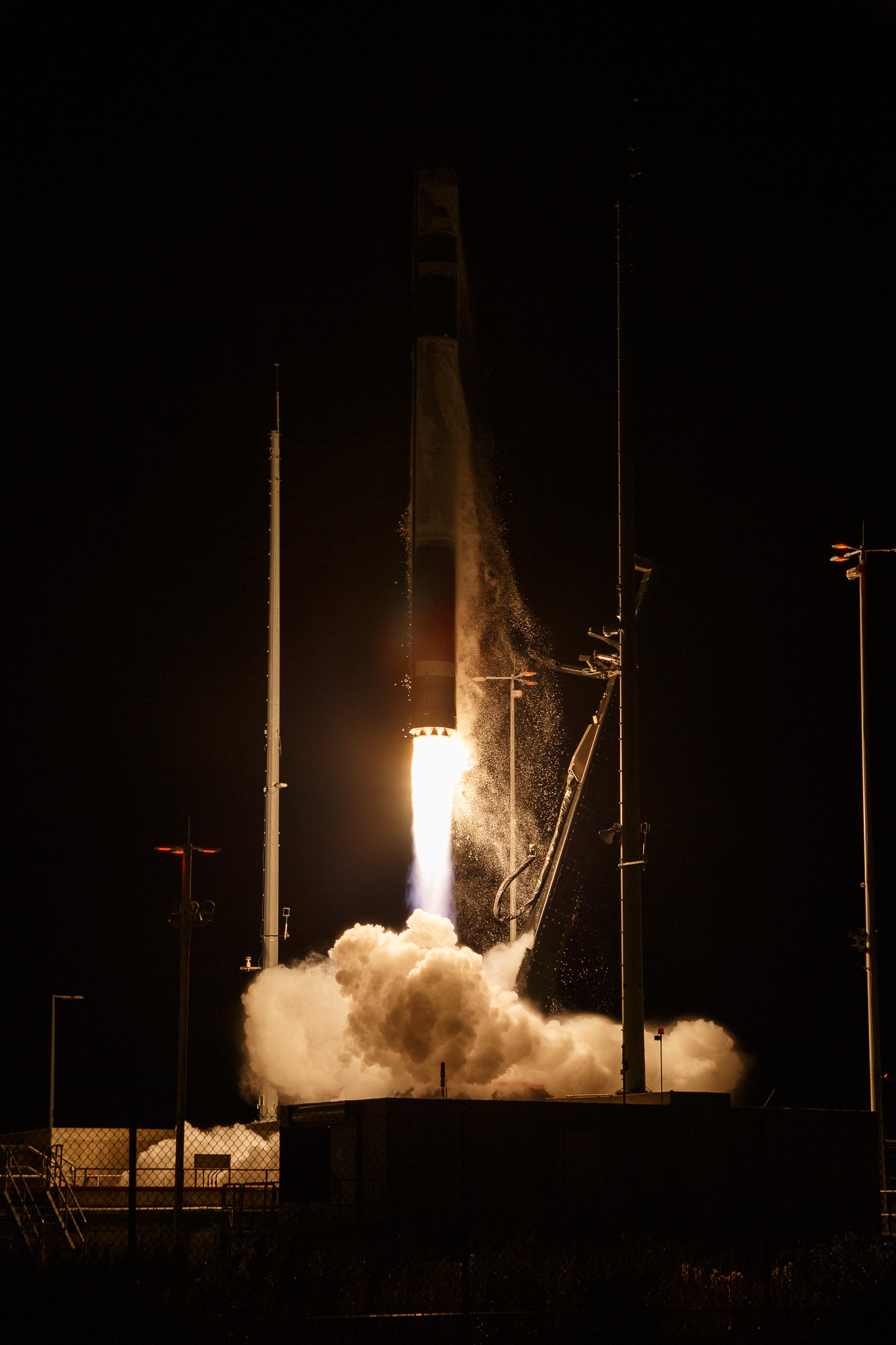
At 12:03 a.m. EST on Thursday, Dec. 18, DiskSat launched aboard a Rocket Lab Electron rocket from the company’s Launch Complex 2 on Wallops Island, Virginia.
The demonstration will evaluate the performance of the DiskSat spacecraft themselves and a specialized dispenser mechanism. The dispenser is engineered to securely contain four DiskSat spacecraft during launch, then sequentially deploy them into low Earth orbit where they will perform maneuvers. Each DiskSat is a circular, flat spacecraft 40 inches (one meter) in diameter and one inch (two-and-a-half centimeters) thick – similar to a small coffee table. Each has an electric propulsion system to allow for orbit changes and maintenance. The DiskSat design is also conducive to operations in very low Earth orbit, which can offer sharper Earth imaging and sensing capabilities as well as lower latency communications solutions.
DiskSat boosts U.S. innovation and commercial space opportunities while providing mission designers new flexibility, enabling them to pursue and achieve NASA’s goals faster and more affordably. DiskSats offer an alternative platform that could significantly expand the scope of future small spacecraft missions for NASA, the commercial space industry, other government agencies, and academia. The DiskSat demonstration also supports NASA’s long-term plans for sustained exploration at the Moon and Mars as well as advancing our ability to study and better understand our home planet.
An Electron Rocket launches from Wallops Island, Virginia, Dec. 18; 2025, at 12:03 a.m. EST from Rocket Lab’s Launch Complex 2. The rocket carried NASA’s DiskSat technology demonstration mission, which will test the performance of a new small spacecraft platform designed to expand the capabilities of current small spacecraft.
NASA/Garon Clark
The Aerospace Corporation, headquartered in Chantilly, Virginia, is leading the design and development of the DiskSat concept as well as the DiskSat spacecraft. NASA’s Small Spacecraft & Distributed Systems program within the agency’s Space Technology Mission Directorate funded the development of the DiskSat technology and demonstration mission. The program is based at NASA’s Ames Research Center in California’s Silicon Valley. The DiskSat launch and in-orbit operations are funded by the U.S. Space Force’s Rocket Systems Launch Program (RSLP) and Department of War Space Test Program (STP), respectively. Rocket Lab USA, Inc., of Long Beach, California is providing launch services. NASA’s Wallops Flight Facility, the agency’s only owned and operated launch range, enabled the mission providing services such as tracking, telemetry, and range safety to ensure a safe and successful mission.
Members of the news media interested in covering this topic should reach out to the NASA Ames newsroom.
Preparations for Next Moonwalk Simulations Underway (and Underwater)
Dual Propulsion Experiment (DUPLEX) deploys from the International Space Station December 2, 2025.
NASA
NASA is working with commercial partners to create high-performing, reliable propulsion systems that will help small spacecraft safely maneuver in orbit, reach intended destinations across the solar system, and accomplish mission operations.
Two new micropropulsion technologies are being tested in space onboard a CubeSat called DUPLEX (Dual Propulsion Experiment) that deployed into low Earth orbit from the International Space Station on Dec. 2. The CubeSat is fitted with two thruster systems that use spools of polymer fibers to provide performance levels of propulsion comparable to existing systems but with greater safety during assembly and more affordability.
One of the propulsion technologies is a fiber-fed pulsed plasma thruster system which employs an electric pulse to vaporize Teflon material and uses the resulting ions to deliver strong, efficient thrust while using very little fuel. The other propulsion technology is a monofilament vaporization propulsion system – inspired by 3D printers – which heats and vaporizes a common polymer material known as Delrin to create continuous thrust.
On orbit, DUPLEX will test its advanced propulsion systems by raising and lowering its orbit over two years, demonstrating the systems’ capabilities to maintain a vehicle’s orbit over time. Micropropulsion solutions enable a variety of cost-efficient capabilities necessary for operators in a bustling low Earth orbit economy, including maintaining and adjusting orbits to avoid debris or nearby spacecraft, and coordinating maneuvers between spacecraft to perform maintenance, inspections, and other critical activities. The systems tested on DUPLEX can also make spacecraft capable of lower cost extended missions in areas that are farther from Earth, such as the Moon and Mars.
Technologies like those demonstrated onboard DUPLEX open the door for U.S. industry to provide efficient, affordable spacecraft systems for various space-based applications, building a stronger orbital economy to meet the needs of NASA and the nation.
The DUPLEX spacecraft was developed by Champaign-Urbana Aerospace in Illinois. NASA’s Small Spacecraft and Distributed Systems program at the agency’s Ames Research Center in California’s Silicon Valley supported the development, with funding from the Small Business Innovation Research program and a 2019 Tipping Point industry partnership award through the agency’s Space Technology Mission Directorate.

 Login
Login