Normal view

There are new articles available, click to refresh the page.
Before yesterdayMain stream

NASA’s Chandra Releases Deep Cut From Catalog of Cosmic Recordings

By: Lee Mohon
23 January 2026 at 13:02
5 Min Read

NASA’s Chandra Releases Deep Cut From Catalog of Cosmic Recordings

This image contains lower-, medium-, and higher-energy X-rays in red, green, and blue respectively.

Like a recording artist who has had a long career, NASA’s Chandra X-ray Observatory has a “back catalog” of cosmic recordings that is impossible to replicate. To access these X-ray tracks, or observations, the ultimate compendium has been developed: the Chandra Source Catalog (CSC).

The CSC contains the X-ray data detected up to the end of 2020 by Chandra, the world’s premier X-ray telescope and one of NASA’s “Great Observatories.” The latest version of the CSC, known as CSC 2.1, contains over 400,000 unique compact and extended sources and over 1.3 million individual detections in X-ray light.

before
after
This image contains lower-, medium-, and higher-energy X-rays in red, green, and blue respectively.
NASA/CXC/SAO; Image Processing: NASA/CXC/SAO/N. Wolk
This image is the sum of 86 observations added together, representing over three million seconds of Chandra observing time. It spans just about 60 light-years across, which is a veritable pinprick on the entire sky. The underlying image contains lower-, medium-, and higher-energy X-rays in red, green, and blue respectively. The annotations on the image show where Chandra has detected over 3,300 individual sources in this field of view over a 22-year timeframe.
NASA/CXC/SAO; Image Processing: NASA/CXC/SAO/N. Wolk
This image contains lower-, medium-, and higher-energy X-rays in red, green, and blue respectively.
NASA/CXC/SAO; Image Processing: NASA/CXC/SAO/N. Wolk
This image is the sum of 86 observations added together, representing over three million seconds of Chandra observing time. It spans just about 60 light-years across, which is a veritable pinprick on the entire sky. The underlying image contains lower-, medium-, and higher-energy X-rays in red, green, and blue respectively. The annotations on the image show where Chandra has detected over 3,300 individual sources in this field of view over a 22-year timeframe.
NASA/CXC/SAO; Image Processing: NASA/CXC/SAO/N. Wolk
before
after

Before and After

X-ray Images of Sagittarius A*

1999 – 2021

This image is the sum of 86 observations added together, representing over three million seconds of Chandra observing time. It spans just about 60 light-years across, which is a veritable pinprick on the entire sky. The underlying image contains lower-, medium-, and higher-energy X-rays in red, green, and blue respectively. The annotations on the image show where Chandra has detected over 3,300 individual sources in this field of view over a 22-year timeframe.

Within the CSC, there is a wealth of information gleaned from the Chandra observations — from precise positions on the sky to information about the the X-ray energies detected. This allows scientists using other telescopes — both on the ground and in space including NASA’s James Webb and Hubble Space Telescopes — to combine this unique X-ray data with information from other types of light.

The richness of the Chandra Source Catalog is illustrated in a new image of the Galactic Center, the region around the supermassive black hole at the center of the Milky Way galaxy called Sagittarius A*. In this image that spans just about 60 light-years across, a veritable pinprick on the entire sky, Chandra has detected over 3,300 individual sources that emit X-rays. This image is the sum of 86 observations added together, representing over three million seconds of Chandra observing time.

Another new representation of the vast scope of the Chanda Source Catalog is found in a just-released sonification, the translation of astronomical data into sound. This sonification encompasses the new map that includes 22 years of Chandra observations across the sky, beginning from its launch through its observations in 2021. Because many X-ray sources have been observed multiple times over the life of the Chandra mission, this sonification represents those repeat X-ray sightings over time through different notes.

Chandra Source Catalog Sonification.
NASA/CXC/SAO/K.Arcand, SYSTEM Sounds (M. Russo, A. Santaguida

In the view of the sky, projected in a similar way to how the Earth is often depicted in world maps, the core of the Milky Way is in the center and the Galactic plane is horizontal across the middle of the image. A circle appears at the position of each detection and the size of the circle is determined by the number of detections in that location over time. A year counter appears at the top of the frame. Since Chandra continues to be fully operational, the text changes to “… and beyond” after 2021 as the telescope continues to collect observations. During the video, a collage of images produced by Chandra fades in as a background. In the final frames of the video, thumbnail images representing the thousands of Chandra observations taken over the lifetime of the mission appear behind the sky map.

The most recent version of the Chandra Source Catalog can be accessed at https://cxc.cfa.harvard.edu/csc/

NASA’s Marshall Space Flight Center in Huntsville, Alabama, manages the Chandra program. The Smithsonian Astrophysical Observatory’s Chandra X-ray Center controls science operations from Cambridge, Massachusetts, and flight operations from Burlington, Massachusetts.

To learn more about Chandra, visit:

https://science.nasa.gov/chandra

Read more from NASA’s Chandra X-ray Observatory

Learn more about the Chandra X-ray Observatory and its mission here:

https://www.nasa.gov/chandra

https://chandra.si.edu

Visual Description

A very deep Chandra X-ray Observatory image around the Sagittarius A* supermassive black hole, located in the center of the Milky Way galaxy, is shown. The image is dominated by burnt orange, deep gold and blue hues, with a sprinkling of rich green. The area looks both intricate and full, with a dense population of tiny dots, along with larger clumps and diffuse areas and nebulous areas peeking through.

At the center of the image, there is a bright, lumpy area in pale gold showing the intense X-ray radiation emanating from the Sagittarius A* black hole. In the surrounding area, there are more smaller lumps layered throughout, feathering out to a large almost butterfly shape filling much of the screen. The image appears textured, like dozens of blue and orange glow worms are paused in their wriggling.

The image offers an unprecedented view of lobes of hot gas extending for a dozen light years on either side of the black hole. These lobes provide evidence for powerful eruptions occurring several times over the last ten thousand years. The image also contains several mysterious X-ray filaments, some of which may be huge magnetic structures interacting with streams of energetic electrons produced by rapidly spinning neutron stars. Such features are known as pulsar wind nebulas. Chandra has detected over 3,300 individual sources that emit X-rays in this field of view. This image is the sum of 86 observations added together, representing over three million seconds of Chandra observing time.

News Media Contact

Megan Watzke
Chandra X-ray Center
Cambridge, Mass.
617-496-7998
mwatzke@cfa.harvard.edu

Joel Wallace
Marshall Space Flight Center, Huntsville, Alabama
256-544-0034
joel.w.wallace@nasa.gov

Share

Details

Last Updated
Jan 23, 2026
Editor
Lee Mohon
Contact

NASA Invites Media to Crew-10 Visit at Marshall

By: Lee Mohon
21 January 2026 at 14:47
Official crew portrait for NASA’s SpaceX Crew-10 mission with NASA astronauts Anne McClain and Nichole Ayers, JAXA (Japan Aerospace Exploration Agency) astronaut Takuya Onishi, and Roscosmos cosmonaut Kirill Peskov.
Official crew portrait for NASA’s SpaceX Crew-10 mission with NASA astronauts Anne McClain and Nichole Ayers, JAXA (Japan Aerospace Exploration Agency) astronaut Takuya Onishi, and Roscosmos cosmonaut Kirill Peskov. Ayers and Onishi will discuss their recent mission to the International Space Station during a visit to Marshall Space Flight Center on Jan. 23.
Credit: NASA

NASA will host two astronauts at 10 a.m. CST Friday, Jan. 23, for a media opportunity at the agency’s Marshall Space Flight Center in Huntsville, Alabama.

NASA astronaut Nichole Ayers and JAXA (Japan Aerospace Exploration Agency) astronaut Takuya Onishi, who served as part of NASA’s SpaceX Crew-10 mission, will  discuss their recent mission to the International Space Station.

Media interested in attending the event must confirm their attendance with Lance D. Davis, lance.d.davis@nasa.gov, and Molly Porter, molly.a.porter@nasa.gov, by 12 p.m., Thursday, Jan. 22 to receive further instructions.

The Crew-10 mission launched March 14 and was NASA’s 11th human spaceflight with SpaceX to the space station for the agency’s Commercial Crew Program. Aboard the station, the crew completed dozens of experiments and technology demonstrations before safely returning to Earth on Aug. 9, 2025.

NASA’s Commercial Crew Program provides reliable access to space, maximizing the use of the station for research and development and supporting future missions beyond low Earth orbit by partnering with private companies to transport astronauts to and from the space station.

The International Space Station remains the springboard to NASA’s next leap in space exploration, including future missions to the Moon and, eventually, Mars. The agency’s Huntsville Operations Support Center, or HOSC, at Marshall provides engineering and mission operations support for the space station, Commercial Crew Program, and other missions.

Within the HOSC, the commercial crew support team provides engineering and safety and mission assurance expertise for launch vehicles, spacecraft propulsion, and integrated vehicle performance. The HOSC’s Payload Operations Integration Center, which operates, plans, and coordinates science experiments aboard the space station 365 days a year, 24 hours a day, supported the Crew-10 mission, managing communications between the International Space Station crew and researchers worldwide.

Learn more about Crew-10 and agency’s Commercial Crew Program at:

https://www.nasa.gov/commercialcrew

-end-

Lance D. Davis
Marshall Space Flight Center, Huntsville, Ala.
256-640-9065
lance.d.davis@nasa.gov  

Molly Porter
Marshall Space Flight Center, Huntsville, Ala.
256-424-5158
molly.a.porter@nasa.gov

Share

Details

Last Updated
Jan 21, 2026
Editor
Lee Mohon
Contact

NASA’s Day of Remembrance Honors Fallen Heroes of Exploration

20 January 2026 at 18:17
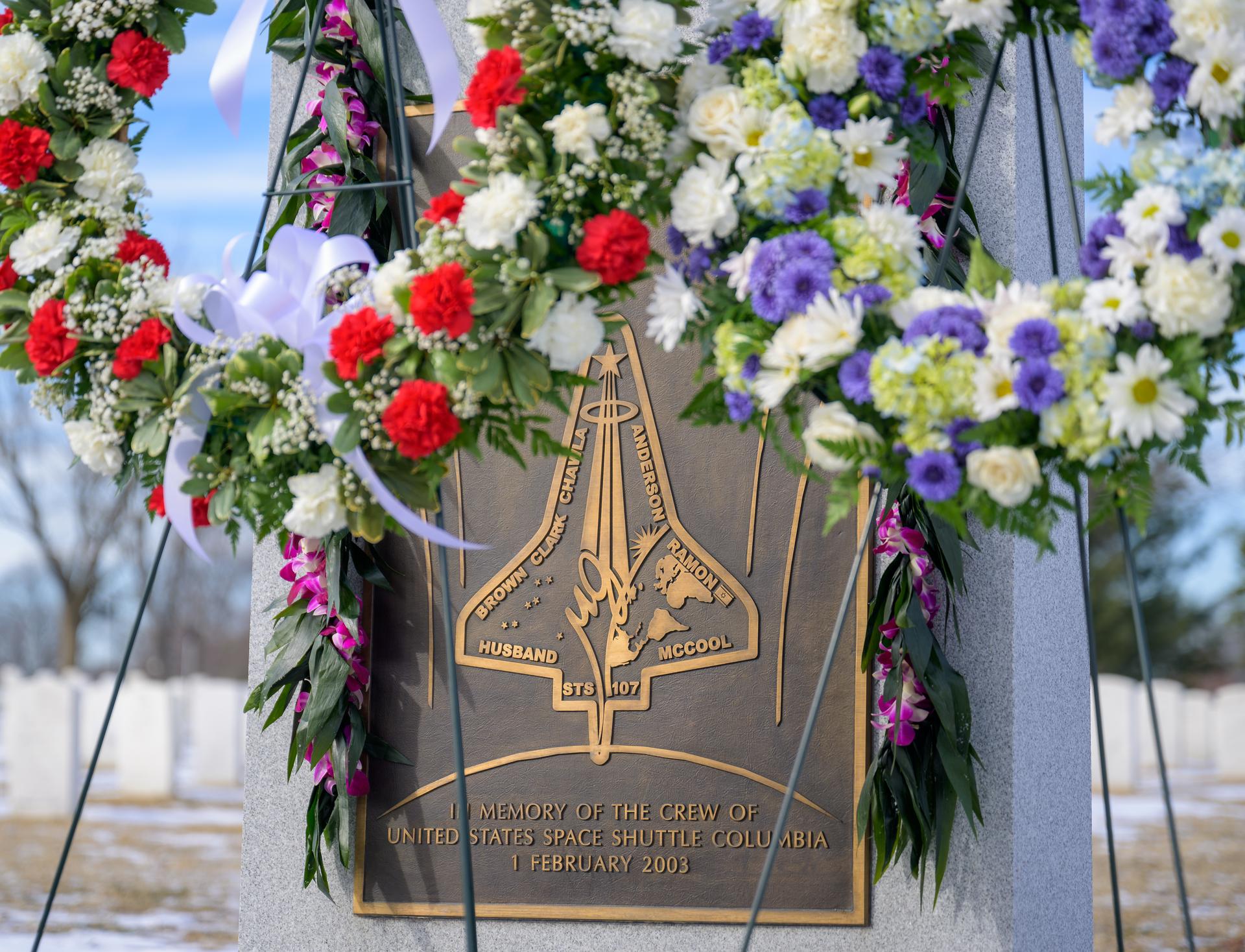
The Space Shuttle Columbia Memorial is seen during a wreath laying ceremony that was part of NASA’s Day of Remembrance, Thursday, Jan. 23, 2025, at Arlington National Cemetery in Virginia. Wreaths were laid in memory of those men and women who lost their lives in the quest for space exploration.
Credit: NASA/Bill Ingalls

NASA will observe its annual Day of Remembrance on Thursday, Jan. 22, which includes commemorating the crews of Apollo 1 and the space shuttles Challenger and Columbia. The event is traditionally held every year on the fourth Thursday of January, as all three astronaut accidents happened around the end of the month.

“On NASA’s Day of Remembrance, we pause to honor the members of the NASA family who lost their lives while pushing the boundaries of exploration and discovery,” said NASA Administrator Jared Isaacman. “We remember them not to retreat from risk, but to respect it — to learn, to improve, and continue onward. Their sacrifice and the strength of their families will forever inspire us as we continue to reach for the stars and pursue the secrets of the universe.”

Isaacman will lead an observance at 1 p.m. EST at Arlington National Cemetery in Virginia, which will begin with a wreath-laying ceremony at the Tomb of the Unknown Soldier, followed by observances for the Apollo 1, Challenger, and Columbia crews.

Several agency centers also will hold observances:

Johnson Space Center in Houston

NASA Johnson will hold a commemoration at 10 a.m. CST at the Astronaut Memorial Grove with remarks by Center Director Vanessa Wyche, NASA astronaut Jasmin Moghbeli, and Cheryl McNair, widow of Challenger astronaut Ronald McNair. The event will have a moment of silence, a NASA T-38 flyover, taps performed by the Texas A&M Squadron 17, and a procession placing flowers at Apollo I, Challenger, and Columbia memorial trees.

Kennedy Space Center in Florida

NASA Kennedy and the Astronauts Memorial Foundation will host a ceremony at the Space Shuttle Atlantis building at Kennedy’s Visitor Complex at 11 a.m. EST. The event will include musical guests, a bell ringing commemoration, a moment of silence, and wreath-laying. Kelvin Manning, deputy director at NASA Kennedy, and Bob Cabana, former NASA associate administrator and Kennedy center director, will provide remarks during the ceremony, which will livestream on the center’s Facebook page.

Ames Research Center in California’s Silicon Valley

NASA Ames will hold a remembrance ceremony at 1 p.m. PST that includes remarks from Center Director Eugene Tu, a moment of silence, and bell ringing commemoration for each astronaut lost in service.

Langley Research Center in Hampton, Virginia

NASA Langley will hold a remembrance ceremony at 1 p.m. EST with acting Center Director Trina Dyal, followed by placing flags at the Langley Workers Memorial.

Marshall Space Flight Center in Huntsville, Alabama

NASA Marshall will hold a candle-lighting ceremony and wreath placement at 9:30 a.m. CST and include remarks from Rae Ann Meyer, Marshall’s acting center director, and Bill Hill, director of Safety and Mission Assurance at Marshall.

Stennis Space Flight Center in Bay St. Louis, Mississippi

NASA Stennis and the NASA Shared Services Center will hold a wreath-laying ceremony and moment of silence at 10:30 a.m. CST with remarks from Center Director John Bailey and Anita Harrell, NASA Shared Services Center executive director.

The agency also is paying tribute to its fallen astronauts with special online content, updated on NASA’s Day of Remembrance, at:

https://www.nasa.gov/dor

-end-

Bethany Stevens / Elizabeth Shaw
Headquarters, Washington
202-358-1600
bethany.c.stevens@nasa.gov / elizabeth.a.shaw@nasa.gov

Coverage, Briefing Set for NASA’s Artemis II Moon Rocket Roll to Pad

14 January 2026 at 17:26
Photo of NASA's SLS (Space Launch System) rocket inside the Vehicle Assembly Building at Kennedy Space Center.
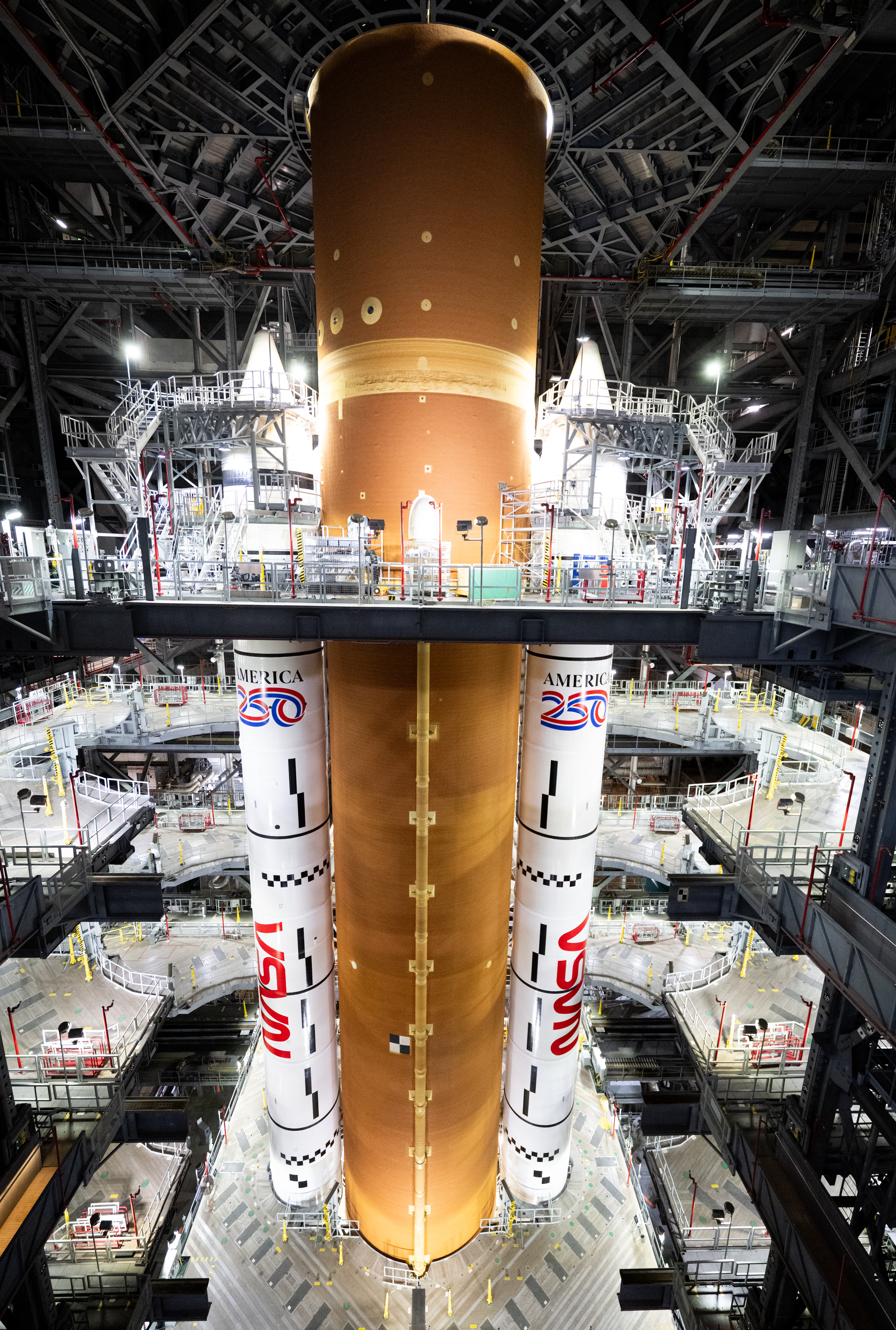
NASA’s SLS (Space Launch System) rocket is seen inside High Bay 3 of the Vehicle Assembly Building as teams await the arrival of Artemis II crewmembers to board their Orion spacecraft on top of the rocket as part of the Artemis II countdown demonstration test, Saturday, Dec. 20, 2025, at NASA’s Kennedy Space Center in Florida.
Credit: NASA/Joel Kowsky

NASA’s integrated SLS (Space Launch System) rocket and Orion spacecraft for the Artemis II mission is inching closer to launch – literally.

The agency is targeting no earlier than 7 a.m. EST, Saturday, Jan. 17, to begin the multi-hour trek from the Vehicle Assembly Building to Launch Pad 39B at NASA’s Kennedy Space Center in Florida.

A pre rollout mission news conference, live feed of rollout, and a media gaggle will stream on NASA’s YouTube channel. Individual streams for each of these events will be available from that page. Learn how to stream NASA content through a variety of online platforms, including social media.

The time of rollout is subject to change if additional time is needed for technical preparations or weather.

All times are Eastern. Events are as follows:

Friday, Jan. 16:

12 p.m.: Artemis II Rollout, Mission Overview News Conference

  • John Honeycutt, Artemis II mission management team chair
  • Charlie Blackwell-Thompson, Artemis launch director, Exploration Ground Systems
  • Jeff Radigan, Artemis II lead flight director, Flight Operations Directorate
  • Lili Villarreal, landing and recovery director, Exploration Ground Systems
  • Jacob Bleacher, chief exploration scientist, Exploration Systems Development Mission Directorate

Saturday, Jan. 17:

7 a.m.: Rollout, Artemis II Live Views from Kennedy Space Center feed begins

9 a.m.: Artemis II Crew Rollout Media Event

  • NASA Administrator Jared Isaacman and the Artemis II crew, including NASA astronauts Reid Wiseman, Victor Glover, and Christina Koch, and CSA (Canadian Space Agency) astronaut Jeremy Hansen, will answer questions about their preparations and the mission for media in-person at the countdown clock.

NASA’s crawler-transporter 2 will carry the 11-million-pound stack at about one mile per hour along the four-mile route from the Vehicle Assembly Building to Launch Pad 39B, on a journey that will take up to 12 hours.

To participate in the news conference by telephone, media must RSVP no later than two hours before the start to: ksc-newsroom@mail.nasa.gov

These events will be open in-person only to media previously credentialed for launch. The deadline has passed for in-person accreditation for Artemis II events at Kennedy.

Rollout to the pad marks another milestone leading up to the Artemis II mission. In the coming weeks, NASA will complete final preparations of the rocket and, if needed, rollback SLS and Orion to the Vehicle Assembly Building for additional work. While the Artemis II launch window opens as early as Friday, Feb. 6, the mission management team will assess flight readiness after the wet dress rehearsal across the spacecraft, launch infrastructure, and the crew and operations teams before selecting a launch date.

Follow NASA’s Artemis blog for mission updates.

Through Artemis, NASA will send astronauts to explore the Moon for scientific discovery, economic benefits, and to build the foundation for the first crewed missions to Mars.

Learn more about Artemis at:

https://www.nasa.gov/artemis

-end-

Rachel Kraft / Lauren Low
Headquarters, Washington
202-358-1600
rachel.h.kraft@nasa.gov / lauren.e.low@nasa.gov

Tiffany Fairley
Kennedy Space Center, Fla.
321-867-2468
tiffany.l.fairley@nasa.gov

NASA Back for Seconds with New Food System Design Challenge

13 January 2026 at 11:53

4 min read

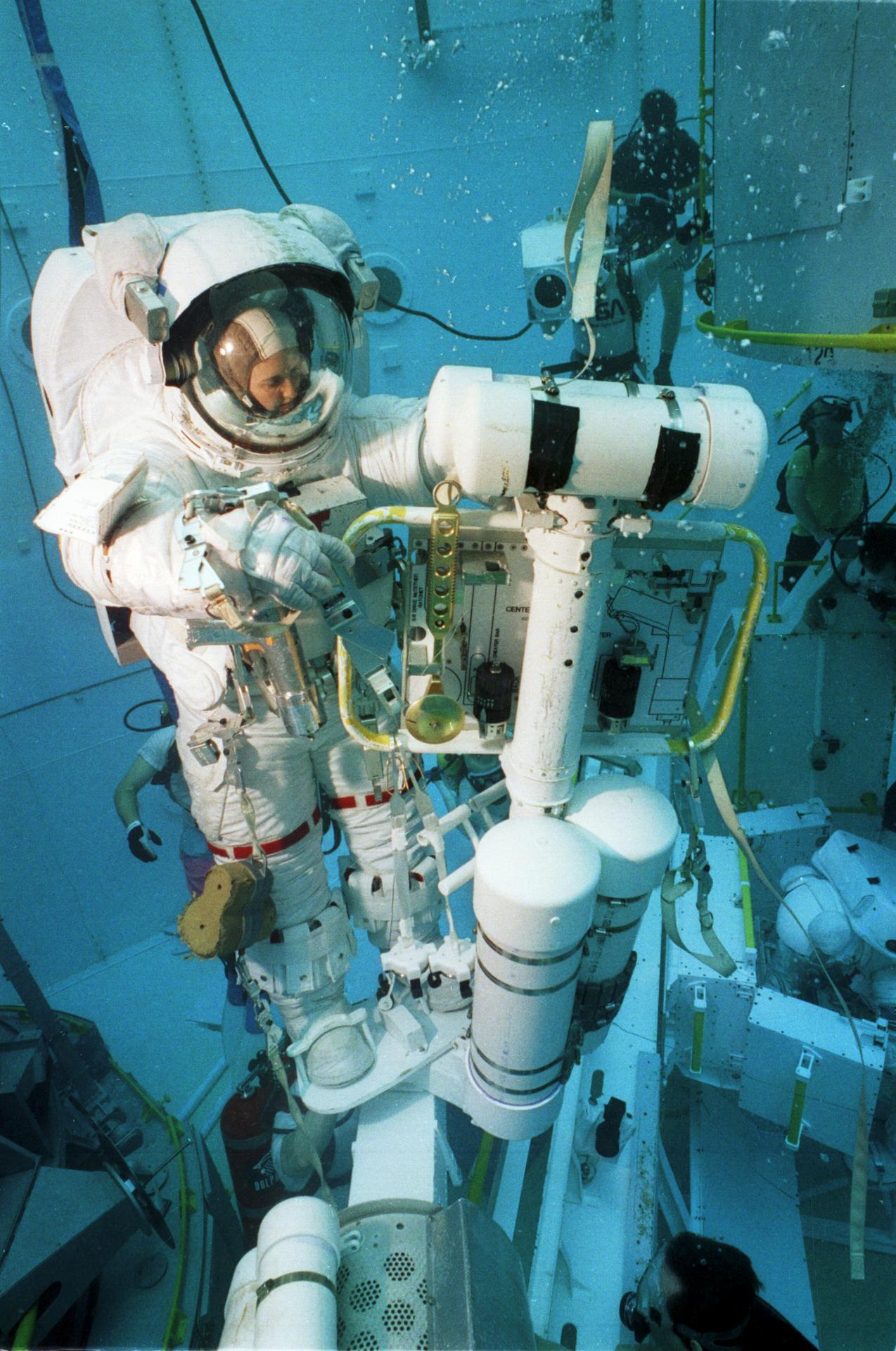
Preparations for Next Moonwalk Simulations Underway (and Underwater)

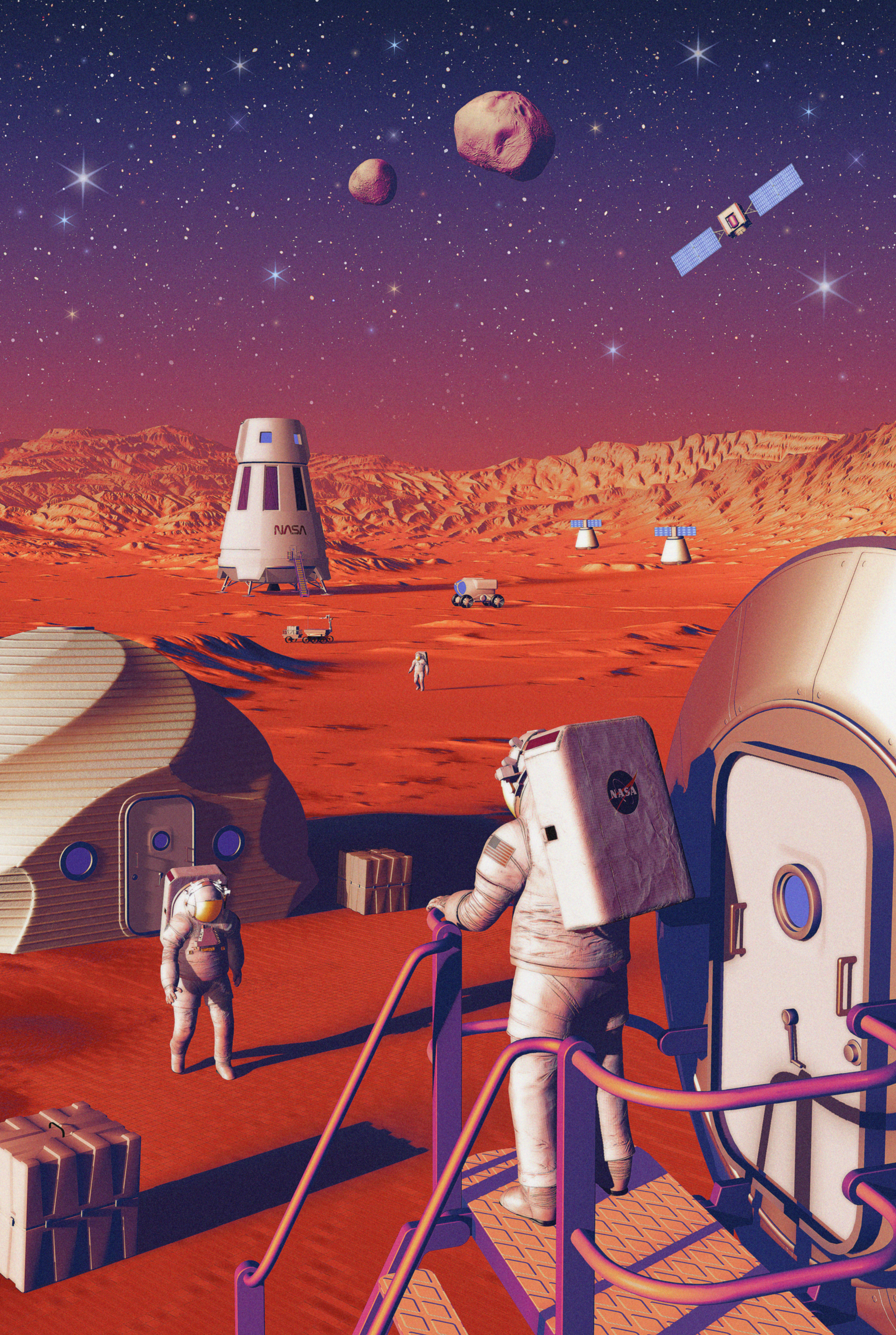
This illustration of Moon to Mars infrastructure shows astronauts living and working on the surface of Mars. NASA’s Moon to Mars Objectives establish an objectives-based approach to the agency's human deep space exploration efforts; NASA’s Moon to Mars Architecture approach distills the objectives into operational capabilities and elements.
This illustration of Moon to Mars infrastructure shows astronauts living and working on the surface of Mars. NASA’s Moon to Mars Objectives establish an objectives-based approach to the agency’s human deep space exploration efforts; NASA’s Moon to Mars Architecture approach distills the objectives into operational capabilities and elements.

NASA is getting ready to send four astronauts around the Moon with Artemis II, laying the foundation for sustainable missions to the lunar surface and paving the way for human exploration on Mars. As the agency considers deep space endeavors that could last months or years, it must develop ways to feed astronauts beyond sending supplies from Earth.

That is why NASA is launching the Deep Space Food Challenge: Mars to Table, a new global competition inviting chefs, innovators, culinary experts, higher-education students, and citizen scientists to design a complete, Earth-independent food system for long-duration space missions.

“In the future, exploration missions will grow in both duration and distance from Earth. This will make the critical question of feeding our astronauts more complex, requiring innovative solutions to allow for long-term human exploration of space,” said Greg Stover, acting associate administrator of NASA’s Space Technology Missions Directorate at NASA Headquarters in Washington. “Opening the door to ideas from beyond the agency strengthens NASA’s ability to operate farther from Earth with greater independence.”

Mars to Table builds on NASA’s first Deep Space Food Challenge by seeking to integrate multiple food production and preparation methods into a holistic, self-sustaining system designed for use on Mars. This new challenge is open now until July 31 to the global public and carries a prize purse of up to $750,000.

“Future crews on the Moon and Mars will need food systems that are nutritious, sustainable, and fully independent from Earth,” said Jarah Meador, program executive for NASA’s Prizes, Challenges, and Crowdsourcing Program at NASA Headquarters. “Food will play a pivotal role in the overall health and happiness of future deep space explorers. The Mars to Table Challenge is about bringing all those pieces together into one comprehensive design.”

Solvers are tasked with creating a complete meal plan suitable for astronauts living on Mars, using a NASA-created mission scenario as their guide. Each team will design a full food system concept, including a detailed operations plan and system design layout that supports a surface mission. Teams must consider every detail – from nutritional balance and taste to safety, usability, and integration with NASA’s Environmental Control and Life Support Systems.

Participants in the Mars to Table Challenge are also encouraged to address food security on Earth. Innovative growth systems designed for space could make fresh food production possible in harsh, remote, or resource-limited areas, such as research stations located at Earth’s poles or in rural areas with limited access to traditional supply chains.

“This challenge isn’t just about feeding astronauts; it’s about feeding people anywhere,” said Jennifer Edmunson, acting program manager for NASA’s Centennial Challenges at NASA’s Marshall Spaceflight Center in Huntsville, Alabama. “Novel meals that are compact, shelf-stable, and nutrient-rich could expand culinary options for groups like military personnel or disaster relief responders. By solving for Mars and future planetary expeditions, we can also find solutions for Earth.”

NASA’s Centennial Challenges have a 20-year legacy of engaging the public to solve complex problems that benefit NASA’s broader initiatives. Past challenges have spurred advances in robotics, additive manufacturing, power and energy, textiles, chemistry, and biology.

Mars to Table is a collaborative, cross-program Centennial Challenge with support from NASA’s Division of Biological and Physical Sciences, Heliophysics Division, Planetary Science Program, Human Research Program, and Mars Campaign Office. Subject matter experts at the agency’s Johnson Space Center in Houston and Kennedy Space Center in Florida support the challenge. This challenge is part of the Prizes, Challenges and Crowdsourcing program within NASA’s Space Technology Mission Directorate. NASA has partnered with the Methuselah Foundation and contracted Floor23 Digital to support the administration and management of this challenge. 

To learn more about the challenge, including timelines, submission requirements, and future webinar dates, visit:

https://www.deepspacefood.org/marstotable

By Savannah Bullard

💾

NASA is launching the Deep Space Food Challenge: Mars to Table, a new global competition inviting chefs, innovators, culinary experts, higher-education stude...

NASA topples towers used to test Saturn rockets, space shuttle

12 January 2026 at 10:21

Two historic NASA test facilities used in the development of the Saturn V and space shuttle launch vehicles have been demolished after towering over the Marshall Space Flight Center in Alabama since the start of the Space Age.

The Propulsion and Structural Test Facility, which was erected in 1957—the same year the first artificial satellite entered Earth orbit—and the Dynamic Test Facility, which has stood since 1964, were brought down by a coordinated series of implosions on Saturday, January 10. Located in Marshall's East Test Area on the US Army's Redstone Arsenal in Huntsville, the two structures were no longer in use and, according to NASA, had a backlog of $25 million in needed repairs.

"This work reflects smart stewardship of taxpayer resources," Jared Isaacman, NASA administrator, said in a statement. "Clearing outdated infrastructure allows NASA to safely modernize, streamline operations and fully leverage the infrastructure investments signed into law by President Trump to keep Marshall positioned at the forefront of aerospace innovation."

Read full article

Comments

© NASA

NASA Marshall Removes 2 Historic Test Stands

By: Lee Mohon
10 January 2026 at 16:01

NASA’s Marshall Space Flight Center in Huntsville, Alabama, removed two of its historic test stands – the Propulsion and Structural Test Facility and the Dynamic Test Facility – with carefully coordinated implosions on Jan. 10, 2026. The demolition of these historic structures is part of a larger project at Marshall that began in spring 2022, targeting several inactive structures and building a dynamic, interconnected campus ready for the next era of space exploration. Crews began demolition in December 2025 at the Neutral Buoyancy Simulator. Learn more about these iconic facilities.

Credits: NASA

I Am Artemis: Dave Reynolds

By: Lee Mohon
9 January 2026 at 12:29
3 Min Read

I Am Artemis: Dave Reynolds

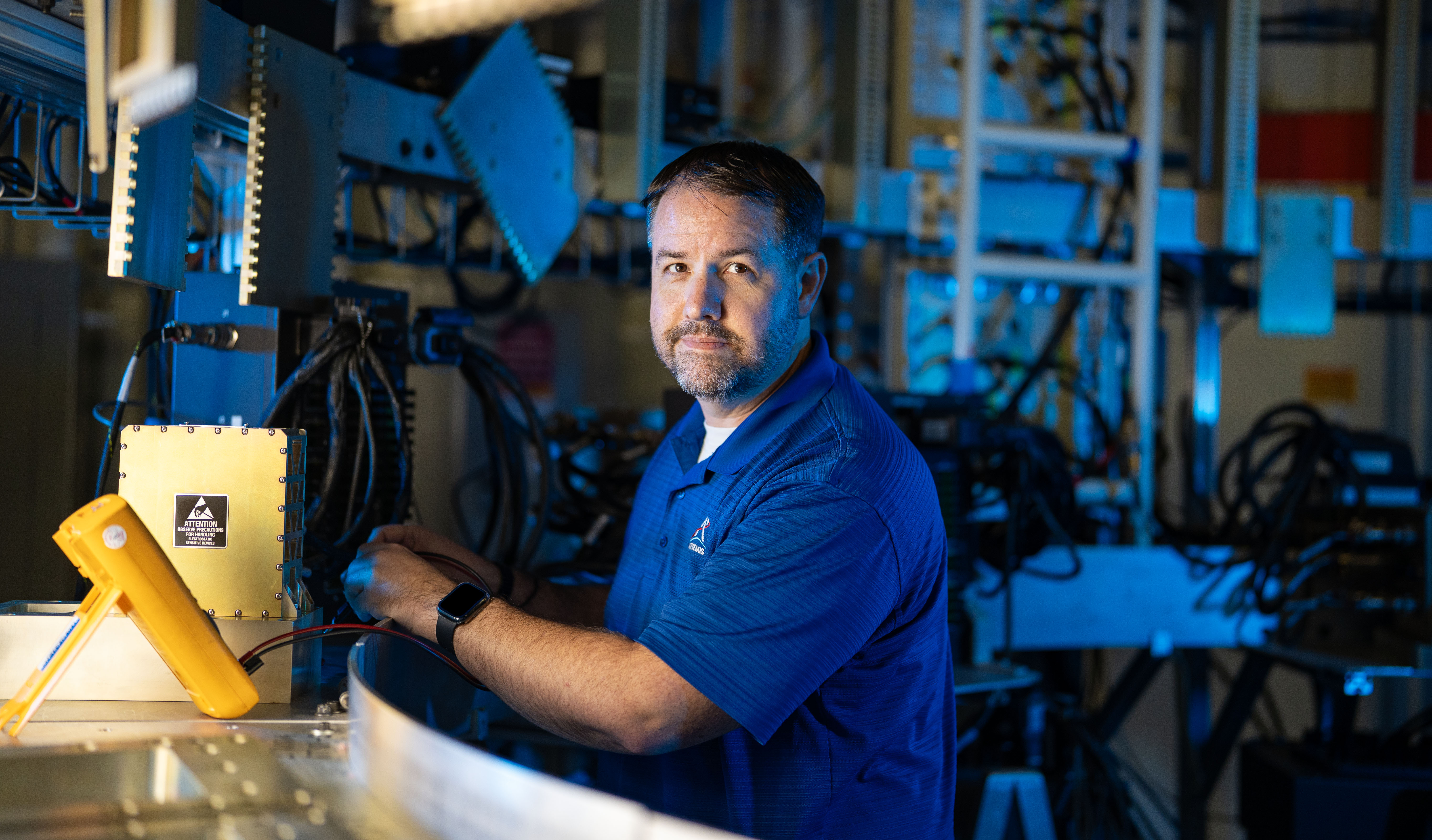
Dave Reynolds, the booster manager for SLS (Space Launch System), works inside the Next Generation Booster Avionics Mockup at NASA’s Marshall Space Flight Center in Huntsville, Alabama. Reynolds is responsible for the design, development, and flight of the boosters for the rocket that carry NASA’s Orion spacecraft and astronauts to the Moon as part of the Artemis II mission.
Credits: NASA

As booster manager for NASA’s SLS (Space Launch System), Dave Reynolds’ path to NASA is embodied by his childhood poster of the space shuttle’s Return to Flight initiative, which hangs in his office, serving as a constant reminder that his journey to the agency began decades ago.

Growing up in Roy, Utah, Reynolds remembers standing outside to watch the billowing smoke rise from booster tests at Northrop Grumman’s Promontory facility. Rockets were the backdrop of his childhood, and growing up during the shuttle missions sparked his fascination for space exploration.

As the booster manager for the SLS, Dave is responsible for the design, development, and flight of the boosters—work that echoes the sense of significance that inspired him as a child to study spaceflight.

“I couldn’t quite verbalize what I felt then, but as I’ve matured over time, I now realize I want to be a part of the team sending astronauts to the Moon, and I have a personal desire to ensure the safety of those individuals,” Reynolds said.

Dave Reynolds, the booster manager for SLS (Space Launch System), works inside the Next Generation Booster Avionics Mockup at NASA’s Marshall Space Flight Center in Huntsville, Alabama. Reynolds is responsible for the design, development, and flight of the boosters for the rocket that carry NASA’s Orion spacecraft and astronauts to the Moon as part of the Artemis II mission.
NASA

Early in his career at NASA’s Marshall Space Flight Center in Huntsville, Alabama, Reynolds worked on the J-2X — a liquid-cryogenic engine that was once slated as a candidate to power the SLS upper stage. In 2012, he made a jump to solid rocket motors when he became the subsystem manager for the SLS boosters office. Reynolds spent his days managing and testing motor cases, seals, igniters, and separation motors.

He was promoted to deputy manager for the SLS office where he helped oversee development of the solid rocket boosters. He also was given the task of developing and managing the evolved composite boosters that would be used for future Artemis missions.

With the launch of Artemis II on the horizon, Reynolds is thrilled to be part of the team preparing to send a crew of four astronauts around the Moon.

Deep down, I’m really excited about Artemis II. The eight-year-old me is still in there, eager to watch the smoke rising from those booster tests at a distance. He wouldn’t believe the things I’ve seen and what I’m about to see.

Dave Reynolds

Dave Reynolds

Booster Manager for Space Launch System

“Deep down, I’m really excited about Artemis II. The eight-year-old me is still in there, eager to watch the smoke rising from those booster tests at a distance. He wouldn’t believe the things I’ve seen and what I’m about to see,” Reynolds said.

Reynolds witnessed moments that would have stunned his eight-year-old self. In 2022, he watched as the SLS illuminated the morning sky during the launch of Artemis I. More recently, the evolved booster he helped develop performed its first full-scale test. Reynolds watched as the booster roared to life – just miles from his hometown in Utah.

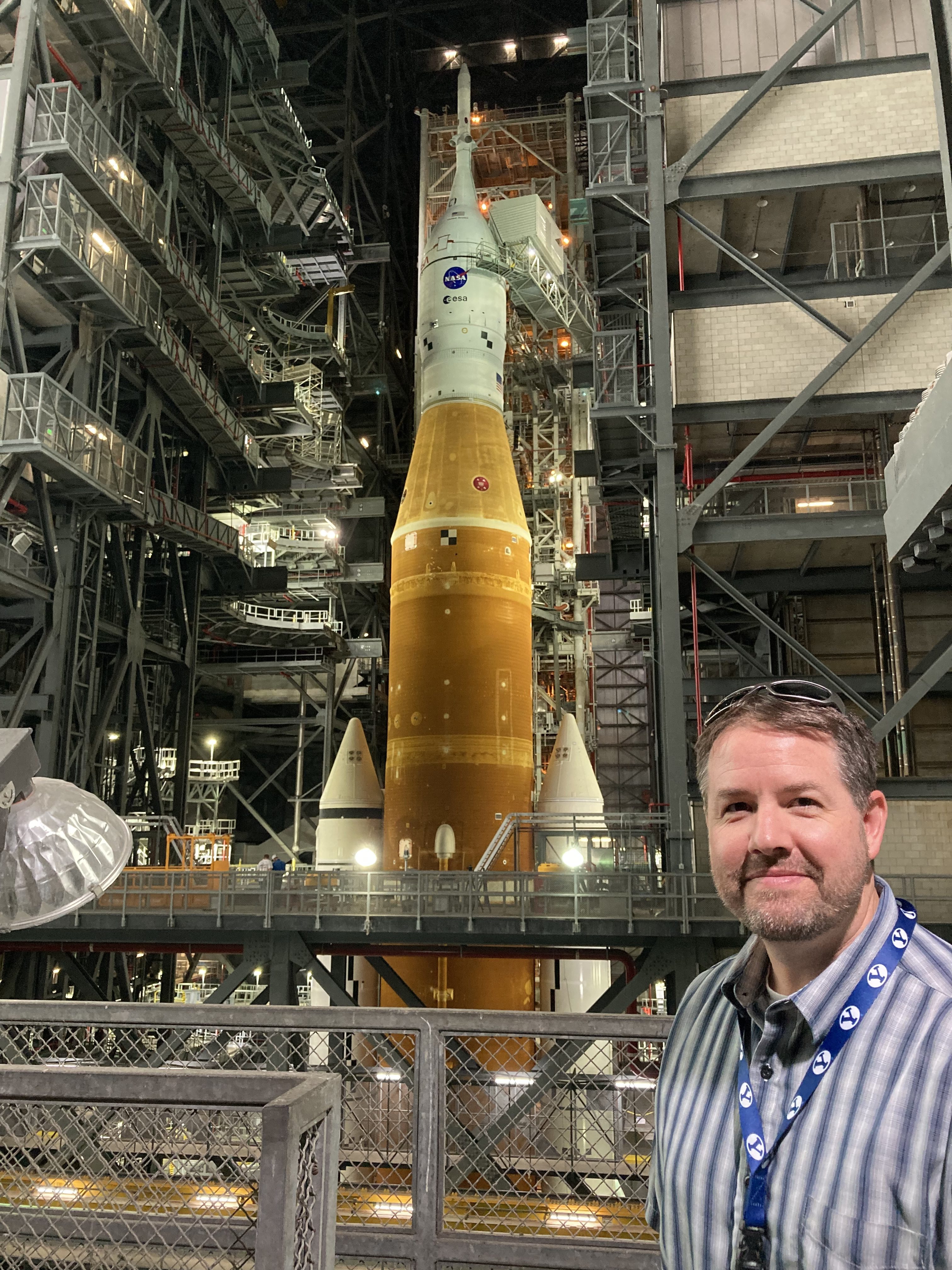
Dave Reynolds, at NASA’s Kennedy Space Center’s Vehicle Assembly Building in front of the SLS rocket that powered the Artemis I mission. Through Artemis, NASA will send astronauts to explore the Moon for scientific discovery, economic benefits, and build the foundation for the first crewed missions to Mars.
Reynolds, at NASA’s Kennedy Space Center’s Vehicle Assembly Building in front of the SLS rocket that powered the Artemis I mission. Through Artemis, NASA will send astronauts to explore the Moon for scientific discovery, economic benefits, and build the foundation for the first crewed missions to Mars.
NASA

From his driveway to the test site, Reynolds’ curiosity grew into a career shaped by purpose, responsibility, and respect for the work ahead. The poster hanging on Reynolds’ wall isn’t just a souvenir from the past – it’s a reminder of where his interest took root and how far that curiosity has carried him.

As the team moves closer to the launch of Artemis II which will take astronauts around the Moon, Reynolds feels a familiar sense of exhilaration. The questions that once drew him toward space are still guiding him today, except this time he is one of the individuals helping to shape the answers.

Learn more about NASA’s Space Launch System at:

https://www.nasa.gov/sls

About the Author

Lane Polak

Lane Polak

Supernova Remnant Video From NASA’s Chandra Is Decades in Making

By: Lee Mohon
6 January 2026 at 16:30
A new video shows changes in Kepler’s Supernova Remnant using data from NASA’s Chandra X-ray Observatory captured over more than two and a half decades with observations taken in 2000, 2004, 2006, 2014, and 2025. In this video, which is the longest-spanning one ever released by Chandra, X-rays (blue) from the telescope have been combined with an optical image (red, green, and blue) from Pan-STARRS.
X-ray: NASA/CXC/SAO; Optical: Pan-STARRS

A new video shows the evolution of Kepler’s Supernova Remnant using data from NASA’s Chandra X-ray Observatory captured over more than two and a half decades.

Kepler’s Supernova Remnant, named after the German astronomer Johannes Kepler, was first spotted in the night sky in 1604. Today, astronomers know that a white dwarf star exploded when it exceeded a critical mass, after pulling material from a companion star, or merging with another white dwarf. This kind of supernova is known as a Type Ia, and scientists use it to measure the expansion of the universe.

Supernova remnants, the debris fields left behind after a stellar explosion, often glow strongly in X-ray light because the material has been heated to millions of degrees from the blast. The remnant is located in our galaxy, about 17,000 light-years from Earth, allowing Chandra to make detailed  images of the debris and how it changes with time. This latest video includes its X-ray data from 2000, 2004, 2006, 2014, and 2025. This makes it the longest-spanning video that Chandra has ever released, enabled by Chandra’s longevity.

“The plot of Kepler’s story is just now beginning to unfold,” said Jessye Gassel, a graduate student at George Mason University in Virginia, who led the work. “It’s remarkable that we can watch as these remains from this shattered star crash into material already thrown out into space.” Gassel presented the new Chandra video and the associated research at the 247th meeting of the American Astronomical Society in Phoenix.

The researchers used the video to show that the fastest parts of the remnant are traveling at about 13.8 million miles per hour (2% of the speed of light), moving toward the bottom of the image. Meanwhile, the slowest parts are traveling toward the top at about 4 million miles per hour (0.5% of the speed of light). This large difference in speed is because the gas that the remnant is plowing into toward the top of the image is denser than the gas toward the bottom. This gives scientists information about the environments into which this star exploded.

“Supernova explosions and the elements they hurl into space are the lifeblood of new stars and planets,” said Brian Williams of NASA’s Goddard Space Flight Center in Greenbelt, Maryland, and principal investigator of the new Chandra observations of Kepler. “Understanding exactly how they behave is crucial to knowing our cosmic history.”

The team also examined the widths of the rims forming the blast wave of the explosion. The blast wave is the leading edge of the explosion and the first to encounter material outside of the star. By measuring how wide it is and how fast it is traveling, astronomers glean more information about both the explosion of the star and its surroundings.

NASA’s Marshall Space Flight Center in Huntsville, Alabama, manages the Chandra program. The Smithsonian Astrophysical Observatory’s Chandra X-ray Center controls science operations from Cambridge, Massachusetts, and flight operations from Burlington, Massachusetts.

To learn more about Chandra, visit:

https://science.nasa.gov/chandra

Read more from NASA’s Chandra X-ray Observatory

Learn more about the Chandra X-ray Observatory and its mission here:

https://www.nasa.gov/chandra

https://chandra.si.edu

Visual Description

This release features a ten second silent video of Kepler’s expanding Supernova Remnant, located in our own galaxy, about 17,000 light-years from Earth. The video was created using X-ray data gathered in 2000, 2004, 2006, 2014, and 2025. Those distinct datasets were turned into highly-detailed visuals, creating a 25-year timelapse-style video of the growing remnant.

Kepler’s Supernova Remnant was once a white dwarf star that exploded when it exceeded its critical mass. Here, in X-ray light, the remnant resembles a cloudy neon blue ring with a diagonal cross line stretching from our upper right down to our lower left. The ring appears thinner and wispier at the bottom, with a band of white arching across the top.

As the video plays, cycling through the 5 datasets, the ring subtly, but clearly, expands, like a slowly inflating balloon. In the video, this sequence is replayed several times with dates included at our lower right, to give sighted learners time to absorb the visual information. Upon close inspection, researchers have determined that the bottom of the remnant is expanding fastest; about 13.8 million miles per hour, or 2% of the speed of light. The top of the ring appears to be expanding the slowest; about 4 million miles per hour, or 0.5% of the speed of light. The large difference in speed is because the gas that the remnant is plowing into towards the top of the image is denser than the gas towards the bottom.

Collecting and interpreting this data over decades has provided information about the environment into which the white dwarf star exploded, and has helped scientists understand how remnants change with time.

Share

Details

Last Updated
Jan 06, 2026
Editor
Lee Mohon
Contact
Joel Wallace

NASA Marshall Prepares for Demolition of Historic Test, Simulation Facilities

6 January 2026 at 13:44
6 Min Read

NASA Marshall Prepares for Demolition of Historic Test, Simulation Facilities

Engineers and technicians hoist the first flight version of the Saturn IB rocket's first stage into the T-tower for static testing at NASA’s Marshall Space Flight Center in Huntsville, Alabama, on March 15, 1965.
Credits: NASA

NASA is preparing for the demolition of three iconic structures at the agency’s Marshall Space Flight Center in Huntsville, Alabama.

Crews began demolition in mid-December at the Neutral Buoyancy Simulator, a facility built in the late 1960s that once enabled NASA astronauts and researchers to experience near-weightlessness. The facility was also used to conduct underwater testing of space hardware and practice runs for servicing the Hubble Space Telescope. The simulator was closed in 1997.

Two test stands – the Propulsion and Structural Test Facility and Dynamic Test Facility – are also slated for demolition, one after the other, by carefully coordinated implosion no earlier than sunrise on Jan. 10, 2026.

NASA Marshall tests fires the first stage of the Saturn I rocket at its historic Propulsion and Structural Test Facility, better known as the “T-tower.”

The demolition of these historic structures is part of a larger project that began in spring 2022, targeting several inactive structures no longer needed for the agency’s missions. All three towering fixtures played crucial roles in getting humans to the Moon, into low-Earth orbit, and beyond.

These structures have reached the end of their safe, operational life, and their removal has been long-planned as part of a broader effort to modernize Marshall’s footprint.  This demolition is the first phase of an initiative that will ultimately remove 25 outdated structures, reduce maintenance burdens, and position Marshall to take full advantage of a guaranteed NASA center infrastructure investment authorized under the Working Families Tax Credit Act.

This work reflects smart stewardship of taxpayer resources.

jared isaacman

jared isaacman

NASA Administrator

“This work reflects smart stewardship of taxpayer resources,” said NASA Administrator Jared Isaacman. “Clearing outdated infrastructure allows NASA to safely modernize, streamline operations, and fully leverage the infrastructure investments signed into law by President Trump to keep Marshall positioned at the forefront of aerospace innovation.”

Built in 1964, the Dynamic Test Stand initially was used to test fully assembled Saturn V rockets. In 1978, engineers integrated all space shuttle elements for the first time, including the orbiter, external fuel tank, and solid rocket boosters. It was last used in the early 2000s for microgravity testing.

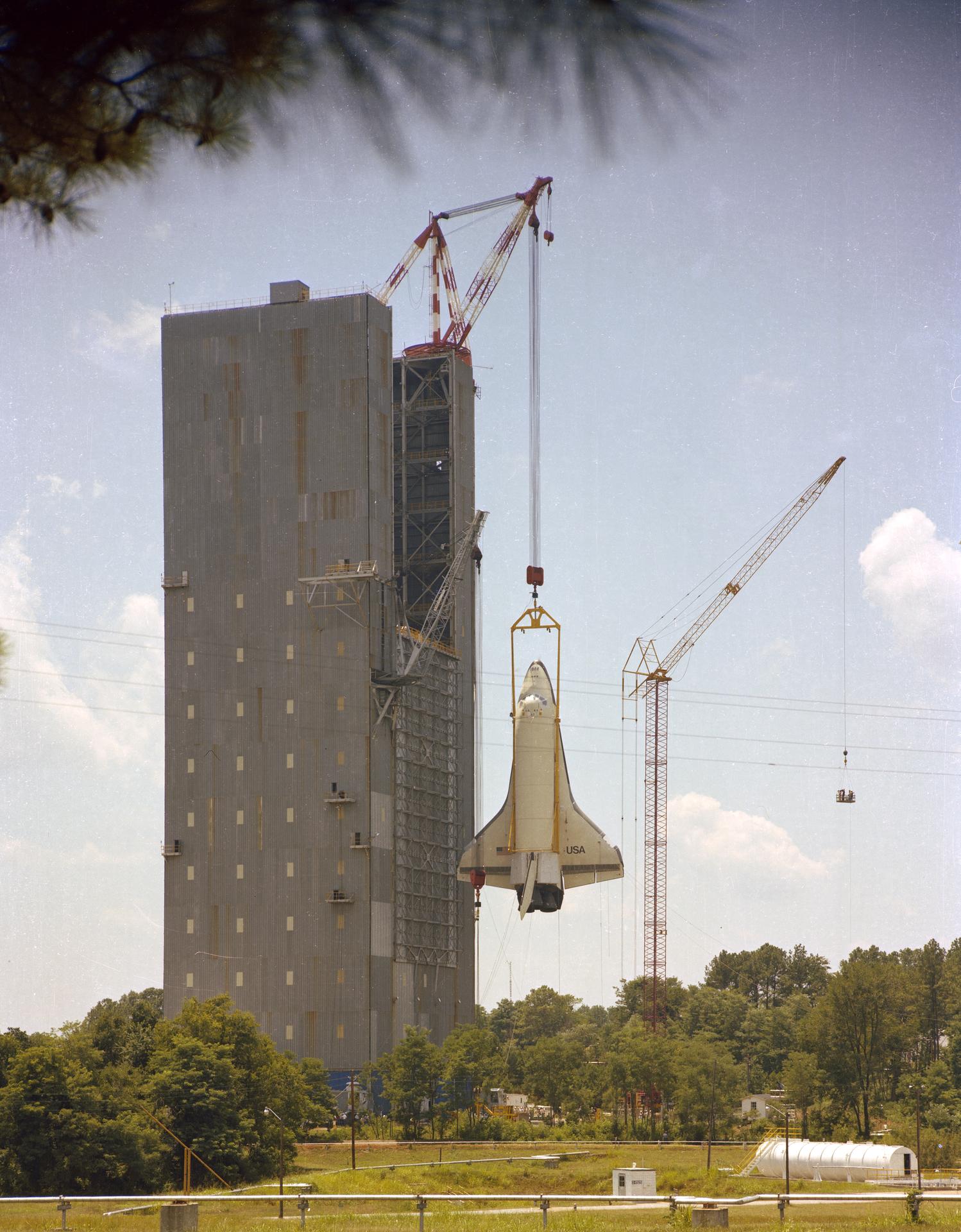
The space shuttle orbiter Enterprise lifted by crane into the Structural Dynamic Test Facility at NASA’s Marshall Space Flight Center in Huntsville, Alabama, for vibration testing in July 1978.
NASA

The Propulsion and Structural Test Facility – better known at Marshall as the “T-tower” due to its unique shape – was built in 1957 by the U.S. Army Ballistic Missile Agency and transferred to NASA when Marshall was founded in 1960. There, engineers tested components of the Saturn launch vehicles, the Army’s Redstone Rocket, and shuttle solid rocket boosters.  It was last used for space shuttle solid rocket motor tests in the 1990s.

“Each one of these structures helped NASA make history,” said Rae Ann Meyer, acting center director at Marshall. “While it is hard to let them go, they’ve earned their retirement.  The people who built and managed these facilities and empowered our mission of space exploration are the most important part of their legacy.”

“These structures are not safe,” continued Meyer. “Strategic demolition is a necessary step in shaping the future of NASA’s mission to explore, innovate, and inspire. By removing these structures that we have not used in decades, we are saving money on upkeep of facilities we can’t use. We also are making these areas safe to use for future NASA exploration endeavors and investments.”

A legacy worth remembering

When NASA opened the Neutral Buoyancy Simulator in 1968, it was one of few places on Earth that could recreate the weightlessness of microgravity. The facility provided a simulated zero-gravity environment in which engineers and astronauts could find out how their designs might handle in orbit. The tank has been central to planning and problem-solving for Skylab missions, repairs to NASA’s Hubble Space Telescope, and more. The tank is 75 feet in diameter, 40 feet deep, and designed to hold up to nearly 1.5 million gallons of water. It was replaced in 1997 by a new, larger facility at NASA’s Johnson Space Center in Houston.

Kathryn Thornton in the Neutral Buoyancy Simulator at Marshall
Astronaut Kathryn Thornton practices maneuvers planned for the STS-61 mission in the Neutral Buoyancy Simulator at NASA’s Marshall Space Flight Center in Huntsville, Alabama, on Aug. 9, 1993.
NASA

The Propulsion and Structural Test Facility is one of the oldest test stands at Marshall. The dual-position test stand, sometimes called the T-tower, was built for static testing large rockets and launch systems – like launching a rocket while keeping it restrained and wired to instruments that collect data. The tests and data played a role in the development of the Saturn family of rockets, including the F-1 engine and S-IC.

The Dynamic Test Stand, a 360-foot tower topped by a 64-foot derrick, was once the tallest human-made structure in North Alabama. Engineers there conducted full-scale tests of Saturn V rockets – the same powerful vehicles that carried Apollo astronauts to the Moon. Later, the stand served as the first location where all space shuttle elements were integrated.

Preserving history for future generations

The irreplaceable historical value of these landmarks has prompted NASA to undertake extensive efforts to preserve their stories for future generations. The three facilities were made national landmarks in 1985 for their part in human spaceflight. In keeping with Section 106 of the National Historic Preservation Act, master planners and engineers at Marshall completed a rigorous consultation and mitigation process for each landmark, working closely with Alabama’s State Historic Preservation Office to preserve their history for future generations.

Detailed architectural documentation, written histories, and large-format photographs are permanently archived in the Library of Congress’ Historic American Engineering Record collection, making this history accessible to researchers and the public for generations.

Additionally, NASA has partnered with Auburn University to create high-resolution digital models of each facility. The project used technologies like LiDAR and 360-photography of the structures in detail before demolition. Their goal is to preserve not just the appearance, but the sense of scale and engineering achievement they represent. The models are still in work, but they’ll eventually be publicly available.

Select artifacts from the facilities have also been identified and transferred to the U.S. Space & Rocket Center through NASA’s Artifact Program, ensuring tangible pieces of this history remain available for educational purposes.

Honoring the past, building the future

For the employees, retirees, and community members who remember these facilities over the decades, their removal marks the end of an era. But their contributions live on in every NASA mission, from the International Space Station to the upcoming Artemis II lunar missions and more.

“NASA’s vision of space exploration remains vibrant, and as we look to an exciting future, we honor the past, especially the dedication of the men and women who built these structures and tested hardware that has launched into space, made unprecedented scientific discoveries, and inspired generations of Americans to reach for the stars,” said Meyer.

The demolitions represent more than removing obsolete infrastructure. They’re part of NASA’s commitment to building a dynamic, interconnected campus ready for the next era of space exploration while honoring the bold spirit that has always driven the agency forward.

Virtual tours and preserved documentation will be made available on Marshall’s digital channels. Marshall will also share video of the test stand demolitions after the event.

For communities near Redstone Arsenal, there could be a loud noise associated with the demolition on the morning of Jan. 10.

💾

This video is of the firing of the Saturn I first stage at NASA's Marshall Space Flight Center. The Saturn I first stage, or S-IB, consisted of eight tanks, ...

NASA’s IXPE Measures White Dwarf Star for First Time

By: Lee Mohon
5 January 2026 at 16:58
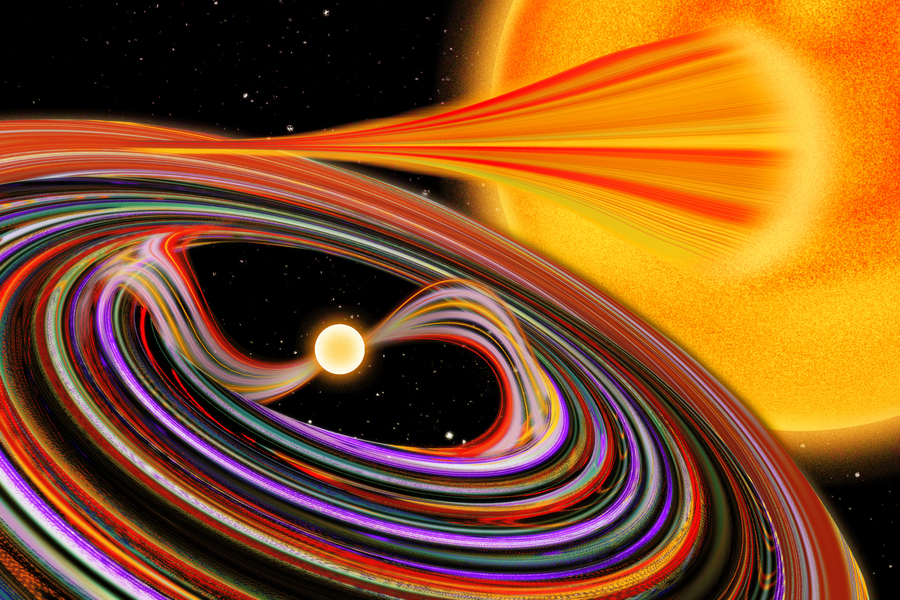
This artist’s concept depicts a smaller white dwarf star pulling material from a larger star, right, into an accretion disk. Earlier this year, scientists used NASA’s IXPE (Imaging X-ray Polarization Explorer) to study a white dwarf star and its X-ray polarization.
MIT/Jose-Luis Olivares

By Michael Allen 

For the first time, scientists have used NASA’s IXPE (Imaging X-ray Polarization Explorer) to study a white dwarf star. Using IXPE’s unique X-ray polarization capability, astronomers examined a star called the intermediate polar EX Hydrae, unlocking the geometry of energetic binary systems. 

In 2024, IXPE spent nearly one week focused on EX Hydrae, a white dwarf star system located in the constellation Hydra, approximately 200 light-years from Earth. A paper about the results published in the Astrophysical Journal. Astrophysics research scientists based at the Massachusetts Institute of Technology in Cambridge led the study, along with co-authors at the University of Iowa, East Tennessee State University, University of Liége, and Embry Riddle Aeronautical University. 

A white dwarf star occurs after a star runs out of hydrogen fuel to fuse in its core but is not massive enough to explode as core-collapse supernovae. What remains is very dense, roughly the same diameter as Earth with as much mass as our Sun.  

EX Hydrae is in a binary system with a main sequence companion star, from which gas is continuously falling onto the white dwarf. How exactly the white dwarf is accumulating, or accreting, this matter and where it arrives on the white dwarf depends on the strength of the white dwarf star’s magnetic field. 

In the case of EX Hydrae, its magnetic field is not strong enough to focus matter completely at the star’s poles. But, it is still rapidly adding mass to the accretion disk, earning the classification “intermediate polars. 

In an intermediate polar system, material forms an accretion disk while also being pulled towards its magnetic poles. During this phenomenon, matter reaches tens of millions of degrees Fahrenheit, bouncing off other material bound to the white dwarf star, creating large columns of gas that emit high-energy X-rays – a cosmic situation perfect for IXPE to study.

“NASA IXPE’s one-of-a-kind polarimetry capability allowed us to measure the height of the accreting column from the white dwarf star to be almost 2,000 miles high – without as many assumptions required as past calculations,” said Sean Gunderson, MIT scientist and lead author on the paper. “The X-rays we observed likely scattered off the white dwarf’s surface itself. These features are far smaller than we could hope to image directly and clearly show the power of polarimetry to ‘see’ these sources in detail never before possible.”

Information from IXPE’s polarization data of EX Hydrae will help scientists understand other highly energetic binary systems.

More about IXPE 

 The IXPE mission, which continues to provide unprecedented data enabling groundbreaking discoveries about celestial objects across the universe, is a joint NASA and Italian Space Agency mission with partners and science collaborators in 12 countries. It is led by NASA’s Marshall Space Flight Center in Huntsville, Alabama. BAE Systems, Inc., headquartered in Falls Church, Virginia, manages spacecraft operations together with the University of Colorado’s Laboratory for Atmospheric and Space Physics in Boulder. Learn more about IXPE’s ongoing mission here: 

https://www.nasa.gov/ixpe

NASA’s Chandra Rings in New Year With Champagne Cluster

By: Lee Mohon
30 December 2025 at 11:45
This release features a composite image of a galaxy cluster first discovered on New Year's Eve day, 2020. The cluster appears here as a large collection of brilliant white lights, each a distinct galaxy. A neon purple cloud stretches across the cluster's crowded core. Many of the hundred-plus galaxies in the cluster are in two clumps of galaxies towards the top and bottom of center. Some are encircled by a faint glowing haze, while a few foreground stars gleam with diffraction spikes. Some of the smaller galaxies are tinted blue, orange, or red, and some appear more oblong than round, suggesting spiral shapes viewed edge-on. The neon purple cloud sits at the heart of the image, surrounding the most densely-packed part of the cluster. This cloud, which spreads vertically across the cluster, is multimillion-degree gas observed by Chandra. The two clumps of observable galaxies, and the spread of superheated gas, reveal that the Champagne Cluster is in fact two clusters in the process of colliding. With the two clusters of sparkling light clinking together, and the auspicious discovery date, astronomers have dubbed the merged cosmic structure "The Champagne Cluster".
X-ray: NASA/CXC/UCDavis/F. Bouhrik et al.; Optical:Legacy Survey/DECaLS/BASS/MzLS; Image Processing: NASA/CXC/SAO/P. Edmonds and L. Frattare

Celebrate the New Year with the “Champagne Cluster,” a galaxy cluster seen in this new image from NASA’s Chandra X-ray Observatory and optical telescopes.

Astronomers discovered this galaxy cluster Dec. 31, 2020. The date, combined with the bubble-like appearance of the galaxies and the superheated gas seen with Chandra observations (represented in purple), inspired the scientists to nickname the galaxy cluster the Champagne Cluster, a much easier-to-remember name than its official designation of RM J130558.9+263048.4.

The new composite image shows that the Champagne Cluster is actually two galaxy clusters in the process of merging to form an even larger cluster. Multimillion-degree gas in galaxy clusters usually takes on an approximately circular or moderately oval shape in images, but in the Champagne Cluster it is more widely spread from top to bottom, revealing the presence of the two colliding clusters. Two clumps of individual galaxies making up the colliding clusters can be seen toward the top and bottom of center. (The image has been rotated clockwise by 90 degrees so that North points to the right.)

The hot gas outweighs the combined mass in all of the hundred-plus individual galaxies in the newly forming cluster. The clusters also contain even larger amounts of unseen dark matter, the mysterious substance that pervades the universe.

In addition to the Chandra data, this new image contains optical data from the Legacy Surveys (red, green, and blue), which consists of three individual and complementary surveys from various telescopes in Arizona and Chile.

The Champagne Cluster is a member of a rare class of merging clusters, which includes the well-known Bullet Cluster, where the hot gas in each cluster has collided and slowed down, and there is a clear separation between the hot gas and the most massive galaxy in each cluster.

By comparing the data with computer simulations, astronomers came up with two possibilities for the history of the Champagne Cluster. One is that the two clusters already collided with each other over two billion years ago. After the collision the two clusters traveled outward and then were pulled back toward each other by gravity, and are now heading into a second collision. The other idea is that a single collision occurred about 400 million years ago, and the two clusters are now traveling away from each other after that collision. Researchers think further studies of the Champagne Cluster can potentially teach them how dark matter reacts to a high-speed collision.

A paper describing these results recently appeared in The Astrophysical Journal and is available online. The authors of the paper are Faik Bouhrik, Rodrigo Stancioli, and David Wittman, all from the University of California, Davis.

NASA’s Marshall Space Flight Center in Huntsville, Alabama, manages the Chandra program. The Smithsonian Astrophysical Observatory’s Chandra X-ray Center controls science operations from Cambridge, Massachusetts, and flight operations from Burlington, Massachusetts.


Read more from NASA’s Chandra X-ray Observatory

Learn more about the Chandra X-ray Observatory and its mission here:

https://www.nasa.gov/chandra

https://chandra.si.edu

Visual Description

This release features a composite image of a galaxy cluster discovered on New Year’s Eve day, 2020.

The cluster appears here as a large collection of brilliant white lights, each a distinct galaxy. A neon purple cloud stretches across the cluster’s crowded core. Many of the hundred-plus galaxies in the cluster are in two clumps of galaxies towards the top and bottom of center. Some are encircled by a faint glowing haze, while a few foreground stars gleam with diffraction spikes. Some of the smaller galaxies are tinted blue, orange, or red, and some appear more oblong than round, suggesting spiral shapes viewed edge-on.

The neon purple cloud sits at the heart of the image, surrounding the most densely-packed part of the cluster. This cloud, which spreads vertically across the cluster, is multimillion-degree gas observed by Chandra. The two clumps of observable galaxies, and the spread of superheated gas, reveal that the Champagne Cluster is in fact two clusters in the process of colliding.

With the two clusters of sparkling light clinking together, and the auspicious discovery date, astronomers have dubbed the merged cosmic structure “The Champagne Cluster”.

News Media Contact

Megan Watzke
Chandra X-ray Center
Cambridge, Mass.
617-496-7998
mwatzke@cfa.harvard.edu

Joel Wallace
Marshall Space Flight Center, Huntsville, Alabama
256-544-0034
joel.w.wallace@nasa.gov
NASA IXPE’s Longest Observation Solves Black Hole Jets Mystery

By: Lee Mohon
16 December 2025 at 16:23

4 min read

Preparations for Next Moonwalk Simulations Underway (and Underwater)

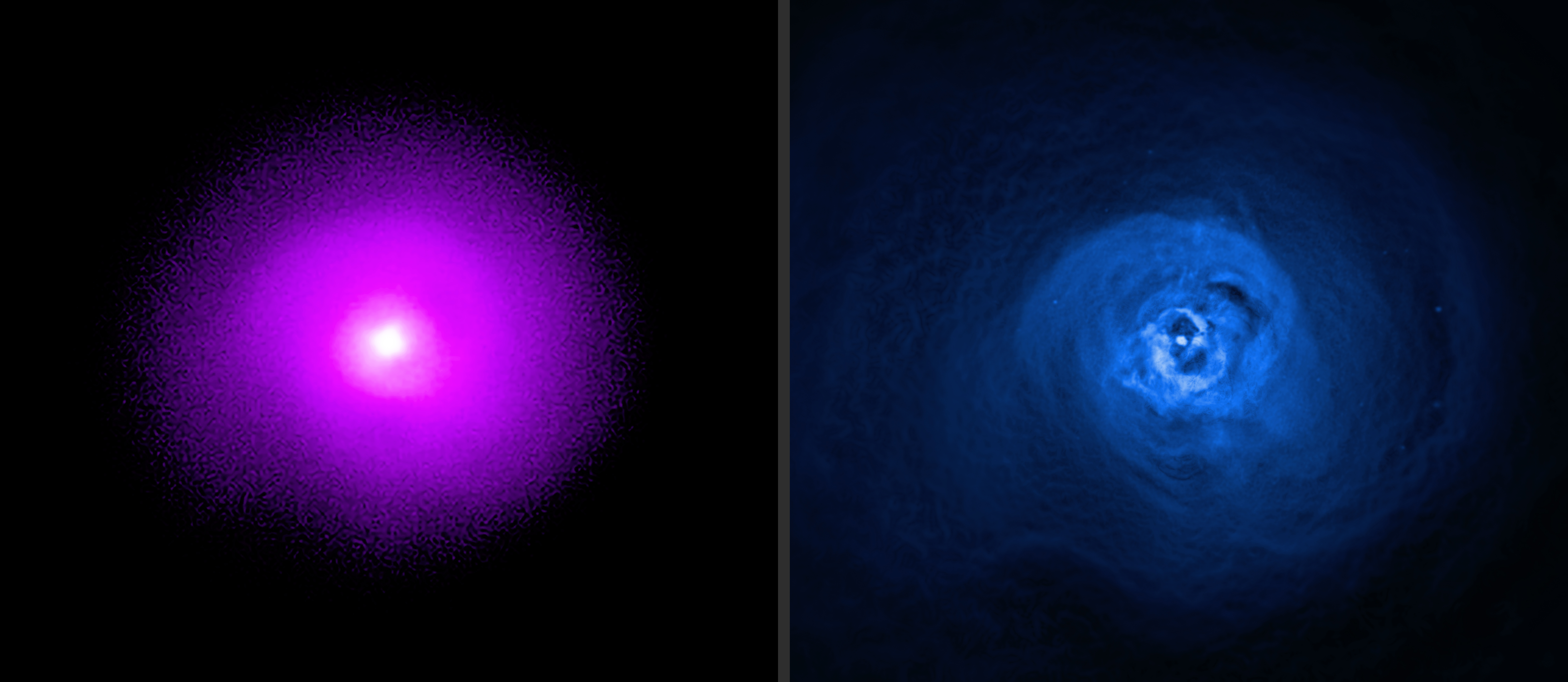
The Perseus Cluster. Left: Imaging X-ray Polarimetry Explorer (IXPE); Right: Chandra X-ray Observatory.
Two composite images show side-by-side observations of the Perseus Cluster from NASA’s IXPE (Imaging X-Ray Polarimetry Explorer) and Chandra X-ray Observatory. Scientists used data from both observatories, along with data from Nuclear Spectroscopic Telescope Array (NuSTAR), and Neil Gehrels Swift Observatory, to confirm measurements of the galaxy cluster.
X-ray: (Chandra) NASA/CXC/SAO, (IXPE) NASA/MSFC; Image Processing: NASA/CXC/SAO/N. Wolk and K. Arcand

Written by Michael Allen

An international team of astronomers using NASA’s IXPE (Imaging X-ray Polarimetry Explorer) has identified the origin of X-rays in a supermassive black hole’s jet, answering a question that has been unresolved since the earliest days of X-ray astronomy. Their findings are described in a paper published in The Astrophysical Journal Letters, by the American Astronomical Society, Nov. 11.

The IXPE mission observed the Perseus Cluster, the brightest galaxy cluster observable in X-rays, for more than 600 hours over a 60-day period between January and March. Not only is this IXPE’s longest observation of a single target to date, it also marks IXPE’s first time observing a galaxy cluster.

Specifically, the team of scientists studied the polarization properties of 3C 84, the massive active galaxy located at the very center of the Perseus Cluster. This active galaxy is a well-known X-ray source and a common target for X-ray astronomers because of its proximity and brightness.

Because the Perseus Cluster is so massive, it hosts an enormous reservoir of X-ray emitting gas as hot as the core of the Sun. The use of multiple X-ray telescopes, particularly the high-resolution imaging power of NASA’s Chandra X-ray Observatory was essential to disentangle the signals in the IXPE data. Scientists combined these X-ray measurements with data from the agency’s Nuclear Spectroscopic Telescope Array (NuSTAR) mission and Neil Gehrels Swift Observatory.

Fast facts

  • Polarization measurements from IXPE carry information about the orientation and alignment of emitted X-ray light waves. The more X-ray waves traveling in sync, the higher the degree of polarization.
  • X-rays from an active galaxy like 3C 84 are thought to originate from a process known as inverse Compton scattering, where light bounces off particles and gains energy. The polarization measurements from IXPE allow us to identify the presence of either inverse Compton scattering or other scenarios.
  • “Seed photons” is the term for the lower-energy radiation undergoing the energizing process of inverse Compton scattering.
  • You may remember the Perseus Cluster from this sonification replicating what a Black Hole sounds like from May 2022.

“While measuring the polarization of 3C 84 was one of the key science goals, we are still searching for additional polarization signals in this galaxy cluster that could be signatures of more exotic physics,” said Steven Ehlert, project scientist for IXPE and astronomer at NASA’s Marshall Space Flight Center in Huntsville.

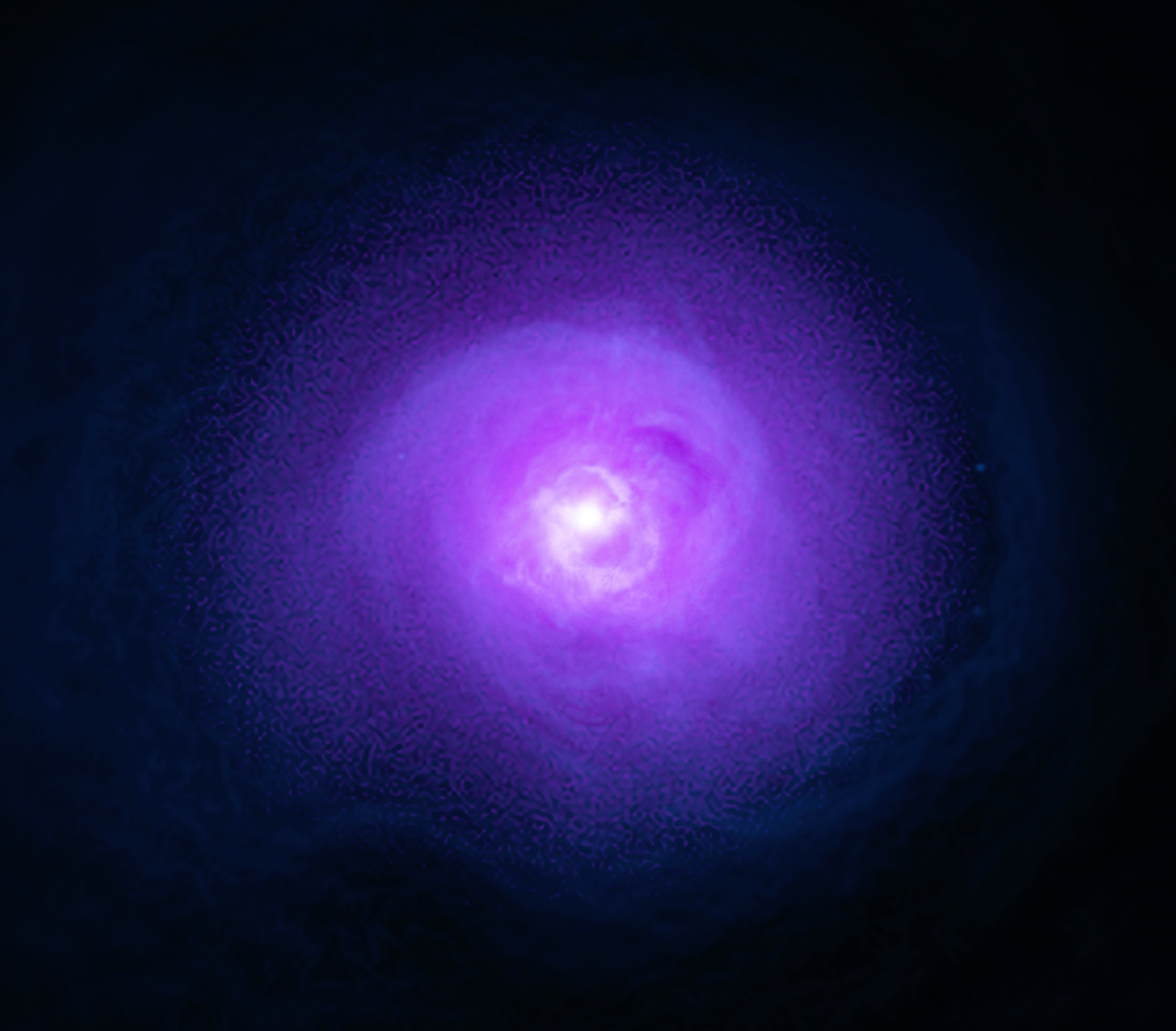
Chandra & IXPE composite image of the Perseus Cluster.
X-ray: (Chandra) NASA/CXC/SAO, (IXPE) NASA/MSFC; Image Processing: NASA/CXC/SAO/N. Wolk and K. Arcand

“We’ve already determined that for sources like 3C 84, the X-rays originated from inverse Compton scattering,” said Ioannis Liodakis, a researcher at the Institute of Astrophysics – FORTH in Heraklion, Greece, and lead author on the paper. “With IXPE observations of 3C 84 we had a unique chance to determine the properties of the seed photons.”

The first possible origin scenario for the seed photons is known as synchrotron self-Compton, where lower-energy radiation originates from the same jet that produces the highly energetic particles.

In the alternative scenario known as external Compton, seed photons originate from background radiation sources unrelated to the jet.

“The synchrotron self-Compton and external Compton scenarios have very different predictions for their X-ray polarization,” said Frederic Marin, an astrophysicist at the Strasbourg Astronomical Observatory in France and co-author of the study. “Any detection of X-ray polarization from 3C 84 almost decisively rules out the possibility of external Compton as the emission mechanism.”

Throughout the 60-day observation campaign, optical and radio telescopes around the world turned their attention to 3C 84 to further test between the two scenarios.

NASA’s IXPE measured a net polarization of 4% in the X-rays spectrum, with comparable values measured in the optical and radio data. These results strongly favor the synchrotron self-Compton model for the seed photons, where they come from the same jet as the higher-energy particles.

“Separating these two components was essential to this measurement and could not be done by any single X-ray telescope, but by combining the IXPE polarization data with Chandra, NuSTAR, and Swift, we were able to confirm this polarization measurement was associated specifically with 3C 84,” said Sudip Chakraborty, a researcher at the Science and Technology Institute of the Universities Space Research Association in Huntsville, Alabama, and co-author on the paper.

Scientists will continue to analyze IXPE’s data from different locations in the Perseus Cluster for different signals.

More about IXPE

NASA’s IXPE, which continues to provide unprecedented data enabling groundbreaking discoveries about celestial objects across the universe, is a joint NASA and Italian Space Agency mission with partners and science collaborators in 12 countries. The IXPE mission is led by NASA’s Marshall Space Flight Center in Huntsville, Alabama. BAE Systems, Inc., headquartered in Falls Church, Virginia, manages spacecraft operations together with the University of Colorado’s Laboratory for Atmospheric and Space Physics in Boulder.

Learn more about IXPE’s ongoing mission here:

https://www.nasa.gov/ixpe

❌
❌