Reports say the Ethereum Foundation has started a new team to prepare the network for possible quantum computer attacks. These machines could one day break the math behind wallets and signatures. The team’s work is moving from research into practical tests and experiments, which has drawn attention across the crypto community.
Ethereum Launches Post-Quantum Team
Based on reports, Thomas Coratger will lead the effort. The team includes cryptographers and engineers already testing new systems on devnets. Some work ties into a project called leanVM and a researcher named Emile, who focuses on building simple quantum-safe tools. The goal is to test new algorithms in real software while keeping current transactions running smoothly.
Today marks an inflection in the Ethereum Foundation’s long-term quantum strategy.
We’ve formed a new Post Quantum (PQ) team, led by the brilliant Thomas Coratger (@tcoratger). Joining him is Emile, one of the world-class talents behind leanVM. leanVM is the cryptographic…
A $1 million prize has been set for improvements to the Poseidon hash function. Another $1 million prize supports broader post-quantum research. In total, roughly $2 million are being offered to labs and independent developers to design and test quantum-resistant solutions. Reports say this funding is meant to speed up work and show what can realistically replace current signatures.
Early Tests And Community Involvement
Multi-client devnets are already active. Developers are experimenting with new signature types to see what works and what fails. Biweekly sessions led by researchers like Antonio Sanso let teams share results and update code. A Post-Quantum Day is scheduled for March 2026 before ETHCC, with a larger event planned in October 2026 to show progress and plan next steps.
Quantum computers could, in theory, break the ECDSA and secp256k1 schemes used today. That risk is not immediate but serious enough that Ethereum is acting now. Reports note users should watch for official guidance, follow wallet updates, and avoid reusing addresses once upgrades roll out.
Community reaction has been mixed. Some online discussions praised the careful planning, while traders noticed a small dip in ETH price. Others questioned how upgrades would reach millions of wallets and what happens to old keys. The Foundation’s approach is to test solutions early so users and services are better protected when changes happen.
This step is part of Ethereum’s long-term plan for safety. Tests will continue, standards will be debated, and progress will be shared publicly. By acting now, Ethereum aims to reduce risk and make future transitions smoother for everyday users and the network as a whole.
Featured image from Unsplash, chart from TradingView
Keep things smelling fresh with these handy home gadgets. After researching and testing over a dozen devices, the Urpower Aroma is our favorite for most people.
Swiss banking giant UBS, with assets under management (AuM) of up to $7 trillion, is set to launch Bitcoin trading for some of its clients. This comes amid predictions that regulatory clarity and broader adoption could send the BTC price to as high as $200,000.
UBS To Offer Bitcoin Trading To Some Wealth Clients
Bloomberg reported that UBS is planning to launch crypto trading for some of its wealth clients, starting with its private bank clients in Switzerland. The bank will reportedly begin by offering these clients the opportunity to invest in Bitcoin and Ethereum. At the same time, the crypto offering could further expand to clients in the Pacific-Asia region and the U.S.
The banking giant is currently in discussions with potential partners, and there is no clear timeline for when it could launch Bitcoin and Ethereum trading for clients. This move is said to be partly due to increased demand from wealth clients for crypto exposure. UBS also faces increased competition as other Wall Street giants are working to offer crypto trading.
Morgan Stanley, in partnership with Zerohash, announced plans to launch crypto trading in the first half of this year, starting with Bitcoin, Ethereum, and Solana. The banking giant may soon also be able to offer its crypto products, as it has filed with the SEC to launch spot BTC, ETH, and SOL ETFs.
Furthermore, JPMorgan, another of UBS’ competitors, is considering offering crypto trading to institutional clients, although this plan is still in the early stages. The bank already accepts Bitcoin and Ethereum as collateral from its clients. Last year, it also filed to offer BTC structured notes that will track the performance of the BlackRock Bitcoin ETF.
Can Bank’s Entry Trigger A BTC Rally To $200,000
Kevin O’Leary predicted that Bitcoin could rally to between $150,000 and $200,000 this year, driven by the passage of the CLARITY Act. His prediction came just as White House Crypto Czar David Sacks said banks would fully enter crypto once the bill passes. As such, there is a possibility that BTC could reach this $200,000 psychological level in anticipation of the amount of new capital that could flow into BTC from these banks once the bill passes.
BitMine’s Chairman, Tom Lee, also predicted during a CNBC interview that Bitcoin could reach between $200,000 and $250,000 this year, partly due to growing institutional adoption by Wall Street giants. Meanwhile, Binance founder Changpeng “CZ” Zhao said that a BTC rally to $200,000 is the “most obvious thing in the world” to him.
At the time of writing, the Bitcoin price is trading at around $89,600, up in the last 24 hours, according to data from CoinMarketCap.
Microsoft and Amazon published a joint op-ed and full-page ad in The Seattle Times urging Washington lawmakers to address the state’s housing crisis. (GeekWire Illustration)
They’re rivals in the cloud, and competitors for customers and talent. But Microsoft and Amazon are on the same page when it comes to Washington state’s housing crisis — literally, in the case of an op-ed Friday and full-page ad last Sunday in The Seattle Times.
The Seattle region “faces a housing emergency that threatens our state’s quality of life, health and economic competitiveness,” write Brad Smith, Microsoft’s vice chair and president, and David Zapolsky, Amazon’s chief global affairs and legal officer.
It was an unusual joint byline, to say the least, but it reflected the similar big-picture goals of their separate housing initiatives.
Combined, the two companies have committed $1.6 billion to preserve and build more than 26,000 affordable homes in the region. But the executives say even that isn’t enough, framing the problem as a supply issue that requires building “more homes of all kinds.”
They’re backing several bills in the current legislative session, including SB 6026, which would allow residential development on commercial land like strip malls and big-box stores. They also praise Gov. Bob Ferguson’s proposed $225 million in bonds for the state Housing Trust Fund.
“Going forward, legislators must commit to a simple test: If a policy makes housing more costly or takes longer to build, don’t pass it. Consider an alternative,” they write. “Enact policies that pencil in today’s market, not aspirational measures that might work down the line.”
They warn that other states are moving faster to attract developers. “Capital is fluid,” they write. “Banks, investors and lenders are going where they can make predictable returns.”
This week on the GeekWire Podcast: Newly unsealed court documents reveal the behind-the-scenes history of Microsoft and OpenAI, including a surprise: Amazon Web Services was OpenAI’s original partner. We tell the story behind the story, explaining how it all came to light.
Apple’s iOS 26 and watchOS 26 introduced a new fitness companion called Workout Buddy. This feature uses Apple Intelligence to provide spoken feedback during workouts and give motivation based on your activity history. Workout Buddy analyzes your pace, heart rate, distance and other metrics to deliver real-time encouragement and performance insights directly through connected Bluetooth headphones. It works in conjunction with the Workout app on Apple Watch and is partially controlled through the Fitness app on iPhone. This guide walks you through everything needed to set up and use Workout Buddy effectively during workouts.
What Workout Buddy does
It’s important to note that Workout Buddy is not a full coaching program. Instead, it adds to your workout with spoken cues that reflect how your session is going. Workout Buddy can remind you of your weekly activity totals, alert you to personal bests or performance milestones and provide an overview when you’re finished. It is designed to feel like a supportive training partner rather than a strict coach.
The feature operates in English by default and uses a text-to-speech model trained on voices from Apple Fitness+ trainers. It is available for a subset of workout types, including running, walking, cycling, high-intensity interval training (HIIT) and strength training. It requires on-device Apple Intelligence, which means you’ll need to keep one of the latest iPhones running updated software nearby during workouts.
Supported models include iPhone 15 Pro, iPhone 15 Pro Max and any iPhone 16 model. You’ll also need an Apple Watch running watchOS 26.
Requirements before you begin
Before Workout Buddy appears in your Fitness app or Workout app you must ensure a few things are in place. First, your Apple Watch must be running watchOS 26 or later and paired to an iPhone with iOS 26 installed. Second, your iPhone must be capable of on-device Apple Intelligence, meaning you must own one of the supported iPhone models we mentioned above and have Apple Intelligence enabled in the phone’s settings.
You’ll also need Bluetooth headphones paired with either your iPhone or your Apple Watch. Workout Buddy’s audio feedback cannot play through the watch speaker so headphones are essential. Lastly, your device language must be set to English, at least initially. If any of these things are missing, the option to enable Workout Buddy may not appear.
How to turn on Workout Buddy from iPhone
While much of the interaction with Workout Buddy happens on Apple Watch during workouts, you can enable it and choose voice options from the Fitness app on iPhone.
Open the Fitness app on your iPhone and tap the Workout tab at the bottom. Scroll through the list of workout types until you find one you plan to use with Workout Buddy. Tap the waveform bubble icon associated with that workout. This will bring up settings where you can turn on Workout Buddy. Flip the toggle to enable it and choose a voice from the available options. Once you have selected a voice, close that screen and your choice is saved. When you start this workout type on Apple Watch, Workout Buddy will activate.
Enabling Workout Buddy for a workout type on iPhone means you do not need to toggle it on separately on Apple Watch each time for that specific workout. However, you may still adjust it from the watch interface for more granular control.
How to turn on Workout Buddy on Apple Watch
To use Workout Buddy during a session, open the Workout app on your Apple Watch. Turn the Digital Crown to scroll through and select the workout you want to do, such as Outdoor Run, Outdoor Walk, Outdoor Cycle, HIIT or Strength Training. If you want to see all available workouts, tap the Add button at the bottom.
Once the workout type is selected, look for the Alerts button on screen. Tap Alerts then scroll until you see Workout Buddy. Tap Workout Buddy and flip the switch to on. You will then be asked to choose a voice if one is not already selected on your iPhone. After selecting the voice, return to the previous screen and tap Start. Workout Buddy will begin working as soon as the workout does.
Using Workout Buddy during a workout
Once you start an exercise on your Watch or iPhone, Workout Buddy will speak to you through your connected headphones. The feedback is designed to be encouraging and relevant to your pace, performance or milestones. It may mention your current progress toward activity goals, pace, splits, personal bests or other highlights from your fitness data. At the end of your session Workout Buddy will offer a summary of key metrics like duration distance and calorie burn.
While a workout is active, you can temporarily mute the audio if you need silence. On Apple Watch during the session, swipe right to reveal controls then tap Mute. This pauses Workout Buddy’s spoken commentary without disabling the feature entirely.
Customizing and managing Workout Buddy settings
Workout Buddy is enabled on a per-workout-type basis. If you prefer voice feedback for running but silence for strength training, you can enable it for one and leave it off for the other. The Fitness app on iPhone allows you to set a default voice preference for each workout type. On Apple Watch you can quickly toggle the feature on or off before starting a session.
If Workout Buddy does not appear as an option for a particular workout type, you may need to check compatibility. Apple’s documentation indicates that only certain types* are supported initially and that the option will not appear for unsupported workouts.
*Apple Watch SE (2nd generation), Apple Watch SE 3, Apple Watch Series 6, Apple Watch Series 7, Apple Watch Series 8, Apple Watch Series 9, Apple Watch Series 10, Apple Watch Series 11, Apple Watch Ultra, Apple Watch Ultra 2, Apple Watch Ultra 3
Troubleshooting common issues
If Workout Buddy fails to activate make sure your devices meet the requirements outlined above. Confirm that your iPhone with Apple Intelligence is nearby and that Bluetooth headphones are connected. If audio feedback is missing, ensure headphones are paired correctly and that the language is set to English. Some users have reported that if the headphones are paired only to the Watch rather than the iPhone, it can interfere with feedback. Switching to the iPhone often resolves that issue.
For workout types where Workout Buddy previously worked but suddenly does not appear, you may try toggling the feature off and on again in the Fitness app or rebooting both devices. In rare cases removing and re-adding the workout type on Apple Watch can refresh the settings.
This article originally appeared on Engadget at https://www.engadget.com/wearables/how-to-use-workout-buddy-with-apple-watch-and-ios-26-130000922.html?src=rss
A 20-year old man in Taiwan went to a dermatology clinic for a strange rash that had developed across his shoulders and chest. The raised, red, and itchy condition had been bothering him for a full month. By this point, he had also developed patches of pigmented skin interlaced with the red rash.
According to a case report in the New England Journal of Medicine, a skin biopsy showed swelling between his skin cells and inflammation around blood vessels, but testing came up negative for other common signs of skin conditions, leaving doctors with few leads. The doctors ultimately came to a diagnosis not by analyzing his skin further but by hearing about his diet.
The man told doctors that two months prior to his clinic appointment—a month before his rash developed—he had switched to a ketogenic diet, which is a high-fat but very low-carbohydrate eating pattern. This diet forces the body to shift from using glucose (sugar derived from carbohydrates) as an energy source to fat instead.
As XRP attempts to climb to higher levels, an analyst affirmed that the altcoin is “doing what it needs to do” to continue its bullish rally, highlighting multiple key structures in key timeframes.
XRP Enters Inflection Point
After retesting the $1.90 area on Friday morning, XRP saw a 4.6% intraday bounce toward the mid-zone of its local range. Over the past five days, the cryptocurrency has been hovering in the $1.85-$2.00 price range, failing to hold the upper zone of this range.
Market watcher ChartNerd pointed out a key reversal pattern that could signal a massive price expansion may be around the corner, noting that the altcoin is at a “critical inflection point” as it retests a macro support zone.
He explained that a running flat ABC correction formation is “a sophisticated structure where the failure of the ‘C’ wave to breach previous lows signals underlying bullish strength.”
XRP has been mirroring the same structure over the past 400 days, which would point “toward a structural breakout, marking the transition from a yearly long base into a new primary uptrend” if it resolves.
As the chart shows, “the wave counts repeating toward the structure are evident in XRP’s price action,” and as long as the macro support holds, around the $1.80 area, the C wave “could be working in the bulls’ defense.”
We could be just building a base above $1.80, marking the C wave in this running flat correction before the major breakout.
ChartNerd added that there could be a scenario in which XRP deviates below its major support before a V-shape recovery. However, he warned that losing this area would not be healthy, detailing that the only way to invalidate the pattern would be for the price to close below the structure’s support, retest it as resistance, and drop to lower levels.
XRP’s Price Defends Macro Support
The analyst emphasized the importance of the $1.80 level, noting that XRP has been defending this territory for over a year and could lead to a new all-time high (ATH) rally.
“This is a macro accumulation zone, and we evidently also have two major levels of descending resistance for XRP,” he detailed, highlighting that when the first multi-month descending resistance broke, the altcoin rallied to a new all-time high.
It’s pretty simple: we have descending resistance on our heads at the moment, and we once had a point of contact on this resistance at the $2.40 high (…) So, at this moment in time, the simplicity tells us: break the descending resistance, and this is where XRP really starts gearing up for further expansion.
Based on this, ChartNerd asserted that if the altcoin defends the $1.80 macro support, then a similar rally is likely. Similarly, he pointed to a bullish reversal structure building below the key $2.70 resistance on XRP’s chart.
Per the post, the cryptocurrency formed a three-month falling wedge pattern that was broken out of during the early January rally. Now, the price is retesting the pattern’s breakout level as support and could be preparing to climb toward the level it started forming.
“So XRP just needs to defend the guard at $1.80, and this is where we could be looking for that sort of major expansion and looking to press back up to the target of $2.70,” before potentially challenging its pre-Q4 range, he concluded.
Ethereum has slipped below the critical $3,000 level, adding fresh pressure to a market that is already showing clear signs of hesitation. After weeks of choppy price action, ETH is now entering a more fragile phase where failed recoveries are starting to shift sentiment. With sellers gaining control and bullish momentum fading, several analysts are warning that this breakdown could open the door for a deeper correction if demand does not return quickly.
The timing is important. Ethereum is moving through a pivotal zone where short-term price direction could shape the broader narrative for 2026. If ETH continues to trade below $3,000 and lower support levels fail to hold, the market may transition into a prolonged risk-off regime. On the other hand, a fast recovery back above this psychological threshold could signal that the breakdown was only a liquidity sweep, setting up a rebound toward higher resistance.
Despite a weakening price structure, on-chain activity suggests large players remain active. Market data shows that Bitmine staked another 171,264 ETH, worth roughly $503.2 million, just a few hours ago. The move adds to the firm’s growing exposure and reinforces the idea that institutional-scale actors are still positioning aggressively, even as Ethereum faces one of its most decisive moments of the year.
Bitmine’s ETH Staking Signals Long-Term Conviction Despite Short-Term Weakness
According to data from Arkham, Bitmine has now staked a total of 1,943,200 ETH, worth roughly $5.71 billion, marking one of the most aggressive Ethereum accumulation and yield-positioning moves currently visible on-chain.
Staking at this scale removes a significant amount of ETH from liquid circulation, effectively shifting supply away from exchanges and into long-term validator positions. In practical terms, it suggests Bitmine is not positioning for a short-term flip, but rather treating Ethereum as a strategic asset that can generate native yield while potentially appreciating over time.
This activity stands out because it is happening while Ethereum is under pressure after losing the $3,000 level. At the moment, the market is stuck in a fragile, risk-sensitive phase, where traders are reacting quickly to breakdowns and failed recoveries. Momentum has weakened, liquidity remains thin, and analysts are increasingly warning that a deeper correction could unfold if key supports continue to fail.
However, Bitmine’s staking expansion provides a counter-signal: large players appear willing to keep committing capital even as sentiment deteriorates. That divergence highlights the current split in the market—short-term participants are defensive, while longer-term allocators are still building exposure. If price stabilizes, this kind of staking-driven supply reduction can become a structural tailwind.
Ethereum Downtrend Pressure Builds
Ethereum is trading near $2,940 after losing the key $3,000 psychological level, putting the market back into a fragile position. The chart shows ETH has been trending lower since the October peak, with a clear sequence of lower highs and heavy sell-side volatility that accelerated into November. Although ETH managed to stabilize into a broad consolidation range between roughly $2,850 and $3,250, the most recent breakdown suggests buyers are struggling to defend support when momentum fades.
From a trend perspective, Ethereum remains capped beneath its major moving averages. Price is trading below the green long-term average and the blue mid-term average, both of which are sloping downward and acting as dynamic resistance.
The recent rebound attempt toward the $3,300–$3,400 zone failed right under the green line, reinforcing that sellers are still controlling rallies. Meanwhile, the red long-term average sits higher near the mid-$3,000s, highlighting that ETH remains far from reclaiming a macro bullish structure.
Volume has increased on the sharp red candles compared to the slower grind higher, which often signals distribution rather than healthy accumulation. If ETH cannot reclaim $3,000 quickly, downside risk opens toward the $2,850 range floor. A clean recovery back above $3,150–$3,250 would be needed to reduce bearish pressure and reset the near-term trend.
Featured image from ChatGPT, chart from TradingView.com
The US crypto market has welcomed a new entrant as 21Shares rolls out its Spot Dogecoin ETF, giving investors another avenue to engage with the infamous dog-themed meme coin. Trading kicked off amid a mix of curiosity and caution, with on-chain data already showing how much the DOGE ETF has performed so far.
21Shares Launches Dogecoin ETF
In a press release on Thursday, January 22, 21Shares announced the official launch of its Spot Dogecoin ETF, TDOG, which began trading on NASDAQ the same day. The new ETF provides investors with direct exposure to Dogecoin through a fully backed, regulated, and transparent vehicle. Each ETF share is also backed 1:1 by DOGE held in institutional-grade custody.
Notably, the launch of the new TDOG ETF brings the total number of US Dogecoin ETFs to three, joining Grayscale’s GDOG and Bitwise’s BWOW. 21Shares is also the only ETF provider endorsed by House of Doge, the official corporate arm of the Dogecoin foundation, highlighting the global asset manager’s close ties to the meme coin.
As one of the largest crypto ETF issuers, 21Shares continues to expand its crypto product lineup with the introduction of TDOG. This follows the investment company’s previous ETF offerings, including TSOL, a Solana ETF released in November 2025; ARKB, a Spot Bitcoin ETF launched in January 2024; and TETH, an Ethereum ETF introduced in July of the same year. Together, these products demonstrate 21Shares’ commitment to providing institutional-grade access to high-demand digital assets.
Federick Brokate, Global Head of Business Development at 21Shares, highlighted DOGE’s large and active global community, calling it a unique digital asset with constantly growing use cases. He added that the new TDOG ETF will give investors regulated, physically backed exposure through a familiar ETF structure they know and trust.
Marco Margiotta, the CEO of House of Doge, also shared comments on the recently launched 21Shares ETF. He said that TDOG is a step toward making Dogecoin easier to access through traditional financial systems. He also disclosed that House of Doge’s partnership with 21Shares will help more people get involved as the Dogecoin ecosystem grows.
How 21Shares Dogecoin ETF Has Performed So Far
Contrary to expectations, 21Shares’ recently launched Dogecoin ETF saw weak performance on the first day of trading, signaling investors’ lack of interest in the investment product. Data from SoSoValue shows that TDOG experienced no inflows on January 22 and instead declined by about 0.07%. Despite it being the second day of trading, the DOGE ETF has still not registered any flows.
This lackluster performance has been observed across all Dogecoin ETFs this week. Grayscales’ GDOG and Bitwise BWOW have reported zero inflows over the last week. The last time GDOG saw positive activity was on January 8, when it received around $333,083 in investments. Before that, the ETF recorded its highest inflows on January 2, totaling roughly $2.3 million. Since its launch in November 2025, GDOG ETF inflows have been unstable, with more days of inactivity than significant investment.
Recent remarks from BlackRock CEO Larry Fink have pointed toward the need for a single, unified blockchain for tokenized markets, and have intensified the focus on platforms capable of handling institutional-scale liquidity, compliance, and settlement. With its long track record in smart contracts, extensive developer ecosystem, and growing role in regulated financial products, Ethereum is now emerging as the most likely candidate to serve as the settlement layer for tokenized capital markets.
Why Asset Managers Prefer Familiar Infrastructure
In an X post, the Ethereum Daily shared a video in which BlackRock CEO Larry Fink made it clear that tokenization is necessary. Speaking at the World Economic Forum, Fink said the financial system must move rapidly toward digitization, adding that a single, common blockchain could reduce corruption and improve transparency across the global markets.
While Fink did not name a specific network, the most plausible candidate could be ETH, based on BlackRock’s own initiatives and public statements that emphasized the role of ETH in asset tokenization. The firm has consistently highlighted ETH as a core platform for its on-chain strategy. Meanwhile, BlackRock launched its BUIDL tokenized money market fund directly on ETH, a product that has already grown to over $2 billion in total value locked. “There’s no second best,” Ethereum Daily noted.
In the staking space, Bitmine has turned Ethereum staking into a multi-billion-dollar business. An analyst known as Milk Road has revealed that the company now has 1.83 million ETH staked, worth roughly $6 million at current prices, and plans to scale that figure toward 4.2 million ETH over time. Over the past months, Bitmine Immersion Technologies Inc. (BMNR) has accounted for nearly 50% of all new ETH entering the staking queue.
Staking at this scale is important because it removes ETH from the liquid supply and locks it into long-term infrastructure rather than keeping it for short-term trading. When one player is willing to commit billions of dollars worth of ETH to staking, it reflects confidence in ETH’s future economic prospects. A lower liquid supply, combined with sustained network demand, will create structural pressure over time.
How Support Built Through Multiple Market Cycles
Analyst Milk Road has also highlighted that Ethereum is holding near a critical support zone around $3,000, hovering just above the lower boundary of its long-term rising structure, an area that has acted as a stress test for ETH throughout the cycle. Historically, when ETH drifts into this area, the market will need to decide whether the weakness is temporary or structural.
The $2,750 level remains the key line because it has repeatedly stopped downside pressure after macro-driven or narrative-driven pullbacks, making it a reliable floor for the broader trend. As long as ETH holds above that level, the broader multi-year uptrend will remain intact.
Ethereum is currently trading under pressure after failing to push above the $3,000 level again over the past 24 hours, a move that is reflecting trader sentiment across the derivatives markets. ETH is currently trading at $2,925, down 2.7% on the day, after moving within a 24-hour range capped at $3,012.99 and finding lows around $2,909.60, according to price data from CoinGecko.
As price action weakens, a notable change has been developing, with on-chain data showing funding rates drifting toward negative territory and derivative positioning beginning to tilt more defensively.
Funding Rates Slide As Shorts Gain Ground
Ethereum’s failure to hold above $3,000 is an important psychological break for traders, especially after several failed attempts to hold above that level in January. Price action over the past week shows sellers maintaining control after ETH rejected around $3,360 on January 18, followed by a steady push lower toward the high-$2,900s.
Although the pullback has so far been orderly above $2,900, this decline has come alongside fading momentum across the derivatives market.
One of the clearest signals for this can be seen in Ethereum’s OI-weighted funding rate, which has been steadily compressing and is now edging toward negative levels. At the time of writing, Ethereum’s OI-weighted is at 0.0008%, close to breaking into negative territory and far below readings around 0.009%, which it registered earlier in the month.
Funding rates turning negative typically indicate that short positions are paying longs, meaning stronger demand for downside exposure. Funding spikes that previously accompanied the price rebound in early January have faded, and the overall trend suggests bearish positioning is slowly gaining the upper hand.
Open Interest, Liquidations, And What’s Next
Although Ethereum’s price action fell below $3,000, derivatives traders have stayed in the market, keeping total open interest at high levels. Data from CoinGlass shows aggregate Ethereum open interest increasing by 0.68% in the past 24 hours, which shows that many traders are not exiting Ethereum entirely. At the time of writing, the total open interest is sitting at about 13.36 million ETH, equivalent to roughly $39.19 billion.
Looking across major exchanges, Binance has the largest share of ETH open interest, accounting for about $8.95 billion, but it is down by 0.8% in the past 24 hours. CME follows with approximately $5.73 billion in open interest, up by 3.72% in the past 24 hours. Gate comes next at around $4.01 billion, while MEXC comes in close at $3.51 billion worth of ETH open interest.
Over the past 24 hours, Ethereum liquidations totaled $64.34 million, with long positions ($52.52 million) accounting for the majority of losses.
A hold above $2,900 could allow Ethereum’s funding rates to normalize and open the door for another rebound attempt to $3,000. However, a continued fall in funding rates into negative territory could see bearish control pushing Ethereum below $2,900.
Mark Griffith — Amazon employee No. 1,037 and the third hire for what would become Fulfillment by Amazon — is retiring after more than two decades with the Seattle-area tech giant.
Griffith spent most of his career at FBA, which handles shipping, customer service, and returns for third-party businesses. He was director of software engineering for FBA and then for Amazon payments. His final role was director of seller fulfillment services.
Griffith penned a lengthy reflection on Substack in which he shares his career journey, what he learned from working at the company, and pithy personal and professional advice.
“I have given my ALL to Amazon for 8 hours+ a day for a long time – but I’ve never given it everything – that is too dangerous – I don’t live to work – I work to live. I work hard; I try to work empathetically and smart and help others – but I am ready to let others carry on,” Griffith said.
Vinay Kumar. (DigitalOcean Photo)
— DigitalOcean named Vinay Kumar as chief product and technology officer of the infrastructure-as-a-service company. Kumar, based in Seattle, was previously with Oracle for more than 11 years, leaving the role of senior vice president of cloud engineering.
Paddy Srinivasan, CEO of DigitalOcean, highlighted Kumar’s experience building cloud and AI platforms at scale, his “tremendous product strategy acumen” and his understanding of the “operational rigor required for mission-critical workloads.”
Chris Hundley. (LinkedIn Photo)
— Chris Hundley has joined Seattle RFID tech company Impinj as executive VP of enterprise solutions.
“Impinj has built an incredible foundation as the market leader in RAIN RFID, with strong momentum helping businesses wirelessly connect billions of items across use cases including loss prevention, shipment verification, and asset management,” Hundley said on LinkedIn.
Hundley is the founder and former CEO of the marketing automation startup Siftrock, which was acquired by Drift in 2018. He was also chief technology officer and president of AudioEye, which aimed to make digital technology inclusive for people with disabilities.
Lindsay Bayne. (LinkedIn Photo)
— Lindsay Bayne is now senior director of advocacy at UiPath, a New York-based company that helps businesses automate repetitive, complex tasks.
Bayne was previously at Microsoft for more than a decade, leaving the role of director of the Growth Innovation and Strategy Team.
“I’m honored to join and partner with this incredibly talented team, advocate for our incredible customers, and help showcase the real-world impact of automation and AI,” Bayne said on LinkedIn.
Christin Camacho. (LinkedIn Photo)
— Christin Camacho is now head of go-to-market for BuildQ, an AI platform for clean energy development and due diligence. Camacho joins the company following nearly seven years at LevelTen Energy, a Seattle-based clean energy marketplace, where she served as vice president of marketing. She previously worked at Redfin.
“BuildQ’s AI accelerates every stage of development for large wind, solar, and storage projects. Ultimately, that means more clean energy projects get built, faster, and that’s a mission I’ve dedicated my career to,” Camacho said via email.
In her new role, Camacho will work with Maryssa Barron, a former LevelTen colleague and founder and CEO of BuildQ.
— Lowell Bander, founding general manager of Seattle’s 9Zero, is changing roles at the climate tech entrepreneurial hub. Bander is taking the title of ecosystem advisor as the organization looks for a new leader. Bander is also an advisor on Seattle Mayor Katie Wilson’s transportation and environment transition team.
— Nate Frazier is now community liaison for the Oregon AI Accelerator. The Portland organization aims to coordinate the state’s entrepreneurial groups, investors and universities to foster AI innovation.
— The Seattle Hub for Synthetic Biology has named the first cohort for its SeaBridge Fellowship, a research training program. In March, the effort received a $10 million grant from the Washington Research Foundation. The scientists will receive two years of financial support plus funding for career development, mentorship training and networking. They include:
Changho Chun, a postdoctoral scholar in the University of Washington’s Department of Rehabilitation Medicine who is doing research that could aid in treating ALS (Lou Gehrig’s disease).
Ian Linde, a postdoc in the Public Health Sciences Division at Fred Hutch Cancer Center studying the conditions under which gene mutations lead to breast cancer tumors.
Abigail Nagle, a postdoc in the UW Department of Laboratory Medicine and Pathology investigating communications between connective tissue and heart muscle tissue.
Stephanie Sansbury, a postdoc in the UW Department of Biochemistry and Institute for Protein Design researching processes around engineered protein nanoparticles in pursuit of therapeutics.
Zachary Stevenson, a postdoc in the UW Department of Genome Sciences studying synthetic cellular circuits to broaden the scope of cell programming.
Julie Trolle, a postdoc in the UW Department of Genome Sciences aiming to engineer cancer-fighting T cells that express multiple genes, thereby improving their ability to kill tumor cells.
Arata Wakimoto, a postdoc in the UW Department of Obstetrics & Gynecology investigating embryonic development as relates to congenital spine and neural tube disorders.
Rachel Wellington, a postdoc in Translational Science and Therapeutics Division of Fred Hutch researching cellular recording technologies in the differentiation of stem cells.
Over the years, Ethereum staking has become one of the most vital and successful aspects of the broader ETH ecosystem, with big companies steadily jumping into the field. The majority of these companies, especially Bitmine Immersion, are revolutionizing ETH staking, turning it into a massive financial sector and edge.
Bitmine Monetized Ethereum Staking At Scale
After the entry of institutional investors, Ethereum staking has been transformed into a significant business opportunity from a technical requirement. At the forefront of this evolution is Bitmine Immersion Technologies Inc. (BMNR), a leading digital asset platform dedicated to improving the ETH ecosystem.
With its remarkable involvement in ETH staking, Bitmine Immersion is proving just how large this opportunity can be. The digital asset platform has successfully transformed Ethereum staking into a multi-billion-dollar enterprise by growing its validator operations and staking infrastructure.
As outlined by Milk Road on the social media platform X, the company intends to increase its present investment of 1.83 million ETH, valued at approximately $6 billion at current rates, to 4.2 million ETH. Bitmine’s plan and robust participation in ETH staking are a clear sign of the growing institutional appetite for on-chain yield.
This expansion demonstrates how staking is now about creating profitable, long-lasting businesses around ETH’s proof-of-stake economy rather than just protecting the network. Over the past month, Bitmine has been responsible for almost half of all new ETH entering the staking queue.
Milk Road stated that staking at this scale removes Ethereum from the liquid supply and locks it away in long-term infrastructure rather than short-term trading. When a single player expresses a willingness to commit billions of dollars’ worth of ETH to staking, it points to an increased confidence in ETH’s future economics.
According to the expert, structural pressure is created by a reduced liquid supply and ongoing network demand over time. Given the sustained growth in institutional staking, Milk Road is confident that ETH’s price will move higher in the foreseeable future.
ETH Powering Crypto Native Financial Rails
With crypto native financial rails expanding, Ethereum is increasingly being positioned as the core infrastructure for major financial firms. JP Morgan asset management firm has confirmed this narrative with its latest fund launched on the ETH network.
Milk Road has reported that JP Morgan has introduced a tokenized money market fund on ETH, which is now live and already holds over $100 million in US treasuries. The rails are native to cryptocurrency, and the product appears to be traditional finance.
In reality, there is no separation, and there is only a financial product operating on the trains that make the most sense. Interestingly, this is how institutions move into new systems. “Incrementally, and only after the rules are clear enough to deploy real capital. Once they are live, they don’t leave,” Milk Road stated.
Ethereum may be down 3% in the past 24 hours, dropping to $2,915 as the broader crypto market cools, but behind the short-term dip lies a far bigger story.
Despite recent turbulence, Ethereum is still being positioned by BlackRock as a core pillar of the future financial system, with the asset management giant calling it a potential “toll road” for tokenization.
ETH has dropped 12% over the past week and 9% over the last year, but its long-term outlook remains strong.
With institutional interest rising and tokenization gaining momentum across global finance, 2026 could be the year Ethereum cements its role as the infrastructure layer for the next generation of money, supporting a highly bullish Ethereum price prediction.
Ethereum Price Prediction: Wall Street Giant BlackRock Sees Ethereum as Financial Infrastructure – Could ETH Become the Internet of Money?
In one section of its 2026 thematic outlook, BlackRock suggested that growing stablecoin adoption is a sign of increasing tokenization, and that “blockchains like Ethereum” are in a good position to benefit.
The asset manager also noted that 65% of all tokenized assets currently run on Ethereum, a strong indicator of the latter’s dominance in this sector, and in crypto more generally.
Source: BlackRock
And there has been a big drive towards tokenization among major financial institutions over the past year or so, with Deutsche Bank even predicting in November that tokenized capital markets could become “the default infrastructure for issuance and trading by 2030,” and that the market tokenized real-world assets (not including stablecoins) could reach $2 trillion by this year.
In other words, Ethereum is in a very bullish position right now, and its chart is reflecting this.
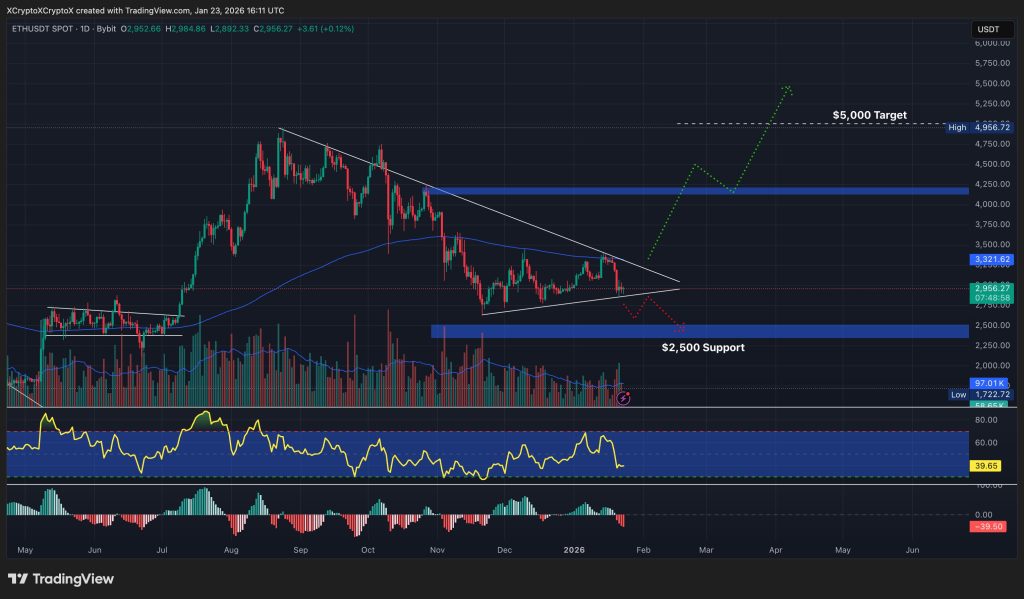
ETH is currently filling out a long-term triangle pattern and moving closer to a key decision point on the chart.
If it breaks to the upside, the next major target would be the $4,000 level, followed by a possible push toward all-time highs.
In the case of a pullback, ETH could dip to the $2,500 support zone before continuing its upward trend.
We could see price compression further in the coming days, with a breakout likely to set the tone for Ethereum’s next major move.
New SUBBD Presale is Bringing AI Content Creation to the Blockchain: Could It 100x in 2026?
Traders may also want to pursue a diversification strategy, in order to expand their exposure to potential gains.
Such a strategy should include an allocation to newer tokens, including presale coins, which can have the potential to rally exponentially when they list for the first time.
Are you interested in AI Agents? Meet Miss Zara Sole
It’s in the process of launching an adult content creation platform, one which offers users AI tools that can help with content generation and even generation of AI performers.
Such tools will make creators more productive, while the use of crypto – via native token SUBBD – will make payouts instant and transparent.
This is why SUBBD is already garnered a strong following, with investors able to join its sale by going to the SUBBD website.
An inactive Ethereum whale has just re-entered the trading scene, withdrawing over $15 million worth of ETH in just a single day. Considering Ethereum’s slow price growth over the past few months and the whale’s sudden appearance despite being dormant for months, there could be a possibility of insider trading.
Dormant Ethereum Whale Moves $15 Million ETH
A sudden $15.14 million Ethereum transaction has caught the crypto market’s attention, with the move either driven by insider knowledge or simple strategic positioning. According to data from blockchain analytics platform, Onchain Lens, the transfer shifted approximately 5,099 ETH from a dormant wallet address on Kraken into active circulation on Thursday, January 22.
Based on on-chain records, the whale, identified by the address ‘0x761F2F,’ has remained inactive in the market for more than three months. The last few times the whale was actively moving in the market were when it executed a series of stablecoin and HYPE transactions. The anonymous whale had initiated multiple million-dollar trades in UETH, USDT, and USDC. Meanwhile, the HYPE transactions were primarily token burns.
After withdrawing 5,099 ETH from Kraken, Arkham Intelligence reported that the whale had transferred the ETH to Lido Finance, converting it into 5,100 STETH. While there is currently no evidence of insider trading, the timing of the transaction raises questions, especially given Ethereum’s muted price action over the past few months and the mounting selling pressure from large scale holders.
Typically, insider trading in crypto occurs when individuals with non-public information make large transactions ahead of major market events that could influence market price. Currently, there has been no spike in Ethereum’s price, nor any major news that could suddenly affect its movements. In fact, ETH continues to trade lower, down by roughly 1.7% over the past 24 hours. Its daily trading volume is also down by 34.89%, signaling reduced confidence among traders and investors.
Whales Go Long On Ethereum
While dormant large-scale players are suddenly re-entering the market, some active whales remain bullish on Ethereum’s long-term prospects despite its ongoing downtrend. According to well-known market analyst Max Crypto, an anonymous whale has just opened a $202 million long position in ETH with 15x leverage.
The scale of the trade is extraordinary considering Ethereum’s recent volatility. It shows strong confidence in the cryptocurrency’s future price action and its potential to overcome its ongoing downtrend. Notably, the position has a liquidation price of $2,495, meaning that if ETH falls to that level, the trade could be forcibly closed by the crypto exchange, resulting in substantial losses for the whale.
Market participants are closely watching the whales’ positioning, with some calling it a brave but chaotic bet. Others have even speculated that the position may have been taken based on insider information, fueling discussions about potential market moves and a possible bullish turnaround for ETH.
Register now to save up to $680 on your TechCrunch Disrupt 2026 pass and get a second ticket at 50% off. This offer ends next week on January 30, or once the first 500 tickets are claimed — whichever comes first.
We miss the slide rule. It isn’t so much that we liked getting an inexact answer using a physical moving object. But to successfully use a slide rule, you need to be able to roughly estimate the order of magnitude of your result. The slide rule’s computation of 2.2 divided by 8 is the same as it is for 22/8 or 220/0.08. You have to interpret the answer based on your sense of where the true answer lies. If you’ve ever had some kid at a fast food place enter the wrong numbers into a register and then hand you a ridiculous amount of change, you know what we mean.
Recent press reports highlighted a paper from Nvidia that claimed a data center consuming a gigawatt of power could require half a million tons of copper. If you aren’t an expert on datacenter power distribution and copper, you could take that number at face value. But as [Adam Button] reports, you should probably be suspicious of this number. It is almost certainly a typo. We wouldn’t be surprised if you click on the link and find it fixed, but it caused a big news splash before anyone noticed.
Thought Process
Best estimates of the total copper on the entire planet are about 6.3 billion metric tons. We’ve actually only found a fraction of that and mined even less. Of the 700 million metric tons of copper we actually have in circulation, there is a demand for about 28 million tons a year (some of which is met with recycling, so even less new copper is produced annually).
Simple math tells us that a single data center could, in a year, consume 1.7% of the global copper output. While that could be true, it seems suspicious on its face.
Digging further in, you’ll find the paper mentions 200kg per megawatt. So a gigawatt should be 200,000kg, which is, actually, only 200 metric tons. That’s a far cry from 500,000 tons. We suspect they were rounding up from the 440,000 pounds in 200 metric tons to “up to a half a million pounds,” and then flipped pounds to tons.
Glass Houses
We get it. We are infamous for making typos. It is inevitable with any sort of writing at scale and on a tight schedule. After all, the Lincoln Memorial has a typo set in stone, and Webster’s dictionary misprinted an editor’s note that “D or d” could stand for density, and coined a new word: dord.
So we aren’t here to shame Nvidia. People in glass houses, and all that. But it is amazing that so much of the press took the numbers without any critical thinking about whether they made sense.
Innumeracy
We’ve noticed many people glaze over numbers and take them at face value. The same goes for charts. We once saw a chart that was basically a straight line except for one point, which was way out of line. No one bothered to ask for a long time. Finally, someone spoke up and asked. Turns out it was a major issue, but no one wanted to be the one to ask “the dumb question.”
You don’t have to look far to find examples of innumeracy: a phrase coined by [Douglas Hofstadter] and made famous by [John Allen Paulos]. One of our favorites is when a hamburger chain rolled out a “1/3 pound hamburger,” which flopped because customers thought that since three is less than four, they were getting more meat with a “1/4 pound hamburger” at the competitor’s restaurant.
This is all part of the same issue. If you are an electronics or computer person, you probably have a good command of math. You may just not realize how much better your math is than the average person’s.
Even so, people who should know better still make mistakes with units and scale. NASA has had at least one famous case of unit issues losing an unmanned probe. In another famous incident, an Air Canada flight ran out of fuel in 1983. Why?
The plane’s fuel sensors were inoperative, so the ground crew manually checked the fuel load with a dipstick. The dipstick read in centimeters. The navigation computer expected fuel to be in kg. Unfortunately, the fuel’s datasheet posted density in pounds/liter. This incorrect conversion happened twice.
Unsurprisingly, the plane was out of fuel and had to glide to an emergency landing on a racetrack that had once been a Royal Canadian Air Force training base. Luckily, Captain Pearson was an experienced glider pilot. With reduced control and few instruments, the Captain brought the 767 down as if it were a huge glider with 61 people onboard. Although the landing gear collapsed and caused some damage, no one on the plane or the ground were seriously hurt.
What’s the Answer?
Sadly, math answers are much easier to get than social answers. Kids routinely complain that they’ll never need math once they leave school. (OK, not kids like we were, but normal kids.) But we all know that is simply not true. Even if your job doesn’t directly involve math, understanding your own finances, making decisions about purchases, or even evaluating political positions often requires that you can see through math nonsense, both intentional and unintentional.
[Antoine de Saint-Exupéry] was a French author, and his 1948 book Citadelle has an interesting passage that may hold part of the answer. If you translate the French directly, it is a bit wordy, but the quote is commonly paraphrased: “If you want to build a ship, don’t herd people together to collect wood and don’t assign them tasks and work, but rather teach them to long for the endless immensity of the sea.”
We learned math because we understood it was the key to building radios, or rockets, or computer games, or whatever it was that you longed to build. We need to teach kids math in a way that makes them anxious to learn the math that will enable their dreams.
How do we do that? We don’t know. Great teachers help. Inspiring technology like moon landings helps. What do you think? Tell us in the comments. Now with 285% more comment goodness. Honest.
We still think slide rules made you better at math. Just like not having GPS made you better at navigation.
Crypto researcher Axel has provided insights into why the Bitcoin, Ethereum, and Solana prices are still crashing. This comes as BTC continues to see a supply overhang, which threatens to put more downward pressure on crypto prices.
Why The Bitcoin, Ethereum, and Solana Prices Are Still Crashing
In a research report, Axel noted that anomalous exchange inflows accompanied the BTC breakdown below the $90,000 zone as sellers prepared in advance. The market is also still at risk of further selling pressure as the 1.0 level of the short-term holders’ SOPR is now acting as a resistance rather than support. As such, there is a possibility that Bitcoin, Ethereum, and Solana prices will decline further.
Further commenting on Bitcoin netflows into exchanges, Axel noted that between January 20 and 21, almost 17,000 BTC flowed into exchanges, coinciding with BTC dropping to as low as $87,000, while Ethereum and Solana prices also dropped. The crypto researcher explained that these anomalously high values followed a period of predominantly negative netflow in the first half of this month.
In the context of the falling Bitcoin price, Axel stated that such a spike is more likely to reflect supply preparation than neutral transfers. In other words, the breakdown below $90,000 appears to be structural rather than emotional. Meanwhile, Bitcoin netflow returned to neutral levels yesterday, but the accumulated inflow still creates a supply overhang, which could lead to further declines in the prices of Bitcoin, Ethereum, and Solana.
Axel noted that a signal of improvement would be if netflow turns negative again amid rising prices, which could indicate that the overhang has cleared. However, with the short-term holders’ 7-day SMA SOPR below 0.996, the crypto researcher suggested that BTC faces increased selling pressure on every recovery as these holders look to sell at breakeven. He added that a reversal trigger could be confirmed if the SOPR breaks above 1.0 from below, with the 7-day SMA holding unity for three to five days to filter out false spikes after the selloff.
Why A Break Above $100,000 Looks Unlikely For Now
In its latest research report, on-chain analytics platform Glassnode explained that a Bitcoin rally above $100,000 looks unlikely for now as the supply overhang persists. They noted how this overhang supply above $98,000 remains the dominant sell-side force capping short to mid-term rebounds.
Alluding to the Unspent Realized Price Distribution metric, Glassnode noted that the recent BTC rally has partially filled the prior air gap between $93,000 and $98,000, driven by redistribution from top buyers into newer market participants.
However, the unresolved supply overhang is expected to likely cap attempts above the $98,400 short-term holders’ cost basis and the $100,000 level. A meaningful and sustained acceleration in demand momentum is said to be required for a clean breakout above $100,000 to occur.

 Login
Login
 Early Tests And Community Involvement