We miss the slide rule. It isn’t so much that we liked getting an inexact answer using a physical moving object. But to successfully use a slide rule, you need to be able to roughly estimate the order of magnitude of your result. The slide rule’s computation of 2.2 divided by 8 is the same as it is for 22/8 or 220/0.08. You have to interpret the answer based on your sense of where the true answer lies. If you’ve ever had some kid at a fast food place enter the wrong numbers into a register and then hand you a ridiculous amount of change, you know what we mean.
Recent press reports highlighted a paper from Nvidia that claimed a data center consuming a gigawatt of power could require half a million tons of copper. If you aren’t an expert on datacenter power distribution and copper, you could take that number at face value. But as [Adam Button] reports, you should probably be suspicious of this number. It is almost certainly a typo. We wouldn’t be surprised if you click on the link and find it fixed, but it caused a big news splash before anyone noticed.
Thought Process
Best estimates of the total copper on the entire planet are about 6.3 billion metric tons. We’ve actually only found a fraction of that and mined even less. Of the 700 million metric tons of copper we actually have in circulation, there is a demand for about 28 million tons a year (some of which is met with recycling, so even less new copper is produced annually).
Simple math tells us that a single data center could, in a year, consume 1.7% of the global copper output. While that could be true, it seems suspicious on its face.
Digging further in, you’ll find the paper mentions 200kg per megawatt. So a gigawatt should be 200,000kg, which is, actually, only 200 metric tons. That’s a far cry from 500,000 tons. We suspect they were rounding up from the 440,000 pounds in 200 metric tons to “up to a half a million pounds,” and then flipped pounds to tons.
Glass Houses
We get it. We are infamous for making typos. It is inevitable with any sort of writing at scale and on a tight schedule. After all, the Lincoln Memorial has a typo set in stone, and Webster’s dictionary misprinted an editor’s note that “D or d” could stand for density, and coined a new word: dord.
So we aren’t here to shame Nvidia. People in glass houses, and all that. But it is amazing that so much of the press took the numbers without any critical thinking about whether they made sense.
Innumeracy
We’ve noticed many people glaze over numbers and take them at face value. The same goes for charts. We once saw a chart that was basically a straight line except for one point, which was way out of line. No one bothered to ask for a long time. Finally, someone spoke up and asked. Turns out it was a major issue, but no one wanted to be the one to ask “the dumb question.”
You don’t have to look far to find examples of innumeracy: a phrase coined by [Douglas Hofstadter] and made famous by [John Allen Paulos]. One of our favorites is when a hamburger chain rolled out a “1/3 pound hamburger,” which flopped because customers thought that since three is less than four, they were getting more meat with a “1/4 pound hamburger” at the competitor’s restaurant.
This is all part of the same issue. If you are an electronics or computer person, you probably have a good command of math. You may just not realize how much better your math is than the average person’s.
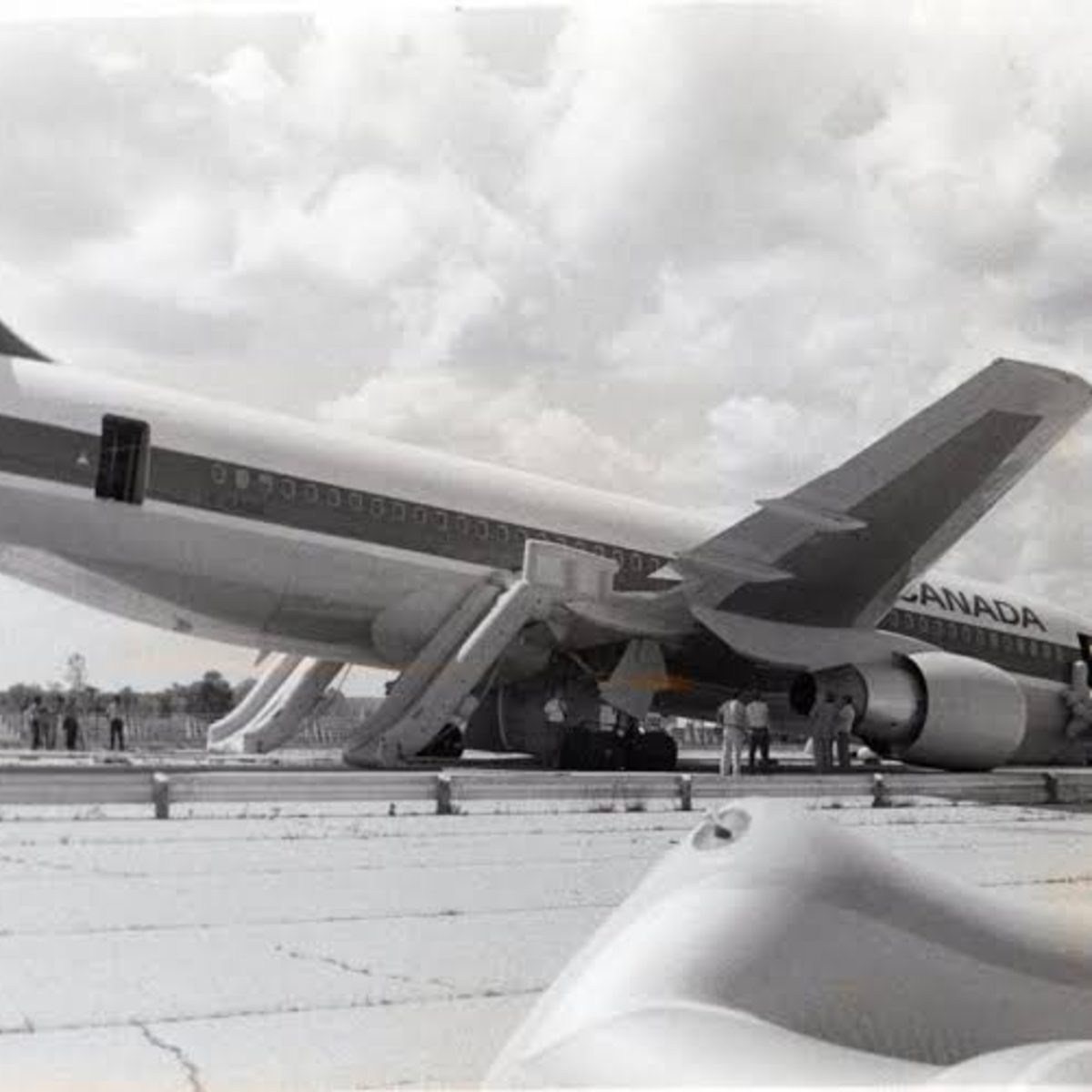
Even so, people who should know better still make mistakes with units and scale. NASA has had at least one famous case of unit issues losing an unmanned probe. In another famous incident, an Air Canada flight ran out of fuel in 1983. Why?
The plane’s fuel sensors were inoperative, so the ground crew manually checked the fuel load with a dipstick. The dipstick read in centimeters. The navigation computer expected fuel to be in kg. Unfortunately, the fuel’s datasheet posted density in pounds/liter. This incorrect conversion happened twice.
Unsurprisingly, the plane was out of fuel and had to glide to an emergency landing on a racetrack that had once been a Royal Canadian Air Force training base. Luckily, Captain Pearson was an experienced glider pilot. With reduced control and few instruments, the Captain brought the 767 down as if it were a huge glider with 61 people onboard. Although the landing gear collapsed and caused some damage, no one on the plane or the ground were seriously hurt.
What’s the Answer?
Sadly, math answers are much easier to get than social answers. Kids routinely complain that they’ll never need math once they leave school. (OK, not kids like we were, but normal kids.) But we all know that is simply not true. Even if your job doesn’t directly involve math, understanding your own finances, making decisions about purchases, or even evaluating political positions often requires that you can see through math nonsense, both intentional and unintentional.
[Antoine de Saint-Exupéry] was a French author, and his 1948 book Citadelle has an interesting passage that may hold part of the answer. If you translate the French directly, it is a bit wordy, but the quote is commonly paraphrased: “If you want to build a ship, don’t herd people together to collect wood and don’t assign them tasks and work, but rather teach them to long for the endless immensity of the sea.”
We learned math because we understood it was the key to building radios, or rockets, or computer games, or whatever it was that you longed to build. We need to teach kids math in a way that makes them anxious to learn the math that will enable their dreams.
How do we do that? We don’t know. Great teachers help. Inspiring technology like moon landings helps. What do you think? Tell us in the comments. Now with 285% more comment goodness. Honest.
We still think slide rules made you better at math. Just like not having GPS made you better at navigation.
It’s a cliché in movies that whenever an airplane’s pilots are incapacitated, some distraught crew member queries the self-loading freight if any of them know how to fly a plane. For small airplanes we picture a hapless passenger taking over the controls so that a heroic traffic controller can talk them through the landing procedure and save the day.
Back in reality, there have been zero cases of large airliners being controlled by passengers in this fashion, while it has happened a few times in small craft, but with variable results. And in each of these cases, another person in the two- to six-seater aircraft was present to take over from the pilot, which may not always be the case.
To provide a more reliable backup, a range of automated systems have been proposed and implemented. Recently, the Garmin Emergency Autoland system got its first real use: the Beechcraft B200 Super King Air landed safely with two conscious pilots on board, but they let the Autoland do it’s thing due to the “complexity” of the situation.
Human In The Loop
Throughout the history of aviation, a human pilot has been a crucial component for the longest time for fairly obvious reasons, such as not flying past the destination airport or casually into terrain or rough weather. This changed a few decades ago with the advent of more advanced sensors, fast computing systems and landing assistance systems such as the ILS radio navigation system. It’s now become easier than ever to automate things like take-off and landing, which are generally considered to be the hardest part of any flight.
Meanwhile, the use of an autopilot of some description has become indispensable since the first long-distance flights became a thing by around the 1930s. This was followed by a surge in long-distance aviation and precise bombing runs during World War II, which in turn resulted in a massive boost in R&D on airplane automation.
While the the early gyroscopic autopilots provided basic controls that kept the airplane level and roughly on course, the push remained to increase the level of automation. This resulted in the first fully automatic take-off, flight and landing being performed on September 22, 1947 involving a USAF C-54 Skymaster. As the military version of the venerable DC-4 commercial airplane its main adaptations included extended fuel capacity, which allowed it to safely perform this autonomous flight from Newfoundland to the UK.
In the absence of GNSS satellites, two ships were located along the flight path to relay bearings to the airplane’s board computer via radio communication. As the C-54 approached the airfield at Brise Norton, a radio beacon provided the glide slope and other information necessary for a safe landing. The fact that this feat was performed just over twenty-eight years after the non-stop Atlantic crossing of Alcock and Brown in their Vickers Vimy airplane shows just how fast technology progressed at the time.
Nearly eighty years later, it bears asking the question why we still need human pilots, especially in this age of GNSS navigation, machine vision, and ILS beacons at any decently sized airfield. The other question that comes to mind is why we accept that airplanes effectively fall out of the sky the moment that they run out of functioning human pilots to push buttons, twist dials, and fiddle with sticks.
State of the Art
In the world of aviation, increased automation has become the norm, with Airbus in particular taking the lead. This means that Airbus has also taken the lead in spectacular automation-related mishaps: Flight 296Q in 1988 and Air France Flight 447 in 2009. While some have blamed the 296Q accident on the automation interfering with the pilot’s attempt to increase thrust for a go-around, the official explanation is that the pilots simply failed to notice that they were flying too low and thus tried to blame the automation.
The Helios Airways 737-300, three days before it would become a ghost flight. (Credit: Mila Daniel)
For the AF447 crash the cause was less ambiguous, even if took a few years to recover the flight recorders from the seafloor. Based on the available evidence it was clear by then that the automation had functioned as designed, with the autopilot disengaging at some point due to the unheated pitot tubes freezing up, resulting in inconsistent airspeed readings. Suddenly handed the reins, the pilots took over and reacted incorrectly to the airspeed information, stalled the plane, and crashed into the ocean.
One could perhaps say that AF447 shows that there ought to be either more automation, or better pilot training so that the human element can fly an airplane unassisted by an autopilot. When we then consider the tragic case of Helios Airways Flight 522, the ‘ghost flight’ that flew on autopilot with no conscious souls on board due to hypoxia, we can imagine a dead-man switch that auto-lands the airplane instead of leaving onlookers powerless to do anything but watch the airplane run out of fuel and crash.
Be Reasonable
Although there are still a significant number of people who would not dare to step a foot on an airliner that doesn’t have at least two full-blooded, breathing human pilots on board, there is definitely a solid case to be made for emergency landing systems to become a feature on airplanes, starting small. Much like the Cirrus Airframe Parachute System (CAPS) – a whole-airplane parachute system that has saved many lives as well as airframes – the Garmin Autoland feature targets smaller airplanes.
The Garmin Autoland system communicates with ATC and nearby traffic and lands unassisted. (Credit: Garmin)
After a recent successful test with a HondaJet, this recent unscheduled event with the Beechcraft B200 Super King Air twin-prop airplane turned out to be effectively another test. As the two pilots in this airplane were flying between airports for a repositioning flight, the cabin suddenly lost pressurization. Although both pilots were able to don their oxygen masks, the Autoland system engaged due to the dangerous cabin conditions. They then did not disengage the system as they didn’t know the full extent of the situation.
This effectively kept both pilots ready to take full control of the airplane should the need have arisen to interfere, but with the automated system making a textbook descent, approach and landing, it’s clear that even if their airplane had turned into another ghost flight, they would have woken up groggy but whole on the airstrip, surrounded by emergency personnel.
Considering how many small airplanes fly each year in the US alone, systems like CAPS and Autoland stand to save many lives both in the air and on the ground the coming years. Combine this with increased ATC automation at towers and elsewhere such as the FAA’s STARS and Saab’s I-ATS, and a picture begins to form of increased automation that takes the human element out of the loop as much as possible.
Although we’re still a long way off from the world imagined in 1947 where ‘electronic brains’ would unerringly fly all airplanes and more for us, it’s clear that we are moving in that direction, with such technology even within the reach of the average owner of an airplane of some description.
If you’re reading this, that means you’ve successfully made it through 2025! Allow us to be the first to congratulate you — that’s another twelve months of skills learned, projects started, and hacks….hacked. The average Hackaday reader has a thirst for knowledge and an insatiable appetite for new challenges, so we know you’re already eager to take on everything 2026 has to offer.
But before we step too far into the unknown, we’ve found that it helps to take a moment and reflect on where we’ve been. You know how the saying goes: those that don’t learn from history are doomed to repeat it. That whole impending doom bit obviously has a negative connotation, but we like to think the axiom applies for both the lows and highs in life. Sure you should avoid making the same mistake twice, but why not have another go at the stuff that worked? In fact, why not try to make it even better this time?
As such, it’s become a Hackaday tradition to rewind the clock and take a look at some of the most noteworthy stories and trends of the previous year, as seen from our rather unique viewpoint in the maker and hacker world. With a little luck, reviewing the lessons of 2025 can help us prosper in 2026 and beyond.
Love it or Hate it, AI is Here
While artificial intelligence software — or at least, what passes for it by current standards — has been part of the technical zeitgeist for a few years, 2026 was definitely the year that AI seemed to be everywhere. So much so that the folks at Merriam-Webster decided to make “slop”, as in computer-generated garbage content, their Word of the Year. They also gave honorable mention to “touch grass”, which they describe as a phrase that’s “often aimed at people who spend so much time online that they become disconnected from reality.” But we’re going to ignore that one for personal reasons.
At Hackaday, we’ve obviously got some strong feelings on AI. For those who earn a living by beating the written word into submission seven days a week, the rise of AI is nothing less than an existential crisis. The only thing we have going for us is the fact that the average Hackaday reader is sharp enough to recognize the danger posed by a future in which all of our media is produced by a Python script running on somebody’s graphics card and will continue to support us, warts and all.
Like all powerful tools, AI can get you into trouble if you aren’t careful.
But while most of us are on the same page about AI in regards to things like written articles or pieces of art, it’s not so clear cut when it comes to more utilitarian endeavours. There’s a not insignificant part of our community that’s very interested in having AI help out with tedious tasks such as writing code, or designing PCBs; and while the technology is still in its infancy, there’s no question the state of the art is evolving rapidly.
Make no mistake, an over-reliance on AI tools can be dangerous. In the best case, the user is deprived of the opportunity to actually learn the material at hand. In the worst case, you make an LLM-enhanced blunder that costs you time and money. But when used properly, the takeaway seems to be that a competent maker or hacker can leverage these new AI tools to help bring more of their projects across the finish line — and that’s something we’ve got a hard time being against.
Meshtastic Goes Mainstream
Another tech that gained steam this year is Meshtastic. This open source project aims to allow anyone to create an off-grid, decentralized, mesh network with low cost microcontrollers and radio modules. We fell in love with the idea as soon as we heard about it, as did many a hacker. But the project has reached a level of maturity that it’s starting to overflow into other communities, with the end result being a larger and more capable mesh that benefits everyone.
Part of the appeal is really how ridiculously cheap and easy it is to get started. If you’re starting from absolutely zero, connecting up to an existing mesh network — or creating your own — can cost you as little as $10 USD. But if you’re reading Hackaday, there’s a good chance you’ve already got a supported microcontroller (or 10) laying around, in which case you may just need to spring for the LoRa radio module and wire it up. Add a 3D printed case, and you’re meshin’ with the best of them.
There are turn-key Meshtastic options available for every budget, from beginner to enthusiast.
If you’re OK with trading some money for time, there’s a whole world of ready to go Meshtastic devices available online from places like Amazon, AliExpress, and even Etsy for that personal touch. Fans of the retro aesthetic would be hard pressed to find a more stylish way to get on the grid than the Hacker Pager, and if you joined us in Pasadena this year for Hackaday Supercon, you even got to take home a capable Meshtastic device in the form of the Communicator Badge.
Whether you’re looking for a backup communication network in the event of a natural disaster, want to chat with neighbors without a megacorp snooping on your discussion, or are simply curious about radio communications, Meshtastic is a fantastic project to get involved with. If you haven’t taken the plunge already, point your antenna to the sky and see who’s out there, you might be surprised at what you find.
Arduino’s New Overlord
In terms of headlines, the acquisition of Arduino by Qualcomm was a pretty big one for our community. Many a breathless article was written about what this meant for the future of the company. And things only got more frantic a month later, when the new Arduino lawyers updated the website’s Terms and Conditions.
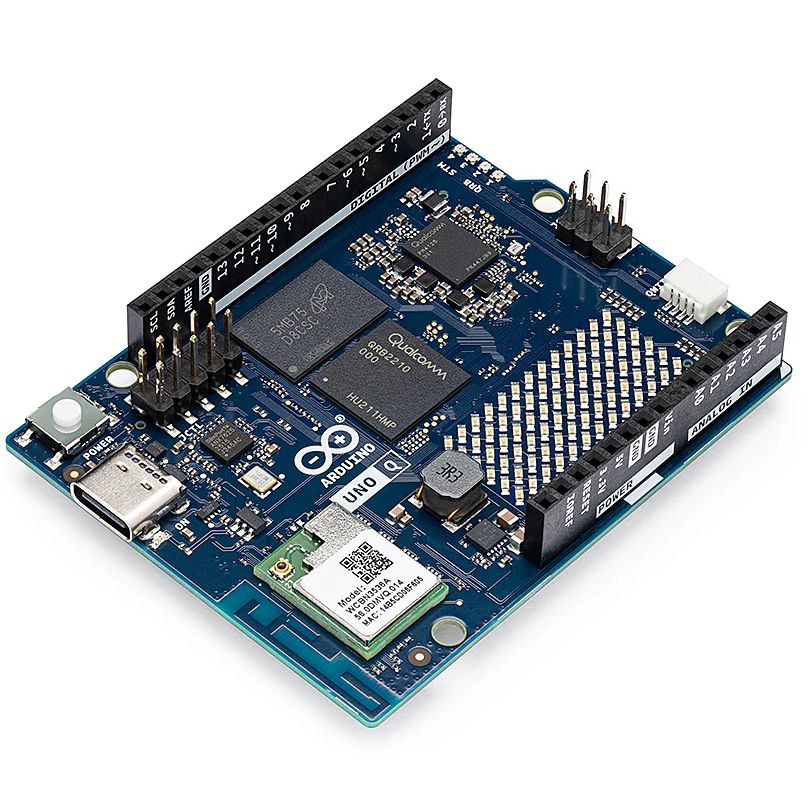
But you didn’t see any articles about that here on Hackaday. The most interesting part of the whole thing to us was the new Arduino Uno Q: an under $50 USD single-board computer that can run Linux while retaining the classic Uno layout. With the cost of Raspberry Pi hardware steadily increasing over the years, some competition on the lower end of the price spectrum is good for everyone.
The Arduino Uno Q packs enough punch to run Linux.
As for the Qualcomm situation — we’re hackers, not lawyers. Our immediate impression of the new ToS changes was that they only applied to the company’s web services — “The Platform” in the contract — and had no bearing on the core Arduino software and hardware offerings that we’re all familiar with. The company eventually released a blog post explaining more or less the same thing, explaining that evolving privacy requirements for online services meant they had to codify certain best practices, and that their commitment to open source is unwavering.
For now, that’s good enough for us. But the whole debacle does bring to mind a question: if future Arduino software development went closed-source tomorrow, how much of an impact would it really have on the community at this point? Today when somebody talks about doing something with Arduino they are more likely to be talking about the IDE and development environment than one of the company’s microcontroller boards — the licenses for which mean the versions we have now will remain open in perpetuity. The old AVR Arduino code is GPLed, after all, as are the newer cores for microcontrollers like the ESP32 and RP2040, which weren’t written by Arduino anyway. On the software side, we believe that we have nothing to lose.
But Arduino products have also always been open hardware, and we’ve all gained a lot from that. This is where Qualcomm could still upset the applecart, but we don’t see why they would, and they say they won’t. We’ll see in 2026.
The Year of Not-Windows on the Desktop?
The “Year of Linux on the Desktop” is a bit like fusion power, in that no matter how many technical hurdles are cleared, it seems to be perennially just over the horizon. At this point it’s become a meme, so we won’t do the cliché thing and claim that 2025 (or even 2026) is going to finally be the year when Linux breaks out of the server room and becomes a mainstream desktop operating system. But it does seem like something is starting to shift.
That’s due, at least in part, to Microsoft managing to bungle the job so badly with their Windows 11 strategy. In spite of considerable push-back in the tech community over various aspects of the operating system, the Redmond software giant seems hell-bent on getting users upgraded. At the same time, making it a hard requirement that all Windows 11 machines have a Trusted Platform Module means that millions of otherwise perfectly usable computers are left out in the cold.
What we’re left with is a whole lot of folks who either are unwilling, or unable, to run Microsoft’s latest operating system. At the same time desktop Linux has never been more accessible, and thanks in large part to the efforts of Valve, it can now run the majority of popular Windows games. That last bit might not seem terribly exciting to folks in our circles, but historically, the difficulty involved in playing AAA games on Linux has kept many a techie from making the switch.
Does that mean everyone is switching over to Linux? Well, no. Certainly Linux is seeing an influx of new users, but for the average person, it’s more likely they’d switch to Mac or pick up a cheap Chromebook if all they want to do is surf the web and use social media.
Of course, there’s an argument to be made that Chromebook users are technically Linux users, even if they don’t know it. But for that matter, you could say anyone running macOS is a BSD user. In that case, perhaps the “Year of *nix” might actually be nigh.
Grandma is 3D Printing in Color
There was a time when desktop 3D printers were made of laser-cut wood, used literal strings instead of belts, and more often then not, came as a kit you had to assemble with whatever assistance you could scrounge up from message boards and IRC channels — and we liked it that way. A few years later, printers were made out of metal and became more reliable, and within a decade or so you could get something like an Ender 3 for a couple hundred bucks on Amazon that more or less worked out of the box. We figured that was as mainstream as 3D printing was likely to get…but we were very wrong.
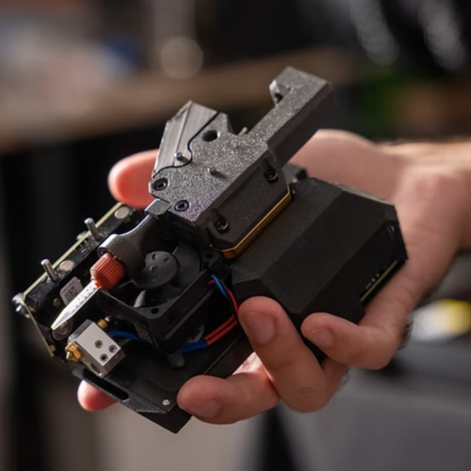
A Prusa hotend capable of printing a two-part liquid silicone.
Today 3D printing is approaching a point where the act of downloading a model, slicing it, and manifesting it into physical form has become, dare we say it, mundane. While we’re not always thrilled with the companies that make them and their approach to things that are important to us like repairability, open development, and privacy, we have to admit that the new breed of printers on the market today are damn good at what they do. Features like automatic calibration and filament run-out sensors, once the sort of capabilities you’d only see on eye-wateringly expensive prosumer machines, have became standard equipment.
Desktop 3D printing still hasn’t reached the sort of widespread adoption that all those early investors would have had us believe in the 2000s, where every home would one day have their own Star Trek style personal replicator. But they are arguably approaching the commonality of something like a table saw or drill press — specialized but affordable and reliable tools that act as a force multiplier rather than a tinkerer’s time sink.
Tariffs Take Their Toll
Finally, we couldn’t end an overview of 2025 without at least mentioning the ongoing tariff situation in the United States. While it hasn’t ground DIY electronics to a halt as some might have feared, it’s certainly had an impact.
A tax on imported components is nothing new. We first ran into that back in 2018, and though it was an annoyance, it didn’t have too much of an impact at the hobbyist scale. When an LED costs 20 cents, even a 100% tariff wouldn’t be much of a hit to the wallet at the scale most of us are operating at. Plus there are domestic, or at least non-Chinese, options for some jellybean components. The surplus market can also help here — you can often find great deals on things like partial reels of SMD capacitors and resistors on eBay if you keep an eye out for them.
We’ve heard more complaints about PCB production than anything. After years of being able to get boards made overseas for literal pennies, seeing a import tax that added at checkout can be quite a shock. But just like the added tax on components, while annoying, it’s not enough to actually keep folks from ordering. Even with the tariffs, the cost of getting a PCB made at OSH Park is going to be much higher than any Chinese board house.
Truth be told, if an import tax on Chinese-made PCBs and components resulted in a boom of affordable domestic alternatives, we’d be all over it. The idea that our little hobby boards needed to cross an ocean just to get to us always seemed unsustainable anyway. It wouldn’t even have to be domestic, there’s an opportunity for countries with a lower import tariff to step in. Instead of having our boards made in China, why not India or Mexico?
But unfortunately, the real-world is more complex than that. Building up those capabilities, either at home or abroad, takes time and money. So while we’d love to see this situation lead to greater competition, we’ve got a feeling that the end result is just more money out of our pockets.
Thanks for Another Year of Hacks
One thing that absolutely didn’t change in 2025 was you — thanks to everyone that makes Hackaday part of their daily routine, we’ve been able to keep the lights on for another year. Everyone here knows how incredibly fortunate we are to have this opportunity, and your ongoing support is never taken for granted.
We’d love to hear what you thought the biggest stories or trends of 2025 were, good and bad. Let us know what lessons you’ll be taking with you into 2026 down below in the comments.
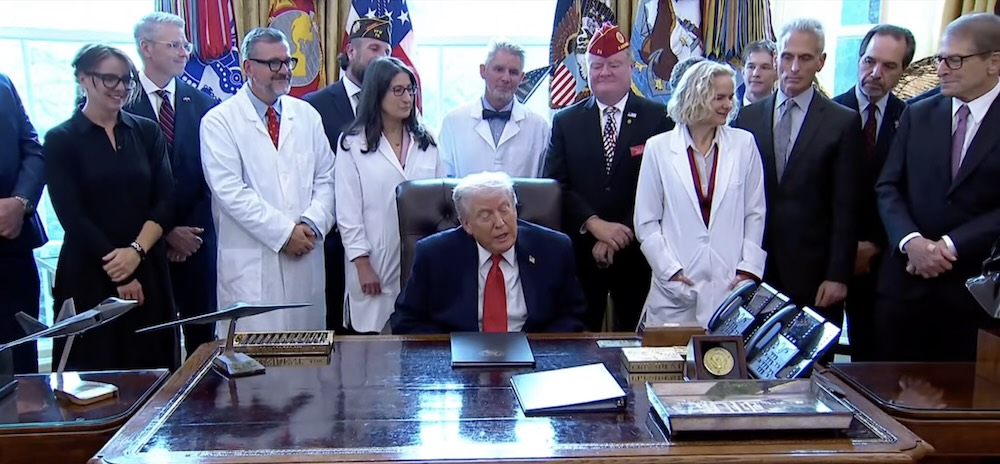
President Donald Trump today signed an executive order expediting the reclassification of cannabis as a less dangerous drug—moving it from Schedule I to Schedule III of the Controlled Substances Act.
The president was joined by several medical leaders during the signing, including Administrator of the Centers for Medicare & Medicaid Services, Dr. Mehmet Oz; Dr. Nora Volkow of the National Institute on Drug Abuse; FDA Commissioner Dr. Martin Makary; and Secretary of Health and Human Services Robert F. Kennedy Jr., among others.
“I have a very distinguished group of people behind me, mostly medical people and brilliant people and they really know what they’re doing,” the president said, prior to announcing he would sign an order to reschedule cannabis.
Trump emphasized the large public support for the reclassification, adding that the move polled at 82% in favor and will help patients “live a far better life.” He also made clear that the rescheduling is not the same as legalization saying, “I want to emphasize the order I’m about to sign doesn’t legalize marijuana in any way, shape or form.”
President Trump signs an executive order in the White House’s Oval Office. Washington, D.C.
Substances classified as Schedule I have a “high abuse potential with no accepted medical use; medications within this schedule may not be prescribed, dispensed or administered,” states the National Library of Medicine. Heroin, LSD, MDMA and cannabis currently fall under this categorization. Last Spring, the United States Drug Enforcement Agency (DEA), proposed that the substance be moved to the list of Schedule III drugs, which have less potential for abuse and are accepted for medical treatments. Other substances classified as Schedule III drugs include ketamine, testosterone and anabolic steroids.
While today’s executive order falls short of full legalization, the reclassification marks one of the most significant reversals in US drug policy in decades. This decision could have wide-ranging effects on the cannabis industry, criminal enforcement and access to research funding.
“Rescheduling cannabis to Schedule III is a meaningful step forward that will finally give legitimate cannabis businesses access to basic banking, tax relief, and the tools needed to operate like any other industry,” says Eugenio Garcia, Cannabis Now’s founder and CEO. “While this progress is welcome, true reform must also include justice—no one should remain incarcerated for cannabis as the nation moves toward acceptance and regulation. This moment is about unlocking economic opportunity while correcting the human cost of prohibition.”
Jamie Pearson, New Holland Group’s president and founder, comments on the progress as well as the work that remains for the cannabis industry: “Today’s executive action is a meaningful and long-overdue step toward aligning federal policy with medical reality. Directing the rescheduling of cannabis to Schedule III acknowledges its accepted medical use and begins to remove structural barriers to research, clinical guidance and responsible access,” she says. This was the message largely put forth by Trump and his supporters during the signing as well.
“That said, rescheduling is not legalization, nor does it resolve all of the regulatory and economic challenges facing the industry,” she says. “The real work now lies in thoughtful implementation, ensuring that research, patient access and public safety advance together, and that policy clarity follows intent. This is progress, and it should be treated with both optimism and discipline.
The prospect of reclassifying cannabis from Schedule I to Schedule III has prompted swift and varied reactions across the political and cannabis landscapes.
“It shows incredible leadership for the president to have the courage to take the lead on cannabis reform,” comments Dave Marrow, CEO of Lume Cannabis MI.
“Today’s executive order to reclassify cannabis is a meaningful step toward aligning federal policy with science and economic reality. Moving cannabis to Schedule III acknowledges its medical value while bringing long-overdue clarity to how cannabis is cultivated, researched, and commercialized. While it’s not the final destination, this shift will accelerate innovation, unlock investment and help professional cultivators and operators continue to raise standards across the industry. At FOHSE Lighting, we see this as real progress for sustainable growth in cannabis cultivation,” says FOHSE Lighting CEO and Co-founder Brett Stevens.
During the signing, those in attendance congratulated Trump for his leadership on the matter. “Thank you for your leadership and vision and finally getting to closure on this issue,” Kennedy, Jr. said. “This is a scientific question that has divided our country for many, many years.”
Trump allowed those alongside him to weigh in, ultimately reinforcing their shared view that increased research into cannabis is essential for advancing medical understanding and improving quality of life. “Research is crucial. Yes, cannabis can be addictive, but we cannot close our eyes to research,” he said. “What we need to do is research and learn how to optimally use it.”
Putting pen to paper, Trump said, “It’s an honor to do this.”

 Login
Login