There's one spec that unifies most laptop users: soldered RAM. Hate it or love it, it's present in many laptops, sometimes making them impossible to upgrade in any meaningful way.
The Department of Veterans Affairs is preparing to issue what’s likely to become one of the largest service contracts in government history as it restructures its arrangements, aiming for rigorous management of the department’s role as a health care payer and greater competition among health care management firms.
The massive contract vehicle represents only the second time VA has signed large contracts with health plans to coordinate private sector care for veterans. The first was shortly after the MISSION Act was signed in 2018. Those contracts are now expiring, and in their place, VA is preparing one large indefinite delivery/indefinite quantity contract with a total potential value of $700 billion over the next ten years.
Among the changes the department is aiming for is a much more rigorous approach to program management in its “community care network,” said Richard Topping, VA’s assistant secretary for management and chief financial officer.
“This program has been unmanaged since its inception. None of the tools, none of the controls that we are talking about introducing here have been available,” he told the House Veterans Affairs Committee on Thursday. “VA had no ability to manage this program, to drive quality, to focus on the outcomes for veterans, to focus on cost. We’ve now got the ability to do that in this contract. The way we designed this unmanaged program also made it very difficult for industry to partner with us. It made it very difficult for community providers to serve our veterans, because it didn’t operate like any other payer program.”
The new contract, called Community Care Network Next Generation, is meant to change much of that. VA says the department intends to cast a wide net for vendors — creating an indefinite delivery/indefinite quantity contract that doesn’t only attract large, national health insurers.
“We are very intentionally not limiting it to the large vendors. The intention is to open this up to competition, to non-large vendors, to those who might bring regional capabilities, regional capacity, and that would not be able to operate on a national or semi-national scale,” Topping said. “They will incur a cost to bid and be awarded a spot on the vehicle. But once they do that, the vendors who are on the vehicle with us, large and small, have a seat at the table with VA, with our program management team to design the task orders. There are two initial task orders in the initial award, those look a lot like what we have now. But we are going to immediately partner with the vendors on the vehicle to begin to build the next more regional, more adaptable, more local models in our task orders.”
Value-based payment models and utilization management
VA plans to use the ID/IQ for its purchased health care for up to ten years. The contract includes a three-year base period, followed by three two-year option periods, and a final one-year option period. During that time, the department plans to use on-ramps and off-ramps to bring new vendors onto the contract — and remove ones that aren’t meeting performance standards.
And contract performance will be overseen and measured by VA program officials who plan to start implementing measures that value quality care over numbers of procedures performed, Topping said.
“VA will implement a comprehensive quality program for community care providers based on nationally recognized measures from the Agency for Healthcare Research and Quality. Contractors will track patient safety events, identify veterans at risk of avoidable visits and readmissions through predictive analytics, and while respecting their choice, guide veterans towards higher performing providers,” he said. “Next Gen will modernize how VA pays its contractors for the care furnished to veterans by implementing value-based payment models. We will begin with episode-based payments for lower extremity joint replacements. As we gain the data and the expertise to manage alternative payments, we will introduce at least three additional models over the performance period of the contract to continually improve care. These models will shift payment away from volume and toward outcomes and total cost of care, which aligns contractor incentives with veterans’ health and system sustainability. We will introduce utilization management. This includes active management of inpatient admissions, emergency department use, concurrent hospital reviews, and high cost drugs administered in clinical settings. This will reduce unnecessary hospitalizations and inappropriate care while protecting veterans’ access to medically necessary services.”
Questions from Congressional overseers
But the department faced bipartisan skepticism during the hearing, partly because VA officials have been slow to detail their plans for the CCN Next Gen effort to members of Congress. VA’s overseers on the House Veterans Affairs Committee say they found out the details of the contract at the same time vendors did — when the request for proposals was released a little over a month ago.
“I understand the VA finds it unprecedented to hold a hearing on an active contract solicitation. I appreciate the sensitivity of the contract, but it is also unprecedented to avoid Congress’s oversight of $1 trillion of spending,” said Rep. Mike Bost (R-Ill.), the committee’s chairman. “My staff and the ranking member’s staff have been told that some topics are off limits because of the sensitive nature of the contract and solicitation. We’ve tried to create a venue in which VA would feel comfortable to speak candidly to our members, but unfortunately, VA failed to assure us of such candor.”
Meanwhile, Democrats on the committee also worry that the new contract will serve as a way to further privatize VA health care — pointing out that more than 40% of veterans’ care is already delivered by private providers through the existing contracts.
Rep. Morgan McGarvey (D-Ky.) said he worried that the contract will lead to large, vertically-integrated conglomerates driving veterans into facilities they control, and away from smaller community-based providers.
“I don’t trust big insurance companies to take care of anybody. The sole thing that motivates them is profit. It’s not people, and it’s certainly not our veterans,” he said. “We have the right to be skeptical when we are talking about private insurance companies taking care of people, because right now they don’t.”
But Topping said the department believes it can avoid problems like the ones McGarvey is worried about through strong oversight and program management.
“The vendors, our health plan partners on this, don’t make the clinical referral from the direct care system to community care. VA does that,” he said. “They don’t make the referral to the provider or determine eligibility [for community care], VA determines that. VA drives where and how our veterans receive care, and we want to know what we’re buying. We want to steer our veterans to the highest quality, lowest cost providers. That goal is not unique to VA — it’s new to us, but we’re bringing this into this program.”
Vendors hoping for a spot on the contract have until March 16 to submit their proposals.
NASA Selects Participants to Track Artemis II Mission
A visual representation of NASA’s Artemis I mission.
Credits: NASA
NASA has selected 34 global volunteers to track the Orion spacecraft during the crewed Artemis II mission’s journey around the Moon.
The Artemis II test flight will launch NASA’s Space Launch System (SLS) rocket, carrying the Orion spacecraft and a crew of four astronauts, on a mission into deep space. The agency’s second mission in the Artemis campaign is a key step in NASA’s path toward establishing a long-term presence at the Moon and confirming the systems needed to support future lunar surface exploration and paving the way for the first crewed mission to Mars.
While NASA’s Near Space Network and Deep Space Network, coordinated by the agency’s SCaN (Space Communication and Navigation) program , will provide primary communications and tracking services to support Orion’s launch, journey around the Moon, and return to Earth, participants selected from a request for proposals published in August 2025, comprised of established commercial service providers, members of academia, and individual amateur radio enthusiasts will use their respective equipment to passively track radio waves transmitted by Orion during its approximately 10-day journey.
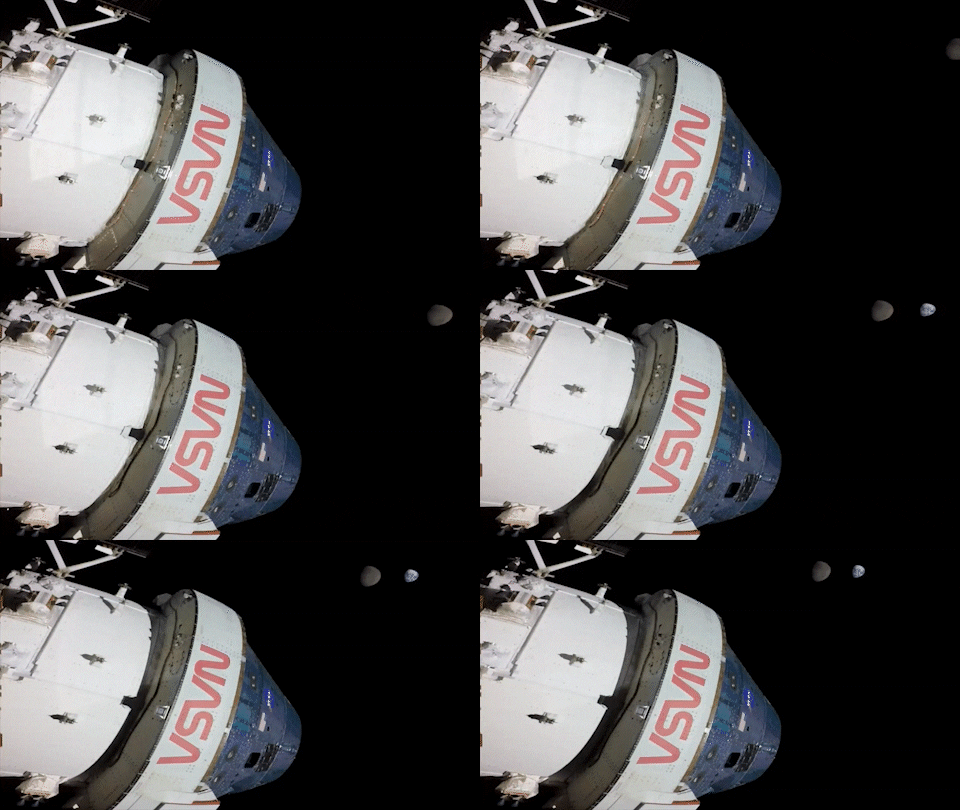
The Orion capsule viewing the Moon during Artemis I.
NASA
“The Artemis II tracking opportunity is a real step toward SCaN’s commercial-first vision. By inviting external organizations to demonstrate their capabilities during a human spaceflight mission, we’re strengthening the marketplace we’ll rely on as we explore farther into the solar system,” said Kevin Coggins, deputy associate administrator for SCaN at NASA Headquarters in Washington. “This isn’t about tracking one mission, but about building a resilient, public-private ecosystem that will support the Golden Age of innovation and exploration.”
This isn’t about tracking one mission, but about building a resilient, public-private ecosystem that will support the Golden Age of innovation and exploration.”
KEvin Coggins
NASA Deputy Associate Administrator for SCaN
These volunteers will submit their data to NASA for analysis, helping the agency better assess the broader aerospace community’s tracking capabilities and identify ways to augment future Moon and Mars mission support. There are no funds exchanged as a part of this collaborative effort.
This initiative builds on a previous effort in which 10 volunteers successfully tracked the Orion spacecraft during Artemis I in 2022. That campaign produced valuable data and lessons learned, including implementation, formatting, and data quality variations for Consultative Committee for Space Data Systems, which develops communications and data standards for spaceflight. To address these findings, SCaN now requires that all tracking data submitted for Artemis II comply with its data system standards.
Compared to the previous opportunity, public interest in tracking the Artemis II mission has increased. About 47 ground assets spanning 14 different countries will be used for to track the spacecraft during its journey around the Moon.
Participants List:
Government:
Canadian Space Agency (CSA), Canada
The German Aerospace Center (DLR), Germany
Commercial:
Goonhilly Earth Station Ltd, United Kingdom
GovSmart, Charlottesville, Virginia
Integrasys + University of Seville, Spain
Intuitive Machines, Houston
Kongsberg Satellite Services, Norway
Raven Defense Corporation, Albuquerque, New Mexico
Reca Space Agency + University of Douala, Cameroon
Rincon Research Corporation & the University of Arizona, Tucson
Sky Perfect JSAT, Japan
Space Operations New Zealand Limited, New Zealand
Telespazio, Italy
ViaSat, Carlsbad, California
Von Storch Engineering, Netherlands
Individual:
Chris Swier, South Dakota
Dan Slater, California
Loretta A Smalls, California
Scott Tilley, Canada
Academia:
American University, Washington
Awara Space Center + Fukui University of Technology, Japan
Morehead State University, Morehead, Kentucky
Pisgah Astronomical Research Institute, Rosman, North Carolina
University of California Berkeley, Space Sciences Laboratory, California
University of New Brunswick, ECE, Canada
University of Pittsburgh, ECE, Pittsburgh
University of Zurich – Physics Department, Switzerland
Non-Profit & Amateur Radio Organizations:
AMSAT Argentina, Argentina
AMSAT Deutschland, Germany
Amateur Radio Exploration Ground Station Consortium, Springfield, Illinois
CAMRAS, Netherlands
Deep Space Exploration Society, Kiowa County, Colorado
Neu Golm Ground Station, Germany
Observation Radio Pleumur-bodou, France
Artemis II will fly around the Moon to test the systems which will carry astronauts to the lunar surface for economic benefits and scientific discovery in the Golden Age of exploration and innovation.
The networks supporting Artemis receive programmatic oversight from NASA’s SCaN Program office. In addition to providing communications services to missions, SCaN develops the technologies and capabilities that will help propel NASA to the Moon, Mars, and beyond. The Deep Space Network is managed by NASA’s Jet Propulsion Laboratory in Southern California, and the Near Space Network is managed by NASA’s Goddard Space Flight Center in Greenbelt, Maryland.
Katrina Lee is a writer for the Space Communications and Navigation (SCaN) Program office and covers emerging technologies, commercialization efforts, exploration activities, and more.
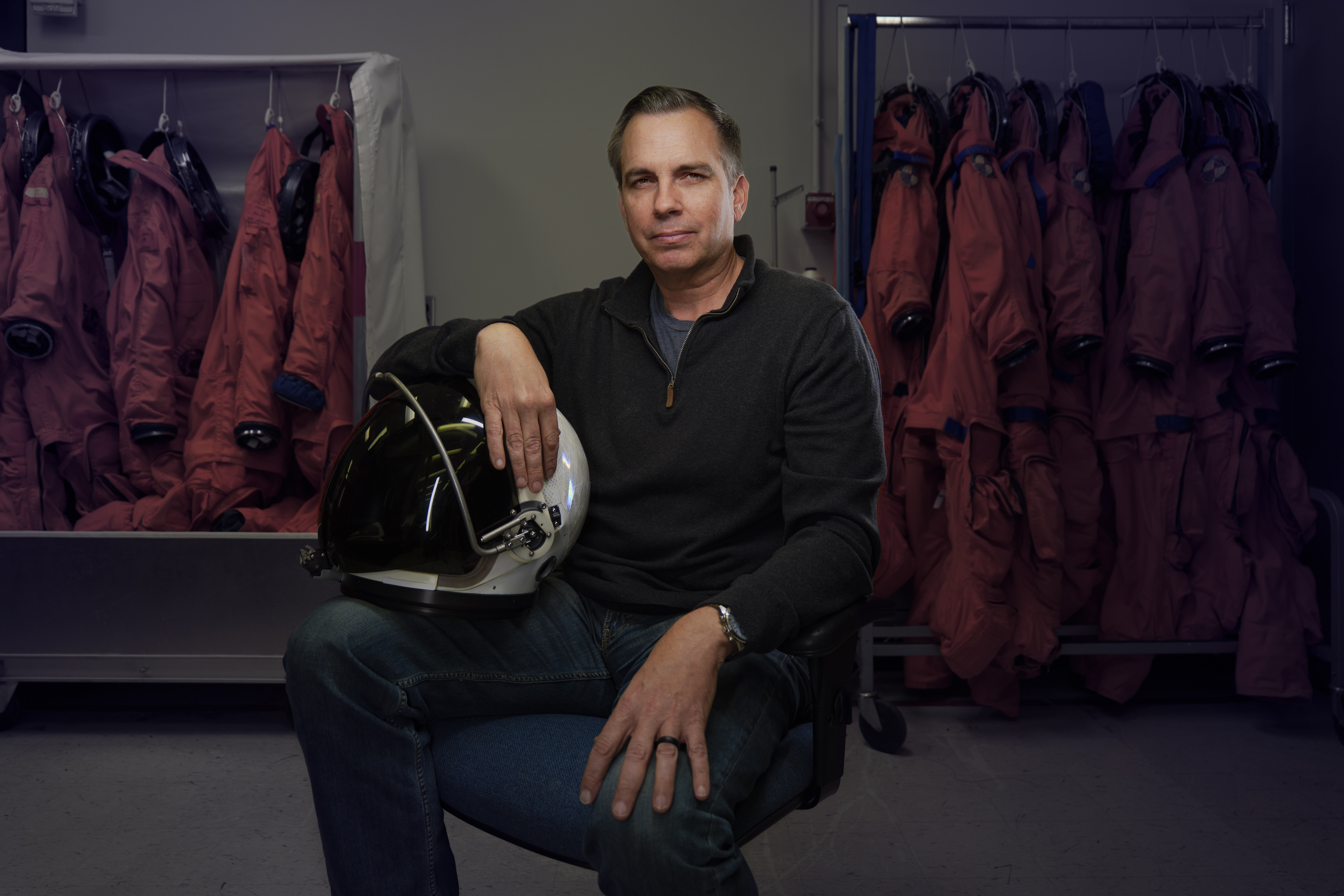
Dustin Gohmert, Orion Crew Survival System (OCSS) manager, sits in the OCSS Lab at NASA’s Johnson Space Center in Houston.
Credits: NASA/Rad Sinyak
Listen to this audio excerpt from Dustin Gohmert, Orion Crew Survival System (OCSS) manager:
0:00 / 0:00
During NASA’s Artemis II mission around the Moon, the astronauts inside the Orion spacecraft will be wearing specialized pressure suits designed to protect them throughout their journey. At NASA’s Johnson Space Center in Houston, Dustin Gohmert leads the team responsible for these suits, known as the Orion Crew Survival System (OCSS).
“We work with the crew to say, ‘Here’s this design concept we have. How does this really work in the spaceflight environment?’” Gohmert said. “As we evolve the design, we take the crew’s input and we adapt the suit over time to take into account not only the desire we have for safety, but the real-world impacts that it has.”
The suits will protect astronauts on launch day, throughout high-risk parts of missions near the Moon, during the high-speed return to Earth, and in emergency situations if such events arise. The OCSS suits are engineered to sustain life for up to six days in the event of an emergency, and can provide the astronauts oxygen, hydration, food, and waste management needed on their way back to Earth.
Dustin Gohmert, Orion Crew Survival System (OCSS) manager, sits in the OCSS Lab at NASA’s Johnson Space Center in Houston.
Credits: NASA/Rad Sinyak
“In an emergency, you’re essentially living in a personal spacecraft that’s only an inch bigger than your body,” Gohmert said. “That’s the reality of survival in space.”
Gohmert’s team in the Orion Crew Survival Systems Lab manages every phase of the suits, including processing, designing, qualifying, and testing them for the mission, as well as integrating them with the Orion spacecraft. Their work addresses engineering challenges, such as how much internal pressure the suit can safely maintain and for how long.
The team custom-builds each suit to fit the anatomy of the astronauts. Crew members undergo detailed sizing and multiple fit checks to ensure precision, and their feedback is a key part of the design evolution and refinement of the suit.
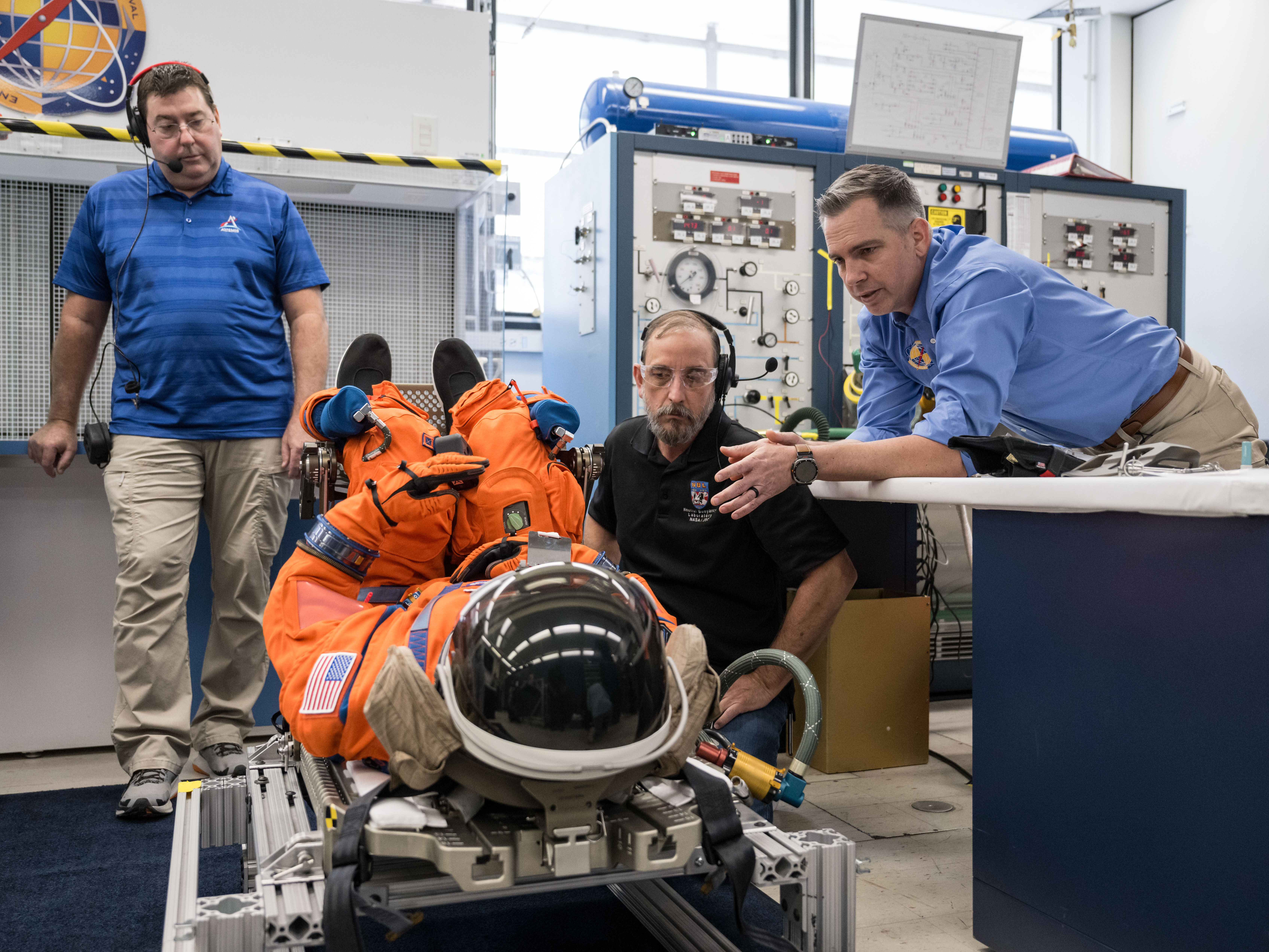
Orion Crew Survival System (OCSS) Manager Dustin Gohmert and his team perform a flight suit long duration fit check with Artemis II crew member Christina Koch in the OCSS Lab at NASA’s Johnson Space Center in Houston.
Credit: NASA/Josh Valcarcel
After earning his bachelor’s in mechanical engineering from the University of Texas at San Antonio and his master’s in engineering from the University of Texas at Austin, Gohmert joined United Space Alliance before becoming a NASA civil servant. He worked through the end of the Space Shuttle Program and later transitioned to Orion. Working on the suit throughout his career has been both technically challenging and a deeply personal responsibility.
The weight of it is incredible; knowing the ultimate responsibility you and the team share in the safety of the crew and the mission. Every thought we have, every piece of paper we write — crew is the number one priority.
dustin Gohmert
Orion Crew Survival Systems (OCSS) Manager
As NASA prepares to explore deep space with Artemis II, Gohmert’s role will play a part in safely sending crew members around the Moon and returning them home.
“I was born after the last Moon landing,” he said. “To actually be a part of the next round is kind of overwhelming. It’s awe-inspiring in every possible way.”
The Small Business Administration suspended more than 1,000 companies in the 8(a) program. SBA made the decision after it deemed those small businesses non-compliant with its financial data request from December.
“Suspended firms have 45 days to appeal the suspension,” said Maggie Clemmons, an SBA spokesperson in an email to Federal News Network. “SBA will release further information on the suspensions in the coming days.”
The suspension comes after SBA sent a letter to more than 4,300 8(a) firms in December seeking 13 different data, ranging from a list of the company’s employees to bank statements for the last three fiscal years to a copy of all 8(a) contracts, as part of its ongoing audit of the program.
Data compiled by GovContractPros, an advisory services firm specializing in federal procurement, found that SBA admitted 753 companies into the 8(a) program in fiscal 2024. Of those 753 firms, the company says SBA suspended 156 of them.
In fiscal 2025, SBA says it admitted only 65 companies into the 8(a) firm. GovContractPros says SBA suspended 10 of those firms, including nine which joined the program after the Trump administration began leading SBA.
Lawyers that represent small businesses say SBA issued the suspensions on Wednesday based on the fact that the 8(a) firms either failed to submit their responses on or before the Jan. 19 deadline or submitted incomplete responses.
“At least some firms that submitted complete data call responses only one day late — on Jan. 20, and before any suspension notices were issued — often due to errors in the government-operated MySBA Certifications portal, nonetheless received suspension notices, indicating that SBA is taking a strict approach to alleged non-compliance with the filing deadline,” wrote Meghan Leemon and Matt Feinberg, partners with the law firm Piliero Mazza, on a blog post. “Firms subject to 8(a) suspension are not permitted to receive new competitive or sole-source 8(a) awards. However, firms are required to complete existing 8(a) contracts, and federal agencies may exercise options on those contracts, even while a firm is suspended, unless otherwise prohibited by statute or regulation.”
SBA’s new clarifying guidance
The suspensions are part of a broad Trump administration effort to audit the 8(a) program and address allegations of fraud and abuse. SBA’s data call was one of several ongoing audits to now include the Treasury Department, the General Services Administration and, as of last week, now the Department of Defense.
“The Biden administration expanded and then abused the 8(a) program to hand out billions in taxpayer-funded government contracts to favored minorities at the direct expense of honest small businesses, which is why we ended the practice on day one,” said SBA Administrator Kelly Loeffler in a press release. “Since then, the Trump SBA has been working to reverse the damage – and today, we’re reiterating one simple fact: the Biden-era practice of discriminating against white Americans is over, and reforms to enshrine that fact are well underway. The SBA is ending diversity, equity and inclusion (DEI) in federal contracting – and our programs will remain open to all eligible job creators in compliance with federal law.”
In addition to suspending nearly a quarter of the 8(a) program participants, SBA issued new guidance today clarifying that the small business development program “is open to job creators of every race – consistent with court orders, notices from the U.S Department of Justice (DOJ), and President [Donald] Trump’s broader effort to eliminate DEI across the federal government – and that any race-based presumptions of social disadvantage have been inoperative since 2023.”
The guidance outlines new ways the SBA will manage the program.
It says it will administer the 8(a) program based on race neutral requirements and there will be no presumptive preference given to anyone.
SBA also will no longer approve the use of “socially disadvantage narratives” as a way to get into the program. It removed from its website the Biden-era “Guide for Demonstrating Social Disadvantage.”
Finally, SBA will consider several factors when determining eligibility for the 8(a) program, including whether the individual has been a “victim of illegal or radical DEI policies or illegal affirmative action policies or has otherwise been the victim of discriminatory practices such as race-based quotas, set asides or hiring targets, in each case by government and non-government actors.”
SBA says these steps are in reaction to the “dramatic expansion” under the Biden administration of companies in the 8(a) program.
Since January 2025, SBA accepted just 65 new 8(a) firms into the program, compared to over 2,100 who were accepted during the four years of the Biden administration.
Undermining the 8(a) program?
Jackie Robinson-Burnette, a former SBA associate administrator in the Office of Government Contracting and Business Development during the Biden administration, wrote on LinkedIn that this change isn’t a small tweak, but it’s re‑anchoring of the program’s foundation.
“It’s important to reform the 8(a) program without crushing the firms the program was designed to help,” wrote Robinson-Burnette, who now is the CEO of Senior Executive Strategic Solutions. “Are we dismantling and putting a sledgehammer to the program to curtail spending $20 million-plus on 8(a) sole source contracts or is it about something else?”
John Shoraka, a former associate administrator of government contracting and business development at SBA and now the co-founder and managing director of GovContractPros, said the SBA and now DoD’s audits are part of a concerted effort to undermine the confidence in the 8(a) program.
“It seems to be one initiative after another initiative, sort of in a very sequenced flow of events to undermine the program and sort of put the brakes on the program,” he said. “I think there’s a perception, and, it’s the wrong perception, that the 8(a) program is, at its core, a DEI program. I honestly don’t think that the administration believes there is significantly more fraud in the 8(a) program than any other contracting program. In fact, the data shows, if you look at inspector general cases or if you look at Department of Justice cases, the instances of fraud in the set-aside programs and particularly the 8(a) program, are actually significantly lower as opposed to across the entire federal government. So when we focus on fraud, waste and abuse in the 8(a) program, I think it’s just raising the flag. They can’t really say we want to kill this program because it’s DEI, they need to identify some sort of red flag to point to and say, ‘Ah-a, we told you this program was fraudulent, and therefore we need to terminate or put the brakes on this program.’”
Leemon and Feinberg, from the law firm Piliero Mazza, said companies caught up in the suspension should consider sending an informal appeals to SBA to lift the suspension.
“If informal channels are unsuccessful, a suspended 8(a) company may — and should — appeal SBA’s decision within 45 days of the date of the Notice of Suspension to SBA’s Office of Hearings and Appeals. This process can be time consuming, and appeals decisions can be delayed for months or even years,” the lawyers wrote.
NASA's first astronauts to fly to the Moon in more than 50 years will pay tribute to the lunar and space exploration missions that preceded them, as well as aviation and American history, by taking with them artifacts and mementos representing those past accomplishments.
NASA, on Wednesday, January 21, revealed the contents of the Artemis II mission's Official Flight Kit (OFK), continuing a tradition dating back to the Apollo program of packing a duffel bag-sized pouch of symbolic and celebratory items to commemorate the flight and recognize the people behind it. The kit includes more than 2,300 items, including a handful of relics.
"This mission will bring together pieces of our earliest achievements in aviation, defining moments from human spaceflight and symbols of where we're headed next," Jared Isaacman, NASA's administrator, said in a statement. "Historical artifacts flying aboard Artemis II reflect the long arc of American exploration and the generations of innovators who made this moment possible."
Intel Arc Pro B70 is shaping up as a straightforward answer to a common workstation headache, running out of VRAM at the worst time. A new leak points to a launch soon, with the card described as the first shipping product built on Intel’s larger Battlemage BMG-G31 chip. Arc Pro B70 is tipped to ship […]
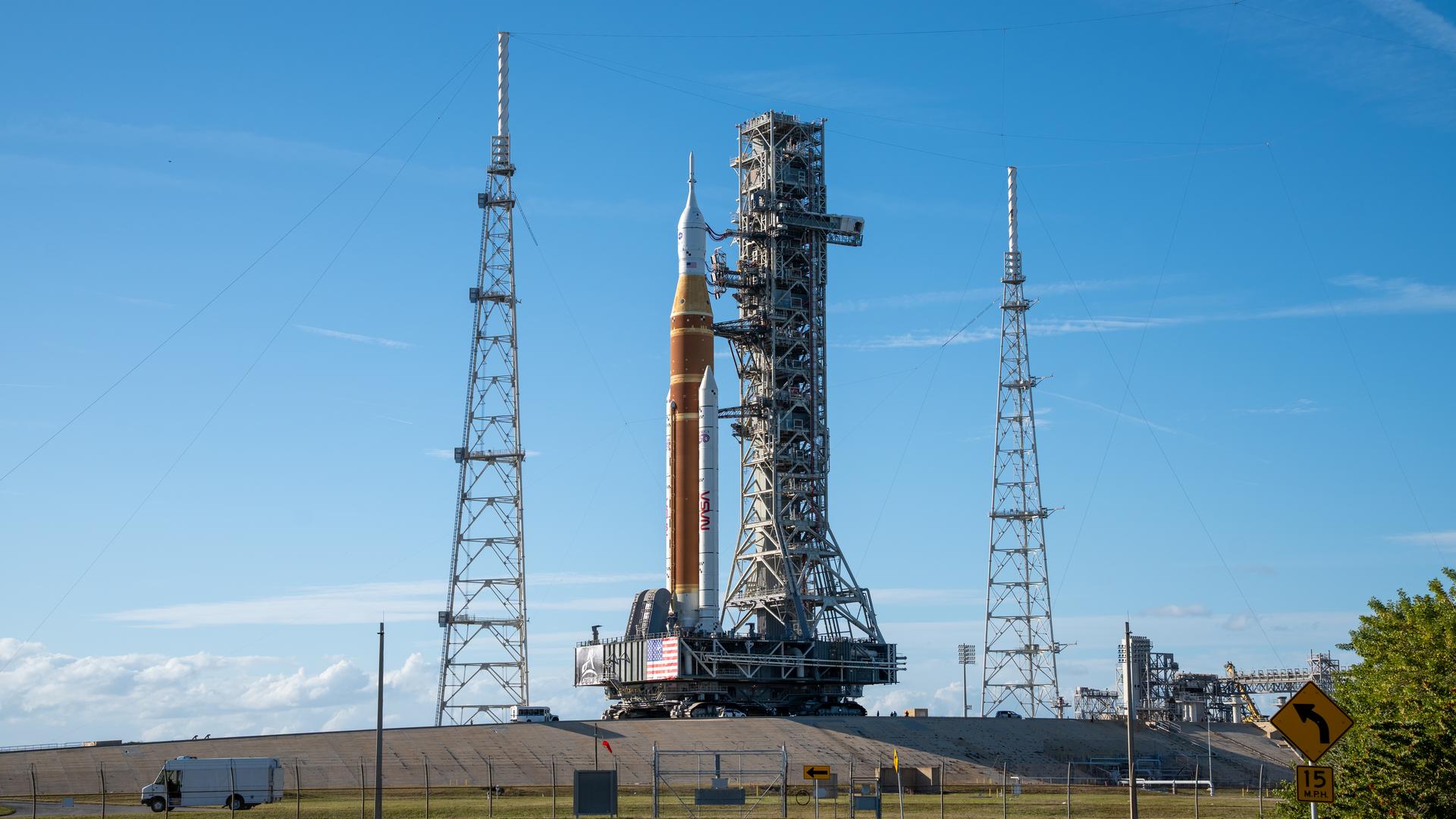
This image shows NASA’s SLS (Space Launch System) and Orion spacecraft rolling out of the Vehicle Assembly Building at NASA’s Kennedy Space Center. NASA’s massive crawler-transporter, upgraded for the Artemis program, carries the powerful SLS rocket and Orion spacecraft on the Mobile Launcher from the Vehicle Assembly Building to Launch Pad 39B at Kennedy Space Center in preparation for the Artemis II mission.
NASA/Brandon Hancock
As America approaches its 250th anniversary of declaring independence, NASA’s Artemis II mission will carry a host of mementos that reflect the nation’s long tradition of exploration, innovation, and leadership in its official flight kit. The items will fly aboard the Orion spacecraft, launched on top of the Space Launch System (SLS) rocket, as it carries four astronauts around the Moon on the first crewed test flight of the agency’s Artemis campaign.
“Historical artifacts flying aboard Artemis II reflect the long arc of American exploration and the generations of innovators who made this moment possible,” said NASA Administrator Jared Isaacman. “This mission will bring together pieces of our earliest achievements in aviation, defining moments from human spaceflight, and symbols of where we’re headed next. During America’s 250th anniversary, Orion will carry astronauts around the Moon while also carrying our history forward into the next chapter beyond Earth.”
Selected to honor America’s historic achievements in space, inspire the next generation of explorers, and reinforce U.S. leadership through international cooperation in science and education, the mementos continue a proud tradition carried forward from Artemis I and earlier human spaceflight missions. Together, they highlight the freedom and innovation that have unlocked the Golden Age of human space exploration.
A 1-inch by-1-inch swatch of muslin fabric from the original Wright Flyer the Wright Brothers used to make the first powered flight in 1903 will be flying aboard Artemis II, lent by the Smithsonian’s National Air and Space Museum. A smaller square cut of the swatch previously flew aboard space shuttle Discovery on STS-51D in 1985 and will make its second journey into space. After the mission, the fabric will be reunited with two other 1903 Wright Flyer swatches at the museum, celebrating the nation’s history and innovation in aviation.
Also flying aboard the Artemis II mission will be a 13-by-8-inch American flag, which flew with the first shuttle mission, STS-1, the final shuttle mission, STS-135, and NASA’s first crewed test flight of SpaceX’s Crew Dragon spacecraft, SpaceX Demo-2.
A flag that was set to fly on NASA’s Apollo 18 mission is included in the flight kit and will make its premiere flight with Orion. The flag serves as a powerful emblem of America’s renewed commitment to human exploration of the Moon, while honoring the legacy of the Apollo pioneers who first blazed the trail.
Orion also will carry a copy of a 4-by-5-inch negative of a photo from the Ranger 7 mission, the first U.S. mission to successfully make contact with the lunar surface. NASA’s Jet Propulsion Laboratory in California managed the Ranger series of spacecraft, built to help identify safe Moon landing sites for Apollo astronauts. The photo represents a major turning point in the race to the Moon that will be echoed today through the success of Artemis.
On Artemis I, a variety of tree seeds flew and were distributed to educational organizations and teachers after the mission, following in the footsteps of tree seeds flown aboard the Apollo 14 mission sprouted into “Moon Trees” after being returned to Earth. The seeds have since taken root at 236 locations across the U.S. to become their own Artemis I Moon Trees. Soil samples collected from the base of established Artemis I Moon Trees planted at NASA’s 10 centers will fly aboard Artemis II, representing the full cycle of exploration: launch, flight, growth, and return to space again. The CSA (Canadian Space Agency) will fly various tree seeds in the kit with the intention of distributing them after the mission.
Also included in the kit will be an SD card including the millions of names of those who participated in the “Send Your Name to Space” campaign, bringing the public along on this journey. The kit will include a variety of flags, patches, and pins to be distributed after the mission to stakeholders and employees who contributed to the flight.
Additionally, NASA has included items from several of its partners in the kit. Stickers and patches from CSA will fly, and ESA (European Space Agency) will fly a flag in the kit for distribution after the mission, marking NASA’s international collaboration with other space agencies through Artemis. Orion’s European Service Module, the powerhouse of the spacecraft, is provided by ESA.
Carrying mementos on the NASA spacecraft has been a tradition since the 1960s, one that was continued on Artemis I, the first uncrewed test flight of Orion and the SLS. During this mission, Orion carried a symbolic flight kit including historical artifacts, from Apollo missions STEM, or science, technology, engineering, and math, items, digitized student essays and teacher pledges, and more.
The official flight kit for Artemis II, which contains about 10 pounds of mementos in total, augments important scientific research aboard Orion.
The 8(a) small business contracting program is coming under the microscope of its biggest user.
The Defense Department is joining a growing list of agencies auditing the use of sole source contracts through the 8(a) program.
Experts warn that DoD’s decision to launch this new audit signals that this 40-year-old small business development program is teetering further on the edge.
“It’s not a death knell, but it’s absolutely going to leave a mark. It’s absolutely going to hinder our ability to bring some of that new technology, that new manufacturing capability to the federal marketplace. That’s probably my bigger concern,” said Norm Abdallah, executive vice president at Hui Huliau, a Native Hawaiian-owned firm in the 8(a) program, in an interview with Federal News Network. “We’re behind in terms of the ability to manufacture here in the U.S., and have outsourced that beyond what one should in the defense of their own country, and so hindering the ability for us to help bring some of that to bear in the U.S. marketplace is probably the biggest concern.”
Abdallah said the 8(a) program is an avenue for companies to enter the market, obtain past performance experience in the federal sector and learn the ropes so DoD, and really every agency’s, ongoing distrust and scrutiny of the program is likely going to impact the government in bigger ways than expected.
Secretary Pete Hegseth posted a video on X on Friday explaining that the Pentagon is worried about two main things: The 8(a) program is a diversity, equity and inclusion (DEI) program, and it’s wrought with fraud.
We are taking a sledgehammer to the oldest DEI program in the federal government—the 8(a) program. pic.twitter.com/c9iH8gcqG7
“Providing these small businesses with opportunities is a laudable goal, but over the decades, as it happens, the 8(a) program has morphed into swamp code words for DEI, race-based contracting. And here’s the worst part, in many, many instances, these socially disadvantaged businesses, they don’t even do work. They take a 10%, 20%, sometimes 50% fee off the top, and then pass the contract off to a giant consulting firm, commonly known as beltway bandits. For decades, this program, 8(a) has been a breeding ground for fraud, and this administration is finally doing something about it,” Hegseth said. “Effective immediately, I’m ordering a line-by-line review of every small business sole source, 8(a) contract that is over $20 million, and we’ll look at everything smaller than that too. The Department of War has the biggest chunk of 8(a) spending by far, 10 times more than any other agency. So our cleanup, it’s going to be 10 times tougher.”
DoD’s audit will include two phases. Hegseth said if a contract doesn’t make meet the DoD’s goal of increasing lethality, they will terminate it.
“We have no room in our budget for wasteful DEI contracts that don’t help us win wars, period, full stop. Second, we’re doing away with these pass through schemes. We’ll make sure that every small business getting a contract is the one actually doing the work, and not just some shell company funneling your money to a giant consulting firm,” he said. “This approach is, of course, not meant to hurt small businesses, and that’s not the point. America is full of great, amazing small businesses. This is part of a larger effort to transform our acquisition ecosystem into one that makes sense for the threats we face in the 21st century.”
An email to DoD seeking more details about the audit and a timeline for the audit wasn’t returned.
Experts say Hegseth’s decision to review sole source contracts worth at least $20 million is directed at Native American, Alaskan Native, Hawaiian Native and other tribal companies. Congress raised the sole source threshold for these firms to $100 million from $22 million in 2020. Firms not belonging to one of these groups have a sole source threshold of $5.5 million for manufacturing and $8.5 million for non-manufacturing contracts. These non-tribal or native firms can receive a sole source contract up to $20 million with certain justifications and approvals.
While experts say Congress may not act to change the law, the ongoing audits by the Small Business Administration, the Treasury Department, the General Services Administration and now DoD are sending signals that, at least for sole source contracts, the program doesn’t work.
A former DoD acquisition executive, who requested anonymity because their current company still does business with DoD, said he believes federal small business goals are at risk across the board, and while they may not be affected this year, in two to four years, agencies will see a huge reduction in their industrial base.
The former DoD executive said the administration is sending an inconsistent message to the federal contracting community. The audits and the reduction of staff in small business offices are sending one message that small businesses aren’t important. But then the White House, and DoD particularly, are expressing the desire to attract new participants to the federal market, including non-traditional companies. The executive said these companies typically depend on small business offices and programs like 8(a) to help them get a foot in the door.
John Shoraka, a former associate administrator of government contracting and business development at SBA and now the co-founder and managing director of GovContractPros, an advisory services firm specializing in federal procurement, said DoD’s audit is part of a concerted effort by the administration to undermine the 8(a) program.
“I think if you look at the dollars in the 8(a) program, especially at DoD, some will point to the fact that they actually went up in 2025. But the challenge that we saw across a lot of our clients was that offer letters that have to go through the district office in order for a sole source award to happen were being held up and or never being processed. So we saw a slowdown in sole source awards,” he said. “I think given what we’ve seen with respect to the SBA audit, given what we’ve seen with respect to the number of 8(a)s being approved, in 2024 there was something like 500 plus 8(a)s approved. In 2025, I think the last count I saw was 66 approved. So given the audits, the slowdown in processing, I think contracting officers are looking over their shoulders. I think in the short term, given the current administration and the current congressional makeup, if you will, we will see a trend away from the 8(a) program.”
DoD’s decision to audit the 8(a) program comes after Treasury and SBA announced similar audits earlier this fall. SBA is looking at the entire program and companies had to submit data to the agency by Monday.
The SBA general counsel’s office is driving the audit, which is unusual because usually these things are either done by the inspector general or program office.
Fraud, DEI concerns unfounded
Shoraka said while the questions being asked by SBA, and now eventually DoD, are legitimate questions, the approach is causing some chaos.
“A lot of our clients reached out to their district office and the district office was actually unaware that those letters had originally gone out with respect to the audit, so there was a disconnect there. The field offices aren’t sure how the data is going to be used, or who’s going to use it, or what they’re looking at,” he said. “From my perspective, given the types of questions that were asked, I think it leads to the question, are there pass throughs happening? Because there was a lot of questions with respect to, who are your subcontractors, who are your vendors, et cetera. So the question is, and I think what SBA was looking at is, are there pass throughs and who’s really in control? Is the disadvantaged individual really owning, operating and benefiting from the 8(a) company? And I think those are legitimate questions. But again, there are legitimate processes and mechanisms to monitor that, including the annual review, which occurs every year on every single 8(a) company.”
The former DoD acquisition executive said while there are concerns about the use of sole source awards over $20 million to tribal companies, the allegations of fraud and the belief that the 8(a) program is a DEI program are unfounded. He said DoD should go to Congress and change the law to reduce the risk of large sole source contracts turning into pass throughs.
Experts agreed that while no program is perfect and there probably are some challenges, the 8(a) program is typically well overseen and maintained.
In fact, Abdallah, from Hui Huliau, said most 8(a) firms spend a lot of time meeting the compliance requirements. But he said it’s also a shared responsibility for oversight with the government.
“There are several folks that have responsibility in there. The first one is the contracting officer. In some cases, they’ve got to approve subcontracts. But more basically, with SBA, we go through a review every year where we have to submit our financials, what work did we do and what work happened?” he said. “They worry about the business mix, how much of your work was set aside versus not set aside? Quite honestly, what means you got the work by some means other than the 8(a) program, be that a subcontractor to another straight commercial, et cetera. So there are lots of hooks to watch it. Do they audit the books, per se, to check for percentages? That’s less common. But it’s part of your overall review.”
Shoraka added there are a significant number of regulations or requirements to mitigate the risk of pass throughs, and most rules allow for legitimate subcontracting.
One thing all of the experts pointed out is that the program is set up to help the 8(a) firm grow and learn, but they still have to do at least 51% of the work under services contracts and 15% of the work under construction contracts.
Shoraka said what is being lost in this entire discussion is there is more fraud in non-small business socio-economic programs across government than there are in the 8(a) and other small businesses initiatives.
Defense Secretary Pete Hegseth stands outside the Pentagon during a welcome ceremony for Japanese Defense Minister Shinjirō Koizumi at the Pentagon, Thursday, Jan. 15, 2026 in Washington. (AP Photo/Kevin Wolf/)
Preparations for Next Moonwalk Simulations Underway (and Underwater)
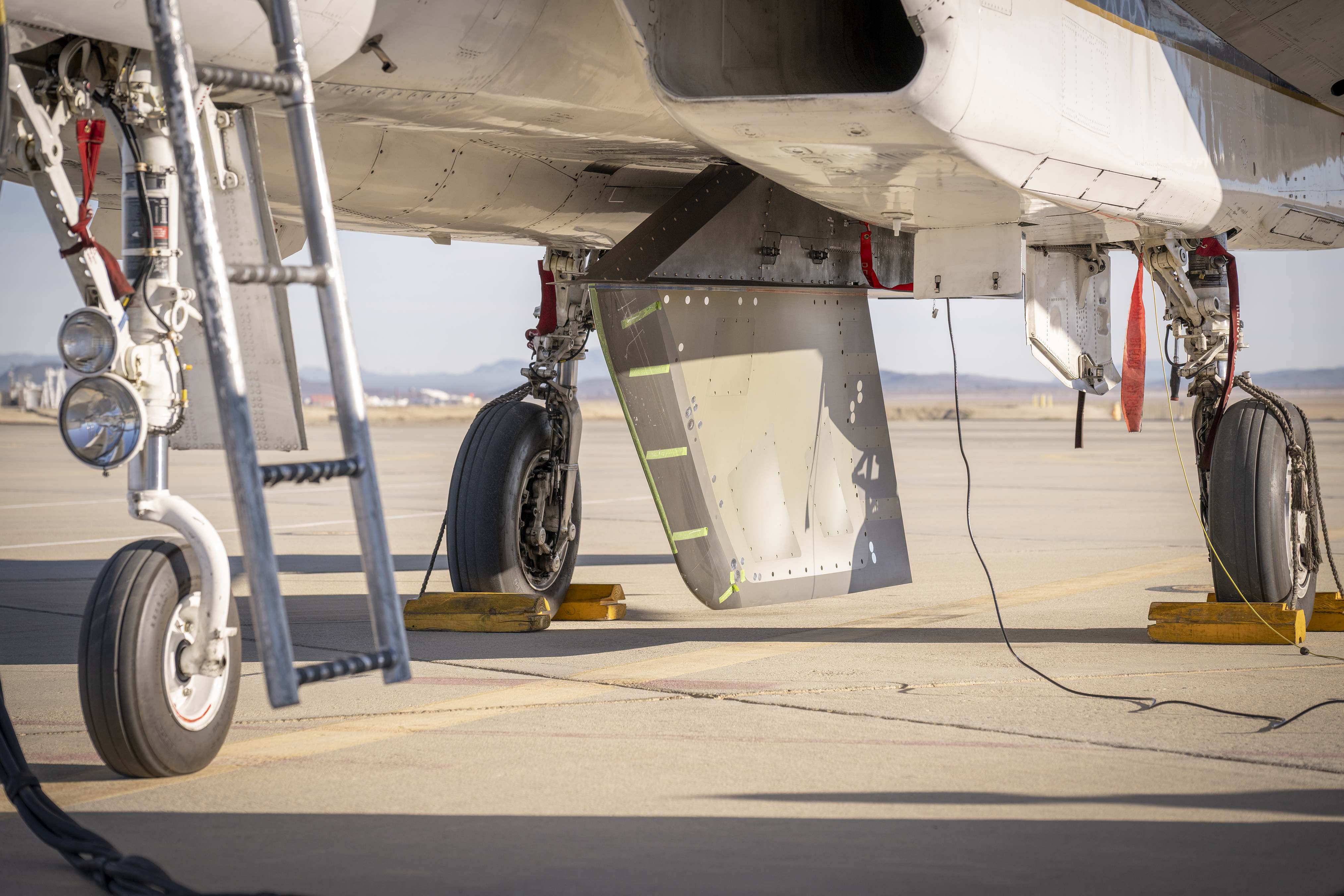
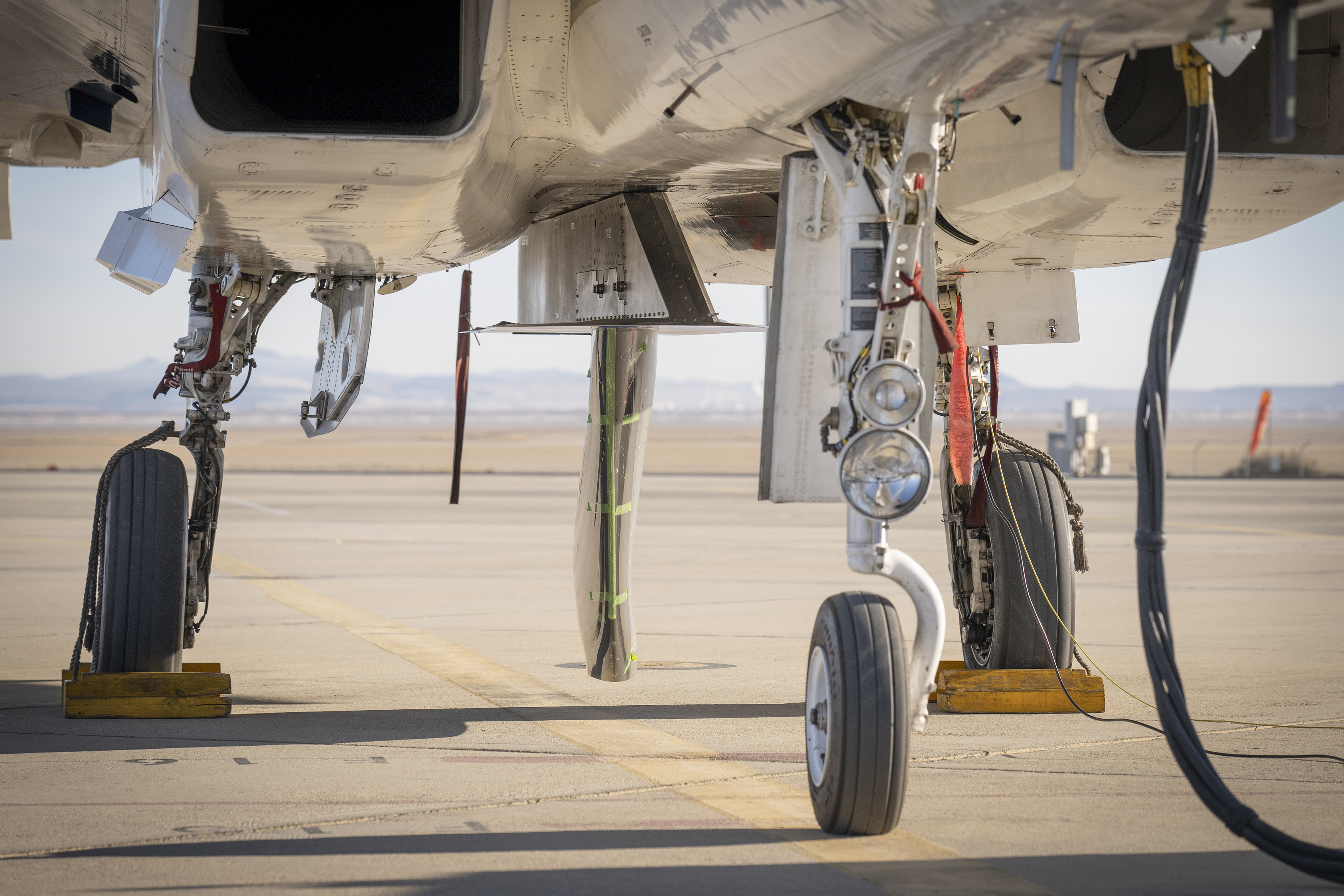
NASA’s Cross Flow Attenuated Natural Laminar Flow test article is mounted beneath the agency’s F-15 research aircraft ahead of the design’s high-speed taxi test on Tuesday, Jan. 12, 2026, at NASA’s Armstrong Flight Research Center in Edwards, California. The 3-foot-tall scale model is designed to increase a phenomenon known as laminar flow and reduce drag, improving efficiency in large, swept wings like those found on most commercial aircraft.
NASA/Christopher LC Clark
NASA researchers successfully completed a high-speed taxi test of a scale model of a design that could make future aircraft more efficient by improving how air flows across a wing’s surface, saving fuel and money.
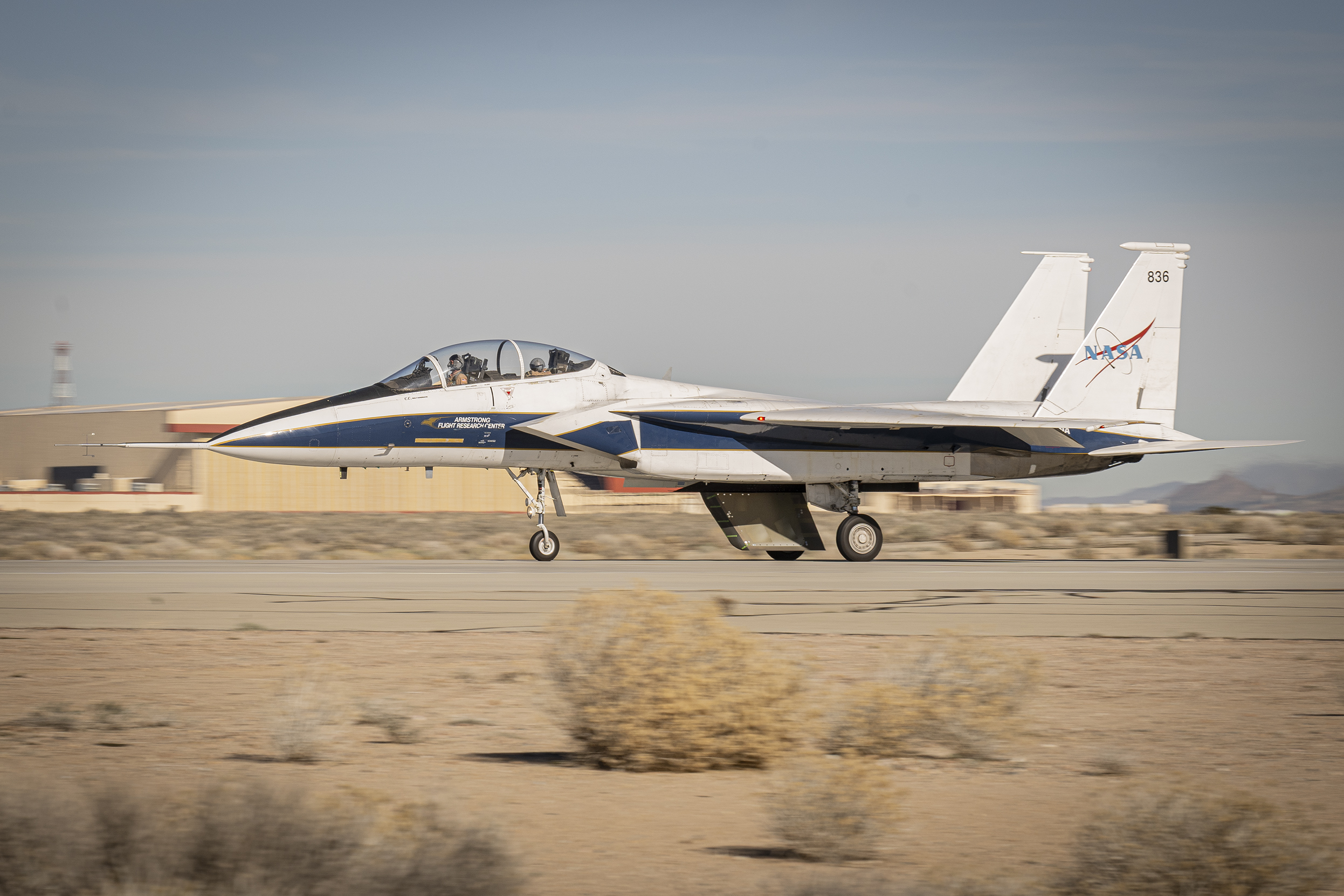
On Jan. 12, the Crossflow Attenuated Natural Laminar Flow (CATNLF) test article reached speeds of approximately 144 mph, marking its first major milestone. The 3-foot-tall scale model looks like a fin mounted under the belly of one of the agency’s research F-15B testbed jets. However, it’s a scale model of a wing, mounted vertically instead of horizontally. The setup allows NASA to flight-test the wing design using an existing aircraft.
The CATNLF concept aims to increase a phenomenon known as laminar flow and reduce wind resistance, also known as drag.
A NASA computational study conducted between 2014 and 2017 estimated that applying a CATNLF wing design to a large, long-range aircraft like the Boeing 777 could achieve annual fuel savings of up to 10%. Although quantifying the exact savings this technology could achieve is difficult, the study indicates it could approach millions of dollars per aircraft each year.
NASA’s Cross Flow Attenuated Natural Laminar Flow test article is mounted beneath the agency’s F-15 research aircraft ahead of the design’s high-speed taxi test on Tuesday, Jan. 12, 2026, at NASA’s Armstrong Flight Research Center in Edwards, California. The 3-foot-tall scale model is designed to increase a phenomenon known as laminar flow and reduce drag, improving efficiency in large, swept wings like those found on most commercial aircraft.
NASA/Christopher LC Clark
“Even small improvements in efficiency can add up to significant reductions in fuel burn and emissions for commercial airlines,” said Mike Frederick, principal investigator for CATNLF at NASA’s Armstrong Flight Research Center in Edwards, California.
Reducing drag is key to improving efficiency. During flight, a thin cover of air known as the boundary layer forms very near an aircraft’s surface. In this area, most aircraft experience increasing friction, also known as turbulent flow, where air abruptly changes direction. These abrupt changes increase drag and fuel consumption. CATNLF increases laminar flow, or the smooth motion of air, within the boundary layer. The result is more efficient aerodynamics, reduced friction, and less fuel burn.
The CATNLF testing falls under NASA’s Flight Demonstrations and Capabilities project, a part of the agency’s Integrated Aviation Systems Program under the Aeronautics Research Mission Directorate. The concept of was first developed by NASA’s Advanced Air Transport Technology project, and in 2019, NASA Armstrong researchers developed the initial shape and parameters of the model. The design was later refined for efficiency at NASA’s Langley Research Center in Hampton, Virginia.
“Laminar flow technology has been studied and used on airplanes to reduce drag for many decades now, but laminar flow has historically been limited in application,” said Michelle Banchy, Langley principal investigator for CATNLF.
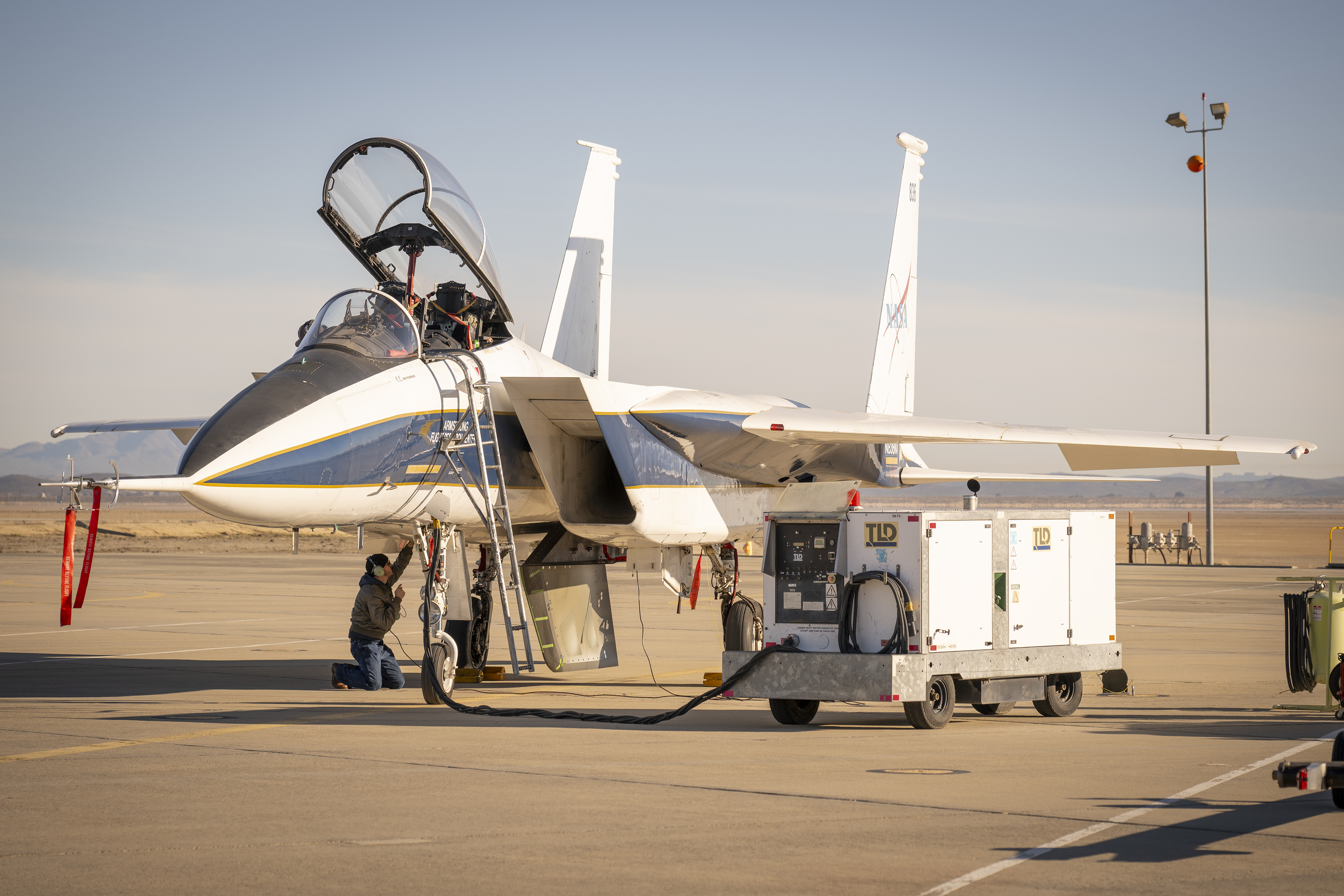
NASA ground crew prepares the agency’s F-15 research aircraft and Cross Flow Attenuated Natural Laminar Flow (CATNLF) test article ahead of its first high-speed taxi test on Tuesday, Jan. 12, 2026, at NASA’s Armstrong Flight Research Center in Edwards, California. The CATNLF design aims to reduce drag on wing surfaces to improve efficiency and, in turn, reduce fuel burn.
NASA/Christopher LC Clark
This limitation is due to crossflow, an aerodynamic phenomenon on angled surfaces that can prematurely end laminar flow. While large, swept wings like those found on most commercial aircraft provide aerodynamic efficiencies, crossflow tendencies remain.
In a 2018 wind tunnel test at Langley, researchers confirmed that the CATNLF design successfully achieved prolonged laminar flow.
“After the positive results in the wind tunnel test, NASA saw enough promise in the technology to progress to flight testing,” Banchy said. “Flight testing allows us to increase the size of the model and fly in air that has less turbulence than a wind tunnel environment, which are great things for studying laminar flow.”
NASA Armstrong’s F-15B testbed aircraft provides the necessary flight environment for laminar flow testing, Banchy said. The aircraft enables researchers to address fundamental questions about the technology while keeping costs lower than alternatives, such as replacing a test aircraft’s wing with a full-scale CATNLF model or building a dedicated demonstrator aircraft.
NASA’s Cross Flow Attenuated Natural Laminar Flow (CATNLF) scale model completes its first major milestone – high-speed taxi test – Tuesday, Jan. 12, 2026, at Edwards Air Force Base in California. NASA’s F-15 research aircraft, with the 3-foot-tall test article mounted on its underside, reached speeds of approximately 144 mph during testing. If successful, the technology could be applied to future commercial aircraft to improve efficiency and potentially reduce fuel consumption.
NASA/Christopher LC Clark
CATNLF currently focuses on commercial aviation, which has steadily increased over the past 20 years, with passenger numbers expected to double in the next 20, according to the International Civil Aviation Organization. Commercial passenger aircraft fly at subsonic speeds, or slower than the speed of sound.
“Most of us fly subsonic, so that’s where this technology would have the greatest impact right now,” Frederick said. NASA’s previous computational studies also confirmed that technology like CATNLF could be adapted for supersonic application.
In the coming weeks, CATNLF is expected to begin its first flight, kicking off a series of test flights designed to evaluate the design’s performance and capabilities in flight.
Looking ahead, NASA’s work on CATNLF could lay the groundwork for more efficient commercial air travel and might one day extend similar capabilities to supersonic flight, improving fuel efficiency at even higher speeds.
“The CATNLF flight test at NASA Armstrong will bring laminar technology one step closer to being implemented on next-generation aircraft,” Banchy said.
The company has made it easy for existing advertisers to expand their reach to include Threads by allowing them to automatically place ads through both Meta's Advantage+ program and via manual campaigns.
DDR3 seemed plenty fast when it first showed up 19 years ago. Who could say no to 6400 Mb/s transfer speeds? Of course compared to the modern DDR5 that’s glacially slow, but given that RAM is worth its weight in gold these days– with even DDR4 spiking in price– some people, like [Gheeotine], are asking “can you game on DDR3“? The answer is a shocking yes.
[Gheeotine] builds two budget-friendly PCs for this video, using some of the newest DD3-supporting motherboards available. That’s not exactly new: we’re talking 12 to 15 years old, but hey, not old enough to drive. We certainly didn’t expect to hear about an x79 motherboard hosting an Ivy Bridge processor in 2026, but needs must when the devil dances. The only concession to modernity is the graphics cards: the x79 mobo got an RX6600XT 8GB, and the other build, using a z97 motherboard got an NVIDIA RTX 4060. The z97 motherboard allowed a slightly newer processor, as well, an i7 4790, with the new and exciting Haswell architecture you may have heard of. Both boards are maxed out on RAM, because at less than one USD/GB, why not?
[Gheeotine] puts a few new titles through their paces on these boxen, and while the results aren’t amazing, everything he tries comes out playable, which is amazing in and of itself. Well, playable unless you’re one of those people who can’t stand playing at resolutions under 4K or FPS under 100. Those of who spent their formative years with 29.7 FPS or 25 FPS in NTSC or PAL regions aren’t going to complain too loudly if frame rates dip down into the 30s playing at 1080p for some of the more demanding titles. Ironically, one of those was the five-year-old Crysis Remastered. Given the age of some of this hardware “Can it Run Crysis” is a perfectly reasonable question, and the answer is still yes.
If you want modern games, you’re much better off with a z97 chipset motherboard if you chose to go the DDR3 route, since you won’t run into issues related to the AVX2 instruction, which first appeared with the Haswell microarchitecture. Here at Hackaday our preferred solution to the rampocalypse is software optimization, Since holding your breath for that would probably be fatal, cost-optimizing PC builds is probably a good plan, even if some might balk at going all the way back to DDR3.
Of course if you’re going to use nearly-retro hardware like DDR3, you might as well go all-out on retro vibes with a nostalgic 80s-style, or even 50s-style case.
Still feeling uneasy about Meta's acquisition of Instagram in 2012 and WhatsApp in 2014, the Federal Trade Commission will be appealing a November ruling that cleared Meta of allegations that it holds an illegal monopoly in a market dubbed "personal social networking."
The FTC hopes the US Court of Appeals for the District of Columbia will agree that "robust evidence at trial" showed that Meta's acquisitions were improper. In the initial trial, the FTC sought a breakup of Meta's apps, with Meta risking forced divestments of Instagram or WhatsApp.
In a press release Tuesday, the FTC confirmed that it "continues to allege" that "for over a decade Meta has illegally maintained a monopoly in personal social networking services through anticompetitive conduct—by buying the significant competitive threats it identified in Instagram and WhatsApp."
NASA’s Center of Excellence for Collaborative Innovation (CoECI) assists in the use of crowdsourcing across the federal government. CoECI’s NASA Tournament Lab offers the contract capability to run external crowdsourced challenges on behalf of NASA and other agencies.
The Office of Dietary Supplements (ODS) at the National Institutes of Health (NIH) announces the “Supplements, Facts First: A Digital Adventure for Every Age” challenge. This competition aims to catalyze innovative multimedia strategies to transform static dietary supplement fact sheets into engaging digital experiences. It addresses a critical gap between authoritative supplement information and meaningful public engagement by incentivizing teams to develop prototypes that target the following modalities:
Preparations for Next Moonwalk Simulations Underway (and Underwater)
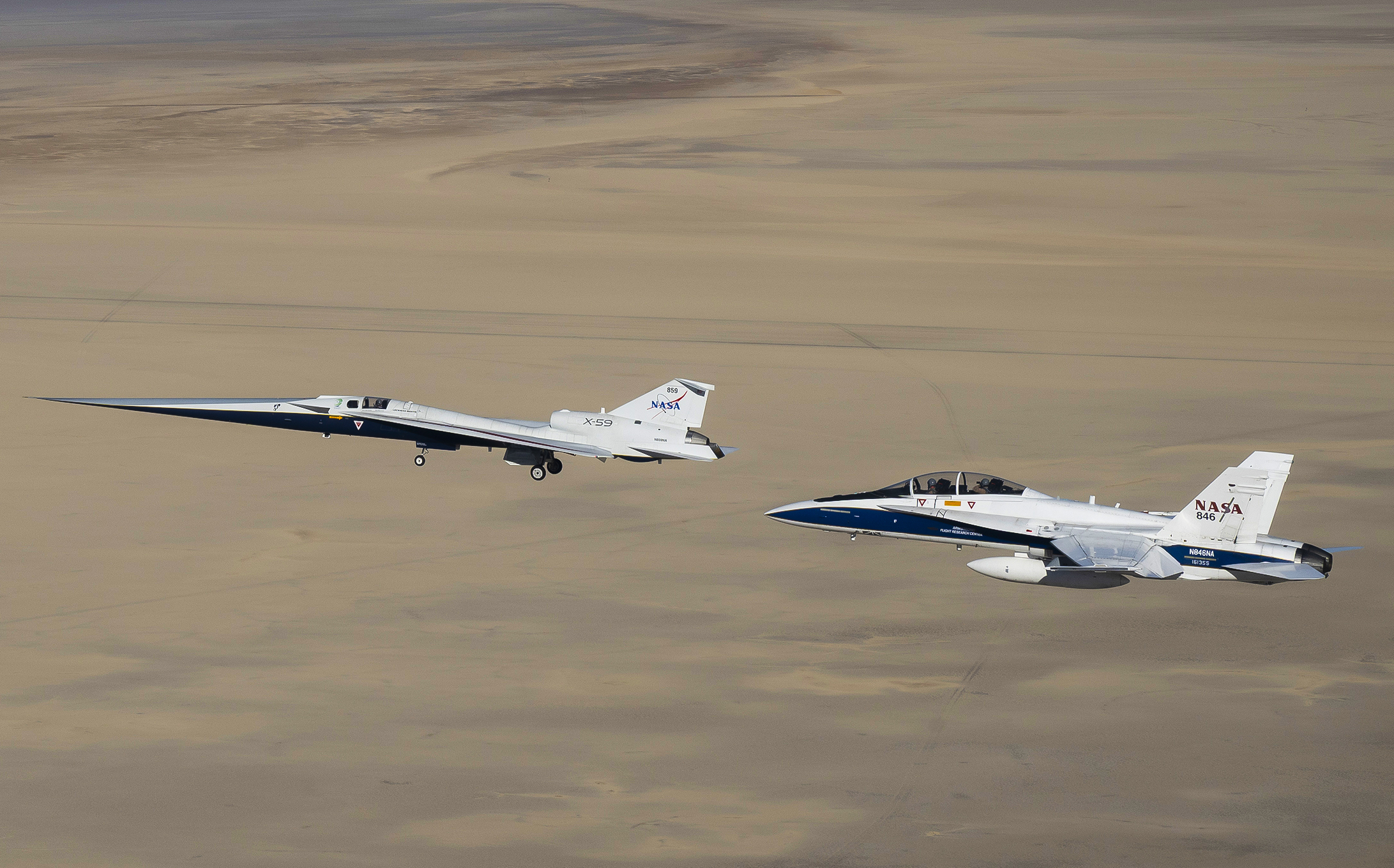
NASA’s X-59 quiet supersonic research aircraft flies above Palmdale and Edwards, California, during its first flight Oct. 28, 2025, accompanied by a NASA F/A-18 research aircraft serving as chase.
NASA/Jim Ross
As NASA’s X-59 quiet supersonic research aircraft continues a series of flight tests over the California high desert in 2026, its pilot will be flying with a buddy closely looking out for his safety.
That colleague will be another test pilot in a separate chase aircraft. His job as chase pilot: keep a careful watch on things as he tracks the X-59 through the sky, providing an extra set of eyes to help ensure the flight tests are as safe as possible.
Having a chase pilot watch to make sure operations are going smoothly is an essential task when an experimental aircraft is exercising its capabilities for the first time. The chase pilot also takes on tasks like monitoring local weather and supplementing communications between the X-59 and air traffic control.
“All this helps reduce the test pilot’s workload so he can concentrate on the actual test mission,” said Jim “Clue” Less, a NASA research pilot since 2010 and 21-year veteran U.S. Air Force flyer.
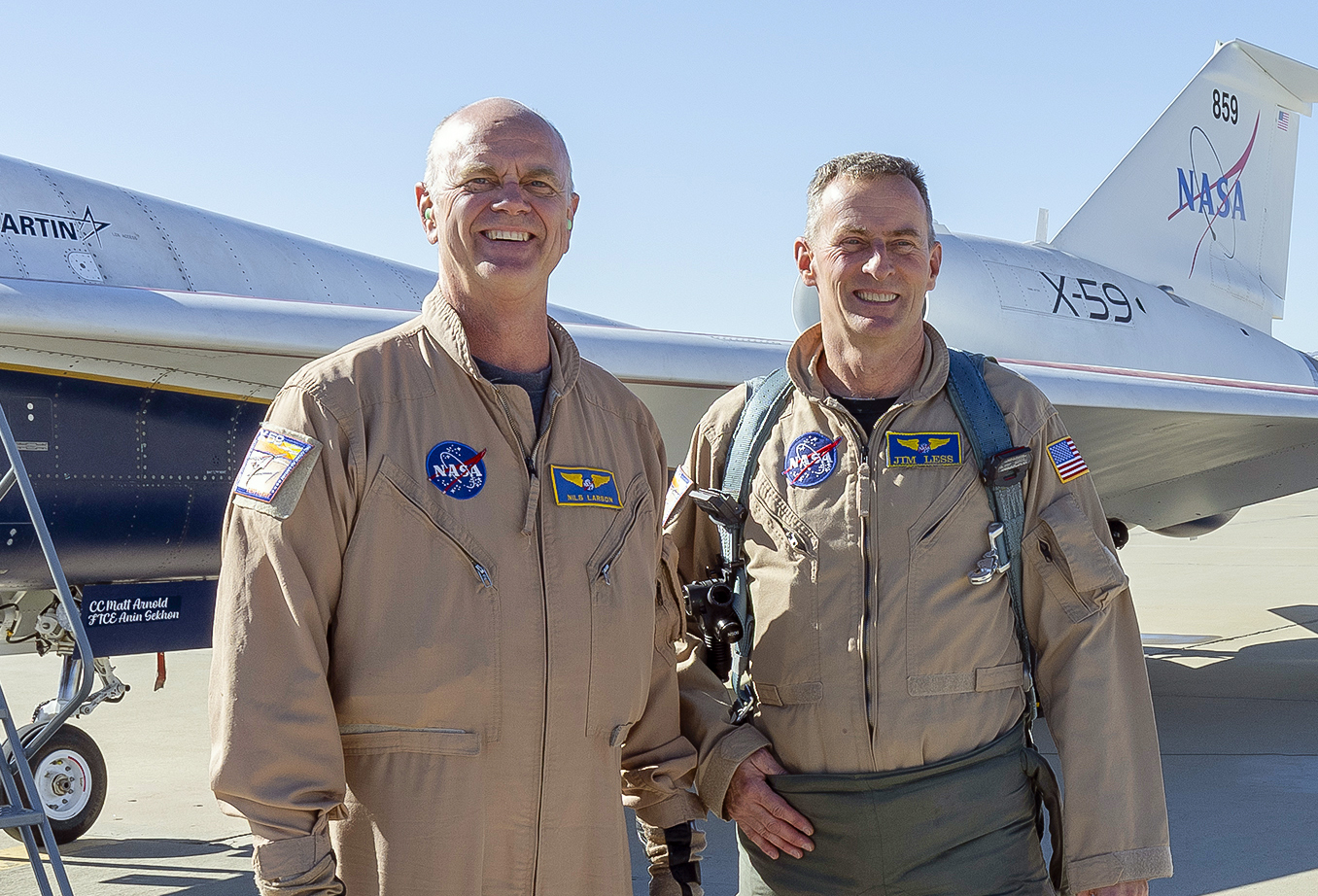
Less served as chase pilot in a NASA F/A-18 research jet when NASA test pilot Nils Larson made the X-59’s first flight on Oct. 28. Going forward, Less and Larson will take turns flying as X-59 test pilot or chase pilot.
NASA pilots Jim “Clue” Less (left) and Nils Larson celebrate the X-59’s first flight on Oct. 28, 2025. Less flew an F-18 chase aircraft while Larson flew the X-59.
NASA/Genaro Vavuris
Staying Close
So how close does a chase aircraft fly to the X-59?
“We fly as close as we need to,” Less said. “But no closer than we need to.”
The distance depends on where the chase aircraft needs to be to best ensure the success of the test flight. Chase pilots, however, never get so close as to jeopardize safety.
We fly as close as we need to, but no closer than we need to.
Jim "clue" LESS
NASA Test Pilot
For example, during the X-59’s first flight the chase aircraft moved to within a wingspan of the experimental aircraft. At that proximity, the airspeed and altitude indicators inside both aircraft could be compared, allowing the X-59 team to calibrate their instruments.
Generally, the chase aircraft will remain about 500 and 1,000 feet away—or about 5-10 times the length of the X-59 itself—as the two aircraft cruise together.
“Of course, the chase pilot can move in closer if I need to look over something on the aircraft,” Less said. “We would come in as close as needed, but for the most part the goal is to stay out of the way.”
Airborne Photo Op
In a view captured from a NASA F/A-18 chase aircraft, the X-59 quiet supersonic research aircraft lifts off for its first flight Oct. 28, 2025, from U.S. Air Force Plant 42 in Palmdale, California.
NASA/Lori Losey
The up-close-and-personal vantage point of the chase aircraft also affords the opportunity to capture photos and video of the test aircraft.
For the initial X-59 flight, a NASA photographer—fully trained and certified to fly in a high-performance jet—sat in the chase aircraft’s rear seat to record images and transmit high-definition video down to the ground.
“We really have the best views,” Less said. “The top focus of the test team always is a safe flight and landing. But if we get some great shots in the process, it’s an added bonus.”
Chase aircraft can also carry sensors that gather data during the flight that would be impossible to obtain from the ground. In a future phase of X-59 flights, the chase aircraft will carry a probe to measure the X-59’s supersonic shock waves and help validate that the airplane is producing a quieter sonic “thump,” rather than a loud sonic boom to people on the ground.
The instrumentation was successfully tested using a pair of NASA F-15 research jets earlier this year.
As part of NASA’s Quesst mission, the data could help open the way for commercial faster-than-sound air travel over land.
Choice of Chase Aircraft
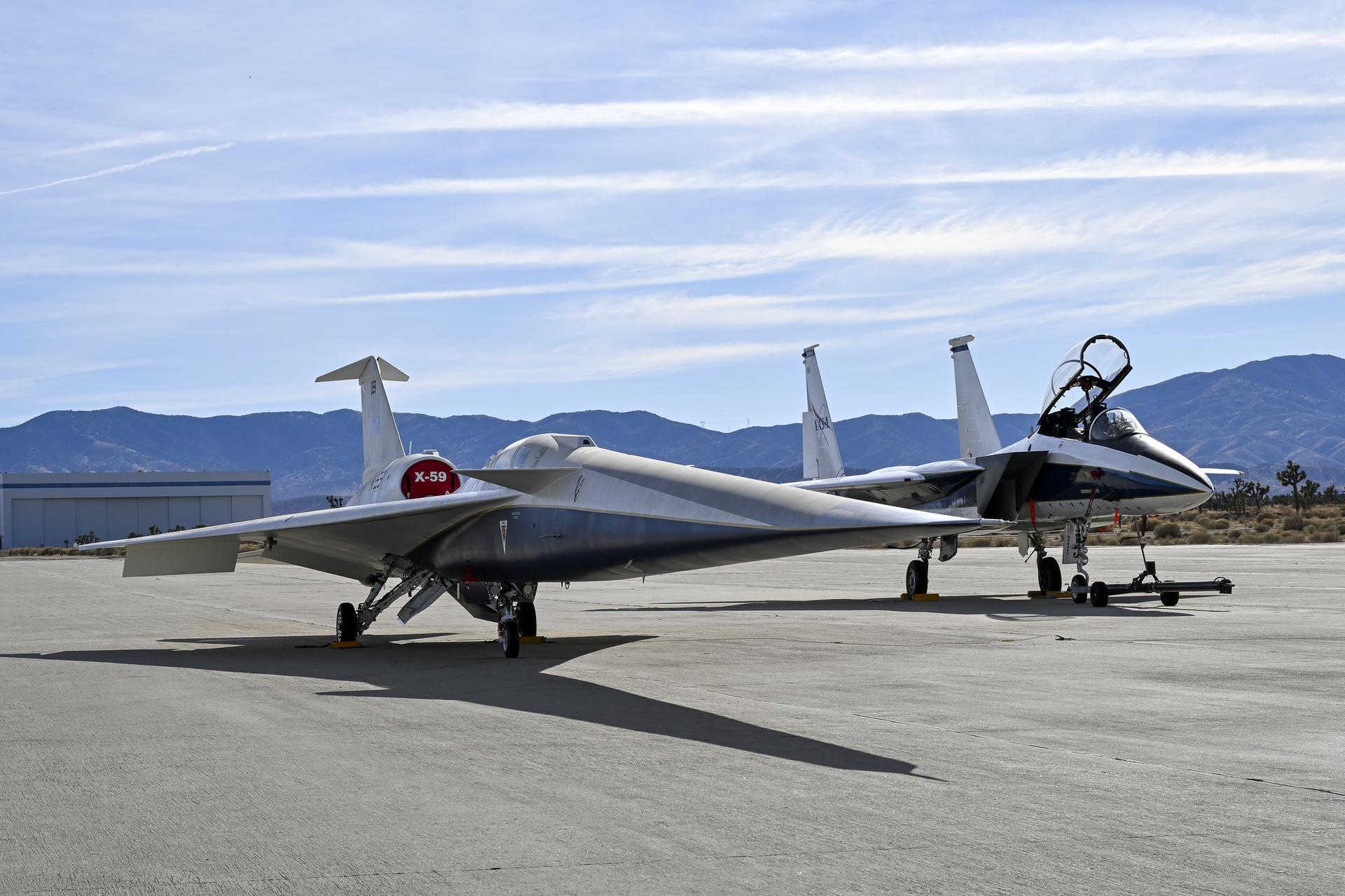
A NASA F-15 aircraft sits 20 feet off the left side of the X-59 aircraft, with a white hangar and hills in the background, during electromagnetic interference testing.
NASA/Carla Thomas
Chase aircraft have served as a staple of civilian and military flight tests for decades, with NASA and its predecessor—the National Advisory Committee for Aeronautics—employing aircraft of all types for the job.
While both types are qualified as chase aircraft for the X-59, each has characteristics that make them appropriate for certain tasks.
The F/A-18 is a little more agile flying at lower speeds. One of NASA’s F/A-18s has a two-seat cockpit, and the optical quality and field of view of its canopy makes it the preferred aircraft for Armstrong’s in-flight photographers.
At the same time, the F-15 is more capable of keeping pace with the X-59 during supersonic test flights and carries the instrumentation that will measure the X-59’s shock waves.
“The choice for which chase aircraft we will use for any given X-59 test flight could go either way depending on other mission needs and if any scheduled maintenance requires the airplane to be grounded for a while,” Less said.
About the Author
Jim Banke
Managing Editor/Senior Writer
Jim Banke is a veteran aviation and aerospace communicator with more than 40 years of experience as a writer, producer, consultant, and project manager based at Cape Canaveral, Florida. He is part of NASA Aeronautics' Strategic Communications Team and is Managing Editor for the Aeronautics topic on the NASA website.
After years of design, development, and testing, NASA’s X-59 quiet supersonic research aircraft took to the skies for the first time on Oct. 28, 2025, markin...
RAM prices have skyrocketed over the past few months, and it doesn’t look like they’re coming down anytime soon. With upgrades threatening to hurt your wallet more than ever, maybe it’s time to take a different approach: making smarter use of the RAM you already have.
For many people, a desktop PC is more than just a functional device. PC building has become a fine art in some circles, and in the pursuit of the perfect PC build, some enthusiasts have resorted to a mild kind of fakery, in the form of "dummy" RAM.
X’s owner, Elon Musk, is allegedly considering integrating XRP and RLUSD into the social media platform. This marks a shift from rumors that the world’s richest man could integrate Dogecoin, given his fondness for the foremost meme coin.
Pundit Claims Rumors of Elon Musk Integrating XRP and RLUSD
In an X post, crypto pundit JackTheRippler claimed that there are rumors that Elon Musk will integrate XRP and RLUSD into X. This came as he shared a video in which the world’s richest man said the social media platform could become half of the global financial system if done right.
This aligns with Elon Musk’s vision to transform X into an ‘Everything App.’ However, it is worth noting that the world’s richest man didn’t mention anything about integrating XRP or RLUSD on the social media platform. Musk has only once commented on XRP, in 2024, when he said he thinks crypto helps with individual freedom, in response to a question about whether the XRP Ledger could be integrated into financial institutions in the future.
Before JackTheRippler’s claim about an XRP and RLUSD integration, Dogecoin had been the coin that had been widely rumored to get integrated into X payments when the payments system launches. This is due to Elon Musk’s fondness for the foremost meme coin, with the world’s richest man referencing the meme coin on several occasions.
However, Elon Musk has never confirmed plans to integrate Dogecoin or any other crypto asset, including the altcoin and RLUSD, into X. There has also been no confirmed date for the X payments launch, which was expected to happen last year. Meanwhile, although Musk has not mentioned integrating cryptocurrencies, the world’s richest man appears to be warming to them, especially Bitcoin.
Last year, Elon Musk admitted that Bitcoin, alongside Dogecoin, was based on energy. He then stated that one can issue fake fiat currency, which governments have done, but that it is “impossible to fake energy.”
Musk Likely To Integrate Crypto Into X
Market experts, such as SkyBridge founder Anthony Scaramucci, have opined that Elon Musk will integrate cryptocurrencies into X. In an interview, he said the world’s richest man will build a super app and that he will be using crypto. However, Scaramucci admitted that he wasn’t sure how Musk would go about it, whether he would integrate known cryptos like Bitcoin, XRP, Dogecoin.
He also raised the possibility of Elon Musk creating his own coin, like Telegram’s TON, or that it could be a stablecoin. In the meantime, X’s Head of Product, Nikita Bier, announced that they are building smart cashtags that will allow users to specify the exact crypto asset when posting a ticker. Users will be able to tap these tickers to see real-time pricing for these crypto assets in their timeline.

 Login
Login