
Normal view

There are new articles available, click to refresh the page.
Today — 16 December 2025Main stream

Bitwise Chief: Bitcoin to Hit Fresh Records in 2026 and Break Four-Year Cycle

16 December 2025 at 11:06

Major asset managers are forecasting that Bitcoin will shatter its traditional four-year cycle and reach new all-time highs in 2026, driven by massive institutional capital inflows and regulatory clarity.

Bitwise Chief Investment Officer Matt Hougan and Grayscale Research both project BTC will exceed its previous peak despite conventional wisdom suggesting 2026 should be a pullback year.

Bitcoin has historically followed a four-year cycle tied to halving events, with three significant up years followed by sharp corrections.

Bitcoin 2026 - Bitcoin Four Year Cycle Chart
Source: Cryptonews

Since the most recent halving occurred in April 2024, more than 18 months ago, traditional cycle theory would predict 2026 as a down year.

However, Hougan argues that the forces driving previous cycles have weakened substantially, while new structural dynamics are taking hold.

We believe the wave of institutional capital that began entering the space with the approval of spot bitcoin ETFs in 2024 will accelerate in 2026, as platforms like Morgan Stanley, Wells Fargo, and Merrill Lynch begin allocating,” Hougan wrote in Bitwise’s annual predictions report.

He expects Bitcoin to reach new all-time highs, relegating the four-year cycle to the dustbin of history.

Institutional Era Replaces Retail-Driven Volatility

Grayscale’s 2026 outlook echoes this transformation, projecting Bitcoin will set fresh records in the first half of next year as the market transitions into what it calls the institutional era.

The asset manager identifies two pillars supporting this view:

  • Macro demand for alternative stores of value amid rising public debt
  • Fiat currency risks, plus improving regulatory clarity that deepens blockchain integration with traditional finance.

The changing market structure has already altered Bitcoin’s price behavior. Previous bull markets saw gains exceeding 1,000% in a single year, while this cycle’s maximum year-over-year increase reached only 240% through March 2024.

Grayscale attributes this moderation to steadier institutional buying rather than retail momentum chasing, arguing the probability of deep, prolonged drawdowns has declined significantly.

Grayscale expects rising valuations in the crypto sector in 2026, and as a result, Bitcoin could exceed its previous high in the first half of the year.
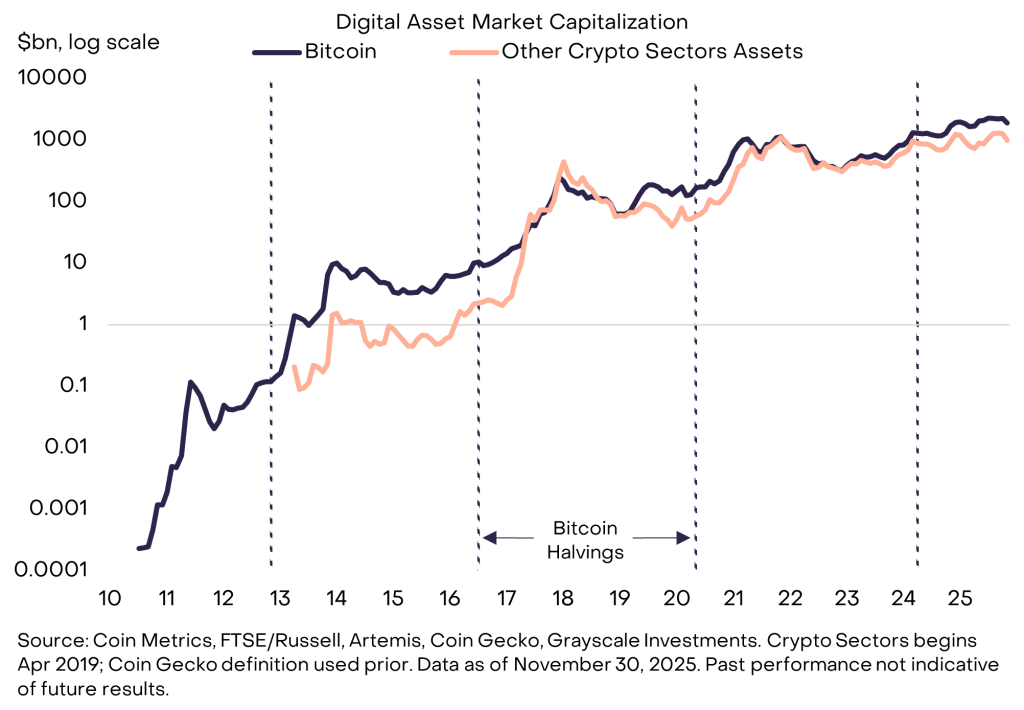
Bitcoin 2026 - Digital Asset Market Capitalization
Source: GrayScale

Bitwise’s analysis also highlights how Bitcoin volatility has steadily decreased over the past decade, with BTC now less volatile than Nvidia throughout 2025.

Hougan predicts Bitcoin’s correlation with stocks will fall in 2026 as crypto-specific factors like regulatory progress and institutional adoption power the asset higher even if equities struggle.

Regulatory Clarity and Monetary Policy Alignment

Katherine Dowling, president of Bitcoin Standard Treasury Company, recently forecast that Bitcoin would reach $150,000 by the end of 2026, citing “the trifecta of a positive regulatory environment, quantitative easing, and institutional inflows.

President Trump recently signed the GENIUS Act, establishing stablecoin regulatory framework, while the Office of the Comptroller of the Currency permitted national banks to offer crypto brokerage services.

Just this month, Bank of America now allows its financial advisers to recommend Bitcoin ETFs, potentially channeling portions of the bank’s $3.5 trillion in client assets into digital assets.

The Federal Reserve cut rates three times in 2025 and expects to continue easing next year.

Notably, Grayscale expects bipartisan crypto market structure legislation to become US law in 2026, which will solidify blockchain-based finance in capital markets.

Since US Bitcoin ETPs launched in January 2024, global crypto ETPs have attracted $87 billion in net inflows, yet less than 0.5% of US advised wealth is allocated to crypto.

On the technical level, according to a CryptoQuant analyst, on-chain data shows long-term holders distributing coins at one of the largest 30-day rates in the past 5 years, typically indicating late-cycle behavior.

However, CryptoQuant data also shows short-term holders are facing pressure, as Bitcoin has traded below their $104,000 cost basis since October 30, resulting in unrealized losses averaging 12.6%.

As reported by Cryptonews today, Bitcoin dropped nearly 4% to approximately $85,940 amid investor risk reduction ahead of crucial US economic data.

Despite near-term volatility, like other major players, Bitfinex maintains that the groundwork is being laid for BTC to regain all-time highs in 2026, supported by looser monetary policy and steady adoption by ETFs, corporates, and sovereign entities that are absorbing multiples of the yearly mined supply.

The post Bitwise Chief: Bitcoin to Hit Fresh Records in 2026 and Break Four-Year Cycle appeared first on Cryptonews.

Yesterday — 15 December 2025Main stream
Before yesterdayMain stream

Bitwise Rolls Out New ETF For Broad Crypto Exposure, Including BTC, XRP, And ADA

10 December 2025 at 04:00

On Tuesday, Bitwise announced the launch of the Bitwise 10 Crypto Index ETF (BITW) on the New York Stock Exchange (NYSE), allowing investors to gain exposure to a diverse range of cryptocurrencies in a single investment vehicle. 

This ETF includes ten digital assets: Bitcoin (BTC), Ethereum (ETH), XRP, Solana (SOL), Chainlink (LINK), Litecoin (LTC), Cardano (ADA), Avalanche (AVAX), Sui (SUI), and Polkadot (DOT). 

Notably, BITW marks the first exchange-traded fund by a major crypto asset manager to incorporate Avalanche, Sui, and Polkadot into its portfolio, as highlighted by Bitwise CEO and co-founder Hunter Horsley in a recent interview with CNBC.

Bitwise ETF Launches With Over $1 Billion In Assets

“This development significantly broadens the audience that can access these various assets, particularly for those digital currencies that lack a spot ETF,” Horsley explained on Monday. 

The fund is tailored for both financial advisors and smaller investors looking to utilize funds from individual retirement accounts (IRAs) or other retirement savings, where ETFs serve as the main investment option.

BITW represents a conversion from a prior index fund that encompassed the same digital currencies and has launched with over $1 billion in assets. 

The approval of Bitcoin and Ethereum ETFs back in January 2024 has led asset managers to compete for the chance to introduce ETFs that track a broader range of digital assets, including altcoins like Sui and Aptos, as well as memecoins such as TRUMP and Dogecoin (DOGE). 

However, these investment vehicles experienced major withdrawals in October and November, particularly for Bitcoin- and Ethereum-focused ETFs. These withdrawals reached record levels amid a broader sense of caution due to falling crypto prices. 

“The timing is ideal for many investors who have been paying attention since the Bitcoin ETF launch and are now looking for a more comprehensive way to allocate to digital assets without the need to select individual assets,” Horsley noted.

BITW Allocates 90% To Major Cryptos 

It’s important to emphasize that while BITW offers exposure to smaller cryptocurrencies in terms of market capitalization, its allocation to these assets is proportionately limited. 

Specifically, the ETF dedicates 90% of its holdings to Bitcoin, Ethereum, Solana, and XRP, with the remaining 10% allocated to the other tokens in the fund. 

The fund will undergo monthly rebalancing, a more frequent schedule compared to many exchange-traded funds in the market that typically rebalance quarterly or semi-annually. 

Bitwise further expressed its commitment to expanding access to cryptocurrency opportunities, stating in a social media post

At Bitwise, we’ve been working tirelessly since 2017 to expand access to the opportunities in crypto. Countless investors have requested an index ETP, and we’re thrilled that NOW, with BITW’s listing on NYSE, you have that option. We believe 2025 is a breakout year for this space, and we are more optimistic than ever about the opportunities ahead.

Bitwise

As of this writing, Ethereum is the best-performing asset in Bitwise’s new fund. It is trading at $3,323 and has recorded gains of up to 6% in the past 24 hours as it approaches key resistance levels. 

Featured image from DALL-E, chart from TradingView.com 

Why 2026 Is Unlikely To Be Crypto’s Next Bust Year: Bitwise CIO

10 December 2025 at 01:00

Bitwise CIO Matt Hougan says the crypto market is anchored to the wrong mental model. Speaking on the Empire podcast recorded 5 December and released on 8 December, he argued that the traditional “four-year Bitcoin cycle” has lost its explanatory power – and that 2026, which many expect to be a brutal post-halving down year, is far more likely to be an “up year” driven by institutional flows and regulatory tailwinds.

“2026 will not be a bad year, Jason,” Hougan told host Jason Yanowitz. “I think 2026 will be a good year […] I just don’t understand the logical reason why [the four-year cycle] would repeat again. It’s not like built into a mechanical clock. It was driven by specific factors and those factors no longer exist, so it won’t keep happening.”

He acknowledged that recent price action has unnerved investors, with Bitcoin giving back a “Vanguard pump” and selling off into a weekend on no obvious news. But he framed that as positioning and microstructure, not the start of a structural unwind.

“People in crypto over the last two months have learned to be nervous on weekends,” he said, pointing to thin weekend liquidity and Friday macro headlines. He noted that sentiment is depressed even though “the market is flat for the year,” adding: “We’re freaking out about a market that is flat for the year.”

Why The 4-Year Crypto Cycle Is Dead

Hougan broke down the four main explanations traditionally used to justify the Bitcoin cycle and argued each is now materially weaker.

First is the halving itself. “The halving cycle is just not that important,” he said. “It’s half as important as it was four years ago […] a fraction of, you know, a quarter as important as it was eight years ago, a sixteenth, etc. There’s just not that much supply being removed.” As issuance becomes a smaller fraction of total supply and ETF and derivatives flows grow, the mechanical supply shock carries less weight.

Second is the rate cycle. Prior “down years” such as 2018 and 2022 coincided with aggressive rate hikes. “Interest rates are going down,” he said. “So that thesis is just completely invalidated, right? It’s completely different.”

Third is the “blow-up” pattern – Mt. Gox, ICOs, FTX – that historically capped euphoric phases. Hougan allowed that balance-sheet stress in parts of the market is “the strongest case for the four-year cycle repeating,” but he does not expect forced liquidations on the scale of prior collapses. In his view, potential problem entities are more likely to “just not buy as much in the future” rather than being compelled sellers.

Fourth is simple randomness: three similar cycles do not make a law of nature. “Across those four, they’re all much weaker than they were in the past,” he summarised.

Why 2026 Is Poised To Be Better Than 2025

Against that, Hougan set what he sees as a once-in-a-generation shift in regulation and institutional behaviour. “You have a once-in-a-generation regulatory change from severe regulatory headwinds to strong regulatory tailwinds,” he said, and “more importantly, you have this institutional adoption narrative that’s going to overwhelm everything.”

In the last six months, he noted, major US wirehouses have “green-lit crypto exposure.” He singled out Bank of America: “They have $3.5 trillion in assets. One percent is $35 billion. Four percent is like $140 billion. That’s more than the total flows into Bitcoin ETFs so far.” He stressed it is not just one bank: “There are four wirehouses. They’re basically all on now […] the biggest advisory groups all managing many trillions of dollars.”

The catch is timing. Institutional allocations are slow and process-driven. “The average Bitwise client, I think, invests after eight meetings with us,” he said, and some of those are quarterly. That “eight-meeting” lag means the ETF era is still in its early innings; the full impact of platforms being switched on is more likely to manifest through 2026 than in a single explosive quarter.

Hougan also emphasised that advisers optimise for client retention, not absolute performance. “The one thing a financial adviser doesn’t want to do is have a meeting with their client where something is down 50% and their client fires them,” he said. That is why reduced volatility, cleaner regulation and mainstream narratives like “Bitcoin as digital gold” and “stablecoins and tokenization as new financial rails” matter so much.

On supply dynamics, he pushed back on two recurring fears: “OG whales dumping” and MicroStrategy as a forced seller. He argued that much of the apparent “selling” by long-term holders is actually upside being sold via covered calls. Whales come to Bitwise and similar firms, he said, saying: “I have a hundred million of Bitcoin […] can you write covered calls against this?” That “effectively introduces new supply into the market” without coins moving on-chain.

On MicroStrategy, he was categorical: “From a data perspective [it is] just strictly untrue that it will be forced to sell its Bitcoin.” The company has meaningful cash to service interest, no principal due until 2027, and manageable maturities relative to its Bitcoin holdings. He agreed with Jeff Dorman’s framing that MicroStrategy is no longer a major marginal buyer but also “not a forced seller.”

Too much pessimism on the timeline.

Brought on @Matt_Hougan to tell us why 2026 will be FAR better than 2025.

Tons of good nuggets in here related to institutions, financial advisors, cycles, and more.

Enjoy the optimism!pic.twitter.com/WZJb55yENF

— Yano 🟪 (@JasonYanowitz) December 8, 2025

Looking ahead, Hougan expects investors to eventually reframe the current period not as a failed bull cycle but as a behavioural transition through a key level. “We might look back at 2025 at some point and say, ‘Huh, you know what? $100,000 was like a big behavioral cliff we had to get over. Took us like a year,’” he said.

For 2026 specifically, his message is clear: the old four-year pattern “won’t keep happening,” and the combination of regulatory clarity and institutional inflows sets up what he calls an “extraordinarily strong” backdrop rather than a programmed bust.

At press time, the total crypto market cap stood at $3.06 trillion.

Total crypto market cap

Featured image from YouTube, chart from TradingView.com

What’s Happening With XRP And Why Did Its Spot ETF Crash 20%?

8 December 2025 at 05:30

XRP’s price has continued to chop, trading sideways, which has impacted the price of the U.S. spot ETFs that provide exposure to the altcoin. Canary Capital’s XRP fund has crashed 20% since its launch, although this fund remains the largest by assets under management (AuM). 

XRP’s Sideways Price Action Leads To Spot ETF Crash

The XRP price has continued to trade within a tight range, just above the psychological $2 level, sparking bearish sentiment among investors. The altcoin is down over 10% in the last month, around the time the first spot XRP ETF, Canary’s fund, launched. This bearish price action has notably contributed to a price crash for Canary’s XRPC fund. 

TradingView data shows that Canary’s XRP ETF is down 20% since its launch on November 13. XRPC also dropped almost 10% last week amid choppy price action. Canary’s fund has also likely crashed due to increased competition from three other spot funds that launched after it. This has led to a slowdown in its inflows since these funds launched. 

XRP

Meanwhile, these funds track the spot XRP price, which also explains Canary’s XRPC crash. XRP has mirrored Bitcoin’s price action amid concerns that the crypto market may already be in a bear market. XRP whales also look to be bearish at the moment, as Santiment data shows a drop in whale transactions from a recent high recorded in November. 

However, despite this bearish sentiment, with the crypto market currently in a state of fear, the XRP ETFs have continued to record daily net inflows. SoSo Value data show that these funds have been on a 16-day net inflow streak since Canary’s XRP fund launched on November 13, and they have yet to record a net outflow day. 

Canary’s XRP ETF, which has suffered a 20% price crash, is currently the largest spot XRP fund with $364 million in assets under management. Grayscale’s GXRP is second with $211 million, while Bitwise and Franklin Templeton are third and fourth. As a group, these XRP funds are about to hit $1 billion in assets under management, with $861 million in total net assets. 

Some Positives For The Altcoin

Santiment data show that XRP exchange outflows have outweighed inflows in recent times. This is a positive as it indicates that more investors are accumulating than selling. Exchange outflows typically represent moves for long-term holding, especially in anticipation of higher prices. 

In an X post, Santiment mentioned that the XRP Ledger is seeing a fascinating trend of whale and shark wallets shrinking in number but continuing to grow in coins held. The on-chain analytics platform noted that there are 20.6% fewer 100 million XRP wallets, but that these wallets, as a group, still own a 7-year high 48 billion coins. As such, the existing 100 million XRP wallets are doubling down on their accumulation efforts and making up for the shrinking number of wallets. 

At the time of writing, the altcoin’s price is trading at around $2.07, up in the last 24 hours, according to data from CoinMarketCap.

XRP

The 8 Best Weed Strains for a Spooky Halloween

By: K. Astre
27 October 2025 at 07:20

Trick or treating might be out for you, but you can still have some fun that is equal parts cool and creepy. Scary movies are always an easy go-to for celebrating Halloween as an adult without feeling like you’re missing out on anything — especially if you’re not really into the idea of costume parties or haunted house attractions. And if you add some weed into the equation, you have the beginnings of a perfectly content night at home. Need some help picking out a strain for your movie marathon?

These particular strain pairings are just for the fun of the holiday and not at all based on matching the post-consumption experience with the type of movie you’ll be watching…. which is a good thing. It’s probably not a good idea to try to intentionally smoke strains that will mirror the potential fear and paranoia of watching a scary movie. Instead, these strains will mellow you out, help you chill and just add to the entertainment factor.

“It” + Pennywise

Whether you choose the original (which you should) or the remake, there are lots of moments when you’ll be glad you went for a high-CBD indica to calm your nerves. Plus, seriously, what’s more peak stoner than smoking a strain that is the exact same name as the main character of the movie you’re watching? Like, really, just pat yourself on the back for this one.

“The Shining” + Jack the Ripper

Jack Nicholson plays Jack Torrance in this classic film about a family’s weird and disturbing winter at a hotel in Colorado. This energizing sativa might be a good choice to help keep you and your friends upbeat during some of the more slow or meandering parts of the movie where you could lose interest. Instead, you guys can giggle your way through until the next scare.

“The Hunger” + Blood Orange Kush

Bust out this oldie but goodie where the iconic David Bowie plays an ageless but still somehow relatively youthful vampire on the hunt for fresh blood. This movie is definitely more eerie than downright scary and the paired strain works well with keeping you relaxed and feeling good with the calm, methodical pace of the movie.

“Carrie” + Killer Queen

Mean teens, hella blood and a nightmare prom? Check. Though this film adapted from a Stephen King novel was made back in the ’70s, it’s still just as creepy now as it was then. You can expect lots of cerebral effects with this hybrid strain that will keep you feeling energized as your body settles into deep relaxation.

“A Nightmare on Elm Street” + Sweet Dreams

Wes Craven did a pretty good job at making people never want to fall asleep again thanks to the disturbing and frequent appearances by Freddy Krueger in their dreams and waking life. This creeper strain is good for lasting through the movie and getting you nice and relaxed for a good night’s sleep — minus the nightmares.

“Psycho” + 3x Crazy

Considered one of the best psychological horror movies of all time, this movie is home to the infamous shower scene that has been copied and parodied since its introduction in 1960. Pairing a nice indica strain with this film will have you feeling zenned out and comfortably relaxed even through all the screeching.

“Night of the Living Dead” + Zombie OG

Take a break from your “Walking Dead” marathon and throw on this classic movie all about the undead feeding on those still living. As the name suggests, this strain is super potent and will have you feeling heavily sedated. It’s great for a late-night solo smoke where you have every intention of falling asleep right afterward.

“The Exorcist” + Holy Ghost

This strain is good for stress and anxiety which could help you keep your cool during an intense, high-stakes movie about clearing a kid of demon possession. And to help with the residual trauma, Holy Ghost is good for a mood boost that can help you shake that lingering sinister feeling.

The post The 8 Best Weed Strains for a Spooky Halloween appeared first on Cannabis Now.

❌
❌