The US crypto market has welcomed a new entrant as 21Shares rolls out its Spot Dogecoin ETF, giving investors another avenue to engage with the infamous dog-themed meme coin. Trading kicked off amid a mix of curiosity and caution, with on-chain data already showing how much the DOGE ETF has performed so far.
21Shares Launches Dogecoin ETF
In a press release on Thursday, January 22, 21Shares announced the official launch of its Spot Dogecoin ETF, TDOG, which began trading on NASDAQ the same day. The new ETF provides investors with direct exposure to Dogecoin through a fully backed, regulated, and transparent vehicle. Each ETF share is also backed 1:1 by DOGE held in institutional-grade custody.
Notably, the launch of the new TDOG ETF brings the total number of US Dogecoin ETFs to three, joining Grayscale’s GDOG and Bitwise’s BWOW. 21Shares is also the only ETF provider endorsed by House of Doge, the official corporate arm of the Dogecoin foundation, highlighting the global asset manager’s close ties to the meme coin.
As one of the largest crypto ETF issuers, 21Shares continues to expand its crypto product lineup with the introduction of TDOG. This follows the investment company’s previous ETF offerings, including TSOL, a Solana ETF released in November 2025; ARKB, a Spot Bitcoin ETF launched in January 2024; and TETH, an Ethereum ETF introduced in July of the same year. Together, these products demonstrate 21Shares’ commitment to providing institutional-grade access to high-demand digital assets.
Federick Brokate, Global Head of Business Development at 21Shares, highlighted DOGE’s large and active global community, calling it a unique digital asset with constantly growing use cases. He added that the new TDOG ETF will give investors regulated, physically backed exposure through a familiar ETF structure they know and trust.
Marco Margiotta, the CEO of House of Doge, also shared comments on the recently launched 21Shares ETF. He said that TDOG is a step toward making Dogecoin easier to access through traditional financial systems. He also disclosed that House of Doge’s partnership with 21Shares will help more people get involved as the Dogecoin ecosystem grows.
How 21Shares Dogecoin ETF Has Performed So Far
Contrary to expectations, 21Shares’ recently launched Dogecoin ETF saw weak performance on the first day of trading, signaling investors’ lack of interest in the investment product. Data from SoSoValue shows that TDOG experienced no inflows on January 22 and instead declined by about 0.07%. Despite it being the second day of trading, the DOGE ETF has still not registered any flows.
This lackluster performance has been observed across all Dogecoin ETFs this week. Grayscales’ GDOG and Bitwise BWOW have reported zero inflows over the last week. The last time GDOG saw positive activity was on January 8, when it received around $333,083 in investments. Before that, the ETF recorded its highest inflows on January 2, totaling roughly $2.3 million. Since its launch in November 2025, GDOG ETF inflows have been unstable, with more days of inactivity than significant investment.
Circle’s chief executive painted a brisk picture at Davos this week: autonomous software agents that act for people could be using stablecoins to pay for everyday things within three to five years.
He said these agents will need a money system that is stable, fast, and programmable. That, he argued, points to stablecoins as the likely choice.
AI Agents And Money
According to reports, Jeremy Allaire of Circle said “literally billions” of AI agents may be transacting on behalf of users in the near term.
“Three years, five years from now, one can expect that there will be billions, literally billions of AI agents conducting economic activity in the world on a continuous basis,” Allaire said during the World Economic Forum in Davos, Switzerland.
He described work on new networks and tools aimed at letting software act like small businesses or helpers that buy services, settle bills, and tip content creators.
This idea is simple on the surface: software needs a reliable unit of account when it spends, and tokenized dollars can fit that role.
Building The Tools
Reports say companies across the crypto and tech world are racing to build the plumbing for this future. Circle is pitching USDC as a neutral payments layer that software can plug into.
Other firms are testing protocols that let a machine sign off on a payment when certain conditions are met. Some large tech groups are also exploring ways for their platforms to let software pay for services automatically. Progress is visible, but the path is not yet clear.
What Regulators Might Ask
Regulators will have questions. Reports note concerns about money flow, consumer protections, and where bank deposits sit if stablecoins grow rapidly.
At Davos, the CEO pushed back on the idea that stablecoins would drain bank deposits the way some fear, saying comparisons to other financial instruments are more fitting.
Still, lawmakers in the US and elsewhere are watching closely. Rules could move faster if policy makers see real volume coming from so-called agentic commerce.
New Networks, New Risks
Based on reports, the technical choices will shape both convenience and danger. If agents can move value at scale, fraud and theft risks may rise too.
Systems will need clear identity checks, fault handling, and ways to stop runaway payments. Some safety work is already under way, but much remains to be designed and tested.
Featured image from Pexels, chart from TradingView
Epoch, a venture firm specializing in Bitcoin infrastructure, issued its second annual ecosystem report on January 21, 2026, forecasting robust growth for the asset despite a subdued 2025 performance.
The 186-page document analyzes Bitcoin’s price dynamics, adoption trends, regulatory outlook, and technological risks, positioning the cryptocurrency as a maturing monetary system. Key highlights include a prediction that Bitcoin will reach at least $150,000 USD by year-end, driven by institutional inflows and decoupling from equities. The report also anticipates the Clarity Act failing to pass, though its substance on asset taxonomy and regulatory authority may advance through SEC guidance. Additional forecasts cover gold rotations boosting Bitcoin by 50 percent, major asset managers allocating 2 percent to model portfolios, and Bitcoin Core maintaining implementation dominance.
Eric Yakes, CFA charterholder and managing partner at Epoch Ventures, brings over a decade of finance expertise to the Bitcoin space, having started his career in corporate finance and restructuring at FTI Consulting before advancing to private equity at Lion Equity Partners, where he focused on buyouts. He left traditional finance in recent years to immerse himself in Bitcoin, authoring the influential book “The 7th Property: Bitcoin and the Monetary Revolution,” which explores Bitcoin’s role as a transformative monetary asset, and has since written extensively on its technologies and ecosystem. Yakes holds a double major in finance and economics from Creighton University, positioning him as a key voice in Bitcoin venture capital through Epoch, a firm dedicated to funding Bitcoin infrastructure.
The Death of the Four-Year Cycle
Bitcoin closed 2025 at $87,500, marking a 6 percent annual decline but an 84 percent four-year gain that ranks in the bottom 3 percent historically. The report states the death of the 4-year cycle in no uncertain terms: “We believe cycle theory is a relic of the past, and the cycles themselves probably never existed. The fact is that Bitcoin is boring and growing gradually now. We make the case for why gradual growth is precisely what will drive a ‘gradually, then suddenly’ moment.”
The report goes on to discuss cycle theory in depth, presenting a view of the future that’s becoming the new market expectation: less volatility to the downside, slow and steady growth to the upside.
Price action suggests a new bull market commenced in 2026, with 2025’s drop from $126,000 to $81,000 potentially being a self-fulfilling prophecy due to cycle expectations, as RSI remained below overbought since late 2024, suggesting bitcoin already went through a bear market and we are commencing a new kind of cycle.
Versus gold, Bitcoin is down 49 percent from its highs, in a bear market since December 2024. Gold’s meteoric rise presents a potential price catalyst for bitcoin; a small rebalancing reallocation from gold of 0.5% would induce greater inflows than the U.S. ETFs; at 5.5%, it would equal bitcoin’s market capitalization. Gold’s rise makes bitcoin more attractive on a relative basis, and the higher gold goes, the more likely a rotation into bitcoin. Timing analysis, as seen in the chart below, which counts days from the local top, suggests Bitcoin might be nearing a bottom versus Gold.
In terms of volatility bitcoin has aligned with mega-caps like Tesla, with 2025 averages for Nasdaq 100 leaders exceeding Bitcoin’s, suggesting a risk-asset decoupling and limiting drawdowns. Long-term stock correlations persist, but maturing credit markets and safe-haven narratives may pivot Bitcoin toward gold-like behavior.
The report goes in-depth into other potential catalysts for 2026, defending its bullish thesis, such as:
Consistent ETF Inflows
Nation State Adoption
Mega-cap Companies Allocating to Bitcoin
Wealth Managers Allocating Clients
Inheritance Allocation
FUD, Sentiment and Media Analysis
Analysis of 356,423 datapoints from 653 sources reveals a fractured sentiment landscape, with “Bitcoin is dead” narratives concluded. FUD is stable at 12-18 percent but the topics rotate, crime and legal themes are up 277 percent, while environmental FUD is down 41 percent.
A 125-point perception gap exists between conference attendees (+90 positive) while tech media is generally negative at (-35). UK outlets show 56-64 percent negativity, 2-3 times international averages.
The Lightning Network coverage dominates podcasts at 33 percent but garners only 0.28 percent mainstream coverage, a 119x disparity. Layer 2 solutions are not zero-sum, with Lightning at 58 percent mentions and Ark up 154 percent.
Media framing has caused mining sentiment to swing 67 points: mainstream outlets cover the sector at 75.6 percent positive, while Bitcoin communities view it at only 8.4 percent positive, underscoring the importance of narrative and audience credibility for mining companies.
Bitcoin Treasury Companies
More companies added Bitcoin to their balance sheets in 2025 than in any previous year, marking a major step in corporate adoption. Established firms that already held Bitcoin—known as Bitcoin treasury companies, or BtcTCs—bought even larger amounts, while new entrants went public specifically to raise money and purchase Bitcoin. According to the report, public company bitcoin holdings increased 82% y/y to ₿1.08 million and the number of public companies holding bitcoin grew from 69 to over 191 throughout 2025.65 Corporations own at least 6.4% of total Bitcoin supply – public companies 5.1% and private companies 1.3%. This created a clear boom-and-bust pattern throughout the year.
Company valuations rose sharply through mid-2025 before pulling back when the broader Bitcoin price corrected. The report explains that these public treasury companies offer investors easier access through traditional brokers, the ability to borrow against holdings, and even dividend payments, though with dilution risks. In contrast, buying and holding Bitcoin directly remains simpler and preserves the asset’s full scarcity.
Looking ahead, Epoch expects Japan’s Metaplanet to post the highest multiple on net asset value (mNAV)—a key valuation metric—among all treasury companies with a market cap above $1 billion. The firm also predicts that an activist investor or rival company will force the liquidation of one underperforming treasury firm to capture the discount between its share price and the actual value of its Bitcoin holdings.
Over time, these companies will stand out by offering competitive yields on their Bitcoin. In total, treasury companies acquired roughly 486,000 BTC during 2025, equal to 2.3 percent of the entire Bitcoin supply, drawing further corporate interest in Bitcoin. For business owners considering a Bitcoin treasury, the report highlights both the growth potential and the risks of public-market volatility.
The Bitcoin Treasury Companies section of the report explores:
The fundamentals of a Bitcoin treasury allocation including the potential benefits and risks of Bitcoin treasury company investing.
The 2025 timeline of Bitcoin Treasury companies.
Current valuations of BtcTCs.
Our opinion on BtcTCs broadly, and how we view them compared to owning Bitcoin directly.
Commentary on specific BtcTCs.
Predictions on Bitcoin treasury companies in the coming years.
Regulation Expectations for 2026
Epoch predicts the Clarity Act—a proposed bill to clarify digital asset oversight by dividing authority between the SEC and CFTC—will not pass Congress in 2026. However, the report expects the bill’s main ideas, including clear definitions for asset categories and regulatory jurisdiction, to advance through SEC rulemaking or guidance instead. The firm also forecasts Republican losses in the midterm elections, which could trigger new regulatory pressure on crypto, most likely in the form of consumer protection measures aimed at perceived industry risks. On high-profile legal cases, Epoch does not expect pardons for the founders of Samurai Wallet or Tornado Cash this year, though future legal appeals or related proceedings may ultimately support their defenses.
The report takes a critical view of recent legislative efforts, arguing that bills like the GENIUS Act (focused on stablecoins) and the Clarity Act prioritize industry lobbying over the concerns of everyday Bitcoin users, especially the ability to hold and control assets directly without third-party interference (self-custody).
The report points out a discrepancy between what crypto-owning voters want — a majority preferring above all, the right to transact. While the Clarity and Genius Acts focus on less popular special interests, they just fall within the 50% support range. Epoch warns that “This deviation between the will of the voters and the will of the largest industry players is an early warning sign of the potential harm from regulatory capture (intentional or otherwise)”.
The report is particularly critical of the way the GENIUS Act set up the regulatory structure for stablecoins. The paragraph on the topic is so poignant that it merits being printed in its entirety:
“Meet the new boss, same as the old boss:
Last year, in our Bitcoin Banking Report, we discussed the structure of the 2-tier banking system in the US (see figure below). In this system, the Central Bank pays a yield on the deposits it receives from the Tier II Commercial banks, who then go on to share a portion of that yield with their depositors. Sound familiar?
The compromise structure in the GENIUS Act essentially creates a parallel banking system where stablecoin issuers play the role of Tier I Central Banks and the crypto exchanges play the role of Tier II Commercial Banks.
To make matters worse, stablecoin issuers are required to keep their reserves with regulated Tier II banks and are unlikely to have access to Fed Master accounts. The upshot of all this is that the GENIUS act converts a peer-to-peer payment mechanism into a heavily intermediated payment network that sits on top of another heavily intermediate payment network.”
The report goes into further depth on topics of regulation and regulatory capture risk, closing the topic with an analysis of how the CLARITY Act might and, in their opinion, should take shape.
Quantum Computing Risk
Concerns about quantum computing potentially breaking Bitcoin’s cryptography surfaced prominently in late 2025, in part contributing to institutional sell-offs as investors reacted to headlines about rapid advances in the field. The Epoch report attributes much of this reaction to behavioral biases, including loss aversion—where people fear losses more than they value equivalent gains—and herd mentality, in which market participants follow the crowd without independent assessment. The authors describe the perceived threat as significantly overhyped, noting that claims of exponential progress in quantum capabilities, often tied to “Neven’s Law,” lack solid observational evidence to date.
“Neven’s law states that the computational power of quantum computers increases at a double exponential rate of classical computers. If true, the timeline to break Bitcoin’s cryptography could be as short as 5 years.
However, Moore’s law was an observation. Neven’s law is not an observation because logical qubits are not increasing at such a rate.
Neven’s law is an expectation of experts. Based on our understanding of expert opinion in the fields we are knowledgeable about, we are highly skeptical of expert projections,” the Epoch report explained.
They add that current quantum computers have not succeeded in factoring numbers larger than 15, and error rates increase exponentially with scale, making reliable large-scale computation far from practical. The report argues that progress in physical qubits has not yet translated into the logical qubits or error-corrected systems needed for factorization of the large numbers underpinning Bitcoin’s security.
Implementing quantum-resistant signatures prematurely — which do exist — would introduce inefficiencies, consuming more block space on the network, while emerging schemes remain untested in real-world conditions. Until meaningful advances in factorization occur, Epoch concludes the quantum threat does not warrant immediate priority or network changes.
Mining Expectations
The report forecasts that no company among the top ten public Bitcoin miners will generate more than 30 percent of its revenue from AI computing services during the 2026 fiscal year. This outcome stems from significant delays in the development and deployment of the necessary infrastructure for large-scale AI workloads, preventing miners from pivoting as quickly as some market narratives suggested.
Media coverage of Bitcoin mining shows a stark divide depending on who is framing the discussion. Mainstream outlets tend to portray the industry positively—75.6 percent of coverage is favorable, often emphasizing energy innovation, job creation, or economic benefits—while conversations within Bitcoin communities remain far more skeptical, with only 8.4 percent positive sentiment. This 67-point swing in net positivity highlights how framing and audience shape perceptions of the same sector, with community credibility remaining a critical factor for mining companies seeking to maintain support among Bitcoin holders.
The report has a lot more to offer including analysis of layer two systems and Bitcoin adoption data on multiple fronts, it can be read on Epoch’s website for free.
Cardano and its vibrant ecosystem are becoming more decentralized as several moves are consistently being made to improve the leading blockchain network. One of these efforts is clearly indicated by the steady expansion of ADA delegation to multiple community DReps across the sector.
More Cardano Delegation To DReps
In a bold and exciting move, the Cardano Foundation has taken another step forward toward deeper and robust decentralization. The Foundation’s goal for deeper decentralization is being carried by expanding its ADA delegation to about 11 community DReps, which strengthens on-chain governance and community participation.
The recent delegation activity was disclosed on Cexplorer, the biggest and most featured OG blockchain explorer, via the social media platform X. The action is in line with Cardano’s changing governance structure, where elected representatives hold a growing amount of decision-making authority instead of fundamental entities.
As reported by the popular explorer, the Cardano Foundation has delegated over 220 million ADA to the 11 community DReps. By expanding its ADA delegation, the foundation is reaffirming its dedication to openness, diversity, and long-term network resilience, thereby making Cardano more decentralized.
These are the most crucial pillars in the move as the network persistently shifts toward a full community-driven ecosystem. According to the explorer, the Foundation has also self-delegated about 171 million ADA, moving it from an auto-abstain in order for all funds to actively participate in governance.
Delegation Operations Snags A Notable Supply
Following the move, the amount of ADA that has been utilized for delegation activity has increased sharply. A massive wave of ADA delegation signals a growing acceptance of on-chain governance across the broader Cardano ecosystem.
Cexplorer reported that the number has seen steady growth over the past several months. Current data shows that over 36.9% of circulating ADA has been delegated to Cardano DReps, which reflects mounting conviction in the network’s model.
Furthermore, it is a sign that more participants are willing to play a crucial role in shaping the blockchain’s future. Thus, decision-making power is shifting from concentrated entities to community voices as more holders pledge their tokens to designated representatives.
When compared to the stake pool, the explorer data shows that roughly 56% of ADA in circulation is delegated to the area. In the meantime, for delegators to be able to take out their staking rewards, they are expected to delegate to a DRep.
After a recent voting operation, Cardano’s future direction is now quite clear. Over 700 community members and 200 DReps participated in the voting process to decide where the ecosystem should be by 2030.
At the end, 67.80%, representing over 3.77 billion ADA, voted yes to the proposal that the network is moving in the right direction. Meanwhile, the rest, representing 491 million ADA, voted No to the proposal.
NASA's first astronauts to fly to the Moon in more than 50 years will pay tribute to the lunar and space exploration missions that preceded them, as well as aviation and American history, by taking with them artifacts and mementos representing those past accomplishments.
NASA, on Wednesday, January 21, revealed the contents of the Artemis II mission's Official Flight Kit (OFK), continuing a tradition dating back to the Apollo program of packing a duffel bag-sized pouch of symbolic and celebratory items to commemorate the flight and recognize the people behind it. The kit includes more than 2,300 items, including a handful of relics.
"This mission will bring together pieces of our earliest achievements in aviation, defining moments from human spaceflight and symbols of where we're headed next," Jared Isaacman, NASA's administrator, said in a statement. "Historical artifacts flying aboard Artemis II reflect the long arc of American exploration and the generations of innovators who made this moment possible."
Aave has handed stewardship of the Lens Protocol to Mask Network, marking a strategic shift that narrows Aave’s focus back to decentralized finance.
This will place the next phase of decentralized social development in the hands of a team more tightly focused on consumer-facing execution.
The transition was confirmed this week by statements from Aave and Lens founder Stani Kulechov, as well as from Mask Network.
Aave Keeps Advisory Role while giving Lens App Development to Mask Network
Kulechov said Aave’s role in Lens will now be limited to technical advisory support, describing the move as a refocus rather than a retreat.
He explained that Aave initially expanded beyond onchain financial primitives to build social primitives that users could own, resulting in the creation of Lens.
Over the years, we have built some of the most important onchain financial primitives. We later expanded that ambition to social primitives that users truly own.
We built the Lens Protocol and its underlying onchain rails, including state-of-the-art decentralized data storage… https://t.co/g0zLIUlaBh
The original aim, he said, was to create neutral social infrastructure that developers could rely on to build consumer-grade applications capable of reaching mainstream users.
With that foundation now in place, stewardship is shifting to Mask Network, which will lead development at the application and product layer while Aave returns to its core expertise in DeFi.
Both Aave and Lens emphasized that the move is not an acquisition, sale, or exit. There was no indication of a transfer of protocol ownership, intellectual property, treasuries, or governance control.
Lens’ core components, including its onchain social graph, profiles, follows, and smart contracts, will remain open-source and permissionless.
Aave said it will continue to provide input on protocol-level decisions but will no longer lead product development or operate social applications directly.
Mask Network, a Web3 company known for integrating blockchain features into social and messaging platforms, will now assume responsibility for consumer-facing execution.
This includes product roadmap decisions, user experience design, and day-to-day operational leadership for social applications built on Lens, such as Orb.
In a statement announcing the transition, Lens said the ecosystem’s next phase requires less protocol experimentation and more focus on unified social experiences that can operate at scale and meet user expectations.
Lens was launched by Aave in 2022 as a Web3-native social protocol designed to give users ownership over their social identities and content through onchain profiles and NFTs.
From the outset, it was positioned as infrastructure rather than a standalone social network.
Lens Enters Its Next Chapter as Decentralized Social Gains Momentum
Since launch, Lens has grown into one of the most widely used decentralized social protocols. Early builder adoption was rapid, with more than 50 projects built on Lens shortly after launch.
By early 2023, the protocol had surpassed 100,000 minted profiles and supported more than 120 applications.
Lens later migrated to Polygon mainnet, rolled out V2 and V3 upgrades, and introduced Lens Chain, a purpose-built network powered by ZKsync and Avail, aimed at improving scalability, speed, and monetization.
Lens uses GHO as gas, enabling near-instant, low-cost transactions, and includes decentralized storage through Grove and features like Family Accounts.
The handover to Mask Network comes as decentralized social regains attention across the crypto industry.
Ethereum co-founder Vitalik Buterin said he plans to spend more time on decentralized social platforms in 2026, arguing that better mass communication tools are needed and that decentralization enables competition by allowing multiple clients to build on shared data layers.
In 2026, I plan to be fully back to decentralized social.
If we want a better society, we need better mass communication tools. We need mass communication tools that surface the best information and arguments and help people find points of agreement. We need mass communication… https://t.co/ye249HsojJ
Mask Network founder Suji Yan described the transition as aligned with the cypherpunk values at the heart of crypto, saying decentralized social should be part of everyday life rather than limited to financial products.
Lens stands for decentralization and the cypherpunk spirit at the heart of blockchain/crypto.
Crypto shouldn’t be just financial products — it should be part of everyday life, in every post, every interaction. Own your post – and make SocialFi great again.
Congressional appropriators are backing the Pentagon’s push to speed up weapons buying, but warn that speed “must be factored alongside cost, performance, lethality and scalability.”
The House released the final 2026 minibus funding package early Tuesday, which includes money for the Departments of Defense, Homeland Security, Labor, Education, Housing and Urban Development, Transportation and Health and Human Services. If passed, the bill would increase defense spending to more than $839 billion — roughly $8.4 billion above the White House’s fiscal 2026 request. House leaders plan to vote on the package later this week.
Congressional negotiators said they “strongly support” the Defense Department’s acquisition reforms, but pushed back on the Pentagon’s efforts to seek additional authorities or changes to its budget and appropriations framework until it fixes its internal processes.
“Rapid delivery of ineffective weapon systems at exorbitant cost will not serve the warfighter well,” the appropriators wrote.
Lawmakers also raised concerns about joint requirements process reform and deep cuts to the department’s acquisition workforce that could jeopardize its ability to carry out Defense Secretary Pete Hegseth’s acquisition reform agenda.
At the very end of the document, Hegseth instructed the department to “improve budget flexibility.”
“Where additional authorities are required, the [undersecretary of defense for acquisition and sustainment], in coordination with the military departments, shall develop a legislative engagement plan to ensure Congress is informed of and aligned with proposed reforms requiring any statutory change,” Hegseth wrote. “All actions will comply with applicable statutes, appropriations law, and procurement integrity requirements.”
That language was likely to become a friction point with Congressional leaders, and now appropriators are saying that reforms laid out in Hegseth’s memo are “internal in nature,” and that the Defense Department needs to “demonstrate progress on these internal procedures and administrative measures” before pursuing additional budget flexibility.
For instance, lawmakers said above-threshold transfer and reprogramming requests are often slowed because “a significant amount of the subcommittees’ time is consumed by waiting for the department to provide requested additional details and justification for these requests.”
“Providing this information alongside the submission of the request would accelerate consideration and create a nimbler process without altering existing authority or reprogramming thresholds,” the appropriators said.
Congressional leaders urged the department’s comptroller and the services’ assistant secretaries to work with the House and Senate Defense Appropriations Subcommittees to improve the amount of detail and justification provided in reprogramming submissions.
Congress gave the department some budget flexibility in 2024 but stopped short of granting broader authorities the department and reform advocates have been seeking that would allow DoD to move money more freely within its accounts without explicit congressional approval.
The Defense Department has also been pushing to change the hardware-centric budgeting model Congress uses to plan and execute the Pentagon’s spending by moving away from the traditional “colors of money” tied to different phases of weapons development. And while DoD has run several pilot projects to test the idea, lawmakers have been hesitant to authorize broader adoption of the approach due to the department’s inability to provide Congress with sufficient data showing the new approach would be more effective than traditional appropriation practices.
“To date, the agreement observes no new or compelling justification or quantitative analysis to support proposals that would alter the current appropriations framework, including with respect to reprogramming thresholds, notification requirements, new start guidelines, or consolidation into a single color of money,” the appropriators said.
“Consideration of legislative changes to the appropriations structure is premature until the Department has demonstrated full and effective use of its existing flexibilities and addressed persistent internal delays,” they added.
Army’s agile funding request rejected
While appropriators approved all 13 budget line-item consolidations requested by the Army in its fiscal 2026 budget, they flatly rejected the Army’s “agile funding” request to raise notification threshold for reprogramming or transfers from $15 million to $50 million for procurement programs and to $25 million for research and development efforts.
“The Department already has sufficient authorities to restructure its internal programming and budgeting processes, and many current challenges with execution can be solved by actions within the Department and do not require statutory change or congressional intervention … Increasing reprogramming thresholds alone is unlikely to improve program execution. Decisions to unilaterally move funding in the year of execution without sufficient oversight introduce uncertainty to both the programs impacted and the industrial base, increasing the risk of development and procurement delays,” the appropriators said.
“The House and Senate Defense Appropriations Subcommittees discourage the secretary of defense and the service secretaries from submitting future requests of this nature,” they added.
Joint requirements reform risks
The Defense Department kicked off the process of dismantling its decades-old Joint Capabilities Integration and Development System (JCIDS) process last year — and Hegseth ordered the Joint Requirements Oversight Council (JROC), which oversees the process, to stop validating service-level requirements to the “maximum extent permitted by law.”
House and Senate appropriators said they support the reform but want more detail on how defense officials plan to mitigate potential risks, such as the military services potentially prioritizing service-specific solutions over joint ones or top-down decision-making stifling bottom-up innovation.
The deputy secretary of defense, vice chairman of the Joint Chiefs of Staff and service secretaries have 60 days to brief appropriators on how they plan to address those risks.
Workforce is the linchpin of acquisition reform
DoD leaders have long warned that the depth of this administration’s workforce cuts could cripple the department’s ability to execute Hegseth’s acquisition reforms.
Appropriators echoed those concerns, saying they are “concerned that recent reductions to the acquisition workforce, the effects of which have yet to be realized, will negatively affect the Department of Defense’s ability to achieve the initial speed and agility sought by this reform effort.”
Lawmakers directed the defense secretary along with service secretaries to submit an acquisition workforce strategy, including a comprehensive assessment of the personnel needed to execute Hegseth’s and Congress’ proposed acquisition reforms.
If you would like to contact this reporter about recent changes in the federal government, please email anastasia.obis@federalnewsnetwork.com or reach out on Signal at (301) 830-2747.
KENNEDY SPACE CENTER, Florida—Preparations for the first human spaceflight to the Moon in more than 50 years took a big step forward this weekend with the rollout of the Artemis II rocket to its launch pad.
The rocket reached a top speed of just 1 mph on the four-mile, 12-hour journey from the Vehicle Assembly Building to Launch Complex 39B at NASA's Kennedy Space Center in Florida. At the end of its nearly 10-day tour through cislunar space, the Orion capsule on top of the rocket will exceed 25,000 mph as it plunges into the atmosphere to bring its four-person crew back to Earth.
"This is the start of a very long journey," said NASA Administrator Jared Isaacman. "We ended our last human exploration of the moon on Apollo 17."
NASA’s Space Launch System rocket and its mobile launcher head for the launch pad. (NASA Photo / Keegan Barber)
NASA’s massive Space Launch System rocket crept to its Florida launch pad today at a top speed of about 1 mph, marking the first step in a journey that will eventually send astronauts around the moon for the first time in more than 50 years.
The 4-mile trek to Launch Complex 39B at NASA’s Kennedy Space Center began at 7 a.m. ET (4 a.m. PT) and lasted nearly 12 hours. Because the rocket with its mobile launcher stands more than 300 feet tall and weighs millions of pounds, the trip required the use of a crawler-transporter — the same vehicle used for the Apollo and space shuttle programs, now upgraded for NASA’s Artemis moon program.
Liftoff for the Artemis 2 mission could come as early as Feb. 6, but there’s lots to be done in the weeks ahead. After today’s rollout, the mission team will conduct a thorough checkout of the Space Launch System and its Orion crew spacecraft. Then there’ll be a “wet dress rehearsal,” during which the launch team will fuel the rocket and count down to T-minus 29 seconds.
“We have, I think, zero intention of communicating an actual launch date until we get through wet dress,” NASA Administrator Jared Isaacman told reporters.
Artemis 2 is slated to send three NASA astronauts and one Canadian astronaut on a 10-day journey tracing a figure-8 route around the moon. The trip will take them as far as 4,800 miles beyond the lunar far side — farther out than any human has gone before.
One of the crew members, Christina Koch, recalled an exchange she had with Apollo 13’s Fred Haise at a commemorative event. “Before I even said, ‘Hello, sir, great to see you,’ he goes, ‘I heard you’re going to break our record,'” she said.
Mission commander Reid Wiseman said he’s already seeing the moon in a different light.
“One of the most magical things for me in this experience is, when I looked out a few mornings ago, there was a beautiful crescent in the morning sunrise, and I truly just see the far side,” he said. “You just think about all the landmarks we’ve been studying on that far side, and how amazing that will look. And seeing Earthrise, just flipping the moon over and seeing it from the other perspective, is what I think when I look out right now.”
Although Artemis 2 will be historic in its own right, the mission’s main purpose is to prepare the way for Artemis 3, which will put humans on the lunar surface for the first time since Apollo 17 in 1972. That mission is officially set for no earlier than mid-2027, but industry experts expect the schedule to slip.
During today’s news briefing, Isaacman took an even longer view. “This is the start of a very long journey,” he said. “I hope someday my kids are going to be watching, maybe decades into the future, the Artemis 100 mission.”
Isaacman, who served as the billionaire CEO of the Shift4 payment processing company before becoming NASA’s chief last month, said that America’s space effort is sending humans back to the moon “to figure out the orbital and lunar economy, for all of the science and discovery possibilities that are out there, to inspire my kids, your kids, kids all around the world, to want to grow up and contribute to this unbelievable endeavor that we’re on right now.”
Blue Origin’s New Glenn rocket is expected to send an uncrewed cargo version of the Blue Moon lander to the moon sometime in the next few months. Isaacman hinted that Blue Origin could be in for a bigger role in the lunar economy as the Artemis program hits its stride.
“I will say I did meet with both Blue Origin and SpaceX on their acceleration plans. These are both very good plans,” he said. “If we are on track, we should be watching an awful lot of New Glenns and Starships launch in the years ahead.”
KENNEDY SPACE CENTER, Florida—The rocket NASA is preparing for sending four astronauts on a trip around the Moon will emerge from its assembly building on Florida's Space Coast early Saturday for a slow crawl to its seaside launch pad.
Riding atop one of NASA's diesel-powered crawler transporters, the Space Launch System rocket and its mobile launch platform will exit the Vehicle Assembly Building at Kennedy Space Center around 7:00 am EST (11:00 UTC). The massive tracked transporter, certified by Guinness as the world's heaviest self-propelled vehicle, is expected to cover the four miles between the assembly building and Launch Complex 39B in about eight to 10 hours.
The rollout marks a major step for NASA's Artemis II mission, the first human voyage to the vicinity of the Moon since the last Apollo lunar landing in December 1972. Artemis II will not land. Instead, a crew of four astronauts will travel around the far side of the Moon at a distance of several thousand miles, setting the record for the farthest humans have ever ventured from Earth.
Outdoor audio usually falls into two buckets: a little Bluetooth speaker that gets lost once people start talking, or a full setup that actually fills the space the way a living-room system does. This Sonance MAG6.1 landscape outdoor speaker system is for the second bucket, and it’s down to $1,799.00, saving you $1,000 off the […]
As the price of Ethereum slowly picks up pace following a brief rebound, a significant portion of the leading altcoin is currently being locked away in staking activity. Many institutions, such as Bitmine Immersion, have ventured into ETH staking, demonstrating the growing faith and interest in the investment method.
Bitmine’s Ethereum Staking Gets A Boost
In the burgeoning cryptocurrency market, Bitmine Immersion, a leading public company, continues to make decisive steps into the growing Ethereum ecosystem. Bitmine Immersion’s step into the ecosystem is evidenced by the company’s rising participation in ETH staking.
The public firm keeps extending its staking operations and reinforcing its commitment to on-chain yield generation following its latest move. This move was reported by Lookonchain, a popular on-chain data analytics platform, in a recent post on the X platform. Furthermore, the move coincides with staking’s continued development from a specialized tactic to a fundamental element of institutional cryptocurrency involvement, providing both recurrent benefits and a closer alignment with network security.
As seen in the report, the firm, led by industry leader and billionaire Tom Lee, has staked another 154,208 ETH valued at a staggering $478.77 million. Interestingly, the massive ETH staking was carried out within a 6-hour time frame, reflecting the firm’s robust conviction in the altcoin’s long-term prospects.
After the latest staking operation, the company has now staked a total of 1.344,224 ETH worth approximately $4.17 billion. By increasing its ETH stake, Bitmine Immersion is demonstrating its interest in Ethereum, from scaling upgrades to the ongoing expansion of DeFi and tokenized assets.
SharpLink Deepens Exposure With Expanded Staking Efforts
Another company making waves in the Ethereum staking is SharpLink Gaming, a move that was initiated alongside the launch of its ETH treasury since June 2. According to a report from the firm’s official page on X, they recently generated over 500 ETH in staking rewards last week.
SharpLink ETH staking rewards underscore its expanded participation in on-chain yield and increasing interest in the altcoin and its ecosystem. This growth highlights a larger trend as more businesses are moving from passive holding to active network participation, making Ethereum staking a key component of their business strategy.
With this additional ETH, SharpLink’s total cumulative staking rewards are now sitting at 11,157 ETH since it was launched. By dedicating more of its ETH holdings to validators, the firm is indirectly contributing to Ethereum’s security and decentralization while reaping the benefits of a constant flow of rewards.
Prior to the development, SharpLink deployed $170 million in ETH with a first-of-its-kind enhanced yield on Linea. Specifically, this move integrates native ETH yield, restaking rewards from Eigencloud, and direct incentives from Linea and Etherfi within an institutional-grade qualified custodian with the help of Anchorage. SharpLink has declared this the most productive way to hold ETH with institutional-grade infrastructure.
The Department of Homeland Security’s inconsistent hiring practices present major challenges at a time when DHS is surging recruitment across its law enforcement components, according to the department’s watchdog.
The DHS inspector general, in an annual report on top management and performance challenges, flagged “fragmented law enforcement hiring” as one of the department’s top three issues.
The IG warns that those longstanding issues have been amplified by a recent influx of funding from the One Big Beautiful Bill Act passed last year. Immigration and Customs Enforcement, Customs and Border Protection, and the Secret Service have all embarked on major hiring initiatives over the past year, backed by billions of dollars in funding.
“There is overlapping, competitive, law enforcement hiring among ICE, CBP, and USSS,” the report warns. “These competing interests can undermine the hiring process when conducted without departmentwide planning. Law enforcement hiring will endure additional stresses in the coming years due to the OBBBA, which funds an increase in departmental law enforcement personnel.”
DHS recruiting is “further complicated by inconsistent vetting requirements and application processes” across law enforcement agencies, according to the report.
“These inconsistencies make it difficult to implement a more centralized, efficient hiring process, resulting in duplication of effort, higher costs, and slower onboarding across the department,” the IG states.
The report comes as the Trump administration touts ICE’s hiring of 12,000 new employees in less than a year. However, the vetting and training of ICE officers has come under increasingscrutiny amid the rapid hiring blitz.
Cyber and AI hiring
The IG report also highlights challenges with DHS’s hiring of cybersecurity, IT and artificial intelligence specialists. For instance, DHS’s Office of Intelligence and Analysis and the Coast Guard, respectively, face administrative challenges in recruiting personnel with AI-related skillsets, according to the IG.
Those types of challenges could delay key DHS AI projects, the report states.
“These challenges are magnified by inconsistent hiring practices across components, pay disparities with the private sector, and complex clearance requirements,” it continues.
Meanwhile, DHS’s Cyber Talent Management System has not met its original goal to help recruit thousands of cyber experts. Hiring using CTMS has reached just several hundred staff since the system was launched in 2021.
“Although there has been some success using CTMS, the department continuously improves it in partnership with hiring managers to make it a more effective tool,” the IG report states.
Furthermore, the Cybersecurity and Infrastructure Security Agency last year terminated many probationary staffers who were part of CTMS, further shaking confidence in the novel talent system.
Still, the IG report recommends DHS deepen centralized hiring efforts like CTMS to address its tech talent gaps.
“These centralized hiring efforts are a step in the right direction,” the report states. “However, it is unclear that these hiring efforts are sufficient to meet the hiring surges required by the OBBBA or keep pace with evolving Department needs as AI and machine learning are integrated into all operations. Since previous hiring surges did not achieve intended outcomes, DHS should pivot to more successful recruitment methods.”
FILE - Customs and Border Patrol agents question occupants of a vehicle they pulled over, during an immigration crackdown in Kenner, La., Dec. 5, 2025. (AP Photo/Gerald Herbert, File)
While a revolutionary storage system for their time, floppy disks are not terribly useful these days. Though high failure rates and slow speeds are an issue, for this project, the key issue is capacity. That’s because [DocJade’s] goal is playing the video game Factorio off floppy disks.
Storing several gigabytes of data on floppy disks is a rather daunting challenge. But instead of using a RAID array, only a single reader and a custom file system is deployed in this setup. A single disk is dedicated to storing pool information allowing for caching of file locations, reducing disk swaps. The file system can also store single files across multiple disks for storage of larger files. Everything mounts in fuse and is loosely POSIX compliment, but lacks some features like permissions and links.
With the data stored across thousands of disks, the user is prompted to insert a new disk when needed. This ends up being the limiting factor in read and write speeds, rather than the famously slow speeds of floppies. In fact, it takes about a week to load all of Factorio in this manner, even after optimizations to reduce disk swaps. Factorio is also one of the few games that could be installed in this manner, as it loads most of the game into memory at launch. Many other games that dynamically load textures and world maps would simply crash when a chunk is not immediately available.
Ethereum’s main network is witnessing a dramatic surge in activity, signaling renewed confidence and accelerating momentum across the ecosystem. Aspects like transaction throughput and user engagement appear to have pushed significantly higher over the past few weeks, breaking past prior peaks.
Another Historic Moment For Ethereum Network
Since the beginning of 2026, the Ethereum network has been hitting major milestones that reflect the blockchain’s efficiency and expanding ecosystem. Even in a volatile crypto landscape, ETH’s network usage and adoption have increased sharply, as evidenced by its rapidly growing active wallet addresses.
On-chain data reveals that the network has recently crossed a key threshold in terms of active wallet addresses following a sudden spike. From the report from Joseph Young, a market expert and narrator, the number of active addresses on ETH has surged to the highest level ever in its history.
This spike in user activity and interest signals more than just routine market noise and speculation. It shows growing adoption, increasing on-chain activity, and rekindled conviction in the leading ecosystem in the midst of general market instability.
After delving into the metric, the expert disclosed that the number of active 7DMA wallet addresses on Ethereum is sitting at over 811,500. As active address counts reached historic levels, the network’s fundamentals appear to have started surpassing its price performance. Should this performance hold, it is likely to play a huge role in shaping ETH’s next major move.
The blockchain’s performance extends beyond just massive active wallet addresses. Young added that Ethereum is the most proven network with more than 10 years of track record, underscoring its reliability and robust scalability.
During the period, ETH remained one of the most active and liquid crypto ecosystems by far. With several key updates over the years, such as the Fusaka Upgrade, the ETH network is now scaling faster than it ever did since its launch.
ETH Carry Out More Transactions Than Ever
Given that a significantly high level of transactions is carried out on the network, Ethereum is still showing robust strength and a growing ecosystem. On-chain Foundation head of research, Leon Waidmann, shared a report that reveals that ETH is experiencing a wave of transactions, reaching unprecedented levels.
With over 2.2 million transactions being executed per day, the network has just hit yet another all-time high. The chart shows that the previous peak was positioned at 1.89 million per day, as recorded on January 10, reflecting its rising real-world usage in a period where network fundamentals are gaining robust significance.
While transactions continue to increase, the network’s transaction costs have remained extremely low. Swapping on the blockchain now costs just $0.04, Non-Fungible Token (NFT) sales cost about $0.06, borrowing fees are $0.03, and bridging costs, which are the lowest, are around $0.01.
In sending a car-sized rotorcraft to explore Saturn’s moon Titan, NASA’s Dragonfly mission will undertake an unprecedented voyage of scientific discovery. And the work to ensure that this first-of-its-kind project can fulfill its ambitious exploration vision is underway in some of the nation’s most advanced space simulation and testing laboratories.
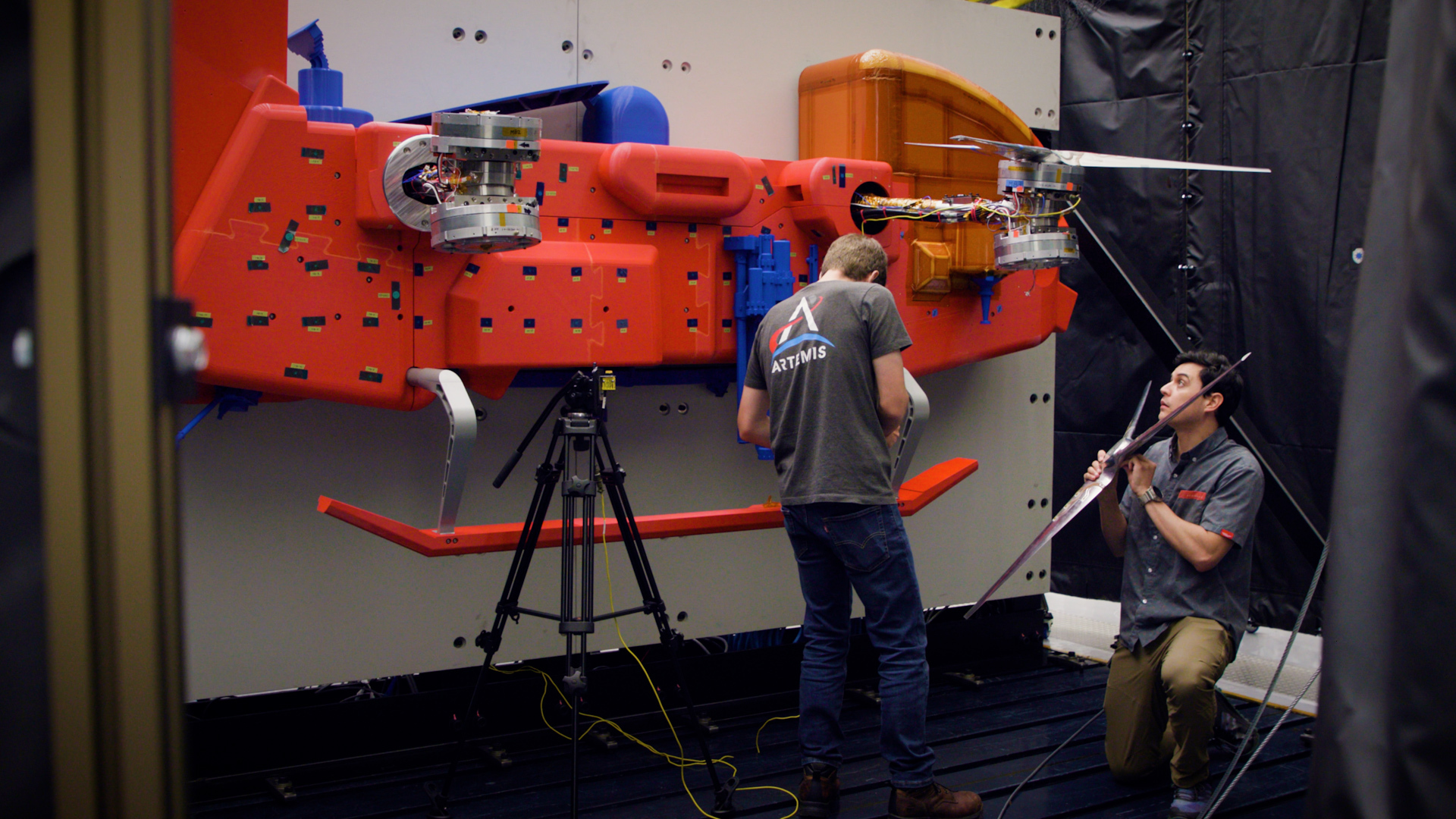
From left, Johns Hopkins APL engineers Tyler Radomsky and Felipe Ruiz install a rotor on the Dragonfly test model at the Transonic Dynamics Tunnel at NASA’s Langley Research Center in Virginia.
NASA
Set for launch in in 2028, the Dragonfly rotorcraft is being designed and built at the Johns Hopkins Applied Physics Laboratory (APL) in Laurel, Maryland, with contributions from organizations around the world. On arrival in 2034, Dragonfly will exploit Titan’s dense atmosphere and low gravity to fly to dozens of locations, exploring varied environments from organic equatorial dunes to an impact crater where liquid water and complex organic materials essential to life (at least as we know it) may have existed together.
Aerodynamic testing
When full rotorcraft integration and testing begins in February, the team will tap into a trove of data gathered through critical technical trials conducted over the past three years, including, most recently, two campaigns at the Transonic Dynamics Tunnel (TDT) facility at NASA’s Langley Research Center in Hampton, Virginia.
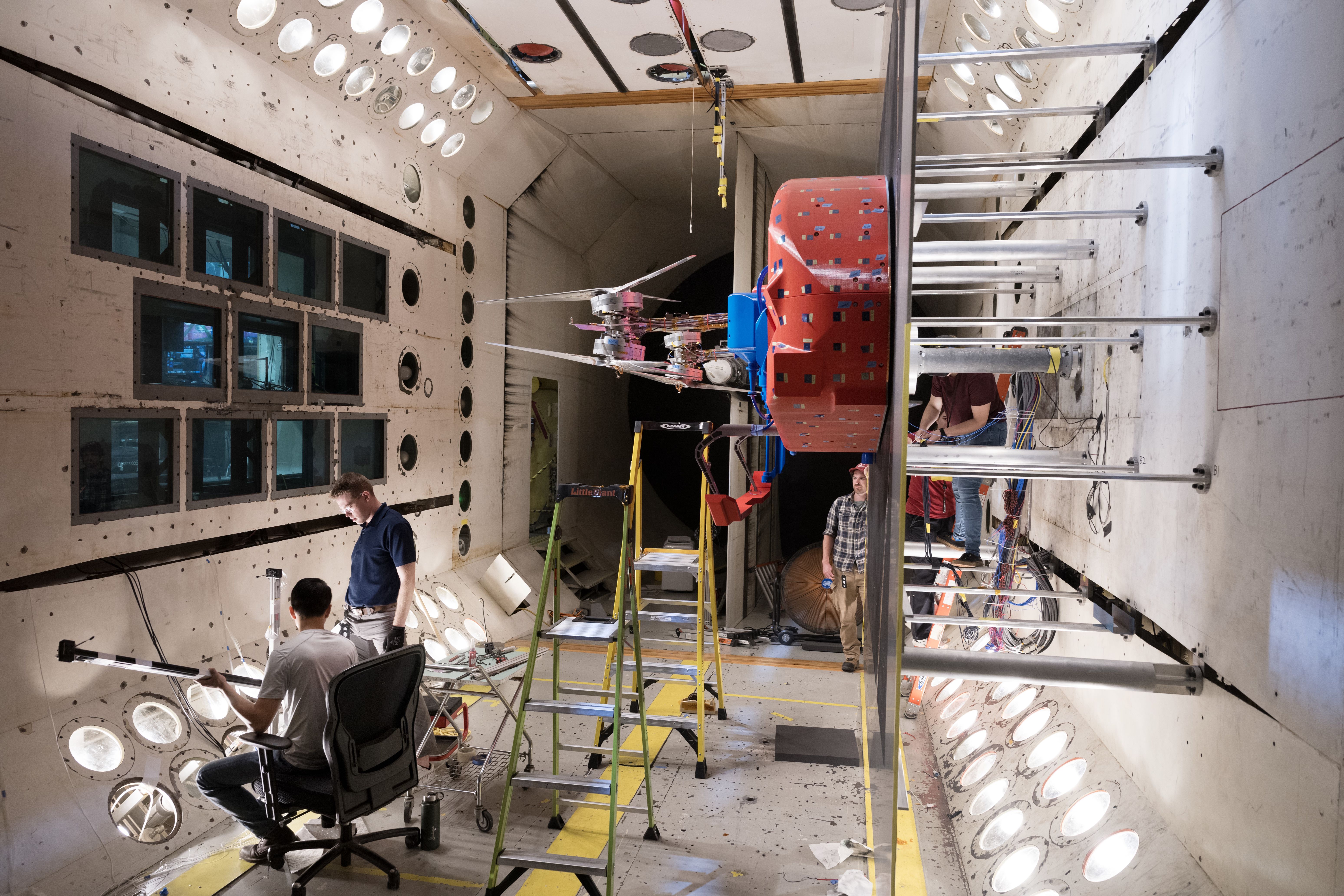
From left, Charles Pheng, Ryan Miller, John Kayrouz, Kristen Carey and Josie Ward prepare for the first aeromechanical performance tests of the full-scale Dragonfly rotors in the Transonic Dynamics Tunnel at NASA’s Langley Research Center in Virginia.
NASA
The TDT is a versatile 16-foot-high, 16-foot-wide, 20-foot-long testing hub that has hosted studies for NASA, the Department of War, the aircraft industry and an array of universities.
Over five weeks, from August into September, the team evaluated the performance of Dragonfly’s rotor system – which provides the lift for the lander to fly and enables it to maneuver – in Titan-like conditions, looking at aeromechanical performance factors such as stress on the rotor arms, and effects of vibration on the rotor blades and lander body. In late December, the team also wrapped up a set of aerodynamics tests on smaller-scale Dragonfly rotor models in the TDT.
“When Dragonfly enters the atmosphere at Titan and parachutes deploy after the heat shield does its job, the rotors are going to have to work perfectly the first time,” said Dave Piatak, branch chief for aeroelasticity at NASA Langley. “There’s no room for error, so any concerns with vehicle structural dynamics or aerodynamics need to be known now and tested on the ground. With the Transonic Dynamics Tunnel here at Langley, NASA offers just the right capability for the Dragonfly team to gather this critical data.”
Critical parts
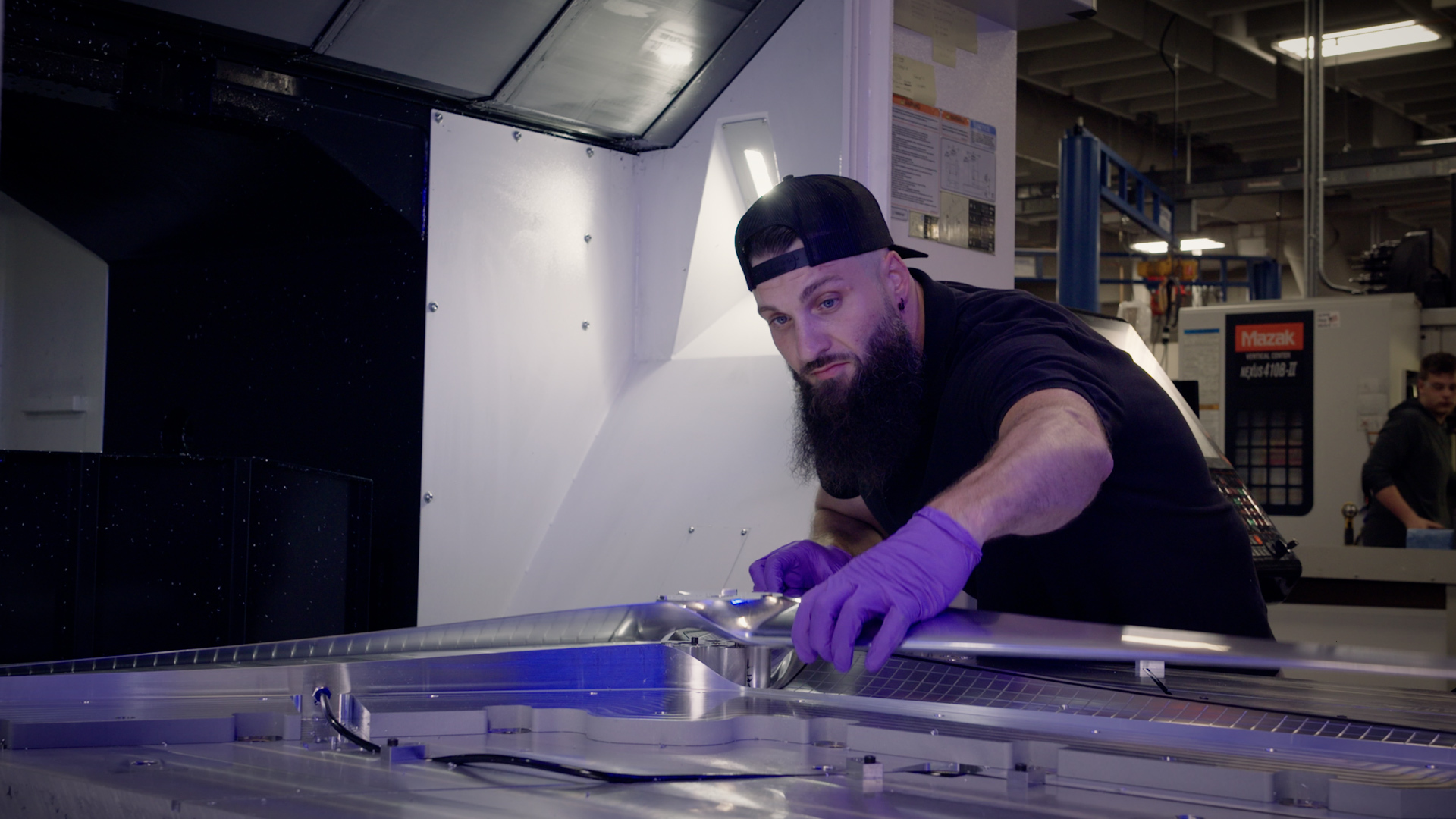
In his three years as an experimental machinist at APL, Cory Pennington has crafted parts for projects dispatched around the globe. But fashioning rotors for a drone to explore another world in our solar system? That was new – and a little daunting.
“The rotors are some of the most important parts on Dragonfly,” Pennington said. “Without the rotors, it doesn’t fly – and it doesn’t meet its mission objectives at Titan.”
Experimental machinist Cory Pennington examines a freshly milled, full-scale Dragonfly rotor in the machine shop at the Johns Hopkins Applied Physics Laboratory (APL) in Laurel, Maryland.
NASA/Johns Hopkins APL
Pennington and team cut Dragonfly’s first rotors on Nov. 1, 2024. They refined the process as they went: starting with waterjet paring of 1,000-pound aluminum blocks, followed by rough machining, cover fitting, vent-hole drilling and hole-threading. After an inspection, the parts were cleaned, sent out for welding and returned for final finishing.
“We didn’t have time or materials to make test parts or extras, so every cut had to be right the first time,” Pennington said, adding that the team also had to find special tools and equipment to accommodate some material changes and design tweaks.
The team was able to deliver the parts a month early. Engineers set up and spin-tested the rotors at APL – attached to a full-scale model representing half of the Dragonfly lander – before transporting the entire package to the TDT at NASA Langley in late July.
“On Titan, we’ll control the speeds of Dragonfly’s different rotors to induce forward flight, climbs, descents and turns,” said Felipe Ruiz, lead Dragonfly rotor engineer at APL.
“It’s a complicated geometry going to a flight environment that we are still learning about. So the wind tunnel tests are one of the most important venues for us to demonstrate the design.”
And the rotors passed the tests.
“Not only did the tests validate the design team’s approach, we’ll use all that data to create high-fidelity representations of loads, forces and dynamics that help us predict Dragonfly’s performance on Titan with a high degree of confidence,” said Rick Heisler, wind tunnel test lead from APL.
Next, the rotors will undergo fatigue and cryogenic trials under simulated Titan conditions, where the temperature is minus 290 degrees Fahrenheit (minus 178 degrees Celsius), before building the actual flight rotors.
“We’re not just cutting metal — we’re fabricating something that’s going to another world,” Pennington said. “It’s incredible to know that what we build will fly on Titan.”
Collaboration, innovation
Elizabeth “Zibi” Turtle, Dragonfly principal investigator at APL, says the latest work in the TDT demonstrates the mission’s innovation, ingenuity and collaboration across government and industry.
“The team worked well together, under time pressure, to develop solutions, assess design decisions, and execute fabrication and testing,” she said. “There’s still much to do between now and our launch in 2028, but everyone who worked on this should take tremendous pride in these accomplishments that make it possible for Dragonfly to fly on Titan.”
When NASA's Dragonfly begins full rotorcraft integration and testing in early 2026, the mission team will tap into a trove of data gathered through critical technical trials conducted over the past three years, including, most recently, a testing campaign in at the Transonic Dynamics Tunnel (TDT) Facility at NASA’s Langley Research Center in Hampton, Virginia.
NASA/Johns Hopkins APL
Dragonfly has been a collaborative effort from the start. Kenneth Hibbard, mission systems engineer from APL, cites the vertical-lift expertise of Penn State University on the initial rotor design, aero-related modeling and analysis, and testing support in the TDT, as well as NASA Langley’s 14-by-22-foot Subsonic Tunnel. Sikorsky Aircraft of Connecticut has also supported aeromechanics and aerodynamics testing and analysis, as well as flight hardware modeling and simulation.
The Johns Hopkins Applied Physics Laboratory (APL) in Laurel, Maryland, leads the Dragonfly mission for NASA in collaboration with several NASA centers, industry partners, academic institutions and international space agencies. Elizabeth “Zibi” Turtle of APL is the principal investigator. Dragonfly is part of NASA’s New Frontiers Program, managed by the Planetary Missions Program Office at NASA Marshall Space Flight Center in Huntsville, Alabama, for the agency’s Science Mission Directorate in Washington.
For more information on NASA’s Dragonfly mission, visit:
A bipartisan group of lawmakers wants the Defense Department and the Department of Veterans Affairs to use a single credentialing and privileging system for medical providers, which would allow clinicians to move between DoD and VA facilities without having to go through months-long approval processes.
Currently, the DoD and the VA rely on separate credentialing and privileging systems to approve their clinicians. But those approvals don’t transfer between the two agencies, forcing providers who switch facilities to restart the approval process from the beginning. The process can take several months, during which clinicians are unable to see patients, which delays access to care and leaves facilities understaffed.
The legislation, introduced by Sens. Jacky Rosen (D-Nev.) and Marsha Blackburn (R-Tenn.), would require DoD and VA to provide Congress with a report on the medical provider credentialing and privileging systems they currently use. The report would assess what data each system stores, how portable provider’s credentialing and privileging information is, how interoperable the systems are and where gaps or limitations exist in their interoperability. It would also require recommendations for scaling those systems with the goal of establishing a single, uniform credentialing and privileging system across both departments.
Under the bill, the Pentagon and the VA would have to jointly select a single credentialing and privileging system by January 2027 and notify Congress that the system is operational by 2028.
“Health care providers shouldn’t be hindered by bureaucratic red tape when caring for the men and women who have bravely served our nation. Our bipartisan legislation would end unnecessary duplication so that medical providers can move between the DoD and VA more quickly, ensuring service members and veterans get the high-quality care they need without delay,” Blackburn said in a statement.
The credentialing process ensures that providers treating service members and veterans meet required qualifications. Meanwhile, privileging determines the medical services a provider can deliver based on their qualifications and experience.
Reps. Greg Murphy (R-N.C.) and Susie Lee (D-Nev.) introduced a companion bill in the House titled the “Department of Defense and Department of Veterans Affairs Medical Credentialing Integration Act of 2025.”
“This legislation is a strategic opportunity for the advancement of healthcare priorities throughout the federal sector healthcare system that strengthens workforce recruitment and retention, refines effective government health agency practices and provides for service members and veterans, all while safeguarding and better utilizing Americans’ hard-earned tax dollars,” Murphy said in a statement.
It is unclear what strategy the lawmakers plan to pursue — while it’s a bipartisan effort, standalone bills often face political hurdles, and lawmakers frequently try to attach such proposals to larger legislative packages like the annual National Defense Authorization Act to increase their chances.
The DoD only recently streamlined its privileging process, which now allows medical providers to move between military treatment facilities with minimal administrative delays.
As of October, providers no longer have to reapply for their clinical privileges when moving within the enterprise, including across stateside and overseas military hospitals and clinics.
“Health care providers should be able to focus on their patients. With portable privileges, they can do so more quickly,” Stephen Ferrara, acting assistant secretary of defense for health affairs, said in a statement. “Enterprise-wide privileging is just one of many efforts to make the Military Health System more agile. Previously, our health care providers renewed their privileges every two years. With this expanded policy, we have extended the renewal window to three years to reduce their administrative load.”
The Military Health System said the process of obtaining clinical privileges remains the same under the new policy.
Jupiter beams bright, Saturn and the Moon cozy up, and the Beehive Cluster appears
Jupiter is at its biggest and brightest all year, the Moon and Saturn pair up, and the Beehive Cluster buzzes into view.
Skywatching Highlights
Jan. 10: Jupiter at opposition
Jan. 23: Saturn and Moon conjunction
Jan. (throughout): Beehive Cluster
Transcript
Jupiter is at its biggest and brightest
The Moon and Saturn share the sky
And the beehive cluster makes an appearance
That’s what’s up, this January
January 10, Jupiter will be at its most brilliant of the entire year!
This night, Jupiter will be at what’s called “opposition,” meaning that Earth will be directly between Jupiter and the Sun.
NASA/JPL-Caltech
In this alignment, Jupiter will appear bigger and brighter in the night sky than it will all year – talk about starting off the new year bright!
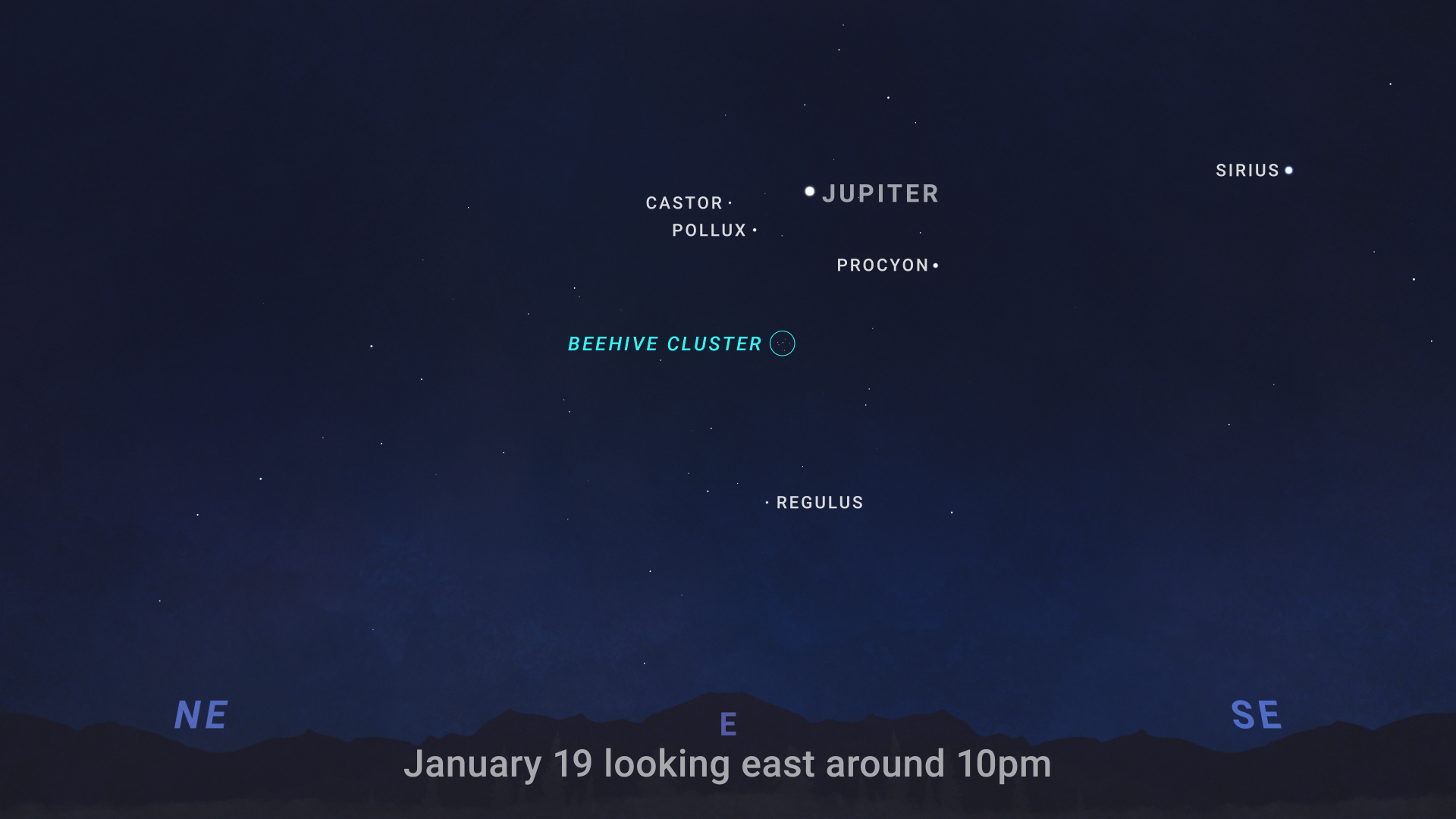
To see Jupiter at its best this year, look to the east and all evening long, you’ll be able to see the planet in the constellation Gemini. It will be one of the brightest objects in the night sky (only the moon and Venus will be brighter)
Saturn and the Moon will share the sky on January 23rd as part of a conjunction!
NASA/JPL-Caltech
A conjunction is when objects in the sky look close together even though they’re actually far apart.
To spot the pair, look to the west and you’ll see Saturn just below the moon, sparkling in the night sky.
The beehive cluster will be visible in the night sky throughout January!
The beehive cluster, more formally known as Messier 44, or M44, is made of at least 1,000 stars
It’s an open star cluster, meaning it’s a loosely-bound group of stars. There are thousands of open star clusters like the beehive in the Milky Way Galaxy!
NASA/JPL-Caltech
To see the beehive cluster, look to the eastern night sky after sunset and before midnight throughout the month – especially great nights to spot the cluster are around the middle of January when the cluster isn’t too high or low in the sky to see.
With dark skies you might be able to spot the beehive with just your eyes, but binoculars or a small telescope will help.
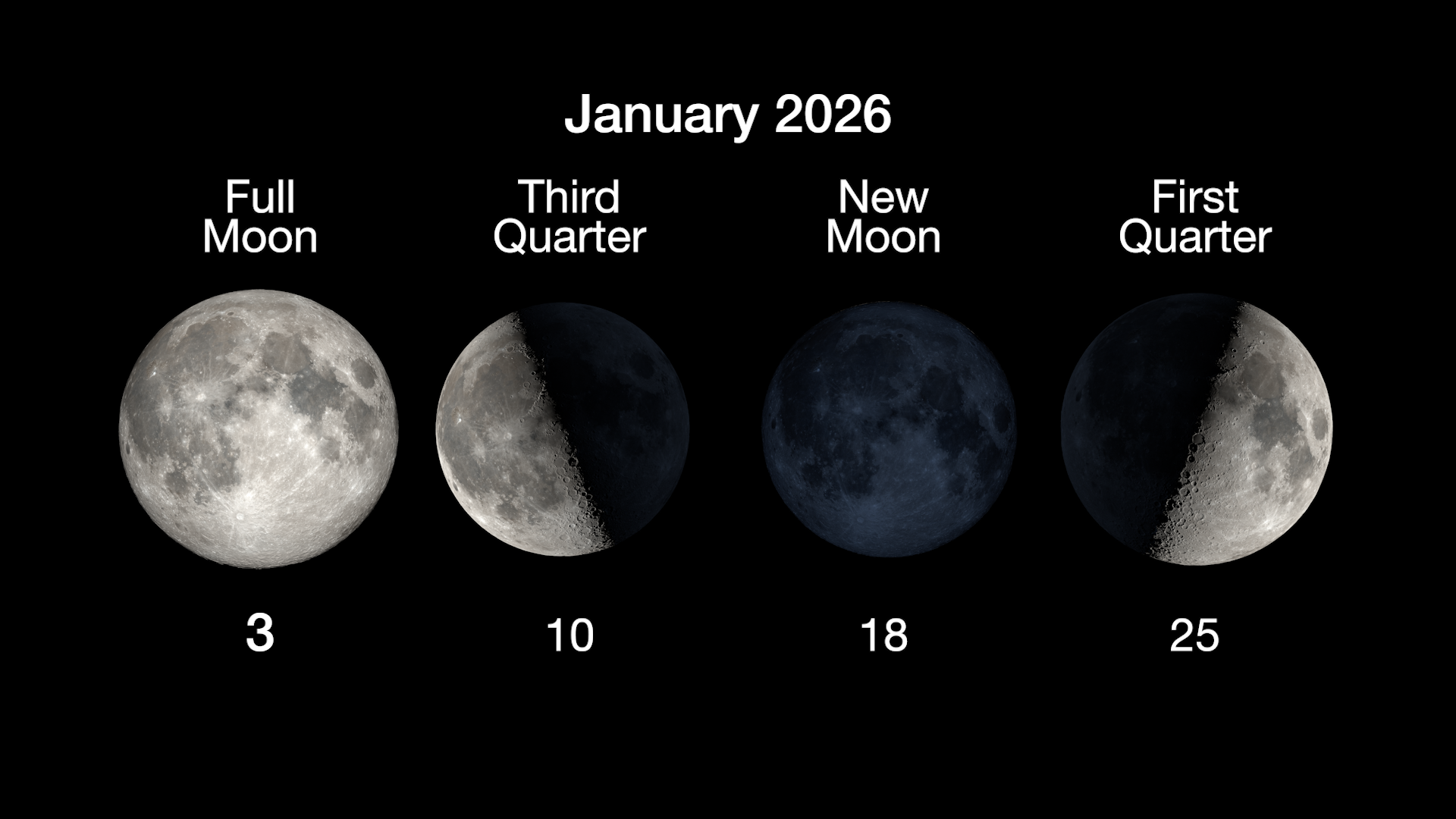
Here are the phases of the Moon for January.
NASA/JPL-Caltech
You can stay up to date on all of NASA’s missions exploring the solar system and beyond at science.nasa.gov.
I’m Chelsea Gohd from NASA’s Jet Propulsion Laboratory, and that’s What’s Up for this month.
Smoky Chipotle Garlic Sauce because Patti and I both love garlic (good thing) and our Smoked Garlic Sauce is pure garlic heaven! Again, I have been thinking on how I can make even better. I love the smoky flavor of chipotle, what do you think of a Smoky Chipotle Garlic Sauce? Perfect. OFF THE HOOK!!! […]

 Login
Login