
Normal view

There are new articles available, click to refresh the page.
Before yesterdayMain stream

Aave Hands Lens to Mask Network, Doubles Down on DeFi Ambitions

21 January 2026 at 09:28

Aave has handed stewardship of the Lens Protocol to Mask Network, marking a strategic shift that narrows Aave’s focus back to decentralized finance.

This will place the next phase of decentralized social development in the hands of a team more tightly focused on consumer-facing execution.

The transition was confirmed this week by statements from Aave and Lens founder Stani Kulechov, as well as from Mask Network.

Aave Keeps Advisory Role while giving Lens App Development to Mask Network

Kulechov said Aave’s role in Lens will now be limited to technical advisory support, describing the move as a refocus rather than a retreat.

He explained that Aave initially expanded beyond onchain financial primitives to build social primitives that users could own, resulting in the creation of Lens.

Over the years, we have built some of the most important onchain financial primitives. We later expanded that ambition to social primitives that users truly own.

We built the Lens Protocol and its underlying onchain rails, including state-of-the-art decentralized data storage… https://t.co/g0zLIUlaBh

— Stani.eth (@StaniKulechov) January 20, 2026

The original aim, he said, was to create neutral social infrastructure that developers could rely on to build consumer-grade applications capable of reaching mainstream users.

With that foundation now in place, stewardship is shifting to Mask Network, which will lead development at the application and product layer while Aave returns to its core expertise in DeFi.

Both Aave and Lens emphasized that the move is not an acquisition, sale, or exit. There was no indication of a transfer of protocol ownership, intellectual property, treasuries, or governance control.

Lens’ core components, including its onchain social graph, profiles, follows, and smart contracts, will remain open-source and permissionless.

Aave said it will continue to provide input on protocol-level decisions but will no longer lead product development or operate social applications directly.

Mask Network, a Web3 company known for integrating blockchain features into social and messaging platforms, will now assume responsibility for consumer-facing execution.

This includes product roadmap decisions, user experience design, and day-to-day operational leadership for social applications built on Lens, such as Orb.

In a statement announcing the transition, Lens said the ecosystem’s next phase requires less protocol experimentation and more focus on unified social experiences that can operate at scale and meet user expectations.

Lens was launched by Aave in 2022 as a Web3-native social protocol designed to give users ownership over their social identities and content through onchain profiles and NFTs.

From the outset, it was positioned as infrastructure rather than a standalone social network.

Lens Enters Its Next Chapter as Decentralized Social Gains Momentum

Since launch, Lens has grown into one of the most widely used decentralized social protocols. Early builder adoption was rapid, with more than 50 projects built on Lens shortly after launch.

By early 2023, the protocol had surpassed 100,000 minted profiles and supported more than 120 applications.

Lens later migrated to Polygon mainnet, rolled out V2 and V3 upgrades, and introduced Lens Chain, a purpose-built network powered by ZKsync and Avail, aimed at improving scalability, speed, and monetization.

Lens uses GHO as gas, enabling near-instant, low-cost transactions, and includes decentralized storage through Grove and features like Family Accounts.

The handover to Mask Network comes as decentralized social regains attention across the crypto industry.

Ethereum co-founder Vitalik Buterin said he plans to spend more time on decentralized social platforms in 2026, arguing that better mass communication tools are needed and that decentralization enables competition by allowing multiple clients to build on shared data layers.

In 2026, I plan to be fully back to decentralized social.

If we want a better society, we need better mass communication tools. We need mass communication tools that surface the best information and arguments and help people find points of agreement. We need mass communication… https://t.co/ye249HsojJ

— vitalik.eth (@VitalikButerin) January 21, 2026

Mask Network founder Suji Yan described the transition as aligned with the cypherpunk values at the heart of crypto, saying decentralized social should be part of everyday life rather than limited to financial products.

🫡🫡

Lens stands for decentralization and the cypherpunk spirit at the heart of blockchain/crypto.

Crypto shouldn’t be just financial products — it should be part of everyday life, in every post, every interaction. Own your post – and make SocialFi great again.

Honored to… https://t.co/EjR7PFqWjB

— Suji Yan 💜🔥🎭 (@suji_yan) January 20, 2026

He said Mask Network intends to focus on building consumer-ready SocialFi applications that bring Lens from infrastructure into daily use.

The post Aave Hands Lens to Mask Network, Doubles Down on DeFi Ambitions appeared first on Cryptonews.
ASTER Slumps 75% to New Lows as Hyperliquid Pulls Ahead — Is the Perp DEX Race Already Over?

19 January 2026 at 09:44

A sharp sell-off in Aster’s token is drawing fresh attention to the decentralized perpetuals trading sector, even as overall derivatives activity remains historically high.

ASTER fell roughly 75% from its peak to trade near new lows this week, showing the growing gap between platforms that are capturing durable trading interest and those struggling to hold on once incentives fade.

The decline has unfolded as Hyperliquid extends its lead over rivals, raising questions about whether the race among perp-focused decentralized exchanges is already tilting decisively in one direction.

Hyperliquid Pulls Ahead as ASTER Selloff Deepens

At the time of writing, ASTER was trading around $0.62, down more than 13% over the past 24 hours. The decline follows weeks of sustained weakness, with the token down over 11% in the last seven days and nearly 74% below its all-time high of $2.41.

Source: Coingecko

Trading activity surged during the selloff, with 24-hour volume jumping more than 300% to over $300 million, pointing to heightened short-term positioning rather than a recovery in confidence.

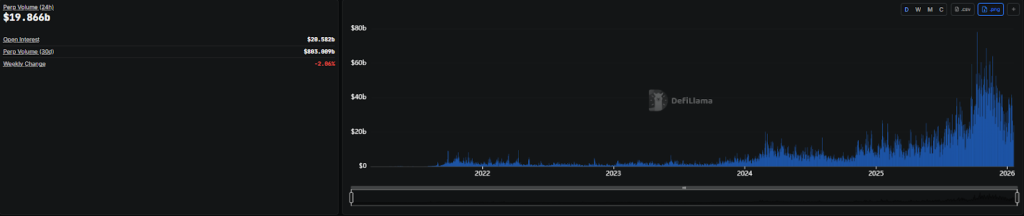
Data from DefiLlama shows that the overall activity in the sector continues to explode, with cumulative perp volume exceeding $803 billion over 30 days.

Total perp trading volume over the past 24 hours stood near $19.9 billion, while open interest reached about $20.6 billion.

Source: DefiLlama

Market data shows Hyperliquid pulling further ahead in both trading volume and open interest, two metrics that traders tend to treat differently.

Over the past seven days, Hyperliquid processed about $40.7 billion in perpetual futures volume, according to figures compiled from CryptoRank and DefiLlama.

That compared with roughly $31.7 billion on Aster and $25.3 billion on Lighter over the same period.

Hyperliquid reclaims the perps throne

As Lighter’s airdrop is distributed, the platform’s volumes have started to fade – weekly volume has decreased nearly 3x from its peak.@HyperliquidX has captured the lead and is now ranked 1st by volume and open interest.@variational_iopic.twitter.com/LChbSdaU8a

— CryptoRank.io (@CryptoRank_io) January 18, 2026

The divergence becomes more pronounced when looking at open interest, which reflects where traders are willing to keep leveraged positions open rather than simply rotate trades.

Hyperliquid recorded about $9.57 billion in open interest over the past 24 hours, exceeding the combined $7.34 billion held across rival platforms, including Aster, Lighter, Variational, edgeX, and Paradex.

The widening gap suggests traders are increasingly using Hyperliquid as a primary venue to hold leveraged positions, rather than simply rotating capital in search of short-term incentives.

The shift has become more apparent as reward-driven activity cools across the sector.

Buybacks Roll Out as Unlocks Cloud Perp DEX Outlook

Lighter, which saw a surge in trading ahead of its airdrop late last year, has experienced a sharp slowdown since the distribution, with weekly volumes falling significantly from their December highs.

Also, the LIT token has dropped to new lows, losing more than a third of its value over the past month as a significant share of airdropped tokens moved into the market.

In an effort to support its token, Aster recently activated what it calls a Strategic Buyback Reserve.

We're now actively deploying our Strategic Buyback Reserve for $ASTER token repurchases automatically.

Building on our Stage 5 Buyback Program announced last month, this activation allocates 20-40% of daily platform fees into targeted buybacks, responding dynamically to market… https://t.co/cIbles9eHM

— Aster (@Aster_DEX) January 19, 2026

The program builds on a broader buyback framework announced in December, under which up to 80% of daily fees can be directed to automatic and discretionary buybacks, all executed on-chain.

However, the scale of upcoming token unlocks remains a central concern for the market.

Aster has significant token unlocks scheduled through 2026, including quarterly releases of roughly 183 million ASTER in January and April, followed by additional large releases mid-year and ongoing monthly emissions.

Although the team previously delayed unlocks to build utility and reduce near-term pressure, the scale of upcoming supply has become a focal point for traders assessing downside risk.

While incentive-driven activity has cooled across the sector, Hyperliquid has continued to attract capital even as its token, HYPE, has weakened alongside the broader market.

The post ASTER Slumps 75% to New Lows as Hyperliquid Pulls Ahead — Is the Perp DEX Race Already Over? appeared first on Cryptonews.

UK drops mandatory digital ID for workers after backlash and liberty concerns

14 January 2026 at 06:15
  • Almost three million people signed a parliamentary petition opposing mandatory digital ID cards.
  • Digital right-to-work checks will remain mandatory under the updated policy approach.
  • The UK digital ID scheme, expected around 2029, will be offered as optional alongside electronic alternatives.

The UK government, led by Prime Minister Keir Starmer, has dropped plans to make a centralised digital ID mandatory for workers, stepping back from a proposal that would have changed how employees prove their right to work.

Under the original plan, workers would have been required to use a government-issued digital credential, rather than relying on traditional documents such as passports.

The reversal follows months of criticism from politicians and civil liberties campaigners, as well as a large-scale public response that questioned whether employment access should depend on one centralised system.

Critics warn of surveillance and data security risks

The mandatory digital ID proposal drew backlash from opponents across the political spectrum, including UK Member of Parliament Rupert Lowe and Reform UK leader Nigel Farage.

Civil liberties groups and campaigners also raised concerns about how a centralised identifier could be used over time.

Opponents warned it could lead to an “Orwellian nightmare” by giving the state a stronger ability to monitor citizens.

Another major fear was that centralising sensitive personal data could create a single “honeypot” vulnerable to hacking and misuse.

Critics also pointed to the risk of mission creep, where a scheme launched for employment checks could gradually expand into other areas, including housing, banking, and voting.

Petition pressure forces a policy climbdown

Public resistance to mandatory digital ID became visible through formal political channels.

Almost three million people signed a parliamentary petition opposing digital ID cards, making the issue difficult for ministers to ignore.

Lowe celebrated the policy shift in a video posted on X, saying he was off for “a very large drink to celebrate the demise of mandatory Digital ID”.

Farage also backed the rollback, calling it “a victory for individual liberty against a ghastly, authoritarian government”.

Digital right-to-work checks stay mandatory from government

Despite dropping plans for a mandatory digital ID credential, officials say digital right-to-work checks will remain mandatory.

That means the government is still committed to keeping employment verification in a digital process, even if it is no longer built around a single government ID system.

When the UK’s digital ID scheme launches around 2029, it is now expected to be optional rather than compulsory.

Instead of becoming the only approved route for proving work eligibility, it will be offered alongside alternative electronic documentation.

Digital euro, EU identity, and crypto privacy debates return

The UK’s partial rollback is also feeding into wider debates about digital control systems, including central bank digital currencies and the European Central Bank’s digital euro project.

In those discussions, civil society groups and some lawmakers have argued for strict privacy guarantees rather than systems that could allow broad traceability.

At the same time, the European Union is moving ahead with its own digital identity framework and digital euro work, while exploring privacy-preserving designs.

One approach includes using zero-knowledge proofs, allowing citizens to prove attributes such as age or residency without revealing their full personal information.

These designs connect to decentralised identity tools and privacy-preserving blockchain technologies, including zero-knowledge credential systems and privacy-enhancing smart contract structures.

The aim is to support compliance while minimising how much personal data is exposed or stored in one place.

Privacy-focused crypto tools have also remained in focus, including privacy coins such as Zcash (ZEC) and Monero (XMR), alongside decentralised identity protocols.

Interest in these tools has continued as regulators step up scrutiny of DeFi and explore identity checks for self-hosted wallets.

The US Treasury’s proposed DeFi ID framework, alongside renewed attention on privacy tokens, shows how policymakers are testing stronger Anti-Money Laundering and Know Your Customer controls on-chain, even as builders push alternative designs.

The post UK drops mandatory digital ID for workers after backlash and liberty concerns appeared first on CoinJournal.

Truebit protocol hack exposes DeFi security risks as TRU token collapses

9 January 2026 at 03:48
  • The TRU token collapsed from $0.1659 to near zero, wiping out market value.
  • Liquidity on decentralised exchanges dried up following the exploit.
  • The attacker wallet was linked to a Sparkle protocol attack 12 days earlier.

A serious security breach at Truebit Protocol has triggered one of the sharpest collapses seen in decentralised finance this year.

The blockchain project, which focuses on verified computing, lost around $26.5 million after an attacker exploited a weakness in its smart contract system.

The incident sent the protocol’s native TRU token crashing to near zero and left liquidity across decentralised exchanges severely strained.

On-chain movements following the exploit show how quickly funds were siphoned away, highlighting ongoing risks around smart contract design and monitoring across the DeFi sector.

How the exploit unfolded

The breach was first flagged by blockchain security firm PeckShield, which detected a series of suspicious transactions on the Ethereum network.

Analysis showed that the attacker drained nearly 8,500 ETH from Truebit Protocol.

At the time of the exploit, the stolen cryptocurrency was valued at about $26.5 million.

On-chain data indicates that the funds were quickly split and transferred to two separate wallet addresses, identified as 0x2735…cE850a and 0xD12f…031a60.

Dividing funds in this way is a commonly used technique to complicate tracking and reduce the chances of recovery.

PeckShield’s preliminary findings suggest the exploit targeted a flaw within the protocol’s contract structure, although a detailed technical breakdown has not yet been published.

Token collapse and liquidity shock

The market impact was immediate. Truebit’s native TRU token suffered a near-total collapse, falling from a daily high of $0.1659 to a low of $0.000000018.

The move effectively erased the token’s market capitalisation within hours.

Liquidity across decentralised exchanges also dried up rapidly.

With pools depleted and confidence shaken, many token holders were unable to exit positions.

The episode underlined how tightly token valuations are linked to protocol security, particularly for smaller DeFi projects where confidence can evaporate quickly once an exploit is confirmed.

Protocol response and containment steps

After the breach, Truebit Protocol issued an official update acknowledging the incident.

The team confirmed that a specific smart contract had been compromised and warned users not to interact with it until further notice.

The protocol stated that it is working alongside law enforcement authorities and taking steps to limit further damage.

Users were also advised to rely only on official communication channels for updates as investigations continue.

No timeline has yet been shared for remediation or potential recovery efforts.

Link to earlier DeFi attack

PeckShield further reported that the wallet involved in the Truebit exploit had been connected to a separate attack on the Sparkle protocol roughly 12 days earlier.

In that case, the attacker acquired tokens and later routed funds through Tornado Cash, a privacy service often used to obscure transaction trails.

The repeated use of similar techniques points to an experienced exploiter actively scanning for vulnerabilities.

The connection has raised broader concerns across the DeFi ecosystem, where a series of linked attacks can amplify risk perception beyond the affected projects.

The post Truebit protocol hack exposes DeFi security risks as TRU token collapses appeared first on CoinJournal.

Aave charts post-SEC expansion as DeFi lender sharpens growth strategy

17 December 2025 at 04:26
  • The strategy focuses on a major protocol upgrade, real-world asset lending, and mobile adoption.
  • Aave V4 aims to unify cross-chain liquidity and simplify development.
  • Horizon targets faster growth in tokenised real-world asset markets through institutional partners.

Aave is setting out its next phase of expansion as regulatory uncertainty in the US eases for the decentralised finance protocol.

Founder and chief executive Stani Kulechov on Dec. 17 detailed what he described as a “2026 Master Plan”, one day after the US Securities and Exchange Commission formally dropped its long-running investigation into the platform.

The update comes after what Aave described as its strongest year so far, with 2025 marked by record net deposits and billions of dollars in activity processed across the protocol.

With the regulatory probe no longer hanging over the project, Aave’s leadership is now focusing on scaling its technology, widening its institutional footprint, and pushing further into consumer-facing products.

According to Kulechov’s post on X, Aave’s strategy for 2026 rests on three core priorities: a major protocol upgrade, the expansion of tokenised real-world asset markets, and broader user adoption through a mobile app.

Aave V4 upgrade

The first pillar of the roadmap is Aave V4, the next major iteration of the lending protocol.

The upgrade is designed to introduce cross-chain liquidity, a modular architecture, and deeper customisation for developers and partners.

Aave Labs, the core development team, had already published a V4 launch roadmap in September, outlining final testing and review phases.

A central feature is the Cross-Chain Liquidity Layer, which builds on earlier versions of the protocol to address fragmented liquidity across different blockchains.

Under the new design, liquidity pools are reorganised into capital hubs on each network, with specialised spokes layered on top to support tailored lending markets for specific asset types.

The structure is intended to support significantly larger volumes of capital while simplifying how new products are launched on Aave.

The upgrade also includes new cross-chain interfaces and a revamped developer experience, which Aave expects will make integrations easier for fintech firms, enterprises, and other large-scale users.

Horizon and institutional markets

The second focus area is Horizon, Aave’s decentralised lending market for tokenised real-world assets.

Horizon is positioned as a gateway for traditional financial institutions to access DeFi infrastructure while bringing off-chain assets on-chain.

Horizon launched on Aug. 27 and surpassed $50 million in deposits by September 1, with most of the early liquidity arriving in RLUSD and USDC. Since then, net deposits have grown to around $550 million.

Aave plans to accelerate Horizon’s growth in 2026, with a stated aim of pushing deposits beyond $1 billion.

The strategy involves expanding collaborations with established financial players including Circle, Ripple, Franklin Templeton, and VanEck.

Through these partnerships, Aave intends to onboard major global asset classes and expand its reach into a real-world asset market estimated at more than $500 trillion.

Aave App and user growth

The third pillar of the roadmap targets consumer adoption through the Aave App. Launched in mid-November, the app offers a banking-style savings experience designed to make decentralised lending more accessible to non-crypto-native users.

The app is currently available on the Apple App Store and is expected to see a broader rollout next year.

Aave is targeting a user base of one million as it seeks a foothold in the global mobile fintech market, which it estimates at about $2 trillion.

The push reflects Aave’s view that long-term scaling depends on product-level adoption, not just protocol-level liquidity.

The post Aave charts post-SEC expansion as DeFi lender sharpens growth strategy appeared first on CoinJournal.

❌
❌