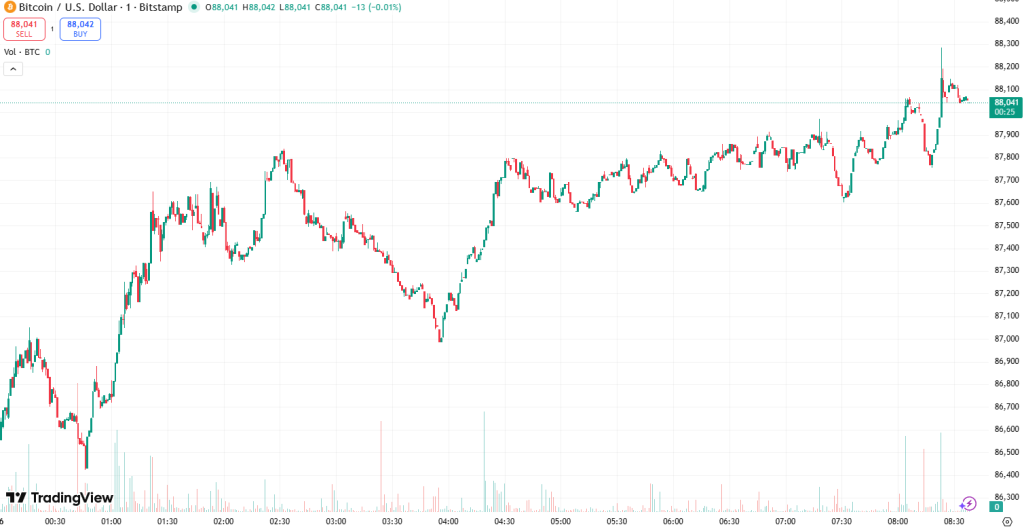
Bitcoin saw choppy trade after a sharp dip and rebound, with bulls defending a key support zone while indicators stayed bearish. Bitcoin traded modestly lower over the past 24 hours, slipping about 1.0% to around $87,814 after a sharp mid-session selloff and a subsequent rebound.
XRP is once again attracting heightened attention in the crypto market, as the broader crypto market suffers another round of downturn. Following a multi-month pullback from its 2025 high of $3.65, XRP is currently trading below $1.9, succumbing to renewed bearish pressure over the weekend.
Most institutional investors remain bullish on Bitcoin despite brutal fourth-quarter volatility that erased nearly a third of the asset’s value from recent peaks.
A new Coinbase Institutional and Glassnode survey found 70% of institutions view BTC as undervalued, even after the token dropped from above $125,000 in early October 2025 to trade around $90,000 by year-end, while 60% of non-institutional investors share that conviction.
Source: Coinbase Institutional
The findings come from a quarterly poll of 148 global investors, split between 75 institutions and 73 non-institutions, conducted between December 10, 2025, and January 12, 2026.
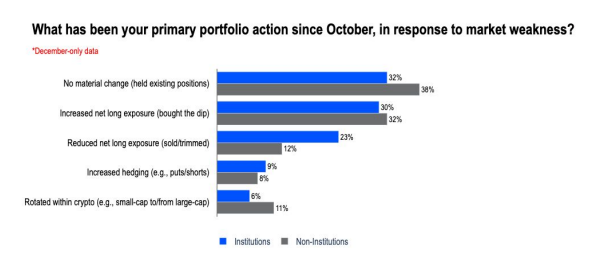
Despite the October liquidation event that shook altcoin markets and compressed leverage across derivatives platforms, most respondents held or added to crypto positions rather than retreating.
Around 62% of institutions and 70% of non-institutions either maintained existing allocations or increased net long exposure since October.
Source: Coinbase Institutional
Bearish Sentiment Rises, But Doesn’t Dominate Positioning
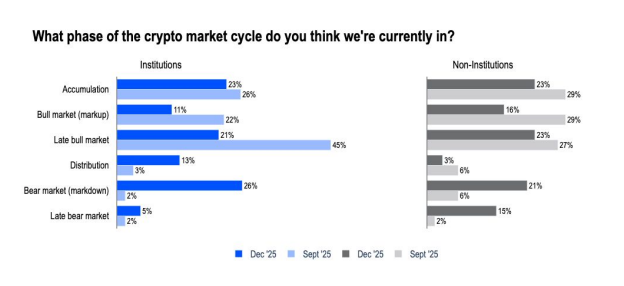
Perceptions of the market cycle shifted noticeably during the quarter.
Around 26% of institutions and 21% of non-institutions now believe crypto has entered the bear-market markdown phase, up sharply from just 2% and 7%, respectively, in the prior survey.
Source: Coinbase Institutional
That shift exposes the weight of October’s deleveraging event, which saw the Altcoin Season Index plummet and mid-cap tokens struggle to recover their third-quarter gains despite the launch of several spot altcoin ETFs in the US.
Still, the uptick in bearish views did not translate into widespread selling. Most investors stuck with their positions, and sentiment toward Bitcoin specifically remained constructive.
“We have a constructive view for 1Q26,” Coinbase Global Head of Research David Duong wrote in the report. “We believe that crypto markets are entering 2026 in a healthier state, with excess leverage having been flushed from the system in Q4.“
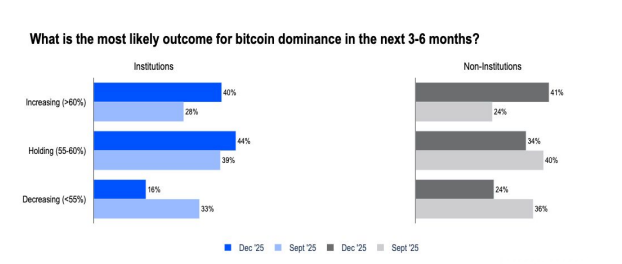
Bitcoin dominance held relatively steady through the turbulence, rising only marginally from 58% to 59% over the quarter, a sign that institutional capital continued to favor the largest digital asset even as smaller tokens faced sustained selling pressure.
Source: Coinbase Institutional
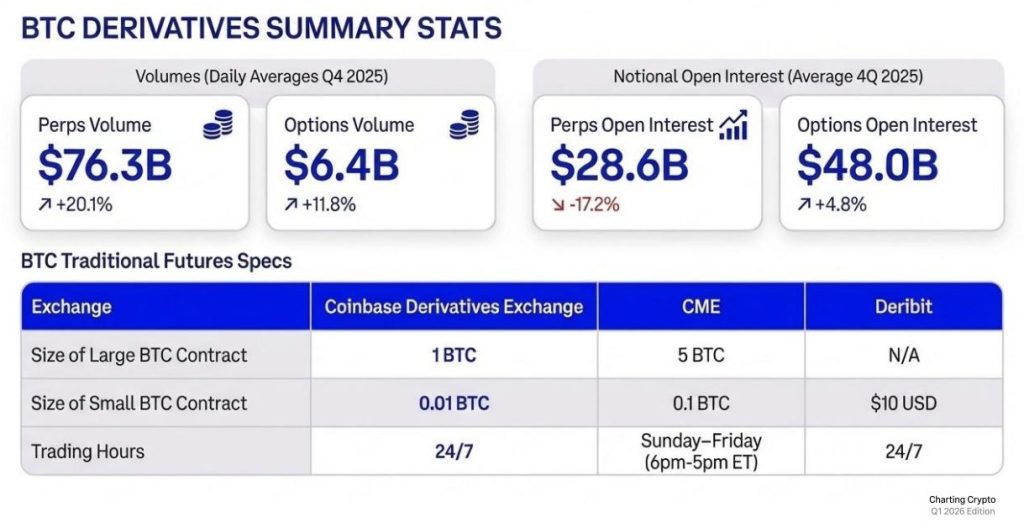
Open interest in BTC options overtook perpetual futures as market participants sought downside protection, with the 25-day put-call skew staying positive across 30-day, 90-day, and 180-day expiries.
Source: Coinbase Institutional
Coinbase Survey Points to Macro Support and Policy Progress
Several factors underpinned the optimistic outlook. Inflation held steady at 2.7% in December’s Consumer Price Index reading, and the Atlanta Fed’s GDPNow model projected robust 5.3% real GDP growth for the fourth quarter as of January 14.
While the future direction of monetary policy remained uncertain, Duong said the firm still expects the Federal Reserve to deliver two rate cuts totaling 50 basis points currently priced into Fed funds futures, “which should provide a tailwind for risk assets broadly and crypto specifically.“
Questions about comprehensive crypto market structure legislation persist, but confidence in eventual regulatory clarity stayed firm.
“We’re confident that we will eventually see a set of rules that allows the industry to reach its full potential,” the report stated, noting that major policy progress in the US, particularly around the proposed CLARITY Act, could boost investor sentiment further.
Beyond the survey, separate data shows institutional engagement deepening across channels.
Similarly, a separate Coinbase survey found that younger US investors now allocate 25% of their portfolios to non-traditional assets, compared with 8% among older cohorts.
Risks Remain, But Long-Term Trajectory Holds
The Coinbase report acknowledged headwinds. While the economy appears solid, the jobs market cooled in 2025, with the US adding just 584,000 positions, down from 2 million in 2024, partly due to increased AI adoption.
Geopolitical tensions have flared in several regions, and any escalation that disrupts energy markets could dampen investor appetite.
“A meaningful uptick in inflation, a spike in energy prices, or a significant flare up of geopolitical tensions could warrant a more cautious approach to risk assets,” the report warned.
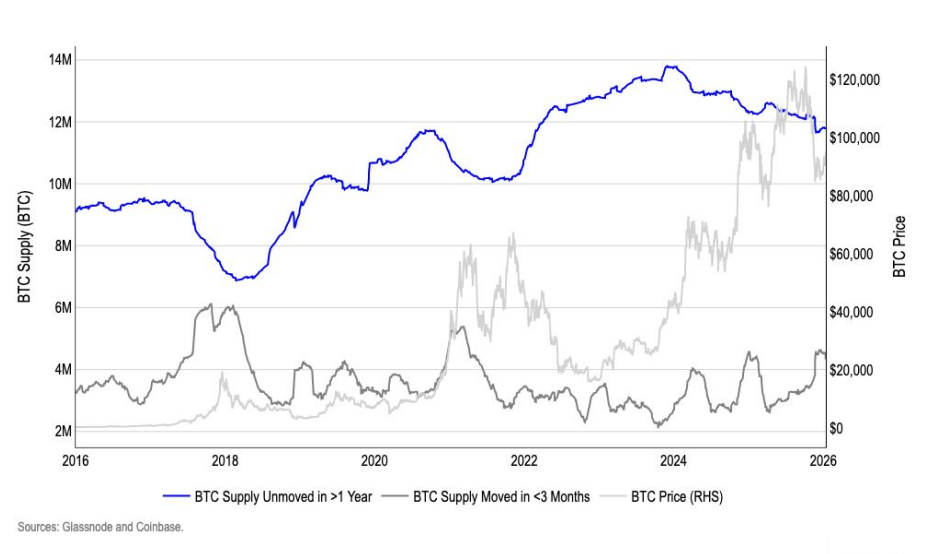
Still, onchain metrics improved after October’s shakeout. Bitcoin supply moved within three months, surged 37% in the fourth quarter, while coins unmoved for over a year fell 2%, indicating short-term distribution that likely cleared weaker hands.
Source: Coinbase Institutional
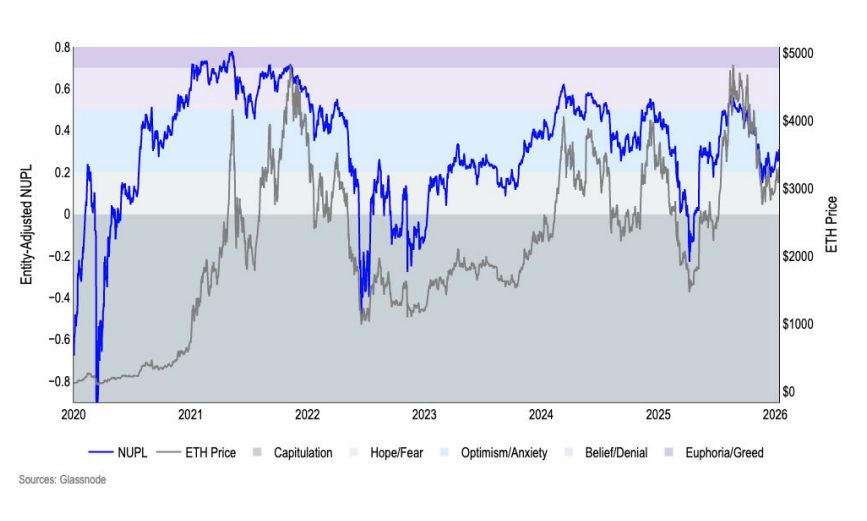
Ethereum’s Net Unrealized Profit/Loss ratio swung sharply through 2025, hitting capitulation in the first quarter, then rising to optimism in the third quarter, and settling back into fear territory by year-end.
Polymarket has re-entered the U.S. market following regulatory approval from the Commodity Futures Trading Commission (CFTC), a move that could position prediction markets as a new engagement tool for major crypto platforms such as Coinbase, according to a report by Clear Street analyst Owen Lau.
The prediction market operator which was restricted from serving U.S. customers in 2022, has returned after receiving a CFTC approval of an Amended Order of Designation.
Polymarket has now launched a U.S.-based application initially offering a limited set of sports-related event contracts, with additional verticals such as politics and crypto expected over time.
Lau describes the development as a meaningful reversal allowing Polymarket to onboard brokerages and customers directly while facilitating trading on regulated U.S. venues.
Polymarket’s comeback is accompanied by a notably aggressive pricing structure. The platform is offering 10 basis point taker fees and zero maker fees which Lau believes is the lowest among major prediction market and sports betting platforms.
For comparison, DraftKings and FanDuel reported net revenue margins of 6.7% and 10.1%, respectively. Lau said Polymarket’s pricing makes it a credible alternative to incumbent sports betting operators and signals increasing fee compression across event-based trading markets.
State-Level Regulatory Risk Remains Fragmented
While the CFTC approval may suggest improved federal-level clarity for certain event contracts, Lau cautioned that regulatory risk remains uneven at the state level.
On Jan. 20, 2026, a Massachusetts judge granted an injunction preventing rival platform Kalshi from offering sports-related event contracts in the state.
More broadly, at least three states — Massachusetts, Nevada, and Maryland — have issued unfavorable rulings against prediction market platforms, highlighting continued fragmentation across U.S. jurisdictions. This patchwork environment could complicate the sector’s expansion even as federal oversight becomes clearer.
Coinbase Seen as Key Distribution Partner
Lau argues that these developments represent an opportunity for Coinbase and indirectly Circle to partner with Polymarket or other prediction market platforms.
Coinbase’s scale — more than 100 million verified users and 9.3 million monthly transacting users — provides a sizable and relevant distribution base for event contracts. In his note, Lau suggests that prediction markets could benefit from being embedded into larger platforms with existing user engagement.
However, he notes that prediction markets may not become major standalone profit centers in the near term. Instead, Lau expects them to serve primarily as engagement and retention tools within Coinbase and other integrated platforms, helping drive activity and user stickiness amid rising competition.
As prediction markets expand beyond sports into politics and crypto, Polymarket’s U.S. return could mark a new phase for event-based trading — even as regulatory uncertainty continues to shape the sector’s trajectory.
The crypto market is down today again. The cryptocurrency market capitalisation decreased by 0.8% over the past 24 hours, now standing at $3.05 trillion. At the time of writing, 93 of the top 100 coins recorded price drops. The total crypto trading volume stands at $139 billion.
TLDR:
Crypto market cap is down 0.8% on Monday morning (UTC);
93 of the top 100 coins and all top 10 coins are down;
BTC decreased by 0.7% to $87,860 and ETH fell by 1.5% to $2,89;
ETH will more likely revisit $2,000 than move above $4,000;
Heightened geopolitical tensions and ongoing conflicts drive volatility across markets;
Macroeconomic developments have influenced risk assets broadly;
Macro uncertainty triggered over $550 million in crypto liquidations;
Larger Bitcoin’s response to recent uncertainty may emerge later;
The UK FCA moved into the final stage of consultations on crypto regulation;
Japan may approve its first set of spot crypto ETFs as early as 2028;
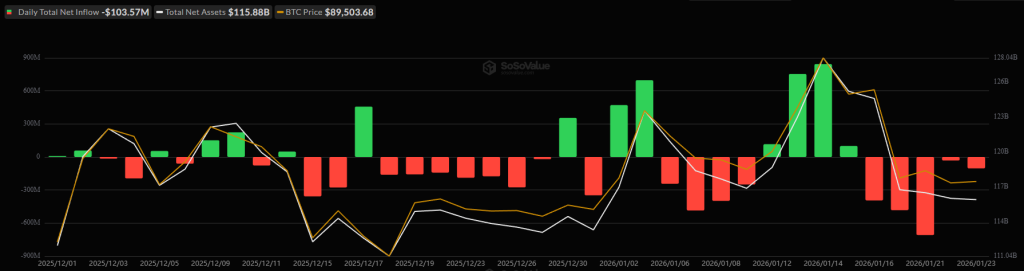
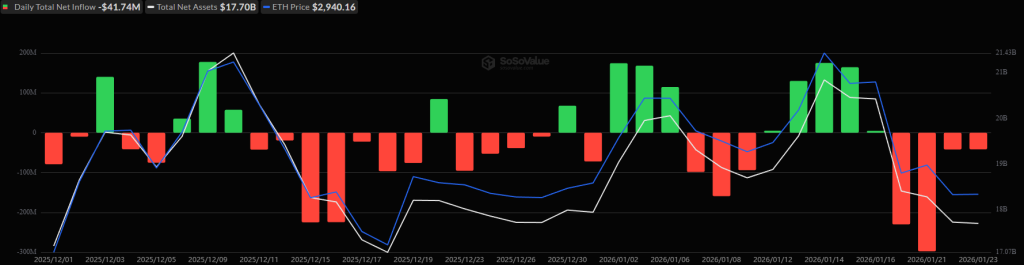
US spot BTC and ETH ETFs saw $103.57 million and $41.74 million in outflows, respectively;
Crypto market sentiment continued falling within the fear zone.
Crypto Winners & Losers
We started the new week very much in the red. As of Monday morning (UTC), all top 10 coins per market capitalisation have posted price drops over the past 24 hours.
Bitcoin (BTC) fell by 0.7%, currently trading at $87,860. This is the smallest drop on the list,
Bitcoin (BTC)
24h7d30d1yAll time
Ethereum (ETH) decreased by 1.5%, changing hands at $2,892.
The highest fall among the top 10 is Solana (SOL)’s 3.3% to the price of $122.
It’s followed by Dogecoin (DOGE)’s drop of 1.6%, now trading at $0.1213.
At the same time, Tron (TRX)fell the least: 0.4% to $0.2953.
Moreover, of the top 100 coins per market cap, 93 have seen their price drop today.
MYX Finance (MYX) fell the most. It’s down 14%, now trading at $5.86.
Monero (XMR) follows, with a decrease of 5.4%, currently standing at $466.
Of the green coins, River (RIVER)stands at the top, having jumped by 43% to the price of $84.7.
The next on the list is Algorand (ALGO), which saw an increase of 2.3% to $0.1189.
QCP analysis notes that crypto assets traded in a narrow range over the weekend before coming under pressure in early Asian hours, triggering over $550 million in leveraged long liquidations. BTC briefly tested $86K before finding support, while Ethereum fell to the $2,785 area.…
Meanwhile, the UK’s Financial Conduct Authority (FCA) moved into the final stage of consultations on a set of proposed crypto regulations. The FCA said it is seeking feedback on 10 proposed rules, describing this as the “final step” in the consultation process.
“These proposals continue our progress towards an open, sustainable and competitive crypto market that people can trust,” the regulator said.
BREAKING: The UK Just Moved to Fully Integrate Crypto Firms Into the FCA Rulebook pic.twitter.com/mGBJ61hLLB
Gadi Chait, Investment Manager at Xapo Bank, commented that recent weakness in Bitcoin follows a brief recovery last week, “set against a backdrop of macroeconomic developments that have influenced risk assets broadly.”
A convergence of factors drives volatility across markets. These include heightened geopolitical tensions and ongoing conflicts. Renewed focus on US strategic positioning toward Greenland and Donald Trump’s address at Davos “added to an already unsettled global environment.”
Regulatory uncertainty, especially in the US, and macroeconomic pressures add to this. “Central bank policy divergence, including expectations around further tightening by the Bank of Japan and the continued reduction of liquidity by the US Federal Reserve, continues to shape market behaviour.”
Chait says that, “amid this uncertainty, traditional commodities have rallied, while Bitcoin has underperformed. The reasons for this divergence are not yet clear, though such sequencing across asset classes is not without precedent.”
“It remains possible that Bitcoin’s response emerges later, particularly as volatility subsides. For long-term participants, however, short- to medium-term price fluctuations remain a familiar feature rather than a signal of impaired fundamentals,” Chait concluded.
Moreover, Petr Kozyakov, Co-Founder and CEO at Mercuryo, argued that as a speculative asset, BTC has come under sustained selling pressure, and altcoins have followed suit.
“While the fortunes of the digital asset space will always be viewed through a lens fixated on token prices, the bigger picture is one of continued stablecoin adoption and the steady development of payment infrastructure,” he says.
He continues: “The evolution of the digital token space is being driven by merger and acquisition activity, alongside the inherent efficiencies of blockchain-based technology and its ability to operate around the clock, at speed and at lower cost.”
“This reality is increasingly unavoidable for financial institutions still reliant on technology that dates back to the 1960s. Away from daily price movements, a quiet revolution is most definitely afoot,” Kozyakov concluded.
Levels & Events to Watch Next
At the time of writing on Monday morning, BTC was changing hands at $87,860. While the coin begun the day at the intraday high of $88,800, it relatively swiftly dropped to the low of $86,126. It has recovered somewhat since.
Over the past seven days, BTC decreased by 5.1%, trading in the $86,319–$93,252 range. It’s now 30% away from its all-time high of $126,080.
Failing to hold the current level risks additional pullbacks towards the $85,000 level, followed by $84,300 and $83,800.
Bitcoin Price Chart. Source: TradingView
At the same time, Ethereum was trading at $2,892. Earlier in the day, it traded at the intraday high level of $2,941. However, it then plunged to the intraday low of $2,787. It managed to shift course and move higher following this drop.
In a week, ETH fell 9.2%, moving between $2,801 and $3,222. Moreover, it decreased 41% from its ATH of $4,946.
Currently, the price risks a fall toward $2,670 and $2,520 in the near term.
Ethereum (ETH)
24h7d30d1yAll time
Additionally, according to Bloomberg Intelligence Senior Commodity Strategist Mike McGlone, it is more likely that ETH will revisit the $2,000 level than push upwards and above $4,000.
ETH has been stuck in the $2,000–$4,000 range since 2023. However, it is leaning toward the lower end of this range.
Ether appears to be heading toward the lower end of its $2,000-$4,000 range since 2023. I see greater risks of it staying below $2,000 than above $4,000, especially when stock market volatility rebounds. pic.twitter.com/1IAMV10Jwe
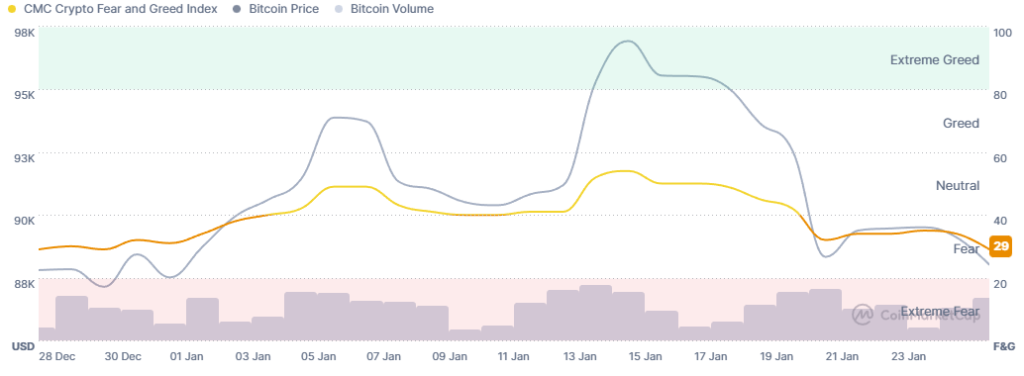
Meanwhile, the crypto market sentiment exited the neutral zone a week ago, and it has continued falling lower within the fear zone since.
The crypto fear and greed index decreased further over the weekend, currently standing at 29, compared to 34 seen over the weekend.
Unsurprisingly, given the market conditions, the sentiment reflects the overall worry and caution. It is now possible that the metric will drop further.
Source: CoinMarketCap
ETFs Continue The Red Streak
The US BTC spot exchange-traded funds (ETFs) posted another day of outflows on Friday, totalling $103.57 million. This is the fifth consecutive day of negative flows.
The total net inflow has pulled back yet again and now stands at $56.49 billion.
Of the twelve ETFs, two recorded outflows, and none saw inflows. BlackRock let go of $101.62 million, and Fidelity followed with $1.95 million in outflows.
Source: SoSoValue
Moreover, the US ETH ETFs posted outflows as well on 22 January, with $41.74 million – a similar level as the day earlier. With this fourth consecutive red day, the total net inflow now stands at $12.3 billion.
Of the nine funds, two ETH ETFs posted outflows, and two saw inflows. BlackRock recorded $44.49 million in outflows, followed by Grayscale’s $10.8 million.
At the same time, Grayscale Mini Trust took in 9.16 million, followed by Fidelity’s $4.4 million in inflows.
The crypto market has seen yet another drop over the past day. Meanwhile, the US stock market closed the week with a mixed picture. That said, it also posted a second consecutive red week. By the closing time on Friday, 23 January, the S&P 500 was up 0.033%, the Nasdaq-100 increased by 0.34%, and the Dow Jones Industrial Average fell by 0.58%. Due to high volatility, investors are shifting their money into safe-haven assets, particularly gold.
Is this drop sustainable?
For now, the drops may continue in the near- to mid-term, pushed by macroeconomic developments. Occasional smaller and brief jumps are expected, intersecting the current trend.
A security breach tied to decentralized exchange aggregator Matcha Meta has resulted in the theft of roughly $16.8 million in crypto assets, adding to a growing list of smart-contract exploits that continue to test the safety assumptions of DeFi users.
The incident unfolded on Sunday and was traced not to Matcha’s core infrastructure, but to SwapNet, one of the liquidity providers integrated into the platform.
Matcha Meta disclosed the issue publicly in a post on X, saying users who had disabled its “One-Time Approval” feature and instead granted direct token allowances to individual aggregator contracts may have been exposed.
We are aware of an incident with SwapNet that users may have been exposed to on Matcha Meta for those who turned off One-Time Approvals
We are in contact with the SwapNet team and they have temporarily disabled their contracts
The team is actively investigating and will provide…
The protocol urged affected users to immediately revoke approvals connected to SwapNet’s router contract, warning that failure to do so could leave wallets vulnerable to further unauthorized transfers.
$17M Vanishes in Seconds: How Matcha Hackers Slipped Funds Onto Ethereum
Blockchain security firms quickly began tracking the exploit as funds moved on-chain.
PeckShield reported that approximately $16.8 million had been drained in total, with the attacker swapping around $10.5 million in USDC for roughly 3,655 ETH on the Base network before starting to bridge assets to Ethereum.
#PeckShieldAlert Matcha Meta has reported a security breach involving SwapNet. Users who opted out of "One-Time Approvals" are at risk.
CertiK independently flagged suspicious transactions, identifying one wallet that siphoned about $13.3 million in USDC on Base and converted the funds into wrapped Ether.
Both firms pointed to a vulnerability in the SwapNet contract that allowed arbitrary calls, enabling the attacker to transfer tokens that users had previously approved.
1/ The vulnerability seems to be in arbitrary call in @0xswapnet contract that let attacker to transfer funds approved to it. (https://t.co/B7ux5zzMLS)
The team have temporarily disabled their contracts is actively investigating.https://t.co/NBNvzxHCRw
Matcha later clarified that the incident was not connected to 0x’s AllowanceHolder or Settler contracts, which underpin its One-Time Approval system.
The team noted that users who interacted with Matcha using One-Time Approvals were not affected, as this design limits how much access a third-party contract can retain.
After reviewing with 0x's protocol team, we have confirmed that the nature of the incident was not associated with 0x's AllowanceHolder or Settler contracts.
Users who have interacted with Matcha Meta via One-Time Approval are thus safe.
The exposure, the team said, applied only to users who opted out of that system and granted ongoing allowances directly to aggregator contracts. In response, Matcha has removed the option for users to set such direct approvals going forward.
Old Token Approvals Emerge as a Persistent DeFi Weak Spot
The breach highlights a recurring tension in DeFi between flexibility and safety. Token approvals, while necessary for interacting with smart contracts, have long been a weak point, particularly when permissions remain active long after a transaction is completed.
In this case, previously granted allowances became the pathway for the exploit once the SwapNet contract was compromised.
The incident arrives amid continued concerns over smart-contract security across the crypto sector.
SlowMist’s year-end report shows that vulnerabilities in smart contracts accounted for just over 30% of crypto exploits in 2025, making them the leading cause of losses.
While overall crypto losses declined in December, falling about 60% month-on-month to roughly $76 million, security firms cautioned that the drop did not reflect a structural improvement.
Crypto-related losses from hacks and cybersecurity exploits fell sharply in December, dropping 60% month-on-month to about $76 million.#Crypto#Hackhttps://t.co/mke6K8sLVQ
PeckShield noted that a single address-poisoning scam accounted for $50 million of December’s losses, showing how concentrated and severe individual incidents can be even during quieter periods.
ETH is down 1.7% in the last 24 hours and is trading below $2,900.
The coin could retest the $2,749 support level if the bearish trend continues.
ETH falls below $2,900
The cryptocurrency market has been bearish in the last three weeks despite an excellent start to the year. After hitting the $3,400 level earlier this month, Ether has lost nearly 20% of its value in the last two weeks.
The bearish performance saw ETH lose 1.5% of its value in the last24 hours and briefly dropped below $2,800 on Sunday. It has now slightly recovered and is currently trading above $2,880.
However, the bearish performance could persist as macroeconomic conditions continue to affect the broader crypto market. The U.S. government risks yet another shutdown as Democratic lawmakers have threatened to block a Department of Homeland Security funding bill following controversy over federal law enforcement actions.
The Federal Reserve will also give its first rate decision of 2026 soon. If the Fed keeps the interest rate the same or increases it, Ether and other leading cryptocurrencies could record further losses in the near term.
With Gold and Silver hitting new all-time highs a few hours ago, leading cryptocurrencies like BTC and ETH could continue to underperform.
Ethereum could dip to the $2,749 support level
The ETH/USD 4-hour chart is bearish and efficient as Ether has recorded losses recently. The leading altcoin closed its daily candle below the $3,017 on Tuesday and lost 5.5% through Sunday.
At press time, ETH is trading at $2,889, close to the key support at $2,749. If this support level holds, ETH could recover toward the daily resistance level at $3,017.
However, traders should be cautious as the momentum indicators show that the bears are currently in control. The MACD lines are within the negative territory, while the RSI of 41 is below the neutral 50.
On the flip side, if Ether closes its daily candle below the $2,749 support, it could extend the correction toward the November 21 low at $2,623.
Coinbase is weighing an equity investment in Coinone as the Korean exchange explores a partial stake sale.
Coinone’s valuation is under pressure from losses even as it invests in AI and new trading features.
Deal activity is accelerating across South Korea’s crypto exchanges as global players seek regulated access.
Coinbase is weighing a potential equity investment in Coinone, South Korea’s third-largest crypto exchange, as the platform explores options that could include selling part of its controlling shareholder’s stake, according to local media and industry sources.
A local outlet reported on Sunday that Coinone has put itself on the market and is discussing scenarios tied to Chairman Cha Myung-hoon’s holdings.
Cha controls 53.44% through his personal stake and his holding company, The One Group.
The possible investment has quickly gained attention because it comes as South Korea’s crypto exchange sector enters a new phase of dealmaking, with major financial groups and global platforms looking for ways to secure access to regulated won-based trading infrastructure.
Coinone sale speculation grows after leadership shift
Sale chatter around Coinone has picked up after Cha returned to frontline management just four months after stepping down as chief executive.
Some observers have interpreted his return as a move that could support a stake transaction, particularly as the discussions reportedly link directly to his controlling position.
Coinone has not confirmed that it is pursuing a full sale.
However, the reports suggest it is exploring multiple structures around ownership, leaving the door open for partial stake sales, new strategic investors, or broader shifts in shareholder control.
Losses weigh on valuation even as tech upgrades accelerate
Coinone has said Cha stepped back into management to sharpen the exchange’s technological competitiveness as it nears a double-digit market share.
The company has highlighted investment in areas such as artificial intelligence as part of its product and infrastructure buildout.
At the same time, Coinone’s losses have continued to pressure its valuation.
Seoul Economic Daily put Coinone’s book value at 75.2B won, or about $52M, at the end of the third quarter, below Com2uS’s reported acquisition cost.
Ownership attention has also turned to Com2uS, the South Korean gaming group that accumulated a 38.42% stake in Coinone between 2021 and 2022.
The size of that holding means any transaction involving Coinone’s control structure would likely be closely watched by market participants tracking how shareholder dynamics may evolve.
Coinbase visit highlights hunt for Korea-compliant partners
Industry sources say Coinbase plans to visit South Korea this week and meet major local players, including Coinone, as it looks for partners to build products aligned with Korean rules.
The reported trip has added momentum to speculation, as South Korea remains one of the world’s most active retail crypto markets but also one of the hardest for foreign firms to enter directly.
In that context, strategic investment can offer a more workable path, allowing overseas platforms to collaborate with licensed local exchanges rather than attempting to build a standalone operation from scratch.
The reports have also circulated widely in the crypto community.
Korea crypto exchange deal wave gathers pace
Coinbase’s reported interest comes as dealmaking accelerates across South Korea’s crypto exchange sector, driven by the value of licensed platforms and their access to won-denominated trading rails.
Traditional finance groups and big tech players have been circling the market, as consolidation becomes a defining theme.
Regulators recently cleared Binance’s long-running effort to take over GOPAX, a move that has helped fuel a wider rush of takeover interest.
Naver Financial agreed to acquire Dunamu, the operator of market leader Upbit, in an all-stock deal, while local media have also reported Mirae Asset Securities is pursuing Korbit.
Coinone has attempted to stand out by building new product features.
In Aug. 2025, it launched what it called the country’s first flexible Bitcoin staking service, allowing users to earn rewards without locking up their holdings.
Still, a possible Coinbase tie-up is emerging at a time when South Korea’s exchange landscape is shifting quickly, and when global players are searching for regulated entry points into one of Asia’s most closely watched crypto markets.
Nomura Holdings and SBI Holdings are among the financial groups expected to create Japan’s first crypto ETFs.
Global crypto market capitalisation has tripled in three years to around $3 trillion.
US-listed spot bitcoin ETFs have grown to roughly $120 billion in total net assets.
Japan could be heading towards its first exchange-traded funds (ETFs) that invest in cryptocurrencies, with listings possible as early as 2028, Nikkei reports.
If the plan moves forward, it could give everyday investors an easier route into bitcoin and other digital tokens, without the added complexity of buying and storing crypto directly.
The development comes at a time when large global institutions are already adding crypto ETFs to their portfolios, while regulators in major markets have started treating digital assets as a more established part of modern investing.
Japan’s Financial Services Agency (FSA) now appears set to test how far crypto exposure can go inside traditional market products, while tightening investor safeguards to match the risks involved.
Crypto ETFs could enter Japan’s regulated market
The FSA plans to add cryptocurrencies to the list of specified assets that ETFs can invest in, according to Nikkei.
This would be a key regulatory step because it would allow fund managers to create products that track crypto prices and trade them through an exchange, much like equity or commodity ETFs.
Stronger investor protection measures are also expected to be proposed alongside the change.
That is likely to be central to how Japan positions crypto ETFs, given the market’s reputation for sharp price swings and the history of losses faced by retail traders during major downturns.
If the rule change is implemented, it would bring crypto closer to Japan’s mainstream investment structure, making it available through products that are more familiar to everyday investors and operate within established oversight.
Nomura and SBI may lead the first wave
Several large financial players are already seen as potential early movers.
Nikkei named Nomura Holdings and SBI Holdings among the groups poised to create Japan’s first crypto ETFs, signalling growing interest from firms that already play a major role in Japan’s financial system.
However, any ETFs built on this framework would still need approval to list on the Tokyo Stock Exchange.
That means Japan’s top exchange would decide whether these funds can trade publicly, opening the door for wider retail participation through ordinary brokerage accounts.
For fund issuers, ETFs could also provide a more scalable way to meet growing demand for crypto exposure, while keeping investors inside more regulated channels than direct crypto trading platforms.
Why ETFs could lower the barrier for retail investors
Crypto has become a significant alternative asset class, but ordinary investors still face practical hurdles when buying it directly.
Bitcoin and other digital assets are traded and stored in crypto wallets protected by private keys, which can be difficult for less experienced investors to manage safely.
This is where ETFs can change the experience.
Instead of learning how wallets work or taking responsibility for storage, investors can buy and sell ETF units through a stock exchange, similar to how they trade shares.
That ease of access is one reason crypto ETFs have become a popular gateway product in other markets.
Regulators elsewhere have already taken this route.
The US and Hong Kong approved their first spot cryptocurrency ETFs in 2024, setting a benchmark that Japan could eventually follow as it builds its own framework.
Institutional adoption is growing, despite volatility
Bitcoin and other cryptocurrencies can be volatile, but the sector has continued to expand.
Global crypto market capitalisation has tripled over the past three years to around $3 trillion.
Institutional investors have also played a bigger role in turning crypto into a more portfolio-friendly asset class.
Pension funds, endowment funds for major universities such as Harvard, and government-affiliated investors have started including bitcoin ETFs in their holdings, adding weight to the idea that crypto exposure is no longer limited to high-risk retail speculation.
The US market offers an example of the scale involved once regulated products become widely available.
The total net assets of US-listed spot bitcoin ETFs now amount to roughly $120 billion.
Some in Japan’s asset management industry estimate that crypto ETFs in the country could eventually reach 1 trillion yen ($6.4 billion).
If Japan moves ahead with listings, that projection suggests a meaningful level of demand could emerge from domestic investors looking for exposure through exchange-traded funds rather than direct ownership.
January 2026 has delivered a blunt message to investors: the playbook has changed. Gold is trading above $5,000 an ounce for the first time. Bitcoin is stuck below $88,000 and cannot hold the $90,000 level it briefly reclaimed. This gap is not just a weird market moment. It looks like a reset in how capital behaves when geopolitics heats up, and policy direction gets messy.
The numbers underline the shift. Gold rose 64% in 2025 and is already up more than 17% in the first weeks of 2026. Bitcoin, meanwhile, sits roughly 11% below its December 2024 all-time high near $108,000. Over one weekend in late January, total crypto market cap dropped by about $56 billion to roughly $2.92 trillion. This is not random noise. It reflects two different investor instincts playing out in real time.
The Safe-Haven Rush: Why Gold Owns the Narrative Right Now
Gold’s run is not coming from one single driver. It is coming from several forces stacking on top of each other.
Central banks, especially in emerging markets, have been buying gold at a pace that looks more like crisis-era behavior than normal reserve management. ETF inflows have reinforced that demand. Retail and institutions are doing the same thing for the same reason: they want a hedge against currency risk, policy mistakes, and the kind of uncertainty that makes investors second-guess everything.
The geopolitical backdrop is not helping. Trade tensions have moved from headlines into concrete threats and real negotiation pressure. President Donald Trump’s administration has floated 100% tariffs on Canadian goods tied to China-related trade developments, plus potential 200% levies on French wines and champagne. That kind of language changes behavior fast because markets do not wait for policy to become law. They price the risk now.
Currency markets are reflecting the same mood. The Japanese yen strengthened to 153.89 per dollar, its strongest level since November 2025, as traders speculated about possible coordination between U.S. and Japanese authorities. Japan’s top currency diplomat kept timing vague, which tends to make uncertainty worse, not better. The euro pushed to a four-month high near $1.1898 as traders cut dollar exposure ahead of the Fed’s next signals and the possibility of new leadership chatter.
These moves matter because they signal something deeper than FX positioning. They suggest investors are questioning stability and coordination at the top of the global monetary system. When people get nervous about reserve currencies, they often reach for gold. Gold does not pay yield. It does not grow cash flow. It holds value because it still functions as a trust asset when confidence in other systems starts to wobble.
History helps frame the moment. In 2008, gold climbed from roughly $800 to about $1,900 by 2011 as central banks flooded the system with stimulus. In 2020, gold hit new highs above $2,000 during peak pandemic fear. This rally is bigger in both percentage terms and absolute levels, which suggests the market is pricing something more structural than a single shock.
Bitcoin’s Reality Check: Why “Digital Gold” Is Not Acting Like Gold
Bitcoin has spent years carrying the “digital gold” label. This month has exposed how fragile that comparison can be when stress hits.
Gold is absorbing defensive flows. Bitcoin is absorbing selling from people who bought higher and now want out. That difference matters because it changes how rallies behave. When gold rallies in a risk-off environment, it often pulls in more buyers. When Bitcoin rallies in the same environment, it often runs into sellers looking to exit.
Technically, Bitcoin has been trapped in a structure that has not offered easy upside. Price action has struggled around $87,619 after losing $90,000 during weekend trading. Support sits around $84,698 with resistance near $89,241. If support fails, downside pressure toward $84,000 becomes the obvious target. If resistance holds, $90,000 stays a psychological ceiling rather than a launchpad.
More important than the chart is the behavior underneath it. CryptoQuant data shows Bitcoin holders selling at a loss for the first time since October 2023. That is a shift in tone. In strong bull phases, holders usually ride volatility because they expect higher prices ahead. When people start locking in losses, they are not thinking in bull-market terms. They are managing pain and uncertainty.
Glassnode analysis adds another problem: a heavy supply overhang above $100,000. Many holders are sitting in positions bought between current levels and six figures. When price approaches their entry zones, they sell to break even or limit damage. That creates a supply wall that is hard to clear without fresh demand and strong momentum.
This is not how Bitcoin behaved in 2020 to 2021. Back then, conviction and institutional narratives pushed price from $10,000 to $69,000 in about a year. Today’s structure feels more like rotation and digestion than acceleration. Futures volumes are compressed. Leverage is subdued. Traders are not leaning into upside the way they do when they truly believe the move is imminent.
Prediction markets reflect the change in psychology. Polymarket odds have shown more confidence in gold holding above $5,500 through mid-year than Bitcoin setting new highs over the same window. That is the opposite of the mood in late 2024 when crypto optimism ran hot after Bitcoin crossed $100,000.
The deeper takeaway is uncomfortable for some investors: Bitcoin is not acting like a safe haven right now. It is acting like a high-volatility asset that depends on liquidity, confidence, and risk appetite. That does not kill the long-term thesis, but it changes how investors should frame it in the short term.
Altcoins Under Stress: What Happens When Speculation Hits a Wall
Bitcoin’s weakness looks mild compared to what is happening in altcoins.
Kaia (KAIA) is a clean example. It fell nearly 20% in 24 hours to around $0.0762 after breaking support near $0.0797 and briefly dipping below $0.0721. It held above its 50-day EMA, which offers some technical comfort, but the drop shows how fast liquidity disappears when sentiment cracks.
Altcoins are built for leverage to mood. In bull phases, capital moves from Bitcoin into Ethereum, then into larger alts, then into smaller speculative tokens as investors chase bigger multiples. In corrections, the flow reverses and the weakest assets get hit first. That creates a brutal reality: altcoins can look unstoppable on the way up and untradeable on the way down.
Ethereum has not offered much shelter either. Ether traded near $2,867 in late January, down 2.6% while Bitcoin fell 1.3%. That underperformance signals that investors are not rotating into higher-beta crypto exposure. Thin spot volume and muted derivatives activity support the same conclusion.
The question now is whether this is a pause before another risk cycle or a deeper structural shift. Several factors argue for caution. U.S. regulation is moving, but it still has open questions around token classification and how securities law will apply. Japan may approve crypto ETFs by 2028, with firms like Nomura and SBI expected to launch products on the Tokyo Stock Exchange, but a two-year timeline does not help the next few months.
There is also a credibility problem. Reports of a U.S.-linked crypto theft scandal involving alleged misuse of access to seizure wallets have rattled confidence. ZachXBT has traced funds linked to thefts spanning 2024 and 2025. Incidents like this do not just hurt sentiment for a week. They raise uncomfortable questions about custody, oversight, and the real-world weak points in the ecosystem.
What Institutions Are Actually Doing Right Now
Retail narratives dominate crypto chatter, but institutional behavior usually tells the cleaner story.
Central banks are voting with their balance sheets, and they are choosing gold. Many of them are not willing, or not able, to justify holding an asset that can drop 15% in a week. Their gold buying creates a steady baseline bid that crypto does not have.
Hedge funds and family offices have also turned cautious. Leverage in crypto derivatives remains compressed compared to peak cycles. Open interest in Bitcoin futures exists, but it has not expanded in the way you would expect if large players were building a new bullish stance.
Corporate treasury adoption has not restarted in a meaningful way. During 2020 to 2021, it was easier to sell boards on Bitcoin exposure because liquidity was abundant and narratives were clean. Today, when gold is up 17% year-to-date and Bitcoin is chopping sideways, that boardroom pitch becomes harder.
Pension funds and sovereign wealth funds remain mostly on the sidelines. They move slowly and demand strong regulatory certainty. The U.S. may get there, but it is not there yet.
Right now, institutional money looks like it is waiting, not charging in. That is the simplest read, and it matters because those investors have the best access to research, infrastructure, and policy visibility.
The Fed Variable: Why This Week Can Move Everything
The late-January Federal Reserve meeting matters more than people want to admit. Not because the market expects a surprise rate hike or cut, but because guidance sets tone and liquidity expectations.
If the Fed signals confidence that inflation is easing and hints at future cuts, risk assets usually respond well. Lower rates reduce the opportunity cost of holding gold, and they tend to weaken the dollar, which supports commodity pricing. Crypto would benefit too, mostly through improved liquidity and renewed risk appetite.
If the Fed stays hawkish and emphasizes inflation risk, the market hears “higher for longer.” That hurts speculation. It also pressures gold through higher real yields, though safe-haven demand can sometimes overpower yield dynamics when fear becomes the bigger driver.
Politics adds another layer. Trump has criticized Jerome Powell publicly, and any credible talk of leadership changes introduces a market question about central bank independence. If markets interpret leadership shifts as more accommodative and more political, both gold and Bitcoin could rally on the same narrative: long-term trust risk in fiat management.
FX moves leading into the meeting show the tension. Traders have been trimming dollar exposure. That positioning can unwind quickly after Fed messaging, which would ripple into correlated assets.
Geography Is Not Background Noise in 2026
Regional differences are starting to matter more.
Asia has been mixed. China’s Shanghai index rose slightly while Japanese equities fell on yen strength. That split reflects different policy priorities and economic conditions across the region.
Japan’s currency strength is a headwind for exporters, but the medium-term ETF discussion positions Japan as a potential regulated gateway for crypto exposure, even if the timeline stretches to 2028. Europe has its own stress points, including trade friction with the U.S. The euro’s strength helps imports but hurts export competitiveness. The ECB has moved more dovishly than the Fed, which further changes cross-border capital flows.
The U.S. still dominates crypto market structure, liquidity, and innovation, even with regulatory uncertainty. Any real legislative breakthrough will matter globally because U.S. clarity tends to set the tone for institutions everywhere.
Emerging markets sit at the center of the gold move. They feel currency risk hardest and often have the strongest incentive to seek alternatives. But in practice, gold is still simpler and more accessible than crypto for most investors in those regions, which helps explain why gold is absorbing flows first.
Portfolio Positioning: What Discipline Looks Like in Uncertain Markets
This environment punishes overconfidence.
Gold’s role is straightforward. It is doing what it has historically done in messy periods. A 5% to 10% allocation to physical gold or gold-backed ETFs can make sense for many investors with multi-year horizons. It should protect the portfolio without taking over the entire strategy.
Crypto needs a different label. It is closer to a venture-style exposure to technology adoption than a pure safe haven. That means sizing should be conservative. A 1% to 3% allocation can keep investors engaged in long-term upside without turning short-term volatility into a lifestyle risk.
This is also a moment where patience often beats activity. Large shifts based on short-term moves tend to destroy value. Rebalancing rules matter more than predictions. If gold has grown far beyond its target weight, trimming back to plan can be smarter than chasing the next headline.
Dollar-cost averaging can work for crypto investors who believe in long-term adoption but do not trust the next six weeks. Small, scheduled buys remove emotion and reduce timing risk.
Leverage is the trap. Borrowing to amplify crypto exposure remains one of the fastest ways to blow up in a market like this. Volatility compression often precedes violent expansion. Liquidations do not care about your thesis.
Scenarios for the Next Six Months
Several paths remain plausible through mid-2026.
One scenario is the most boring and arguably the most consistent with current structure: gold keeps rising on safe-haven demand while crypto chops sideways. Gold could press toward $5,500 as tensions and central bank buying persist. Bitcoin could range between $80,000 and $95,000, supported by long-term holders but capped by overhead supply and cautious institutions.
A second scenario requires alignment: easing geopolitical tension plus Fed rate cuts. That would likely rotate capital out of gold and back into risk, lifting crypto meaningfully. Bitcoin could reclaim $100,000 if market structure improves and leverage returns, while gold could pull back but remain elevated above $4,500.
A third scenario is the darker one: economic conditions deteriorate materially. Gold could push toward $6,000 while crypto faces forced liquidations and deeper downside, with Bitcoin potentially testing $70,000 or lower.
A fourth scenario depends on policy competence: a clear U.S. regulatory breakthrough that unlocks institutional capital at scale. It is possible, but the near-term probability remains lower than crypto bulls want.
The most realistic outcome may look like a mix: partial easing in some geopolitical zones, new flashpoints elsewhere, gradual Fed shifts, and crypto alternating between relief rallies and pullbacks without clean direction.
Risk Management Rules That Still Matter
When correlations move and narratives break, basics protect capital.
Position sizing is the first filter. Overallocating to a single theme is the most common failure. Crypto should be sized so that total loss would not change your life. Gold should be sized so it protects the portfolio without trapping you in defensive posture if equities rebound.
Diversification only works when it is real. Ten cryptocurrencies do not diversify if they all move with Bitcoin. Two forms of gold exposure can also behave differently: physical gold, gold ETFs, and miners each carry distinct risks.
Liquidity matters more than people admit. Assets that trade cleanly in calm markets can become thin in stress. Holding enough cash or liquid reserves to avoid forced selling remains a timeless rule.
Discipline is the edge. Volatility is designed to trigger bad decisions. Rules around rebalancing and allocation prevent emotional reactions. Writing down your principles during calm periods and following them during stress is not just advice. It is a practical survival tool.
Taxes also become more important as volatility increases. Crypto gains and losses can be managed strategically through loss harvesting, holding periods, and timing. Gold can have special tax treatment in some jurisdictions. Investors should not wing it.
What Past Divergences Tell Us
This is not the first time asset relationships have shifted.
In 2013’s taper tantrum, gold fell while risk assets also struggled. Safe-haven flow went into dollars, not gold. That episode shows safe haven behavior changes depending on what investors fear.
In 2018, Bitcoin collapsed while gold stayed rangebound, because macro fear was muted. That period shows gold does not automatically benefit from crypto weakness.
In 2020, both rallied after the initial crash because stimulus and inflation fears dominated. That environment is not today’s environment. Today looks more like geopolitical stress plus constrained liquidity, which tends to favor gold over speculative assets.
The lesson is simple: correlations are not laws. They are temporary relationships shaped by the dominant fear in the room.
The Ethereum Problem: Why Number Two Looks Stuck
Ethereum’s underperformance is not just a chart issue. It points to a broader question about smart contract platforms and real adoption.
DeFi activity is down from peak levels. NFT volumes have collapsed. Layer-2 scaling has reduced fees, which is good for users, but it has also fragmented liquidity and attention across multiple networks. That can weaken Ethereum’s network effects, even if the technology continues to improve.
Solana and other platforms have gained share, but they have also struggled during broad risk-off conditions. So this is not just an Ethereum-specific problem. It is a demand problem across crypto applications.
The bigger concern for Ethereum bulls is the application gap. Ethereum has proven it can work. What it has not proven is that it can deliver mainstream use cases that compete with web2 experiences at scale. Many on-chain apps still feel like tools for crypto-native users rather than products built for the public.
Without clear demand drivers, ETH valuation stays tied to speculative appetite. In a market where investors are reducing risk, that is not a great setup.
Regulation: The One Catalyst That Can Reprice Everything
Even with weak price action, regulation remains the biggest potential reset.
U.S. legislative progress is focusing on custody rules, stablecoin frameworks, and exchange registration. Real clarity on token classification would be the unlock. It would reduce existential risk for projects, give institutions rules they can follow, and lower the odds of surprise enforcement events that shake markets.
International coordination is improving too. FATF standards have pushed most major jurisdictions toward common baselines for exchanges and wallet providers. The EU’s MiCA rules bring structure across a large economic bloc. Some elements are heavy, but clear rules often matter more than perfect rules.
Japan’s ETF discussion suggests growing acceptance of crypto as an investment asset class, even if the pace is slow. China remains restrictive on trading, but it continues to pursue blockchain applications and central bank digital currency research.
Regulation will not fix market structure overnight, but it can change who is allowed to participate. That is how market regimes shift.
The CBDC Wildcard
Central bank digital currencies sit in a strange place. They validate the concept of digital money while competing with private crypto rails.
CBDCs are permissioned and controlled. They do not offer the decentralization or supply constraints that define Bitcoin. They can also enable deeper state-level visibility into transactions, which raises privacy concerns.
Still, their development signals something important: central banks agree that the future of money is digital. The question is whether CBDCs simply replicate existing payment rails, or whether they introduce programmable money that could replace some stablecoin and DeFi use cases.
If CBDCs expand surveillance and control, some users may move toward crypto as an opt-out alternative. If CBDCs remain limited and functional, they may coexist without materially disrupting crypto adoption.
The timeline remains unclear. Technical scaling, interoperability, and political pushback will shape how fast democracies move. Authoritarian systems may move quicker, but that experience may not translate cleanly to the U.S. or Europe.
Conclusion: Dealing With Markets That Do Not Follow Narratives
Early 2026 is forcing investors to separate slogans from reality.
Gold is behaving like gold. It is absorbing defensive flows during uncertainty. Bitcoin is behaving like a high-volatility asset that depends on liquidity and confidence. That does not destroy the long-term crypto thesis, but it does change how investors should frame it right now.
Investors should position for the market they have, not the market they want. Gold deserves a role as insurance. Crypto deserves a smaller, deliberate role as a high-upside, high-risk exposure to long-term adoption. Diversification, disciplined sizing, and patience remain the cleanest strategy in a regime where trends are not cooperating.
The next months will reveal whether crypto consolidates before a new growth phase or whether this marks a deeper shift in how capital treats digital assets during stress. Investors who stay disciplined and realistic will be fine either way. Investors who overextend on conviction or trade emotionally will likely learn the same lesson markets teach every cycle.
Markets humble confidence. This divergence is a reminder that assets do not owe anyone the behavior that narratives promised. The investors who accept that and manage risk accordingly will be in the best position for whatever 2026 delivers.
Frequently Asked Questions
1. Why is gold outperforming Bitcoin in early 2026?
Gold is benefiting from geopolitical tension, central bank buying, and currency uncertainty. Bitcoin is behaving like a risk asset, not a safe haven, and is facing selling pressure from recent buyers.
2. Is Bitcoin still considered “digital gold”?
In theory, yes. In practice, not right now. Bitcoin is trading more like a speculative asset that depends on liquidity and risk appetite rather than a defensive store of value.
3. Why did gold cross $5,000 per ounce?
Central banks accelerated gold purchases, investors sought safety amid trade and policy uncertainty, and currency volatility increased demand for non-fiat stores of value.
4. Why are altcoins falling more than Bitcoin?
Altcoins carry higher risk and lower liquidity. When markets turn risk-off, capital exits speculative tokens first, leading to sharper and faster declines.
5. Is Ethereum underperforming Bitcoin in 2026?
Yes. Ethereum has lagged Bitcoin due to weaker demand for DeFi and NFTs, fragmented liquidity from layer-2 solutions, and lack of strong new mainstream applications.
6. What role is the Federal Reserve playing in these markets?
Fed guidance affects liquidity, dollar strength, and risk appetite. Uncertainty around rates and potential leadership changes has increased volatility across gold, crypto, and currencies.
7. Are institutions buying crypto right now?
Most large institutions are cautious. Central banks are buying gold, while hedge funds, pensions, and corporates are largely waiting for clearer regulation and better risk-reward setups.
8. Is now a good time to invest in Bitcoin?
That depends on time horizon and risk tolerance. Short-term conditions favor caution, while long-term investors may prefer small, disciplined allocations using dollar-cost averaging.
9. How much gold or crypto should a portfolio hold in 2026?
Many investors consider 5–10% in gold for protection and 1–3% in crypto for upside exposure, sized according to personal risk tolerance and financial goals.
10. What could change the outlook for crypto in 2026?
Clear U.S. regulation, Fed rate cuts, easing geopolitical tensions, or renewed institutional adoption could improve sentiment. Until then, crypto is likely to remain volatile and range-bound.
Machine learning is no longer confined to research labs or experimental innovation teams. As we move into 2026, machine learning (ML) has become a core operational capability across industries — powering everything from personalized customer experiences to automated decision-making and predictive intelligence.
But as adoption grows, so does complexity.
The role of a machine learning professional today looks very different from what it did just a few years ago. Businesses are no longer searching for generic ML talent. Instead, they want domain-aware, production-ready experts who can design, deploy, and maintain scalable ML systems that drive real business outcomes.
This shift is fundamentally changing how organizations hire machine learning developers, what skills they expect, and how ML roles differ across sectors.
In this in-depth guide, we’ll explore how machine learning roles are evolving across industries, why specialization matters more than ever, and how businesses can adapt their hiring strategies to stay competitive in 2026 and beyond.
Why Machine Learning Roles Are Changing So Rapidly
The evolution of ML roles is driven by three major forces:
ML has moved into production
Industry-specific requirements are increasing
ML systems are now part of core business infrastructure
As a result, companies that continue to hire ML talent using outdated criteria often struggle to achieve ROI. That’s why forward-thinking organizations are rethinking how they hire ML developers — focusing on real-world impact rather than academic credentials alone.
From Generalist to Specialist: A Major Shift in ML Hiring
In the early days of ML adoption, companies hired generalists who could:
experiment with datasets
train models
run offline evaluations
In 2026, that approach no longer works.
Modern ML professionals are increasingly specialized by sector, combining technical expertise with deep domain understanding. This specialization allows them to build models that are not only accurate — but also usable, compliant, and scalable.
Machine Learning Roles in the Technology and SaaS Sector
How the Role Is Evolving
In SaaS and technology companies, ML professionals are no longer “supporting features” — they are shaping product strategy.
ML developers in this sector now focus on:
recommendation engines
personalization systems
AI-powered analytics
intelligent automation
customer behavior prediction
They work closely with product managers, designers, and backend engineers.
What Companies Look For
To succeed, companies must hire machine learning developers who understand:
large-scale data pipelines
real-time inference
A/B testing
MLOps and CI/CD for ML
cloud-native ML architectures
Product-driven ML has become a core differentiator in SaaS businesses.
Machine Learning Roles in Finance and FinTech
How the Role Is Evolving
In finance, ML roles have shifted from pure modeling to risk-aware, regulation-conscious engineering.
ML professionals now build systems for:
fraud detection
credit scoring
risk modeling
algorithmic trading
compliance monitoring
Accuracy alone is not enough — explainability and governance are critical.
What Companies Look For
Financial organizations hire ML developers who can:
balance model performance with transparency
work with sensitive data securely
integrate ML with legacy systems
comply with regulatory standards
This sector heavily favors ML engineers with real-world deployment experience.
Machine Learning Roles in Healthcare and Life Sciences
How the Role Is Evolving
Healthcare ML roles are evolving toward decision support and operational intelligence, not autonomous decision-making.
Use cases include:
diagnostics assistance
patient risk prediction
medical imaging analysis
hospital operations optimization
ML professionals work alongside clinicians, researchers, and compliance teams.
What Companies Look For
Healthcare organizations hire ML developers who understand:
data privacy and security
bias and fairness in models
validation and auditing
human-in-the-loop systems
Domain knowledge is often as important as technical expertise.
Machine Learning Roles in Retail and eCommerce
How the Role Is Evolving
Retail ML roles have expanded from recommendation systems to end-to-end intelligence pipelines.
ML developers now work on:
demand forecasting
dynamic pricing
inventory optimization
customer segmentation
churn prediction
Speed and scalability are essential.
What Companies Look For
Retailers aim to hire ML developers who can:
work with high-volume transactional data
deploy real-time systems
optimize performance and costs
integrate ML into business workflows
Retail ML success depends heavily on production reliability.
Machine Learning Roles in Manufacturing and Supply Chain
How the Role Is Evolving
In manufacturing, ML is increasingly applied to predictive and operational intelligence.
Key applications include:
predictive maintenance
quality control
supply chain optimization
demand planning
anomaly detection
ML developers work with IoT data and complex operational systems.
What Companies Look For
Manufacturing firms hire ML developers who can:
process streaming and sensor data
build robust forecasting models
integrate ML with physical systems
ensure reliability and uptime
This sector values engineers who understand real-world constraints.
Machine Learning Roles in Marketing and Advertising
How the Role Is Evolving
Marketing ML roles have shifted toward personalization and attribution intelligence.
ML developers now build systems for:
customer lifetime value prediction
campaign optimization
attribution modeling
content personalization
These roles combine data science with business insight.
What Companies Look For
Marketing teams hire ML developers who can:
translate data into actionable insights
work with noisy, unstructured data
align ML outputs with KPIs
support experimentation frameworks
Communication skills are critical in this sector.
Machine Learning Roles in Logistics and Transportation
How the Role Is Evolving
Logistics ML roles focus on optimization under uncertainty.
Use cases include:
route optimization
fleet management
demand forecasting
delay prediction
ML professionals work closely with operations teams.
What Companies Look For
Logistics firms hire ML developers who can:
handle time-series and geospatial data
build scalable optimization systems
integrate ML into operational workflows
Reliability and performance matter more than novelty.
Machine Learning Roles in Energy and Utilities
How the Role Is Evolving
In energy, ML supports forecasting, efficiency, and sustainability.
ML developers work on:
load forecasting
predictive maintenance
grid optimization
energy consumption analytics
Systems must be robust and explainable.
What Companies Look For
Energy organizations hire ML developers who understand:
time-series modeling
system reliability
regulatory considerations
long-term operational planning
The Rise of MLOps and Production-Focused ML Roles
Across all sectors, one role is becoming universal: production ML engineer.
Modern ML professionals must understand:
model deployment
monitoring and observability
retraining workflows
cost optimization
cross-team collaboration
This is why companies increasingly prefer to hire machine learning developers with MLOps experience rather than pure researchers.
How Hiring Expectations Have Changed
In 2026, companies no longer hire ML talent based on:
academic background alone
model accuracy in isolation
research publications
Instead, they prioritize:
production experience
system design skills
business alignment
domain understanding
This shift is reshaping ML hiring strategies across industries.
Common Hiring Mistakes Companies Still Make
Despite progress, many organizations struggle by:
hiring generalists for specialized problems
underestimating production complexity
ignoring domain expertise
failing to align ML with business goals
Avoiding these mistakes starts with clarity about the role you actually need.
How to Hire Machine Learning Developers for Modern Industry Needs
To adapt to evolving roles, companies should:
define sector-specific ML requirements
prioritize real-world deployment experience
evaluate communication and collaboration skills
consider dedicated or remote ML teams
This approach leads to stronger outcomes and faster ROI.
Why Many Companies Choose Dedicated ML Developers
Given the growing complexity, many organizations prefer to hire ML developers through dedicated engagement models.
Benefits include:
faster onboarding
flexible scaling
access to specialized expertise
reduced hiring risk
This model is especially effective for long-term ML initiatives.
Why WebClues Infotech Is a Trusted Partner to Hire ML Developers
WebClues Infotech helps businesses adapt to evolving ML roles by providing skilled machine learning developers with cross-industry experience.
Their ML experts offer:
sector-specific ML knowledge
production and MLOps expertise
scalable engagement models
strong collaboration and communication skills
If you’re planning to hire machine learning developers who can deliver real-world impact.
Future Outlook: Where ML Roles Are Headed Next
Looking ahead, ML roles will continue to evolve toward:
greater specialization
tighter integration with business strategy
stronger focus on governance and ethics
increased collaboration with non-technical teams
Companies that anticipate these changes will have a clear advantage.
Conclusion: ML Success Depends on Hiring the Right Talent
Machine learning is no longer a one-size-fits-all discipline.
In 2026, ML success depends on understanding how roles differ across industries — and hiring accordingly. Organizations that adapt their hiring strategies to these evolving roles are the ones turning ML into a true competitive advantage.
If your goal is to build reliable, scalable, and impactful ML systems, the smartest move you can make is to hire machine learning developers who understand both the technology and the sector you operate in.
Because in today’s AI-driven economy, the right ML talent makes all the difference.
📊 US markets (Friday close): Wall Street finished mixed. The S&P 500 edged slightly higher, the Nasdaq added a small gain, while the Dow slipped as traders stayed selective ahead of a busy macro week.
🌏 Asia-Pacific: Most regional indices are under mild pressure this morning. The yen strengthened sharply, weighing on Japanese exporters and adding a defensive tone across the session.
💱 FX: The US dollar is softer broadly, with markets focused on heightened volatility in USD/JPY and rising intervention risk chatter.
🥇 Gold: Safe-haven demand remains front and centre — gold has pushed above $5,000, hitting fresh record territory amid geopolitical tension and risk-off flows.
🛢️ Oil: Crude is holding near recent highs after last week’s bounce, as traders balance geopolitical risk premia against broader supply expectations.
₿ bitcoin: Crypto is choppy, with risk sentiment and the dollar’s moves continuing to drive short-term direction.
🚀 Trade carefully today: volatility can spike around headlines and top-tier data. Follow NordFX for more updates and stay tuned.
🌅 Morning Update — 26 January 2026 was originally published in Coinmonks on Medium, where people are continuing the conversation by highlighting and responding to this story.
Crypto Airdrop Scams in 2026: Real Examples & Red Flags
In 2026, crypto airdrop scams are no longer amateur phishing attempts — they are professionally engineered traps powered by AI, fake audits, cloned wallets, and social engineering that even experienced traders fall for.
Every week, thousands of users lose wallets, NFTs, stablecoins, and long-term holdings — not because they were careless, but because airdrop scams now look legitimate.
This guide breaks down:
Real airdrop scam examples
How modern airdrop scams actually work
Red flags most people still miss
A practical crypto airdrop scam prevention checklist
How to safely interact with real airdrops in 2026
If you’ve ever searched:
“Is this airdrop legit?”
“How do crypto airdrop scams work?”
“How to avoid fake airdrops?”
This article is your answer.
What Is a Crypto Airdrop Scam?
A crypto airdrop scam is a fraudulent campaign that promises free tokens in exchange for wallet interaction, approvals, or signatures — with the goal of draining funds, stealing NFTs, or compromising wallet security.
Unlike early phishing scams, modern airdrop scams often involve:
Fake smart contracts
Malicious token approvals
Wallet-draining signatures
Cloned websites and social profiles
AI-generated “community” activity
Why Crypto Airdrop Scams Exploded in 2026
Crypto airdrop scams didn’t just increase — they evolved.
1. AI-Generated Legitimacy
Scammers now use AI to:
Clone real project websites
Generate realistic whitepapers
Fake GitHub commits
Simulate Discord & X engagement
Many scams now look more polished than real startups.
2. Multi-Chain Complexity
With Ethereum, Solana, Arbitrum, Base, Sui, Aptos, and Layer 3s, users regularly:
Bridge assets
Sign cross-chain approvals
Interact with unfamiliar contracts
Scammers exploit this confusion.
3. Wallet Fatigue
After years of DeFi, NFTs, and memecoins, users are:
Desensitized to signing messages
Overconfident in wallet security
Unaware of new approval-based exploits
Real Crypto Airdrop Scam Examples (2025–2026)
Example 1: The “Retroactive Reward” Scam
Victims received messages claiming they qualified for a retroactive airdrop due to past DeFi activity.
The trap:
Website cloned from a real Layer 2
Wallet connection required
“Claim” button triggered unlimited token approval
Result: Wallet drained within seconds.
Key lesson: Retroactive airdrops never require urgent action.
Example 2: Fake Token Appears in Wallet
Users suddenly saw a new token in their wallet labeled:
“AIRDROP_ELIGIBLE”
Clicking the token’s website link led to a fake claim portal.
What happened:
Approval signature granted access to all ERC-20 tokens
NFTs transferred out instantly
Wallet labeled “compromised” afterward
Key lesson: Never interact with unsolicited tokens.
Example 3: Discord Moderator Impersonation
Scammers impersonated admins in a real project’s Discord:
Same name
Same profile image
AI-generated chat history
They shared a “private airdrop link” during high traffic events.
Key lesson: Admins never DM airdrop links.
Example 4: NFT Holder Airdrop Trap
NFT holders were targeted with exclusive airdrops:
“Claim your holder reward”
“Limited-time distribution”
The contract approval allowed:
NFT transfer permissions
ERC-20 draining
Key lesson: NFT approvals are just as dangerous as token approvals.
The Most Common Crypto Airdrop Scam Red Flags
Red Flag #1: Urgency or Countdown Timers
Legitimate airdrops don’t rush you.
“Claim within 24 hours or lose eligibility” is a scam signal
Red Flag #2: Wallet Approval Before Verification
If you must approve tokens before seeing eligibility — walk away.
Red Flag #3: Airdrop Links Shared in DMs
Real projects:
Post on official blogs
Use verified X accounts
Pin announcements publicly
Scammers use private messages.
Red Flag #4: No Independent Mentions
Search the airdrop name:
No GitHub?
No Medium post?
No reputable coverage?
That silence is your warning.
Red Flag #5: “Free” Tokens with No Tokenomics
If there’s:
No supply details
No vesting
No utility explanation
It’s bait.
How Wallet Draining Airdrop Scams Actually Work
This is what most people don’t understand.
Step 1: Trust Setup
Scammer builds legitimacy using:
Fake audits
Paid influencers
Bot-driven social proof
Step 2: Wallet Interaction
User connects wallet and signs:
Token approval
Permit signature
Blind message
Step 3: Asset Extraction
Assets are:
Transferred to multiple wallets
Bridged instantly
Mixed or swapped
Step 4: Cleanup
Website disappears.
Discord wiped.
X account renamed.
Crypto Airdrop Scam Prevention Checklist
Before Connecting Your Wallet
Verify project on multiple platforms
Confirm contract address via official sources
Search “[project name] airdrop scam”
Before Signing Anything
Read approval details
Avoid “unlimited” permissions
Reject blind signatures
Wallet Hygiene Best Practices
Use a burner wallet for airdrops
Never use cold wallets for claims
Revoke permissions regularly
After Any Interaction
Monitor wallet activity
Use approval trackers
Move funds if anything feels off
Scammers rely on short memory and fast clicks. You rely on process.
Save this post so you can run this checklist every time a new airdrop appears in your wallet.
Best Tools to Detect Airdrop Scams in 2026
While no tool is perfect, these help:
Wallet approval dashboards
Contract scanners
Browser wallet warnings
Important: Tools are supplements — not substitutes for skepticism.
Are Any Crypto Airdrops Still Legit?
Yes — but they share common traits.
Legit Airdrops Usually:
Are announced publicly
Don’t require urgency
Don’t request unlimited approvals
Are discussed openly by developers
Have clear tokenomics
If an airdrop feels too generous, it probably is.
Why Even Experienced Traders Fall for Airdrop Scams
Because scammers exploit:
FOMO
Fatigue
Overconfidence
Familiar branding
Experience doesn’t eliminate risk — process does.
What To Do If You’ve Been Hit by an Airdrop Scam
Revoke approvals immediately
Move remaining assets
Mark wallet as compromised
Never reuse it
Warn others publicly
Staying Safe in an Era of Sophisticated Crypto Airdrop Scams
In 2026, crypto airdrop scams are one of the largest wealth transfer mechanisms in the industry — from users to criminals.
If you remember one thing, let it be this:
A real airdrop will never pressure you, rush you, or require blind trust.
Use the crypto airdrop scam prevention checklist, stay skeptical, and treat every “free token” as a potential threat.
Your wallet doesn’t need more tokens — it needs better defenses.
With decentralized exchanges (DEXs) taking more and more mindshare from centralized exchanges (CEXs) in trading and spot volumes, competition in this sector is rapidly intensifying. Inspired by the success of Hyperliquid, most of these platforms are running points programs. This is the case for Variational, one of the most promising trading protocols to farm right now.
What Is Variational ?
Unlike other perp DEXs like Hyperliquid or Extended that use an order book, Variational uses a Request for Quote (RFQ) model, notably used by large over-the-counter (OTC) venues. This system consists of takers (traders) requesting quotes and makers (market makers) responding with bids and/or offers.
In the case of Variational, the only market maker allowed is the Omni Liquidity Provider (OLP).
Source : Variational Docs
This model have various advantages :
Zero Fees : Since all market making on Omni is done by OLP instead of external market makers, Omni doesn’t need fees to generate revenue.
Complete control over revenues : A portion of the fees are directly red irected to users via various incentives.
Listing Variety : All OLP requires for a new listing is a reliable price feed, a quoting strategy, and a hedging mechanism. This manifests as around 500 tradable tokens on Omni !
The team And Partners
Variational was co-founded by Lucas Schuermann and Edward Yu, they have great experience in trading, having work with Genesis after their hedge fund (Qu Capital) was bought by Digital Currency Group (DCG) in 2019.
Source : Variational docs
They later left in 2021 to create their own proprietary trading firm after raising $10M. After two years, they decided to leverage their experience in trading and OTC exchanges to found the Variational protocol in 2023.
Other team members include many crypto veterans in algorithmic trading, with past experience at major firms such as Google and Goldman Sachs.
In June 2025, they raised an additional $1.5M in a strategic round.
Important Metrics
As mentioned in my previous article about perp DEXs, before farming a project I always analyze whether the opportunity cost is worth it. Let’s go through the key metrics one by one.
Trading Volume
It is important to note that at this time of year, volumes are down across nearly all perp DEXs.
Srouce : DefiLlama
Currently, the 24h trading volume is around $850M, placing Variational in the top 6 alongside major names such as Extended, Hyperliquid, and Lighter. Keep in mind that volume can be manipulated through wash trading, so it should not be used as a standalone indicator. For example, Aster ranks third, but farming its airdrop is not attractive.
Open Interest
Open interest represents the total value of active long and short contracts. It is a good indicator of project health, as it implies traders are holding positions for longer periods. Like any metric, it can be manipulated, so it should be evaluated alongside others.
Currently, open interest is around $1.26B, placing Variational in the top 6 perp DEXs. One week earlier, when I started writing this article before the Lighter TGE, it stood at $441M.
Source : DefiLlama
TVL
The current TVL is around $132M. While this may seem low compared to projects like Lighter or Extended, it is important to note that the OLP vault has not yet been opened.
For comparison, roughly half of the TVL on Lighter and Extended is stored in their vaults. Based on this, it would be reasonable to expect a TVL of around $260M for Variational once the vault opens. Depending on yield attractiveness, this could attract significant capital.
For a project still officially in private beta, this is already a strong TVL.
Roadmap
What users currently interact with is Omni, where retail traders can trade more than 480 tokens with a zero-fee model and up to 50x leverage on all pairs.
The team also plans to launch Variational Pro, designed for advanced and institutional traders of OTC derivatives. This dual-product approach allows Variational to target both retail traders (via Omni) and institutional entities (via Pro).
At the moment, the OLP vault is not open for public deposits. The team plans to launch it soon, allowing users to earn a share of Omni’s revenues. This is expected to be highly attractive, as Omni generates significant revenue due to the absence of external market makers.
On the trading side, the team plans to expand beyond crypto into other markets such as stocks, and to support additional collateral types beyond USDC, enabling broader cross-margin functionality.
There are many additional smaller features detailed in the documentation.
The Token ($VAR) and Points Program
There is limited information available about the token at this stage. The points season is expected to end no later than Q3 2026 and could conclude earlier depending on roadmap progress.
We know that approximately 50% of the token supply will be allocated to the community through multiple incentive mechanisms, rather than a single airdrop. Additionally, the team plans to buy back tokens using at least 30% of protocol revenues.
The points program launched three weeks ago, including a retroactive distribution of 3M points for users who traded before its launch. Going forward, 150,000 points will be distributed every Friday at 00:00 UTC, with snapshots taken every Thursday at 00:00 UTC.
Start now with the best boosted code you can have, allowing you to have a 15% points boost and silver rank :
I don’t have an affiliate code, so I gave you the one I use, which is the best one to start earning those precious points on Variational. If you want to support my work, a simple like is enough.
For an estimate of point valuation, there is a strong analysis published by Points Goblin :
My Personal Opinion and Strategy
Following the Lighter TGE, there has been a rapid rotation toward newer perp DEXs such as Variational and Extended. This should not discourage farming these projects as long as the cost per point remains low.
I personally faded Lighter in June when its TVL reached around $170M, assuming it was too late. That assessment was incorrect, as TVL later exceeded $1B
Market conditions are currently pessimistic, with many participants sidelined. If hype returns, earning points will become significantly harder, while existing points are likely to increase in value.
This is why I am currently trading on Variational, mainly farming funding via the FundingView app.
Based on gathered information, points appear to be weighted more heavily toward :
Holding positions for multiple days
Trading low open-interest pairs
Trading newly listed pairs
For additional insights, the following X accounts are worth following:

 Login
Login