
Normal view

There are new articles available, click to refresh the page.
Before yesterdayMain stream

Portugal Bans Polymarket Over €4M Insider Trading Scandal

20 January 2026 at 10:58

Portugal’s gaming regulator has banned crypto prediction platform Polymarket following suspicious trading patterns during the country’s presidential election that saw over €4 million wagered in just two hours before results emerged.

The Portuguese Gaming Regulation and Inspection Service (SRIJ) ordered the platform to cease operations and face blocking after determining its activities violate national laws prohibiting political betting.

The controversy centers on suspicious shifts in betting odds that occurred precisely when exit polls began circulating privately, raising serious questions about information leakage and insider trading on prediction markets.

🚨Portugal Takes Action Against @Polymarket: A Wake-Up Call for Crypto Prediction Markets?🇵🇹

According to Rádio Renascença, Portugal's gambling regulator SRIJ has ordered the blockchain-based prediction platform Polymarket to immediately cease operations in the country and… https://t.co/4dVlcPNCiG

— Tax guy 🇵🇹 (@cryptaxpt) January 20, 2026

Suspicious Betting Patterns Trigger Investigation

According to reports from Portuguese outlet Renascença, António José Seguro entered Sunday’s presidential election with 60% odds on Polymarket while challenger André Ventura held just 30%.

By 6 PM, one full hour before polls closed, Seguro’s probability had surged to 96%, reaching 100% when official projections confirmed his victory.

Portugal Bans Polymarket - Polymarket Prediction Image
Source: Polymarket

The timing proved even more suspicious in markets predicting the next President of the Republic.

At 6:30 PM, Seguro’s chances of reaching Belém Palace rocketed from 68.6% to 93.2% within a single hour.

During that same period, Cotrim de Figueiredo’s odds collapsed from 22% to merely 2.5%, settling at 95% for Seguro by 8 PM when Portuguese voters first learned the results.

Between 6 PM and 8 PM, the critical window between Seguro’s odds surge and public result announcements, over €5 million traded across various markets.

Trader who knew more than the rest turned $576 into $2,300 in 1 hour on Polymarket

On the market "João Cotrim de Figueiredo vote share in Portuguese presidential first round?" there was extreme volatility

The "16%-18%" range was at 97%, then collapsed to 15%, and an hour later… pic.twitter.com/4FfmHntGHw

— Logics (@immortalhowwl) January 19, 2026

Total volume in the main presidential market exceeded $120 million (approximately €103 million), while alternative markets accumulated nearly $10 million (approximately €8.1 million).

The apparent mystery of how bettors correctly identified the winner two hours before official announcements dissolves upon closer examination.

Around 6 PM, preliminary exit poll projections began circulating privately, all confirming a comfortable Seguro victory with over 30% of the vote.

The two candidates will face off in a runoff ballot on February 8, though Polymarket won’t be available for Portuguese bettors this time.

Portugal Regulatory Crackdown and Compliance Measures

The SRIJ confirmed it became aware of Polymarket “very recently” and considers the company’s activity “illegal.”

According to Renascença, the regulator stated that “the website is not authorized to offer betting in Portugal, and under national law, betting on political events or happenings, whether national or international, is not permitted.”

Polymarket received notification on Friday to cease Portuguese operations within 48 hours.

As of Monday, the site remained active, prompting SRIJ to notify network services for platform blocking.

Portugal joins a growing list of countries restricting the platform.

Polymarket has been banned in Ukraine, Singapore, and France, while facing blocks in Australia, Belgium, Germany, the UK, Iran, and North Korea, amongst others.

🚨 Ukraine blocks @Polymarket over unlicensed gambling and “war bets.”#Polymarket #Ukrainehttps://t.co/GkEnLZVayy

— Cryptonews.com (@cryptonews) January 13, 2026

Notably, concerns over insider trading on prediction markets have intensified following high-profile bets on geopolitical events, particularly after Polymarket nearly perfectly predicted President Trump’s 2024 victory.

Austin Weiler, a researcher at blockchain intelligence firm Messari, argued that preventing insider trading is “realistically possible only on prediction markets applying Know Your Customer (KYC) measures.”

“For KYC’d platforms, the most effective mechanism is to restrict access upfront for users to specific markets,” Weiler explained, adding that state actors could be barred from political or geopolitical markets.

Kalshi Challenges Polymarket Dominance In Prediction Market

KYC requirements vary widely across established prediction platforms.

Kalshi enforces identity verification as part of its regulated model under the US Commodity Futures Trading Commission (CFTC) authority, leading regulated exchanges like Coinbase to develop prediction market websites operating through Kalshi’s federally approved framework.

While Polymarket is also legally recognized by the CFTC, access and permitted markets differ significantly, with ongoing legal questions about whether the platform features contract trading or gambling under another name.

Amid regulatory hurdles and Kalshi lawsuits, Polymarket’s December 2025 volume breakdown showed a 28% increase in politics betting, with over $4.3 billion wagered compared to Kalshi’s $5.96 billion in the same period.
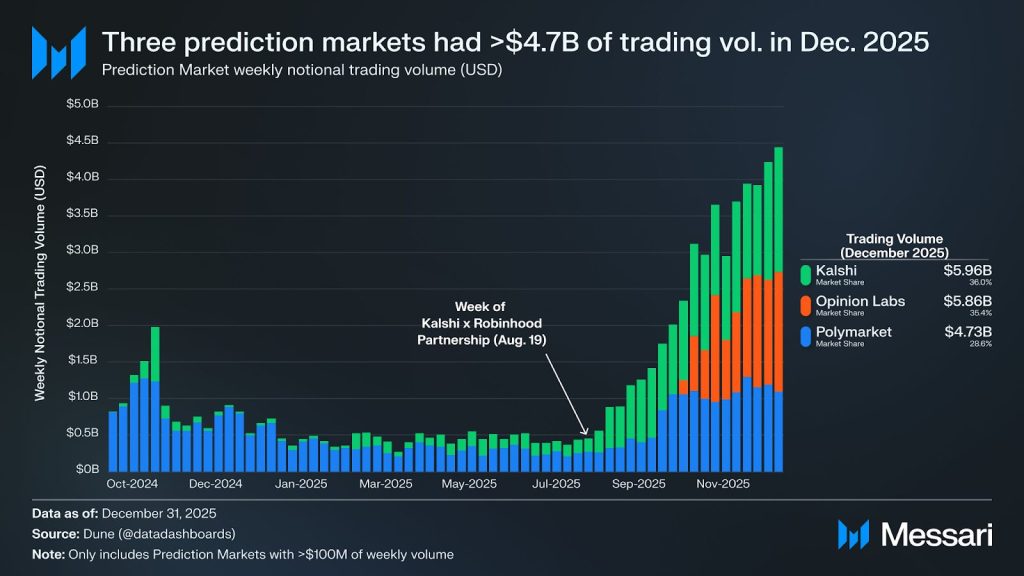
Portugal Bans Polymarket - Messari Volume Chart
Source: Messari

The post Portugal Bans Polymarket Over €4M Insider Trading Scandal appeared first on Cryptonews.

Portugal orders Polymarket to shut down over election betting surge

20 January 2026 at 09:03
  • Portugal prohibits political betting under its 2015 online gambling law.
  • Polymarket remains accessible, but regulators may ask ISPs to block it.
  • Polymarket faces restrictions in 30+ countries, with access limits varying by market.

Portugal’s gambling regulator has ordered blockchain-based prediction market Polymarket to cease operations in the country within 48 hours after the platform saw a sharp spike in activity linked to Sunday’s presidential election.

According to Rádio Renascença, bets placed on the outcome of the Jan. 18 vote exceeded 103 million euros ($120 million).

The regulator, the Serviço de Regulação e Inspeição de Jogos (SRIJ), said Polymarket does not hold a licence to offer betting services in Portugal and is therefore operating illegally.

The enforcement step highlights how prediction markets are increasingly colliding with national gambling laws, particularly when political events drive rapid inflows of user activity and large volumes of capital.

A fast-growing prediction market meets strict local gambling rules

Polymarket is a prediction market that lets users bet on real-world events such as politics, sports, or other developments by buying shares tied to potential outcomes.

In Portugal, betting on political events and other real-world outcomes is illegal.

Under the country’s 2015 online gambling law, betting is permitted only on sports, casino games, and horse racing.

SRIJ said Polymarket is not authorised to offer betting services in Portugal and cannot legally operate political markets, whether they relate to domestic events or international developments.

The regulator’s 48-hour deadline and what could come next

The regulator’s decision was tied to the surge in election-related betting, with activity around the Portuguese presidential race drawing increased attention.

SRIJ formally ordered Polymarket to quit the country within 48 hours.

However, the platform remains accessible for now, though regulators may soon instruct internet service providers to block access.

Other prediction market platforms, including Kalshi, Myriad, and Limitless, also appear to be accessible in Portugal, even as authorities focus specifically on Polymarket’s licensing status and its political betting markets.

Election-related volume draws fresh scrutiny

The size of the wagering linked to the Jan. 18 vote has put the spotlight on how quickly liquidity can concentrate on political markets.

Rádio Renascença reported that bets exceeded 103 million euros ($120 million), underscoring the scale of the activity on Polymarket tied to Portugal’s presidential election.

Such volumes can draw regulator attention faster than smaller niche markets, especially in jurisdictions where political betting is explicitly restricted.

Polymarket faces bans in 30+ countries

Polymarket was founded in 2020 and has already faced restrictions in more than 30 countries, including Singapore, Russia, Belgium, Italy, and, more recently, Ukraine.

Regulatory approaches vary by jurisdiction. Some countries, such as Belgium, have blacklisted the website.

Others, including France, have limited access so that local users can enter the platform in a “view-only” mode rather than actively participate.

Portugal’s enforcement action adds to that growing list and shows how legal pressure on prediction markets can escalate quickly when platforms gain traction around elections.

The post Portugal orders Polymarket to shut down over election betting surge appeared first on CoinJournal.

Bitcoin Adoption In West Virginia Sets A New Regional Benchmark

17 January 2026 at 16:00

Bitcoin literacy and community growth are accelerating in West Virginia, and it’s starting to reshape how communities across the state engage with digital finance. What was once viewed as a niche interest among tech enthusiasts is now gaining traction across broader segments of the state’s population. As residents become more curious about digital assets, conversations are shifting from speculation to understanding how BTC works and what it could mean for personal and regional economic resilience.

Bitcoin As A Tool For Regional Economic Growth

West Virginia has been making headlines in the Bitcoin space recently, particularly with fresh legislative moves as of January 2026. MartyParty revealed on X that the biggest current development is Senator Bill 143 (SB143), which was introduced this week by State Senator Chris Rose.

This is officially titled the Inflation Protection Act of 2026, which would allow the state’s Board of Treasury Investment to allocate up to 10% of public funds into precious metals like gold, silver, and platinum. The bill requires any qualifying digital asset to have maintained an average market capitalization of at least $750 billion over the prior year, which qualifies only BTC. In addition, the bill also allows for regulated stablecoins, but only the US federal or state regulators can approve the assets.

Bitcoin

However, the bill frames this as a hedge against inflation and currency depreciation, and empowering the state treasurer to invest in BTC without directly naming it in most of the statute. Although the purpose section explicitly mentions empowering investment in gold, silver, and BTC. These assets would need to be made through qualified custodians, ETFs, or other secure frameworks.

What Pension Funds And Endowments Think About Bitcoin

The Bitcoin price prediction by funds indicates a bullish outlook for 2026. CryptoRank.io has mentioned that the institutional analysts are pricing in a bullish scenario for BTC in 2026. The average target across the forecasts shown is around $150,000 per BTC, implying roughly 75% upside from current levels.

At the same time, longer-term valuation models assume a more gradual growth path. Popular asset manager VanEck predicts BTC could reach approximately $2.9 million by 2050, which equates to around 15% annualized growth broadly in line with the BTC historical long-term performance as a macro asset.

In contrast to institutional forecasts, prediction markets maintain a more conservative outlook. On Polymarket, the pricing base-case range between $110,000 to $130,000. This consensus could shift toward the institutional targets if spot ETF inflows remain strong and if the US regulatory uncertainty continues to decline, including initiatives such as the Blockchain Regulatory Certainty Act.

Bitcoin

Ripple CEO Comments On Latest CPI Data – Here’s What He Said

16 January 2026 at 17:00

Ripple CEO Brad Garlinghouse has commented on the latest CPI data, which shows that inflation has remained steady in the U.S. Garlinghouse highlighted the potential impact that the pro-crypto policies may have had on the soft inflation data. 

Ripple CEO Highlights Crypto Impact On CPI Data

In an X post, the Ripple CEO noted that the latest CPI data shows a 3.5% reduction in financial services costs for consumers. He then raised the possibility that this decline could be partly due to the Trump administration’s pro-crypto policies. The administration has created a regulatory environment for the crypto industry that may have made financial services more accessible, reducing their cost.   

Notably, the CPI data came in line with expectations, which was a positive for Bitcoin and the broader crypto market. The CPI came in at 2.7% year-over-year (YoY), in line with expectations. The core CPI came in at 2.6% YoY, lower than expectations of 2.7%, signaling that inflation in the country has remained steady. 

Following the release of the CPI data, Bitcoin broke $92,000 and since surged to a new yearly high above $97,000. Major altcoins like Ethereum, Ripple-linked XRP, Solana, and Dogecoin have also recorded significant gains. The inflation data is bullish for the market as it could, in the long run, influence the Fed to make more rate cuts if inflation holds steady rather than trends upwards. 

Polymarket data show an increase in the number of rate cuts the Fed could make following the release of the CPI data. There is now a 27% chance of three rate cuts this year, while a 21% chance of two. Previously, crypto traders were betting on only two rate cuts this year. Trump is also expected to nominate a rate-cut advocate as the next Fed chair, which would be positive for lower interest rates. 

Ripple CEO Also Comments On Crypto Legislation

The Ripple CEO also commented on the CLARITY Act’s markup, just before its postponement. He noted that the markup was long overdue, but that it is a massive step forward in providing workable frameworks for crypto while continuing to protect consumers. Garlinghouse further remarked that he and his company know firsthand that clarity beats chaos and that the bill’s success is crypto’s success. 

The Ripple CEO also mentioned that they will continue to move forward with a fair debate and remain optimistic that issues can be resolved through the markup process. The Senate Banking Committee has since postponed the markup after Coinbase withdrew its support for the bill due to concerns about DeFi and stablecoin yield provisions. Meanwhile, Garlinghouse has yet to comment on the postponement, while Coinbase CEO Brian Armstrong believes that progress with the bill hasn’t stalled despite the setback. 

Ripple

Bitcoin Price Will Still Rally Above $99,000 Despite Bearish Sentiment, Here’s Why

16 January 2026 at 15:00

Crypto analyst TARA has predicted that the Bitcoin price will still rally despite bearish signals that have surfaced. She highlighted why the flagship crypto could reach this level and what could happen once it touches the price target. 

Analyst Predicts Bitcoin Price Surge To $99,000

In an X post, TARA opined that the Bitcoin price will reach $99,300, even though the flagship crypto is printing a bearish candlestick. She stated that BTC wants to touch this price target before it retraces deeper so that the correction does not break the critical support at $90,000. The analyst added that retracement levels for BTC will continue to be adjusted, with the new 2026 high above $97,000, while revealing subwaves on the way to the full target at $103,000. 

Notably, crypto traders are currently betting on the Bitcoin price rallying past the $99,000 level and reaching the psychological $100,000 level. Polymarket data shows a 48% chance that BTC will rally to $100,000 this month. This follows the flagship crypto’s recent rally from around $92,000 to above $97,000 following the release of the soft CPI inflation data earlier this week. 

Bitcoin

The spot Bitcoin ETFs have also contributed to the Bitcoin price surge to start the year. In an X post, Bloomberg analyst Eric Balchunas highlighted that ETFs recorded net inflows of $843 million on January 14 and now boast 1-week net inflows of $1 billion and $1.5 billion year-to-date (YTD). With BTC rallying to $97,000 after trading sideways towards the end of last year, Balchunas opined that the buyers may have exhausted the sellers. 

Arthur Hayes Predicts Bitcoin Rally On Rising Liquidity

In his latest blog post, BitMEX co-founder Arthur Hayes predicted that the Bitcoin price could sustain this rally as dollar liquidity rapidly increases. Hayes expects dollar liquidity to increase as U.S. President Donald Trump finds more ways to inject liquidity into the economy. The BitMEX co-founder highlighted how Trump plans to lower mortgage rates, which could cause Americans to borrow more.  

Hayes also mentioned that the liquidity in 2025 didn’t support crypto portfolios, which is why the Bitcoin price underperformed. He urged market participants not to draw wrong conclusions from the 2025 underperformance, as it was always a liquidity story rather than a cyclical bear market, as some analysts suggested. 

More liquidity could also flow into the market as Trump nominates a rate-cut advocate to replace Fed Chair Jerome Powell. This could lead to larger rate cuts, which would be bullish for the Bitcoin price and the broader crypto market. 

At the time of writing, the Bitcoin price is trading at around $95,300, down in the last 24 hours, according to data from CoinMarketCap.

Bitcoin

Prediction Markets Promised Unbiased Truth, But They'll be Riddled with Manipulation

12 January 2026 at 02:16

If prediction markets are supposed to reflect the collective wisdom of the crowd, why are they starting to look more like a place where the best connected players bend outcomes to their advantage? That tension sits at the heart of one of Web3’s fastest-growing sectors.

Prediction platforms like Polymarket have unexpectedly become engines of user growth, pulling everyday bettors from Web2 into DeFi. But the deeper they scale, the more they reveal a structural contradiction. The system meant to reveal unbiased truth may be increasingly vulnerable to manipulation, insider edge, and capital-driven distortion.

This is actually worse than crypto hype cycles and token speculation. It’s about how prediction markets are changing the relationship between trust, money, information, and human behavior, and what happens when those incentives collide.

Transparency Isn’t Enough

The cracks in the system are becoming harder to ignore. Prediction markets were championed for their ability to aggregate intelligence from diverse participants. The reality emerging today is more complicated. When money pools deepen, strategic behavior follows.

Whales can move prices at will and information asymmetry is a competitive edge rather than a filter to accuracy. And unlike securities markets, prediction platforms operate in a regulatory space where insider behavior is harder to classify, let alone punish.

The Polymarket case involving the pseudonymous trader AlphaRaccoon reflects this perfectly. In 2025, the trader accurately predicted almost every outcome in a slate of markets tied to Google’s “Year in Search” results, reportedly earning over $1 million in a single day. The near-perfect record raised a question that shakes the foundation of prediction markets: was this an example of brilliant analysis, or privileged intelligence?

SEC-style insider trading rules do not fully extended to the prediction markets, and for that, suspicion is unanswered and that ambiguity threatens public confidence.

Liquidity, Bias, and Whales Influence

Even without outright misuse of information, structural distortions persist. Many prediction markets lack deep liquidity, so prices can be swayed disproportionately by a handful of large traders. In theory, a prediction market mirrors distributed reality. In practice, it can start mirroring whoever has the strongest wallet.

That inversion from "collective belief discovery" to "whale influence" is where integrity risks increase. The danger is eroding trust in the promise that Web3 markets are fairer than their centralized predecessors.

Lessons from Sports Betting Scandals

Web3 is not the first domain to confront corruption by information advantage. In normal sports betting, multiple scandals exploded in 2025 alone. Some athletes, coaches, and insiders exploited data access and performance influence.

NBA players including Terry Rozier and Chauncey Billups were charged in alleged fraudulent betting schemes that used non-public insights. In Major League Baseball, Emmanuel Clase and Luis Ortiz faced indictments tied to pitch manipulation for betting purposes. Major leagues swiftly imposed new betting restrictions, but not before the integrity of regulated markets was questioned nationwide.

These show that whenever human behavior, money, and uncertainty intersect, temptation grows. If elite athletes can risk jail for advantage in those tightly regulated systems, prediction markets that operates under softer oversight faces even greater exposure.

The Mission Is Shifting, Whether Builders Admit It or Not

Prediction markets were imagined as democratic oracles. Users would express belief with capital, and the aggregate price would reveal probability. But today's market reality shows that expression can become influence. A bet is no longer just a reflection of belief; it can shift sentiment, alter narrative, or amplify selective information.

That transition pulls prediction markets toward an identity crisis. Are they truth markets? Are they trading games? Are they speculative platforms with informational byproducts? Or are they early-stage casinos camouflaged as economic theory?

These answers matter, because how the market defines itself will dictate how participants behave.

Innovation vs Integrity

The promise of prediction markets remains undeniable. They democratize forecasting. They unlock new economic behaviors. They speak the language of millions who already wager daily. They are onboarding gateways for Web3 precisely because they remove friction.

But future relevance depends on trust. Platforms like Polymarket will need to build mechanisms that outpace misconduct. That includes more robust oracle systems, manipulation-resistant market architecture, and governance that responds to exploitation without abandoning decentralization principles. Regulation is not a threat if aligned with growth, it may be the shield that lets these markets scale into mainstream adoption.

Conclusion

Prediction markets are no longer side projects in crypto’s experimental sandbox. They are shaping the crypto culture, steering the crowd's behavior, and testing the boundaries between public information, private gain, and collective intelligence. Their growth has shown both extraordinary potential and fragile vulnerabilities that cannot be ignored.

If they succeed, they could become one of Web3’s most powerful user pipelines and a more transparent alternative to legacy betting markets. If they fail to reconcile incentives with integrity, they may become just another field for power concentration and manipulation.

At this crossroads, the question is not whether prediction markets will grow, they already have. It is whether they can evolve without losing the credibility that makes their existence meaningful.


Prediction Markets Promised Unbiased Truth, But They'll be Riddled with Manipulation was originally published in Coinmonks on Medium, where people are continuing the conversation by highlighting and responding to this story.

Dow Jones to Add Polymarket Prediction Data Across WSJ, Barron’s Platforms

7 January 2026 at 12:28

Bitcoin Magazine

Dow Jones to Add Polymarket Prediction Data Across WSJ, Barron’s Platforms

Dow Jones said Wednesday it has entered an exclusive partnership with Polymarket to distribute real-time prediction market data across its consumer news platforms, marking a big and mainstream expansion of alternative market signals into some of the most widely read financial publications in the world.

Under the agreement, Polymarket’s prediction data will appear across Dow Jones digital properties, including The Wall Street Journal, Barron’s, MarketWatch and Investor’s Business Daily.

The data will be featured through dedicated modules on homepages and market-related pages, as well as select print placements, Dow Jones said.

The partnership positions Dow Jones as one of the first major legacy publishers to formally integrate prediction market signals into mainstream financial journalism, offering readers a new and upcoming way to assess market expectations alongside traditional indicators like analyst forecasts.

Dow Jones CEO Almar Latour said the move reflects growing demand for real-time insight into how markets collectively price future outcomes.

As part of the collaboration, Dow Jones will roll out new consumer-facing features that incorporate prediction market information, including a custom earnings calendar highlighting market-implied expectations for corporate performance. Additional data-driven products are expected to launch over time.

The agreement underscores Dow Jones’ broader strategy of expanding its data and analytics offerings amid intensifying competition for investor attention. 

While financial news outlets have long relied on polls, surveys and analyst consensus to convey expectations, prediction markets offer continuously updated probabilities based on live trading activity.

Polymarket’s recent successes

Polymarket founder and CEO Shayne Coplan said the partnership brings prediction markets closer to the financial mainstream. “The Dow Jones group, including The Wall Street Journal, are setting a new standard for accessible, data-driven information,” Coplan said. “This partnership combines journalistic insight with real-time market probabilities to create a more comprehensive news experience.”

The deal follows a string of recent media and institutional partnerships that have elevated the visibility of prediction markets beyond crypto-native audiences. 

For Polymarket, the Dow Jones partnership marks its first major media collaboration since relaunching in the U.S. after resolving regulatory issues with the Commodity Futures Trading Commission. 

The New York-based platform had been barred from U.S. operations in 2022 for offering unregistered derivatives contracts before returning under a regulated framework following the acquisition of a CFTC-licensed exchange.

Founded in 2020, Polymarket has grown rapidly by allowing users to trade on the outcomes of real-world events ranging from elections to economic data and corporate earnings. The platform also accepts Bitcoin deposits. 

This post Dow Jones to Add Polymarket Prediction Data Across WSJ, Barron’s Platforms first appeared on Bitcoin Magazine and is written by Micah Zimmerman.

Polymarket quietly changes fee model for short term crypto markets

6 January 2026 at 09:12
  • Fees collected from takers are redistributed daily to liquidity providers in USDC.
  • The highest fees apply when market odds are near 50% and fall toward zero at extremes.
  • Longer-term crypto, political, and non-crypto markets remain fee-free.

Prediction market platform Polymarket has made a subtle but meaningful change to how some of its crypto markets operate.

Updated documentation on the site shows that 15-minute crypto up and down markets now carry taker fees, a break from the platform’s long-standing zero-fee trading model.

The update appeared without a formal announcement and applies only to a narrow segment of markets.

Most Polymarket markets remain fee-free, signalling a targeted structural adjustment rather than a platform-wide shift.

The change was identified through revisions to Polymarket’s Trading Fees and Maker Rebates Program documentation.

These sections now explain that taker-only fees have been enabled on short-duration crypto markets to fund liquidity incentives.

Archived versions of the documentation indicate that this language is new, suggesting the fee model was introduced recently and without public notice.

Documentation reveals new fee structure

According to the updated material, the taker fees apply solely to 15-minute crypto markets.

These are short-term contracts designed for rapid price movements, where liquidity conditions can change quickly.

The platform states that fees collected from takers are redistributed daily to liquidity providers in USDC stablecoin, rather than retained by Polymarket itself.

This redistribution mechanism positions the fee as a funding tool for market makers rather than a revenue stream for the platform.

Other markets, including longer-term crypto predictions, political markets, and non-crypto events, continue to operate without fees.

Fees tied to market odds

The documentation outlines a variable fee model based on market odds.

Fees are highest when prices are close to 50%, a range typically associated with the greatest uncertainty and trading activity. As odds move closer to 0% or 100%, the fee declines sharply toward zero.

Examples included in the documentation show how this plays out in practice.

A taker trade of 100 shares priced at $0.50 would incur a fee of about $1.56, which is slightly over 3% of the trade’s value at the peak of the curve.

Smaller trades and those placed near probability extremes face lower charges, with very small fees rounded down.

Social media reaction frames intent

The quiet rollout prompted discussion on X, where several users framed the move as a market-structure adjustment rather than a conventional fee increase.

X user 0x_opus said the change would increase protection from wash trading, arguing that the platform is not charging users in the traditional sense because the fees are redirected to liquidity providers.

Another trader, kiruwaaaaaa, described the move as being directed against high-frequency bots, saying the fee-funded rebates could incentivise tighter spreads and more consistent liquidity.

A third user, Tawer955, offered a more detailed breakdown, calling the headline effect of the change “scary, but not as bad as it sounds.”

He said the structure creates a sustainable cash flow for liquidity providers while reducing incentives for bots that previously exploited free liquidity.

Impact limited to select markets

For the majority of Polymarket users, the change is expected to have a limited impact. Only 15-minute crypto markets are affected, while the rest of the platform remains fee-free.

Even within the affected markets, the fee design reduces costs for directional trades and those placed near clear probability outcomes.

By concentrating fees around the most competitive price ranges and redistributing them to liquidity providers, Polymarket appears to be fine-tuning incentives in its fastest markets without altering the broader user experience.

The post Polymarket quietly changes fee model for short term crypto markets appeared first on CoinJournal.

❌
❌