Tether led crypto protocol revenue in 2025 with approximately $5.2 billion, accounting for 41.9% of total revenue across 168 revenue-generating protocols, according to CoinGecko Research. Stablecoin issuers dominated the rankings, with just four entities generating 65.7% or roughly $8.3 billion…
Tether emerged as the most profitable crypto entity in 2025, generating an estimated $5.2 billion in revenue as stablecoins overtook all other protocol categories in earnings.
According to the latest Coingecko annual crypto industry report, Tether alone accounted for 41.9% of all stablecoin-related revenue in 2025, outpacing competitors such as Circle, Hyperliquid, Pump.fun, Ethena, Axiom, Phantom, and PancakeSwap.
The results show that dollar-backed digital currencies have become the most durable revenue engine in crypto, even as market conditions fluctuated throughout the year.
Tether Leads Stablecoin Issuers To Capture Crypto Revenue Crown
Among more than 168 crypto protocols tracked in 2025, stablecoin issuers collectively generated the highest revenue, with Tether firmly at the center.
INSIGHT: Stablecoins generated $5.2B in revenue in 2025, accounting for 41.9% of total protocol revenue. pic.twitter.com/fjJrAn9k7B
Its $5.2 billion haul placed it well ahead of Circle and other major players, reinforcing USDT’s position as the industry’s primary settlement asset.
Within the top ten revenue-generating protocols, just four entities, led by Tether and Circle, produced 65.7% of total earnings, equivalent to roughly $8.3 billion.
Source: Coingecko
The remaining six protocols in the top ten were all trading-focused platforms, highlighting a sharp divide between stable revenue streams and market-dependent income.
That contrast became clear as trading revenues swung widely with investor sentiment during the year.
Phantom, for example, recorded $95.2 million in revenue in January at the height of the Solana meme coin frenzy, only to see earnings fall to $8.6 million by December as speculative activity cooled.
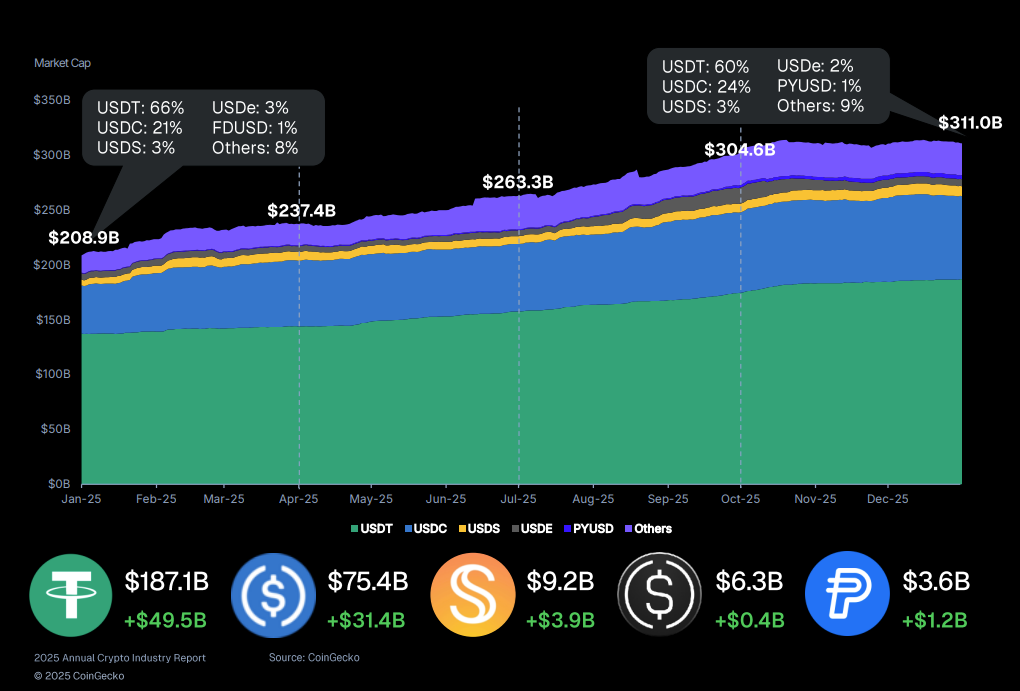
USDT Claims 60% Share Of $311B Stablecoin Market
The broader stablecoin market expanded rapidly, with total market capitalization rising by $6.3 billion in the fourth quarter alone to reach a record $311.0 billion.
That marked a 48.9% year-over-year increase, adding $102.1 billion as adoption accelerated across regions.
Tether maintained clear leadership with 60.1% of the total stablecoin market cap, or about $187.0 billion, followed by Circle’s USDC at 24.2%, equivalent to $72.4 billion.
Source: Coingecko
Tether is now the world’s third-largest digital asset by market value at $186.8 billion, up roughly 50% from a year earlier.
While the top players strengthened their grip, shifts within the top five reflected changing risk appetites.
Ethena’s USDe experienced the sharpest reversal, with its market cap plunging 57.3%, or $6.5 billion, after a mid-October depeg on Binance undermined confidence in high-yield looping strategies.
Other stablecoins posted mixed but notable moves as capital rotated within the sector.
PayPal’s PYUSD surged 48.4%, adding $1.2 billion to reach $3.6 billion and briefly claiming the fifth spot before World Liberty Financial’s USD1 reclaimed it by nearly $1.
Additional high-growth tokens included Ripple’s RLUSD, which expanded 61.8% to add $488.2 million, and USDD, which climbed 76.9% with a $366.8 million increase.
Inside Tether’s $500B Valuation Path and Expanding Investment Empire
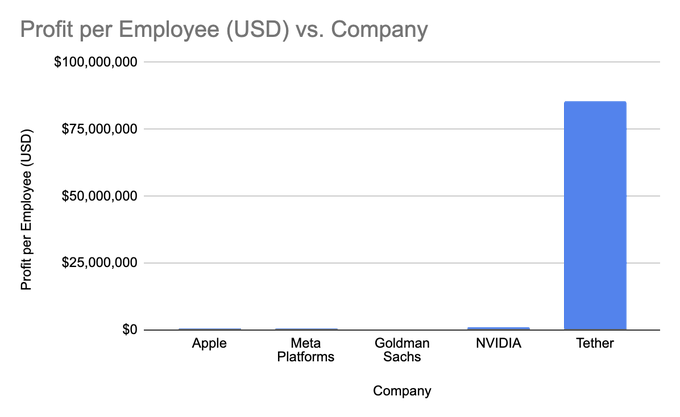
Looking ahead, Bitwise CIO Matt Hougan recently suggested that Tether could become the world’s most profitable company if its trajectory continues.
“There’s a chance that many emerging market countries will convert from primarily using their own currencies to using USDT,” Hougan said, pointing to Tether’s near-total dominance outside Western markets.
Based on projected interest income, calculations indicate that custody of $3 trillion in assets could generate annual revenue exceeding the $120 billion earned by Saudi Aramco last year.
Tether CEO Paolo Ardoino previously told Cryptonews he remains confident USDT will retain its lead due to the company’s deep understanding of real-world usage.
Beyond stablecoins, Tether has expanded aggressively into traditional assets and investments.
The company recently became the second-largest shareholder in Italian football club Juventus and has reportedly explored raising $20 billion for a 3% stake, a deal that would imply a valuation near $500 billion and place Tether among the world’s most valuable firms.
Iran’s central bank quietly built up a large stash of Tether’s USDT last year as the rial struggled and trade with the outside world grew harder. The move turned parts of the crypto ledger into a public trail of a policy that would normally be private.
Central Bank’s Crypto Moves
According to a blockchain analysis by Elliptic, the Central Bank of Iran acquired at least $507 million in USDT over 2025, a figure the firm treats as a conservative minimum because it only counts wallets it could tie to the bank with high confidence.
Reports say much of the buying happened in the spring months of 2025 and that payments were routed through channels that included Emirati dirhams and public blockchains. Those stablecoins were then used in local crypto markets to add dollar-linked liquidity and help slow the rial’s slide.
New Elliptic research: We have identified wallets used by Iran’s Central Bank to acquire at least $507 million worth of cryptoassets.
The findings suggest that the Iranian regime used these cryptoassets to evade sanctions and support the plummeting value of Iran’s currency,… pic.twitter.com/I7NHGO0wtP
Elliptic’s tracing shows an early flow of USDT into Nobitex, Iran’s biggest crypto exchange, where the coins could be swapped into rials and fed into the market. After a breach and growing scrutiny in mid-2025, other paths were used, including cross-chain bridges and decentralized exchanges, to move and convert funds.
A Freeze And A Warning
That open ledger also left the transactions visible to outside observers. On June 15, 2025, Tether blacklisted several wallets linked to the central bank and froze about $37 million in USDT, showing that stablecoins can be cut off when issuers or regulators step in. That intervention narrowed some options for on-chain liquidity.
This episode matters for two reasons. First, it shows how a state institution can use stablecoins to gain access to dollar value when normal banking routes are closed.
Second, it highlights a weakness: if a private issuer can freeze balances, those reserves are not the same as cash held in hard foreign accounts.
Trade, Sanctions, And A New Tool
Reports note the purchases likely served a twin goal — to smooth domestic exchange rates and to help settle trade with partners who avoid direct dollar banking.
The method is blunt. It gives a way to move value, but it also creates new points of control and exposure that can be tracked on public ledgers.
Analysts will be watching how regulators and stablecoin issuers respond. They will also track whether other countries under pressure turn to similar mixes of centralized and decentralized tools.
The public tracing of these flows makes it harder to hide big moves, even when actors try to obscure them across chains and exchanges.
Featured image from Unsplash, chart from TradingView
A pair of bills in Massachusetts would require manufacturers to tell consumers when their connected gadgets are going dark. It should be a boon for cybersecurity as connected devices grow obsolete.
Ethereum’s network has been buzzing. Blocks are full, wallets show new activity, and on-chain counters are ticking up fast. But not all of that motion looks like real people using the chain.
Address Poisoning On The Spotlight
In a recent blog post, researcher Andrey Sergeenkov warned that a recent Ethereum upgrade is being exploited to send tiny transactions that create misleading wallet history entries, a tactic known as address poisoning.
According to the expert, a big slice of the traffic may be the result of “dusting” or address poisoning attacks. Small, almost worthless transfers — sometimes less than a dollar — are being sent to a wide range of addresses.
Record-high Ethereum activity that everyone’s celebrating is an address poisoning attack.
– Over $740K already stolen, and growing
– This became possible thanks to the Fusaka upgrade
– This attack is ongoing right nowhttps://t.co/cqoEvqttQd
These tiny transfers create fake-looking entries in a wallet’s history. People who skim their recent transactions or copy addresses from a short list of past contacts can be tricked into sending funds to a scammer by mistake. It is a basic trick that gets more power when fees fall.
Why It Happened
Reports say that after recent updates and lower average gas costs, sending millions of tiny transactions became affordable. When fees drop, attackers can spray dust across large numbers of wallets and run follow-up scams at scale.
The tactic uses two steps: first, make a history entry that looks like a real counterparty; second, hope a user copies that wrong entry. Some attacks aim to deanonymize users, while others are pure bait to steal funds later.
Simple Mistakes With Big Consequences
An Ethereum wallet owner might glance at a list and use the wrong address. Or they might be prompted by a message that seems to match a past transfer. Either way, if funds are sent to the attacker, those funds are usually gone.
Reports estimate that hundreds of thousands of dollars have been siphoned from victims who fell for different versions of this trick. The sums are not always massive per case, but they add up when many victims are targeted.
Small Transfers From Strange Addresses
Look for small incoming transfers from addresses you do not recognize, especially when those transfers appear in large batches. Watch for identical token amounts or for many transfers with the same memo or pattern.
Wallets that show sudden clusters of tiny token receipts are worth extra caution. Security tools and some wallets can hide tiny transfers or warn users about unusual incoming dust. Use those features if they are available.
What Experts Advise
Based on reports, researchers urge people to verify the full address they are sending to, not just the start or end of it. Use address book features, QR codes, or trusted contacts to confirm destinations.
Avoid copying addresses from a short recent-history view. If you receive a small, unexpected deposit, take it as a warning sign, not an invitation.
Featured image from Pexels, chart from TradingView
ETH is down 3% in the last 24 hours and is now trading above $3,200.
The bearish performance comes amid renewed trade tensions between the U.S. and the EU.
ETH dips below $3,200 on the U.S.-EU trade tensions
Ether, the second-largest cryptocurrency by market cap, is down 3.4% in the last 24 hours and briefly dropped below the $3,200 level. The coin is now trading at $3,205 after slightly recovering from the dip.
The bearish performance comes amid the ongoing trade tensions between the United States and the European Union. President Donald Trump threatened to escalate tariffs, starting at 10% on February 1 and rising to 25% by June, on imports from eight NATO allies (Denmark, Norway, Sweden, France, Germany, the UK, the Netherlands, and Finland).
The president added that the tariffs will stay in place until Denmark agrees to sell Greenland to the United States.
Rachael Lucas, crypto analyst at BTC Markets, stated that,
“The latest U.S.-EU trade war headlines have certainly injected fresh volatility into an already uneasy market … adding a layer of geopolitical uncertainty that markets were in no shape to absorb. But while the headlines are loud, they’re not the fundamental driver of the current pullback in crypto.”
ETH eyes the $3,360 resistance level as the market begins recovery
The ETH/USD 4H chart is bearish and efficient after Ether lost more than 3% of its value in the last 24 hours. The technical indicators remain positive, suggesting that ETH could rally higher in the near term.
The RSI of 52 is above the neutral 50, indicating a fading bullish momentum. The MACD lines remain above the neutral zone, signalling that the buyers remain in control.
If the market recovery continues, ETH could rally towards the first major resistance level at $3,360 over the next few hours or days.
However, if the market correction continues, ETH could retest the January 12 swing low of $3,068.
Ethereum’s validator exit queue has dropped to zero, a shift that on-chain watchers say could change how the market views sell pressure. According to on-chain metrics and recent reports, validators who once waited weeks to withdraw are no longer lining up. That alone removes a large, visible source of potential ETH flowing back into markets.
Ethereum Exit Queue Clears
The queue once held millions of ETH. Now it is empty, data from Ethereum Validator Queue shows. This means validators who choose to exit can be processed almost immediately, rather than being forced to wait. The backlog that worried traders in late 2025 has gone.
A change this clear removes an obvious supply overhang and it shifts the balance between how much ETH stays locked versus how much can be spent.
Supply Tightening And Market Noise
Based on reports, staking inflows have been strong enough to pull a big share of circulating ETH out of active markets. With fewer validators lined up to leave, sudden large dumps tied to emergency exits become less likely.
That does not make prices certain, but it lowers one kind of downside risk. Traders tracking on-chain flows now weigh staking behavior alongside spot and derivatives activity when forming short-term views.
Staking Demand Grows
Entry requests to stake ETH are rising fast. Reports note that the entry queue — ETH waiting to become active validators — has climbed to high levels once seen only in big onboarding periods.
Wait times for new activations have stretched into many weeks in places. Institutions and staking services are part of this push, according to market observers, and their moves tend to lock up larger sums for longer.
Security, Yield, And Real Effects
More ETH locked for staking helps the network’s security because more validators are actively participating. It also creates yield opportunities for holders who prefer steady returns over trading.
That said, the presence of large staking pools and services means some risks are concentrated. If one big provider faces trouble, the effects will be felt widely. Reports say regulators and product issuers are watching closely as staking becomes easier to access through mainstream channels.
What Traders Are Watching
Price action will depend on many things beyond exit queues. Derivatives positions, ETF flows, and macro headlines still matter. Still, analysts point out that when a visible outlet for mass withdrawals disappears, the narrative around “forced selling” weakens.
Liquidity conditions can shift quietly — and then rapidly — if any of those other levers move. Market participants are therefore watching withdrawal metrics alongside exchange balances and futures open interest.
Featured image from Gemini, chart from TradingView
Ethereum is showing signs of strength on two critical fronts at the same time. On-chain activity has climbed to record levels, reflecting heavier real usage across the network, while long-term technical structure is leaning towards upside continuation.
Together, these signals suggest that Ethereum’s current phase may be more than just sideways movement, as underlying data points to sustained demand and constructive price behavior.
Ethereum Daily Transactions Reach New High
Ethereum’s price action is turning bullish with a steady increase in recent days. Notably, on-chain data shows that this increase is on top of steady on-chain activity in recent days.
Data from Ethereum’s on-chain activity shows that daily transactions recently climbed to approximately 2.8 million, setting a new all-time high for the network. Interestingly, this figure stands out not just as a record, but because it is roughly 64% higher than the daily transaction levels observed during the peak of the 2021 bull market.
The chart data from Sentora illustrates a progression showing Ethereum’s transaction count rising steadily over the years and spiking up in early 2026.
Comparing the transaction activity to 2021 adds more context considering the intense amount of activity that the Ethereum network was witnessing at the time. Back then, Ethereum was at the center of an altcoin season and NFT boom, all of which contributed to a spike in transaction activity and a push to new price highs.
The fact that Ethereum is now processing significantly more transactions per day compared to 2021 shows that its network usage has grown above speculative behavior. The steady climb in transaction activity shows the sheer amount of usage across decentralized finance and stablecoin settlement, among many others.
Technical analysis of Ethereum’s market capitalization on the three-week candlestick timeframe shows the cryptocurrency is still trading in a zone of stability. Particularly, technical analysis done by crypto analyst Egrag Crypto suggests that Ethereum is in reaccumulation within a macro uptrend.
A look at the 3-week timeframe shows that ETH’s market cap is holding above the 21 EMA, respecting the rising macro trendline, printing higher highs & higher lows, and compressing under historical resistance. That is constructive behavior, not weakness.
History shows that periods where Ethereum’s market cap held above the 21 EMA on this timeframe have led to expansion phases, whereas sustained moves below it have marked bear market conditions.
At present, the structure indicates the EMA support is being defended. From a probabilistic standpoint, the current setup leans toward continuation rather than breakdown. A move through the overhead resistance band would likely confirm an expansion phase and allow Ethereum to go on a 70% to 75% bullish continuation.
On the other hand, a bearish outcome will become possible if the price action loses the 21 EMA on the three-week chart. This could validate a deeper 25% to 30% correction toward the lower trendline, but this scenario carries a lower probability.
Featured image from Unsplash, chart from TradingView
According to CoinGecko’s annual report, crypto treasury companies were among the year’s biggest buyers even as prices fell. Their balance sheets grew sharply, and their actions left a clear mark on supply and markets. The numbers tell a story of heavy buying, pause, and then corporate moves to protect share value.
Large Treasury Buying Spree
Reports have disclosed that these treasury firms deployed close to $50 billion into Bitcoin, Ethereum, and other tokens during 2025. At the start of the year, treasuries held more than $56 billion in crypto.
By January one, 2026, that figure had risen to $134 billion — a gain of 137%. This buying helped push institutional ownership higher, with treasuries holding more than 5% of both Bitcoin and Ethereum supply by year-end.
Public companies alone raised their Bitcoin reserves from about 598,714 coins to more than 1 million, an increase near 500,000 BTC.
Market Drop Came Late In The Year
The broader market did not keep its earlier momentum. Total crypto value fell almost 8% in 2025 and finished the year near $3 trillion. Most of the damage came late.
2025 Annual Crypto Industry Report is now LIVE
Last year marked crypto’s first down year since 2022, featuring a brief $4.4T peak in Q4 before a historic $19B liquidation ended the year at $3.0T.
The market shed almost a quarter of its value in the last three months, and a liquidation wave near $19 billion in October sped the decline after total market value briefly hit about $4.4 trillion.
Bitcoin slipped roughly 1.4% to near $95,300 at one point as investors weighed policy moves in the US and shifting rate expectations.
Supply Now Held By Treasuries
By the start of 2026, treasuries were holding more than 1 million Bitcoin and 6 million ETH. That concentration matters because assets put on corporate books are less likely to be traded frequently.
When large shares of supply are locked up, price swings can be smaller in calm times, but the effect can flip if selling is forced.
Companies Shifted Strategy When Stocks Fell
When prices fell in the fourth quarter, some treasury firms saw their share prices dip below the value of their crypto holdings. To support their stock, many paused buying and turned to share buybacks.
That action slowed the pace of token purchases. The move was traditional: protect investors’ equity value rather than add more tokens into a weakening market.
Featured image from Pexels, chart from TradingView
Ethereum’s on-chain activity has jumped sharply, driven by a wave of first-time users and heavier transaction flow across the network. According to Glassnode, new activity retention roughly doubled this month — rising from about 4 million to around 8 million addresses — a move that points to a fresh cohort of wallets interacting with Ethereum rather than just repeat users.
Surge In New Users
Daily transactions hit a record high of 2.8 million on Thursday, a figure that is up 125% from the same period last year. Based on reports from Etherscan, active addresses have more than doubled year-over-year, moving from roughly 410,000 accounts to over 1 million as of Jan. 15. Those numbers suggest real, broad-based engagement is increasing, not merely short-lived spikes.
Ethereum’s Month-over-Month Activity Retention shows a sharp spike in the “New” cohort, indicating a surge in first-time interacting addresses over the past 30 days.
This reflects a notable influx of new wallets engaging with the Ethereum network, rather than activity being… pic.twitter.com/h8Zw7hXOSX
Observers link the transaction growth in part to rising stablecoin activity and lower fees. Reports have disclosed that many transfers are migrating execution to Layer 2 networks while settlement stays on Ethereum’s main chain, which keeps finality secure and helps push down gas costs. Staking has also climbed, reaching nearly 36 million ETH, adding another layer to the network’s tightening supply dynamics.
At the same time, market behavior remains careful. Strength in US equities has helped stabilize crypto prices, yet money flowing into Ethereum looks selective rather than broad.
It seems that positioning is rather conservative; traders prefer waiting for more accurate signals regarding ETH prices instead of attempting to predict a breakout. In turn, ETH is consolidating around a correction, but there is not enough momentum-driven buying.
Analyst Views & Price Movement
There were also those who cited optimism based on improvements to on-chain fundamentals. For instance, LVRG Research reported that the increasing number of transactions and staking activities encouraged a positive network.
Some traders argue the compression in price action could precede a breakout. Ether traded near a two-month high of $3,400 on Wednesday and was around $3,300 in early trading on Friday, reflecting the tug of war between renewed demand and persistent caution.
Despite the stronger metrics, technical hurdles remain. Reports and recent analysis suggest the market is in a repair phase, not a confirmed uptrend.
Overhead supply still constrains sustained advances, and many market participants want to see ETH reclaim key long-term resistance levels, such as the 200-day EMA, before committing large-scale capital.
That explains why short-term traders operate inside a defined range while longer-term players hold back.
What This Means For Traders And Investors
Network health has improved materially — more users, more transactions, and higher staking — but price action has not yet matched those gains.
Based on the data presented, cautious optimism is reasonable. Traders may find chance to trade the range, while investors looking for conviction should wait for cleaner technical confirmation before assuming a sustained rally.
Featured image from Blockzeit/EthBurn, chart from TradingView
ETH has maintained its price above $3,300 despite losing less than 1% of its value.
The leading altcoin could rally higher in the near term amid growing institutional demand.
ETH stays above $3,300 despite market pullback
ETH, the second-largest cryptocurrency by market cap, has lost less than 1% of its value in the last 24 hours and is now trading above $3,300 per coin.
This performance comes despite growing institutional demand for Ethereum products. According to data obtained from SoSoValue, Ether-linked funds saw steady demand. Spot ether ETFs recorded $175 million in net inflows on Wednesday, led by BlackRock’s ETHA and Grayscale products, extending a gradual recovery in flows after a quiet December.
The market pullback was primarily caused by the U.S. Senate Banking Committee (SBC) pushing back on discussing the crypto market-structure bill after Coinbase withdrew support for the latest draft.
The committee Chairman, Tim Scott, announced in an official statement that bipartisan leaders, alongside the crypto and financial sectors, are continuing to work on the draft.
The postponement comes after Coinbase’s CEO, Brian Armstrong, suddenly opposed the way, stating that it is better to have no bill than a bad one.
Armstrong pointed out that the bill kills stablecoin rewards, erodes the Commodity Futures Trading Commission’s (CFTC) authority, imposes DeFi prohibitions that violate privacy rights, and imposes a de facto ban on tokenized equities.
ETH eyes a breakout to $3,500
The ETH/USD 4-hour chart remains bullish despite the current market pullback. ETH is trading above $3,300 as the bulls defend the support level at $3,288.
The MACD indicator on the 4-hour chart remains above the signal line, with green histogram bars above the zero line, expanding in support of the bullish thesis.
The RSI of 67 shows that buyers remain in control, with the bulls breaking above the immediate 200-day EMA resistance at $3,339. A daily candle close above this level could see ETH surge towards the resistance zone at $3,447, tested on December 10.
However, failure to overcome this resistance level could see ETH retracing towards the $3,000 psychological region.
Standard Chartered has pushed its base-case price target for Ethereum to $7,500 by the end of the year, a big jump from an earlier $4,000 projection.
According to the bank’s digital assets team, growing demand from corporate treasury buyers and spot ETH products has driven the change in outlook.
Bank Raises Ethereum Target
The bank’s lead analyst expects fee growth on the Ethereum network and stronger institutional adoption to be key drivers for the move higher.
The bank also revised its longer-term numbers, lifting its 2028 target to $25,000 and laying out scenarios that push toward $40,000 by 2030. These wider targets reflect models where stablecoins and tokenized assets expand on Ethereum’s chain.
Institutional Buying Drives Demand
Data cited by market researchers points to heavy accumulation since June, with spot ETF flows and treasury firms together taking close to 4% of Ether’s circulating supply over that period.
ETHEREUM SEEN OUTPERFORMING BITCOIN
Standard Chartered says Ethereum’s outlook has improved and it is likely to outperform bitcoin. While weak bitcoin performance has weighed on the broader crypto market, rising institutional demand for ethereum and its dominance in stablecoins,…
Treasury firms alone reportedly bought about 2.3 million ETH in just over two months, a pace that Standard Chartered says outstrips some previous accumulation phases seen in Bitcoin.
Ethereum Vs. Bitcoin
Standard Chartered’s note also argues that Ether could outperform Bitcoin, raising the possibility of the ETH/BTC ratio returning toward levels last seen during 2021’s run-up.
Based on the bank’s scenarios, weaker Bitcoin momentum combined with stronger real-world use of Ethereum might lift Ether’s price faster than Bitcoin’s in the months ahead.
Long-Term Upside Scenarios
Some headlines have pointed to even bigger long-range targets produced by the same models, including forecasts of $30,000 by 2029 and $40,000 by 2030 under more bullish assumptions.
These outcomes rely on a substantial expansion of stablecoin use, tokenized real-world assets, and continued staking demand that would remove supply from the market.
Independent forecasters remain split, and other banks have offered lower year-end projections, offering a reminder that expert views differ.
Meanwhile, market watchers caution, though, that relative moves depend heavily on ETF flows and corporate balance-sheet decisions.
Network Fundamentals And Risks
According to the bank, Ethereum’s large share of stablecoin activity and its role in decentralized finance make fee income and on-chain demand a meaningful part of valuation models.
That said, the bank notes that scale improvements and Layer 1 throughput will matter a lot if big, traditional finance transactions migrate onchain.
The research also warns that shifts in macro conditions, outflows from major ETFs, or regulatory setbacks could change the math quickly.
Featured image from Unsplash, chart from TradingView
ETH is trading above $3,100, up by less than 1% in the last 24 hours.
The coin could rally towards the $3,500 psychological level if the bullish trend resumes.
ETH continues to range above $3k
The cryptocurrency market has had a positive start to the year, with Bitcoin reclaiming the $90k level. Ether is also trading above $3k once again, while XRP has reclaimed its position as the fourth-largest cryptocurrency by market cap.
However, the three leading cryptocurrencies have been ranging over the past few hours, with altcoins recording mixed performances. Bitcoin and Ethereum extend gains for the second consecutive day, crossing above $92,000 and $3,100, respectively, while XRP stabilizes near $2.00.
The technical indicators suggest that the bulls could regain control of the market and push Ether higher. However, with the weekly candle opening today, it would take a few hours before Ether’s direction could become clear to traders.
Ether eyes $3,500 amid a bullish triangle pattern
The ETH/USD 4-hour chart is bearish and efficient as Ether has lost 1.7% of its value in the last seven days. At press time, ETH is trading at $3,113, above the local support trendline connecting the December 18 and 29 lows.
The momentum indicators suggest that the bulls are currently in control of the market. The RSI of 49 shows a fading bearish momentum. If the RSI crosses above the neutral 50, Ether’s price could rally higher in the near term.
The MACD lines are also close to crossing into the positive zone, reinforcing a bullish bias in the market.
If the bullish trend resumes, Ether could surpass the December 10 high of $3,260, with the next major resistance around the $3,500 psychological level.
However, if the bearish trend persists, Ether could slip below the $3k level and test the support level around the December 18 low of $2,920.
Rumble on Wednesday announced the launch of a new digital wallet built in partnership with stablecoin giant Tether, allowing users and creators to send, receive and store cryptocurrency directly on the video-sharing platform without relying on banks or third-party payment processors.
The product, dubbed Rumble Wallet, will enable direct peer-to-peer payments using Bitcoin, Tether’s USDT stablecoin and Tether Gold (XAUt).
The company said the wallet is designed to let creators get paid directly by their audiences, reducing fees and limiting the risk of payment restrictions, account freezes or deplatforming by traditional financial intermediaries.
Founder, chairman and CEO Chris Pavlovski said the wallet aligns closely with the company’s free-speech mission and its long-running push to build alternatives to Big Tech infrastructure.
“Rumble represents free speech and liberty the same way that cryptocurrency and a decentralized internet represent freedom, and Rumble Wallet is the natural combination of those things,” Pavlovski said in a statement. “We are putting more power into the hands of users and creators so they can engage with and financially support the content they like.”
Later, Pavlovski posted on X, “If its not clear, I’ll make it really clear. Rumble Wallet will compete directly against Coinbase and Venmo — but we’re NOT custodial and we CANNOT shutdown your account. Its true financial freedom to buy, hold and tip crypto.”
BREAKING: Video streaming giant Rumble launches a crypto wallet to enable its audience to tip in #Bitcoin and crypto.
The announcement comes as the company continues to position itself as a “freedom-first” technology platform, appealing to creators and audiences frustrated with censorship, demonetization and opaque moderation policies on mainstream platforms.
The wallet is non-custodial, meaning users maintain confirmation of their own digital assets rather than handing control to a centralized provider.
The wallet is built using Tether’s Wallet Development Kit, which is designed to help platforms integrate crypto payments directly into their products.
CEO Paolo Ardoino said the collaboration reflects the company’s broader focus on decentralization and user autonomy.
“At Tether, we champion technologies that break boundaries and promote freedom, decentralization and the fundamental right to free expression,” Ardoino said. “Rumble Wallet brings those ideals together into one product that will give tens of millions of users more control than any platform has offered before, even in the United States.”
The two companies already have deep financial ties. Tether holds nearly 104 million shares of Rumble, representing roughly 48% of the company, according to disclosures.
MoonPay will power Rumble Wallet’s crypto on- and off-ramps, allowing users to seamlessly convert between digital assets and traditional payment methods such as credit cards, Apple Pay, PayPal and Venmo.
“Peer-to-peer payments powered by crypto are the future of the internet economy,” said MoonPay CEO Ivan Soto-Wright. “Rumble is one of the first major platforms to adopt this model, giving creators the ability to get paid instantly in stablecoins or Bitcoin and easily move in and out of fiat.”
Shares of Rumble rose 3% following the announcement, reflecting investor optimism around the platform’s expanding crypto strategy and creator monetization tools.
Trend Research has lifted its Ether holdings above 601,000 ETH using borrowed stablecoins.
The firm is now the third largest corporate Ether holder despite being unlisted.
Fundstrat expects Ether to fall toward $1,800 in the first quarter of 2026.
As 2026 approaches, Ether is becoming a clear dividing line for large crypto focused firms.
Some companies are increasing exposure aggressively, while others are preparing for a potential downturn in the months ahead.
Recent on chain data and market positioning show that corporate strategies around Ether are no longer aligned, reflecting different expectations around price behaviour, liquidity conditions, and the pace of crypto adoption within the financial system.
Trend Research pushes ahead
Hong Kong based investment firm Trend Research has continued to accumulate Ether despite growing discussion of downside risks in early 2026.
Blockchain data shared by Lookonchain shows the firm recently acquired about $35 million worth of ETH, lifting its total holdings above 601,000 ETH.
At current prices, the position is valued at roughly $1.83 billion.
The same data indicates that Trend Research has borrowed around $958 million in stablecoins from the decentralised lending protocol Aave.
Its average purchase price stands near $3,265 per ETH. Lookonchain published these details in a Monday post on X.
According to a post by founder Jack Yi, Trend Research plans to keep buying Ether regardless of short term price moves of a few hundred dollars.
Alongside ETH, the firm also maintains a heavy position in the Trump family linked World Liberty Financial token, underlining a broader high conviction crypto stance going into next year.
Corporate holder rankings shift
With more than 601,000 ETH, Trend Research now ranks as the third largest corporate Ether holder.
It sits behind BitMine Immersion Technologies and SharpLink Gaming.
However, because Trend Research is not publicly listed, it does not appear on several widely followed tracking platforms, including the StrategicEthReserve.
BitMine, the largest corporate Ether holder, has historically relied on a dollar cost averaging strategy rather than large single phase accumulation.
The contrast highlights how firms with significant balance sheets are adopting different approaches as uncertainty builds around the next market cycle.
Fundstrat flags downside risk
While some firms continue to accumulate, others are bracing for a possible drawdown.
Fundstrat Global Advisors recently circulated an internal research note projecting that Ether could fall to a local bottom around $1,800 in the first quarter of 2026.
Screenshots of the note emerged on Dec. 21 and were attributed to Fundstrat co-founder and managing partner Tom Lee.
The analysis pointed to a meaningful pullback across major crypto assets in the first half of 2026, followed by the formation of a durable low either in the first or third quarter before a recovery into year-end.
The forecast drew attention because Lee is also chairman of BitMine, which holds roughly $12.3 billion worth of Ether, making it the largest known corporate ETH holder.
Smart money stays cautious
Positioning data suggests that professional traders are also leaning defensive.
According to blockchain intelligence platform Nansen, traders labelled as smart money remain net short on Ether by about $117 million.
At the same time, Nansen data shows these traders added around $15 million in long positions over the past 24 hours.
The move points to a modest pickup in risk appetite, even as overall positioning continues to reflect caution around near term price direction.
Law enforcement in Russia has blocked major sites on the dark web, including a carding market leader. The platforms have been seized amid ongoing investigations into hacking groups, with Russian authorities ramping up efforts to dismantle the cybercrime rings and detain their members.
Interior Ministry of Russia Hits Stolen Credit Cards Market
The Ministry of Internal Affairs of the Russian Federation (MVD) has brought down four prominent websites operating on the dark web, blockchain forensics firm Elliptic has revealed. The sites have been blocked by Directorate “K”, MVD’s unit combatting computer-related crime.
The seized platforms are the Sky-Fraud forum, Trump’s Dumps, UAS Store, and Ferum Shop, which became the leading market for stolen credit cards after the largest marketplace in the niche, Unicc, was taken offline in January, the report details.
According to Elliptic’s estimate, the sites have collectively made more than $263 million in crypto sales denominated in bitcoin (BTC), ether (ETH), and litecoin (LTC) before they were shut down. Ferum accounts for the bulk of that amount with $256 million in bitcoin generated, or 17% of the carding market.
Trump’s Dumps, another website distributing compromised card data, has allegedly made around $4.1 million since its launch in 2017. Both sites were advertised on the on Sky-Fraud forum, where carding techniques and money laundering tips were among the main topics. Directorate “K” has apparently left a message in its source code, reading: “Which one of you is next?”
[#Russia] SKY-FRAUD & FERUM, famous Russian #carding forums closed by Russian authorities.
The fourth blocked website, UAS Store, was a platform offering stolen remote desktop protocol credentials that cybercriminals use to gain access to victims’ accounts from other devices. These breaches have increased during the Covid-19 pandemic as more employees are now working from home. Since late 2017, UAS Store has made around $3 million in cryptocurrency.
Elliptic notes that the latest seizures have been executed after the previous top carding marketplace, Unicc, and its affiliate proxy market Luxsocks, became inaccessible in mid-January. The seizures also came after the subsequent arrest of Unicc’s suspected administrator by the Russian Federal Security Service (FSB). Researchers claim the crypto proceeds of the two platforms reached $372 million.
Meanwhile, the MVD has sought through a Moscow court the arrest of six unidentified hackers accused of “illegal circulation of means of payment.” Whether the group is linked to the closed-down dark web sites is not clear yet. Last month, FSB and MVD busted the notorious Revil ransomware group on a U.S. request, detaining 14 of its suspected members.
Do you think Russia will continue to crack down on dark web platforms and hacking groups? Tell us in the comments section below.

 Login
Login