Normal view

There are new articles available, click to refresh the page.
Before yesterdayMain stream

Expert Analyzes XRP, Ethereum, And Solana: Predictions For The Next Altcoin Season

23 January 2026 at 04:00

As the crypto market faces uncertainty and continues in a consolidation phase, market expert Sam Daodu has issued a report examining the potential for XRP, Ethereum (ETH), and Solana (SOL) to emerge as frontrunners if a new altcoin season arises in 2026. 

XRP, ETH, And SOL Price Forecasts

Daodu began his analysis by pointing out that Bitcoin’s (BTC) dominance is currently hovering around 59%, alongside an Altcoin Season Index reading of 55. These indicators suggest that 2026 could herald a substantial rotation towards altcoins, mirroring significant shifts experienced during cycles in 2016-2017 and 2020-2021.

The expert outlines several bullish scenarios for each. For XRP, he envisions a potential surge past the $6-$8 range if exchange-traded fund (ETF) inflows maintain a monthly average exceeding $400 million and RippleNet continues to expand its influence in global banking. 

ETH, on the other hand, could see itself climbing toward $12,000-$18,000 if Layer 2 (L2) adoption unlocks broader usage and ETF inflows rebound. 

Daodu highlights that active addresses are at cycle highs, indicating organic demand that may translate to higher prices once institutional sentiment shifts positively.

For SOL, the outlook is similarly optimistic. Solana might rocket to the range of $500-$800 if its transaction finality of 150 milliseconds and low fees attract a new wave of applications. Additionally, the rise in ETF filings could lead to significant capital inflows.

Potential Risks Ahead 

In more stable scenarios, Daodu suggests that XRP might consolidate between $2.50-$3.50 if institutional adoption progresses steadily without dramatic catalysts. 

He also speculates that Ethereum could trade within the range of $5,000-$9,000, benefiting from consistent demand driven by staking yields and decentralized finance (DeFi) growth.

Meanwhile, Solana might trend between $200-$350, assuming that developer growth and retail adoption continue at their current pace without major breakthroughs. 

However, Daodu cautions that XRP could fall below $1.50 if demand for ETFs wanes or if regulatory uncertainties arise. Similarly, ETH could fall below $2,500 if scalability issues arise or if regulatory challenges become more pronounced. SOL could drop below $100 if outages persist or if it faces increased competition from other Layer 1 platforms.

What AI Models Anticipate

AI predictions provide additional insight into the expected performance of these altcoins. For XRP, forecasts vary significantly, with ChatGPT estimating a range of $0.80-$3.00, while Grok presents a more bullish outlook with a target of $1.50-$6.00. 

Ethereum’s AI predictions show a range of $3,000-$9,000 from ChatGPT, while Gemini anticipates a high of $7,000-$18,000 through increased tokenization. 

Lastly, Solana’s predictions range from $120-$350 from ChatGPT to a more optimistic $300-$800 from Gemini, depending on the growth of consumer applications.

XRP

XRP was trading at $1.93 at the time of writing, down 2% in the previous 24 hours. ETH traded at roughly $2,952, while SOL traded at $128, both experiencing comparable declines during the same time period. 

Featured image from DALL-E, chart from TradingView.com  
Solana Will Become A ‘Decentralized Nasdaq’ In 2026, Delphi Digital Predicts

21 January 2026 at 09:30

Delphi Digital is betting that Solana’s next major upgrade cycle will reposition the network as an “exchange grade” environment capable of supporting onchain order books that can realistically contend with centralized venues on latency, liquidity depth, and market structure. In a Jan. 20 post on X titled “2026 is the Year of Solana”, the research firm argued Solana’s 2026 roadmap is its “most aggressive upgrade cycle” yet, one that “overhaul[s] everything from consensus to infrastructure to become the decentralized Nasdaq.”

Why Delphi Digital Calls 2026 “The Year Of Solana”

Delphi framed the roadmap less as a grab bag of performance enhancements and more as a capital-markets push: “Solana’s roadmap is about transforming it into an exchange grade environment where a native onchain CLOB can viably compete with CEX latency, liquidity depth, and fairness. Here are all the upgrades making this possible.” In that view, shaving milliseconds matters only insofar as it produces predictable, enforceable execution outcomes for applications like high-frequency trading and central limit order books.

The centerpiece, Delphi wrote, is Alpenglow, a consensus redesign it called “the most significant protocol level change in Solana’s history.” The firm said Alpenglow introduces a new architecture built around Votor and Rotor, with Votor changing how validators reach agreement. Rather than “chaining multiple voting rounds together,” validators would aggregate votes offchain and “commit to finality in one or two rounds,” producing “theoretical finality in the 100-150 millisecond range, down from the original 12.8 seconds.”

Delphi emphasized Votor’s parallel finalization paths as a resilience feature, not just a speed play. If a block gets “overwhelming support (80%+ stake)” it finalizes immediately; if support is between 60% and 80%, a second round triggers, and finality follows if that also clears 60%. The goal, Delphi argued, is to preserve finality even with unresponsive segments of the network.

Alpenglow also introduces what Delphi called a “20+20” resilience model: safety holds as long as no more than 20% of stake is malicious, while liveness persists even if another 20% is offline, “tolerat[ing] up to 40% of the network being either malicious or inactive while still maintaining finality.” Under this design, Proof of History is “effectively deprecated,” replaced by deterministic slot scheduling and local timers. Delphi said the upgrade is expected to roll out in early to mid 2026.

Delphi also pointed to Firedancer, Jump’s C++ validator client, as a structural upgrade aimed at reducing a long-standing operational risk. Solana has historically relied on a single client, now known as Agave, and Delphi described that “monoculture” as a central weakness because client-level faults can cascade into broader network halts.

Firedancer’s objective, Delphi said, is a deterministic, high-throughput engine that can process “millions of TPS with minimal latency variance.” Ahead of full readiness, Delphi highlighted “Frankendancer,” a transitional build that combines Firedancer’s networking and block production modules with Agave’s runtime and consensus components, as a bridge to “substantially” increased client diversity.

On infrastructure, Delphi spotlighted DoubleZero as a private fiber overlay for validators, likening its transmission profile to traditional exchange connectivity: “the same infrastructure traditional exchanges like Nasdaq and CME rely on for microsecond level transmission.” The argument is that as validator sets expand, propagation variance becomes the enemy of tight finality windows. By routing messages along “optimal paths” and supporting multicast delivery, Delphi said DoubleZero can narrow latency gaps across validators—an enabler for both Votor’s quorum formation and Rotor’s propagation design.

Delphi also framed Solana’s block-building roadmap as a market-structure project. It described Jito’s BAM (Block Assembly Marketplace) as separating ordering from execution via a marketplace and privacy layer, with transactions ingested into TEEs so “neither validators nor builders can see raw transaction content before ordering takes effect,” reducing pre-execution behavior like frontrunning.

Harmonic, meanwhile, targets builder competition by introducing an open aggregation layer so validators can accept proposals from “multiple competing builders in real time,” with Delphi summarizing: “Think of Harmonic as a meta-market and BAM as a micro-market.”

Raiku rounds out the thesis by adding deterministic latency and programmable execution guarantees adjacent to Solana’s validator set, using Ahead-of-Time (AOT) transactions for pre-committed workflows and Just-in-Time (JIT) transactions for real-time needs—without modifying L1 consensus.

Delphi ultimately tied the technical roadmap to market demand: Solana’s spot trading gravity, the consolidation of onchain perps toward a handful of venues, and the need to reach performance parity with centralized platforms. It cited expectations for “new Solana native perps like Bulk Trade coming early next year,” and pointed to products like xStocks bringing “onchain equities directly to Solana,” arguing that liquidity and attention are consolidating toward a chain with faster settlement, better UX, and denser capital.

At press time, SOL traded at $127.

Solana price chart

Solana Price Prediction: Rare Bullish Pattern Forms – Is SOL About to Skyrocket to $1,000?

20 January 2026 at 13:49

After four consecutive days of negative trading sessions, SOL could be ready to make a comeback as a rare buy signal has shown up, favoring a bullish Solana price prediction in the near term.

The crypto market plummeted this week after President Donald Trump threatened to increase tariffs for eight European countries if they opposed his plan to purchase Greenland.

As a result, Solana has dropped 9% in the past 7 days.

However, trading volumes have subsided in the past 24 hours by nearly 25%, now accounting for just 5% of the token’s circulating market cap.

$SOL 🟣

DCA in, when short term holders are in the red.

DCA out, when they are in the green.

All that's required, is patience.

Capitalising on peoples pain thresholds seldom fails.

h/t: @OnChainMind pic.twitter.com/dWVFJssm6g

— James (@JamesEastonUK) January 20, 2026

This indicates that the selling pressure is progressively easing, as short sellers may be ready to cash out some of their gains.

Solana Price Prediction: SOL Hits Key Support After Bollinger Bands Say “Buy”

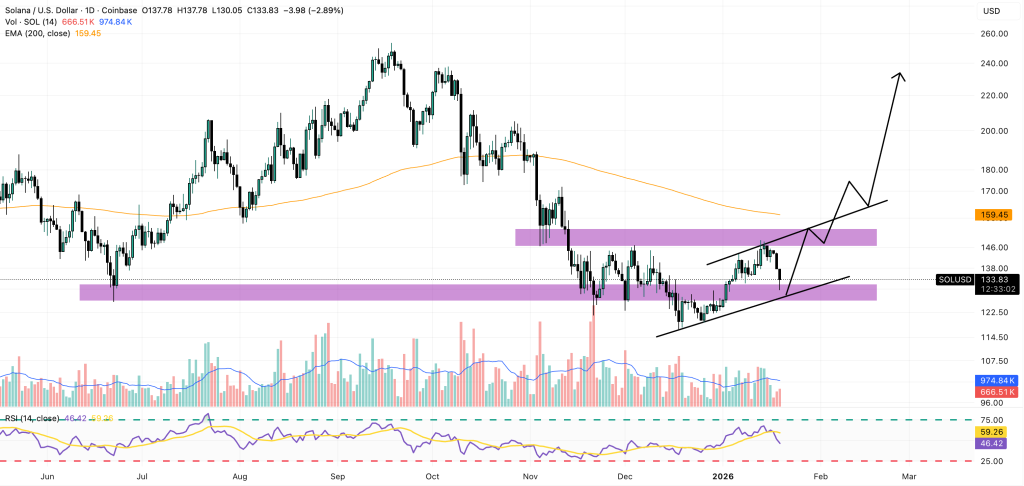
Solana just hit a key technical area of demand at $130, where a trendline and a horizontal support are in confluence.

This level has been the line in the sand for bulls at least three times in the past few months, underscoring its importance to market participants.

solana price chart
Source: TradingView

In addition, the price has formed an ascending price channel after Bollinger Bands sent a “buy” signal in mid-December.

These technical indicators are used to identify potential reversal points. Back then, the price dropped below the lower band, flashing an “oversold” signal.

If this reversal is confirmed, the price could recover to $150 first and then to $170 if bullish momentum gains enough traction.

As the largest altcoins like SOL seem poised to make a comeback, top meme coins may follow their footsteps.

A hot crypto presale called Maxi Doge ($MAXI) is catching serious momentum, pulling in over $4.5 million as traders look for the next breakout meme coin.

Maxi Doge ($MAXI) Has Early Dogecoin Vibes

If you feel down and out for missing Dogecoin’s rally to the top, Maxi Doge ($MAXI) offers you a second chance to bank on a promising meme coin.

This Ethereum token has rapidly become one of the hottest presales in this space. It embodies the spirit of ‘degens’, gym rats, and sleep-deprived traders who want to make it out of mom’s basement once and for all.

maxi doge crypto presale

$MAXI holders will get to showcase their biggest Ws to earn some bragging rights and attractive rewards via fun competitions like Maxi Ripped and Maxi Gains.

In addition, they get exclusive access to a collective “hive mind” where they can bounce ideas around with fellow risk-takers to make the most out of this market.

Finally, the token’s staking rewards currently sit at 69%, offering some icing on the cake for early buyers who lock up their tokens.

To buy $MAXI while the presale is still on, simply head to the official Maxi Doge website and connect your favorite wallet (e.g. Best Wallet).

You can either swap your ETH or USDT for this token or use a bank card to buy $MAXI in seconds.

Visit the Official Maxi Doge Website Here

The post Solana Price Prediction: Rare Bullish Pattern Forms – Is SOL About to Skyrocket to $1,000? appeared first on Cryptonews.

Solana Price Prediction: $1 Billion in Real World Assets Just Landed on SOL – Is SOL About to Overtake Ethereum?

19 January 2026 at 16:49

The Solana blockchain just crossed the $1 billion milestone in real-world assets (RWA), a major signal that strengthens the long-term bullish Solana price prediction.

According to data from RWA.xyz, the total value of tokenized RWAs on Solana surged by 17% over the past 30 days, highlighting growing adoption from institutions and DeFi protocols alike.

real-world assets solana

This has positioned Solana in the third spot. In this particular market, the blockchain still has a lot of work to do to overthrow Ethereum as the latter boasts a total of $12.8 billion in RWAs – over 12x more than the former.

Nonetheless, Solana is growing at a much faster rate, which could shorten the number of years that it would take the network to surpass its top competitor.

BlackRock’s USD Liquidity Fund is the largest program within Solana’s RWA ecosystem with more than $200 million in assets.

As Solana continues to showcase its technical robustness and practical use cases, more institutional players like BlackRock could launch new initiatives to expand their footprint in the RWA space.

Solana Price Prediction: SOL Hits Key Support at $130

Solana (SOL) seems to be ready to retest the $130 support today. However, its price action continues to favor a bullish outlook as an ascending price channel has formed.

solana price chart
Source: TradingView

In the past 24 hours, the token has shed 6% as selling pressure increased significantly during the Asian session following a quiet weekend.

The Relative Strength Index (RSI) has also sent a sell signal as it broke below the 14-day moving average.

However, as long as the $130 level holds, we should get a strong bounce to $150 shortly. Meanwhile, if we break this barrier, SOL could retest $110 in the near term.

Although the market has taken a breather lately, investors’ interest in top crypto presales in the Solana ecosystem, like Bitcoin Hyper ($HYPER), keeps growing.

Bitcoin Hyper Is Bringing Solana’s Speed to Bitcoin, Unlocking a New Way to Use BTC

Bitcoin Hyper ($HYPER) is a hot new crypto presale bringing Solana-style speed to the Bitcoin ecosystem.

It is the first-ever Bitcoin Layer 2 with smart contract support, allowing BTC to be used for more than just holding.

This means Bitcoin holders can access things like staking, trading, and on-chain applications, without having to move funds away from the Bitcoin ecosystem.

With over $30 million already raised during its public presale, Bitcoin Hyper is quickly gaining attention as a project aiming to unlock new utility for Bitcoin users.

A new phase for how Bitcoin can be used is starting, with Bitcoin Hyper focused on bringing programmability to Bitcoin while keeping BTC within the Bitcoin ecosystem.

The $HYPER token powers this Bitcoin Layer 2, supporting transactions, presale staking rewards, governance participation, and access to applications built directly on Bitcoin Hyper.

To take part in the $HYPER presale, visit the official website and connect any compatible wallet (such as Best Wallet)

From there, secure early access to $HYPER using USDT, ETH, BNB, or a bank card.

Visit the Official Bitcoin Hyper Website Here

The post Solana Price Prediction: $1 Billion in Real World Assets Just Landed on SOL – Is SOL About to Overtake Ethereum? appeared first on Cryptonews.

Solana Labs CEO Says Ethereum-Style ‘Walkaway’ Thinking Is a Death Wish

19 January 2026 at 05:30

Over the weekend, Solana Labs CEO Anatoly Yakovenko pushed back on Vitalik Buterin’s latest case for Ethereum “ossification,” arguing that for Solana, continuous protocol iteration is not optional, it is survival.

The exchange was sparked by a Jan. 12 post in which Buterin said “Ethereum itself must pass the walkaway test,” framing Ethereum as a base layer that should remain usable even if the community largely stops making substantive protocol changes.

“It must support applications that are more like tools […] than like services that lose all functionality once the vendor loses interest in maintaining them,” Buterin wrote. “But building such applications is not possible on a base layer which itself depends on ongoing updates from a vendor in order to continue being usable […] Hence, Ethereum itself must pass the walkaway test.”

Why Solana Can’t Afford To Ossify

Yakovenko replied that he “actually think[s] fairly differently on this,” laying out a philosophy that treats adaptability as core to Solana’s value proposition. “Solana needs to never stop iterating,” he wrote. “It shouldn’t depend on any single group or individual to do so, but if it ever stops changing to fit the needs of its devs and users, it will die.” In Yakovenko’s framing, the risk is not merely technical stagnation; it is a network losing relevance to the people building and transacting on it.

Buterin’s “walkaway test” rests on the idea that Ethereum should reach a point where its usefulness does not “strictly depend on any features that are not in the protocol already,” even if the ecosystem continues improving via client optimizations and limited parameter changes. He also sketched a set of medium-term protocol objectives, ranging from quantum resistance and scalable architecture to long-lived state design and decentralization safeguards, aimed at making Ethereum robust “for decades” and reducing the need for frequent disruptive upgrades.

Yakovenko’s critique is less about those specific goals than the premise that a base layer should aspire to being able to “ossify if we want to.” In his view, ossification is not a neutral milestone; it risks locking in a protocol that can’t keep pace with developer and user demands. “To not die requires to always be useful,” he wrote. “So the primary goal of protocol changes should be to solve a dev or user problem.” At the same time, he emphasized prioritization over maximalism: “That doesn’t mean solve every problem, in fact, saying no to most problems is necessary.”

A key overlap in both positions is a skepticism toward dependence on a single “vendor,” though they operationalize it differently. Buterin wants Ethereum’s base layer to become sufficiently complete that it can remain dependable even if the upgrade cadence slows dramatically. Yakovenko, by contrast, argues that Solana should assume upgrades will keep coming, but not necessarily from any one core team.

“You should always count on there being a next version of solana, just not necessarily from Anza or Labs or fd,” he wrote, referencing major entities in Solana’s development orbit. He then pointed to a future where governance and funding mechanisms could directly underwrite that work, suggesting “we are likely to end up in a world where a SIMD vote pays for the GPUs that write the code,” a nod to both on-chain coordination and the growing role of AI-assisted development.

At press time, SOL traded at $133.84.

Solana price chart

Money Flows Out From Bitcoin And Ethereum Into Solana And XRP, Here Are The Numbers

13 January 2026 at 17:30

Bitcoin, Ethereum, Solana, and XRP are at the center of a clear capital rotation unfolding across the crypto market, as investors scale back exposure to the largest assets while reallocating capital into selective alternatives. The latest CoinShares Digital Asset Fund Flows Weekly Report (Volume 268) captures this shift through hard fund-flow data, highlighting deliberate institutional repositioning.

Bitcoin And Ethereum See Heavy Withdrawals As Capital Rotates

Digital asset investment products recorded $454 million in net outflows over the latest reporting week, a move linked to weakening expectations for near-term US Federal Reserve rate cuts. As macro conditions tightened, capital moved defensively, pressuring risk assets across the board.

Bitcoin accounted for the overwhelming share of redemptions. BTC investment products saw $405 million in outflows, reinforcing the idea that investors are reducing exposure where liquidity is deepest and allocations are largest. Ethereum followed with $116 million in outflows, confirming that selling pressure remains concentrated in core holdings rather than across the entire asset class.

The regional breakdown sharpens this picture. The United States recorded $569 million in outflows, making it the dominant source of capital withdrawal during the week. In contrast, other regions remained selectively constructive. Germany posted $58.9 million in inflows, while Canada added $24.5 million and Switzerland recorded $21 million, pointing to regional divergence rather than a synchronized global retreat.

Flows by product and provider further reinforce this trend. Multi-asset investment products saw $21 million in outflows, indicating reduced appetite for broad crypto exposure. Binance-linked products lost $3.7 million, while Aave-related products recorded $1.7 million in outflows, showing that pressure extended beyond just Bitcoin and Ethereum-linked vehicles.

Solana And XRP Capture Inflows Amid Market Repositioning

While headline flows were negative, capital did not exit crypto entirely. Instead, it rotated. XRP led alternative asset inflows with $45.8 million, standing out as the strongest performer during the week. Solana followed closely with $32.8 million in inflows, continuing a pattern of steady institutional accumulation.

These inflows are notable because they occurred during a week of broad net outflows, suggesting intentional reallocation rather than indiscriminate risk-off behavior. Investors appeared willing to maintain crypto exposure, but only where they perceived stronger relative upside or differentiated fundamentals. Solana’s inflows reflect confidence in its ecosystem growth and transaction throughput, while XRP’s gains point to improving sentiment around its positioning and use-case clarity.

Smaller assets also saw selective interest. Sui recorded $7.6 million in inflows, reinforcing the theme that capital is being redeployed with precision rather than withdrawn wholesale.

The numbers draw a clear conclusion. Bitcoin and Ethereum are increasingly treated as macro-sensitive anchors within crypto portfolios, absorbing most of the downside when conditions tighten. Solana and XRP, by contrast, are emerging as tactical allocation targets. If this rotation persists, market leadership could shift away from incumbents toward assets perceived to offer better capital efficiency, reshaping short-term market structure without undermining crypto’s broader institutional footprint.

Solana price chart from Tradingview.com (Bitcoin, Ethereum, XRP)

Upexi plans to expand Solana treasury as SOL trades near $140

13 January 2026 at 12:42
  • Upexi currently has a market capitalisation of $140.32 million.
  • The transaction will help the company boost its SOL holdings by 12% to over 2.4 million tokens.
  • Solana has seen notable ETF inflows as SOL price hovers near $140.

Upexi, Inc. said on Tuesday that it has entered into a securities purchase agreement with Hivemind Capital Partners for a convertible note valued at about $36 million, to be issued in exchange for locked Solana (SOL) tokens.

The transaction comes as the Nasdaq-listed company continues to expand its digital asset treasury.

Upexi currently has a market capitalisation of $140.32 million.

Upexi eyes more Solana

Under the terms outlined in the press release, the convertible note carries an interest rate of 1.0%, payable quarterly, with a fixed conversion price of $2.39 per share and a maturity of 24 months.

The SOL tokens provided as consideration will be used to collateralise the note.

The securities were issued through a private placement directly to Hivemind Capital Partners, with no placement agent or underwriter involved.

Upon finalising this deal, Upexi will use the capital to buy more SOL tokens.

If completed, DAT’s holdings of the token would rise to more than 2.4 million SOL.

Upexi CEO Marshall said the company recorded a 34% rise in adjusted SOL per share in 2025, adding that the deal represents “a great start to building SOL per share in 2026.”

“This transaction improves Upexi’s market position in the Solana treasury space, is accretive to our adjusted Solana per share should the Note convert to equity, and has limited credit risk given the in-kind nature of the transaction,” stated Upexi CEO Allan Marshall.

Solana sees ETF inflows, price gains

The announcement comes against a backdrop of renewed strength in the Solana ecosystem, with SOL price gaining to above $140 as spot Solana exchange-traded funds (ETFs) continue to attract consistent institutional capital inflows.

On Jan. 12, SOL ETFs saw a total of $10.67 million in inflows, with SoSoValue showing total net inflows at over $827 million and net assets at over $1.14 billion.

Solana has seen consecutive net inflows since investors pulled over $32 million from various spot ETFs on December 3, 2025.

SOL and XRP have posted consistent positive flows, which contrasts with the mixed flows witnessed for Bitcoin and Ethereum.

This institutional interest has supported SOL’s price, which has shown resilience and bounced to above $140.

On January 13, 2026, the price of Solana hovered around $143, up on the day as Bitcoin broke to $93,500.

The post Upexi plans to expand Solana treasury as SOL trades near $140 appeared first on CoinJournal.

Solana’s Price Next Move Tied To Its On-Chain Strength: Can The Network Deliver?

13 January 2026 at 13:00

Solana’s price has delivered a slight rebound as the broader crypto market gradually shifts towards a bullish outlook. Although the price of SOL may be demonstrating strength once again, its future trajectory is largely tied to the performance of the leading network in the days ahead.

Network Performance Becomes The Key Catalyst For Solana’s Price

Following a slight bounce on Monday, Solana is back above the $140 price mark. However, on-chain data suggests that the altcoin is nearing a turning point where its next significant price change may depend more on how well its network functions going forward than on market sentiment.

This thesis was outlined by Santiment, a leading market intelligence and on-chain data platform, after examining the correlation between SOL’s current price movement and its network activity. With price spikes coinciding with reduced network activity, the focus is now on the blockchain’s ability to maintain that momentum.

Santiment highlighted that as ongoing market volatility cools off, the price of SOL experienced a leg up as high as $144, drawing dangerously close to breaking past its $145 resistance level. While the price remains below the key resistance level, the altcoin awaits its next major catalyst in order to clear this level.

Solana

According to the on-chain platform, this will mostly depend on whether SOL network growth can start to increase once more, drawing attention to its fading new wallet creation. Data shows that the number of new wallet addresses created in a weekly timeframe has dropped significantly over the last few weeks.

In contrast to the prior optimistic moments, when new addresses were generated at record rates, accompanied by soaring trading and meme-coin activity, the slowdown represents a significant change.

As of November 2024, the number of weekly wallet addresses created was approximately 30.2 million. Fast forward to today, and the figure has fallen sharply, sitting at about 7.3 million. This massive drop in wallet creation signals a growing cooling phase in user onboarding across the SOL network

SOL Maintaining Large Daily Transactions

New wallet addresses may have reduced significantly, but Solana’s transaction scale remains robust. Despite fluctuations in the overall market momentum, SOL maintains a remarkably high level of daily transactions, demonstrating the power of its network.

In a recent report from Solana Daily on the X platform, it was revealed that the network has persistently carried out more than 60 million transactions every day for the past 750 days. This consistency demonstrates the chain’s widespread use in Decentralized Finance (DeFi), Non-Fungible Tokens (NFTs), payments, and high-throughput applications that depend on its affordability and speed.

An interesting aspect of this growth is that the network has maintained zero uptime within the timeframe, reinforcing its position as a reliable hub for on-chain activity. Currently, Solana is supported by real usage rather than just speculative spikes, which increases network efficiency.

Solana

Former NYC mayor backed token tumbles on Solana amid liquidity fears

13 January 2026 at 06:52
  • Some crypto community members accused the project team of removing liquidity, sparking rug pull fears.
  • Rune flagged data suggesting $3.4 million was drained from the token’s liquidity pool.
  • Bubblemaps showed $2.5 million in USDC removed near the peak, with $900,000 not returned after partial additions.

Former New York City Mayor Eric Adams has launched a Solana-based meme coin that he said is aimed at fighting antisemitism and supporting the next phase of innovation in the city.

The token, called the New York City token (NYC), was announced in a Jan. 13 post on X and quickly went live for trading on the Solana decentralised exchange Jupiter.

In the post, Adams shared a link to the token’s official website and said the project was built to fight the spread of antisemitism and anti-Americanism across the US and New York City.

The NYC token initially saw strong momentum after it began trading.

It rallied to a high of $0.58 and briefly reached a market cap of $580 million, according to DEXScreener data.

Liquidity movements trigger rug pull allegations

As the price fell, accusations surfaced online that the team behind the token may have removed liquidity, adding to fears of a potential rug pull.

Crypto analyst Rune flagged data indicating that at least $3.4 million had been drained from the token’s liquidity pool.

Separately, analytics posted by Bubblemaps suggested that a wallet linked to the token’s deployer removed $2.5 million in USDC liquidity when the token was trading near its peak.

After the price had already plunged by more than 60%, about $1.5 million in USDC was added back.

Still, roughly $900,000 was not returned, which further fuelled suspicion among some community members and investors.

The allegations have not been confirmed, but the timing and size of the liquidity movements quickly became a central focus of discussion.

Team cites TWAP strategy to manage volatility

In response to the concerns, the NYC token X account released a statement claiming the project is using Time-Weighted Average Price (TWAP) mechanisms to manage price stability.

The account said funds were being added to the liquidity pool gradually to reduce the risk of further disruption after the initial volatility seen during the launch.

Despite that explanation, the episode has kept attention on how liquidity is handled for newly launched meme coins, especially when trading activity accelerates rapidly across decentralised markets.

Website details token split and proposed use cases

While the token’s official website offers limited detail about the project’s long-term direction, Adams said in a Fox Business interview that proceeds from the NYC token would go toward nonprofits focused on raising awareness about antisemitism and anti-Americanism through educational campaigns.

Other proposed use cases include funding blockchain and crypto education, along with scholarships for students in underserved communities.

Adams officially stepped down as mayor on Jan. 1, after being replaced by Zohran Mamdani.

During his time in office, he was one of the most outspoken political figures in support of cryptocurrency.

His initiatives included converting his first three paychecks into Bitcoin and Ethereum, creating the Office of Digital Assets and Blockchain Technology, and launching the NYC Blockchain Plan to encourage responsible innovation and attract Web3 businesses.

The post Former NYC mayor backed token tumbles on Solana amid liquidity fears appeared first on CoinJournal.

Solana Structure Suggests One Final Test Before Bulls Can Step In

12 January 2026 at 07:00

Solana’s price action is sending a clear message: the correction may not be finished yet. While buyers continue to show up at key levels, the broader structure still points to the possibility of one final downside test before a sustainable move higher can take shape. 

Wave IV Still Unfinished As C-Wave Pressure Persists

Crypto analyst More Crypto Online, in a recent update, explained that Solana’s chart structure still points to the possibility of another downside move before the ongoing correction is fully completed. Within the orange scenario, price action continues to align with a C-wave decline in a broader wave IV correction, keeping the corrective outlook valid as long as the structure remains non-impulsive.

Even when viewed through the alternative white scenario, the current pullback can still be classified as an A-wave, which leaves room for another low before a B-wave recovery begins or before a potential fifth wave to the upside develops. In both interpretations, the analyst noted that the correction may not yet be finished.

Solana

From a short-term perspective, the chart suggests that Solana could drift lower into the $81 to $90 region. Currently, there are no clear structural signals indicating an immediate bullish continuation, as the absence of impulsive upside movement keeps downside scenarios firmly in play.

However, if prices were to turn higher from current levels without setting a new low, the broader structure since January 2025 would start to resemble a triangular consolidation rather than a completed wave IV. This alternative setup would imply extended sideways movement instead of a rapid trend resumption. Until stronger upside momentum appears, the focus remains on the risk of one more corrective low.

Controlled Reaction At The 50% Fibonacci Signals Solana Buyer Strength

AltCoin Việt Nam stated that Solana’s current price action is showing a strong and reassuring reaction around the 50% Fibonacci level. Instead of breaking down aggressively, the price has been rebounding in a controlled manner, suggesting that buyers are still maintaining influence. From a wave-structure perspective, wave IV does not appear to be rushing toward completion, leaving room for wave C to extend further if the market continues to move in line with the broader rhythm.

Adding to the bullish bias is the ongoing ETF narrative surrounding Solana. Spot SOL inflows are not arriving in a FOMO-driven manner, but rather through steady accumulation across several sessions. This type of capital flow often reflects longer-term positioning rather than short-term speculation, which explains why the price tends to rebound quickly whenever it revisits key support zones.

That said, the outlook is not without invalidation. A sustained move below the 50% Fibonacci level would signal that the current structure has broken down. However, the analyst views the recent pauses as temporary breathers within a broader upward structure, rather than the beginning of a meaningful downtrend.

Solana

Solana Mobile to airdrop 20% of SKR tokens to Seeker phone users

8 January 2026 at 03:45
  • 20% of SKR supply is reserved for Solana Seeker phone users and developers via airdrop.
  • Seeker Season 1 saw over 100,000 users, 9 million transactions, and $2.6 billion in volume.
  • SKR launches on January 21 with governance, staking, and Guardian delegation.

Solana Mobile has officially confirmed plans to airdrop a significant portion of its upcoming SKR token to users of its Seeker smartphone.

The announcement marks a major milestone for the Solana Mobile ecosystem as it transitions from early adoption into a token-powered governance and incentive model.

With the SKR launch scheduled for January 21, Solana Mobile is positioning the Seeker phone as a central gateway to crypto-native mobile experiences.

The airdrop is designed to reward early participants who helped validate the concept of crypto-first smartphones.

Airdrop details and snapshot confirmation

Solana Mobile has confirmed that 20% of the total SKR token supply has been set aside specifically for an airdrop.

The allocation is intended for both Seeker phone users and developers who actively participated in the ecosystem.

According to the company, a snapshot has already been taken to determine eligibility for the airdrop.

This means participation during Seeker Season 1 is the key factor in qualifying for SKR tokens.

Solana Mobile has not yet released exact individual allocation figures, but further details on claims are expected soon.

The company has emphasised that the airdrop is meant to recognise real usage rather than speculative behaviour.

This approach reinforces SKR’s role as a utility and governance token rather than a short-term promotional asset.

Seeker Season 1 proves crypto mobile demand

The airdrop follows the conclusion of the first-ever Seeker Season.

Season 1 recorded participation from more than 100,000 Seeker users.

During the season, users interacted with over 265 decentralised applications.

The ecosystem processed more than 9 million transactions over the period.

Total on-chain volume during Season 1 reached approximately $2.6 billion.

Solana Mobile described these results as proof that crypto-native mobile devices can scale.

The data also demonstrates sustained engagement rather than one-time experimentation.

This performance set the foundation for introducing SKR as a coordination mechanism for the platform.

Transition into Seeker Season 2

Alongside the SKR announcement, Solana Mobile confirmed the launch of Seeker Season 2.

Season 2 begins immediately following the conclusion of the first season.

While full details are still forthcoming, the company has indicated that new incentives are coming.

This suggests that SKR will play an active role in future engagement and rewards.

The timing positions the token launch as a bridge between past participation and future growth.

By tying seasons together, Solana Mobile is encouraging long-term involvement rather than one-off usage.

SKR token launch and utility

The SKR token is scheduled to launch on January 21 at 2:00 a.m. UTC.

In the United States, this corresponds to January 20 at 9:00 p.m. Eastern Time.

SKR is designed to function as both a governance and utility token within the Seeker ecosystem.

Token holders will be able to delegate SKR to network participants known as Guardians.

Guardians play a role in securing the ecosystem, verifying devices, and curating the decentralised app store.

Delegation is also expected to unlock staking-style rewards for participants.

This model aims to decentralise decision-making while maintaining ecosystem quality.

The post Solana Mobile to airdrop 20% of SKR tokens to Seeker phone users appeared first on CoinJournal.

Wyoming launches state-backed stablecoin as public finance experiment

8 January 2026 at 02:20
  • Wyoming has launched FRNT, the first stablecoin issued and backed by a US state government.
  • The dollar-pegged token is fully backed by cash and Treasuries and managed by Franklin Templeton.
  • Interest from reserves is directed to Wyoming public schools rather than token holders.

Wyoming has formally entered the digital asset market by issuing the first stablecoin created and backed by a US state government.

The launch places a publicly managed dollar-pegged token directly onto open crypto networks, marking a shift from privately issued stablecoins that currently dominate the market.

Known as the Frontier Stable Token (FRNT), the project reflects years of legal and technical groundwork and positions Wyoming as a testing ground for how blockchain-based money could function inside public finance systems.

The token’s debut also arrives as US regulators continue to debate how digital dollars should be governed, leaving states to explore their own approaches within existing frameworks.

How the token enters crypto markets

The Frontier Stable Token went live on January 7, according to an announcement carried by Wyoming Public Media and confirmed by the state’s Stable Token Commission.

Trading is initially available on Kraken, a Wyoming-based cryptocurrency exchange, with issuance beginning on the Solana blockchain.

While Solana is the first network used, the token has been designed for broader reach.

Through Stargate, the stablecoin can move to Ethereum, Arbitrum, Avalanche, Base, Optimism, Polygon, and Solana.

This multi-chain structure allows the token to circulate beyond a single ecosystem, increasing its potential use across decentralised finance applications and payment rails without being locked into one network.

Backing structure and reserve controls

Wyoming has allocated $6 million to the project so far, with further funding still under discussion as public trading begins.

The reserves backing the token are held in a Wyoming-chartered trust and managed by Franklin Templeton.

Those reserves are reported to be fully backed, consisting of US dollars, cash equivalents, and short-term US Treasury securities.

Rather than being distributed to token holders, interest generated from the reserve assets is directed to Wyoming public schools.

Why holders receive no yield

At launch, the stablecoin does not offer yield to users who hold it.

State officials have linked this decision to regulatory uncertainty in the US surrounding interest-bearing digital assets.

By avoiding yield payments, Wyoming aims to reduce legal risk while federal rules remain unsettled.

Officials have indicated that the structure could be revisited in the future if clearer guidance emerges at the national level. Any changes would depend on how regulators define the boundaries between stablecoins, securities, and banking products.

Testing payments inside government systems

Beyond acting as a digital dollar, the stablecoin is also being explored as a payment tool for government services.

Wyoming officials have highlighted the cost of card processing fees, which can significantly reduce net revenue for local administrations.

In counties with high transaction volumes and fixed margins, these fees are seen as a growing strain.

By settling payments on-chain, the state is examining whether digital tokens could lower costs and speed up settlement while keeping more value within public systems.

The public launch follows several delays over the past year, although no technical or liquidity issues have been reported so far.

Early trading volumes remain modest, which is typical for a newly issued stablecoin, particularly one issued by a government.

The Wyoming Stable Token Commission is scheduled to meet on January 15 to review early performance and discuss next steps as the experiment moves forward.

The post Wyoming launches state-backed stablecoin as public finance experiment appeared first on CoinJournal.

Upexi bets big on Solana treasury strategy with $1B shelf filing

23 December 2025 at 13:27
  • Upexi files a $1B shelf to flexibly scale its Solana treasury strategy.
  • The company now holds about 2M SOL, ranking fourth among public companies.
  • The company aims to raise capital only when it boosts SOL per share.

Upexi has filed a $1 billion shelf registration with the US Securities and Exchange Commission (SEC), signalling a long-term commitment to building one of the largest Solana (SOL) digital asset treasuries among public companies, even as crypto markets remain under pressure.

Particularly, the filing comes at a fragile moment for both Solana and crypto-linked equities.

A flexible war chest takes shape

Upexi’s Form S-3 shelf registration allows it to raise up to $1 billion through a mix of common stock, preferred shares, debt securities, warrants, or bundled units.

The structure gives management discretion to issue capital over time rather than all at once, depending on market conditions.

The Nasdaq-listed company stressed that there is no fixed timetable for issuance.

Instead, offerings would be staged and supported by prospectus supplements that spell out terms and intended use.

Proceeds could fund working capital, research and development, acquisitions, capital expenditures, or debt repayment.

Alongside the filing, Upexi announced plans to terminate its existing equity line of credit once the shelf becomes effective. That credit facility has never been used.

The company’s management framed the decision as a shift toward more efficient capital access with better control over pricing and timing, while reducing transaction costs.

Despite carrying a notable debt load, with a debt-to-equity ratio near 0.95, Upexi maintains strong near-term liquidity.

Its current ratio stands around 3.4, indicating that liquid assets comfortably exceed short-term obligations.

The company has also said any use of the shelf would be pursued only if accretive to adjusted Solana per share.

From consumer brands to crypto treasury

Based in Tampa, Florida, Upexi manages consumer brands such as Cure Mushrooms and Lucky Tail pet care products.

However, over the past year, Upexi’s identity has increasingly shifted toward digital assets.

In January, Upexi formally launched its Solana digital asset treasury strategy.

Since then, it has accumulated roughly 2.0 to 2.03 million SOL tokens, placing it among the top four Solana holders disclosed by US-listed companies.

At current prices, those holdings are valued near $250 million.

Notably, the pace of accumulation was fastest in the second half of 2025, when Upexi aggressively added to its position.

At its peak, the SOL treasury was worth more than $500 million before a sharp correction in Solana’s price later in the year cut that value roughly in half.

And rather than retreat, Upexi’s latest filing suggests renewed conviction.

The company has described Solana as a long-term treasury asset, not a trading position.

Its strategy includes acquiring SOL, holding it on the balance sheet, staking for yield, and pursuing discounted locked-token purchases when available.

In the stock market, Upexi shares have struggled alongside the broader crypto equity space.

The Upexi stock price has fallen more than 50% year-to-date and currently trades around $1.80 to $2.00, down sharply from a May peak above $22.

In addition, the company’s market capitalisation hovers near $115 million, well below the notional value of its SOL holdings at higher prices.

Moving forward, investors will be watching how Upexi balances dilution risk against its ambition to scale a Solana treasury, and whether future capital raises truly enhance SOL exposure on a per-share basis.

The post Upexi bets big on Solana treasury strategy with $1B shelf filing appeared first on CoinJournal.

Solana AI token Ava AI (AVA) allegedly bundled 40% at launch

19 December 2025 at 10:10
  • Bubblemaps flagged coordinated early Ava AI purchases as suspicious activity.
  • 23 wallets, allegedly tied to the Ava AI deployer, bought 40% of tokens at launch.
  • AVA price has fallen 96% from its January 2025 all-time high.

The Solana-based AI token Ava AI (AVA) has come under scrutiny after blockchain analytics firm Bubblemaps revealed that nearly half of the token’s initial supply may have been acquired by a small cluster of wallets tied to the project’s deployer.

The findings suggest potential insider coordination during the token’s launch, raising questions about the fairness and decentralisation of its initial distribution.

Coordinated buying at launch

According to Bubblemaps, 23 wallets, including the deployer, were freshly funded just before AVA’s debut on the memecoin launch platform Pump.fun.

These wallets, funded through Bitget and Binance in tight time windows, received similar amounts of Solana (SOL) and showed no prior blockchain activity before acquiring AVA.

Bubblemaps described this as a classic example of “sniping,” where crypto trading bots purchase tokens immediately upon public release to gain a price advantage over ordinary investors.

Further analysis revealed that these wallets were connected to other accounts that also bought AVA early.

The similarity in funding sources, timing, and purchase amounts strongly suggests coordination across multiple wallet clusters.

Bubblemaps highlighted that much of this activity went unnoticed at the time, emphasising the need for ongoing monitoring of early token distribution to detect suspicious behaviour.

Implications for investors

The news of early wallet coordination has sparked discussions among investors and analysts.

Some, like the Twitter user ScoutOnchain, argue that speculative buying and FOMO are intrinsic to new crypto trends, while others emphasise the need for more accessible analytics tools to help investors detect suspicious activity.

The concentration of nearly 40% of AVA’s supply in a small number of wallets has significant implications for retail investors.

A large supply held by few entities can increase the risk of price manipulation or a rug pull, where insiders dump their holdings and cause the token’s value to collapse.

AVA’s price trajectory appears to reflect these risks.

After reaching an all-time high of $0.3318 on January 15, 2025, the token has fallen by approximately 96% from that peak, currently trading around $0.01062 with a market capitalisation of $10.6 million.

Its 24-hour trading range currently sits between $0.01043 and $0.01143, while the seven-day range has swung between $0.008029 and $0.01371.

And despite the decline from its peak, the token’s circulating supply remains nearly identical to its total supply of approximately 999 million AVA, with a maximum supply capped at 1 billion.

Bubblemaps has pledged to continue monitoring early token movements and provide insights to the community, signalling an ongoing effort to bring transparency to new launches.

The post Solana AI token Ava AI (AVA) allegedly bundled 40% at launch appeared first on CoinJournal.

❌
❌