
Normal view

There are new articles available, click to refresh the page.
Before yesterdayMain stream

Ethereum Founder Vitalik Buterin Ditches Big Tech: His 2026 “Self-Sovereign” Stack Reveals Surprising Changes

23 January 2026 at 11:19

Ethereum cofounder Vitalik Buterin has outlined a personal shift away from Big Tech platforms, framing 2026 as a pivotal year for what he calls “computing self-sovereignty.”

This is a concept that extends beyond blockchain and into how individuals use everyday software, communication tools, and artificial intelligence.

2026 is the year we take back lost ground in computing self-sovereignty.

But this applies far beyond the blockchain world.

In 2025, I made two major changes to the software I use:

* Switched almost fully to https://t.co/caFP0K5fYF (open source encrypted decentralized docs)
*…

— vitalik.eth (@VitalikButerin) January 22, 2026

In a post shared on X, Buterin described a series of changes he has made across his devices to reduce reliance on centralized, data-intensive services.

Vitalik Buterin Replaces Google, Telegram With Privacy-Focused Alternatives

He claimed that the process started in 2025 when he transferred nearly completely to the open-source and encrypted and decentralized document platform Fileverse, which is purported to be a privacy-focused alternative to Google Docs.

At roughly the same period, he reported having changed to Signal as his main messaging application, abandoning Telegram.

Signal supports end-to-end encryption on all conversations by default and only retains a little metadata, whereas Telegram encrypts messages only in optional so-called secret chats.

He further stated that it otherwise stores messages and metadata on its servers, a design that has attracted increased attention due to an increase in law enforcement requests in some jurisdictions.

🔒 Telegram CEO Pavel @Durov has issued a statement reaffirming the platform’s commitment to user privacy.#privacy #telegramhttps://t.co/ZPIeUno9K1

— Cryptonews.com (@cryptonews) April 21, 2025

The changes made in 2026 included more extensive ones, which were due to those initial adjustments.

Buterin claimed to have substituted Google Maps with OpenStreetMap, with Organic Maps on mobile phones, citing the advantage of local and offline use that restricted the volume of location data sent to third parties.

He also left Gmail for Proton Mail, citing encrypted messaging as a more powerful tool to use for confidential communication.

Simultaneously, he claimed to have started giving priority to decentralized social media and still tests the idea of running large language models locally, as opposed to using cloud-based AI services.

Buterin Sees Local AI as the Future of User Privacy

The rationale of these decisions is not purity in ideology but practicality, as Buterin wrote.

According to him, it is not necessary to send big amounts of personal information to centralized services, as there are tools that can be used to minimize this exposure.

He admitted that local AI systems still have usability and integration issues, especially for translation, transcription, and document search, but noted that there has been a lot of improvement in the last year.

He explained a more ambitious long-term vision where local models are integrated with cryptographic schemes like zero-knowledge proofs, trusted execution environments, and local data filtering to restrict the information that ever leaves a user’s device.

Rising AI Demand Puts Self-Sovereign Computing Back on the Map

The remarks made by Butterin come amidst the wider revival of interest in self-sovereign computing, which is a model that highlights the importance of individualized controls of data, identity, and computing resources.

The idea integrates identity systems based on decentralization, personal servers, and privacy-by-design software with the aim of minimizing reliance on platforms that are controlled by corporations.

Privacy activists, including Naomi Brockwell, have long held the position that the most consistent approach to ensuring autonomy is to run software and AI models in place.

The most private way to use AI is to host it locally, but you're limited by your own hardware. There are AI platforms that allow you to access more powerful models & also respect your privacy. Planning to update this video soon to include newcomers like https://t.co/ueOskOEx0g. pic.twitter.com/WlB6PUxlpA

— Naomi Brockwell priv/acc (@naomibrockwell) January 19, 2026

The time also stands out due to the re-evaluation of the strategic value of computing infrastructure by governments and corporations.

Analysts believe that 2026 will be the year of a change in the treatment of AI data centers, energy-backed compute and GPU capacity.

👀 Governments are expected to start treating AI data centers and energy-backed computing power as strategic infrastructure in 2026, similar to how oil reserves are managed.#AI #Energy #TokenizedDollars #Cryptohttps://t.co/DUYrsqn7iI

— Cryptonews.com (@cryptonews) January 13, 2026

With the demand of large-scale AI continuing to outpace its supply, compute and energy are becoming viewed as a source of geopolitical power.

In that environment, the appeal of local and decentralized computing models has grown, particularly as concerns mount over surveillance, data residency, and platform dependence.

The post Ethereum Founder Vitalik Buterin Ditches Big Tech: His 2026 “Self-Sovereign” Stack Reveals Surprising Changes appeared first on Cryptonews.
Vitalik Buterin Proposes Fix to Ethereum Staking — No More Single-Node Risk

22 January 2026 at 05:32

Vitalik Buterin, the co-founder of Ethereum, has suggested the fundamental alteration to the staking system in the network to eliminate the dependency on one validator node.

In a detailed post published Wednesday on the Ethereum Research forum, Buterin introduced the idea of “native distributed validator technology,” or native DVT.

Source: ethresear.ch

The idea would allow stakers to split validator responsibilities across multiple nodes directly at the protocol level rather than relying on complex external setups.

Ethereum’s Staking Boom Brings New Security Questions

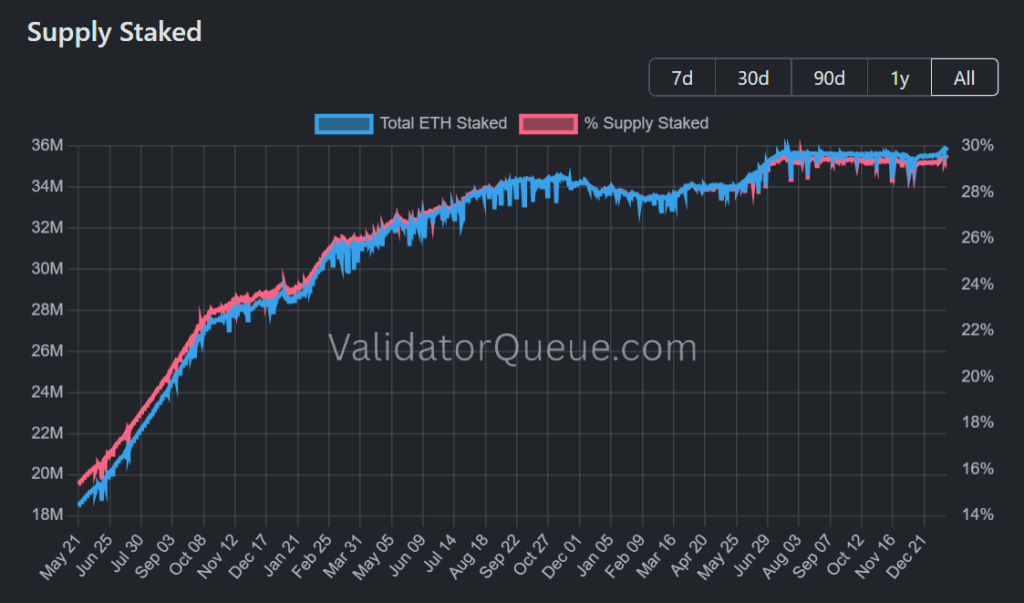
The proposal comes as Ethereum staking reaches record scale with more than 36 million ETH now staked across nearly one million validators, with the total value of staked assets exceeding $118 billion.

Source: ValidatorQueue.

While this growth has reinforced Ethereum’s security, it has also amplified long-standing concerns around centralization, operational risk, and the technical barriers faced by solo stakers.

For much of Ethereum’s proof-of-stake history, running a validator meant placing 32 ETH behind a single machine and a single private key.

Any failure, from a power outage to a software bug or security breach, could result in inactivity penalties or slashing.

These risks pushed many users toward large staking providers and liquid staking platforms, concentrating control of consensus among a relatively small group of operators and cloud providers.

Buterin’s proposal directly targets that single-node risk, as under the proposed native DVT, a validator with a larger balance would be allowed to register multiple keys, up to a maximum of 16, and define a threshold for signing duties.

Validator actions, such as block proposals or attestations, would only be considered valid if a minimum number of those keys signed off together.

As long as more than two-thirds of the nodes behave honestly, the validator would continue operating normally without penalties.

Buterin’s Native DVT Idea Targets Easier, Safer ETH Staking

Unlike existing DVT solutions such as Obol or ssv.network, which rely on external tooling, networking layers, and the linear properties of BLS signatures, Buterin’s design would be embedded directly into Ethereum’s consensus rules.

He argued this would dramatically simplify staking operations, reduce setup complexity, and remove dependencies that may not be compatible with future cryptographic upgrades.

🚀 @VitalikButerin unveils "The Splurge," a bold plan to prepare Ethereum for a quantum future!#Ethereum #QuantumComputinghttps://t.co/vvRijeahpS

— Cryptonews.com (@cryptonews) October 29, 2024

From a user perspective, Buterin described the experience as running multiple standard validator nodes with minimal configuration changes.

Most of the added complexity would be limited to block production, where one node would act as a temporary leader and others would co-sign its output.

The proposal is explicitly aimed at medium- to large-sized ETH holders, including institutions and individual “whales,” who currently face a choice between running fragile single-node setups or outsourcing control to staking providers.

By making multi-node staking simpler, Buterin said native DVT could increase client diversity, improve measurable decentralization metrics, and encourage more self-custodial staking.

Ethereum Developers Debate Practical Challenges of the DVT model

The discussion quickly drew technical feedback from the community.

Ethereum developer Alonmuroch raised questions around coordination during block production, the possibility of multiple proposers racing to collect signatures, and the need for protocol-level key rotation to handle compromised keys without forcing validators to exit and re-stake.

Buterin largely agreed, noting that instant key changes should be feasible and that reducing operational headaches is central to the proposal’s motivation.

The proposal also fits into a broader shift in Buterin’s recent public messaging.

Earlier this month, he declared 2026 the year Ethereum would reclaim lost ground on self-sovereignty and trustlessness, calling for fewer compromises in favor of convenience.

Days later, he warned that Ethereum risks becoming an “unwieldy mess” if developers continue layering complexity onto the protocol without deliberate simplification.

The post Vitalik Buterin Proposes Fix to Ethereum Staking — No More Single-Node Risk appeared first on Cryptonews.

Vitalik Buterin Calls for Return to Decentralized Social, Warns Against ‘Corposlop’ Crypto Platforms

21 January 2026 at 03:29

Ethereum’s co-founder Vitalik Buterin has renewed his push for decentralized social media arguing that competition — rather than engagement-maximising algorithms or speculative tokens — is essential to building healthier mass communication systems.

In 2026, I plan to be fully back to decentralized social.

If we want a better society, we need better mass communication tools. We need mass communication tools that surface the best information and arguments and help people find points of agreement. We need mass communication… https://t.co/ye249HsojJ

— vitalik.eth (@VitalikButerin) January 21, 2026

In a post on X, Buterin said he plans to be “fully back to decentralized social” in 2026, framing the shift as a response to deep structural problems in today’s dominant platforms.

“If we want a better society, we need better mass communication tools,” he wrote, calling for systems that surface high-quality information, help people find points of agreement, and serve users’ long-term interests instead of optimising for short-term engagement.

According to Buterin decentralization provides a starting point by allowing real competition. Shared data layers allow multiple clients to be built on top of the same social graph, reducing the power of any single interface or algorithm.

“Decentralization is the way to enable that,” he said, arguing that choice at the client level is critical to improving online discourse. Buterin notes that his return to decentralized social is already underway.

Since the start of the year, he said every post he has written or read has been accessed through Firefly, a multi-client interface that supports X, Lens, Farcaster and Bluesky.

The experience, he suggested, highlights how decentralized tools can coexist with — and gradually pull attention away from — centralized platforms.

Tokens Are Not Social Innovation

Buterin was sharply critical of how many crypto-native social projects have evolved. Too often, he argued, teams mistake the addition of a speculative token for meaningful innovation.

While combining money and social interaction is not inherently flawed — he cited Substack as an example of a system that successfully supports high-quality content — problems arise when platforms create price bubbles around creators instead of rewarding the content itself.

Over the past decade, Buterin said, repeated attempts to financialise social influence have failed in predictable ways: rewarding pre-existing social capital rather than quality and ultimately collapsing as tokens trend toward zero.

He dismissed claims that creating new markets and assets is automatically beneficial, describing such thinking as “galaxy-brained” rhetoric that masks a lack of genuine interest in improving information flow. “That is not Hayekian info-utopia,” he wrote. “That is corposlop.”

A Renewed Focus on the ‘Social’

For decentralized social to succeed, Buterin argued, it must be led by teams that care deeply about the social problem itself.

He praises the Aave team’s stewardship of Lens to date and said he is optimistic about the project’s next phase, pointing to the incoming team’s long-standing interest in encrypted social communication.

Buterin said he plans to post more actively on Lens this year and encouraged users to spend more time across Lens, Farcaster and the broader decentralized social ecosystem.

The goal is to move beyond “a single global info warzone” and reopen a frontier where new and healthier forms of online interaction can emerge.

The post Vitalik Buterin Calls for Return to Decentralized Social, Warns Against ‘Corposlop’ Crypto Platforms appeared first on Cryptonews.

Ethereum DAOs face overhaul as Vitalik warns token voting has failed

19 January 2026 at 09:14
Ethereum (ETH) co-founder Vitalik Buterin has outlined proposals for restructuring decentralized autonomous organizations (DAOs) in the cryptocurrency ecosystem, according to statements published by the developer. Buterin stated that the Ethereum ecosystem requires more DAOs but argued that current implementations have…

Vitalik Buterin Warns Ethereum Faces “Unwieldy Mess” — Demands Protocol Cleanup Now

19 January 2026 at 07:40

Ethereum co-founder Vitalik Buterin is warning that Ethereum risks becoming an “unwieldy mess” unless developers begin actively simplifying the protocol instead of continuously adding new features.

In a post published on X on Sunday, Buterin said Ethereum’s biggest threat is not competition but internal complexity.

An important, and perenially underrated, aspect of "trustlessness", "passing the walkaway test" and "self-sovereignty" is protocol simplicity.

Even if a protocol is super decentralized with hundreds of thousands of nodes, and it has 49% byzantine fault tolerance, and nodes fully… pic.twitter.com/kvzkg11M3c

— vitalik.eth (@VitalikButerin) January 18, 2026

He argued that decentralization, trustlessness, and self-sovereignty lose their meaning if the protocol becomes so complex that only a small group of experts can understand or maintain it.

His remarks come as Ethereum is simultaneously posting record transaction activity and historically low fees.

Buterin Calls Out ‘Protocol Bloat’ in Ethereum’s Codebase

Buterin noted that even a network with hundreds of thousands of nodes and strong fault tolerance fails its core mission if its codebase grows into multiple layers of advanced cryptography that few people can audit.

At the center of his concern is what he describes as protocol bloat.

Ethereum’s development process, he said, has historically favored adding features while rarely removing old ones, largely to preserve backward compatibility.

Over time, this leads to a protocol that grows heavier, harder to reason about, and more fragile.

Buterin warned that such complexity undermines security, raises the barrier for new client teams, and weakens Ethereum’s ability to survive if current core developers step away.

To counter this trend, Buterin called for an explicit “simplification” or “garbage collection” function within Ethereum’s development process.

He said simplification should focus on reducing total lines of code, minimizing reliance on complex cryptographic dependencies, and introducing stronger invariants that make client behavior more predictable.

Buterin Outlines Plan to Strip Complexity From Ethereum

He pointed to past changes such as the removal of the SELFDESTRUCT opcode and transaction gas caps as examples of how carefully chosen constraints can make the protocol easier to implement and safer to operate.

Buterin also outlined larger-scale cleanup options, including moving rarely used or complex features out of the core protocol and into smart contracts.

Under this approach, legacy transaction types, precompiles, and even the Ethereum Virtual Machine itself could eventually be demoted from mandatory protocol components, allowing new clients to focus on a simpler core.

The broader goal, he said, is for Ethereum to pass what he calls the “walkaway test.”

That means reaching a point where Ethereum’s value proposition remains intact even if active protocol development slows or stops.

Ethereum’s Path Forward Draws Sharp Divide With Solana

In a January 12 post, Buterin said Ethereum must be able to ossify if it chooses, with all essential features already in place.

🚀 Vitalik Buterin declares 2026 the year Ethereum reverses centralization drift with technical shifts restoring self-sovereignty and trustlessness across nodes, wallets, and applications.#Ethereum #VitalikButerinhttps://t.co/IxoJdam8lj

— Cryptonews.com (@cryptonews) January 17, 2026

These include quantum-resistant cryptography, a scalable architecture built around ZK-EVMs and PeerDAS, full account abstraction, a secure gas schedule, and a proof-of-stake system that can remain decentralized for decades.

Buterin’s push for simplification has not gone unchallenged. On January 18, Solana co-founder Anatoly Yakovenko publicly rejected the idea of protocol ossification, arguing that blockchains must “never stop iterating” to remain useful.

Yakovenko said Solana’s survival depends on continuous adaptation driven by developers whose livelihoods rely on the network, framing stagnation as a greater risk than complexity.

His comments come amid significant technical progress on the network.

Ethereum is currently processing close to 2.5 million transactions per day, while average gas fees have fallen to around $0.15.

📈 Ethereum is handling more transactions than at any point in its history while charging users some of the lowest fees seen in years.#Ethereum #ETHhttps://t.co/iRJ5gNsvVM

— Cryptonews.com (@cryptonews) January 19, 2026

Recent upgrades, including the Fusaka hard fork and adjustments to blob parameters, have expanded capacity and reduced costs, largely through increased layer-2 usage.

At the same time, Ethereum’s staking dynamics have turned sharply positive.

The validator exit queue has dropped to zero, while entry queues have surged to multi-year highs, showing reduced sell pressure and rising confidence in Ether as a yield-bearing asset.

The post Vitalik Buterin Warns Ethereum Faces “Unwieldy Mess” — Demands Protocol Cleanup Now appeared first on Cryptonews.

Solana Labs CEO Says Ethereum-Style ‘Walkaway’ Thinking Is a Death Wish

19 January 2026 at 05:30

Over the weekend, Solana Labs CEO Anatoly Yakovenko pushed back on Vitalik Buterin’s latest case for Ethereum “ossification,” arguing that for Solana, continuous protocol iteration is not optional, it is survival.

The exchange was sparked by a Jan. 12 post in which Buterin said “Ethereum itself must pass the walkaway test,” framing Ethereum as a base layer that should remain usable even if the community largely stops making substantive protocol changes.

“It must support applications that are more like tools […] than like services that lose all functionality once the vendor loses interest in maintaining them,” Buterin wrote. “But building such applications is not possible on a base layer which itself depends on ongoing updates from a vendor in order to continue being usable […] Hence, Ethereum itself must pass the walkaway test.”

Why Solana Can’t Afford To Ossify

Yakovenko replied that he “actually think[s] fairly differently on this,” laying out a philosophy that treats adaptability as core to Solana’s value proposition. “Solana needs to never stop iterating,” he wrote. “It shouldn’t depend on any single group or individual to do so, but if it ever stops changing to fit the needs of its devs and users, it will die.” In Yakovenko’s framing, the risk is not merely technical stagnation; it is a network losing relevance to the people building and transacting on it.

Buterin’s “walkaway test” rests on the idea that Ethereum should reach a point where its usefulness does not “strictly depend on any features that are not in the protocol already,” even if the ecosystem continues improving via client optimizations and limited parameter changes. He also sketched a set of medium-term protocol objectives, ranging from quantum resistance and scalable architecture to long-lived state design and decentralization safeguards, aimed at making Ethereum robust “for decades” and reducing the need for frequent disruptive upgrades.

Yakovenko’s critique is less about those specific goals than the premise that a base layer should aspire to being able to “ossify if we want to.” In his view, ossification is not a neutral milestone; it risks locking in a protocol that can’t keep pace with developer and user demands. “To not die requires to always be useful,” he wrote. “So the primary goal of protocol changes should be to solve a dev or user problem.” At the same time, he emphasized prioritization over maximalism: “That doesn’t mean solve every problem, in fact, saying no to most problems is necessary.”

A key overlap in both positions is a skepticism toward dependence on a single “vendor,” though they operationalize it differently. Buterin wants Ethereum’s base layer to become sufficiently complete that it can remain dependable even if the upgrade cadence slows dramatically. Yakovenko, by contrast, argues that Solana should assume upgrades will keep coming, but not necessarily from any one core team.

“You should always count on there being a next version of solana, just not necessarily from Anza or Labs or fd,” he wrote, referencing major entities in Solana’s development orbit. He then pointed to a future where governance and funding mechanisms could directly underwrite that work, suggesting “we are likely to end up in a world where a SIMD vote pays for the GPUs that write the code,” a nod to both on-chain coordination and the growing role of AI-assisted development.

At press time, SOL traded at $133.84.

Solana price chart

Ethereum Staking Hits Record Levels As Buterin Urges Builders To Deliver Real Apps

16 January 2026 at 00:00

According to ValidatorQueue data, staked Ethereum has climbed to close to 36 million, equal to nearly 30% of the circulating supply. That figure now represents more than $119 billion at current prices.

Staking rose from 35.5 million to almost 36 million since early January, even though ETH has fallen more than 30% since August.

The unstaking queue is zero, while the staking queue topped 2.5 million ETH — its highest level since August 2023. Based on reports, those moves point to strong long-term bets on the network.

Ethereum Staking Shows Strong Conviction

Institutional interest helped push the numbers higher. Publicly listed Digital Asset Treasuries and big staking services are said to be among the active participants.

Some of the latest increases came during a stretch that had been mostly flat since last August. Market watchers say that rising stakes add to the protocol’s security profile, and the large queue suggests demand for on-chain commitments remains high even with price weakness.

Buterin Says Infrastructure Is Ready

Meanwhile, reports have disclosed that Ethereum’s founder, Vitalik Buterin, has urged builders to stop experimenting only in theory and start shipping real products.

He has argued that the technical pieces are finally functional: the chain runs on proof of stake, transaction costs are lower, and scaling through ZK-EVMs and Layer 2s is working.

Messaging that began with Whisper has been adapted into Waku, and apps such as Status and Railway were cited as examples that already use these systems.

In 2014, there was a vision: you can have permissionless, decentralized applications that could support finance, social media, ride sharing, governing organizations, crowdfunding, potentially create an entire alternative web, all on the backs of a suite of technologies.… pic.twitter.com/ihU9qOrXfG

— vitalik.eth (@VitalikButerin) January 14, 2026

He used the term “walkaway test” to describe a simple check: if a decentralized app’s operator disappears, can the data and functionality remain available to users? Fileverse, a decentralized document editor, was pointed to as a case where documents would survive even if the team behind it vanished.

Builders Urged To Ship Practical Apps

Buterin also criticized the trend toward overly centralized consumer devices and services that lock users into accounts and subscriptions. He warned against appliances that require registration and that may collect data on routine tasks.

He contrasted those products with tools that a person truly owns and controls. The message was clear: now that infrastructure is in place, developers should focus on practical software people will actually use, not just experiments that live on testnets.

What This Means Going Forward

The split between the technical optimism and the market reality is visible. On one side, nearly 36 million ETH staked and a swollen staking queue show investor conviction in the protocol’s future.

On the other, price pressure since August has been real and is still being felt. Reports emphasize that the climb in staked ETH strengthens the network’s security, but the call to build usable, user-friendly apps remains loud.

If developers respond by shipping useful products that meet everyday needs, the combination of a secure chain and working applications could push broader adoption.

For now, the numbers and the rhetoric are both sending a clear signal: the ingredients exist, and attention is shifting toward turning them into tools people rely on.

Featured image from Unsplash, chart from TradingView

Buterin Puts Ethereum On Notice: Pass The ‘Walkaway Test’

13 January 2026 at 10:00

Vitalik Buterin is arguing that Ethereum’s long-term credibility hinges on a standard usually applied to applications, not base layers: the chain should remain meaningfully usable even if its stewards “walk away.” In a Jan. 12 post on X, the Ethereum co-founder framed the “walkaway test” as a requirement for a settlement layer meant to host “trustless and trust-minimized applications” across finance, governance, and beyond.

Buterin’s premise is that Ethereum’s core promise breaks down if the protocol itself depends on continuous, human-managed upgrades to stay safe and competitive. “But building such applications is not possible on a base layer which itself depends on ongoing updates from a vendor in order to continue being usable — even if that ‘vendor’ is the all core devs process,” he wrote. “Ethereum the blockchain must have the traits that we strive for in Ethereum’s applications. Hence, Ethereum itself must pass the walkaway test.”

Ethereum Can’t Rely on Endless Upgrades

The post lands amid a broader, recurring tension in Ethereum’s culture: the desire to keep evolving versus the benefits of stability. Buterin’s formulation doesn’t call for freezing the protocol immediately. Instead, he argues Ethereum should reach a position where it could “ossify” without sacrificing its value proposition.

“This means that Ethereum must get to a place where we can ossify if we want to,” Buterin said. “We do not have to stop making changes to the protocol, but we must get to a place where Ethereum’s value proposition does not strictly depend on any features that are not in the protocol already.” In other words, Ethereum can continue to improve—but it should not need to, in order to remain a credible base for durable, user-owned systems.

From there, Buterin lays out the technical and economic conditions he views as prerequisites for passing the test. The most time-sensitive in his framing is cryptography. “Full quantum-resistance” should not be treated as an upgrade to postpone until the last possible moment, he argues, warning against “the trap” of delaying in exchange for short-term efficiency.

The protocol, in his view, should be able to make a straightforward claim about long-lived safety: being able to say Ethereum “as it stands today, is cryptographically safe for a hundred years.”

Scalability is presented as an architectural destination rather than a perpetual series of feature-driven forks. Buterin points to “ZK-EVM validation and data sampling through PeerDAS” as key components, and suggests an ideal end-state where improvements increasingly come via “parameter only” changes—potentially implemented through validator voting mechanisms akin to how the gas limit can be adjusted.

He also emphasizes state growth as a durability risk that must be addressed at the protocol level. The goal, as he describes it, is a “state architecture that can last decades,” including “partial statelessness and state expiry” so that sustaining thousands of transactions per second over long periods doesn’t make syncing or hardware requirements untenable. Alongside that, he flags future-proofing storage structures to match that environment.

Other items in the framework target known fault lines for decentralized execution: moving toward a more general-purpose account model via “full account abstraction,” ensuring the gas schedule is resilient against denial-of-service risks in both execution and ZK-proving, and hardening proof-of-stake economics so the system “can last and remain decentralized for decades,” including ETH’s role as “trustless collateral.”

Finally, Buterin highlights block building as a centralization pressure point, arguing Ethereum needs a model that can “resist centralization pressure and guarantee censorship resistance even in unknown future environments.” Buterin’s closing message is less about a single roadmap item than a governance and engineering posture: do the heavy lifting now so later progress can be dominated by client optimization and parameter tuning, not perpetual redesign.

At press time, ETH traded at $3,132.

Ethereum price chart

❌
❌