Normal view

There are new articles available, click to refresh the page.
Today — 26 January 2026Main stream

Terpenes, Unlocked: The Aromatic Soul of Cannabis

25 January 2026 at 03:06

As the vast scientific possibilities of cannabis rapidly become more researched, so too does the studying and research behind the fascinating components that are terpenes. These botanical compounds are the building blocks that give cannabis buds their characteristics—everything from the aromas of the bud to the physical appearance to the various feelings and sensations that cannabis strains can provide.

Myrcene gives indica strains their relaxing and “couchlock” feelings, while terpinolene and limonene, for instance, give sativa strains the boost in energy and creativity that they’re commonly known for. Pinene can exude a very forest-like aroma while caryophyllene exudes a pepper-like smell. Truly, the study of terpenes is a marvelous new field of botanical sciences. And a few very innovative companies are not only researching but also creating these unique compounds.

“Terpenes are the aromatic soul of cannabis,” says True Terpenes CEO Daniel Cook. “They’re what give each strain its signature scent and flavor—from citrusy bursts to deep, earthy notes.”

Since 2016, True Terpenes has been at the forefront of terpene science and production. Prior to creating the company, Founder Chris Campagna ran a medical cannabis clinic in Oregon and personally witnessed how drastically inconsistent the terpene profiles in cannabis products could be. Additionally, Campagna observed how many terpenes are destroyed during common extraction methods.

Shawna Vreeke, PhD, DABT, True Terpenes’ Director of Toxicology.

The removal of those crucial terpenes could be very problematic, especially as most states have some form of a medical cannabis program and people from all types of societal demographics have become medical cannabis patients. For instance, if a patient relied on a myrcene-heavy indica to alleviate sleeping issues or anxiety, the destruction of that myrcene could lessen the potency of their medicine. If a patient were using a pinene-dominant strain for muscle pain, the deletion of that terpene could possibly worsen that patient’s pain.      

From reading the vast research on the entourage effect of cannabinoids by neurologist Dr. Ethan Russo, Campagna realized the true essential nature of terpenes and how vitally useful they could be for cannabis cultivators and consumers alike. 

“That insight led to the creation of True Terpenes, a company dedicated to supplying high-quality, consistent terpene blends to product innovators,” Cook says. “By rebuilding terpene profiles, brands could craft reliable, effective products that honored the complete cannabis experience—not just its THC content.”

There’s a multitude of reasons why terpene solutions such as True Terpenes’ blends have greatly increased in popularity. First, there’s the rapid expansion of the US cannabis industry itself to thank. Despite only being recreationally legal in 24 states, the country’s cannabis industry surpassed $30 billion in sales in 2024, according to the 2025 Vangst Jobs Report. Cultivators and extractors from across the legal markets are very likely coming to the same realization that Campagna did in Oregon and are eager to find ways to strengthen their terpene profiles against damaging manufacturing practices. As the later states legalize and create statewide cannabis industries of their own, diverse terpene blends will almost certainly become of greater necessity.

Next, the awareness of terpenes and their many possibilities became greater common knowledge among cannabis consumers as the retail cannabis industry expanded. Whereas only THC content mostly mattered in the unlicensed market days, an increasing number of consumers now know the difference in feelings and effects between indica versus sativa and between ocimene, terpinolene and linalool.  

“The evolution of our terpene solutions mirrors the evolution of the cannabis consumer, from simple curiosity to sophisticated preference,” Cook says. “Early on, the industry leaned into basic flavors and strain mimicry. Today, people expect authenticity, consistency and depth.”

The growing adoption of terpene blend solutions can also be attributed to their inherent flexibility, as they can seamlessly integrate into virtually every cannabis product, from gummies and beverages to vape cartridges and various topicals. This allows brands to fine-tune flavor, aroma and effect with consistency. Because terpene blends can be used across so many product formats, they’re accessible to virtually every type of cannabis consumer. Whether it’s a pack of mini-prerolls enjoyed by someone in their early twenties or a topical chosen by a senior exploring cannabis for the first time, both experiences can be enhanced by the very same terpene profile.

“People want more than just THC or CBD percentages; they’re seeking products that deliver mood, taste and effect with nuance and intention,” Cook says. “Flavor and aroma make that possible.”

As prestigious institutions such as The University of Arizona and privately funded companies continue to advance the overall research and knowledge on terpenes, Cook predicts a bright future for their scientific appeal and usage: “We’re entering the experience economy of cannabis and terpenes are the key to unlocking differentiated, targeted and repeatable experiences. They give products character. They invite the consumer into a ritual. And, most importantly, they’re helping both new users and connoisseurs explore cannabis with more excitement, clarity and control.”

This story was originally published in issue 52 of the print edition of Cannabis Now.

The post Terpenes, Unlocked: The Aromatic Soul of Cannabis appeared first on Cannabis Now.
Solana (SOL) Slips Further As Bears Target Deeper Support Zones

26 January 2026 at 00:08

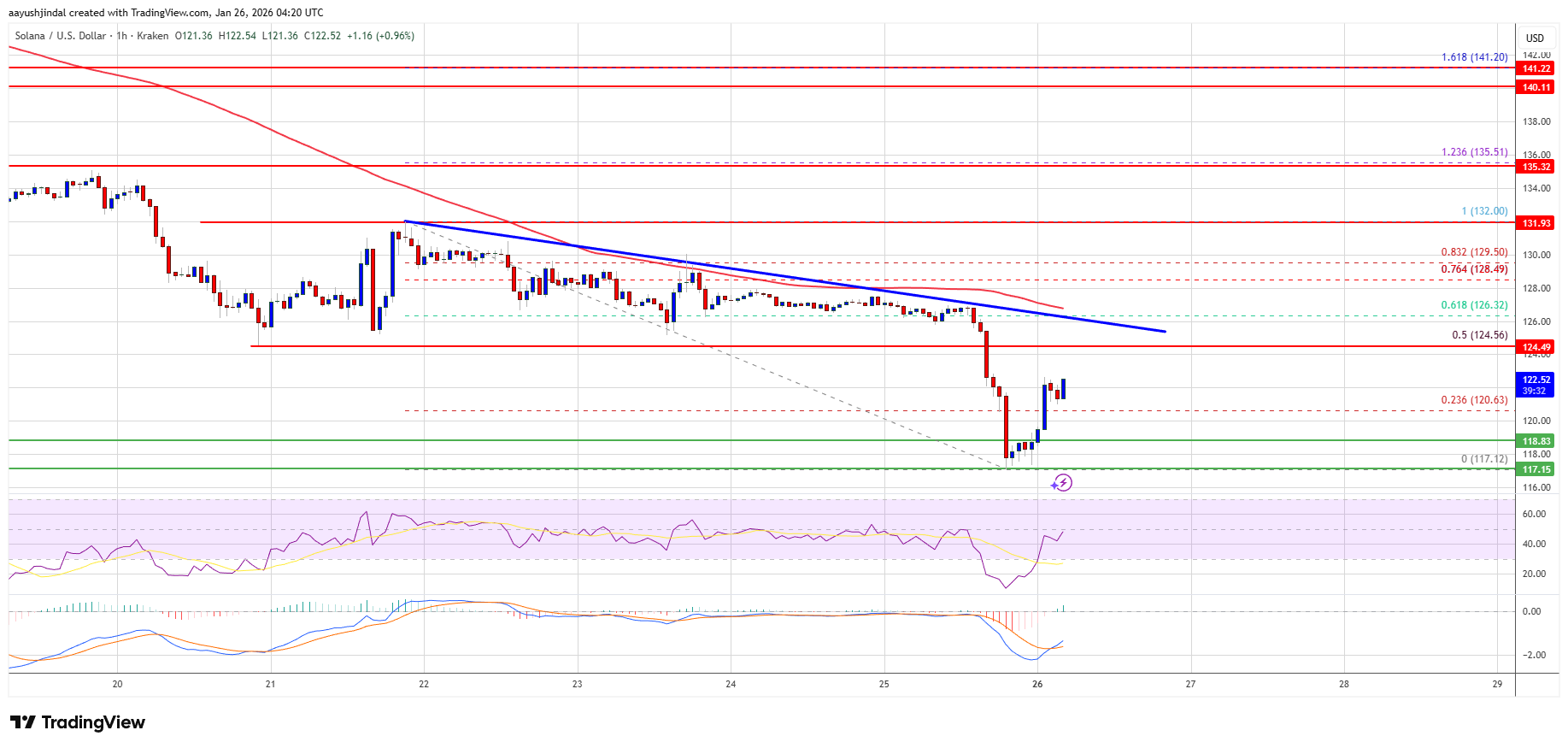
Solana failed to settle above $132 and extended losses. SOL price is now consolidating losses below $130 and might struggle to start a recovery wave.

  • SOL price started a fresh decline below $132 and $130 against the US Dollar.
  • The price is now trading below $130 and the 100-hourly simple moving average.
  • There is a key bearish trend line forming with resistance at $126 on the hourly chart of the SOL/USD pair (data source from Kraken).
  • The price could start a recovery wave if the bulls defend $118 or $115.

Solana Price Dips Further

Solana price failed to remain stable above $132 and started a fresh decline, like Bitcoin and Ethereum. SOL declined below the $130 and $126 support levels.

The price gained bearish momentum below $122. A low was formed at $117, and the price is now consolidating losses. The price recovered a few points and climbed above the 23.6% Fib retracement level of the downward move from the $132 swing high to the $117 low.

Solana is now trading below $130 and the 100-hourly simple moving average. On the upside, immediate resistance is near the $125 level or the 50% Fib retracement level of the downward move from the $132 swing high to the $117 low.

Solana Price

The next major resistance is near the $126 level. There is also a key bearish trend line forming with resistance at $126 on the hourly chart of the SOL/USD pair. The main resistance could be $132. A successful close above the $132 resistance zone could set the pace for another steady increase. The next key resistance is $140. Any more gains might send the price toward the $144 level.

Another Drop In SOL?

If SOL fails to rise above the $126 resistance, it could continue to move down. Initial support on the downside is near the $119 zone. The first major support is near the $117 level.

A break below the $117 level might send the price toward the $115 support zone. If there is a close below the $115 support, the price could decline toward the $102 support in the near term.

Technical Indicators

Hourly MACD – The MACD for SOL/USD is losing pace in the bearish zone.

Hourly Hours RSI (Relative Strength Index) – The RSI for SOL/USD is below the 50 level.

Major Support Levels – $117 and $115.

Major Resistance Levels – $126 and $132.

Yesterday — 25 January 2026Main stream

XRP Price Bearish Continuation Confirmed As Downside Pressure Builds

25 January 2026 at 23:18

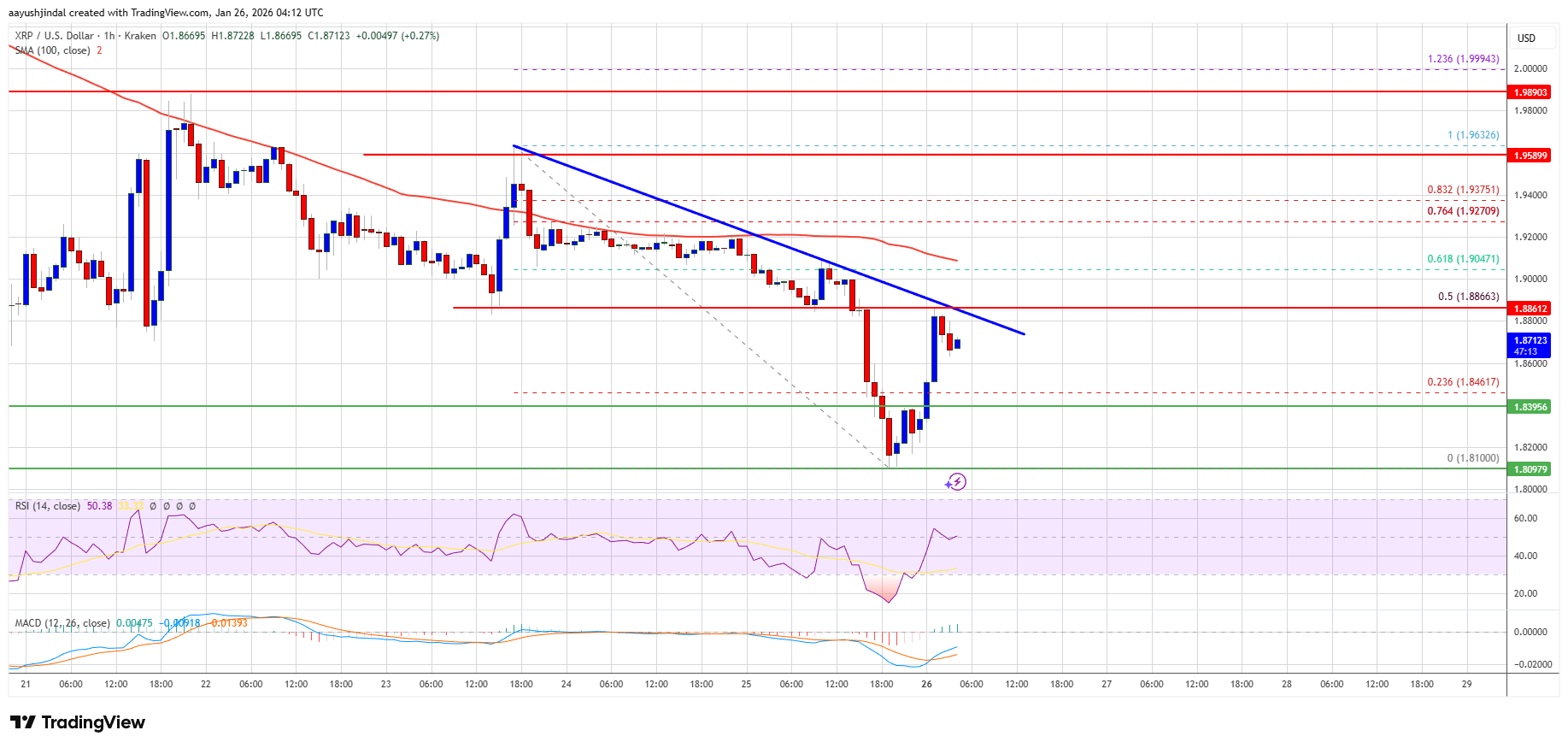
XRP price extended losses and traded below $1.880. The price is now consolidating and might decline further if it remains below $1.920.

  • XRP price started a fresh decline below the $1.90 zone.
  • The price is now trading below $1.90 and the 100-hourly Simple Moving Average.
  • There is a key bearish trend line forming with resistance at $1.885 on the hourly chart of the XRP/USD pair (data source from Kraken).
  • The pair could continue to move down if it stays below $1.90.

XRP Price Dips Further

XRP price failed to stay above $1.950 and started a fresh decline, like Bitcoin and Ethereum. The price declined below $1.920 and $1.90 to enter a short-term bearish zone.

The price even spiked below $1.850. A low was formed at $1.810, and the price is now consolidating losses. There was a recovery wave above $1.850. The price cleared the 23.6% Fib retracement level of the downward move from the $1.963 swing high to the $1.810 low, but the bears remained active.

The price is now trading below $1.90 and the 100-hourly Simple Moving Average. If there is a fresh upward move, the price might face resistance near the $1.8850 level and the 50% Fib retracement level of the downward move from the $1.963 swing high to the $1.810 low. There is also a key bearish trend line forming with resistance at $1.885 on the hourly chart of the XRP/USD pair.

XRP Price

The first major resistance is near the $1.90 level. A close above $1.90 could send the price to $1.950. The next hurdle sits at $2.00. A clear move above the $2.00 resistance might send the price toward the $2.050 resistance. Any more gains might send the price toward the $2.120 resistance. The next major hurdle for the bulls might be near $2.20.

Downside Break?

If XRP fails to clear the $1.90 resistance zone, it could start a fresh decline. Initial support on the downside is near the $1.840 level. The next major support is near the $1.820 level.

If there is a downside break and a close below the $1.820 level, the price might continue to decline toward $1.780. The next major support sits near the $1.750 zone, below which the price could continue lower toward $1.70.

Technical Indicators

Hourly MACD – The MACD for XRP/USD is now gaining pace in the bearish zone.

Hourly RSI (Relative Strength Index) – The RSI for XRP/USD is now near the 50 level.

Major Support Levels – $1.840 and $1.820.

Major Resistance Levels – $1.8850 and $1.90.

Ethereum Price Sinks To $2,800, Raising Fresh Downside Fears

25 January 2026 at 22:18

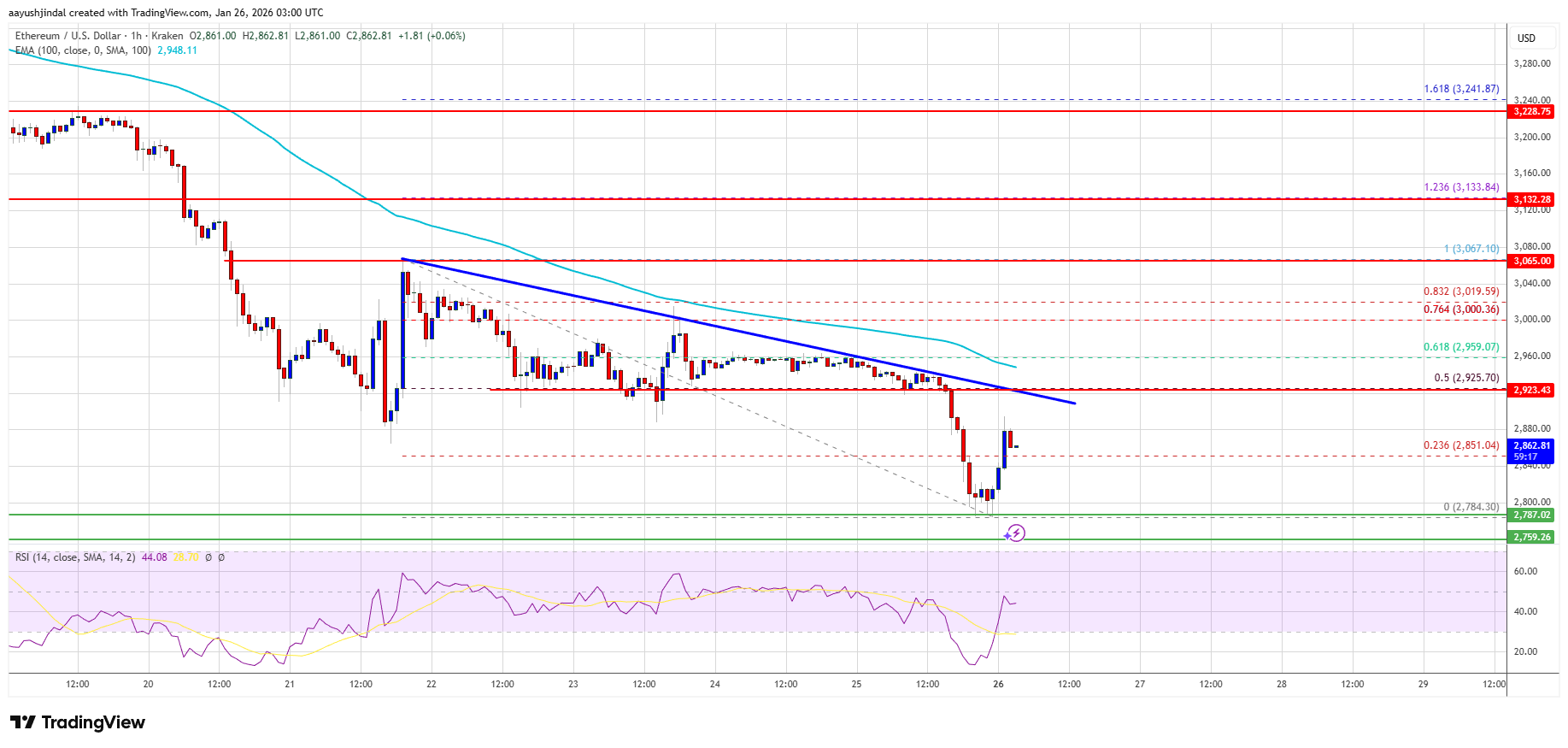
Ethereum price extended losses and traded below the $2,865 zone. ETH is now consolidating losses and might aim for a recovery if it clears $2,920.

  • Ethereum remained in a bearish zone and traded below $2,950.
  • The price is trading below $2,900 and the 100-hourly Simple Moving Average.
  • There is a bearish trend line forming with resistance at $2,920 on the hourly chart of ETH/USD (data feed via Kraken).
  • The pair could start a fresh increase if it stays above the $2,800 zone.

Ethereum Price Dips Further

Ethereum price failed to remain stable above $2,950 and extended losses, like Bitcoin. ETH price declined below $2,880 and $2,865 to enter a bearish zone.

The bears even pushed the price below $2,840. The price finally tested $2,800 and is currently consolidating losses. There was a minor upside above the 23.6% Fib retracement level of the downward wave from the $3,067 swing high to the $2,784 swing low.

Ethereum price is now trading below $2,900 and the 100-hourly Simple Moving Average. If the bulls can protect more losses below $2,800, the price could attempt another increase.

Immediate resistance is seen near the $2,920 level. There is also a bearish trend line forming with resistance at $2,920 on the hourly chart of ETH/USD. The first key resistance is near the $2,960 level or the 61.8% Fib retracement level of the downward wave from the $3,067 swing high to the $2,784 swing low. The next major resistance is near the $3,000 level. A clear move above the $3,000 resistance might send the price toward the $3,065 resistance.

Ethereum Price

An upside break above the $3,065 region might call for more gains in the coming days. In the stated case, Ether could rise toward the $3,120 resistance zone or even $3,150 in the near term.

More Losses In ETH?

If Ethereum fails to clear the $2,920 resistance, it could start a fresh decline. Initial support on the downside is near the $2,840 level. The first major support sits near the $2,800 zone.

A clear move below the $2,800 support might push the price toward the $2,780 support. Any more losses might send the price toward the $2,720 region. The main support could be $2,650.

Technical Indicators

Hourly MACDThe MACD for ETH/USD is losing momentum in the bearish zone.

Hourly RSIThe RSI for ETH/USD is now below the 50 zone.

Major Support Level – $2,800

Major Resistance Level – $2,920

Bitcoin Price Breakdown Risk Grows As Bears Aim For $85K

25 January 2026 at 21:59

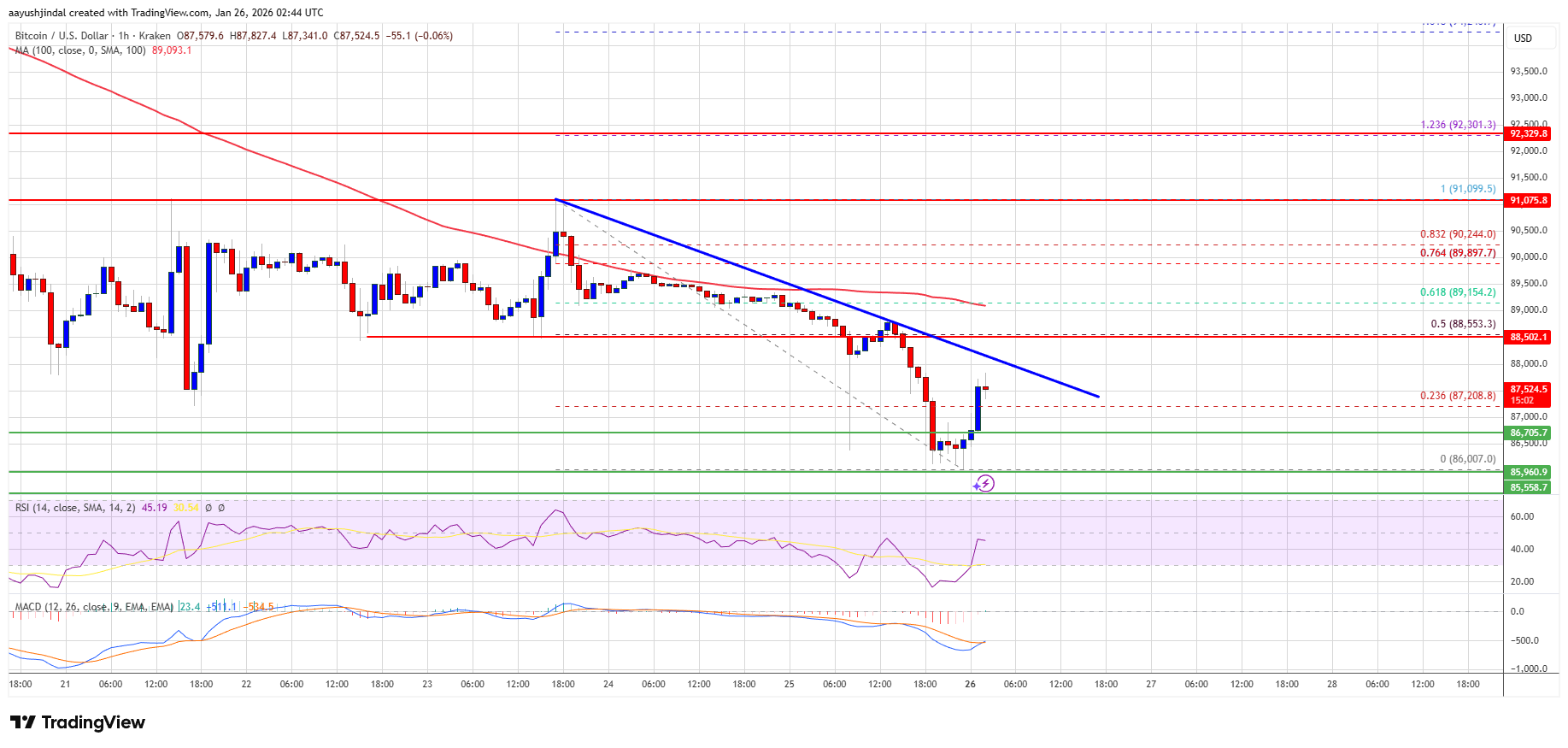
Bitcoin price extended losses and traded below $88,500. BTC is consolidating losses and might attempt a recovery wave if it clears $88,500.

  • Bitcoin started a minor recovery wave from the $86,000 level.
  • The price is trading below $88,200 and the 100 hourly Simple moving average.
  • There is a new bearish trend line forming with resistance at $88,000 on the hourly chart of the BTC/USD pair (data feed from Kraken).
  • The pair might recover if it manages to settle above $86,200 and $86,000.

Bitcoin Price Dips Further

Bitcoin price failed to stay above the $89,000 support and extended losses. BTC declined sharply below the $88,500 and $87,000 support levels.

The bears even pushed the price below $86,500. A low was formed at $86,007, and the price is now attempting a recovery wave. There was a move above the 23.6% Fib retracement level of the downward move from the $91,099 swing high to the $86,007 low.

Bitcoin is now trading below $88,500 and the 100 hourly Simple moving average. If the price remains stable above $86,500, it could attempt a fresh increase. Immediate resistance is near the $88,000 level. There is also a new bearish trend line forming with resistance at $88,000 on the hourly chart of the BTC/USD pair.

The first key resistance is near the $88,500 level since it is close to the 50% Fib retracement level of the downward move from the $91,099 swing high to the $86,007 low.

Bitcoin Price

A close above the $88,500 resistance might send the price further higher. In the stated case, the price could rise and test the $89,200 resistance. Any more gains might send the price toward the $90,000 level. The next barrier for the bulls could be $91,000 and $91,500.

More Losses In BTC?

If Bitcoin fails to rise above the $88,500 resistance zone, it could start another decline. Immediate support is near the $86,700 level. The first major support is near the $86,200 level.

The next support is now near the $85,500 zone. Any more losses might send the price toward the $83,500 support in the near term. The main support sits at $82,500, below which BTC struggle to recover in the near term.

Technical indicators:

Hourly MACD – The MACD is now losing pace in the bearish zone.

Hourly RSI (Relative Strength Index) – The RSI for BTC/USD is now below the 50 level.

Major Support Levels – $86,700, followed by $86,000.

Major Resistance Levels – $88,500 and $89,200.

Colombia Pension Giant Takes First Step Into Bitcoin – Details

25 January 2026 at 15:00

AFP Protección, Colombia’s second-largest private pension manager, is preparing a new product that will give some savers a way to gain exposure to Bitcoin. Reports say the move will be limited, targeted and tied to advisory checks rather than open to every account holder.

Bitcoin As An Option For Qualified Savers

Reports note the fund will be offered only to investors who meet a risk profile and pass a tailored advisory process. That means access won’t be automatic; it will be conditional on an assessment meant to match a person’s tolerance with a small, optional slice of crypto.

The product is designed for long-term allocation and not for quick trading or speculation, according to market coverage. AFP Protección’s executives emphasized that core pension portfolios will remain focused on traditional assets such as bonds and equities, and that any Bitcoin exposure would be a narrow, complementary allocation.

💥 En primicia, Valora Analitik conoció que Protección se prepara para lanzar desde Colombia un fondo con exposición a Bitcoin. El producto no estará enfocado en la especulación de corto plazo, sino en ampliar las opciones de diversificación con una gestión integral de riesgos y… pic.twitter.com/nAO8mbsTLi

— Valora Analitik (@ValoraAnalitik) January 22, 2026

The language used by the firm frames the initiative as diversification rather than a wholesale shift of retirement capital. Juan David Correa, who serves as president of Protección SA, confirmed the plan in an interview with local media outlet Valora Analitik.

Size And Reach Of The Manager

AFP Protección manages assets for millions of clients and has a sizable balance sheet. Reports put its assets under management at roughly 220 trillion Colombian pesos — roughly US$55 billion — and note that the firm serves a broad base of workers through mandatory pensions, voluntary saving plans and severance accounts. The sheer scale of the manager helps explain why even a small, optional product gets wide attention.

Regulation And Reporting

Reports also point to a tightening regulatory backdrop in Colombia. Tax and customs authorities have rolled out new crypto reporting rules that align with international reporting standards.

Those rules are likely to affect how crypto products are structured and how returns or transfers are reported for tax purposes. The change in rules is one reason AFP Protección has framed its product as measured and compliant.

How This Fits A Regional Trend

Across Latin America, some institutional players have been experimenting with limited crypto exposure for years. Colombia’s move follows earlier steps by one or two other local managers and fits a regional pattern where established firms test small, controlled offerings before widening access. The step will be watched closely by investors and regulators overseas.

Reports say potential participants should expect thorough suitability checks, clear disclosures and limits on how much of a retirement portfolio can sit in the new vehicle.

Featured image from Pexels, chart from TradingView

Is Bitcoin Supercycle Truly On The Horizon? Analyst Predicts $31K Bottom In 2026

25 January 2026 at 13:00

The calls of a potential Bitcoin supercycle in 2026 intensified over the past week after former Binance CEO Changpeng ‘CZ’ Zhao — yet another prominent voice in crypto — laid out his predictions for the new year. However, a popular analyst on the social media platform X has released an opposing view, predicting a deep bottom for the BTC price this year.

BTC Price At Risk Of Further 65% Decline

In a January 25th post on the X platform, prominent crypto trader Ali Martinez said, in a sarcastic tone, that “the super cycle is super cycling.” In what seemed like a response to the buzz around CZ’s Bitcoin supercycle projection, the market pundit tempered the expectations with a $31,000 price bottom call for the premier cryptocurrency in 2026.

This bearish prediction is based on the appearance of price fractals on the BTC chart. For context, fractals are repeating patterns in price charts that can help map and project potential price movements for a particular cryptocurrency (Bitcoin, in this scenario).

Bitcoin

As observed in the chart above, the price of BTC is currently following a similar movement pattern as in 2022. The premier cryptocurrency, after initially setting a then all-time high around $67,000 in early 2021, witnessed a nearly 55% correction to just above the $30,000 level by mid-July.

While the price of Bitcoin recovered and went back to set a record high of above $69,000 by the end of 2021, the market leader spent the majority of the following year in a downward trend. Exacerbated by the various bearish events of 2022, BTC ended the year at a low of around $15,500.

Martinez believes that the Bitcoin price is undergoing a similar movement pattern, having experienced an over 32% decline before climbing to the current all-time high of $126,080. The market pundit postulates that the premier cryptocurrency is currently witnessing the extended decline that saw its price reach $15,500 in 2022.

However, it is worth mentioning that the target this time around lies at $31,800, nearly 65% drop from the current price point. Hence, if the historical patterns highlighted by Martinez are to go by, there seems to be a higher likelihood of the Bitcoin price embarking on an extended downward trend rather than a supercycle.

Bitcoin Price At A Glance

As of this writing, the price of BTC stands at around $88,528, reflecting an over 1% decline in the past 24 hours.

Bitcoin

Bitcoin Finds A Real-World Use Case In Las Vegas Stores

25 January 2026 at 13:00

Small shops and some bigger chains in Las Vegas are now taking Bitcoin for everyday buys. People scan a QR code, pay from a phone, and the merchant gets paid. According to local reports, owners are trying this out to cut the cost of credit card processing and to attract customers who prefer crypto.

Merchants Cut Costs With Bitcoin

Reports say the move is largely about fees. Credit card processing often takes away 2.5–3.5% of a sale. For many small operators, that is painful. Payment tools that accept Bitcoin — often routed over the Lightning Network or through services that can convert crypto to cash — have lowered that burden for merchants.

According to FOX5, more businesses across Las Vegas are now accepting Bitcoin payments, from chains like Steak ’n Shake to small shops and medical practices. Merchants said Bitcoin helps attract new customers and cut costs, while Square has enabled about 4 million U.S. merchants…

— Wu Blockchain (@WuBlockchain) January 24, 2026

Square’s program, which lets millions of US merchants enable Bitcoin checkout with no processing fee through 2026, helped speed up adoption in the area.

Stores Report Real Transactions

Business owners are reporting real use, not just experiments. Juice stands and cafes have processed payments. Some larger outlets are listed on public payment maps so customers can find them.

This has meant more foot traffic from people who travel with crypto or who prefer to keep their cards for other uses. Reports note both new customers and savings on fees as clear benefits.

Lightning Network Speeds Up Payments

The Lightning Network is being used to make payments faster and cheaper at the cash register. It moves small Bitcoin payments quickly without the long wait a base-layer transfer can cause.

Merchants scan a code or show one on a screen. The payment is then sent from the buyer’s wallet and settled almost instantly. This technical fix has made in-person Bitcoin payments workable for the first time at many spots.

How Owners See It

Owners are balancing savings against new risks. Some keep crypto for a short time, then sell it for cash. Others leave part of their receipts in Bitcoin. Chargebacks, a problem with cards, are reduced when crypto is used.

A few places say small boosts in sales followed their switch to crypto, yet long-term patterns are still being watched. Reports have disclosed these mixed outcomes as part of a slow but clear shift.

Customers Find New Ways To Pay

Shoppers are adapting. Tourists who carry crypto find these spots useful. Locals who are curious try the method at least once. Payment apps and merchant directories make the process easier for everyone.

For those who like simple steps, scanning a QR code and approving a payment on a phone works fine. For others it is a novelty that might stick.

Featured image from Unsplash, chart from TradingView

💾

Las Vegas Valley businesses are accepting Bitcoin as payment as the cryptocurrency continues to grow in popularity.For more Local News from KVVU: https://www...

Does Capital Really Rotate From Gold To Bitcoin? On-Chain Data Offers Insight

25 January 2026 at 11:00

“Bitcoin is the digital gold” is one of the most popular narratives in the cryptocurrency industry, reiterating BTC’s growing status as a formidable store of value. However, while the premier cryptocurrency has floundered over the past months, gold and the metals market have largely witnessed explosive growth.

These contrasting performances have led to conversations about capital rotation between Bitcoin and gold, as the crowd expects one to always outperform the other at any given time. Recent data, however, suggests that the relationship between the BTC and gold price action is overrated.

Capital Flow Link Between BTC And Gold Overestimated 

In a January 24 post on the X platform, on-chain analyst with the pseudonym Darkfost weighed in on the discourse surrounding capital rotation between gold and Bitcoin. According to the market pundit, the idea that investor funds flow from gold to Bitcoin is somewhat overblown.

To highlight this overestimation, Darkfost shared a chart showing periods where BTC outperforms or underperforms depending on gold’s trend. This chart typically provides two signals: positive (BTC above the 180-day moving average [MA] and gold below the 180-day MA) and negative (BTC below the 180-day moving average and gold below the 180-day MA).

Bitcoin

As observed in the chart above and stated by Darkfost, the relationship between Bitcoin and gold does not appear to be fully substantiated. The on-chain analyst revealed that there have been as many positive periods as the negative ones, suggesting that the flagship cryptocurrency moves independently of gold.

Darkfost wrote:

This suggests that BTC continues to evolve independently, without clear evidence of a sustained capital rotation from gold.

Furthermore, Darkfost noted that a positive signal does not necessarily mean that capital is flowing out of gold into Bitcoin. According to the on-chain analyst, it is simply not possible to determine whether there is a capital flow relationship between the world’s largest cryptocurrency and gold.

Bitcoin & Gold Price Overview

While Bitcoin started the new year on a pretty strong note, the bullish momentum has pretty much waned over the past two weeks. Meanwhile, the gold price has continued to flourish this year, recently reaching a new all-time high above $4,900 per ounce.

As of this writing, the price of BTC stands at around $89,230, reflecting no significant movement in the past 24 hours. According to data from CoinGecko, the flagship cryptocurrency is nearly 30% adrift its all-time high above the $126,000 level.

Bitcoin

Bitcoin Whale Demand Hits Extreme Levels As Next Rally Loads Up

25 January 2026 at 09:00

The Bitcoin price action has been muted over the past few days, trading within the $90,000 and $88,000 levels. Classically, consolidation periods often precede major moves either to the upside or downside of the market.

As such, questions on the next trajectory of the flagship cryptocurrency are being asked. A latest on-chain evaluation has offered a positive prognosis on the next direction for the Bitcoin price. 

Accumulation Demand Metric Surges To All-Time-High 

In a Quicktake post on CryptoQuant, on-chain analyst CoinNiel hypothesized that the Bitcoin price could be at the beginning of a bullish trend. The market quant based this prognosis on two metrics — the Accumulator Address Demand and the Liquidity Inventory Ratio (month). 

The Accumulator Address Demand metric monitors the net buying pressure coming from addresses that buy Bitcoin consistently, and without any significant selling. This behavior (of buying and rarely selling) is typical of the large-scale Bitcoin holders, commonly known as the whales. 

Notably, CoinNiel also pointed out that when major withdrawals from exchanges occur, they are rarely ever incited by retailers, but by whales. As such, when the Bitcoin whales withdraw their holdings from exchanges, their buying pressure translates into an increase in the Accumulator Address Demand. 

Bitcoin

From the chart above, the indicator has reached an all-time high level. According to the crypto pundit, this could be a sign that the whales are currently experiencing, on intense levels, the “fear of missing out.”

The second metric, the Liquidity Inventory Ratio (Month), also reinforces CoinNiel’s bullish outlook. This metric tracks and compares existing Bitcoin demand to the supply available on exchanges, showing whether demand can overwhelm available supply

When this ratio rises sharply, it is usually a sign that demand is absorbing newly created supply. From the data shared by the analyst, the Liquidity Inventory Ratio has also reached an extreme value of 3.8.

However, this extreme reading is only a reflection of what is happening on US exchanges. Hence, CoinNiel implied that, for the first time in years, US exchanges are recording exceptionally high demand relative to the coins available.

In theory, a 3.8 reading implies the imminence of a supply shock in the scenario where current conditions prevail. But, the analyst highlighted that it may not necessarily happen, as a 3.8 reading is more a sign of intensified whale demand than a surefire means to predict supply shocks. 

The big picture, especially when these two metrics are looked at together, appears to be distinctly bullish. This is because available data points out that the whales are likely positioning for what could be a resumed bullish trajectory for the Bitcoin price.

Bitcoin Price At A Glance

As of this writing, Bitcoin is valued at $88,520, reflecting an over 1% decline in the past 24 hours.

Bitcoin

Money Keeps Leaving: Bitcoin ETFs Shed $1.72 Billion In Just 5 Sessions

25 January 2026 at 03:00

US-based spot Bitcoin exchange-traded funds pulled funds for a fifth straight trading day, and the totals added up quickly. According to Farside data, about $103.5 million left on Friday, bringing the five-day sum to roughly $1.72 billion.

Bitcoin was trading near $89,160 at the time of these reports — still well below the $100,000 mark it last reached on November 13. This movement has sent a clear signal: many investors are stepping back right now.

ETF Flows And Who Is Selling

Reports note that ETF flows are often on the radar as a quick read on investor mood, but the picture is not always simple. Large outflows can reflect institutional rebalancing or tactical moves by funds, not only mass retail selling.

The US market had a four-day trading week because of Martin Luther King Jr. Day on Monday, which may have concentrated trades into fewer sessions and amplified the numbers. Still, losing more than a billion dollars in a few days will get attention.

Market Mood And Metals

The wider mood has soured. The Crypto Fear & Greed Index registered an Extreme Fear score of 25, and sentiment trackers have been flashing caution. Reports say Santiment believes retail traders are pulling back while attention drifts toward more traditional assets.

Meanwhile, metals have been strong. Reports disclose that with gold trading near $5,000 and silver approaching $100, some market players feel Bitcoin has been left out of a rally that lifted metals, which has weighed on confidence in the crypto market.

Bitcoin Price Action

Bitcoin has struggled to find a steady rhythm over the past week. Prices slipped below the $89,000 to $90,000 range as traders reacted to fresh geopolitical tension and renewed trade worries, before stabilizing as nerves eased.

This was driven higher after some soft political indicators around tariff threats, only to substantiate the idea that markets rarely react to conflict but rather to changes in tone and expectations.

Signals That Could Matter

These movements illustrate how Bitcoin behaves more like a risk asset rather than an asset shelter, falling in tandem with equities when unexpected financial shocks hit the globe, before rebounding when the fever subsides to gather fresh buyers.

Current price patterns indicate caution, where traders are weighing short-term political risks against medium- and long-term macro patterns, as well as institutional interests.

There are some quieter indications that the rout could be losing steam. To this effect, there are assertions suggesting that supply distribution on-chain and social chatter can be circumstantial evidence showing there is less selling pressure.

Featured image from Money; Shutterstock, chart from TradingView

SEC To Dismiss 3-Year Lawsuit Against Gemini – Details

25 January 2026 at 05:00

In a major development, the US Securities and Exchange Commission has filed a joint stipulation with defendant Gemini Trust Company, LLC to terminate its long-running civil enforcement action with prejudice, effectively ending the three-year legal battle over the Gemini Earn crypto lending program.

SEC Vs Gemini

In January 2023, the SEC instituted one of the most controversial crypto-related lawsuits against Gemini Trust Company and its partner, Genesis Global Capital LLC, accusing both parties of illegally offering and selling unregistered securities through the Gemini Earn lending program, a financial product that operated between 2021 and 2022, which allowed customers to lend crypto for interest at 7.4% per annum. 

Following the FTX crash in 2022, Genesis, which had a significant financial exposure to the now-defunct crypto exchange, halted withdrawals on the Gemini Earn Program, effectively locking up $940 million in investor assets. Since then, a series of events has unfolded, including Genesis entering bankruptcy proceedings, and through that process, all Earn investors ultimately recovered 100 percent of their crypto assets in kind. In addition, Gemini has settled related matters with state and federal regulators, paying over $50 million in civil fines. 

In the joint stipulation filed this week, the SEC noted that its decision to seek dismissal “in the exercise of its discretion” took into account the full investor recovery and those regulatory settlements. The dismissal is with prejudice, preventing the SEC from re-filing the same claims, and represents the formal end of one of the most high-profile enforcement actions in the US crypto industry.

US Crypto Regulatory Turnaround

The dismissal of the Gemini case comes amid a broader recalibration of the US crypto regulatory approach under the Donald Trump administration. Several high-profile SEC actions against major platforms, involving Coinbase, Kraken, and Binance, have been dropped or paused, reflecting a shift from a forceful regulatory approach seen under the former chairman, Gary Gensler. 

At the same time, Congress and the White House continue to pursue pro-crypto legislative and policy initiatives. In July 2025, US President Donald Trump signed the GENIUS Act into law, a landmark bill establishing a comprehensive federal framework for stablecoins, aimed at boosting consumer protection and supporting broader adoption of digital assets.

Alongside the GENIUS Act, the highly anticipated Clarity Act, passed by the US House, aims to delineate regulatory responsibilities between agencies like the SEC and the Commodity Futures Trading Commission (CFTC) based on how digital assets function. The US Senate Agriculture Committee is set to observe a markup session of the bill on January 27, indicating steady progress despite recent concerning events, including public outrage by Coinbase founder Brian Armstrong and the Banking Committee’s continued postponement of its own hearing session.

SEC

Bitcoin Spot ETFs Record $1.33 Billion Outflow In 2026 See-Saw Performance

25 January 2026 at 01:00

The Bitcoin Spot ETFs continue to witness a volatile start to 2026, with back-to-back weeks showing sharply contrasting performance. After netting a staggering $1.42 billion in weekly netflows on January 16, market momentum soon swung the opposite way in line with a Bitcoin decline, forcing a net outflow of $1.33 billion over the last week. A similar phenomenon was seen in the first two weeks of the year, after an initial net deposit of $458.77 million by January 2 was followed by a net outflow of $681.01 million by January 9. This investor behavior suggests a highly reactive market with little long-term confidence.

No Positive Performance In Bitcoin Spot ETF Market Onslaught

In analyzing the most recent wave of withdrawals in the Bitcoin Spot ETF market, data from SoSoValue shows that the fourth trading week of January recorded no single day with a positive netflow. The heaviest outflows totaled $708.71 million on January 21, followed by the smallest daily outflow of $32.11 million on January 22.

Looking at individual funds, BlackRock’s IBIT, the market leader, suffered the largest net outflows valued at $537.49 million. As usual, Fidelity’s FBTC ranks a close second with redemptions surpassing deposits by $451.50 million. Other Bitcoin Spot ETFs with heavy net outflows also included Grayscale’s GBTC, Bitwise’s BITB, and Ark Invest’s ARKB, which suffered losses estimated at $172.09 million, $66.25 million, and $76.19 million, respectively. 

Meanwhile, VanEck’s HODL, Valkyrie’s BRRR, and Franklin Templeton’s EZBC also experienced net outflows between $6 million and $11 million. Notably, Grayscale’s BTC, Invesco’s BTCO, WisdomTree’s BTCW, and Hashdex’s DEFI recorded the least activity with zero netflows. At press time, total net assets for the Bitcoin Spot ETFs stand at $115.88 billion, with BlackRock’s IBIT accounting for over 54% of these holdings, as the undisputed market leader. Meanwhile, total cumulative net inflow is presently valued at $56.49 billion.

Related Reading: Monero, Zcash, And Dash Prohibited In India Amid Money-Laundering Crackdown

Ethereum Spot ETFs Register $611M Outflows In Market Bloodbath

According to more data from SoSoValue, the Ethereum Spot ETFs also witnessed massive levels of redemptions in the last trading week, resulting in a net outflow of $611.17 million. Similar to its Bitcoin counterpart, the BlackRock ETHA also produced the largest net withdrawals valued at $431.50 million. Presently, the total net assets for the Ethereum Spot ETFs are valued at $17.70 billion, representing 4.99% of Ethereum’s market cap. Meanwhile, the cumulative total net inflow is valued at $12.30 billion.

Bitcoin Spot ETF

Before yesterdayMain stream

Bitcoin Price Mirroring Key Patterns From 2021 – Is History About To Repeat?

24 January 2026 at 18:30

The Bitcoin price is showing signs of history repeating itself, as current price action mirrors key patterns from the 2021 cluster. With resistance near $91,000–$92,000 and the macro downtrend looming, traders are watching closely to see if BTC will break higher or face renewed pressure. The coming days could prove decisive in shaping the next major move.

Bitcoin Mirrors 2021 Cluster: History In Motion

Bitcoin continues to mirror the price patterns seen during the 2021 cluster. Crypto analyst Rekt Capital noted that the current market structure is echoing historical behavior, suggesting that similar dynamics are at play. Traders are closely watching these familiar patterns to gauge whether the cycle is repeating itself or if new trends may emerge.

The rules of the game remain consistent. A bearish acceleration would likely be triggered if Bitcoin breaks down from the macro descending triangle base, currently positioned around $82,000. Conversely, a bullish bias would require a decisive break above the macro downtrend, which sits near $100,000. These levels serve as critical decision points for the market, dictating whether bulls or bears gain control in the coming sessions.

Bitcoin

So far, Bitcoin has encountered rejection in the high $90,000s, falling just short of the macro downtrend. This mirrors previous market behavior, in which the asset developed a basing structure near the triangle’s base before attempting to push higher toward the downtrend’s upper boundary. It demonstrates that history is repeating itself for now, with the market consolidating and preparing for its next directional move.

If the macro downtrend continues to act as resistance, the triangle’s base may gradually weaken over time. Such a development would increase the risk of further downside, making the reaction at both the base and the downtrend crucial. 

BTC Surpasses $91,000 Before Facing Selling Pressure

In a recent market update by Ted, it was noted that while Bitcoin broke above the $91,000 threshold yesterday, the rally met significant resistance. Sellers entered the market with substantial force at these local highs, effectively capping the momentum and preventing a sustained breakout.

As a result of this rejection, Bitcoin has retreated into the “no-trading zone.” Ted suggests that this period of sideways price action is likely to persist through the next couple of days, largely driven by the typical low-liquidity environment seen during the weekend.

Looking ahead, the outlook remains cautious. Ted emphasizes that any upward movements will likely be short-lived until BTC can decisively clear the $91,000 to $92,000 resistance zone. Meanwhile, such a move must be backed by strong spot demand to prove its validity.

Bitcoin

$7 Trillion Player Is Moving Into Bitcoin, Can This Trigger A Surge To $200,000?

24 January 2026 at 19:30

Swiss banking giant UBS, with assets under management (AuM) of up to $7 trillion, is set to launch Bitcoin trading for some of its clients. This comes amid predictions that regulatory clarity and broader adoption could send the BTC price to as high as $200,000. 

UBS To Offer Bitcoin Trading To Some Wealth Clients

Bloomberg reported that UBS is planning to launch crypto trading for some of its wealth clients, starting with its private bank clients in Switzerland. The bank will reportedly begin by offering these clients the opportunity to invest in Bitcoin and Ethereum. At the same time, the crypto offering could further expand to clients in the Pacific-Asia region and the U.S.

The banking giant is currently in discussions with potential partners, and there is no clear timeline for when it could launch Bitcoin and Ethereum trading for clients. This move is said to be partly due to increased demand from wealth clients for crypto exposure. UBS also faces increased competition as other Wall Street giants are working to offer crypto trading. 

Morgan Stanley, in partnership with Zerohash, announced plans to launch crypto trading in the first half of this year, starting with Bitcoin, Ethereum, and Solana. The banking giant may soon also be able to offer its crypto products, as it has filed with the SEC to launch spot BTC, ETH, and SOL ETFs. 

Furthermore, JPMorgan, another of UBS’ competitors, is considering offering crypto trading to institutional clients, although this plan is still in the early stages. The bank already accepts Bitcoin and Ethereum as collateral from its clients. Last year, it also filed to offer BTC structured notes that will track the performance of the BlackRock Bitcoin ETF.

Can Bank’s Entry Trigger A BTC Rally To $200,000  

Kevin O’Leary predicted that Bitcoin could rally to between $150,000 and $200,000 this year, driven by the passage of the CLARITY Act. His prediction came just as White House Crypto Czar David Sacks said banks would fully enter crypto once the bill passes. As such, there is a possibility that BTC could reach this $200,000 psychological level in anticipation of the amount of new capital that could flow into BTC from these banks once the bill passes. 

BitMine’s Chairman, Tom Lee, also predicted during a CNBC interview that Bitcoin could reach between $200,000 and $250,000 this year, partly due to growing institutional adoption by Wall Street giants. Meanwhile, Binance founder Changpeng “CZ” Zhao said that a BTC rally to $200,000 is the “most obvious thing in the world” to him.

At the time of writing, the Bitcoin price is trading at around $89,600, up in the last 24 hours, according to data from CoinMarketCap.

Bitcoin

Stablecoins Gain Ground In Africa As Remittances Outpace Aid, Ex-UN Official Says

24 January 2026 at 18:00

Africa is seeing a quiet shift in how people send and hold value. Mobile phones are central. According to Vera Songwe, a former UN under-secretary-general, millions who lack bank accounts can use stablecoins to protect savings and move money faster. That access matters in places where inflation has been high and bank fees are steep.

Use By Businesses And Everyday People

Reports have disclosed that stablecoins now make up around 43% of all crypto transaction volume in sub-Saharan Africa. Nigeria alone processed nearly $22 billion in dollar-linked stablecoin activity over a recent 12-month span.

That money is used for remittances, payroll and business settlements. Firms and market traders are among the biggest users, but many everyday people are joining in too.

In countries such as Egypt, Nigeria, Ethiopia and South Africa, demand is driven by volatile local currencies and rules that limit access to dollars. Mobile money networks help push adoption along.

Stablecoins Speed Up Cross-Border Payments

Traditional remittances can be costly. At a World Economic Forum panel in Davos, Switzerland on Thursday, Songwe noted that sending $100 through traditional money transfer services in Africa often costs around $6, making cross-border payments both slow and costly.

Stablecoins cut those costs and shorten wait times from days to minutes for many transfers. Small payments and wages can be settled quickly, and that speed changes how businesses plan cash flow.

Local Rules Are Changing Fast

Governments are reacting in different ways. Ghana passed a Virtual Asset Service Providers law to bring trading into a formal framework. On January 13, Nigeria required crypto platforms to link transactions to tax ID numbers, a move meant to bring activity into official records.

South Africa’s central bank has warned that stablecoins and other tokens could pose risks to financial stability as use grows. Policy is being written while users and tech firms keep pushing ahead.

Risks And The Road Ahead

High inflation remains a core reason people are turning to stablecoins. Reports say inflation has exceeded 20% in 12 to 15 countries since the pandemic, and that reality pushes people to look for alternatives to local notes.

Everyday Use, Measured Change

What started as a tech niche has grown into a practical tool for many across the continent. For small and medium businesses, the benefit is clear: faster settlements and lower costs.

For people without bank accounts, a smartphone can now open a route to store value in currencies less tied to local inflation. Adoption will likely keep rising, but how quickly it becomes part of mainstream finance will depend on stronger rules, better safeguards, and the continued spread of simple mobile services that people trust.

Featured image from Unsplash, chart from TradingView

💾

With more stablecoin transfers in 2024 than Visa and Mastercard combined, the asset-pegged token is shifting from niche crypto instrument to a foundational e...

XRP Ledger Enters The AI Era As Ripple Merges Two Mega Trends

24 January 2026 at 16:30

The XRP Ledger has entered a new phase of innovation as Ripple integrates to bring together two of the most powerful technology trends shaping the global economy. Long known for its speed, low transaction costs, and enterprise-grade reliability, the Ledger is now expanding beyond payments to data-driven and automated financial applications. By merging AI with decentralized settlement, Ripple is positioning the Ledger to support smarter workflows and more efficient liquidity management.

How Ripple Is Embedding Intelligence Into On-Chain Systems

An analyst known as SMQKE on X has shared a case study of an AI implementation in the cross-border payment, in which Ripple has successfully combined blockchain technology and artificial intelligence to enhance the efficiency, speed, and cost-effectiveness of global transactions.  As a leading provider of real-time cross-border payment solutions, Ripple leverages the XRP Ledger, a decentralized blockchain that enables real-time cross-border settlement. 

Related Reading: Surge In XRP Transactions: 1.45 Million Daily Users Could Signal Price Rally Ahead, Says Expert

What sets this integration apart is the use of AI to optimize transaction flows and routing decisions in real time. Ripple AI-powered systems continuously process large volumes of payment data in real time, allowing financial institutions to make dynamic decisions on the most effective payment paths. 

BlackRock is now using Ripple’s RLUSD as collateral, which is extremely bullish for XRP. JackTheRippler revealed that the altcoin is being positioned as the future infrastructure, which is being built with the potential to hit over $10,000 per coin. With the REAL token launching on January 26th, trillions in global capital could flood into the XRP Ledger. According to JackTheRippler, some projections suggest up to $800 billion could flow into the REAL token on XRP Ledger, potentially sparking a powerful supply shock.

Why The Comeback Feels Different This Time

The rise of the phoenix XRP is here. Crypto analyst Xfinancebull highlighted that Caroline Pham isn’t just another name in crypto. Pham played a role in pushing utility regulation into the Commodity Futures Trading Commission (CFTC), helping shift policy toward real-world use cases. Currently, she is at MoonPlay and posting about the phoenix on X.

Related Reading: How Donald Trump’s Latest Crypto Move Will Boost Demand For XRP

Years ago, Brad Garlinghouse drew that same phoenix, and it became one of the biggest pieces of XRP lore. While the market chased narratives, Ripple has been building institutional-grade crypto products for years. Meanwhile, the token, RLUSD, and the XRP Ledger are now live operating, and recognized among the most compliant blockchain assets in the crypto world.

This is the same asset that survived the SEC’s biggest regulatory battles in crypto history, and is now on the other side with legal clarity, growing integration, and increasing relevance to government infrastructure in its favor. Xfinancebull concluded that Caroline has helped clear the regulatory path, Brad and Ripple built what actually runs on that path, and they have been aligning all along, which is how the real adoption happens.

XRP

❌
❌