The past week has seen price action flatten out after the previous saw steep, uninterrupted downside, placing Dogecoin price predictions at a crossroads between a local bottom and another leg down.
Risk appetite has grown increasingly selective, pushing DOGE to the sidelines as speculative capital rotates toward meme coins more detached from macro narratives.
Still, derivatives market activity could point to e a liquidity flush rather than a structural breakdown. Open interest has reset to its October baseline near $1.4 billion, signalling that excess leverage has largely been cleared from the market.
Following such a sharp drawdown, the stabilization of speculative demand points to underlying confidence rather than a cascade of de-risking.
If price can begin forming higher lows from here, DOGE may yet re-enter the bull cycle — but failure to attract fresh momentum could see it lag as capital concentrates elsewhere.
That said, fundamentals could put it back in the conversation as DOGE permeates deeper into mainstream TradFi markets with inclusion in the first S&P-linked crypto index ETF.
Dogecoin Price Prediction: 550% Could Be Next
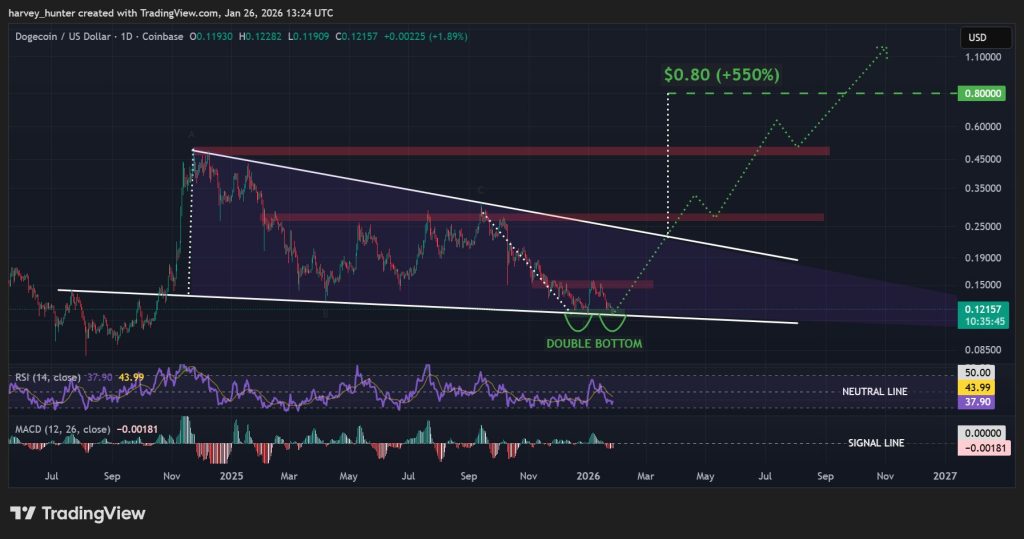
Technicals emphasize current levels as key to the bull run, as the lower boundary of a year-long falling wedge pattern comes under pressure.
Momentum indicators paint the setup as a potential launchpad. The RSI nears oversold levels around 30, suggesting that any further downside may be limited as sellers near exhaustion.
The MACD has also levelled off and started rising towards a golden cross above the signal line, suggesting a deep and brief correction over a complete trend flip.
This all lines up with what appears to be an early double bottom reversal.
With a second bottom forming along the $0.115 support, a sharp rebound above the reversal structure’s neckline at $0.15 could put the key $0.28 wedge breakout threshold under test.
If $0.28 flips to support, a confirmed wedge breakout eyes a 550% push past the previous $0.50 all-time high, into new price discovery targeting $0.80.
Still, a breakdown scenario could see a return to lows around $0.09.
Maxi Doge: Market Behavior Favours This High-Beta Play
As capital rotation becomes selective, speculative demand is concentrating on high-beta plays. While coins like $PENGUIN and $WHITEWHALE lead, momentum almost always circles back to one thing: Doge.
History makes the pattern clear: Dogecoin started the trend, Shiba Inu ran with it in 2021, followed by Floki, Bonk, Dogwifhat, and Neiro. Every bull cycle eventually crowns a new Doge-inspired frontrunner.
This time around, Maxi Doge ($MAXI) is tapping into those early Dogecoin vibes with a community built around sharing early alpha, trading ideas, and competitive engagement.
Participation is at its core. Weekly Maxi Ripped and Maxi Pump competitions reward top performers with leaderboard recognition, incentives, and bragging rights.
The hype is already showing in the numbers. The $MAXI presale has raised almost $4.5 million, while early backers are earning up to 69% APY through staking rewards.
For those who missed the Doge wave before, Maxi Doge could be the next chance to catch a meme coin before it enters the mainstream.
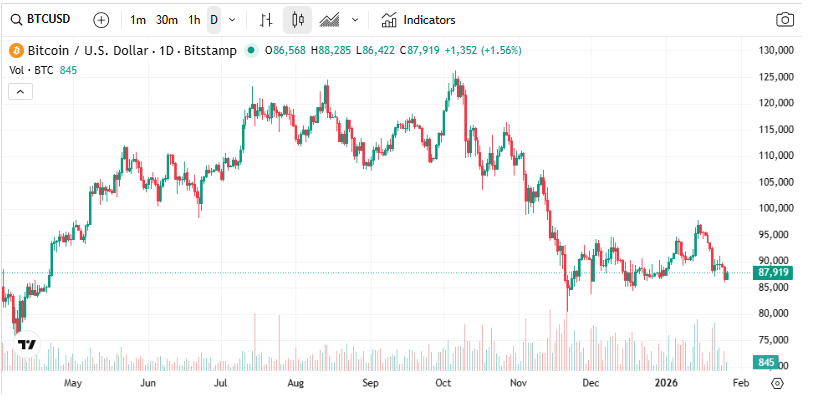
Bitcoin holders have experienced over $4.5 billion in realized losses following the cryptocurrency’s dramatic decline from above $120,000 to below $90,000, which marks the highest level of capitulation since the 2022 bear market.
The Bitcoin price prediction indicator shows that the price might be bracing for another drop below $80k because the last time this much realized losses occurred in Bitcoin, the price dropped more than 50% to $28,000 from $69k.
Bitcoin Capital Flight Sees ETFs Bleed $1.33B in Single Week
The exodus from Bitcoin continues through institutional channels, with U.S.-based Bitcoin ETFs recording $1.33 billion in net outflows over one week, the largest withdrawal since February 2025.
This substantial capital flight shows weakening institutional confidence in the cryptocurrency’s near-term prospects.
Adding to the bearish sentiment, stablecoin market capitalization has contracted significantly.
According to CryptoQuant researcher Darkfost, the Ethereum-based stablecoin total market cap declined by $7 billion in just seven days, dropping from $162 billion to $155 billion.
Darkfost characterized this development as “a very negative signal,” explaining that investors are completely exiting the crypto market as it continues correcting, while precious metals surge and equity markets maintain strong upward trends.
This migration of liquidity explains the persistent weakness across cryptocurrency markets.
The analyst drew parallels to 2021, noting that similar stablecoin market cap declines confirmed Bitcoin’s entry into bear market territory, though the Terra Luna collapse amplified that downturn.
Darkfost emphasized that current conditions must improve rapidly, or Bitcoin risks confirming a bearish trajectory with a breakdown well below $80,000.
Bitcoin Price Prediction: $80K Support Acts As Make-or-Break Zone
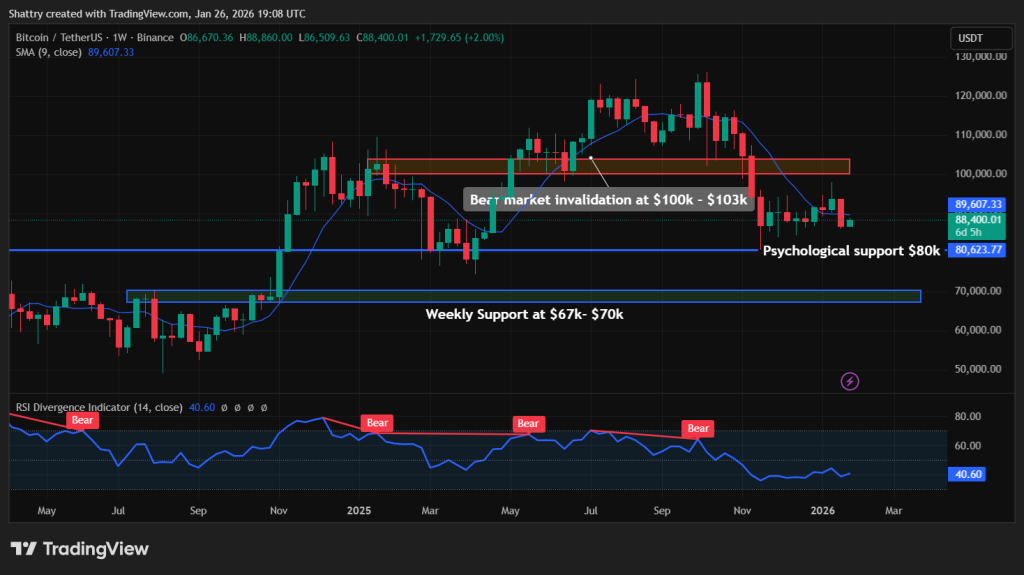
The weekly BTC/USDT chart shows Bitcoin consolidating after a sharp rejection from the $100,000–$103,000 supply zone, which is clearly identified as a bearish invalidation area.
Price currently trades in the mid-to-high $80,000 range, positioned just beneath the 9-week Simple Moving Average, which has transformed into short-term dynamic resistance following the recent breakdown.
Repeated failures to reclaim the $100,000 level confirm that sellers remain aggressive at elevated prices, establishing that zone as a formidable ceiling for any sustained recovery attempts.
Source: TradingView
The $80,000 level represents critical psychological and structural support. Bitcoin has demonstrated positive reactions near this zone, indicating buyers are defending it vigorously.
As long as Bitcoin maintains weekly closes above $80,000, the broader market structure remains corrective rather than definitively bearish.
Technical momentum indicators suggest caution in the near term.
The Relative Strength Index hovers around the low-40s and has printed multiple bearish divergences during the previous rally, signaling deteriorating momentum and validating the ongoing consolidation phase.
The chart suggests Bitcoin occupies a range-bound corrective phase, with $80,000 serving as the crucial line in the sand.
Holding above this level preserves the possibility of base-building and potential recovery toward $90,000–$95,000 initially.
A decisive weekly close above $100,000 would invalidate the bearish structure and signal trend continuation.
Conversely, losing $80,000 support would likely accelerate downside momentum toward the $70,000 region before establishing a more meaningful bottom.
Bitcoin Hyper Raises $31M As The Leading Crypto Presale
If Bitcoin successfully breaches the $100,000 psychological barrier, established BTC-beta projects like Bitcoin Hyper stand to benefit substantially.
Bitcoin Hyper ($HYPER) is developing the first functional Layer 2 solution for Bitcoin, leveraging Solana-based technology to provide speed and scalability while maintaining Bitcoin’s security framework.
The project has raised over $31million to facilitate Bitcoin-native decentralized applications, offering BTC holders opportunities to deploy assets productively through purpose-built on-chain tools.
Interested investors can participate in the presale by visiting the official Bitcoin Hyper website and connecting their wallet (such as Best Wallet).
The token is currently available for $0.013645 each and could be purchased via USDT or SOL swaps, or directly through a bank card.
A winter storm in Washington, D.C., has compelled the senators to delay the first markup vote on comprehensive digital asset market structure legislation.
The Senate Agriculture Committee confirmed on Monday that it had postponed its scheduled Tuesday markup of the Digital Commodity Intermediaries Act because of dangerous weather conditions across the capital.
The committee staff cited unsafe travel conditions, noting that much of Washington is covered by snow and ice amid dangerously low temperatures caused by a major winter storm.
Flights Canceled, Roads Icy as Senate Crypto Markup Slips
The weekend was topped off by an arctic cold snap and heavy snowfall, with wind chills dropping down to below zero and daytime temperatures struggling to reach the mid-20s Fahrenheit.
The snowy sidewalks and the icy roads, along with the high winds, led to the closure of federal offices on Monday, with a snow emergency being declared in the city, which limited the movement of vehicles on major routes.
People were also greatly affected in air travel, with thousands of flights being cancelled across the country and major delays at Reagan National Airport as airlines and airports cleared backlogs.
Schools and universities in the area of Washington, Maryland, and Virginia went to closures or remote education, and legislators had restricted mobility as crews proceeded with snow removal.
The weather scramble created a new obstacle of a long legislative procedure that has already experienced a series of postponements.
The Agriculture Committee markup is paid close attention to, as it is the first occasion that the Senate formally votes on and amends a crypto market structure bill.
The panel oversees the Commodity Futures Trading Commission, and the legislation would expand the agency’s authority over digital commodities such as Bitcoin.
The bill is the product of months of negotiations led by Committee Chair John Boozman, with contributions from Senator Cory Booker, though bipartisan agreement has proven difficult.
Agriculture Committee Emerges as Key Path for Crypto Legislation
The way ahead was unclear even before the weather delay, as the Senate Banking Committee, which has jurisdiction over the Securities and Exchange Commission, has consistently put off its parallel bill, the CLARITY Act.
That effort was derailed earlier this month after Coinbase withdrew its support, citing concerns over restrictions on tokenized equities, stablecoin rewards, and the balance of power between regulators.
The delay in the Banking Committee has increased pressure on the Agriculture Committee’s bill, which now represents the most immediate legislative vehicle for crypto market structure reform.
Senate Agriculture Committee advances crypto bill for January 27 markup without Democratic support as Banking delays CLARITY Act over stablecoin disputes.#ClarityAct#Stablecoinhttps://t.co/Wjz1vpYh5d
The Agriculture Committee’s bill differs from the Banking Committee’s approach on several key issues, including stablecoins and token classification.
While the CLARITY Act explicitly restricts interest-like rewards for holding payment stablecoins, the Agriculture Committee’s proposal largely sidesteps yield rules by excluding permitted payment stablecoins from CFTC oversight, deferring those questions to other frameworks such as the GENIUS Act.
The bill also explicitly places meme coins under CFTC jurisdiction, a move not mirrored in the Banking Committee’s draft.
The legislation has drawn increasing political attention as President Trump said last week that he expects to sign a crypto market structure bill “very soon,” framing digital assets as a strategic priority for maintaining U.S. competitiveness.
XRP has dropped 4% over the past week, with trading volumes spiking by 171% as the token broke below key support at $1.90.
This surge in activity signals growing uncertainty, adding doubt to the bullish XRP price prediction that has dominated recent sentiment.
Bearish pressure is intensifying after Donald Trump threatened a 100% tariff on Canadian goods if the country strikes a trade deal with China.
While XRP briefly rebounded from $1.80 during the Asian session, broader market jitters continue to weigh heavily on price action.
The Fear and Greed Index shows that sentiment has soured in the past couple of weeks as this key metric dropped sharply from a 54 reading on January 14 to 29 at the time of writing.
Now, traders are wondering whether XRP is going to zero, so it’s time to take a look at the charts.
XRP Price Prediction: 11% Downside Risk Ahead If This Happens
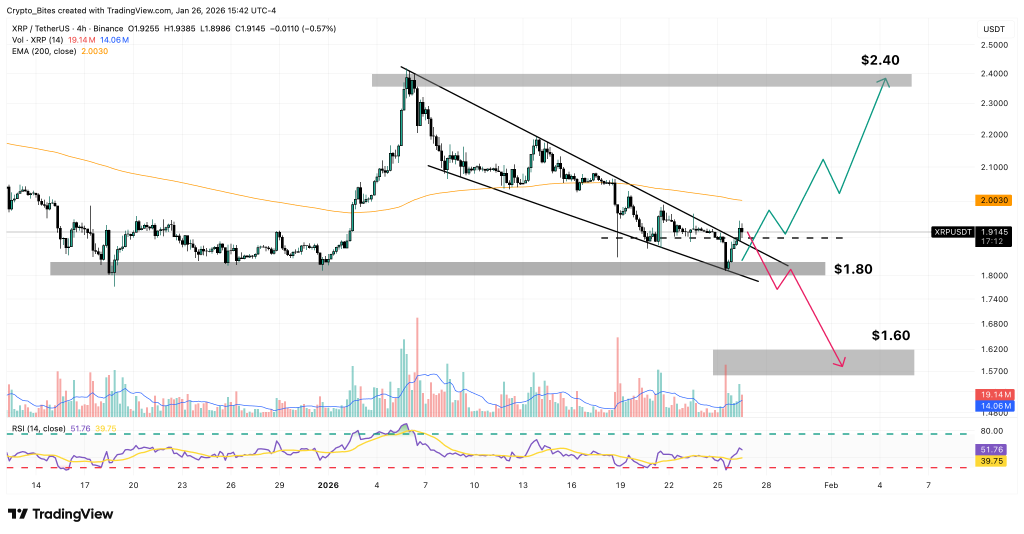
XRP is currently retesting a key structural resistance at $1.90. This is the previous low of the dominant bearish structure, meaning that a bullish breakout will confirm a trend reversal.
If the price rejects a move above this mark, it could rapidly drop to $1.80 and increase the risk of a move to lower levels.
In that scenario, the most likely target, one that hasn’t been touched in months, would be the $1.60 area.
Hence, even though a move to zero is highly unlikely, the current setup does favor a bearish outlook.
Meanwhile, while major altcoins struggle to hold key levels, crypto presales like Maxi Doge ($MAXI) are heating up with strong momentum and early investor interest.
This Ethereum-based meme coin channels the same viral energy that sent Dogecoin soaring in 2021, and could deliver a similar breakout as soon as its presale closes.
Maxi Doge Presale Is Channeling the Early Dogecoin Energy That Once Drove 1000x Gains
Maxi Doge ($MAXI) is a fast-rising meme coin presale that’s flashing many of the same signals that powered Dogecoin’s breakout in 2021.
Instead of empty hype, the project is building a trader-first culture where momentum, community, and rewards come first.
At the center is an active group of like-minded traders sharing setups, early opportunities, and wins as the market heats up again.
Engagement is fueled through weekly competitions like Maxi Ripped and Maxi Gains, where traders showcase their biggest Ws and climb the leaderboard for rewards and bragging rights.
On top of that, $MAXI offers staking rewards of 69% per year for early participants who lock in during the presale phase.
For anyone who watched DOGE explode from the sidelines, Maxi Doge offers a second chance to get positioned early in a meme coin that’s gaining momentum by the week.
Gold climbed to a fresh all-time high, crossing $5,100 an ounce on Monday, extending its record-breaking run as investors seek shelter amid rising geopolitical tensions and global fiscal risks. Spot gold prices gained 2.4%, trading at $5,102 an ounce, before paring gains to $5,086.
The surge comes days after President Donald Trump warned Canada that the U.S. would impose a 100% tariff on goods sold in the U.S. if the country strikes a trade deal with China. “If Canada makes a deal with China, it will immediately be hit with a 100% Tariff against all Canadian goods and products coming into the U.S.A.,” Trump wrote in a Truth Social post.
However, Ethereum is moving in the opposite direction, trading at $2,877.15 with a 24-hour trading volume of $24.69 billion. The token now sits 36% below its $4,953.73 peak.
The $5K Race Ends
The “Gold versus ETH: Which hits $5K first?” market on Myriad has reached a resolution, with gold hitting the $5k mark first. The precious metal jumped 7.28% on the week and was recently priced at $4,938 before Monday’s breakout.
While gold is typically compared to Bitcoin, predictors on Myriad favored ETH for months, betting on its volatile upward mobility, but they’ve become less confident as crypto markets slide. The prediction market opened in October 2025.
Institutional Flows Tell the Story
Western ETF holdings have climbed by about 500 tonnes since the start of 2025. Goldman Sachs lifted its December 2026 gold price forecast to $5,400 an ounce, up from $4,900, arguing that hedges against global macro and policy risks have become “sticky.”
Central bank purchases remain robust as Goldman estimates central-bank purchases are averaging around 60 tonnes a month, far above the pre-2022 average of 17 tonnes.
“While this rally in gold has not, and will not, be linear, we believe the trends driving this rebasing higher in gold prices are not exhausted,” Natasha Kaneva, head of Global Commodities Strategy at J.P. Morgan, stated. “The long-term trend of official reserve and investor diversification into gold has further to run.”
Ethereum saw $630 million in outflows last week, reflecting bearish sentiment as investors withdraw funds. A whale that had been dormant for nine years transferred 50,000 ETH, worth $145 million, to a Gemini wallet, a move often associated with liquidation intent.
According to @EmberCN monitoring, a dormant 9-year ETH whale address activated in the last 12 hours, transferring 50,000 ETH (worth $145 million) to Gemini exchange. The address withdrew 135,000 ETH ($12.17 million) from Bitfinex 9 years ago when ETH was priced ~$90, representing… pic.twitter.com/akGYWcKoVC
The precious metal’s surge comes as flashpoints from Greenland and Venezuela to the Middle East reflect higher geopolitical risk. Trump’s tariff threat follows tensions that mounted after Canadian Prime Minister Mark Carney delivered an address at the World Economic Forum in Davos that was widely seen as a rebuke of the Trump administration’s policies.
Earlier this month, Carney announced that Canada and China reached a preliminary deal to remove trade barriers. Under the tentative agreement, Beijing cut tariffs on some Canadian agricultural products, while Ottawa increased quotas for imports of Chinese electric vehicles.
Canadian Prime Minister Mark Carney said on Sunday that Ottawa has no plans to pursue a free trade deal with China, noting that the recent agreement only reduces tariffs on select sectors. Carney’s remarks came a day after President Trump threatened a 100% tariff on Canadian goods.
What Desks Are Watching
The gold-crypto divergence indicates a broader risk recalibration. Following a record-breaking 2025, gold entered 2026 with momentum intact as geopolitical tensions, falling real interest rates, and efforts by investors and central banks to diversify away from the dollar reinforce its safe-haven role.
ETH failed to reclaim its “digital gold” narrative during peak macro stress. Analysts note that if ETH maintains support around the $2,500 level, it could reach an all-time high of $6,000 by 2026, but that thesis requires risk appetite to return. In August 2025, Trump raised the tariff on Canadian goods to 35%. A 100% tariff threat marks a major escalation.
Markets are pricing in two interest-rate cuts by the Federal Reserve later this year. Traders await this week’s FOMC meeting, where the central bank is widely expected to hold rates steady.
BitMine Immersion Technologies, a New York–listed company chaired by Fundstrat’s Tom Lee, has quietly built one of the largest concentrated positions in Ethereum ever disclosed by a single entity.
In an update published on January 26, BitMine said it now holds 4,243,338 ether, giving the company control of roughly 3.52% of Ethereum’s total circulating supply.
BitMine provided its latest holdings update for January 26th, 2026:
$12.8 billion in total crypto + "moonshots": – 4,243,338 ETH at $2,839 (@coinbase) – 193 Bitcoin (BTC) – $200 mllion stake in Beast Industries @MrBeast – $19 million stake in Eightco Holdings (NASDAQ: $ORBS)…
At the time of disclosure, the position was valued at roughly $12 billion, making BitMine the largest Ethereum treasury in the world and the second-largest crypto treasury overall, behind Strategy Inc., formerly Strategy, which holds more than 700,000 bitcoin.
BitMine Accelerates ETH Accumulation as Prices Slide
The disclosure shows how quickly BitMine’s balance sheet has expanded over the past six months.
Weekly purchase data shared by the company indicates steady accumulation since late October, 2025, with particularly large buying activity in December.
In the week ending January 26 alone, BitMine added just over 40,000 ETH, following purchases of more than 35,000 ETH the prior week and several six-figure ETH buys in December.
The pace of accumulation has continued even as ether prices softened, with ETH down double digits over the past month amid broader market volatility.
Ethereum is currently trading at $2,940.44, showing a 2.0% increase over the past hour, which suggests short-term buying pressure returning to the market.
BitMine’s total crypto, cash, and equity holdings now stand at $12.8 billion, according to the company.
In addition to its Ethereum position, the firm holds 193 bitcoin, $682 million in cash, a $200 million stake in Beast Industries, and a smaller equity position in Eightco Holdings.
BitMine’s Ethereum Bet Moves Closer to the 5% Mark
The company trades on the NYSE American under the ticker BMNR and was last priced around $28.50, down modestly on the day and slightly lower over the past week.
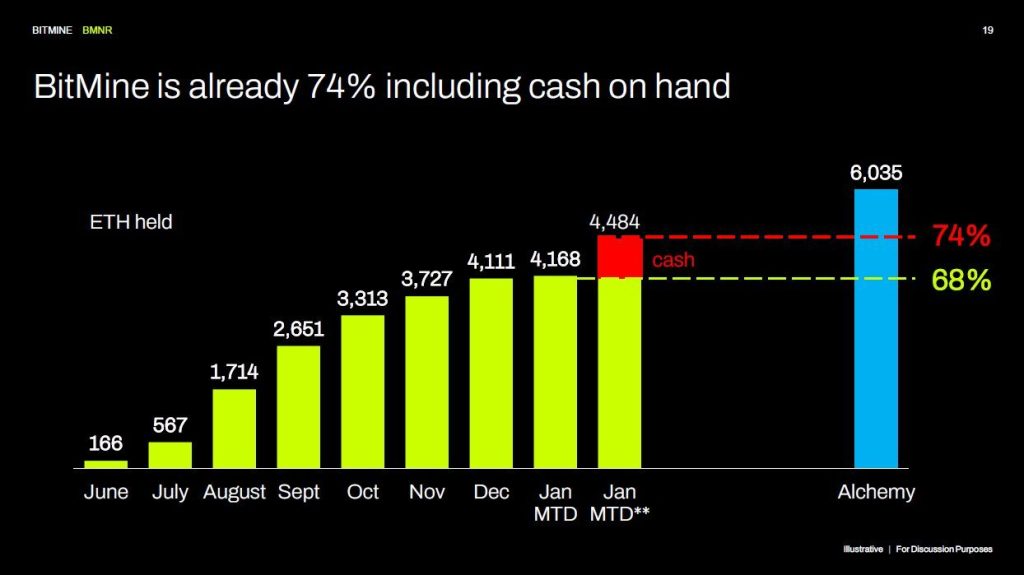
The Ethereum accumulation is central to BitMine’s stated long-term strategy, as it has publicly set a goal of acquiring 5% of Ethereum’s total supply, a target it refers to as the “alchemy of 5%.”
Based on current supply estimates, reaching that level would require roughly 6 million ETH.
At current market prices, closing that gap would require several billion dollars in additional capital.
BitMine Expands Ethereum Staking as Holdings Grow
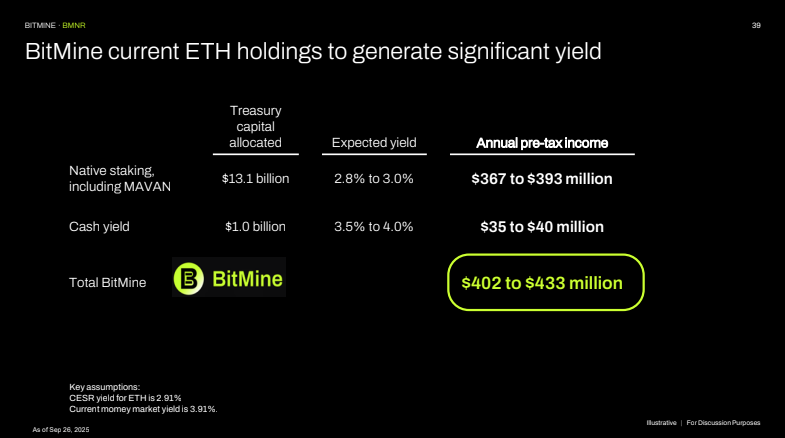
Beyond holding ether on its balance sheet, BitMine is also expanding its staking operations. As of January 25, the company had staked 2,009,267 ETH, worth about $5.7 billion, representing nearly half of its total holdings.
Using the composite Ethereum staking rate of roughly 2.81%, BitMine estimates that a fully deployed staking strategy could generate about $374 million in annual fees, or more than $1 million per day.
For now, the company relies on external staking providers, but it plans to launch its infrastructure, known as the Made in America Validator Network, or MAVAN, in early 2026.
Chairman Tom Lee has framed the Ethereum strategy as a long-term bet on institutional adoption of blockchain technology.
Speaking after last week’s World Economic Forum meeting in Davos, Lee said discussions among policymakers and business leaders increasingly point to the convergence of traditional finance, crypto, and artificial intelligence.
He pointed to Ethereum’s role in tokenization and financial infrastructure projects as evidence that Wall Street is already building on the network.
Crypto traders are abandoning token speculation in favour of prediction markets following a brutal $150 billion altcoin crash, with platforms like Polymarket seeing app installs surge from 30,000 to over 400,000 between January and December 2025, according to Bloomberg.
Source: Bloomberg
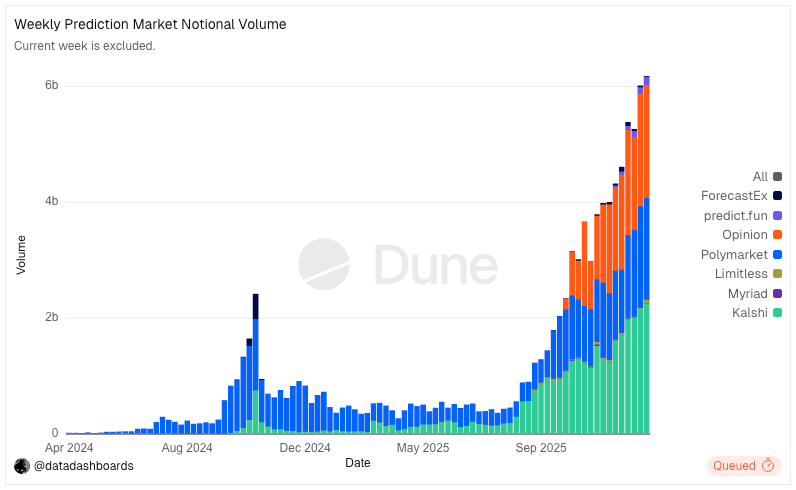
Weekly trading volume across prediction platforms, including Polymarket and Kalshi, exploded from $500 million in June to nearly $6 billion in January, data from Dune shows, while crypto exchange downloads collapsed by more than half during the same period.
The shift reflects deep fatigue across the token economy after Bitcoin plunged nearly 30% from its October peak and more than 11 million coins effectively died last year, marking the largest extinction event in crypto history, according to CoinGecko.
Former memecoin traders are leading the exodus toward prediction markets that offer binary odds on real-world events rather than multi-year token roadmaps.
Nikshep Saravanan, who abandoned his digital creator startup to build HumanPlane, a prediction market research platform, said the shift made sense after losing traction without funding.
“Here I can do a lot more with no capital,” the 27-year-old Canadian explained. “There’s so much more interest here.“
Tre Upshaw followed a similar path after losing money on memecoins like SafeMoon, now running Polysights, an analytics dashboard for prediction markets.
“I realized that’s just hyper gambling,” he said. “I got burned so many times on memecoins.”
Yet losses remain widespread across prediction markets too, with 70% of trading addresses showing realized losses, while fewer than 0.04% of Polymarket addresses captured over 70% of total realized profits totalling $3.7 billion.
70% of Polymarket traders lost money while the top 0.04% captured over $3.7 billion in profits, revealing extreme concentration in prediction markets.#Polymarket#Tradershttps://t.co/E5CeFnJIwR
The infrastructure supporting these markets remains fundamentally crypto-powered despite traders fleeing token speculation.
On Polymarket, every key part of trades except order-matching happens on-chain, revealing blockchain technology’s most durable use case yet as belief-driven speculation cools.
Crypto contracts have become the second-busiest trading category on Polymarket, up from fourth place a year ago, with notional crypto volume increasing nearly tenfold across major platforms, according to Dune data.
Exchanges Rush Into Prediction Markets
Major crypto platforms are aggressively expanding into event contracts as user demand shifts.
Coinbase added prediction markets in December through Kalshi routing, with Clear Street analyst Owen Lau projecting the exchange could generate $700 million in prediction market revenue for 2025, while Robinhood’s annual run rate already approaches $300 million.
Gemini and Crypto.com have also launched their own prediction market efforts, with Crypto.com white-labeling services for Trump Media.
“As we add more instruments, they tend to complement each other,” said Max Branzburg, Coinbase’s head of consumer and business products, noting the firm has “seen tons of excitement” from users wanting a single venue to trade everything.
A Mizuho survey cited by Bloomberg found that Coinbase and Robinhood users were 9 times more likely to use prediction platforms than the general population.
Polymarket is back in the U.S. after CFTC approval. Clear Street analyst says prediction markets could become an engagement tool for platforms like Coinbase. #Polymarket#Coinbasehttps://t.co/h9EX7a4YFn
The platform also recently rolled out real estate bets that allow crypto traders to now speculate on housing prices
The company raised $205 million across two funding rounds and secured a $2 billion investment from Intercontinental Exchange at a valuation of nearly $9 billion.
Last month, Kalshi also closed a $1 billion round at an $11 billion valuation and secured CNN as its official prediction markets partner.
Despite near-term outflows, 70% of institutions view Bitcoin as undervalued in a recent Coinbase Institutional and Glassnode survey, and 62% maintain or increase crypto positions since October’s crash.
“Crypto markets are entering 2026 in a healthier state, with excess leverage having been flushed from the system,” said David Duong, Coinbase Global Head of Research.
Bitcoin is again near another critical on-chain inflection point as a key profitability indicator goes back to the levels that last occurred during one of the most painful downtrends in the history of the market.
CryptoQuant analyst Adler AM data shows that the Net Realized Profit and Loss of Bitcoin has dropped by approximately 97% after it achieved its recent high and is now approaching the levels of near-zero territory.
The situation is similar to those observed in June 2022 before BTC plummeted from about 30,000 to almost 16,000.
Net Realized P/L has dropped by 97% and returned to zero. The last time this happened was in June 2022 – right before the drop from $30K to $16K. Whales are still in profit (a 25-80% buffer), so there is no panic yet. But the market is being supported not by buyers – but by the… pic.twitter.com/ooQsnaGTCA
Net Realized P/L tracks the balance between realized profits and losses on the Bitcoin network based on on-chain cost basis. Positive readings signal dominant profit-taking, while negative values reflect loss-driven selling.
Readings near zero suggest trades are occurring close to cost basis, indicating profit exhaustion and a balance between buyers and sellers.
Bitcoin Selling Pressure Fades, but Buyers Stay on the Sidelines
The analyst pointed out that the current setup resembles the period just before Bitcoin’s main capitulation leg in 2022. In late 2024 and early 2025, Net Realized P/L surged above $1.5 billion, reflecting an overheated profit-taking phase.
By January 26, 2026, that figure had collapsed to roughly $60 million, effectively flattening at the zero line. In 2022, a similar return to zero did not mark a bottom.
Instead, the metric continued lower into deeply negative territory, falling to around minus $350 million as the price slid another 50%.
Adler noted that the present zero reading should not be interpreted as a bullish reversal signal. Instead, it represents a pause where selling pressure from profit-takers has largely dried up, but fresh demand has not stepped in.
On-chain data suggests the market is currently being supported more by the absence of sellers than by strong buying interest, a fragile equilibrium that has historically broken lower during risk-off environments.
Despite the warning signals, large Bitcoin holders remain in profit, as realized price data segmented by balance size shows that all major whale cohorts are still comfortably above their average acquisition costs.
Holders with balances between 100 and 1,000 BTC have the highest realized price, near $69,900, giving them an estimated profit buffer of about 25% at current prices.
Other large cohorts, including wallets holding 10–100 BTC and those with more than 10,000 BTC, have average entry prices closer to $48,000 and $51,000, translating to unrealized gains of 70% to 80%.
This helps explain the lack of panic selling, even as price has pulled back sharply from recent highs.
Bitcoin Slips Below $88K as Volatility Picks Up
At the time of writing, Bitcoin was priced at approximately $87,756, having fallen by approximately 1.1% in the last 24 hours and 5.7% in the last week.
Trading volume, however, surged more than 160% day over day to $53.1 billion, pointing to heightened activity as traders reposition amid volatility.
Macro pressure has contributed to the discomfort because U.S. President Donald Trump threatened to impose 100% tariffs on any Canadian products in case Ottawa strengthens trade relations with China, and the rumors of a potential American government shutdown resurfaced.
The move triggered more than $320 million in liquidations of leveraged long positions in a matter of hours.
Digital asset investment products saw sharp outflows last week, with investors pulling $1.73B — the largest weekly decline since mid-November 2025, according to CoinShares.#BTC#ETPshttps://t.co/2ni4w83evG
Bitcoin is trading near $87,700, down about 1% on the day, yet Robert Kiyosaki remains unmoved by short-term price swings. The Rich Dad Poor Dad author says he continues buying Bitcoin and Ethereum regardless of volatility, arguing that price matters less than the direction of the global financial system.
In a recent post, Kiyosaki pointed to two forces shaping his strategy: the rising US national debt, now above $38.4 trillion, and the steady erosion of the dollar’s purchasing power. From his perspective, daily price movements are a distraction.
As debt expands and deficits deepen, scarce assets gain relevance. As he put it bluntly, he does not worry about market fluctuations because “the national debt keeps going up and the purchasing power of the US dollar keeps going down.”
Q: Do I care when the price of gold silver or Bitcoin go up or down?
A: No. I do not care.
Q: Why Not?
A: Because I know the national debt of the US keeps going up and the purchasing power of the US dollar keeps going down.
That logic explains why Kiyosaki groups Bitcoin with gold and silver, often referring to BTC as “digital gold.” While he has long favored physical metals, he now sees Bitcoin and Ethereum as modern extensions of the same hedge against monetary dilution. His long-term outlook remains bold, with Bitcoin potentially reaching $1 million over the coming years or decade.
Institutional Credibility Weakens as Investors Seek Bitcoin Hedges
Kiyosaki’s stance reflects deep skepticism toward traditional financial authorities. He has repeatedly criticized institutions such as the Federal Reserve and the US Treasury, arguing that policy decisions have fueled debt growth rather than long-term stability.
This view aligns with a broader investor shift. As inflation pressures, rising interest costs, and geopolitical uncertainty persist, capital has increasingly moved toward assets outside the traditional financial system. Bitcoin’s fixed supply of 21 million coins, with more than 19.98 million already in circulation, continues to attract investors who see scarcity as protection rather than speculation.
Bitcoin Price Prediction: $87K Base Forms as Trendlines Hint at a Springboard Move
While the long-term narrative remains intact, Bitcoin’s short-term chart sits at a critical junction. After pulling back from the $95,500–$96,000 zone, BTC is consolidating between $86,000 and $88,000, an area where multiple technical levels converge.
On the 4-hour chart, price is pressing against the lower boundary of a descending wedge while still respecting a rising long-term support line that has guided the broader uptrend since late 2025. Recent candles near $86,100 show long lower wicks, suggesting dip-buying rather than forced liquidation.
BTC/USD Price Chart – Source: Tradingview
Momentum remains soft, with RSI hovering near 39–40, but it has begun to turn higher. A sustained hold above $88,000 would open a path toward $90,700 and $93,300, with a potential retest of $95,500. A break below $86,000 would delay that recovery and expose $84,300, without undermining the broader structure.
Taken together, Kiyosaki’s long-term conviction and Bitcoin’s developing technical base suggest the market is pausing, not peaking. For investors focused beyond short-term noise, this consolidation may be the kind of quiet reset that precedes the next expansion phase.
Bitcoin Hyper: The Next Evolution of BTC on Solana?
Bitcoin Hyper ($HYPER) is bringing a new phase to the BTC ecosystem. While BTC remains the gold standard for security, Bitcoin Hyper adds what it always lacked: Solana-level speed. The result: lightning-fast, low-cost smart contracts, decentralized apps, and even meme coin creation, all secured by Bitcoin.
Audited by Consult, the project emphasizes trust and scalability as adoption builds. And momentum is already strong. The presale has surpassed $31 million, with tokens priced at just $0.013635 before the next increase.
As Bitcoin activity climbs and demand for efficient BTC-based apps rises, Bitcoin Hyper stands out as the bridge uniting two of crypto’s biggest ecosystems. If Bitcoin built the foundation, Bitcoin Hyper could make it fast, flexible, and fun again.
Michael Saylor’s Strategy has expanded its Bitcoin treasury again, acquiring an additional 2,932 BTC for approximately $264.1 million during the period from Jan. 20 to Jan. 25.
Strategy has acquired 2,932 BTC for ~$264.1 million at ~$90,061 per bitcoin. As of 1/25/2026, we hodl 712,647 $BTC acquired for ~$54.19 billion at ~$76,037 per bitcoin. $MSTR$STRChttps://t.co/RooLfEvniX
The company disclosed that the purchases were made at an average price of $90,061 per Bitcoin, inclusive of fees and expenses.
The update reinforces Strategy’s position as the largest corporate holder of Bitcoin globally, continuing its multi-year accumulation strategy that has become central to its balance sheet approach.
Total Bitcoin Holdings Reach 712,647 BTC
Following the latest acquisition, Strategy reported that it now holds a total of 712,647 BTC as of Jan. 25.
The company said its aggregate Bitcoin purchases total roughly $54.19 billion, with an average acquisition price of $76,037 per Bitcoin. The figures show the scale of Strategy’s long-term bet on Bitcoin as a treasury reserve asset, accumulated across multiple market cycles.
Strategy’s growing holdings show its belief that Bitcoin represents a superior store of value over time, particularly amid concerns around currency debasement and global macro uncertainty.
Purchases Funded Through Share Sales Under ATM Program
Strategy disclosed that the recent Bitcoin purchases were funded through proceeds generated from the sale of shares under its at-the-market offering program.
During the Jan. 20–25 period, the company sold approximately 1.57 million shares of its Class A common stock, generating net proceeds of about $257 million. Strategy also issued roughly 70,201 shares of its variable rate preferred stock, raising an additional $7 million.
In total, the company generated about $264 million in net proceeds, which were then deployed toward Bitcoin accumulation.
The disclosure also shows that Strategy retains major remaining capacity for future issuances, including billions of dollars available across multiple stock and preferred equity programs.
Corporate Bitcoin Accumulation Continues Into 2026
Strategy’s continued purchases come as institutional adoption of Bitcoin remains a major theme entering 2026, with more companies exploring crypto as a long-term balance sheet asset.
The firm has consistently framed Bitcoin as a scarce, inflation-resistant reserve that can outperform cash and traditional holdings over extended time horizons. While the strategy remains controversial due to Bitcoin’s volatility, Strategy has maintained its commitment to accumulation even during periods of market weakness.
With over 712,000 BTC now on its balance sheet, Strategy’s exposure to Bitcoin price movements is unmatched among public companies, making it a key bellwether for corporate crypto adoption.
As the company continues leveraging equity issuance to fund purchases, investors will closely watch how its aggressive treasury strategy evolves alongside broader market conditions in 2026.
Ledger is preparing for a potential U.S. initial public offering that could value the crypto wallet maker at more than $4 billion, according to reports.
The Paris-based company has enlisted major Wall Street banks, including Goldman Sachs, Jefferies, and Barclays, to advise on the deal, with a potential listing later this year.
The move comes as Ledger increases its presence in the U.S., where capital markets activity and institutional interest in digital asset firms are especially concentrated in New York.
Hardware #wallet maker #Ledger is preparing for a potential U.S. #IPO, reportedly working with Goldman Sachs, Jefferies, and Barclays on the deal, which could take place as early as this year pic.twitter.com/hjJQcnXxfh
Ledger’s IPO ambitions reflect a belief that it has reached sufficient scale to withstand public-market scrutiny from Wall Street.
In an earlier interview, CEO Pascal Gauthier said the company had grown to a point where a listing was realistic, adding that the U.S. stood out as the natural venue.
Roughly 40% of Ledger’s business now comes from North America, a figure that has shaped both its listing strategy and operational expansion in New York.
Gauthier has also said the firm is weighing a U.S. IPO alongside a potential private funding round, keeping multiple capital-raising paths open.
“Money is in New York today for crypto, it’s nowhere else in the world, certainly not in Europe,” Gauthier told the Financial Times.
He reiterated that view in November 2025 when the company first flagged the IPO plans, emphasizing that his increased time in New York was driven by where crypto financing is now concentrated.
From Nano Wallets to Triple-Digit Millions in Revenue
Founded in 2014 by Éric Larchevêque, Joël Pobeda, and Thomas France, Ledger built its reputation on hardware wallets designed to keep private keys offline.
Its early success came from the Ledger Nano series, which gained traction as hacks and exchange failures highlighted the risks of custodial storage.
The company has since broadened its product lineup, launching the Ledger Stax, a touchscreen device aimed at long-term holders and institutional users.
It has also rolled out an iOS app for enterprise clients and recently completed a major rebranding alongside the release of the Ledger Nano Gen5.
Ledger said its revenues reached triple-digit millions in 2025, marking its strongest performance to date, with further growth expected this year.
Over the past decade, the firm estimates it has sold more than seven million devices globally and now safeguards around 20% of global crypto assets, including over $100 billion worth of bitcoin.
Potential Ledger IPO closing market cap?
– raised $3m in 2019, $380m in 2021, $109m at $1.4b in Mar 2023 – seeking $4b valuation in IPO (~3x valuation from last raise)
The company was last valued at $1.5 billion in 2023 after raising a $108 million extension to its Series C round, bringing total funding in that round close to $500 million.
While Ledger has since said its valuation has increased, it has not disclosed an updated figure ahead of the reported IPO preparations.
Fees, Data Exposure, and the Self-Custody Debate
As Ledger expands beyond pure hardware, it has reframed its devices as “Ledger signers,” positioning them as tools for securing digital assets and online identities in an AI-driven environment.
That shift has not been without controversy, particularly around new monetization features.
Last October, Ledger revealed that its Multisig app would charge a flat $10 fee per transaction, excluding token transfers, which would instead incur a 0.05% variable fee.
The charges are applied on top of standard blockchain gas fees, prompting backlash from users who argue that self-custody should not come with recurring platform costs.
Security concerns have also resurfaced following a recent data exposure incident involving a third-party provider.
On January 5, 2026, blockchain researcher ZachXBT said personal information of Ledger customers was accessed in a hack on Global-e, a payment processor used by the company.
While no funds were compromised, researchers warned that the exposure heightens the risk of phishing and social engineering attacks.
Most institutional investors remain bullish on Bitcoin despite brutal fourth-quarter volatility that erased nearly a third of the asset’s value from recent peaks.
A new Coinbase Institutional and Glassnode survey found 70% of institutions view BTC as undervalued, even after the token dropped from above $125,000 in early October 2025 to trade around $90,000 by year-end, while 60% of non-institutional investors share that conviction.
Source: Coinbase Institutional
The findings come from a quarterly poll of 148 global investors, split between 75 institutions and 73 non-institutions, conducted between December 10, 2025, and January 12, 2026.
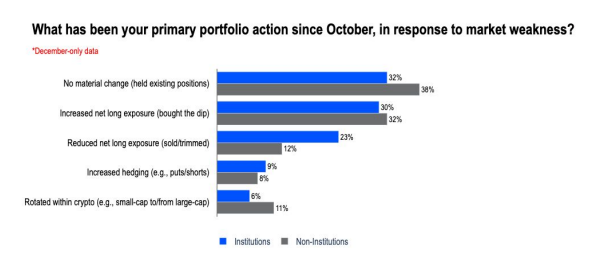
Despite the October liquidation event that shook altcoin markets and compressed leverage across derivatives platforms, most respondents held or added to crypto positions rather than retreating.
Around 62% of institutions and 70% of non-institutions either maintained existing allocations or increased net long exposure since October.
Source: Coinbase Institutional
Bearish Sentiment Rises, But Doesn’t Dominate Positioning
Perceptions of the market cycle shifted noticeably during the quarter.
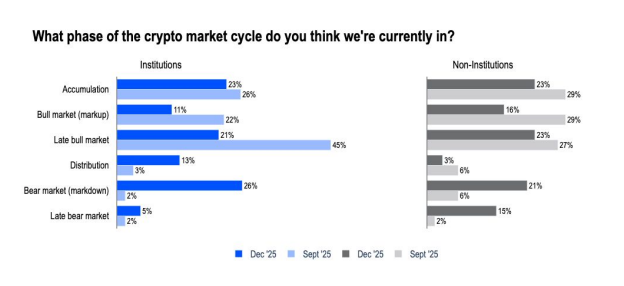
Around 26% of institutions and 21% of non-institutions now believe crypto has entered the bear-market markdown phase, up sharply from just 2% and 7%, respectively, in the prior survey.
Source: Coinbase Institutional
That shift exposes the weight of October’s deleveraging event, which saw the Altcoin Season Index plummet and mid-cap tokens struggle to recover their third-quarter gains despite the launch of several spot altcoin ETFs in the US.
Still, the uptick in bearish views did not translate into widespread selling. Most investors stuck with their positions, and sentiment toward Bitcoin specifically remained constructive.
“We have a constructive view for 1Q26,” Coinbase Global Head of Research David Duong wrote in the report. “We believe that crypto markets are entering 2026 in a healthier state, with excess leverage having been flushed from the system in Q4.“
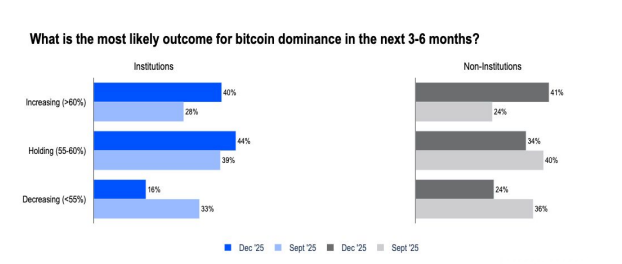
Bitcoin dominance held relatively steady through the turbulence, rising only marginally from 58% to 59% over the quarter, a sign that institutional capital continued to favor the largest digital asset even as smaller tokens faced sustained selling pressure.
Source: Coinbase Institutional
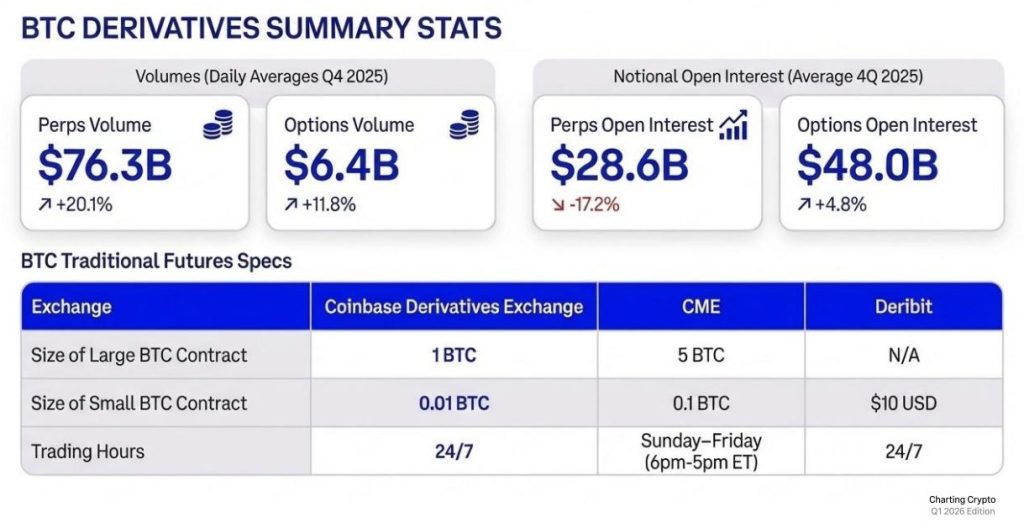
Open interest in BTC options overtook perpetual futures as market participants sought downside protection, with the 25-day put-call skew staying positive across 30-day, 90-day, and 180-day expiries.
Source: Coinbase Institutional
Coinbase Survey Points to Macro Support and Policy Progress
Several factors underpinned the optimistic outlook. Inflation held steady at 2.7% in December’s Consumer Price Index reading, and the Atlanta Fed’s GDPNow model projected robust 5.3% real GDP growth for the fourth quarter as of January 14.
While the future direction of monetary policy remained uncertain, Duong said the firm still expects the Federal Reserve to deliver two rate cuts totaling 50 basis points currently priced into Fed funds futures, “which should provide a tailwind for risk assets broadly and crypto specifically.“
Questions about comprehensive crypto market structure legislation persist, but confidence in eventual regulatory clarity stayed firm.
“We’re confident that we will eventually see a set of rules that allows the industry to reach its full potential,” the report stated, noting that major policy progress in the US, particularly around the proposed CLARITY Act, could boost investor sentiment further.
Beyond the survey, separate data shows institutional engagement deepening across channels.
Similarly, a separate Coinbase survey found that younger US investors now allocate 25% of their portfolios to non-traditional assets, compared with 8% among older cohorts.
Risks Remain, But Long-Term Trajectory Holds
The Coinbase report acknowledged headwinds. While the economy appears solid, the jobs market cooled in 2025, with the US adding just 584,000 positions, down from 2 million in 2024, partly due to increased AI adoption.
Geopolitical tensions have flared in several regions, and any escalation that disrupts energy markets could dampen investor appetite.
“A meaningful uptick in inflation, a spike in energy prices, or a significant flare up of geopolitical tensions could warrant a more cautious approach to risk assets,” the report warned.
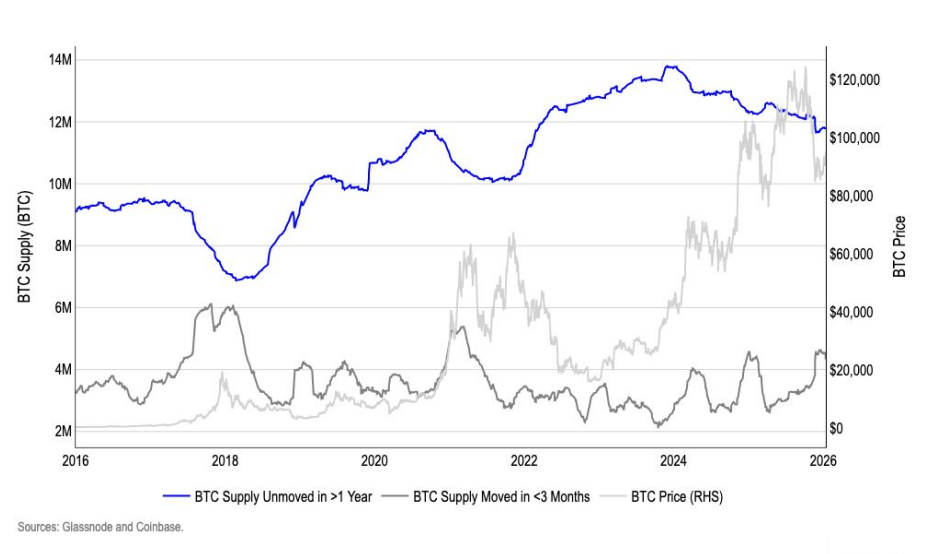
Still, onchain metrics improved after October’s shakeout. Bitcoin supply moved within three months, surged 37% in the fourth quarter, while coins unmoved for over a year fell 2%, indicating short-term distribution that likely cleared weaker hands.
Source: Coinbase Institutional
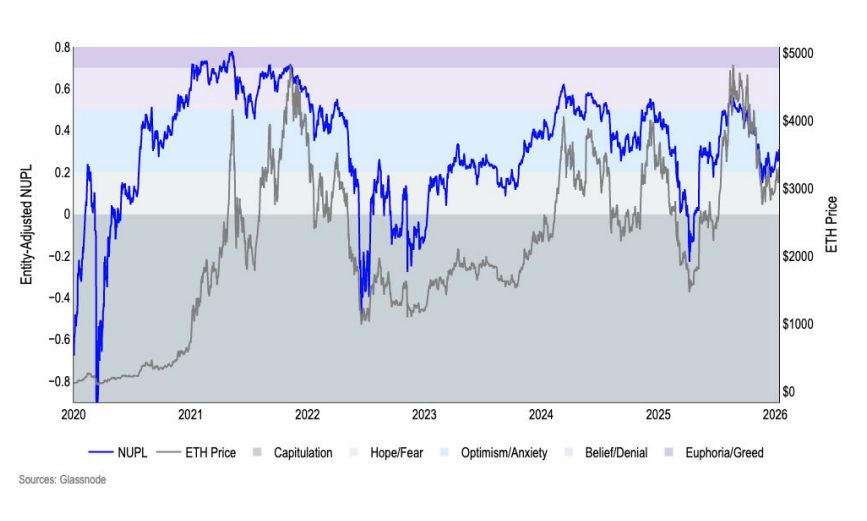
Ethereum’s Net Unrealized Profit/Loss ratio swung sharply through 2025, hitting capitulation in the first quarter, then rising to optimism in the third quarter, and settling back into fear territory by year-end.
Polymarket has re-entered the U.S. market following regulatory approval from the Commodity Futures Trading Commission (CFTC), a move that could position prediction markets as a new engagement tool for major crypto platforms such as Coinbase, according to a report by Clear Street analyst Owen Lau.
The prediction market operator which was restricted from serving U.S. customers in 2022, has returned after receiving a CFTC approval of an Amended Order of Designation.
Polymarket has now launched a U.S.-based application initially offering a limited set of sports-related event contracts, with additional verticals such as politics and crypto expected over time.
Lau describes the development as a meaningful reversal allowing Polymarket to onboard brokerages and customers directly while facilitating trading on regulated U.S. venues.
Polymarket’s comeback is accompanied by a notably aggressive pricing structure. The platform is offering 10 basis point taker fees and zero maker fees which Lau believes is the lowest among major prediction market and sports betting platforms.
For comparison, DraftKings and FanDuel reported net revenue margins of 6.7% and 10.1%, respectively. Lau said Polymarket’s pricing makes it a credible alternative to incumbent sports betting operators and signals increasing fee compression across event-based trading markets.
State-Level Regulatory Risk Remains Fragmented
While the CFTC approval may suggest improved federal-level clarity for certain event contracts, Lau cautioned that regulatory risk remains uneven at the state level.
On Jan. 20, 2026, a Massachusetts judge granted an injunction preventing rival platform Kalshi from offering sports-related event contracts in the state.
More broadly, at least three states — Massachusetts, Nevada, and Maryland — have issued unfavorable rulings against prediction market platforms, highlighting continued fragmentation across U.S. jurisdictions. This patchwork environment could complicate the sector’s expansion even as federal oversight becomes clearer.
Coinbase Seen as Key Distribution Partner
Lau argues that these developments represent an opportunity for Coinbase and indirectly Circle to partner with Polymarket or other prediction market platforms.
Coinbase’s scale — more than 100 million verified users and 9.3 million monthly transacting users — provides a sizable and relevant distribution base for event contracts. In his note, Lau suggests that prediction markets could benefit from being embedded into larger platforms with existing user engagement.
However, he notes that prediction markets may not become major standalone profit centers in the near term. Instead, Lau expects them to serve primarily as engagement and retention tools within Coinbase and other integrated platforms, helping drive activity and user stickiness amid rising competition.
As prediction markets expand beyond sports into politics and crypto, Polymarket’s U.S. return could mark a new phase for event-based trading — even as regulatory uncertainty continues to shape the sector’s trajectory.
The crypto market is down today again. The cryptocurrency market capitalisation decreased by 0.8% over the past 24 hours, now standing at $3.05 trillion. At the time of writing, 93 of the top 100 coins recorded price drops. The total crypto trading volume stands at $139 billion.
TLDR:
Crypto market cap is down 0.8% on Monday morning (UTC);
93 of the top 100 coins and all top 10 coins are down;
BTC decreased by 0.7% to $87,860 and ETH fell by 1.5% to $2,89;
ETH will more likely revisit $2,000 than move above $4,000;
Heightened geopolitical tensions and ongoing conflicts drive volatility across markets;
Macroeconomic developments have influenced risk assets broadly;
Macro uncertainty triggered over $550 million in crypto liquidations;
Larger Bitcoin’s response to recent uncertainty may emerge later;
The UK FCA moved into the final stage of consultations on crypto regulation;
Japan may approve its first set of spot crypto ETFs as early as 2028;
US spot BTC and ETH ETFs saw $103.57 million and $41.74 million in outflows, respectively;
Crypto market sentiment continued falling within the fear zone.
Crypto Winners & Losers
We started the new week very much in the red. As of Monday morning (UTC), all top 10 coins per market capitalisation have posted price drops over the past 24 hours.
Bitcoin (BTC) fell by 0.7%, currently trading at $87,860. This is the smallest drop on the list,
Bitcoin (BTC)
24h7d30d1yAll time
Ethereum (ETH) decreased by 1.5%, changing hands at $2,892.
The highest fall among the top 10 is Solana (SOL)’s 3.3% to the price of $122.
It’s followed by Dogecoin (DOGE)’s drop of 1.6%, now trading at $0.1213.
At the same time, Tron (TRX)fell the least: 0.4% to $0.2953.
Moreover, of the top 100 coins per market cap, 93 have seen their price drop today.
MYX Finance (MYX) fell the most. It’s down 14%, now trading at $5.86.
Monero (XMR) follows, with a decrease of 5.4%, currently standing at $466.
Of the green coins, River (RIVER)stands at the top, having jumped by 43% to the price of $84.7.
The next on the list is Algorand (ALGO), which saw an increase of 2.3% to $0.1189.
QCP analysis notes that crypto assets traded in a narrow range over the weekend before coming under pressure in early Asian hours, triggering over $550 million in leveraged long liquidations. BTC briefly tested $86K before finding support, while Ethereum fell to the $2,785 area.…
Meanwhile, the UK’s Financial Conduct Authority (FCA) moved into the final stage of consultations on a set of proposed crypto regulations. The FCA said it is seeking feedback on 10 proposed rules, describing this as the “final step” in the consultation process.
“These proposals continue our progress towards an open, sustainable and competitive crypto market that people can trust,” the regulator said.
BREAKING: The UK Just Moved to Fully Integrate Crypto Firms Into the FCA Rulebook pic.twitter.com/mGBJ61hLLB
Gadi Chait, Investment Manager at Xapo Bank, commented that recent weakness in Bitcoin follows a brief recovery last week, “set against a backdrop of macroeconomic developments that have influenced risk assets broadly.”
A convergence of factors drives volatility across markets. These include heightened geopolitical tensions and ongoing conflicts. Renewed focus on US strategic positioning toward Greenland and Donald Trump’s address at Davos “added to an already unsettled global environment.”
Regulatory uncertainty, especially in the US, and macroeconomic pressures add to this. “Central bank policy divergence, including expectations around further tightening by the Bank of Japan and the continued reduction of liquidity by the US Federal Reserve, continues to shape market behaviour.”
Chait says that, “amid this uncertainty, traditional commodities have rallied, while Bitcoin has underperformed. The reasons for this divergence are not yet clear, though such sequencing across asset classes is not without precedent.”
“It remains possible that Bitcoin’s response emerges later, particularly as volatility subsides. For long-term participants, however, short- to medium-term price fluctuations remain a familiar feature rather than a signal of impaired fundamentals,” Chait concluded.
Moreover, Petr Kozyakov, Co-Founder and CEO at Mercuryo, argued that as a speculative asset, BTC has come under sustained selling pressure, and altcoins have followed suit.
“While the fortunes of the digital asset space will always be viewed through a lens fixated on token prices, the bigger picture is one of continued stablecoin adoption and the steady development of payment infrastructure,” he says.
He continues: “The evolution of the digital token space is being driven by merger and acquisition activity, alongside the inherent efficiencies of blockchain-based technology and its ability to operate around the clock, at speed and at lower cost.”
“This reality is increasingly unavoidable for financial institutions still reliant on technology that dates back to the 1960s. Away from daily price movements, a quiet revolution is most definitely afoot,” Kozyakov concluded.
Levels & Events to Watch Next
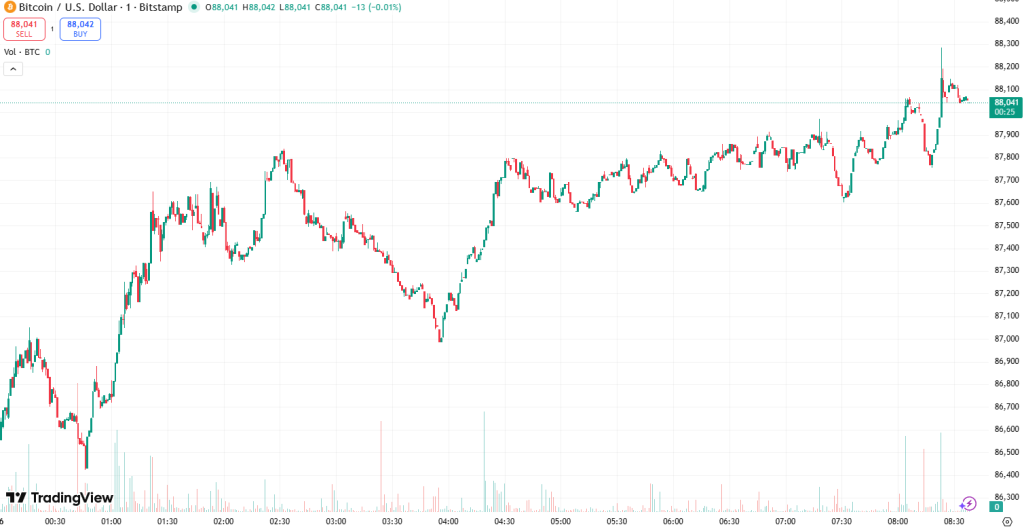
At the time of writing on Monday morning, BTC was changing hands at $87,860. While the coin begun the day at the intraday high of $88,800, it relatively swiftly dropped to the low of $86,126. It has recovered somewhat since.
Over the past seven days, BTC decreased by 5.1%, trading in the $86,319–$93,252 range. It’s now 30% away from its all-time high of $126,080.
Failing to hold the current level risks additional pullbacks towards the $85,000 level, followed by $84,300 and $83,800.
Bitcoin Price Chart. Source: TradingView
At the same time, Ethereum was trading at $2,892. Earlier in the day, it traded at the intraday high level of $2,941. However, it then plunged to the intraday low of $2,787. It managed to shift course and move higher following this drop.
In a week, ETH fell 9.2%, moving between $2,801 and $3,222. Moreover, it decreased 41% from its ATH of $4,946.
Currently, the price risks a fall toward $2,670 and $2,520 in the near term.
Ethereum (ETH)
24h7d30d1yAll time
Additionally, according to Bloomberg Intelligence Senior Commodity Strategist Mike McGlone, it is more likely that ETH will revisit the $2,000 level than push upwards and above $4,000.
ETH has been stuck in the $2,000–$4,000 range since 2023. However, it is leaning toward the lower end of this range.
Ether appears to be heading toward the lower end of its $2,000-$4,000 range since 2023. I see greater risks of it staying below $2,000 than above $4,000, especially when stock market volatility rebounds. pic.twitter.com/1IAMV10Jwe
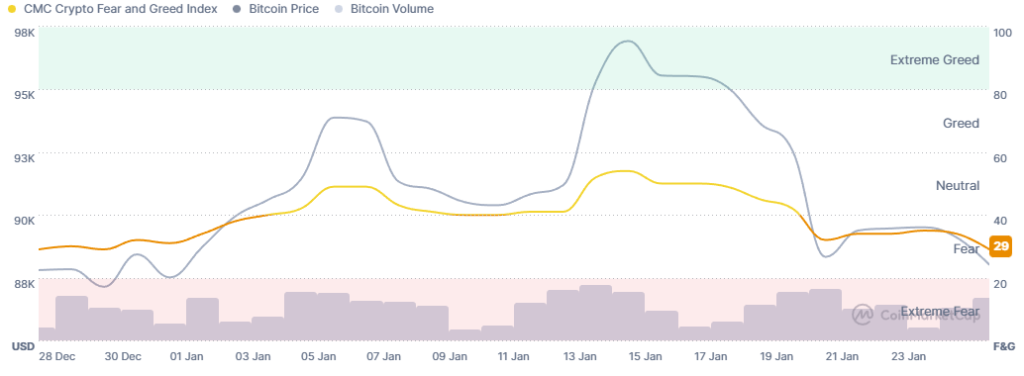
Meanwhile, the crypto market sentiment exited the neutral zone a week ago, and it has continued falling lower within the fear zone since.
The crypto fear and greed index decreased further over the weekend, currently standing at 29, compared to 34 seen over the weekend.
Unsurprisingly, given the market conditions, the sentiment reflects the overall worry and caution. It is now possible that the metric will drop further.
Source: CoinMarketCap
ETFs Continue The Red Streak
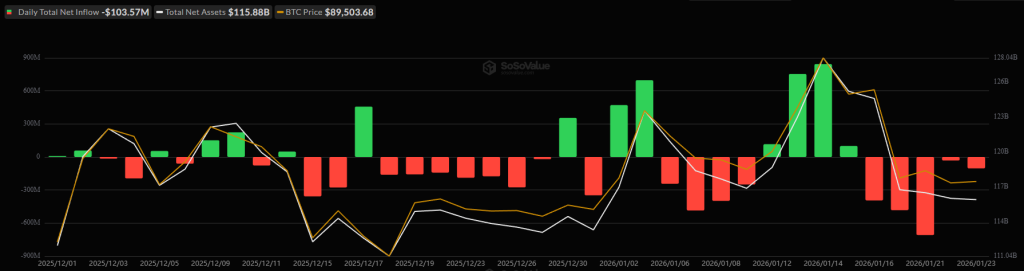
The US BTC spot exchange-traded funds (ETFs) posted another day of outflows on Friday, totalling $103.57 million. This is the fifth consecutive day of negative flows.
The total net inflow has pulled back yet again and now stands at $56.49 billion.
Of the twelve ETFs, two recorded outflows, and none saw inflows. BlackRock let go of $101.62 million, and Fidelity followed with $1.95 million in outflows.
Source: SoSoValue
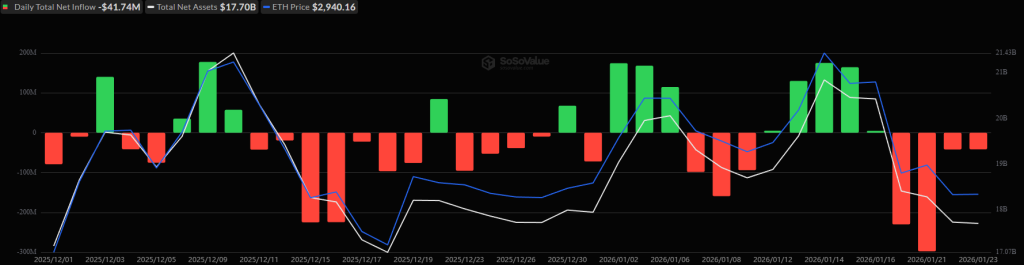
Moreover, the US ETH ETFs posted outflows as well on 22 January, with $41.74 million – a similar level as the day earlier. With this fourth consecutive red day, the total net inflow now stands at $12.3 billion.
Of the nine funds, two ETH ETFs posted outflows, and two saw inflows. BlackRock recorded $44.49 million in outflows, followed by Grayscale’s $10.8 million.
At the same time, Grayscale Mini Trust took in 9.16 million, followed by Fidelity’s $4.4 million in inflows.
The crypto market has seen yet another drop over the past day. Meanwhile, the US stock market closed the week with a mixed picture. That said, it also posted a second consecutive red week. By the closing time on Friday, 23 January, the S&P 500 was up 0.033%, the Nasdaq-100 increased by 0.34%, and the Dow Jones Industrial Average fell by 0.58%. Due to high volatility, investors are shifting their money into safe-haven assets, particularly gold.
Is this drop sustainable?
For now, the drops may continue in the near- to mid-term, pushed by macroeconomic developments. Occasional smaller and brief jumps are expected, intersecting the current trend.
A security breach tied to decentralized exchange aggregator Matcha Meta has resulted in the theft of roughly $16.8 million in crypto assets, adding to a growing list of smart-contract exploits that continue to test the safety assumptions of DeFi users.
The incident unfolded on Sunday and was traced not to Matcha’s core infrastructure, but to SwapNet, one of the liquidity providers integrated into the platform.
Matcha Meta disclosed the issue publicly in a post on X, saying users who had disabled its “One-Time Approval” feature and instead granted direct token allowances to individual aggregator contracts may have been exposed.
We are aware of an incident with SwapNet that users may have been exposed to on Matcha Meta for those who turned off One-Time Approvals
We are in contact with the SwapNet team and they have temporarily disabled their contracts
The team is actively investigating and will provide…
The protocol urged affected users to immediately revoke approvals connected to SwapNet’s router contract, warning that failure to do so could leave wallets vulnerable to further unauthorized transfers.
$17M Vanishes in Seconds: How Matcha Hackers Slipped Funds Onto Ethereum
Blockchain security firms quickly began tracking the exploit as funds moved on-chain.
PeckShield reported that approximately $16.8 million had been drained in total, with the attacker swapping around $10.5 million in USDC for roughly 3,655 ETH on the Base network before starting to bridge assets to Ethereum.
#PeckShieldAlert Matcha Meta has reported a security breach involving SwapNet. Users who opted out of "One-Time Approvals" are at risk.
CertiK independently flagged suspicious transactions, identifying one wallet that siphoned about $13.3 million in USDC on Base and converted the funds into wrapped Ether.
Both firms pointed to a vulnerability in the SwapNet contract that allowed arbitrary calls, enabling the attacker to transfer tokens that users had previously approved.
1/ The vulnerability seems to be in arbitrary call in @0xswapnet contract that let attacker to transfer funds approved to it. (https://t.co/B7ux5zzMLS)
The team have temporarily disabled their contracts is actively investigating.https://t.co/NBNvzxHCRw
Matcha later clarified that the incident was not connected to 0x’s AllowanceHolder or Settler contracts, which underpin its One-Time Approval system.
The team noted that users who interacted with Matcha using One-Time Approvals were not affected, as this design limits how much access a third-party contract can retain.
After reviewing with 0x's protocol team, we have confirmed that the nature of the incident was not associated with 0x's AllowanceHolder or Settler contracts.
Users who have interacted with Matcha Meta via One-Time Approval are thus safe.
The exposure, the team said, applied only to users who opted out of that system and granted ongoing allowances directly to aggregator contracts. In response, Matcha has removed the option for users to set such direct approvals going forward.
Old Token Approvals Emerge as a Persistent DeFi Weak Spot
The breach highlights a recurring tension in DeFi between flexibility and safety. Token approvals, while necessary for interacting with smart contracts, have long been a weak point, particularly when permissions remain active long after a transaction is completed.
In this case, previously granted allowances became the pathway for the exploit once the SwapNet contract was compromised.
The incident arrives amid continued concerns over smart-contract security across the crypto sector.
SlowMist’s year-end report shows that vulnerabilities in smart contracts accounted for just over 30% of crypto exploits in 2025, making them the leading cause of losses.
While overall crypto losses declined in December, falling about 60% month-on-month to roughly $76 million, security firms cautioned that the drop did not reflect a structural improvement.
Crypto-related losses from hacks and cybersecurity exploits fell sharply in December, dropping 60% month-on-month to about $76 million.#Crypto#Hackhttps://t.co/mke6K8sLVQ
PeckShield noted that a single address-poisoning scam accounted for $50 million of December’s losses, showing how concentrated and severe individual incidents can be even during quieter periods.
Jeel, a subsidiary of Riyad Bank, has signed a partnership with Ripple to explore advanced blockchain applications aimed at strengthening financial services across Saudi Arabia.
More big news from the Middle East! @Ripple is partnering with @Jeelmovement, the innovation arm of @RiyadBank, to advance Saudi Arabia’s financial future through blockchain innovation
The Kingdom’s visionary leadership has established Saudi Arabia as a forward-thinking… pic.twitter.com/KhQ7giluhE
In a press release shared with CryptoNews, the firm said the partnership will focus on developing secure and transparent digital infrastructure that can support the Middle East.
The agreement is part of growing institutional interest in blockchain payment systems and digital asset technologies as Saudi Arabia continues positioning itself as a regional leader.
Cross-Border Payments, Custody and Tokenization in Focus
The deal will also assess how blockchain technology can improve the speed, cost efficiency and transparency of cross-border payments, a key area of opportunity for the Gulf region’s remittance and trade corridors.
Beyond payments Jeel and Ripple will also explore use cases in digital asset custody and tokenization. These technologies are increasingly viewed as foundational components of next-generation financial markets, allowing the storage of digital assets and the representation of real-world assets on blockchain networks.
Regulatory Sandbox Testing to Support Responsible Innovation
Jeel and Ripple will also jointly develop proofs-of-concept within Jeel’s regulatory sandbox allowing Ripple’s blockchain solutions to be tested in a controlled and compliant environment.
The firm’s will examine how blockchain-enabled payment corridors can improve international remittance experiences while also evaluating custody frameworks.
“This partnership with Ripple reflects our strategy of using the Jeel Sandbox to responsibly explore next-generation financial infrastructure,” said George Harrak CEO of Jeel.
“By combining regulated experimentation with global blockchain expertise, we are building the foundations to evaluate scalable use cases that enhance cross-border payments and digital asset capabilities in line with the Kingdom’s long-term digital ambitions,” adds Harrak.
The sandbox approach is expected to help demonstrate scalable and interoperable digital financial infrastructure that could contribute to the modernization of Saudi Arabia’s banking ecosystem.
Value for Both Jeel and Ripple
For Jeel, the partnership strengthens its position as a pioneer in regulated blockchain experimentation, expanding its innovation capabilities beyond traditional fintech acceleration programs. The collaboration also supports Riyad Bank’s broader ambition to evaluate future-ready digital financial services.
Ripple, meanwhile, gains strategic access to Saudi Arabia’s fast-growing fintech landscape through Jeel’s institutional network and innovation platform.
“Saudi Arabia’s visionary leadership has established the Kingdom as a forward-thinking global hub for digital transformation,” said Reece Merrick, Managing Director for the Middle East and Africa at Ripple. “Ripple has signed an MOU with Jeel to explore integrating secure, efficient blockchain solutions into the national financial architecture.”
Japanese Bitcoin treasury firm Metaplanet reported a 104.6 billion yen ($680 million) impairment on its Bitcoin holdings, reflecting the impact of last year’s market downturn on the value of its digital asset portfolio.
Key Takeaways:
Metaplanet booked a $680 million Bitcoin impairment that will drive large reported losses but does not impact cash flow.
The write-down reflects aggressive Bitcoin accumulation, with holdings rising to over 35,000 BTC.
Bitcoin income strategies drove an upward revision to revenue forecasts.
In a press release issued Monday, the company said the impairment was recorded as a non-operating expense and does not affect cash flows or day-to-day operations.
Even so, the accounting charge is expected to weigh heavily on reported results for the fiscal year ended December 2025.
Metaplanet Forecasts Up to $640M Loss Following Bitcoin Write-Down
Including the Bitcoin-related write-down, Metaplanet now expects to post a consolidated ordinary loss of 98.56 billion yen ($640 million) and a consolidated net loss of 76.63 billion yen ($498 million).
The company also forecast a comprehensive loss attributable to shareholders of 54.02 billion yen ($351 million). Final earnings are scheduled for release on Feb. 16.
“While short-term accounting volatility is inherent to our business model, our medium-to-long-term BTC accumulation and capital strategy remain on track,” Metaplanet said, underscoring its commitment to maintaining Bitcoin as a core treasury asset.
The scale of the impairment reflects the company’s rapid accumulation of Bitcoin over the past year. By the end of 2025, Metaplanet held 35,102 BTC, up sharply from 1,762 BTC a year earlier.
According to a previous disclosure from Chief Executive Simon Gerovich, the firm spent $451.06 million during the fourth quarter of 2025 to expand its holdings, paying an average price of $105,412 per Bitcoin.
*Notice Regarding Revision of Full-Year Earnings Forecast for Fiscal Year Ending December 2025, Recording of Bitcoin Impairment Loss, and Announcement of Full-Year Earnings Forecast for Fiscal Year Ending December 2026* pic.twitter.com/VIKYRYb981
Bitcoin was trading near $87,500 at the end of December.
Despite the headline loss, Metaplanet raised its full-year 2025 guidance, pointing to stronger-than-expected performance in its Bitcoin income generation business.
That segment, which relies on derivatives and options strategies, has become a growing contributor to revenue.
The company now expects full-year revenue of 8.9 billion yen ($57.8 million), up 31% from its prior forecast, while operating income is projected at 6.3 billion yen ($41 million), representing a 33.8% increase.
Metaplanet cited more diversified funding, including the issuance of Series B perpetual convertible preferred stock and access to a $500 million credit facility, as key drivers of the upward revision.
Metaplanet Targets Strong 2026 Growth Despite Share Price Drop
Looking ahead, Metaplanet forecast revenue of 16 billion yen ($104 million) and operating income of 11.4 billion yen ($74 million) for fiscal 2026, with the Bitcoin income generation unit expected to account for the bulk of that growth.
Shares of Metaplanet listed in Tokyo fell 7.03% on Monday to 476 yen, while the company’s US-traded shares closed higher on Friday.
Last month, Metaplanet shareholders approved five proposals at an extraordinary meeting, clearing the way for two new classes of preferred shares designed to fund Bitcoin purchases while delivering fixed monthly and quarterly dividends to investors.
The Tokyo-listed company is now positioned to raise capital through dividend-paying securities rather than further diluting common stockholders.
Gold’s rally is showing little sign of slowing as global markets head into 2026 with investors increasingly looking for refuge in traditional safe-haven assets amid geopolitical uncertainty.
According to Gracy Chen the CEO of crypto exchange Bitget says gold continues to act as “the world’s ultimate insurance policy,” as demand remains firm while broader financial markets adjust to shifting macroeconomic risks.
“Technically, the market is still in expansion mode,” Chen said pointing to Fibonacci extension levels that suggest gold could climb toward the $5,325–$5,400 range in the months ahead.
She added that strong buying interest holding around $4,830 indicates the current move is part of a sustained trend rather than a topping pattern.
Gold Remains the Anchor in Uncertain Markets
Gold has benefited during periods of heightened global instability and Chen believes the current environment will continue to support its role as a defensive asset.
With many investors reassessing risk exposure across equities and emerging markets, the precious metal is once again being positioned as a portfolio hedge against inflation, geopolitical shocks and currency volatility.
The resilience of demand at key technical support levels suggests that gold’s rally is being driven by structural factors rather than short-term speculation.
Bitcoin Undervalued Despite Macro Headwinds
Chen also drew parallels between gold’s trajectory and Bitcoin’s outlook arguing that the world’s largest cryptocurrency remains undervalued relative to its long-term potential.
“Bitcoin is on a similar trajectory considering it is an undervalued asset currently,” she said.
While Bitcoin remains sensitive to macroeconomic events Chen highlights several forces that could support an increasingly bullish breakout over the next year.
ETF Inflows and US Regulation Fuel Bullish Setup
The key catalysts Chen points to continued institutional demand through spot Bitcoin ETFs which have provided steady inflows and reinforced Bitcoin’s growing role in mainstream portfolios.
She also notes that Bitcoin volatility has declined compared to major tech stocks showing maturation in the asset class.
In the policy arena ongoing progress on a US crypto market structure bill could also provide greater regulatory clarity, potentially unlocking further institutional participation.
Bitcoin Could Reach $180K by End of 2026?
Chen believes Bitcoin’s current market cycle may also be diverging from historical norms with structural adoption and regulatory momentum creating conditions for sustained upside.
“If these forces persist Bitcoin has a credible path toward $150,000–$180,000 by the end of 2026,” she said.
Traditional Safety Meets Digital Upside
Chen’s outlook shows a broader theme emerging across global markets: investors are increasingly balancing traditional stores of value like gold with digital alternatives such as Bitcoin.
As geopolitical risks continue to linger and financial systems evolve both assets may continue to benefit from their roles as hedges—one rooted in centuries of history – the other driven by institutional adoption and technological change.
Crypto markets entered the new week on the back foot as a wave of macro uncertainty sparked heavy liquidations across major digital assets.
Key Takeaways:
Macro uncertainty triggered over $550 million in crypto liquidations as bitcoin and ether came under pressure.
Tariff threats, US shutdown risks, and yen volatility are driving a broader risk-off shift toward safe-haven assets.
Derivatives markets have turned defensive, with rising volatility and increased demand for bitcoin downside protection.
After trading in a tight range over the weekend, prices slid during early Asian hours, triggering more than $550 million in leveraged long liquidations, according to market data cited by QCP Asia.
Bitcoin briefly dipped to the $86,000 level before stabilizing, while Ethereum fell toward the $2,785 area.
Tariff Threats, Shutdown Fears, and FX Uncertainty Weigh on Markets
Market participants point to a cluster of macro developments driving the move, according to QCP.
Chief among them were comments from President Donald Trump on the possibility of imposing 100% tariffs on Canadian imports, renewed concern over a looming partial shutdown of the US government, and ongoing uncertainty around potential US-Japan coordination to arrest further weakness in the yen.
Currency markets remain a key pressure point. A “rate check” on USD/JPY by the New York Fed late last week signaled growing sensitivity to yen depreciation, with the 160 level widely viewed as a threshold that could prompt intervention.
While the pair has since pulled back, it continues to trade near two-month highs around 154, prompting investors to unwind short-yen positions rather than risk sudden policy action.
QCP analysis notes that crypto assets traded in a narrow range over the weekend before coming under pressure in early Asian hours, triggering over $550 million in leveraged long liquidations. BTC briefly tested $86K before finding support, while Ethereum fell to the $2,785 area.…
US domestic politics are adding another layer of tension. Although broader risk sentiment found some relief after Canadian Prime Minister Mark Carney said Ottawa has no plans to pursue a free trade deal with China, fiscal negotiations in Washington remain unresolved.
House Republicans have advanced spending bills that include roughly $64.4 billion for border security and the Department of Homeland Security, while Senate Democrats have indicated they will block the measures.
With current government funding set to expire on January 30, failure to reach an agreement would result in a partial shutdown.
Markets appear to be taking that risk seriously. Polymarket odds currently imply roughly a 75% chance of a shutdown by January 31, a dynamic that echoes last autumn’s fiscal standoff, which coincided with a sharp drawdown in crypto prices.
Bitcoin Options Signal Rising Downside Protection as Volatility Climbs
Derivatives markets are already reflecting a more cautious stance. Put skews and implied volatility have risen across maturities, with traders rolling downside protection in bitcoin options from the 88,000 level toward 85,000, according to QCP.
Alongside ongoing geopolitical and fiscal headlines, markets face a busy week that includes major technology earnings and a Federal Reserve policy decision.
While the Fed is expected to hold rates steady, investors will be watching closely for any shift in Chair Jerome Powell’s guidance.
“With multiple macro risks unresolved, crypto prices are likely to chop around in the near term, pending greater clarity, particularly around the risk of a US government shutdown,” QCP said.
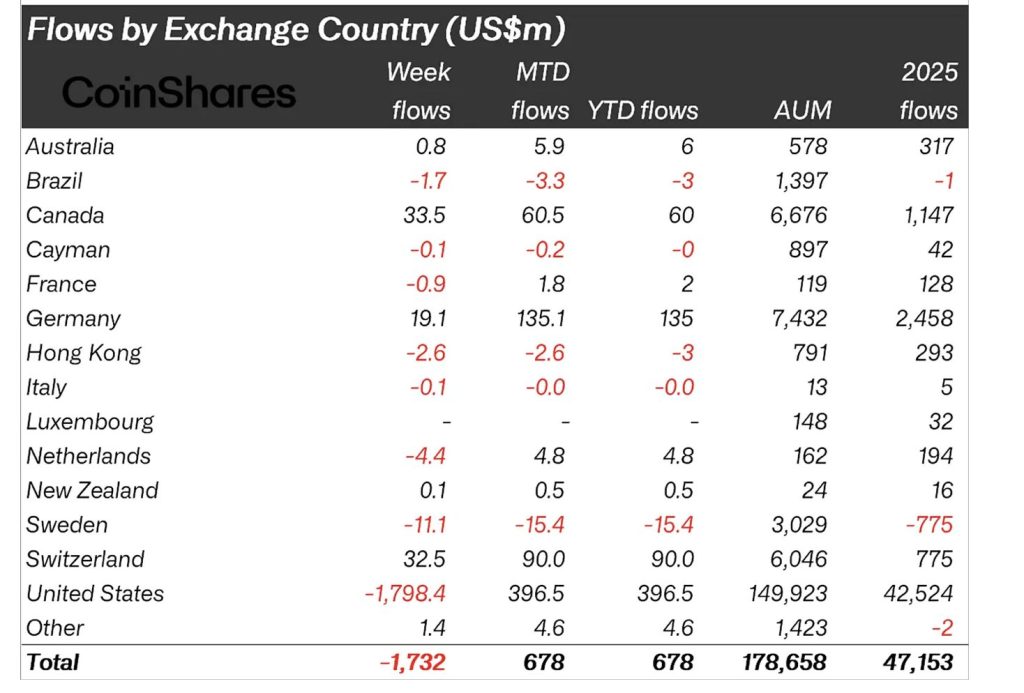
Digital asset investment products saw sharp outflows last week with investors pulling $1.73 billion, the largest weekly decline since mid-November 2025, according to CoinShares report authored by head of research James Butterfill.
CoinShares notes that the wave of redemptions reflects persistent bearish sentiment, driven by fading expectations for interest rate cuts, negative price momentum and growing disappointment that digital assets have not yet benefited from the broader “debasement trade.”
Outflows were heavily concentrated in the United States, which accounted for nearly $1.8 billion, while sentiment was more mixed across Europe and Canada.
Bitcoin and Ethereum Lead Weekly Redemptions
Bitcoin products recorded outflows of $1.09 billion, the largest since mid-November 2025, showing that investor confidence has yet to recover following the October 2025 price crash.
Ethereum followed with $630 million in outflows while XRP investment products saw an additional $18.2 million exit the market — highlighting broad-based weakness across major assets.
Butterfill addes that minor inflows into short-Bitcoin products — totalling just $0.5 million — suggest bearish positioning remains limited, but overall sentiment has not meaningfully improved.
Solana was also a notable exception attracting $17.1 million in inflows and bucking the wider negative trend. Smaller altcoins such as Binance-linked products ($4.6 million) and Chainlink ($3.8 million) also posted modest gains.
Regional Flows Diverge Outside the US
While the US dominated the outflows, CoinShares reports that other regions saw investors take advantage of price weakness to add to long positions.
Switzerland recorded inflows of $32.5 million, Canada added $33.5 million, and Germany saw $19.1 million in inflows. Sweden and the Netherlands both posted smaller outflows of $11.1 million and $4.4 million respectively.
The divergence suggests that while US-based investors are reducing exposure some international allocators continue to view pullbacks as entry opportunities.
Long-Term Adoption Model Points to $317K Bitcoin Floor by 2029
Despite near-term bearishness in fund flows CoinShares Research maintains a bullish long-term outlook based on its updated adoption-based valuation model.
The framework models Bitcoin as a global savings asset competing with deposits, gold, real estate, and bonds. Using conservative assumptions — including sub-1% disposable income allocation and a reduced flow-to-market-cap multiple of 3.5x — CoinShares projects Bitcoin ownership could rise from roughly 560 million owners in 2025 to 1.16 billion by 2029.
Under this scenario Bitcoin’s valuation floor could reach approximately $317,000 by 2029 implying a potential 3.2x return from mid-November 2025 levels, notes the firm.
CoinShares stressed that the model is designed to estimate price-supporting bottoms rather than speculative cycle peaks with ETF growth and emerging-market adoption continuing to accelerate global participation.

 Login
Login