Ethereum extended its pullback as sellers held control, with key support and resistance zones in focus. Notably, Ethereum (ETH) has traded lower over the past 24 hours, falling about 2.9% to roughly $2,858.
XRP is approaching a decisive technical point, and analysts say it is now at a level that could define its next major move. This comes as XRP trades at $1.87, up 0.4% on the day, as it attempts to recover after dipping to $1.89 yesterday.
The XRP open interest (OI) has now collapsed to a 14-month low, hitting levels XRP last witnessed when it traded below $1. This comes as the XRP price continues to slide to new lows, having recently collapsed to a new yearly floor of $1.8 amid a broader market collapse that has seen Bitcoin (BTC) drop to $86,000.
The UK’s Financial Conduct Authority (FCA) has moved into the final stage of consultations on a sweeping set of proposed crypto regulations, as it advances the government’s broader plan to bring digital assets firmly within the country’s regulatory perimeter.
Key Takeaways:
The FCA has entered the final consultation phase on 10 proposed rules to regulate the UK crypto market.
The regulator aims to boost trust and transparency while acknowledging that crypto investment risks will remain.
A new licensing regime for crypto firms is planned, with applications expected to open in September 2026.
In a recent statement, the FCA said it is seeking feedback on 10 proposed rules, describing the move as the “final step” in its consultation process.
The proposals are designed to shape how crypto firms operate in the UK, while aligning the sector more closely with standards applied across traditional financial markets.
FCA Says New Crypto Rules Aim to Build Trust Without Eliminating Risk
“These proposals continue our progress towards an open, sustainable and competitive crypto market that people can trust,” the regulator said.
At the same time, the FCA stressed that crypto investing will always carry risk, and regulation is intended to improve transparency and consumer understanding rather than eliminate volatility altogether.
The consultation package spans a wide range of market activity.
It includes proposed rules on business conduct standards, restrictions on using credit to purchase crypto, regulatory reporting requirements, asset safeguarding, and how retail collateral is treated when borrowing digital assets.
Stakeholders have until March 12 to submit feedback.
BREAKING: The UK Just Moved to Fully Integrate Crypto Firms Into the FCA Rulebook pic.twitter.com/mGBJ61hLLB
The proposals were first outlined in December, when the FCA signaled its intention to regulate crypto in a manner broadly consistent with conventional financial services.
Since then, the regulator says it has made “significant progress” in refining the framework as part of the government’s crypto roadmap.
Earlier this month, the FCA also published an indicative timeline for a new licensing regime covering crypto asset service providers.
Under the current plan, the application window for firms seeking authorization is expected to open in September 2026, though the regulator noted that details will be confirmed at a later date.
Once in force, the licensing regime would impose tighter oversight on crypto businesses operating in the UK, requiring FCA approval and ongoing compliance with regulatory standards.
UK Weighs Ban on Crypto Donations
As reported, the UK government is considering a ban on cryptocurrency donations to political parties, a move that could directly affect Reform UK, which recently became the first party in the country to accept digital assets.
The proposal is under review as part of the upcoming Elections Bill, according to people familiar with internal discussions, though officials have yet to formally confirm the plan.
The debate follows Reform UK’s push to present itself as Britain’s most crypto-friendly party under the leadership of Nigel Farage.
Furthermore, the UK government has moved a step closer to overhauling how decentralized finance activity is taxed, backing a new framework that would spare users from triggering capital gains each time they deposit tokens into lending protocols or liquidity pools.
Japan’s Financial Services Agency is considering adding cryptocurrencies to the list of assets eligible for spot exchange-traded fund (ETF) products. Nikkei reported Monday that Japan would likely approve its first set of spot crypto ETFs as early as 2028. If approved, this would end the agency’s ban on spot crypto ETFs.
This further extends the expected timeframe for a potential crypto ETF launch in Japan. A KPMG Japan executive claimed in August 2025 that a Bitcoin ETF launch would likely be delayed until 2027.
Besides, Hajime Ikeda, the Executive Officer of Nomura Holdings, pointed to a survey at the time, noting that over 60% of Japanese investors express a desire to invest in cryptoassets “in some form or other.”
That said, the recent move by the Japanese regulator to launch spot crypto ETFs would address growing investor demand for access to crypto.
Nomura, SBI Holdings Poised to Create Japan’s First Crypto ETFs
Per the Nikkei report, Japan’s largest asset manager Nomura Holdings and financial services giant SBI Holdings have been developing related ETF products that await approval for listing on the Tokyo Stock Exchange.
If approved, the crypto ETFs would allow investors to trade digital assets similar to stocks or gold ETFs.
Last year, SBI Holdings confirmed plans to launch its XRP ETFs upon regulatory greenlight. In a presentation published in August, SBI revealed plans to launch two ETFs. The first product is a Gold and Crypto Assets ETF that will invest 49% of its assets in Bitcoin (BTC), while the second will be a Bitcoin and XRP ETF that will offer exposure to these two tokens.
The U.S. and Hong Kong already approved their first spot crypto ETFs in 2024.
Japan Finance Minister Supports Crypto Trading With Stock Exchanges
Japan’s Finance Minister Satsuki Katayama recently touted that 2026 would be the “digital year,” expressing support to crypto trading at stock exchanges.
Ethereum is more likely to revisit the $2,000 level than stage a decisive move back above $4,000, according to Bloomberg Intelligence Senior Commodity Strategist Mike McGlone.
Key Takeaways:
Ethereum faces higher downside risk toward $2,000 than a breakout above $4,000, according to Mike McGlone.
Long-term analysts argue ETH is in an accumulation phase despite weak price momentum.
Ethereum’s roadmap points to renewed focus on self-sovereignty and user experience beyond 2025.
In a recent post on X, McGlone pointed to persistent range-bound trading and rising macro risks weighing on the asset.
He said Ether has remained trapped in a $2,000–$4,000 range since 2023, but momentum appears to be shifting toward the lower end.
Rising Market Volatility Could Keep Ethereum Below $2,000
McGlone argued that the risks of Ethereum staying below $2,000 are greater than the chances of a sustained breakout above $4,000, especially if volatility in global equity markets rebounds.
His accompanying chart highlights repeated failures near the upper boundary of the range, alongside multiple tests of support closer to $2,000.
McGlone’s view contrasts with a more optimistic narrative circulating among crypto-focused analysts.
BullifyX, a widely followed market commentator, recently compared Ethereum’s long-term price structure to that of gold.
According to BullifyX, Ethereum is undergoing an extended accumulation phase characterized by gradual higher lows and compressed price action, a pattern that historically preceded strong rallies in traditional safe-haven assets.
Every time I look at the #Ethereum chart, it mirrors #GOLD a little too perfectly.
Long accumulation. Relentless structure. Explosive moves after patience is rewarded.
That’s not weakness that’s strength building quietly.
The analyst described Ethereum’s current behavior as a period of quiet positioning rather than fading demand, suggesting that prolonged consolidation could ultimately lay the groundwork for a sharp upside move once conditions shift.
In a recent post, he said the community is entering a phase focused on restoring personal autonomy and improving user experience, arguing that earlier compromises made in pursuit of adoption no longer need to define the network’s future.
“2026 is the year that we take back lost ground in terms of self-sovereignty and trustlessness,” Buterin said in an X post.
Together, record activity, falling fees, and rising participation suggest Ethereum is entering a new phase, one where scale no longer comes at the expense of accessibility.
Ethereum Foundation Makes Quantum-Resistant Security a Strategic Priority
As reported, the Ethereum Foundation has elevated post-quantum security to a core strategic focus, forming a dedicated Post Quantum team and committing $2 million to the effort.
Announced by Ethereum researcher Justin Drake, the initiative will be led by Thomas Coratger alongside Emile, a contributor to leanVM.
Drake said the foundation has been working on quantum-resilience research quietly for years, dating back to early discussions in 2019, before formally making it a top-level priority.
The foundation’s plan spans research, development, and ecosystem coordination.
This includes new developer calls focused on user-facing security, two $1 million cryptography prize programs, active multi-client post-quantum testing networks, and a series of global workshops aimed at accelerating collaboration and readiness across the Ethereum ecosystem.
Solana price has continued to fall even as meme-driven activity across the network has sharply picked up. SOL was trading near $122 at press time, down 3.3% over the past 24 hours. Over the week, the price has ranged between…
On-chain investigator ZachXBT says a $40 million-plus theft from US government crypto seizure wallets may trace back to John Daghita, an alleged threat actor who goes by “Lick,” and a contractor relationship tied to Daghita’s family.
The $40 Million+ Govt Crypto Wallet Robbery
In a Jan. 25 post, ZachXBT pointed to Command Services & Support (CMDSS), describing it as a firm with “an active IT government contract in Virginia,” and alleging it was “awarded a contract to assist the USMS in managing/disposing of seized/forfeited crypto assets.” ZachXBT added: “It still remains unclear at this point how John obtained access from his dad.”
In case you are curious how John Daghita (Lick) was able to steal $40M+ from US government seizure addresses.
John’s dad owns CMDSS, which currently has an active IT government contract in Virginia.
The allegation lands against a backdrop of earlier tracing work published Jan. 23, where ZachXBT linked wallet activity and recorded chats to the same persona. “Meet the threat actor John (Lick), who was caught flexing $23M in a wallet address directly tied to $90M+ in suspected thefts from the US Government in 2024 and multiple other unidentified victims from Nov 2025 to Dec 2025,” ZachXBT wrote.
ZachXBT’s thread centers on a dispute in a Telegram group chat between “John” and another threat actor, Dritan Kapplani Jr., in what the community calls “band for band (b4b)”, an on-the-spot contest to prove who controls more funds. ZachXBT said the interaction was “fully recorded,” and claims the footage includes screen-shared wallet balances and contemporaneous transfers that help establish control.
According to the thread, the recording shows John screen-sharing an Exodus wallet displaying a Tron address holding $2.3 million. In a second segment, ZachXBT said “another $6.7M worth of ETH” moved into an Ethereum address while the argument continued.
3/ In part 1 of the recording Dritan mocks John however John screenshares Exodus Wallet which shows the Tron address below with $2.3M:
TMrWCLMS3ibDbKLcnNYhLggohRuLUSoHJg pic.twitter.com/jvcjIVEpaE
ZachXBT framed the key evidentiary point as ownership continuity across addresses: “The recording captures that John clearly controls both addresses. Additional addresses can likely be found in the recordings. I then began tracing backwards to verify the source of funds.”
That tracing, ZachXBT said, connects the cluster to a March 2024 transfer of $24.9 million from a US government address tied to the Bitfinex crypto hack seizure. He also claimed $18.5 million “currently sits” at a cited address.
Beyond that 2024 linkage, ZachXBT asserted the primary address he tracked was tied to “$63M+ inflows from suspected victims and government seizure addresses in Q4 2025,” listing multiple transactions and chains, and separately flagged an additional 4.17K ETH ($12.4 million) flow from MEXC into the same cluster.
The Jan. 25 post attempts to explain a potential access path: if CMDSS was involved in US Marshals Service crypto asset management, the question becomes whether contractor-side systems, credentials, or processes provided an opening, intentionally or otherwise. ZachXBT stressed that the exact mechanism remains unknown.
Shortly after the post, ZachXBT said CMDSS’s X account, website, and LinkedIn “were all just deactivated,” and claimed Daghita “began trolling again on Telegram.”
On X, the claims drew sharp reactions from prominent Bitcoin commentators. Nakamoto Inc. CEO David Bailey wrote: “The son of the CEO of the company hired by the US Marshalls to safeguard the nation’s Bitcoin, stole $40m from it and now appears to be running. Treasury must secure the private keys from the Justice Department ASAP before more is stolen.”
Prominent Bitcoin advocate and co-founder of the Satoshi Nakamoto Institute Pierre Rochard framed the situation in national-security terms, posting, “This is a national security crisis,” and urging Congress to pass the BITCOIN Act.
Coinbase is weighing a potential equity investment in South Korea’s Coinone, as the country’s third-largest crypto exchange explores options that include selling part of its controlling shareholder’s stake, according to local media and industry sources.
A local outlet reported Sunday that Coinone has put itself on the market and is discussing scenarios tied to Chairman Cha Myung-hoon’s holdings, which total 53.44% through his personal stake and his holding company, The One Group.
Speculation around a sale picked up after Cha returned to frontline management just four months after stepping down as chief executive, a move that some observers read as preparation for a stake transaction.
Tech Upgrades Accelerate Even As Losses Weigh On Valuation
Coinone, meanwhile, said Cha stepped back in to sharpen its technological edge as it nears a double-digit market share, building out areas such as artificial intelligence.
Attention has also turned to Com2uS, the gaming group that accumulated a 38.42% stake in Coinone between 2021 and 2022.
Seoul Economic Daily reports that South Korea's third-largest crypto exchange Coinone is up for sale. Major shareholder and chairman Cha Myung-hoon is considering selling part of his stake and exploring other options. Coinbase will visit Korea this week to discuss equity…
Coinone’s continued losses have weighed on its book value, which Seoul Economic Daily put at 75.2B won, or about $52M, at the end of the third quarter, below Com2uS’s reported acquisition cost.
Against that backdrop, industry sources say Coinbase plans to visit South Korea this week and meet major local players, including Coinone, as it looks for partners to build products that fit Korean rules.
Korea’s Crypto Exchange Sector Sees Surge In Deal Activity
The talks come as dealmaking accelerates across South Korea’s crypto exchange sector, with traditional finance and big tech circling licensed platforms and won trading rails.
Coinone has tried to differentiate on product as well as ownership, launching what it called the country’s first flexible Bitcoin staking service in Aug. 2025, letting users earn rewards without locking up their holdings.
Coinone says discussions remain open-ended, and it has not settled on a structure, a timeline or a buyer. Still, the prospect of a Coinbase tie-up lands at a moment when Korea’s exchange map is already shifting, and when global players are watching for a way in.
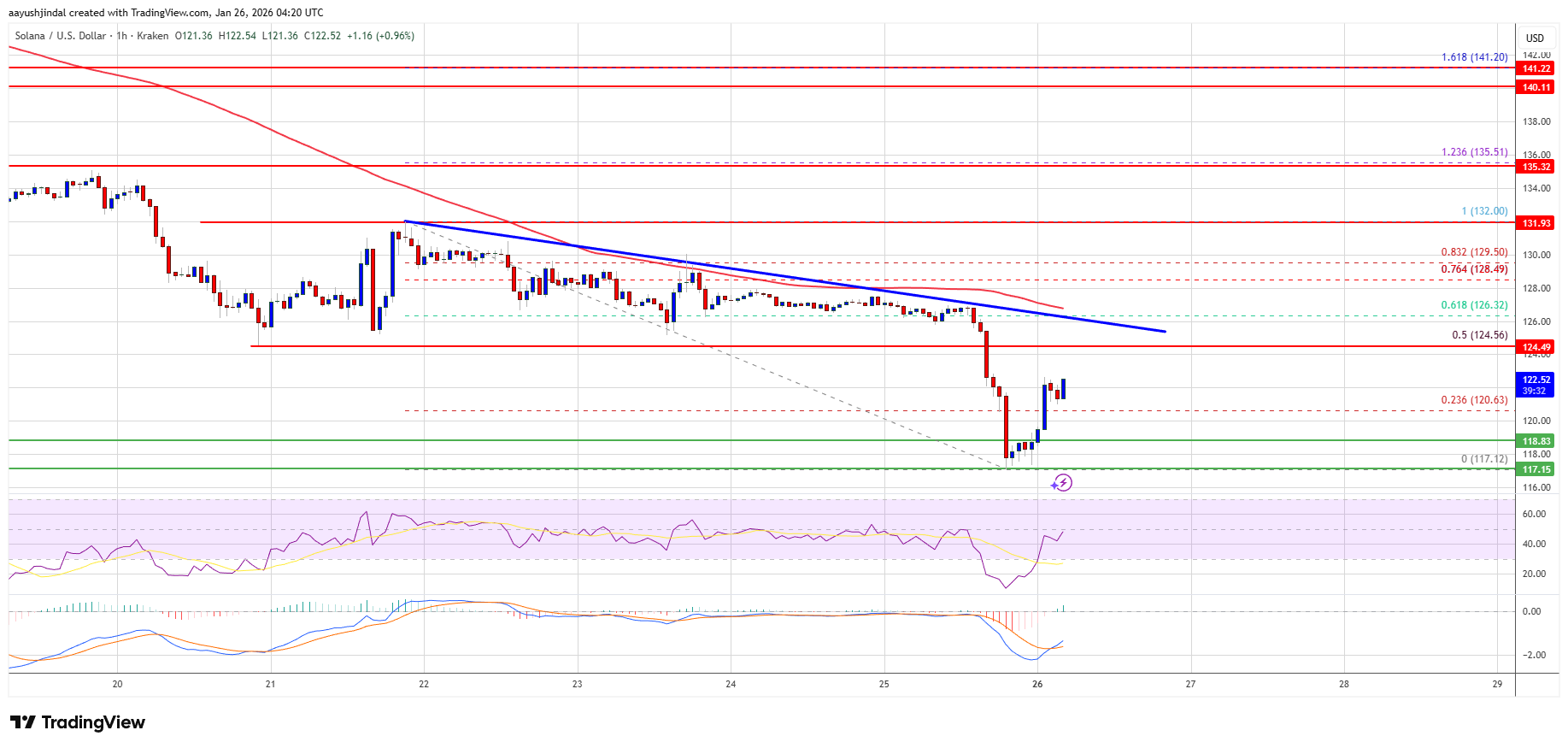
Solana failed to settle above $132 and extended losses. SOL price is now consolidating losses below $130 and might struggle to start a recovery wave.
SOL price started a fresh decline below $132 and $130 against the US Dollar.
The price is now trading below $130 and the 100-hourly simple moving average.
There is a key bearish trend line forming with resistance at $126 on the hourly chart of the SOL/USD pair (data source from Kraken).
The price could start a recovery wave if the bulls defend $118 or $115.
Solana Price Dips Further
Solana price failed to remain stable above $132 and started a fresh decline, like Bitcoin and Ethereum. SOL declined below the $130 and $126 support levels.
The price gained bearish momentum below $122. A low was formed at $117, and the price is now consolidating losses. The price recovered a few points and climbed above the 23.6% Fib retracement level of the downward move from the $132 swing high to the $117 low.
Solana is now trading below $130 and the 100-hourly simple moving average. On the upside, immediate resistance is near the $125 level or the 50% Fib retracement level of the downward move from the $132 swing high to the $117 low.
The next major resistance is near the $126 level. There is also a key bearish trend line forming with resistance at $126 on the hourly chart of the SOL/USD pair. The main resistance could be $132. A successful close above the $132 resistance zone could set the pace for another steady increase. The next key resistance is $140. Any more gains might send the price toward the $144 level.
Another Drop In SOL?
If SOL fails to rise above the $126 resistance, it could continue to move down. Initial support on the downside is near the $119 zone. The first major support is near the $117 level.
A break below the $117 level might send the price toward the $115 support zone. If there is a close below the $115 support, the price could decline toward the $102 support in the near term.
Technical Indicators
Hourly MACD – The MACD for SOL/USD is losing pace in the bearish zone.
Hourly Hours RSI (Relative Strength Index) – The RSI for SOL/USD is below the 50 level.
The Financial Conduct Authority has begun seeking final feedback on a set of proposals aiming to apply traditional finance standards to the UK crypto sector.
The cryptocurrency market faced a sharp correction in the early hours of January 26, with BTC erasing its entire monthly progress. After peaking at $97,000 on January 14, Bitcoin slid approximately 10.9% to briefly dip below the $87,000 mark. This volatility has pushed the January return to -0.5%, reflecting a broader “risk-off” sentiment across the digital asset space. The pullback is being attributed largely to rising uncertainty around U.S. government shutdown, alongside broader risk-off sentiment across global markets.The GameFi sector bore the brunt of the sell-off, dropping nearly 5%, led by double-digit losses in Axie Infinity (AXS). While Ethereum fell below $2,900, some assets showed resilience; notably, River (RIVER) surged 30% and Beam (BEAM) rose 19%, suggesting that despite the macro-level decline, specific project catalysts continue to drive isolated pockets of growth.
But what else is happening in crypto news today? Follow our up-to-date live coverage below.
Bitcoin dipped under $88,000 as Asia opened to mixed trade, with investors leaning into safety and pushing gold to a record above $5,000 an ounce.
In China, stocks moved in different directions. The Shanghai index rose 0.12%, and China A50 gained 0.49%, while the SZSE Component slid 0.74% and DJ Shanghai eased 0.09%. Hong Kong’s Hang Seng edged up 0.04%.
Gold extended a rally that has reshaped the commodity market. Spot gold rose 1.79% to $5,071.96 an ounce by 0159 GMT after touching $5,085.50 earlier, and US gold futures for February delivery gained 1.79% to $5,068.70.
Total crypto market cap: $3.04 trillion, down 1.4%
Greenland Tariff Threat Rolled Back As Trade Risks Linger
Investors have treated the metal as a refuge through shifting policy expectations and geopolitical stress. Prices surged 64% in 2025, and they have gained more than 17% this year, supported by safe-haven demand, expectations of easier US monetary policy, central bank buying and ETF inflows.
President Donald Trump’s trade threats stayed in focus. He abruptly stepped back on Wednesday from threats to impose tariffs on European allies as leverage to seize Greenland, and he said over the weekend he would impose a 100% tariff on Canada if it followed through on a trade deal with China.
He has also threatened to hit French wines and champagnes with 200% tariffs in an apparent effort to pressure French President Emmanuel Macron into joining his “Board of Peace” initiative.
Some observers fear the board could undermine the United Nations’ role as the main global platform for conflict resolution, though Trump has said it will work with the UN.
US Futures Ease After Volatile Week Marked By Trade Risks
Currency markets also turned volatile. The yen jumped to more than a two-month high on speculation that coordinated intervention by US and Japanese authorities could be imminent, and Tokyo’s top currency diplomat left that prospect open while keeping markets guessing.
The yen rose as much as 1.2% to 153.89 per dollar, its strongest since November. The euro hit a four-month high of $1.1898 and was last up 0.4% at $1.18665, as traders trimmed dollar positions ahead of the Federal Reserve meeting and watched for a possible announcement by the Trump administration of a new Fed chairman.
Wall Street faces another busy week after a rocky stretch. US stock index futures fell modestly on Sunday evening as markets braced for the Fed decision on Wednesday and a wave of corporate earnings, after last week’s pullback tied to geopolitical strains and trade uncertainty.
Japan is edging closer to approving spot cryptocurrency exchange-traded funds, with regulators signaling that the first products could be cleared for listing as early as 2028. A report published by Nikkei Asia on Jan. 26 said the Financial Services Agency…
Bitcoin price began the week under pressure after CME futures reopened well below Friday’s close, drawing attention to a large pricing gap. CME Bitcoin futures opened near $86,560 after closing the previous session around $89,500, leaving a downside gap of…
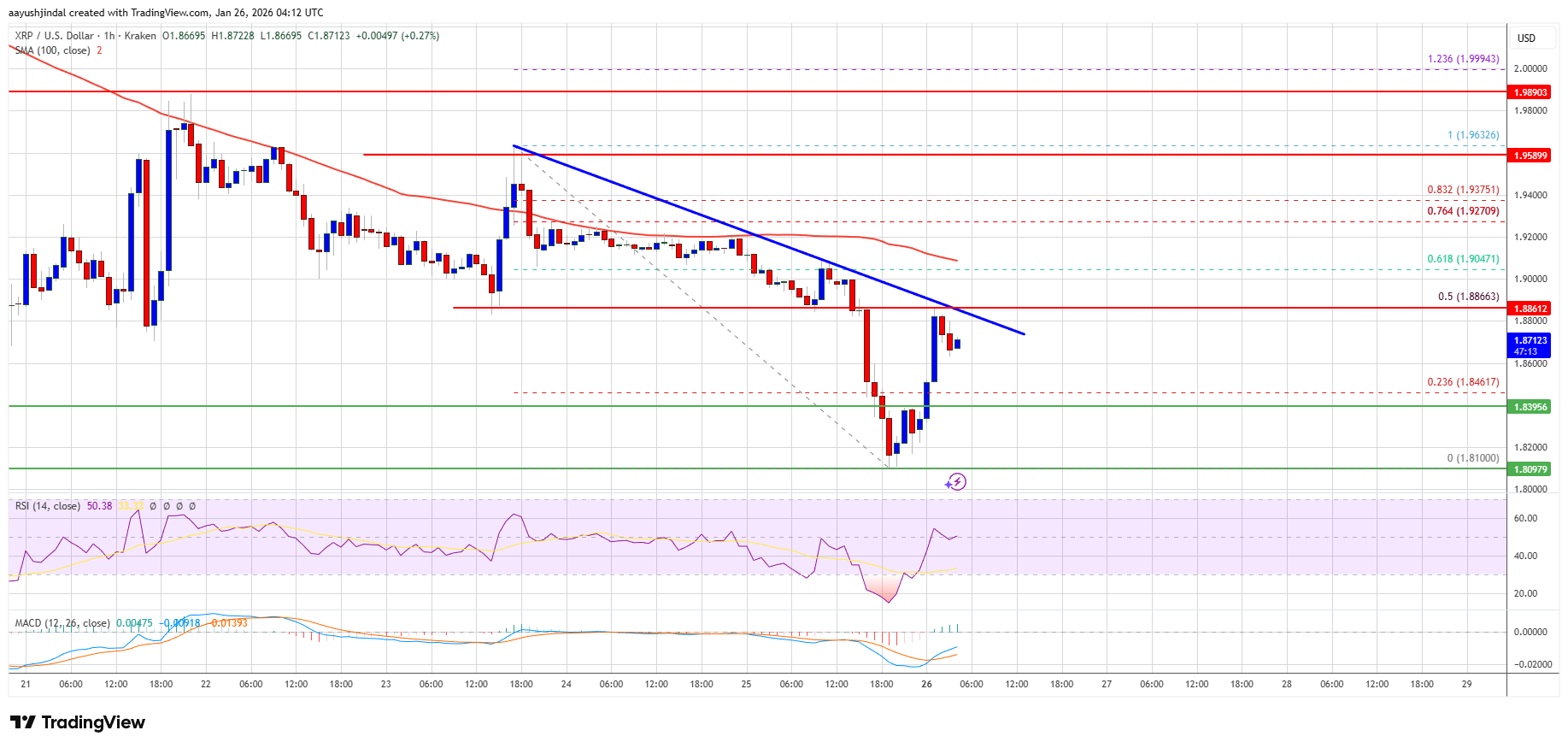
XRP price extended losses and traded below $1.880. The price is now consolidating and might decline further if it remains below $1.920.
XRP price started a fresh decline below the $1.90 zone.
The price is now trading below $1.90 and the 100-hourly Simple Moving Average.
There is a key bearish trend line forming with resistance at $1.885 on the hourly chart of the XRP/USD pair (data source from Kraken).
The pair could continue to move down if it stays below $1.90.
XRP Price Dips Further
XRP price failed to stay above $1.950 and started a fresh decline, like Bitcoin and Ethereum. The price declined below $1.920 and $1.90 to enter a short-term bearish zone.
The price even spiked below $1.850. A low was formed at $1.810, and the price is now consolidating losses. There was a recovery wave above $1.850. The price cleared the 23.6% Fib retracement level of the downward move from the $1.963 swing high to the $1.810 low, but the bears remained active.
The price is now trading below $1.90 and the 100-hourly Simple Moving Average. If there is a fresh upward move, the price might face resistance near the $1.8850 level and the 50% Fib retracement level of the downward move from the $1.963 swing high to the $1.810 low. There is also a key bearish trend line forming with resistance at $1.885 on the hourly chart of the XRP/USD pair.
The first major resistance is near the $1.90 level. A close above $1.90 could send the price to $1.950. The next hurdle sits at $2.00. A clear move above the $2.00 resistance might send the price toward the $2.050 resistance. Any more gains might send the price toward the $2.120 resistance. The next major hurdle for the bulls might be near $2.20.
Downside Break?
If XRP fails to clear the $1.90 resistance zone, it could start a fresh decline. Initial support on the downside is near the $1.840 level. The next major support is near the $1.820 level.
If there is a downside break and a close below the $1.820 level, the price might continue to decline toward $1.780. The next major support sits near the $1.750 zone, below which the price could continue lower toward $1.70.
Technical Indicators
Hourly MACD – The MACD for XRP/USD is now gaining pace in the bearish zone.
Hourly RSI (Relative Strength Index) – The RSI for XRP/USD is now near the 50 level.

 Login
Login