Editor’s note: We published this article nearly three months ago, on 10 September 2025. The recent revelations about the killing, on 2 September, of two survivors who were clinging to a sinking shipwreck after their boat had been destroyed in the initial attack by U.S. forces, highlight the deeper problems with the Trump administration’s approach of using military force to deal with what is essentially a law-enforcement issue.
A largely overlooked directive issued by the Trump administration marks a major shift in U.S. counterterrorism policy, one that threatens bedrock free speech rights enshrined in the Bill of Rights.
President Donald Trump continues to use his pardon powers in remarkable ways. Now he has pardoned former Honduran President Juan Orlando Hernández, who was sentenced to 45 years in prison for drug trafficking.
Cato asked me to write a statement on this development and here is what I wrote:
As the sector continues to gain global momentum, Taiwanese authorities have announced that a locally issued stablecoin could be launched next year, pending the imminent approval of the country’s regulatory crypto framework and related legislation.
First Local Stablecoin To Debut Next Year
On Wednesday, Taiwan’s Financial Supervisory Commission (FSC) Chairman Peng Jin-long revealed that the island’s first regulated stablecoin could debut in the latter half of 2026, local news outlet Focus Taiwan reported.
The FSC chair affirmed that the Virtual Assets Service Act (VASA), which incorporates stablecoin regulation, could be passed during its third hearing in the next legislative session, scheduled for this week, after clearing initial reviews with a “high level of consensus.”
After the framework’s approval, stablecoin-centered regulations would be developed within six months, setting the launch of a locally issued token pegged to the New Taiwan Dollar (NTD) or the US Dollar (USD) to the second half of the year.
The VASA supports the efforts by Taiwanese authorities to establish a comprehensive crypto framework that promotes industry growth and safeguards investors. Last year, the FSC announced an overhaul of the Anti-Money Laundering (AML) framework to include crypto businesses, introducing stricter AML guidelines for Virtual Asset Service Providers (VASPs) and requiring all crypto firms to complete the AML registration by September 2025.
In January, Peng stated that investors could have a “convenient” entrance to crypto assets in the future through stablecoins, which could serve as a bridge between the country’s legal tender and virtual currency.
In March, the FSC published the finalized draft of its landmark crypto legislation, which the VASA’s draft proposed authorizing banks to issue stablecoins pegged to the New Taiwan Dollar or the US Dollar.
Meanwhile, Premier Cho Jung-tai and Central Bank Governor Yang Chin-long recently expressed support for a formal Bitcoin (BTC) policy, pledging to study the flagship cryptocurrency as a strategic reserve asset, accelerate pro-BTC rulemaking, and pilot treasury exposure through government-seized assets.
Taiwan Sets Financial Institutions’ Role
At the legislative hearing, the FSC’s chair highlighted that the bill’s draft draws from the European Union (EU)’s Markets in Crypto-Assets Regulation (MiCA). He explained that the Virtual Assets Service Act doesn’t require stablecoins to be issued exclusively by financial institutions, which has been a divisive topic in other jurisdictions.
As reported by Bitcoinist, South Korea’s long-awaited stablecoin legislation could be delayed until next year as the Korean Financial Services Commission clashes with the Bank of Korea (BOK) over the role of banks in the sector.
A local news media outlet recently noted that the BOK and regulators agree that financial institutions must be involved in the issuance of won-pegged tokens, but differ on the extent of their role.
The central bank is pushing for a consortium of banks owning at least 51% of any stablecoin issuer seeking regulatory approval. Meanwhile, regulators are concerned that giving a majority stake to banks could reduce participation from tech companies and limit the market’s innovation. Earlier this week, authorities set December 10 as the deadline for the government to deliver a draft bill.
Unlike South Korea’s financial authorities, Focus Taiwan reported that the regulator and the central bank have agreed that only financial institutions will be allowed to issue stablecoins in the initial stage to reduce risk management, suggesting that companies could join at a later stage of the project.
President Donald Trump premised his mass deportation agenda on the idea that he will be “returning millions and millions of criminal aliens.” Department of Homeland Security (DHS) Secretary Kristi Noem has repeatedly claimed that they are arresting the “worst of the worst.” New nonpublic data from Immigration and Customs Enforcement (ICE) lea
Since January 2025, the Justice Department has been aggressively holding federal contractors accountable for violating cybersecurity violations under the False Claims Act.
Over the last 11 months, the Trump administration has announced six settlements out of the 14 since the initiative began in 2021.
Sara McLean, a former assistant director of the DOJ Commercial Litigation Branch’s Fraud Section and now a partner with Akin, said the Trump administration has made a much more significant push to hold companies, especially those that work for the Defense Department, accountable for meeting the cyber provisions of their contracts.
Sara McLean is a former assistant director of the DOJ Commercial Litigation Branch’s Fraud Section and now is a partner with Akin,
“I think there are going to be a lot more of these announcements. There’s been a huge uptick just since the beginning of the administration. That is just absolutely going to continue,” McLean said during Federal News Network’s Risk & Compliance Exchange 2025.
“The cases take a long time. The investigations are complex. They take time to develop. So I think there are going to be many, many, many more announcements, and there’s a lot of support for them. Cyber enforcement is now embedded in what the Justice Department does every day. It’s described as the bread and butter by leadership.”
A range of high-profile cases
A few of the high-profile cases this year so far include a $875,000 settlement with Georgia Tech Research Corp. in September and a $1.75 million settlement in August with Aero Turbine Inc. (ATI), an aerospace maintenance provider, and Gallant Capital Partners, a private equity firm that owned a controlling stake in ATI during the time period covered by the settlement.
McLean, who wouldn’t comment on any one specific case, said in most instances, False Claims Act allegations focus on reckless disregard for the rules, not simple mistakes.
“We’ve seen in some of the more recent announcements new types of fact patterns. What happens is when announcements are made that DOJ has pursued a matter and has resolved a matter, that often leads to the qui tam relators and their attorneys finding more matters like that and filing them,” said McLean who left federal service in October after almost 27 years. “It’ll be interesting to see if these newer fact patterns yield more cases that are similar.”
Recent cases that involve the security of medical devices or the qualifications of cyber workers performing on government contracts are two newer fact patterns that have emerged over the last year or so.
Launched in 2021, the Justice’s Civil-Cyber Fraud initiative uses the False Claims Act to ensure contractors and grantees meet the government’s cybersecurity requirements.
President Joe Biden signed an executive order in May 2021 that directed all agencies to improve “efforts to identify, deter, protect against, detect and respond to” malicious cyberthreats.
130 DOJ lawyers focused on cyber
Justice conducted a 360 review of cyber matters and related efforts, and one of the areas that emerged was to use the False Claims Act to hold contractors and grantees accountable and drive a change in behavior.
“The motivation was largely to improve cybersecurity and also to protect sensitive information, personal information, national security information, and to ensure a level playing field, so that you didn’t have some folks who were meeting the requirements and others who were not,” McLean said.
“It was to ensure that incidents were being reported to the extent the False Claims Act could be used around that particular issue. Because the thought was that would enable the government to respond to cybersecurity problems and that still is really the impetus now behind the enforcement.”
McLean said the Civil-Cyber Fraud initiative is now embedded as part of the DOJ’s broader False Claims Act practice. It has about 130 lawyers, who work with U.S. attorney’s offices as well as agency inspectors general offices.
Typically, an IG begins an investigation either based on a qui tam or whistleblower filing, or a more traditional review of contracts and grants.
The IG will assign agents and DOJ lawyers will join as part of the investigative team.
McLean said the agents are on the ground, interviewing witnesses and applying all the resources that come from the IGs. DOJ then decides, based on the information the IGs bring back, to either take some sort of action, such as intervening in a qui tam lawsuit and taking it over, or to decline or settle with a company.
“They go back to the agency for a recommendation on how to proceed. So it’s really the agencies and DOJ who are really in lockstep in these matters,” she said. “DOJ is making the decision, but it’s based on the recommendation of the agencies and with the total support of the agencies.”
Many times, Justice decides to intervene in a case or seek a settlement depending on whether the company in question has demonstrated reckless disregard for federal cyber rules and regulations.
McLean said a violation of the False Claims Act requires only reckless disregard, not intentional fraud.
“It’s critically important for anyone doing business with the government, especially those who are signing a contract and agreeing to do something, to make sure that they understand what that is, especially in the cybersecurity area,” she said. “What they’ve signed on to can be quite complicated. It can be legally complicated. It can be technically complicated. But signing on the dotted line without that understanding is just a recipe for getting into trouble.”
When a whistleblower files a qui tam lawsuit, McLean said that ratchets up the entire investigation. A whistleblower can be entitled to up to 30% of the government’s recovery, whether through a decision or a settlement.
Self-disclosures encouraged
If a company doesn’t understand the requirements and doesn’t put any resources into trying to understand and comply with them, that can lead to a charge of reckless disregard.
“When it comes to employee qualifications, it’s the same thing. If a contract says that there needs to be this level of education or there needs to be this level of experience, that is what needs to be provided. Or a company can get into trouble,” McLean said.
“The False Claims Act applies to making false claims and causing false claims. It’s not just the company that’s actually directly doing business with the government that needs to worry about the risk of False Claims Act liability, because a company that’s downstream, like a subcontractor who’s not submitting the claims to the government, could be found liable for causing a false claim, or, say, an assessor could be found liable for causing a false claim, or a private equity company could be found liable for causing a false claim. There are individuals who can be found liable for causing and submitting false claims.”
She added that False Claims Act allegations can apply not only to just the one company that has the direct relationship with the government but also to their partners if they are not making a good faith effort to comply.
But when it’s a mistake, maybe an overpayment or something similar, the company can usually claim responsibility and address the problem quickly.
“DOJ has policies of giving credit in False Claims Act settlements for self-disclosure, cooperation and remediation. That is definitely something that is available and that companies have been definitely taking advantage of in this space,” McLean said. “DOJ understands that there’s more focus on cybersecurity than there used to be, and so there are companies that maybe didn’t attend to this as much as they now wish they had in the past. The companies discover that they’ve got some kind of a problem and want to fix it going forward, but then also figure out, ‘How do I make it right and in the past?’ ”
McLean said this is why vendors need to pay close attention to how they comply with the DoD’s new Cybersecurity Maturity Model Certification.
She said when vendors sign certifications that they are complying with CMMC standards without fully understanding what that means, that could be considered deliberate ignorance.
“Some courts have described it as gross negligence. Negligence would be a mistake. I don’t know if that helps for the for the nonlawyers, but corporations which do not inform themselves about the requirements or not taking the steps that are necessary, even if it’s not through necessarily ill intent, but it’s not what the government bargained for, and it’s not just an accident. It’s a little bit more than that, quite a bit more than that,” she said.
“The one thing that’s important about that development is it does involve more robust certifications, and that is something that can be a factor in a case being a False Claims Act and a case being more or less likely to be one that the government would take over. Because signing a certification when the information is not true starts to look like a lie, which starts to look like the more intentional type of fraud … rather than a mistake. It looks reckless to be signing certifications without doing this review to know that the information that’s in there is right.”
Digital asset adoption continues to grow after Turkmenistan announced plans to legally accommodate cryptocurrency operations from 2026. Following this move, the Central Asian nation joins the expanding list of countries opting for regulation in the crypto industry against an outright ban.
Turkmenistan Explores Crypto Amid Economy Diversification
On Friday, Reuters reported that President Serdar Berdymukhamedov of Turkmenistan signed a new law that will permit registration of crypto exchanges and crypto mining companies from January 1, 2026.
Notably, this development appears to represent part of the state government’s recent efforts to diversify its economy beyond gas exports, following Turkmenistan’s status as the nation with fourth fourth-largest gas reserves. Reuters also confirmed the government’s motive behind its new regulation, stating an intent to drive investment and speed up digitalization.
While there are no official data on the level of crypto ownership in Turkmenistan, citizens’ ability to purchase digital assets using credit/debit cards, as well as the existence of Bitcoin ATMs, indicate significant traction requiring legalization. In particular, local Kyrgyzstan media states the new regulations signed by President Berdymukhamedov assert the legal status of cryptocurrencies as civil assets but with no economic power to serve as currency or means of payment.
Furthermore, all licensed crypto exchanges are mandated to ensure the protection of users’ data and deposits. Meanwhile, mining operations can be performed by both individuals and local businesses following approval and registration with the recognized state authority. Other aspects of Turkmenistan’s crypto regime cover specific definitions of terms, and operations center around offering, transfer, issuance, and storage.
Crypto Adoption Surges In Central Asia
Beyond Turkmenistan, other nations in Central Asia, including Kazakhstan and Uzbekistan, are also ramping up crypto regulatory efforts to create an enabling environment for digital assets adoption. Notably, Uzbekistan has completed legal preparations to formally adopt stablecoins for payments in 2026, while also permitting the trading of tokenized stocks on licensed exchanges.
Meanwhile, Bitcoinist reported that Kazakhstan has recently allocated $500 million – $1 billion for a national reserve fund with a potential launch slated for 2026. In addition, the former soviet state also introduced a national stablecoin, KZTx, in collaboration with the world’s biggest exchange, Binance.
Taken together, these crypto-friendly moves show that Central Asian nations are doubling down on blockchain and digital assets as an emerging pillar of the global financial sector.
According to data from CoinMarketCap, the total crypto market cap is now valued at $3.05 trillion following a modest rebound in the last week after an extended correction that began in early October.
In mid-July 1941, anti-interventionist Senator Burton Wheeler (D‑MT) sent 1,000,000 postcards to Americans across the country, urging them to write President Franklin Roosevelt to keep America out of the raging war in Europe. Two of those postcards were received, respectively, by Staff Sergeant William L. White at Fort Benning, Georgia, and 1st Lieutenant Alford T. Hearns at Fort McIntosh, Texas.
KuCoin has secured a major regulatory victory in Europe with its announcement that KuCoin EU Exchange GmbH (KuCoin EU) has obtained a Markets in Crypto-Assets Regulation (MiCAR) license in Austria.
Big news for Europe, bigger news for the world! KuCoin EU is now officially MiCAR-compliant and approved by the Austrian FMA! Secure, regulated crypto access is coming to the EU very soon.
The approval allows KuCoin EU to provide fully compliant digital asset services across 29 countries in the European Economic Area (EEA), excluding Malta.
MiCAR is recognized for its rigorous standards and harmonized rules, designed to enhance investor protection, platform transparency, and market stability. By achieving full authorization through its Austrian entity, KuCoin demonstrates its commitment to operating responsibly within trusted regulatory regimes.
The MiCAR license follows a series of recent compliance milestones, including KuCoin’s securing of AUSTRAC Digital Currency Exchange Registration in Australia in November, alongside ongoing upgrades to its global compliance infrastructure across multiple jurisdictions.
With this new approval, KuCoin EU said it is positioned to roll out secure, transparent, and compliant digital asset services to millions of European users under a unified regulatory framework—an offering that many exchanges have yet to achieve.
Leaders Point Out MiCAR as a Defining Moment for KuCoin
BC Wong, CEO of KuCoin, called the approval a major achievement for the company’s long-term Trust and Compliance strategy. “Securing the MiCAR license with our local entity in Austria is a defining milestone,” Wong said. “Europe’s MiCAR framework represents one of the highest regulatory standards worldwide, and we are proud to meet this benchmark.”
As part of our $2B Trust Project, KuCoin will continue building transparent, credible, and security-driven Web3 infrastructure that strengthens user trust and supports responsible industry growth.”
KuCoin stated that its regulatory progress is supported by a robust trust architecture, including SOC 2 Type II, ISO 27001:2022, ISO 27701, and CCSS certifications, as well as independent Proof-of-Reserves audits—all of which reinforce its “Trust First. Trade Next.” philosophy.
New EU Platform Coming Soon as Users Transition
With MiCAR authorization secured, KuCoin EU is preparing to launch a fully compliant European platform. Users across the EEA, except for Malta, will soon receive early-access updates and onboarding information. Moving forward, new user registrations will no longer be supported through KuCoin Global.
The MiCAR license marks not just a new chapter for KuCoin in Europe, but also a broader shift toward a safer, more transparent, and more regulated digital asset ecosystem worldwide.
Bybit Secures Austria’s MiCA License
Earlier this year, Bybit, the world’s second-largest crypto exchange by trading volume, officially planted its flag in Europe. The company has also received a MiCAR license from Austria’s Financial Market Authority, as stated in a May 29 news release.
In an unprecedented step, the Department of Defense announced online on Nov. 24, 2025, that it was reviewing statements by U.S. Sen. Mark Kelly, a Democrat, who is a retired Navy captain, decorated combat veteran and former NASA astronaut.
The Trump administration wants access to state driver’s license data on millions of U.S. residents as it builds a powerful citizenship verification program amid its clampdown on voter fraud and illegal immigration.
The U.S. Department of Homeland Security seeks access to an obscure computer network used by law enforcement agencies, according to a federal notice, potentially allowing officials to bypass negotiating with states for the records.
Headlights. Indicators. Trunk releases. Seatbelts. Airbags. Just about any part of a car you can think of is governed by a long and complicated government regulation. It’s all about safety, ensuring that the car-buying public can trust that their vehicles won’t unduly injure or maim them in regular operation, or in the event of accident.
However, one part of the modern automobile has largely escaped regulation—namely, the humble door handle. Automakers have been free to innovate with new and wacky designs, with Tesla in particular making waves with its electronic door handles. However, after a series of deadly incidents where doors wouldn’t open, regulators are now examining if these door handles are suitable for road-going automobiles. As always, regulations are written in blood, but it raises the question—was not the danger of these complicated electronic door handles easy to foresee?
Trapped
A number of automakers have developed fancy retractable door handles in recent years. They are most notably seen on electric vehicles, where they are stated to have a small but measurable aerodynamic benefit. They are often paired with buttons or other similar electronic controls to open the doors from the inside. Compared to mechanical door handles, however, these door handles come with a trade-off in complexity. They require electricity, motors, and a functioning control system to work. When all is well, this isn’t a problem. However, when things go wrong, a retractable electronic door handle often proves inaccessible and useless.
It’s not hard to find case reports of fatal incidents involving vehicles with electronic door handles—both inside and out. Multiple cases have involved occupants burning alive inside Tesla vehicles, in which electronic door handles failed after a crash. Passengers inside the vehicles have failed to escape due to not finding emergency release door pulls hidden in the door panels, while bystanders have similarly been unable to use the retracted outside door handles to free those trapped inside.
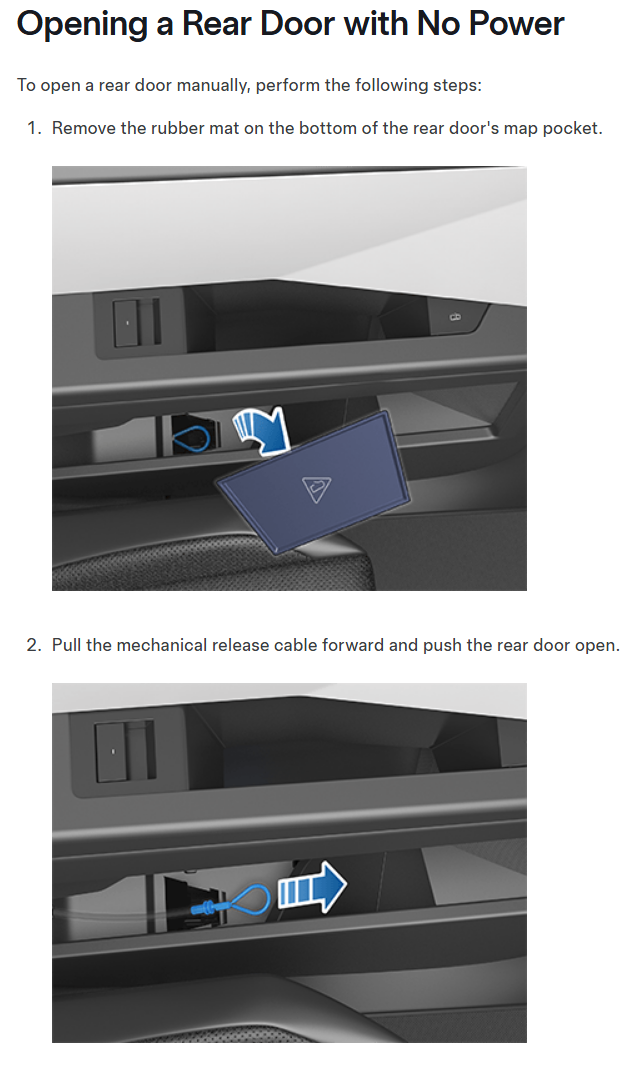
In response, some Tesla owners have gone so far as to release brightly-colored emergency escape ripcords to replace the difficult-to-spot emergency release pulls that are nearly impossible to find without prior knowledge. In the case of some older models, though, there’s less hope of escape. For example, in the Tesla Model 3 built from 2017 to 2023, only front doors have an emergency mechanical release. Rear passengers are out of luck, and must find another route of escape if their electronic door handles fail to operate. No Tesla vehicles feature an easily-accessible mechanical release that can be used from outside the vehicle.
US regulations mandate highly-visible emergency trunk release handles that are easily activated. However, obvious mechanical backups have not been required for cars fitted with electronic door handles. Credit: NHTSA
It’s worth noting that in the US market, federal regulations have mandated glow-in-the-dark trunk releases be fitted to all sedans from the 2002 model year onwards. You could theoretically escape from the trunk of certain Teslas more easily than a Cybertruck or Model 3 with a failed electrical system.
Tesla isn’t the only company out there building cars with retractable door handles. It does, however, remain the most prominent user of this technology, and its vehicles have been involved in numerous incidents that have made headlines. Other automakers, such as Audi and Fiat, have experimented with electronic door handles, both for ingress and egress, with varying degrees of mechanical backup available. In some cases, automakers have used smart two-stage latches. A small pull activates the electronic door release, while a stronger pull will engage a mechanical linkage that unlatches the door. It’s smart engineering—the door interface responds to the exact action a passenger would execute if trying to escape the vehicle in a panic. There are obviously less concerns around electronic door releases that have easily-accessed mechanical backups; it’s just that Tesla is particularly notable for not always providing them.
Over the years, national automotive bodies have thrown up their arms about all sorts of emerging automotive technologies. In the United States specifically, NHTSA has famously slow-walked the approval of things like camera-based rear-view mirror systems and replaceable-bulb headlamps, fearing the worst could occur if these technologies were freely allowed on the market.
Meanwhile, despite the obvious risks, electronic door handles have faced no major regulatory challenges. There were no obvious written rules standing in the way of Tesla making the choice to eliminate regular old door handles. Nor were there strict regulations on emergency door releases for passengers inside the vehicle. Tesla spent years building several models with no mechanical door release for the rear passengers. If your door button failed, you’d have to attempt escape by climbing out through the front doors, assuming you could figure out how to open them. Even today, the models with mechanical door releases still often hide them behind interior trim pieces or carpets, where few passengers would ever think to look in an emergency.
Try explaining this to someone in the back seat while the car is burning around you. Credit: Tesla
Obvious Mistakes
Flush door handles have become popular with Chinese automakers like BYD and Geely. However, these door handles require the vehicle’s electrical supply to be intact in order to work. Credit: BYD
Things are beginning to change, however. Chinese regulators have led the charge, with reports stating that electronic retractable door handles could be banned as soon as 2027. While some semi-retractable styles will potentially avoid an outright ban, it’s believed new regulations will require a mechanically redundant release system as standard.
As for the US, the sleeping giant of NHTSA has finally awoken in the wake of Bloomberg‘s reporting on the matter. As reported by CNBC, Tesla has been given a deadline of December 10 to deliver records to the federal regulator, regarding design, failures, and customer issues around its electronic door release systems. The Office of Defects Investigations within NHTSA has already recorded 16 reports of failed exterior door releases in the a single model year of the Tesla Model Y. It’s likely a drop in the ocean compared to the full population of Tesla vehicles currently on roads. Meanwhile, the US automaker also faces multiple lawsuits over the matter from those who have lost family members in fatal crashes and fires involving the company’s vehicles.
In due time, it’s likely that automotive regulators in most markets will come out against electronic door handles from a safety perspective alone. No matter how well designed the electrical system in a modern vehicle, it’s hard to beat a lever flipping a latch for simplicity and robustness. The benefits of these electronic door handles are spurious in the first place—a fraction of a percent reduction in drag, and perhaps a little more luxury appeal. If the trade-off is trapping passengers in the event of a fire, it’s hard to say they’re worthwhile.
The electronic door handle, then, is perhaps the ultimate triumph of form over function. They’re often slower and harder to use than a regular door handle, and particularly susceptible to becoming useless when iced over on a frosty morning. For a taste of the future, lives were put at risk. Anyone could see that, so it’s both strange and sad that automakers and regulators alike seemed not to notice until it was far too late. Any new regulations will, once again, be written in blood.
The history of US agriculture from 1940 to the end of the 20th century is characterized by remarkable gains in productivity, increased specialization in high-value crops, and rapid technological advancements, particularly in mechanization and automation. These developments significantly reduced the need for manual labor in farming, accelerated the reallocation of workers from agriculture to industry and services, and contributed to substantial growth in income per capita.
A study released today by independent researchers supported by ADL (the Anti-Defamation League) found that short dialogues with a large language model (LLM) programmed to engage with believers of certain antisemitic conspiracy theories reduced their belief in antisemitic conspiracy theories by 16 percent and increased favorability toward Jews by 25 percent among initially unfavorable participants.
지난주 유럽연합 집행위원회가 디지털 분야 규제를 단순화하겠다는 새 제안을 공개했다. 이번 규제안에는 작은 규제안이 여럿 담겨 있는데, 가장 눈에 띄는 대목은 EU가 추진해온 논란 많은 AI 관련 규제의 일부 조정과 GDPR 개정이다.
이번 규제 간소화의 배경에는 EU가 글로벌 기술 경쟁에서 뒤처지고 있다는 깊은 우려가 깔려 있다. 혁신과 경쟁력이 약화되고 있다는 문제 제기 역시 정당한 지적이다. 1년 전 유럽중앙은행 전 총재 마리오 드라기가 EU 상황에 대한 ‘충격 보고서’를 내놓으며 논쟁에 불을 붙였고, 이번 집행위 발표에서도 드라기의 이름이 여러 차례 언급됐다.
기술 담당 집행위원 헨나 비르꾸넨은 기자회견에서 “마리오 드라기가 1년 전에 ‘지금 아니면 없다’고 말했다. 지금은 그때보다 더 ‘지금 아니면 없다’는 상황이다”라고 강조했다.
기대에 미치지 못하는 규제 완화
강한 표현을 사용했지만, 기대한 만큼 EU의 분위기를 뒤바꿀 조치라고 보기는 어렵다. 대부분 규제가 그대로 유지되기 때문이다. 고위험 AI 관련 핵심 규정 상당수는 최소 1년 연기됐는데, 이는 불확실성을 줄이기는커녕 오히려 키우는 조치다. GDPR은 개인 데이터를 AI 학습에 사용할 수 있음을 명확히 하는 방향으로 개정됐는데, 집행위 설명에 따르면 유럽사법재판소가 밝힌 입장을 반영한 수준이다. 한편, 스웨덴 개인정보보호청(IMY)은 이런 변경 사항을 “중대하다”고 평가했다.
이 밖에 데이터 규칙 간소화, 사이버보안 보고 절차 단순화, 여러 EU 회원국에서 비즈니스를 전개하려는 기업을 위한 디지털 기업 지갑 등도 포함됐다. 웹사이트의 쿠키 팝업도 줄어들 전망이다. 많은 시민에게는 반가운 조치겠지만, EU의 경쟁력에 실질적 영향을 미칠 정도는 아니다.
새 제안에는 벌써 비판이 쏟아졌다. ‘빅테크에 굴복한 것’이라는 주장도 나왔다. 하지만 발표 직후 구글, 아마존, 애플, 메타를 회원으로 둔 로비 단체 CCIA는 이메일 성명을 통해 이번 조치가 “너무 약하다”고 주장했다.
비르꾸넨 집행위원은 기자회견에서 “이번 패키지가 충분하지 않다는 이해관계자도 있을 것이고, 과하다고 말하는 이도 있을 것이다. 균형 있는 조치라고 본다”라고 말했다.
유럽 기술 산업의 더 넓은 위기
필자는 이번 집행위 제안을 니클라스 젠스트룀의 벤처캐피털 아토미코(Atomico)가 이번 주 발표한 연례 보고서 ‘유럽 기술 산업 현황’ 보고서와 함께 읽어보는 것이 흥미로웠다. 아토미코의 보고서는 매년 유럽 스타트업 생태계에 대한 통계를 담지만, 올해는 정치적 메시지에 가까운 강한 문제 제기가 포함됐다.
아토미코가 강조하는 ‘강력한 기술 생태계 구축 방안’은 AI법이나 GDPR과 같은 대규모 규제와 거리가 있다. 스타트업 규제·행정 부담을 줄이고 혁신 기업의 실패 리스크를 완화하는 이른바 ‘28번째 조항(28th Order)’ 도입이 오히려 가장 절실한 입법 과제다.
스타트업 이해관계자는 아토미코 조사에서 데이터 규제나 AI 규제가 큰 장애 요소라고 답하지 않았다. 오히려 시장 파편화, 세제 규정, 자본 접근성, 노동 규제 등이 더 큰 문제라고 지적했다. 투자자의 경우 ‘엑시트 기회 부족’이 대표적 고민이다.
이처럼 EU의 디지털 경쟁력 해법으로 ‘기술 특화’ 입법에 지나치게 집중하는 것은 위험하다. 더 중요하거나 마찬가지로 중요한 과제가 너무나 많기 때문이다.
아토미코가 강조하는 중요한 요인 중 하나는 ‘유럽의 낮은 자기 확신’이다. 필자도 여러 차례 지적한 내용이다. 유럽 기술 생태계는 과거 어느 때보다 강하고 업계의 낙관론도 지난 10년 중 최고치지만, 여전히 ‘유럽에서 세계적 기술기업이 탄생할 수 있다’고 믿는 이가 부족하다.
아토미코는 “이는 구조적 문제의 신호다. 유럽은 창업자, 투자자, 공공·민간 금융기관 등 내부의 이해관계자를 향해 ‘세계 최고 기업을 만들 최적의 장소는 유럽’이라는 확신을 완전히 심지 못했다. 집단적 자기 확신이 없으면 아무리 대담한 목표도 일정 수준 이상 나아가기 어렵다”라고 지적했다.
집행위의 새 규제 패키지가 이런 문제를 해결하는 데 큰 역할을 할지는 알 수 없다. 하지만 어딘가에서 출발해야 하는 것만은 분명하다. dl-ciokorea@foundryco.com
The background is of course the strong concern that the EU is falling behind in the global tech rally, with reduced innovation and competitiveness as a result. A concern that is justified, given that just a year ago former ECB President Mario Draghi presented his horror report on the situation in the EU, which became a blowtorch. During the Commission’s press conference for last week’s proposal, Draghi was referred to several times.
“It’s now or never, Mario Draghi said in his report a year ago. Now it’s even more now or never,” said Tech Commissioner Henna Virkkunen at the press conference.
Despite the rhetoric, the new measures may not offer the turnaround for the EU one might expect. Most legislation remains in place. A heavy part of the AI regulation concerning so-called high-risk AI is being postponed for at least a year, but that creates more uncertainty rather than less. The GDPR is being amended to make it clear that personal data can be used to train AI, but according to the Commission, this is only in line with what the European Court of Justice has already stated. (The Swedish Authority for Privacy Protection (IMY) calls the changes “substantial.”)
Added to this are measures such as simplified data rules, simplified cybersecurity reporting, and a digital corporate wallet that will reduce administration for companies that want to operate in several EU countries. And there will be fewer cookie pop-ups on the web, something that will certainly please many citizens but that will not have a significant impact on the EU’s competitiveness.
The proposals have of course already attracted criticism. The EU is giving in to “big tech,” it has been said. Yet it didn’t take many seconds after the announcement before an email from the lobby group CCIA, which represents Google, Amazon, Apple, and Meta, came in, saying the measures were far too weak.
“There will be many stakeholders who say this is not enough, and some may say it is too much, so I think we have a balanced package,” Henna Virkkunen said at the press conference.
A broader crisis for EU tech
I personally find it interesting to read the Commission’s new proposal in parallel with another report that came out this week, the annual State of European Tech from Niklas Zennström’s venture capital company Atomico. A report that this year has turned into something of a political rallying cry in addition to the interesting statistics about the European startup sector it always contains.
Atomico’s most important points for building a stronger tech ecosystem are not at all about legislation at the AI Act or GDPR level. The concrete legislation most in demand is the more or less promised “28th Order” that simplifies rules and administration for startups and makes it less risky for innovative companies to fail.
Data and AI regulatory burden is far down the list of obstacles startup stakeholders note when polled by Atomico. Things like market fragmentation, tax regulations, access to capital, and labor regulations all rank higher. And for investors, there is of course the limited opportunities to make an exit.
Focusing too much on “tech-specific” legislation as a cure for EU digital competitiveness is a risk when there are so many other issues that have at least as much impact.
One such issue that Atomico highlights, and which I have written about before, is Europe’s low self-confidence. Despite the continent’s tech scene being stronger than ever and the optimism in the tech community being at its highest in a decade, there are still too few who believe in a thriving tech future for Europe.
“This is a sign of something structural. Europe has yet to fully convince its own stakeholders — founders, investors, and public and private financiers — that it is the best place to build world-leading companies. Collective self-confidence is essential, and without it, even the most audacious ambitions can only go so far,” writes Atomico.
I don’t know if the Commission’s new package will do much to change that. But of course, you have to start somewhere.
Many people celebrated President Donald Trump’s executive order targeting “political debanking.” Yet, those same people seem to be silent now that the president created new pressures to effectively debank the left.

 Login
Login