Thirty years ago today, Netscape Communications and Sun Microsystems issued a joint press release announcing JavaScript, an object scripting language designed for creating interactive web applications. The language emerged from a frantic 10-day sprint at pioneering browser company Netscape, where engineer Brendan Eich hacked together a working internal prototype during May 1995.
While the JavaScript language didn’t ship publicly until that September and didn’t reach a 1.0 release until March 1996, the descendants of Eich’s initial 10-day hack now run on approximately 98.9 percent of all websites with client-side code, making JavaScript the dominant programming language of the web. It’s wildly popular; beyond the browser, JavaScript powers server backends, mobile apps, desktop software, and even some embedded systems. According to several surveys, JavaScript consistently ranks among the most widely used programming languages in the world.
In crafting JavaScript, Netscape wanted a scripting language that could make webpages interactive, something lightweight that would appeal to web designers and non-professional programmers. Eich drew from several influences: The syntax looked like a trendy new programming language called Java to satisfy Netscape management, but its guts borrowed concepts from Scheme, a language Eich admired, and Self, which contributed JavaScript’s prototype-based object model.
The past few months, we’ve been giving you a quick rundown of the various ways ores form underground; now the time has come to bring that surface-level understanding to surface-level processes.
Strictly speaking, we’ve already seen one: sulfide melt deposits are associated with flood basalts and meteorite impacts, which absolutely are happening on-surface. They’re totally an igneous process, though, and so were presented in the article on magmatic ore processes.
For the most part, you can think of the various hydrothermal ore formation processes as being metamorphic in nature. That is, the fluids are causing alteration to existing rock formations; this is especially true of skarns.
There’s a third leg to that rock tripod, though: igneous, metamorphic, and sedimentary. Are there sedimentary rocks that happen to be ores? You betcha! In fact, one sedimentary process holds the most valuable ores on Earth– and as usual, it’s not likely to be restricted to this planet alone.
Placer? I hardly know ‘er!
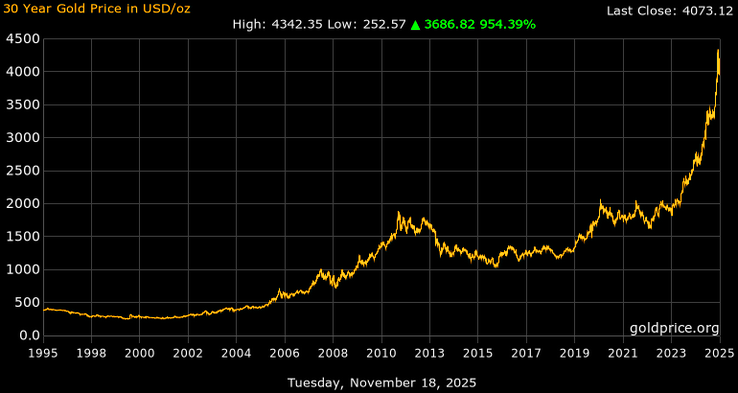
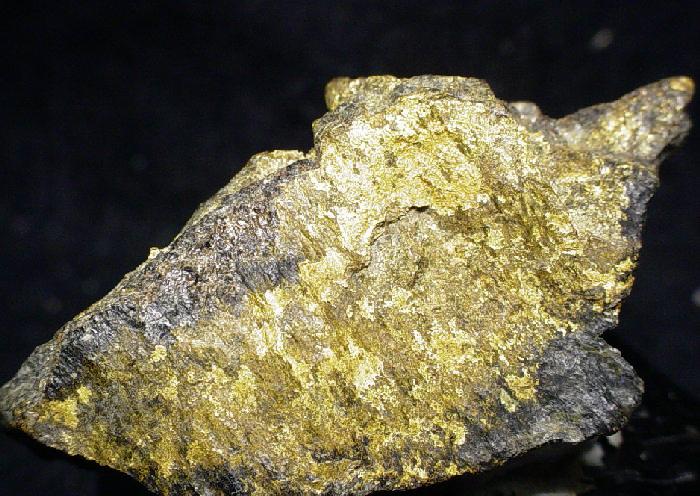
We’re talking about placer deposits, which means we’re talking about gold. In dollar value, gold’s great expense means that these deposits are amongst the most valuable on Earth– and nearly half of the world’s gold has come out of just one of them. Gold isn’t the only mineral that can be concentrated in placer deposits, to be clear; it’s just the one everyone cares about these days, because, well, have you seen the spot price lately?
Since we’re talking about sediments, as you might guess, this is a secondary process: the gold has to already be emplaced by one of the hydrothermal ore processes. Then the usual erosion happens: wind and water breaks down the rock, and gold gets swept downhill along with all the other little bits of rock on their way to becoming sediments. Gold, however, is much denser than silicate rocks. That’s the key here: any denser material is naturally going to be sorted out in a flow of grains. To be specific, empirical data shows that anything denser than 2.87 g/cm3 can be concentrated in a placer deposit. That would qualify a lot of the sulfide minerals the hydrothermal processes like to throw up, but unfortunately sulfides tend to be both too soft and too chemically unstable to hold up to the weathering to form placer deposits, at least on Earth since cyanobacteria polluted the atmosphere with O2.
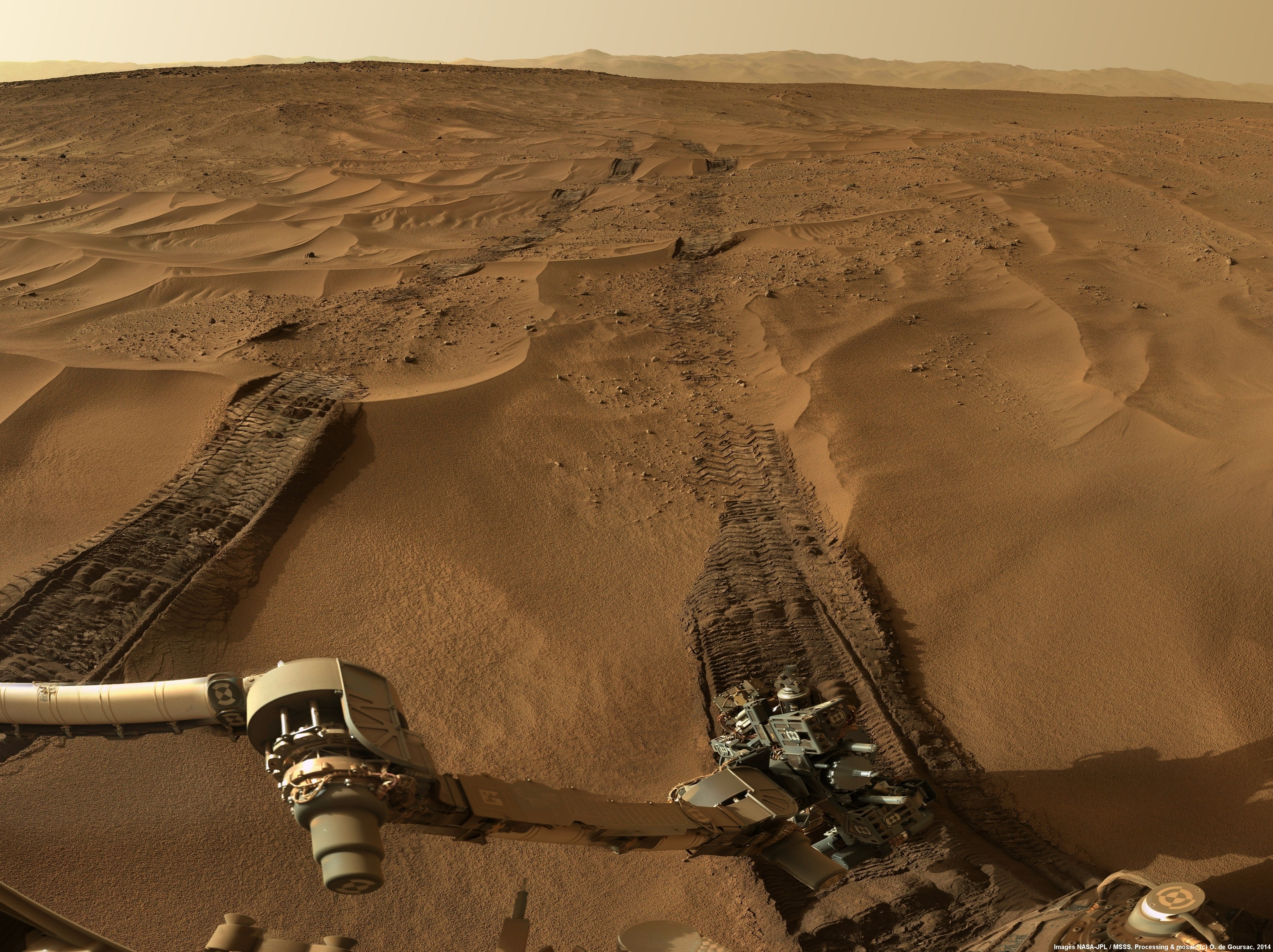
Dry? Check. Windswept? Check. Aeolian placer deposits? Maybe! Image: “MSL Sunset Dunes Mosaic“, NASA/JPL and Olivier de Goursac
One form of erosion is from wind, which tends to be important in dry regions – particularly the deserts of Australia and the Western USA. Wind erosion can also create placer deposits, which get called “aeolian placers”. The mechanism is fairly straightforward: lighter grains of sand are going to blow further, concentrating the heavy stuff on one side of a dune or closer to the original source rock. Given the annual global dust storms, aeolian placers may come up quite often on Mars, but the thin atmosphere might make this process less likely than you’d think.
We’ve also seen rockslides on Mars, and material moving in this matter is subject to the same physics. In a flow of grains, you’re going to have buoyancy and the heavy stuff is going to fall to the bottom and stop sooner. If the lighter material is further carried away by wind or water, we call the resulting pile of useful, heavy rock an effluvial placer deposit.
Still, on this planet at least it’s usually water doing the moving of sediments, and it’s water that’s doing the sortition. Heavy grains fall out of suspension in water more easily. This tends to happen wherever flow is disrupted: at the base of a waterfall, at a river bend, or where a river empties into a lake or the ocean. Any old Klondike or California prospector would know that that’s where you’re going to go panning for gold, but you probably wouldn’t catch a 49er calling it an “Alluvial placer deposit”. Panning itself is using the exact same physics– that’s why it, along with the fancy modern sluices people use with powered pumps, are called “placer mining”. Mars’s dry river beds may be replete with alluvial placers; so might the deltas on Titan, though on a world where water is part of the bedrock, the cryo-mineralogy would be very unfamiliar to Earthly geologists.
Back here on earth, wave action, with the repeated reversal of flow, is great at sorting grains. There aren’t any gold deposits on beaches these days because wherever they’ve been found, they were mined out very quickly. But there are many beaches where black magnetite sand has been concentrated due to its higher density to quartz. If your beach does not have magnetite, look at the grain size: even quartz grains can often get sorted by size on wavy beaches. Apparently this idea came after scientists lost their fascination with latin, as this type of deposit is referred to simply as a “beach placer” rather than a “littoral placer”.
Kondike, eat your heart out: Fifty thousand tonnes of this stuff has come out of the mines of Witwatersrand.
While we in North America might think of the Klondike or California gold rushes– both of which were sparked by placer deposits– the largest gold field in the world was actually in South Africa: the Witwatersrand Basin. Said basin is actually an ancient lake bed, Archean in origin– about three billion years old. For 260 million years or thereabouts, sediments accumulated in this lake, slowly filling it up. Those sediments were being washed out from nearby mountains that housed orogenic gold deposits. The lake bed has served to concentrate that ancient gold even further, and it’s produced a substantial fraction of the gold metal ever extracted– depending on the source, you’ll see numbers from as high as 50% to as low as 22%. Either way, that’s a lot of gold.
Witwatersrand is a bit of an anomaly; most placer deposits are much smaller than that. Indeed, that’s in part why you’ll find placer deposits only mined for truly valuable minerals like gold and gems, particularly diamonds. Sure, the process can concentrate magnetite, but it’s not usually worth the effort of stripping a beach for iron-rich sand.
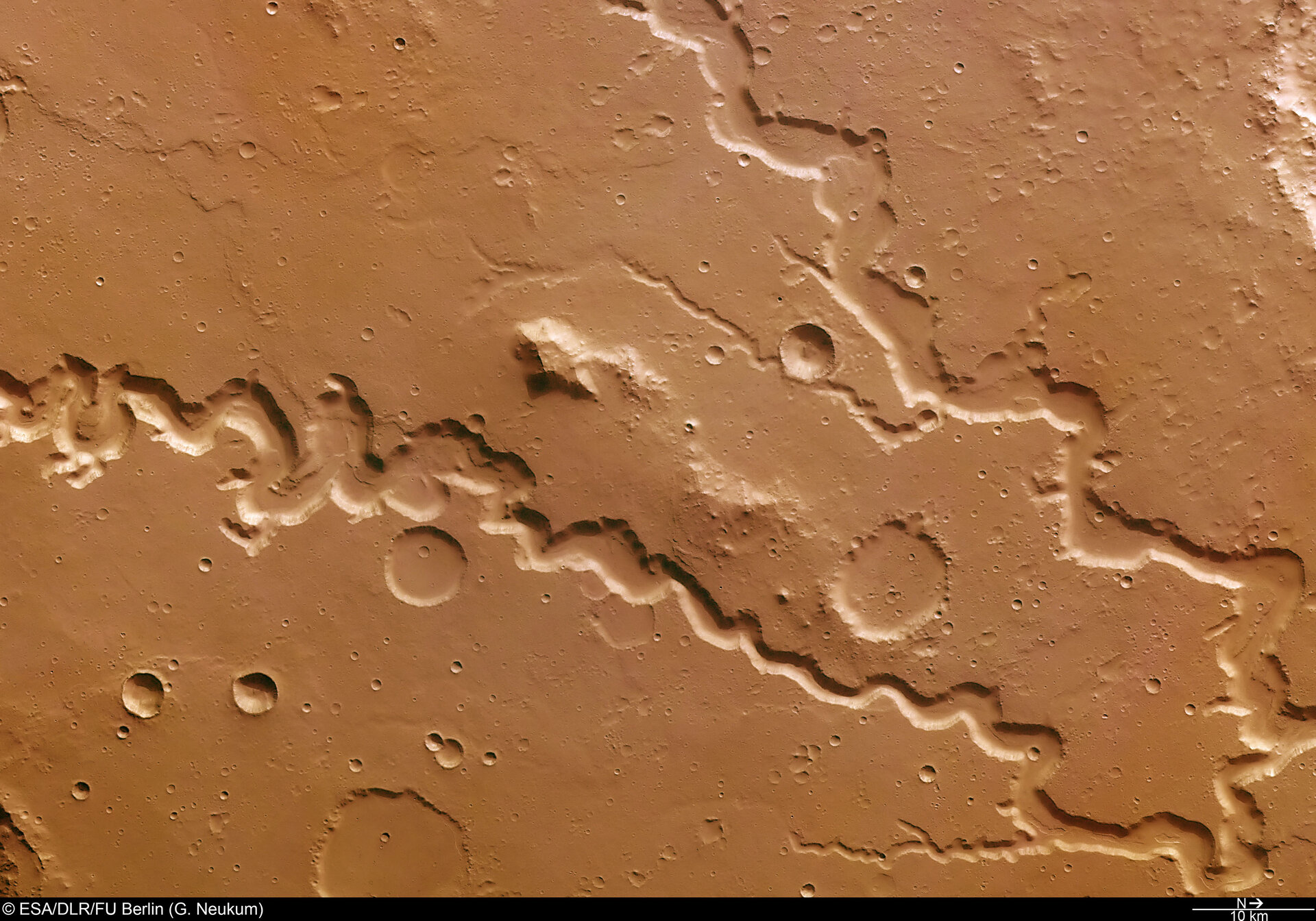
The most common non-precious exception is uraninite, UO2, a uranium ore found in Archean-age placer deposits. As you might imagine, the high proportion of heavy uranium makes it a dense enough mineral to form placer deposits. I must specify Archean-age, however, because an oxygen atmosphere tends to further oxidize the uraninite into more water-soluble forms, and it gets washed to sea instead of forming deposits. On Earth, it seems there are no uraninite placers dated to after the Great Oxygenation; you wouldn’t have that problem on Mars, and the dry river beds of the red planet may well have pitchblende reserves enough for a Martian rendition of “Uranium Fever”.
If you were the Martian, would you rather find uranium or gold in those river bends? Image: Nandes Valles valley system, ESA/DLR/FU Berlin
While uranium is produced at Witwatersrand as a byproduct of the gold mines, uranium ore can be deposited exclusively of gold. You can see that with the alluvial deposits in Canada, around Elliot Lake in Ontario, which produced millions of pounds of the uranium without a single fleck of gold, thanks to a bend in a three-billion-year-old riverbed. From a dollar-value perspective, a gold mine might be worth more, but the uranium probably did more for civilization.
Lateritization, or Why Martians Can’t Have Pop Cans
Speaking of useful for civilization, there’s another type of process acting on the surface to give us ores of less noble metals than gold. It is not mechanical, but chemical, and given that it requires hot, humid conditions with lots of water, it’s almost certainly restricted to Sol 3. As the subtitle gives it away, this process is called “lateritization” and is responsible for the only economical aluminum deposits out there, along with a significant amount of the world’s nickel reserves.
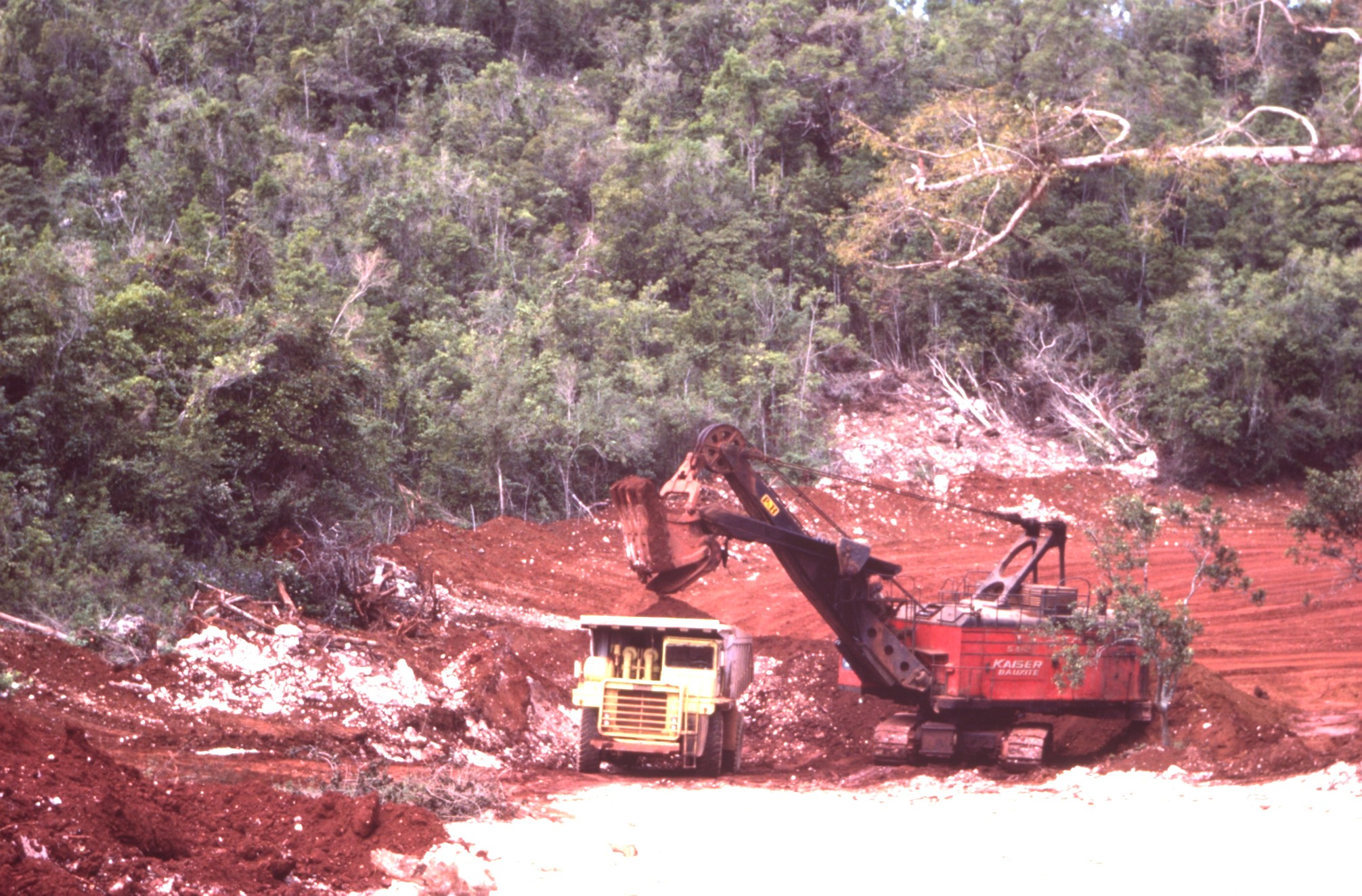
The process is fairly simple: in the hot tropics, ample rainfall will slowly leech any mobile ions out of clay soils. Ions like sodium and potassium are first to go, followed by calcium and magnesium but if the material is left on the surface long enough, and the climate stays hot and wet, chemical weathering will eventually strip away even the silica. The resulting “Laterite” rock (or clay) is rich in iron, aluminum, and sometimes nickel and/or copper. Nickel laterites are particularly prevalent in New Caledonia, where they form the basis of that island’s mining industry. Aluminum-rich laterites are called bauxite, and are the source of all Earth’s aluminum, found worldwide. More ancient laterites are likely to be found in solid form, compressed over time into sedimentary rock, but recent deposits may still have the consistency of dirt. For obvious reasons, those recent deposits tend to be preferred as cheaper to mine.
That red dirt is actually aluminum ore, from a 1980s-era operation on the island of Jamaica. Image from “Bauxite” by Paul Morris, CC BY-SA 2.0
When we talk about a “warm and wet” period in Martian history, we’re talking about the existence of liquid water on the surface of the planet– we are notably not talking about tropical conditions. Mars was likely never the kind of place you’d see lateritization, so it’s highly unlikely we will ever find bauxite on the surface of Mars. Thus future Martians will have to make due without Aluminum pop cans. Of course, iron is available in abundance there and weighs about the same as the equivalent volume of aluminum does here on Earth, so they’ll probably do just fine without it.
Most nickel has historically come from sulfide melt deposits rather than lateralization, even on Earth, so the Martians should be able to make their steel stainless. Given the ambitions some have for a certain stainless-steel rocket, that’s perhaps comforting to hear.
It’s important to emphasize, as this series comes to a close, that I’m only providing a very surface-level understanding of these surface level processes– and, indeed, of all the ore formation processes we’ve discussed in these posts. Entire monographs could be, and indeed have been written about each one. That shouldn’t be surprising, considering the depths of knowledge modern science generates. You could do an entire doctorate studying just one aspect of one of the processes we’ve talked about in this series; people have in the past, and will continue to do so for the foreseeable future. So if you’ve found these articles interesting, and are sad to see the series end– don’t worry! There’s a lot left to learn; you just have to go after it yourself.
Plus, I’m not going anywhere. At some point there are going to be more rock-related words published on this site. If you haven’t seen it before, check out Hackaday’s long-running Mining and Refining series. It’s not focused on the ores– more on what we humans do with them–but if you’ve read this far, it’s likely to appeal to you as well.
PC gamers have almost too many options when it comes to titles to play, which is a great problem to have. With decades of games to choose from (and the first port of call for most indie titles, too), the options are endless. You also get the perks of (nearly always flawless) backward compatibility and console-beating graphical performance — if you've got the coin for it when you’re building your perfect kit or picking up a high-powered gaming laptop.
The whole idea of what a gaming PC is and where you can play it is shifting, too, with the rise of handheld gaming PCs like the Steam Deck. We've tried to be broad with our recommendations here on purpose; here are the best PC games you can play right now.
Crypto firm Ripple has revealed how it is capturing the projected $16 trillion tokenization industry by onboarding several institutions onto the XRP Ledger (XRPL). The firm alluded to security and how its custody service is helping solve this issue.
Ripple Comments On How It Is Capturing The Tokenization Industry Using XRP Ledger
In an X post, Ripple indicated that it has managed to capture some of the projected $16 trillion industry onto the XRP Ledger through the adequate security it provides institutions. The crypto firm stated that it provides a security environment that mirrors the rigor of the banks it serves, combining HSM with FIPS-certified hardware to deliver security that scales. That way, they can protect assets without sacrificing operational speed.
Ripple further noted that legitimate integration with the global financial system requires verification. That is why they adhere to SOC 2 Type II and ISO 27001 standards, ensuring that the infrastructure of these institutions that tokenize on the XRP Ledger is compliant with necessary regulations.
Commenting on this, Ripple’s Head of Information Security, Akshay Wattal, said that in crypto, security isn’t a feature but the foundation of institutional trust. He added that effective custody requires in-depth architecture, battle-tested cryptography, and the governance rigor of a global financial institution.
Notably, Ripple provides custody solutions to global banks, including BBVA, SG Fogre, DBS Bank, and DZ Bank. However, these banks are yet to tokenize on the XRP Ledger even as institutions move to tap into this $16 trillion industry. The crypto firm continues to propose several ways to onboard these institutions onto the network.
One of Ripple’s proposals is the introduction of Confidential Multi-Purpose Tokens (MPTs) on the XRP Ledger in order to provide privacy for these institutions. The company’s developer, Ayo Akinyele, also recently proposed native XRP staking on the network, which could compel these institutions to build on XRPL, as they can earn yields while doing so.
Progress On Other Sides Of Its Business
In addition to its custody service, Ripple is also making progress in other areas of its operations, which also drives value to the XRP Ledger. The company announced yesterday that it had partnered with fintech company RedotPay, which has integrated Ripple Payments to launch a crypto conversion feature for Nigerian users.
The development also provides a huge boost for XRP, which will be one of the supported assets on RedotPay’s “Send Crypto, Receive NGN” feature. Ripple revealed that there are plans to support its RLSUD stablecoin in the future. Meanwhile, Bitcoinist reported that the crypto firm had scored a major win after the Monetary Authority of Singapore approved an expanded scope of payment activities for the company. This enables Ripple to broaden the range of regulated payment services it offers in the country.
Artificial intelligence, or AI, is a type of technology that helps machines and computers have “thinking” abilities similar to humans. Devices using AI can learn words and concepts, recognize objects, see patterns, or make predictions. They can also be taught how to work autonomously. AI is often used to help people understand and solve problems more quickly than they could on their own.
AI includes:
Machine learning: This type of AI looks at large amounts of data and learns how to make fast and accurate predictions based on that data.
Deep learning: This type helps computers operate much like the human brain. It uses several layers of “thought” to recognize patterns and learn new information. Deep learning is a type of machine learning.
Generative AI: A human can use generative AI to create text, videos, images, and more. It is based on deep learning.
NASA’s Perseverance Mars rover alongside the rock nicknamed “Cheyava Falls,” in this July 23, 2024, selfie made up of 62 individual images. “Cheyava Falls,” which has features that may bear on the question of whether the Red Planet was long ago home to microscopic life, is to the left of the rover near the center of the image. The small hole visible in the rock is where Perseverance collected the “Sapphire Canyon” core sample.
NASA/JPL-Caltech/MSSS
How is NASA using AI?
NASA has found uses for AI in many of its missions and programs.
For missions to the Moon, AI can use satellite imagery to create detailed 3D maps of dark craters. This data could help scientists plan missions, spot hazards, and even identify where future crews might find water ice. On Mars, the Perseverance rover uses AI to drive itself autonomously. It takes pictures of the ground, sees obstacles, and chooses the safest path.
AI also helps NASA search for planets outside our solar system. For example, AI has helped citizen scientists find over 10,000 pairs of binary stars. These pairs orbit each other and block each other’s light. This information could help scientists search for new planets and learn more about how stars form.
———————————————————————————————
Words to Know
Autonomous: acting or operating independently, without external control. An autonomous technology can perform duties without human intervention.
Citizen scientist: a member of the public, often a volunteer, who collects data that can be used by scientists. When members of the public participate in research in this way, it’s called citizen science.
———————————————————————————————
NASA also uses AI to support its work on Earth. The agency uses AI to aid disaster relief efforts during and after natural disasters like hurricanes or wildfires. For example, AI can count tarps on roofs in satellite images to measure damage after a storm. NASA is also supporting flight controllers and pilots by using AI to plan better flight routes, making air travel safer and more efficient.
AI is helping NASA explore space, protect people, and make amazing discoveries!
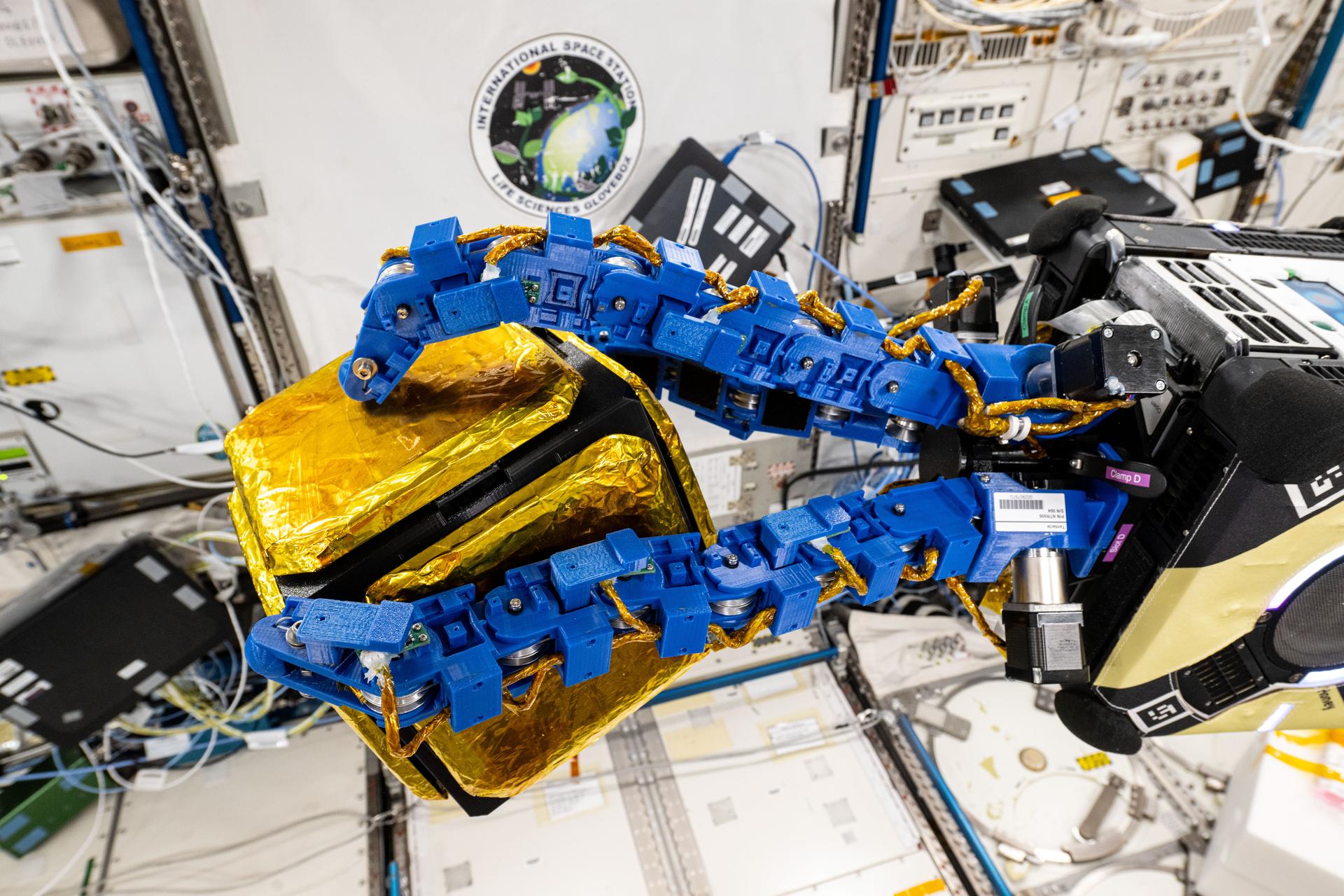
The blue tentacle-like arms containing gecko-like adhesive pads, attaBlue tentacle-like arms with gecko-like adhesive pads reach out and grapple a “capture cube” inside the International Space Station. The arms are attached to the cube-shaped Astrobee robotic free-flyer, right. The experimental grippers demonstrated techniques to autonomously perform tasks in low Earth orbit.
NASA
Advice From NASA AI Experts
“AI is a great field for people who like solving problems, building things, or asking questions about how the world works. People use AI to help doctors understand diseases, to teach robots how to explore space, and to help communities prepare for things like floods or wildfires. If you like using technology to help people and discover new things, AI could be a great career for you!” – Krista Kinnard, NASA’s Deputy Chief AI Officer
In this illustration, astronauts work on the lunar surface as part of NASA’s Artemis program.
NASA
Start exploring coding and STEM activities like robotics clubs. Just remember to always stay curious, keep practicing, and don’t be afraid of making mistakes. This really helps you learn.
Martin Garcia
AI Adoption and Innovation Lead, NASA’s Johnson Space Center
Career Corner
NASA roles that may involve AI include: Astronauts: Astronauts on the International Space Station can use an AI “digital assistant” to get medical recommendations. This is helpful when communication with Earth is interrupted. It could also be useful on future missions to distant destinations like Mars. Engineers: Engineers can use AI to help them generate designs for things like new spacecraft. Astronomers: AI helps astronomers analyze satellite and deep space telescope data to find stars and exoplanets. Meteorologists: Weather experts can use machine learning to make climate projections. Programmers: Programmers can use AI to update code used in older missions, bringing it up to modern standards. IT professionals: AI can enable IT experts to understand outages across NASA, allowing them to get programs back up and running faster. Program managers: Program managers can use AI to plan and model NASA missions.
Bitcoin price’s most popular top-calling indicators failed to trigger during the latest bull market, leaving observers questioning whether the underlying data is now broken. This analysis examines several widely used tools, explores why they underperformed this cycle, and outlines how they can be adapted to Bitcoin’s evolving market structure.
Table of Contents
Bitcoin Price Forecast Tools
On the Bitcoin Magazine Pro Price Forecast Tools indicator, the latest bull market never reached several historically reliable top models such as Delta Top, Terminal Price, and Top Cap, with the latter not even touched in the prior cycle. The Bitcoin Investor Tool, which uses a 2-year moving average multiplied by 5, also remained untested, and the Pi Cycle Top Indicator failed to provide precise timing or price signals despite being closely watched by many traders. This has led to understandable questions around whether these models have stopped working or whether Bitcoin’s behavior has outgrown them.
Figure 1: Historically reliable top models, such as Top Cap, Delta Top, and Terminal Price, were not attained in the bull cycle.View Live Chart
Bitcoin is an evolving asset with a changing market structure, liquidity, and participant mix. Rather than assuming the data is broken, it may be more appropriate to adapt the metrics to a different lens and time horizon. The goal is not to abandon these tools, but to make them more robust and responsive to a market that no longer delivers the same exponential upside and violent cycle tops as earlier years.
Bitcoin Price: From Fixed Thresholds to Dynamic Signals
The MVRV Z-Score 2-Year Rolling metric has been a core tool for identifying overheated conditions, but in this cycle, it did not call the bull market peak particularly well. It registered a major spike as Bitcoin first pushed through the $73,000–$74,000 zone, yet failed to give a clean exit signal for the later stages of the advance. Currently, the metric is printing the most oversold readings on record.
Figure 2: The usually reliable MVRV Z-Score 2YR Rolling metric failed to trigger exit signals in the latter stages of the cycle. View Live Chart
To address this shortcoming, the MVRV Z-Score can be recalibrated on a 6-month rolling basis rather than two years, making it more sensitive to recent conditions while still anchored in realized value dynamics. Alongside the shorter lookback, it is helpful to move away from fixed thresholds and instead use dynamic distribution-based bands. By mapping the percentage of days spent above or below different Z-Score levels, it becomes possible to mark zones such as the top 5%, as well as the bottom 5% on the downside. During this cycle, Bitcoin did register signals in the upper bands as it first broke above $100,000, and historically, moves into the top 5% region have coincided reasonably well with cycle peaks, even if they did not capture the exact tick high.
Figure 3: A recalibrated 6-month MVRV Z-Score with targeted upper and lower percentiles delivers more timely buy/sell signals.
Cyber Monday Sale: 40% Off Annual Plans!
The BEST saving of the year is here. Get 40% off all our annual plans.
Unlock +150 Bitcoin charts.
Access Indicator alerts – so you never miss a thing.
Private TradingView indicators of your favorite Bitcoin charts.
Members-only Reports and Insights.
API access & more all for a FRACTION of standard industry prices.
Bitcoin Price: Faster-Reaction Metrics for Today’s Cycle
Beyond valuation tools, activity-based indicators like Coin Days Destroyed can be made more useful by shortening their lookback periods. A 90-day moving average of Coin Days Destroyed has historically tracked large waves of long-term holder distribution, but the more muted and choppy nature of the current cycle means that a 30-day moving average is often more informative. With Bitcoin no longer delivering the same parabolic moves, metrics need to react faster to reflect today’s shallower yet still important waves of profit-taking and investor rotation.
Figure 4: The 30DMA Coins Days Destroyed has proven to react faster to on-chain dynamics.View Live Chart
Excluding the latest readings and focusing on the advance up to the all-time high of this cycle, the 30-day Coin Days Destroyed metric flashed almost exactly at the cycle peak. It also triggered earlier as Bitcoin first crossed roughly $73,000–$74,000, and again when price moved through $100,000, effectively flagging all key distribution waves. While this is easy to observe in hindsight, it reinforces that on-chain supply and demand signals remain relevant; the task is to calibrate them to current volatility regimes and market depth.
Bitcoin Price Spent Output Profit Ratio (SOPR)
The Spent Output Profit Ratio (SOPR) provides another lens on realised profit-taking, but the raw series can be noisy, with sharp spikes, frequent mean reversion, and large moves both during rallies and during intra-bull capitulations. To extract more actionable information, a 28-day (monthly) change in SOPR can be used instead. This smoothed alternative highlights when the pace of profit realisation is accelerating to extreme levels over a short window, cutting through the noise of intra-cycle volatility.
Figure 5: Applying a 28DMA to the SOPR metric smooths the data, reduces unnecessary ‘noise’, and accurately identifies local tops.
Applied to the latest cycle, the monthly SOPR change produced distinct peaks as Bitcoin first moved through the $73,000–$74,000 zone, again above $100,000, and once more around the $120,000 region. While none of these perfectly captured the final wick high, they each marked phases of intense profit-taking pressure consistent with cycle exhaustion. Using monthly changes rather than the raw metric makes the signal clearer, especially when combined with cross-asset views of Bitcoin’s purchasing power versus equities and Gold.
Bitcoin Price Cycle Conclusion: Adapt or Fall Behind
In hindsight, many popular top-calling indicators did work throughout this bull market when measured through the right lens and on appropriate timeframes. The key principle remains: react to the data, do not attempt to predict. Rather than waiting for any single metric to perfectly call the top, a basket of adapted indicators, interpreted through the lens of purchasing power and changing market dynamics, can increase the probability of identifying when Bitcoin is overheating and when it is transitioning into a more favorable accumulation phase. The coming months will focus on refining these models to ensure they remain viable not just historically, but robustly accurate going forward.
Disclaimer: This article is for informational purposes only and should not be considered financial advice. Always do your own research before making any investment decisions.
Ripple Labs has secured an expanded license from Singapore’s central bank, adding to its already strong regulatory foothold in the country. According to a Dec. 1 announcement, Ripple Markets APAC, which serves as the blockchain payment firm’s Singapore subsidiary, has…
Ripple Labs has received regulatory approval from Singapore’s central bank to widen the scope of its payments business, strengthening the firm’s push to deepen its institutional footprint across Asia-Pacific.
Key Takeaways:
Ripple won approval from Singapore’s central bank to expand regulated payment services for banks and corporates.
The wider license allows Ripple to scale infrastructure for faster, cheaper cross-border transactions using RLUSD and XRP.
The move supports Ripple’s Asia-Pacific expansion as regional on-chain activity jumps roughly 70% year over year.
The company said Monday that its local unit, Ripple Markets APAC, has been cleared by the Monetary Authority of Singapore under its Major Payment Institution (MPI) license to expand regulated payment activities.
The decision enables the firm to broaden the services it can offer to banks and corporates in the city-state’s tightly supervised financial market.
Ripple President: Singapore Approval Sets Stage for Bigger Investment Push
Ripple President Monica Long said the company values Singapore’s regulatory stance and sees the broader license as a foundation for further investment.
She added that the move would help Ripple build infrastructure for financial institutions seeking faster and more secure cross-border payments.
At the center of those services is Ripple Payments, which connects clients to on- and off-ramps for collections, custody, currency conversion and payouts.
The system uses digital payment tokens such as RLUSD and XRP to settle transactions across borders, aiming to reduce fees and processing times for corporate users moving money internationally.
Singapore has been part of Ripple’s strategy since 2017. The firm first secured its MPI license in 2023, allowing it to provide regulated digital token services.
While the MAS registry still lists token-related activities under the license, the company says the latest approval widens its operating scope beyond those functions, positioning it to offer a broader set of institutional services.
The @MAS_sg has approved an expanded scope of payment activities for our Major Payment Institution license – enabling us to deliver end-to-end, fully licensed payment services to our customers in the region.
The regulatory milestone arrives alongside an acquisition drive designed to support enterprise clients.
In early November, Ripple bought Palisade, a wallet and custodian provider, as part of a plan to bundle custody with payments and liquidity tools for large customers.
Regional growth has been a key driver. Ripple Asia-Pacific head Fiona Murray said on-chain activity in the region has climbed about 70% year-over-year, with Singapore at what she called “the center of that growth.”
She said the expanded permissions will help Ripple deliver regulated services “to the institutions driving that growth.”
Ripple’s RLUSD Wins Regulatory Green Light in Abu Dhabi
Last week, Ripple’s dollar-backed stablecoin RLUSD was cleared for institutional use in Abu Dhabi after receiving recognition as an Accepted Fiat-Referenced Token from the local regulator.
The approval allows licensed firms within Abu Dhabi Global Market (ADGM) to use RLUSD for regulated financial activities inside the free-zone financial center.
The green light was granted by the Financial Services Regulatory Authority, which supervises ADGM. Under the rules, companies can deploy RLUSD if they meet requirements around reserves, transparency, and compliance.
The decision strengthens Ripple’s expansion across the UAE. In recent months, the company secured approvals in Dubai and Abu Dhabi and onboarded partners including Zand Bank and Mamo.
As reported, Ripple is also weighing whether to bring staking to the XRP Ledger (XRPL), a move that would push the decade-old blockchain deeper into the rapidly expanding world of decentralized finance.
Some people are not merely satisfied with functionality, or even just good looks. These persnickety snoots (I am one of them) seek something elegant, a true marriage of form and function.
Image by [YANG SHU] via Hackaday.IOShould such a person be in the market for a macro pad (or ‘macropad’ if you prefer), that snoot should look no further than [YANG SHU]’s 8-key programmable stream deck-like device.
The main goal here was the perfect fusion of display and feel. I’m not sure that an FDM-printed, DIY macro pad can look any better than this one does. But looks are only half the story, of course. There’s also feel, and of course, functionality.
Yes those are (hot-swappable) mechanical key switches, and they are powered by an ESP32-S2. Drawn on the 3.5″ LCD are icons and text for each switch, which of course can be easily changed in the config app.
There’s a three-direction tact switch that’s used to switch between layout profiles, and I’m sure that even this is satisfying on the feel front. Does it get better than this? Besides maybe printing it in black. I ask Hackaday.
KeebDeck Keyboard Gets Two Thumbs Up
Did you make it to Supercon this year? If so, you hold a badge with a special keyboard — a custom job by Hackaday superfriend [Arturo182], aka Solder Party. Were you wondering about its backstory?
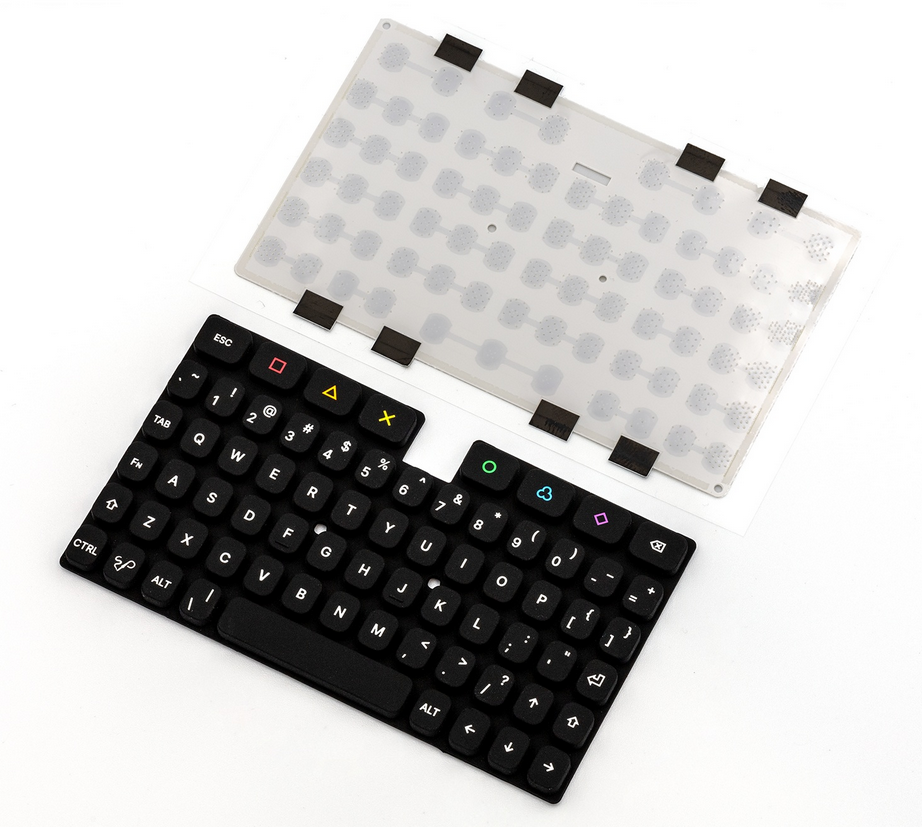
This 69-key alphanumeric silicone number has all the keys a hacker needs, plus a rainbow of extras that can be used for macros. According to [Arturo182], the keyboard has a tactile feel thanks to a snap dome sheet underneath the keys, and this makes it more comfortable for long thumb-typing sessions.
Be sure to check out the teasers at the bottom of the KeebDeck page, because there is some really exciting stuff. If you want to build one, GitHub is your friend, pal.
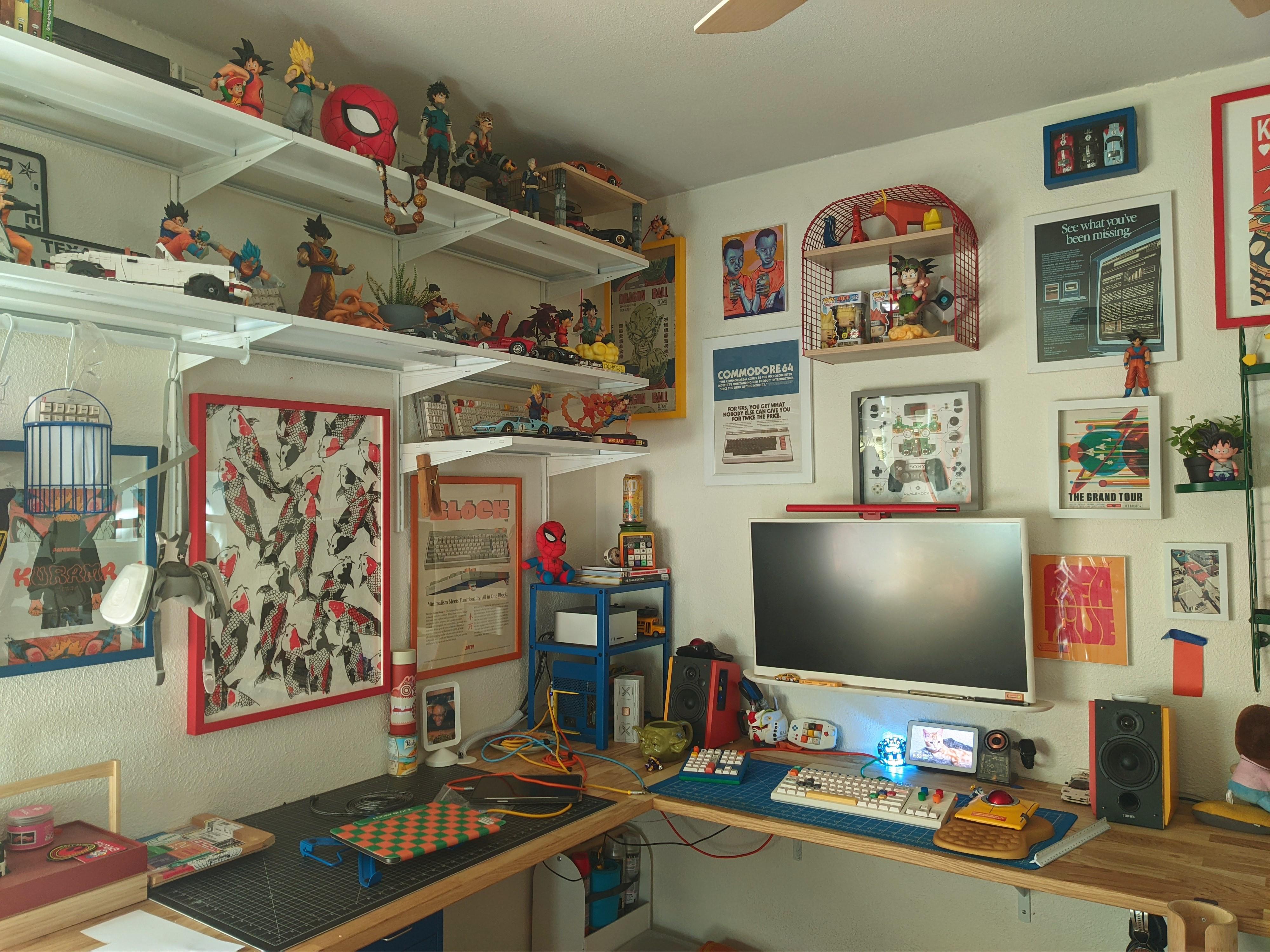
Here’s what I know: That’s a Nulea m512 mouse, the keyboard is a KBD Craft Sachiel LEGO number, and that there is a Cidoo macro pad. Best of all, [Tardigradium] hand-painted the speakers. Neat-o!
Do you rock a sweet set of peripherals on a screamin’ desk pad? Send me a picture along with your handle and all the gory details, and you could be featured here!
Historical Clackers: the Gerda Typewriter Was One of Accessibility
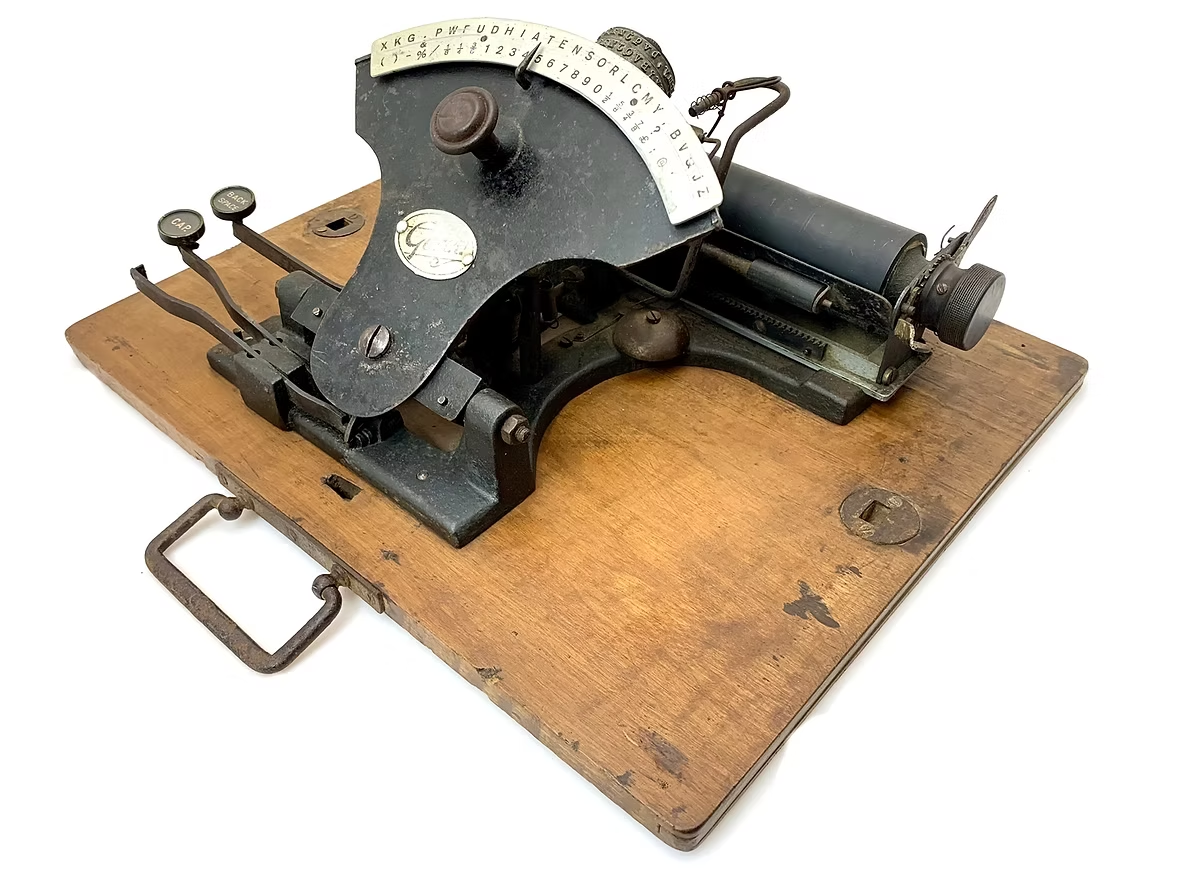
Some of us (okay, I) would have thought that most accessibility inventions are fairly recent, say, from the 1960s onward. But consider the Gerda typewriter, which was created in 1919 to enable blind and one-armed victims of WWI to become employable typists.
According to the Antikey Chop, it’s quite possible that the German government helped grease the wheels of this project so that these soldiers would have a usable typewriter with which to get on with life.
Three versions of this index typewriter were produced: a two-handed Gerda, one with a Braille index, and one with an English index. All entered the market the same year, and were produced for a total of three years.
The Gerda’s typewheel was quite like Blickensderfer, and some even had the DHIATENSOR layout. More expensive than last week’s Clacker (75 Marks), the Gerdas for blind and sighted people with two hands cost 195 Marks, and the one-handed edition was 205 Marks. Some of the two-handed models had rectangular, wooden key-tops, and others had round, glass-topped keys.
Finally, Module-Based Keyboard Is a Sensory Nightmare
I’ve been an early adopter of keyboards in the past. This is usually to bring them to your attention, either before they’re released, or just as they’ve come out. And never have I ever had this poor of an experience.
Games Radar recently reviewed a surprisingly not-failed Kickstarter keyboard that actually shipped, the Naya Create. It may not look like it, but the Create is supposed to be a gaming keyboard. What it does look like is mouse-focused, or at least mouse-forward. And that’s the point of it. Evidently.
Those big modules are interchangeable, and there are four of them so far: the Touch (a trackpad), Track (a trackball that falls out reliably), the Tune (a dial), and the Float, which is designed for space mousing around. They sound cool enough, and might actually be the best part of this whole setup.
To fully illustrate my poit I hvemt’t corrected any of the typos experieved typim this semtemve with the Naya Create while tryig to maintain my usual speed.
But according to Games Radar, the Naya Create is so not worth the $850 (!) asking price. It has ‘mushy, low-profile switches’ and clammy caps, and although the reviewer complains about the non-staggered keys, y’all know that those are my preference at this point.
And apparently, by default, Backspace is mapped to the left side. What? Of course, you can remap any key, whenever the software decides to work. Whenever the reviewer tried to save changes, the software would say that the keyboard is disconnected. Wonderful.
Despite these shortcomings, Games Radar says the keyboard is rock-solid aluminium with good hinges. So there’s that. Just, you know, swap out the switches and keycaps, and wait for software updates, I guess.
On September 19, 1982, Carnegie Mellon University computer science research assistant professor Scott Fahlman posted a message to the university’s bulletin board software that would later come to shape how people communicate online. His proposal: use :-) and :-( as markers to distinguish jokes from serious comments. While Fahlman describes himself as “the inventor… or at least one of the inventors” of what would later be called the smiley face emoticon, the full story reveals something more interesting than a lone genius moment.
The whole episode started three days earlier when computer scientist Neil Swartz posed a physics problem to colleagues on Carnegie Mellon’s “bboard,” which was an early online message board. The discussion thread had been exploring what happens to objects in a free-falling elevator, and Swartz presented a specific scenario involving a lit candle and a drop of mercury.
That evening, computer scientist Howard Gayle responded with a facetious message titled “WARNING!” He claimed that an elevator had been “contaminated with mercury” and suffered “some slight fire damage” due to a physics experiment. Despite clarifying posts noting the warning was a joke, some people took it seriously.
Brink, the Bitcoin development organization, recently funded the first ever independent security audit of Bitcoin Core conducted by a third party (the full report is available here). The audit was conducted by Quarkslab, a software security firm, with the help of the Open Source Technology Improvement Fund (OSTIF) and collaboration with Bitcoin Core developers Niklas Gögge, from Brink, and Antoine Poinsot, from Chaincode Labs.
This security audit marks a milestone in the development history of Bitcoin Core, the most widely adopted and reference client of the Bitcoin network and protocol.
While Bitcoin Core security policies and practices have been steadily hardened and revised to be more thorough and comprehensive over the last few years, an external audit by a third party specialized in security review is a new bar to meet. It was met.
The audit involved manual code review, static and dynamic analysis with automated tools, and advanced fuzz testing, which takes automatically generated input and runs it through different code paths attempting to reveal unexpected or detrimental behavior.
No critical, high, or medium-severity bugs were discovered in the audit. Two low-severity issues were different, and thirteen other issues that are not classified as vulnerabilities under Bitcoin Core’s vulnerability classification criteria.
The entire process also resulted in improvements in Bitcoin Core’s testing infrastructure, including new fuzz testing infrastructure for block connection and chain reorganization scenarios, a new area to be covered by testing, file system improvements speeding up and improving fuzz testing in general, new utilities for testing back sliding code performance, and suggestions for improving code readability for reviewers and new developers.
Some of these improvements are already being worked on for eventual review and merging into the Bitcoin Core repository.
The results of this independent security audit have reinforced that Bitcoin Core’s improvements over recent years in security policy, testing, and overall quality review have had a meaningful impact on the project.
In a year that again saw AI assistants and tools climb the app store charts over and over, it's interesting to see a timer that helps you disconnect from your tech winning Google's highest app award.
Apple’s updated App Review Guidelines require apps to disclose and get consent before sharing personal data with third-party AI, raising compliance stakes.
Apple’s updated App Review Guidelines require apps to disclose and get consent before sharing personal data with third-party AI, raising compliance stakes.
Marissa Coughlin and Constantine Vetoshev, owners of Swoon City, a new romance bookstore in Seattle’s Ballard neighborhood. (GeekWire Photo / Kurt Schlosser)
When Marissa Coughlin left her latest tech job to open a romance bookstore and crafting hub in Seattle, she didn’t leave technology behind completely.
In fact, alongside her partner, Constantine Vetoshev, who still works in tech, artificial intelligence has become a major player in this next chapter of their lives.
Coughlin worked in a variety of communications and content roles for companies including Airbnb, Textio, Highspot, and most recently, T-Mobile. Vetoshev is a software developer at Brook.ai, a Seattle-area health technology startup that uses AI to help clinical teams deliver remote care.
Both big readers, the pair first started looking at spaces and developing a bookstore business plan in 2023. But with two small children, they were waiting for better timing. When a space became available on Market Street in Seattle’s Ballard neighborhood they finally made the leap, and opened Swoon City last month.
While Coughlin has no interest in seeing AI used to write the books or illustrate the covers that line her shelves, she’s a big believer in how the technology can help the back end of the business.
“I think more businesses should be using this stuff, especially small businesses, if they can figure out how to tap into it,” Coughlin said. “It’s super useful, but you have to know that it’s there and what it can do, and be a little bit creative and figure out the solutions.”
Here are some of the ways Swoon City is tapping into AI, leveraging Coughlin and Vetoshev’s know-how:
To help pick the store’s inventory of 3,000 books, they used analysis based on Seattle Public Library data of the most-borrowed romance novels over the past 18 months.
They built a custom generative AI tool to categorize all the romance novels they bought into sub-genres so people can quickly find their favorites. For example, the book “Thirsty” would typically just be categorized under romance or maybe paranormal romance, but Swoon’s system categorizes it as paranormal romance, LGBTQ, enemies to lovers, vampire romance, romantic comedy, and urban fantasy.
GenAI was used to build a customer loyalty program. Vetoshev, who said he is “all in” on Anthropic, asked the AI assistant Claude to analyze some requirements they had for different programs. Claude wrote back and said, “You could go with this one, or you could just build it yourself. Here’s how.”
Swoon City moved into a space previously occupied by Monster, which sold clothing, crafts and more. (GeekWire Photo / Kurt Schlosser)
“I feel like there’s a lot of things that we’ve created for this store that other people who might be curious about doing something like this could tap into and be able to leverage for their own stuff,” Coughlin said.
Vetoshev said he can come home from his day job, put the kids to bed and then focus on something that needs to be built for the store.
“A couple of hours of work with a [large language] model, and we’re off to the races,” he said.
The technology is all in service of a genre that is exploding, especially among young readers.
Romance is the leading growth category for the total print book market thus far in 2025, and the volume for the category has more than doubled compared to four years ago, with 51 million units sold in the past 12 months, according to industry analysis.
NPR credited romance interest driven by Gen Z readers, especially on BookTok, a subcommunity of TikTok for recommending, reviewing, and discussing books.
Swoon City is hoping to follow in the successful footsteps of The Ripped Bodice, an independent brick-and-mortar romance bookstore with locations in Los Angeles and Brooklyn, N.Y.
Coughlin looks forward to bringing people together not just around books, but by hosting various events and building out crafting classes for embroidery, stained glass, jewelry making and more.
“I feel like part of what was exciting for a romance bookstore is the community, because it is often not a genre that’s as well respected in the book community, even though it’s huge,” she said.

 Login
Login