A truly smart home isn’t one that you control with your voice or phone, but one that is fully automated. Presence detection is key to creating an environment that anticipates your next move, whether that’s turning on a light in a cupboard or understanding exactly who is in which room.
The power of automations is what draws many of us to Home Assistant in the first place, but there’s no denying that the process can feel a little drawn-out. Good news! A new experimental Home Assistant feature aims to make it easier to create automations, and you can try it out right now with the flick of a switch.
Bluetooth is a well-worn technology that you might be tempted to write off in your smart home, especially if your server doesn’t already have Bluetooth capabilities. I wasn’t going to bother, but then I saw an opportunity to pick up a cheap adapter and gave it a shot.
I've never been a fan of Christmas lights, but I do love Matter, and that's the only reason I had any interest in the Govee Christmas Sparkle String Lights. But it's the fun I had with this product that makes it a welcome addition to this year's tree.
Strategy, the Michael Saylor-led corporate Bitcoin buyer long watched by investors, has sharply cut back purchases this year, according to CryptoQuant. Once a steady force of demand, its monthly buys have fallen dramatically, changing the way market watchers view institutional support for Bitcoin.
Sharp Drop In Monthly Purchases
Based on reports, Strategy’s monthly accumulation peaked around 134,000 BTC in late 2024. By November 2025 that figure had dropped to roughly 9,100 BTC. That move amounts to about a 93% decline from the high-water mark. Buying this month was almost nil, with only 135 BTC recorded early in December. Those numbers show how quickly a major buyer can thin out.
Strategy’s Bitcoin buying has collapsed through 2025.
Monthly purchases fell from 134K BTC at the 2024 peak to just 9.1K BTC in November 2025, only 135 BTC so far this month.
A 24-month buffer makes one thing clear: they’re bracing for the bear market. pic.twitter.com/qEwXR3JQ82
Reports have disclosed that on November 17, 2025, Strategy made a sizeable purchase of roughly 8,178 BTC, a buy worth near $835 million at the time. The purchase was the largest for the firm since July and pushed its total holdings to about 649,870 BTC. But while that single entry was large, it did not reverse the broader trend: overall monthly activity is far lower than it was a year earlier.
Big Holdings But More Cash On Hand?
According to CryptoQuant, Strategy has also piled up cash — about $1.4 billion has been set aside. That reserve is being held to cover dividend payments, debt servicing and other company needs. Observers say this signals a shift toward preserving liquidity rather than steady accumulation of Bitcoin. In other words, the company appears to be prioritizing cash stability over more buys for now.
What CryptoQuant And Others Are Watching
Market analysts are taking the slowdown as a warning sign that corporate appetite for Bitcoin treasuries may be cooling. If other big holders act the same, the structural demand that helped support prices could weaken.
Some traders will read the figures as a move to brace for a possible bear market. Others point out that Strategy’s enormous stash — nearly 650,000 BTC — still gives it room to ride out a downturn without having to sell immediately.
Key signals to monitor include the monthly purchase totals going forward and any change in Strategy’s cash holdings. Observers will be watching to see if the company returns to regular Bitcoin purchases or if the reduced buying becomes the standard.
It’s also important to monitor other corporate treasuries, because if several slowdowns occur together, the market for newly issued and available Bitcoin could tighten significantly.
Bitcoin may be sliding into a new bear phase unless fresh macro liquidity – particularly through spot ETFs – returns to the market, according to CryptoQuant CEO Ki Young Ju.
Bitcoin Bear Market Incoming?
Sharing a composite on-chain dashboard overlaid on the BTC price, Ju wrote on X: “Most Bitcoin on-chain indicators are bearish. Without macro liquidity, we enter a bear cycle.” The chart stacks ten CryptoQuant metrics behind the price in a red-to-green heatmap from 2021 to 2025, highlighting how regime shifts in prior cycles coincided with clusters of bearish readings.
The indicators in the panel include the MVRV Z-score, CryptoQuant P&L Index, the Bull-Bear Cycle Indicator, Inter-Exchange Flow Pulse, Network Activity Index, Stablecoin Liquidity, Bitcoin Demand Growth, Trader On-chain Profit Margin, Trader Realized Price and a Technical Signal metric. When the majority are bullish, the backdrop turns light green; when they flip bearish, it shifts to red. In the latest section of the chart, as BTC has pulled back from its highs, red once again dominates – the visual basis for Ju’s warning.
For the next major move, Ju argues that on-chain data is now subordinate to macro conditions and ETF flows. Quoting his own post, he wrote: “It is simple. If you think macro gets better next year, you buy. Otherwise, you sell. I’m not a macro expert, so find macro bros. New ETF inflows are the key.”
That line pinpoints what he believes can “save” Bitcoin from a deeper drawdown: renewed demand from spot ETFs as a conduit for institutional capital. In earlier stages of the cycle, rising ETF inflows coincided with strong price appreciation; more recently, slowing or negative flows have mirrored the loss of upward momentum.
Ju frames the current environment as one that demands flexible scenario management rather than rigid forecasts. “At this stage, it is more about being reactive than predictive. Set your scenarios and trade accordingly,” he told followers. The composite chart is designed for exactly that purpose, showing how past bull tops and bear markets aligned with persistent stretches of red across profit, valuation and liquidity metrics.
Despite the bearish tilt, Ju does not foresee a repeat of the 2022 collapse, when Bitcoin fell roughly 65% from peak to trough. He cites the behaviour of Michael Saylor led Strategy as a stabilizing factor. “If Strategy holds its 650K BTC this cycle (or sells only a little), we would not see another -65% drawdown like in 2022,” he wrote. In his view, that supply remaining largely off the market reduces the probability of a violent deleveraging event.
Ju characterizes the current pullback as substantial but not extreme in historical context. “We are about -25% from ATH now, and even if a bear cycle comes, the downside would likely be smaller and look more like a broad sideways range,” he argued, suggesting that prolonged consolidation is more likely than a single dramatic crash.
His message to long-term investors is explicitly calming. “Long-term holders should avoid panic selling,” he advised. While cyclical on-chain indicators flash red, he insists the structural backdrop has improved: “Bitcoin has more liquidity channels now, so the long-term outlook is obviously strong, imo.” Those channels include ETFs and a deeper institutional market structure than in prior cycles.
Several key Bitcoin metrics are beginning to exhibit bullish action once again alongside the renewed upward traction in the asset’s price. With this kind of trend that points to growing momentum, the crypto king appears to be gearing up for a pivotal shift driven by newfound appetite from investors.
A Key Market Shift Unfolding For Bitcoin
Bitcoin has experienced a rebound as the crypto landscape turns bullish again, sending its price back above the $90,000 mark. Following the bounce on Wednesday, the BTC market appears to have reached a critical junction as it hints at an impending shift in the current trend.
Delving into the market performance, Darkfost, an author at CryptoQuant and market expert, has outlined the key driver behind the unfolding shift. In the research shared on the X platform, the expert revealed that the market today is heavily driven by derivatives. In addition to the derivatives-driven market, 2025 has been the most speculative year Bitcoin has ever seen in its existence.
Another key driver highlighted by the market expert is the actions of investors in the United States and the renewed demand at the institutional level. Darkfost’s research hinges on a critical Bitcoin metric, one that shows the average evolution of the Coinbase Premium Gap in the monthly timeframe and the Spot Bitcoin Exchange-Traded Funds (ETFs) netflows.
Specifically, this metric is the Bitcoin ETF – Netflow USD Vs. Coinbase Premium. It is worth noting that the Coinbase Premium Gap calculates the pricing difference between Coinbase Pro and Binance. This helps illustrate the behavior of different groups of investors. While Coinbase Pro is typically used by institutions and whales, Binance, which has the largest volume, is available to everyone.
The Coinbase Premium Gap decreased from +$109 to -$40 since October 16, when Bitcoin was valued at almost $113,000. Such a drop suggests that institutional investors sharply decreased their positions.
BTC ETFs Netflows Impact On The Market
Interestingly, the trend was also observed in ETF netflows, which also flipped negative. During the period, BTC fell from $113,000 to $80,000, reflecting how much the US and institutional demand influence the market.
As seen in the past, large negative swings have frequently indicated market bottoms, provided that the trend thereafter begins to turn. A trend of this kind is what is playing out in the market today.
However, current data reveals that the Coinbase Premium Gap has bounced back to -$13 while the average ETF netflow is valued at around -$100 million. This comeback in both sectors indicates that in the near term, the situation seems to be improving, and BTC’s price is reacting appropriately to the crucial shift.
As a result, Darkfost predicts that a new all-time high for BTC may happen quickly if this pattern continues in the long run. The ongoing shift may be subtle, but it is noticeable as the market appears to be preparing for a phase that might largely change the course of Bitcoin.
A crypto market analyst has compared XRP to NVIDIA, an American technology company with one of the biggest tech success stories in history. The analyst implied that buying XRP today could mirror the opportunity investors had when purchasing NVIDIA shares in 2000 at just $0.35. The comparison emphasizes the long-term potential of the XRP price and highlights the importance of HODLing.
XRP Today Shows Growth Potential Like NVIDIA In 2000
A leading market expert, Egrag Crypto, has drawn a striking parallel between the current XRP price and the early days of NVIDIA. He suggested that buying XRP now could be akin to purchasing NVIDIA shares at just $0.35, as recorded in 2000. At the time of writing, the shares are priced around $180, representing a staggering 51,329% increase from over two decades ago.
Egrag Crypto points out that a $10,000 investment in NVIDIA at $0.35 per share in 2000 would have secured roughly 28,571 shares. At today’s prices, those shares would be worth over $5,142,780, demonstrating an investment strategy focused more on maintaining conviction and patience than timing or predicting the market perfectly. Beyond this, the analyst’s comparison illustrates the power of investing long-term in disruptive technologies, showing how early adoption and willingness to hold through volatility can result in life-changing gains.
Applying this perspective to XRP, Egrag Crypto highlighted that the cryptocurrency has surged from $0.006 to $3.65 over the past 10 years. By comparing the altcoin to NVIDIA shares, he suggests the cryptocurrency could have similar potential for transformative, explosive growth. As a result, he implied that the current XRP price of $2.2 may present a potential entry point for investors willing to commit to a disciplined long-term strategy.
Much like NVIDIA in its early days around 2000, XRP is still in the initial stages of its growth trajectory. The cryptocurrency recently emerged from a prolonged legal battle with the US SEC that had constrained its development and price appreciation for nearly 7 years. With increasing utility and ongoing ecosystem developments, XRP is well-positioned to grow over time. While its price has declined roughly 20% this year, according to CoinMarketCap, analysts remain optimistic about its long-term outlook.
XRP On-Chain Activity Hits Record Levels
On the technical front, XRP has experienced a remarkable surge in on-chain activity, signaling heightened engagement across the network. Data from CryptoQuant shows that on December 2, the velocity metric for the XRP Ledger (XRPL) spiked to a yearly high of $0.0324.
Analysts from CryptoQuant have revealed that the rise in circulation velocity suggests that XRP is being actively traded rather than sitting idle in cold wallets. The increase points to high liquidity and significant participation from whales who appear to be moving large amounts of tokens.
Additionally, such activity indicates that the XRP network is experiencing unprecedented levels of engagement, with more coins changing hands in a short time than the market has seen so far in 2025.
Home Assistant is amazing because it’s free, but it’s not always the easiest platform in the world to use. Though you can choose to pay for remote access by signing up to Home Assistant Cloud or go it alone with VPN access, there’s actually another easy way to add remote access to your smart home.
Strategy, the world’s largest corporate holder of Bitcoin, has set aside a $1.44 billion U.S. dollar reserve as a liquidity buffer against a prolonged market downturn, a move that analysts at CryptoQuant say signals preparation for a potential bear market phase.
The company, the world’s largest corporate holder of Bitcoin, raised the funds through ongoing at-the-market equity sales.
Strategy’s Bitcoin buying has collapsed through 2025.
Monthly purchases fell from 134K BTC at the 2024 peak to just 9.1K BTC in November 2025, only 135 BTC so far this month.
A 24-month buffer makes one thing clear: they’re bracing for the bear market. pic.twitter.com/qEwXR3JQ82
The reserve is designed to cover dividend payments on preferred stock and service interest obligations for at least 12 months, with the stated goal of extending coverage to 24 months or more.
Strategy also disclosed that it may sell Bitcoin or Bitcoin derivatives as part of its risk-management toolkit if market conditions deteriorate.
Strategy Pivots to Dual-Reserve Treasury as Bitcoin Buying Slows
CryptoQuant described the move as a structural change from Strategy’s long-standing playbook of issuing equity and convertibles primarily to buy more Bitcoin.
Instead, the company is now operating a dual-reserve treasury model that pairs long-term Bitcoin exposure with short-term dollar liquidity aimed at reducing the risk of forced BTC sales during market stress.
The shift comes as Strategy’s pace of Bitcoin accumulation has slowed sharply through 2025. Monthly purchases fell from 134,000 BTC at the 2024 peak to 9,100 BTC in November 2025, with just 135 BTC added so far this month, according to CryptoQuant.
The analytics firm said the scale and timing of the dollar buffer signal preparation for a sustained bear market.
Despite the slowdown, Strategy remains deeply exposed to Bitcoin. On Nov. 17, the firm bought 8,178 BTC for roughly $835.5 million in its largest purchase since July, bringing total holdings to about 650,000 BTC.
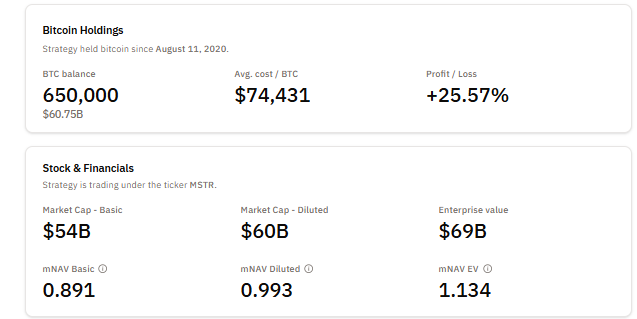
Strategy’s stock trades under the ticker MSTR, with a basic market capitalization of about $54 billion and an enterprise value near $69 billion.
Market net asset value metrics show the stock trading close to the value of its Bitcoin holdings. Basic mNAV stands at 0.892, diluted mNAV at 0.994, and enterprise-value mNAV at 1.136, reflecting the effect of debt and preferred obligations.
Falling Shares Put Strategy’s Bitcoin Treasury Model Under the Microscope
CEO Phong Le has said the company would only consider selling Bitcoin if its shares fall below net asset value and access to new financing dries up.
He described such sales as a last resort to protect what he calls “Bitcoin yield per share,” stressing that selling would occur only if issuing new equity became more dilutive than reducing holdings.
Strategy’s annual fixed obligations tied to preferred shares are estimated at $750 million to $800 million. Le said the new dollar reserve currently covers about 21 months of dividends.
Founder and Executive Chairman Michael Saylor described the reserve as the next stage in Strategy’s evolution as a Bitcoin-focused treasury company, positioning it to navigate market volatility while maintaining its long-term digital-asset strategy.
To reassure investors, the company recently launched a “BTC Credit” dashboard, stating that it has sufficient dividend coverage even if Bitcoin prices remain flat for extended periods.
Strategy also said its debt remains well-covered if Bitcoin falls to its average cost of roughly $74,000 and remains manageable even at $25,000.
The reserve strategy has drawn mixed reactions from the market. Bitcoin critic Peter Schiff argued that the shift shows the company is being forced to sell stock to buy dollars rather than Bitcoin in order to meet its obligations.
Today is the beginning of the end of $MSTR. Saylor was forced to sell stock not to buy Bitcoin, but to buy U.S. dollars merely to fund MSTR's interest and dividend obligations. The stock is broken. The business model is a fraud, and @Saylor is the biggest con man on Wall Street.
Strategy’s share price has fallen more than 60% from recent highs even as Bitcoin has traded between $95,000 and $110,000 in late 2025, adding to investor scrutiny of the model.
Strategy’s stance is also being watched by index providers. MSCI is currently reviewing how companies with large digital-asset treasuries should be treated in major equity indexes.
Any change in classification could force benchmark-tracking funds to rebalance, adding another layer of volatility to a stock that already trades with a high Bitcoin beta.
Home Assistant is, in my opinion, the best smart home software available. It's free, open-source, privacy-focused, works with a huge number of devices, and can make your smart home do almost anything you can think of. Despite all that, Home Assistant definitely has its faor share of problems.
XRP price is edging towards a key support level as short positioning grows and on-chain activity rises. XRP traded at $2.13 at press time after slipping 1.3% in the past day, extending a week of steady weakness that pushed it…
If you exclude certain companies like Peloton, the world of cycling technology is surprisingly open. It’s not perfect by any means, but there are enough open or open-ish standards for many different pieces of technology from different brands to interoperate with each other, from sensors and bike computers and even indoor trainers to some extent. This has also made it possible for open source software to exist in this realm as well, and the GoldenCheetah project has jumped in for all of us who value FOSS and also like to ride various bicycles from time to time.
GoldenCheetah focuses on gathering data from power meters, allowing cyclists to record their rides and save them in order to keep track of their training performance over time. It works well with sensors that use the ANT+ protocol, and once it has that data it can provide advanced analytics such as power curves, critical power modeling, and detailed charts for power, heart rate, and cadence. It can display and record live indoor-training data, and in some situations it can even run interval workouts, although not every indoor trainer is supported. There are no social features, subscriptions, or cloud requirements which can be refreshing in the modern world, but is a bit of a downside if you’re used to riding with your friends in something like Zwift.
All in all, though, it’s an impressive bit of software that encourages at least one realm of consumer electronics to stay more open, especially if those using bike sensors, computers, and trainers pick ones that are more open and avoid those that are proprietary, even if they don’t plan to use GoldenCheetah exclusively. And if you were wondering about the ANT+ protocol mentioned earlier, it’s actually used for many more things that just intra-bike wireless communications.
Home Assistant is closing out the year with its 2025.12 release, bringing major quality of life improvements, an overhaul to automation building, and a new area for testing preview features. There's a lot here to give you more intuitive control over your smart homes.
Home Assistant is a free, open-source, and independent smart home platform, but did you know there’s a company called Nabu Casa chipping in behind the scenes? If you want to pay to make remote access and cloud backup as easy as possible, that’s where your money goes.
The team behind Home Assistant is best known for its incredible free and open-source smart home software, but the same team has also produced some hardware products. Nabu Casa, the commercial company set up by the creators of Home Assistant, currently sells a handful of products, including a dedicated Home Assistant hub and a prototype of a local smart speaker.
There are lots of switches that you can use with your smarthome. Some might not be compatible with the wiring in your house, while others are battery powered and need attention on the regular. [Willow Herring] came across some nice self-powered versions that were nonetheless locked to a proprietary hub. Reverse engineering ensued!
[Willow] was using a range of smart home products from Quinetic, including the aforementioned self-powered switches. However, she couldn’t stand using them with the Quinetic hub, which was required to get them functioning with the brand’s relays and in-line switch relays. It all came down to the buggy smartphone app that was supposed to lace everything together, but never worked quite right. Instead, she set about deciphering the language the switches speak so they could be paired with other smarthome systems.
[Cameron Gray] had done some work in this area, which proved a useful starting point, though it didn’t enable the use of the switches with the various types of Quinetic relays. [Willow] decided to try and learn more about the system, starting with a CC1101 radio module hooked up to a ESP8266. Some tinkering around with expected message lengths started bearing fruit, and soon enough the format of the messages became clear.
Before long, [Willow] had figured out how to get the whole system talking to MQTT and Home Assistant, without compromising their ability to operate independently. Code is on Github for those eager to tinker further.
With the crypto market turning increasingly bearish, Bitcoin’s price has experienced another pullback, bringing it closer to the $80,000 mark once again. Along with the current drop in price, BTC’s derivatives market is showcasing bearish performance, suffering one of its steepest declines of the ongoing cycle.
Mass Derivative Unwind For Bitcoin
In a volatile landscape, Bitcoin’s Open Interest (OI) has contracted sharply as though the speculative framework supporting the market were suddenly removed. This steep drop in open interest comes after a sudden pullback in the price of BTC, causing it to lose the previously reclaimed $91,000 mark.
A report from Darkfost, a market expert and author at CryptoQuant, shows that the open interest has been sliced in half, indicating a drastic shift in investors’ sentiment and behavior. With a massive portion of leverage being evaporated, the market now stands unusually silent, while it prepares for its next decisive trigger.
Darkfost highlighted that Bitcoin leveraged positions continue to get liquidated or are being intentionally closed. Despite the recent drop in BTC’s price, this period of uncertainty is not bolstering traders’ enthusiasm to increase their exposure to risk.
Currently, the market is exhibiting a risk-off attitude, a trend that is understandable given the current state of the crypto environment. As a result, the open interest of BTC has cleared a whopping $20 billion. Data shared by the expert shows that the key metric fell from 47.5 billion BTC to 28.35 billion BTC between October 6 and December, indicating a drop of half during the period.
According to the expert, this is the worst flush in both the current cycle and the history of Bitcoin since the availability of the derivatives market. “I continue to say that the derivatives market has a major impact on Bitcoin and is the number one driver,” Darkfost stated.
BTC Percentage Loss Hits Historic Level
As the Bitcoin price continues to pull back, short-term BTC holders are feeling the weight of the waning action. These holders, also referred to as retail investors, have realized substantial losses from their positions.
Darkfost’s research is based solely on the spot market. His objective is to identify a very particular group of investors who speculate over the short term. With a realized price of $113,692, BTC holders between 1 month and 3 months are now experiencing the largest percentage loss in the ongoing market cycle.
For the past two weeks, this group of investors has been holding average unrealized losses between 20% and 25%. During his cycle, these phases have been linked with the creation of a bottom. This is because the cohort often has to decide between two behaviors: selling or holding.
In the event that a large portion of these traders are capitulating, this is typically the moment when the opportunity to accumulate BTC becomes more interesting, as observed in recent weeks. However, this setup becomes valid if the bullish trend remains intact in the long term, which Darkfost expresses trust in for the meantime.
Christmas shouldn’t be stressful, but here we are, only a few weeks out and already wondering where the rest of the year went. This year, why not give yourself the gift of a smarter home?

 Login
Login