A prominent Cardano supporter just warned the community that the layer-2 scaling solution Hydra may not be as safe as they think. Are investors’ funds at risk, and does this justify a bearish Cardano price prediction?
If you want to use Hydra, you trust the operators of Hydra Head.
You are only in control of your funds if you are one of the Hydra Head operators.
When you lock ADA into a Hydra Head, you sign a transaction with your private key. The transaction sends ADA into an on-chain… pic.twitter.com/hbh78guPLY
In a lengthy X post, a pseudonymous user named YODA, known for his support of the Cardano network for years, highlighted a potential flaw in the design of Hydra. This technical weakness would supposedly allow node operators to have a say on what happens with users’ tokens.
He clarified that the funds locked up in the L2 and delegated to third-party Hydra Heads (validators) are fully in control of the latter, not the owner.
In theory, if Hydra Heads collude and introduce false transactions, they would be able to sign them without necessarily having access to the private keys of the original owner of the ADA tokens.
“Every update requires signatures from all Hydra Head operators. Those signatures are made using the private keys of the operators, not the users,” YODA emphasized.
He added: “If they collude, they can ALL sign a malicious snapshot that splits all the funds between them.”
Cardano Price Prediction: ADA Finds Support at $0.40 But Bearish Trend Persists
Aside from Dogecoin (DOGE), Cardano (ADA) has been one of the worst-performing top 10 tokens this year, with total losses now reaching 49%.
The daily chart shows that the token has found support temporarily at $0.40.
However, ADA has been on a strong downtrend and is not yet showing signs of a trend reversal. The price needs to climb above $0.52 to reverse this downtrend.
Otherwise, ADA may face a much more dramatic correction to $0.32, meaning a total downside risk of 25%.
Well-established tokens like ADA have struggled to reach higher highs during this cycle. However, a new crypto presale called Maxi Doge ($MAXI) has managed to raise over $4 million in just a few weeks to launch its community-centered meme coin.
Maxi Doge ($MAXI) is The New Dogecoin-Themed Meme Coin
Maxi Doge ($MAXI) is an Ethereum meme coin that aims to bring together an army of like-minded ‘degens’ who are not afraid to make YOLO trades to get out of mom’s basement.
Through fun competitions like Maxi Gains and Maxi Ripped, token holders will compete by showcasing their highest-yielding traders to earn rewards and bragging rights.
They also get exclusive access to a hub through which they can share ideas, insights, setups, and more.
This is a vibrant community that fully embraces the energy that comes with bull markets.
Finally, up to 25% of the presale’s proceeds will be used to invest in high-potential projects.
The gains will be used to fund the project’s marketing efforts to make $MAXI known.
VTB, Russia’s second-largest bank, has told clients it plans to let them buy and sell real cryptocurrencies through its brokerage service, with a target rollout in 2026 pending regulator approval.
According to the bank, the move would go beyond the derivative products that most Russian banks have offered so far. It is a clear shift toward opening traditional finance to digital assets, at least for now among wealthy clients.
Client Eligibility And Timetable
Reports have disclosed that VTB intends to begin with high-net-worth customers only. The bank set thresholds for its initial offering: clients with assets above $1.3 million or annual income over $649,000 would be eligible at first.
Andrey Yatskov, who heads VTB’s brokerage arm, said there is “sharp demand” from clients for access to actual crypto, not just paper products tied to token prices. The bank has picked 2026 as the planned start year, but it made that clear the launch depends on regulators signing off.
Real Crypto, Not Just Contracts
Based on reports, the service would allow ownership of the underlying coins — not merely derivative contracts or token-linked notes. That is a significant distinction in Russia, where until recently banks were limited to offering exposure through derivative instruments.
Allowing customers to hold coins directly would require legal and compliance work, from custody arrangements to anti-money-laundering controls. Those steps are on the critical path before any retail expansion can happen.
Potential Market Signals
VTB has also given investors a sense of how it views crypto as an asset class. The bank recommended a 7% allocation to crypto for some investor profiles, and its internal forecasts have mentioned medium-term Bitcoin price targets in the $200,000–$250,000 range under favorable conditions.
If VTB moves forward, it could be the first major Russian bank to operate in this way — a signal that some parts of the financial sector see token ownership as something to be offered through mainstream channels.
Regulatory Hurdles And Geopolitics
The plan is not risk free. Russian regulation of crypto is still evolving, and any permit to offer direct trading will require approval from the relevant authorities. Sanctions and other geopolitical pressures could alter timelines or force changes to how the service is structured.
Compliance teams will need to reconcile domestic rules with international restrictions that affect many big banks operating in or dealing with Russia.
For now, the rollout remains conditional. VTB’s timeline, client criteria, and product design all hinge on legal clarifications and regulator consent. Market participants and clients will likely follow announcements from the Bank of Russia and other agencies to judge how soon broader access might come.
Featured image from Pexels, chart from TradingView
Meta Platforms Inc. shares climbed after reports that the company is weighing deep reductions to the budget behind its metaverse projects. Investors pushed the stock higher as traders reacted to the possibility that one of the company’s most costly bets could be scaled back.
Metaverse Budget Faces A Major Trim
Based on reports from Bloomberg and Reuters, Meta is considering cuts of up to 30% to the unit that builds its virtual reality and metaverse products, a move tied to planning for the company’s 2026 budget. The change would mainly affect Reality Labs, the division that makes Quest headsets and Horizon virtual spaces.
Reality Labs Has Been Losing Billions
Reality Labs has posted heavy losses since 2020. Reports put the total at more than $60 billion and, by some counts, closer to $70 billion in cumulative losses over recent years. Those sums have kept pressure on management to rethink where the company puts its money.
Investors Reward A Smaller Bet
The market response was swift. Meta’s share price jumped roughly 4%, and some outlets calculated that the move added about $69 billion to the company’s market value as traders reacted positively to a pullback from costly metaverse spending. That reaction signals investors prefer money steered toward projects with clearer near-term returns.
Layoffs Could Follow Early Next Year
Reports have warned that the cuts could bring staff reductions inside Reality Labs, with layoffs possibly starting as early as January 2026. Company leaders reportedly discussed budget scenarios during recent planning meetings. Any job cuts would mark a sharp change after years of heavy investment in virtual reality and related software.
A Bigger Push Toward AI And Wearables
At the same time, Meta has been moving money into artificial intelligence and related hardware. The company finalized a multibillion-dollar deal this year to take a large stake in Scale AI — a pact reported at roughly $14 billion for a near-half ownership — and then hired talent from that startup to help run a new AI effort. That tradeoff shows where Meta’s priorities now lie.
What This Means For Users And Competitors
For people who own or use Meta’s VR gear, this does not mean every project will end. But several initiatives could see slower progress and smaller teams. For rivals and suppliers in the AR/VR space, the cut may reshape who wins short-term device and platform business.
Analysts say the move narrows one major uncertainty for Meta while opening another: how well the company can compete in AI after so many dollars flowed into virtual worlds.
Featured image from Unsplash, chart from TradingView
U.S. and Canadian cybersecurity agencies say Chinese-linked actors deployed "Brickstorm" malware to infiltrate critical infrastructure and maintain long-term access for potential sabotage. Reuters reports: The Chinese-linked hacking operations are the latest example of Chinese hackers targeting critical infrastructure, infiltrating sensitive networks and "embedding themselves to enable long-term access, disruption, and potential sabotage," Madhu Gottumukkala, the acting director of the Cybersecurity and Infrastructure Security Agency, said in an advisory signed by CISA, the National Security Agency and the Canadian Centre for Cyber Security. According to the advisory, which was published alongside a more detailed malware analysis report (PDF), the state-backed hackers are using malware known as "Brickstorm" to target multiple government services and information technology entities. Once inside victim networks, the hackers can steal login credentials and other sensitive information and potentially take full control of targeted computers.
In one case, the attackers used Brickstorm to penetrate a company in April 2024 and maintained access through at least September 3, 2025, according to the advisory. CISA Executive Assistant Director for Cybersecurity Nick Andersen declined to share details about the total number of government organizations targeted or specifics around what the hackers did once they penetrated their targets during a call with reporters on Thursday. The advisory and malware analysis reports are based on eight Brickstorm samples obtained from targeted organizations, according to CISA. The hackers are deploying the malware against VMware vSphere, a product sold by Broadcom's VMware to create and manage virtual machines within networks. [...] In addition to traditional espionage, the hackers in those cases likely also used the operations to develop new, previously unknown vulnerabilities and establish pivot points to broader access to more victims, Google said at the time.
Bitcoin is currently holding the fort above $91k after a prolonged downturn sent the world’s favourite crypto down to a seven-month low of $82,000 by November 21, not long after Bitcoin notched a new all-time high (ATH) of $126,080 on October 6.
The wider crypto market jumped 6% yesterday, lifting total capitalization to about $3.24 trillion. Today, momentum has cooled with a near 2% drop to $3.18 trillion. Bulls remain optimistic that this pause is consolidation, not capitulation.
Additionally, with crypto entering maturity, Bitcoin dominance is generally falling, indicating that the next substantial bull market may well be powered by altcoins. With that in mind, here’s why XRP, Solana, and Pepe are the best crypto to buy right now.
XRP ($XRP): Transforming Global Cross-Border Payments
Ripple’s XRP ($XRP) continues to dominate the international value-transfer niche thanks to its fast settlement speeds and minimal fees. The XRP Ledger (XRPL) serves as Ripple’s answer to slow, expensive legacy systems like SWIFT.
Major institutions, including the UN Capital Development Fund and U.S. government agencies, have highlighted the XRPL’s utility, while Ripple’s expanding network of fintech partners has helped XRP secure its position as the third-largest non-stablecoin, now capitalizing over $124 billion.
Ripple’s rollout of RLUSD, a dollar-backed stablecoin, marks a strategic move to capture the next generation of global payments infrastructure. Every RLUSD transaction burns a small amount of XRP, gradually reducing supply and reinforcing XRP’s long-term value proposition.
Following the resolution of its five-year legal battle with the SEC, XRP rallied to a July high of $3.65. Its current price near $2.09 represents a 43% retracement, but indicators suggest resilience. Furthermore, the relative strength index (RSI) sits at 36, indicating the token is likely to conclude today’s -2.8% selloff over the weekend and swing back into green.
The recent introduction of nine U.S.-based XRP ETFs is expected to accelerate institutional inflows throughout the holiday season. Additional ETF approvals may follow, and if Congress successfully passes comprehensive crypto legislation before year-end, XRP could target $15 or more by 2026.
Solana (SOL): The Speed Leader Closing In on a Potential $1,200 Target
Solana ($SOL) has cemented itself as a top-tier smart-contract network, prized for its lightning-fast transactions and low fees. With a market cap surpassing $76 billion and almost $9 billion in total value locked across its DeFi protocols, Solana remains Ethereum’s most formidable competitor.
New Solana spot ETFs from Grayscale and Bitwise, launched late last month, could open the door to significant capital inflows, echoing earlier institutional waves that propelled Bitcoin and Ethereum to new heights.
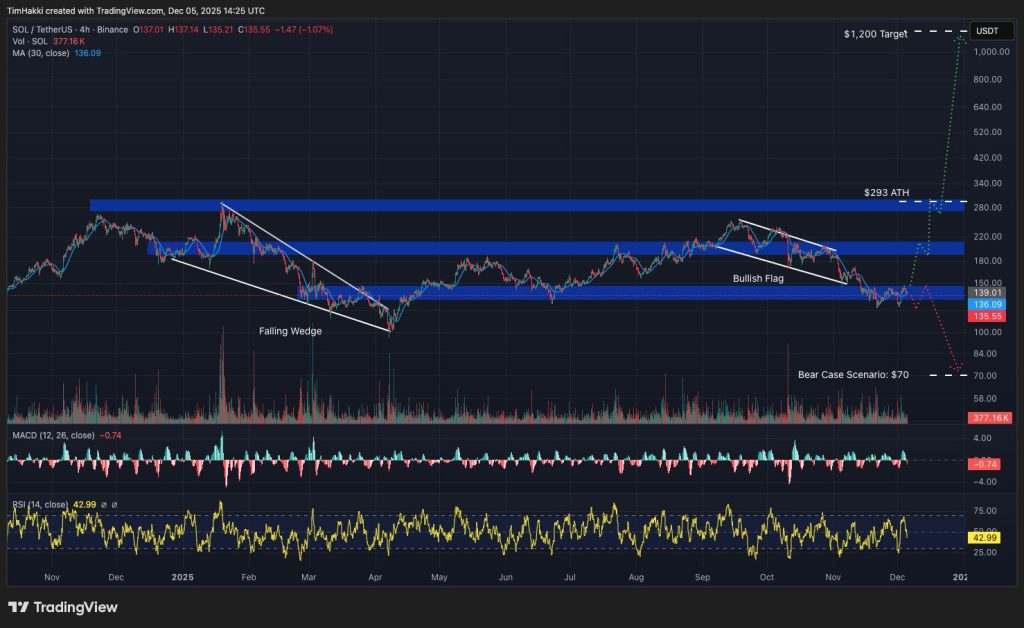
After dipping near $100 earlier this year, SOL now trades around $136, holding firm at a critical support zone. A bullish flag pattern has taken shape since mid-September, signaling a potential breakout.
The next major resistance sits near $250; a decisive move above that level could propel SOL beyond its prior ATH of $293.31, with a 4x up to $1,200 emerging as an ambitious yet attainable stretch target if the festive season turns into a bull market.
At the same time, Solana has become a leading hub for Real World Asset (RWA) tokenization, with giants like BlackRock and Franklin Templeton choosing the network to deploy tokenized financial products.
Pepe (PEPE): The Internet’s Favorite Frog Prepares for a Potential Upswing
Launched in April 2023, Pepe ($PEPE) quickly rose through the meme-token ranks, capitalizing on the global popularity of Matt Furie’s iconic character. Now boasting a market cap above $1.9 billion, PEPE enjoys an unmatched cultural presence, amplified when Elon Musk briefly switched his X profile picture to a Pepe meme, fueling speculation about his meme coin interests. Musk is publicly known to hold Bitcoin and Dogecoin.
Currently priced near $0.000004554, PEPE sits roughly 84% below its late-2024 high of $0.00002803 after a quiet summer and subdued fourth quarter.
Its RSI is now around 45, which indicates the token is neither overbought nor oversold and has plenty of headroom for further gains over the weekend.
With the token hovering near its lowest valuation in nearly two years, PEPE offers traders a high-upside entry point ahead of the next major market run. Clearer U.S. regulatory guidance could revive risk appetite and fuel a meme coin gold rush, potentially giving PEPE the momentum to retest its all-time high before year-end.
Bitcoin Hyper (HYPER): A Meme-Powered Bitcoin Layer-2 Built for 2026 and Beyond
One emerging project generating buzz ahead of 2026 is Bitcoin Hyper ($HYPER), a Bitcoin layer-2 solution wrapped in meme-culture branding. Despite its playful façade, HYPER targets real technical improvements with high-speed throughput, ultra-low fees, and smart-contract functionality.
Developed using the Solana Virtual Machine (SVM), HYPER features decentralized governance and a Canonical Bridge designed for seamless Bitcoin movement across multiple chains.
The presale has already raised around $29 million, and prominent analyst Borch Crypto forecasts the token could surge up to 100× upon exchange listing.
A recent Coinsult audit revealed zero contract vulnerabilities, boosting investor confidence. HYPER tokens power transaction fees, governance, and staking, with presale users able to earn up to 40% APY.
With the project’s full platform release planned for 2026, both seasoned Bitcoin users and newcomers have the chance to position themselves early in what may evolve into a major enhancement of Bitcoin’s utility landscape.
Poland’s efforts to align its crypto market with the European Union’s Markets in Crypto-Assets framework have hit a major political roadblock after lawmakers failed to override a presidential veto on a sweeping digital-asset bill.
This leaves the country as the last EU member without a national MiCA-style regime.
According to a Bloomberg report, the vote was held in the lower house of parliament on Friday, falling short of the three-fifths majority required to overturn President Karol Nawrocki’s decision to reject the legislation.
The outcome halts Prime Minister Donald Tusk’s push to place Poland’s crypto sector under tight regulatory control and forces the government to restart the legislative process from scratch.
Tusk Flags Crypto as National Security Threat Amid Russia Sabotage Claims
Tusk had framed the bill as a national security measure in the days leading up to the vote.
Addressing parliament, he said the unregulated crypto market had become a conduit for money laundering and foreign interference, including activity linked to Russia and Belarus.
He told lawmakers that Polish authorities had identified “several hundred” foreign entities operating in the domestic crypto market and warned that Russian intelligence and organized crime groups were exploiting digital assets for covert financing.
Government officials have tied those concerns to recent security incidents.
Last month, Warsaw blamed Russia for a blast on a key railway route used for supply traffic to Ukraine, an allegation Moscow dismissed.
Russia is using cryptocurrencies to pay saboteurs carrying out hybrid attacks across the European Union, according to a Polish security official. #Russia#Cryptohttps://t.co/MsOjIZjSfu
The blocked law would have implemented MiCA-style rules in Poland, introducing licensing for crypto-asset service providers, investor protection standards, stablecoin reserve requirements, market abuse bans, and strict anti-money laundering controls.
It also proposed granting authorities the power to block crypto-related websites through administrative orders, a provision the president described as opaque and vulnerable to abuse.
Political Tensions Rise After Poland Blocks Sweeping Crypto Oversight Bill
Nawrocki also criticized the scale of the bill, which exceeded 100 pages, contrasting it with far shorter implementing laws in neighboring Czechia and Slovakia.
He warned that heavy supervisory fees and added domestic restrictions would drive Polish crypto firms to register in other EU countries, costing Poland tax revenue and talent.
His chief of staff, Zbigniew Bogucki, said on Friday that the president is open to regulation as long as future proposals are not excessively restrictive.
The failure to override the veto leaves crypto companies operating in Poland without a clear national legal framework ahead of the EU’s July 1, 2026, MiCA compliance deadline.
The political dispute has increasingly drawn in industry players.
Nawrocki has portrayed himself as a defender of the crypto sector and was endorsed before his election by Kristi Noem, a senior U.S. official, at a conference in southeast Poland sponsored by trading platform Zondacrypto.
Poland has elected Karol Nawrocki, a conservative who says crypto should be “born in freedom, not buried in red tape.”#poland#cryptohttps://t.co/BVJXhQBnrK
The exchange later stated that it accepts no Russian clients and fully complies with anti-money laundering rules.
Foreign Minister Radosław Sikorski added another dimension to the dispute on Friday, saying on radio RMF FM that the crypto industry sponsors figures across the right wing of Polish politics, explaining the sharp resistance to tighter oversight.
America’s AI Action Plan outlines a comprehensive strategy for the country’s leadership in AI. The plan seeks, in part, to accelerate AI adoption in the federal government. However, there is a gap in that vision: agencies have been slow to adopt AI tools to better serve the public. The biggest barrier to adopting and scaling trustworthy AI isn’t policy or compute power — it’s the foundation beneath the surface. How agencies store, access and govern their records will determine whether AI succeeds or stalls. Those records aren’t just for retention purposes; they are the fuel AI models need to power operational efficiencies through streamlined workflows and uncover mission insights that enable timely, accurate decisions. Without robust digitalization and data governance, federal records cannot serve as the reliable fuel AI models need to drive innovation.
Before AI adoption can take hold, agencies must do something far less glamorous but absolutely essential: modernize their records. Many still need to automate records management, beginning with opening archival boxes, assessing what is inside, and deciding what is worth keeping. This essential process transforms inaccessible, unstructured records into structured, connected datasets that AI models can actually use. Without it, agencies are not just delaying AI adoption, they’re building on a poor foundation that will collapse under the weight of daily mission demands.
If you do not know the contents of the box, how confident can you be that the records aren’t crucial to automating a process with AI? In AI terms, if you enlist the help of a model like OpenAI, the results will only be as good as the digitized data behind it. The greater the knowledge base, the faster AI can be adopted and scaled to positively impact public service. Here is where agencies can start preparing their records — their knowledge base — to lay a defensible foundation for AI adoption.
Step 1: Inventory and prioritize what you already have
Many agencies are sitting on decades’ worth of records, housed in a mix of storage boxes, shared drives, aging databases, and under-governed digital repositories. These records often lack consistent metadata, classification tags or digital traceability, making them difficult to find, harder to govern, and nearly impossible to automate.
This fragmentation is not new. According to NARA’s 2023 FEREM report, only 61% of agencies were rated as low-risk in their management of electronic records — indicating that many still face gaps in easily accessible records, digitalization and data governance. This leaves thousands of unstructured repositories vulnerable to security risks and unable to be fed into an AI model. A comprehensive inventory allows agencies to see what they have, determine what is mission-critical, and prioritize records cleanup. Not everything needs to be digitalized. But everything needs to be accounted for. This early triage is what ensures digitalization, automation and analytics are focused on the right things, maximizing return while minimizing risk.
Without this step, agencies risk building powerful AI models on unreliable data, a setup that undermines outcomes and invites compliance pitfalls.
Step 2: Make digitalization the bedrock of modernization
One of the biggest misconceptions around modernization is that digitalization is a tactical compliance task with limited strategic value. In reality, digitalization is what turns idle content into usable data. It’s the on-ramp to AI driven automation across the agency, including one-click records management and data-driven policymaking.
By focusing on high-impact records — those that intersect with mission-critical workflows, the Freedom of Information Act, cybersecurity enforcement or policy enforcement — agencies can start to build a foundation that’s not just compliant, but future-ready. These records form the connective tissue between systems, workforce, data and decisions.
The Government Accountability Office estimates that up to 80% of federal IT budgets are still spent maintaining legacy systems. Resources that, if reallocated, could help fund strategic digitalization and unlock real efficiency gains. The opportunity cost of delay is increasing exponentially everyday.
Step 3: Align records governance with AI strategy
Modern AI adoption isn’t just about models and computation; it’s about trust, traceability, and compliance. That’s why strong information governance is essential.
Agencies moving fastest on AI are pairing records management modernization with evolving governance frameworks, synchronizing classification structures, retention schedules and access controls with broader digital strategies. The Office of Management and Budget’s 2025 AI Risk Management guidance is clear: explainability, reliability and auditability must be built in from the start.
When AI deployment evolves in step with a diligent records management program centered on data governance, agencies are better positioned to accelerate innovation, build public trust, and avoid costly rework. For example, labeling records with standardized metadata from the outset enables rapid, digital retrieval during audits or investigations, a need that’s only increasing as AI use expands. This alignment is critical as agencies adopt FedRAMP Moderate-certified platforms to run sensitive workloads and meet compliance requirements. These platforms raise the baseline for performance and security, but they only matter if the data moving through them is usable, well-governed and reliable.
Infrastructure integrity: The hidden foundation of AI
Strengthening the digital backbone is only half of the modernization equation. Agencies must also ensure the physical infrastructure supporting their systems can withstand growing operational, environmental, and cybersecurity demands.
Colocation data centers play a critical role in this continuity — offering secure, federally compliant environments that safeguard sensitive data and maintain uptime for mission-critical systems. These facilities provide the stability, scalability and redundancy needed to sustain AI-driven workloads, bridging the gap between digital transformation and operational resilience.
By pairing strong information governance with resilient colocation infrastructure, agencies can create a true foundation for AI, one that ensures innovation isn’t just possible, but sustainable in even the most complex mission environments.
Melissa Carson is general manager for Iron Mountain Government Solutions.
Digital information travels through fiber optic cables through the network and data servers behind glass panels in the server room of the data center. High speed digital lines 3d illustration
[Rick] had a problem. His garage refrigerator was tasked with a critical duty—keeping refreshing beverages at low temperature. Unfortunately, it had failed—the condenser was forever running, or not running at all. The beverages were either frozen, or lukewarm, regardless of the thermostat setting. There was nothing for it—the controller had to be rebuilt from scratch.
Thankfully, [Rick]’s junk drawer was obliging. He was able to find an Arduino Uno R4, complete with WiFi connectivity courtesy of the ESP32 microcontroller onboard. This was paired with a DHT11 sensor, which provided temperature and humidity measurements. [Rick] began testing the hardware by spitting out temperature readings on the Uno’s LED matrix.
Once that was working, the microcontroller had to be given control over the fridge itself. This was achieved by programming it to activate a Kasa brand smart plug, which could switch mains power to the fridge as needed. The Uno simply emulated the action of the Kasa phone app to switch the smart plug on and off to control the fridge’s temperature, with the fridge essentially running flat out whenever it was switched on. The Uno also logs temperature to a server so [Rick] can make sure temperatures remain in the proper range.
With the crypto market showing signs of recovery, both the XRP and Solana Exchange Traded Funds (ETFs) have attracted significant investor interest. The rivalry among major crypto ETFs has intensified, with XRP taking the spotlight amid its consistent surge in daily inflows and the Solana ETF recording significant outflows.
Solana ETFs See Largest Outflow Yet
Solana has entered a surprising phase of turbulence as its recently launched US Spot ETF struggles to maintain momentum after weeks of inflows. The latest data from Sosovalue reveal a sizable setback with a fresh withdrawal of $32.19 million, marking the third and largest outflow recorded since the investment product debuted in late October 2025.
The outflow, registered on December 3, came as a major surprise, especially given that the broader crypto market had been enjoying a slight reprieve from the bearishness weighing it down. Notably, Sosovalue’s data shows that the entire Solana ETF outflow originated from the 21Shares TSOL offering, which shed $41.79 million in a single session. Minor inflows into the remaining six Solana ETFs had softened the blow, reducing total outflow to $32.19.
Since the launch of Solana ETFs, TSOL has been responsible for all negative flows posted, including the $13.55 million pullback on December 1 and the $8.10 million decline in late November. Across all sessions, 21Shares Solana ETF has now seen total outflows reach $101.51 million.
The weakness in TSOL stands in sharp contrast to Bitwise’s Solana ETF, BSOL. BSOL continues to outpace other investment products, with impressive cumulative inflows of $580.72 million, making it the most successful Solana ETF. Grayscale’s GSOL follows at a distant $89.01 million. Overall, the net cumulative inflows for the Solana ETF have reached $623.21 million. While this is impressive, it is still significantly behind the XRP ETF.
XRP Overtakes Solana ETF As It Nears $1 Billion Inflows
The latest on-chain numbers show the XRP ETF pulling ahead of the Solana ETF with surprising speed and volume. Analyst Neil Tolbert highlighted the rise in XRP ETF inflow this week, noting that growing institutional interest indicates the trend is only getting started. With more XRP ETFs expected to debut soon, Tolbert anticipates a significant rise in demand and inflows as traditional finance finally wakes up.
Five Spot XRP ETFs collectively hold more than $984 million in assets, with less than $16 million to reach the $1 billion inflow milestone. Canary Capital’s XRPC leads with $358.88 million, followed by Grayscale’s GXRP, Bitwise’s ETF, Franklin Templeton’s XRPZ, and finally REX-Osprey’s XRPR.
According to SosoValue, the total XRP ETFs, excluding that of REX-Osprey, have attracted approximately $887.12 million in net cumulative inflows. Since its launch in November, the XRP ETF has recorded 15 days of positive inflows, in stark contrast to Solana ETFs, which have seen multiple outflows.
Despite Solana launching seven ETFs as early as October 2025 and XRP only introducing four last month, XRP ETFs have already surpassed Solana ETFs in total inflows by almost 30%. With fewer products and a later debut, XRP has emerged as the clear winner amongst the newest ETF entrants in 2025.
Chinese-sponsored groups are using the popular Brickstorm backdoor to access and gain persistence in government and tech firm networks, part of the ongoing effort by the PRC to establish long-term footholds in agency and critical infrastructure IT environments, according to a report by U.S. and Canadian security offices.
Here's some good news for the "Han shot first" crowd. The original cut of Star Wars (1977), the film known today as A New Hope, is coming back to theaters. We first learned in August that some version of the film would be screened again in 2027 for its 50th anniversary. But we know now this will indeed be the version everyone saw before George Lucas made those questionable, CGI-heavy changes in the 1997 Special Editions. The re-release arrives in theaters on February 19, 2027.
In a short update posted Friday on the official Star Wars website, Lucasfilm all but clarified that this will be the original cut. It described it as "a newly restored version of the classic Star Wars (1977) theatrical release." Gizmodoreported that it received further clarification that this will indeed be the OG one, before those "improvements” in the Special Edition (and subsequent re-releases).
Han Solo (Harrison Ford), Princess Leia (Carrie Fisher) and Luke Skywalker (Mark Hamill) in a scene from Star Wars: A New Hope.
Disney Plus
Those mid-'90s edits included early CGI effects that essentially served as a testing ground before Lucas moved on to the Prequel Trilogy. It also added a CG Jabba the Hutt / Han Solo scene (originally shot with actor Thomas Declan Mulholland as Jabba) that was cut from the original version.
Perhaps most infamously, Lucas made Greedo shoot first at Han in the canteen scene. Hardcore fans hated the change. It smoothed some of the rough edges of Han's start. It gave him a shorter, less dramatic journey into the reluctant hero he grew into as the story progressed. It's as if Lucas was signaling, "Okay, Han may have started as kind of a jerk, but he wouldn't shoot a bounty hunter in cold blood! Think of the children watching!"
But in my view, Return of the Jedi had the worst changes in 1997 and later. Although I didn't mind the new celebration music and location montage at the end (others disagree), it also added that cringey and out-of-place musical number in Jabba's palace. But I despised the change Lucas made for the film’s 2011 Blu-ray release: Darth Vader's overly telegraphed "Nooooooo…" as he makes the climactic decision to chuck the Emperor into the Death Star's reactor shaft. C’mon, George: It’s so more powerful for the audience to project Vader’s thought process onto his silent helmet. But if Disney sticks with the 50th Anniversary scheme, we'll have to wait until 2033 to see the untainted version of that movie in theaters again.
This article originally appeared on Engadget at https://www.engadget.com/entertainment/the-1977-cut-of-star-wars-will-return-to-theaters-in-2027-221113091.html?src=rss
The $83 billion deal gives the streamer a century’s worth of prestige television and movies, from Batman movies to Game of Thrones. It also ends the streaming wars.

 Login
Login